


EXPLORE ISSUES



‘We will never grow old, he tells her. And our love will never die.’
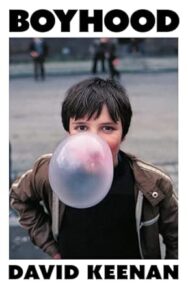
Boyhood, David Keenan’s latest novel, opens in 1979 with the abduction of a young boy outside a Glasgow football ground. Nine years later, the boy’s brother, Aaron Murray, meets a new friend, The Precious Gift, who takes Aaron, through dreams and visions, to Ireland in the 70s, Paris during World War Two, and 1980s Mexico. It is a tale of love, violence, art, beauty and inheritance. These extracts focus on Aaron’s relationships with his parents and the way memory both sustains and wounds him.
Boyhood
By David Keenan
Published by White Rabbit
9
The first words that Aaron’s dad Donald Murray forgot, the first words that slipped through the slow-widening hole in his head, were ‘crowbar’ (he used the word ‘jackdaw’ instead) and ‘geraniums’. I know what I’m trying to say, his dad would say, pointing to the potted flowers that lined the windows of the extension at the back of their house, its fogged-up windows with blackbirds skipping past, the colour of autumn in the air, their warm, safe house whose name was Tara, in Mount Vernon, where Aaron grew up, and the abandoned sandpit next to it. It’s just that the words have gone missing, he would say. Now hand me that jackdaw. Then: Nephew. Illiterate. Incline. Insole. Then: Son. Brother. Then: Nemo. In dreams Aaron is walking backwards to return these words to his father. He is walking backwards in order to piece him back together. His father’s hand is shaking as he drinks soup from a flask and the hot soup runs down his chin. And now his short grey beard is dyed orange. On the bench in the Botanic Gardens, Aaron wants to ask him if he remembers. But memory now is a taunt, a goad, and he’s better off out of it. Then his father says: Aaron was just a little boy. And Aaron says to him, but I’m Aaron, you mean Nemo. And all his father says is, yes. Yes, he was only a little boy. And now Nemo is come back to them. An angel touched Aaron on the head when he was born, his father says to him, and he nods, to himself, and still, it is Nemo, come back to them once more.
10
Between Aaron and his mum Elizabeth, it was T. Rex that was their bond. Or anything to do with Marc Bolan, really. They collected Bolan records and memorabilia as their hobby together and in the summer of 1984 the two of them took the bus to London and stayed in a hotel on Kensington High Street where they shared a room with two single beds. In the morning, they walked to Notting Hill Gate in the sunshine, to shop for Marc Bolan records at the Music & Video Exchange there. When they arrived, the Exchange had only just opened, and the guy behind the counter asked Aaron if he was starting work there that morning. He wasn’t even old enough to be employed. He felt so cool. His mum was so proud. One day you could work in a record shop like this, she said. Together they bought an American pressing of Electric Warrior on Reprise Records as well as Dandy in the Underworld with the original cut-out sleeve and with a sticker on it saying ‘FACTORY SAMPLE NOT FOR SALE’ as well as a 7” single with picture sleeve of ‘Ride a White Swan’. They were so excited to buy some rarities. Afterwards they agreed to split up (Aaron wanted to visit a record shop in South London near Clapham Common) and meet again on a bench in Kensington Gardens to have lunch together, later in the afternoon. His mum was so impressed with him being so independent and brave and taking the Tube on his own to a record shop. He had such an odd feeling, a similar feeling to when he had traded his children’s library card for an adult one at Shettleston Library on the Wellshot Road, a sense of excitement tinged with sadness about all that he was leaving behind. Which made it all the more sweet when he got back to their bench in Kensington Gardens and saw his mum waving to him as she approached across the park in her long flowery dress and with her dark hair in a headband – her nickname among friends, he later found out, was Wonder Woman – bringing them tuna sandwiches that she had bought in the bakery, and two cans of Coke.
Something about them being apart in London and then coming back together again was so wonderful. That night, while his mum had a shower, Aaron nipped over to the McDonald’s across the road. There were no McDonald’s in Glasgow until the summer of the Garden Festival, so it was a rare treat to order Filet-O-Fish and a Big Mac and two fries please – the dim lights in the night and the sweet smell of grease – even though the woman couldn’t understand his accent and kept saying, fush, fush, which Aaron and his mum had a laugh about when he returned, just in time to eat their joyful meals in bed and watch a horror movie on TV. When she phoned his dad, his mum talked about how adventurous Aaron had been, and he fell asleep as Elizabeth sat up in bed smoking and with the TV on low, reading The Women’s Room by Marilyn French. And now he is sat on a bench in the future, which is also the past, now, with his mum dead, and his brother disappeared, and his father a blank for a memory, and he thinks of that T. Rex song, the one his mum loved best of all and that she would play in the morning while getting ready on her old Dansette, the same one she’d had as a teenager, the one that smelled of burnt dust, that T. Rex song about dancing from the womb straight into the tomb.
21
Aaron’s father was a young man once. It seems impossible to imagine. Because his father grew up in a time before young people existed, in a time when childhood careered straight into adulthood, kind of like it is now all over again. Whereas Aaron was born in the once-time of the young, the window of the young, the gasp. When his father was a boy, he sold firewood door to door in the east end of Glasgow. Aaron’s grandfather took Donald out of school and made him work, so he received no education. Early on, a customer, a retired teacher on the Shettleston Road, took Donald under his wing and told him about a thing called poetry. He said that one of the best things a boy could do in his life was to memorise poetry by heart. And so, every time he saw him, he taught Aaron’s father one line from ‘If ’ by Rudyard Kipling. His father remembered it all his life and used to recite it to him. For Aaron’s sixteenth birthday, his dad bought him a scroll with the poem printed on it. I want to say that Aaron still has it there in front of him, next to the Polaroid with Scott Ruff. I want to believe it was so precious that it would live forever. But the truth is that Aaron threw it in the bin years ago. There is something heartbreaking in the transmission of masculinity from fathers to sons.
Boyhood by David Keenan is published by White Rabbit and released on 9 April 2026, priced at £23.00.
RELATED BOOKS
ALSO IN THIS ISSUE
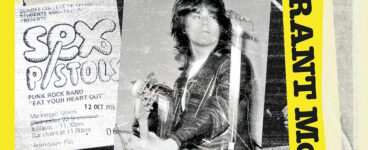
 Caledonia Screaming: Scottish Punk 1976 – 1977 by Grant McPhee
‘Punk didn’t need Scotland, but Scotland needed punk.’
 Quite Ugly One Evening: A Q & A with Chris Brookmyre
‘It begins with Jack Parlabane locked in a state room with a body: not only is he covered in the dea …
ALSO ON BOOKS FROM SCOTLAND
-

The Scottish Colourists: Art & Life by Alice Strang
‘Together the quartet embodied a new spirit in Scottish art and they are celebrated as Scotland’s le …
-
David Robinson Reviews: Our Noble Selves by Kate Atkinson
‘As I suggested at the start, there’s a whole heap of plot in Our Noble Selves – spies, murders, and …
-
‘They had spoken perhaps ten sentences each and it had already begun. Moira’s resentments, her preju …
-

Ayont the Thistle by Jim Mackintosh, Alan Riach and James Robertson
‘Nane ae this then but – ma hert daen its hing/ an yon wee smile ae yours in the saft smir ae the ga …
-

David Robinson Reviews: This Door of the Seas
‘He sees what he wants to. And it makes a kind of sense too – especially to colonists from Scotland, …
-
The Broons and Oor Wullie Celebrate their 90th Birthdays!
‘Whatever the future may hold, we can be sure that The Broons and Oor Wullie will always be a part o …
FEATURED AUTHOR:
T.F. Muir

Born in Glasgow and now a dual UK/US citizen, T.F. Muir is the author of the DCI Andy Gilchrist series – the first of which, Eye For An Eye, won the Pitlochry Award for the best crime novel by an unpublished writer, and the second, Hand For A Hand, con …
FEATURED PUBLISHER:
Sparsile Books

Sparsile Books is a small independent publisher, based in Glasgow, specializing in high quality fiction and non-fiction. We see publishing as an art in itself, and we work closely with our authors to ensure that the books we publish give readers a uniq …