


EXPLORE ISSUES



David Robinson Celebrates
‘I can guarantee that you won’t have read anyone else like her.’
2026 is Agnes Owens’ centenary year. To celebrate, Polygon are publishing seven new editions of her novels and short stories in collaboration with the official Agnes Owens Archive. The first four are released in May 2026, with more to be released in September 2026. David Robinson looks back at her life and career.
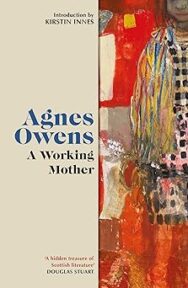
A Working Mother
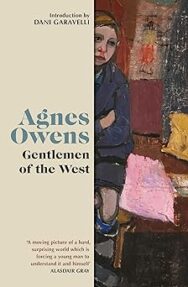
Gentlemen of the West
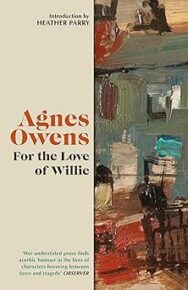
For the Love of Willie
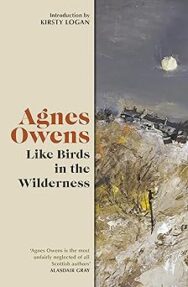
Like Birds in the Wilderness
By Agnes Owens
Published by Polygon
Most reviewers of Agnes Owens’s 1994 novel A Working Mother—to my mind the most intriguing of her four books published this May to celebrate the centenary of her birth—concentrate on the booze-fuelled loveless triangle between Betty, its main protagonist, and the two men in her life: her husband Adam and his friend Brendan. They’re quite right to do so too, but I’m going to start with a much less important character, a Polish Jew called Mrs Rossi who runs a small employment agency.
When Betty goes to see her, Mrs Rossi fixes her up with a job as a temp with a legal firm, whose boss, Mr Robson, offers her a permanent job. He soon asks if Betty would do some extra typing for him at his house over the weekend on a project of his own, tentatively called ‘Human Behaviour in Animals’. After she has spent a couple of hours on this, he summons her to his bedroom.
‘He stroked my hair, my face and my breasts for some minutes, then retired behind the screen. I sat on the edge of the bed hearing small panting noises, then a low painful groan, but as I wasn’t involved in this I considered I had been let off lightly.’
All of which is distinctly creepy, and decades before #MeToo. Yes, there is money in it—no small consideration for a working mother on the breadline with a non-working husband and two deadbeat children to support—so should she take Mr Robson’s offer of a permanent job? She consults Mrs Rossi, who in turn consults the Tarot cards. ‘There are three men in your life,’ Mrs Rossi tells her, ‘one of whom you have great doubts about. Cast your doubts aside, for this man is good for you and he will improve your circumstances greatly.’ This is, when you remember husband Adam and lover Brendan, spot-on. Not only that, but all Mrs Rossi’s cards seem to keep telling the truth throughout the rest of the novel, right up until the moment when they don’t.
If you haven’t read anything by Agnes Owens, and because her work is still followed around by that 2003 quote from Alasdair Gray about her being ‘the most unfairly neglected of all living Scottish writers’, there’s a chance you haven’t, all of this might lead you to expect her to be some kind of Muriel Spark. She’s not: no-one is. The Daily Telegraph compared her to Beryl Bainbridge and Evelyn Waugh, though anything further from Owens’s work than Brideshead Revisited is hard to imagine. One thing is for sure: I can guarantee that you won’t have read anyone else like her. Few writers also have as impressive a writerly fan club as Owens, as it includes Liz Lochhead, who has the strongest claim to have ‘discovered’ her; James Kelman, who suggested the change of direction in Owens’s writing that led to her debut, Gentlemen of the West (1984); and Douglas Stuart, who has said that her work inspired him to write Shuggie Bain.
Mrs Rossi, it turns out, is an anomaly in Owens’s fiction. An employment agency is, unlike the employment exchange (the broo) in Gentlemen of the West, somewhere that really does offer the possibility of a job, a way out of poverty, an escape from feckless, booze-addled men and an ever-narrowing future. In Owens’s fiction, no such escape is usually offered. She offers few consolations, redemptions, happy endings or compromises. Her characters aren’t even particularly likeable. Betty, for example, gets her friend the sack for no particular reason, and has joyless sex with her husband’s best friend. They routinely self-sabotage, deceive friends and colleagues, accept violence as normal, or casually inflict it on others (including kicking dogs to death – Brendan in A Working Mother; Big Eck in Like Birds in the Wilderness). Mac, the 22-year-old bricklayer protagonist of both Gentlemen of the West and Like Birds in the Wilderness, is fairly typical in being prepared to do almost anything for a pint or, better still, a hauf and a hauf. Such characters know what fate awaits them – joining the derelicts out in the cold or as patients at the psychiatric clinic – but do nothing to avert it. Here’s Mac again, depressed at seeing how far his drinking buddy has fallen: ‘If I had any conscience at all,’ he says, ‘I should report Mick to the social workers or any kind of authority that took care of down-and-outs. But who was I to play God when I could scarcely take care of myself?’
This is, of course, reprehensible, but there’s truth here too. We aren’t good Samaritans, most of us, and pass by those in need on the other side of the road every day. How do we find out about those over there on the margins? We need fiction that will tell us, without giving us the easy outs, without neat resolutions, happy endings or a dawning of faith. We need writers who can write about marginalised people without pathos or condescension, who know their lives from the inside. ‘All my stories are about building site workers, tramps and alcoholics,’ Owens told Chitra Ramaswamy in 2008. ‘They’re the only people I have great knowledge of. I’ve lived with them and had husbands who took a good drink. I know the patter. I couldn’t have written about anything else and I didn’t want to write about wealthy people. It’s boring.’
If you read enough Agnes Owens, you’ll know that she is never boring, and her voice – sarcastic, wickedly funny, terse (no wonder her books are so short), and unshowy – is unique. In her introduction, Dani Garavelli detects the influence of Steinbeck, which is plausible enough given that in A Working Mother Betty tells her lover Brendan ‘You remind me of that Lennie guy in Of Mice and Men’ – although as she says, it would have to be a Steinbeck shorn of all traces of sentimentality for the parallel to be exact.
Famously, Liz Lochhead realised Owens’s talent when reading the short story she had written for an evening class in Alexandria for beginning writers in 1978. The story opened like this: ‘Arabella pushed the pram up the steep path to her cottage. It was hard going since the four dogs inside were a considerable weight.’ Right enough, that is both intriguing and different, and Lochhead’s co-tutors Kelman and Gray (they each took four-week turns) agreed. That got the ball rolling, though publication still took several more years.
Yet Owens’s short story had real enough roots. In 1946, when she and her husband Sam were homeless, they set off for the Highlands with a young daughter in tow and just £11 in their pockets, sleeping in a two-man tent or in derelict buildings. For more than a year they wandered from town to town in search of work. At one place (sources suggest Keith):
‘We lived next door to an old, bent couple. We lived in terrible conditions, I mean, we had just one room. I don’t know what they had, but I’m quite sure it would’ve been pretty filthy! They kept a pail of urine or maybe shit outside their door! And you had to run by this to go to another terrible toilet.
But they had a daughter. I don’t know what her name was, and she hurled dogs about in a pram … In this story [‘Arabella’] I’ve made her quite cruel to the dogs, but she’s not aware of it – she’s not aware that she’s anything to be looked down upon.’
Jane Gray, ‘Giving “people like that” a Voice: A Conversation with Agnes Owens’, Études Écossaises 11.1 (2008), 207-223, http://etudesecossaises.revues.org
That’s the thing about Owens’s characters: none of them are aware that they are anything to be looked down upon. And why should they? Owens understands their lives are much harder than most. In that year of wandering round the Highlands, for example, Agnes gave birth to another child. Her husband, an alcoholic former soldier, who suffered from PTSD, died in 1963 aged 43. By then, she had two more children with him, and three more with her second husband, Pat. Their youngest, Patrick, was stabbed to death outside her home in Balloch in the week before Christmas in 1987.
Before that tragedy, Owens’s two books had centred on Mac, the unambitious young brickie whose escapades drew heavily on what John, her youngest son from her first marriage, told her about a bricklayer’s working (and drinking) life. After Patrick’s death, she didn’t write for years. ‘It took all your time to get through the day,’ she told an interviewer. ‘You weren’t ill, no, and you never became ill, but you would have loved to have died.’
All of which takes us back to Mrs Rossi. Her employment agency is going through such a hard time that when Betty turns up assailing for a job as her assistant, she tells her that she is actually shutting it down.
‘I hung my head despairingly. “That’s that then,” I said.
“Wouldn’t you like to try the cards?” she asked. “They might help.”
“If the future is so certain, I can’t do anything about it.”
“True,” she agreed.’
The cards Betty has been dealt – on her last reading with Mrs Rossi, standing in for the three men in her life – offered no escape, and now neither does the employment agency. Betty thinks about each of her men – her husband, lover and employer – in turn:
‘Adam is certainly not rational. Brendan has no intelligence whatsoever and Mr Robson is weird. But they’re all I’ve got to work on.’
Betty is more consistent about this than she is about many things. ‘When I thought about it,’ she notes earlier on in the novella, ‘there wasn’t much I could do except play the cards dealt me as well as I could.’ And that’s one thing that Polygon’s centenary reissue of four of her books (there’ll be another four in September) reminds you about Agnes Owens. When you think about it, few writers played the cards dealt them anywhere near as well.
Polygon’s Agnes Owens Centenary editions of Gentlemen of the West (introduction by Dani Garavelli), Like Birds in the Wilderness (introduction by Kirsty Logan), A Working Mother (introduction by Kirstin Innes) and For the Love of Willie (introduction by Heather Parry) are priced £8.99.
ALSO IN THIS ISSUE

 Everything Everyday by Hannah Lavery
‘We will remember what we did. We will / be remembered for what we did not do.’
 David Robinson Reviews: Borrowed Land by Kapka Kassabova
‘The pain is real because the love of place is real.’
ALSO ON BOOKS FROM SCOTLAND
-

‘They had spoken perhaps ten sentences each and it had already begun. Moira’s resentments, her preju …
-

Ayont the Thistle by Jim Mackintosh, Alan Riach and James Robertson
‘Nane ae this then but – ma hert daen its hing/ an yon wee smile ae yours in the saft smir ae the ga …
-

David Robinson Reviews: This Door of the Seas
‘He sees what he wants to. And it makes a kind of sense too – especially to colonists from Scotland, …
-

The Broons and Oor Wullie Celebrate their 90th Birthdays!
‘Whatever the future may hold, we can be sure that The Broons and Oor Wullie will always be a part o …
-

Pretty Valuable Things by A. J. Leslie
Harper considered Charles for a few moments, lit a cigarette, then said ‘we are treating it as murde …
-
Shadow of Madness: A Q & A with D. V. Bishop
‘Yet a great novel of historical fiction also has us escape the here and now by immersing us in the …
FEATURED AUTHOR:
Metaphrog

Metaphrog are Franco-Scottish duo Sandra Marrs and John Chalmers, winners of The Sunday Herald Scottish Culture Awards 2016 Best Visual Artist. The Red Shoes and Other Tales and their Louis graphic novels are highly acclaimed internationally, and have …
FEATURED PUBLISHER:
Society of Antiquaries of Scotland

The Society of Antiquaries of Scotland has been an active publisher of Scotland’s history and archaeology since 1792. We publish beautifully illustrated volumes covering the entire range of Scotland’s past, helping to bring it to life for future genera …