


EXPLORE ISSUES



‘I enjoy stillness. It creeps up on you and becomes almost a force. I’ve had squirrels run over my feet. I’ve had deer come and look at me from six feet away, I’ve had a robin perch on my hat, all those sorts of things, just by sitting still.’
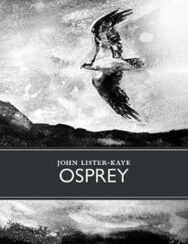
Join David Robinson and John Lister-Kaye on a spring afternoon at the Aigas estate to discuss John’s latest release, Osprey, a beautiful book about the remarkable return of an iconic bird to Scotland and the natural world it inhabits.
Osprey
By John Lister-Kaye
Published By Little Roller Books
Let me set the scene. It is a glorious late spring afternoon. I am sitting by a Highland loch at the Aigas estate 30 miles west of Inverness next to Sir John Lister-Kaye. I know him a little and like him a lot. He inherited a baronetcy going back to 1378, worked as a young man alongside Gavin Maxwell, set up Aigas as Scotland’s first wildlife study centre 50 years ago, and now, at the age of 80, is generally recognised as the country’s finest nature writer.
What fascinates me about John Lister-Kaye is that he knows absolutely everything about the view in front of us. He knows that buzzards nest in the trees to our right, and crossbills and crested tits in the remnant of the ancient Caledonian pine forest to our left, that grebes were drawn to the loch by the bottle sedge on its furthest verge, and otters come up the burn and swim underneath the landing beneath our feet to fish for trout. He knows, as he walks up to the Illicit Still – the lochside hut where he writes his books – which birds, rodents, insects and animals might cross his path, what they have most likely eaten, where they were probably going, and which predators they feared most. People like me might know the basics about the Scottish landscape: if knowledge of the natural world is like a jigsaw, we might be able to put together the corners and edges. One of the reasons I like JLK is that he can put together – and explain – the whole picture.
Right now, the centre of that picture is 360 yards away across the loch: a nest on top of a telegraph pole on which JLK’s tripod-mounted high-powered telescope inside the Illicit Still has been focussed for most of the last three years. Look though its eyepiece and, if you’re lucky, you can spot the mocha-and-cream feathered Pandion haliaetus. Pandion was a mythological king of Athens, haliaetus means sea eagle. The king of fishers. The fisher king. The osprey.
Ospreys had been wiped out in Scotland by the 1950s, but came back gradually. One was recorded as fishing in Aigas’s eight-acre loch in 1984, and a pair built a nest half a mile away in Aigas Gorge in 2015. The speculative telegraph pole nest went up in 2019, complete with platform and primitive nest and a wire net to make it safe from pine martens. JLK and his team of rangers watched and waited.
He tells the story in his new book, Osprey, out this month. In the proof copy I read, it blazed with hope – not only did Aigas have its own pair of ospreys but they appeared to be breeding – but ended in disappointment. Not only were the pair apparently too immature to breed successfully, but the male had vanished. On 9 May last year, JLK found its dead body in the Beauly Firth.
I know that the story did not end there because the first thing he told me when he picked me up at Beauly station was that there is a pair in the nest, and that they flew back from Africa only the week before. What happened after 9 May last year?
‘It’s a real tearjerker. The female comes to realize that her partner has deserted her or is dead, and at that moment in her nesting calendar, he is supposed to be bringing her six fish a day. Of course, he wasn’t bringing any. She’s wasting away, getting very hungry, and she starts to produce this really quite pathetic call. I can’t begin to imitate it, but what she is saying to the world is, “I’m in distress.” And she keeps that up for probably three weeks. Then it changes, and becomes more positive, and the new call, which is more strident, and is intended to go further, is basically saying, “I’m a female. I’m here. I’ve got a site. I need a male.” She is lucky because the male turned up, and they partnered up. And that’s very sweet, because initially she’s wary of him, and when he brings in a fish, she accepts it, and then she brings her wings up and holds them like this as she eats the fish he has provided…’ He raises his elbows and lowers his head like a primary school pupil determined to prevent anyone copying their writing.
‘It’s called mantling. When I saw that for the first time, I phoned [ornithologist] Roy Dennis – who is Mr Scottish Osprey - and asked him what was going on. And he said, it’s because they haven’t pair-bonded properly, and she doesn’t want him to touch her. The wings aren’t protecting the food – they’re for keeping him away.
‘Then the male goes into a series of display flights, which is really extraordinary. They keep it up for hours and hours. He finds a thermal, spirals up to about 3000 feet, then closes his wings and comes down in a stoop, bottoms out and lets the momentum take him up again and then flaps his wings to take him back to the top, then it’s down again and up again and down again and all the time he is calling to her. It’s a very, very impressive courtship behaviour pattern, and he keeps it up for days until she accepts him.
‘By then it was late August, early September, too late in the year to breed. The best we could hope for was that they would migrate and then re-establish their partnership when they came back the following year, which they did. We still don’t know whether they are sexually mature enough to breed – it takes five years – but we’re praying that this year they’ll get it right.’
The reason they are in Scotland in the first place, he says, is that they need the long hours of summer daylight. That’s the survival advantage for them of migrating here – because they can’t fish in the dark, but in the middle of the Scottish summer, they can catch more fish, which means they can feed their chicks better.
If I were an osprey, I say, I’d prefer fishing in a loch to the sea, as the waters are clearer and stiller and more transparent. ‘But in the tidal waters of the Beauly Firth,’ he points out, ‘the water can be quite shallow twice a day. That exposes particularly flat fish like flounders and mullet, which don’t seem to have worked out yet that this is when their chances of predation are very high. Often you see Ospreys standing in the shallows having just caught a flounder, so the water is no deeper than that.
‘For an osprey fishing on this loch, so many things have to come together. The surface mustn’t be too ruffled. The fish have to be rising – and it’s no good seeing a ring of water where a fish has come up, because by the time you see that the fish will be on its way down again. So the osprey, which has very sharp visual acuity, will hover and see a fish on its way up, and then it’s a timing job: its dive has to coincide with the fish just coming to the surface. It is probably only successful about 30% of the time, whereas in the tidal shallows, it’s probably greater than 50%.’
Perhaps the ospreys are getting their talons into the floundering flounders of the Beauly Firth even as we talk: certainly when I look through JLK’s telescope all I can see is an empty nest. But that’s not uncommon: and of all the virtues nature writers need, patience must surely come out on top. I ask JLK how many hours he has looked through that telescope at the telegraph pole nest. I don’t think the thought has ever occurred to him. ‘I’ve never counted. But the great thing about the Illicit Still is that I can cook here here, sleep here, there’s a loo here, so every day for the last three years with one or two exceptions – say I had a funeral to go to or something like that – I’d be here from five in the morning until eight at night. And from the end of May to the start of July, when there’s virtually no night, I’d often be here all the time.’
If nothing was happening on the osprey front, there would always be something else. ‘In the book, I’ll mention other things – a sabre wasp, a golden eagle that came swooping, a tiger beetle – they’re phenomenal, incidentally, imagine something that size that can run at human walking speed. These things aren’t just fillers: they are part of this whole jigsaw.
‘But certainly you have to put in the hours. You have to learn to be still. I’ll give you an example. About five or six years ago I was looking for a pine marten and one of our rangers had said that they’d heard kits calling from inside the den, which was a hole in the bank of the burn. I went up into the woods, but I couldn’t find it, so I thought I’d sit down and wait, and maybe I might hear the same thing, and that would lead me to where it was.
‘So I sat there, and I’d been there about an hour or two, totally still. A goshawk came in, flying very fast a couple of feet above the ground. I could have reached out and touched it, it was so near. Then it swerved up steeply and grabbed a jay by its breast and took off with it. I saw the whole thing right in front of me. Now there’s absolutely no way that that would have happened if I hadn’t been sitting really still for two hours.
‘I enjoy stillness. It creeps up on you and becomes almost a force. I’ve had squirrels run over my feet. I’ve had deer come and look at me from six feet away, I’ve had a robin perch on my hat, all those sorts of things, just by sitting still.’
Psychologists are still unsure why some people respond so fully to nature and others don’t. The divide between those who can enjoy stillness and those who can’t is, I suspect, equally stark and widening. Even some nature-lovers, says JLK, lack the patience required to say, wait for an otter or a pine marten to show itself, and cites plenty of examples. I don’t doubt that he is right: infinite scrolling started on our computers 20 years ago and on mobile phones almost immediately afterwards. Attention spans are getting shorter and shorter: only the week before I interviewed JLK, an educationalist told me that most teenagers she knew no longer consumed any kind of long form content – films, TV, theatre or books.
Mercifully, there are still some holdouts. I have great hopes for fishermen, and anglers of all kinds, for whom patience is still a virtue. The rangers JLK employs at Aigas (‘over 350 applicants for each post we have,’ he says, shaking his head in disbelief) also strike me as having the kind of knowledge of the natural world that only comes from stillness in watching it. And of course there’s the man who set up the wildlife centre at which they work: 80 this month and quite prepared to spend nearly all of the next one looking at the pair of ospreys nesting on the other side of his loch, watching, waiting and wondering.
Osprey by John Lister-Kaye, is published by Little Roller Books, priced £18.
RELATED BOOKS

ALSO ON BOOKS FROM SCOTLAND
-


The Scottish Colourists: Art & Life by Alice Strang
‘Together the quartet embodied a new spirit in Scottish art and they are celebrated as Scotland’s le …
-

David Robinson Reviews: Our Noble Selves by Kate Atkinson
‘As I suggested at the start, there’s a whole heap of plot in Our Noble Selves – spies, murders, and …
-
‘They had spoken perhaps ten sentences each and it had already begun. Moira’s resentments, her preju …
-

Ayont the Thistle by Jim Mackintosh, Alan Riach and James Robertson
‘Nane ae this then but – ma hert daen its hing/ an yon wee smile ae yours in the saft smir ae the ga …
-

David Robinson Reviews: This Door of the Seas
‘He sees what he wants to. And it makes a kind of sense too – especially to colonists from Scotland, …
-

The Broons and Oor Wullie Celebrate their 90th Birthdays!
‘Whatever the future may hold, we can be sure that The Broons and Oor Wullie will always be a part o …
FEATURED AUTHOR:
Dan Richards
Dan Richards’ first book, Holloway, co-authored with Robert Macfarlane & illustrated by Stanley Donwood, was published by Faber in 2013. The Beechwood Airship Interviews (HarperCollins, 2015) explored the creative process, head-spaces and workplace …
FEATURED PUBLISHER:
Banner of Truth Trust

The Banner of Truth Trust is an Evangelical and Reformed non-profit publishing house, structured as a charitable trust and founded in London in 1957 by Iain Murray, Sidney Norton and Jack Cullum. Its offices are now in Edinburgh. We publish books that …