


EXPLORE ISSUES



Miss Blaine’s Prefect and the Parcel of Rogues
‘Wherever she goes, though, she will be well worth following.’
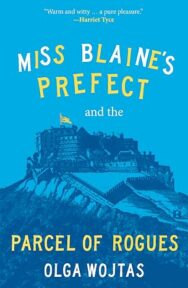
David Robinson speaks to Olga Wojtas about her new novel, Miss Blaine’s Prefect and the Parcel of Rogues, the latest in her comic cosy crime series starring her wonderful time-travelling librarian Shona McMonagle.
Miss Blaine’s Prefect and the Parcel of Rogues
By Olga Wojtas
Published by Saraband
‘Which writers do you find funny?’ I ask Olga Wojtas, almost apologetically because it’s such an obvious question for a comic novelist, one I’m sure she must have been asked at every book festival she’s ever been to. She has the grace to pause and at least pretend to think.
‘The odd thing,’ she replies, ‘is that they’re virtually all from a very long time ago. James Thurber, Saki, Jerome K. Jerome, EF Benson. The most modern one is probably Terry Pratchett. It’s really strange, because obviously there are more recent humorists, but sometimes they can have quite a cruel edge to them. And what I’m trying to do is to write something that’s completely escapist, where there is no jeopardy, and you know everything is going to be alright even though it’s all undermined by absurdity.’
But while that would indeed be an accurate summary of the first five books in her Miss Blaine’s Prefect series of novels featuring her time-travelling Morningside librarian protagonist Shona McMonagle – all are absurd, escapist, and very definitely funny – there’s something extra about her sixth. In Miss Blaine’s Prefect and the Parcel of Rogues, all but two of the main characters actually existed. Considering that past volumes have included encounters with sea monsters, Dracula and Macbeth’s witches, this is a significant change – although the novel remains as delightfully, wittily, and intelligently daft as ever.
One of its central characters is Robert Burns. When Shona finds herself yanked out of her 21st century existence and thrust straight into a soirée at Edinburgh’s Assembly Rooms in 1788, she is soon on the receiving end of his attention. ‘His male gaze was firmly fixed on my decolletage,’ she writes, ‘Then he looked me straight in the eye and gave me a smile followed by a long, slow wink. I was in absolutely no doubt as to what he meant: “Get your cloak; you’ve pulled.”’ Just what we might expect, of course, but as Shona later discovers, Burns’s laddish persona is actually a ploy by his publicist to boost sales.
The Assembly Rooms bash has attracted la crème de la crème of Enlightenment Edinburgh – Adam Smith, Joseph Black, James Hutton, Henry Mackenzie, Dugald Stewart, William Robertson – but Shona soon finds herself among an equally dazzling female coterie of Anne Murray Keith, Jean Elliot, Alison Cockburn and Jane, Duchess of Gordon. Shona, a feminist down to her Doc Martens, is shocked that they have been all but ignored by history and she may well have a point.
They, of course, have never met anyone like her: opinionated, boldly going into places like coffee houses where 18th century women weren’t supposed to go, disregarding sexism at every turn. ‘I really enjoyed writing their conversations with Shona,’ says Wojtas, ‘because they speak in such different registers. Shona has a terrible habit of Shonasplaining, because she thinks she knows it all. But these 18th century women are so very polite. So instead of saying “You daft woman, we know all that’” they’ll say “We are much obliged to you, but this is quite unnecessary” – all the time so polite though in fact they’d be trying not to roll their eyes. And when Shona uses an expression like “mad as a box of frogs” they have this huge discussion about what she can possibly mean.’
But while that linguistic disconnect provides real comedy, as does the way in which Shona and Marcia Blaine (the headmistress of the school made famous in The Prime of Miss Jean Brodie who sends Shona on all her time-travelling missions) feed Burns some of his most famous lines, there is a little light learning to be had along with the laughs.
‘One of the things I didn’t realize about 1788 Edinburgh,’ says Wojtas, ‘was that the Mound was still a pile of rubble and duckboards, and the George IV Bridge didn’t exist. So Walter Scott, who lived in George Square, or George’s Square, as it was then [named after the builder’s brother, not the king], would have had to do this huge circuitous journey to get to the Assembly Rooms, where he meets Shona. That’s quite a long journey, and of course, he was lame in one leg. I’m always amazed by these things: you know, we think of Robert Louis Stevenson as being frail and feeble, and obviously he spent a lot of his childhood in bed. Yet every day he’d be walking from Swanston to Edinburgh University and back again.’
Scott is only 16 when he meets Shona at the Assembly Rooms, where she advises him that if he ever does try his hand as a novelist, staying anonymous would be a good career move (‘It creates a buzz. Mystery is irresistible’). ‘I quite liked the idea of writing about Scott as a teenager. We have this image of him as very fuddy-duddy, but he wasn’t. My husband is a lawyer, and has all these books about old Scottish judges – Cockburn and so on. And when Scott was an advocate, it was said, if you were in Parliament Hall, and you saw this group of advocates falling about with laughter, it was because Scott was doing impersonations. And we just don’t think of him like that.
‘With the law lords, although there was obviously Lord Braxfield, the hanging judge, there was Lord Monboddo, who believed we all had tails. Well, I just thought these characters are a gift, so I started reading more about the Edinburgh Enlightenment and how you had these intellectual ladies who would keep open house. The men would come round and take tea and discuss things, but there were all these very bright ladies there, and I thought, well, we don’t hear about them, I’m sure they weren’t just handing around the tea. So I got the idea that they were the brains behind the Enlightenment and they must have had a much bigger influence than we realize.’
When Shona is among these women each of them is always introduced with the particular adjective (‘the formidable Anne Murray Keith’, ‘the dazzling duchess’, ‘the poetic Jean Elliot’ etc). Although Wojtas admits that this is partly as an aid to the reader, she agrees when I point out that repetition often adds to comedy, as with the frequency of Alexander McCall Smith’s references to the ‘traditionally built’ Mma Ramotswe or PG Wodehouse’s to the ‘inimitable’ Jeeves. ‘Absolutely,’ she agrees. ‘I should have mentioned them at the start. Especially Wodehouse, because he was basically who I was modelling myself on. Most characters in novels change as a result of what happens. Jeeves and Bertie never change; whatever difficulty Bertie gets into, Jeeves is always going to get him out of it. The interest in the book is how that is going to happen. It’s the same with Shona – she starts off as a numpty and ends up as a numpty!’
We talk briefly about her plans for Shona’s next adventures, which are still in the planning stage. Wherever she goes, though, she will be well worth following. The world the way it is, we need all the laughs we can get.
Miss Blaine’s Prefect and the Parcel of Rogues by Olga Wojtas is published by Saraband, priced £10.99.
RELATED BOOKS
ALSO IN THIS ISSUE
 Josephine Jay Reviews: The Shape of Monsters by C. L. Hellison
‘Hellisen’s world is one that ponders the driving forces of fate against personal agency – asking wh …
 David Robinson Interviews Olga Wojtas
‘Wherever she goes, though, she will be well worth following.’
ALSO ON BOOKS FROM SCOTLAND
-


The Scottish Colourists: Art & Life by Alice Strang
‘Together the quartet embodied a new spirit in Scottish art and they are celebrated as Scotland’s le …
-

David Robinson Reviews: Our Noble Selves by Kate Atkinson
‘As I suggested at the start, there’s a whole heap of plot in Our Noble Selves – spies, murders, and …
-
‘They had spoken perhaps ten sentences each and it had already begun. Moira’s resentments, her preju …
-

Ayont the Thistle by Jim Mackintosh, Alan Riach and James Robertson
‘Nane ae this then but – ma hert daen its hing/ an yon wee smile ae yours in the saft smir ae the ga …
-

David Robinson Reviews: This Door of the Seas
‘He sees what he wants to. And it makes a kind of sense too – especially to colonists from Scotland, …
-

The Broons and Oor Wullie Celebrate their 90th Birthdays!
‘Whatever the future may hold, we can be sure that The Broons and Oor Wullie will always be a part o …
FEATURED AUTHOR:
Nan Shepherd

Anna (Nan) Shepherd was born in 1893 and died in 1981. Closely attached to Aberdeen and her native Deeside, she graduated from her home university in 1915 and for the next forty-one years worked as a lecturer in English. An enthusiastic gardener and hi …
FEATURED PUBLISHER:
McNidder & Grace

McNidder & Grace is an award-winning independent publisher specialising in biographies and memoirs, music literature, art, travel, history, sport, and crime fiction. McNidder & Grace carry the stories and voices of a wide range of authors and g …