


EXPLORE ISSUES



‘Bad witches speak to our fears – the darkness inside ourselves included – and their good sisters to the powers of intuition, inherited wisdom and connection to nature’s cycles.’
Mairi Kidd’s historical novels take a look at the hidden stories of women’s lives in Scotland’s past. Her latest novel is set in the Highlands in the 17th century, in a community torn apart by the paranoia and superstition of the witch hunts. We asked Mairi Kidd to tell us of her favourite fictional witches.
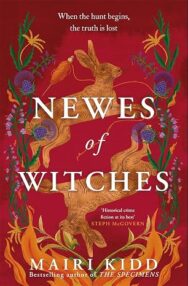
Newes of Witches
By Mairi Kidd
Published by Black and White
Weird Sisters: the appeal of the literary witch
Early modern witch-hunting has close links with the advent of printing – the title of my new novel draws on the 1591 pamphlet Newes from Scotland – but the witch has been a firm favourite in literature for much longer. Bad witches speak to our fears – the darkness inside ourselves included – and their good sisters to the powers of intuition, inherited wisdom and connection to nature’s cycles. Here are a few of my favourite fictional witches…
Granny Weatherwax
First appearing in Terry Pratchett’s Equal Rites in 1987 and finally in his last book The Shepherd’s Crown in 2015, Esme ‘Granny’ Weatherwax is the (non-)leader of the Discworld’s witches and one of Pratchett’s greatest creations. Iron-willed, as practical as she is powerful and as sharp as she is wise, Granny’s genuine feats of magic are hugely satisfying – her ‘borrowing’ of a swarm of bees stands out – but a large part of her appeal is her understanding that magic is a last resort. Granny knows most human matters can be managed by what she calls ‘headology’ and Pratchett fan A. S. Byatt called ‘insidious wisdom about human nature’. Sidekicks Gytha ‘Nanny’ Ogg, Magrat Garlick, Agnes Nitt and Tiffany Aching also rank among Pratchett’s best characters.
Erif Der in The Corn King and the Spring Queen by Naomi Mitchison
On the face of it, this huge 1931 work is a historical novel set in antiquity but it has speculative, fantasy and mythical elements too. The scope is immense, spanning many years in the fictional Black Sea society of Marob and in Ancient Sparta. Marob is a place where magic is real; in Sparta it is not. This clash between belief systems is a central theme of the novel, and Mitchison does not come down on either side. Our guides are Erif, a witch who serves her community as Spring Queen, and her husband Tarrik, the Corn King. Erif has magic and determinedly holds to it even when no one else believes in it, and although Tarrik is the first to go on quest, the heart of the book is her own journey in search of purpose. It’s not perfect – Mitchison’s own new introduction to a later printing explores this – but it is vivid and remarkable and Erif is a fascinating character, part model for Mitchison’s own political interest and part exploration of women’s agency through time.
Baba Yaga in The Kingdom by the Sea by Joan Aitken and Jan Pieńkowski
A huge character in Slavic folklore, Baba Yaga is a cunning old witch – sometimes good, sometimes bad – who flies through the air in a giant mortar and pestle and lives in a house that stalks through the forest on chicken legs. Joan Aitken retold her story in this collection with her trademark wit and wisdom, but the real reason I remember it from childhood is the wonder of Pieńkowski’s dark silhouette illustrations on marbled grounds. Perfect for frightening young imaginations to just the right degree.
Jadis, the White Witch in The Lion, the Witch and the Wardrobe by C. S. Lewis
I love Turkish Delight and the idea of travelling in a sleigh, and so I’ve always suspected I’d be Edmund Pevensie and immediately betray all my friends to the White Witch. She’s a terrible villain, of course, but as played by Tilda Swinton in the BBC adaptation in the 2000s, for my money she’s the most stylish witch ever to appear on screen.
Cailleach, Berthe and Merrow in Hagtale by Sally O’Reilly
Hagtale is an unusual entry in the recent catalogue of books seeking to retell the story of Lady MacBeth. Rather than drawing on the historical Gruach, O’Reilly’s book plays with ideas of ‘history’ recreated from unreliable sources to suit the concerns of their writers’ times. I loved the three witches, especially Cailleach.
To be clear, Scotland’s ‘witches’ had nothing in common with these characters. They were ordinary people, members of their communities, mostly women but some men, and what they have in common is simply that they were caught up in a dreadful miscarriage of justice. At this remove, it’s easy to ask how on earth it could have happened, but our enduring fascination with the witch should give us pause before we dismiss our ancestors as unsophisticated or superstitious. What is the appeal, after all, if not a tendency in human beings to believe that there really is magic in the world?
Newes of Witches by Mairi Kidd is published by Black and White, priced £16.99.
RELATED BOOKS
ALSO IN THIS ISSUE

 On the Bodies of Strangers by Hannah Stevens
‘Across the road, a flash of colour catches Valeria’s eye.’
 Author Profile: Catherine Simpson
‘I’ve always been a writer – making up stories and plays as a child and writing my own magazines and …
ALSO ON BOOKS FROM SCOTLAND
-

The Scottish Colourists: Art & Life by Alice Strang
‘Together the quartet embodied a new spirit in Scottish art and they are celebrated as Scotland’s le …
-

David Robinson Reviews: Our Noble Selves by Kate Atkinson
‘As I suggested at the start, there’s a whole heap of plot in Our Noble Selves – spies, murders, and …
-
‘They had spoken perhaps ten sentences each and it had already begun. Moira’s resentments, her preju …
-

Ayont the Thistle by Jim Mackintosh, Alan Riach and James Robertson
‘Nane ae this then but – ma hert daen its hing/ an yon wee smile ae yours in the saft smir ae the ga …
-

David Robinson Reviews: This Door of the Seas
‘He sees what he wants to. And it makes a kind of sense too – especially to colonists from Scotland, …
-

The Broons and Oor Wullie Celebrate their 90th Birthdays!
‘Whatever the future may hold, we can be sure that The Broons and Oor Wullie will always be a part o …
FEATURED AUTHOR:
David Torrance

David Torrance is a constitutional specialist at the House of Commons Library and a widely published historian of Scottish and UK politics. He has written unauthorised biographies of SNP politicians Alex Salmond and Nicola Sturgeon, as well as the biog …
FEATURED PUBLISHER:
Muddy Pearl

Muddy Pearl is a young independent publisher based in Edinburgh and specialising in books that help people explore issues of spirituality and prayer, international and social justice, health and lifestyle from a faith perspective. Our authors include t …