


EXPLORE ISSUES



‘Together the quartet embodied a new spirit in Scottish art and they are celebrated as Scotland’s leading artists of the twentieth century.’
Author Alice Strang chooses her five favourite works from her new book, The Scottish Colourists: Art and Life.
The Scottish Colourists: Art & Life
By Alice Strang
Published by National Galleries of Scotland
The four artists known as the ‘Scottish Colourists’ are Samuel John Peploe, John Duncan Fergusson, George Leslie Hunter and Francis Campbell Boileau Cadell. They were connected via friendships with Peploe and a shared immersion in progressive French art. Together the quartet embodied a new spirit in Scottish art and they are celebrated as Scotland’s leading artists of the twentieth century.
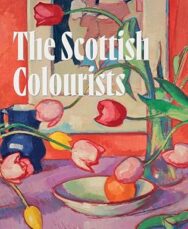
Tulips – The Blue Jug by Samuel John Peploe
Samuel John Peploe was born in Edinburgh in 1871, making him the oldest of the Scottish Colourists. He can be considered the most successful of the group, critically and commercially. We chose Peploe’s stunning Tulips – The Blue Jug of around 1919 for the cover of the new book because it sums up their shared used of bold design, bravura brushwork and brilliant colour. Peploe could spend up to three days arranging and re-arranging his still life compositions before creating a painting of them in a single session.
Eástre (Hymn to the Sun) by John Duncan Fergusson
The Scottish Colourists are renowned for their vibrantly coloured paintings, but John Duncan Fergusson also made sculpture for almost forty years; he made his first in Paris in 1908 and continued to work in three dimensions until the mid-1950s. His most famous sculpture is Eástre (Hymn to the Sun), for which his future wife, the dance pioneer Margaret Morris, is believed to have sat. Fergusson explained that it depicts the Saxon Goddess of Easter and represents the triumph of the sun after the gloom of winter.
Reflections, Balloch by George Leslie Hunter
George Leslie Hunter can be described as the most independent of the Scottish Colourists. The lyricism of his handling of light, reflections, distant viewpoint and balance of colour seen in Reflections, Balloch shows him at the height of his powers, shortly before his death in 1931. The acquisition of this painting by the National Galleries of Scotland two years later was controversial, as the institution did not collect contemporary art at the time. It also helped to strengthen the campaign to establish a Scottish National Gallery of Modern Art, which opened in 1960.
Interior by Francis Campbell Boileau Cadell
Francis Campbell Boileau Cadell is arguably best known for his paintings of the interiors of his home at 6 Ainslie Place in Edinburgh’s Georgian New Town. His magnificent house extended over six floors and Interior shows the view from his north-facing studio on the first floor, through to the drawing-room. His skills as an interior designer are clear to see, from the polished black linoleum floor, to the lilac-painted walls, lapis lazuli fireplace surround and a favourite conceit of his, the inclusion of one of his works, in this case hanging above the white sofa.
Jack and Tommy by Francis Campbell Boileau Cadell
Cadell was the only one of the Scottish Colourists to serve during the First World War. He was posted to the 9th Battalion, The Royal Scots in 1916 and eventually to the 5th Battalion, the Argyll & Sutherland Highlanders. In 1915 he began the ‘Jack and Tommy’ series of spontaneous and often witty drawings. They show off his marvellous draughtsmanship and interest in the experience of the rank and file. Cadell sold many of them to benefit the British Red Cross Society and included 20 in a book of 1916 named after the series.
The Scottish Colourists: Art & Life by Alice Strang is published by National Galleries of Scotland, priced £24.99.
RELATED BOOKS

ALSO ON BOOKS FROM SCOTLAND
-


David Robinson Reviews: Our Noble Selves by Kate Atkinson
‘As I suggested at the start, there’s a whole heap of plot in Our Noble Selves – spies, murders, and …
-
‘They had spoken perhaps ten sentences each and it had already begun. Moira’s resentments, her preju …
-

Ayont the Thistle by Jim Mackintosh, Alan Riach and James Robertson
‘Nane ae this then but – ma hert daen its hing/ an yon wee smile ae yours in the saft smir ae the ga …
-

David Robinson Reviews: This Door of the Seas
‘He sees what he wants to. And it makes a kind of sense too – especially to colonists from Scotland, …
-

The Broons and Oor Wullie Celebrate their 90th Birthdays!
‘Whatever the future may hold, we can be sure that The Broons and Oor Wullie will always be a part o …
-

Pretty Valuable Things by A. J. Leslie
Harper considered Charles for a few moments, lit a cigarette, then said ‘we are treating it as murde …
FEATURED AUTHOR:
Dan Richards

Dan Richards’ first book, Holloway, co-authored with Robert Macfarlane & illustrated by Stanley Donwood, was published by Faber in 2013. The Beechwood Airship Interviews (HarperCollins, 2015) explored the creative process, head-spaces and workplace …
FEATURED PUBLISHER:
Edinburgh University Press

Connecting people and ideas to inspire creative thinking, open new perspectives and shape the world we live in. Our ambition is to create a community of authors, editors, advisors and practitioners committed to publishing world-class academic research …