


ABOUT THIS BOOK
BUY THIS BOOK
As an Amazon Associate and Bookshop.org affiliate we earn from qualifying purchases.
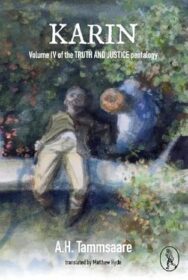
Karin
by A.H. Tammsaare, translated by Matthew Hyde
Karin is Volume IV of A.H. Tammsaare’s monumental Truth and Justice pentalogy which “chronicles Estonia’s evolution from a serf economy of imperial Russia to an independent nation state, and remains a cornerstone of European literature” (Times Literary Supplement). It examines different public and private themes in each volume. Karin is the story of marital conflict and therefore could not be more different thematically from Volume III’s account of the 1905 Revolution – a social conflict. Nevertheless it still has that mix of satire and pathos, of which Tammsaare is a master.
The volumes are not short and examine many aspects of societies everywhere and not just in interwar Estonia. Karin depicts various couples and how they deal with their marital problems, but it also observes the new Estonian middle class, which previously had been German. Although a rational novelist, Tammsaare is extraordinarily skilful at writing dialogues brimming with irrationalism, presumably because he considered it an innate feature of human behaviour. This often generates his subtle humour, which is to be found in all his literary works.
Karin is married to Indrek, the protagonist of all the volumes except the first in which he only comes to the foreground towards the end. She has not appeared in the previous volumes, and the reader only hears about the early part of their marriage in a few flashbacks. It was probably inevitable that his passive and undemonstrative nature would clash with Karin’s emotional and unpredictable one. What they do have in common, however, is that neither of them behave as would be expected of their sex in that time and place.
A.H. Tammsaare (Author)
A.H. Tammsaare (I Loved a German, Truth and Justice pentalogy) was born in 1878 into a poor farming family in a small Estonian village. Due in part perhaps to his family’s unusual intellectual curiosity, Tammsaare raised money for an education and studied law at the University of Tartu until he was hospitalised with tuberculosis in 1911. After a year in hospital he spent six years recovering on his brother’s farm. When Estonia became independent, he moved to Tallinn in 1920 and embarked on the most productive period of his life.
His greatest influences were Russian realists such as Dostoyevsky, Tolstoy and Gogol, but his work also shows the influence of Oscar Wilde, Knut Hamsun and André Gide. He occupies a central role in the development of the Estonian novel and is a figure of European significance. He died in 1940, in the midst of the Republic’s most difficult times.
Matthew Hyde is a literary translator from Russian and Estonian to English. He has had translations published by Pushkin Press, Dalkey Archive Press (including the Best European Fiction anthology for the last four years running), Words without Borders and Asymptote. Prior to becoming a translator, Matthew worked for ten years for the British Foreign Office as an analyst, policy officer and diplomat, serving at the British Embassies in Moscow, and Tallinn, where he was Deputy Head of Mission. After that last posting Matthew chose to remain in Tallinn with his partner and young son, where he translates and plays the double bass. He has recently recorded an album of his own compositions with leading Estonian jazz musicians: Nordic Blues, available on bandcamp. He translated The Death of the Perfect Sentence for Vagabond Voices in 2017.
ALSO ON BOOKS FROM SCOTLAND
-

The Scottish Colourists: Art & Life by Alice Strang
‘Together the quartet embodied a new spirit in Scottish art and they are celebrated as Scotland’s le …
-
David Robinson Reviews: Our Noble Selves by Kate Atkinson
‘As I suggested at the start, there’s a whole heap of plot in Our Noble Selves – spies, murders, and …
-
‘They had spoken perhaps ten sentences each and it had already begun. Moira’s resentments, her preju …
-

Ayont the Thistle by Jim Mackintosh, Alan Riach and James Robertson
‘Nane ae this then but – ma hert daen its hing/ an yon wee smile ae yours in the saft smir ae the ga …
-

David Robinson Reviews: This Door of the Seas
‘He sees what he wants to. And it makes a kind of sense too – especially to colonists from Scotland, …
-

The Broons and Oor Wullie Celebrate their 90th Birthdays!
‘Whatever the future may hold, we can be sure that The Broons and Oor Wullie will always be a part o …
FEATURED AUTHOR:
Cal Flyn

Cal Flyn is an award-winning writer from the Highlands of Scotland. She writes creative nonfiction, literary criticism, and long-form journalism. Her first book, Thicker Than Water, about frontier violence in colonial Australia, was a Times book of the …
FEATURED PUBLISHER:
Glasgow Museums

We have a long history of publishing – Kelvingrove Art Gallery and Museum opened in 1901, and people have been writing about and publishing on the city’s collections ever since. The focus of Glasgow Museums Publishing programme is naturally the one mil …