


EXPLORE ISSUES



‘This enraged the locals and he came close to being run out of town on several occasions.’
As voters prepare to head to the polls in upcoming by-elections in Makerfield and the North-East of Scotland, author and historian Rob McInroy revisits the dramatic Ross and Cromarty by-election of 1936 to explain why this remarkable episode in Scottish political history still resonates ninety years later, making his latest book a timely release.
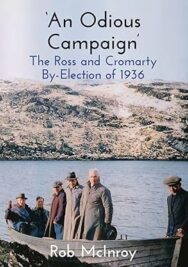
‘An Odious Campaign’: The Ross and Cromarty By-Election of 1936
By Rob McInroy
Published by Tippermuir Books
Voters in Aberdeen South and Arbroath and Broughty Ferry will soon be going to the polls for by-elections caused by the resignations of sitting members Stephen Gethins and Stephen Flynn, following their election to the Scottish Parliament in the 2026 Holyrood elections.
Meanwhile in England, electors in the Makerfield constituency will be voting in a by-election caused by the resignation of Josh Simons to allow Andy Burnham a route back to the UK parliament and, from there, the opportunity to replace Sir Keir Starmer as UK Prime Minister. Three by-elections caused by politicians resigning for essentially political reasons.
Such political machinations can irritate voters, who don’t appreciate being called on to vote outside normal political cycles (remember Brenda from Bristol – “You’re joking – not another one”?)
But they’re nothing new.
Back in 1936, Ross and Cromarty saw one of the most explosive and vituperative by-elections in British history, dubbed by the Inverness Courier an “odious campaign”, and one which lived long in the memories of those who endured it.
The 1935 general election, a matter of weeks before, had seen the National Government returned to power with a huge majority. But this masked tensions among the ruling parties which the Ross and Cromarty campaign would bring to the fore.
In particular, both Ramsay MacDonald – the National Labour former Prime Minister and architect of the National Government – and his son, Malcolm, a Cabinet Minister – lost their seats. National Labour’s representation fell to eight MPs and the National Liberals’ to 33. It was becoming difficult to portray the now massively Conservative-controlled government as truly “National” and Prime Minister Stanley Baldwin was keen to have both MacDonalds returned to parliament as soon as possible.
Ramsay MacDonald was quickly accommodated, representing the Scottish Universities. That left Malcolm MacDonald. A safe seat was required.
Ross and Cromarty had been a Liberal stronghold for a century and for twenty-five years there had been cooperation between the Liberals and the Unionists. Here was the epitome of a very safe National Government seat.
Within weeks of the election its MP, Sir Ian Macpherson, stood down due to ill-health, creating a convenient vacancy for MacDonald. The party hierarchy didn’t consult the local Liberal and Unionist associations, however, and there was fury in the Highlands at this perceived “political jobbery” foisting an outsider on the constituency. Not only that, but MacDonald was National Labour and he was being eased into a seat which should have gone to a National Liberal candidate.
Both the Liberal and Unionist Associations were split, with many refusing to countenance supporting a Socialist. A group of Easter Ross farmers telegrammed Randolph Churchill, son of Winston Churchill and a journalist with a reputation for creating political controversy, inviting him to stand as an independent Unionist candidate against MacDonald. The independent Liberals, too, sought someone to stand against him. This seemingly safe seat was quickly becoming a considerable challenge.
Eventually, MacDonald found himself campaigning against Randolph Churchill as an independent Unionist, and an independent Liberal, Welshman Dr Russell Thomas. This was potentially disastrous as it could split the National Government vote and let the Socialist in. Exactly the same thing had happened in Wavertree, Liverpool, the previous year, when the independent candidate who split the vote was none other than Randolph Churchill.
Would he do it again?
The chances seemed high because Labour fielded a high-quality candidate, Hector McNeil, who would in time become a Cabinet Minister and whose honest, passionate campaigning was much appreciated in the Highlands of Scotland.
Randolph Churchill’s campaign was astonishingly invective, consisting largely of personal attacks on Ramsay and Malcolm MacDonald. This enraged the locals and he came close to being run out of town on several occasions.
At times, the by-election descended into farce, as the candidates tried to criss-cross the vast and remote constituency in blizzard conditions. For days on end roads were all but impassable. All four candidates were involved in car crashes, Hector McNeil on an almost daily basis.
At one stage, Malcolm MacDonald was hit in the eye with a snowball and was forced to spend several days in a rest home. That didn’t greatly affect his campaigning, however, because at the same time George V died and the country was plunged into mourning, causing the campaign (supposedly) to be halted until after the funeral. Randoph Churchill even managed to turn this into a scandal.
A bizarre feature of the campaign was that, in addition to Malcolm MacDonald and Randolph Churchill, Tom Baldwin, the son of Stanley Baldwin, and Harrington Law, son of Andrew Bonar Law, were in the constituency working as journalists. Ishbel and Sheila MacDonald also campaigned on their brother’s behalf so, at various stages, six offspring of four British Prime Ministers were involved in the campaign.
Initially, campaigning centred on Westminster’s machinations and local outrage at being forced to do London’s bidding. Gradually, though, the focus shifted and the preoccupations of 1930s society began to take precedence. Agriculture was a major issue, alongside the poverty that was affecting Ross and Cromarty because of the depression and the decline in agriculture. The threat of Nazi Germany was also concerning voters.
Various trade agreements which allowed foreign imports at subsidised rates were hugely contentious and Malcolm MacDonald, as the Cabinet Minister responsible for negotiating most of these, found this both an opportunity and a challenge, with Randolph Churchill seeking to exploit local dissatisfaction.
Tariffs, preparations for war, a cost-of-living crisis. These all featured heavily in the 1936 campaign. Ninety years on, we can expect exactly the same issues to be repeated in Aberdeen and Arbroath. Plus ҫa change.
The by-election turned out to be a disaster for the Liberals, who campaigned calamitously and lost their deposit, giving an unequivocal indication of the downward trajectory of Liberalism. The Labour candidate did extremely well, however, and the Ross and Cromarty campaign heralded the beginning of Labour’s resurgence which would culminate in their 1945 election victory.
Malcolm MacDonald eventually won, and won well, but the campaign clearly showed that, whatever the entrenched views of Westminster, the country was ready for change. Thus, the Ross and Cromarty by-election can be seen as a bellwether for Britain’s changing political appetites.
Above all, Ross and Cromarty demonstrated that by-elections are an unpredictable and high-risk strategy for any governing party. Malcolm MacDonald’s supposed easy route back to Westminster came close to being ruined by a toxic combination of national, local and factional concerns.
The same thing could easily happen in Aberdeen and Arbroath. In particular, just as Randolph Churchill chose rearmament and tariffs as national issues with strong local significance in Ross and Cromarty, opposition parties will undoubtedly highlight energy, net zero and North Sea oil while campaigning in Aberdeen, seeking to cause unrest and division and split the SNP vote.
‘An Odious Campaign’: the Ross and Cromarty By-Election of 1936 by Rob McInroy (Tippermuir Books) relates the day-to-day skullduggery of an extraordinary campaign. Although ninety-years old, that campaign can teach us much about modern politics and the dangers of taking the electorate for granted.
‘An Odious Campaign’: the Ross and Cromarty By-Election of 1936 by Rob McInroy is published by Tippermuir Books and is available now, priced £11.99

ALSO ON BOOKS FROM SCOTLAND
-


The Scottish Colourists: Art & Life by Alice Strang
‘Together the quartet embodied a new spirit in Scottish art and they are celebrated as Scotland’s le …
-

David Robinson Reviews: Our Noble Selves by Kate Atkinson
‘As I suggested at the start, there’s a whole heap of plot in Our Noble Selves – spies, murders, and …
-

‘They had spoken perhaps ten sentences each and it had already begun. Moira’s resentments, her preju …
-

Ayont the Thistle by Jim Mackintosh, Alan Riach and James Robertson
‘Nane ae this then but – ma hert daen its hing/ an yon wee smile ae yours in the saft smir ae the ga …
-

David Robinson Reviews: This Door of the Seas
‘He sees what he wants to. And it makes a kind of sense too – especially to colonists from Scotland, …
-

The Broons and Oor Wullie Celebrate their 90th Birthdays!
‘Whatever the future may hold, we can be sure that The Broons and Oor Wullie will always be a part o …
FEATURED AUTHOR:
Karen Campbell

Karen Campbell is the author of nine novels. A former police officer, then Glasgow City Council press officer, she won the Best New Scottish Writer Award in 2009. She also teaches creative writing and has worked with young offenders, homeless people, r …
FEATURED PUBLISHER:
Serafina Press

Based in the Borders seaside town of Eyemouth, Serafina Press aims to produce art-driven children’s picture books. The books have a strong sense of their Scottish or North Northumberland location, but are not limited in appeal to the region – they sell …