


ABOUT THIS BOOK
PUBLISHER: University Press of New England
FORMAT: Paperback
ISBN: 9781584652106
RRP: £18.00
PAGES: 200
PUBLICATION DATE:
December 31, 2003
BUY THIS BOOK
As an Amazon Associate and Bookshop.org affiliate we earn from qualifying purchases.
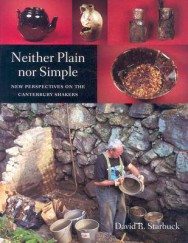
Neither Plain Nor Simple: New Perspectives on the Canterbury Shakers
David R. Starbuck
Canterbury Shaker Village, located in Canterbury, New Hampshire, just northeast of Concord, has seen more archeological research than any other Shaker community. David R. Starbuck has been digging there for over a quarter of a century. Beginning in 1978, Starbuck and his team mapped some 600 acres of the village, preparing sixty-one base maps, as well as dozens of drawings of foundations and mill features. Accompanying the maps were several hundred archeological site reports describing the history and present condition of every field, dump, foundation, wall, path, and orchard within the community. These documents offered the first comprehensive look at both the built and natural environment of any Shaker village. This above-ground study–with much updating–forms the second part of this volume. Through the 1980s, grant funding was available chiefly for above-ground recording and only rarely for excavating. Still, from the beginning Starbuck and his team speculated about what types of unexpected artifacts might be found if excavations were conducted in the Shaker dumps or in the nicely-manicured lawns behind the village’s communal dwellings. With the 1992 death of Sister Ethel Hudson, the community’s last surviving member, it seemed clear that Canterbury Shaker Village represented an unparalleled opportunity to use archeology as a cross-check on surviving nineteenth-century historical records and visitors’ accounts. The Canterbury Shakers constitute one of the very best test cases for historical archeology precisely because they were a society that tightly controlled their internal descriptions of themselves. Because we know what the Shakers expected of themselves, we can use excavations to determine whether they actually lived up to their own ideals. Excavations into various dumps began in 1994. In the Second Family blacksmith shop foundation, for example, Starbuck discovered thousands of pipe wasters–evidence that the Canterbury Shakers manufactured red earthenware tobacco pipes for sale to the World’s People. The Shakers’ hog house contained numerous ceramics and glass bottles; at another dump almost a hundred stoneware bottles for beer or ginger beer were unearthed along with whisky flasks, perfume bottles, and false teeth. These new artifacts contradict the popular image of the Shakers as plain, simple, and otherworldly, thereby challenging existing paradigms about the nature of Shaker society. Starbuck’s findings suggest that Shaker consumption practices were highly complex and that Shakers were perhaps more “human” than previously imagined. Neither Plain nor Simple, which brings together the original site maps with his most recent findings, will serve as the definitive archeological investigation of the Canterbury Shakers and their lifeways, and function as a model for similar archeological studies of communal societies.
Reviews of Neither Plain Nor Simple: New Perspectives on the Canterbury Shakers
"Because the Shakers were a religious group that believed in communal living and celibacy, and because the group was founded in the 18th century, many people have assumed that they were cloistered, rigid or austere . . . But what Starbuck has found suggests that, while they adhered to their principles, their principles may have been different than what most people have commonly believed."–Valley News (also ran in Concord Monitor)
David R. Starbuck
DAVID R. STARBUCK’s books include The Great War Path: British Military Sites from Albany to Crown Point (UPNE, 1999) and Massacre at Ft. William Henry (UPNE, 2002). He is Assistant Professor of Anthropology at Plymouth State College.
ALSO ON BOOKS FROM SCOTLAND
-


The Scottish Colourists: Art & Life by Alice Strang
‘Together the quartet embodied a new spirit in Scottish art and they are celebrated as Scotland’s le …
-

David Robinson Reviews: Our Noble Selves by Kate Atkinson
‘As I suggested at the start, there’s a whole heap of plot in Our Noble Selves – spies, murders, and …
-

‘They had spoken perhaps ten sentences each and it had already begun. Moira’s resentments, her preju …
-

Ayont the Thistle by Jim Mackintosh, Alan Riach and James Robertson
‘Nane ae this then but – ma hert daen its hing/ an yon wee smile ae yours in the saft smir ae the ga …
-

David Robinson Reviews: This Door of the Seas
‘He sees what he wants to. And it makes a kind of sense too – especially to colonists from Scotland, …
-

The Broons and Oor Wullie Celebrate their 90th Birthdays!
‘Whatever the future may hold, we can be sure that The Broons and Oor Wullie will always be a part o …
FEATURED AUTHOR:
Akemi Dawn Bowman

Akemi Dawn Bowman is the author of William C. Morris Award Finalist Starfish, Summer Bird Blue, and Harley in the Sky. Her sci-fi series, The Infinity Courts, was published in 2021, followed by her middle-grade debut, Generation Misfits. A proud Ravenc …
FEATURED PUBLISHER:
Vagabond Voices

Vagabond Voices is an independent publisher based in Glasgow, committed to introducing new titles from Scottish authors and translating fiction from other languages. We also publish poetry and polemics. Our carefully selected list aims to reflect liter …