


ABOUT THIS BOOK
PUBLISHER: Bloomsbury Publishing PLC
FORMAT: Electronic book text
ISBN: 9781472522245
RRP: £25.99
PUBLICATION DATE:
April 10, 2014
BUY THIS BOOK
As an Amazon Associate and Bookshop.org affiliate we earn from qualifying purchases.
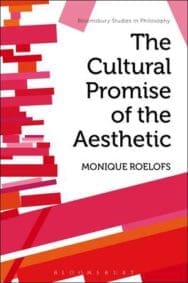
The Cultural Promise of the Aesthetic
Monique Roelofs
Aesthetic desire and distaste prime everyday life in surprising ways. The Cultural Promise of the Aesthetic casts much-needed light on the complex mix of meanings our aesthetic activities weave into cultural existence.Anchoring aesthetic experience in our relationships with persons, places, and things, Monique Roelofs explores aesthetic life as a multimodal, socially embedded, corporeal endeavor. Highlighting notions of relationality, address, and promising, this compelling study shows these concepts at work in visions of beauty, ugliness, detail, nation, ignorance, and cultural boundary. Unexpected aesthetic pleasures and pains crop up in sites where passion, perception, rationality, and imagination go together but also are in conflict. Bonds between aesthetics and politics are forged and reforged.Cross-disciplinary in outlook, and engaging the work of theorists and artists ranging from David Hume to Theodor W. Adorno, Frantz Fanon, Clarice Lispector, and Barbara Johnson, The Cultural Promise of the Aesthetic lays open the interpretive web that gives aesthetic agency its vast reach.
Reviews of The Cultural Promise of the Aesthetic
Monique Roelofs's The Cultural Promise of the Aesthetic is important because it analyzes the concepts of "address" (as a widespread social phenomenon and a carrier of meaning) and "aesthetic relationality" (relations with people mediate relations with things, and relations with things mediate relations with people) and the connection between them (i.e., modes of address constitute the muscles and joints of aesthetic relationality) in ways that restore the "promise" of aesthetics as a promise of culture. These concepts are vital in aesthetics but also in contemporary feminism, race theory, political theory, and other areas of cultural critique intersecting with aesthetics. Often these intersections are mostly negative and aesthetics has often been left out of the picture. But if we reconceive aesthetics as Roelofs proposes, we will recognize that it is needed for cultural critique and for culture itself – hence the promise of aesthetics. Using a variety of examples from (mostly) contemporary art, Roelofs makes these points clearly and develops the key concepts of address, relationality, and promise in inspired ways. — Michael Kelly, Professor of Philosophy, University of North Carolina at Charlotte, USA and Editor-in-Chief of the Encyclopedia of Aesthetics (2nd ed. 2014)
Monique Roelofs
Monique Roelofs is Associate Professor of Philosophy at Hampshire College, USA.
ALSO ON BOOKS FROM SCOTLAND
-


The Scottish Colourists: Art & Life by Alice Strang
‘Together the quartet embodied a new spirit in Scottish art and they are celebrated as Scotland’s le …
-

David Robinson Reviews: Our Noble Selves by Kate Atkinson
‘As I suggested at the start, there’s a whole heap of plot in Our Noble Selves – spies, murders, and …
-

‘They had spoken perhaps ten sentences each and it had already begun. Moira’s resentments, her preju …
-

Ayont the Thistle by Jim Mackintosh, Alan Riach and James Robertson
‘Nane ae this then but – ma hert daen its hing/ an yon wee smile ae yours in the saft smir ae the ga …
-

David Robinson Reviews: This Door of the Seas
‘He sees what he wants to. And it makes a kind of sense too – especially to colonists from Scotland, …
-

The Broons and Oor Wullie Celebrate their 90th Birthdays!
‘Whatever the future may hold, we can be sure that The Broons and Oor Wullie will always be a part o …
FEATURED AUTHOR:
T.F. Muir

Born in Glasgow and now a dual UK/US citizen, T.F. Muir is the author of the DCI Andy Gilchrist series – the first of which, Eye For An Eye, won the Pitlochry Award for the best crime novel by an unpublished writer, and the second, Hand For A Hand, con …
FEATURED PUBLISHER:
Hachette UK

Hachette UK is the UK’s second largest book publishing group. The award-winning adult publishing divisions are Orion; Little, Brown; John Murray Press; Hodder & Stoughton; Headline; Quercus; Octopus, and Bookouture. They publish fiction and non-fic …