


ABOUT THIS BOOK
PUBLISHER: Johns Hopkins University Press
FORMAT: Paperback
ISBN: 9780801863585
RRP: £16.50
PAGES: 224
PUBLICATION DATE:
March 1, 2000
BUY THIS BOOK
As an Amazon Associate and Bookshop.org affiliate we earn from qualifying purchases.
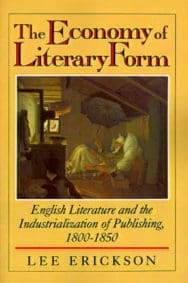
The Economy of Literary Form: English Literature and the Industrialization of Publishing, 1800-1850
Lee Erickson
In the first half of the 19th century technological developments in printing led to the industrialization of English publishing, made books and periodicals affordable to many new readers, and changed the market for literature. This work analyzes the effect on literary form as authors and publishers responded to the new demands of a rapidly expanding literary marketplace. These developments offer a new understanding of the differences between Romantic and Victorian literature. As publishing became more profitable, authors became able to devote themselves more professionally to their writing. The changing market for literature also affected the relative cultural status of literary forms. As poetry became less profitable, it became hard to publish. As periodicals grew in popularity, essays became the centre of reviews, and their authors the arbiters of culture. The novel, which had long sold chiefly to circulating libraries, found an outlet in magazine serialization – and novelists discovered a new popular audience.With chapters on William Wordsworth, Thomas Carlyle, and Jane Austen, as well as on specific literary genres, this study seeks to provide a synthesis of recent publishing history which helps to explain the differences and continuities between Romantic and Victorian literature. It should be of interest not only to literary critics and historians but also to bibliographic historians, cultural or economic historians, and all who have an interest in the commercialization of English publishing in the 19th century.
Reviews of The Economy of Literary Form: English Literature and the Industrialization of Publishing, 1800-1850
"The Economy of Literary Form is, for all the modesty of its historical sample, a major contribution to its field… a useful and original book." — John Sutherland, Times Literary Supplement
ALSO ON BOOKS FROM SCOTLAND
-


The Scottish Colourists: Art & Life by Alice Strang
‘Together the quartet embodied a new spirit in Scottish art and they are celebrated as Scotland’s le …
-

David Robinson Reviews: Our Noble Selves by Kate Atkinson
‘As I suggested at the start, there’s a whole heap of plot in Our Noble Selves – spies, murders, and …
-

‘They had spoken perhaps ten sentences each and it had already begun. Moira’s resentments, her preju …
-

Ayont the Thistle by Jim Mackintosh, Alan Riach and James Robertson
‘Nane ae this then but – ma hert daen its hing/ an yon wee smile ae yours in the saft smir ae the ga …
-

David Robinson Reviews: This Door of the Seas
‘He sees what he wants to. And it makes a kind of sense too – especially to colonists from Scotland, …
-

The Broons and Oor Wullie Celebrate their 90th Birthdays!
‘Whatever the future may hold, we can be sure that The Broons and Oor Wullie will always be a part o …
FEATURED AUTHOR:
Gordon Brown

Gordon Brown served as Prime Minister of Britain from 2007 to 2010, during which time he is widely credited with having prevented a second Great Depression in the wake of the financial crash. Previously, he was Britain’s longest-serving Chancellor from …
FEATURED PUBLISHER:
Edinburgh University Press

Connecting people and ideas to inspire creative thinking, open new perspectives and shape the world we live in. Our ambition is to create a community of authors, editors, advisors and practitioners committed to publishing world-class academic research …