


EXPLORE ISSUES



Ten years will not be enough to restore Scotland to where it was in the past…
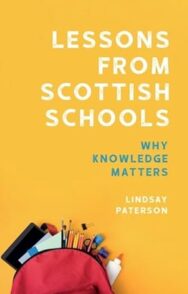
In Lessons from Scottish Schools, Lindsay Paterson embarks on an exploration of what we can learn from the past to improve the education of tomorrow. We asked him a few questions about his inspiration behind the book and what he thinks the future of education may look like.
Lessons From Scottish Schools
By Lindsay Paterson
Published by Edinburgh University Press
What inspired you to write this book; what were you hoping to explore in your research and writing?
Two things provoked me into thinking that a book might be a useful contribution to debate. One was the most obvious – the steady decline in Scotland’s scores in the internationally respected Programme for International Student Assessment (the PISA studies). These have been run by the OECD mostly every three years since 2000, and test 15-year-old students in reading, mathematics and science. In the most recent round (2022) the survey covered more than half the countries in the world, sampling in a carefully scientific way around 700,000 students. In the first round in 2000, Scotland was well above average, but its position has steadily declined. Why was this happening?
The second motive for the book was the contrast between this decline and the results of previous trends, up to the mid-1990s. Scotland’s system of comprehensive secondary schools – that is, with no selection test on entry –raised attainment while also reducing social inequalities of attainment with respect to sex, religion, ethnicity and socio-economic circumstances. I had brought together research on this in a previous book (Education and Society in Scotland since 1945, EUP, 2023). The main point was that this success had been based on a persistently academic curriculum, taking forward into a more democratic age the long Scottish tradition of highly academic schools staffed by academically expert teachers. This tradition has been called democratic intellectualism. That resonant term was inaccurate as a description of how the system operated up to the 1960s, but it was an authentic label for the aspirations that informed the development of the comprehensive-schools from the 1970s onwards. The new curriculum that was put in place between 2004 and 2010 – the Curriculum for Excellence – deliberately sought to overturn this tradition.
Did you find what you were expecting in researching your book? Did your views on Scotland’s education change during the process? Is there a recognisable pattern to our decline?
The recognisable pattern then emerged by bringing these two background reasons together and speculating that the reason for the recent decline might be the shift away from the old academic curriculum.
We can never be sure, because the Scottish government did not conduct any rigorous trials of the new curriculum before it was implemented. They did not even collect any baseline data on students’ attainment against which to compare the subsequent trends, and they abolished all the existing Scottish surveys of student progress (some of which dated back to the 1930s, and all of which had been in place in some form since the 1960s). The government also withdrew Scotland from two other large-scale international studies of children at primary school and in early secondary. That left only PISA. This is unsatisfactory because a survey only of 15-year-olds cannot tell us what schools have contributed to students’ learning.
Nevertheless, the PISA studies do allow us to set the Scottish experience at mid-secondary level in an international context. That comparison, as discussed in the book, suggests that the new curriculum is very likely to be at least a large part of the explanation of the decline.
Your book suggests that the implementation of the Curriculum for Excellence is flawed. How do you think it could be adapted to improve our educational standards? Do you think earlier approaches to educational provision still have relevance?
The book concludes that a modernised version of the previous Scottish tradition is the best way forward. Recent neuroscientific research on how people learn is the clue to this. That research has shown the importance of knowledge – not as a list of dry facts, but as a structure of explanations, which psychologists call schemas. The facts matter, but, in the curriculum, mainly as a way into the schemas. Consider, for example, the schema of photosynthesis. That concept provides a unifying explanation of how most plants harvest energy from the sun, water and carbon dioxide. In early primary school, pupils would encounter this informally through studying individual plants. The purpose of teaching these facts would be gradually to build up an intuitive sense of how photosynthesis works. In successful education systems – such as in Singapore and Estonia – that intuition is then formalised in the later years of primary school into a grasp of the general explanatory schema that we call photosynthesis. When the pupil has grasped that, then recognising photosynthesis in any new plant species is far easier.
The idea of schemas is crucial for education because it enables us to put things into our memories and to recall them later. Learning is about the long-term memory, which has infinite capacity. But the only way into that is our working memory, which is tiny: most of us can hold at most about half a dozen things in it at any one time. The research shows that, once a schema is in long-term memory, then new facts are much easier to pass through the working memory into long-term memory because we assimilate the new fact into the stored schema. Recalling schemas is also the most effective way of bringing old memories back to life. For example, if we have the schema for photosynthesis and we want to understand a new plant that we have never seen before, we will learn about that plant more efficiently if we recall the general rules of photosynthesis and apply these to this new situation.
The importance of schemas also shows the importance of disciplines, or subjects of study. The schemas of botany are obviously not the same as those of, say, history. The schemas of practical subjects – sport, music, technology – are different again. Schemas may be thought of in a cultural sense as the residues of hundreds of years of human thought and practice, from all parts of the world. Disciplines are not arbitrary, as is sometimes alleged. They are the fruits of careful refinement, always changing but only ever changing on the basis of reinterpreting the best that has been passed on from the past.
The Scottish tradition which the Curriculum for Excellence has displaced aimed to follow that kind of sequence. But, if it is the clue to how to proceed, it would have to be modernised in two main ways. One is recovering what was gradually being developed in the 1970s and 1980s – a way of packaging schemas etc for almost the full range of ability, not only for a highly selected few. The other updating is to take account of another strand of recent research, on teaching. The most effective kind of teaching is where the teacher leads – setting the agenda, asking questions all the time (thus training pupils’ memories), and letting pupils work on their own or in groups only for short periods and then returning to whole-class teaching to emphasise the schemas that are being learnt.
This way of teaching requires that the teacher knows each student individually, and so it can be described as student-centred. It is quite different from the student-centredness that pervades the Curriculum for Excellence, where students are encouraged to discover things for themselves, and even to decide what to study. All recent rigorous research shows that giving students that freedom is inefficient, and is likely to lead them into errors of understanding. Only the authoritative teacher who has a deep understanding of the relevant schemas can lead the students to the correct meanings. Anything else also widens inequalities, because the students who have well-educated parents get the schemas at home, thus giving them an advantage over those whose parents have not themselves had the opportunity to develop that kind of understanding.
Scottish policy in the past two or three decades neglects all of this. The Curriculum for Excellence is not based on the structured schemas of disciplines. It does not present the details – the syllabus – with which teachers might build up students’ conceptual understanding. It extols cross-curricular projects and skills without paying adequate attention to the dependence of both of these on disciplinary knowledge. It has not been accompanied by any understanding of how teachers can lead learning by strongly structuring what happens in their classrooms. Much of this absence in the Curriculum for Excellence has come across to teachers themselves as a frustrating vagueness – a total lack of clarity on what the curriculum and each strand in it is expecting students to learn.
You look at educational provision from countries as varied as Finland, Ireland, Korea and New Zealand. What ideas from other countries do you think could work in Scotland?
Comparison of education policy with other countries can never be definitive, because too many other things vary at the same time – labour market, policies on poverty and opportunity, patterns of migration, social structure, wider culture, and long-established traditions. But considering other countries can always help to cast light on the debate in any particular country. Analysing recent trends in 13 other education systems – from nearby (England, Ireland), to the other side of the world (New Zealand, Singapore, Japan, South Korea) – allowed the debates about knowledge and teaching to be clarified. These comparisons confirmed the importance of structured knowledge and of the effectiveness of teacher-led student-centredness. Countries which, like Scotland, have moved away from an academic tradition have declined. Those which have subsequently moved back to teacher-led knowledge have recovered. Moreover, a recurrent finding is that wider social culture can restrain any political attempts to overturn the place of knowledge or the importance of teacher leadership.
We’re sure many educators will be able to relate to the challenges you present. How can teachers find their voice in presenting solutions?
Despite all the evidence that is presented in the book, any idea of yet another new curriculum imposed from above would be deeply unwelcome to teachers, who have struggled with the vagueness of the Curriculum for Excellence, on top of the pressures caused by the Covid pandemic, by rising levels of indiscipline, and by much worse student absence than in the past.
Nevertheless, perhaps the one important advantage of the Curriculum for Excellence is that it encourages schools to be innovative. Already, some schools have been trying to develop a more knowledge-based and teacher-led curriculum, with good results. So that is the best way ahead. It requires the Scottish government and its educational agencies to encourage experiments of this kind, especially by disseminating to teachers research information about why knowledge and teacher leadership are important. Schools also have to be provided with resources to evaluate their innovations properly, and to discuss their experiences with other schools who are also innovating and evaluating. None of this need cost much. It puts teachers in charge of where Scottish education goes next.
What do you hope Scottish education looks like in ten years’ time?
The best outcome would be a gradual return to a knowledge-based curriculum, but now based on what we know from research about the importance of schemas, of memory, and of student-centred teacher leadership. Ten years will not be enough to restore Scotland to where it was in the past, even the quite recent past of the 1990s. But, by a decade from now, it should at least be clear whether the country is once again on the right track.
Lessons From Scottish Schools is published by Edinburgh University Press and is available now, priced £19.99
RELATED BOOKS

ALSO ON BOOKS FROM SCOTLAND
-


The Scottish Colourists: Art & Life by Alice Strang
‘Together the quartet embodied a new spirit in Scottish art and they are celebrated as Scotland’s le …
-

David Robinson Reviews: Our Noble Selves by Kate Atkinson
‘As I suggested at the start, there’s a whole heap of plot in Our Noble Selves – spies, murders, and …
-
‘They had spoken perhaps ten sentences each and it had already begun. Moira’s resentments, her preju …
-

Ayont the Thistle by Jim Mackintosh, Alan Riach and James Robertson
‘Nane ae this then but – ma hert daen its hing/ an yon wee smile ae yours in the saft smir ae the ga …
-

David Robinson Reviews: This Door of the Seas
‘He sees what he wants to. And it makes a kind of sense too – especially to colonists from Scotland, …
-

The Broons and Oor Wullie Celebrate their 90th Birthdays!
‘Whatever the future may hold, we can be sure that The Broons and Oor Wullie will always be a part o …
FEATURED AUTHOR:
Iain Maloney

Iain Maloney is the author of eight books, including the critically acclaimed The Only Gaijin in the Village (Birlinn, 2020), a memoir about his life in rural Japan. He is also a freelance editor and journalist, mainly for The Japan Times. He was born …
FEATURED PUBLISHER:
Edinburgh University Press

Connecting people and ideas to inspire creative thinking, open new perspectives and shape the world we live in. Our ambition is to create a community of authors, editors, advisors and practitioners committed to publishing world-class academic research …