


EXPLORE ISSUES



‘I trust Strang when he says that we need the old folk tales from a time when our ancestors lived in greater harmony with the world around them, even those of us who are too old or weak or inured to city comforts to follow in his footsteps.’
Dougie Strange’s The Bone Cave is a mesmerising journey through remote Scotland, full of myth and self-reflection. David Robinson dives deep into this unique and memorable debut in his latest review.
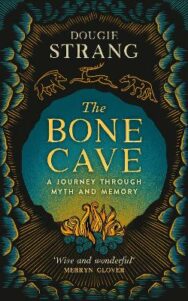
The Bone Cave
by Dougie Strang
Published by Polygon
In Danny Boyle’s 1996 film Trainspotting, Spud, Renton, Sick Boy and Tommy only make it a few hundred yards into The Great Outdoors from Corrour Station before they turn back, after Renton’s iconic speech about the miserableness of being Scottish, to heroin and Leith. Although the scene isn’t in Irvine Welsh’s original novel, it has all the pathos, anger and comedy needed for serious semiotic oomph.
Tommy, you may recall, wanted to climb Leum Uilleum, the Corbett straight in front of them as they get off the train, not that he knows its name, or has a map, boots or anything else that might help him. The others have even less. Spud, in long-sleeved T-shirt and trainers, carrying cans of Special Brew in a plastic bag, tries to reason with Tommy. ‘It’s just not natural, man,’ he implores. And he’s right: in his world, it’s not. To him, getting out of his head is natural; walking across a desolate landscape such as Rannoch Moor is not.
Dougie Strang’s The Bone Cave takes the opposite point of view: that it’s our way of living, our attitude to land ownership and our ignorance of the past that are unnatural. These conclusions, however, only emerge as a by-product of his primary aim – to use his knowledge of Scottish myth and folklore to uncover a country that is half-hidden from most of us who live in it.
His journey into Scotland’s deep past both starts and finishes not too far from Corrour. Indeed, had Renton and the gang only wandered a few hundred yards from the station platform, they could have picked up echoes of it in the name of the stream flowing down the western flank of Beinn a’ Bhric, the slightly higher summit adjoining Leum Uilleum. Allt Nighean Mhic Dhomnuill means The Stream of Donald’s Granddaughter, the Donald in question being a 16th century poet from Fersit called Brown-Eyed Donald, a deer hunter who apparently found favour with the Cailleach, the witchy spirit of the wintry mountains.
Strang, who has studied folklore at Edinburgh University, knows that the Cailleach is both more and less than that, an elusive figure named in countless Highland streams, lochs and mountains, who is both a land-shaping giant (the Hebrides originated when a few boulders slipped from her apron, Corrievreckan whirlpool is where she washed her clothes) and the old crone of winter. With so many overlapping myths, it would be all too easy for a book such as this to end up as a mash-up of pre-Celtic woo-woo, so Strang concentrates on ‘the one tradition that seems to be aboriginal to the Highlands’: the Cailleach who mediates between the deer and the hunter, who has to be propitiated for there to be any chance of a venison benison.
All of which takes us back to Beinn a’ Bhric – which seems, judging by all the place-specific references, to have been a particular haunt of the Cailleach – and Donald of the Brown Eyes. In one of the stories set there, the Cailleach gives him the choice of whether he wants the sense of sight or of smell to be taken away from any deer he hunts. (He chooses sight, or the ability to stalk upwind without being seen.) The Cailleach then warns him that when he has gralloched his last stag, he will find a ball of yarn in its belly. In countless other stories, the hunted deer turns into a woman, and vice versa.
What are we to make of all this? Well, says Strang, the story of Donald’s last deer and the ball of wool could be a reference to the coming of sheep farming. And all those shape-shifting deer? That’s something we can find in folktales throughout the world, where the hunter has to think like – indeed, almost be – the animal he is hunting.
Now I’m a townie born and bred, and I might not have emotionally understood much of this had I not once, on a Cairngorm hillside, seen a herd of about a hundred deer from relatively close up, and then watched as they caught our scent, turned as one, and charged away from us. Not only was this one of the most magnificent sights I have seen, but it took me, briefly, out of my own time. Suppose I was a Mesolithic hunter, I wondered, just how would I be able to kill such a fast-running animal?
Clearly, I would have to think like a deer, and need all the help of whatever spirits I could hope to find. Today, I might not believe that an actual person called Donald of the Brown Eyes sat down with the Cailleach on a ridge of Beinn a’ Bhric and shared a meal with her, as one of the folk tales insists. Nor does Strang. But Mesolithic me might well have suspected that deer came into my world from Rannoch Moor, and that Beinn a’ Bhric somehow guarded them. Maybe there was a spirit there called the Cailleach, and what harm could it do trying to get on her good side? The very existence of places on or near the mountain like Fuaran Cailleach Beinn a’ Bhric (Well of the Old Woman of Beinn a’ Bhric), or The Witch’s Stone, or the Cailleach’s Grave – get a good map and they’re all on it – shows that many people since then must have thought the same thing. Our hunting ancestors would have known all about waymarkers like these, but today we have forgotten about them: when Strang visits the Cailleach’s Grave, all he finds there is a Homer Simpson badge, a toy car and a plastic vampire bat, left there because it is now a Geocache site for GPS users.
By this stage, we have already followed Strang on a month-long journey across the remoter parts of Scotland, often wild camping, occasionally hitching, and generally walking in places where he hardly ever sees a soul. He has deliberately left his mobile phone behind, along with a 21st century mindset. Instead, he is on the lookout for a hidden Scotland where folktales and myths surface in the landscape, searching out what Hamish Henderson called the ‘carrying stream’ – the deeper current of folk culture.
Sometimes, this can be dispiriting. At Arisaig, searching for driftwood for a fire at a place with many fond memories, he finds instead ‘new raised beaches of plastic’. On Mull, a historic healing well has been demolished by a landlord’s JCB. Even the Glen Orchy shepherd’s cottage where the Gaelic poet Duncan Ban MacIntyre used to live is now full of cans of pesticide. Caravanners clog the roads searching out places where scenes from Outlander were shot, the hills ‘bristle’ with wind turbines, the Beauly-Denny power line scars the land.
But look again. The hills may be denuded, the valleys emptied, the land mismanaged, biodiversity threatened and so much of our lives given over to getting and spending that we fail to notice the sheer beauty of the world around us. Yet when we do, there is still hope. I’ll trust Strang – a fine writer, by the way – when he writes about how wild camping in Glen Affric, swimming on a remote loch, or watching owls hunt at dusk restores an inner balance in himself. I trust him too when he says that we need the old folk tales from a time when our ancestors lived in greater harmony with the world around them, even those of us who are too old or weak or inured to city comforts to follow in his footsteps.
And although there is far more to his book than stories of deer-hunting Donald and the Cailleach, I hope you will forgive me if I return to Corrour Station. The stories go that Donald of the Brown Eyes was, in his later years, looked after by his granddaughter, and that his grave was beside the stream named after her. Yet when Strang goes to Beinn a’ Bhric, he can’t find any sign of anything that could be Donald’s grave. Then he looks up at the mountain and realises that all of it is Donald’s grave. The stream – The Stream of Donald’s Granddaughter – is her tears. ‘This is how myth dwells in the land,’ he writes. ‘This is the dreaming of the ancestors.’
And this, I should remind you, is just yards away from where Renton made that speech about how shite it was to be Scottish. It’s not. If you follow Strang in reading the landscape ‘in a new – or rather very old – way’ it’s anything but.
The Bone Cave by Dougie Strang is published by Birlinn, priced £14.99.
RELATED BOOKS

ALSO ON BOOKS FROM SCOTLAND
-


Lessons From Scottish Schools: A Q & A with Lindsay Paterson
Ten years will not be enough to restore Scotland to where it was in the past…
-

Saltwater: A Midsummer Ghost Story by Elaine Thomson
‘The very thought of those grey faces made my skin grow cold.’
-

‘An Odious Campaign’ by Rob McInroy – Why a 1936 By-Election Still Resonates
‘This enraged the locals and he came close to being run out of town on several occasions.’
-

‘‘That’s right, Bobby,’ he growled. ‘I haven’t seen you in – well, since you decided to kill me.’ ‘
-

David Robinson Reviews: Solitary Agents by David Goodman
‘This is very much an up-to-the-minute story of spycraft, positively revelling in all the things tha …
-

The Savage Landscape by Cal Flyn
‘It is their resistance to the intrusions of the outside world − culturally, economically, environme …
FEATURED AUTHOR:
Juliet Conlin

Juliet Conlin was born in London and grew up in England and Germany. She holds an MA in Creative Writing from Lancaster University and a PhD in Psychology from the University of Durham. She works as a writer and translator and lives with her husband an …
FEATURED PUBLISHER:
Edinburgh University Press

Connecting people and ideas to inspire creative thinking, open new perspectives and shape the world we live in. Our ambition is to create a community of authors, editors, advisors and practitioners committed to publishing world-class academic research …