


EXPLORE ISSUES



‘While it felt as if more people than ever were talking about DEI, I grew sceptical as to whether the volume of conversation was having a positive impact on LGBTQ communities suffering the most as a result of badly designed systems.’
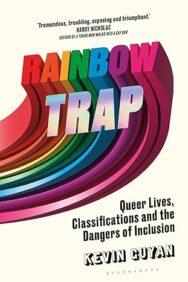
Kevin Guyan’s Rainbow Trap is an enlightening exploration of how social categorisation systems work, particularly within the LGBT community, and how they help and hinder genuine inclusion efforts. This extract shows the author’s own contemplation of societal change as he celebrates his wedding day.
Rainbow Trap: Queer Lives, Classifications and the Dangers of Inclusion
By Kevin Guyan
Published by Bloomsbury
I hadn’t given much thought to the intersection of classifications and LGBTQ lives until my wedding day. In fact, I had never imagined the possibility of getting married. I grew up in the Scottish city of Aberdeen and coming out as gay in the late 2000s felt like putting myself in a box outside the system that sorted everyone else I knew. Gone were the expected milestones of wife, children and house in the suburbs. Nobody knew (myself included) what life-defining moments were now on my horizon. I went to university, my on-ramp for a queer life, and quickly realized that existing outside the main sorting system meant the parties were more fun, the relationships more intense and the outfits far more wild. So it was a peculiar afternoon to find myself in the back seat of a London Black Cab squeezed between my mum, dad and soon-to-be husband just seven months after same-sex marriage was legalized in England and Wales. As we pulled up to the side of the road, I slipped cash under the plastic guard and asked Andrés, ‘Are you ready?’ He focused his dark eyes on me and replied, ‘Let’s go.’ I swung open the door and excitedly stepped out into the leafy square. We felt hopeful that social attitudes towards men marrying men and women marrying women were moving in a more positive direction. Andrés and I were being invited into a system that had, until recently, kept people like us on the outside. On arrival, we were ushered into a wood-panelled back room to meet the Registrar for our ceremony. We could hear the excited chatter of friends and family as they took their seats in the room next door. Younger me had never rehearsed this moment but I felt ready and excited for the future that lay ahead. Yet, looking through the documents in front of us, something seemed wrong. The olive-green form that would become our marriage certificate asked us to write our names, ages and whether we were previously married – questions we had expected to answer. But, at the far edge of the document, were two boxes for the ‘Rank or profession’ of our fathers. Men marrying men writing about the employment history of men. It instantly became clear some archaic requirements of the system remained stubbornly in place.
In sharing vows and exchanging rings, we were about to embark on something that changed who we were as gay men – to ourselves, each other and the wider world. Although our ceremony meant something to us, I was unsure what our actions said about the political and social possibilities of queer lives. In 2012, the cultural historian Lisa Duggan described marriage equality as ‘the singularly representative issue for the mainstream LGBT rights movement, often standing in for all the political aspirations of queer people’. In the late 1990s – when same-sex marriage remained an unlikely possibility among campaign groups in the UK and the United States – gay cultural critic Leo Bersani lambasted the pursuit of marriage and referenced Foucault’s hope that homosexual love could bring about ‘new alliances’ and offer a blueprint for a new ‘way of life’. For Duggan, Bersani and Foucault, rather than expanding our horizons, marriage impoverished our ability to imagine LGBTQ lives that depart too radically from the straight, status quo. With our friends and family waiting patiently for us to take our spots at the top of the aisle, what possibilities (or new ‘way of life’) had Andrés and I abandoned to gain access to a system that, just a few months prior, did not want us?
***
Andrés and I now live in Edinburgh, Scotland and – over the past decade – I have worked as a researcher investigating how UK organizations, businesses and workplaces respond to inequities associated with gender, sex and sexuality. You are likely familiar with DEI interventions such as unconscious bias training, staff networks, pronoun badges, celebration months, allyship schemes and rainbow lanyards. While it felt as if more people than ever were talking about DEI, I grew sceptical as to whether the volume of conversation was having a positive impact on LGBTQ communities suffering the most as a result of badly designed systems. Time and time again I encountered good-intentioned individuals who refused to consider how bigger questions of history, politics and power limited what inclusive interventions could actually achieve. Eyes rolled when I questioned whether ‘debate’ will resolve opposition between trans communities and anti-trans campaign groups or if we really need yet another staff survey to capture more data about the negative experiences of queer employees. My most heated arguments did not involve fascists on the far right or those burning the progress flag at a Pride parade. They were white, middle-class liberals – people like me. Yet, liberal faith in DEI fixes was not matched by evidence of the world around us: the UK has plummeted in international LGBTQ rankings, the number of reported hate crimes against queer communities has rocketed and the Council of Europe singled out the UK (alongside Hungary, Poland, Turkey and Russia) for specific condemnation in its report on attacks to LGBT rights.65 I also sensed an insidious thread running through calls for more of the same, an unsaid discomfort with the direction of change and suggestion that the situation for queer people was ‘good enough’. What I saw among those working in the DEI industry was a dawning realization that access to same-sex marriage, basic legal protections and improved visibility was the start rather than the end for this queer political project. Queer people wanted more. And well-meaning straight people stood in the way.
I had another niggle I could not shake off – an irritation that has niggled a long history of queer thinkers and doers – people’s quickness to celebrate the idea of ‘being included’. While promoting my first book Queer Data I was surprised by the level of enthusiasm among LGBTQ people to share information about their sexual orientation and gender identity with the state even though exercises like the census had run for over 200 years in the UK and, until recently, failed to count people who were not straight and cisgender. Inclusion has become a rallying cry for many LGBTQ equalities organizations, which discounts the risks of being brought into settings that historically ignored or actively excluded us. For example, disability justice writer Mia Mingus has argued that when inclusion exclusively relates to logistics – for example, adding ramps for wheelchair users – then the underpinning ableist culture, which previously did not recognize an inaccessible space as a problem, remains undisrupted. Queer/trans disability studies scholar J. Logan Smilges also calls attention to how a too concerted ‘focus on individuals’ access needs distracts from the messier, meaner, and more systemic ways that ableism operates in our world’ and asks, ‘Does the energy we spend demanding access secure the kind of liberation we want it to?’
The individuals selected for inclusion tend not to deviate from dominant gender, sex and sexuality norms or cause too much trouble – they offer the most tolerable form of diversity. Furthermore, the inclusive interventions that brought them into the system are presented back to minoritized communities as ‘evidence’ that structural or systemic inequities are being addressed. Inclusion invites more people in but rarely considers the negative experiences of those already on the ‘inside’, nor does it acknowledge the box breakers who fail to satisfy the entry requirements or refuse the invitation. When we set our sights on gaining access to long-established systems, slipping standards and a race to the bottom mean we ultimately set a low bar for progress.
Political objectives feel as if they are changing. Increasingly intersectional and inspired by individuals born around the millennium, many queer activists are ambivalent about the objective of ‘being included’ in long-established systems. In this book’s investigation of six systems, I disrupt easy thinking about the ‘promise of inclusion’ and irritate this fissure so that it reveals what ‘being included’ also excludes. This objective goes against the grain, particularly among practitioners working in the DEI industry. Stating that inclusion invites benefits and harms, and these outcomes are not equally distributed across or within minoritized communities does not undo the good deeds of diversity workers and LGBTQ activists. Rather, it sharpens our critical faculties and creates opportunities to expose how some inclusive interventions – and their reliance on classifications – require us to take a medicine that prolongs, rather than shortens, our suffering.
Rainbow Trap: Queer Lives, Classifications and the Dangers of Inclusion by Kevin Guyan is published by Bloomsbury, priced £20
RELATED BOOKS

ALSO ON BOOKS FROM SCOTLAND
-


The Pocketbook Guide to Scottish Superheroes
‘I had seen a lot of weird shit in my job. Ballpoints turning into tulips, words blurring then trick …
-
In the Shade of the Peepal Tree by Selinder Narwan
‘I stepped back, holding my chunni over my mouth. Panic started to build up inside me; I needed to g …
-
‘It is the same with his poems and short stories, the crystalline and precise language; the way they …
-

Flight Patterns by Lorna J. Waite: An Appreciation by Janette Ayachi
‘I’ve recently heard poetry archives described as ‘fugitive, ephemeral’, but here the wish of collec …
-

The Scottish Colourists: Art & Life by Alice Strang
‘Together the quartet embodied a new spirit in Scottish art and they are celebrated as Scotland’s le …
-

David Robinson Reviews: Our Noble Selves by Kate Atkinson
‘As I suggested at the start, there’s a whole heap of plot in Our Noble Selves – spies, murders, and …
FEATURED AUTHOR:
Muriel Spark

Muriel Spark was the grande dame of Scottish letters. A prolific writer, she has produced over twenty novels as well as works of poetry, drama, biography, non-fiction and children’s stories. Spark was born Muriel Camberg in Edinburgh in 1918 and educat …
FEATURED PUBLISHER:
Serafina Press

Based in the Borders seaside town of Eyemouth, Serafina Press aims to produce art-driven children’s picture books. The books have a strong sense of their Scottish or North Northumberland location, but are not limited in appeal to the region – they sell …