


EXPLORE ISSUES



‘It is the same with his poems and short stories, the crystalline and precise language; the way they could never be; on a first read, second-guessed, the knowledge that no-one else could ever have written them, or conceived their twists and turns. He, and his voice, will be hugely missed.’
Last week, the award-winning poet and academic Douglas Dunn passed away. The North Sea Poet collective published a beautiful tribute with contributions from his peers, friends, colleagues and former students. You can read the full tribute here. We at BooksfromScotland greatly appreciate their generosity in allowing us to share a selection of these rememberances.
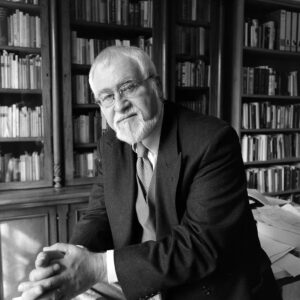
Photo credit: ©Norman McBeath RSA
Remembering Douglas
The last time we ate in the chatelaine’s garden
you were already somewhere further off but still
in hailing distance. Plans were made to live
that afternoon again before the autumn closed us in.
That was in August, when as once you wrote
the door of a refrigerator opens far away.
Now you are gone, your art, your suffering,
and memory turns back to face necessity.
How terrible it was to be a man, to sign
your name beneath her printed name
as death required, then step outside again
to find the people going quietly
about their business, keeping an eye
on the clock and an ear to the heart
obediently beating time. Could that be possible?
Sensible, commonplace, beyond understanding.
Still you returned, to literature and jazz,
to children and a teacher’s passion to impart
the seriously beautiful and damn the charlatans.
A new love flowered late. This was the life, my friend,
as surely as a book would open in your hand
its passport made of time; as surely as your clarinet
lay waiting near the music stand, as surely
as the ghost of Adolphe Saxe is heard in heaven.
Into the catalogue of loss we pass as human,
with a black line at the column’s end to show
that nothing more is down for us: the bare
administrative fact can only underscore
the mystery of our coming here and going hence,
accompanied by love, your words, a whisky
and the angel voice of Lester Young, a breath
of life shared freely in the meantime.
– Sean O’Brien
Don Paterson
It could be hard to love Douglas. In conversation, his silences and blank stares could leave you feeling you’d committed some terrible offence – until you slowly learned that they were universally dispensed, and far more shield than judgement. The trick was to get a drink in him; then he’d become expansive, gossipy, and very funny. Add a bit of jazz, and you’d quickly unlock the enthusiast and the bon vivant.
Douglas was my mentor, then my colleague and – eventually – my friend. I first met him in the late 80s at his house in Tayport, where he’d generously agreed to look over a few of my poems. I threw up in his toilet from nerves. They were not misplaced. While he was sympathetic to my infirmity – I’m certain he recognised it as the compliment it was – his compassion had its limits. In the converted ballroom that then housed his library, he stomped all over my poems like Gene Kelly in combat boots. I was sent away to read what I had not, which was everything, and was told to stop trying to show off, and go figure out how to move and enlighten the reader. ‘You start with yourself.’ Later at St Andrews, Douglas and Robert Crawford made the School of English a safe harbour for poets, and as Heads of School, hired John Burnside, Kathleen Jamie and me to teach on the staff.
As a seeker of truth, Douglas loathed the betrayal of fact. To be wrong merely through an ignorance you could have easily corrected made you a fool. The other day I found myself recounting the story of how, after reading out a translation I’d made of a poem by Robert Desnos, Douglas came stomping up to me: ‘It’s not Day-NOH, it’s Day-NOSS – his family were from Normandy!’ A crime on a par with the incorrect pronunciation of Norman surnames was not knowing the difference between the hyphen and the en dash: every module handbook Douglas ever wrote ended with the line – added, I should say, without a trace of sarcasm – ’Students unable to locate the long dash on their keyboard should make an appointment to see Professor Dunn in his office’. His only show of vulnerability was the odd forlorn enquiry at the end of the month re the precise date our salaries were paid, since Dougie had by then often blown all his money on stamps. (He was a serious and expert collector.)
Douglas was not just a great encourager of young poets, but – as our former colleague Chris Jones recounts below – a notoriously lenient marker of student creative writing. I can hear him now: ‘Jesus, it’s not the Booker Prize …’ He was also the last man in the university to be permitted to smoke in his own office and to submit his reports on floppy disk, just as he’d been one of the last to use a typewriter. We treated him as something between a kindly, grumpy uncle and a walking library. (I once asked him to recommend a couple of good Hungarian novelists: he rattled off seven, complete with developed opinions on each.) The students regarded him as the last of a protected species, and were therefore fiercely protective of him. When he turned 80, we all gathered in St Andrews to celebrate his work and his life – one that then gave every impression of being almost over. But new treatment for his cancer was followed by marriage to Beth, the most wonderful blessing after decades living alone. Douglas won almost four more good years, and survived right up to the day all the fags and whisky had likely planned to catch up with him anyway.
We last saw him in August, still on excellent form. He would have been 84 today. He was the most important Scottish poet of the post-war period (or at least he can fight it out with WS Graham). He is survived by Beth and his children Robbie and Lilias. He leaves so many vivid memories, about a million books, and some highly valuable (or so he assured us) albums of stamps from the French Colonies. It could be hard to love Dougie; that so many of us found it easily worth the trouble should tell you what kind of man he was. Below the carapace beat a very soft heart.
Paul Muldoon
I met Douglas and his then wife, Lesley Balfour, when they stayed with me and my then wife, Anne-Marie Conway, in our “hardly passionate” Marlborough Park Central home in South Belfast. These were the “tranquilized” Seventies, and Douglas and I would have substantiated the widespread belief that no self-respecting poet could manage on anything less than a bottle of whiskey a day.
The big question was — Scotch or Irish? As it turns out, one of the few major disagreements I ever had with him was over the meaning of the word Scotus. I insisted that, at its core, it meant “Irish.” He insisted I was a glaikit dunderheid.
I rekindled my relationship with Douglas Dunn when we were both still attached to St Andrews University, he as Director of the Scottish Studies Centre and I as an Honorary Professor in the School of English. From first to last, I admired him unconditionally as a makar of the first rank, and marvel still not only at the shining poems of Terry Street but his heartbreaking Elegies for Lesley Balfour, the politically charged St Kilda’s Parliament, right the way up to The Noise of a Fly with its haunting image of “a poem trapped in a empty fountain pen.” We are all the richer for the many poems Douglas Dunn somehow succeeded in releasing into the world.
Claudia Daventry
Some things to love about Douglas Dunn:
1. His beard, which he never went anywhere without
2. His waistcoats: he was natty as a fox in spats
3. The wraiths of blue smoke that snuck back in when he left the room.
4. He could be tender, loving and respectful.
5. And really messy,
6. cantankerous about the fools he never suffered, either gladly or at all.
7. If you put on Sidney Bechet, he would go into a trance like Kaa.
8. That he loved children, put on a Georgian woolly hat to entertain mine
9. and like a mad smoking sheep let his photo be taken: couldn’t care less.
10. He spent many a serious poetry class talking about anything but: turntables, say, or
11. the Great Wall of China being constructed only to protect rhubarb.
12. In the younger days he could take a bottle of Springbank with dinner and leave on his feet
13. a bit like Joni Mitchell, but not exactly
14. There was nobody so fierce about punctuation and so kind to young writers.
15. Right at the last moment boom tish he pulled a wife out of a hat.
16. Better than anyone he knew how to take the ordinary and spin it to gold.
Simon Armitage
I have a first edition of Terry Street and it’s a proud possession. I’m still learning from it. It told me something about writing on the subject of life – real life in everyday places – just as Elegies taught me about writing on the subjects of love and loss. He was a rascal in conversation and a maestro on the page. A precision craftsman, one of the last.
Rosemary Goring
During Douglas’s time at the University of St Andrews I’d meet him every autumn, ahead of giving a seminar to his postgrad students. Before the class we’d go to lunch, often in the Doll’s House restaurant, where he sat looking very professorial and serious. In all the years I knew him, he was never loquacious. It was as if he was rationing his words and saving them for the page. Sometimes there would be long, grave silences as we ate, but I always looked forward to seeing him, and came away feeling recharged about poetry and the importance of literary culture. These meetings were typical of him in many ways: he spoke when necessary, what he said was to the point, and he was both generous and kind, rigorous and stern. To know more about how and what he thought you needed only to turn to his poems. A unique and outstanding presence in the world of poetry, he is irreplaceable.
Alan Taylor
Midway through a family holiday in St Andrews, I rang Douglas and asked if he might be free to meet. It was 1985 of which I am certain because Secret Villages, an unjustly neglected collection of stories, had not long been published. He suggested I take the bus to Tayport where he was currently living. The house – a villa no less – was called Braeknowe, one of whose former owners was the town’s provost. I was shown into the library-cum-study-cum-fumatorium, which in the provost’s time had been a ballroom. Books were ubiquitous, among them what looked like a full set of Jazz Book Club editions. ‘They’re yours if you want them,’ said Douglas. Was he kidding? I demurred. Noon had been and gone and he was keen to go to lunch, the venue for which was a nearby pub. I can’t recall exactly what he ordered but meat was conspicuous by its excess. His wife Lesley, he explained, was vegetarian and his chances to indulge were few. ‘Some men when they leave home commit adultery,’ he declared, fork poised. ‘I prefer to commit carnivory.’
Wendy Cope
Douglas was a tutor on the first Arvon course I went on (in the mid 1970s.) I greatly admired Terry Street (still do). At first I was so overawed by meeting its author that I could barely speak to him. Eventually I managed to ask him about T.S.Eliot’s bewildering opinion that poetry has nothing to do with the personal life of the poet. If that was true, I had got it all wrong. Douglas told me to ignore it. Eliot was just trying to disguise the fact that The Waste Land had anything to do with his personal life.
The other memory that stands out from that course is being in the room when Douglas was helping a 16-year-old boy craft his poem into a villanelle. I was intrigued. After the course I had a go at writing one of my own – the first of many.
I only came across Douglas once after that – decades later in St Andrews. But I continued to enjoy and admire his poems.
DOUGLAS DUNN
There you are in that firth-side provost’s ballroom
You made your study and your library,
Insulated with box-files, folders, books.
You’re showing me how to let a poem move.
Noon light pours in. We’re both still young. Fife shines.
Then there you are, en route to Budapest,
Wined and dined at a night-time village inn,
Dancing ahead of me in a conga line
With beautiful women and Hungarian fiddle players
When you glance back, laughing with amazement
As the line speeds up. You’re right ahead of me.
So now I’m cubbyholed in my book-stowed room,
Reading how in Terry Street a roofer’s sunstruck trowel
Becomes precious. And there you are.
-Robert Crawford
Nichola Deane
Douglas was my first tutor when I arrived in St Andrews in 1991, and meeting him in those first tutorials was fairly terrifying. And yet—I remember him emerging from behind the stacks of books on his desk, in a cloud of cigarette smoke, for an hour of long silences punctuated by my gabbling (most of the other students in the group said very little) and sparse but brilliant comments from Douglas. As when he pointed out the ways in which Milton places all the energy of his lines at the left margin, and I felt that what I was getting was not academic theorising, but an experience of Milton, as if Douglas knew him personally. Of poetry being a breathing, loved process, proved upon the pulses. Not an abstraction, but the singing. To borrow from Heaney, Douglas was ‘a nine-to-five man who had seen poetry.’
There was so much in those tutorials about really seeing, really listening. You can’t get a degree in that, you can’t teach people how to teach like that, nor can you assess it, quantify it, sell it. But that attentiveness was what Douglas transmitted; a generous, immersive awareness. And for me, it changed everything.
Kathleen Jamie
I never found Douglas easy. I always felt tongue-tied in his company, and ignorant. He was one who inhabited poetry so easily. Breathed it. Who heard or felt metre with apparent ease. He seemed a lonely figure in the Scotland he came home to. I mean the 1980s and 90s. He had no close contemporaries here. Also he wasn’t doing the Scottishness of the time: a sort of recognition poetry of class or language. I failed to understand then that his elegant English verse extended our national literature. Extended its reach, its intimacies, sounds and concerns. He was brave.
Reach he had. I once found a first edition of Terry Street in a secondhand bookshop in Dunedin, New Zealand. Of course I bought it, for every reason but also because I felt obscurely sorry for it, down there by the too-bright Pacific. I wanted to bring it home to the haars of the North Sea.
I’ve written before about how Douglas published my own first poems, and so opened astonishing doors for me.
He clearly maintained close friendships, though. I once saw Douglas and Seamus Heaney greet each other by rubbing noses.
Peter Mackay
The second time I met Douglas was when we were doing a reading together in Oxford for Clutag Press, and walking through the foggy stones I asked some banal question about how he liked the city. In his deadpan way, out of the corner of an eye, he just said “In other times they would have put the heads of people like me on spikes here”. There was always something unfooting, enlivening and unexpected about Douglas’s company, about his absolute decency, and about his work. You never quite knew where the conversation might go, what would be next. It is the same with his poems and short stories, the crystalline and precise language; the way they could never be; on a first read, second-guessed, the knowledge that no-one else could ever have written them, or conceived their twists and turns. He, and his voice, will be hugely missed.
John Glenday
My copy of Dunn’s Elegies, bought at a reading he gave in 1986, has the word ‘glamourie’ underlined in pencil. I didn’t know then, though I should have, that it comes from the same root as the word grammar, as does its sister-word ‘grimoire’. Gramarie is the alternative Scots form. ‘Dark was the vaulted room of gramarye…’ so said Sir Walter.
There’s not much of the dark in Elegies. It’s a collection unexpectedly rich in daylight and music and, believe it or not, wings – peacock, sparrow, starlings, razorbill, lark, geese, gulls, bees and a single fly. Who else could have shown us that grief had wings and we’d believe it? How, forty years on, can a poem still leave me simultaneously tearful and uplifted? What sort of glamourie is that?
Inside that same book, there’s a tiny freebie thing I picked up at the Stanza Poetry Festival in 2012. A wee postage-stamp sized book with a single four-line poem stapled inside.
IDLENESS
Can you hear them? The flap of a butterfly.
The unfolding wing of a resting wren.
The sigh of an exhausted garden ghost.
A poem trapped in an empty fountain pen.
ALSO ON BOOKS FROM SCOTLAND
-


Flight Patterns by Lorna J. Waite: An Appreciation by Janette Ayachi
‘I’ve recently heard poetry archives described as ‘fugitive, ephemeral’, but here the wish of collec …
-

The Scottish Colourists: Art & Life by Alice Strang
‘Together the quartet embodied a new spirit in Scottish art and they are celebrated as Scotland’s le …
-

David Robinson Reviews: Our Noble Selves by Kate Atkinson
‘As I suggested at the start, there’s a whole heap of plot in Our Noble Selves – spies, murders, and …
-

‘They had spoken perhaps ten sentences each and it had already begun. Moira’s resentments, her preju …
-

Ayont the Thistle by Jim Mackintosh, Alan Riach and James Robertson
‘Nane ae this then but – ma hert daen its hing/ an yon wee smile ae yours in the saft smir ae the ga …
-

David Robinson Reviews: This Door of the Seas
‘He sees what he wants to. And it makes a kind of sense too – especially to colonists from Scotland, …
FEATURED AUTHOR:
Sally Magnusson

Broadcaster and journalist Sally Magnusson has written 10 books, most famously, her Sunday Times bestseller, Where Memories Go (2014) about her mother’s dementia. Half-Icelandic, half Scottish, Sally has inherited a rich storytelling tradition. Her deb …
FEATURED PUBLISHER:
Edinburgh University Press

Connecting people and ideas to inspire creative thinking, open new perspectives and shape the world we live in. Our ambition is to create a community of authors, editors, advisors and practitioners committed to publishing world-class academic research …