


EXPLORE ISSUES



‘The acts of men may sprawl through history, scripture and record, but women’s pain is so often tidied into a sentence.’
Nadia A. Maloney appreciates the exploration of women’s lives in Mairi Kidd’s short story collection, The Second Best Whore in Town.
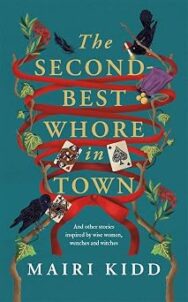
The Second Best Whore in Town
By Mairi Kidd
Published by Black & White Publishing
History has always found names or labels for women. What is less commonly found throughout history is a woman’s story.
In The Second-Best Whore in Town, a collection of nine stories, Mairi Kidd reaches into more than a thousand years of Scottish history, folklore and half-remembered lives to find women who have been judged, diminished, silenced, mythologised or reduced to a line in someone else’s story. Then she does something deceptively simple and quietly revolutionary: she gives them a voice. Kidd asks us to look beyond the name history has given a woman and consider the life that might have existed underneath it.
What struck me most was not simply how much women have suffered throughout history, but how recognisable their struggles remain today. Across centuries, social classes, landscapes and circumstances, the same patterns emerge. Oppression, strength, resistance, resilience. The vocabulary of power may have changed, the laws may have evolved, and our societies may congratulate themselves on their progress, but the underlying structures are often disturbingly familiar. Kidd makes us confront them, not through abstract political arguments, but through the intimate, complicated, devastatingly human lives of women.
The title story introduces us to Priss Carsewell, a young woman who flees Fife under the shadow of witch trials and eventually finds herself in seventeenth-century London, first groomed into sex work and later a wealthy and well-known brothel owner. The story history leaves behind is easily summarised: whore, thief, drunk. Kidd is interested in the woman. We read on as her life unfolds through poverty, exploitation, motherhood, loss and extraordinary determination.
Kidd’s Priss is intelligent, big-hearted and endlessly resourceful. She is not romanticised. Neither is she rescued from the choices she makes. Instead, Kidd gives us the circumstances around those choices: poverty, men, violence, displacement and the brutal arithmetic of survival. Priss has been dealt a poor hand, but she plays it anyway. Her attitude towards being the second-best whore in town, because “being first would leave no room for improvement”, captures something extraordinary about her. There is humour there, but also defiance, acceptance and ownership. Just as Chimamanda Ngozi Adichie warned us of the dangers of a single story, Kidd allows a woman long oppressed by history to stand up again and tell us who she was.
If Priss’s story exposes the brutality of women’s circumstances, Bearing and Begetting examines something perhaps even more insidious: the language we use to conceal that brutality. Kidd opens by examining the strange linguistic gymnastics societies perform around the things that happen to women: menstruation, pregnancy, rape. The acts of men may sprawl through history, scripture and record, but women’s pain is so often tidied into a sentence. She contrasts the detailed biblical accounts of men’s actions with the almost casual dismissal of women’s experiences of pregnancy and childbirth, including those of enslaved women such as Bilhah and Zilpah.
A fourteen-year-old girl is sexually abused and impregnated by a priest, then subsequently married off to a much older man. Yet even a powerful noblewoman seeking justice discovers the limitations of her own position. She may possess wealth and status, but she is still a woman moving inside structures created by men. Bearing and Begetting is a very short story, but its message is extraordinarily powerful. It asks us to think not only about what women have endured, but about the language through which their suffering has been minimised, disguised and normalised.
Such themes echo throughout the collection. In Alphabets and Angels, Eithne dreams of reading, writing and acquiring knowledge. Instead, life prescribes marriage and motherhood. Her life is not necessarily miserable. Her husband is good to her; she loves her children. And that complexity matters. Oppression is never a single story. Sometimes it looks like duty. Expectation. Love. The life everybody tells you that you ought to want.
Only when her children are grown, and her husband has died, is Eithne able to pursue the intellectual life she dreamed of as a girl. How many women, even today, recognise something of their own lives in that story? While reading this story, Simone de Beauvoir’s The Second Sex came to mind, particularly her exploration of what it means to become a woman according to society’s definitions and expectations. Kidd’s language here is particularly beautiful. Her writing connects ancient language to landscape and nature; language is never merely a collection of words. It carries a worldview, a relationship with the land, and an understanding of our place within it.
A delightfully unexpected pleasure of this collection is how much Scottish history is absorbed throughout its stories. Gaelic words, ancient kingdoms, kings and queens, political conflicts, witch trials and islands emerge not as lessons, but as lived worlds. Kidd’s prose is often beautifully melancholic, but it is also vivid, atmospheric and occasionally wonderfully irreverent. She can place the reader in the crowded streets of seventeenth-century London, in a forest haunted by violent dreams or on a windswept Scottish island. I felt these places. I could almost smell them.
In The Seal Wife, Kidd brings us almost completely into the present. Kaltrina, an Albanian woman who has been trafficked while trying to find work to support her mother, escapes one form of captivity only to find herself inside another. Iain believes he has saved her, yet hides her passport and keeps her in his home. He does not beat her. He does not sexually assault her. And still, she is not free. That distinction is crucial.
Kidd links Kaltrina’s story to the selkie traditions found across Scotland, Ireland and Scandinavia: tales in which a man steals the magical object a shapeshifting woman needs to return to the sea, trapping her on land and turning her into his wife. In the old stories, it is a sealskin. In Kidd’s modern retelling, it is a passport. Centuries collapse in that single substitution. The folklore becomes something far more than a beautiful or mysterious tale of supernatural love. It becomes a story of captivity, of a man who mistakes possession for love. The parallel is devastating in its simplicity.
The power of the collection lies in its willingness to question the idea that the versions of history we have inherited are complete. And who benefits when we accept the dominant narrative as the only one? The book left me thinking about how important it is that we continue to challenge the stories we have inherited. Because history is not simply a record of what happened. It is also a record of who was permitted to tell it.
The Second-Best Whore in Town is a fascinating, beautifully written and at times, devastating collection. It is rich in Scottish history, folklore, language and landscape, but its greatest achievement is the humanity it restores to women whose lives have too often been reduced to labels, accusations and footnotes.
The Second Best Whore in Town by Mairi Kidd is published by Black & White Publishing and is available now, priced £16.99
ALSO IN THIS ISSUE

 Everything Everyday by Hannah Lavery
‘We will remember what we did. We will / be remembered for what we did not do.’
 The Nowhere Emporium by Ross Mackenzie
‘They jostled for position and traded strange and wonderful theories about where the shop had come f …
ALSO ON BOOKS FROM SCOTLAND
-


Flight Patterns by Lorna J. Waite: An Appreciation by Janette Ayachi
‘I’ve recently heard poetry archives described as ‘fugitive, ephemeral’, but here the wish of collec …
-

The Scottish Colourists: Art & Life by Alice Strang
‘Together the quartet embodied a new spirit in Scottish art and they are celebrated as Scotland’s le …
-

David Robinson Reviews: Our Noble Selves by Kate Atkinson
‘As I suggested at the start, there’s a whole heap of plot in Our Noble Selves – spies, murders, and …
-
‘They had spoken perhaps ten sentences each and it had already begun. Moira’s resentments, her preju …
-

Ayont the Thistle by Jim Mackintosh, Alan Riach and James Robertson
‘Nane ae this then but – ma hert daen its hing/ an yon wee smile ae yours in the saft smir ae the ga …
-

David Robinson Reviews: This Door of the Seas
‘He sees what he wants to. And it makes a kind of sense too – especially to colonists from Scotland, …
FEATURED AUTHOR:
Eliza Chan

Eliza Chan is a Scottish-born speculative fiction author who writes about East Asian mythology, British folklore and reclaiming the dragon lady. Her Sunday Times bestselling debut novel Fathomfolk — inspired by mythology, East and Southeast Asian citie …
FEATURED PUBLISHER:
Belle Media

Belle Media is based in Glasgow. Our first book was a social history of the Clyde, Hurricane Hutch’s Top 10 Ships of the Clyde. This led to our first picture book series The Adventures of Captain Bobo and the launch of children’s imprint Belle Kids. Ou …