


EXPLORE ISSUES



‘I’ve recently heard poetry archives described as ‘fugitive, ephemeral’, but here the wish of collection is honoured; death is no place to hide, a flower blooms, seeds again and the peculiar authority of leaving instructions for poems is Lorna’s final act of voice and defiance.’
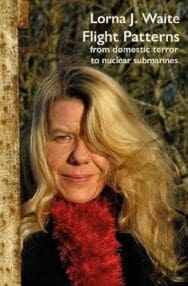
When poet Lorna J. Waite passed away, she left an archive of poems alongside instructions in publishing them. Janette Ayachi was asked to be involved in the project and here she gives an appreciation of Lorna’s work, while exploring what it means to preserve an artist’s creative output.
Flight Patterns
By Lorna J. Waite
Published by Main Point Books
THE AFTERLIVES OF POETS
When asked to read through Lorna J. Waite’s manuscript and write an introduction for Flight Patterns, I immediately thought about the significance of continuing to bring a poet’s work into the world after their death. What happens when a collection becomes a literary work and an archive: a record of a life, a creative practice, a cultural retrieval marking particular moments in Scottish literary history?
In the stream of Edwin Morgan, whose work continues to be resurrected, salvaged from the dusty archives and driven to print, is there something particularly important about preserving women’s voices after death? I think so. Especially when so much of women’s writing has historically been kept outside the dominant literary archive (unpublished, lost, excluded from anthologies, treated as confessional/domestic, remembered through their relationships to men) and then, after all that erasure, what happens when there is no one left to insist?
Franz Kafka explicitly requested his unpublished manuscripts be burned, but Lorna left material and instructions to preserve. Her intentions were documented; the editor honours them and admits that some computer-recovered files are open to the possibility that the poet might not have consented to their publication. As a poet myself, I know that a saved file can feel like a declaration of completion, but it can also be a draft, a fragment, an abandoned possibility. There are degrees of uncertainty: how do we preserve a poet’s voice without speaking over it?
Flight Patterns is the second posthumous collection, after Radiant Point, that Main Point Books has published with the help of Taproot Press, two of Scotland’s most prominent small imprints that build lists of carefully curated titles supporting alternative poetry.
Lorna’s work belongs to that lineage; it stands on the edge, having swooped in from the tradition of feminist Scottish radical poets. It gathers its wingbeat and takes flight again into mythopoetic meditations and memories of violence through the lens of therapy presented in documentary-style realism. Her poetry is not just activist but erotic; folkloric, clinical and cosmic; it swirls through the thermals of a whole range of tones that encompass survival and witness. She speaks with awe as she describes the ineffable mysteries of life; she writes the light in a monochromatic world.
Lorna was an extraordinary woman with a powerful voice; the loss was felt deeply in the literary and academic community, and amongst the things she left behind were people who loved and knew her and helped carry her work forward into the literary afterlife. When a poet dies, the work remains, but the final authority over what it means disappears.
Isn’t all poetry this timeless, subjective and multifaceted? In one of Lorna’s poems, I assumed an initial within a poem was meant to pair with someone particular in Lorna’s life, and I was mistaken. We cannot assume certainty; what remains is interpretation, memory, love and editorial responsibility. Or is ambiguity part of what allows poetry to survive beyond its author? Who gets to speak for a dead poet?
I spoke to Robert Alan Jamieson, Shetlandic poet and novelist, Creative Writing Professor at Edinburgh University, and Lorna’s editor and friend:
Q- You described working on Lorna’s book as being ‘in the eternal zone’ – what does that mean to you? Does editing a poet after their death change your understanding of what a literary life or legacy is?
RAJ- In the absence of the author, where there are queries as to intention, then it’s necessary to look deeper, to compare versions possibly. Lorna left a Contents list, a binder with printed copies, and an e-file. Unfortunately, these didn’t always match up — in those instances, there was some latitude for misinterpretation. But with a little thought, it seemed likely that the e-file copies post-dated the printed, and that the e-copies had been edited by Lorna after printing — otherwise there would be other e-files matching the prints.
The ‘other poems’ presented a different problem — they were simply individual e-files, and it’s impossible to know if Lorna would have agreed to their publication, their order or their presentation. With these, it was more a matter of whether I felt they were sufficiently finished to warrant inclusion, if the book was to be a reflection not only of her wishes for the titular sequence, but of her work as a poet more generally.
Overall, I intervened as little as possible as editor, concentrating more on compiling. I knew her to be quite sure of how she wanted her writing to be presented, and so stayed ‘out of the way’ as far as possible. There are only a couple of poems she wanted to include that hadn’t reached a state of grace — paper copies with handwritten revisions, notes to herself — where I felt it was necessary to interpret a final form.
Re: the question of legacy, I suppose that would be what it is, were her papers to remain in an archive somewhere, unseen — but making visible her work in these books is to honour her wishes and to increase the chances of that work reaching those who will appreciate it. I think she is a unique voice, drawing from a deep well, emotionally and culturally, who will matter to many both now and in the future. She is important as a Scottish working-class woman poet but also as a Kilbirnie lass who, by the act of writing, claimed the right to be heard. We might even say that Scotland, indeed the world, could benefit from hearing her voice right now, telling her truths, demanding peace in such a brave, honest manner — so although we are in the eternal zone, there is also reason to act promptly.
When a poet enters that ‘eternal zone’, death doesn’t have to end the work, publication becomes another stage of its life. I am fascinated with archives, memory, ghosts, legacy and literary afterlives, by unfinished scripts and voices returning. How does a poet’s work stay alive after their death, and not just keep breathing, but be born again? How does the poetry take its first breath into publication, as the poet takes their last?
The body might be an archive at risk of disappearance; however, poetry, as an embodied experience, preserves things that archives cannot – people, places, languages and memories can keep taking flight even when the physical evidence of their existence has vanished. Poetry continues to speak into the unseen; it continues to unravel webs of the hidden universe; poetry never expires.
We inherit writers from people who came before us. Lorna inherited MacDiarmid and MacLean, whom she described as ‘illumination on the horizon leaving trails for the contemporary writer to follow’. I inherited writers from my teachers; future writers may inherit Lorna. What can we learn from her? She teaches us about the human condition, its connectedness, aliveness, grief and the transience of life. What happens to a poet after death? They become part of somebody else’s education, another poet’s vocabulary and imagination.
I also spoke to Murdo MacDonald, Professor Emeritus of History of Art at Dundee University, scholar of Scottish art and culture and Lorna’s partner. Flight Patterns is dedicated to the Rivers Centre. Murdo described the psychological support Lorna received there, enabling her to deal with complex PTSD, and said these poems are directly connected to that therapeutic work. While she rarely read them aloud to him, she spoke frequently about the insights beneath them, many of which emerged through recovered memories of domestic violence:
MM- Thinking your father has killed your mother by smashing her head against the cooker until the blood drips on the floor and that you are next but knowing you must protect your sister who is sleeping upstairs, is not an easy thing to cope with. ‘Home’ for Lorna was camping on her own in Glen Etive.
We also spoke about the artist and poet, Maud Sulter and how she was a crucial mentor for Lorna.
MM- There is, as you suggest, a connection between Sulter’s recovery of Black women’s histories and Lorna’s own attempts to recover women’s and working-class histories in Scotland, but there was also a very deep link between them in terms of what I’d call their shared West of Scotland classicism. That is to say, they both took for granted the value of myth in the understanding of both personal conditions and global histories.
Both practices resist disappearance: one retrieves women from the racialised margins of European art history; the other retrieves women and working-class lives from the histories Scotland has too often allowed to fade from view. Yet, amid the devastation of domestic terror and the machinery of state violence, Lorna keeps finding her way back to the earth, to rivers, caves, shells, the winged language of birds.
‘I am Scottish, familiar with peaks, clouds, Atlantic fronts
The blast of the Baltic on Edinburgh tenements
The sunsets of my West Coast selfhood
Never happy with my back to the sea at twilight’
The horizon expands as she writes of ‘fledge’ and ‘pattern recognition’ as if naming the process of her own becoming.
For me, Flight Patterns is her final choreography: an intricate dance of body and word, shadow and light. Each poem is a gesture toward freedom, a reach of the arm, a turning of the head, a thrash of a wing. To read them is to stand beside her as she transforms her suffering into movement, her silence into song. Her poems don’t ask for pity; they demand witness. Publishing this book now feels like observing one last stand; a continuation of her lifelong refusal to be erased.
I’ve recently heard poetry archives described as ‘fugitive, ephemeral’, but here the wish of collection is honoured; death is no place to hide, a flower blooms, seeds again and the peculiar authority of leaving instructions for poems is Lorna’s final act of voice and defiance. A poet’s voice can continue to evolve through editors, readers and future generations, in immortal memory.
When I asked RAJ whether publishing Lorna’s work was itself a form of retrieval, he told me that he had not initially thought of it that way. But, on reflection, he recognised the publication as ‘an extension of Lorna’s work’; those entrusted with her writing were also ‘dealing with the trauma of her loss through the making of the book(s).’ The archive preserves, the editor interprets, the publisher gives access, the reader reanimates and the poem itself changes through each encounter.
Lorna had asked RAJ to assist with her first collection, The Steel Garden, so the work of editing her poetry after death became a familiar conversation in which the poet was no longer there to answer back. ‘It was not a new process this time around,’ he explains, ‘more a resumed dialogue,’ although her absence inevitably heightened the sense of responsibility. He was fortunate, he says, to have Murdo and Jennie of Main Point Books there to temper that responsibility, but when I asked what it meant to give Lorna’s work the best possible platform, his answer unexpectedly brought me into that chain of custodianship: ‘I would regard your introduction and involvement as a key part of that.’
That sentence made me conscious that I too had entered Lorna’s afterlife. The poem passes from poet to paper, from paper to archive, from archive to editor, from editor to publisher and then outward again, through an introduction, a reader, a future reader. None of us can replace the poet, but each of us becomes temporarily responsible for how their words are carried. To write about Lorna is not simply to describe a poet who is no longer here; it is to participate, however carefully, in the continuation of her work.
When a poet like Lorna J. Waite speaks to the contemporary, a visionary whose work is not safely historical, a new publication must enter the present; it’s not simply about preserving a dead poet; it’s about reintroducing one into the cultural conversation.
I am part of Lorna’s afterlife, holding responsibility after being given access to such a remarkable spirit and voice. So are her friends and editors, the small publishers and now, you too, the readers. It’s true, Scotland and beyond will benefit from her poetry about place and what remains; about trauma and peace, working-class identity, women’s histories, memory and survival. In these poems, flight is not escape but evolution. Her poems are a murmuration: fierce, articulate, unafraid. The poet takes her last breath, but the poems take flight.
Flight Patterns by Lorna J. Waite is published by Main Point Books, priced £10.00.
RELATED BOOKS

ALSO ON BOOKS FROM SCOTLAND
-


The Scottish Colourists: Art & Life by Alice Strang
‘Together the quartet embodied a new spirit in Scottish art and they are celebrated as Scotland’s le …
-

David Robinson Reviews: Our Noble Selves by Kate Atkinson
‘As I suggested at the start, there’s a whole heap of plot in Our Noble Selves – spies, murders, and …
-

‘They had spoken perhaps ten sentences each and it had already begun. Moira’s resentments, her preju …
-

Ayont the Thistle by Jim Mackintosh, Alan Riach and James Robertson
‘Nane ae this then but – ma hert daen its hing/ an yon wee smile ae yours in the saft smir ae the ga …
-

David Robinson Reviews: This Door of the Seas
‘He sees what he wants to. And it makes a kind of sense too – especially to colonists from Scotland, …
-

The Broons and Oor Wullie Celebrate their 90th Birthdays!
‘Whatever the future may hold, we can be sure that The Broons and Oor Wullie will always be a part o …
FEATURED AUTHOR:
Jean Menzies
Jean Menzies is an author, presenter, and as of 2022 Dr Jean Zacharski Menzies, PhD in ancient history! She is Edinburgh born and based. You might know her from her YouTube channel JeansThoughts where she’s been discussing books, writing, studying, an …
FEATURED PUBLISHER:
HarperCollins

HarperCollins UK publishes a wide range of books, from cutting-edge contemporary fiction, to block-busting thrillers, from fantasy literature and children’s stories to enduring classics. It also publishes a great selection of non-fiction titles, includ …