


ABOUT THIS BOOK
PUBLISHER: Bloomsbury Publishing PLC (Digital)
FORMAT: Electronic book text
ISBN: 9781474269032
RRP: £36.99
PAGES: 800
PUBLICATION DATE:
February 23, 2017
BUY THIS BOOK
As an Amazon Associate and Bookshop.org affiliate we earn from qualifying purchases.
Hume’s Reception in Early America: Expanded Edition
Mark G. Spencer
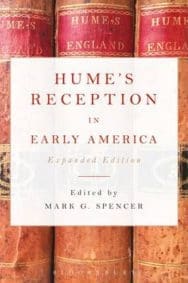
Hume’s Reception in Early America: Expanded Edition brings together the original American responses to one of Britain’s greatest men of letters, David Hume. Now available as a single volume paperback, this new edition includes updated further readings suggestions and dozens of additional primary sources gathered together in a completely new concluding section.From complete pamphlets and booklets, to poems, reviews, and letters, to extracts from newspapers, religious magazines and literary and political journals, this book’s contents come from a wide variety of sources published in colonial America and the early United States between 1758 and 1850. As well as classics by Thomas Jefferson, John Adams and Alexander Hamilton, it contains scores of unknown and hard-to-locate items, many of which have not been reprinted since their original publication. These responses are divided into four parts covering Hume’s Essays; his Philosophical Writings; his History of England; and his Character and Death. Each of those parts has a separate introductory essay, and every selection is introduced by a short headnote that sets the piece in its historical context and provides bibliographical references.Packed with new insights into Hume and American thought and culture, Hume’s Reception in Early America reveals the relevance and impact of Hume on American political, philosophical, historical, religious, and aesthetic debates.
Reviews of Hume’s Reception in Early America: Expanded Edition
Mark G. Spencer is Associate Professor of History at Brock University, Canada. He is the author of David Hume and Eighteenth-Century America (2005) and has edited eleven volumes, including David Hume: Historical Thinker, Historical Writer (2013) and The Bloomsbury Encyclopedia of American Enlightenment (2015). Hume's Reception in Early America: Expanded Edition brings together the original American responses to one of Britain's greatest men of letters, David Hume. Now available as a single volume paperback, this new edition includes updated further readings suggestions and dozens of additional primary sources gathered together in a completely new concluding section.From complete pamphlets and booklets, to poems, reviews, and letters, to extracts from newspapers, religious magazines and literary and political journals, this book's contents come from a wide variety of sources published in colonial America and the early United States between 1758 and 1850. As well as classics by Thomas Jefferson, John Adams and Alexander Hamilton, it contains scores of unknown and hard-to-locate items, many of which have not been reprinted since their original publication. These responses are divided into four parts covering Hume's Essays; his Philosophical Writings; his History of England; and his Character and Death. Each of those parts has a separate introductory essay, and every selection is introduced by a short headnote that sets the piece in its historical context and provides bibliographical references.Packed with new insights into Hume and American thought and culture, Hume's Reception in Early America reveals the relevance and impact of Hume on American political, philosophical, historical, religious, and aesthetic debates. A collection of classic and rare writings on David Hume, written in the early United States between 1758 and 1850, illustrating the impact of Hume's thought on modern American philosophy. Preface to the New EditionAcknowledgementsPart I: Early American Responses to Hume's Essays, Moral, Political, and LiteraryIntroductionPart II: Early American Responses to Hume's Philosophical WritingsIntroductionPart III: Early American Responses to Hume's History of EnglandIntroductionPart IV: Early American Responses to Hume's Character and DeathIntroductionIndex This volume is an indispensable source for Hume scholars, historians of the period and anyone interested in how Hume's extensive writings were received in America from 1758 – 1850. Most of the 125 extracts will be unknown and inaccessible to the majority of readers. Largely for religious, political and linguistic reasons there was much closer engagement with Hume's writings on religion and history by American commentators than by continental European writers, and Spencer here provides impeccably documented quotations and references. First published in 2002, this enlarged and corrected paper-back version is a splendid achievement. — Peter Jones, Emeritus Professor of Philosophy, University of Edinburgh, UK For anyone doubting Hume's profound importance as a philosopher, historian and political thinker in the age of the Enlightenment, Spencer's unparalleled run of evidence for his wide-ranging contemporary American reception ought to be regarded as conclusive proof. — David Allan, Reader in Scottish History, University of St Andrews, UK Made available for the first time in an affordable paperback edition, Spencer's outstanding anthology of printed responses to the works of David Hume is a primary point of reference for scholars and students interested in the American Enlightenment. One of the most striking revelations – reinforced by 38 newly discovered primary sources added to this new edition – is that Hume remained a central part of American periodical culture well into the nineteenth century. — Mark R. M. Towsey, Senior Lecturer in Modern British History, University of Liverpool, UK Mark C. Spencer's expanded edition of his well-received Hume's Reception in Early America (2002), greatly enhanced by the addition of 125 excellent new entries which strengthen his argument that Hume's works were quite well-known to members of America's intellectual culture before 1850, is an outstanding model of primary source research and topical organization. — Roger J. Fechner, Professor Emeritus of History, Adrian College, USA
Mark G. Spencer
Mark G. Spencer is Associate Professor of History at Brock University, Canada. He is the author of David Hume and Eighteenth-Century America (2005) and has edited eleven volumes, including David Hume: Historical Thinker, Historical Writer (2013) and The Bloomsbury Encyclopedia of American Enlightenment (2015).
ALSO ON BOOKS FROM SCOTLAND
-


The Scottish Colourists: Art & Life by Alice Strang
‘Together the quartet embodied a new spirit in Scottish art and they are celebrated as Scotland’s le …
-

David Robinson Reviews: Our Noble Selves by Kate Atkinson
‘As I suggested at the start, there’s a whole heap of plot in Our Noble Selves – spies, murders, and …
-

‘They had spoken perhaps ten sentences each and it had already begun. Moira’s resentments, her preju …
-

Ayont the Thistle by Jim Mackintosh, Alan Riach and James Robertson
‘Nane ae this then but – ma hert daen its hing/ an yon wee smile ae yours in the saft smir ae the ga …
-

David Robinson Reviews: This Door of the Seas
‘He sees what he wants to. And it makes a kind of sense too – especially to colonists from Scotland, …
-

The Broons and Oor Wullie Celebrate their 90th Birthdays!
‘Whatever the future may hold, we can be sure that The Broons and Oor Wullie will always be a part o …
FEATURED AUTHOR:
Sara Sheridan

Author Sara Sheridan was born in Edinburgh and studied English at Trinity College, Dublin. She spent a short time running an art gallery in Ireland, before returning to Edinburgh in 1991. She started writing full time for her 1998 novel Truth or Dare. …
FEATURED PUBLISHER:
Saraband

Saraband is a creative independent publisher known for its engaging, well-written and beautiful non-fiction titles (especially in nature, history and memoir), and for its emerging literary and crime fiction lists. The crime, mystery and noir titles are …