


ABOUT THIS BOOK
PUBLISHER: Taylor & Francis Ltd
FORMAT: Electronic book text
ISBN: 9781317207696
RRP: £34.99
PAGES: 320
PUBLICATION DATE:
May 31, 2017
BUY THIS BOOK
As an Amazon Associate and Bookshop.org affiliate we earn from qualifying purchases.
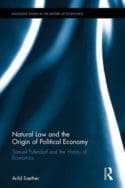
Natural Law and the Origin of Political Economy: Samuel Pufendorf and the History of Economics
Arild Saether
Samuel Pufendorf’s work on natural law and political economy was extensive and has been cited by several important figures in the history of economic thought. Yet his name is rarely mentioned in textbooks on the history of economic thought, the history of political science or the history of philosophy. In this unprecedented study, Arild Saether sheds new light both on Pufendorf’s own life and work, as well as his influence on his contemporaries and on later scholars.This book explores Pufendorf ‘s doctrines of political economy and his work on natural law, which was translated into several major European languages. Natural Law and the Origin of Political Economy considers the influence he had on the writings on political economy of John Locke, Charles Montesquieu, Jean-Jacques Rousseau, Francis Hutcheson and Adam Smith, amongst others. If Smith can be called the father of modern economics, this book claims that Pufendorf can be called the grandfather.This volume is of great importance to those who study Pufendorf ‘s extensive works, as well as those interested in history of economic thought, political economy and political philosophy.
Arild Saether
Arild Saether is Professor Emeritus. He retired from University of Agder, Kristiansand Norway in 2011 and is now affiliated with Agder Academy of Sciences and Letters. Recently he received his Doctor of Philosophy (Dr. Philos) from the Norwegian School of Economics, Bergen. Previously he worked for two and a half years as a Professor of European Economic Integration in Maastricht, the Netherlands, and three years as Director of Euro- Faculty Tartu-Riga-Vilnius. Saether has published books on economic theory and a number of journal articles. For over twenty years his main area of research has been the history of economic thought.
OTHER BOOKS BY THE SAME AUTHOR

ALSO ON BOOKS FROM SCOTLAND
-


The Scottish Colourists: Art & Life by Alice Strang
‘Together the quartet embodied a new spirit in Scottish art and they are celebrated as Scotland’s le …
-

David Robinson Reviews: Our Noble Selves by Kate Atkinson
‘As I suggested at the start, there’s a whole heap of plot in Our Noble Selves – spies, murders, and …
-
‘They had spoken perhaps ten sentences each and it had already begun. Moira’s resentments, her preju …
-

Ayont the Thistle by Jim Mackintosh, Alan Riach and James Robertson
‘Nane ae this then but – ma hert daen its hing/ an yon wee smile ae yours in the saft smir ae the ga …
-

David Robinson Reviews: This Door of the Seas
‘He sees what he wants to. And it makes a kind of sense too – especially to colonists from Scotland, …
-

The Broons and Oor Wullie Celebrate their 90th Birthdays!
‘Whatever the future may hold, we can be sure that The Broons and Oor Wullie will always be a part o …
FEATURED AUTHOR:
Kapka Kassabova

Kapka Kassabova is a poet and writer of narrative prose. At the core of her work is a quest for transformative encounter with places and people. Margins, confluences, aftermaths – those are her places. In the last decade she has created a body of work …
FEATURED PUBLISHER:
Waverley Books

Quirky, special, niche and Scottish, Waverley Books publish well-designed, high-quality books on Scotland, history, trains, nostalgia, fiction, cookery. We’ve been publishing books for the past 25 years.