


ABOUT THIS BOOK
PUBLISHER: Academic Studies Press
FORMAT: Paperback
ISBN: 9781618118141
RRP: £32.95
PAGES: 240
PUBLICATION DATE:
May 30, 2018
BUY THIS BOOK
As an Amazon Associate and Bookshop.org affiliate we earn from qualifying purchases.
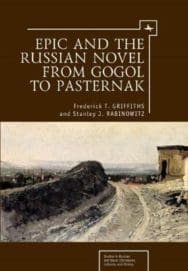
Epic and the Russian Novel from Gogol to Pasternak
Frederick T. Griffiths
Stanley J. Rabinowitz
Epic and the Russian Novel from Gogol to Pasternak examines the origin of the nineteen- century Russian novel and challenges the Lukacs-Bakhtin theory of epic. By removing the Russian novel from its European context, the authors reveal that it developed as a means of reconnecting the narrative form with its origins in classical and Christian epic in a way that expressed the Russian desire to renew and restore ancient spirituality. Through this methodology, Griffiths and Rabinowitz dispute Bakhtin’s classification of epic as a monophonic and dead genre whose time has passed. Due to its grand themes and cultural centrality, the epic is the form most suited to newcomers or cultural outsiders seeking legitimacy through appropriation of the past. Through readings of Gogol’s Dead Souls-a uniquely problematic work, and one which Bakhtin argued was novelistic rather than epic-Dostoevsky’s Brothers Karamazov, Pasternak’s Dr. Zhivago, and Tolstoy’s War and Peace, this book redefines “epic” and how we understand the sweep of Russian literature as a whole.
Reviews of Epic and the Russian Novel from Gogol to Pasternak
"Felicitous phrasing throughout (the Odyssey as "the grandfather of all Baedekers," 155) renders this erudite volume a pleasure to read and ponder. Griffiths and Rabinowitz have created an exemplary and inspirational work of interdisciplinary scholarship. Any scholar of Slavic studies, classics, Russian intellectual history, or the classical heritage should gladly welcome this book."–Judith E. Kalb, University of South Carolina "Griffiths and Rabinowitz reveal the genre's liveliness, fluidity, and seemingly limitless ability to assert itself in modern letters. Newarly every sentence rewards, and will provoke serious readers to pause and think. The impressive erudition and critical imagination which Griffiths/Rabinowitz combine make one hope that this ancient/modern pair of critical bogatyri will sally forth again."–John M. Kopper, Dartmouth College
Frederick T. Griffiths
Frederick Griffiths (Ph.D. Harvard University) is Class of 1880 Professor of Greek and Professor of Women’s and Gender Studies, Amherst College. His primary focus has focused on relationship of literature and politics in Hellenistic Alexandria (Theocritus and Apollonius Rhodius), 19th and 20th century Russian (with S. J. Rabinowitz: Gogol, Tolstoy, Dostoevsky, Pasternak), and 20th century America (Willa Cather, Richard Wright, Ralph Ellison, Charles Johnson). He is the author of Theocritus at Court: Articles on Apollonius Rhodius, Willa Cather, Richard Wright, Ralph Ellison.Stanley J. Rabinowitz (Ph.D. Harvard University) teaches Russian language and literature at Amherst College. He has taught at the University of California at Berkeley and has been the Max Hayward Fellow in Russian Literature at St. Antony’s College, Oxford. His research interests include modern Russian prose and Russian classical dance during the first quarter of the twentieth century.
ALSO ON BOOKS FROM SCOTLAND
-

The Scottish Colourists: Art & Life by Alice Strang
‘Together the quartet embodied a new spirit in Scottish art and they are celebrated as Scotland’s le …
-
David Robinson Reviews: Our Noble Selves by Kate Atkinson
‘As I suggested at the start, there’s a whole heap of plot in Our Noble Selves – spies, murders, and …
-
‘They had spoken perhaps ten sentences each and it had already begun. Moira’s resentments, her preju …
-

Ayont the Thistle by Jim Mackintosh, Alan Riach and James Robertson
‘Nane ae this then but – ma hert daen its hing/ an yon wee smile ae yours in the saft smir ae the ga …
-

David Robinson Reviews: This Door of the Seas
‘He sees what he wants to. And it makes a kind of sense too – especially to colonists from Scotland, …
-

The Broons and Oor Wullie Celebrate their 90th Birthdays!
‘Whatever the future may hold, we can be sure that The Broons and Oor Wullie will always be a part o …
FEATURED AUTHOR:
Kirsty Logan

Kirsty Logan is the author of the novels Now She is Witch, The Gracekeepers, and The Gloaming, the short story collections A Portable Shelter and The Rental Heart & Other Fairytales, the flash fiction chapbook The Psychology of Animals Swallowed Al …
FEATURED PUBLISHER:
Waverley Books

Quirky, special, niche and Scottish, Waverley Books publish well-designed, high-quality books on Scotland, history, trains, nostalgia, fiction, cookery. We’ve been publishing books for the past 25 years.