


EXPLORE ISSUES



‘In earlier times it was a site where lovers came to relax and dream, hence the beautiful traditional song’.
Want to discover another part of Edinburgh? Porto Press have just released a new walking guide that specialises in taking you along routes that go along the city’s old railways, now transformed into smooth, gently-graded, tarmac routes. Ideal for walkers of all ages as well as cyclists and joggers, these routes show Scotland’s capital in a new light. Enjoy this extract that follows the route of the former Balerno Railway from the Water of Leith Visitor Centre to Colinton Station.
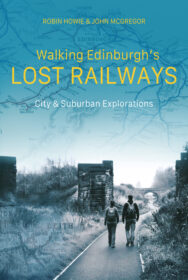
Walking Edinburgh’s Lost Railways
by Robin Howie and John McGregor
Published by Porto Press
The Balerno Railway left the main line just west of Slateford Station. Close by today is the Water of Leith Centre on Lanark Road, an appropriate start to the Walk. The Water at this point is crossed by two arched masonry viaducts, one carrying the 1822 Union Canal and the other the Caledonian main line (1848). Stone for the 14-arch railway structure, built entirely by manual labour, came from several local quarries which the canal accessed.
That at Hailes has an interesting history. At its peak activity, the quarry employed 150 men and 100,000 tons of stone were extracted annually. The quarry was abandoned in 1902 when it had reached a depth of 100 ft and became flooded. In 1949 water was pumped out into the Murrayburn to make way for a landfill site, subsequently grassed over and, in 1981, made into a public park worthy of a visit. It is rumoured that an elephant from Edinburgh Zoo is buried there – such rumours usually have some basis though I am unaware of any attempt to test the story. However, the tale of a horse entombed in one of the hollow piers of Glenfinnan viaduct on the West Highland Railway has been proved more-or-less true –investigation has shown (unless there was a second horse, and a similar incident!) that the skeleton lies within a pier of Loch-nan-Uamh viaduct, further to the west.
The Union Canal aqueduct with the railway viaduct carrying the main line behind.
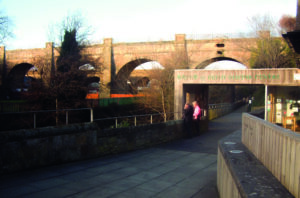
The Water of Leith Conservation Trust – the first river charity to be established in Scotland – works to preserve and enhance the Water, its heritage and wildlife; their Visitor Centre promotes education and facilitates recreation, and they work with volunteers and community groups to deliver over 200 river clean-ups and habitat improvement drives annually. Pay a visit to the Centre – your support will be appreciated. Scottish Water is currently improving the waste-water network and protecting the environment along the valley by upgrading overflow chambers, ‘which help to prevent items, wrongly flushed down the toilet, from reaching the river’ (quoting Scottish Water).
On my visiting days there were a couple of temporary, but well-signed, detours from the track bed.
From the Visitor Centre, head west on Lanark Road to where it is crossed by a pedestrian bridge, reached by a ramp on the north side. For a short detour, cross the Union Canal by the former railway bridge and continue via the short embankment to a high fence by the main line, where all trace of Balerno Junction has gone. Return to the pedestrian bridge and cross Lanark Road signed ‘Colinton Dell ½ mile and Colinton 1 mile’.
Welcome to the start of the former railway, which passes under Redhall Bank Road (part of the original Lanark Road, later shifted northwards to allow more quarrying) and over Bogsmill Road. Here begin the embankments and cuttings which took the sinuous line high above the winding wooded gorge of the Water – a haven for wildlife, which to some extent is true all the way to Balerno. It is no surprise to learn that Colinton (originally Colintoun) means ‘village of the woods.’
Colinton tunnel, looking west. The mural recalls the Caledonian Company’s blue-liveried locomotives. (North British ‘bronze-green’ was subdued by comparison.)
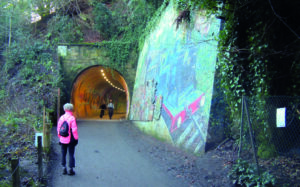
Continue to what was once the site of Hailes Halt, overlooking Katesmill Bridge and a weir. For a pleasing detour, follow the stepped path, signed ‘Colinton via Katesmill’, and descend to the Water. The bridge here is a girder span but, as parts of the wooden decking are in disrepair, access is barred. The weir is best appreciated during a wet spell. Return to the course of the railway from where a path on the right climbs to Lanark Road. Higher up is a sign ‘Knockifulbraehead’ – quite a mouthful!
Continue to the Colinton Tunnel, a modest 150 yards in length although this is concealed by its tight curve. (High above, Spylaw Bank Road descends to Dell Road but the exact spot where road crosses railway is difficult to judge.) The tunnel retains its ‘echo qualities’ but is no longer a dark and scary place. The Colinton Tunnel Murals – a stunning visual celebration, and with no anti-social graffiti – link the story of the railway to the history of the community.
The words on the wall are from Robert Louis Stevenson’s poem ‘From a Railway Carriage’ … a lovely evocation of a child’s first rail journey, which contrasts with his alarming description of the Scotland Street Tunnel (see Walk 1).
‘Faster than fairies, faster than witches,
Bridges and houses, hedges and ditches; …
And here is a mill and there is a river:
Each a glimpse and gone for ever!’
At the west end of the tunnel is the site of Colinton Station, spanned by Bridge Road. All that remains is the access road descending to a small car park.
Walking Edinburgh’s Lost Railways by Robin Howie and John McGregor is published by Porto Press and will be released on 20 April, priced at £18.99.
RELATED BOOKS

ALSO ON BOOKS FROM SCOTLAND
-


The Scottish Colourists: Art & Life by Alice Strang
‘Together the quartet embodied a new spirit in Scottish art and they are celebrated as Scotland’s le …
-

David Robinson Reviews: Our Noble Selves by Kate Atkinson
‘As I suggested at the start, there’s a whole heap of plot in Our Noble Selves – spies, murders, and …
-
‘They had spoken perhaps ten sentences each and it had already begun. Moira’s resentments, her preju …
-

Ayont the Thistle by Jim Mackintosh, Alan Riach and James Robertson
‘Nane ae this then but – ma hert daen its hing/ an yon wee smile ae yours in the saft smir ae the ga …
-

David Robinson Reviews: This Door of the Seas
‘He sees what he wants to. And it makes a kind of sense too – especially to colonists from Scotland, …
-

The Broons and Oor Wullie Celebrate their 90th Birthdays!
‘Whatever the future may hold, we can be sure that The Broons and Oor Wullie will always be a part o …
FEATURED AUTHOR:
Richard Strachan

Richard Strachan is a former bookseller, who lives in Edinburgh with his family. His short fiction has been published in various magazines including The Dark and Interzone, and by Galley Beggar Press in their digital singles list.
FEATURED PUBLISHER:
Serafina Press

Based in the Borders seaside town of Eyemouth, Serafina Press aims to produce art-driven children’s picture books. The books have a strong sense of their Scottish or North Northumberland location, but are not limited in appeal to the region – they sell …