


EXPLORE ISSUES



‘This is very much an up-to-the-minute story of spycraft, positively revelling in all the things that tech can do: gait analysis, thermal imaging, software that can send a marked pixel and identify where a message is opened, drone surveillance, and all manner of computer hacking.’
David Robinson connects the influences, the history and the intriguing plot points in David Goodman’s latest espionage thriller, Solitary Agents.
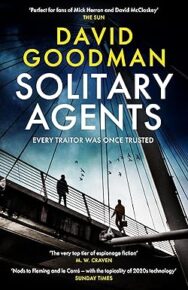
Solitary Agents
By David Goodman
Published by Headline
Two successful films, a bestselling book and an award-laden musical heading to Aberdeen, Edinburgh and Glasgow later this year: whatever form it takes, the story behind Operation Mincemeat seems to strike a chord with everyone. Wily Brits outfox Nazis in 1943 by planting fake invasion plans on a corpse: what’s not to like?
If all of this sounds suspiciously like the plot of a spy thriller, that’s because it was. In 1937, Sir Basil Home Thomson – fascinating chap, knew Robert Louis Stevenson in the South Pacific, interrogated Mata Hari - wrote a thriller called The Milliner’s Hat Mystery. In it, false plans are put on a dead body which is allowed to fall into enemy hands. Ian Fleming, future creator of James Bond but then assistant to the director of naval intelligence, liked the idea. Asked in 1939 to come up with a list of ways of deceiving the enemy – the so-called Trout Memo in which he compared wartime deception to fly fishing – Fleming came up with 54 suggestions. The dead body carrying fake invasion plans was number 28.
Before I climb out of this particular rabbit hole, it’s worth pointing out how easy coming up with a counterfeit identity used to be. A letter and photo from a loved one, a briefing about bogus invasion plans, maybe stubs from a theatre show on the same date as the military briefing (in Operation Mincemeat, a 1943 show at the Prince of Wales Theatre at which the teenage Morecambe and Wise made their London debut) : all were easily concocted or obtainable. The wonder is that the Nazis didn’t try the same trick on us.
And now? Well, if you’re trying to hide the fact that you’re a spy, the people you need to fool will most likely be able to follow your digital footprint back for at least a decade. And that’s just the stuff you know about. Beyond that is everything you have inadvertently put out on the internet – all the information collected passively from websites, apps, advertisers and data brokers, through cookies, tracking pixels, device fingerprinting and data mining.
This profusion of metadata is a massive problem for the continuing existence of the spy thriller. A lone spy photocopying secret plans in Moscow commands our attention; data analysts staring at computer screens in MI5’s London HQ do not.
David Goodman has clearly given the matter some thought, and in his debut novel A Reluctant Spy – winner last year of both the Debut Prize at Bloody Scotland and the McDermid Debut Award at the Theakston Old Peculier Crime Writing Festival in Harrogate – he came up with a possible solution.
He calls it the Legends Programme and it works like this. Suppose you are a trainee banker or a computer programmer, or work in some profession or other that might well be of use to the UK’s intelligence network. Once you have passed a few background checks you may never have known about, you get the old tap on the shoulder and a civil servant asks you whether you would be prepared to do something for your country. You won’t be put in any danger, you’ll be told, or at least nothing that can’t be easily handled. All you have to do is to allow your identity – that 20-year digital footprint, solid enough to fool any enemy – to be temporarily borrowed by a very real MI6 agent.
In A Reluctant Spy, that was exactly what happened to Jamie Tulloch, an executive in a software sales company. Except, as he found almost straight away when he came upon the murdered body of his handler, that bit about not being put in harm’s way wasn’t exactly true, and he had to finish the mission himself despite not having any training in spycraft. Foiling a rogue Russian general’s dirty bomb plot, however, turned out to be a lot more exciting than his nine-to-five job in the tech company. To his own surprise as much as that of his MI6 handlers, he turned out to be good at the spying business, and although he goes back to that job in the tech company for the next ten years, he can’t help thinking back to those few days of derring-do in Zanzibar.
This is where Goodman’s follow-up novel, Solitary Agents, begins – with Tulloch resolving to return to the Legends Programme – only this time not as a trainee but as a handler: a proper spy not a reluctant one. First, though, he has to pass an extensive SIS fieldwork test called Red Poacher. For this, a small team of wannabe spies are dropped off in the Highlands with three weeks in which to prove that they can infiltrate three high-value military targets. Another set of wannabe spies – Blue Team – has to stop them, although to make it realistic, they are not told which three out of 15 potential UK targets have been chosen. Told in short narrative bursts from multiple points of view, this is quite gripping – a sort of cross between Race Across the World and Traitors.
What gives Goodman’s latest novel its twist - and this is hardly a spoiler as there are still 300 pages to go - is what happens in Rosyth. Tulloch has managed to take a photo of himself in the conning tower of a decommissioned submarine at the base – thus ticking off the first of his missions – when he hears a shot and sees one of his Red team colleagues fall on the ground as if dead. Surely, he thinks, Blue Team are carrying the need for realism too far? But who are the black-clad team of four people who briefly capture him? Are they CIA? Rogue operators? If someone has indeed been killed, as Blue Team suspects, why is the whole exercise being allowed to continue? If he does have any doubts, Tulloch shrugs them off. He is determined to succeed, and so proceeds to the next target, where he is captured by Blue Team. They tell him, after he survives a prolonged interrogation, that he has passed this test, but now has a new mission.
At this point, it is fair to say, there is quite a gap between what the reader knows is happening and what Tulloch is piecing together. Maintaining that gap requires storytelling of craft and ingenuity, yet Goodman’s plot never stops piling on the action, flashing forwards and back between hunters and pursuers, and widening the storyline until it becomes of geopolitical import.
Goodman makes a few nods to the spy novel’s past – one of the would-be agents on the evaluation exercise called Fleming is nicknamed 008, and the brass plate on SIS’s Human Resources Annex, in a possible allusion to John le Carré’s real surname, reads ‘Cromwell Associates’. But this is very much an up-to-the-minute story of spycraft, positively revelling in all the things that tech can do: gait analysis, thermal imaging, software that can send a marked pixel and identify where a message is opened, drone surveillance, and all manner of computer hacking.
For all that, the through-line between Operation Mincemeat (dead people used as cover stories) and Solitary Agents (living people used as cover stories) isn’t too hard to discern. And although I enjoyed Goodman’s narrative panache, my own next mission will be to search out Sir Basil Thomson’s The Milliner’s Hat Mystery, which is where it all seems to begin. This was the seventh in his Inspector Richardson series: forgotten now, it was praised by Dorothy L Sayers and many other Golden Age crime writers for its attention to detail. Because it inspired Operation Mincemeat, which successfully diverted many German troops away from Sicily, and because my dad was in the Eighth Army which then successfully invaded Sicily in July 1943 before moving onto mainland Italy, and because he survived the war and married my mother afterwards, there is even a chance – how big or small we’ll never know – that I might even owe it my life.
Solitary Agents by David Goodman is published by Headline, priced £20.
RELATED BOOKS

ALSO ON BOOKS FROM SCOTLAND
-


David Robinson Reviews: Our Noble Selves by Kate Atkinson
‘As I suggested at the start, there’s a whole heap of plot in Our Noble Selves – spies, murders, and …
-

‘They had spoken perhaps ten sentences each and it had already begun. Moira’s resentments, her preju …
-

Ayont the Thistle by Jim Mackintosh, Alan Riach and James Robertson
‘Nane ae this then but – ma hert daen its hing/ an yon wee smile ae yours in the saft smir ae the ga …
-

David Robinson Reviews: This Door of the Seas
‘He sees what he wants to. And it makes a kind of sense too – especially to colonists from Scotland, …
-

The Broons and Oor Wullie Celebrate their 90th Birthdays!
‘Whatever the future may hold, we can be sure that The Broons and Oor Wullie will always be a part o …
-

Pretty Valuable Things by A. J. Leslie
Harper considered Charles for a few moments, lit a cigarette, then said ‘we are treating it as murde …
FEATURED AUTHOR:
Kapka Kassabova

Kapka Kassabova is a poet and writer of narrative prose. At the core of her work is a quest for transformative encounter with places and people. Margins, confluences, aftermaths – those are her places. In the last decade she has created a body of work …
FEATURED PUBLISHER:
Handsel Press

The Handsel Press was founded in 1976 to publish high quality academic and more popular books relating Christian faith to other fields of study, and to the arts. The Press also publishes a number of biographies and commentaries at an affordable price. …