


ABOUT THIS BOOK
PUBLISHER: Institute of Education Press
FORMAT: Paperback
ISBN: 9781858566672
RRP: £25.99
PAGES: 200
PUBLICATION DATE:
June 1, 2015
BUY THIS BOOK
As an Amazon Associate and Bookshop.org affiliate we earn from qualifying purchases.
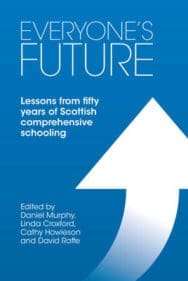
Everyone’s Future: Lessons from Fifty Years of Scottish Comprehensive Schooling
Daniel Murphy
Linda Croxford
Cathy Howieson
David Raffe
It is 50 years since comprehensive education was introduced in Scotland, England and Wales. But while the ideal of comprehensive education has been largely abandoned in England, comprehensive schools are alive and well in Scotland and command public support. This long-term overview of the development of the Scottish system, with contrasting accounts from England, Northern Ireland and Wales, concludes that comprehensive schooling, linked to underlying democratic values of liberty, equality and fraternity, has made a positive difference to the development of contemporary Scotland. Drawing on a wide range of research, documentary and policy evidence, the book provides a critical account of developments in curriculum and governance and the impact of comprehensive schooling on its students’ outcomes, social class and gender inequalities. It exploits a unique series of surveys to give voice to young people and their increasingly positive attitudes to school, especially among the less academic. But the Scottish system’s success is still only partial.Looking forward, the book outlines lessons from the Scottish experience both for Scotland and for other countries considering how best to educate young people of secondary-school age. A valuable resource for students, teachers, academics and policymakers.
Daniel Murphy
Daniel Murphy has held many different posts in Scottish comprehensive schools, including three headships, since qualifying as a teacher in 1974. He is the author of Dealing with Dilemmas (2013, 2nd edn) and Schooling Scotland (2014). Linda Croxford joined the Centre for Educational Sociology in 1983 as a researcher on the Scottish School Leavers’ Surveys and is still analysing datasets for evidence of inequalities in education and youth transitions. Cathy Howieson worked as a careers adviser before joining the Centre for Educational Sociology in 1986; since then she has researched widely in the areas of compulsory and post-compulsory education and training and young people’s transitions. David Raffe was a member of the Centre for Educational Sociology from 1975 and was its director for many years until his death in 2015. He conducted research on numerous aspects of secondary and post-secondary education and training in Scotland and elsewhere.
ALSO ON BOOKS FROM SCOTLAND
-


The Scottish Colourists: Art & Life by Alice Strang
‘Together the quartet embodied a new spirit in Scottish art and they are celebrated as Scotland’s le …
-

David Robinson Reviews: Our Noble Selves by Kate Atkinson
‘As I suggested at the start, there’s a whole heap of plot in Our Noble Selves – spies, murders, and …
-
‘They had spoken perhaps ten sentences each and it had already begun. Moira’s resentments, her preju …
-

Ayont the Thistle by Jim Mackintosh, Alan Riach and James Robertson
‘Nane ae this then but – ma hert daen its hing/ an yon wee smile ae yours in the saft smir ae the ga …
-

David Robinson Reviews: This Door of the Seas
‘He sees what he wants to. And it makes a kind of sense too – especially to colonists from Scotland, …
-

The Broons and Oor Wullie Celebrate their 90th Birthdays!
‘Whatever the future may hold, we can be sure that The Broons and Oor Wullie will always be a part o …
FEATURED AUTHOR:
R.M. Murray

R. M. Murray is founding director and Head of Visual Art & Literature at An Lanntair arts centre in Stornoway, on the Isle of Lewis. He studied in Aberdeen and then at the Glasgow School of Art, where he was in a punk band with Peter Capaldi and Cr …
FEATURED PUBLISHER:
Scotland Street Press

Scotland Street Press publishes with a mission to concentrate on debut authors and, particularly, older women. They publish memoir, literary fiction, poetry and biography with special attention paid to quality in the editing, design and typography. Sco …