


EXPLORE ISSUES


‘Richardson has written a tapestry of stories that weave between timeless, almost otherworldly natural settings before abruptly teleporting us to Parliament, or to a tower block on the edge of a new town.’
Rebecca Nasim Asl recommends the visual storytelling and modern fables of Steven D.P. Richardson and Timorous Beasties’s new novel, Timorous Beasties Toile Tales.
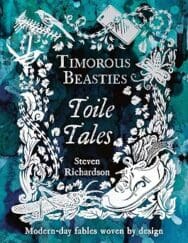
Timorous Beasties Toile Tales
By Steven D.P. Richardson, illustrated by Timorous Beasties
Published by Black & White Publishing
Toile Tales is a gorgeous collection of original illustrations and stories. We’re transported over the course of 21 tales between the depths of lochs and shallows of ponds to the web of a spider, the shadowed roots of forest floors to the streets of Edinburgh and the houses of Parliament.
True to fable form, each story comes with its own message. There’s subtle commentary on political issues, warnings about groupthink, vanity and overconsumption, and what one will do to provide.
But to reduce Toile Tales to just the ‘tales’ is to do the book a disservice. The illustrations in the form of toile (decorative patterns used for furnishings which combine art and narrative) are the genesis and the beating heart of this exquisite work of art.
Unusually, the book invites the reader to look at the ‘picture first’. Illustrator Paul Simmons, co-founder of Timorous Beasties, the Scottish design studio specialising in wallpapers and fabrics that take inspiration from toile traditions, explains that Toile Tales began with a series of ‘toile illustrations’ that existed without a narrative. Writer Steven Richardson then responded to each of the drawings ‘as though they were stories waiting to be read’.
And thus, an image of a crow waiting beneath a blooming flower while a butterfly rests on its back became ‘The Crow and the Butterfly’, a tale about the destructive power of obsession and control.
The toile of four people sitting under a tree and blanketed by flowers while pigeons and a blackbird clutching cherries surround them becomes the Grimm-esque tale ‘The Cherries’, while an illustration of three lizards on a bed of plants, one seemingly attempting to climb some run-down metal fencing transforms into a fable about marriage, hope and opportunity in left behind towns in ‘The Lizards’.
The idea of ‘illustration as the catalyst rather than the conclusion’ made me question my own relationship with illustrations and text. Illustrated books for adults are particularly rare, so I’m used to illustration as a by-product of a pre-existing narrative, be it in manga, animated TV and film, or in the Persian miniatures I grew up gazing at. Yes, ekphrastic poetry and literature exists, but rarely do illustrators illustrate intending for their imagination to lead a writer. The images usually follow the words.
By drawing attention to this inversion of the typical creative process early on in Toile Tales, the reader is encouraged to engage with the book actively rather than passively. Before each tale, I found myself paying particular attention to the initial toile, surveying the intricacies and details with a focus I wouldn’t have otherwise possessed, peering and squinting at the shapes, tracing the linework as though searching for the story myself. I wondered how I could translate each image into text, what characters and lives would unravel from my hand. Reading this book became a tactile experience.
Luckily, there’s no need for the reader to ponder too long. Richardson has written a tapestry of stories that weave between timeless, almost otherworldly natural settings before abruptly teleporting us to Parliament, or to a tower block on the edge of a new town.
The stories find a natural rhythm, and ebb and flow through the world while capturing the cadences, humour, twists and sentiments of the original Aesopian fables Richardson says were an inspiration. His creativity seeps through, however – at no point do the tales feel like retellings or lazy interpretations of stories that we’ve heard for millennia. These do indeed feel like ‘modern-day fables’, as the front cover proclaims.
Richardson also does well to ensure his work does not feel condescending or overly didactic. While the lessons are clear in some fables, in others there are layers of interpretation which mean the morals never come at the expense of the storytelling.
And what stories they are. The fables seem to veer into myth, with telling details on each page. Each tale feels like reading a painting – we’re summoned like the sun to stand at ‘the loch’s pale cove’ and bear witness to the hart shaking dew from its mane, and to peer with the apprentice poet at the secrets of the water’s depths.
Impressive too is Richardson’s ability to take the reader into new settings and new casts 20 times over, and to allow each tale to feel unique.
So too does Simmons make each illustration feel distinct. Each of the initial toiles, as well as the illustrations that speckle the pages of the book are full of life, character and colour.
This interwoven approach places Toile Tales into a wider illustrative and physical history, allowing the book to become a tangible piece of art where one can spend hours poring over the pictures, hours reading the text, and even longer flicking between one and the other.
There’s something to be said too for just how mesmerising the illustrations are. I am not one for defacing books, but if I was so inclined I would pull the pages from this book and display them on the wall and be surrounded by them. Toile Tales deserves more than to be sequestered on the shelf of a neglected study, among dusty hardbacks we have every intention of reading. It deserves a place on the coffee table, kept in reach and returned to time and time again.
‘What a theatre the mind is’, writes Richardson in ‘The Swineherd’s Teeth’. What a theatre too is Toile Tales.
Timorous Beasties Toile Tales by Steven D.P. Richardson is published by Black & White Publishing and is available now, priced £30.
RELATED BOOKS

ALSO ON BOOKS FROM SCOTLAND
-

David Robinson Reviews: The Bohemian Queen by Jean Findlay
‘Right from the start, her Elizabeth Stuart is daring, taking risks in the hunt that few others woul …
-
The Pocketbook Guide to Scottish Superheroes
‘I had seen a lot of weird shit in my job. Ballpoints turning into tulips, words blurring then trick …
-

In the Shade of the Peepal Tree by Selinder Narwan
‘I stepped back, holding my chunni over my mouth. Panic started to build up inside me; I needed to g …
-

‘It is the same with his poems and short stories, the crystalline and precise language; the way they …
-

Flight Patterns by Lorna J. Waite: An Appreciation by Janette Ayachi
‘I’ve recently heard poetry archives described as ‘fugitive, ephemeral’, but here the wish of collec …
-
The Scottish Colourists: Art & Life by Alice Strang
‘Together the quartet embodied a new spirit in Scottish art and they are celebrated as Scotland’s le …
FEATURED AUTHOR:
Seona Calder

Seona Calder was born and raised in Scotland. After studying art, she went on to work as an illustrator on various projects, including books on science, astronomy and animal behaviour. Seona claims that ‘living with a menagerie of animals over the year …
FEATURED PUBLISHER:
Tapsalteerie

Tapsalteerie is an independent poetry press based in rural Aberdeenshire. We publish a diverse range of poetry with a focus on new and innovative writing, translations, collaborative working, and the Scots language. Tapsalteerie started life as a pamph …