


ABOUT THIS BOOK
PUBLISHER: ShieldCrest
FORMAT: Paperback
ISBN: 9781911090212
RRP: £35.00
PAGES: 233
PUBLICATION DATE:
July 25, 2016
BUY THIS BOOK
As an Amazon Associate and Bookshop.org affiliate we earn from qualifying purchases.
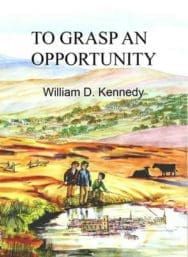
To Grasp an Opportunity
William D. Kennedy
The ‘Highland Clearances’ have become one of the best known events of Scottish history but the movement of people from the south was equally disruptive, if not quite so dramatic in its execution. This book chronicles the lives of members of four families from Galloway in South West Scotland, who left to ‘better themselves’. A brief introduction to the history of the Glenkens area of Galloway and an outline of the development of Manchester and the Lancashire cotton trade leads the reader through their early years in business towards their eventual domination of the fine cotton spinning industry centred in that city. It will appeal to those interested in the history of Galloway and the City of Manchester, as all the families, broadened by marriage and wealth, played a leading part in both places. Their lives spanned the 1745 rebellion, John Paul Jones’s raid on Scotland at Kirkcudbright, The Peninsular War culminating in the Battles of Trafalgar and Waterloo, the American trade embargoes and Civil War. The ‘reminiscences’ of family members give a unique insight into life and travel in early Victorian times which, hitherto could only be found in private publications.
William D. Kennedy
William Kennedy, the second youngest of a family of four was brought up on a farm in Shropshire. After school and Agricultural College he worked his way up to becoming farm manager of the Cally Estate at Gatehouse of Fleet, Kirkcudbrightshire. He returned to the area after a spell abroad and was lucky enough to be able to acquire a farm in a beautiful situation overlooking the Solway Firth, where he and his family live. His various business interests have all been broadly connected with agriculture, country sports and land management. This book grew out of his interest in family and local history. His research led him to find a bigger story than merely rags to riches. He found these families and their connections linked in an exceptional way to many events that took place during the Victorian era.
ALSO ON BOOKS FROM SCOTLAND
-


The Scottish Colourists: Art & Life by Alice Strang
‘Together the quartet embodied a new spirit in Scottish art and they are celebrated as Scotland’s le …
-

David Robinson Reviews: Our Noble Selves by Kate Atkinson
‘As I suggested at the start, there’s a whole heap of plot in Our Noble Selves – spies, murders, and …
-
‘They had spoken perhaps ten sentences each and it had already begun. Moira’s resentments, her preju …
-

Ayont the Thistle by Jim Mackintosh, Alan Riach and James Robertson
‘Nane ae this then but – ma hert daen its hing/ an yon wee smile ae yours in the saft smir ae the ga …
-

David Robinson Reviews: This Door of the Seas
‘He sees what he wants to. And it makes a kind of sense too – especially to colonists from Scotland, …
-

The Broons and Oor Wullie Celebrate their 90th Birthdays!
‘Whatever the future may hold, we can be sure that The Broons and Oor Wullie will always be a part o …
FEATURED AUTHOR:
Nan Shepherd

Anna (Nan) Shepherd was born in 1893 and died in 1981. Closely attached to Aberdeen and her native Deeside, she graduated from her home university in 1915 and for the next forty-one years worked as a lecturer in English. An enthusiastic gardener and hi …
FEATURED PUBLISHER:
The White Horse Press

The White Horse Press is a small independent publisher specialising in scholarly books and journals on environment and society. We aspire to standards of academic quality as high as those of the best international scholarly publishers, and to a friendl …