


ABOUT THIS BOOK
PUBLISHER: Princeton University Press
FORMAT: Hardback
ISBN: 9780691002651
RRP: £65.00
PAGES: 338
PUBLICATION DATE:
April 4, 1999
BUY THIS BOOK
As an Amazon Associate and Bookshop.org affiliate we earn from qualifying purchases.
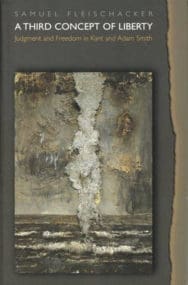
A Third Concept of Liberty: Judgment and Freedom in Kant and Adam Smith
Samuel Fleischacker
This text explores a third definition of liberty. In Samuel Fleischacker’s view, Kant and Adam Smith think of liberty as a matter of acting on our capacity for judgement, thereby differing from those who tie it to the satisfaction of our desires and those who translate it as action in accordance with reason or “will”. Integrating the thought of Kant and Adam Smith, and developing his own stand through readings of the “Critique of Judgement” and “The Wealth of Nations” Fleischacker shows how different acting on one’s best judgement is from acting on one’s desires – how. in particular, good judgment, as opposed to mere desire, can flourish only in favourable social and political conditions. At the same time every individual must do for him or herself, hence not something that philosophers and politicians who reason better can do in everyones stead.For this reason advocates of a liberty based on judgment are likely to be more concerned than are libertarians to make sure that government provides people with conditions for the use of their liberty, such as excellent standards of education, health care and unemployment insurance, while at the same time promoting a less paternalistic view of government than most of the movements associated for the past 30 years with the political left.
OTHER BOOKS BY THE SAME AUTHOR

ALSO ON BOOKS FROM SCOTLAND
-


David Robinson Reviews: Our Noble Selves by Kate Atkinson
‘As I suggested at the start, there’s a whole heap of plot in Our Noble Selves – spies, murders, and …
-
‘They had spoken perhaps ten sentences each and it had already begun. Moira’s resentments, her preju …
-

Ayont the Thistle by Jim Mackintosh, Alan Riach and James Robertson
‘Nane ae this then but – ma hert daen its hing/ an yon wee smile ae yours in the saft smir ae the ga …
-

David Robinson Reviews: This Door of the Seas
‘He sees what he wants to. And it makes a kind of sense too – especially to colonists from Scotland, …
-

The Broons and Oor Wullie Celebrate their 90th Birthdays!
‘Whatever the future may hold, we can be sure that The Broons and Oor Wullie will always be a part o …
-

Pretty Valuable Things by A. J. Leslie
Harper considered Charles for a few moments, lit a cigarette, then said ‘we are treating it as murde …
FEATURED AUTHOR:
Corrina Campbell

Corrina is a self-taught illustrator/author with a background in primary education. Having taught children from nursery to primary 7, Corrina has a wealth of knowledge with regards to engaging children in literature and knowing what makes a great story …
FEATURED PUBLISHER:
McNidder & Grace
McNidder & Grace is an award-winning independent publisher specialising in biographies and memoirs, music literature, art, travel, history, sport, and crime fiction. McNidder & Grace carry the stories and voices of a wide range of authors and g …