


ABOUT THIS BOOK
PUBLISHER: Edward Elgar Publishing Ltd
FORMAT: Hardback
ISBN: 9781788971843
RRP: £85.00
PAGES: 296
PUBLICATION DATE:
July 27, 2018
BUY THIS BOOK
As an Amazon Associate and Bookshop.org affiliate we earn from qualifying purchases.
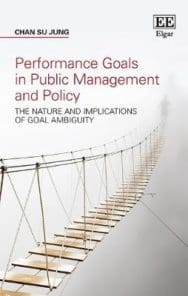
Performance Goals in Public Management and Policy: The Nature and Implications of Goal Ambiguity
Chan S. Jung
Chan Su Jung provides a thorough review of goal ambiguity in the public sector, exploring the general assertions, arguments and empirical evidence regarding performance goal ambiguity, particularly highlighting its causes, consequences, and mediation effects. The author proposes a new conceptual framework for successful analysis of goal ambiguity that can effectively relate to diverse organizational and program characteristics.Using U.S. federal programs, South Korean central government agencies, and English local authorities as examples, Jung empirically tests his framework to validate the new approach for goal ambiguity analysis. The author corroborates management capacity, third-party involvement, learning times, size, and work complexity as predictors of goal ambiguity and performance. In addition, Jung studies political insulation structures as moderators between management capacity and goal ambiguity, along with the negative effect of goal ambiguity on performance. Based on these empirical findings, the author provides clear and transferable principles to guide further theoretical and conceptual studies on the topic.An essential read for quantitative researchers and doctoral students of public management and policy, this book will guide future empirical studies on goal ambiguity and performance in the public sector.
Reviews of Performance Goals in Public Management and Policy: The Nature and Implications of Goal Ambiguity
`This book is a must read to those who are interested in public performance goals and goal ambiguity issues. The author offers not only comprehensive and superb conceptual discussions on public performance goals and goal ambiguity as independent, mediating, and dependent variables in public organizations, but also provides rigorous evidence based on empirical analyses of U.S. Federal government data as well as the data obtained from British local governments and South Korean central government. While this book itself is a refined scholarly architecture of public performance goals and goal ambiguity by carefully linking concepts, models, and empirical analyses, the author also envisions exciting future research by positing fourteen compelling research propositions and various research methods.' — M. Jae Moon, Yonsei University, South Korea
Chan S. Jung
Chan Su Jung, Samhwa Global Limited, Hong Kong SAR
ALSO ON BOOKS FROM SCOTLAND
-


David Robinson Reviews: Our Noble Selves by Kate Atkinson
‘As I suggested at the start, there’s a whole heap of plot in Our Noble Selves – spies, murders, and …
-

‘They had spoken perhaps ten sentences each and it had already begun. Moira’s resentments, her preju …
-

Ayont the Thistle by Jim Mackintosh, Alan Riach and James Robertson
‘Nane ae this then but – ma hert daen its hing/ an yon wee smile ae yours in the saft smir ae the ga …
-

David Robinson Reviews: This Door of the Seas
‘He sees what he wants to. And it makes a kind of sense too – especially to colonists from Scotland, …
-

The Broons and Oor Wullie Celebrate their 90th Birthdays!
‘Whatever the future may hold, we can be sure that The Broons and Oor Wullie will always be a part o …
-

Pretty Valuable Things by A. J. Leslie
Harper considered Charles for a few moments, lit a cigarette, then said ‘we are treating it as murde …
FEATURED AUTHOR:
Gavin Francis

Gavin Francis is an award-winning writer and GP. He is the author of four books of non-fiction, including Adventures in Human Being, which was a Sunday Times bestseller and won the Saltire Scottish Non-Fiction Book of the Year Award, and Empire Antarct …
FEATURED PUBLISHER:
Fruitmarket Publishing

Fruitmarket is a free, public space for culture in the heart of Edinburgh, providing inspiration and opportunity for artists and audiences. We programme, develop and present world-class exhibitions, commissions, publications, performances, events and e …