


ABOUT THIS BOOK
PUBLISHER: Bloomsbury Publishing PLC
FORMAT: Paperback
ISBN: 9781472957733
RRP: £18.99
PAGES: 256
PUBLICATION DATE:
September 6, 2018
BUY THIS BOOK
As an Amazon Associate and Bookshop.org affiliate we earn from qualifying purchases.
Pacific Exploration: Voyages of Discovery from Captain Cook to the Beagle
Nigel Rigby
Pieter van der Merwe
Glyn Williams
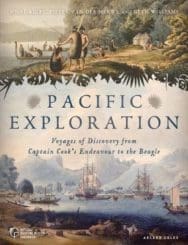
Captain Cook is generally acknowledged as the first great European scientific explorer. His voyage of exploration to the Pacific in HM bark Endeavour, commencing in 1768, lasted almost three years, recorded thousands of miles of uncharted lands and seas – including New Zealand, the east coast of Australia and many Pacific islands – and tested all Cook’s skills as a navigator, seaman and leader. His voyages were among the first to take civilian scientists, notably Sir Joseph Banks, and they revealed to European eyes the mysterious and exotic lands, peoples, flora and fauna of the Pacific, never before seen.But while Cook understandably dominates the story of 18th-century Pacific exploration, the achievements of those who followed him on many voyages of science and exploration into the Pacific have been neglected and deprived of the greater attention they deserve. Correcting this imbalance, Pacific Exploration explores the European voyages that continued Cook’s work not only of charting but also starting to exploit and control the Pacific. These voyages, by William Bligh, George Vancouver, Matthew Flinders, Malaspina, Laperouse and Arthur Phillip, span a period that saw Britain becoming the world’s leading maritime power, a situation well in place by the time that Charles Darwin’s voyage in Fitzroy’s Beagle laid the basis of even greater understanding of the development of life on earth.Recounting and illustrating these achievements and legacies using fascinating text and beautiful illustrations and artworks from the period, this book explores topics of scientific discovery, engagement with indigenous peoples, the use of shipboard artists and scientists, the growing professionalism of the hydrographic service, the vessels used and the colonial, commercial and imperial contexts of the voyages.
Nigel Rigby
Dr Nigel Rigby is Curator of Exploration at the National Maritime Museum, Greenwich, UK. He is co-author of a number of books on aspects of maritime history, including Captain Cook and the Pacific and editor of The Worlds of the East India Company.Pieter van der Merwe MBE is General Editor of Royal Museums Greenwich, UK. He has authored and edited a number of books on aspects of British maritime history, including South 2nd edition.Glyn Williams is Professor Emeritus of History at Queen Mary, University of London, UK. He has authored and edited a number of books on imperial and maritime history, including Naturalists at Sea and Arctic Labyrinth.
ALSO ON BOOKS FROM SCOTLAND
-

David Robinson Reviews: Our Noble Selves by Kate Atkinson
‘As I suggested at the start, there’s a whole heap of plot in Our Noble Selves – spies, murders, and …
-
‘They had spoken perhaps ten sentences each and it had already begun. Moira’s resentments, her preju …
-

Ayont the Thistle by Jim Mackintosh, Alan Riach and James Robertson
‘Nane ae this then but – ma hert daen its hing/ an yon wee smile ae yours in the saft smir ae the ga …
-

David Robinson Reviews: This Door of the Seas
‘He sees what he wants to. And it makes a kind of sense too – especially to colonists from Scotland, …
-

The Broons and Oor Wullie Celebrate their 90th Birthdays!
‘Whatever the future may hold, we can be sure that The Broons and Oor Wullie will always be a part o …
-

Pretty Valuable Things by A. J. Leslie
Harper considered Charles for a few moments, lit a cigarette, then said ‘we are treating it as murde …
FEATURED AUTHOR:
Ewan Morrison

Ewan Morrison is an award-winning novelist, scriptwriter and essayist. His fiction tends to focus on the subject of the modern family, cults, idealism, technology and extremism. As a novelist he has won the The Saltire Society Literary Prize and the Gl …
FEATURED PUBLISHER:
Charco Press

Edinburgh-based Charco Press, founded by Samuel McDowell and Carolina Orloff, aims to change the current literary scene to make room for a kind of literature that has been overlooked’ and ‘expose the UK reader to new and exciting voices. Charco Press i …