


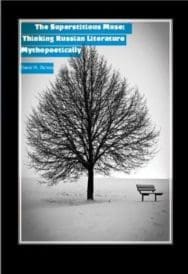
ABOUT THIS BOOK
PUBLISHER: Academic Studies Press
FORMAT: Paperback
ISBN: 9781618118127
RRP: £41.95
PAGES: 432
PUBLICATION DATE:
May 30, 2018
BUY THIS BOOK
As an Amazon Associate and Bookshop.org affiliate we earn from qualifying purchases.
The Superstitious Muse: Thinking Russian Literature Mythopoetically
David Bethea
For several decades David Bethea has written authoritatively on the “mythopoetic thinking” that lies at the heart of classical Russian literature, especially Russian poetry. His theoretically informed essays and books have made a point of turning back to issues of intentionality and biography at a time when authorial agency seems under threat of “erasure” and the question of how writers, and poets in particular, live their lives through their art is increasingly moot. The lichnost’ (personhood, psychic totality) of the given writer is all-important, argues Bethea, as it is that which combines the specifically biographical and the capaciously mythical in verbal units that speak simultaneously to different planes of being. Pushkin’s Evgeny can be one incarnation of the poet himself and an Everyman rising up to challenge Peter’s new world order; Brodsky can be, all at once, Dante and Mandelstam and himself, the exile paying an Orphic visit to Florence (and, by ghostly association, Leningrad).This sort of metempsychosis, where the stories that constitute the Ur-texts of Russian literature are constantly reworked in the biographical myths shaping individual writers’ lives, is Bethea’s primary focus. This collection contains a liberal sampling of Bethea’s most memorable previously published essays along with new studies prepared for this occasion.
Reviews of The Superstitious Muse: Thinking Russian Literature Mythopoetically
"Bethea (Slavic languages and literatures, U. of Wisconsin-Madison and Russian studies, Oxford U.) explores how the poetic impulse creates and is created by story, looking at Russian literature primarily as transmission and modification of large cultural patterns, though also recognizing the individuality of the authors. A central section on Pushkin as poet and thinker is preceded by a section on general themes and followed by one surveying how other Russian authors viewed their own work and that of others. Specific topics include the apocalyptic plot in Russian literature, how to read Pushkin's dialogue with Shakespeare in The Stone Guest, and Nabokov's style, and Joseph Brodsky's "To My Daughter." The ultra-contemporary typeface is for readers with a short attention span."–(Annotation (c)2010 Book News Inc. Portland, OR) "Few American Slavists have been as prolific as David M. Bethea; hence this ample collection represents only a small sampling of his work. Nonetheless, it gives a good sense of his scholarly preoccupations over the past three decades. The book is wide-ranging in both its theoretical concerns and its choice of primary texts. . . . Bethea's approach opens up obscure passages in unprecedented ways, often with admirable clarity."–Michael Wachtel, Princeton University "Slavic Review "
David Bethea
David Bethea (Ph.D. University of Kansas, 1977) is a Vilas Professor of Slavic Languages, University of Wisconsin-Madison. Research interests include: Pushkin and his era, modern Russian poetry (esp. Khodasevich and Brodsky), Russian religious thought and cultural mythology, Russian emigre literature, Anglo-American vs. Russian modernism, 20th century Russian/Slavic literary theory (esp. influence studies), biography. Among his books are: Joseph Brodsky and the Creation of Exile (Princeton: Princeton University Press, 1994), and Realizing Metaphors: Alexander Pushkin and the Life of the Poet (Madison: University of Wisconsin Press, 1998).
ALSO ON BOOKS FROM SCOTLAND
-

The Scottish Colourists: Art & Life by Alice Strang
‘Together the quartet embodied a new spirit in Scottish art and they are celebrated as Scotland’s le …
-
David Robinson Reviews: Our Noble Selves by Kate Atkinson
‘As I suggested at the start, there’s a whole heap of plot in Our Noble Selves – spies, murders, and …
-
‘They had spoken perhaps ten sentences each and it had already begun. Moira’s resentments, her preju …
-

Ayont the Thistle by Jim Mackintosh, Alan Riach and James Robertson
‘Nane ae this then but – ma hert daen its hing/ an yon wee smile ae yours in the saft smir ae the ga …
-

David Robinson Reviews: This Door of the Seas
‘He sees what he wants to. And it makes a kind of sense too – especially to colonists from Scotland, …
-

The Broons and Oor Wullie Celebrate their 90th Birthdays!
‘Whatever the future may hold, we can be sure that The Broons and Oor Wullie will always be a part o …
FEATURED AUTHOR:
Murray Pittock
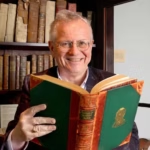
Since 2007, Murray has been Bradley Professor at the University of Glasgow and successively Dean, Vice-Principal and Pro Vice Principal at the University. Outside the University, he serves on the National Trust for Scotland Board (2019-27) and Investme …
FEATURED PUBLISHER:
Wild Goose Publications
Wild Goose Publications produces books, e-books, CDs and digital downloads relating to the community’s concerns for social justice, political and peace issues, holistic spirituality, care for creation, and healing, and supplies innovative resources for …