


EXPLORE ISSUES


‘I don’t think I decided to become a writer. I just was.’
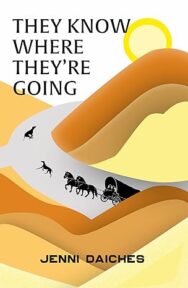
Jenni Daiches (the pen name for the fiction and poetry released by Jenni Calder) has just released her latest novel, They Know Where They’re Going. It’s a literary dystopia set in a future UK where climate change has had a devastating effect on the young Ishbel Saddler and her family and sees them travel from their farm in Cambridge to the Highlands in Scotland where water is more plentiful. BooksfromScotland asked Jenni about her life and writing.
They Know Where They’re Going
By Jenni Daiches
Published by Scotland Street Press
Where were you born?
Chicago, USA
What is your first memory?
Probably walking with my parents down a leafy street in Chappaqua, NY, where we were living at the time. I can’t have been more than three.
Did you enjoy school? Did you have a favourite teacher or subject?
I enjoyed my first three schools, in Ithaca, NY and Cambridge, England. My American schools I remember as quite fun and not particularly demanding. It was a shock adjusting to school in England where the first thing I had to do was prepare for the 11Plus exam but I had a wonderful teacher who got me through it. I then went on to a direct grant grammar school which was a mixed experience – I was a bit of a rebel. My favourite subject was always English, followed closely by History. I was briefly taught by a lovely young woman straight from Oxford who treated us like co-conspirators. I wasn’t surprised when I later ran into her on an Aldermaston March.
Do you remember when and how you decided to become a writer?
I don’t think I decided to become a writer. I just was. I grew up in a very literary household, can’t remember ever not being able to read and was making up stories at an early age.
Did you read newspapers growing up? How do you get your news now?
I was a teenager when I started (sporadically) reading my parents’ Guardian and New Statesman and I’m still a Guardian and more occasional New Statesman reader. I’m a daily listener to BBC radio news and viewer of Channel 4 news.
What was your favourite childhood holiday?
When we were still living in the US from 1946 we returned to Scotland every two years and spent a month in Cullen on the Moray coast. We continued going there after re-locating to Cambridge. I loved it and still do.
Where is your favourite place now?
See above.
Did you go to university? What is your most abiding memory of that time?
I read English at Cambridge University, at what was then New Hall (now Murray Edwards College), a young and still very small women’s college. I have many abiding memories – friendship, getting arrested at a Committee of 100 demonstration in Trafalgar Square, the severe winter of 1963 when the Cam froze and I could walk on the river from my New Hall room to my boyfriend’s room in King’s College, bypassing closed gates designed to keep students in or out. After Cambridge I did an MLitt at Birkbeck College, University of London. By that time I was married and living in a tiny flat in Islington so it was a very different experience.
What was your first job?
On leaving school I got a job helping to clean the newly built university chemistry lab. It was hard and tedious work and I hated it. I then got a job in a milk bar and learnt to make milkshakes and knickerbocker glories which was much more fun.
Other than writing, what has been your favourite job?
I’ve always enjoyed teaching and have done this at every level from primary school to post-graduate students. Teaching English literature at the University of Nairobi was particularly rewarding. I worked for 23 years at the National Museum of Scotland in various capacities, including guiding the interpretation of displays in the new Museum of Scotland, opened in 1998. This was hugely challenging, involving working closely with curators and designers – a steep but very valuable learning curve.
What is your favourite film?
Impossible to choose a favourite, but I’ve always – since the age of about 5 – been a big fan of Westerns. Two films that made a huge impression on me as a student were Ashes and Diamonds (dir. Andrzej Wajda) and Electra (dir. Michael Cacoyannis)
What is your favourite meal?
Any meal that involves getting together with my family.
What is your favourite album or song?
My taste in music is so eclectic I couldn’t possibly identify a favourite but something I go back to over and over again is Jocelyn Pook’s Hallelujah, not Leonard Cohen but her setting of Psalm 117. Soul music.
How do you exercise?
Walking the dog, plus housework, gardening, tai chi and physio in a (vain) effort to mitigate sciatica.
Do you have a favourite word? (It can be in any language).
My love of words is pretty much all-embracing. It would be invidious to have a favourite but I do love ‘serendipity’, for its sound and its meaning – the accidental discovery of things you weren’t looking for. The process of writing is full of serendipitous moments!
Which writers have influenced you over your life?
There are so many different kinds of influence. As a child my mother read to me and my siblings a number of Victorian classics (Jane Eyre, David Copperfield, Treasure Island et al, also poetry and Homer) and I was a voracious reader from an early age. As a teenager and student I read English and American 19th and 20th century fiction and poetry widely plus European works in translation. Books that have entered the bloodstream range from the Iliad to Middlemarch, from Nostromo to Nineteen Eighty-Four, from Moby Dick to Mrs Dalloway. Of contemporary writers most of those I most admire are American women, above all Elizabeth Strout. But influence? For others to detect.
What are you reading now?
I have just finished Strout’s The Things We Never Say (heart-breakingly wonderful), currently reading Louise Penney’s Black Wolf (darkly political) and Shaun Bythell’s Remainders of the Day (delightfully caustic).
They Know Where They’re Going by Jenni Daiches is published by Scotland Street Press, priced £12.99.
RELATED BOOKS

ALSO ON BOOKS FROM SCOTLAND
-

The Scottish Colourists: Art & Life by Alice Strang
‘Together the quartet embodied a new spirit in Scottish art and they are celebrated as Scotland’s le …
-
David Robinson Reviews: Our Noble Selves by Kate Atkinson
‘As I suggested at the start, there’s a whole heap of plot in Our Noble Selves – spies, murders, and …
-
‘They had spoken perhaps ten sentences each and it had already begun. Moira’s resentments, her preju …
-

Ayont the Thistle by Jim Mackintosh, Alan Riach and James Robertson
‘Nane ae this then but – ma hert daen its hing/ an yon wee smile ae yours in the saft smir ae the ga …
-

David Robinson Reviews: This Door of the Seas
‘He sees what he wants to. And it makes a kind of sense too – especially to colonists from Scotland, …
-
The Broons and Oor Wullie Celebrate their 90th Birthdays!
‘Whatever the future may hold, we can be sure that The Broons and Oor Wullie will always be a part o …
FEATURED AUTHOR:
Richard Strachan
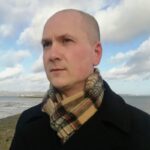
Richard Strachan is a former bookseller, who lives in Edinburgh with his family. His short fiction has been published in various magazines including The Dark and Interzone, and by Galley Beggar Press in their digital singles list.
FEATURED PUBLISHER:
Kitchen Press
Kitchen Press is an independent publishers specialising in restaurant and market cookery books. We collaborate with chefs, illustrators, photographers and writers throughout the UK to create beautiful books, celebrating just some of the innovation happ …