


EXPLORE ISSUES


The Heights and The Isle of Karma
‘What draws either Rankin or McCall Smith to write a standalone novel?’
David Robinson looks at the latest novels from two authors Ian Rankin and Alexander McCall Smith, each of which are a departure from their well-known and well-loved serial characters.
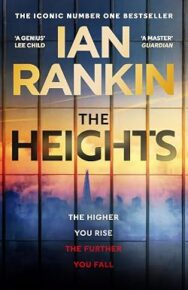
The Heights
By Ian Rankin
Published by Orion
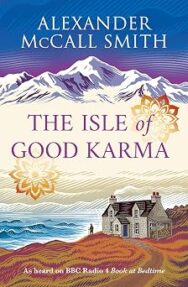
The Isle of Good Karma
By Alexander McCall Smith
Published by Polygon
Imagine, for a moment, that you are a bestselling writer of a series of novels. They have found fans all over the world, each one in the series fleshing out your central character that little bit more, in the process making them more and more believable and enticing for your fans.
Now, though, your latest novel has nothing to do with any of that. Not only will your much-loved central character not even make an appearance in it, but the new book will have a completely different setting. If writers are brands – as your publisher’s marketing team will insist they are – isn’t this a bit of a risky strategy?
Risky or not, it is one that Scotland’s two leading writers – that’s if you go by book sales, popularity and knighthoods – are trying out this month.
The Heights is Ian Rankin’s first standalone novel for two decades, although it builds on his 2023 short story The Rise. Instead of Edinburgh, where most of Rankin’s 23 John Rebus novels have been set, it features London at its lushest and plushest – an 18-story residential tower block overlooking Hyde Park so exclusive its smallest suite would set you back £15 million. And instead of surly old John Rebus, who could hardly be understood by the locals last time he was in London (in 1992’s Tooth and Nail), this time Rankin’s main character, DS Gillian Gish, is Tottenham born and bred.
In all the years Rankin hasn’t written a standalone novel, Alexander McCall Smith has written eight, including The Isle of Good Karma, which is also out this month. He is also incredibly prolific on the serial fiction front – indeed, no-one on these islands has written more. Just add them up: 26 starring Botswana’s ‘traditionally built’ detective Mma Ramotswe (the latest, The Big Cats’ Dinner Party, published only a month ago); 19 in the 44 Scotland Street series set in Edinburgh’s New Town; and 16 about Merchiston philosopher Isabel Dalhousie. On top of that, there are three set in Pimlico’s Corduroy Mansions, four about the Edinburgh-based Private Passions Company, five about the Swedish Detective Elf Varg and six wonderfully wacky ones featuring the pompous German academic Professor Doctor Moritz-Maria von Igelfeld. That isn’t even a comprehensive list of his literary output, merely of his serial fiction for grown-ups.
What draws either Rankin or McCall Smith to write a standalone novel? In Rankin’s case, the lure is probably writing about a different kind of case – one in which, rather like Agatha Christie’s Death on the Nile or Murder on the Orient Express, all of the suspects are pretty much holed up together in the same place. True, they are free to come and go, but in The Heights there will usually be a closed-circuit security circuit tracking their every move. Or at least it normally would be – except that on the night a male concierge is killed in the hotel’s reception area, someone has switched it off.
On the floors above, the inhabitants of The Heights are sufficiently varied to hold our interest: a record producer, his latest male star, an actress, a gangster’s wife, an international art dealer, a financial wheeler-dealer, a Zimbabwean exile, and a Russian with a significant oligarch clientele. All are UHNWIs (ultra-high net worth individuals), and at least the two of them sufficiently famous to intrigue a tabloid newsdesk. Again, this is straight from the Christie playbook. Except Rankin wants to set himself an even greater challenge: instead of one detective – Poirot – exercising his ‘little grey cells’ on the matter, this time there is a whole police team. True, the main focus is on DS Gillian Gish – she’s the only one we see away from work – but she hardly overshadows her colleagues.
Rankin’s plotting has always been his strong point, and here it needs to be. Just as there are plenty of murder suspects among the residents of The Heights, so are also there a number of potential crime-busters trying to work out whodunnit. Add the threads that link almost every one of the suspects to each other and you have a very intricate cat’s cradle indeed.
McCall Smith’s latest standalone runs in a different direction altogether. In The Isle of Good Karma, he takes a single idea – what would happen if people could tell you were a good person just by looking at you? – and pushes it as far as it will go. Where Rankin has set himself a complex puzzle, McCall Smith has, it seems, set himself one with the simplicity of a fable.
His protagonist, Maeve Macdonald, is the head of English at a school on Lewis. She is 42, single, and although she loves her job, knows that life is passing her by. Craving excitement, she quits her job and decides to go travelling for six months, starting in Nepal.
First, though, McCall Smith has to show us that Maeve isn’t just a good teacher but a good human being. In the classroom, we see her opening the minds of her young charges to the glories of Shakespeare and Burns. On the croft she shares with her bachelor uncle, she helps with her neighbour’s sheep. Everyone likes her. Her neighbour’s son – also a pupil – adores her. He might be sad to see her go to Nepal but he knows she will have a good time. How? Because second sight runs in his family.,
And indeed, everything DOES work out. Maeve hadn’t wanted to leave her uncle all by himself but he is suddenly reunited with the love of his life, whom he hasn’t seen since she left Lewis 40 years ago. Her friend Ella, somewhat to her surprise, gets her husband’s permission to join her on a trekking tour of Nepal. Everything that can go right for Maeve does: free outfitting at a Glasgow outdoors shop in exchange for modelling their ‘pre-middle-age’ lines; a taxi driver on the airport run who switches off his meter just because he is feeling in a good mood; even a flight upgrade to business class. (Being pathologically good, she gives this to Ella).
In Nepal, her run of good luck continues, although the people there call it good karma. They can see it in Maeve everywhere she goes; whether checking into her hotel, visiting the Buddhist temples and generally seeing the sights in Kathmandu, her straightforward goodness is immediately obvious. Even computers can pick up on Maeve’s aura of good karma, which is why, even without the hotel receptionist doing anything, his computer gives her an another upgrade from a hotel room to a suite of the kind that Rankin’s characters in The Heights would expect as of right.
So far, then, so (literally) fabulous. So simple. So much like a fairy story in which a spell has been cast and a person’s life has miraculously had all of its hurdles magically removed. And why shouldn’t adults have these kinds of fairy stories too? What is this life if, full of care, we have no time to stand and stare – or, to adapt WH Davies’s poem, weren’t full of care in the first place?
Just as Rankin has expanded his short story The Rise to the full-length novel The Heights to make it more intricate and complex, so has McCall Smith expanded what would have been a whimsical short story to a full-length novel – not to make the plot more complicated but to examine whether such an apparently unlikely story can ever be retrieved and brought back from its playful premise (‘what would it be like if …’) to something approaching reality. Because Maeve’s good fortune – her karma – can’t last. We know that. Accidents will happen, and so will death, and so will mistakes. When such things happen, any apparent simplicity about the path of our lives vanishes too. This happens even to people of such obvious goodness as Maeve.
Yet the glorious thing about our short lives is that they can still contain wonders. In Nepal, Maeve’s life expands to contain the possibility of love. On the flight from Delhi, she meets a handsome American academic. He is, she notices, reading Montaigne’s Essays. This is, for the reader, an obvious sign of being a good egg. Because Montaigne’s Essays teach us that wisdom comes from learning how to handle everyday challenges, enjoy life, endure suffering, and value friendship. I don’t think any of McCall Smith’s standalone novels – I’ve read them all – would disagree with any of that.
The Heights by Ian Rankin is published by Orion, priced £25
The Isle of Good Karma by Alexander McCall Smith is published by Polygon, priced £18.99
RELATED BOOKS
ALSO IN THIS ISSUE
 Chantelle Streete Reviews: The Miseducation of Caroline Bingley
‘McLeod uses these moments to great comic effect, while also showcasing the class tensions and ingra …
ALSO ON BOOKS FROM SCOTLAND
-


Flight Patterns by Lorna J. Waite: An Appreciation by Janette Ayachi
‘I’ve recently heard poetry archives described as ‘fugitive, ephemeral’, but here the wish of collec …
-
The Scottish Colourists: Art & Life by Alice Strang
‘Together the quartet embodied a new spirit in Scottish art and they are celebrated as Scotland’s le …
-

David Robinson Reviews: Our Noble Selves by Kate Atkinson
‘As I suggested at the start, there’s a whole heap of plot in Our Noble Selves – spies, murders, and …
-
‘They had spoken perhaps ten sentences each and it had already begun. Moira’s resentments, her preju …
-

Ayont the Thistle by Jim Mackintosh, Alan Riach and James Robertson
‘Nane ae this then but – ma hert daen its hing/ an yon wee smile ae yours in the saft smir ae the ga …
-

David Robinson Reviews: This Door of the Seas
‘He sees what he wants to. And it makes a kind of sense too – especially to colonists from Scotland, …
FEATURED AUTHOR:
David Alston

David Alston is a Historian and Independent Researcher. He is the author of Ross & Cromarty: A Historical Guide (1997) and My Little Town of Cromarty: The History of a Northern Scottish Town (2006). He was a Highland Councillor and from 1991–2003 w …
FEATURED PUBLISHER:
Bright Red Publishing

Bright Red Publishing is an independent educational publishing company based in Edinburgh with our own distribution warehouse in Fife. We are a small, but perfectly formed, team of seven and we manage every part of our publishing process here in Scotla …