


ABOUT THIS BOOK
PUBLISHER: University of Exeter Press
FORMAT: Electronic book text
ISBN: 9780859899291
RRP: £14.00
PAGES: 284
PUBLICATION DATE:
March 2, 2015
BUY THIS BOOK
As an Amazon Associate and Bookshop.org affiliate we earn from qualifying purchases.
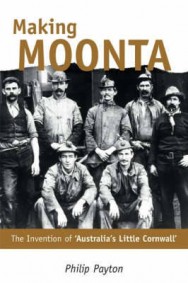
Making Moonta: The Invention of ‘Australia’s Little Cornwall’
Philip Payton
Winner of the 2008 Holyer An Gof Award for non-fiction. An investigation of the popular tradition of ‘Australia’s Little Cornwall’: how one town in South Australia gained and perpetuated this identity into the twenty-first century. This book is about Moonta and its special place in the Cornish transnational identity. Today Moonta is a small town on South Australia’s northern Yorke Peninsula; along with the neighbouring townships of of Wallaroo and Kadina, it is an agricultural and heritage tourism centre. In the second half of the nineteenth century, however, Moonta was the focus of a major copper mining industry. This book is about Moonta and its special place in the Cornish transnational identity. Today Moonta is a small town on South Australia’s northern Yorke Peninsula; along with the neighbouring townships of of Wallaroo and Kadina, it is an agricultural and heritage tourism centre. In the second half of the nineteenth century, however, Moonta was the focus of a major copper mining industry.From the beginning, Moonta cast itself as unique among Cornish immigrant communities, becoming ‘the hub of the universe’ according to its inhabitants, forging the myth of ‘Australia’s Little Cornwall’: a myth perpetuated by Oswald Pryor and others that survived the collapse of the copper mines in 1923-and remains vibrant and intact today.
Philip Payton
Philip Payton is Professor of Cornish & Australian Studies, University of Exeter, and is Director of the Institute of Cornish Studies at the University’s Cornwall campus. He has written widely on Cornwall and the Cornish; he is the author of A.L. Rowse and Cornwall: A Paradoxical Patriot (UEP, 2005, paperback 2007) and The Cornish Overseas: A History of Cornwall’s Great Emigration. He is a frequent visitor to Australia, where he has conducted extensive research and addressed numerous conferences.
ALSO ON BOOKS FROM SCOTLAND
-


The Scottish Colourists: Art & Life by Alice Strang
‘Together the quartet embodied a new spirit in Scottish art and they are celebrated as Scotland’s le …
-
David Robinson Reviews: Our Noble Selves by Kate Atkinson
‘As I suggested at the start, there’s a whole heap of plot in Our Noble Selves – spies, murders, and …
-
‘They had spoken perhaps ten sentences each and it had already begun. Moira’s resentments, her preju …
-

Ayont the Thistle by Jim Mackintosh, Alan Riach and James Robertson
‘Nane ae this then but – ma hert daen its hing/ an yon wee smile ae yours in the saft smir ae the ga …
-

David Robinson Reviews: This Door of the Seas
‘He sees what he wants to. And it makes a kind of sense too – especially to colonists from Scotland, …
-

The Broons and Oor Wullie Celebrate their 90th Birthdays!
‘Whatever the future may hold, we can be sure that The Broons and Oor Wullie will always be a part o …
FEATURED AUTHOR:
Peter May

Peter May was a novelist, originally from Glasgow but lived and worked in France. He started out as a journalist, studying at the Edinburgh College of Commerce, and winning the Fraser Award aged just 21 for his writing. He was named Scotland’s Young Jo …
FEATURED PUBLISHER:
Luath Press

Luath Press takes its name from Robert Burns, whose little collie Luath (Gael., swift or nimble) tripped up Jean Armour at a wedding and gave him the chance to speak to the woman who was to be his wife and the abiding love of his life. Burns called one …