


ABOUT THIS BOOK
PUBLISHER: Bucknell University Press
FORMAT: Paperback
ISBN: 9781611487046
RRP: £24.95
PAGES: 252
PUBLICATION DATE:
June 15, 2015
BUY THIS BOOK
As an Amazon Associate and Bookshop.org affiliate we earn from qualifying purchases.
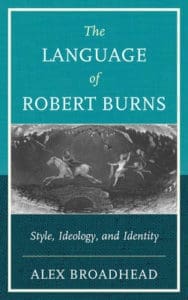
The Language of Robert Burns: Style, Ideology, and Identity
Alex Broadhead
This monograph offers a radical reconceptualisation of the relationship between the poetics and practice of Robert Burns and revaluates the nature of his role in the history of Scots. By drawing on ideas from twenty-first century sociolinguistic theory, it seeks to transform the debate surrounding Burns’s language. Through a series of readings that explore the way in which Burns used and commented on the styles associated with different places, groups and genres, it demonstrates how languages, places and the identities associated with both are, in Burns’s writing, subject to continual reinvention. In this respect, the study breaks with existing accounts of the subject, insofar as it presents Scots, English and the other languages used by Burns not as fixed, empirically-observable entities, but as ideas that were revised and remade through the poet’s work. Focusing on Burns’s poems, songs, letters, prefaces and glossaries, the book pays special attention to the complex ways in which the author engaged with such issues as phonology, grammar, and the naming of languages.The Burns who emerges from this book is not the marginal figure of traditional accounts- an under-educated poet alienated from the philological mainstream-but rather a well-informed thinker who, more than any other contemporary writer, embodies the creative linguistic spirit of the eighteenth century.
Reviews of The Language of Robert Burns: Style, Ideology, and Identity
In this fascinating study, Broadhead presents a picture of Burns that is far removed from the rustic self-educated Scottish peasant who used the Scottish dialect in his poetry because he was not sufficiently sophisticated in his use of English…Broadhead takes a 21st-century sociolinguistic approach to show that Burns not only had great command of both English and Scots, but also was a master linguist who manipulated different registers and dialects in his poetry. The author presents his argument in his coherent introduction; in the five chapters that follow, he focuses on different aspects of Burns's use of language in his poetry. Writing primarily for those conversant with literary criticism, the author includes easy-to-understand explanations of the linguistic concepts he uses and a wealth of examples from the poetry itself to illustrate his argument effectively. In taking a linguistic approach, Broadhead reveals another intriguing layer of Burns's sociopolitical and cultural impact…A helpful glossary of Scots words is included. Summing Up: Highly recommended. Graduate students through faculty. CHOICE
Alex Broadhead
Alex Broadhead is a University teacher at the University of Liverpool.
OTHER BOOKS BY THE SAME AUTHOR

ALSO ON BOOKS FROM SCOTLAND
-


The Scottish Colourists: Art & Life by Alice Strang
‘Together the quartet embodied a new spirit in Scottish art and they are celebrated as Scotland’s le …
-

David Robinson Reviews: Our Noble Selves by Kate Atkinson
‘As I suggested at the start, there’s a whole heap of plot in Our Noble Selves – spies, murders, and …
-

‘They had spoken perhaps ten sentences each and it had already begun. Moira’s resentments, her preju …
-

Ayont the Thistle by Jim Mackintosh, Alan Riach and James Robertson
‘Nane ae this then but – ma hert daen its hing/ an yon wee smile ae yours in the saft smir ae the ga …
-

David Robinson Reviews: This Door of the Seas
‘He sees what he wants to. And it makes a kind of sense too – especially to colonists from Scotland, …
-

The Broons and Oor Wullie Celebrate their 90th Birthdays!
‘Whatever the future may hold, we can be sure that The Broons and Oor Wullie will always be a part o …
FEATURED AUTHOR:
Eliza Chan

Eliza Chan is a Scottish-born speculative fiction author who writes about East Asian mythology, British folklore and reclaiming the dragon lady. Her Sunday Times bestselling debut novel Fathomfolk — inspired by mythology, East and Southeast Asian citie …
FEATURED PUBLISHER:
Society of Antiquaries of Scotland

The Society of Antiquaries of Scotland has been an active publisher of Scotland’s history and archaeology since 1792. We publish beautifully illustrated volumes covering the entire range of Scotland’s past, helping to bring it to life for future genera …