


EXPLORE ISSUES



‘As I suggested at the start, there’s a whole heap of plot in Our Noble Selves – spies, murders, and an innocent man being framed all among the ingredients.’
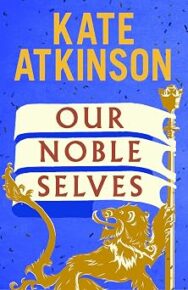
Our Noble Selves by Kate Atkinson is a witty post-war historical novel set against the Festival of Britain. David Robinson found the book to be a brilliant and whimsical read.
Our Noble Selves
by Kate Atkinson
Published by Doubleday
Kate Atkinson’s latest, hugely enjoyable, novel Our Noble Selves is so stuffed full of head-spinning whodunnitry and has such a enormous cast of suspects that you can’t help but think that somewhere in her Edinburgh house there must be an enormous whiteboard with all the characters’ names on it, different coloured lines for each, and all of them twisting together and pulling apart before coming together in one great, final explosive denouement.
On such a whiteboard, the strongest of those lines – let’s colour it red – would belong to Harry Flynn. Flynn was a Japanese PoW in the Second World War, but now it’s 1949 and he has found a job as a middle-ranking minion helping to plan ahead for the 1951 Festival of Britain. Some context here: this is a time of austerity, when Britain has only just finished one war and is already fighting another (Korea), when hope is as tightly rationed as butter, and when much of the country is tired, broke, possibly rubble-strewn and maybe even still mourning. At such a time, the Festival’s mission is to celebrate a colourful, optimistic, forward-looking technocratic Britain. The potential for satire and comedy is obvious and Atkinson doesn’t disappoint.
Already on our whiteboard, there is a little squidge of yellow. That will stand for Veronica, Flynn’s stepdaughter from a marriage that was effectively over in months. Insignificant when we meet Harry, she will play a big part later on. Then there are all of Harry’s office colleagues, a mixture of misfits at work on what is, after all, a mildly absurd project, each with their own colourful backstory of wartime terror or bravery, and each of them wondering what really happened when a female colleague is murdered and Harry, the last person to see her alive, turns up for work the next day with a black eye.
At this point, I must come clean. There is no whiteboard. With Atkinson, there never is. Her fiction has the immediacy and panache that you just don’t get from filling in a chapter-writing plan with made-up stuff. Writing that sort of way, where you’d know you would be writing Chapter 17 a week on Tuesday, would bore her and the whole point of writing fiction is that it never should be a chore.
So rather than planning ahead on a whiteboard, she follows the story where it wants to go. In the afterword to her 2018 novel Transcription* – like Our Noble Selves, also largely set at the start of the Fifties, and also involving spies and unrepentant fascists – she offered intriguing hints as to her writing process. Her initial interest, she revealed, was spiked by the release of transcriptions of an MI5 agent’s bugged conversations with British Nazi sympathisers and collaborators in the Second World War. Then she started wondering who had done all the boring transcription work – and she created an MI5 typist called Juliet. Influenced by Penelope Fitzgerald’s novel Human Voices (set in the wartime BBC) and a memoir by family friend and Schools Broadcasting pioneer Rosemary Horstman, she gave Juliet a peacetime job working in the BBC as a producer of children’s programmes. The whole plot of Transcription was about how a dark incident from wartime follows Juliet into her peacetime life in the BBC – yet as Atkinson admits in the afterword, when she started the novel, she had no intention of setting anything in the BBC. It wasn’t planned; it just happened.
Now look at the afterword to Our Noble Selves (and don’t worry, no spoilers!). This time Atkinson admits, the process wasn’t quite as straightforward.
‘I intended quite a large part of it to centre on the fall of Singapore and the subsequent harrowing experience of the POWs on the Burmese Railway (Flynn’s war). I did a lot of research, and I think it was while I was standing in the Commonwealth War Graves Commission cemetery in Kanji in Singapore that it struck me there was no place for this war in what is, to all extents and purposes, a relatively light-hearted novel…. To utilize it for my own trivial ends began to feel exploitative.’
Even if she hadn’t mentioned going out to Singapore, I’d have no doubt that Atkinson’s research had indeed been thorough: in Transcription, for example, the list of her sources runs to two pages, not including interviews and DVDs. But even though her fiction doesn’t shy away from death (it haunts almost every page of Life After Life), she realised – quite correctly – that Flynn’s experiences on the Burma Railroad were just too horrific to be anything other than gently shaded in.
So: let’s suppose you and I were Kate Atkinson. We’ve got reams and reams of stuff on the traumatic life of a PoW on the Burma Railroad. We might realise it didn’t exactly fit into the Festival of Britain theme, but we would surely want to prove that we’d done all the research, wouldn’t we? (Be honest!) But look at what Atkinson does. She goes, quite deliberately, in the other direction altogether. This is how she describes Flynn:
‘He wasn’t whole, he never would be whole, but like hundreds of thousands, perhaps millions, of men before him who had returned from a war, he was getting on with his life by treating the past as if it barely existed. He vowed never to write a memoir, never to seek out a survivors’ reunion, or swap stories of torture or imprisonment…’
There’s something terribly British about that, or at least we would like to think so, because stiff upper lip stoicism seems to have melted away these days. But although Atkinson never actually says so in Our Noble Selves, I can’t help feeling that this reticence is at the core of what makes her characters’ selves noble. Think of Teddy Todd – one of my favourite characters in all of fiction (and again, no spoilers!) – in A God in Ruins and how keen he is to put his wartime heroism behind him and never refer to it once, seeing out his days as a teacher and compiler of nature notes for his local paper in his (and Atkinson’s) beloved Yorkshire. Or even in this novel, think of Flynn’s office companion Evans:
‘Before the war Evans had been a Methodist lay preacher, and he was still inclined to goodness, although his religion had been lost during the war on a merchantman in the Arctic convoys, somewhere in the Barents Sea between Hvaljjördur and Arkhangelsk.’
Still inclined to goodness: I love the compression of that, a whole life behind four words. Because that’s the other thing about Atkinson: she is the princess of pith. Here she is, just a couple of pages later, describing the orphaned office boy (called Boy throughout), not only getting his father’s death down to just one word, but maybe raising a smile in the process:
‘The Boy’s own father having died before the war (of something simply referred to as ‘lungs’ by his mother), Evans had taken him under his wing…’
Of course he did. That’s what ‘still inclined to goodness’ means.
Atkinson hardly ever gives interviews these days or appears at book festival events, but I did once get the chance to talk to her about her writing process, which is how I know that whiteboards never come into it. The best way to describe it, she said, is to imagine four bars on a computer graph, each one representing one of the main characters, each one edging up, keeping pace with each other. ‘You’re constantly edging the narrative forwards, always on the front edge because you don’t know what’s going to happen, and you have an instinctive knowledge about how far you want each of them to go. You want a feeling of completeness with each section, a rhythm and structure, and - most importantly – shape to it, and only then can you move the story on again.’
As I suggested at the start, there’s a whole heap of plot in Our Noble Selves – spies, murders, and an innocent man being framed all among the ingredients. But the reason Atkinson had to make such a fundamental reframing of her novel is that it IS a comedy, so there is no room for Flynn’s memories of his days in captivity. There is just a little flicker of all Atkinson’s research in the Far East. Evans points out that for all the mentions of the ‘glorious Few and the plucky Londoners during the Blitz,’ many others ‘like the Jews in the camps’ were ignored. Flynn agrees. ‘The Malays, the Chinese, the Tamils,’ he says. ‘They had it worse than anyone on the Railway and there were a lot more of them. I doubt their story is ever going to be told.’
That’s just one line retrieved from all Atkinson’s research, and there’s not a lot more. Abandoning that plot stand – or consigning it to a past Flynn wants to forget – must have been difficult, but she was right to do so. Because – far more than I have room to show – this is a true comic novel. Flynn, for example, has not only to compile a book of Festival of Britain poetry from some truly execrable contributions (plenty of laughs there) but to publicise the recipe for the Festival Cake, which is produced by a woman so similar to the Fifties and Sixties celebrity cook Fanny Cradock that it’s a good job the dead can’t sue for libel. The dinner party at her flat, complete with a live winkle trying to escape the fruits de mer, is one of the most gloriously hellish ones I have read.
Much of the Festival of Britain did indeed lend itself to comedy. As Atkinson points out in the afterword, many of the things people might think she invented were actually real. The submissions to the Festival’s Eccentrics Corner did indeed include 604 gallstones (from one patient!) and plans for a collapsible rubber bus; Norman Hartnell absolutely did insist that all the cinema usherettes had red hair to go with their green uniforms; and a boy really did get stuck inside a Henry Moore sculpture. A novel that could take in such absurdities really couldn’t also carry the weight of too much horror.
It is there, all the same, but muted. In Flynn’s office, his mild-mannered supervisor, a former actor before the war (‘light on his feet, Evans said’) had stormed ashore on D-Day and his affable, rotund colleague Badgley (‘Badger’ since his prep school nursery) had once parachuted into occupied France. Neither would talk about their exploits any more than Flynn, and the only ones who do in Atkinson’s novel turn out to be charlatans or worse.
The Festival of Britain mattered. As Atkinson points out ‘For the first time the British public had experienced open-air cafés, spaghetti, hot dogs, ice-cold drinks, soft toilet rolls, and the opportunity to drink wine with their meal. So Continental. So modern. The glimpse of a possible future.’ Our Noble Selves (the title is from an Army toast) does it full justice. It is not just an excellent comic novel but it is a fine literary and historical one too.
* See https://booksfromscotland.com/2018/09/david-robinson-reviews-transcription-by-kate-atkinson/
Our Noble Selves by Kate Atkinson is published by Doubleday, priced £22.
RELATED BOOKS

ALSO ON BOOKS FROM SCOTLAND
-

‘They had spoken perhaps ten sentences each and it had already begun. Moira’s resentments, her preju …
-

Ayont the Thistle by Jim Mackintosh, Alan Riach and James Robertson
‘Nane ae this then but – ma hert daen its hing/ an yon wee smile ae yours in the saft smir ae the ga …
-

David Robinson Reviews: This Door of the Seas
‘He sees what he wants to. And it makes a kind of sense too – especially to colonists from Scotland, …
-

The Broons and Oor Wullie Celebrate their 90th Birthdays!
‘Whatever the future may hold, we can be sure that The Broons and Oor Wullie will always be a part o …
-

Pretty Valuable Things by A. J. Leslie
Harper considered Charles for a few moments, lit a cigarette, then said ‘we are treating it as murde …
-
Shadow of Madness: A Q & A with D. V. Bishop
‘Yet a great novel of historical fiction also has us escape the here and now by immersing us in the …
FEATURED AUTHOR:
Andrew Greig
Andrew Greig was born in Bannockburn, although raised in the Fife town of Anstruther. Equally at home with poetry – his first book was the poetry collection White Boats – and literary fiction – In Another Light won the Saltire Society prize in 2004. He …
FEATURED PUBLISHER:
McNidder & Grace
McNidder & Grace is an award-winning independent publisher specialising in biographies and memoirs, music literature, art, travel, history, sport, and crime fiction. McNidder & Grace carry the stories and voices of a wide range of authors and g …