


Though the clocks have gone forward, and Spring is in the air, Wintersong, a poetry collection by Joy Mead is a relevant read at any time. Here she tells us of the inspiration behind the collection and shares poems.
Wintersong
By Joy Mead
Published by Wild Goose Publications
These poems were written in a disturbing and troubling context – an emotional time of absence and loss which also proved to be an opportunity to search and remember. Out of the shadows, the darkness, and often the injustice, the need to lament and mourn goes hand in hand with the special significance of small moments and ordinary occasions.
So the poems attempt to express the poet’s calling and the value of poetry and creativity as they contemplate moments of loss and joy, both in my own life and in the lives of others near and far. And above all else Wintersong is a book with a longing to keep hope alive.
More than human wisdom,
looking is the poet’s charge:
to mark and mourn
death and loss;
to not let things go by
unnoticed; to respond
to the daily miracles, the music
of wind in the trees,
across stones, in the grass,
the shimmer of the willow –
how I see your face
in the darkness of absence.
(‘From within the dark times’)
Awake!
Be gentle as you walk
on the good Earth,
our home and life-giver.
Touch with kindness
all that has being
and shares with you
this sacred space.
Be still and connect
in the silence
what you are
with what you value.
Give attention to life’s littleness.
Contemplate what it means
to honour the small things –
the seeds and sunlight –
that sustain our wider being.
Listen, feel, touch and smell;
think and imagine –
these are sacred acts.
Real life is what it is,
not what you might be told it is.
Watch and never turn away.
Discern what is needful.
We can no longer sleep unaware
nor be silent while others sleep.
May the sound of our own voices
disturb our foolish slumber.
Awake and see!
Awake and tell what you see!
Awake and seek
a beautiful future
for all the Earth
and its creatures.
Winter Song by Joy Mead is published by Wild Goose Publications, priced £9.99.
Doric Books are a wonderful publisher celebrating the language of the North-East of Scotland. Here we share their latest children’s picture book on a local legend, Cedric the flapper skate.
Cedric e Flapper Skate
By Jackie Ross
Published by Doric Books
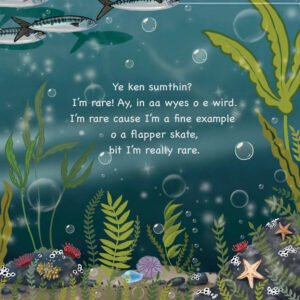
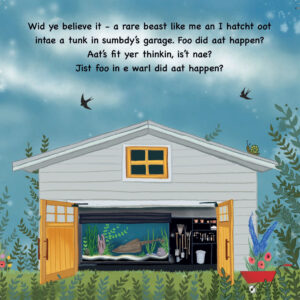
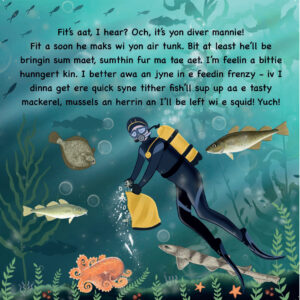

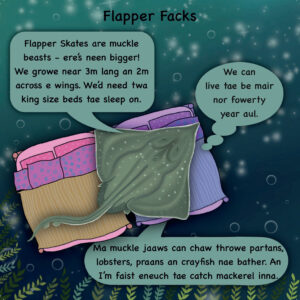
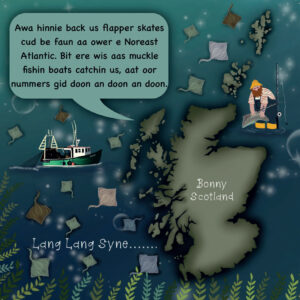
Cedric e Flapper Skate by Jackie Ross is published by Doric Books, priced £7.99.
Patrick Jamieson finds a wonderful and powerful memoir of connection and community in Sally Huband’s debut, Sea Bean.
Sea Bean
By Sally Huband
Published by Cornerstone
These days it’s verging on cliché to interpret women’s nature writing as a cypher for trauma or a means of understanding the human body. Yet it is impossible to ignore an ever-growing genre of Scottish nature ‘memoir’ that uses a re-encounter with the natural world for this very purpose. Equally, it is impossible to deny that this emerging form of nature writing is some of the most exciting work to be produced in Scotland today. Now, we can add Sally Huband’s Sea Bean to that list. Familiar in its form, like the best books of its kind, Huband’s debut works within these parameters to create something unique, weaving together mythology, community and ecology in a profoundly moving story of overcoming disability and rediscovering your place in the world.
Like so many of its type, it begins with a move from the city to somewhere remote. Sally, her infant son and husband move from Aberdeen to Shetland when he’s offered a job flying helicopters to and from the Mainland. They’re swept away by the romantic dream of island life: the freedom, wilderness, community and – most importantly – the house prices. It is a ‘shiny lure of nature’. ‘Lure’, here, is auspicious, and it doesn’t take long for the illusion to be shattered. Biblical winds, electricity shortages and a freedom which soon reveals itself as isolation mean their first few years are a torture. For Sally, especially so. Already ‘unmoored’ by motherhood before their arrival, she quits her job in conservation in the belief she’ll find part-time work on the Isles. She doesn’t. The struggle of caring for a baby on an unforgiving, unfamiliar island surrounded by a ‘hostile’ sea is exacerbated when she suffers two miscarriages. When she manages full term at the third time of trying, the strain put upon her body is so severe that it triggers the onset of inflammatory arthritis, ending forever her dream of walking all along the island’s shoreline. She is bereft, unable to work and unsure of herself or her place.
However, as is so often the case, what seems unforgiving and hostile soon becomes a remedy. Intrigued by the discovery of dead birds on a visit to the beach with her family, Sally takes her first steps into the world of ‘beachcombing’, the search for curiosities or useful objects washed ashore. This proves an able distraction from her struggles, and before long provides purpose: ‘Beachcombing returned me to myself’, she writes in one of many gorgeous turns of phrase. This proves true in more ways than one. Huband continually synonymises the sea with her body, most notably in the image of the eponymous sea bean, the search for which drives Sally as she continues her recovery. The sea bean, she notes, is also known by the names ‘sea-kidney’ and ‘sea heart’ due to its shape. In searching for this drift-seed washed ashore an unnatural environment, Sally is searching for a piece of herself.
After four years on the island they move to a new house in a small community near the shore. Contrary to stereotypes of closed island life, they are welcomed, even by the seasoned beachcomber Tex who paroles the beach each morning in his battered boiler suit. Beachcombing teaches Sally the ‘language of the sea’, both literally and figuratively, as she learns local Shaetlan words such as shoormal – meaning high-tide – or mareel – a type of bioluminescent plankton. She becomes integrated, accepted, a part of something after so many years adrift. As the book progresses this community takes her from the Faroe Islands to Orkney and the Netherlands. Across these journeys Sally learns of the extreme impact the fishing industry has had upon both the marine life and human population around the Atlantic, and when she arrives back on Shetland she does so with renewed purpose. Her return is a homecoming.
On the surface, so far, so familiar. However, Huband’s debut stands out in several ways. The most immediate is its acute focus on the art of beachcombing. Huband’s passion flows through the prose as she breathes life into this lesser-known pastime, revealing its purpose and significance in careful detail, placing it in the historical context of the North Atlantic, and showing what the study of coastlines can teach us about marine pollution. This is no simple ‘cypher’; for Huband the landscape of Shetland – rendered in beautiful description aided by use of the Shaetlan language – is as much a thing to study and conserve as it is a mirror by which to better understand ourselves. Her writing is frank, learned and lyrical, bending effortlessly between hard science and allegory. Neither does the book ever threaten towards navel gazing. Huband is as interested in the peopled landscape as the natural one, providing sympathetic, memorable descriptions of beachcombers she meets along her way, while the rich local histories she weaves into her journeys provide an essential context to the ecological crises she encounters.
Which leads well into the use of the myth. Throughout the book, found objects are placed within stories told and retold across generations. Catshark eggcases figure in a Shetland folktale about Death and grief, while the sea bean, we are told, has been used as a protective charm all along the north-east Atlantic, and an aid during childbirth. However, in the book’s unexpected final chapter, the discovery of a story of Shetland women accused of witchcraft reveals the sea bean to have once been linked to the devil. When Sally further discovers its modern use as a gift for survivors of domestic abuse, the message is clear. This is not simply one person’s story of recovery, but a story about all people, past and present injustices, and what we can learn about this from the shoreline and its gifts. As Sally writes, ‘in these islands it is not unusual for the weather, the body and magic to coalesce’.
In the final moments of the book’s opening chapter, Sally reflects on the remarkable journey beachcombing has led her on. ‘I could never have imagined’, she writes, ‘becoming a dedicated sender of messages in bottles, or the comfort that this would bring’. Equally, she did not foresee that she would become a writer. By the end of Sea Bean it struck me that these two things might not be so different. To write a message in a bottle, or a story for an imagined reader, both are labours of love, sent out without guarantee in the hope they might one day be found and read. I do hope Sally’s message is found and read by many – I’ve no doubt they’ll be better off for it.
Sea Bean by Sally Huband is published by Cornerstone, priced £18.99.
Alexander Hamilton’s cyanotype photography is stunning, and In Search of the Blue Flower celebrates its beauty and technique. Here, he shares with us his first influences and first steps into his practice.
In Search of the Blue Flower: Alexander Hamilton and The Art of Cyanotype
By Alexander Hamilton
Published by Studies in Photography
Leaving a mark; seeking to leave a trace. My earliest serious attempts at art were to observe an object, and to place it onto a prepared surface and to use chemicals and light to reveal and to leave a mark, a trace of its unique existence.
Photography as the artform of the 20th century; in its beginning, the early practitioners used chemical processes to reveal glimpses of the world they saw around them. The early British pioneers John Herschel (1792-1871) and Fox Talbot (1800-1877) called it “photogenic drawing”, using writing paper coated in chemicals to allow them to fix and to hold an image. As a young artist this was what fascinated me. I wanted this direct engagement with the object and the surface I was working with. As an artist it was the action of light on the surface of an object that held my fascination, the excitement of revealing an image.
Where did this all begin? Nothing in my early childhood seems connected to this awakening. I was born of Scottish parents in Chapel Brampton in England. My early years were spent in a simple hut-like building, surrounded by fields and a vegetable garden, until we moved to the urban environment of Northampton. My strongest memories were of yearning to get back to the countryside, making cycle trips back to my childhood home, until one day it disappeared, possibly a consequence of the farmer seeking more land to grow his crops. It was the move to the very north of Scotland, to Caithness in 1962, that that this sense of an artistic awakening began. At the age of twelve, I suddenly felt I was in my correct skin. I was born at last. My life could begin. The world around me appeared familiar and natural. I loved to feel as though I was held between the land and the sky. Anyone who has experienced the Caithness landscape, known as the Flow Country, will recognise the sense of a sublime feeling, of enormous skies and the endless flat land.
The landscape of Caithness became my source of inspiration, and led me to use my Sixth Year art studies to take long walks along the course of Thurso river, to hunt out plants near Dunnet Head and to spend hours in the disused flagstone quarries at Achanarras, a perfect place to seek out good examples of fossilised fishes. The joy of finding a fossil which had laid undiscovered for thousands, if not millions of years had a profound impact on me. This emotional connection to the past and the feeling of seeing something suspended intime and space was at the core of what I would hope to convey in my own creative practice.
I was already certain that this was my path, namely, to enter art college. When I reached my final school year, I applied to various art colleges and was accepted by Edinburgh College of Art (ECA).
My arrival in Edinburgh before starting art college involved a few part-time jobs all to pay the rent on a flat at the top of Leith Walk. Through lack of funds, I discovered a new cheap food, a dessert called Angel Delight. The strawberry flavour was the best one and that became my new diet. This continued until through lack of nutrition, and the detrimental health risks of living in a damp flat, I quickly went down with pleurisy. My choice if I was to be ready for art college was to return home to recover and then start again.
Having recovered, I was back in Edinburgh at the beginning of October 1968, to meet my new fellow travellers on the journey into the world of art. During my first year at ECA a student sit-in started before Christmas 1969, in which classes were disrupted and parts of buildings occupied. The main push was to shift the very outdated curriculum to embrace more experimental artforms. The challenge was a teaching staff that had predominately been selected from past students, thereby perpetuating what you might call the ‘Edinburgh style’, or more broadly, the style of the Scottish Colourists. The idea that you could mix photography on your canvas with paint was viewed with deep suspicion. Out of this flurry of unrest, some minor concessions were made, but generally ECA settled back into its well-trodden ways. The art of Paris had made some gains within the Scottish establishment, but the world of American art, and especially the international Fluxus, was held firmly at bay.
In my second year at ECA, I moved into a flat on Howard Place, opposite the Royal Botanic Garden Edinburgh (RBGE). With this move, the botanic gardens were to become my second home. At RBGE I became acquainted with the world of plants, the glasshouses, and the staff. I found a library on the site, one which was unexpectedly open to the public. The librarian suggested I investigate the work of Anna Atkins (1799- 1871), a Victorian woman who recorded seaweed via the medium of cyanotype. This was like a window into a world I had been seeking. I stumbled, with her help, into the world of early photographic processes. Up until the moment of discovering the work of Atkins, I understood all photography as camera-based images, but these were created without a camera. They were rather like the fossils I had found, images somehow conveying the spirit of the object they recorded. These small A4 size images with the deepest blue I had ever seen, the seaweed forms, in white against the blue background, brought memories of the Caithness walks of my childhood flooding back.


This discovery of the work of Atkins did not immediately push me in a new direction, but the window that had opened made me reflect that it might be a potential pathway. Throughout my second year at ECA I was racing around trying to work out what medium to use. As I came to the end of my second year at ECA in 1970, a vital event was to occur, a total work of art experience, an exhibition known as Strategy: Get Arts(SGA). At the time, I did not fully realise that this event would shape my future engagement with the world of art.

In Search of the Blue Flower: Alexander Hamilton and The Art of Cyanotype by Alexander Hamilton is published by Studies in Photography, priced £30.
River Spirit is the latest novel by award-winning author Leila Aboulela. A coming-of-age tale set during the Mahdist War in 19th century Sudan, it marks another success in a glittering career for one of Scotland’s most beloved contemporary writers. Here, Leila sits down with BooksfromScotland to tell us about some of her favourite books.
River Spirit
By Leila Aboulela
Published by Saqi Books
The book as . . . memory. What is your first memory of books and reading?
I remember my mother teaching me how to read the Qur’an. It was the beautiful script and the rhythms that captured me; I could only understand about half of the words. I mixed up many meanings. ‘Malik’ which means ‘Master of the Day of Judgement’ sounded like the colloquial ‘What’s wrong? Are you alright?’ when addressing a woman, and for a long time this is what I thought it meant. Reading the Qur’an was a step towards memorising it and so both reading and retaining merged. The words and their effects were intended to stay within and not just pass through. It was wonderful to learn that words could have the power to heal, to protect and to sustain.
The book as . . . your work. Tell us about your latest novel River Spirit. What did you want to explore in writing this book?
I wanted to explore the historical links between Sudan and Scotland. The Victorian hero, Charles Gordon, who was killed in Khartoum, was Scottish. The story of the siege of Khartoum in the 1880s is thrilling especially as the British relief expedition, Gordon was impatiently waiting for, arrived the day after he was killed! I grew up a walk away from the palace where he would stand on the roof, pointing his telescope north over the Blue Nile. After researching the history, I found it more compelling to tell the story from a Sudanese point of view and especially that of women, who appeared if ever only in the footnotes. I did not find a single first-person account from a woman’s point of view. So, I used my imagination to fill in the gaps. The result is a love story between a woman from South Sudan and a merchant from the North; they repeatedly come together and separate due to the wars, the intervention of others and sometimes their own decisions.
The book as . . . inspiration. What is your favourite book that has informed how you see yourself?
Tayeb Salih is known for his classic Season of Migration to the North but it’s his earlier, quieter novella The Wedding of Zein which is my favourite. As a student in London, homesick for Sudan, I used to read it on the bus going back and forth to LSE. Even though it was set in a village, and I was from urban Khartoum, it was full of all that I was missing. Zein is the village idiot, abused and derided until a wandering ascetic comforts him with the prophesy that he will marry the most beautiful girl in the village. There is so much harshness and gritty descriptions, that the novella never tips into being a fairy tale. I did not think that leaving Sudan would affect me so much and The Wedding of Zein made me aware of all that was quintessentially Sudanese about myself.
The book as . . . an object. What is your favourite beautiful book? David Roberts was a nineteenth century Scottish artist renowned for his Orientalist paintings. I have a coffee table book entitled Egypt-Yesterday and Today, with page after page of his gorgeous paintings of the Nile Valley, all in his distinctive style inspired by his travels. Bulky temples in the desert with a few tiny people next to them. The sunny, sandy pyramids of Giza. Romantic visions of boats sailing on the Nile at sunset. Roberts did not only paint archaeological sites, there are also lavish crowded street scenes, majestic mosques, souqs and slave girls. The ‘today’ of the title refers to moder day photos of the same locations in smaller frames and it’s fascinating to compare between them and how Roberts depicted the same scene.
The book as . . . a relationship. What is your favourite book that bonded you to someone else?
When I first met my mother-in-law, she gave me a copy of The Far Pavilions by M.M Kaye. I had never read a novel set in India before, and I was enthralled by the romance and the setting. My mother-in-law was English and so, from my family’s point of view, everything about her was unusual and unconventional including the gift of a book! She was the one who introduced me to the Virago Modern Classic and to writers that became important to me like Anita Desai and Doris Lessing.
The book as . . . rebellion. What is your favourite book that felt like it revealed a secret truth to you?
I’ve had a protected Muslim upbringing, married young and never actually lived alone, yet I identified strongly with the vulnerable, lost heroine in Jean Rhys’s Voyage in the Dark. This is such a beautiful novel about loneliness and feeling bewildered in a new place. Reading it in my mid-twenties, it revealed the secret truth to me that even though I was a seemingly settled mum of two, I was floating in the inside.
The book as . . . a destination. What is your favourite book set in a place unknown to you?
I grew up in Sudan reading a range of British writers, Daphne du Maurier, Dickens, Charlotte Bronte, Somerset Maugham. I read them at a time when Britain was unknown to me. Then in my twenties, Britain did indeed become my destination and I had the wonderful experience of living and visiting all the places I had read about. Jane Eyre especially was a favourite as I was growing up. Also, Stan Barstow’s A Kind of Loving made a big impression on me, introducing me to another side of Britain that was rough and somehow more relatable that the drawing rooms and ballgowns of Jane Austen.
The book as . . . the future. What are you looking forward to reading next?
I have been a fan of James Robertson ever since I read Joseph Knight. I love how he connects Scotland to the wider world. He looks inwards but with a deep awareness of the complex links and history. And the Land Lay Still was his brilliant novel of modern Scotland. I will now be going further back in time to ancient Scotland in News of the Dead.
River Spirit by Leila Aboulela is published by Saqi Books, priced £16.99.
The world is running out of water. With supply in the Scottish cities drying up, Aida is forced back home to live with her mum at their rural farm. For now, they are safe with just enough to get by, but when suspicious strangers begin turning up and the water is turned off, Aida and her family are forced to make a terrible decision. The thrilling follow-up to Rachelle Atalla’s debut The Pharmacist, Thirsty Animals establishes her place among Scotland’s most exciting writers working today. Read an exclusive extract from the novel below.
Thirsty Animals
By Rachelle Atalla
Published by Hodder & Stoughton
Do you think they will close the border? I finally asked.
He paused. Maybe . . . I mean, if the government decide too many folk are crossing over, then why wouldn’t they?
Out in the corridor I could see a boy eyeing up the doughnut stand. Lewis, the manager, had fitted a lock to the cabinet a few weeks ago because doughnut-looting had become a problem. But now we were never very sure who was meant to have the key. It was awkward more than anything, especially in the middle of the night, when a customer asked for a doughnut and you had to do the rounds, locating a key from someone who was usually on a break, while acting as if it was the
most natural thing in the world to want a doughnut at 4 a.m. And I was never here when the doughnuts got delivered so I half-suspected that it was the same stale ones that sat in the
cabinet day after day, saved from decay only by their obscene sugar content.
If they do close the border, Aaron said, then they’ll likely close this place too. And the outlet shops.
A laugh snorted out of me. Not exactly a tragedy, though, is it?
My mum and sister are both working at the Mountain Warehouse.
I fell silent then. Sorry, yeah, it’s just, you know . . .
No, I know. They’re awful. Total shit.
*
Are you just passing through? I said, surprising myself for even asking.
The man looked up, holding my eye for longer than seemed natural. My wife has relatives near Fife, and they sponsored our visas.
Have you visited before?
He shook his head, perhaps embarrassed, his eyes shifting momentarily to the floor. And I wanted to laugh: the number of people making it across the border who had never thought to venture into Scotland before.
Are you a golf fan? Aaron asked.
The man stared at us blankly. Sorry?
Golf, Aaron pressed, completely straight-faced. St Andrews, in Fife, is the home of golf.
Oh, the man replied, I never thought to bring my clubs . . . It was as if he was in a fog, disorientated not only by us but by the environment we inhabited. He stared at me, his lips parted. You still have running water, yes?
I nodded.
He licked his lips. I was told that Loch Ness . . . it has more water than all the lakes in England and Wales combined. Is that true?
This wasn’t the first time I’d been asked this. It was like some rumour, an urban legend spreading between those making their way north – maybe it gave people hope. But it was weird. And always Loch Ness. I had seen a piece of art somewhere that highlighted the loch’s depth – deep crevices making their way to the centre of the earth. I tried to visualise the empty and exposed space; it all seemed so unnatural and disturbing. But, if Loch Ness was to be everyone’s saviour, then I was yet to see it come to fruition. The treatment of water, logistics and distribution – those were the terms thrown at us in the government briefings. It had barely rained here in over a year, but this man was looking at me so earnestly, and it felt as if he really needed this, so I nodded and said, Yeah, it’s true. It actually has nearly double the volume of water of all the lakes in England and Wales combined.
We watched them walk away, the boy once again gulping at the water. Slow down, Jamie, the man said. Save some for the rest of us.
Aaron came round to where I was standing and placed his elbows on the counter, cupping his chin in his hands. How long until he realises we’re charging double the going rate for a bottle of spring water?
I laughed but it was half-hearted.
Aaron straightened, something solidifying in his voice. Every time I go into the stock room there seems to be less and less. If they close the land border, how will they get goods in? Will they still let things come by boat, even if they won’t let people?
How the fuck should I know? I said. I’m not the border police. I’ve no idea how these things work.
Have you been seeing all the stuff on social media about what it’s like south of the border? Proper Third World shit . . .
I’m trying not to look, I said. My socials are already a mix of the horrific versus perfectly poised selfies.
How can you not look? he said. I can’t seem to switch it off.
The internet on the farm is chronic, I said. And anyway, terrible things have always been happening to people. We just never really wanted to look at them until now.
It was never so close to home until now, he said.
Thirsty Animals by Rachelle Atalla is published by Hodder & Stoughton, priced £18.99.
Lady Macbethad reimagines the early life of Gruoch, wife of Macbeth, and inspiration for one of Shakespeare’s most memorable heroines. A novel that consciously shifts the dial on male-dominated history, Isabelle Schuler reclaims and celebrates the life of this remarkable woman in an impressive debut sure to delight readers of historical fiction and others alike. We spoke to her to find out more.
Lady Macbethad
By Isabelle Schuler
Published by Raven Books
Congratulations, Isabelle, on the publication of Lady Macbethad. How does it feel having the book reach readers and can you tell us a little bit about what readers should expect from the book?
This is perhaps one of the more surreal experiences I’ve ever had! I come from a performing background as an actress, so it feels so strange to create something and put it out into the ether, knowing people will be interacting with it but not necessarily having the same relationship with the audience that I did as a performer. Weird and wonderful!
Readers can expect a story full of passion, desire, ambition, destiny, betrayal, lust, and a respectable body count.
What is it about the character of Lady Macbeth that you felt deserved further exploration?
I’ve always struggled with the gendered language around ambition in Shakespeare’s play especially in his handling of Lady MacBeth, but when I discovered Gruoch – the real Lady MacBeth – and the incredible life that she had led, all before marrying MacBeth, I knew I had to give this character an origin story. While there is much allusion to Shakespeare’s play (and I did root much of my understanding of Shakespeare’s character in my approach to Gruoch) this is very much an origin story. More than a retelling, I wanted it to be a reclamation of a life that was far more expansive than the depiction Shakespeare gave her.
Lady Macbeth is both a very famous fictional character and a real historical figure. How did you marry those two things in the creation of your character?
I used Shakespeare’s play as a blueprint for filling out the events of Gruoch’s life. I used his characterisation of her as a base, something to work towards and grow into: I think we only just begin to see the seeds of Shakespeare’s Lady MacBeth towards the end of Gruoch’s story. The events of the book end long before the events of the play and map more closely onto a historical account of her life and of the lives of those around her. There are also quite a lot of Easter eggs in the book – nods to Shakespeare’s play – which were enormous fun to put in.
The novel first started life as a film. How was the process in adapting between forms?
It actually began as a TV show, the pilot episode specifically, which meant that though I had the whole series plotted out, I’d only written thoroughly about a tenth of my plot which in turn only covers a third of the events of the book.
When I turned to writing the novel, I found far more freedom in being able to expand her life, meeting her at the age of five and following her right through to her early twenties, which a TV show would not have allowed in such depth. However, I also had to confront the fact that all the research I’d put off in writing the TV show (‘the production designer can sort out historically-accurate sets, the costume designer can sort out the wardrobe’) was suddenly very much my responsibility. I remember sitting down to write the first few paragraphs of the book and wrote ‘she walked across….’ then had to google ‘floors in 11th century Scotland.’ Needless to say, I delayed beginning the novel to fill in my knowledge of the material world of 11th century Scotland. Given that I had already thoroughly researched the events and characters, this final stage did not take as long, thankfully!
You would regularly attend a Shakespeare festival throughout childhood. What do you love about his work? Are there any other Shakespearean characters that you think deserve the novelisation treatment?
I could write entire books about why I love Shakespeare’s plays – his characters, his stories, his poetry – but other more educated, more academic people have done just that far better than I ever could. The closest I can come to a concise articulation is that in all of his plays, Shakespeare so perfectly captures the things that make us beautifully, messily, delightfully, problematically human. He speaks right into the heart of human nature and in so doing has created stories that will survive the test of time, even if the settings become controversial. Society progresses, yes, and technological advances are made, but at the end of the day, Shakespeare’s characters fall and fight for love exactly as we do. They rage against those who wrong them as we do, and plot their petty revenges as we do. They look and sound and move so exactly like us, that I cannot help but be mesmerised by how much I see of myself and my friends and the world around us in scripts that were written 400 years ago.
As for Shakespearean secondary characters that deserve their own story – undoubtedly there are some, but I’ll keep those to myself for now!
You are a bookseller too. Do you think that’s an advantage for a writer in any way?
Being a bookseller comes with the delightful perk of getting to snoop on what other people are reading, which is both informative but can also be a hindrance. I believe that as a writer you have to write what you are authentically inspired by and passionate about, and it can be very easy to see a trend in book buying and want to jump on it. So in a way, I do tend to keep my bookselling and writing hat separate. That being said, being a bookseller is the most delightful career I can imagine having. There are few things I love more than getting excited with people about the stories they are reading.
What are you reading now? What books are you looking forward to reading this year?
I am currently reading Clytemnestra by Constanza Casati with whom I share a publishing birthday! I’m also reading Fair Rosaline by Natasha Solomons which comes out later this year. I have an impossibly long list of books to read but I am looking forward to The Revels by Stacey Thomas which comes out in July, and I am desperate to read Super-Infinite by Katherine Rundell.
Lady Macbethad by Isabelle Schuler is published by Raven Books, priced £14.99.
Born in Minsk in 1981, international lawyer Maxim Znak was arrested in autumn 2020 and sentenced to ten years in prison in 2021. While imprisoned, Znak wrote 100 stories charting 100 days in prison in Belarus today, compiled as The Zekameron. The stories bear witness to resistance and self-assertion and the genuine warmth and appreciation of fellow prisoners. They were sent directly to Jim Dingley, who has worked with Scotland Street Press to bring them to an English audience. In this exclusive essay, Jean Findlay from Scotland Street Press explains why they published The Zekameron.
The Zekameron: One Hundred Tales From Behind Bars and Eyelashes
By Maxim Znak, translated by Jim and Ella Dingley
Published by Scotland Street Press
In early February 2022 I was talking to a friend, a poet, and telling him why we could not publish a manuscript that had come to us direct from a jail in Belarus. Two of our directors had advised against the risk of publishing such politically dangerous stuff. The poet said ‘Well, that is exactly why you must publish.’ Two weeks later the entire world turned against the official Russian and Belarusian state apparatus, so we wouldn’t stick out in our implicit criticism. It was safe to publish – for us, yes, but for the author would this just endanger his life further?
Arguments raged in the office, I maintained that this was a second ‘One Day in the Life of Ivan Denisovich’, (except that it is 100 days) and our designer said that she had heard that Methuen did not want to publish Solzhenitsyn in the West until he was safely out of Russia. But as is often the case in publishing, someone else did, it was published in New York and then the UK followed suit. Much later the Ukrainian writer, Vitaly Korotich, declared: “The Soviet Union was destroyed by information – and this wave started from Solzhenitsyn’s One Day“.
Maxim Znak is an international lawyer from Belarus – the country which borders Ukraine and which is run by dictator Alexander Lukashenka, one of President Vladimir Putin’s most loyal allies. After Lukashenka’s disputed re-election in August 2020, Znak was gathering evidence of violations of the electoral process when he was arrested and sent to Remand Prison no.1 in Minsk. He was held there from September 2020 until December 2021. This prison has the chilling reputation of being the only one in Europe where the death penalty is still being carried out. It was here that Znak wrote his stories.
These were sent directly to Jim Dingley who had previously translated two books (both Pen Award winners) from Belarus for Scotland Street Press. Both books were written in the Belarusian language, a language banned in Belarus. If caught reading, writing, speaking or singing in the language, people were liable to arrest, detention and punishment. The official language is Russian; it is the language of government, media and education. Znak has written his book in Russian.
The manuscript’s arrival provoked the question: would its publication endanger Znak’s life, or help agitate for his release? But as the brilliant lawyer had by then been sentenced to ten years in a penal colony in the North of Belarus, his wife and sister urged Scotland Street Press to proceed with publication.
As for the book itself, it important to emphasise that it is not memoir, not fact, it is fiction – literature, based on experience. Zek means prisoner in Russian and the title is also a wordplay on Boccaccio’s Decameron, which was a collection of 100 stories from different people escaping the Plague in 14th century Florence. However, Znak’s writing style is closer to Beckett than to Boccaccio. Banality and brutality vie with the human ability to overcome oppression. The tone is laconic, ironic, the humour dry. The stories bear witness to resistance and self-assertion and the genuine warmth and appreciation of fellow prisoners., Znak applies different writing styles in each of his stories and the translation aims to reflect that as closely as possible. The German translation, recently published by Suhrkamp in Berlin, translates it as one narrator in different states of being, more Kafkaesque. It has been well received.
Our first review on the Tweet sphere by Anna Vaught catches it well: ‘It’s a terse account of painful experience, prison, bewilderment; hugely atmospheric and extremely funny – full of dry wit and small biting observations. And what the book says about how we must write because speaking is too painful is so brilliantly drawn.’
As I write, I am told that Maxim has heard news of the publication and he has written.
‘About Scotland [Street] Press (previously I knew only about Scotland Yard) – I am really happy at the thought that the translation is successful. It’s great! Especially in English, the most widespread language of books. Wonderful. Thanks to those who made this miracle possible. I am very grateful. In his Legends of the Arbat Veller has a story about a poet from the mountains who became famous because a free translation was made of his poems by two Russian-speaking lads of Jewish nationality. I’ve forgotten who it was, perhaps Rasul Gamzatov … But the point is that the translations were better than the original – perhaps it’s like that here. That would be good. I’m keeping an eye on the fate of the publication, fingers crossed. Well, how can I keep my eye on anything? The view from my room is limited.’
Well thanks here are due to Creative Scotland and to Pen Translates for funding and to the hard-working team at Scotland Street Press. Above all thanks to the courageous writer, recognised by Amnesty as a prisoner of conscience.
The Zekameron by Maxim Znak, translated by Jim and Ella Dingley, is published by Scotland Street Press, priced at £12.99.
In October 1978, a day that started like any other for Ali Mirsepassi – full of anti-Shah protests – ended in near death. He was stabbed and dumped in a ditch on the outskirts of Tehran for having spoken against Khomeini. In The Loneliest Revolution, sociologist and activist Mirsepassi digs up this and other painful memories to ask: How did the Iranian revolutionary movement come to this? How did a people united in solidarity and struggle end up so divided? In this extract, read Mirsepassi’s first-hand account of his remarkable near-death encounter.
The Loneliest Revolution
By Ali Mirsepassi
Published by Edinburgh University Press
Tehran, 1978
A fall day in 1978 forever altered my life. A day that started like any other tore asunder the life I had worked years to build for myself and my country. For the past forty years, the ghost of that fateful day has trailed my shadow. Today, March 5 2020, as I write these words in the early morning light, sitting in a café on Bleecker Street in Manhattan, the shock of that day still thrums in my mind like a buzzing broken record, while the corresponding images, dark and painful to behold, flash uncontrollably before my eyes.
I have only recently disclosed the details of that day to my family and friends, the people who know me best. It has taken me decades to expose the nefarious underbelly of my political biography to them. Spurring me on has been the realization that burying the ugly face of politics smothers with it hope for change. Neither goodness nor peace can dwell in my mind so long as this darkness remainsundisturbed by the light of revelation. It is time to let the ‘unthought’—those memories I have tried so long to cast into oblivion—speak.
I never intended to hide what happened that day, but the fear that it would overtake and distort memories of my precious, if turbulent, youth led me to push it out of my mind. After all, this event transpired just as I and countless other Iranians were on the cusp of realizing the impossible: toppling a police state indifferent to our wills, hopes, and ambitions. I could see the freedom we had so long been denied materializing as protestors poured daily into Tehran’s city streets. Everything I had hoped for, social change on an unimaginable scale directed by and for Iranians, lay within our reach, and all that remained was for us to seize it. Only as we were turning the corner into a future free of the Pahlavi state’s modern autocracy did I learn, tragically and violently, that our hopes were fodder for a power struggle that would once again sideline and silence us. When people nurture dreams manipulated by the powerful, any one of them might fall victim to their political caprices.
It was late October 1978 when I almost became such a casualty. I had just pulled off what was perhaps my greatest stunt as a student activist. In front of hundreds of my classmates at the National University in northern Tehran, I delivered a speech arguing for the continuation of an ongoing university strike, a direct challenge to a demand Ayatollah Ruhollah Khomeini had issued just the prior day. University students all over Iran had had been striking for six to eight weeks by this time, refusing to attend classes and occupying university grounds and buildings, bringing whole campuses to a standstill. Khomeini’s sudden decree that students and faculty should cease the strikes and immediately allow for the resumption of normal university operations confused most of us, and it was only his supporters gathered among us who left his command unchallenged. The crowd settled on the idea of a debate to keep tensions from growing, and I was elected by the pro-strike faction to make the case for keeping university operations halted. I accepted the assignment with a sense of solemn responsibility and considerable anxiety. My speech stressed the need to maintain unity and a common purpose by making political decisions ourselves. We, as students, should think for ourselves, and do what we think is reasonable. I concluded that if we listened to our hearts and minds, we would vote for the continuation of the strikes. My arguments proved a success, and I left the campus relieved the crowd had voted to continue the strike.
As the last spectators trickled out of the campus, a vast and powerful silence settled over the land. I walked toward the vacant lot where I had parked my old red Paykan. Once the car entered my field of vision, a speck dissolving into the horizon, I hurried toward it, guided by an intuition that arrived seconds too late. Before I could even pull the car keys from my pocket, the world came crashing down on me. When I opened my eyes hours later, there was nothing but the darkness of the ditch I found myself in. Several unfamiliar faces peered down at me. Seeing my eyes flutter open, they yelled: ‘He’s not dead!’ It seemed my ability to hear had alone survived the fall. I was completely weak, unable to stand or move, let alone understand what had just happened.
When I next woke, night had fallen, and I was resting in a hospital. The nurse and later a doctor joked that it was divine providence or else extreme luck that had saved me. I had been stabbed twenty-one times and yet survived. A few children playing in a village outside of Tehran, they explained, had noticed a car stop at a local garbage dump. Out from the car climbed a man. He opened the trunk, pulled a body from it, and dumped it into a ditch before quickly driving away. The children informed their parents of this, who immediately called for an ambulance. At the hospital, doctors surveyed the damage done. Some wounds were superficial, others more serious, and a great deal of blood had been lost. But none had been fatal. After being bandaged and recovering from the initial shock, I was released from the hospital that same night. I did not feel mentally prepared to go home and explain the bruises and bandages on my body to my parents. Frail and in poor physical shape, I took a taxi instead to my friend Mozafar’s apartment in central Tehran, where I stayed for several days. And with that, the revolution ended for me two or three months earlier that it did for most others.
The Loneliest Revolution by Ali Mirsepassi is published by Edinburgh University Press, priced £14.99.
Elemental, fierce and full of wonder, the Cairngorm mountains are the high and rocky heart of Scotland. To know them would take forever, to love them demands a kind of courageous surrender. In The Hidden Fires, Merryn Glover undertakes that challenge with Nan Shepherd as companion and guiding light. Following in the footsteps and contours of The Living Mountain, she explores the same landscapes and themes as Shepherd’s seminal work. In this special essay written exclusively for BooksfromScotland, Merryn reflects on her relationship to Shepherd and what it meant to follow in her footsteps.
The Hidden Fires
By Merryn Glover
Published by Polygon
“I set out on my journey in pure love.” So said Aberdeenshire author, Nan Shepherd, in The Living Mountain, her now-celebrated account of exploring the Cairngorm mountains of Scotland. It is also the opening sentence of my book in response, The Hidden Fires. Like her, the journey began in childhood, gazing up at snowy peaks with longing and devotion. Unlike her, my first mountains were the Himalayas of Nepal and North India. So our journeys are different in origins and time, but they meet in the Cairngorms and in mind.
Though she ‘had run from childhood’ in both the Deeside hills to the south-east of them and the Monadhliath range to the north-west, she was in her early twenties before she made her first fateful walk up to their western hem, climbing Creag Dubh. I also was in my early twenties when I first ventured into the Cairngorms, walking over the plateau and down to the Shelter Stone. But I was a fleeting visitor at the time, on a round-the-world trip after six months back in South Asia, discovering Scotland with my new love. He became my lasting love and we made home together here, first in Stirling and then in the Cairngorms area for the past 17 years. And like Shepherd, I was in my early 50s when I began to write about them.
Or, more specifically, it is the time when we both wrote our non-fiction accounts. They loom as a distant horizon in her three modernist novels set in rural Aberdeenshire and published between 1928 and 1933, when she was in her 30s. They come into sharp focus in her 1934 poetry collection titled In the Cairngorms, where her images are as clear and ringing as the light, water and hills she describes. For me, there was also early poetry, and then this landscape became a potent element in my 2021 novel Of Stone and Sky, that reaches its emotional high point in a peak far up in the Cairngorms. So, by the time Shepherd set down her ‘traffic of love’ with the mountains, and I wove mine around hers, we had both been contending with them in walking and words for some time.
But to follow her is no mean feat. It is perhaps presumptous. Dangerous even. As John Lister-Kaye said, “You have to be brave to meddle with a beloved classic such as Nan Shepherd’s The Living Mountain.” Or foolish. I don’t feel very brave and I do feel the fool quite often, in my writing and my mountain-going, as The Hidden Fires makes eminently clear. I am not an expert on mountaineering in general or the Cairngorms in particular; nor on Shepherd or her extraordinary literature. Others have got those patches well covered and I explore their work with enthusiasm and cite them in my bibliography. But what I have set out to do is tell a new story about both this range and Shepherd’s relationship with it through the lens of my own. And I’ll tell you what gave me the courage to ‘dare the exploit’, to borrow a Shepherd phrase. It was her.
Throughout her life she championed others and cheered them on, both in their walking and their writing. Although there was a long pause in her own publication between her poetry collection and The Living Mountain, she was not ‘silent’. Rather, she edited the Aberdeen University Review for many years, wrote reviews, contributed to literary organisations and supported and maintained a lively correspondence with several fellow authors. As a walker, she regularly took friends, students and children up to the Cairngorms, delighting in their discovery of her beloved mountains as much as in her own. Though she treasured hill-going by herself, she spoke of the pleasure of ‘the perfect hill companion’. Such a person, she wrote ‘is the one whose identity is for the time being merged in that of the mountains, as you feel your own to be’.
I think it would have pleased her to know that she became such a companion for me. Writing my own book felt like a quiet, expansive conversation across time with a kindred spirit and I believe she would have felt joy at another person falling in love with the Cairngorms, at being moved by her work and wanting to share the journey with her – and with others. As I follow her in recounting the ‘grace accorded from the mountain’, I sense her blessing.
Extract from The Hidden Fires: A Cairngorms Journey with Nan Shepherd, Chapter 3: The Plateau
We had a brew of coffee and a chat with the porridge family, then set off south across the rock-tumbled terrain. Its lip yielded startling views down into Lochain Uaine, one of the four ‘green lochs’ of the Cairngorms. Not green that day, it was a deep, ringing indigo blue that softened to turquoise at the edges where the water was so clear we could see the steep sides sloping down into unfathomable depths. Above us, the sky vaulted in echoing blue, holding together the sharp ridge lines, the glowing hills, the distant horizon. The ocean of cloud had slipped away from the nearby chasms, and its retreating tide eddied like surf in the valleys. At my feet, grasses like threads of gold were tousled in the breeze and there was no sound but fleeting bird whistles and the rush of a burn. Perched on a rock high above the loch, I watched the sunlight spangling its surface and drew the world into me like breath. Writing of the mountain, Shepherd says, ‘The mind cannot carry away all that it has to give, nor does it always believe possible what it has carried away.’ No, indeed. The mind cannot even begin to receive it all, let alone retain or understand it, but in the act of trying, the self is enlarged. Beauty opens me; high mountain air stretches my lungs, far views flood my head, the whole wild presence of it expanding the whole of me till I become porous. It is not just the sacred space that is ‘thin’ but the person who sees it. Wonder pours into me and lifts me up, like a lantern, floating and filled with light. Perhaps it is what Shepherd meant when she said, ‘[O]ne walks the flesh transparent.’
The Hidden Fires by Merryn Glover is published by Polygon, priced £14.99.
Edinburgh’s favourite cat returns this month with the re-publication of Maisie and the Botanic Garden Mystery. Follow Maisie into the capital’s iconic garden as she aims to answer the age-old question: Who ate all the pies?
Maisie and the Botanic Garden Mystery
By Aileen Paterson
Published by Royal Botanic Garden Edinburgh
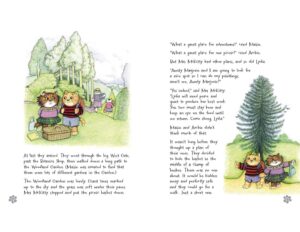
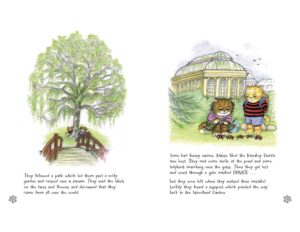
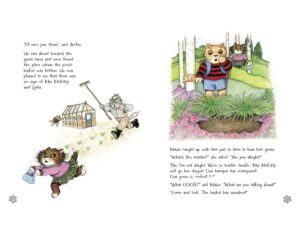
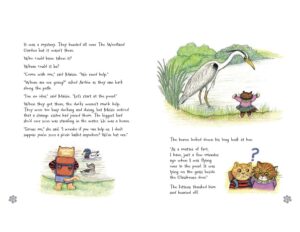
Maisie and the Botanic Garden Mystery by Aileen Paterson is published by Royal Botanic Garden Edinburgh, priced £8.44.
Friendships can be the foundation of our earliest memories and most formative moments, so why are they often seen as secondary to romantic, or familial connection, something to age out of and take a back seat to other relationships? In BFFs, Anahit Behrooz examines of the power of female friendship, not as something lesser, but as a site of radical intimacy, with reference to the work of Toni Morrison and Elena Ferrante, Booksmart and Grey’s Anatomy, Insecure, The Virgin Suicides and beyond. In this extract, Behrooz looks at the work of filmmaker Céline Sciamma and author Toni Morrison.
BFFS: The Radical Potential of Female Friendship
By Anahit Behrooz
Published by 404 Ink
There is a wayward delight in watching a genre burst at its seams, become expansive and disorderly and all-encompassing. The increasingly gendered and intersectional concerns of the coming-of-age story allow us to see not only the emotional and psychological maturation of previously ignored protagonists, but the social and political conditions which inform their lives. And the social and political is always, always collective. As in Sciamma’s Girlhood, the rich archive of this kind of tale is dense not only with individual identity formation, but with the interdependence of the group, with the ways in which we come of age together. Childhood, these stories understand, is a wonderfully and frighteningly porous thing. We are raised as much by our friends – the small, equally unformed beings scattered around us – as we are by our parents and guardians: taught at their bloody, gingham-ed knees not just who we want to be, but how we want to be loved.
Miles away from the strict education novels of the late-eighteenth century, the long history of the female coming-of-age story pulls at the tension between the individual and the communal, navigating the strange chaos of growing selfhood alongside our capacity for headlong, pluralising intimacy. Contained within these friendships is something intense and precarious that subverts the supposed idyll of childhood: all the untapped desires of our inchoate selves meeting the demands of increasingly rigid assemblies of femininity. The bonds of our girlhoods, I believe, can be romantic but they are not romantic. Rather, there is something discomforting about their fierceness, their hypersensitivity, their lack of abandon. Liquid bright and malleable, we form ourselves within our cohorts, both alone and together. As we come of age, so do our friendships, their intimacies pulled in the bruised wake of adolescent anguish. There is so much potential for loveliness here. There is so much potential for shatter.
Toni Morrison’s Sula is a book about such friendship, its knitted beauty and unnerving brutality. The events of the novel are set in a small Black neighbourhood in the uplands of Ohio in the 1920s and ’30s, and the narrative takes its time to get to the eponymous Sula and her strange, feverish sisterhood with Nel, the quiet, obedient girl she befriends in their youth. Rather, the first third tells the history of their community: the Bottom, a wooded, hilled area ‘gifted’ by a slave owner to a previously enslaved man whom he tricks into accepting the agriculturally inferior land. This exercise of malicious white power lays the groundwork for everything: the poverty that dogs Sula and Nel’s childhoods, the violence that scaffolds their intrepid attachment. Tender and impetuous though it may be, their friendship is never quite allowed innocence, not really, too embroiled as it is in the hostility of its surroundings. Early on, when four white boys torment Nel on her way home from school, Sula wordlessly pulls out a paring knife and slices off the tip of her finger. ‘If I can do that to myself,’ she asks them, ‘what you suppose I’ll do to you?’ Blood may be thicker than water, but Sula and Nel’s friendship becomes evidence of the long-forgotten fullness of this axiom: the blood of the covenant is thicker than the water of the womb, the ties that we choose stronger than the ones we are born into.
In the slow drip-drip of her blood, in the tiny scrap of flesh left on the road, Sula renders her very self open and permeable to the muddle of her and Nel’s girlish connection. Images of such porosity wind throughout: Sula and Nel silently lying against each other in the grass, each unconsciously copying the other in gestures and play; Sula and Nel walking in tandem past a crowd of men in the multiplied burgeoning of their sexuality; Sula recalling in adulthood ‘the days when we were two throats and one eye and we had no price.’ On the cover of my copy – a 1980 edition bound in plastic from the public library – two little girls appear silhouetted, surrounded by a ghostly, or perhaps an angelic, glow. They look practically the same, although not much can be made out except four large eyes and two smock dresses covering gangly limbs. But towards the bottom the dresses begin to merge, blurred into a single garment that holds the girls attached at the waist, the hips, their covered knees; a gradual and willing immersion.
In her reading of Sula in The Paris Review, Namwali Serpell writes about Morrison’s insistence on such instability, about her investigation of the sly potential of girlhood friendship to reconstitute the self. ‘I’m feeling this trembling time,’ Serpell writes, ‘its desire and ache… this girlish queerness – neither straight nor lesbian exactly, but feverish with slant possibility – this dewy conspiracy of selves.’ In literature, the theme of the double – materialising as twins and echoes and unlikely sympathies – has long typically signalled a Gothic uncanniness, a signifier of psychological fracture, but here in Sula its presence is perversely restorative. Friendship as dewy conspiracy, underground collusion. The strange twinning of Nel and Sula’s relationship is eerie not in its fragmentation of the self but in its disobedience of individual selfhood, refusing the placid singularity that these narratives ought to entail. The transgression of their bond disturbs the normativity of their surroundings: together, the girls watch in horror as a child they play with drowns, they feel the undisguised lust of male gazes on their bodies, they replace the lost love of their parents with their own. ‘You. Sula. What’s the difference?’ Nel is asked in adulthood, as they – long past the days of childhood osmosis – collapse together again, and again.
BFFs: The Radical Potential of Female Friendship by Anahit Behrooz is published by 404 Ink, priced £7.50.
In Quinn, the debut novel by Em Strang, David Robinson finds a subtle and sophisticated exploration of forgiveness and motive.
Quinn
By Em Strang
Published by Oneworld
Cast your mind back a month, to Tommy Lee Royce taking his revenge cold in the final series of the BBC TV drama Happy Valley. A psychopath, yes, but at least you felt you knew the way his mind worked, what he had done in the past and what intended to do in the future. Circling round Tommy Lee was a plot whose intricacy only our heroine, Sgt Catherine Cawood, could fathom. But she did, and we followed her for all the deep-down reasons people watch crime drama: not just the solving of the puzzle but the reassurance of justice being seen to be done and order restored. The same things apply with crime novels: see it, read it, sorted.
I read Quinn, Em Strang’s short but intense debut novel, just after binge-watching Sally Wainwright’s TV series. Both deal with murder and the possibilities – or otherwise – of forgiveness. But there the comparisons end and the differences between crime and literary fiction start to open up.
Take uncertainty. While we know everything about the crimes Tommy Lee Royce has committed, we know hardly anything about what Strang’s eponymous hero has done. Indeed, we’re not even sure that he has indeed killed anyone, though clearly he is in detention of some sort after the death of Andrea, his best friend since childhood and subsequent lover. We don’t know too much about Quinn’s life, how old he was when he and Andrea fell in love, whether or not they had a fatal falling out, and if they did what caused it. All the who, what, where, when, how of the crime has, at least in Quinn’s own mind, disappeared.
What’s there instead? Well, there’s guilt, even though it’s unspecified: something that weighs on him, even though he sometimes tries to convince himself that one day Andrea will turn up and everyone will have to tell him they’re sorry. Sorry for locking him up in that cell where the only other occupant is Stone Man who usually sits crouched in a recess in the wall but occasionally emerges from it to take photos of him. Sorry for uniformed staff beating him up for no reason, sorry even for the maggots eating their way in his dreams through his rotting cheeks no matter how many times he brushes them off and hears them ‘fall plip plip plip on the concrete floor’.
All of which, for a prisoner whose mind has only a meniscus of rationality, has the ring of truth. Suppose you were such a man and had killed the woman you loved. For your own sanity’s sake there would indeed be memories that you would want to bury deep and leave unexpressed. Instead, you might prefer to dwell on other things less freighted with pain: the silver birch tree in the forest that you and Andrea had marked out as your own, the miniature plastic doll she gave you because she thought it looked a bit like her. You’d think about such things and, because imprisonment means you’re suspended in time, those thoughts might run in a loop ‘like a wheel without spokes’. There’d be bags of self-pity in the mix too, and if your childhood was laced with oppressive parents and religion, those thoughts might also have the quasi-Biblical form of expression they do here, right from the occasionally repeated opening sentence: ‘Things have been done that hurt the mouth to speak of.’
Already, you can see, we have moved far away from Tommy Lee Royce, but Strang’s short, intense novel takes us even further. Quinn is, or yearns to be, a writer. He wants to impress Andrea with his stories. ‘I wanted to say something new and present readers with a challenge, but if I wanted publication, I had to turn out a series of stock images and ideas that people could take comfort from or use to explain the world away’.
This, you can’t help thinking, might well apply to Strang too. An award-winning poet who has worked in Scottish prisons for a decade, she is presumably well versed in how far apart the cliches of crime fiction are from the inner lives of prisoners she has come to know. ‘People like certainty and clarity,’ notes Quinn, ‘especially when they are afraid’ – which is why, after Andrea’s death, suspicion at first fell on a stranger who’d been in touch with her. ‘No-one knew anything about him, so it was easy to attach blame, to indict and demonise. Where there is no understanding, there is harsh judgment.’
So how does Strang do the opposite of this for Quinn, a man who is so clearly an unreliable narrator? The first, and most obvious, way is through Jennifer, Andrea’s mother, who arouses the anger of her neighbours by inviting Quinn to share her home after he is released from prison. If she can see some good in him, surely there must be? But the forgiven, redeemed prisoner is yet another of those predictable story arcs that Quinn himself would scorn to write – just, in fact, like the one about the prisoner who is only cynically faking a wish to be forgiven. Strang knows this, and clearly realises that her readers are watching out for the first sign of any dash towards the predictable. Her talent lies in the way that she keeps them inside Quinn’s fraying, frightened mind, smuggling him past condemnation even when he is caught lying to himself.
How does she do it? Technically, by nudging us away from linear narrative, avoiding any official account of Andrea’s death, and relying entirely on what is going on inside Quinn’s head – even if that is as far removed from the crime for which he has been imprisoned as a memory of being made to kill a chicken as a seven-year-old. The way in which the story appears on the page further underlines this, as each paragraph is preceded by a complete line break, which is astonishingly effective in making us read in a different way altogether. We slow down, become more attentive. We are not following clues so much as Quinn’s memories, dreams and stories. These might or might not – I’m not going to tell you – reveal what really happened to Andrea, and whether or not Quinn ends up being truly forgiven. But in a way which is imaginative, compelling and refreshingly cliche-free, they explain everything you need to know about him.
Quinn by Em Strang is published by Oneworld, priced £14.99.
In Nemidoonam, the startling debut pamphlet by Nasim Rebecca Asl, the poet explores the intricacies of language, identity and belonging. Her poems take us on a journey through childhood into young adulthood while weaving between a range of worlds, both in the UK and abroad. Read three poems from the collection exclusively here at BooksfromScotland.
Nemidoonam
By Nasim Rebecca Asl
Published by Verve Poetry Press
The meaning of my name
Nasim: Here we have the winds of summer lassoed into letters. You will
arrive unannounced to bloom carnations on a stranger’s dusty cheeks and allow the pink of their blood to dance. A welcome addition to the driest of days. A relief for parents used to a firstborn’s sirocco and hurricane gale. You are temporal. Altruistic. Zephyr. Comfort bringer. You are a wordeater (just like your mam), a force of nature, a racoon-eyed windflower of a girl. You were serenaded by aeolian machines for the first nine nameless days of your life. Tubes billowed breath into your miniature lungs. It may take a while for the gust to carry you to yourself. For you to learn to breathe alone.
Despair not – you are imbued with meaning.
For more famous Nasims please see: Pedrad, where comedy cancels the immigrant experience; Prince, where violence is performative; or Shah, a shadow who goes by
the more pronounceable Naz.
we are nine and playing princesses
arms spiralling like sycamore seeds
we careen from one end of the big yard to the next.
grey pleats fan from our empty hips like ballgowns.
scalloped socks slide down our tiny ankles.
the plaits trailing behind our pigtailed heads are budding wings.
if we lay down in our shadows we’d be dwarfed.
you decree so we spin and spin and spin and spin until
grass is sky and clouds are daisies. we tumble,
flushed, limbs skidding on tarmac, knees grazed, breathless.
on bruised elbows i cross my legs to look at you.
when the war cry breaks out our classmates scatter like dandelion seeds.
i make a wish, then we’re up and running from the yard
across the field, down the hill away, away from the power
of the boys nipping at our small heels. i am faster than you,
a berry-brown waif already used to fleeing the rumbling of a man.
your fingers stretch for mine. i pull you behind me.
ignore my bursting heart, the mess of moths rising
in the dust of my stomach i can’t catch my breath
but as i turn to your buttercup hair my chin is glowing –
you are the most beautiful thing my short life has seen.
i don’t know what this means. i release your milk-bottle fingers,
let a boy with hair as gold as yours snatch you instead.
i’m glad that he’s not old or bold enough to pucker up.
your lips stay apple-red.
after school, i open my snow white diary
write i’m scared i might love girls, re-read my unjoined letters,
bury them in felt tip, slam shut the book, and feed it
to the monsters under my bed
Ode to Sinners, 63 Newgate Street
Here’s to staying out past 2am
for the first time in three years.
Here’s to floors awash with booze,
beer, vodka, mixer, sticking to our shoes.
Here’s to bass drumming in our ribs,
to guitarbeats, remixes so loud we are pressed
like shells to each other’s ears to shout secrets
no one else can hear. All the club’s a stage.
Here’s to toilet paper trains trailing heels
down the bathroom’s aisle. Here’s to sisterhood
in the ladies’, to rants about men, to extolling the virtues
of strangers you’ll never see again. Here’s to dancing.
To exorcising adulthood, to hands that linger,
to our favourite singers emerging from the speakers
like Mithras from rock, Aphrodite rising from the sea
sloshing around our feet. Here’s to blisters.
Here’s to being too old for going out out. To yawns
that simmer at the shores of our lips, to constellations of sweat
glimmering on our philtrums. Here’s to the cage
at the edge of all things, to the bodies still
slim enough to squeeze through the bars,
to the bright budgies writhing and thriving
and smiling inside, a melody of off-key seagulls
while their pals record videos that’ll disappear
with morning. Here’s to not caring your mascara has smudged.
Here’s to being the youngest we’ll ever be.
Here’s to not being IDed. Here’s to £2.50 trebs,
to apple-sour shots, to fingers that find each other
in the dark, to the dregs, to moonlight
spying on us past the guards at the doors.
Here’s to illicit plastic straws. Here’s to paparazzi
strobes documenting our indiscretions.
Here’s to beginnings, crowds thinning, reason dimming,
here’s to bringing the moves. Here’s to jackets
tied like ballgowns around our waists. Here’s to him
for spinning you away from the leches. Here’s to grinning
against stubbled cheeks, to tiptoes and aching Achilles,
to skin grazing, to winners, to grace, to the small back of midnight,
to coats exchanged to keep you warm, to stinging mouths,
to ears ringing for dawn, to the firefly glow of your last cigarette.
Here’s to the drunken wings we grow. Here’s to your feathers,
to how soft and light and tipsy their promise feels in my arms.
Nemidoonam by Nasir Rebecca Asl is published by Verve Poetry Press, priced £7.99.
When three people suffer strokes after seeing dazzling lights over Edinburgh, then awake completely recovered, they’re convinced their ordeal is connected to the alien creature discovered on a nearby beach. In The Space Between Us, Doug Johnstone, one of Scotland’s finest crime novelists, moves into new territory with a life-affirming first-contact novel reminiscent of the great science-fiction stories of the past. Meet Ava, one of the three characters connected to the beached alien, in this exclusive extract.
The Space Between Us
By Doug Johnstone
Published by Orenda Books
Ava
She lay in bed and held her breath so she could listen better. Michael lay next to her, his breathing ragged and slow. She wondered about the dosage she’d put in his food. Really, she had no idea. She’d been stealing pills from Rowan’s handbag in the staffroom at work, storing them up. She’d experimented with half a pill in his food for the last couple of nights, then crushed up three in tonight’s casserole, putting in too much garlic to cover it. He berated her about the food, but that was nothing new.
She stared at the swirling pattern on the ceiling, strands intertwined like the arms of some creature. His breathing slowed even more and she felt the baby kick in her belly. Ava was eight months gone, and the baby was letting her know she couldn’t wait much longer. It was one thing for Ava to be controlled and dominated by this monster, another to bring a new-born daughter into this home. That’s why she had to do this now.
Michael turned towards her, face slack in sleep. She flinched. How had it come to this, the sight of him making her cower? She was ashamed of who she’d become, coerced and bullied. No more.
She smelled stale garlic on his breath and stomach acid rose up her throat. If she puked now, he would surely wake up. He was normally such a light sleeper, aware of movement in the room even when he was dreaming. Some primal state of alertness, watching for anything that could threaten his world order.
She lifted her side of the covers, pulse beating in her neck. She listened to his breath as the baby pressed against her kidneys and bladder. There would be time to pee when this was over.
She moved her legs, feet onto the floor, rolled her body in a smooth motion until she was standing. Michael was snoring, hands above his head like he was fighting off birds. She stepped to the door, waited, opened it, heard it creak and froze.
Michael snuffled and wrinkled his nose like he was disagreeing with something. He muttered under his breath and fire flowed from her heart through her body. She imagined herself a marble statue, here in the bedroom doorway for hundreds of years, ignored by everyone. She heard a car in the distance, faint rumble of the boiler downstairs. He snuffled again, moved his arm to the empty side of the bed. His hand moved across the bare covers and she was sure it was all over. She began to think of excuses, needing to pee or she had to take another antacid.
He scratched his nose then shifted his weight and went back to snoring.
She watched him for a long time then crept out of the room and downstairs, feet on the outer edges of the steps because some creaked in the middle. She reached the bottom and walked across the hall to the cupboard full of raincoats and boots. She shifted a pile of old jumpers she’d placed there weeks ago, lifted out a small suitcase full of all the things she would need. Change of clothes, money she’d been siphoning from the shopping, toiletries, the passport she’d taken from the locked drawer without him knowing. She could sort everything else once she was free.
She wore loose pyjama trousers and an old St Andrews Uni sweatshirt of Michael’s, warmer than she would usually wear in bed this time of year, but she would be outside soon. Her feet were bare. She had trainers in the suitcase, there would be time to put them on once she was out.
She went to his jacket hanging near the door and rifled through the pockets. Keys for his New Town office, ID, wallet. She’d read about human-trafficking cases where women were locked in cages or basements, brought there as sex slaves. She wasn’t in that situation but she was still imprisoned by him, by his fucking gaslighting, demeaning her, always making her more reliant on him.
Everyone at the school thought she lived a happy life. Her mum thought she was in love with a wonderful husband. Everything looked good from outside this expensive Longniddry house. How could she be in a prison with a handsome, rich husband and a baby on the way? But that’s what had changed, the realisation that it wasn’t just her anymore. She’d become used to her situation, excused it and normalised it. But a daughter made everything different and she needed to get out.
She found the car key and took the cash from his wallet. She lifted her case and went to the front door. The alarm was on, he always set it before bed. He changed the combination regularly but she’d found the note on his phone with the most recent number. She just hoped it was up to date. She punched in the numbers, cringing at each beep, holding her breath. Waited a moment, expecting the loud wail. But silence. She glanced upstairs, waited for him to shout out or appear.
Nothing.
She opened the door and walked across the driveway to the Mercedes. She unlocked it and cringed again at the blip of the lock, the flashing lights. She placed the case in the passenger seat then took off the handbrake. She didn’t want to start it here with the engine noise, so she heaved at the car, door open, hand on the steering wheel. Eventually the car wheels nudged forward. She leaned her shoulder into the doorframe, felt the baby squirm, did a little pee into her pyjama trousers but kept pushing. She turned the wheel to angle the car through the driveway and climbed in, closing the door as quietly as she could. The car had some momentum on the road and she waited until it was another thirty yards down the street then put her foot on the clutch and pressed ignition. It kicked into life, a ping warning her she didn’t have her seatbelt on.
She pulled it on and drove away, expecting something to happen – Michael to run down the street, the police to turn up, lights flashing. She drove past the big stucco houses, everyone safe and warm inside. She looked in the mirror. The street was dark and she laughed, feeling the release, then the baby kicked.
She turned left then left again, looping round to Links Road. She didn’t want to take the A1, if he woke and found her gone, it was the first place the police would look for the car. She drove along the coast, Firth of Forth to her right. She saw clear skies, stars bulleting the blackness, the full moon. She thought about the distance to that rock, how far she might need to run to really escape.
She reached the Port Seton caravans, beach alongside, moonlight shimmering across the water. She glanced in the mirror again, nervous, still waiting for him to somehow appear.
A bright light appeared in the sky, blazing an eerie blue-green, streaking overhead in front of her. There was a hiss and a roar, a trail of sparks behind. It seemed to be descending, heading for the sea to the east. She couldn’t take her eyes off it. The sound penetrated her skin, the car shuddered and rocked, then she smelled something sweet and salty at the same time, tasted it in the back of her throat. The road in front of her rose up and spun round and she felt dizzy, unable to get her bearings. Bile rose in her throat then she puked down her sweatshirt. She pissed herself as the car drifted and she couldn’t control it, didn’t know which way was up. The car mounted the pavement and went over the grass verge to the rocky beach where it thumped into the sand and she passed out.
The Space Between Us by Doug Johnstone is published by Orenda Books, priced £9.99.
Henny is a baby chick, sweet and fluffy just like her friends. But unlike her friends, Henny has one tiny problem – she’s stuck in her shell! In this gorgeous debut by author and illustrator Aileen Crossley, follow Henny on her journey as she and her friends try to solve her problem – and save the day along the way.
Henny is Stuck
By Aileen Crossley
Published by Little Door Books
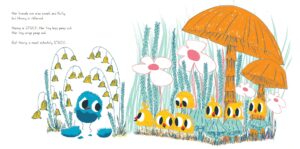
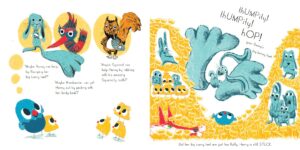

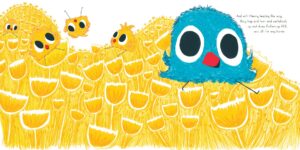
Henny is Stuck by Aileen Crossley is published by Little Door Books, priced £7.99.
When carwash employee Davey Burnet takes the wrong customer’s motor for a ride, he sets off a series of events that leads him and his carwash into Glasgow’s criminal underworld. Will he make it out with his kneecaps intact? And will the unpopular DCI Alison “Ally” McCoist be able to help? Squeaky Clean, the debut novel by Callum McSorley, is a pitch-black crime fiction comedy in the mould of Christopher Brookmyre and Frankie Boyle’s Meanwhile. In this exclusive extract, an early morning customer arrives at the carwash with a service request that will change the lives of everyone involved.
Squeaky Clean
By Callum McSorley
Published by Pushkin Press
He was waiting outside the closed shutter at 7 a.m., a Mr Big type: shirt open down to his freezing nips revealing a heavy gold chain nestled in greying chest hair, fag resting between the sovvy rings on his thick fingers, tailored jeans and pointed black shoes, both expensive and dated, the dress of the middle-aged working class gone wealthy. Behind him, a gunmetal Range Rover, engine idling, exhaust smoke fogging the early morning air. Its vanity plate read: V1P MCG.
“We’re no open yet,” Sean said, taking the padlock keys out of his pocket as he arrived at the car wash. Sean was the owner, a wiry and shrivelling forty-year-old with skin like tanned cow-hide, who spent most of his time during winter in the office chaining joints and watching Russia Today. In summer, he took a folding chair out front and sunbathed while the boys worked.
“A know,” the man said. “Sorry fir turnin up so early, pal, it’s just am in a bit ae trouble here.” He took a fast, hard draw on his cigarette.
Sean snuck a look past the guy’s shoulder. The headlights were blinding but Sean couldn’t make out any damage on the four-by-four’s bumper, and it didn’t look particularly mockit either. “It’s a big motor, it’ll cost ye twenty just fir a wash.” Overpricing was a method Sean often used when he wanted a customer to get to fuck.
“Actually am lookin fir a valet an aw. The full hing. Seats shampooed and windies polished. The lot.”
“Ye want the seats cleaned?”
“Aye, how much will that cost?”
Sean laughed, a broken-throated, cackling honk. “At seven in the mornin? Fifty quid, easy.”
The guy sucked the fag down to the filter and tossed it onto the road. “Sure hing, pal.”
Fucksake. Sean wasn’t one to hide his thoughts from his facial expressions. His hard-living eyes, sunk deep in their sockets, rolled in disgust. “Look, the boays will be in at half past, can ye wait that lang?”
“Ye goat a kettle in there?” He pointed at the shutter.
Fuck. “Aye, moan in.”
The guy’s name was Paul McGuinn and you might have heard of him. At least, that’s what he seemed to think. “Call me Paulo. Am fae Brigton, originally,” he said, meaning that although he didn’t live there any more his roots were still in the east end, meaning he was one of the lads, not some posh cunt like his car might indicate. He was rich the way a footballer was rich, not rich the way a Tory was rich. That’s the impression he wanted to give anyway. “Yersel?”
“Possilpark.”
“At least ye didnae say Easterhoose. Fuckin blacknecks!” He laughed and Sean returned a grimace. Up close in the cramped, gyprock office Sean had built at the back of the unit—it had no desk or filing cabinet but did have a couch, television, fridge, kettle, microwave and George Foreman grill—Sean could smell Paulo’s aftershave and a hint of BO underneath. In the harsh light of a bare lightbulb, he could see sweat stains on Paulo’s white shirt, seeping from under his arms and spreading out from the small of his back. Hair gel was slowly being washed down his forehead and onto his red face. “Here, can a smell grass?”
Of course he could: Sean puffed through five or six joints a shift. The earthy stink of weed had soaked into the couch cushions and the carpet (a patchwork of car mats) and seeped into the plasterboard walls like damp.
“Mind if ye roll wan up while we wait? Been oan the gear aw night an I could dae wae chillin oot a bit.” He tapped his nose when he said “gear” and winked.
Sean sighed. “Let us put the kettle oan first.”
Squeaky Clean by Callum McSorley is published by Pushkin Press, priced £16.99.
A Woman of the Sword is an epic fantasy seen through the eyes of an ordinary woman. Lidae is a daughter, a wife, a mother — and a great warrior born to fight. This latest book by Anna Smith Spark, author of the acclaimed Empires of Dust series, delves deep into the complex relationship between warfare, gender and motherhood. In this pulse-racing extract, Lidae protects her family from a frightening home invasion.
A Woman of the Sword
By Anna Smith Spark
Published by Luna Press Publishing
And Lidae was dreaming of a city falling the next night, when it came. The red fires, but in the dream they’re not fires but walls of red, columns of red coming down all over the city crushing things. And then they’re people or huge trees, it’s her own city, Raena, in the country of Cen Elora that is certainly not at the edge of the world and is certainly not a desert, and it’s a city she’s dreamed about before, since she was a child, or the idea that she’s dreamed it before is part of the dream. And sometimes she’s sacking the city and sometimes she’s a victim of the sack and the army attacking her don’t look like people, but she can’t see what they look like.
And she woke, confused, and it came.
From off in the distance, very far off, a dog barked. A sharp angry warning. A noise, outside the house, the click of metal on something. The cow in the byre moved suddenly, a thud of its body, and it lowed. It was afraid for its calf.
Something is wrong, Lidae thought. Something—A memory out of the dream, the dark in their camp one night, out on the flank in the mountains ahead of the rest of the army, too much silence, a sound of metal catching, very distant, enemy swords coming suddenly down on them out of the dark, they couldn’t see, they died, and they couldn’t see. Maerc had died that night, the wound had been in his back, he had been sleeping.
The same silence. The same feeling.
Wake the boys get them up get them up.
‘I hope he was dreaming of good things, a woman, something,’ Acol had said of Maerc, and Acol had been weeping. They burned Maerc’s body as if he’d died gloriously in battle. It had broken Acol’s heart to think of Maerc dead without knowing, sweaty and foetid.
Get the boys up. Get away. Something terrible is coming. I cannot bear to think of them dying in their sleep. A sound of metal. The cow in the byer lowed and stamped. Something terrible is here now. I feel it.
Thieves, she thought. Thieves.
‘Ryn. Samei.’ She clamped her hands over their mouths, tried to wake them but keep them silent, the terror in their faces at her hands over them, her face pressed down to them. Lidae thought: they think I am killing them.
‘Ryn. Samei. Keep silent. Get down under the bed.’ She’d have thought it was Samei who’d have shouted, refused, flailed about. So young, too little to understand anything, but the fear in her voice made him dumb, he did as she ordered him mutely, too frightened of his mother’s voice and her hands that he must think were trying to kill him. Ryn, older, understanding things were wrong, trying to fight her off, ask questions, protest that he had been sleeping. Noise: him pushing her away, speaking.
‘Ryn! Samei! Get under the bed! Get under the bed!’
She opened the chest, there was no time to put on the helmet, she stood in her nightshift and drew her sword.
The blade gleamed in the dark. Hunger stirred and flickered in the metal. Bronze, the colour of the boys’ skin. Polished rich bronze, burning.
In the hilt of the sword there was a red stone. Red glass. In the dark the red seemed to gleam. Ryn cried out. The sword felt so good in her hands. Samei whimpered like a beast. She thought: he thinks I will kill him.
She shifted her grip on the sword hilt. Stood still one pace back from the doorcurtain that divided the sleeping place off from the living place. All the last years falling away. She felt the sword whispering. Light seemed to run in rainbows up the blade. She could remember very clearly the first time she had used a sword to kill someone.
The sound of someone fumbling with the door, trying to shove it open. A voice said, ‘It’ll be barred. Just burn it.’
‘Stay there,’ she hissed to the children. ‘Just stay there, don’t move. Stay.’
The village was too far for help to come. A hill between the house and the village, Emmas had wanted that, because he’d wanted to be apart in silence, after years piled together in the army four to a tent. The dog barked again, furious. She thought: if there is anyone left alive in the village to come. She thought: but that’s madness. This is thieves prowling around.
‘Stay and be utterly silent. Ryn, keep Samei silent. You must.’
The dog barked, far off, and then the barking stopped.
‘He said there was coin here. A widow, he said, with gold hoarded away.’ The door was kicked open. They were going to burn us alive in here, Lidae thought. Cold night air through the door, making the doorcurtain tremble. Footsteps coming inside. On the other side of the wall the cow lowed suddenly and loudly and frantically. Cattle thieves. See? See?
The doorcurtain was ripped aside and a man stood before her, staring at her through a helmet. Dead cold blank eyes, the cold set of his teeth. The sword in his hand trembled. It knew, the bronze sword that he carried, it knew what she was. Lidae’s sword came up took him. His throat, just at the point where the collarbones almost meet together, the red glass in the hilt of her sword smiling at her as the sword went in. The site of the soul, she had heard it said of that place in the throat. He made a noise as the sword took him. She had forgotten the sound of a man dying like this. The sword leapt and her heart leapt.
A Woman of the Sword by Anna Smith Spark is published by Luna Press Publishing, priced £13.99.
Rymour Books have published two books recently that showcase Glaswegian Scots . The following extracts are from two new books both supported by a Scots Language Publication Grant from The Scottish Book Trust. Liberties is a new novel by emerging Glasgow writer, Peter Bennett. Set in the east end of Glasgow during the 1990s, it deals with issues of poverty, crime and family loyalty. The Glasgow Effect is a collection of short stories entirely in the Glaswegian dialect by Ian Spring, author of two books on Glasgow and a volume of short stories in English, The Stone Mirror. Laced with black humour, it nevertheless engages with social issues such as alcoholism, violence and mental illness.
Liberties
By Peter Bennett
Published by Rymour Books
The Glasgow Effect
By Ian Spring
Published by Rymour Books
We approach the Portland Arms, Tam an I. It’s just past hauf past wan. The facade ay the buildin husnae changed a bit since it was built in nineteen thirty-eight. Fae the pavement up tae the bottom ay the windae sills an surroundin the door, the waw is comprised ay black an grey granite. Above the doorway is the sign ‘Portland Arms’ in stainless steel letterin, backlit by red neon light. The remainder ay the waw at the front ay the buildin is constructed wae red facin brick wae stane copin.
Enterin the main door, we immediately arrive in a small vestibule where there ur two doors—wan tae the left and wan tae the right. These two doors were originally, ah wid surmise, put in place fur ease ay access tae either end ay the circular bar held within.
Part ay Tindal’s vision, ye see? Naw well, ah don’t suppose ye dae. Jonathan Tindal wis the proprietor back when he built this incarnation ay the pub in nineteen thirty-eight. It wis tae replace the auld pub ay the same name that stood next door. Bit ay a visionary ye see, auld Tindal. He decided that a pub should be expansive wae loads ay room for patrons tae be seated rather than crowded roon a bar as wis the case in many ay the surroundin pubs ay the time. Accordingly, he promptly acquired the tenement block next door tae the auld pub, demolished it and built wan mare attuned to his philosophy.
Where wis ah then? Aw aye, the two doors. As ah said, there ur two doors as ye arrive, wan at either side. We take the wan tae the right. This takes us intae the Celtic end. The other door as ye may or may no have gathered, takes ye intae the Rangers end.
Hardly in keepin wae Tindal’s vision fur the modern publican then. He obviously never accounted fur the entrenched sectarian divisions ay this city at the time ay inception.
Ah personally, care not a jot fur such segregation. Ma ain faither wis spat oan in the street as he searched fur work when he came oer fae County Donegal in nineteen twinty-three. Ah’ve witnessed countless acts ay violence borne fae the ignorance ay bloody eejits oan baith sides ay the fence. They kin bloody keep it! It is however, a segregation ay choice, ah should point oot. Ah mean, there’s nae doormen staunin there directin folk tae their delegated section an there’s nae real risk involved in croassin tae the other side, as it were. Rather, it’s an arrangement that’s evolved naturally an organically. It should be applauded in a city wae countless pubs affiliated tae either ay the Auld Firm. Everyone is seemingly happy wae the continued modus vivendi an there’s nae mare trouble in the Portland than any other pub. Still though, we’re creatures ay habit, Tam and I, and wae names like Coyle and O’Henry there wis only wan door we were gaun tae use.
Through the door, the customary aroma ay tobacco smoke an insipid, stale beer greets us like an auld friend. A strangely comfortin sensation that comes wae familiarity. Horizontal layers ay grey smoke hing in the air like ghostly apparitions, hoverin seemingly indefinitely as each layer is renewed cyclically by the relentless puffin ay the patrons throughout the bar. Tam goes tae the bar tae order oor drinks. A hauf pint ay heavy an a hauf ay Glenfiddich wae watter fur me. Tam’s usual is a hauf pint ay Tennents lager an a measure ay varyin whiskies dependin oan baith his mood, an his finances.
Lookin aroon the surroundin tables, ah kin observe aw ay the usual faces. At this time ay the day, it’s largely pensioners an unemployed people in fur a couple ay drinks tae while away the ooirs an drudgery ay their day. The sad thing is, occasionally wan ay the faces disappear. People die, life goes oan. Some ay the mare popular characters may even get a commemorative plaque, mounted, in memoriam, at their favoured seat or stool at the bar.
Ah acknowledge the friendly faces ah see; ah nod ay the heid or a cursory wink. Maist offer some sort ay recognition; a raised gless or smile in response. Some however, just stare blankly, unwillin tae enter intae any type ay social interaction. Ah’ve largely gied up tryin tae talk tae the young yins that come in. Maist feign the slightest ay interest in any subject matter ye try tae ignite conversation wae afore buggerin aff as soon as possible. They’re no aw as polite as that though. Some ay the youngsters prefer tae blatantly ignore the opinions held by masel an other elderly people, preferrin insteid tae shun ye entirely. The erosion ay common courtesy an respect fur yer elders in this country ah put it doon tae. It just didnae happen in ma day but there ye go, times change. Mibbe it’s me though; ah mean who’d want tae listen tae an auld bugger like me rabbitin oan. It’s just hard tae accept ah suppose. Ah mean, it wisnae always like this, ye just get aulder an it seems ye become less relevant tae people.
There’s wan shinin light though, ma young grandson. Twinty years auld he is, a strappin big lad. Ma only grandchild an the only real faimily ah’ve goat left. His faither—ma son, died ye see. He goat in wae the wrang crowd an started messin aboot wae the drugs. Died because ay that bloody shite when the boay wis just eleven year auld. Daniel wulnae go doon that road though, ah’m certain ay it. He’s a bright lad, that yin an nae mistake; sais he might drap in an see me the day, in fact.
Wan ay the aforementioned ignorant wee bastarts is oan ma seat when ah get tae it. Tam an I ayeways sit here when we’re in, ‘Dae ye mind shiftin son, yer oan ma seat.’ ah sais tae him.
‘Aye? Ah don’t see yer name oan it.’ he sais, ‘ …ye might huv soon enough when ye croak it though ya auld cunt.’ he sais, laughin wae his pal an pointin tae the plaque at the next table.
‘You’ll huv an embossed imprint ay ma boot oan the cheek ay yer erse if ye don’t sling yer hook ya cheeky wee bastart!’ ah sais tae him. Nae respect these swines! He stauns up lookin as if he’s goat somethin else tae say fur himsel afore pickin up his pint an noddin tae his mate, afore the two ay them bugger aff, movin alang a few tables. Bloody swines.
Ah’m hoachin fur a bloody drink noo efter that kerry oan. Where’s Tam went tae fur them, the Wellpark Brewery?
He’s staunin at the bar talkin tae some big brute ay a fella, bletherin away. Ah’m ready fur gien him a shout but he starts makin his waiy taewards me kerryin the drinks oan wan ay they wee circular trays ye get in pubs, stoappin tae blether tae mare people sittin at the tables he passes oan the waiy. ‘Will you stoap natterin tae every bugger in the bloody place an get oer here wae they drinks.’ ah sais tae him oer the hum ay the many voices in the room.
Efter whit seems like an inordinate amount ay time he eventually gets here, puttin the tray oan the table an sittin doon.
‘Whit took ye?’ ah sais. ‘Ah’m bloody parched.’
‘Stoap yer moanin Coyle! Ah’m entitled tae say hello tae a few people. That’s whit the pub’s fur—socialisin.’ he sais. Ah take ma drinks an decide against pursuin it any further. He’s right, ah suppose. Cannae really argue wae that.
‘Who wis the big fella ye were talkin tae at the bar?’ ah sais.
‘Aw aye, him. Nice big fella, never caught his name.’ he sais.
***
That’s the place, amigo, Scooby Doo hid sed. Ye cannae whack it fur an away day, Imber. Goat the castle an aw that an some stoatin boozers.
JIST THE TICKET
Sae ah wis in Sammy Dows waiting oan him wi a pint o heavy an a wee nippy sweetie wan Setterday efternoon.
Then Cuddy Mackay cams in the door. Ye fur anither hauf, he ses.
Naw, ah ses, ah’m waitin fur a train.
Whaur are ye aff tae? he ses.
Naewhir in particular, ah ses. Ah didnae want tae say Imber. Jist me an Scooby Doo thought we’d git oot o toon.
Weel, no big Scobie, he ses. Ah jist caught him in the Corn Exchange. Sed he’s gaun tae
Paisley fur the
GEMME AT LOVE STREET
An, efter another hauf, Cuddy wis aff tae the Buchanan Galleries fur the Christmas shopping fur the weans.
Ah thoat, whit wid ah dae? Love Street fur the Buddies agin the Jags?
Naw! Nae danger a that, nae danger at aw! Ah’m aff tae Imber, ah thoat. It’s goat the castle an aw that and some stoatin boozers.
Sae ah went across the road but the platform gate wis closin and the train wis puffing away fae the platform.
Nae bother, ah thoat, ah’ll get the next yin.
The Vale wis across the road an it wisnae a bad wee shoap. They hid a big list o whiskies oan a blackboard. Ah’ll check out wan o those, ah thoat. Sae ah hid a Glenmorangie an a hauf o heavy an ah watched the scores coming in oan the telly. Then ah hid a Macallan and it wis time fur the results, Sae ah jist decided tae haud oan an hae anither.
BUDDIES 0 JAGS 0
Sae efter that ah goat oan the train. Thir wis a lass wi a trolley. This is grand, ah thoat. Ah’ll hiv a can o McEwan’s Export. Ah liked the train. It made a sort of clicking sound oan the rails as it pulled past the sheds at Springburn. Sae ah jist shut ma eyes an listened tae it gaein oan.
A minit later thir wis a guy shakin me by the shodder. The train wis stopped deid still.
Is this the six thirty tae Imber? ah asked him.
Weel, this wis the six thirty tae Imber, then it wis the seven forty five back tae Glesca. Noo it’s gonna be the ten thirty five tae Imber agin.
But if ye hiv tae get back tae Imber, pal, ye can get the nine fifty at platform seven.
Weel, thir wis nae chance o that. Ma away day wis banjaxed. May as weel hiv stayed at hame wi a boatle o ginger an a
CHICKEN TIKKA MASALA
Mind ye, Imber’s the place, goat a castle an some stoatin boozers. Never been thir but.
Liberties by Peter Bennett and The Glasgow Effect by Ian Spring are published by Rymour Books, priced £10.99 and £9.99.
Set in the days leading up to a future referendum on Scottish independence, The Darker the Night sees friends David Bryant and Fulton Mackenzie conscripted as unlikely detectives when a Senior Civil Servant is found dead in an alleyway in central Glasgow. Wrestling with their own demons, the men set about trying to discover the truth, and in doing so show that some things are more important in life than politics. In this extract, peer into the mind of Fulton Mackenzie, a reporter on fictional Glasgow newspaper The Siren:
The Darker the Night
By Martin Patience
Published by Polygon
You never know when it’s going to hit you. It’s not like you see it off in the distance slowly approaching and you can prepare yourself. It’s more like a car bomb going off on the street you’ve walked down every day of your life. Everything you held true is going and you’re plunged into a world from which you suddenly fear you cannot escape.
Fulton was returning home after buying eggs from the local shop. A tall, lanky teenager was approaching him on the pavement. His black hoodie was pulled up, his earphones were in, and his head was down, bobbing along to the music. He was staring at the ground so intently it was as if he was tracing ants. If it had stayed that way, nothing would have happened. But a few steps away from Fulton the teenager looked up from the pavement and stared directly at him. It was barely a second but in that moment Fulton’s world was shattered by the furious, rushing return of the past. In that face he saw his beautiful young son, Daniel – the boy who would never grow old. He’d be a teenager now; he would have the same blithe limbs, the same light stubble, and the same smattering of spots on his face. The boy passed by, completely oblivious, as Fulton felt the box of eggs slip from his hand, its lid springing open and the eggs smashing on the pavement, their yellow yolks streaking the tarmac.
It had been seven years since that night. They were on the road to Kilmarnock that rises out of Glasgow onto the bleak, soggy, unforgiving moors. A place where a misstep means you can be up to your neck in a peaty bog. That was Fulton’s recurring nightmare. That was what we he woke up from more nights than he cared to count – the collar of sweat on his neck like a cordon of water that he was about to slip under. The waking up Fulton took as a sign that, deep down, he never wanted to put an end to it all. He’d even recce’d a bridge where he could quickly finish it. One small step and it would be over. But Fulton would be jolted by thoughts of his daughter. He would see the dimples that appeared on either side of Alana’s mouth whenever she smiled. The way she said ‘Dad’ like no other word. It came from the heart rather than the lips. And Fulton knew then he would never do it. Instead he was left living, wrestling with the truth of what had happened that night. Throughout the years only a few shards of memory had revealed themselves.
He remembered his son kicking the back of his seat. It was in three-kick bursts and Dan would laugh and shout, ‘Too slow, you can’t catch me.’ Fulton remembered taking his hand off the wheel and awkwardly reaching back and tickling under his son’s knee. Dan started squealing and twisting in his car seat. And then he would promise he wouldn’t kick any more, only to repeat it a couple of minutes later. But that wasn’t what caused the crash.
Fulton remembered Clare’s stony expression. They had had a massive argument. But what was the cause of the fight? Money? Family? Or something else? No matter how many times Fulton cast his mind back he could never find the truth. It was like a bleeding sore that he constantly picked at and that never healed.
The Darker the Night by Martin Patience is published by Polygon, priced £9.99.
ALSO ON BOOKS FROM SCOTLAND
-


Saltwater: A Midsummer Ghost Story by Elaine Thomson
‘The very thought of those grey faces made my skin grow cold.’
-
‘An Odious Campaign’ by Rob McInroy – Why a 1936 By-Election Still Resonates
‘This enraged the locals and he came close to being run out of town on several occasions.’
-

‘‘That’s right, Bobby,’ he growled. ‘I haven’t seen you in – well, since you decided to kill me.’ ‘
-

David Robinson Reviews: Solitary Agents by David Goodman
‘This is very much an up-to-the-minute story of spycraft, positively revelling in all the things tha …
-

The Savage Landscape by Cal Flyn
‘It is their resistance to the intrusions of the outside world − culturally, economically, environme …
-

The Shortest History of Scotland: A Q & A with Murray Pittock
‘We need to be better aware of that to understand the challenges and achievements of the past, and t …
FEATURED AUTHOR:
Karen Campbell

Karen Campbell is the author of nine novels. A former police officer, then Glasgow City Council press officer, she won the Best New Scottish Writer Award in 2009. She also teaches creative writing and has worked with young offenders, homeless people, r …
FEATURED PUBLISHER:
Frontline Noir

Frontline Noir, founded in 2008, is a publisher of current affairs and recent history titles covering controversial topics and events, often written by people who were participants or otherwise affected. Our aim is to ensure such subjects are given a h …