


Award-winning Sita Brahmachari has written a beautiful tale for children that explores loss and discovery, legend and reality, settling into a new place, and the coming to terms with sadness. In Corey’s Rock, a grieving family move to Orkney, and ten-year-old Isla finds solace in the nature and folklore, particularly the story of the Selkie. Endorsed by Amnesty International for illuminating the human rights values of family, friends, home, safety and refuge, and beautifully illustrated by Jane Ray, this a book that will stay with readers young and old. Enjoy the extract below.
Corey’s Rock
By Sita Brahmachari
Published by Otter Barry Books
We stand on the grey rock
of our new home.
The four of us.
At sunset.
Four is an even number,
Mum, Dad, me and Sultan.
But everything feels odd.
Stroking Sultan’s head
and watching the surface
where nothing breaks
but waves.
‘Time to say goodbye,’ Mum says.
She hands me petals, and more to Dad.
We raise our hands to scatter them across the sea.
The rose that’s supposed to mean we say goodbye
to Corey.
My brother.
We watch him float away.
A petal for every birthday.
One by one by one by one by one.
Five red petals blur the fire horizon.
‘We’ll call this Corey’s rock,’ Dad says.
I follow the red dots far out to the world’s end,
calling for Corey.
My voice,
the wind’s voice,
the sea’s sway,
all melt away and the petals grow heavy and sink
into the inky depths.
‘Corey,’ I call.
I hit my head against the bedpost.
Through bleary eyes I search for the reason I am here,
where nothing is where it should be,
not even the door.
The windows have shrunk into
painted brick walls.
I lift my head from my pillow.
And now I remember the
half-unpacked trunk in the corner,
below the window with the curtain of yellow daffodils
that only make me feel sadder.
Corey loved daffodils.
I creak down the rickety stairs
where Mum and Dad sit close in the fire’s glow,
steam rising from their cups,
Sultan warming their feet.
Mum reading, Dad sleeping.
The TV is turned to silent.
These are the things we did in our old flat with Corey,
but now they seem strange,
as if we’re pretending he never was.
My eyes are caught by a rolling wave.
Am I still dreaming?
On the screen
seals wash in, swash in, from the sea.
Fishermen rush to the shore,
not with nets but with blankets.
Dad stirs and watches the passing pictures,
searching for the remote. He mutters,
‘Shipwreck…here I am digging up the ancient boats
and now new ones washing in…’
The seals wash up one by one by one by one.
An old man reaches down and pulls back a skin
and underneath,
my breath flies out of me,
there is a boy’s face.
‘Corey!’ I say his name out loud.
Corey’s Rock by Sita Brahmachari is published by Otter Barry Books, priced £8.99.
Scottish Poetry 1730 – 1830 is the new essential anthology of Scottish poetry produced during the Enlightenment and Romantic periods. As well as covering well-known work by the era’s most famous names, the book’s crowning achievement is its detailed and considerate recovery of women poets who have otherwise been written out of the canon, such as working-class poet Christian Milne and Mary Edgar, author of just one slim collection. Read a few of our favourites from the book below:
Scottish Poetry 1730 – 1830
Edited by Daniel Cook
Published by Oxford University Press
‘Bonny Christy’
Allan Ramsay (1684-1758)
How sweetly smells the simmer green!
Sweet taste the peach and cherry;
Painting and order please our een,
And claret makes us merry:
But finest colours, fruits and flowers,
And wine, tho’ I be thirsty,
Lose a’ their charms and weaker powers,
Compar’d with those of Chirsty.
When wand’ring o’er the flow’ry park,
No nat’ral beauty wanting,
How lightsome is ‘t to hear the lark,
And birds in concert chanting!
But if my Chirsty tunes her voice,
I ‘m wrapt in admiration,
My thoughts with extasies rejoice,
And drap the hale creation.
Whene’er she smiles a kindly glance,
I take the happy omen,
And aften mint to make advance,
Hoping she ‘ll prove a woman;
But dubious of my ain desert,
My sentiments I smother,
With secret sighs I vex my heart,
For fear she love another.
Thus sang blate Edie by a burn,
His Chirsty did o’erhear him;
She doughtna-let her lover mourn,
But, ere he wist, drew near him.
She spake her favour with a look,
Which left nae room to doubt her:
He wisely this white minute took,
And flang his arms about her.
My Chirsty! — witness, bonny stream,
Sic joys frae tears arising!
I wish this may not be a dream;
O love the maist surprising!
Time was too precious now for tauk;
This point of a’ his wishes
He wad na with set speeches bauk,
But wair’d it a’ on kisses.
‘To a Gentelman Desirous of Seeing My Manuscript’
Christian Milne (1773-1816)
I’m gratify’d to think that you
Should wish to see my Songs,
As few would read my Book, who knew
To whom this Book belongs.
My mean estate, and birth obscure,
The ignorant will scorn;
Respect, tho’ distant, from the good,
Makes that more lightly borne.
Tho’ I could write with Seraph pen–
Tho’ Angels did inspire,
None but the candid and humane
My writings would admire.
The proud wou’d cry, ‘Such paltry works
‘We will not deign to read;
‘The Author’s but a Shipwright’s Wife,
‘And was a serving Maid.’
Inur’d to hardships in my youth,
If want my age should crown,
I’ll never beg the haughty’s bread;
Death’s milder than their frown.
You’ll think but little of my Songs,
When you have read them o’er;
But say, ‘They’re well enough from her’–
And I expect no more.
‘Melrose Abbey’
John Wilson (1785 – 1854)
It was not when the sun through the glittering sky,
In summer’s joyful majesty,
Looked from his cloudless height;—
It was not when the sun was sinking down,
And tinging the ruin’s mossy brown
With gleams of ruddy light;—
Nor yet when the moon, like a pilgrim fair,
‘Mid star and planet journeyed slow,
And, mellowing the stillness of the air,
Smiled on the world below;—
That, Melrose! ‘mid thy mouldering pride,
All breathless and alone,
I grasped the dreams to day denied,
High dreams of ages gone!—
Had unshrieved guilt for one moment been there,
His heart had turned to stone!
For oft, though felt no moving gale,
Like restless ghost in glimmering shroud,
Through lofty Oriel opening pale
Was seen the hurrying cloud;
And, at doubtful distance, each broken wall
Frowned black as bier’s mysterious pall
From mountain-cave beheld by ghastly seer;
It seemed as if sound had ceased to be;
Nor dust from arch, nor leaf from tree,
Relieved the noiseless ear.
The owl had sailed from her silent tower,
Tweed hushed his weary wave,
The time was midnight’s moonless hour,
My seat a dreaded Douglas’ grave!
My being was sublimed by joy,
My heart was big, yet I could not weep;
I felt that God would ne’er destroy
The mighty in their trancèd sleep.
Within the pile no common dead
Lay blended with their kindred mould;
Theirs were the hearts that prayed, or bled,
In cloister dim, on death-plain red,
The pious and the bold.
There slept the saint whose holy strains
Brought seraphs round the dying bed;
And there the warrior, who to chains
Ne’er stooped his crested head.
I felt my spirit sink or swell
With patriot rage or lowly fear,
As battle-trump, or convent-bell,
Rung in my trancèd ear.
But dreams prevailed of loftier mood,
When stern beneath the chancel high
My country’s spectre-monarch stood,
All sheathed in glittering panoply;
Then I thought with pride what noble blood
Had flowed for the hills of liberty.
High the resolves that fill the brain
With transports trembling upon pain,
When the veil of time is rent in twain,
That hides the glory past!
The scene may fade that gave them birth,
But they perish not with the perishing earth;
For ever shall they last.
And higher, I ween, is that mystic might
That comes to the soul from the silent night,
When she walks, like a disembodied spirit,
Through realms her sister shades inherit,
And soft as the breath of those blessèd flowers
That smile in Heaven’s unfading bowers,
With love and awe, a voice she hears
Murmuring assurance of immortal years.
In hours of loneliness and woe
Which even the best and wisest know,
How leaps the lightened heart to seize
On the bliss that comes with dreams like these!
As fair before the mental eye
The pomp and beauty of the dream return,
Dejected virtue calms her sigh,
And leans resigned on memory’s urn.
She feels how weak is mortal pain,
When each thought that starts to life again,
Tells that she hath not lived in vain.
For Solitude, by Wisdom wooed,
Is ever mistress of delight,
And even in gloom or tumult viewed,
She sanctifies their living blood
Who learn her lore aright.
The dreams her awful face imparts,
Unhallowed mirth destroy;
Her griefs bestow on noble hearts
A nobler power of joy.
While hope and faith the soul thus fill,
We smile at chance distress,
And drink the cup of human ill
In stately happiness.
Thus even where death his empire keeps
Life holds the pageant vain,
And where the lofty spirit sleeps,
There lofty visions reign.
Yea, often to night-wandering man
A power fate’s dim decrees to scan,
In lonely trance by bliss is given;
And midnight’s starless silence rolls
A giant vigour through our souls,
That stamps us sons of Heaven.
Then, MELROSE! Tomb of heroes old!
Blest be the hour I dwelt with thee;
The visions that can ne’er be told
That only poets in their joy can see,
The glory born above the sky
The deep-felt weight of sanctity!
Thy massy towers I view no more
Through brooding darkness rising hoar,
Like a broad line of light dim seen
Some sable mountain-cleft between!
Since that dread hour, hath human thought
A thousand gay creations brought
Before my earthly eye;
I to the world have lent an ear,
Delighted all the while to hear
The voice of poor mortality.
Yet, not the less doth there abide
Deep in my soul a holy pride,
That knows by whom it was bestowed,
Lofty to man, but low to God;
Such pride as hymning angels cherish,
Blest in the blaze where man would perish.
‘To the River North Esk’
Mary Edgar (FL. 1810 – 1824)
In museful mood, how frequent here I stray,
When summer smiles illume the lovely scene!
Sweet river! On thy margin soft and green,
I turn, and oft retrace my winding way;
And often on thy changeful surface gaze,
Where the smooth stream reflects an azure sky,
Red rock, green moss, and shrubs of darker dye,—
Or gayly gleams with bright meridian rays.
Here, scarce a zephyr curves the glassy plain,
And scarce a murmur meets the listening ear:
There, white foam swells the wave, and still we hear
The rushing waters tumblind down amain,
Till, softening in their course, the noiseless tide
Within the enchanting mirror gently glide.
Scottish Poetry 1730 – 1830 edited by Daniel Cook is published by Oxford University Press, priced £12.99.
Karen McCombie’s latest book for children follows Tyra as she moves school and has to make new friends. BooksfromScotland spoke to the author to find out more about her book and her advice for kids in a similar situation to Tyra.
The Broken Dragon
By Karen McCombie
Published by Barrington Stoke
Well done on another book under your belt with the release of The Broken Dragon. Can you tell the readers what to expect from the book?
Readers can expect a short and sweet tale of a dragon-obsessed ten-year-old, plus they’ll learn about Kintsugi – the Japanese art of mending things with gold! It’s all wrapped up in a story of kinship care, where children live with a member of their extended family, when staying with their parents isn’t an option. In this case, Tyra has just moved in with her beloved nan.
Your book explores the challenges of starting a new school. Do you think back to your own childhood and school days when you write your books? What are your go to tips for making new friends?
Due to my family moving around – including a spell in Australia – I ended up going to five primary schools in total. I was already a shy kid and trying to fit in and find my feet at each new school really dented my already fragile self-confidence! What I’d love my younger self to have known are these two short-cuts to getting to know people…
1) Smile, even if you’re feeling wibbly as half-set jelly inside! Not everyone will smile back, but the nice ones – the potential future friends – might!
2) Ask questions or give compliments. Shyness can tie your tongue in knots and make your head feel echoingly empty of anything to say about yourself. But you can always find questions to ask or nice things to say. Something as simple as “where did you get your pencil case?” or “I like your trainers” could be a quick-fix route to bonding with someone.
You also feature the Japanese art of Kintsugi in your book. Why do you think the theme of embracing imperfection is useful for young readers?
Small children operate in their own wee world, but there’s a tipping point of self-awareness at a certain stage of development, where children can start comparing themselves to other people and their achievements. And that can sadly chip away at your confidence if you think you’re falling short! I just wanted to write a story that might help make children think about the fact that quirks and differences can be pretty interesting. A lot more interesting than perfection!
You have now published over 100 books, and before you wrote your books you were a journalist for a variety of children’s’ magazines. Although tech may change, do you think young people’s preoccupations remain the same? How have your readers changed over the years?
Tech aside, the fundamental things that mattered to children and teenagers I wrote for at the beginning of my career 20+ year ago are the same as they are today; friendship joys and woes and family dynamics. Luckily, that’s always at the core of what I write! And my biggest thrill these days is that readers of my best-selling ‘Ally’s World’ series back in the early 2000s are now becoming parents and are emailing me to say they’re starting to read my books to their children. That’s pretty mind-blowing!
How to keep inspired? Are there days when stories will just not come? What do you do then?
Writing is a full-time job, but yep, some days my brain feels more like it’s full of sludge than intricate storylines and zippy dialogue. When that happens, I don’t force it, and turn my attention to sorting out the admin around my job. That’s so dull that I’m soon itching to get back to writing! Oh, and taking my dog out for a walk always helps clear my mind. There’s nothing quite like chasing a frantic Westie who’s chasing a squirrel to get the adrenalin pumping!
What books are you enjoying reading at the moment? What are you looking forward to reading?
I’m a huge fan of short books… as a former magazine journalist and sub-editor, I often spot where longer novels are sagging and how they could’ve been edited to tighten the story up and keep things pacey! So I do enjoy reading quick-read Barrington Stoke children’s books. Recent favourites have been The Journey Back To Freedom by Catherine Johnson (the true story of former slave Olaudah Equiano) and Victorian gothic tale The Mermaid in the Millpond by Lucy Strange.
And I’m also really looking forward to reading Glitter Boy by former teacher Ian Eagleton, after I saw him talk on the ITV news about the book and the importance of having diverse stories in schools . It looks like a really joyous read, and a great addition to classrooms!
The Broken Dragon by Karen McCombie is published by Barrington Stoke, priced £7.99.
An ageing artist, struggling with an unnamed degenerative illness, is inspired by a fresco in Venice to create one last great work. A meditation on love and creation, With or Without Angels is a fictional response to an artwork created by the late Scottish artist Adam Smith, itself inspired by the work of Giandomenico Tiepolo. Read ‘the old artist’s first encounter with the fresco in the extract below.
With or Without Angels
By Douglas Bruton
Published by Fairlight Books
The first afternoon the old artist spent at the Ca’ Rezzonico museum in Venice he saw only one picture – Giandomenico Tiepolo’s fresco of Il Mondo Nuovo, ‘The New World’. He wanted to climb up into the picture, to be a part of that crowd – and I am sure that ordinarily and for his own reasons he did not like crowds. He wanted to be pigment and paint and laid down for all time on a piece of wall. His eyes moved through the work, taking in each individual gathered together on Tiepolo’s fresco. He imagined himself young, a child running excitedly between the legs of the men in breeches and clutching at the long skirts of the women and stopping to stroke the arched neck of the dog – it was a yellow-brown whippet or a greyhoud and a little skittish from his petted attentions. A masked clown glared at him, growled, showing his teeth below a papier-maché hooked nose with wide nostrils and high roughed cheekbones. The old artist stared so hard at the picture that his eyes stung and began to water.
It was quiet in the gallery room – not that he was entirely alone, but there was a church-hush all about him and the people there talked in hot whispers. He lay down on the floor in front of the picture, closed his eyes and slept.
And the light in the gallery shifted, shadows crawling across the floor towards the far wall.
Suddenly there was noise. Music playing somewhere. Maybe the man on the wooden stool with his arms in the air and holding a long wand, maybe he was conducting some street musicians. He would later pass round his three-cornered hat for the crowd to drop pennies into. And cheering there was, and laughter – though the laughter was far off.
He could smell the perfume of the ladies – something with musk in it and flowers, mint perhaps and the sweetened wet earth mint grows in. And the well-dressed men smelled of rosewater, or those wearing the hats of common men smelled of fish and something sour, too, like meat that has hung too long in the sun or like milk when it has turned and the smell of it when the bottle is raised to the nose makes you jerk back as though stung.
And there were dancers somewhere, dressed in carnival masks, or maybe they were juggling coloured wooden balls and the crowd was held, wanting the balls to clumsily drop and at the same time to stay spinning in the air, birling.
The afternoon sun was high in the sky, and the air sweated and itched.
Then he felt something tugging at his pockets – hadn’t they told him that he must be careful of pickpockets? ‘They are quick as mice and slippery as eels. You must keep your wallet close and your hand always guarding it.’
‘Signore, signore, it is done.’
He woke then.
The young gallery attendant was leaning over him, shaking him. There was something gentle in his voice, even tender. Speaking like a lover, almost, and not with any note of censure at this man sleeping at the feet of Tiepolo’s Il Mondo Nuovo.
‘It is time for the gallery to close,’ the young man said, smiling.
With or Without Angels by Douglas Bruton is published by Fairlight Books, priced £9.99.
In Kapka Kassabova’s Elixir, her latest book on her native Bulgaria, David Robinson finds an imaginative history and a fantastic landscape.
Elixir: In the Valley at the End of Time
By Kapka Kassabova
Published by Jonathan Cape
THERE is a double-page map at the start of Kapka Kassabova’s Elixir which, with its uncial script, drawn mountains, and places with names like The Dark, The Village of Storks, The Birches, and Valley at the End of Time, will remind Tolkien fans of Pauline Baynes’s map of Middle Earth in Lord of the Rings. An inset map in the same faux-archaic style makes clear that we are in the southern Balkans, not Middle Earth, the Rhodope Mountains not Rivendell. Just over the border to the south is Greece, to the west is North Macedonia. We are in Bulgaria’s Deep South, which to me is a faraway land about which I know almost nothing other than what I have read in the two other books in Kassabova’s Balkan Quartet (this is the third) about her homeland.
So let’s start, as she does, in Empty Village, two kilometres south of Dogwood and five north of Thunder. Like almost everywhere else on the Elixir map, she has named these villages herself. Sixteen pages in, she tells us that Empty Village is really called Leshten, meaning hazel, and light research with Dr Google tells you that Dogwood is really Gorno Dravano and Thunder is really Garmen. This renaming persists throughout the book, but it has a purpose: nothing to do with Tolkien, but everything to do with the imagination, and the repeated overlaying of the past on the present. Strip away some of those layers, Kassabova is suggesting, and you might be able to glimpse a different land altogether, one more closely linked to nature. One where the valleys she is exploring – specifically the Valley at the End of Time, which the very real Mesta River flows through – do indeed offer the elixir of hope.
What kind of hope? Well, look again at some of those chosen double names: Dogwood, The Birches, Chestnut River. Then look at how the book itself begins. For the last ten years, Kassabova has lived near Beauly. An idyllic part of the Highlands, you’d have thought, and maybe it was until the first spring of the pandemic, when swathes of the nearby forest were razed. The local quarry was already expanding and mega-pylons had started marching out of Scotland’s largest power substation. The landscape, which had once enchanted her, had now become so noisy and mechanised that she found it hard to work (‘My blood sloshed like a river jumping its banks’). She needed to get away, to go somewhere the natural world didn’t feel quite as broken.
Southern Bulgaria is, apparently, such a place. A herbalist’s heaven, not only is it one of Europe’s leading exporters of medicinal and culinary plants, but every village seems to have its own expert plant-gatherers, healers and mystics with elaborate spells and recipes for their use. In The Empty Village – once home to 500 people year-round but now to only three – she finds herself living next door to a poet who has spent decades roaming the hills, collecting stories and recording songs. Kassabova sets off from there with the aim of doing something similar for the region’s foragers, healers and herbalists.
It’s not paradise: she’s clear about that. If it was, villages wouldn’t be empty, house prices wouldn’t have shot up a hundredfold in a generation (no, I don’t understand how those two things go together either), there’d be no gangsterism, Roma slums, or high unemployment. The scenery may be spectacular, but personally I’d rather visit the villages around Lake Ohrid, the double world heritage site (both natural and cultural) some 160 miles to the east that Kassabova wrote about in her 2020 book To The Lake. Then again, maybe that’s just me: I’ve always been more interested in history than herbs.
That said, there’s still plenty of history here too, going at least as far back as the Borgomils, those tenth century neo-Gnostics who were mocked for going around carrying two bags, one for books and one for healing herbs. And few groups of people have been quite as tangled up in history’s blues as the Pomak population of south Bulgaria – non-Turkish Muslims who converted to Islam under the Ottoman Empire – whose folk traditions Kassabova explores here.
It’s the Pomaks – persecuted by Communists for trying to cling onto their own customs and before that by their Orthodox neighbours for not being Christian – who know how to ‘bring down the moon’ (naked women at a crossroads at midnight summoning the moon’s power), how to use cuckoo-pint to fight off cancer, and how to conceive (an odd one for Muslims, this, but spending the night in a Christian church named after St George on St George’s Day apparently does the trick). Got a face rash, venereal disease or eye problems? The Pomaks have the very herbs you’ll need, but you’ll also need to know how the spell works, how the bread has to be left for the spirits, why you have to cut the plants from west to east, and what to do with the wheat and salt as you chant the magic words.
I’m a sceptic. Kassabova isn’t. Even in Scotland, where local knowledge of where to find specific herbs has often disappeared, she is a firm believer in the efficacy of herbal cures (and also, she admits, a hypochondriac). In southern Bulgaria, though, knowledge of herbs is deeper-rooted. If you want to meet the Pomak healers, work with the herb dealers, or find out the folklore behind the plants, it seems relatively easy to do so. Kassabova is also a good listener, even to women who tell her they get their secrets from ‘healers from the stars’.
So why, in the village of The Birches, does she admit that ‘all the women I met were taking tranquillisers or anti-depressants’? She would doubtless argue that this is because Communism broke the link between the land and the people, because the Pomaks’ forests have been cut down, because they were made to work on collective tobacco farms and stripped of their Muslim names and forbidden to wear their traditional dress. Yet if Kassabova can find a healer there to wave an egg in front of her face and cast out negative energy, so could the rest of the villagers. Why don’t they do just that instead of going to the doctor for tranquillisers? Come to think of it, why did those medieval Borgomils, for all their knowledge of how to use plants for healing, have a life expectancy less than half of our own?
Yet, when you’ve finished the book, look again at that double-page map. Its place-names may have been changed from those on any atlas, but nothing has been lost and much gained. Somehow, in an alchemical process that involves stirring together vast knowledge of plants, history, spirituality, magic and local folklore, Kassabova has mastered the art of tying together the inner and outer landscapes of southern Bulgaria. Elixir may well suffer the fate of being filed under ‘travel’ in your local bookshop, but it is far more than that – indeed, it makes those books whose maps use places’ actual names appear positively anaemic by comparison.
Elixir: In the Valley at the End of Time, by Kapka Kassabova is published by Jonathan Cape, priced £20.
For her first book, The Ethical Carnivore, Louise Gray wrote about only eating animals she killed herself in order to explore the impact of meat on climate change. For her second book Avocado Anxiety And Other Stories About Where Your Food Comes From, the author explores the role of fruit and vegetables in shaping our environment. She tells BooksfromScotland why our diets are key to saving the planet.
Avocado Anxiety And Other Stories About Where Your Food Comes From
By Louise Gray
Published by Bloomsbury
Why we are all suffering from Avocado Anxiety
When we come back to look at the early decades of the 21st Century, the dish that will surely sum up our age is avocado on toast? The fruit (it is in fact a berry) is one of the most popular photos posted on Instagram, you can buy burgers made almost entirely of avocado, the pop star Miley Cyrus had one tattooed on her bicep. It is hugely popular, but then again it is the subject of derision. Avocados are connected to drug cartels in Mexico and water scarcity in Chile. In one meme it was claimed eating avocado on toast rather than saving money for a house, was preventing young people getting on the property ladder.
Is it any wonder that many of us claim to be suffering from ‘avocado anxiety’. We love to eat this most instagrammable of fruit, but they make us feel confused and anxious.
As an author I want to help people negotiate this ethical minefield. Firstly, what is the carbon footprint of avocados? According to the University of Lancaster it is about 1.6kg of carbon dioxide equivalent per kg. This is a lot less than Scottish beef (18kg CO2e per kg) but a lot more than a Scottish potato (0.3kg CO2e per kg). Generally, fruit and vegetables have a lower carbon footprint because it takes a lot less energy to grow a plant than to raise an animal. However, if the vegetables have been flown in by air freight, such as asparagus from Peru (18kg CO2e per kg), it can be up there with steak. A vegan diet generally has a lower carbon footprint, unless you are living off exotic fruits and vegetables flown in from abroad.
But it is not all about carbon. There are other issues to worry about, such as water. Avocados may not have a heavy carbon footprint but they use up a lot of water, around 85 litres to grow an avocado from Peru. When the water is coming from places suffering water shortages such as parts of Spain and South America this can cause droughts, harming local populations and wildlife. The UK government is so worried about the problem, it has ordered Cranfield University to come up with ideas on how to re-balance our exports and imports so we rely less on imported fruit and veg (we currently import 44% of our vegetables and 84% of our fruit), and begin to build back our own horticultural industry. We will also have to learn to put different home-grown ingredients on toast. (In my book there is a recipe for smashed broad beans on toast).
Then there are the issues of human rights. Avocados have been connected to abuse of workers in Kenya and kidnapping of farmers in Mexico. Bananas perhaps have the most shocking history when it comes to human rights. The UK’s most popular fruit is so cheap because it relies on a monoculture built on cheap labour and the clearing of rainforests.
Oh dear, am I making you anxious? I did not mean to. My book actually found as many positive stories about fruit and veg as negative. Fairtrade bananas are just a little bit more expensive than other bananas (it would cost you just £3 extra per year to switch to Fairtrade). Potato farmers are learning how to look after the soil better, largely from watching the organic movement. Horticulturalists are learning how to make space for nature by growing crops such as lettuce on vertical farms indoors, and leaving wild land for birds and other wildlife. As consumers we can cut food waste by eating our leftovers and embracing the wonky carrot, we can eat plant proteins like broad beans and grow our own courgettes.
One answer is simply not being too anxious. When it comes to food, anxiety does not make people behave better in the long run. It tends to make people freeze and later binge on what they wanted to eat anyway. In the most extreme cases it leads to eating disorders. I think instead we could be educating ourselves about the delicious alternatives and the small ways we can make the food system better. We can shop at our local independent greengrocer or order an organic veg box. As a nation we do not eat enough fruit and veg (only a third of adults eat the recommended five-a-day), we need to start filling our plates with vegetables from farmers and growers we trust.
Ultimately it is about government policy. I believe that by making the consumer aware we can drive those in power to take seriously the role of food in making our population healthier and our environment more resilient. School meals could be procured from Scottish farmers, subsidies could be directed at nature-friendly farming and retailers could be encouraged to stock more affordable seasonal fruit and vegetables.
I can’t completely take away avocado anxiety – I’m not sure I want to, it is a product of living in our age. But through my book I hope I can help you worry a wee bit less.
Avocado Anxiety And Other Stories About Where Your Food Comes From by Louise Gray is published by Bloomsbury, priced £17.99.
When 12-year-old John Nicol gets a job at the Forth Bridge construction site, he knows it’s dangerous. But John has no choice—with his father gone, he must provide an income for his family—even if he is terrified of heights. John meanwhile finds comfort in the new Carnegie library, his friend Cora and his squirrel companion, Rusty. Read an excerpt the morning of John’s twelfth birthday and his first encounter with the life-changing power of books.
Rivet Boy
By Barbara Henderson
Published by Cranachan Publishing
13th September 1888
I wake in a pool of sweat. Seagulls screech, clouds roll and lightning flashes in my dream-darkness. I bite my lip so hard that I taste blood and open my eyes.
A wedge of moonlight shines onto the floor through the gap in the curtain, and the sky is already lightening a little. Dey snores in his little bedroom off the hall, the only bedroom in our flat. Mother shuffles on her mattress in the kitchen alcove and I pull my blanket tight around my shoulders where I lie on the floor. What little light and warmth the range offered has disappeared, and now our flat is shrouded in a ghostly gloom. The second I close my eyes again, I am falling, falling, falling…
‘John!’ Mother’s whisper is directed right into my ear, and I wince away with the fright. ‘What in heaven’s name is wrong with you? Can we get a wink of sleep around here if you please? You of all people will need it, with starting as a brigger on Monday.’
I can’t describe what I am seeing in my mind’s eye, so I don’t try.
‘Sorry, Mother.’
‘If you cry out like that again, the wee one will wake, I’m sure of it, and then none of us are going to get any sleep at all—wheesht now!’ she whispers.
Her wagging finger is right in front of my nose. I answer by rolling my eyes. She clips me round the head—I didn’t think it was that obvious! Gosh, I need to keep my temper in better check.
Turning towards the range and facing the kitchen wall, the sounds of the night envelop me again. Footsteps from the tavern, the hoot of an owl, the faraway rush of the Firth. The rustling.
My eyes ping open. I fear the rats almost as much as I fear heights, but there is no need to worry—it’s only a mouse, still a little fluffy. It has emerged from the crack beside the cooker, looking bewildered and disorientated just like me. Scrambling and snuffling, it makes its way along the edge of the wall. Can it tell that I am watching? Lying on the floor, we are the same: too young and too fluffy for the big world around us. On impulse, I sit up and the mouse shoots back into the crack from whence it came. Mother is breathing deeply again. Moving slowly, I raise myself up and tiptoe to the larder. The door doesn’t creak much if you lift it a little, and I reach in for a crust of bread. Just a little will do the job. I crouch in front of the crack and place the crumbs on the floor in the shadow of the range. This way it looks like we missed this corner in the sweeping.
Crawling back under the cover, I stretch out and stare at the ceiling, but sleep will not come. Thoughts do though, and worries. Today is my birthday. No one should be sad on their birthday. Besides, I am now the proud owner of a book with empty pages.
I doze until Mother begins to stir in the kitchen.
Thursday, the 13th of September 1888. I am twelve.
I can’t help feeling excited. After all, I am going to the new Carnegie Library as a birthday treat. With Dey’s bad leg and Mother so busy with the wee one, I am usually needed for chores and errands, but today is different. By late morning, Mother says the words I have been waiting for.
‘Right! Now don’t say Mrs Nicol does not keep a birthday promise to her only son. You’re a man now, John, and you’ll be a working man all too soon. I wish it was different, but that can’t be helped. Today is your day. You may go to the library; I know you want to. Take out your membership as a birthday treat. Now, I’ve been in to see the librarian and he assures me there will be no problem. Remember to look after anything you borrow though—we’ve no money to pay for replacements, mind.’
‘I will, Mother.’
I walk up along Priory Lane and St Margaret Street before turning the corner to reach the Abbot Street entrance to the library. I have often walked past and wondered what a proper library may look like inside. The well-to-do gentlemen who step so confidently up the stone stairs to its imposing door belong to another world. How could I join them? I feel awe, but also peace as I narrow my eyes against the sun, high in the noon sky, and read the words. Carnegie Public Library. The letters are chiselled into the pointed arch above the door, rounded, swirling and simply perfect. The carved stone sun beneath the arch seems to be turning a blind eye to me, the boy sneaking into a man’s world. Taking the three steps in one giant leap, I am through the door and into the muted light inside. For a moment, it takes my breath away.
How silent it is in here, like a church. I am reminded of the deafening noise of the bridge site. Here one can breathe and think. Dust motes dance in the sunlight from each window. The tiles ooze a comfortable cool, and in the distance, posh shoes tap up and down the polished staircase with its wrought-iron banister. I tiptoe into the lending room and suddenly, stories soar all around me.
Rivet Boy by Barbara Henderson is published by Cranachan Publishing, priced £7.99.
In the much-anticipated second novel from Ayòbámi Adébáyò, we follow the lives of Ẹniọlá and Wuraola, two people from different backgrounds whose lives come together as they are impacted by the political changes in Nigeria at the turn of the millenium. We introduce you to Ẹniọlá in this extract.
A Spell of Good Things
By Ayòbámi Adébáyò
Published by Canongate Books
It did not make a difference if Ẹniọlá reminded her that their classrooms were not even in the same building. His mother would still make him wait for Bùsọ́lá before leaving home. She wanted them to walk to and from Glorious Destiny Comprehensive Secondary School together every single day when possible and had even forced Ẹniọlá to promise that he would always follow his younger sister to her desk before going to his classroom.
On most mornings, as they approached the first school building, their white socks already coated with red dust from what was not even a ten-minute walk, Ẹniọlá often thought about the secondary school his father had promised Ẹniọlá would attend. He was sure there was no red dust on the way to that school. It probably had pavements, walkways and grassy lanes leading from its hostels to its laboratories and classrooms.
Ẹniọlá was nine when his father made that promise. He could not imagine then that anything would cause him to end up in this stupid Glorious Destiny school. He had been in primary five at the time, and all his classmates were preparing to write common entrance examinations. Meanwhile, his father insisted that, since the primary school system was designed to go all the way up to primary six, Ẹniọlá must move on to that class instead of secondary school like most of his classmates.
Ẹniọlá had spent weeks thinking about how he could convince his parents that he was ready for secondary school. He was taller than most of the JSS1 students he ran into on his way to and from his primary school, and he always scored higher than at least half of his classmates in tests and exams. He had memorised all the conversions and tables on the back of his Olympic Exercise Book and could recite the times table from one times one, which equalled one, through twelve times twelve, which equalled one hundred and forty-four, all the way to fourteen times fourteen, which was one hundred and ninety-six. During the weeks that led up to his ninth birthday, Ẹniọlá swept the living room before his mother got to it in the mornings, stopped complaining about not being allowed to go outside and play football with their neighbour’s children when he was asked to watch Bùsọ́ lá, and since he wasn’t tall enough to wash the whole car, spent his Saturday mornings scrubbing the tires of his father’s blue Volkswagen Beetle. Worried that all his goodness would go unnoticed by his parents, even as he suspected that he might be close to qualifying for sainthood, one Sunday on the way to Mass, Ẹniọlá announced that he wanted to become an altar boy. He was relieved when his mother said she would not allow it because it might distract him from his studies. Throughout that week, he lied often about how much he wanted to be an altar boy, making a good impression on his father, who thought such intense desire showed he was growing up in the fear of the Lord.
…
After his father’s promise, it was easier for him to listen as his classmates bragged about secondary school. He could also tell them about how he would attend a Federal Unity school. A year after they all went off to secondary school, yes. But was any of them even going to a boarding school? A Unity school? Ẹniọlá found a way to bring up the Unity school almost every day, retelling the stories Collins had shared with him until he could see that some of his friends had become jealous. Their envy was a comfort as they wrote their common entrance exams and went away to different schools, while he was left behind to complete primary six with two boys who had failed every common entrance exam they wrote. He was going to be like Collins soon. He too would return home thrice a year, and other boys in the neighbourhood would gather around him as he told stories of all he had been up to without his parents monitoring him. He thought about this every day as he walked to and from school alone. The friends he used to make the trip with were no longer his schoolmates, and though he missed them, it did not matter. He was going to be like Collins soon. That would make up for everything; all he had to do was wait.
And then, at the end of his first term in primary six, just a couple of weeks before Christmas, his father and over four thousand teachers in the state were sacked. At first, everything at home went on as usual. His father continued to leave the house at seven in the morning on weekdays, tie knotted, hair shining where globs of Morgan’s Pomade had not been combed in thoroughly, side parting still in place. Ẹniọlá went on believing he would still proceed to the Unity school in Ìkìrun as planned. After all, it was only a matter of time before the governor realised that he was destroying public schools and all the teachers would be reinstated with a personal apology from him. At the very least, some teachers had to be reinstated, and Ẹniọlá’s father, with his experience and qualifications, would definitely be one of those who would be called back because they were needed. It had to happen soon. How would the school run its syllabus without history? How? Night after night, Ẹniọlá fell asleep next to Bùsọ́lá on the sofa while their parents continued this conversation instead of saying the bedtime prayers.
On the radio, one of the governor’s aides explained that most of the teachers who had been retrenched taught subjects—fine arts, Yorùbá, food and nutrition, Islamic and Christian religious studies—that would do nothing for the nation’s development.
What will our children do with Yorùbá in this modern age? What? You see, what we need now is technology, science and technology. And how will watercolours be useful to them? Isn’t that what the fine arts teachers teach them about? Watercolour.
The man on the radio laughed.
Christmas had come and gone. It was the first day of the new year, and some of his parents’ friends, many of whom had also lost their jobs, had come over for dinner. As the man continued to laugh, Ẹniọlá found that although the bowl in front of him was filled with pepper soup, he could no longer feel the sting from the peppers or taste the meat. He felt as though he was drinking water with a spoon. When he returned to school after the holidays, he listed retrenchment and reinstatement among the new words he had learnt during the Christmas break.
A Spell of Good Things by Ayòbámi Adébáyò is published by Canongate Books, priced £18.99.
Darkly comic but full of heart, Justin Davies (Help! I Smell a Monster and Whoa! I Spy a Werewolf – Orchard Books – ) and Floris Books bring us this quirky middle-grade mystery, and it is perfect for fans of Malamander and A Series of Unfortunate Events. Below, the author introduces us to the world of Haarville.
Haarville
By Justin Davies
Published by Floris Books
Welcome to Haarville — if you’ve arrived, you’ve survived. Off the grid and not on the maps, it’s a place shrouded in fog and steeped in pungent pongs. Everything here smells fishy, especially the town’s suspicious new arrivals.
Twelve-year-old Manx Fearty is an orphan (his family has a terrible habit of dying, terribly), and now he’s about to lose their perpetual device shop to sinister newcomers claiming to be long-lost relatives. As he sets out to prove them wrong, Manx finds himself on the trail of a murky, mist-muddled mystery — and it’s one he needs to solve fast, otherwise Haarville is doomed.
With the help of his fiercely protective drag-queen guardian Father G (aka the fabulous Gloria in Excelsis), loyal best friend Fantoosh, and oystercatcher-with-attitude Olu, Manx wades through secrets, schemes and some stomach-churning seafood. Can he save both his family’s legacy and his town?
Haarville by Justin Davies is published by Floris Books, priced £7.99.
Stuart MacBride is one of Scotland’s bestselling crime writers. With the release of his latest thriller The Dead of Winter, BooksfromScotland caught up with him to chat about his favourite books.
The Dead of Winter
By Stuart MacBride
Published by Bantam Press
The book as . . . memory. What is your first memory of books and reading?
The very first book I can remember is Winnie-The-Pooh. That was the book where I went from being read to, to reading for myself. And. It. Was. GREAT! It was as if I’d performed the most wonderful magic trick and transformed all these lumpy squiggles on the page into sounds and smells and sights and adventures (which I know breaks the alliterative streak, and I suppose I could’ve gone for ‘swashbuckling adventures’, but that doesn’t really cover what Pooh and his friends get up to). It’s a trick that still delights me to this day.
I reread Winnie-The-Pooh and The House at Pooh Corner on a fairly regular basis – it’s a pretty good sign that I’ve reached my limit with mankind’s spiteful, obnoxious stupidity and need a reset. There’s nothing like taking that little furry paw and going for a stroll through the Hundred Acre Wood to lower my blood pressure.
The book as . . . your work. Tell us about your debut novel Cold Granite. What did you want to explore in writing this book?
At the time I was just looking to write the kind of story that I’d love to read – something that featured my hometown, rather than yet another novel set in Edinburgh, London, or Glasgow. Something where the police officers weren’t all Automatons For Justice™ whose every single line of dialogue was dedicated to advancing the plot. NO, I wanted my police officers to have lives outside of the investigation, for them to behave like an actual team does, to have a sense of humour… You know, like real people.
It wasn’t until I’d finished that I realised the entire book was about redemption. Nearly every character in it, good, bad, or misunderstood, is seeking it in their own way.
The book as . . . inspiration. What is your favourite book that has informed how you see yourself?
There isn’t one. Not on its own, anyway. Instead, I’m a hodgepodge of everything I’ve read over the years, so you could say I’m more of a library than a single book. And I’m still a work in progress – new wings get added every year and older volumes are shipped off to the Great Library Cart in the sky, while others remain to be nibbled at by the rats and mice.
The book as . . . an object. What is your favourite beautiful book?
Oooh, now that’s a difficult one. I collect picture books – I’ve a special fondness for the work of Oliver Jeffers and Jonny Duddle – so it could easily be any of those, or the coffee-table-sized copy of Dante’s Inferno with Gustave Dore’s illustrations, but I think I’m going to go with Elektra Assassin. In my humble opinion, it must be one of the most gorgeous graphic novels ever produced. Bill Sienkiewicz’s artwork was ground-breaking in its day, and it’s still astonishing now. Its mix of fine-art paintings, pencil sketches, inks, pastels always fits the story perfectly and, at the time, Frank Miller was pushing the boundaries of what the genre could do narratively. While Miller successfully firebombed his own reputation at the turn of the century, it takes nothing away from the sheer beauty of Sienkiewicz’s work.
The book as . . . a relationship. What is your favourite book that bonded you to someone else?
That would be a dirty-big omnibus edition of James Herriot’s memoirs. Though I suppose ‘bonded’ isn’t quite the right word, as I’d married the person in question by then and they’d be pretty upset if they read this and think we weren’t in some significant way already bonded.
In our household, there is a clear separation of labour – I do the horrible DIY stuff (predominantly sanding and varnishing at the time) and Fiona reads aloud while I do it. The omnibus was the first book we tried it with, and I can still remember to this day the sheer stomach-aching gasps of laughter when we got to Cedric, the farting dog. I think Fiona needed about a dozen goes to get through the page in question without collapsing in a fit of giggles. And my varnishing went pretty wonky as well – paintbrush clasped in one hand while I wiped the tears from my eyes with the other.
The lessons, dear reader, are A: always try to marry someone who’s good at reading out loud, and B: anyone who doesn’t laugh at fart jokes is not worth marrying.
The book as . . . rebellion. What is your favourite book that felt like it revealed a secret truth to you?
I’ve found many truths in books, but the one I’m going to share with you is the one that fundamentally shifted the way I saw something very dear to me. Back in 2016, during a moment of weakness, I let myself be talked into becoming a contestant on Celebrity Mastermind. This was deeply silly of me, because I abhor quiz shows of all varieties, but I said I’d do it, and I’m a man of my word. My topic was to be ‘The Life and Major Works of A.A. Milne’ – which ties us neatly to the first question here – and in order to not make a complete prat of myself on national television, I went out and bought a copy of Ann Thwaite’s biography: A. A. Milne: His Life. It completely changed my understanding of not only the author who wrote the book that turned me into a reader, but also of Pooh and his world.
For example: did you know that Milne’s maths teacher was H.G. Wells? OK, that counts as an interesting bit of trivia rather than a ‘secret truth’ but bear with me.
I hadn’t realised that several of the Hundred Acre Wood’s residents were ‘inspired by’ people in Milne’s life. Like Eeyore. I’d always viewed him as this sad, depressive character, but after reading Thwaite’s book I discovered he was most likely based on Milne’s boss at the magazine, Punch: one Owen Seaman (later knighted, then made a Baronet) who Milne hated. Seaman was a rabid conservative, Milne was a liberal, and they argued about nearly everything.
Going back to reread Winnie-The-Pooh I can see it. Eeyore isn’t a sad little donkey, gloomy because things don’t go right for him … he’s a dick. A nasty, condescending, rude, superior dick. I’ve no idea how I never spotted that in all my previous readthroughs, but there it is, bright as a shiny button.
The book as . . . a destination. What is your favourite book set in a place unknown to you?
Ringworld by Larry Niven – set way off in the future, Louis Wu and a team of odd bods travel to a vast artificial structure that orbits its own star. In case you’re wondering, it’s a great big ring – like a flattened hula-hoop – millions of miles across, built by an ancient race that abandoned it aeons ago.
I must have been about eleven or twelve when I first read it and the whole concept just blew my tiny little mind. The thought of standing on this huge thing where the mid-day sky fades into the blackness of space as the arc of the horizon swoops upward into infinity on either side was just terrific. The floating cities, the weird cultures, beings, and animals. Sadly, I was too young to spot the paper-thin female characters and good-old-fashioned 1970s sexism…
But if you can grit your teeth and squint past those bits, it remains a nostalgic sci-fi romp to somewhere you’ve definitely never been.
The book as . . . the future. What are you looking forward to reading next?
Although Mount TBR is tall enough to need lights atop it to ward off light aircraft, I’m going to be very naughty and avoid scaling it in favour of Burn the Plans by Tyler Jones. I hear – from people I trust on this kind of thing – that it’s a creepy collection of lovely, dark, things-that-go-bump-in-the-night short stories and, apparently, the best horror book to be published for ages.
Now, this might just be me, but given all the genuine horror happening in the world, a little fictional horror sounds like a very welcome escape.
The Dead of Winter by Stuart MacBride is published by Bantam Press, priced £20.
Jenny Boyd was one of the faces of the 1960s, in the thick of Swinging London. A successful model, sister to Pattie Boyd, friend of the Beatles, muse to Donovan, and wife of Mick Fleetwood, she shares her experiences, her excitements and disappointments, in her star-studded memoir Jennifer Juniper. Here, she writes of her first catwalk experience in the US.
Jennifer Juniper
By Jenny Boyd
Published by Sandstone Press
Sally and Marion came into the office one day with exciting news. An American called Paul Young had seen their clothes and wanted a collection made to launch Youthquake, his company in the States. As well as Foale and Tuffin and Mary Quant, he had asked a few other up-and-coming designers who were also transforming British fashion in the 60s, including Mick’s sister, Sally Jesse, designer of soft leather handbags with clear Perspex handles, and a new shoe designer called Moya Bowler, who’s black snakeskin ankle boots I now owned after paying a week’s wages. This event was to be called ‘The British Fashion Invasion’. Pattie and I were chosen to wear Foale and Tuffin designs, and two other women were chosen to model the Mary Quant collection. The first step towards this venture was for the four models to go out to New York and begin the publicity campaign.
This was to be the first time of doing a catwalk in front of so many people, and the first time of doing photographic modeling with Pattie, neither of which fazed me. I was excited to be chosen as part of the team, but mostly I went along with whatever was asked of me, believing it to be part of my job.
An Englishman called Terry met us at the airport in New York, full of smiles and enthusiasm. The noise, the heat, and the humidity hit me as he herded us towards a waiting limo. While sinking into the soft black leather seats, feeling the cool bursts of air-conditioning and listening to the latest Motown songs on the car radio I had my first glimpse of New York and my memorable journey to Manhattan.
Photographs for American Vogue were taken of us that evening as we danced hour after hour under the bright lights at one of Manhattan’s new celebrity nightclubs called Arthur. Sybil Burton, ex-wife of actor Richard Burton and founder of the nightclub, had named it Arthur in honour of a George Harrison quip in The Beatles film, A Hard Day’s Night. When asked the name of his hairstyle he had replied, ‘Arthur’. We danced the night away in our wide satin black and white zigzag print trousers, mini skirts and dresses, everything we wore designed to be youthful and fun, I’m sure we were seen by many people in the audience as outrageous and daring.
Apart from being seen at Arthur’s most evenings wearing our trendy clothes and being photographed by the press, there was not quite the same enthusiasm in more conventional places such as the Algonquin Hotel where we were staying. It was my first morning in Manhattan and after my wake-up call from Terry I was told we were to meet downstairs for breakfast, before going off to the Youthquake office on Broadway. I stood with him and Pattie as well as the two sophisticated Mary Quant models while we waited for a table, but as soon as the maître di saw me in my red trouser suit he looked at Terry and then pointed at me.
‘She can’t come in here wearing trousers,’ he said. ‘It’s not allowed.’
I felt myself go scarlet. I was incensed and horribly embarrassed as Terry tried to sooth my fragile ego in front of the others, telling me to go upstairs and put on a dress. This was 1965 and I was seventeen, but it was indicative of how conservative people still were at that time. The Algonquin was one of the oldest New York City hotels and it had been home to a gathering of literary writers and artists in the 20s known as the Algonquin Round Table. For ten years writers, critics, and actors would meet there for lunch every day, establishing a reputation across America for being very creative and witty. And yet, the very place that housed them was now throwing me out for wearing trousers.
The Youthquake office was right in the heart of the garment industry, 1400 Broadway. One by one, we met Paul Young and his partners in their office. It was still very much a man’s world in the fashion business, and I had been used to working mostly for women since leaving school. I stood in front of these three, large, middle-aged men, as they sat behind a desk talking and laughing amongst themselves while every so often glancing my way and looking me up and down. I felt uneasy. It disturbed me to see them acting as if they were a bunch of overgrown kids in starched white shirts and ties, playing at being businessmen. I suddenly felt trivialized by them, made to look small and insignificant, and I could feel myself getting tearful as I closed their door after the meeting, a mixture of disgust and exhaustion. ‘Don’t take it to heart,’ Pattie told me later. ‘Treat it as a game.’
…
Finally, after our week of publicity and fittings, Sally and Marion arrived for the big day. It was to be their first fashion show to this large an audience and in America. As I walked along the four-foot-high platform in front of a hall full of people, including the press, fashion editors, and merchandisers I realized that a layer of shimmering, white, silk cloth had been draped over the catwalk since our rehearsal. Keeping my balance in heels was a feat in itself, let alone without my glasses. I couldn’t make out where the platform ended and where the drop to the white carpet began. Even so, with the help of the loud thumping music I pulled it off but vowed never again to do a traditional catwalk.
I was in the company of models who had completed numerous catwalks and knew exactly how to do the exaggerated walk; twisting and gliding along the platform, feet moving on an invisible straight line, hands on hips, and all the time smiling confidently. But for someone who was inherently shy, walking along a slippery platform with the disadvantage of being near-sighted, in front of hundreds of people was a nerve-wracking experience. I was younger, inexperienced, and had jumped in at the deep end. It was my baptism of fire.
From then on, whenever I went to catwalk auditions, much to the annoyance of other models who had spent a small fortune on training to walk professionally, I just danced. I would get the job. This became my identity. I couldn’t be compared to Pattie or my brother-in-law. I had found my passion, my own self-expression.
Jennifer Juniper by Jenny Boyd is published by Sandstone Press, priced £12.99
Patrick Jamieson enjoys Martin MacInnes wrestling with issues global and intimate in his latest novel In Ascension.
In Ascension
By Martin MacInnes
Published by Atlantic
Beneath the dressings of form and style, most works of art are concerned with the same basic question: What makes us who we are? The ways of approaching this question are numerous. Modernists turned inward, Naturalists to our environments, while authors of some of the greatest science-fiction sought answers far beyond the reaches of everyday life. In this sense, In Ascension, the latest book by Inverness author Martin MacInnes, is not remarkable. What is remarkable is that it does not assume a single explanation of ‘I’ that is psychological, environmental, or evolutionary, but seeks the answer in all these places at once. This is science-fiction, but not as we know it.
Typically, it all begins with a birth. As a child, Leigh Hasenboch grows up at the water’s edge in Rotterdam surrounded by violence. The violence of the city’s architecture – tower blocks built up following its destruction in World War Two – the violence of ‘growth itself’, and the volatile moods of her depressed father. Poorly protected by her mother and sister, for young Leigh the sea becomes a haven, a place of contact and connection, submerging herself in the ‘teeming immensity’ of the water near their home. Fascinated by the origins of life, she immerses herself in the world of microorganisms, and at first opportunity escapes her fractured family life to study marine biology at the local university.
The stages of Leigh’s career thus structure the five parts of this unforgettable novel. First, she joins a submarine research team in the Caribbean, where the discovery of an inexplicably deep and undocumented Atlantic trench seems unerringly linked to an advancement in propulsion technology which suddenly makes interstellar travel a possibility. Questions are asked but little is given in the way of answers. Her involvement in the trench then affords her a position at a covert space agency based in the Mojave Desert, and later a place on an unprecedented mission to the fringes of our solar system in response to what appears to be alien contact. Despite the grand outward trajectories of these journeys, they continually pull Leigh back to Rotterdam and her past:
‘Maybe, what I thought was an objective and personal interest in the origin and development of cellular life was in fact something smaller, an attempt to flee my own history but also an acceptably disguised way of exploring it. Maybe, rather than investigating the origins of life, I was merely and regrettably pursuing my own individual history.’
For this is where the novel’s real interest lies. Not in the hard science of interstellar travel or the answer to earth’s origins – though there is enough high concept and 2001-esque eeriness in their voyage to keep the most ardent sci-fi fan happy – but what the pursuit of such things reveals about us as individuals. Discoveries made at both the trench and outer reaches of the solar system suggest a convergence to time, endings fold into beginnings, and throughout the novel the distinction between past and present becomes blurred. If this sounds ambitious it is because it is, and MacInnes marries these personal and conceptual themes through a sophisticated web of imagery. Water is the novel’s prime symbol: that which connects human to planet, future to past. Viewing the expanse of the inner solar system from its fringes, Leigh notes how it appeared ‘like the juvenile stage of an aquatic life form’. Water is where life came from in its earliest microorganisms, but it is also the site of its impending demise – it is no coincidence MacInnes sets the novel in a city so at risk of rising sea levels. For Leigh, too, to descend into water means to descend into herself:
‘As the water continued to pull me in, I was drawn, equally involuntarily, to my past. I returned to the ocean, as I returned to my childhood in Rotterdam.’
Elsewhere Leigh recalls how her mother Fenna told her, aged thirteen, of the salmon, and how it swims upstream to return home and give birth to its young. In her struggle forwards to find answers to the past, Leigh too pulls against the current of time. Whether or not she will find what she is looking for – or if she will make her way home – is unclear, but the signs do not look good. A vague spectre of absence can be felt from the very beginning. Towards the end, as they leave the solar system, Leigh describes their feeling of existential dread as ‘earth-loss’, and it immediately becomes clear that this is what we have been feeling throughout the previous 500 pages – a latent ‘earth-loss’. This is not a novel about climate change, but its presence can be felt on the fringes of every page, and I can hardly recall a recent novel that has better emphasised the deep need to preserve our planet.
In Ascension is unmistakably a Martin MacInnes novel, who with Infinite Ground (2016) and Gathering Evidence (2020) has already established himself as a unique and formidable voice in the UK literary scene. Like those novels, it deconstructs a familiar genre in ways that continually surprise, blending high concept with intimate character study. There is also a chaotic quality, not in its pacing – which is intimate and measured – but in its prose. Sentences occasionally extend out with a feverish feel. It makes sense that promotional material sent out with the review copy states that MacInnes wrote the novel entirely by hand. There is a slight unevenness to the book’s sections, too, with the concluding part struggling to match the strength of those previous. Such issues, however, only remind us that the author is human – an important reminder, it should be said, in a book so deeply concerned with our connection to the world around us.
In Ascension by Martin MacInnes is published by Atlantic, priced £17.99.
David Robinson contemplates televisual adaptation as he finds Don Paterson’s childhood memoir compelling and impressive.
Toy Fights: A Boyhood
By Don Paterson
Published by Faber
Sometimes I think how easy it must be to be a TV commissioning editor. Of course, you’ll have to read a few duff books – all those narcissistic memoirs offering little more than an expanded CV, all achievements underlined, all old battles rehashed and revenged, all doubt and despair discreetly tidied away. But every now and again, there’ll be books like Don Paterson’s Toy Fights, which play out in your head as you read them.
Maybe you’d want to change the title. You could call it The Young Poet, for example, because after all that’s what most people know about Paterson: that he has won every poetry award going for his own stuff and has spent decades writing about, editing and teaching everyone else’s. Then again, maybe not. Because by the time Toy Fights ends, with the 20-year-old Paterson leaving Dundee on the London train to try his luck as a jazz guitarist, there’s not even a hint that this is how his life will eventually pan out.
By that stage, though, Paterson has already done something that eludes most memoirists. He has taken the reader into the mind he had – or at least a convincing version of it – as a teenager. This is an uncomfortable place to be – particularly so when, as a 16-year-old, he was hospitalised after an acute schizophrenic episode. I have never read a better description of what Baudelaire called ‘the wind of the wing of madness’ – a feeling of having no centre, of not knowing who answered when he was spoken to, of having a mind occupied by vandalising strangers, while all the time convinced that an irretrievable dissolution of the self is just a misstep away.
The teenage Paterson’s mental unravelling began with a panic attack that might have had something to do with some PCT-laced Afghan mixed with brown heroin he’d smoked in a squat near his Dundee home. Either way, this was when his sense of self started to crumble (‘I’d been bound hand and foot and thrown into the back seat of myself’). And so the journey through the outer circles of mental hell begins, and for these, a future poet – or at least someone with a talent for being precise about the imprecise – turns out to be an excellent guide. Other skills are needed too: an ability to capture the human comedy playing out in Ward 89 at Ninewells Hospital (check out the Billy Connolly-grade belter of an anecdote on pages 291-4) comes in handy, as does being able to write about such potentially numbing topics as medication changes without dropping the book’s drumbeat of sardonic pizazz. ‘These days,’ he writes, ‘thioridazine is only prescribed as a drug of last resort for schizophrenia since instant death was a popular side effect: it essentially puts Lars Ulrich in charge of your heartbeat, with all the manic enthusiasm, rank incompetence and stick-dropping potential that implies.’
In The Arctic, Paterson’s most recent poetry collection, he mentions writing with a ‘sentient curled lip’ and that precisely describes his prose too. It is relatively rare to find memoirs with such a consistent wry, self-assured, sardonic tone, especially when dealing with topics such as a childhood edged with poverty and a school which had only recently merged with a borstal, and where ‘on a regular day chairs were hurled through windows, legs ripped off pigeons and shites taken in teachers’ desk drawers’. Yet there’s a confidence in the writing that makes the Connolly comparison in my last paragraph not too much of a stretch. Here, for example, is Paterson describing the approach to his hometown:
‘What first-time rail traveller to Dundee has not crossed the bridge at sunset to gaze upriver at the broad, mountain-flanked Tay, shimmering like the rainbow-crossing of Bifröst itself – then turned to see the glittering, twinkling city rise up on its twin green hills, and not dreamed herself bound for some inexplicably unsung Shangri-La? And then pulled into Dundee station and gone: “Oh.”’
There’s plenty more where that came from (‘In Dundee “Closed for Refurbishment” was just a way of giving the fire brigade three days’ notice’), but just as impressive is the way Paterson can swivel to seriousness and back again. Like me, he had a spell as an obnoxious teenage Christian; unlike me, he went the whole Pentecostal hog, right down to speaking in tongues (‘It was, in the midst of the most psychologically damaging episode of my life, wildly cathartic’) with his own tongue liberated to make all the beautiful syllables he had ever imagined. Others, such as the group’s charismatic, bullying leader Luke, didn’t get much beyond repeating a couple of made-up words like Oombara coombara. ‘I was embarrassed for him, amazed no-one had ever pulled him aside to tell him to either shut up or make more of an effort.’
At such moments, it’s easy to imagine a TV commissioning editor rushing to buy up the rights to adapt the book and attempt to do on the screen what Paterson does on the page. Certainly, the laughs are there: Young Don turning up for the Boys Brigade and being made to unpick all 40 badges on the uniform his mother had bought from their neighbour; doing non-stop origami for a couple of years and even using the Evening Telegraph to appeal for fellow enthusiasts (headline: ‘Young Donald Is Seeking Fellow Paper-Folders’); not to mention the sheer sexual precocity of some members of the gang he loosely hung around with (‘I’ve shagged more lasses than you’ve had Mivvis, Donald,’ one ten-year-old tells him) and whose mock-serious fights give the book its title.
But Toy Fights goes deeper than anecdotage. It burns with rage at the neglect of the poor, bristles with musical knowledge and controversial opinions on identity politics, the internet, poetry, arts funding, and education, and even veers towards love. This is where the sentient curled lip uncurls and tries not to wobble, and it happens when his father strides into the picture in his cowboy boots, stetson, and huge bling buckle belt spelling out ‘Russ’. Russell L Paterson died of dementia three years ago, but is the other central figure in the book, heroically going without holidays and working his guitar-picking fingers to the bone to pay off hire purchase debts and provide the basics for his family. By day a colouring artist working on the Beano for DC Thomson, by night he made the local country music wannabes sound better than they really were. In the words of the poem dedicated to him in The Arctic:
… yet my father, on your one-two-three
took one breath to exhume your opening key
then shadowed you as with Apollo’s harp
through your ascent from E flat to K sharp.
This is why his father is so heroic – not because he is an obvious hero, but almost the opposite: he is helping someone reach the end of the song without drawing attention to himself, an act of compassion like – in the next verse’s lovely simile – ‘the Dalai Lama gently shepherding/ a drunken wasp towards an open window’. That’s what really counts, Paterson is saying, more than showing off or hogging the limelight. And while there’s a certain Dundonian rigour about not letting anyone get too big for their own boots – Paterson’s hatred of narcissists is visceral, intensified by the realisation that went deep into his mind aged 16, when he feared he was beginning to lose it, that ‘at the centre of us is not a self, but a clean hole.’
Narcissists – Luke the evangelical bully, for example, virtually any politician, or (I’ll add it for him) writer of the conventional look-at-me type of memoir – quite obviously can’t understand this. The full realisation of our inner fragility can, in this sense, be considered a gift, even if not the kind you would even wish on anyone. For a poet, though, doesn’t a remembered nearness to mental dissolution actually help when it comes to creating something out of nothing? Isn’t seeing things from a different angle part of what we expect from poetry?
I have no intention of wading into such deep waters, so I’ll merely pose the question and scamper back to dry land. But the fact that this is the kind of book that makes the reader think as well as imagine and (certainly) laugh out loud sets the bar high for anyone else – royal or commoner – with a memoir out this year. Toy Fights also expanded my musical horizons, not least in jazz guitar and consulting Google and YouTube so frequently about musos I’d never heard of but who rank highly in Paterson’s personal pantheon meant that it took me ages to read. And if I really were a TV commissioning editor, I’d have one question to ask Paterson: will there be a second volume and, if so, how soon can I read it?
Toy Fights: A Boyhood by Don Paterson is published by Faber, priced £16.99.
Thank goodness January is cheered by the annual Burns celebrations. And as this wonderful picture book from the brilliant Itchy Coo demonstrates, you’re never too young to enjoy the Bard!
Rabbie’s Rhymes: Robert Burns For Wee Folk
By James Robertson
Published by Itchy Coo
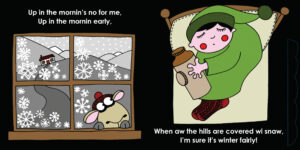
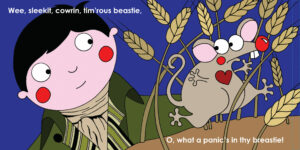
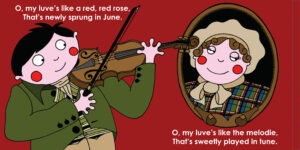
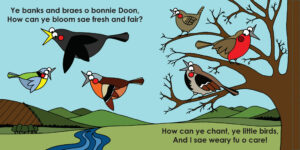
Rabbie’s Rhymes: Robert Burns For Wee Folk by James Robertson is published by Itchy Coo, priced £7.99.
Victoria Mackenzie’s astonishing debut novel, For Thy Great Pain Have Mercy On My Little Pain, has already been garnering praise from writers and reviewers, and it is a novel that heralds an exciting new voice here in Scotland. Here, at BooksfromScotland, Victoria tells us about some of her favourite books.
For Thy Great Pain Have Mercy On My Little Pain
By Victoria Mackenzie
Published by Bloomsbury
The book as . . . memory. What is your first memory of books and reading?
At primary school I loved a book called Flossie Teacake’s Fur Coat by Hunter Davies. When Flossie puts on her sister’s coat she is magically transformed from gawky child into a glamorous 18 year old. The book spoke to my frustrations of being a child, with no autonomy, no choice about anything, and yearning for a grown up life which I thought would be full of excitement and adventure. Ha!
The book as . . . your work. Tell us about your debut novel For Thy Great Pain Have Mercy On My Little Pain. What did you want to explore in writing this book?
For Thy Great Pain Have Mercy On My Little Pain is based on the lives of two medieval mystics, Julian of Norwich and Margery Kempe, who lived in Norfolk in the early fifteenth century. They both claimed to have visions of Christ, at a time when such claims risked accusations of heresy – and when the punishment for heresy was to be burnt at the stake.
I wanted to show the very different ways that these two women coped with their visions, and also to explore what life was like for a woman in the medieval period. Julian’s experience of being an anchoress particularly intrigued me – I wanted to imagine how it would really feel to be in a single room for so many years. What was it like physically? The cold, the boredom, the inability to stretch your legs and get fresh air. And how would it change your personality, your ideas about the world, your sense of self?
The book also explores motherhood, the impact of grief, and the very human need to be loved and accepted by others.
The book as . . . inspiration. What is your favourite book that has informed how you see yourself?
Maggie Nelson’s The Argonauts. She writes so honestly and frankly about the body, sex, parenthood, love, relationships, but her writing is also informed by her deep engagement with literary ideas. The way she brought together the bodily and the intellectual was a revelation.
The book as . . . an object. What is your favourite beautiful book?
The graphic novel The Dancing Plague by Gareth Brookes. It’s a sort of graphic novel, though it tells the true story of a dancing plague that afflicted a town in Strasbourg in 1518, when many inhabitants were seized by a demonic compulsion to dance. Brookes uses a blend of his own ‘pyrographic’ techniques and embroidery to create incredibly unusual and beautiful images. And it’s all offset with a wonderful medieval sense of humour – earthy insults and exclamations, like ‘By the balls of St Bartholomew!’
The book as . . . a relationship. What is your favourite book that bonded you to someone else?
A lot of my friendships are based on a love of books and I met two of my closest friends when we worked together in the same library. Recommending and sharing books has become part of our twenty-year conversation so it’s hard to narrow it down to a single book. Recently I recommended Leonard and Hungry Paul by Rónán Hession and that was a big success, it’s such a gentle, lovely book.
The book as . . . rebellion. What is your favourite book that felt like it revealed a secret truth to you?
There’s no single truth that a book has revealed to me about myself, but there are many books that have resonated in their approach to life and art. During lockdown I read Samantha Clark’s memoir, The Clearing, which contained many truths about family relations, art as a discipline, and the pain that can be caused when you need to carve your own path in life. It’s such a thoughtful meditation, full of clear-eyed observations – and her writing style is exquisite.
The book as . . . a destination. What is your favourite book set in a place unknown to you?
I’ve never been to Paris and would love to be a fly on the wall (or perhaps that should be a barfly) at the 1950s Paris bars and cafes in James Baldwin’s novel, Giovanni’s Room, hanging out with the artists and misfits. I’m a big fan of short books that pack a punch, and this one is just stunning.
The book as . . . the future. What are you looking forward to reading next?
I’ve recently been given The Mercies by Kiran Millwood Hargrave, which I’m really looking forward to. Like For Thy Great Pain it’s an historical novel based on a true story and explores the way society tries to constrain women and punish them for independence. Hargrave’s novel is set in Norway in 1617 and I’ve a feeling the writing will be absolutely gorgeous.
For Thy Great Pain Have Mercy On My Little Pain by Victoria Mackenzie is published by Bloomsbury, priced £14.99.
For most of us the word ‘palaeontology’ is likely to conjure images of dinosaurs and flying reptiles, but what of that other evolutionary branch to which we belong, the mammals? In Beasts Before Us, palaeontologist Dr Elsa Panciroli expands our understanding of evolutionary history to reposition mammals as central protagonists throughout the pre-historic era. We spoke to Elsa about her remarkable work and the impact she hopes it might have.
Beasts Before Us: The Untold Story of Mammal Origins and Evolution
By Elsa Panciroli
Published by Bloomsbury
Can you tell us a little bit about Beasts Before Us?
Mammals are animals that feed their young on milk, and have fur. They include most of the large charismatic creatures on Earth today, including humans. Most books about the origin of mammals start when the non-bird dinosaurs became extinct after an asteroid impact about 66 million years ago, but this is far from the true beginning. Beasts Before Us tells you the part of the mammal story you’ve never heard before, it is the untold story. It stretches back over 300 million years to our first egg-laying predecessors, which share a common ancestor with reptiles. The book then takes you through time following the incredible evolution of our lineage, which flourished long before the dinosaurs appeared.
In Beasts I also seek to reframe a few narratives: for example we need to challenge what evolutionary ‘success’ looks like – tiny rodents are arguably the most successful mammals on earth! I don’t shy away from addressing the dubious practices associated with fossil extraction, which has traditionally been tied to the exploitation of indigenous people and lands. I also tell the stories of some less well-known scientists, such as the indefatigable Polish researcher Zofia Keilan-Jaworowska, who defied the Nazis to learn palaeontology, and led expeditions to the heart of Mongolia in search of fossils.
The book is not what one might expect when they imagine a book on paleontology – it is witty, engaging like a page-turner, and anchored by a clear storytelling style that seamlessly drifts into reflections on your own past. What made you write this book in this way?
Very few people enjoy reading dusty, dry scientific text, not even scientists! When I write I always think: if I wasn’t a scientist, would I want to read this? By challenging myself in this way constantly, I remember to keep the reader at the heart of what I write. I hope to connect with readers by sharing non-scientific details too: the soggy atmosphere at a field site, or the thrill a fossil gives you when you touch it. Extinct animals and places can be hard to picture in the minds’ eye, so adding elements of creative storytelling helps you imagine them and engage with the science.
What connections do you see between storytelling and our understanding of evolutionary history? How has storytelling shaped popular understanding of our origins over the past centuries?
Palaeontology is a lucky science, because fossils lend themselves so naturally to storytelling. The very best science communicators have always used narrative methods to talk about discoveries. A good example is Hugh Miller (1802–1856), a Scottish writer and self-taught geologist. His books were like the David Attenborough documentaries of his day. He was widely read around the world, and much admired by great thinkers and writers, including John Ruskin and Charles Dickens. Miller’s books were enjoyed not just for the knowledge they contained, but his amazing way with words; he presented evolution like a theatre, with stage sets and actors entering and exiting the scene, something his readers would have connected with easily. Another example is the brilliant Arabella Buckley (1840–1929): she wrote popular science books for people of all ages that championed evolution, and did so in a way that avoided a lot of the masculine-dominated narratives of the time. Great figures in science at the time credited her with setting them on their scientific career path.
Storytelling is a powerful thing, it can shape the way we think about the present as well as the past. And of course, the way we interpret the scientific evidence and tell those stories reflects current society almost as much as it does the state of knowledge itself.
You wrote Beasts Before Us relatively early into your research career. Has it always been an ambition of yours to write a book?
Certainly, I’ve been writing since I was six years old! All through childhood I would scribble excessively long stories and draw illustrations to accompany them. I composed silly poems too, inspired particularly by Roald Dahl. Over the years I’ve kept writing, most of it fiction, including writing almost a complete book – a story steeped in nature and Scottish folklore. But unfortunately I never had the confidence to try and publish anything more than a handful of poems. It wasn’t until I began my academic training in my late twenties that I gained the skills and confidence to send work to editors and publishers. Although my articles and books are non-fiction, I try and allow some of my creative side to creep in wherever I can.
While most people associate paleontology with the study of dinosaurs, you use this book to champion the evolutionary history of mammals as just as, if not more, worthy of study. What can we gain as human beings by studying our animal ancestors?
Evolutionary history gives us a kind of perspective that’s hard to gain any other way. Robert MacFarlane called it gaining ‘deep time spectacles’; the ability to see beyond the miniscule scope of the human lifetime. I find that very humbling. I think looking at the path of evolution can also challenge our interpretation of ourselves and the natural world. We see that the traits we associate with being humans – like large brains, replacing our baby teeth with adult ones, feeding our babies on milk – can all be traced to our ancestors, countless millions of years ago. The more you look, the more clear it is that every organism is connected through common ancestry, which gives us a sense of kinship with all life on earth. We can also see how intimately organisms are linked to the world around them, responding to changes in habitat and climate. It’s really quite beautiful. This interconnectedness is something I explored in my second book, Earth: A Biography of Life.
The book ends with a relatively grim forecast of our future, with the Anthropocene incurring a current mass extinction event that is set to see all but the smallest and most adaptable mammals going extinct. What changes can we as individuals make to help stave off the destructive impact of human activity on the world’s biodiversity?
I understand people might find it a bit grim, but there are seeds of hope in there too. Looking over hundreds of millions of years, life has withstood some pretty brutal extinction events – times when our seas were hotter than a bubble bath, and the rain was acidic enough to melt snail shells. I find comfort in knowing that, eventually, life recovers. But it only does so because the major perturbations that cause extinctions (whether they are from asteroid strikes or gases from volcanic eruptions) have always been temporary. This teaches us a really simple lesson: if we can stop poisoning our atmosphere and destroying habitats, life will spring back. But the longer we leave it, the more we will lose – extinction is forever, after all. So this isn’t an excuse for complacency.
There are many ways we can curb our impact on the planet as individuals, and we should do as many of them as possible. From small things like avoiding plastics, to the single biggest thing you can do, which is eat vegetarian and vegan. Meanwhile, we need to campaign to reshape our society away from the destructive consumerist patterns we’ve got ourselves stuck in. There is definitely scope for us to live happier lives with a much lighter footprint on the planet. If we lay off nature and give it a chance, it can spring back. The sooner we do this the better.
If you could choose one thing you hope readers take from Beasts Before Us, what would it be?
That’s a difficult question! I’d hope I can persuade people away from some of the old-fashioned ways of thinking about evolution. A lot of empirical language dominates how we discuss nature, there are ‘winners’ and ‘losers’, and we talk about life as if it is a series of oppressive empires that rise and fall. I think it’s time to step away from that militaristic framework and see that everything that ever lived, whether it’s big and small, charismatic or niche, hunter or prey – is successful and well adapted for its time and place. Whether it became extinct or not is really just a matter of luck.
Beasts Before Us: The Untold Story of Mammal Origins and Evolution by Elsa Panciroli is published by Bloomsbury, priced £12.99.
This month sees the 100th birthday of the legendary Ivor Cutler. Bruce Lindsay has just released a biography of this unique artist and performer, and here, for BooksfromScotland, he chooses ten of his favourite Ivor Cutler moments. Enjoy!
Ivor Cutler: A Life Outside a Sitting Room
By Bruce Lindsay
Published by Equinox Publishing
-
‘I’m Going in a Field’ – on Ludo
-
‘Yellow Fly’ – on Velvet Donkey
-
‘Cockadoodledon’t’ – on Ludo
-
‘Pass the Ball, Jim’ – on Privilege
-
‘Life in a Scotch Sitting Room Vol 2 Episode 2’ – Velvet Donkey
-
‘I Ate a Lady’s Bun’ – A Flat Man
-
‘Barabadabada’ – Jammy Smears
-
‘Phonic Poem’ – Velvet Donkey
https://www.youtube.com/watch?v=qfnfhseuncM
-
‘Whale Badge’ – Privilege
-
‘I Believe in Bugs’ – Dandruff
And for a little bit of a cheat, Bruce also recommends watching:
Shoplifters
Ivor Cutler by Ivor Cutler
Ivor Cutler: A Life Outside a Sitting Room by Bruce Lindsay is published by Equinox Publishing, priced £25.
A man has broken into Zoe’s flat, someone she thought she’d never see again. A man they call the Hand of God. Now that he’s found her, she knows she must return to a past she thought she’d left far behind, to the cult of the Children and their isolated compound Home – to rescue the sister who saved her all those years before. Read an exclusive extract from this heart-racing thriller about coming of age under the indoctrination of a cult – and the extraordinary lengths it takes to break free.
Home
By Cailean Steed
Published by Raven Books
I’ve been thinking about the red entries that the Hand of God had me read from the book. They both had the same letters – F and S, for Father and Seed – but different numbers.
Different women. But Father only has one wife.
I consider asking about this, but it doesn’t seem right. I look out of the window instead.
We’ve only been in the car a couple of hours so far. Our usual trips last hours and hours, take us far away, but this doesn’t feel like a usual trip.
We start to pass more and more houses, until there’s no fields or trees to be seen at all and we’re in the middle of innumerable tall grey buildings. It’s raining, and Sullied people scurry past on the streets with their faces hidden under hoods or umbrellas. Some buildings are all windows in the front, and have bright signs on top. These are ‘shops’, the Hand of God has told me. Sullied people use their money to get things in them, mostly things that they don’t need. It’s called ‘shopping’. When there’s so many buildings around you that you feel swallowed up in them, that’s called a ‘city’.
The Hand of God pulls to a stop at a red light. Sullied people can’t be trusted to know when to stop and go while driving, so they need lights to tell them. The Hand of God scratches his cheek and his nails make a rasping sound against the stubble there.
‘You will likely find the place we visit tonight strange, little Acolyte,’ he says. ‘It’s not something I’ve shown you before.’
‘Not the woods?’ I say. He smiles a little.
‘Not the woods, no. It’s… well, you could think of it as a kind of outpost.’
‘An outpost,’ I repeat. I haven’t heard the term before.
‘In a manner of speaking. You know that we draw new Children from among the Sullied, when they are worthy enough.’ The light turns to green and the car begins to move forward again.
‘They give us money,’ I remember.
‘That’s right. But some also complete spiritual tasks for us, depending on their abilities and station. Tasks that are … useful for us. For the Children. Some Sullied people have positions that make them important in their society, for various reasons. We draw those people to us. And some very lucky Sullied people, if they are enough use to us, become truly Unsullied, and join the rest of the Children at Home.’
‘Alright,’ I say. I think about the Awakened people I know at Home, which makes me think about Teneil, which makes me think about her arm flopping as the man carried her out of the hall, which makes me think about what I heard last night. I still haven’t told the Hand of God any of it. But he knows what I know. Of course.
Doesn’t he?
‘So there are places in the world Outside, places where those Sullied who are working to become Unsullied gather and do good work. Outposts of the Children. We call those places “churches”.’
‘Churches,’ I say, tasting the strange word. ‘So today we are visiting churches?’
‘A church. And yes, we are. First. Then our work will take us elsewhere.’
‘Are we getting rid of a demon tonight?’ I say, feeling a little thrill deep in the pit of my belly. It’s a bit like excitement, but it’s also a bit like feeling ill.
‘Oh, yes. We will rid the world of a great evil tonight,’ says the Hand of God. ‘An evil that comes from the heart of the Children itself. And your actions tonight will prepare you for the greatest task of all, little Acolyte.
‘I won’t let you down,’ I say.
The Hand of God touches my shoulder. ‘I know you won’t,’ he says.
*
I stare down at my fingers, twisting together in my lap. I should feel happy. Proud. He’s trusting me with more of our important work. But I don’t feel right. I can’t stop thinking about how I haven’t told him everything, and how that shouldn’t matter – how he should know it, anyway. The Elders and the Hand of God can read minds. It’s what we were always taught. They can tell when you’re lying. The Hand of God knew I was lying that time in the Atonement Room, when I told him that Amy hadn’t said anything important to me before she left. Of course he did. Because he knows everything I know.
The only possibility is that he knows I was listening that night – the fact that he came into my room and tucked me into bed suggests he knew I’d been up, anyway – and doesn’t feel the need to talk about it. And it must be the same with what I saw in the Worship Hall last night. He’d bring it up if he wanted to know more.
That’s it. That’s got to be it.
Why, says a little voice in my head that sounds a lot like Catherine, would he ever need you to open your mouth, if it was really true he could read minds? Why would he ever ask you to speak? He wouldn’t. He wouldn’t need you to ever talk, or answer his questions.
I think shut up as hard as I can, but the voice keeps going, relentless.
He’d know you were thinking this, it says. He’d know that you were doubting him, right now.
I look over at the Hand of God, panicked. But he’s just looking ahead and navigating the car through more grey city streets. He doesn’t look like he’s noticed anything at all.
It’s not true, the voice says. And if that’s not true …
What else isn’t true?
Home by Cailean Steed is published by Raven Books, priced £14.99.
Heather Darwent’s The Things We Do To Our Friends, is a psychological thriller set in Edinburgh. It tells the story of Clare, a misfit who arrives in the city hoping to reinvent herself. She aspires to make new friends, friends who will help her become the person she believes she can be. Soon she meets an ambitious, monied group of students who have big plans for her, but their plans are potentially dangerous, their intentions shrewd yet unscrupulous. Clare must reckon with how far she’ll go for the group, and what she’ll do to hide her own terrible secrets…
We asked Heather to recommend seven deadly friendship novels that partner perfectly with her debut.
The Things We Do To Our Friends
By Heather Darwent
Published by Viking
The inspiration around the book was friendship in all its glory, the negatives, and the positives. I wanted to write something that placed these connections at the heart of the plot as I’m endlessly fascinated by the platonic relationships we make through our lives, and how these can sour and become toxic.
The challenge was to create friendship on the page: the chemistry, the shared history, and indeed the idea of ‘banter’ that can be hard to express. If the group is too big, it’s hard to form distinct characters, but then a certain amount of characters are needed to create a delicious tension. It’s tricky, and some authors nail these logistical challenges. These are seven of my favourite novels with intriguing, and sometimes deadly, friendship groups. All of these books give such a focus to friendship and make for fascinating reads.
The Truth Will Out by Rosemary Hennigan
In The Truth Will Out, Hennigan uses the backdrop of the theatre, and it leads to a claustrophobic narrative. The group convenes to put on a play, recreating a tragic event from the past, and the complex friendships and tensions set around the rehearsals are cleverly crafted.
The Secret History by Donna Tartt
It would be remiss not to mention The Secret History by Donna Tartt. Here, the friendships are flawlessly constructed, an elite group who feel so incredibly real. The way the group falls apart as the book descends into a dark thriller means it’s impossible to look away.
The Secret Place by Tana French
School friendships have a certain allure to them. The characters are not yet fully formed: the insecurities heightened; alliances uncertain. This is a crime novel that also serves as a brilliant character study.
The Lessons by Naomi Alderman
I loved this atmospheric book that begins in an Oxford College. The friendships here are charged with rippling tension, and the story follows the characters into their adult life as the friendships morph into co-dependency.
Social Creature by Tara Isabella Burton
The ruthless narrator, Louise, makes for a compelling voice in Burton’s debut. I found the Ripleyesque plot to be truly gripping, and it’s beautifully written with plenty of twists and turns.
We Were Liars by E. Lockhart
A YA novel that explores the charms and pitfalls of a gilded upbringing. Here, the relationships between the teenagers are expertly pitched against the adult ties. There’s bucket loads of toxic behaviour, plus a gasp-inducing twist ending.
The Girls Are All So Nice Here by Laurie Elizabeth Flynn
The girls in my final pick are truly horrible. Each time you think they couldn’t get more malevolent; they surprise you in this twisty thriller. The dual timeframe works really well, and a college reunion is an enticing setting for a final showdown.
The Things We Do To Our Friends by Heather Darwent is published by Viking, priced £14.99.
In Abi Elphistone’s re-imagining of the classic Peter Pan story, Martha Pennydrop is ten, and desperate to grow up. Eagerly awaiting the Moment Life Begins, she busies herself with taking care of her little brother Scruff. But when Martha and Scruff discover a drawer full of mysterious gold dust in the bedroom of their new house so begins an incredible adventure to the magical world of Neverland which forces her to rediscover the imagination she thought she had to turn her back on to keep her brother safe. Meet the Pennydrop family in this exclusive extract below.
Saving Neverland
By Abi Elphinstone
Published by Puffin
Number 14 Darlington Road in Bloomsbury, London, looks like a perfectly ordinary townhouse – at first glance, anyway.
It is tall and thin, with three rows of windows and a blue door with a brass knocker. Almost an exact copy of the terraced houses either side of it. And yet, if you were to linger a while outside Number 14, you would notice that one of the top-floor windows – the one with the white cotton curtains billowing in the breeze – is never shut. Even on the coldest winter nights, when frost clings to the rooftops and the air swirls with snow, you will find this particular window wide open.
Had ten-year-old Martha Pennydrop known there was something strange about this window when her family moved into the house a few weeks ago, I very much doubt she would have chosen the room beyond it as her bedroom. But it had been at the start of the summer holidays, when nights are warm and bedroom windows are often left open, so she wasn’t aware that this one was impossible to shut, and that it had been that way for over a hundred years.
And she certainly wasn’t aware that magic was involved because, until the mischief kicks in, magic looks remarkably innocent.
✩
Martha was sitting on her bed the evening it all began. Sunlight spilled in through the open window, and, if Martha had not been concentrating so hard on the notepad in her lap, she might have noticed that her whole bedroom was lit gold in the setting sun. But Martha didn’t have time for noticing things anymore. She was ten now, and ten – as everyone knows – is the beginning of the end. It’s when your age jumps to double digits.
It’s when you enter your last year of primary school. It’s when you’re expected to eat all the vegetables on your plate without complaining.
Ten was, as far as Martha could tell, the age at which you either grew up or got left behind. And getting left behind wasn’t an option because Martha had discovered it came with dangerous consequences – consequences that were always there, lingering at the back of her mind.
Growing up while sharing a bedroom with your seven-year-old brother, however, was like trying to complete a complicated puzzle in the same room as a rhinoceros.
‘WHOOPEE!’ Scruff shrieked as he bounced on his bed in his pyjamas, knocking over a lamp and sending a photo frame clattering to the floor. He leaped still higher.
‘These beds are so much springier than our old ones, don’t you think?’
Martha didn’t answer, but she looked up briefly because a secret part of her wanted to leap on to her bed and bounce with Scruff. She pressed her notepad into her lap to stop her legs getting any ideas because charging into childish games could, and most probably would, lead to disaster. It certainly had done six months ago . . . Martha shuddered at the memory of the Terrible Day and turned back to her notepad.
‘If the roof wasn’t in the way,’ Scruff said, panting, ‘I could probably bounce out of the house and over half of London.’
Martha tried her best to focus on the list in her notepad. It was a checklist for the day just gone, detailing all the jobs she had done about the house to make sure things didn’t get out of control. She ran her finger down the list of evening duties to make sure she’d ticked each one off:
- Have bath (make sure Scruff washes between his toes and behind his ears)
- Brush teeth (give Scruff a star on his Star Chart if he does it without shouting and kicking – ask Dad if Scruff can sponsor a sloth or a penguin or whatever his favourite animal is when he gets ten stars)
- Lay out clothes for the next day (search Scruff’s pockets for sweets as kitchen supply suspiciously low)
- Brush hair (if feeling strong, wrestle Scruff to ground and brush his too)
- Check Scruff’s inhaler is in our bedroom (VERY IMPORTANT)
Martha flicked over the page and scribbled out the same checklist for tomorrow. Then she turned to the back of her notepad and lifted out a photo. It showed her doing a backflip in their old town hall while the rest of her gymnastics club cheered her on.
She smiled. Her dad had taken her to that club every Saturday: she’d learned to do the splits while performing a handstand and do a backflip from standing. And just as good as all that was her dad being around so much more then, driving her to and from the club, and spending the hours in between with Scruff, who loved animals so much that the keepers at the local animal sanctuary let him muck out the llamas at weekends.
But then Mr Pennydrop had been asked to head up the removal company he worked for. Rather than working nearby, he’d had to take the train to and from the company’s head office in London, a two-hour journey twice a day, every weekday for a year.
With each passing day, Martha noticed him becoming more and more stressed, so she and Scruff had tried to do nice things to help him relax. They’d decorated Mr Pennydrop’s briefcase with unicorn stickers, but on seeing them he hadn’t looked very pleased. They’d baked a cake for his birthday, but misread the recipe and stirred in washing powder instead of baking powder. The cake had tasted of soap. And they’d painted Father’s Day cards at the childminder’s house one evening after school, but in their rush to give them to their dad they hadn’t waited for the paint to dry, and the important documents Mr Pennydrop was holding had been ruined.
Then the last day of the summer term had come, just over a month ago, and Mr Pennydrop announced he’d found a fully furnished flat to rent, on the top two floors of a house in London, and they were moving there because it would make life easier. Only life didn’t seem easier. Martha’s dad was trying his best with her and Scruff, but he was still just as stressed. Perhaps even more so given that he’d started locking himself up in his study after school pick-ups to chase up removal vans and organize paperwork.
Martha thought of her mum briefly, hundreds of miles away from Number 14 Darlington Road in some new place or other. A Free Spirit was what Mr Pennydrop called his ex-wife (so free, it turned out, that she had checked out of the family when Martha and Scruff were very little and checked into a backpackers’ shack on a beach in Thailand and never returned).
She sent postcards now and again, but Martha didn’t bother reading them. It wasn’t as if she missed her mum; she’d barely even known her. And, quite frankly, Martha had enough on her plate keeping the family going and preventing another Terrible Day.
Saving Neverland by Abi Elphinstone is published by Puffin, priced £14.99.
ALSO ON BOOKS FROM SCOTLAND
-


Saltwater: A Midsummer Ghost Story by Elaine Thomson
‘The very thought of those grey faces made my skin grow cold.’
-
‘An Odious Campaign’ by Rob McInroy – Why a 1936 By-Election Still Resonates
‘This enraged the locals and he came close to being run out of town on several occasions.’
-

‘‘That’s right, Bobby,’ he growled. ‘I haven’t seen you in – well, since you decided to kill me.’ ‘
-

David Robinson Reviews: Solitary Agents by David Goodman
‘This is very much an up-to-the-minute story of spycraft, positively revelling in all the things tha …
-

The Savage Landscape by Cal Flyn
‘It is their resistance to the intrusions of the outside world − culturally, economically, environme …
-

The Shortest History of Scotland: A Q & A with Murray Pittock
‘We need to be better aware of that to understand the challenges and achievements of the past, and t …
FEATURED AUTHOR:
Andrew Greig

Andrew Greig was born in Bannockburn, although raised in the Fife town of Anstruther. Equally at home with poetry – his first book was the poetry collection White Boats – and literary fiction – In Another Light won the Saltire Society prize in 2004. He …
FEATURED PUBLISHER:
Rymour Books

Rymour Books is a small but fast growing publisher of, primarily, titles of Scottish interest. Their books have received excellent reviews and been nominated for awards, and in the short time since its formation it has established a growing reputation, …