


In a powerful mix of memoir, travelogue and history, Allyson Shaw takes the reader around Scotland with the stories behind a handful of women who were convicted and executed as witches. In this extract from Ashes and Stones, we learn more about Lillias Adie, who faced trial in Torryburn in 1704.
Ashes and Stones: A Scottish Journey in Search of Witches and Witness
By Allyson Shaw
Published by Sceptre
Lillias’s accuser was a woman named Jean Bizet. Neighbours could come forward with accusations during a kirk session. In the session minutes, Jean Bizet describes going from house to house in the village one night, drinking. Near the end of the evening, she was seized with terror, convinced that Lillias was coming for her. Other witnesses heard Jean Bizet cry out, ‘O Lilly with her blew doublet! O Mary, Mary Wilson! Christ keep me,’ while wringing her hands and then passing out. According to the minutes, Jean Bizet was at a friend’s house late into the evening and was in a state of drunken distemper. She accused Lillias Adie of acting with Janet Whyte and Mary Wilson in a conspiracy. When Jean Bizet’s husband, James Tanochie, heard of this business, he said he would ‘ding the devil out’ of his wife.
Lillias was perhaps vulnerable as an elderly, single woman. The victims of the Scottish witch-hunts were overwhelmingly poor, older women. Lillias had an unusual appearance that perhaps marked her out from her neighbours. We know from the dimensions of Lillias’s coffin before it was destroyed that she was uncommonly tall. Her teeth were very prominent. Jean Bizet fixates on Lillias’s blue doublet, and from the scant statements at the trial, it’s impossible to know why this troubled Bizet. Was Lillias’s doublet brighter or finer than most? While this detail is seemingly inconsequential, it forms a fragment of Lillias as an individual woman, part of a time, a place and a people, and it helps us picture her. A blue doublet would have been a common garment at the time. The clothing of the poor was often dyed with woad, a yellow-flowered plant with tall stems and pale leaves. Woad blue is the blue of the sky reflected in the sea on a sunny day. That blue was the colour of much modest clothing, and had been for a millennia, and it was the blue Lillias wore.
Following the accusations of Jean Bizet, Lillias Adie was arrested by Bailie Williamson at 10 p.m. on 28 July 1704. Modern readers marvel at the confessions wrung from the accused during the witch-hunts, perhaps imagining women on a witness stand, confessing bizarre, sordid behaviour. This is often the way witch trials are portrayed in fiction. The reality is that, after arrest, the church needed evidence to take to the Privy Council in Edinburgh. The bulk of the evidence was the confession, extracted over months, during which the accused was often tortured, starved and sleep-deprived. There was no limit on how long the Kirk could hold someone before producing this ‘evidence’. The interrogators would ask leading questions: ‘When did you sleep with the devil?’ ‘Where did you meet other witches?’ and, crucially, ‘What are their names?’ These interrogations would have been intense. A room of powerful men questioning a terrified, tortured woman.
During Lillias’s initial interrogation, she swore, ‘What I am to say shall be as true as the sun is in the firmament.’ She confessed to a flurry of demonic meetings. Between interrogations, she was possibly held in the garret of the Townhouse of Culross – the seat of government and also a prison, where women accused as witches were confined and ‘watched’. The loft space where she was held had no fire for warmth, and what little light there was came up through the slats of the floor. A man would have been paid to watch her and keep her awake. Sleep deprivation was the most common form of torture used to extract confessions from the accused. It was effective. Lack of sleep for one or two nights created a docile suggestibility in the prisoner’s mindset. Longer periods of sleep deprivation resulted in hallucinations and deeper confusion.
Between Lillias’s trial record and everything that went unsaid and unrecorded, we must read her sufferings. The interrogators only wrote down what they thought they needed to convict her.
Perhaps she was led, in her exhaustion, to believe what was being asked of her. The crime of witchcraft involved merry-making with the devil, renunciation of Christian baptism, and the sex crime of ‘meeting with the devil carnally’. The ministers pointedly asked accused women if they’d had sex with Satan, and the churchmen wanted details.
Lillias was interrogated by the minister and church elders four times during the course of her month-long incarceration, which ended only because she died, perhaps of suicide or the effects of imprisonment on her aged body. The trial record states that Lillias had been meeting the devil since the previous witch-hunt in Torryburn in 1666. She would have seen these earlier public executions as a young woman. Over the course of their lives, almost everyone in early modern Scotland would have witnessed the spectacle of women strangled and burned at the stake. It was an event, and often ale was given to the spectators. The bonfire would have been seen for miles and the smoke would have lingered for days, a signal to other women. No one was safe; none were immune to accusation. This is how terror works.
Lillias’s interrogation went on; she met with a coven of ‘twenty or thirty’ witches, all now dead. She stated that she could not name the others, as they were ‘masked like gentlewomen’. As with all confessions extracted under torture, one must read beyond what is written. In this detail of others being dead or masked, we glimpse Lillias’s courage. Her interrogators wanted names, and she initially provided none. In her further confessions, she said that the devil had come to her hundreds of times and ‘lay with her carnally’. When he first trysted with her, it was at the hour just before sunset on Lammas, or the first of August, a transitional hour on the cross-quarter day in the harvest calendar. Lammas, or ‘Loaf Mass’, marked the midpoint between the summer solstice and the autumn equinox. At this pivotal moment, at an hour that was not quite night nor day, Lillias said she met the devil behind a stook, or bundled sheaf, set up in the field to dry. He was both pale and black, and his flesh was cold. Lillias added details: the devil wore a hat and arrived at their dances on a pony. Though he promised her much, she said he gave her only poverty and misery.
Ashes and Stones: A Scottish Journey in Search of Witches and Witness by Allyson Shaw is published by Sceptre, priced £18.99.
When Hanni Winter shows her new husband the heartbreaking photos she captured during the war, he recognises one of the girls as his sister he thought was lost in the concentration camps. They decide to find her, and travel back to where Hanni took the picture. But there is more to Hanni’s past that her husband doesn’t know. In this extract, Hanni worries about the consequences of their journey.
The Girl in the Photo
By Catherine Hokin
Published by Bookoutre
Once the euphoria of recognising Renny in the photograph had worn off and all the arrangements for the journey were in place – once there was nothing else to do but set out on it – Freddy’s faith in the search had started to crack. He was too proud to admit that he was wavering; Hanni was too careful of his emotional state to comment. The visit to Elias, and more specifically the way Freddy had looked at her in the bar and the night that had followed, had made her remember the basis of their bond.
His happiness matters more to me than mine; mine matters more to him than his.
So when Freddy’s hopes started to fly, she didn’t pull them down again: she encouraged them to soar. And when they crashed, she didn’t beg him to listen to the voice of reason in his head, or in hers, and stop. It was a change he was grateful for, a shift in mood that pulled them back together. It didn’t mean Hanni was blind. She saw the doubts clouding his eyes when he thought she wasn’t looking. And she had seen the tremor in his hand when they were finally travelling through the German Democratic Republic and the GDR train guard spent too long scrutinising their papers.
‘It’s unusual to see a police inspector from the West venturing into the East. This conference in Dresden must be an important one.’
Freddy had agreed, very seriously, that it was. Then he had launched into a speech about shared investigative processes still being a focus despite Germany’s political divisions, which was horribly flimsy but bored the train guard away.
The instant the man was gone, Freddy’s façade collapsed. He crumpled back into his seat and immediately started to fret over Hanni’s safety.
‘That was rough. That was harder than I expected and those are our legitimate papers. If the Czech ones are subjected to the same level of interest…’ Freddy left ‘which they will be’ unsaid, but it still hung there between them. ‘Well, you heard what Elias warned us could happen. I won’t blame you if you want to call it quits, Hanni. And I won’t hold it against you, no matter how hard I came down on you before.’
It wasn’t exactly an apology, and Hanni wasn’t looking for one of those – she understood why he had felt let down – but it was good enough, it came from the heart. They had always had a language of their own. They had learned to say ‘I love you’ and ‘I need you’ in a myriad different ways while they navigated who they were going to be to each other. They might forget how to use it at times, but, so far, that language had always come back.
Hanni slipped her hand into his, grateful beyond anything for that. ‘And since when did I give up on things, or sit waiting at home like a good little wife? It’s not your responsibility to find her, my love – it’s ours.’
Ours sounded good; it sounded as certain as us. Hanni wanted to believe it; she wanted Freddy to believe it. She had filled her voice with all the confidence Freddy had been trying to pour into her for the last three weeks. They had learned how to wrap that – or the imitation of that – around each other as well.
He smiled and pulled her closer. Hanni nestled into his side and took refuge in a silence she hoped Freddy would decide was a companionable one. The last thing her nerves needed was questions. Unfortunately, his senses were still on alert.
‘I really needed to hear you say that. You’ve been so on edge since we left Berlin, I thought you were regretting coming with me.’
Hanni shifted away from him before her stiffening body betrayed her. She thought he had been too busy to notice her fears, or that she had been successfully hiding them.
Tell him who you saw on the platform at Berlin. Tell him why that scared you. Don’t hide the truth again, or lie like you did with the Theresienstadt photographs.
It was the right impulse, but Hanni couldn’t act on it. The truth – ‘there was a man I recognised at the station. He was at my exhibition, behaving oddly, and I think he might be following us’ – opened up a minefield. They were about to illegally enter a country where – or so rumour had it – Soviet-backed secret agents were as completely embedded as they were in the GDR. Hanni didn’t need Freddy to have even the slightest suspicion that there were eyes already on them. That would only convince him that he was right to be cautious, that he should go on without her.
Which might be the best thing; it would at least get me out of this.
As much as Hanni wanted to support Freddy, she also desperately wanted to turn round and go home. She wanted Theresienstadt to disappear back into history and for Freddy to give up. Except he would never do that, so she couldn’t either. Never mind that he might discover secrets in the town which she wouldn’t be there to explain, his quest could very easily end in heartache. How could she abandon him to face that pain alone? So she couldn’t turn back and she couldn’t tell him that they might be being followed, either by a secret agent or by her father. Admitting the possibility of that was unthinkable. It would involve spilling the whole story of Reiner and his web of spies, and it wasn’t the time for that yet. Besides, she could be wrong. Hanni wasn’t certain that the man she had seen boarding the Dresden train at Berlin’s Ostbahnhof was the one who had thrown her off balance at the gallery. His height was similar, and so was the dark hair combed neatly under his hat. But it had been a moment’s glimpse in a crowded station. He hadn’t turned; she hadn’t seen his face.
And why would Reiner set a tail on me when I am so clearly not following him?
Freddy had noticed her nerves but that was all he had noticed, and telling him the truth was too dangerous. So, despite what she had promised herself, it had to be another lie. But a small one; a deflection.
‘Of course I’m not regretting it. And yes, I’ve been a little on edge but it’s nothing to worry about.’
Hanni kissed Freddy’s cheek and smiled into his eyes, hating how easy it was for her to convince him she was never anything but honest.
‘I’m nervous about my language skills, that’s all. If I’ve been quiet it’s because I’ve been running all the phrases and grammar I learned years ago back through my head and testing my fluency. I’m not sure it’s as good as it could be.’
That too was a minefield. Hanni had told Freddy that she had learned Czech but she hadn’t told him why, and he had been too caught up with Elias’s complicated chain of arrangements to ask her. Now that his detective’s brain was re-engaged and he was weighing up the journey’s dangers, she could see the questions forming. She kissed him again, on the mouth this time, offering a silent thanks for the luxury of an empty carriage.
‘So maybe we should take the time now to practise. Run over our cover stories in Czech rather than German and quiz each other about them.’
It was a good suggestion, it did what was required and diverted him. They spent the rest of the journey turning their identity papers into fully fledged characters and helping each other iron out their accents. By the time the train pulled into the tiny suburban station on the edges of the city, which was as close as the rail line still went, Freddy’s nerves had vanished and his enthusiasm was racing.
He helped her down the steep step and onto the platform, holding on to her hand as they weaved their way through the press of people and bags. Hanni knew how they appeared to the world, there were enough admiring glances to tell her: like a couple perfectly in step and in tune with each other. It was what she wanted them to be, and she knew Freddy would have agreed with that assessment if anybody had asked him.
What would he do if he knew the truth? If he knew what a good actress I’ve become? How devastated would he be then?
The thought of that was as bad as the lying.
The Girl in the Photo by Catherine Hokin is published by Bookoutre, priced £8.99.
Tanya Landman continues her retellings of classic literature for Barrington Stoke with Frankenstein. We spoke to her to find out more about her latest book.
Frankenstein: A Retelling
By Tanya Landman
Published by Barrington Stoke
This is the latest in a series of retellings for 13+ readers you have written and published with Barrington Stoke, which includes Jane Eyre and Wuthering Heights. What is it about approaching such well-known and respected texts in this way that you enjoy, and how did your experience of retelling Frankenstein differ from those that had come before?
With retellings I get all the pleasure of crafting words and sentences into satisfying, tasty prose without having to suffer the anguished self-doubt involved in creating convincing plots and characters of my own.
I’d read and loved both Jane Eyre and Wuthering Heights as a teenager and used to spend hours imagining myself into Jane and Kathy’s heads. It was a real joy to be able to put myself back in time and be inside their minds again. Retelling both books was a labour of love.
Frankenstein was different. I confess I hadn’t actually read the book before I accepted the commission from Barrington Stoke and when I did pick up a copy I found it a struggle to wade through! I thought a lot of the prose was difficult and dated and yet I was fascinated by the character of Victor Frankenstein and his truly monstrous ego.
I discovered a really good audio book and listened to it several times (often with my eyes shut) to imagine the scenes unfolding and catch the feel and the sense of the story. And then I noted down all the scenes and ideas that had made my heart race or my skin prickle or made me want to cry and those were the ones I concentrated on. Passages and characters I found dull and uninteresting mostly got the chop. It was a different challenge to retelling Jane Eyre and Wuthering Heights but I absolutely loved crafting Mary Shelley’s electrifying masterpiece into what I hope is a version that will grip a modern reader.
Frankenstein is considered by many to be the first science fiction novel, and indeed one of the first major horror novels as well. Many sections are still chilling to read today. What about the story did you think would resonate with a younger audience, and how did you bring those elements to the surface for this edition?
Yes – it’s a pioneering work in both genres and an extraordinary achievement, especially for such a young woman. I am in awe of Mary Shelley.
But for me what resonates (and I think will resonate with younger readers) are the very human horrors and human failings that lie at the heart of the story. When I was in my teens I felt so confused about who I was and where my place was in the world. I wanted to fade into the background and pass unnoticed. But I also wanted to do something notable with my life – like save the planet.
I completely understand Frankenstein’s burning ambition to achieve the extraordinary – to make his life matter, to be famous for something – anything! I think the idea of that one fatal flaw – and all the horrors that result from it – is as relevant now as it ever was.
Frankenstein is a story many young people these days will feel they know, but do you think some elements may be surprising when they read it for the first time?
I think its contemporary relevance will be surprising to some. Most people have images in their head of the Hammer House of Horror monster with the bolt through his neck. They imagine it will be a schlock! horror! screeching violins and nails-on-blackboards kind of a read. Instead (I hope) they will find it’s a fascinating tale about the nature of Man and his position in the natural world – and what makes a monster.
Frankenstein is in many ways a cautionary tale about the obsession with dominating life and the fatal pursuit of progress. Do you think these themes have particular relevance today?
Oh yes – absolutely. Man’s desire to subdue and conquer Nature has led us to the edge of an abyss.
Throughout human history there have always been made dictators and despots. But in these days of mass communication we are more aware than ever of how fragile our world is. And the future becomes more perilous ever day because of a few very rich, very powerful people with colossal egos and bottomless pits of ambition.
Are there any other classic novels you’d be particularly interested in retelling?
Yes – plenty. Bring it on!
Frankenstein: A Retelling by Tanya Landman is published by Barrington Stoke, priced £7.99.
Across 2022, Publishing Scotland will be curating a series of online content to tie in with Visit Scotland’s Year of Stories. Each month we will share the features, profiles and interviews that you can find over on their website.
You can visit Publishing Scotland’s Year of Stories homepage here.
During the winter, Publishing Scotland’s #YS2022 themes were LANGUAGE and CELEBRATION.
Each month Publishing Scotland will be offering Publisher Spotlights, so you can get to know some of Scotland’s publishers. Catch up with the latest profiles.
Publishing Scotland spotlight Gaelic Books Council
Publishing Scotland spotlight Vagabond Voices
Publishing Scotland spotlight Acair Books
Publishing Scotland spotlight Scottish Text Society
Publishing Scotland spotlight Hallewell Publications
Publishing Scotland spotlight Arkbound Publishing
Publishing Scotland spotlight Scottish Book Trust
Publishing Scotland spotlight Swan & Horn
Publishing Scotland spotlight Ailsapress
Publishing Scotland spotlight Charco Press
Each month Publishing Scotland hosted features too, including book recommendation lists and author interviews.
Click here to read an interview with Marcas Mac an Tuairneir about his poetry collection Polaris.
To read an interview with Ely Percy about their novel Vicky Romeo Plus Joolz, click here.
To read recommendations on books celebrating a sense of place, click here.
Click here for book recommendations for music lovers.
Click here for book recommendations on friendship.
For recommendations on books that explore big ideas, click here.
For recommendations on Scottish love stories, click here.
For book recommendations that look to the future, click here.
If you want to take part in the Year of Stories, follow the hashtags #YS2022 and #TalesofScotland, or visit the VisitScotland website.
Naomi Mitchison is one of the most fascinating and prolific writers of the 20th century. David Robinson finds her wartime diaries, re-issued by Weidenfeld & Nicolson, as relevant reading as ever.
Among You Taking Notes: The Wartime Diary of Naomi Mitchison 1939-1945
Edited by Dorothy Sheridan
Published by Weidenfeld & Nicolson
Christmas 1941, and Naomi Mitchison is attending (somewhat reluctantly, no doubt) the United Free Church carol service in Campbeltown. ‘They sang “Stille Nacht”,’ she writes in her diary, ‘and I sang it in German, but of course inaudibly, so that was alright.’
To read Mitchison’s Among You Taking Notes, a selection of entries from her wartime diaries that has just been republished (Weidenfeld & Nicolson, £14.99) is to be transported into a world that is only half recognisable. That year’s war news had been unremittingly grim, especially if, like Mitchison, you hated Churchill, scorned Pathé newsreel propaganda, and thought Glaswegians had been completely demoralised by the Clydebank Blitz. That Christmas, in the wake of the sinking of the battleship Prince of Wales and the battle cruiser Repulse by Japanese bombers on 10 December, victory was so far out of sight that it was hard to imagine what it would look like. Mitchison herself was clearly uncertain: visiting Edinburgh the previous month, she dreamed of ‘being a member of the first Scottish Parliament under the New Order or maybe the Supreme Soviet of Scotland, working with the others all over Europe.’
She wrote her diaries not for publication but in response to a 1939 request for daily accounts of wartime life by the social research organisation Mass Observation. Nella Last, the Barrow housewife whose 12 million-word diary was turned into the 2006 TV film Housewife, 49 by Victoria Wood (in which she also starred) was another such diarist. The two women could hardly have been more different. While Last was married to a shopfitter and lived in a 1930s semi, Mitchison had an open marriage with a man who was a key player in working out what the postwar welfare state would look like, and with whom she bought Carradale House, on the Mull of Kintyre, in 1937. By 1941, she had published 23 books, including 11 novels, and diary entries in that year alone mention eating sausage rolls with Stevie Smith, accidentally bumping into EM Forster (‘he was kind and woolly as usual’) and receiving both a request to give a BBC talk from George Orwell and a letter from Leonard Woolf explaining that Virginia had killed herself because she feared she was going mad (‘I do sympathise,’ Mitchison wrote. ‘One so often feels like that.’)
As well as being a writer, she was a Haldane, which is another way of saying she came from the most precociously gifted family in Scotland. My favourite example of this (not mentioned in the diaries) involves her scientist brother Jack who, when he was four, fell and had a bloody cut on his head. When the doctor was summoned, Jack asked him ‘Is this oxyhaemoglobin or carboxyhemoglobin?’
Mitchison’s branch of the family owned Cloan country house near Auchterarder (another branch owned Gleneagles), and as she and her husband Dick already had a house in London with a staff of five servants and a nurse, money was hardly in short supply. At Carradale, her household included her six children, their friends, numerous evacuees, refugees, Free French soldiers as well as gardeners and estate staff.
This, then, is one of the least typical wartime diaries you will ever read. Because Mitchison is a fiercely individualistic Haldane – as well as being a feminist, a socialist and a Scottish nationalist – all the traditional markers of British wartime defiance (Churchill’s rhetoric, the Battle of Britain, the Blitz spirit, Low’s cartoons, the ‘miracle’ of Dunkirk etc) don’t register with her – indeed, it’s only when Hitler invades her beloved USSR that she loses her ambivalence about the necessity of war in the first place. To swim against the tide so strongly, you need a strong sense of intellectual self-confidence. For Mitchison, that’s no problem. Here she is, for example, reflecting on sculptor Eric Gill’s posthumous autobiography and taking him to task for his condescending attitudes to women: ‘I am more intelligent than he was, more intellectual, a better IQ, a hell of an intellectual heredity. I can think past him.’
So of course, she goes on to argue, women have sexual fantasies just like men and ‘have an eye for the beauty of their lovers’ bodies’. Of course art should reflect that. Of course women should be able to buy erotic art – just as she herself had been tempted to buy Gill’s wood carving of Mellors in Lady Chatterly’s Lover (‘with all the Gill emphasis on the penis’). And of course there should be love across the chasms of class.
At such moments, we see ourselves in her so clearly. ‘It is always a bore,’ she writes, ‘being ahead of one’s time.’ It’s no idle boast. She was.
But she was also – and this is why the diaries fascinate – the Big House chatelaine. She could and did organise her local Labour Party branch meetings, but realised that if they held them at Carradale, her views would have an unfair advantage in any debate. She was similarly honest enough to admit to herself that although Carradale meant an escape from the threat of being bombed in London, it also meant an escape from the more intellectually stimulating company of her friends there. When she wanted to set up a regular Sunday evening debating society for young locals at Carradale village hall – which she and Dick had gifted to the village – the committee running it turned her down. She stormed out in tears. ‘I was half inclined to say why should anyone like me with a world reputation have to submit to being bullied by a lot of villagers,’ she moaned to her diary.
At moments like that, she wondered what she was doing in Carradale in the first place, as ‘coming up here I move back 50 years from say London or Birmingham’. There were, she noted, ‘plenty of people who are waiting to catch me out’, and if they caught her having an affair with a local man ‘they would condemn me, say I was a whore and leave it at that’. Sometimes, she wondered if locals are taking advantage of her, laughing at her farm management skills and ‘wondering if my various boyfriends are really double crossing me’.
Yet Christmas at Carradale in 1941 told a different story. There were about 30 people for the party on December 21 – fishermen, gardeners, nurses, teachers and foresters as well as farmers and family – and when they switched off all the house lights to play Sardines and Murder, ‘there was a good deal of hand-holding’ as Naomi and Ian the plumber hunted down the murderer. Looking back 80 years, these moments of carefree classlessness shine out. Halloween – when everyone wore masks – was another such time, but even at that 1941 Christmas Day dinner, she’d invited a local fisherman friend and his wife to join the family celebrations (‘Neither of them had ever had turkey before and they were very excited about it’). Doing research into night fishing for her extended narrative poem ‘The Alban Goes Out’, Mitchison had already befriended a number of the local fishermen and had been delighted to be invited into their homes. ‘I would never have thought to be so much at ease across so thick a class barrier,’ she told her diary.
Yet if that class barrier was starting to wear thin, it was as much because of her husband’s work as her own. To explain how, let’s jump forward to Christmas 1942. While Naomi was in Carradale, Dick Mitchison had remained in London, working first with his fellow socialist, the economist (and prolific detective fiction writer) GDH Cole on postwar reconstruction plans and then with William Beveridge, whose seminal report was published in November 1942. The five giants to be overcome on the road to a new and fairer Britain, Beveridge famously pointed outing what became a foundation stone of the British Welfare State, were ‘Want, Disease, Ignorance, Squalor and Idleness’.
That Christmas, the tide of war was turning. In October, El Alamein ended a string of British defeats, and monumental battles at Midway and Stalingrad halted the Japanese and Nazi advances. At Carradale, the servants got £2 instead of £1 in their Christmas stockings and there was goose instead of turkey for Christmas Day lunch. There were 18 children at an afternoon party, and when they left at 6.30, all the grown-ups trooped down to the village hall, where Dick Mitchison was to give a talk.
There were 35 locals in the audience, and if you or I had been there, we mightn’t have been too intrigued by its subject – Social Insurance and Allied Services, the formal title of what became known as the Beveridge Report. We might also have found it hard to sit still for the 90 minutes (!) Dick Mitchison spoke, though if we realised its significance we might well have done. Because that Christmas Day 80 years ago, the world we live in – frayed around the edges but still just about recognisable – was slowly being born.
Among You Taking Notes: The Wartime Diary of Naomi Mitchison 1939-1945 edited by Dorothy Sheridan and with a new introduction by Tessa Dunlop, is published by Weidenfeld & Nicolson, price £14.99
Silver Unicorns and Golden Birds is a beautiful new collection of classic Scottish Traveller tales, as told by the late great Duncan Williamson (1928–2007), who is widely regarded as one of Scotland’s greatest storytellers. Recently nominated for the Carnegie Medal, it is both a demonstration of Williamson’s storytelling prowess, and a celebration of the magic and true value of stories themselves.
Silver Unicorns and Golden Birds
By Duncan Williamson
Published by Floris Books
As we approach the height of the festive buying season, it’s easy to lose sight of the real worth of what we gift to each other. Whilst plastic (be it in the form of toys, clothes, games consoles or mobile phones) is guaranteed to end up on most Christmas shopping lists, here are some wise words from Duncan Williamson’s introduction to Silver Unicorns and Golden Birds, as he recalls Christmases from his own childhood.
Around Christmas time my father would say, “Well, thank God, this is Christmas Eve. Come doon beside me and I’ll tell you a story. Now remember, children, any toy I could buy – what’s the sense of buying you a toy when you’ll only break it – it’ll be destroyed in a couple of days. Even if I had the money to afford it. But, this story will last you the entire time of your life.”
My father told me a story when I was only five years old. Now that was seventy years ago! And I can remember that tale the way he told it to me, just the very way. I can visualise him sitting there by the fireside, a young man putting coals in his pipe, you know, smoking his pipe, and all the little kids gathered round the fire; he sitting there telling them a beautiful Christmas tale. Which was far better to us now when I look back than anything he could have bought for us.
Duncan’s father’s words are just as relevant in 2022 as they were when first spoken in the 1930s, and they provide a wonderful reminder that the impact of books and stories can endure for a lifetime. So, in the spirit of gifting, we hope you enjoy this seasonal story, taken from the newly published Silver Unicorns and Golden Birds.
The Hare and the Scarecrow
Once upon a time there was this scarecrow and he’d stood in the field all summer scaring off the birds. After all the harvest was cut and it came near Christmas time, the farmer forgot about the scarecrow and left him in the field. Poor little scarecrow was so sad! No one ever came along and said hello. He just stood there in the field, no one to speak to, just a lonely old scarecrow. Then one morning, just before Christmas, along came a large brown hare, and he stopped beside the scarecrow.
He said, ‘Good morning, Mister Scarecrow!’
And the scarecrow was so glad to have someone to talk to, he said, ‘Oh, good morning, Mister Hare!’
The hare said, ‘Why are you so sad and lonely standing all by yourself in the field when everyone around the world is so happy because it’s Christmas time?’
‘What can I do?’ he said. ‘I’m just an old scarecrow. All the birds are gone because it’s wintertime and no one seems to want to bother with me any more.’
‘Look, Mister Scarecrow, it is not right that you should stand in the field in the cold winter months after spending all summer scaring off the birds for the farmer!’
‘There’s nothing really I can do about it. The farmer has forgotten me.’
The hare said, ‘I know why he has forgotten about you – because he is busy up in his house decorating a nice Christmas tree for his children. He bought his children all these lovely presents for Christmas and tonight they’re going to have a great party. And you, poor scarecrow, are left in the field all alone by yourself after working so hard all summer; so that the farmer could have nice crops of grain and sell these crops of grain for money to buy all these present for his children – and have a nice Christmas party! It is not fair.’
‘There’s nothing really I can do, because I’m just a scarecrow!’
Then along comes a woodland fairy. She hears what the scarecrow has said. She stops aside him, and she too is sorry for the scarecrow.
She says to him, ‘I too am not very happy about this.’
The scarecrow says, ‘Look, there’s nothing I can do… I cannot walk.’
And the fairy says, ‘Yes, you can! Because I am going to put a magic spell on you for two hours tonight and you can do anything you like. You can walk and go wherever you want to go! But remember, you must not talk – or the spell will be broken.’
‘I would love to go to the farmhouse and join the children’s Christmas party.’
The fairy says, ‘You have got two hours to yourself to do what you like!’ And the scarecrow was happy.
The hare said, ‘It’s just right that he should have these things because he’s worked so hard!’ The hare went on his journey and the woodland fairy flew off, left the scarecrow all by himself.
Now the scarecrow stood in the field and rubbed his hands together, said, ‘I don’t want to go too early. I don’t want to go too late; I will just wait till the children begin their Christmas party. Then I will go and join them!’
Back in the farmhouse the farmer was busy putting up the Christmas tree, putting all the presents under and lighting it up for his three children. Then, the scarecrow thought it was time – now it was quite dark, about six o’clock – and the children had begun their party.
So, the scarecrow got down from the stake he was tied to. And when he started to walk, he felt so light and free. ‘Oh, dear,’ he said, ‘at last I’m free from this field!’
He walked and walked till he came to the farmer’s door. He looked through the window and saw the great big Christmas tree. All the children were happy. They had party hats on, they were singing and dancing and having great fun. But the poor scarecrow he didn’t know how to open the door! So, he just sat all alone and wished he could join the children.
But the farmer was so busy with his children helping them, having party games and all the fun, he felt it so warm in the house he said, ‘I think I’ll go outside for a few minutes and get a breath of fresh air.’
The farmer walked to the door, opened it and walked out on the steps. And lo and behold who should be sitting there but the scarecrow! The farmer scratched his head and said to himself, ‘I wonder where in the world did you come from? The last time I saw you, you were down in my ten-acre field scaring the crows. But, you’ve been a good scarecrow to me; you scared all the birds away all summer and you worked really hard. I think it’s about time you should come and join our Christmas party!’ So, the farmer lifted up the scarecrow and carried it inside.
And the children said, ‘Daddy, Daddy! What have you brought?’
He said, ‘Children, gather round, because I have a little friend who comes to visit you!’
And the children said, ‘Daddy, it’s the scarecrow!’
‘I know, children, it’s the scarecrow. But you must remember… come up here till I tell you a wee story. I built this scarecrow myself and I made him nice. I gave him a hat and I gave him a turnip for a head. I gave him hands and legs made of straw and I put him in my field to scare away the birds. If I didn’t do that then the birds would eat all the grain, and the grain would never grow up – I wouldn’t have any harvest. And if I didn’t have any harvest then I wouldn’t get any money, and if I didn’t get any money then I couldn’t buy you children all these wonderful presents and make this lovely Christmas tree. It’s all because of the scarecrow. So, I think it’s about time he should come and join the Christmas party!’
And the children said, ‘Yes, Daddy, we understand. Please, put him beside the Christmas tree!’
So, the farmer carried the scarecrow and put him beside the tree. And the scarecrow was happy to be there. Then the children started to dance and sing, carry on and have their party games. But lo and behold the scarecrow got so excited he couldn’t help himself; he got up and walked on the floor. He started to sing, and he started to dance. And he danced and sang, danced and sang and clapped his hands. The farmer and his children were so taken away with this scarecrow they thought it was magic. They couldn’t believe a scarecrow would do this. Then, forgetting what the fairy had told him, he was just going to tell stories about all the birds in the field that he’s seen… when the clock struck eight and the scarecrow fell on the floor.
The farmer was amazed. He picked him up and said, ‘I’ve never seen anything like this before.’
The children said, ‘Daddy, please, put him beside the Christmas tree again… he must be a magic scarecrow!’
And the farmer said, ‘No, he is not a magic scarecrow; he is just an old scarecrow. But he will never again stand in a cold field in the winter months. When all the harvest is off the field and all the birds have flown away for the winter, our scarecrow will join our Christmas party – every year!’
The children were so happy and excited they said, ‘Yes, Daddy, please, let’s have the scarecrow for next Christmas!’
‘Right, children,’ he said, ‘have your party!’
The farmer carried the scarecrow and put him in the shed, shut him up for the rest of the winter till the next summer came along. Then he placed him back in the field again. And the scarecrow was happy, for he knew he’d heard the farmer saying that he would join the children at their Christmas party next year. The scarecrow looked forward to it.
And that is the end of my wee story.
Silver Unicorns and Golden Birds by Duncan Williamson is published by Floris Books, priced £12.99.
Teenager Max’s life changes forever when he loses his hearing in a boating accident on a remote Scottish island. As he looks to make sense of his new life, and adapting in school, he begins to notice something strange and sinister happening to the islanders around him – a secret government test programme utilising the wind turbines, and it must be stopped. Victoria Williamson dives deeper into the inspiration of her book with Books from Scotland.
War of the Wind
By Victoria Williamson
Published by Neem Tree Press
When I was growing up, I always found the sight of man-made structures slightly creepy.
Until the age of five, I lived in Anniesland in Glasgow, and from the hill at Dawsholm Park, there was a view across the city which was dominated by the two towering gasometers of the old Temple gasworks. I don’t know why the sight of these two looming metal structures made me shiver uneasily as I was playing in the sandpit or on the swings, but I think I associated them with something other-worldly, something not quite human. They seemed somehow beyond my understanding, and therefore sinister.
I had the same feeling about other man-made structures I came across around Glasgow as I grew up: the rickety old Spider Bridge connecting Kirkintilloch and Lenzie, the humming pylons that crisscrossed the fields south of the Campsie Hills, the extra-terrestrial form of the Bearyards water tower in Bishopbriggs. An avid reader from an early age, I began to associate those structures with the science-fiction books that I loved to read, particularly with the alien-spaceships from War of the Worlds and The Tripods series, and with human experiments with technology that went wrong. When wind turbines started appearing across the landscape, I knew that they’d one day make an appearance in one of my novels. Even though I support green energy initiatives, I never quite managed to conquer my early misgivings at the sight of the imposing metal structures that loomed ominously through the mist on foggy days, and glinted eerily in the sunlight on bright mornings. I knew that when they made an appearance in one of my books, the turbines would serve a malevolent purpose.
The seeds of War of the Wind were sown early in my childhood by these misgivings around artificial structures of concrete and steel, but the characters who appeared in the final novel took much longer to develop. Growing up, I had little direct experience of children with disabilities, either in school or in novels. It wasn’t until I was already at university in the late nineties that the debate about inclusive education really got underway – up until that point, children with additional support needs had been excluded from mainstream education, missing out on opportunities to learn alongside non-disabled peers in inclusive environments that would have been beneficial for all children. Fortunately, by the time I returned to university and trained as a primary school teacher myself, inclusive education had become the norm, and specialising in teaching children with additional support needs within mainstream settings, I had lots of opportunities to help children engage with each other. It wasn’t always a straightforward experience, as children without disabilities or a disabled family member themselves could sometimes bring prejudiced opinions to the classroom from outside.
One thing I found that really helped overcome these misconceptions about what disabled people were able to achieve, was positive role models in children’s books. When I was young, disabled characters rarely appeared in books or on TV, and when they did, it was usually in a token or ‘sidekick’ role. The last fifteen years has seen a much greater understanding from the publishing industry of the need for inclusive books where all children get the chance to see themselves in heroic starring roles, which has been immensely helpful for teachers trying to promote inclusivity in their classrooms. It was seeing this need for visible representation in fiction, coupled with my own experiences of teaching children with additional support needs, which led to the development of the four main characters in War of the Wind – Max, who loses his hearing in a boating accident, Erin, who has been deaf since birth, Beanie, who has Down’s syndrome, and David, who has cerebral palsy. Like a number of similar mainstream children in real life, Max has some misconceptions about disability he needs to overcome, and readers go on a journey with him through the book as he learns to accept his own disability. Through his eyes, they see the assumptions that other islanders make about Max due to his hearing loss, as well as the assumptions Max himself makes about the other children in his additional support needs class.
These journeys of understanding are ones we all need to embark on to help create a more inclusive world, confronting our prejudices and preconceived ideas. In War of the Wind, this journey of understanding is coupled with the sinister tale of a wind turbine experiment gone wrong, giving the main characters the opportunity to showcase their abilities as they attempt to stop the malevolent scientist, Doctor Ashwood, before his secret weapons trial has tragic consequences. This book has been the culmination of my life experiences so far, but like my readers, I hope I never stop learning from the experiences of others and developing my capacity for empathy. And who knows, if I try really hard, then perhaps one day I might even conquer my mistrust of the sinister structures that watch us silently from every hilltop as we go about our daily lives, heedless of their gaze and the messages they whisper on the wind…
War of the Wind by Victoria Williamson is published by Neem Tree Press, priced £8.99.
Creative genius, war artist, adventurer: these are just some of the descriptors attributed to Aberdeenshire-born painter and printmaker James McBey. Alasdair Soussi, author of the biography Shadows and Light, tells Books from Scotland about McBey how the creator’s work has come to mean so much to him.
Shadows and Light, The Extraordinary Life of James McBey
By Alasdair Soussi
Published by Scotland Street Press
As I stood over James McBey’s gravestone in Tangier, Morocco, during one parched afternoon earlier this year, I couldn’t help but think of the words the Scottish artist-adventurer had written to his American wife, Marguerite, some ten years before his death in 1959:
’If anything should happen, and if it be possible without much trouble, I should like to stay in the lower property, on the high bit, just beneath the Cherifian Garden. It is still, to me, a heaven down there.’
Today, on Cherifian Rocks, a steep tract of 30 acres which twists its way down to the ocean through sprawling woodland and brushland, one can still experience the reverent silence which has cocooned McBey’s place of rest for more than 60 years. The land, once owned by the McBeys themselves, but for many years now under the ownership of the American School of Tangier, enjoys views over the Straits of Gibraltar, and, just as in the artist’s time, remains impervious to the hustle and bustle of the city.
For me, as his biographer, visiting McBey’s graveside was a pilgrimage, a chance to pay homage to one of the greatest – and today most underrated – artists in Scottish, British and European history. But while he ended his life amid the sun-kissed surrounds of north-western Morocco – he began it in 1883 as the illegitimate son of a blacksmith’s daughter in Foveran, Aberdeenshire, on the edges of the icy North Sea. His was not a young life spent in grinding poverty, but neither was it one filled with riches, all-consuming love and emotional stability: he endured an uneasy relationship with his mother, who forced him to give up school at 13 to begin work as a bank clerk, and who, going prematurely blind and suffering mental health issues, tragically hanged herself in the basement of their Aberdeen tenement. As a child, he met his father only once – and, lacking any kind of emotional support from his parents, found it with his maternal grandmother whom he cherished.
McBey’s bleak beginnings were to haunt him for the rest of his days – but it would also set him on a path to independence that would become the hallmark of a stellar artistic career. Yet it was McBey the man – his eventual severing of ties with a banking trade he had come to loathe, his largely self-taught status as an artist, his decision to leave Aberdeen for the bright lights of London and his global adventures – which first compelled me to document his extraordinary story. But it was his art – and particularly his etchings in which he was regarded as a bona fide genius – that gained him celebrity status on both sides of the Atlantic during the inter-war years.
Indeed, McBey’s many prints, watercolours and oils, from his travels in the Arabic-speaking world, the US, Europe and elsewhere hang in museums worldwide. In London’s Imperial War Museum is his portrait of a gaunt and exhausted T. E. Lawrence (aka Lawrence of Arabia) whom he painted in war-torn Damascus during his swashbuckling stint as Britain’s official war artist in the Middle East during World War I. In the US the Cummer Museum of Art & Gardens in Florida, just one of several museums in America which honour McBey, boasts one of the largest collections of his work outside Scotland. Among the McBeys on display at the Tangier American Legation Museum in Morocco is his hypnotic oil painting of Zohra, his domestic servant in Tangier during the early 1950s, which is widely-known as the ‘Moroccan Mona Lisa’. And at Aberdeen Art Gallery, the Scotsman’s spiritual home, which hosts the world’s largest archive of his work, one can visit its McBey Gallery and enjoy a taste of the man once celebrated as the printmaking heir to Rembrandt and Whistler.
McBey – an international Scot par excellence who lived in London, the US and Morocco – largely shunned the Establishment, and lived according to his own rules. As one of his (many) lovers suggested in a poem, McBey’s propensity for good fortune (and success) was almost heaven-sent:
The wonder grows from day to day
How God can look after James McBey
When as the Bible says he oughter
He casts his bread upon the water
Lo! It returns upon the tide
Well buttered on the other side
When servants leave him is he stranded?
No God is much too open handed –
He takes two angels from the Host
And sends them via The Morning Post
No wonder France is still in debt
And baulked the Balkans fume and fret,
And trade is in a dreadful plight –
God has no time to put things right:
He’s far too busy, night and day,
In doing things for James McBey
Shadows and Light, The Extraordinary Life of James McBey by Alasdair Soussi is published by Scotland Street Press, priced £29.99. It will also be the subject of an exhibition at Aberdeen Art Gallery between February and May 2023.
Millie Partridge desperately needs a party, and she’s invited to a Hebridean Island for New Year’s Eve – just the ticket. Thing start going wrong almost immediately, made worse when an acquaintance from her past goes missing, but no one is sure the how, when, or why. Read an exclusive extract below on Books from Scotland about a Hogmanay sure to go off with a bang.
Auld Acquaintance
By Sofia Slater
Published by Swift Press
No one seemed sure what to say at first. It was horrible, of course, but for who? Until we knew who had been in the car, our exclamations of sad surprise could only be general, and the deaths were no one’s specific grief. The tragedy sat in the centre of the dining table, unclaimed. In my head the words not Nick, not Nick, not Nick ran on a loop, and I could see by the mixture of determination and anxiety on everyone else’s faces that they too were picturing friends and mentally crossing their fingers. At last Winston spoke up, addressing the one person we could be sure had experienced some kind of loss, albeit of a petty variety.
‘That puts out your bookings rather sadly, Mrs Flyte.’
‘Oh, no.’ She waved her hand to dismiss that minor concern, but continued, contradicting the gesture, ‘Though, after all, it is too bad; I put linens in the Great Room.’
No one was asking what we were all wondering. I forced myself to speak.
‘Did the police tell you what happened?’ ‘They weren’t sure. They thought perhaps the husband fell asleep at the wheel. The ferry leaves so early, you know.’
Husband. I was relieved. So, it couldn’t have been Nick. Unless… But no, when I thought of his message, I couldn’t believe it had come from a married man, and I’d done plenty of casual online stalking since he and I stopped working together. If he was with someone, if he had got married, I would have found a trace.
It was Penny who asked the question we really wanted answered.
‘Who – who were they?’
‘A married couple,’ answered Mrs Flyte, before speaking the two names I was least expecting: ‘Drew and Lorna Strang.’
Penny’s hand flew to her mouth, but it couldn’t strangle her cry completely.
‘I’m sorry… I have to…’ She stood, clutching at herself, and hurried from the room.
‘Did she know them?’ asked Winston, looking around the table with a raised eyebrow. Everybody else, obviously relieved that no one they knew had died, shrugged and made sympathetic grimaces. I was struggling to clear my throat; it was as though shock had put a stopper in it.
‘We used to work together. I did too. But they were… close.’
‘Of course,’ said Mrs Flyte. ‘I didn’t really think, but then of course you’d all know each other, wouldn’t you? Oh, this is terrible. The weekend isn’t going to plan at all. First the mix-up with Mr Harriot, then my help from the big island not showing up, and now this. I don’t know how the party can go ahead under the circumstances.’
‘Don’t say that!’ exclaimed Ravi. ‘This is our New Year’s. We can’t let an accident stop us.’
‘I don’t know, Rav,’ said Bella. ‘It’s not a good look, is it? Drinking and dancing when somebody’s just died.’
‘I’m so sorry,’ said James to me in an undertone while the others debated how soon was too soon when it came to doing shots in the aftermath of a tragedy. ‘It must be terrible for you, since you knew them.’
‘It’s more the shock. I haven’t spoken to them in a year or so.’ I paused, wondering when Penny and Nick had last spoken. ‘We weren’t exactly friends. But it’s weird when something like this touches your life, you know?’
‘Trust me, I do.’
We fell silent. At the other end of the table, Ravi and Bella were still arguing. She was concerned about ‘optics’, and he wasn’t about to let the kind of New Year’s party he felt was his due slip from his grasp. All the while, Winston watched them, smiling faintly and, whenever the discussion threatened to die down, dropping a gentle pot-stirring comment to set them off again. Mrs Flyte had her hand at her heart still and was rather urgently gulping down the dregs of the wine.
‘Marjorie, let me clear for you,’ James called down the length of the table. ‘I didn’t realise you were having to do everything without help.’
‘Would you?’ She gave him a shaky smile as he stood and began gathering the glass dessert dishes, all streaked with red. ‘I usually have a couple of girls come over from the next island. They should have arrived this afternoon. I can’t think what’s happened. I need their help in the kitchen just to keep everyone fed until the ferry comes back, though I’m sure we won’t have the party as planned.’
‘Nothing goes ahead as planned on this island, does it?’
Auld Acquaintance by Sofia Slater is published by Swift Press, priced £8.99.
Carrie Kills A Man, by musician and broadcaster Carrie Marshall, is about growing up in a world that doesn’t want you, and how a tattooed transgender rock singer killed a depressed suburban dad. Touching on topics from coming out to trans parenthood, fashion disasters and pop culture icons, Carrie’s memoir is both frank and funny. She talks to Books from Scotland to tell us more.
Carrie Kills A Man: A Memoir
By Carrie Marshall
Published by 404 Ink
Can you tell us a little bit of what we can expect from Carrie Kills A Man?
I’d love to. Carrie Kills A Man is a bit like a Scottish version of Titanic where the boat is my life, the iceberg is me being trans and nobody wants to paint me like one of their French girls. It’s about growing up weird, escaping into pop music and trying to hold things together until you can’t hold them any longer – and what happens when you have to hurl a hand grenade into the middle of an apparently perfect life.
That sounds pretty serious, I know, but CKAM isn’t a misery memoir. It’s also about the power of music and of friendship, the joy of being your best self and what it’s like to go out looking like the sole survivor of a terrible accident in a clown factory.
You’ve written a number of books before in differing forms – how did you find writing your own story? Why did now feel the right time?
It’s been really interesting and a little bit strange, especially with some of the more difficult memories: you’re taking things that used to cause you great shame and sometimes pain and putting them out there for others to see and potentially judge you for. There were definitely times when I had to ask myself, ‘are you really sure you want people to know about this?’
I didn’t originally plan to write a book; I was just keeping a diary. But unfortunately for me, coming out coincided with the beginning of a huge pushback against trans people, especially in the UK and Scottish press and on social media. And the portrait being painted of us is a monstrous one; it’s like people are competing with one another to see who can make up the nastiest stuff about us. Because lots of people don’t know any openly trans people, some really bad actors are taking advantage of that. So if the press aren’t going to get it right, then we need to find other ways to tell our stories and connect with people.
The book itself touches on ‘growing up in a world that doesn’t want you’ as a trans woman, but is also described as laugh-out-loud funny; how do you manage to find the humour in telling your story, even in some of the darker moments?
I think being Scottish means I’m just naturally drawn to that – we Scots are brilliant at mining comedy from pretty dark seams sometimes, and we’ll tell the most horrendously embarrassing stories to make our friends laugh. I’ve done that all my life, so it was natural to do it in the book too.
At first I wasn’t sure about whether being funny was appropriate, but I think it’s important because there’s a poisonous narrative of trans people and the wider community as militant, humourless, thought-policing snowflakes when the reality is completely different. The LGBT+ people I know are some of the daftest, least precious and funniest people I’ve ever met.
You touch on a lot of lessons throughout your life, whether through coming out, fashion choices, friendships – what would you say the most important lessons you’ve learned have been?
That’s a really good question. I think probably the biggest lesson I’ve learnt is that most people aren’t playing life on easy mode; I just thought they were because as an apparently straight cisgender guy I was playing life on easy mode. And I still have it easier than many.
Culture is a constant thread within your memoir, whether influences, crushes, favourite bands – who are some cultural figures who had the biggest impact on you and why?
I think the two most significant figures are Shirley Manson from Garbage and Eddie Izzard. I could never decide if I wanted to be Shirley or marry her: she’s just incredible, a rock star warrior queen who sings about queerness and androgyny and writes anthems for outsiders of all kinds. And Eddie just blew my mind. To be a closeted trans person and see Eddie up there on stage, out and proud and absolutely loved by thousands of people, was like discovering a whole new colour.
The book does come somewhat full circle when you recall meeting someone at Category Is Books in Glasgow, and hearing about their life as a young LGBTQ+ person. How do you feel things have changed since your own youth? Do you feel hopeful for the future?
I do. Things feel really dark right now, but there’s a huge generational shift happening and it’s really beautiful to see. For my kids and their peers, whether you’re gay or trans or non-binary is probably the least interesting thing about you. It’s just not a thing. You can push a culture war, ban books and try to bring back Section 28, but that knowledge and understanding and empathy is out there now. That genie isn’t going back in the bottle.
What do you hope readers take from Carrie Kills A Man?
I really hope readers see themselves reflected a little bit, whether that’s in the funnier stuff – I think we sometimes need outsiders’ eyes to remind us of just how weird and funny a lot of the things we take for granted are – or in the bigger picture: you don’t need to be trans to wonder what it’d be like if you decided to reboot your whole life and take a different path. Most of all, I hope people will understand that we’re not an issue, an ideology or a fad; we’re just ordinary people who’d really appreciate decent healthcare and snacks.
Carrie Kills A Man: A Memoir by Carrie Marshall is published by 404 Ink, priced £12.99.
Phoebe Anna Traquair worked in a range of media including embroidery, enamels, illuminated manuscripts and murals. Her total commitment to the place of art in her daily live is revealed in this new book with more fascinating details. You can view some of her works below.
Phoebe Anna Traquair
Published by National Galleries of Scotland
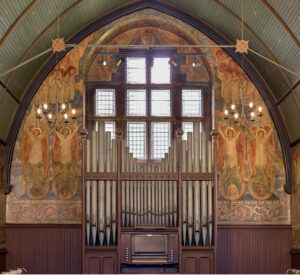
The west wall Oil and gold leaf on plaster.
Traquair was now seeking to represent a wholeness of life. Inspired partly by Blake, partly by Dante, and partly (and increasingly so through the 1890s) by Rossetti, this would define the decoration’s importance within the history of modern art.
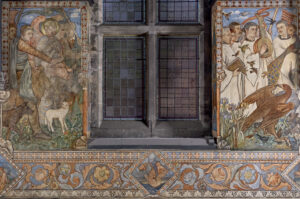
Beasts and Cattle and The Fowls of the Air with (in border) The Creation of the Birds: detail of the north wall Oil and gold leaf on plaster.
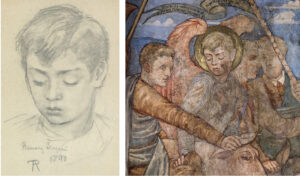
Study of Ramsay, 1890 Pencil on paper, 17 × 12 cm Private collection The Song School of St Mary’s Episcopal Cathedral, 1888–92 Beasts and Cattle panel: detail of Ramsay Traquair, Phoebe Anna Traquair and Dr Ramsay Traquair Oil and gold leaf on plaster
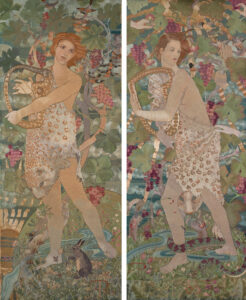
The Progress of a Soul, 1893–1902 Silk with applied paint, wool, and gold and silver thread on linen National Galleries of Scotland, Edinburgh From left to right: The Entrance, 1893–95 The Stress, 1895–97
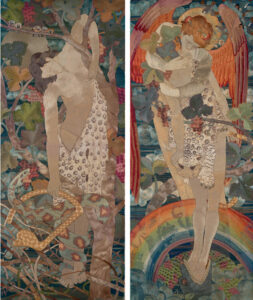
The Progress of a Soul, 1893–1902 Silk with applied paint, wool, and gold and silver thread on linen National Galleries of Scotland, Edinburgh From left to right: Despair, 1897–99 The Victory, 1899–1902
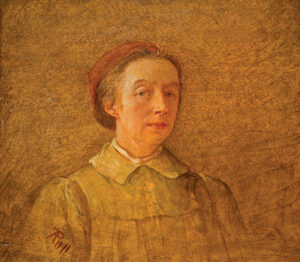
Detail of Self-portrait, 1909–11
Phoebe Anna Traquair is published by National Galleries of Scotland, priced £20.
David Ross’s new novel asks us to travel back in time to 2014 in the wake of the failed Scottish independent referendum as renowned photo-journalist Jude Montgomery arrives in Glasgow in search for important people from her past. It’s a brilliant novel that explores love, loss, art, hope and perseverance, and takes us across America over four decades. In this exclusive feature, David F. Ross provides the fictional article that gives Jude Montogomery her name in journalism. We also have a bonus extra for readers – an excellent playlist that evokes the spirit of the novel.
Dashboard Elvis is Dead
By David F. Ross
Published by Orenda Books
The Low Expectations of the Bowery Bums
(This article was first published in 1996)
By Judithea Montgomery
I have a friend who thinks very differently about life. Both of us occupy the same streets, by and large. Our routines are governed by the same seven-day-week time structure, but we don’t have the same resources. We navigate the same seasonal cycles, the comparative freedom of summer and the restrictive dangers of winter. Thriving or surviving. Sometimes, just. My friend and I are representative of this city’s poor huddled masses; incomers or immigrants drawn towards New York City, magnetized by the temptations of opportunity. We arrived here (separately) with dreams of grid-iron streets, powered by glorious neon and paved with gold.
My friend and I live (again, separately) on the Lower East Side. He pays no rent. Owns nothing other than what covers his body. His navigation of a twenty-four-hour day is unrecognizable from mine. From yours. From Mayor Rudy Giuliani’s. For my friend, it might be argued, the streets are paved with shit and open rivers of piss run out into the East River. Only, he doesn’t think this way. He sees it differently.
My friend is called Hennessey. American Irish, from Queens. He’s got five brothers and sisters, and has no idea where any of them are, or even if anyone of them still is. His pa died in an unregulated boxing match when Hennessey was ten years old. A loser, left for dead among the other carcasses in a meat factory warehouse as the homeboys counted their winnings. A day after his demented mom passed away in hospital, his uncle and cousins beat him close to death for selling some medicinal weed on their turf. That was six years ago. Now he lives on these Bowery streets with the other bums, panhandling and scrambling to get from one day to the next.
Mayor Giuliani, to paraphrase Lou Reed, why don’t you just go down to Alphabet City and club ’em to death? Get it over with. Dump ’em on the boulevards, for the garbage trucks to sweep up and have done with it?
Or why don’t you should spend some time down in the mean streets. If you were to scratch away the grimy surface, there’s artistic gold to be uncovered. If you chose to engage with Hennessey, or Avery, or Ziggy Flatiron, or any number of the neighborhood’s young, destitute characters, you wouldn’t find anyone dreaming of becoming a lawyer or a doctor or an architect. But you would find a supportive environment of poets, writers, sculptors, and people still capable of holding on to a dream in the toughest of circumstances.
It was the British sociologist Ruth Glass who first coined the term “gentrification”. “Once this process of ‘gentrification’ starts in a district,” Glass wrote, “it goes on until all or most of the original working-class occupiers are displaced, and the whole social character of the district is changed.”
The social and cultural character of the Bowery, of the whole Lower East Side, of Manhattan itself, and – as surely as the wreckage follows the ball – the rest of the boroughs, is under threat from City Hall and its cozy relationship with real-estate industry lobbyists. The under-the-radar legislation of the last two years has created several loopholes that gradually remove rent-stabilized status for tenants. The trajectory of this decision will see hundreds of thousands of apartments lost to the lower-waged. A green light will be given to City Planners to rezone swathes of the city, multiplying density in poorer, working-class communities – especially those of color – whilst limiting density in the white, better-off communities. Might I be the first to coin a new term for this: segri-fication.
There are challenges in the inner-city urban areas, of that there is no doubt. On Avenue B, the line between prostitution and desperation is blurred to the point of erasure. Prices are pegged to the drug market, usually to the price of a vial of crack. I’ve seen despairing women live in encampments like Hennessey’s, or worse, in dumpsters, out risking their lives – from assault and AIDS – for a five-buck hustle with a john. Burglary, as you would imagine, is rife. My own building has been robbed three times in the last year. One time, my girlfriend and I were tied up while the invader searched the apartment. He took a kettle and a worthless watch, but he left my camera when I told him it was my living. Desperation, rather than wanton lawlessness, drove him.
Mayor Giuliani’s relentless pursuit of a dirty, mythologized Gotham, populated by crackheads, murderers, and rapists, and heading rapidly towards the abyss of Nether Hell is an easy manifesto gimme. He is suggesting to the already gentrified that their city could be cleaner, safer, sanitized … de-sensitized. It’s a vote-winner, amongst those who vote. A no-lose offer from an insulated, privileged man who hates leaving the Upper East Side for more than a few hours at a time. Who in their neighboring ivory towers, wouldn’t say, “YES! Mr Giuliani, please clampdown hard on the minor offenders, the hot-dog vendors, and the jaywalkers. Hammer the homeless community on our behalf”?
The powerful always pick on easy targets like my friend, Hennessey. This is predicated on an understandable fear. How far are any of us from losing everything we value, having to resort to the street, with pleading words scrawled on cardboard held over a cup? Easier to wash away those to whom it has already happened; easier not to have to look fate in the eye.
You might rightly ask why I’d pen this lament for a part of the city where Travis Bickle once prayed to God for the rain to wash the trash off the sidewalk, or where – in real life, not celluloid – violent hustlers like Larry Hogue habitually assault car-bound customers to support a drug habit. Well, here’s why. If the bulldozer gets its way, an area loses its character. It will lose its identity. Eventually it will lose its soul. I’d pose this: If only a fraction of the city’s crime problem can be solved through better policing, how much more could be achieved, instead, through social reform? Crimes are not only offenses against society but are the inevitable consequences of its breakdown.
The Lower East Side has been changing for several years. There is nothing unusual about this. Cities are in a perpetual process of regeneration. The pace of reinvention is often imperceptible. People now call it gentrification, but that change isn’t about developing identity and character; it’s about cleansing the population, and it’s been happening for centuries. In 1853, a predominantly Black community called Seneca Village emerged in Manhattan. The community had acquired affordable plots to construct homes, churches, and a school. When Irish and German immigrants moved to the village, it became a rare example of racial harmony in an integrated neighborhood. Through eminent domain rules, the city took control of the land. The Seneca Village community was wiped away to create the first major landscaped park in the United States. Those who benefitted most called it the Central Park. Such clearances always benefit the gentry. The collateral damage is seen as worth it in the long run. Post-rationalized as a necessary eradication of the slums, it’s always been about commercial gain for the few. The modern-day equivalent of Seneca Village is leaving a legacy of anonymous, anodyne steel-and-glass shells that could be anywhere.
Bowery is New York’s oldest street. It is riven with complex contradictions. It has been poor, rich, violent, cultured, upscale, and downtrodden — all at the same time. The Bowery gave birth to one of the most influential music scenes of all. In the mid-seventies, the area was a slum, but it drew artistic, creative people to it because it was cheaper than anywhere else. It also had great bookstores and music stores and cinemas and drugs, and it had Max’s Kansas City and it had CBGB’s. The landlords were absent. Developers didn’t look in this neighborhood’s direction then. The city didn’t care about the Bowery. It was left to the people that lived here. They flourished and their output is our stimulus. The people that lived here then – and live here now – appropriated it for themselves. They treat it as if it belongs to them, and they to it.
If any city street can claim to have borne every facet of New York’s history, it is Bowery. Now, adventurous tourists go downtown on weekend safaris just to browse in the new boutiques and drink overpriced coffee in the omnipresent Starbucks. The ‘freaks’ like my friend Hennessey are just another attraction for uptown visitors to gape at, but they rarely pay for the privilege. Hennessey and his comrades are innocent victims of this perpetual cyclical shift.
In 1991, the New York Times ran an article entitled ‘The Story of a Street Person.’ It was written by Elizabeth Swados, the Broadway theatre director. The piece was a heart-breaking elegy for her brother, Lincoln, another of the legion of Bowery bums. It contained the following paragraph:
‘Some people romanticize the plight of the homeless as if each life were the content of a folk song. Others point to Reagan and maintain that he broke the back of the poor in our country. Still others understand enough to see that some people are on the streets because of cutbacks during the Koch Administration and the resulting lack of hospitalization, care, and housing for the mentally ill. But generalizations are worthless. Every person has a different story. Each one of them was brought low by a specific, personal demon. When you think this way, the conditions in the street become unbearable. You are in touch with the individual humanity of homeless people and can’t block out their suffering by blaming a “global condition”.’
My friend Hennessey encountered Lincoln Swados in 1989, just before Lincoln died. He was a very difficult man, Hennessey said. Generous, but also dangerous, as often characterizes the untreated schizophrenic. Lincoln wrote achingly beautiful poetry, while living in what most would consider terrible squalor. I anticipate he, like Hennessey, had become so accustomed to the daily routine of his lowered expectations that he couldn’t function outside of them. As Elizabeth wrote of her brother:
‘If he moved one block away, the rituals of his life would be shattered.’
An aspect that those who have never experienced homelessness can’t grasp. There may not be heating, or running water, or a front door that can be locked, but street people are part of a living community. They look out for each other, respecting the value of meagre belongings or fortuitous finds. They are as attached to the routines of their environment as those with a roof over their head.
Not everything complicated or difficult should be cleansed, moved on or brushed out of sight just because we lack the will to address our society’s greatest challenges constructively and with empathy and humanity. Hennessey and Avery and Ziggy Flatiron et al don’t want your sympathy. They don’t want your disdain. They simply want to be left alone in the courageous, characterful, complex, creative, mean streets they call home. They are content in their lowered expectations: the personal and the societal.
Mr Mayor, leave their neighborhood intact. Remove your cruel objections.
Resist those commercial temptations and leave them on their own.
Dashboard Elvis is Dead playlist:
https://open.spotify.com/playlist/5qRs2G7lsFZqPD2qX3Duvh?si=10fe8c3b028f41bd
Dashboard Elvis is Dead by David F. Ross is published by Orenda Books, priced £9.99.
Flora Shedden’s Supper collects over 100 delicious and doable recipes, aiming to show how home cooks can elevate even the most ordinary dinners at home into something joyful and celebratory. You can test out her recipe for grilled mackerel with parsley salsa below.
Supper
By Flora Sneddon
Published by Hardie Grant
This is a perfectly light supper for a warm evening. It can be paired with lots of bread and colourful, jewel-like salads for a hungry household, but can also make for an excellent solo dinner with some potatoes and a few salad leaves.
Preheat the grill (broiler) to its highest setting.
In a food processor or using a stick blender and bowl, blitz together the parsley, oil, capers, garlic and lemon juice until very smooth. This should take roughly 2 minutes.
Chop the cherry tomatoes into small pieces – I like to do quarters or eighths, but this is entirely dependent on your patience!
Mix the parsley sauce with the tomatoes to create a vibrant green salsa. Season to taste and set aside.
Pat the mackerel fillets dry with kitchen paper to help the fish crisp up under the grill. Place on a roasting tray (pan), skin-side up, with a small piece of baking paper underneath (this helps prevent the fish from sticking to the tray, however you don’t need too much as any excess may burn underneath the grill). Drizzle the skin with a little olive oil and season generously with some salt and pepper. Grill (broil) for 4–6 minutes depending on the size of your fish. The skin should blister and blacken a little and the flesh should be just cooked and flaking nicely.
Serve immediately with the salsa and some fennel fronds and flowers (or any other herbs you have to hand). This recipe is also delicious served with a dry white wine, but then again so is everything …
Serves 2
30 g (1 oz) flat-leaf parsley
3 tbsps extra virgin olive oil
1 tbsp capers
1 garlic clove
juice of 1/2 lemon
250 g (9 oz) mixed cherry
tomatoes
2 mackerel, butterflied
olive oil, for drizzling
fennel fronds and flowers
(optional)
salt and freshly ground
black pepper
SUBS
parsley – half basil and
half dill
capers – 3 anchovies
mackerel – sardines
fennel fronds – dill

Supper by Flora Shedden (Hardie Grant, £22) Photography ©Laura Edwards
Supper by Flora Sneddon is published by Hardie Grant, priced £22.
Eleanor is abandoned by her fiancé, Eric, at the heart of the Edinburgh Christmas market, as he follows a mysterious woman back to a hotel she owns in the Highlands. There, he meets many more men on the staff, men like him, who seek to entertain the woman they serve. But it only gets stranger from there, and the doubt creeps in… Dive into the world of Joanna Corrance’s The Gingerbread Men below in this exclusive pre-publication extract.
The Gingerbread Men
By Joanna Corrance
Published by Haunt Publishing
I decided to leave my fiancé on Christmas Eve, the very same day that I had proposed to her.
We stood beneath a snow-filled sky at the Christmas market in Edinburgh, hot drinks clasped in our gloved hands and glowing from the thrill of our recent engagement. Eleanor, my fiancé, was choosing new baubles for our Christmas tree which, on her insistence, had been erected at the end of November. I had tried to explain that the needles would fall off and that by Christmas Day we would be left with balding branches and a clogged hoover. If it were up to her, she would probably have kept the tree up all year round.
There was no hesitation. I made my decision in the seconds between her putting down a matt bauble and picking up a glossy red one, as she deliberated over which would suit our tree’s garish aesthetic better.
When people spoke about leaving their long-term partner, it was usually after months, or even years, of painful deliberation, after the fighting had become too much or the indifference too lonely. It wasn’t like that for me.
Oblivious, Eleanor continued to chatter away, radiating her usual rosy-cheeked chirpiness. She had recently qualified as a children’s art therapist, which had only seemed to enhance her sunny demeanour. Her family, all headmistresses or doctors in niche specialities, had the kind of relationships you see in nice, family-friendly films. I knew that was meant to be a good thing, but it could leave me feeling a bit inadequate.
Our boots had sunk into the snow, which had become grey and slushy from the grit and hundreds of stomping, dirty soles. On either side of the path was crisp, untouched snow that had fallen during the day. Rows of identical wooden huts lined the path, decorated with gold fairy lights wound through holly. Eleanor clasped her paper cup of hot chocolate in one mittened hand and gestured with the other at some shiny, metallic baubles in their boxes, still debating the appropriate level of garishness. It seemed that, when it came to Christmas, the uglier the better. From late November onwards, our flat would be filled with tat, the kind of things we would never be caught dead with in our household at any time outside the festive season. I went along with it despite my feelings on the matter. We had planned to revisit the subject once I had moved in properly, when I was certain she would have come around to my way of thinking.
I had only just handed in my notice on the lease for my grubby one bedroom on the outskirts of Edinburgh and was in the process of moving the few furnishings that belonged to me into Eleanor’s Stockbridge flat, which had more space between floor and ceiling than it did actual floor space. Things had been moving in the direction of a proposal for some time and, given that I had already been unofficially living with her, Christmas Eve had seemed as good a time as any to finally formalise it. Thankfully, she was delighted to be engaged and didn’t seem to mind that I couldn’t afford a proper ring. Apparently, her grandmother had promised her hers anyway. We had planned to bring up the topic of the ring when we made the announcement the following day over Christmas dinner at her grandparents’ house. They lived in a beautiful old Victorian house, within walking distance of all the galleries and parks. They were the kind of people who, when you commented on what an amazing place it was and in such an incredible location, would bristle and say ‘bought it for pennies back in our day’, but any sense of discomfort about their own wealth was notably absent when it came to the lavish spread on the dinner table and the number of professionally wrapped gifts under their ceiling-high Christmas tree, which had evidently been put up and decorated by their hired help. Tomorrow, the house would be glittering with tinsel and wealth. It would be my third Christmas with them.
I knew exactly how her family would react when we announced our engagement. There would be a barely noticeable flash of concern quickly followed by gasps and congratulations; the popping of champagne corks would come just a moment too late. Eleanor wouldn’t notice the apprehension, but I would notice everything. When Eleanor’s mother first met me, her eyes had lit up and she commented on ‘what a handsome chap’ I was. Her gaze flickered curiously from me to her daughter and Eleanor pretended not to notice. Eleanor’s mother was of a generation that seemed to think it was acceptable to openly label people as ‘plain’. Later, when she asked me about my background and what I did for a living, she had smiled thinly.
‘Eric.’ Eleanor waved an orange mitten in front of my face, obscuring my view. She hadn’t noticed that, throughout the entire debate about matt versus gloss, I had been staring at the woman standing several feet behind her.
The woman was younger than me by a few years, perhaps the same age as Eleanor. She blinked a flash of powder blue and curled her dewy lips into a small smile that brightened her rounded cheeks, which flushed in the cold air into two almost comically pink circles. She was startlingly doll-like, with a face that looked like it was made of delicate, glistening china. It was as eerie as it was entrancing. I glanced behind me, wanting to make sure she wasn’t looking at someone else, and when I turned back her smile had widened, exposing two slightly too-large canines, one ever so slightly snaggled. Strangely, it only enhanced her appeal.
With the grace of a dancer, she peeled off a grey glove and extended her open palm. Her index finger curled and beckoned me towards her.
‘Eric,’ Eleanor repeated, irritably brushing a curly blonde strand from her eyes and tucking it back beneath her hat. ‘Are you listening to me?’
Glancing down, I blinked back to the present and placed a hand on her padded arm.
‘Eleanor, I’m sorry.’ I wasn’t actually sorry, but it seemed like the right thing to say. Ignoring her bemused expression, I removed my hand from her arm and walked past her without looking back.
The entrancing woman stood by the mulled wine hut with a small, triumphant smile. The strange combination of the thrill and the wickedness of what I was doing only drew me in further. As I got closer, a rich, woody, Christmas smell washed over me: spices, ginger and nutmeg as she stood by a steaming vat of mulled wine. I was intoxicated.
Wordlessly, she took my arm and led me away.
The Gingerbread Men by Joanna Corrance is published by Haunt Publishing, priced £9.99.
After his morning jog goes awry, the Stick Man’s epic journey begins to unfold, through the wilderness and the seasons of the year. Another children’s classic from Julia Donaldson and Axel Scheffler, you can preview some of the Scots version, translated by James Robertson, below.
Stick Mannie: Stick Man in Scots
By Julia Donaldson, illustrated by Axel Scheffler, and translated by James Robertson
Published by Itchy Coo
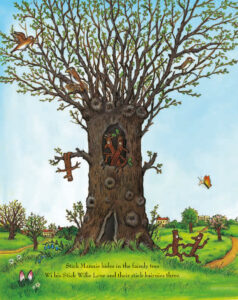
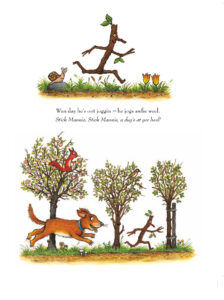
[Images 1-5] Stick Man © Julia Donaldson, Axel Scheffler, 2008 Scholastic Children’s Books. All rights reserved
Stick Mannie: Stick Man in Scots by Julia Donaldson, illustrated by Axel Scheffler, and translated by James Robertson is published by Itchy Coo, priced £6.99.
In Ever Dundas’ new novel, HellSans is a typeface that is enforced by the government as the ultimate control device. Those allergic to it find themselves not only unsupported, but actively persecuted, forced into the outskirts of the city. Having created this dystopian tale that will stay with you long after the last page, Ever Dundas talks to BooksfromScotland about her favourite books.
HellSans
By Ever Dundas
Published by Angry Robot Books
The book as . . . memory. What is your first memory of books and reading?
My first memory of reading is struggling to read. In Sunday school we all had to read a passage from the Bible and I couldn’t. The other kids were horrible to me (how very Christian of them). I was never formally diagnosed with dyslexia but all the things I struggled with point to that. Eventually I got some extra help, and when I finally learned to read I devoured books as if they were life-giving sustenance.
The book as . . . your work. Tell us about your latest book HellSans. What did you want to explore in writing this book?
HellSans is set in an alternative dystopian UK, where the Inex, a cyborg doll-like personal assistant, has replaced the smartphone and the population is controlled by its ‘bliss’ reaction to HellSans, the enforced, ubiquitous typeface. But there’s a minority who are allergic to the typeface: so-called ‘deviants’ who are forced to live in ghettos or on the streets.
The story follows two protagonists, Jane Ward and Dr Ichorel Smith. Jane is a queer woman, and she’s CEO of the company that develops the Inex. She’s powerful and in league with the government until she falls ill with the allergy. Losing her charmed life, she languishes in the ghetto until her story collides with Icho.
Icho is a queer woman who has a HellSans allergy cure and is on the run from the government and the Seraphs who all have their own agenda for the cure (the Seraphs run the ghetto and are ‘terrorists’ or ‘freedom fighters’ depending on your viewpoint).
The book is in three parts, and the first two parts, ‘Jane’ and ‘Icho’, can be read in an order of the reader’s choosing.
HellSans was influenced by my experience as a disabled person living under a Tory government that was investigated by the UN for human rights violations against disabled people. I experienced how quickly and easily you can fall through the cracks of capitalism, and I got a taste of the dehumanising punitive benefits system. Even with all the support I had, it almost broke me. There’s also little in the way of medical or social support and it’s a fight to access what little there is. Ableism and health supremacy permeates society and no one cares if disabled people suffer and die.
I funnelled all that into HellSans, but I didn’t want it to be worthy and preachy; it’s first and foremost a sci-fi thriller. I want readers to be swept up in the story, so I hope I’ve achieved that.
The book as . . . inspiration. What is your favourite book that has informed how you see yourself?
Nietzsche: A Philosophical Biography by Julian Young. I read it every morning as I had breakfast and it was such a soothing way to start the day. I loved travelling with Nietzsche each morning, and I loved the challenge of the thought experiment that is the eternal return. But more than informing how I see myself, it’s informed the core of my third novel.
The book as . . . an object. What is your favourite beautiful book?
We have so many beautiful books, it’s hard to choose. But I think I’ll go with Emil Ferris’ My Favourite Thing Is Monsters, as the art is so entrancing.
The book as . . . a relationship. What is your favourite book that bonded you to someone else?
The Catcher In The Rye. When I was a young teen, my sister Rachel gave me her tatty copy which had all her scribbles in the margins, passages underlined.
I don’t get all the recent social media hatred of it, just because Holden isn’t a particularly likeable character. Why do characters have to be ‘likeable’? Or even relatable? I loved it as a teen and reread it as an adult and still love it; even now, I find the passage where he talks about being the catcher in the rye very moving.
My sister also introduced me to 1984, Brave New World, American Psycho, and Equus; you wouldn’t judge any of these books on the likeability of the characters.
Rach died a few years ago. I wish I’d had the chance to tell her what an impact she had on me as a person and a writer.
The book as . . . rebellion. What is your favourite book that felt like it revealed a secret truth to you?
Groosham Grange by Anthony Horowitz. It blew my nine-year-old mind because the bad guys won – but were they the bad guys?
What I’d been taught was bad wasn’t necessarily bad. The people I thought were bad – were they really? The things I was told to be afraid of – were they really the things to fear? As the Groosham Grange headmasters explain to the protagonist: ‘All right, I admit it. We are, frankly, evil. But what’s so bad about being evil? We’ve never dropped an atom bomb on anyone. We’ve never polluted the environment or experimented on animals or cut back on National Health spending.’ Beware the bankers, beware the politicians – don’t get distracted by those they call monstrous, don’t get distracted by their scapegoats.
The book as . . . a destination. What is your favourite book set in a place unknown to you?
Susanna Clarke’s Piranesi. I’d love to visit the House.
The book as . . . the future. What are you looking forward to reading next?
I’m not sure what I’m reading next from my ridiculous ‘to read’ tower, but I’m very much looking forward to Mat Osman’s The Ghost Theatre which is out May 2023. I had the pleasure of reading an early draft during a miserable lockdown January when I was dealing with a friendship imploding; it brought escape and cheer. I’m looking forward to holding it in my hands in book form and immersing myself in that world again.
HellSans by Ever Dundas is published by Angry Robot Books, priced £9.99.
Richard Holloway is one of the country’s most beloved thinkers, and he has turned to poets and writers for guidance and solace as life has gone on. David Robinson dives into The Heart of Things, this book created to offer lessons – in Richard’s words – who ‘know best how to listen, and teach us to listen’.
The Heart of Things
By Richard Holloway
Published by Canongate Books
Sixty years ago, when I was eight, I travelled from one end of the country to the other to meet the man my mother’s sister had married. Uncle Jack was everything our family wasn’t – upper-class, rich, received pronunciation, effortless manners. An elderly judge, he’d lost an eye in the Irish War of Independence (he was on the wrong side) and the left lens of his glasses was an opaque grey. My aunt – who was much younger than him and beautiful – warned us that he thought children should be seen and not heard and gave me emergency lessons in cutlery etiquette before introducing me to him.
They were only married for a short while before he died, so I never really knew him. He left almost everything to his daughter from a long-ago marriage, but my aunt inherited his books. The year after he died, I came across something he’d written on the flyleaf of a poetry collection. ‘How cruel it is,’ I read, ‘that the old can still appreciate beauty.’ I don’t remember a single thing he said to me, but those words have stuck in my mind ever since.
I was still a child, so I didn’t understand them as completely as I do now that I am nearly Uncle Jack’s age. But I understood enough. My one-eyed uncle was no doubt frightening if you were a prisoner before him or a child at his table who wasn’t sure how to use a fish-knife, but this poetry book – I can’t remember its title – had clearly unlocked something else within him. He was hurt, this small but apparently impervious pillar of the Establishment; hurt by looking back in old age at the tormentingly evanescent beauty of life.
That particular sentiment is at the heart of Richard Holloway’s The Heart of Things too – his thirty-third and, he keeps threatening, final book, out in paperback this month, just ahead of its author’s 89th birthday. There is, though, far more to it than just an old man’s howl of regret. While most poetry anthologies just give you the poems, this one gives you the later chapters of a spiritual autobiography too.
The earliest ones – about faith, obedience, and the surrendered life of monk and subsequent minister – were well covered in his wonderful autobiography, Leaving Alexandria. Even there, though, poetry had its place. When I first read it, I skipped past the epigraphs and assumed that the title was entirely straightforward; Alexandria in the Vale of Leven was where Holloway grew up, where Christianity first enchanted his teenage mind, and from where he left to be a novice monk in England. Only now, reading his anthology, do I realise that it also came from C. F Cavafy’s poem ‘The God Abandons Antony’, an extract from which was one of the epigraphs I’d overlooked and which is also included here:
At midnight, when you suddenly hear
an invisible procession going by
with exquisite music, voices,
don’t mourn your luck that’s failing now,
work gone wrong, your plans
all proving deceptive – don’t mourn them uselessly:
as one long prepared, and graced with courage,
say goodbye to her, the Alexandria that is leaving.
Mark Antony’s plans have all gone wrong: he has been abandoned by Bacchus, is about to lose Alexandria and, by implication, Cleopatra, and faces defeat at the hands of Octavius. Holloway discovered the poem, he says, at just the right time – ‘when God was abandoning me or I was abandoning God’ – and it gave him courage.
Mostly, though, the poetry and writing he chooses have other messages. Because he no longer looks forward to the ‘sure and certain hope of the resurrection to eternal life’ (as he points out, ‘certain hope’ is a bit of a contradiction), he often finds himself looking backwards at his life, as from the stern of a ship at its ever-widening wake. In such circumstances, melancholy is inevitable, so no wonder it afflicts so many writers. Yet, as he says, maybe he’s got that the wrong way round and it is melancholy that makes them writers in the first place. But if it is, and if everything (including all poetry) will be lost to death, why bother writing at all? Why not just be melancholic? The answer – the bravery, elan, wisdom, regret and defiant celebration of life to be found in poetry – is precisely why Holloway finds it so necessary.
His book’s subtitle is ‘An Anthology of Memory and Lament’, but although Holloway claims all he is doing is following Montaigne in ‘making up a bunch of other men’s flowers’, he is actually doing quite a lot more. Not only does each chapter end with a few lines of his own unpublished poetry, but the anthologised pieces aren’t just lumped together under loose themes but brought together in a persuasive line of thought. I nearly wrote ‘thesis’, but that would be wrong, because there’s nothing narrowly dogmatic about the book, so you’ll find for example John Betjeman writing about meeting death with hope, just as readily as Edna St Vincent Millay on facing it with defiance.
For all that, there is a tide of ideas running through this book, and they do generally run in the same direction – towards the last things, death itself, and what we might miss most about life. Yet anyone who has ever heard Holloway talk about such matters, whether from the pulpit or book festival stage, knows that he does so with a wisdom and eloquence that can be strangely uplifting. It’s the same here. At the end of an extract, Holloway will often seize on a particular phrase and underline it by repetition (‘every poem, in time, becomes an elegy’ – Borges), or bring the whole poem back as part of another argument altogether, as he does with Mark Doty’s poem ‘Migratory’. This is an effective technique, constantly drawing the reader into a deeper understanding. It also helps that there’s not a whiff of waffle or a drop of ‘poetry-speak’, just crystal-clear exposition. I wish there could be more books like this, more personal, well thought-out and beautifully written anthologies, though that may well be another way of saying I wish there could be more people like Richard Holloway.
There is, as I have mentioned, a lot of regret in this book: indeed Holloway admits that he loves the word itself (‘Like a good poem, it is its own meaning. Just say it softly: REGRET’). That much my Uncle Jack might have known all about. But towards the end, after the Cavafy poem, the book’s tone subtly changes. Writing about forgiveness (‘Jesus thought the unforgiven and unforgiving life were not worth living’), he points out how it can bring about ‘a certain lightness of being in spite of all that crushing weight of all that history pushing into and through us. Transcendence is the word.’
He concludes with a poem of his own that makes this very point. After tracking the formative memories of his life, it ends like this:
Now as my own life
spools its last reel,
I’m still not sure
if Someone was behind it,
like the projectionist
In the old picture houses
I went to and loved
as a boy.
Maybe at The End,
somehow,
I’ll know.
But wasn’t it great,
the show, I tell myself,
as the lights come up
and the curtains
start to close?
It was, it WAS!
AMEN.
The Heart of Things by Richard Holloway is published by Canongate Books, priced £10.99.
Tom Morton has travelled the world in search of the finest drams that the world has to offer; Holy Waters is his journey to the spiritual heart of whisky, sake, rum, and many more drinks to list. Revelling in the lore and mysteries, the relationships between human and landscape and beyond, it’s a celebration of cultures and artisan craft. Read an extract from the book below.
Holy Waters: Searching for the sacred in a glass
By Tom Morton
Published by Watkins Publishing
Largs is a small holiday town on the Firth of Clyde, about 30 miles from Glasgow, and it has been one of my favourite places since I first tasted home-made Italian ice cream and smelled the tang of salt, vinegar and fishy chip fat on the evening air.
I have never consumed an alcoholic drink in Largs, but I have worshipped in the local Gospel Hall, sung choruses at open-air meetings and eaten large quantities of Nardini’s ice cream and fish and chips, washed down with Barr’s Irn Bru. I have gazed at The Pencil, the monument to Scottish King Alexander III’s defeat of King Haakon of Norway’s forces in 1263, the battle that brought to an end Viking harassment of Scotland’s mainland, though not Norse influence over the islands.
Vikings are still part of Largs’s lore and street geography, pub names and touristic mythology. But long gone is the item that planted the romance of the Vikings in my head and heart as a youngster – the gigantic facsimile of a Norse war galley that used to jut from an Art Deco building that was once the 1300- seat Viking cinema. We kids would shriek with excitement each time we passed that fake boat’s ferocious-looking dragon’s head prow, but before long the building was the headquarters and bottling plant of J H Wham and Son, who produced a truly horrible blend of sweet South African wine and Scotch Whisky called Scotsmac. It was a favourite of schoolboys and girls on an illicit bender as it was cheap and effective; alcoholics liked it too. In fact, it was not unlike the much mentioned Buckfast Tonic Wine or other electric soups of Scottish industrial culture. It was affectionately known as Wham’s Dram or sometimes Bam’s Dram.
Scotsmac is no longer available for sale. It had gone through several owners by the time it vanished from the cheaper British supermarkets’ shelves in 2018, and it’s 15 per cent alcohol, viciously hangover-inducing axe-blow to head and heart, thankfully, became a thing of the past. I once conducted a tongue-very-much-in-cheek ‘guided tasting’ that involved Scotsmac, Buckfast Tonic Wine, Irn Bru and English St George’s Whisky. It’s fair to say that the audience left discombobulated and desperately seeking a proper drink.
And that was it for me and Vikings really, once childhood has departed. Or so I thought. Then, for reasons spelled out in two other books, I ended up living in the Shetland Islands, that northernmost of British archipelagos halfway to Scandinavia, and Vikings came rampaging back into my life.
Holy Flight – Tasting Notes
Lerwick Brewery Blindside Stout
Founded in 2012, the Lerwick Brewery is fairly new, and has been the most northerly brewery in the UK since the closure of Valhalla in Unst, Shetland’s northernmost island. This is my favourite of all their beers; it’s a highly successful dark IPA that conjures up for me memories of the night in Cork when I encountered Murphy’s Stout for the first time.
Colour: Dark ruby brown
Nose: Malty and dark with lots of wedding-cake fruitiness.
Palate: Lighter than you’d expect from that blackness, roasted nuts and burned toast. It has a great deal of character.
Finish: Small bubbles, so doesn’t ransack your tastebuds; leaves a fairly smoothe aftertaste.
Scapa Skiren Single Malt
Skiren is Old Norse for the sparkling summer light you get in Orkney, where this whisky comes from. The Scapa distillery is right next to the sea, not too far from its competitor Highland Park in Kirkwall, and its products have often been dismissed as less characterful than its better-known local cousin. Notably by myself. Recently, I bought a bottle in the community shop that sits right in front of the St Rognvald Hotel, and I have to say I was very impressed.
This has been aged only in ‘first fill’ American oak (that would be barrels bought in kit form from the USA, where it is illegal to re-use barrels that have had whiskey in them previously) and it has a delightful, supple smoothness, lacking the sweet sherry oak notes of Highland Park but with a gloriously assured fruitiness and a charcoal tang from the treatment the American oak casks would have had across the Atlantic – all are charred internally to add character to the whiskey made there.
Colour: Sandy, light gold
Nose: Salt and sweetness, a walk along a storm-tossed beach on a cloudy day. Firm leathery notes with a hint of seaweed.
Palate: This is a really assured whisky, with the merest hint of heathery island influence. There is a salt shoreline aspect, but you could be forgiven for thinking this was a Speyside malt. The American oak makes it creamy and smooth.
Finish: Burn-free and long lasting, vanilla pods and gorse bushes in the snow. Very nice indeed.
Lindisfarne Original Mead
Lindisfarne, or Holy Island, is reached by tidal causeway from the Northumberland coast in the north of England. The island is steeped in the Celtic, Roman and Viking traditions, and it’s 238 thought it was first settled by monks who arrived with St Aidan, via Iona. The monks brought their expertise in both beekeeping and the uses of honey to make mead, and this mead was seen by the locals, understandably, as holy – an elixir that could be used to heal the sick, promote long life and provide a little bit of comfort from the ferocious North Sea weather.
Lindisfarne Mead as sold today from the winery on the island comes in three varieties – original, dark, pink and spiced – and includes more than just fermented honey. It uses what’s thought to be a Roman, rather than Viking or Celtic recipe. So in addition to honey, ingredients include water, wine and raw alcohol, as well as various herbs and spices. The taste is described by the makers as ‘light, smooth, with a sharp aftertaste – reminiscent of a sweet-wine.’ The label is based on the artwork of the Lindisfarne Gospels, which were created at Lindisfarne Priory on the island in the 7th century.
Put it this way: it’s better than Buckfast Tonic.
Colour: Yellow-oaky gold
Nose: A smell of honeysuckle in the sunshine.
Palate: Slightly tart with honey coming in.
Finish: Cinnamon and ginger with a substantial, sweet punch.
Holy Waters: Searching for the sacred in a glass by Tom Morton is published by Watkins Publishing, priced £12.99.
Local Hero: Making a Scottish Classic celebrates the 40th anniversary of Bill Forsyth’s much-loved film, offering a scene-by-scene breakdown with commentary from cast and crew. Here, author Jonathan Melville selects five of his favourite scenes, including some newly-unearthed secrets from the production.
Local Hero: Making a Scottish Classic
By Jonathan Melville
Published by Polaris Publishing
Mac says “No” to Gordon
Sometimes it takes multiple viewings of a film to spot things you’d previously missed. Watching the scene that takes place in the hotel dining room soon after Mac (Peter Riegert) realises Ben (Fulton Mackay) owns the beach and tries to negotiate with him, Mac asks Gordon (Denis Lawson) to turn down the music. ‘Don’t you like this?’ asks Gordon, to which Mac replies ‘No’, going on to say the word a few more times. Discussing the scene with Denis Lawson, he confirmed that it was improvised to reflect the earlier scene of Mac asking Gideon (Peter Mowat) to add a dollar sign to his boat, the old man repeatedly saying ‘No’ to him. By the time we’ve reached the dining room scene Mac is now the old man and as much a part of the town as Gideon.
Whose Baby?
Bill Forsyth may have spent months of his life trying to perfect the Local Hero script, but one of the most memorable scenes was improvised on the day by star Peter Riegert. Originally Mac was meant to finish a conversation with Happer (Burt Lancaster) in the phone box and exit it, only for Roddy the barman (Tam Dean Burn) to tell him it was about to get another coat of paint. On the day Riegert spotted that a baby was in the pram beside the other actors and suggested to Forsyth that he ask the other characters ‘Whose baby?’ The look of confusion on the actors’ faces is because none of them had any lines, making the moment work perfectly.
Danny meets Gideon (or The Scene you Haven’t Seen)
This one’s a bit of a cheat as it’s a scene that’s not actually in Local Hero, but it was in Bill Forsyth’s script and it was filmed, so it sort-of counts. If you’ve watched the film then you’ll know that it’s hinted that Marina (Jenny Seagrove) might be a mermaid, though the actress herself won’t confirm or deny this. During my research I discovered that a scene had been shot between Danny and Gideon in which the latter tells a tale of mermaids being either homemakers or homebreakers, a story based on something that happened to Bill Forsyth years before on a Highland beach. For me it gives even more credence to the theory that Marina is indeed more than meets the eye, but it’s likely Forsyth removed it to ensure the film felt more grounded.
The Ceilidh
Technically this is more than just a scene, but I couldn’t resist dwelling on the full ceilidh sequence that lasts 16 minutes in the film. As well as being one of the few times that virtually the entire cast is gathered together at the same time (the church interior being the other), it’s one that’s packed with lovely little moments that allow both the film’s stars and those with smaller roles to shine. As Gordon tries to nudge Mac into agreeing a price for the village, Mac is slowly getting drunk, leading to the moments when he offers to swap places with Gordon and be “a good Gordon, Gordon.” In between this there’s Andrew (Ray Jeffries) doing his Jimmy Stewart impression, Victor (Christopher Rozycki) singing his song on stage, Peter (Charlie Kearney) wondering “what the poor people are doing tonight” and Pauline (Caroline Guthrie) chasing Danny around the room. There’s also Mac dancing with Stella (Jennifer Black) and Ben stealing pork pies. Perfection.
The final scene
Like much of Local Hero, the final moments of the film aren’t exactly what Bill Forsyth had in mind when he finished the script and began the shoot. Originally, after leaving Scotland, Mac returns to his Houston apartment, takes out his shells and photos, and phones his mechanic to discuss his Porsche, before standing outside on the balcony and watching the city. After studio executives watched the film they decided the ending was too depressing and pushed Forsyth to shoot something happier, perhaps with Mac jumping out of the helicopter and staying in Ferness with his new friends. Unwilling to compromise too much but aware he had to do something, Forsyth decided to use a short piece of footage he’d already shot, placing it at the end of the film and adding the sound of a ringing phone. Is it Mac phoning Ferness? Is it a wrong number? No matter your view, the executives were happy and Forsyth was able to release his film in 1983. The rest is cinema history.
Local Hero: Making a Scottish Classic by Jonathan Melville is published by Polaris Publishing, priced £16.99.
Throughout the history of golf, there are numerous myths and misconceptions – Neil Millar challenges these by revisiting the evidence supporting the sport’s earliest history, showcasing how the game blossomed in Scotland and its spread across subsequent centuries. We talk to Neil to learn a bit more about the history of golf, and the truth behind some of these most enduring myths.
Early Golf: Royal Myths and Ancient Histories
By Neil S Millar
Published by Edinburgh University Press
Can you tell us more about what we can expect from Early Golf?
Early Golf (which is subtitled ‘Royal Myths and Ancient Histories’) is a book that aims to dispel some of the widespread and popular myths associated with the early history of the game. The book’s primary focus is the period from the fifteenth to the nineteenth centuries, when golf flourished in Scotland and was subsequently exported from Scotland to other parts of the world.
What drew you to this topic? Have you always had an interest in golf?
By profession, I’m a scientist (a Professor of Molecular Pharmacology) but I’ve had a long-standing interest in the history of golf and I’ve read numerous accounts of the game’s early history. I became increasingly frustrated by the frequent repetition by many golf writers of anecdotes that were rarely, if ever, accompanied by the citation of supporting documentary evidence. This book re-examines and reassess the evidence, with the aim of providing a reliable account of early golf history.
You say yourself that fact-checking the early history of a sport can be laborious but can also reveal fascinating new information – what do you enjoy about the process of diving deep into these histories? How do you approach a topic so vast?
Trawling through early written documents in libraries and archives can certainly be time consuming. However, finding long-forgotten historical evidence is exhilarating and is also very rewarding. Recent advances in the digitisation of historical records and the better cataloguing of historical archives have meant that undertaking the research for this book was considerably less daunting than it might otherwise have been. The starting point for topics discussed in the book was, typically, prompted by unsubstantiated claims that had been made by previous writers and then repeated in numerous subsequent publications.
The book challenges myths and misconceptions about golf, including Mary Queen of Scots’ supposed love of the sport – what are some notions people have had about golf and its history that aren’t quite true? How did they come to be believed?
With Mary Queen of Scots, it’s more of a case of writers making unsubstantiated and increasingly exaggerated claims. It’s true that there is a single contemporary historical document claiming that Mary acted inappropriately by playing golf shortly after the murder of her husband. However, this is a document that was drawn up by Mary’s enemies, with the aim of discrediting her prior to her trial and execution in England. It’s a document that is now seen as providing an unreliable account of Mary’s activities. But, despite this, there have been claims that Mary played golf in some twenty different locations in Scotland. The claims concerning Mary’s enthusiasm for golf have become increasingly exaggerated and, at times, almost absurd. It has even been claimed that she designed the Old Course in St Andrews. This is a good example of the romanticisation of golf history.
Your research is underpinned by historical documents, many of which are included throughout; are there any documents or historical artefacts that you found particularly interesting or pertinent to the topic that stand out, or that you enjoyed learning more about?
Of particular significance is a letter that was written in 1513 by Catherine of Aragon, the first wife of King Henry VIII. This letter, which still survives in the British Library, has long been seen as providing evidence that golf was played in England (as opposed to Scotland) about a hundred years earlier than might otherwise have been thought. It is a claim that has been repeated endlessly but it is a story that arose as a consequence of a transcriptional error that was made in the nineteenth century when attempting to decipher the letter’s sixteenth-century handwriting. The letter was assumed to contain a reference to Catherine of Aragon being ‘busy with the golf’ but, on re-examination, it’s clear that she wrote ‘busy with the Scots’ (Catherine was writing about preparations for a forthcoming battle between England and Scotland). Whereas there are written references to ‘golf’ in Scotland in the 1400s, there is no evidence of golf being played in England before the union of the Scottish and English crowns in the early 1600s.
The book, naturally, focuses on the early days of golf and its origins – how do you think the sport has evolved over the centuries? What roots of the game can you see in these earliest records?
Although the first part of Early Golf takes a chronological approach and focusses primarily on the re-examination of myths that are associated with early golf history, the second part of the book is more thematic and addresses issues relevant to how the game has evolved. This includes a discussion of the origins of golf societies (and their claimed foundation dates), the development of women’s golf and the evolution of golf balls and clubs. The final couple of chapters address two particularly contentious topics: whether golf has its origins in Scotland and the extent to which early golf in Scotland may have been influenced by early stick-and-ball game played in other countries.
What do you hope readers take from Early Golf?
I hope that readers of Early Golf will discover that golf is a game with a long and a fascinating history, but that much of what has been written about early golf in popular histories is incorrect.
Early Golf: Royal Myths and Ancient Histories by Neil S Millar is published by Edinburgh University Press, priced £24.99.
ALSO ON BOOKS FROM SCOTLAND
-


Saltwater: A Midsummer Ghost Story by Elaine Thomson
‘The very thought of those grey faces made my skin grow cold.’
-

‘An Odious Campaign’ by Rob McInroy – Why a 1936 By-Election Still Resonates
‘This enraged the locals and he came close to being run out of town on several occasions.’
-

‘‘That’s right, Bobby,’ he growled. ‘I haven’t seen you in – well, since you decided to kill me.’ ‘
-

David Robinson Reviews: Solitary Agents by David Goodman
‘This is very much an up-to-the-minute story of spycraft, positively revelling in all the things tha …
-

The Savage Landscape by Cal Flyn
‘It is their resistance to the intrusions of the outside world − culturally, economically, environme …
-

The Shortest History of Scotland: A Q & A with Murray Pittock
‘We need to be better aware of that to understand the challenges and achievements of the past, and t …
FEATURED AUTHOR:
Todd Westbrook

Todd is a writer lucky enough to have appeared in newspapers, magazines, agencies and online outlets in a number of countries and across a wide range of subject areas. His first book, the non-fiction work Revolution, was published in October 2020. He f …
FEATURED PUBLISHER:
Hallewell Publications

Hallewell Publications is a small publishing house based in Argyll which concentrates largely on a single project: a popular series of walking guides which covers Scotland and selected areas of England. We currently have over 50 titles in print (for a …