


New Writing Scotland collects the best new poetry and short fiction in Scotland today, from both emerging and established writers. This latest edition – nobody remembers the birdman – is no different, bringing together over forty pieces of new writing to dive into. You can read Ellen Forkin’s story ‘Hare, Bee, Witch’ below.
‘Hare, Bee, Witch’
By Ellen Forkin
Taken from nobody remembers the birdman: New Writing Scotland 40
Edited by Rachelle Atalla, Marjorie Lotfi & Maggie Rabatski
Published by Association for Scottish Literature
I never profited the neighbours’ milk, my familiars sneaking in the moonlight, with cream on their snouts. I have no poppets, dirty wax, torn linen and stolen hair, moulded with swift fingers to the likeness of my enemies. There are no spare pins to prick agony into them. I did not curse the village cat, plump and thick-furred, until it vomited up blood and lay on its side, all a-twitching. It was unwelcome upon my table, but I meant it no harm. I have lived many a year; I fear the rumours about me will live longer. But it is not true. I, Isobel, am good.
It has started to rain, a fine drizzle made ice by the wind. My body is tied to a stake with peat, and what little wood they can spare, all stacked up about my bare feet and legs. It will burn slow. I am in a shift, grubby and torn, my exposed body shivering violently. A crowd stares; surely the whole of Orkney has come to Gallow Ha’ to watch. They take in my matted hair, unwashed skin, blooms of bruises, red, festering cuts and sores. My nose is broken, crooked. I am one of four women, all equally ragged and bleeding and staring into nothingness. We have known horrors. The executioner stands by, legs apart, breathing deeply. He, with a twist of rope in his meaty hands, promises of more horrors to come.
‘Witch!’
‘Hag!’
‘Crone!’ All shouted into the wind. Am I a witch as they say I am? I certainly didn’t curse Old Rob who ate and drank too a-plenty, until the great redness of his nose and cheeks finally poisoned him. Now he is confined to his bed with only weak ale to wet his trembling lips. I am not homeless, dirty, and simple like Margaret who begged constantly for alms and bread and sometimes the sweet oblivion of honey. She slept in byres and barns, unseemly on folks’ doorsteps. And neither am I like Ingrid, with her one, wandering eye, who has lived through many a bad crop. She was foolish enough to comment her wisdom on dying grain before the young folk even thought of the word ‘famine’.
Oh yes, people are hungry.
I feel their eyes eating us up.
My throat feels prickly, exposed to the icy rain. Soon the rope will curl around my neck. A kindness, some say. A kindness before the flames. It is but little comfort. The meaty hands fidget, making the rope twitch.
After the strangling, our bodies will be burnt to nothing. We will not crawl out of our graves, groaning and undead, to torment the isles with our evil. On Judgement Day, we will not rise with every other soul, facing east into the holy light. That’s what burning is: a precaution for the living; a punishment for the dead.
We will be unmarked ash, filth in the breeze, and nothing more.
I hear Margaret keening.
I try to twist to catch Agnes’s eye. Agnes who is pious and good and churchly. Agnes who I, in my agony under ‘the boots’, named as a fellow witch because she was so devout. Who could ever suspect her of devilry? But then, it was Agnes who dared to scold the bishop for misquoting the Bible. Agnes who shamed her husband for not compensating young Jamie, his future uncertain with a mangled hand. Agnes who stood tall in church, singing loudly, unflinchingly. Untouchable.
The husband stands apart but does not look sorry. The bishop, I’m sure, is word-perfect now. The sermon and its prayers flow over us and few pay attention. Certainly not I.
My neighbours say I cannot recite the Lord’s Prayer without mistakes peppering my speech. It’s a tricky thing to learn for a simple woman such as myself. They say, in breathless whispers, that I slip out into the darkness as a midnight hare. To gaze at the moon and read the stars. They say I eavesdrop at their doorways as a bumblebee, then fly away home heavy with their secrets. It is common knowledge I killed the plump and thick-furred cat because she was a rival witch.
Shapeshifting. But not quite. I swallow, my throat raw, and think of my mother. Her murmured words. Her tricks. I gaze at the crowd, waiting, waiting. Anne, kind but slow, meets my eye. I strike.
Our souls – they swap. I snap into her plump and doughy body, taking my thoughts and feelings and knowledge and memories with me. Her blood feels warm and sluggish. Her fingers thick and shorter than I am used to. And my body, the one I have just abandoned, starts screaming.
‘You’ve got the wrong woman! I’m not Isobel! I’m not Isobel! It is not I.’ The crowd titters, delighted. Anne, trapped in my old body, sobs. Hysterical, ugly tears. The executioner wraps the rope around his hands. He is ready.
I step away. My new body has small, spongey feet. I cannot be Anne for long. I do not want her husband. Her children. Her skills of midwifery. Anne will be found lifeless, crumpled in a ditch, before the sun has set. The shock of the burnings, many will say. No one will notice the froth of hemlock upon her tongue.
And I will crouch in the heather, heart skittering, a midnight hare. My long ears twitching in the wind, as a flea bites my shank. I will hide and know that I, Isobel, am good no longer.
Ellen Forkin is a chronically ill writer living in windswept Orkney. She has a love for all things folklore, myth and magic. Find her published and upcoming work in The Haar, Paragraph Planet, Crow & Cross Keys and in Ghostlore on the Alternative Stories podcast.
nobody remembers the birdman: New Writing Scotland 40 edited by Rachelle Atalla, Marjorie Lotfi and Maggie Rabatski is published by the Association for Scottish Literature, priced £9.95.
Paul Strachan has written a history of the rivers of Burma and the paddle steamers run by Scottish companies in the 19th and early 20th centuries. Below is an extract and some photos from this book which is illustrated throughout.
The Fabulous Flotilla: Scotland’s Adventure on the Rivers of Burma
By Paul Strachan
Published by Whittles Publishing
Standing anywhere along the bank of the Irrawaddy, or Ayeyarwady, river, you will see an average of at least 500,000 cubic feet of water flowing past you every second. In the monsoon it it would be just over 2,000,000 cubic feet per second. Such a flow represents one of the greatest challenges to navigation, and as the channels and sands shift daily the river cannot be charted. It is buoyed – haphazardly – only in the low water season. Officially the river begins at a confluence of streams from the Himalayas near Myitkyina in Kachin state, from where it flows 1,370 miles into the Indian Ocean. It is navigable by larger vessels for just over 1,000 miles. Its main tributary is the Chindwin, which runs for 750 miles, of which 600 are navigable by lighter vessels.
These are not of course the only rivers in Burma. The Irrawaddy has several other tributaries, which extend into a vast area, and altogether the Irrawaddy basin covers over 150,000 square miles. Then there is the Salween which, at 1,749 miles, is the longest river in Burma, though navigable for only its lowest 50 miles or so, such is the strength of its flow. From the south-eastern port of Moulmein1 there is a whole network of rivers, mainly navigable for some distance, and in the western coastal region of the Arakan there is a river system of dazzling complexity, the main form of communication in a land with few roads. Finally, the several thousand square miles of the Irrawaddy Delta have an uncounted number of creeks and channels. To say that Burma is a land of rivers is an understatement.
In the distant past peoples migrated from deep inland down these river valleys; first came the Pyu, the proto-Burmans, ethnically Tibeto-Burmese, then the Mien, or Myan, the Burmans themselves. They lived in city-states that were like oases in jungles full of wild animals. Upriver came trade from India, bringing Indian religious cults, Hindu and Buddhist – the latter in a mix of what was later to be defined as Mahayana and Theravada, but until the ‘purification’ by the 11th-century kings of Pagan2 these two divisions would have been seen as one and the same.
All movement – of goods, cultures, religions, armies – in this country was by river, and this remained so till the late 20th century. Back in the 12th century the King of Ceylon mounted a naval raid and, having crossed the Indian Ocean, sailed upriver to seize valued elephants to take back home. In the 13th century the Mongols under Genghis Khan were to sail down the river and take Pagan. There followed several centuries of Mon–Burmese3 conflict in which armies were shipped up and down the Irrawaddy in great barges. Then the British arrived, and in three short, sharp river wars annexed the country in stages. Thereafter the British colonisation and economic development (or exploitation, depending on your viewpoint) all took place along the rivers, assisted by the development of the Irrawaddy Flotilla, which after 1864 became a Scottish concern.
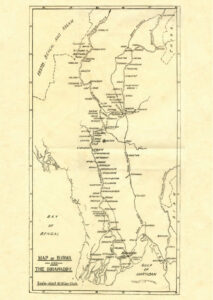
Map of Burma and the Irwaddy River.
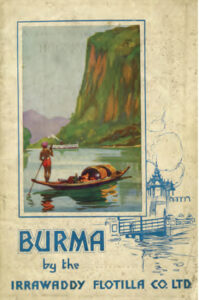
Handbook: a guide book for tourists produced by the IFC in 1935. Burma’s most famous artist, U Ba Nyan, was commissioned to illustrate the cover.

The saloon of a typical express steamer, with the tiny cabins off to the sides. The saloon would be ventilated by air blowing through from a forward opening when the ship was in motion. Note also the electric fans.
The Fabulous Flotilla: Scotland’s Adventure on the Rivers of Burma by Paul Strachan is published by Whittles Publishing, priced £18.99.
Born in 2089, Theo finds himself reliving lives that span prehistoric times to those modern – he’s been a King, a fisherman; a man, a woman; a hunter, famer; a soldier, a priest. He’s lived more lives than we can comprehend, each shining a light on his own disintegrating world. Read an extract from this mind-bending novel below.
Labyrinth
By Oliver Thomson
Published by Sparsile Books
Let’s play the music and dance
I. Berlin
New York, Jan 17th, 2118
I’m facing a crisis, probably of my own making. My career is extremely dull, but I need the money, so I put up with it. My love life is a contradiction in terms, disaster. Yesterday I zoomed Dr Jane, the shrink at my old college, and she instantly diagnosed early-onset metempsychosis.
‘What’s that?’ I asked. ‘It sounds nasty.’
‘Well, it’s still quite rare,’ she replied. ‘Nothing to worry about. It was recognised quite recently by a group of research psychiatrists based at the Bronx University. They identified a kind of non-functional DNA, buried under the more recent functional DNA, which means that some people have memories about their ancestors, usually as dreams. Often they are quite detailed, as if the people actually inherit a mental picture from long-dead relatives. The ancient Greeks understood it perfectly well, Pythagoras in particular.’
‘In other words I dream too much,’ I said. It’s mostly about my ancestors who were much brighter than me and make me feel inadequate. I feel boringly average with a third-class degree in social media, reduced from a second because I failed the hacking practical.
I asked Dr Jane what I should do about it all.
‘I have several patients who practice yoga and they are quite good at controlling these dreams. So are some Australian aborigines. But the Bronx research group are looking for more guinea pigs to back up their research using a new bio implant, so they’re offering money to anyone like you who will report your dream memories. Why not give it a go? You could download the memories yourself and play them back; it might be therapeutic as well as financially useful. And find a good woman while you’re at it. Was there not a suitable woman in one of your dreams?’
I thought there was. It might even have been Dr Jane herself, for she was very attractive in some ways. Then she added, ‘From bits you mentioned earlier I gather there are a few mysteries in your past. Why not get those dreams in the right order, so that you have a proper family history, maybe even going back to the Stone Age?’
Brooklyn, New York, Jan 2nd, 2119
I fear that I made no immediate effort to follow the doctor’s advice. After signing up for the program and receiving the implant, I set the recordings to download onto my comp, but never seemed to get the time to replay them. Apart from my work, the news had become my main obsession, but it has been more and more depressing.
New York is once more the worst city for overdose deaths per thousand people. All the international space stations have been abandoned due the huge halo of satellite debris scattered round the globe. And today is the 400th anniversary of the first ever financial crash in the USA, when the banks dished out too much paper money, then suddenly panicked and stopped, causing all-round disaster and misery. It still keeps happening. The one bit of good news is that this year the average summer temperature has dropped to 47 degrees, so perhaps global warming has stopped at last. Yet there has been a spate of violent hurricanes including Hurricane Harry VII which left half of Texas under water And of course famine and wars continue in dozens of places all round the globe. To cheer us up the massive new cruise liner, the thorium-powered QE4, came up the Hudson to a rousing welcome from the fire tugs.
But I realise that I haven’t introduced myself yet, so here goes.
My name is Theo A. Thens. I was born in the year 2089 on floor 203 of the north condominium, where the lifts frequently broke down and most people just went up or down a few floors except on special occasions. Of those in employment most worked on e-pods, so they didn’t need to move around much. There was a frozen food shop on floor 198 which catered for most of our needs and an open exercise area on the floor above where we could also plant vegetables in tubs.
Until I was fifteen I never went above floor 220, but when I did, it was to visit a poor cousin of my mother’s and I was shocked by the conditions up there. People had to go either up or down five floors to the shops and these offered a very limited choice. The ceilings in the rooms were even lower than in ours, and many of the apartments had no external window. For some this was a blessing, for the average summer temperature was then 48 degrees and the less sunlight the better. All coal and gas-burning heaters had been illegal for the last seventy years, but it had been too late to stop many of the effects of global warming. Several countries close to the equator had been reduced to empty desert and the children of redundant oil-workers had formed maniac gangs which roamed the country causing mischief. In our own building groups of youngsters wandered along the corridors spraying the walls with obscene pictures and unintelligible slogans from long-forgotten tribes.
Eventually my father, Mino, developed quite an expertise in real meat trading on his e-pod and we were able to move to a three-storey block with a real lawn off Brooklyn, while I attended the Multi-media College.
New York by this time had so many cable ducts and so few vehicles apart from roboids that most of the streets were left permanently dug up. Thus the cable repair people could spend all day fiddling with the tangle of disconnected drains, leaking water pipes, telecom tubes, redundant wires and satellite connectors until they found each fault, by which time they needed to start all over again.
When I was eighteen my father announced that there was little future in real meat, as cattle breeding had been discontinued in most countries due to methane emissions, so I chose to go into timber trading instead. Not that I see or feel any actual wood. I just shift various types of plank around the world using my e-pod. Very occasionally I go to a dealers’ conference, which means three changes of roboid to the other end of the state. I now control three out-workers, so I have to put myself about a bit.
To sum up I do now feel slightly important. I get a little bit of respect, but I haven’t fought in a war or invented anything. I’m still underachieving, so if my soul has transmigrated from someone else’s dead body, like Orpheus said, then it’s unlikely that I’m much of an improvement on the last owner. Unless of course its owner was a cockroach. As Dr Jane suggested, I think I will replay my dreams, at least the exciting ones. There was a shrink in Switzerland called Jung who said that you can remember things in dreams which you could never remember when you are awake. But I can, if I replay my recordings.
I am a good hunter, one of the best in the tribe. We have always brought in enough meat and hides for the women and children. But the animals seem to be moving away. We have to run a long distance to find any. And the berries hardly ever seem to ripen. My legs are beginning to hurt. I need more to eat. I’m tired. There is a constant trickle of ice-cold water coming from the cave above my head and I cannot be bothered moving.
Labyrinth by Oliver Thomson is published by Sparsile Books.
The Wee Kirkcudbright Centipede is an amazing dancer but when her neighbour asks her to explain how she does it, they end up in quite the fankle. Based on the song by Matt McGinn, the story is now captured in this bright, fun picture book. You can see a sample of the story below.
The Wee Kirkcudbright Centipede
By Matt McGinn, illustrated by Fran Raw
Published by Foggie Toddle Books
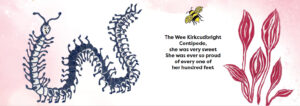
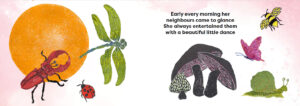
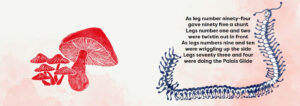
The Wee Kirkcudbright Centipede by Matt McGinn, illustrated by Fran Raw is published by Foggie Toddle Books, priced £6.99.
In her debut collection, Leyla Josephine dances between her private and public lives, with her poetry navigating secrets, faith, shame, lust, death and more. You can read an exclusive extract of a few poems from the collection below.
In Public/In Private
By Leyla Josephine
Published by Burning Eye Books
In Public / In Private
Definition of in public:
in a place where one can be seen (by many people or one other person): there is no specification of how they are seen, if they are aware they are being seen or if there is any value/ truth in what is observed.
Sentence examples: The former actress is now rarely seen in public. They were seen kissing in public. The drunk pissed in public, a breeze on her pebbledash bum.
Definition of in private:
Not in public: secret, confidential, without others seeing. Sentence examples: The hearings will be conducted in private. May I speak to you in private? The poet cried in private and she didn’t like that no one knew; it made her question whether the crying
happened at all.
Sub Club
The sky has caved in
and we can finally touch it.
We are abyss
dancing. Sucked into
the vacuum, side by side.
Geckos with wide eyes.
Even the light has a pulse tonight.
Stars spiral down the drains.
The bathroom has flooded
again. One-eyed gods
thud above us,
and we sacrifice
our limbs willingly.
Charging ourselves
to oblivion, swallowing
batteries. We are so high
if we died like this
it would feel right.
Taxis wait above
our submarine
on the soaked street
ready to take us
to worried parents,
but we’re not finished yet.
The floor thumps
into our legs,
travels up our spines
until it feels like the music
is coming out
from our insides.
We are bleached
by strobe light.
The girls
i’ve got the girls / forever / they’ve been with me / staggering down streets / laughing / dancing / on tables / girls / with our tales that we keep / for takeaway meals / girls / hold your hand / make you tea / come to bed with me girl / seas separate
us sometimes / but somehow we come home / to melt / into each other / always / the girls / mac counter warriors / belts of lipstick weapons / contouring is witchcraft / fuck him / fuck that / taking our bodies back / bring the girls out of the dark / into highlighter herstory / the girls / just try to call us / hysterical girls / fire in our cheeks girls / keys between our knuckles girls / the betrayed again girls / when we are alone / you underestimate us / but together we take up the pavement / cemented / and you feel threatened / my girls / our love stories are the greatest never told / we are the bold girls / the too much girls / we laugh as loud as our mothers / feel the moon in our waters / we don’t chew when we eat / forget to breathe when we speak / we are the don’t interrupt us girls / the angry girls / the silenced girls / the dangerous girls / the we’re coming for you / girls /
In Public/In Private by Leyla Josephine is published by Burning Eye Books, priced £9.99.
As part of the Year of Scotland’s Stories, we are running a series of Responses on BooksfromScotland, commissioning writers to respond to books from the publishing membership, engaging with work in different ways. For November, and to close the series, Edwin Morgan Poetry Award-winner Titilayo Farukuoye considers The Golden Treasury of Scottish Verse, on the past, present and future of Scottish poetry.
The Golden Treasury of Scottish Verse
By Edited by Kathleen Jamie, Don Paterson & Peter Mackay
Published by Canongate Books
Confession: l have only been claiming the title poet for a season now. I maybe toyed with it, and definitely aspired to it before, but there is something about claiming an official label to one’s name that sometimes requires the force of Edwin Morgan, and a nod from an entire selection committee of well admired writers, to claw back layers upon layers of rejection, imposter syndrome, self-doubt and ‘don’t take yourself so seriously-s’, that encourage us to step into our truths.
And frankly, as a Black (dyslexic) poet of a different birth tongue, excelling in the literary world, in a foreign language, was not, shall we say, anticipated of me.
To think, that I would even put the word poet into my mouth just as I am getting ready to mention so many of our national icons featured in the collection – The Golden Treasury of Scottish Verse: Robert Burns, Peter Mackay, Liz Lochhead, Jackie Kay, Alastair Mackie, Veronica Forrest-Thomson, Vahni Capildeo, Edwin Morgan,… and many more, is truly something.
Looking at The Golden Treasury of Scottish Verse, I had to practice a little bit of self-care, and personal bolstering to remind myself to claim space in this literary landscape of Scottish poetics. (If not for my own sake, then for all of the writers marginalised and rendered invisible in a sector in which queer, BPOC, disabled, working class poets and poets with asylum and migration experience continue to face barriers in. I allowed myself to ask, What is Scottish poetry actually? What is the legacy we inherit as Scottish poets today? And who can claim the craft for themselves?
Editors Kathleen Jamie, Don Peterson and Peter Mackay invite answers to this in the collection. As I -open the book anywhere – appreciative of their instruction, I cannot help myself but romanticise far away times, imagine wild stormy landscapes, green plains, a tempestuous sea,..
This initial image is a visitors’ illusion, a pretty smile Scotland holds up to the sky – a face that, tourists, from across the sea (Atlantic and otherwise) and folk we bump into on the Royal Mile, or, on the off chance of us nipping out early onto Princes Street, see, in this home of ours. It’s a part, at least, of the whole story.
Quickly, the collection transforms and shapes into something that poetry inevitably does. It becomes societal commentary, a history lesson, a reflection and negotiation of the poet’s realities…
In six o’clock news, Tom Leonard writes, ‘yooz doant no thi trooth’, and continues, ‘yirsellz cawz’ ‘yi canny talk right.’ ‘This is the six a clock nyooz. belt up’. Leonard’s poem is gorgeously attributed to the powerplay embodied by dominant language and the culture of the disenfranchisement Scotland experiences from mainstream cultural institutions in the UK. What does it mean for a people if the news is not reported in their tongue? What are the repercussions of intellectualising one regional language over another?
I quickly find my own linguistic limits in the collection, and soon also start thinking about gate keeping, and the power that lies with commanding Scots and Gaelic among other languages. They serve as markers of belonging and justify a ‘claim’ to Scotland and Scottishness. Stretching for my own voice to read out loud and discover meanings my eyes alone don’t grasp, as well as dictionaries and translations online, google searches, and friends, all come to my aid: I become painfully aware of my lack of (Scottishness) exposure to Scots and Gaelic.
I enjoy this challenge though (especially since I have never seriously claimed Scottish identity for myself) and can’t help but wonder if this could be an invitation to all of us to explore our own relationships with Scotland’s languages, and to indulge in them a little bit more. Excitingly, Du Fu (712–770) a prominent Chinese poet of the Tang Dynasty is represented in the collection. I can’t wait to see poems in Urdu, Punjabi, Farsi, Twi, Yoruba, Arabic, Amharic, Polish, Cantonese and more in future collections commemorating Scottish Verse.
There is a lot that is striking in the collection, Ian Crichton Smith’s Clearances almost next to Marion Bernstein’s The Highland Laird’s Song are a good shock to a reader’s system. Bernstein’s lines all for me all for me echo in my head long after the fact of reading the poem, The dirty creatures now complain; Blaming me, Blaming me; leave one shivering, contrasting the pain, devastation and fury the poem Clearances offered insight to.
To me this speaks to the reckoning we still need to do as a nation. How do we negotiate our violent past? Is there a way to make good past evils? How can we move beyond narratives of victimhood and pity and actually learn from the past to change the systems and elevate communities, elevate peoples who have been mistreated and violated for generations?
Scotland’s legacy of colonialism and Empire also finds traces in the book, Jackie Kay’s In my Country answers the question Where are you from? with ‘Here’ I said. ‘Here. These parts’.
Scottish Ghanian visual artist, educator, and poet Maud Sulter’s (1960-2008) work is a crucial voice in Scotland that should be commemorated to acknowledge this history. Among some of her most influential works must be Blackwomen’s Creativity Project, through which Sulter sought to document artistic practices of Black women creatives in the 1980s, which led to the publication Passion: Discourses on Blackwomen’s Creativity.
Sulter writes in Passion (2002) ‘See me, I’m a heroic poet and I don’t care who knows it. And I chose my own kind and in doing so apparently consigned myself to a footnote in history.’
Even today, the beckoning to see violence and injustice addressed, still remains with those who endured and survived it. A way of sharing this responsibility can be to actively seek out and elevate the poets who are doing this work. Future Scottish Verse should ensure that we bring trailblazers like Sulter to the forefront. We urgently need to acknowledge the countless poets who are continuing her inspiring work.
A project this year led by independent arts collective Rhubaba brought together Black Scottish women and non-binary people creatives today, to commemorate Sulter’s work. Alongside documentary film maud., the zine PASSIONS (2022) was dedicated to Maud Sulter and serves to archive and spotlight Black women and non-binary creatives in the Scotland.
Jeda Pearl is an incredible voice in poetry and science fiction writing in Scotland today, in her poem Inheritance Reverb published in PASSIONS (2022), the Scottish-Jamaican poet writes, ‘yuh still lost in yuh maze of post-colonial consumption’ directly addressing Scotland’s colonial legacy. The poem continues ‘mi double-dar yuh give our lush little islands a mention’.
Renowned creative non-fiction writer Amanda Thomson describes that public awareness and willingness to engage in the issue is only temporary, in TWA Black WIMMIN, Revisited. (PASSIONS, 2022) she writes, ‘I can’t help but think that there’s a cyclical nature to the world and our position in it, we ebb and flow; we come into view and recede again (though we are always visible to those like us and those who choose to see us, or who seek us out).’
It is impossible not to mention Edinburgh Makar Hannah Lavery’s debut collection Blood Salt Spring. In her poem The anti-racist working group, Lavery writes, ‘Wonder if they are starting to realise, that they don’t want to give anything away.’ ‘Hush Now (Shitty Brown) and Thirty laughing emojis, brilliantly testify to the reality of race on an everyday basis.’
Award-winning poet Roshni Gallagher is an important new voice in the scene. She describes her poem The Whitby as ‘a sonnet about reckoning with the colonial ties of a place that I love (…) The poem follows the journey first boats that transported indentured labourers from India to Guyana in the 1800s.’
To me poetry is a way to digest and articulate stories and struggles that affect communities. The Golden Treasury of Scottish Verse is a brilliant collection, that through its vastness touches on and verbalises so much of Scottish culture, history, and aspiration.
As a new poet, and as Black poet, I see my work as an opportunity to reconcile, give voice and contemplate issues that pertain our lives today, so that we might better communicate them, and might even come up with solutions, or how wonderful poet Andrés N. Ordorica would put it, to contemplate ‘what it means to be from ni de aquí, ni de allá (neither here, nor there)’.
For the occasion, I would like to offer you my most recent Scottish poem.
Glasgow, King Street.
By Titilayo Farukuoye
Their hair: clouds, flowers
in the sky.
dancing in knots
in braids, in weaves
in twists
Reflections of the sun
(brown, black, green, red, blond, purple)
Their bodies: slick, taking space
wide, laughing, chatting
round, stiff and flexible.
Fingers licking:
Caramelised plantain
(Dodo!)
Dripping chicken
Jollof!
Happy cheers and bouncin:
bumps
arms smiles
breasts all of it.
hair
All pigments, colouring fabrics
compelling
contrasting dancing with
each other.
Raging for attention.
‘Should I help you adjust your headscarf?’
The Golden Treasury of Scottish Verse, edited by Kathleen Jamie, Don Paterson & Peter Mackay is published by Canongate Books, priced £30.
The Year of Stories x Books from Scotland response strand was inspired by Fringe of Colour’s series, which you can read more of at fringeofcolour.co.uk.
JD Kirk has become a bestselling sensation with his self-published crime novels. Better known as Barry Hutchison, BooksfromScotland caught up with him to talk about his latest novel and about his career as an author.
Eastgate
By JD Kirk
Published by Xertex Media
Eastgate is the fourth in a new crime series centred around a character called Bob Hoon. After such a varied writing career including multiple children’s books, what brought you to crime, and how has the experience of writing Bob Hoon differed from your hugely successful DCI Jack Logan series?
So the Bob Hoon books are a spinoff from the Logan series. There’s a character in the Logan series, Robert Hoon, who was Detective Superintendent. He was basically created to be like a Scottish psychotic version of the boss in Cagney and Lacey who was always giving them grief. He was supposed to be quite a two-dimensional character who just popped up in a few scenes to cause trouble, but then I started getting lots of emails about him. They were quite mixed, it was half going, ‘I absolutely hate this character and skip over all his scenes’, and the other half going, ‘I love him, he’s the greatest character I’ve ever read’. So I was quite tempted to see if I could redeem him a bit in the eyes of the people who hate him, if I could still stay true to his character but turn him into a three-dimensional character that people identified with.
It was originally going to be a trilogy. The first one is called Northwind, the second Southpaw, and the third Westward, and it was my son who said I had to do four. I had no idea what East was going to be, but then up in Inverness there’s the Eastgate Shopping Centre, and I thought that could work. At least it fits in with the naming pattern! Eastgate is basically an action movie in book form. It’s a terrorist takeover of the shopping centre which Bob Hoon finds himself at the centre of. It’s like a sweary, psychotic, Scottish Die Hard. It was almost like a Christmas Special this one, because the cast of the Logan series are in it, it rounds off the Hoon series, it’s kind of a big explosive action-packed ending with all the characters the readers have come to love over the course of the series, with a bit of social commentary on male entitlement in there too through the villains.
This conscious framing of the book as a Die Hard set in the Highlands is complemented by Bob Hoon, who’s written very much in the hard-boiled mode with a number of genre winks and familiar characterisations. Do you enjoy working within the tropes of different genres?
Yeah, very much so. The Hoon books were always meant to be fun, I mean they go dark at points, but it’s always been me having an absolute blast writing them. I suppose it’s been like a tour of all my writing inspirations as well, so it goes through books I’ve read, films I’ve seen, and there’s little winks and nods to those, down all the way to things like how my daughter’s really into anime and there’s little nods to that in there. So yeah, it’s been a celebration of all the fiction I’ve loved really. With it being the last one in the series as well I’d say it’s probably not as dark as some of the earlier ones, despite it being an Incel terrorist takeover! It’s more a celebration of Bob Hoon.
So you were born in Fort William and are settled there now with your family. All the Jack Logan books are set in the Highlands and of course Eastgate is set in the Inverness shopping centre of the same name. How important is setting to your work and to the crime form in general?
Well I’d say it’s very important for a couple of reasons. Firstly, I’m a very lazy person and I know the Highlands quite well, so in terms of having to do very little research, it was really important! But what I’ve found is, it does really well in the Highlands, my series, because people really like reading about where they live, but internationally it also does really well too. Certainly during lockdown, people would feel like they were able to travel to the Highlands, so internationally that’s a big pull of the books, the romance of it all.
What’s also interesting is I have something called aphantasia, which means I have no mental pictures, I think in words. But the number of people who say, ‘Oh, wow, it was just like being there’, and I always found that fascinating just how that works, because when I read a book, quite often when there are paragraphs and paragraphs describing a scene, I’ll almost gloss over that because it’s doing me no favours. It’s like, I get it, you’re in a room! I want the dialogue and the action and the story. But a lot of people like that lingering in a place and establishing the scene, so it fascinates me how different readers respond to different ways of writing.
So for those who may not know, you self-publish your crime fiction through Zertex Media, and to massive success. What was it that took you down that path of publishing, and what kind of benefits do you think it grants you as the author?
Well I worked with publishers for about ten years writing kids’ books, but ultimately it was by accident that I got into self-publishing. Like most kids’ authors, most of my income came from doing school events, and I got asked to go to a school in Elgin and talk about how kids can publish their own books. But I had no idea how kids could publish their own books! As far as I was concerned, you wrote something and sent it to London, and 6 months to a year later a book arrived in the post. But they were offering to pay me to do four different sessions, so I thought okay, I’ll learn. I quickly rattled off this comedy/science fiction book called Space Team and I stuck that on Kindle. Then we went away on holiday, and Space Team started outselling all my kids’ books, but I’d done no marketing for it. I didn’t think anyone was going to buy it. I designed the cover myself, it was all self-edited, it was an experiment to learn.
By the time we were back from holiday, it was making something like £50 or £60 per day, and I thought I’m going to try and write a second one. When I wrote a second one then the sales of the first book skyrocketed, and by the time I wrote the third one I was earning more in one day on these three books than I was in six months on all my traditionally published books combined. I ended up writing twelve books in that series, we did three spin-off book series and the audiobooks, but it all felt a bit ad-hoc. It was still just me uploading to Kindle. So when I had the idea for the crime series, I wanted to do it properly. We set up a limited company, contacted foreign rights sales agents, TV rights agents, we’ve now got a PR company involved. We wanted to get into bookshops, so we got tied up with Booksource and then CPI to do print runs, and we’ve got Martin Palmer Publishing Services who are kind of acting as sales agents.
In terms of the advantages, what I was getting a bit sick of with traditional publishing, was that I’d pitch an idea and say, ‘Right I want to do this book’, and they’d say, ‘Great, now can you put a unicorn in it? Unicorns are massive at the moment!’ So you’re always compromising. Which is part of the whole industry, of course, but then when I was doing the Space Team books, I was just writing it for myself. Then when people were asking about merchandise, I had all the rights, so I did T-shirts, mugs, and we were able to exploit audio fully, because a lot of my books the audio rights were with the publishers but they never did anything with them. Hanging on to all the rights was massive, but creatively it was just really freeing.
On the flip side, suddenly all the responsibility was mine as well. Luckily we were in a position where it wasn’t just me doing everything, we had cover designers, editors, working with us freelance. We’ve actually just started doing some Logan and Hoon series merchandise, exclusive merchandise whose proceeds are going to local charities based here in the Highlands. There’s a different charity every 3 months – the first one was set up by an old school friend whose son died of cancer when he was a year old, so they’ve set up a charity for raising awareness for children with cancer. Again this was led by people just asking for merchandise, so I thought since I’ve been so well supported in the area, we could use this as a way of giving a bit back into the local area.
So what do you think it was about your books that made them such a huge success? You mention how you didn’t do any marketing for the Space Team titles, and I’m sure there are a lot of writers considering self-publishing but who are unsure of how to go about it. Do you have a magic tip?
I genuinely wish I knew. I think a big part of it is just being nice to people. When I was learning about self-publishing I joined a couple of Facebook groups, and I got involved in those. And when my first Space Team book came out, a couple of people in that group who I’d not necessarily helped but who had seen me help others out, shared it, said check this new book out, and it just built from there. With Amazon especially, I think if you can get that momentum early, if you get a flurry of readers who review it positively, then Amazon will start to show it around. That’s why I changed my name for the crime fiction series. Well two reasons: firstly I didn’t want the kids who’d read my other books to suddenly read books about death and murder and lots and lots of swearing, but also, if I put out books under my sci-fi name then I know lots of sci-fi readers would’ve picked up those books because Amazon would have registered the name and displayed it as of interest to science fiction readers. So I kept the name a secret until it had established itself as a crime series in its own right, and Amazon knew that JD Kirk writes crime and to show those books to crime readers. But these are all things that I’d learned by trial and error over the course of the Space Team books.
So involving yourself in the community and learning the system…
Yeah, and I think the word ‘community’ there is really important. Around both the Space Team books and JD Kirk books, I don’t do much marketing, but I look at building a community. For example, with the JD Kirk group, a lot of the readers are older and are on Facebook and some were alone at Christmas, so we did a kind of Christmas get-together. I put on some quizzes, I’d recorded videos with a wee Santa hat, and loads of them got together on the Facebook group to chat and spend Christmas together. I just love that kind of thing happening regardless of any knock-on effect, but people then become more than readers of the book, they become invested in the community as well, so that when a new book comes out they’re straight on it and chatting about it. So for me it’s always been about communities of readers.
We had a readers’ newsletter a couple of years ago, which we’ve recently rebranded to the JD Kirk VIP Club, and there are about 20,000 people on that, so I’ll email them every couple of weeks, and I’m guaranteed to get something like 500-600 emails back from people just telling me what they’ve been up to and how their day’s going. I love that.
Eastgate by JD Kirk is published by Xertex Media, priced £2.99.
Sophia Gravia is Scotland’s rising star in romance fiction. Nasim Asl talks to her about her rise to literary fame.
Glasgow Kiss
By Sophia Gravia
Published by Orion
What Happens in Dubai
By Sophia Gravia
Published by Orion
Sophie Gravia is certainly impressive – she works as a nurse (as does her protagonist Zara), writes around her shifts, self-published her debut novel and now has bestselling books A Glasgow Kiss and What Happens in Dubai to her name. We met in a Glasgow café, Sophie fresh from a research trip abroad for her next book, and I was blown away by how warm, open, and genuinely grateful she is for the well-deserved success she’s experienced.
A Glasgow Kiss and What Happens in Dubai are the first books you’ve written – and they’ve both done so well. How did they come about?
It was all so random. I was on holiday with my friends, and the night before I’d had a really dodgy date – the panty sniffer one! I put it in the first chapter of A Glasgow Kiss! That was my first online date ever. I told my friends, and they were killing themselves laughing. One of my friends told me to blog it – I’d never blogged anything in my life. Soon after I ended up off work for a while, so thought I’d start blogging anonymously as Sex in the Glasgow City. It got thousands of hits.
Your first online date! That’s really bad luck. Had you written much before writing about your dates?
No. I’d really enjoyed writing in school, but I didn’t feel like my grammar or stuff like that was good enough. I’m a nurse, and my work was really intense during Covid. We had a wellness session one day, where we had to stand up in front of a group and say one thing that we’d done for ourselves during the pandemic. There were doctors standing up saying they’d started playing violin, or abstract painting…when they came to me I just cried and was like ‘I don’t do anything’. I started writing my book that night when I got home. It was really easy to write. The next book was harder because there were expectations!
How was it then, entering the publishing industry, finding an agent, getting signed to Orion as someone who didn’t have any experience with it?
I watched a YouTube tutorial and self-published on Amazon! I couldn’t afford to print it myself or get copies printed to sell. It was mental, it ended up selling thousands. Normally, they sell 200 copies a year that way, but before I got signed, I’d sold over 20,000 in a couple of months. I designed the cover myself, did it myself, but I’m so pleased to have been picked up and have it published with Orion.
One thing I really enjoyed was the dialogue – it felt so real to read, as though I was just sitting in the pub with pals listening to them chat.
A lot of the characters are based on real people – my best friend is totally Zara’s best friend, Ashley. So I was just thinking ‘what would she say?’.
What’s the reaction been to your books from other people you know? How have they reacted to the sex scenes and explicit parts of the novels?
I really worried about it. My family is Catholic, my mum is the holiest person. I told them I’d written a book but that I didn’t want them to read it because it was like 50 Shades of Grey! They were all so proud and really supportive.
Aw, that’s great to hear. Do you tell normally tell the people you date that you write romance books?
I usually put a picture of me holding a picture of my book on my profile so they know straight up, but 95% of the messages I get are from people asking to be in the third one…I often get told bad stories from random people I meet though. I was in a taxi and the driver had read my book and knew who I was, and he gave me the most horrific story you’ve ever heard in your life. I don’t think people would believe me if I put it in the next book!
That must have been awful, because there are some quite graphic things in there already! Let’s talk about that though – because your books are unusual a little in the genre, by being so honest when talking about bodies, and bodily functions, and how things all work. Your writing on sex feels frank and refreshing because you’re not romanticising it.
I just don’t have a filter. It’s all genuinely the way I talk in everyday life. I’ve reread things I’ve written and thought ‘oh, I can’t say that’ but my friends all love it. I write it all the way I think it in my head. Some things I do think are a bit too much so I cut back, but the period stories – half the people say those things are their favourite parts, because something similar has happened to them. It’s just an unfiltered approach to sex.
That’s quite important though, especially for women who are taught to have a filtered approach.
Yeah, of what it should be like! I get a lot of messages from people who say they think they’re the only one who has had these experiences, so it’s nice to show it happens to everyone. Not everyone has someone to talk to about it, and it’s great for people to realise they’re not alone about it.
There’s a lot to unpack there too about female bodies and pleasure, our body image and how we perceive ourselves.
There’s a lot of Zara focusing on her own body, and I was really keen to keep that in the book because that’s how real people feel. They look in the mirror and put themselves down. It’s from the character’s perspective, that’s how people think. But I’m pleased that by the end of the second book you can see how Zara’s grown in terms of body image, even with the cosmetic treatments she gives to other people, enhancing their own unique beauty rather than changing them.
It’s really lovely to see you writing this, in Glasgow, about Glasgow, while the wider genre of romance is having such a moment, especially with younger audiences.
I love watching Netflix, Grey’s Anatomy. I listen to a lot of audiobooks in the car, so I’ve read a lot of the really popular TikTok ones – Love Hypothesis, Spanish Love Deception. But I need to listen to self-empowerment books to get in the zone to write. I’m such a Leo. The readers are sometimes too young…I was in Waterstones a few weeks ago and a girl asked me to sign her book, and I was like ‘oh my god, no!’. She was 14, and I was telling her she couldn’t read it, she was too young! I was thinking I was going to ruin her childhood. There’s no age limit on books!
But would you rather have teenage girls read books like yours, which are honest, and more unfiltered and based on real experiences than be watching porn?
…That is true. It’s more like reality. But I’ve got kids and I’d die if they read it the now! But the ending…I didn’t want to give my books a romcom ending. I didn’t want that, it’s not realistic. I wanted to her to be sure of herself, for it to be about character growth. One of my friends reads my books for me, and she thinks the books are just a love story between Zara and Ashley, and I really think it is.
You’re partway through your third book, and that marks the end for Zara…
She’s like my younger self, maybe more naïve…I know how it ends, but how do I write without her? I’m signed for a fourth book with new characters, but it feels weird not having Zara or Ashley or Raj or Tom.
Glasgow Kiss and What Happens in Dubai by Sophia Gravia are published by Orion, priced £8.99.
As the year draws to a close, it’s time to get cosy and treat yourself to the perfect wintery treat. Read an exclusive recipe below on Books from Scotland by the Hebridean Baker, taken from his new cookbook, for the perfect hot toddy bundt cake.
The Hebridean Baker: My Scottish Island Kitchen
By Coinneach MacLeod
Published by Black & White Publishing
Nothing beats a soothing mug of hot toddy on a winter’s evening – and that inspired me to take those wonderful flavours of honey, lemon and whisky, and combine them into this beautiful Hot Toddy Bundt Cake. A slice of this will definitely ward off those winter blues!
SERVES 8 SLICES
INGREDIENTS
For the bundt
225g (8oz) butter
225g (8oz) caster sugar
4 eggs
225g (8oz) self-raising flour
1 teaspoon baking powder
2 tablespoons honey
1 lemon, zested
Icing
200g (7oz) icing sugar
3 teaspoons lemon juice
3 teaspoons whisky
(1 teaspoon of cold water at a time if needed to create a runnier consistency)
METHOD
Pre-heat your oven to 160°C fan (350°F). Lightly butter your bundt tin (I use a 20cm/8” silicone bundt tin).
Cream together the butter and sugar with a handheld mixer until light and fluffy. Beat in the eggs, one by one, until well combined.
Sift in the flour and baking powder, and stir together carefully on a low speed until just combined.
Add the honey and lemon zest, and mix well.
Place the batter into the prepared tin and bake for 40 to 45 minutes, or until a skewer inserted into the cake comes out clean.
Allow to cool in the tin for 5 minutes, then carefully release the cake onto a wire rack. Leave to cool completely.
To make the icing, sieve the icing sugar into a bowl and begin to mix in the lemon juice and whisky to make a thick but pourable icing. If it isn’t runny enough to pour on, mix in a teaspoon of water.
Pour the icing over the cake, scatter over the lemon zest and serve – an accompanying mug of hot toddy is optional!
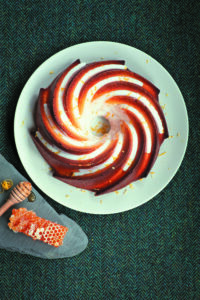
The Hebridean Baker: My Scottish Island Kitchen by Coinneach MacLeod is published by Black & White Publishing, priced £26.
Next weekend sees the second outing for the Push The Boat Out festival for poetry. We can’t wait to attend; the sheer variety of events over the weekend show that the current poetry scene is as vibrant as ever! We decided to get in touch with them to ask them to preview some of the festival highlights.
Push the Boat Out, which runs from Friday 4 – Sunday 6 November this year, is Edinburgh’s International Poetry Festival: a vibrant, polyphonic cross-genre explosion of contemporary poetry, hip hop, and spoken word from Scotland, the UK, and further out to sea. Whether shared on social media, witnessed in a live performance, heard in the words of a song or read on the page, poetry has become something that enriches our collective understanding of the world, and PTBO reflects that by finding new ways to create accessible, exciting events that reach a wide range of audiences. This year’s programme is all about the intersections: where poetry meets rap, hip hop and songwriting; where it meets film, visual art or even dance; where it meets politics and debate.
The 2022 programme spans 54 events, featuring 80+ artists and taking over almost every possible space in the Capital’s huge Summerhall venue. Look out for performances from names like Roger Robinson, Joelle Taylor, Brian Bilston, Michael Pedersen, Stuart Murdoch, Leyla Josephine, Kathleen Jamie, Hollie McNish, Don Paterson, Omar Musa and Hannah Lavery, live music/hip hop gigs, workshops on poetry with gaming and photography, and even a poetic cocktail class!
Here are some of our top picks for what looks set to be one of the most exciting weekends for word-lovers this year:
Memoirs of the Moment: Michael Pedersen and Seán Hewitt
Saturday 5th November | 3:30 pm – 4:20 pm
Poets Seán Hewitt and Michael Pedersen talk about their recently released, and stunningly poetic, new memoirs: Pedersen’s ‘Boy Friends’ and Hewitt’s ‘All Down Darkness Wide’. Each text offers a unique perspective: one an insight into grief and male friendship, and the other a revelatory exploration of facing a loved one’s depression.
https://pushtheboatout.org/events/memoirs-of-the-moment-with-michael-pedersen-and-sean-hewitt/
Hannah Lavery and Michael Mullen
Sunday 6th November | 11:00 am – 11:50 am
Edinburgh Makar, Hannah Lavery, is an acclaimed poet and playwright, celebrated for her play, ‘Lament for Sheku Bayoh’. Her compañero for this event, Rutherglen poet Michael Mullen, has recently been crowned co-winner of the prestigious under-30s Edwin Morgan Award, 2022.
https://pushtheboatout.org/events/double-bill-hannah-lavery-and-michael-mullen/
Zaffar Kunial and Andrés N. Ordorica
Saturday 5th November | 1:30 pm – 2:20 pm
Zaffar Kunial has long been established as one of the UK’s most essential voices in contemporary poetry, while Andrés N Ordorica’s graceful debut collection, ‘At Least This I Know’ made beautiful waves in the Scottish literary scene this year.
A Poetry Feast of Mythical Beasts with Hollie McNish, Calum Rodger, Anita Mackenzie, Julie Rea, Ceitidh Campbell, Katie Ailes and Dave Hook
Saturday 5th November | 6:00 pm – 6:50 pm
We are frankly buzzing with excitement for this one. Inspired by the viral map Mythical Beasts of Scotland created by Púca Printhouse earlier this year, seven poets have been commissioned to give contemporary voice some of Scotland’s fantastical beasties in a live show that features dance, rap, electronica, RPG gaming, song and visual art. From Anita Mackenzie’s selkie reflecting on the meaning of skin to Dave Hook’s sentient nuclear submarine that decides to become a kelpie, from the ghostly presence of the bean nighe mirroring contemporary reproductive rights to the lowlands outcast creature Shellycoat hanging round a housing scheme, to Hollie McNish taking on Nessie herself, with new live illustrations by the original creators of the map, this is an audacious and totally fresh take on the myths that mak’ us.
https://pushtheboatout.org/events/a-poetry-feast-of-mythical-beasts/
Truth Prevails: Poetry Across Frontiers, with Jitka Bret Srbová, Ondřej Lipár, Rob Mackenzie, Niall O’Gallagher, Alycia Pirmohamed and Jitka Stehlíková.
Friday 4th November | 4:30 pm – 5:50 pm
‘Truth Prevails’: Does this Czech motto still apply in our post-truth era? Do art and poetry speak truth to power and what truth would that be in a time of societal polarisation and political turmoil across Europe? Three Czech poets and three poets from Scotland discuss their perspectives and experiences as they meet face-to-face for the first time following a series of digital encounters organised by Literature Across Frontiers.
National Poets: The Scots Makar and The Welsh Laureate
Sunday 6th November | 2:30 pm – 3:20 pm
Kathleen Jamie, the Scots Makar, talks to freshly-appointed Welsh Laureate Hanan Issa, sharing their work, their concept of the role of a “national poet” and their plans for the rest of their tenures.
https://pushtheboatout.org/events/national-poets-the-scots-makar-and-the-welsh-laureate/
Eduardo C. Corral & Alycia Pirmohamed
Saturday 5th November | 11:00 am – 11:50 am
This double bill welcomes globally renowned poet Eduardo C. Corral and 2020 Edwin Morgan Award winner Alycia Pirmohamed. Harmoniously blending English and Spanish, Corral’s poetry is a tender exploration of history and sexuality, while Pirmohamed’s flowing and tumbling voice reflects on so much: longing and loss, heritage, identity, and faith.
https://pushtheboatout.org/events/double-bill-eduardo-c-corral-alycia-pirmohamed/
Poets Talk: Denise Riley and Tom Pow
Saturday 5th November | 12:00 pm – 12:50 pm
Two of contemporary poetry’s most storied veterans reflect on careers which span decades of poetry in this unmissable event
https://pushtheboatout.org/events/poets-talk-denise-riley-and-tom-pow/
Don Paterson: The Music of The Arctic
Sunday 6th November | 7:00 pm – 7:50 pm
Musician Graeme Stephen joins Don Paterson for this exceptional and provoking event celebrating Paterson’s 2022 Faber collection Arctic. A guitarist who plays it all – from free-flowing jazz to the warmth of traditional Scottish folk – Stephen will accompany the poet as his verses rise and fall through tales of gods, men and women, art and politics.
https://pushtheboatout.org/events/the-music-of-the-arctic/
Poetry will never stand still. There are challenging times ahead. Get in the boat, compañeros.
As part of the Year of Scotland’s Stories, we are running a series of Responses on BooksfromScotland, commissioning writers to respond to books from the publishing membership, engaging with work in different ways. For October, Josie Giles – author of Deep Wheel Orcadia – considers the art and power of translation in Never Did the Fire, and the accompanying translation diary which dives further into the process itself.
Never Did the Fire and Catching Fire
By Diamela Eltit and Daniel Hahn
Published by Charco Press
What happens when a revolution breaks down? What happens to the bodies broken down by revolution? What is it like to live in the afterlife of revolution?
In Diamela Eltit’s Never Did the Fire, an unnamed woman in an unnamed place lives an unmistakeably specific life. She lies in bed without sleeping next to her unsleeping partner; she goes to work as a carer, washing and dressing people only a few years older than her; she remembers schisms, plots, and arguments over the technicalities of historical materialism. Each day unfolds like the last, as her body breaks down taking care of other bodies. A dictator is dead, and she is alive, but not living.
Never Did the Fire — Jamás el feugo nunca in the original Spanish, from a poem by César Vallejo — is a novel in translation, rendered in English by Daniel Hahn. It is published alongside a translation diary as long as the novel itself, which day-by-day details the intimate process of shifting a story from one language in to another. Hahn loves the book, struggles with the book, hates the work, commits to the work, loses himself in the details of prepositions and pronouns. From the struggle a new novel emerges, not the original, but not not the original either. Hahn rarely discusses the themes of the novel, its politics: he trusts that by taking care, word by word, line by line, week by week, the truths of the novel will win out.
One language is not the same as another; one revolution is not like another. Translation reaches across languages, insisting despite the evident truth that “translation is impossible”, as Hahn writes, that something worth doing can still be done. Revolutionaries reach across political cultures in a process we call solidarity, an insistence despite the evident truth that our struggles are not the same that we can still lend strength to each other. I read a novel about revolution by a revolutionary, in the hope of nurturing my own struggles; I find neither comfort nor inspiration, but something harder and more true. I read the English that translates the Spanish that translates the experience of post-revolutionary life, and find something that speaks to my own life, a hand reaching out.
Of course, this reaching out and reaching across is not neutral, not a natural good. “Translation is a fundamentally political act,” writes Kavita Bhanot and Jeremy Tiang in Violent Phenomena, their anthology of essays on translation and decolonisation. English as a language of empire and capital demands access to other languages; readers in the imperial core demand access to other lives and other struggles; revolutionaries in the imperial core seek authentication of their lives in the struggles of other revolutionaries. Words and worlds taken from these others, this othering, are put back in service of colonial desire. Against these dynamics, solidarity demands strict attention to the specifics of power, as translation demands precise care to the specifics of a sentence.
Like Eltit’s protagonist, chance words and encounters in my daily life spark memories of my own times in revolution. A turn in an argument throws me back into the caravan where we plotted a blockade, SIM cards removed from our phones; a passing uniform summons the sight of a riot shield cracking my skull; a friend’s face in sun recalls the same face in shadow as we turned to each other under streetlights. I pick over these memories as I try to keep living, as I sit at my desk in my flat typing out words about struggle, as I feel impossibly distant from my times in revolution, distant from our failures and successes, living under new oppressions and with dwindling hopes. How can I translate my feelings about this translation into something that will speak to you, my reader, about what revolution means to me? Can you feel me reaching out?
I am drawn to stories of revolution and failure – always have been, even when I was convinced that revolution can succeed. Before the Cromwell trilogy, Hilary Mantel wrestled with revolution in A Place of Greater Safety, trying to answer the question of what happened to make the revolution eat its young: her non-judgemental attention to the interiority of world-shifting figures is humbling, true. Ursula Le Guin’s The Dispossessed portrays an anarchist utopia, of the kind I have co-envisioned in a thousand consensus decision-making meetings, and yet centres an anti-hero at the limits of that revolution. Pedro Lemebel, like Eltit a Chilean Marxist and activist against the Pinochet regime, wrote Tengo miedo torero (shifted into English as My Tender Matador), at the centre of which is not the plot to assassinate the dictator but rather the travesti “queen of the corner” who is used, abused and left behind by the righteous revolutionaries. I find in these novel’s, like Eltit’s, the truth of revolution: its brokenness, its incompleteness, its reality. It is as if only by imagining revolution as unfinished can I see it as possible.
The dictator dies, and life keeps going. Revolutionaries age, their bodies broken by trauma, and someone must look after them. We surrender “to the legitimacy of the rest we deserve”, as Eltit’s novel opens, but the rest brings no restoration, not while oppression continues to live alongside us. We want to say, “revive yourself”, as Eltit’s novel ends, but we pause, waiting, on the desire and not the revival. Like Eltit’s protagonist, we list the daily tasks of life, getting up, cooking, washing, going out, coming back, and then pause at the door. We write books to explain what has happened to us, and it is impossible to translate that experience, but the experience demands that we try. A writer reaches out to a reader, untranslatable, translated.
Never Did the Fire and Catching Fire by Diamela Eltit and Daniel Hahn are published by Charco Press, priced £9.99.
The Year of Stories x Books from Scotland response strand was inspired by Fringe of Colour’s series, which you can read more of at fringeofcolour.co.uk.
Based on a true story, The Call of the Cormorant centres Karl Kjerúlf Einarsson – artist, adventurer, charlatan and swindler, forever in search of Atlantis. This ‘unreliable biography’ is a fantastical tale of island life and adventure, intersecting with his arrival in 1930s Berlin. You can read an extract below.
The Call of the Cormorant
By Donald S Murray
Published by Saraband Books
A storm was coming.
We could see the clouds darkening over the unfamiliar shores of North Rona a short distance away, layer upon layer stacking up from the horizon they had long been stored behind, becoming dense and impenetrable, the wind, too, chilling. I shivered, regretting the decision that had taken us this far north. There had been too few fish to be caught in the narrow waters of the Minch over the last while, between the northern end of Skye and Harris. We knew this only too well. We had cast our lines there for weeks, only to lift them empty. It was this that had brought us this far away from our homes in Scalpay. Desperation. Need. Hunger.
A storm was coming.
When it arrived, it was likely to be at its most intense in the waters where we were now. Under the ocean’s surface, a narrow ridge of rock stretches from Ness, at the top of Lewis, all the way to North Rona. There is a shallowness of water here, a space into which the Atlantic tumbles whenever sky and sea churn, as they seemed likely to do at that moment. When I saw the signs, the gathering of clouds, the increasing spit and fury of the wind, I turned to my fellow crewman Norman Macleod.
‘Shall we head for Rona? Tie up there?’
‘I don’t think we need to. It’ll quickly blow over.’
‘What about Skigersta or Cape Wrath?’ I suggested, mentioning places at the northern edge of Lewis and Sutherland. There are harbours in those locations, places where we could tie up safely.
‘I don’t think so, Iain. It would be crazy to come all this way just to turn around again, simply for the sake of a squall. Besides, those places aren’t exactly the most sheltered of harbours. As risky in their own way as being out here. Let’s sit it out.’
I nodded reluctantly. There was truth in what Norman was saying. I had heard of boats going down near the Kyle of Durness or Loch Eriboll, one from Scalpay sinking near Tolsta Head. Those parts were almost as dangerous as here. Yet, despite his argument, this place was probably the riskiest of all. On a stormy day, the depths of the Atlantic could come storming like an army over that stony border between sea and land. We should really turn the boat round and head for Rona, tie up there for a day or two to allow the ocean to become still and peaceful again. I had heard accounts of boats from these parts – fishing, say, off Sule Stack and Sule Skerry – being driven towards Norway or the Faroe Islands, ending up wrecked on the coast of Europe. But I knew better than to argue with Norman about that. When the man had made up his mind, no surge of the sea could stir or shift him.
‘We’ll ride it out,’ I heard him mutter. ‘It won’t be long passing.’ And then, almost as an afterthought, ‘Take the sail down. We don’t want things to be too easy for the storm.’
It was just after that when the storm began – wind and wave combining to bludgeon the deck, washing over it with a thunderous weight of water. I gripped the side of the boat tightly, aware that the force of the sea threatened to sweep me away from my place. The thought began to occur to me that I might never see Scalpay again; the placenames of the island – Ceann a’Bhaigh, Rubha Glas, Meall Chailbost – coming from my lips like a prayer. I could see some of the sights too, streaming through my head with the suddenness of the lash of surf that crested each swell. The cattle. Sheep. Heather. Sand. As soon as they came to me, I had the thought that they were a presentiment of death, a sign that I wasn’t going to come across those places anymore. I stiffened and tried to chase the thought from his head. There was no need to think like that.
No need to think like that when the boat was breached, water lapping across the deck. No need to think like that even when I saw Norman toppling into the sea a short time later. No need to think like that even when the mast was broken, shattered in half by the waves. No need to think that even when the storm continued for hours, over days and nights, till the moment I looked up to see that our vessel was a short distance away from another group of islands; when I became aware, too, that there was another boat making its way towards us from there; when I was conscious, too, that only one of the others who had gone out fishing from Scalpay a few days before with me was still on board our boat, still showing signs of life.
The Call of the Cormorant by Donald S Murray is published by Saraband Books, priced £9.99.
David Robinson enjoys rattling through the nineteenth century with William Boyd’s hero in his latest novel, The Romantic.
The Romantic
By William Boyd
Published by Viking
Tragedy, comedy, hero’s journey, rags to riches, rebirth, overcoming the monster, voyage and return: according to screenwriting orthodoxy, every story that there ever was or can be springs from those seven templates. In his latest novel, The Romantic, William Boyd takes that a step further. All seven plot types happen to just one character.
His name is Cashel Greville Ross, and he begins life in Co Cork in 1799, apparently an orphan, although in adolescence he finds out that his governess aunt is his mother, and his father is the local landowner. Freed from the predictable obligations of class and rank but raging at having been so comprehensively lied to by his parents, he joins the 99th Regiment of Foot (Hampshires) as a drummer. Look at the dates, and you just know he’s going to end up at Waterloo. He does – though as he approaches the battlefield, the name on the nearest signpost makes him think that one day the Battle of Nivelles will go down in history.
The randomness of the past this hints at is a repeated theme in the novel: it’s only because an army surgeon is busy elsewhere, for example, that the wounded Ross limps away from the battlefield with two legs rather than one. These simple twists of fate soon start to pile up: being a Waterloo veteran not only gives Ross a certain cachet when he subsequently serves in the East Indian Army, but also impresses Lord Byron (who wants to be a war hero more than anything) and endears him to Shelley’s sister-in-law Claire Clairmont, with whom he has an affair in the weeks before the poet drowned.
By this stage, we’re 130 pages in, and only now does he meet the love of his life, the Contessa Rafaella Rezzo, whom he meets at the party held in his honour by Byron in Pisa. (Just in case he didn’t get the message that she’s keen too, she sends him a letter containing a scented lock of pubic hair.) More of her later.
It’s still only 1822, and the very first page of the novel has told us that there’s another six decades to go. Reading The Romantic it sometimes seems as though, for Boyd, these are rather like an Olympic gymnastic floor exercise map, in which extra marks are given for covering as much of it – here, both time and space – with as much flamboyant control as possible. True, there are some parts of the planet he never reaches: South America, despite Ross’s repeated longing to set up a commune in Venezuela, remains unvisited, as does the Far East and the northern tundras. But his record in Africa, India, America and most of Europe is impressive, not least because he doesn’t just visit those places but lives there too.
Just as Olympic floor gymnasts have to work hardest on the four tumbling passes (those double back flips and interlinked twists, usually on the diagonal line across the square mat) allowed in their routine, so Boyd pays most attention to those moments when Ross sets himself up in a different line of work, usually in a different continent. If he can ‘land’ those scenes, the novel, however seemingly preposterous, may just about work.
Ross’s life as a soldier is the first of these, and probably the most familiar: after all, Stendhal (a key influence on this novel), Thackeray, Conan Doyle, and many other novelists have already made Waterloo a very crowded literary battlefield, even if few writers have followed Boyd deep into the 3rd Kandyan war (1817-18) in mountainous central Sri Lanka, where Ross is made to confront an acute moral dilemma.
My own favourite ‘landing’, though, is Ross’s attempt to set up a farm in west-central Massachusetts, which is saved from failure by the realisation that there is a healthy market for the pure, freshwater ice from his lake, not just in America but in pre-refrigeration Britain too. (Who knew?) But whether there, or in his attempt to wrest back the claim to have discovered the source of the White Nile in what is now Uganda from the English explorer John Hanning Speke, or in Ross’s accidental participation in smuggling Greek artefacts from Turkish-controlled islands such as Rhodes, Boyd’s set-up is invariably well worked, plausible and intriguing.
No-one should be surprised. When it comes to making his fiction so believable that it just slides into the past, Boyd has form: indeed, it’s his favourite literary game. In many of his novels, he makes a point of blurring the line between fact and fiction to make them near-indistinguishable. In Any Human Heart, for example, his fictional protagonist meets any number of real-life people, from Virginia Woolf to the Duke of Windsor, in a series of encounters we can also follow across footnotes. In Love is Blind, the real-life Chekhov isn’t named, but there’s no doubt at all who that consumptive Russian staying at Nice’s Pension Russe in 1897 is meant to be. And just in case you’ve forgotten how easy Boyd finds it to pull the wool over the eyes even of people who use them for a living, remember how completely his fictional monograph Nat Tate, An American Artist 1928-1960 fooled the art world a quarter of a century ago.
When Ross meets the Contessa, we are told, ‘he knew as an animal knew that he had found his maid’. Already his background has freed him from a conventional future, already his parents’ lies have turned him into a straight arrow; when he meets the Contessa nothing matters apart from her, there can be no future apart from her. Quite why the course of true love doesn’t run smoothly would require a spoiler; but if it hadn’t have done, the book Ross then writes about their impossible relationship (a bit like Stendhal’s On Love) would never have become a London bestseller; and his publisher wouldn’t have felt so free to gamble and … The plot spins, the pages turn.
The point of it all isn’t, I think, entertainment alone, though The Romantic offers that on a panoramic scale. Wherever in the world Ross finds himself, and whatever he finds himself doing, he is forever rising or falling. His career is kinetic, explosive, spectacular, and without any kind of safety net. People die even more unexpectedly than they do now, can be jailed for debts for years without hope of freedom, contracts can turn out to have devious small print. The fluidity and randomness of life – that great Boydian theme – are all here in abundance. Yet if you want, to paraphrase Marvell, to see someone tearing their pleasures with rough strife through the iron gates of life, Cashel Greville Ross (1799-1882) is your very man.
The Romantic by William Boyd is published by Viking, priced £20.
1970s Denny. A heatwave is wracking Scotland, and Sadie arrives at her new council flat with her big sister and mum. Readers follow her from childhood through adulthood in hilarious, crushing detail, from first dates, to running away from home, jobs, grief, Covid, and all the darkness and drama that is growing up. Read some snapshots below.
Sadie, Call the Polis
By Kirkland Ciccone
Published by Fledgling Press
Useful Advice
I used to believe everything my mither told me, including her age which stayed at twenty-five for nearly ten years. She seemed to know everything, and if she didn’t, she faked it better than anyone else in the world. She once told me the meaning of life, back when I trusted her every word.
−Life, she said, −is good with friends and better with money.
−But what about love? I asked.
−Love’s fine if you can leave the next morning.
This was probably the wisest thing she ever told me.
That and −Always stash your cash under the floorboards.
Past lives
According to my mither, we all brought something of our past lives into this one. Reincarnation, I suppose. She used to tell me the story of her other life, the one she lived before she became my mither. Back then, she was a happy dolphin – a daft idea really, because I saw her feeble attempts at swimming. From the steps of the pool, I’d watch while she thrashed in the foamy water, with all the grace of a sack of cats. My love of rain didn’t extend to the swimming pool spray, but because I was wee enough to get into The Mariner Centre for free (and my sister still at an age where she qualified for a cheap ticket), that’s just how we spent our weekends. Mither insisted we go every Sunday because it was Divorced Dads’ Day. Sometimes she’d talk to someone, but it never went anywhere further than the car park. While the other kids
dive-bombed into the pool, bolstered by the fearlessness of being young and dumb, I found myself at the shallow end of the water near Mither, pretending to be a mermaid, trying to turn something miserable into a good memory. Even now, I can’t swim. My sister, however, took to the water like she did everything else in life – with supreme confidence. Sometimes, I reckoned Mither was right, and Lily was a beautiful dolphin in a former life. She was every bit as graceful in the water. Dressed in her one-piece green bathing suit, she turned smoothly underneath the white-speckled water, her legs kicking flecks of foam in a neat spray, knowing full well everyone nearby was watching, each one of them completely mesmerised by her unearthly elegance. Try being her wee sister, I’d think, looking on enviously, dreaming that I’d come back in my next life as her.
If anything, Mither must have been a cat in a past life – because most people crossed the road to avoid her. Another feline characteristic she had was her fur coat, a shiny smooth brown pelt. She wore it with everything, no matter the weather or temperature and she never sweated either. When the coat went threadbare, she seemed to find another somewhere else. Mither enjoyed the kind of glamour people rarely saw in real life, only on the front pages of expensive magazines, the type that sold clothes to rich people, stuff I’d never wear. Not only because they were too expensive, but because I couldn’t get them to fit. My clothes were the sort that came with a big red Clearance sticker and an XXL tag. Lily took how I dressed personally.
−You look like a fucking tramp, she’d hiss whenever I got ready to go out and play. Sometimes I felt Lily didn’t like me much. In her eyes, I was a walking, talking, drinking, eating example of our mither’s bad decisions. Lily never recovered from the fact she wasn’t an only child.
−I want all the love, she explained calmly while I lay in bed listening to the rain drop. Magpie or not, it didn’t matter what I was in a past life. In this life, I was an intruder who stole time, effort, love, air and money. I’d never be allowed to forget it.
Denny, in Falkirk
For years, life was 87 Little Denny Road, a flat on the second top floor of a block in-between blocks. I spent most of the day and all night in my bedroom, sitting on my bed or walking on the floor, also someone else’s roof. Sometimes I’d lean onto the windowsill and watch rain slide down the glass, one drop splitting into different directions. Yet, as much as I loved the rain, it also brought a lot of unwelcome problems. There was a crack in the window, a small tear that let water trickle into the house, a persistent leak that dribbled down the wall, causing long wet stains that never seemed to dry. Worse, the rainwater fed the thick fluffy black filaments of mould hidden behind my cupboard, making my clothes smell and my chest hurt.
Mither didn’t have a leaky window in her bedroom. What she had was a very large, mirrored wardrobe on the far wall. Every night before she went to work, I’d hear her tell herself how amazing she looked. Lily, meanwhile, took the smallest room because it was easier to keep neat and tidy. Also, she’d spotted damp in the other room, so it was immediately passed over to me. Thank you, damp! Being at the other side of the hall also gave Lily easy access to the bathroom, a small space with just enough width for a bath and a toilet. The hall floor was uncarpeted. I heard Lily going to the bathroom late at night, her feet making tiny squeaks that yanked me out of my dreams, fun little holidays in my own head, no passport or payment necessary.
Sadie, Call the Polis by Kirkland Ciccone is published by Fledgling Press, priced £10.99.
Nasim Asl is both impressed and disturbed by Heather Parry’s debut, Orpheus Builds a Girl.
Orpheus Builds a Girl
By Heather Parry
Published by Gallic Books
For millennia, women’s bodies have been objectified, commodified and politicised. We can see the battle for women to have the right to make decisions about their own bodies still playing out around the world. In Iran, women are protesting for the right to show their hair in public. In the US this year, the overturning of Roe vs Wade means some women are limited when it comes to making choices about their own bodies.
In her debut novel, Orpheus Builds a Girl, Heather Parry explores how even in death women can lose agency of their bodies to the absolute extreme. She’s crafted a novel that is mesmerising, grotesque, sympathetic and gripping in equal measure. Parry’s work is simultaneously both of our time but could have been written during the original gothic period of literature, so strong is her storytelling voice.
Loosely based on a story featured in the Our American Life podcast, in which a German man working in a hospital became obsessed with a young Cuban-American patient before digging up her body and keeping it in his home, Orpheus Builds a Girl follows a similar plot. The Nazi scientist Dr Wilhelm von Tore – the Orpheus in this tale – flees Germany and moves to the US. Living under a false identity, he works in a hospital. At the same time, we follow the life of Luciana, the titular ‘Girl’, as told through the eyes of her sister Gabriela as the two grow up in Cuba, leave during Castro’s regime, and enter womanhood as immigrants in Florida.
The story is told via alternating chapters, covering different historical periods and the two storylines merge around a third of the way through the novel, when Luciana, suffering from uncurable tuberculosis, meets Wilhelm. Cue his obsession with her, his eventual control of both her dying and dead body and her sister Gabriela’s years long fight for justice and peace. Sounds simple enough, but Wilhelm has been long consumed with dreams of undoing death, and the novel takes a dark and grisly turn; squeamish readers may find themselves skimming certain paragraphs.
While the time jumping between chapters can take a little while to register and adjust to, the two voices are powerful and the characterisation is distinct. It’s obvious which narrator is speaking when, and the use of contrasting language and voice is fascinating. Wilhelm’s chapters are filled with pseudo-scientific vocabulary, and there’s a gruesome viscerality in his descriptions of the body that contrast sharply with his more emotive ramblings. Both characters are consciously narrating and speak directly to the reader – Wilhelm believes he has written a ground-breaking memoir and scientific paper that challenges everything medicine knows about death, while Gabriela is writing emotively to expose Wilhelm’s obvious moral deficiencies and regain some control of her family’s narrative. The domesticity and familial focus of her sections contrast unnervingly with the at-times uncomfortable experience of reading Wilhelm’s interior monologue, which serves to further the moral chasm between the two.
The two characters are worlds and generations apart, but both their geopolitical contexts are fascinating. Parry is successful in constructing believable and fascinating characters, and some of the horror of the novel comes from how firmly established in historical reality the characters are – they feel unnervingly real.
As the story progresses, the characters’ mental states become more and more exposed and the lines between truth and fantasy become blurred, exposed, and blurred again. So persuasive is the voice of Wilhelm that at times I questioned the veracity of the possibility of his experiments, before rapidly reprimanding myself. Credit to Parry’s pen. Though the pacing of the narrative felt slightly imbalanced and the expositionary childhood passages at the start of the novel could feel a little long – especially before the two character’s lives intersect and the narrative thrust really takes shape – the research that went into the historical and political context can’t be underestimated and undeniably contributed to the authenticity of the novel.
Women and power lie at the heart of Parry’s book. The domination and control Wilhelm displays throughout the narrative is best encapsulated as the deranged doctor screams Luciana is his ‘object’ and ‘personal property’. Throughout, Parry explores the ownership of the body in death as well as in life. Some of the most moving scenes in the novel are expressions of sisterhood and love between Gabriela and Luciana, and the gentleness that exists between them even through some harrowing moments is a perfect foil to the grossness of Wilhelm’s narrative. Through the Madrigal family, large themes and topics are exposed – Parry weaves stories of immigration, racism, the American dream, the medical and social treatment of women as well as their sexual liberation, the spectre of fascism, authoritarian regimes and the failure of authorities through the plot.
It’s a novel that feels incredibly timely. Society’s fascination with the macabre is as noticeable as its ever been, if the endless ream of murder documentaries and podcasts available to stream are any indication. At the time of writing, the series Dahmer is topping the Netflix chart. We still have a morbid fascination with humans who represent the worst of us. Taboo subjects are compelling and the theatre of the grotesque is clearly addictive – despite the wishes of victims and their families. Parry makes us question our role as voyeurs in this tradition, and exposes our complicity as violence, death and desecrated bodies are used as entertainment – and more often than not, it’s women and minorities who suffer the most dehumanisation. Luciana is the perfect example of this.
Indeed, it was only as Orpheus Builds a Girl drew to its close, that I realised that in a novel focused so intensely and explicitly on the life, death, body and corpse of a woman, we did not hear Luciana’s voice directly. There’s no justice, no remorse. That in itself, is its own tragedy, and it’s one that Parry exposes with haunting subtlety.
Orpheus Builds a Girl by Heather Parry is published by Gallic Books, priced £12.99.
Fifteen-year-old Cathy O’Kelly lives in an insular world – she’s been bullied, home schooled, and is now going to high school, dreaming of getting the marks she needs to be a proper Scots writer. This time, her bully isn’t in a tracksuit, but an aspiring poet. Emma speaks to Books from Scotland about her new book, and the importance of fostering the Scots language, both on the page and beyond.
The Tongue She Speaks
By Emma Grae
Published by Luath Press
Can you tell us a little bit of what we can expect from The Tongue She Speaks?
The Tongue She Speaks is a book about the Scots language itself, told in Scots. It’s about the barriers Scots speakers face and how this plays out across the generations. It’s also about dreams, music and very much an ode to the emo culture of the early noughties, which was thriving in Glasgow at the time. If you’ve seen Almost Famous, it’s a bit like that, but on a much more intimate stage.
What drew you to 2007 Glasgow and the emo and punk scenes as a backdrop for your story? What is it about that time / place?
During lockdown, I really started to long for a simpler time and that was when I was a teenager. I also found myself watching a lot of YouTube blogs about Y2K nostalgia and had it in my head when I was working on the Scots Warks project – designed to encourage Scots literacy. As part of that, I had to write a creative piece to inspire people to take up the lead, and it’s where the book began. With Scots and nostalgia in mind, it actually got to the point where I was watching videos of my old high school, which was knocked down well over a decade ago. Just imagining the early days of the internet, back when people lived in the real world a bit more, and online was just this dangerous, slightly bizarre new world that everyone was navigating for the first time.
Scots Warks project: https://www.scotslanguage.com/scots-warks
‘Scots is a language. It’s no jist fur poor folk and those who cannae speak English properly’ marks the start of your blurb – can you tell us a little about writing in Scots, and the attitudes touched on in this quote in regards to the legitimacy of Scots?
Despite being very much a proud Scots writer these days, there was a time when I was ashamed of being a Scots speaker – largely as I’d no idea that it was a language and it felt like everyone around me was telling me not to speak it – that it was just bad English. It was only about a decade ago, while studying English in Glasgow, that my good friend and I drunkenly started joking in Scots, and we’ve honestly never looked back. Her name is Lorna Wallace and she’s had huge success with Scots too, which began with a viral poem that was a modern rendition of To a Mouse – Tae a Selfie!
The book explores this further, with Cathy wanting to be a writer, and her bully an aspiring poet – how did you find exploring these tensions while writing about being a writer?
I guess I found it quite easy because it was very much a reflection of my own life in a lot of ways. Like Cathy, I felt the pressure to be something I wasn’t, but it took me a lot longer to find my voice. I spent years to pretending to be everyone but myself. It was only when Chris Agee, a poet who was in residence at Strathclyde University, saw value in my own stories, which came in my own voice, that I started to use it. I’ll always be grateful to him for that. It’s really been a simple case of write what you know.
Your previous book Be guid tae yer Mammy won the Scots Book of the Year for 2022 (congratulations!); continuing from the previous question, why do you feel it’s important we continue to spotlight the thriving work in Scots in its own distinct awards and support such as funding?
I think there’s a distinct lack of Scots voices out there, especially female ones. When we think of well-known Scots writers, it’s typically not women who (currently) come to mind, but I hope it changes and we hear from people of all genders and sexualities.
Fundamentally, Scots is also the mother tongue of 1.5 million people. It’s what I grew up speaking, and it comes so much more naturally to me than English. It feels authentic, and as my work is set in my home city and deals with a lot of lived experience of mental illness, I can’t think of a better way to tell my stories.
Who or what inspires your own work?
My own life – history, art, music. When I was younger, I was really drawn to F. Scott Fitzgerald’s work. He captured what it meant to live in the Jazz Age and I guess I’m trying to do similar, to capture a sense of what it’s like to live now, in my own voice. Even if my work is a total world away from the likes of The Great Gatsby.
Another huge inspiration to me is David Bowie. He said in an interview about twenty years ago that all of his work is about social isolation and rebellion and that really resonated with me.
I also take a lot of inspiration from family members who’re long gone, and all of the poetry from Cathy’s Great Grandfather in The Tongue She Speaks was actually written by my Great Grandfather. I have photograph upon photograph from that time, and I imagine there’s more stories I’ll eventually take from those heirlooms.
What do you hope readers take from The Tongue She Speaks?
I hope that readers see the nuances of PTSD, which Cathy is clearly suffering from. I want people to walk away with a realisation too that bad people don’t always look like monsters – they can be girls on trains pretending to use their God for good, when it’s really bad, and friends who tear others down, then follow it up with intermittent praise (fun fact – it’s called trauma bonding!).
I also hope that readers see the battles Scots speakers face and the courage that it takes to create in the leid. While I wish people could just freely write and use Scots, it’s not currently the case (especially online…), but I hope that changes one day.
The Tongue She Speaks by Emma Grae is published by Luath Press, priced £9.99.
The Banes o the Turas is a poetical translation of and engagement with Turas Viaggio, by the Italian poet, composer, musician, folklorist and friend of Hamish Henderson, Pino Mereu. A portrait of that friendship and Mereu’s visits to Scotland, in keeping with the traditions championed by both poets, this is a poetical owersettin in Scots, and you can read an extract below.
The Banes o the Turas
By Jim Mackintosh
Published by Tippermuir Books
Padstow
May Day in Cornwall, 2016
I
The flauchterin leaves o the aik
shrood the gliskens o sun, the tendrils
o this licht scatter
oan the brae-side, rinnin oot tae the bay.
Oan this whitelin saun ah can rest
easy, chasin the douce an lusty spring
gust aboot ma mou.
Ah’m in Padstow.
The drumtap o vyces herald
the stert o the Festival oan this
May mornin. It’s a feast, it’s a feast: abdie
up fer jiggin wi the twins, Eros an Tanatos.
Unite and unite and let us all unite for
Summer is i-come-un today
And whether we are going we all will unite
In the merry morning of May.
The tree of life is weytin while
Martin plays the Siege o Delhi,
sic a pure an simple magic, lowin wi passion
– a tune o hert-gled daeins an dremes.
It’s magic, naethin repeatit or replenished,
aa’thin bursts oot, wi nae dreid they
hae a go at Life an Daith an vyces born free
champin at the bit tae brak oot fae thay shores.
Under the earth I go declares Bardie.
Fechtin intae the nicht, oan an oan
intil the skreich o day, ilka life
ready tae be born aince mair…ah gie masel
up tae this sang an stert oan my wey.
Lunis agro
Martis frittu
Mercuris crudeles
Giobia immortale
Chenabara nudda si ottenet
E, durche si Sabadu – torture su die
e gloriosa Dominiga, repose in pache
Amen
*
Spittal o Glenshee
The Hamecomin, 2015
I
The schule o hailly wirds shuttert ticht.
Fae the windaes anely the lang-day derkens
while the corbies craw,
loupin an jiggin abuin the deid-stanes.
Fae there, atween-the-lichts he venturit
bi Ben Gulabeinn
wha’s dauchy neb cockit a snoot
yet wi open airms tae aa the carnaptious,
syne wi a blinterin stretch touched the lift
wi the mortal grains o yer saul.
The fairies o Glenshee jiggit wi glee,
liftin yer hert wi aa the sangs o oor kin
tae bring ye hame laden wi a kist o riches
oan the wings o freedom’s flicht.
Cam aa ye, gies a sang Hamish!
A joyfu sicht whaur vyces cam thegither.
Ah ken ye’re here:
the vyce o the wind
oor ain vyce
the vyce o this Earth
the vyce o seelence
the vyce o the stanes
II
Ben Gulabeinn, a braith o life
– wirds findin strenth, text
blessit wi the air yer saul
wis aye seekin.
A lichtsome speerit wyves destinies
wi meestery, mindins o freedom fer
aa the days o life – the hailly age:
renouncin, faur aback yet aye the wey forrit.
Sheddins o keppins, chyces, tellins,
graftins: a lanely life oan
the wark-road wi his wirds sauf
unner his airm, a daily darg chasin licht
at reflecks an inspires.
Wi aa its lowse verse, its forms,
its spaces fer new creations, freedom
wi a cost measurt bi its limits.
And wi luve, respeck, forgieness,
ilka horizon a kythin o kennin
lik a guid craftsman embraces
his kist o craft or the tylor
his fine claith.
Lichts turn tae waves o derkness,
sheddas in the muinlicht
– a triumph o the lown.
The seelence is the derk innocence.
There’s nae sorra in the unco
buryin o the banes.
Here, the stoor o the turas
settles aince mair.
An wi yon beamin
glow ayont wirds, Hamish
fer aye oor lad o pairts
bides eternal.
The Banes o the Turas by Jim Mackintosh is published by Tippermuir Books, priced £9.99.
Across 2022, Publishing Scotland will be curating a series of online content to tie in with Visit Scotland’s Year of Stories. Each month we will share the features, profiles and interviews that you can find over on their website.
You can visit Publishing Scotland’s Year of Stories homepage here.
During September, Publishing Scotland’s #YS2022 theme was REFRESH.
Each month Publishing Scotland will be offering Publisher Spotlights, so you can get to know some of Scotland’s publishers. Catch up with the latest profiles.
Publishing Scotland spotlight Scotland Street Press
Publishing Scotland spotlight Association for Scottish Literature
Each month Publishing Scotland will have features too, including book recommendation lists and author interviews.
Click here to read an interview with Katharine Hill about her book A Mind of Their Own.
To read an interview with Joe Donnelly about his book Checkpoint, click here.
To read an interview with the Hebridean Baker, Coinneach MacLeod, click here.
If you want to take part in the Year of Stories, follow the hashtags #YS2022 and #TalesofScotland, or visit the VisitScotland website.
Singer-Songwriter James Yorkston has followed up his first novel, 3 Craws, with this latest release, The Book of the Gaels, a tender, raw, and funny tale of two young boys travelling to Dublin with their father while they battle poverty and grief. We’re delighted to share this extract with you.
The Book of the Gaels
By James Yorkston
Published by Oldcastle Books
1
Creagh, West Cork, 1975
Due to the proximity of the house to the lough, or perhaps more accurately, the proximity of the house to the cess pit, there was always an army of flies around, and they were more often in the house than out. I’d say the constant rain was an irritation for them, and here inside they’d find enough scraps and scrapes of food to get by. We’d watch them squadron around the house, up and down the staircase, in and out of rooms, groups of twenty or so, sometimes interacting with smaller groups, buzzing, conversing. We’d be sitting there, my wee brother Paul and me, commentating on their battle manoeuvres, the flies from upstairs being the rotten Jerrys, and our brave Scottish brigade gallantly guarding the foot, the exit to outside. What helped our fantastic little game was that on occasion a fly would all of a sudden drop out of the air, dead. It’d lie beside us, give us a last shimmy, a shake of the legs and be still.
We discussed when it had last been to Confession. Would its soul be clean? Bless me, fly-father, for I have sinned. It has been two long minutes since my last confession. In that time, I have landed on an apple and wandered around a bit before taking off again for the big light, you know, the one in the kitchen…
Once, a fly death-valleyed in Paul’s hair, and sensing it wasn’t on the hallowed ground of the window sill or the staircase, or the sink or the fruit bowl, or a shoe or drink, it fuzzled for a good minute longer than we were used to. Paul was screaming Get it off ! Get it off ! And I was dancing around him like a puppet master, invisible strings to Paul’s head, scared to touch him, scared to see the fly. When the buzzing stopped, Paul sat on the stairs weeping and I, bravely, looked through his hair and removed most of the fly.
Is it all gone? It is.
It wasn’t, but the most of it was. I think maybe I lost a leg with the combing, and maybe a wing, but nothing one wouldn’t get riding down the path outside on a pony or a bicycle.
Once the bodies were dead for sure, safe, still, we’d pick them up by shuffling them on to pieces of paper using one of our father’s old books, until we had a bunch, twenty or so, then we’d carefully carry them to the top of the stair. We’d position ourselves and wait, waiting for the next battalion of flies to emerge from below. When they arrived, or when we had become bored, we’d throw the entire lot of carcasses into the air and down the stairwell, shouting Attack! Attack! And Hiawatha!
I have no idea what the other flies thought, if anything. Seeing their dead cousins springing briefly back into life then falling like a stone once more on to the ribbed stair carpet below.
Next time we scooped them up, they’d be missing legs, half their bodies, wings… Where did it go, all this excess?
Come supper, I’d stir my soup with caution.
4
The rain came that evening, and it brought us outside. Father appeared, grinning – Come on! – Paul and me looked at each other and prepared for the onslaught that awaited. As father pulled on his boots, we added layer upon layer, all our jumpers and shirts, followed by the big woollen beany hats that Mrs Cronin from up the lane had knitted us, our scarves, and finally our coats. We knew what’d be up and sure enough, within moments father had us leaving the house and walking outside, him striding quickly ahead, then returning and grabbing my own hand, Paul holding my other and – off we went, in procession, down to the lough. We’d learnt not to grumble, for this would be a happy time for us all. Father couldn’t complain about the weather, after all it was him who was dragging us now right into the heart of it. We began the slow freeze and curse the lack of second trousers or be grateful we remembered all our socks. Past the farms, sensible dogs pricking up their ears and seeing us approach, but them being keen on being dry and barking only, not charging towards us. Father picked up a long stick anyway, just to wave, beckon with. We continued on, father’s speed, us slipping behind him on the once-tarmacked road, long now defeated by grasses and wildflowers. We slipped into the forest, offering a small degree of cover but nothing really, almost bigger raindrops now, collecting on the canopy and falling far down on to us.
Whack! Right on the nose.
Look down, watch my step, avoid the sticks, the slips, passing occasional ruined buildings, ancient tracks, heavily mossed walls…
…and finally out, out of the forest and by the lough, the rain now tipping upon us and us – well, my father – hysterical with the noise – at least, I’ve always thought it was the noise, the beating of the rain upon the lough, the lough surrounded by forests and mountains on each side and the roar of the falling weather reverberating all around. There was a car there too, parked a good few stones’ throw away, but they had a motor running and father looked to them anxiously, slipping his face from them to the lough, them to the lough, until they turned their motor off and he relaxed There you go and concentrated on the lough.
He was hypnotised, staring out there. There was nothing else to hear, nothing else to think about, just the enormity of the body of water itself and the huge, vacuumed swell of the rainfall. The incessant downpour, constantly slapping our backs, felt like a massage, more distraction from real life, more putting us firmly here in the now.
The wet began to trickle through my defences and down my neck. One tiny river, then another. Reach my tightened waistband and circle around, tickling. I’d ignore it, best I could.
Looking up at father, his eyes were wide, occasionally wiped by a naked hand, he was inviting the weather, challenging, revelling, swimming in it. His jaw was slammed shut, slightly shaking, steam piling out of his nostrils like a bull, blinking his eyes as if this dwam was delivering some magical, powerful charm. Shaking himself from a momentary slumber then back, staring once more, eyes darting left and right but always, always returning straight down the line, forwards, as far as the eye could see, a mile or so across into the inlet where this giant, deep lough met the Irish Sea.
The Book of the Gaels by James Yorkston is published by Oldcastle Books, priced £9.99.
David Robinson is thrilled to be taken to 1920s London by master storyteller, Kate Atkinson.
Shrines of Gaiety
By Kate Atkinson
Published by Doubleday
‘“Is it a hanging?” an eager newspaper delivery boy asked no-one in particular.’ That’s the first sentence of Kate Atkinson’s new novel Shrines of Gaiety, and already the hook is in. (Do you want to read on? Of course you do.) No, it isn’t a hanging, but that’s a reasonable question all the same, what with the crowd of drunken toffs outside Holloway so early in the morning, the press photographers waiting expectantly, demonstrators already there with their placards, and the police keeping an eye on everything in the background. And of course, what with it also being 1926, when the gallows in England’s only female-only prison were still in occasional use.
If you want to know why Atkinson is such readable writer, you could do worse than look in depth at that opening scene. In just five pages, she not only introduces its central character – notorious Soho nightclub owner Nellie ‘Ma’ Coker, who is being released from prison that day – but five of her six grown-up children. On top of that, the novel sets up a secret mission: a police chief inspector has summoned an undercover agent to the scene who’ll be able to recognise Coker and her children in the future. That’s eight key characters we’ve met for the first time, each differentiated with either dialogue or description, and yet – and this is Atkinson’s real skill – so subtly that you hardly notice it.
Think about it. If you (I presume) or I attempted such a thing, by character No 3, the reader might already be tiring of so many introductions. Instead, we see the scene through the newspaper boy’s eyes as he shoves his way through the crowd towards the gates. They’re quite imposing. How high are they? ‘If there had been three of the boy, each standing on the shoulders of the one below, like the Chinese acrobats he had seen at the Hippodrome, then the one at the peak might have just reached the arched apex of the doors.’ Exactly. And right there you have one of the reasons I love reading Kate Atkinson: her prose is so rich that a description of one thing invariably becomes a description of two or three others.
So when Holloway’s gates open and a woman comes out and the crowd cheers, the newspaper boy can’t understand why some of them are shouting ‘Jezebel!’ at her. This woman is dwarfed by bouquets but is so old that she doesn’t look like anything that the boy has heard of Jezebels. The girls surrounding Ma Coker – daughters, we’ll soon find out – remind him of the dancers he’s seen at matinees in a nearby theatre, where the doorman, ‘a cheerful veteran of the Somme’ let him in for free. All the time, details roll into Atkinson’s prose at just the right moment, the focus becoming clearer with each one, the vignette moving from two dimensions to a solid, load-bearing three. We won’t need the newspaper boy again, apart from a sentence right at the end, but he’s served his purpose. He can go.
Introductions over, we are soon in the middle of what is, in the words of the title of the novel being written by Ma Coker’s youngest son Ramsay (think Roman Roy in Succession), The Age of Glitter. This is the frenetic world Evelyn Waugh would conjure up in Vile Bodies, where the Bright Young Things pursued a frenetic round of heavy drinking, party-going and promiscuity. If you didn’t think Baldwin’s Britain did Bohemia, look again at the clubs Ma Coker ran – at The Pixie, where you might come across Tallulah Bankhead or the King of Denmark; or The Amethyst, where the Aga Khan was a regular, where dance hostesses could earn £80 in a good week and where profits, piling up at more than £1000 a week, were ‘better than a goldmine’.
For all that, Ma Coker – modelled, apparently, on Kate Meyrick, the Irish queen of Soho clubland in the 1920s – has to contend with the attentions of the police. The good cops, led by Chief Inspector Frobisher, want to close her down and ask a York librarian, in town to check on the whereabouts of two local girls, to help them infiltrate The Amethyst and report on any racketeering and prostitution she finds there. The bad cops don’t mind turning a blind eye in exchange for backhanders, and some of them even have club management ambitions of their own. So, too, do the London crime syndicates.
All I need to say about the plot is that at some stage almost all of these characters will either rub each other up the right way (romance) or the wrong way (violence) and very occasionally both. Those two girls from York seeking their fortune on the paved-with-gold streets of London crash through the intricate plot like fairground workers on the waltzers, giving it a spin as they go. Will they end up on the mortuary slab like so many girls down from the provinces seem to be doing that year? Or will they become demimondaines or drug-dealers, private dancers or police informers, lovers or losers? Atkinson’s plot is so entertainingly baroque most of these possibilities remain wide open for most of the novel.
Frankly, I don’t read Kate Atkinson for plot. It’s there all right, and it’s thought-out and full of enough twists to keep the reader turning the pages. But most of us KA fans would probably keep turning those pages anyway. Or at least I would.
Why? I think it boils down how effectively she sets her scenes. Her descriptions are both concentrated and loose. Let’s start out with concentrated. Here’s how she describes Ma Coker’s second-eldest daughter: ‘Betty was hard-nosed and occasionally mawkishly sentimental, a combination shared with her mother and many dictators both before and since’. See what I mean? It’s what I was trying to say about that opening chapter: she invariably illuminates more than merely the subject supposedly in focus.
What about loose? I like this about Atkinson’s writing even more. Here’s Gwendolen, the York librarian, out shopping in Regent Street. She passes a blind cornettist playing ‘What a Friend We Have in Jesus’ (‘Do we, Gwendolen wondered. She had lost any religion she might have once had’) and she starts remembering how the soldiers used to sing ‘when this bloody war is over’ to the hymn’s tune and how she’d hear them singing it when she was a nurse on the Western Front, and how they’d apologise and say ‘Sorry Sister’ and how embarrassed they were when, in extremis, they’d swear in front of her.
What I’ve described in a paragraph takes up over a page in the text (Page 85), and it absolutely deserves to. But you can see how clearly one thought flows from the next, and also note how the whole thing starts: those parentheses in which a character thinks out loud are an Atkinson trademark, and there’s one on most pages. Gwendolen’s musings in Regent Street spiral, quite naturally and completely credibly, down towards death and loss, but Atkinson has a wonderful ability to follow her character’s thoughts in the opposite direction. The scene in which Ramsay, having just finished The Murder of Roger Ackroyd, decides to write a crime novel of his own is a typically hilarious example.
There’s a lot happening in this novel – cliffhangers and comedy, drugs, dancers, double-crosses, maybe murderers too – and it happens at a frenzied pace. The plot is like the dance floor of The Amethyst, crowded and showy and sparkling, and, at the same time, edged with darkness and crime. Bringing all of that to life would be beyond most writers, but the way Atkinson handles her material is not only entertaining but shimmers and shimmies with style.
Shrines of Gaiety by Kate Atkinson is by Doubleday, priced £20.
ALSO ON BOOKS FROM SCOTLAND
-


Saltwater: A Midsummer Ghost Story by Elaine Thomson
‘The very thought of those grey faces made my skin grow cold.’
-

‘An Odious Campaign’ by Rob McInroy – Why a 1936 By-Election Still Resonates
‘This enraged the locals and he came close to being run out of town on several occasions.’
-

‘‘That’s right, Bobby,’ he growled. ‘I haven’t seen you in – well, since you decided to kill me.’ ‘
-

David Robinson Reviews: Solitary Agents by David Goodman
‘This is very much an up-to-the-minute story of spycraft, positively revelling in all the things tha …
-

The Savage Landscape by Cal Flyn
‘It is their resistance to the intrusions of the outside world − culturally, economically, environme …
-

The Shortest History of Scotland: A Q & A with Murray Pittock
‘We need to be better aware of that to understand the challenges and achievements of the past, and t …
FEATURED AUTHOR:
Charles Stross

Charles Stross is a full-time science fiction writer and resident of Edinburgh, Scotland. The author of seven Hugo-nominated novels and winner of three Hugo awards for best novella, two of which are part of the Laundry Files series, Stross’s works have …
FEATURED PUBLISHER:
Ringwood Publishing
Ringwood Publishing is a small independent Scottish Publisher, based in Glasgow, dedicated to publishing quality works of Scottish fiction and non-fiction around the key national themes of politics, football, religion, money, sex and crime. Submissions …