


Scotland Street Press will be publishing a collection of poems from Alan Spence from his time as Edinburgh Makar. Enjoy these two poems from the collection, and then get yourself the whole book – it’s a marvellous celebration of the city.
Edinburgh Come All Ye
By Alan Spence
Published by Scotland Street Press
EDINBURGH COME ALL YE
From the Mediterranean to the Baltic,
from the Caspian Sea to the Atlantic,
folk have foregathered here in Edinburgh
on this bright autumn day they’ve come together.
In a world turned tapsalteerie, upside down
they’ve come from a the airts to this old town.
Let’s sing a great Come All Ye, let it ring,
a song of peace and oneness, gathering
in strength from everyone who gives it voice,
sung clear and pure and from the heart. Rejoice
to hear it rise and swell, anthemic, free.
Our oneness is our true humanity –
this city every city, this nation
the world. Beyond all separation,
division, sing einheit, l’unita
unidad, aonachd jednosc, jednota…
and every other way of saying it.
Oneness. Come All Ye. Celebrate. Sing it.
THE OLD TOWN
In a poem, in a dream, I turn and find myself
walking through the Old Town. Is it Edinburgh?
Krakow? In the poem, in the dream, it’s both,
somehow, it’s both at the same time.
I walk on down the Canongate to Market Square.
It’s Festival time, there’s jazz in the streets, poetry
in the air. I turn and find myself in a poem
in a dream. Where? Here in this bright room.
Stevenson and Conrad trade stories, tell their tales,
travellers come home at last to this place.
Milosz and MacCaig flyte, take flight, a zen calvinist,
a catholic atheist – their ideas fizz and flare.
Language is the only homeland, says Milosz.
MacCaig responds, My only country is six foot high…
Beyond the poem, the dream, the world
is turning mad, hellbent on self-destruct.
So praise them, these sister-cities of literature,
as one, Edinburgh-Krakow, Krakow-Edinburgh,
as one, holding to the dream, the poem,
to language, our homeland, our hope.
Edinburgh Come All Ye by Alan Spence is published by Scotland Street Press, priced
In Arun Sood’s tender New Skin for the Old Ceremony, four old friends embark on a road trip around the Isle of Skye. They reminisce on a similar motorcycle journey they once made in India and reflect on how their lives have changed as they’ve grown. Nasim Asl spoke to Arun ahead of his novel’s publication.
New Skin for Old Ceremony
By Arun Sood
Published by 404 Ink
How are you feeling about the release of New Skin for the Old Ceremony – your debut novel?
There is a sense of nervous anticipation that does come with the excitement. If you put a little part of yourself out into a public space, there’s a bit of nervousness that comes with it. It’s fiction, but as fiction does, it draws on experience and themes that can be personal or important to you. There’s so much attention on authorial intention that there’s a bit of apprehension that comes with themes that come close to your own personal life and how they might be taken.
I know you’re a poet too, and I was struck by the poetic nature of your prose style in the book. Why did you want to write this story?
A friend once said to me, if you’re thinking of writing a book, write the book you would want to pick up and would be excited by. I’ve always been excited by the idea of an Easy Rider-esque road narrative, but transposed to Scotland. This idea of friends, not a lot happens aside from the unfurling or coming together of the relationships, but interwoven with themes of nationalism, populism, race, and fragmentary friendships. A simple road narrative allows for these bigger themes to be explored. It was liberating to use language in a new way and to be playful. I enjoyed writing it, but I had to treat it like work to get the novel finished.
It does feel like a cinematic novel, especially at the beginning when we’re introduced to each character in turn, then dip in and out of the past and present.
In terms of the writing process, it was as inspired by cinema as it was by other fiction. I was thinking of cinema with the character introductions, like flashing and cutting between them. And the jumps in time between north India and Skye…The relationship between road movie and travel writing is interesting. Road movies are derivative of epic travels, journeys like Homer.
Let’s talk about the title – why did you go for that Leonard Cohen album as the title for the book?
I always listen to music when I’m writing. That album was definitely played a lot! I did listen to other albums while writing other parts of the book, but these four characters form a collective bond through listening to this album in the early stage of the book. The album congeals their special friendship – even as their friendships disintegrate, the art and the album stay. We all have that music or album or song that takes us back to a place. I also quite like the formal fact of having chapters based on and named for the 12 tracks of the album. When I was thinking about the chapters, I’d think about song lyrics in a particular track, and how they might relate to what happened in that chapter.
And the book’s subtitle – a kirtan – what does that mean?
It’s an Indian classical musical form, which usually derives from or is centred on spiritual or Vedic texts. I did it in this bashful, non-traditional way, where the music that is being derived is the Leonard Cohen album, rather than this spiritual Vedic text. I love that album. I listened to it a lot when I was travelling in India when I was 19.
One thing that weaves through the experience of two of the characters and the story is the experience of being mixed-race and trying to find belonging in two different cultures.
It felt natural to write that into the characters because it’s something I’ve experienced and thought about, that type of journeying, or ‘roots tourism’. It does crop up in the first section of the book, especially with Raj. He feels he should connect to India, but he gets there and feels dislocated from it, which is difficult for him to come to terms with, whereas Viddy realises and accepts more easily the dualities in her identity. In terms of the form of the novel, that’s why I’ve got the Kirtan and smashed it with Leonard Cohen because being mixed or growing up between cultures or in diasporic cultures, it can be difficult to know what belongs to you or what doesn’t. Some of the frictions or conversations Raj and Viddy have are derived from some of my own musings on what it is to be between cultures, including growing up in a nation like Scotland with a very strong national identity.
A large part of the book does indeed take place in Scotland. What was it like writing the landscape and trying to capture Scottish identity?
Even regionally in Scotland there are very strong identities and there can be sometimes abrasive attitudes towards east or west. It was interesting to capture Liam being very rooted in his Glaswegian identity, which was very different to Bobby, who’s from Aberdeenshire. Then you had Raj moving from the east to the west, then they all end up in the Northern Highlands and Islands. I wanted to explore how these regional identities are bound under notions of nationalism, of Scottishness. As much as Bobby and Liam have jibes to each other, there’s a resolute notion of them being rooted in being Scottish. And the timeframe of the novel goes from Blair’s Britain to post-independence referendum. So, a lot happens in Scotland during those years.
There’s a real contrast between that world and the earlier trip to India.
Both locations, Skye and North India, are prone to being romanticised in ways that can sometimes be problematic or far removed from the reality of actually knowing these places or living in these places. Liam’s romanticisation of Northern India as this place of spirituality, full of yoga and gurus and enlightenment is exposed as ridiculous in the face of the socio-political reality, but it remains an alluring place for him. Similarly, Bobby wants to have this romantic notion of Skye but is conscious that it’s problematic to think of Skye as a wild, untouched place when it’s been exposed so much in recent years. It’s not actually somewhere people can go to live a wild, free existence. These are complex places in themselves.
New Skin for Old Ceremony by Arun Sood is published by 404 Ink, priced £9.99.
As part of the Year of Scotland’s Stories, we are running a series of Responses on BooksfromScotland, commissioning writers to respond to books from the publishing membership, engaging with work in different ways. For September, and to celebrate the recent Booker-longlisting of Graeme Macrae Burnet’s latest book Case Study, fellow crime writer Tariq Ashkanani revisits his earlier work His Bloody Project.
His Bloody Project
By Graeme Macrae Burnet
Published by Saraband
To mis-quote Shrek: His Bloody Project has layers.
Its outermost is also its simplest. At its heart, this is a crime novel. It has a homicide, it has a villain. But unlike most of his peers, Graeme Macrae Burnet begins his story at the end – with the reveal of the murderous acts and their perpetrator’s admission of guilt.
Peel that layer away. Reveal the narrative structure beneath.
His Bloody Project is presented as something akin to a ‘found footage’ movie. Burnet opens with a brief in-person explanation for having pulled together various pieces of documentation during his own historical research, before providing them to the reader to work through. This cracking of the fourth wall is something which makes for a refreshing twist on the reader’s own role in the story (other excellent examples of this style include Joseph Knox’s True Crime Story and the works of Janice Hallett).
But go on, peel that layer away too. Who is the main character of this story?
That would be young Roderick Macrae. The son of a crofter in the small village of Culduie in the north of Scotland, he lives a fairly pitiful existence scraping a living from the soil along with his family and neighbours. We learn of his character early on: His Bloody Project opens with a selection of statements from Roderick’s contemporaries. Some say he is wicked, others say he is not; some say he is stupid, others that he is highly intelligent. Right from the start we are presented with these contrasting views, with these uncertainties. Right from the start we are presented with the ongoing question which will linger over the entire sorry tale: who is Roderick Macrae?
Well, keep on peeling. We’re not there yet.
Most of the book itself is made up of Roderick’s memoirs. Written after the fact, in an Inverness prison awaiting trial. In eloquent style, he tells us the sad tale of his life in Culduie and of the hardships that everyone faced. He also tells us of Lachlan Mackenzie – the local constable, eventual murder victim and a most horrible person, obnoxious and leery. Mackenzie wages a war-of-sorts against Roderick’s family, and knowing his fate in advance only serves to drape proceedings in a melancholy dread.
Mackenzie is described as a brute who has made difficult many of the villagers’ lives – none more so than Roderick’s father, whose futile attempts to get out from under Mackenzie’s thumb have backfired repeatedly. Further, Roderick’s sister has fallen pregnant with Mackenzie’s child; a relationship in which his sister likely had little choice in.
It is testament to Burnet’s writing that when Roderick finally embarks upon his journey to murder Lachlan Mackenzie, the young man has the reader’s understanding, if not their sympathy.
Everything in this section is told from Roderick Macrae’s point of view. The reader is given no cause to doubt him, the boy’s soul seemingly laid bare: his fears for his family’s future, his despair at his father’s feud with Lachlan Mackenzie, his shame in being utterly unable to successfully pursue Mackenzie’s daughter, Flora. Indeed, Roderick has already admitted his murderous deeds, what reason does he have now to conceal anything?
And then, of course, the final layer is peeled back.
Because this found footage style of writing isn’t just an entertaining way to tell a story, it’s also an incredibly effective method of constructing unreliable narration. In focusing the reader’s attention on Roderick’s version of events – and doing so in a believable way – the impact is all the more keenly felt when presented with the medical examiner’s reports into Roderick’s victims. Plural, of course, because along with Lachlan Mackenzie, Roderick has also killed his daughter, Flora, and his infant son. Worse, Flora’s genitals have been brutally mutilated.
It’s a shocking reveal. One that works all the better for the cold, emotionless way it is handled. In contrast to Roderick’s emotional journey of self-destruction, the medical report is detached and impassive, almost chilling. Suddenly the reader is forced to question the entirety of Roderick’s story. That opening proposition, first asked as a result of the conflicting statements from the Culduie residents, rears its head once more: who is Roderick Macrae?
From there, the novel dives into this issue with aplomb. Interrogation and musings by experts in psychology and ‘mental science’ follow, before both versions of Roderick are presented to the reader by way of that classic twofold proposition: the courtroom drama. Here, the disparity is on full display between those of working class and those who would view themselves as educated (and if not high society, then at least higher than those living in Culduie).
Experts surmise that criminals must be deformed in some way – there is mention of webbed fingers or prominent cheekbones. They consider women who die in childbirth to suffer from congenital weakness, and that an entire class of people exist who are incapable of experiencing boredom, who are suited mainly for repetitive and undemanding labour. Time and time again, the status of Roderick’s mind is called into question. Can a boy who commits these crimes be in full control of his faculties? Can the performing of such brutal acts be proof itself of insanity?
Finally, the reader is asked to be the jury of the story they have just finished, and although Burnet provides a firm narrative ending, it is not necessarily a conclusive one.
With the final layer removed, the core of His Bloody Project is at last exposed. At its widest, it is many things. It is a contemplation on free will and the mental intent required to commit a crime. It is a commentary on social inequality and the prejudices of those with supposed evolved sensibilities. It is a con – albeit a wonderful one – that passively invites the reader to pull the wool over their own eyes before letting it fall away.
But it is also simply a collection of documents, gathered together and presented without any overt attempt to trick or fool. Indeed, as Burnet states in his introductory remarks, it is left to the reader to reach their own conclusions, and to solve the question that has hovered over them this entire time, lingering on their shoulder, watching them turn every page.
Who is Roderick Macrae?
His Bloody Project by Graeme Macrae Burnet is published by Saraband, priced £8.99.
In 2019, Gommie began walking the coastline with nothing but a backpack, tent and collection of pens, in search of hope during increasingly hard times. i am ill with hope captures this – the ongoing journey, poems, illustrations, offering bitesize snapshots of hope to enjoy. You can read some poems and see some of the illustrations below.
i am ill with hope
By Gommie
Published by Salamander Street
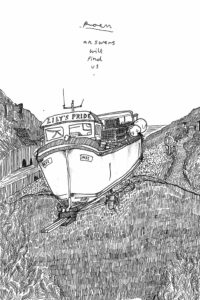
POEM
I woke up
With nothing
And I still
Felt
Love.
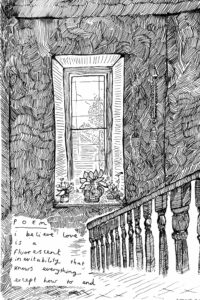
I KNOW YOU ARE LONELY
I know you are lonely.
And hurt.
Your heart has been broken
And you stand in front of the dry leaves
And say you match them.
You don’t.
You are the pink and the blue and the red
All living next to each other
With no one dominant colour.
You are what makes my pen move.
You hug puppies
The same way I wish I could write poetry.
You champion those without a voice.
You hide my face with your kindness.
I know you are lonely.
And hurt.
You are just like me.
I am the left foot of Philip Guston.
You are the right foot of Agnes Martin.
You are Judy Chicago’s purple plate.
Your thoughts wrap around words as snug as Christo
and Jeanne-Claude.
Believe me, equilibrium doesn’t exist without the U-Turns.
So I celebrate you.
In Procida.
Under Branch Hill Pond.
In the Louvre
Drawing pictures of tourists.
Stripped bare with Giacobetti
And using the humble perspective of time
As an interior decorator that
Hangs all good things to come.
I know you are lonely.
And hurt.
You are just like me.
But I also know you love dolphins
And believe that every romance is an essential journey.
You pick Renoir’s flowers
And I know you would never, never, take any of the
moments that hurt back.
No matter how much you miss them,
You’re still here.
So sleep with the ravens.
Be lost in illumination.
Art is our phenomenon.
And remember it is falling down these disguised pits
That makes life
So
Damn
Magnificent.
You uplift me.
You make me want to build a ship,
Sit on a long table with you and
Eat pancakes on your birthday.
Understand Italian Baroque more.
Walk down the catwalk with Kimono.
Go on a tree adventure with Hockney.
Let him whip me.
I know exactly what it is you make me want to be.
You make me want to be.
I know you are lonely.
And hurt.
You are just like me.
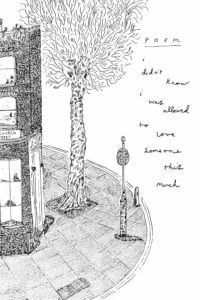
POEM
If I do
The right thing
Today maybe
Tomorrow my life
Will
Be better.
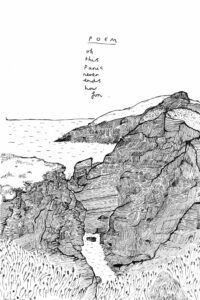
i am ill with hope by Gommie is published by Salamander Street, priced £12.99.
In the latest work from Jim Crumley, dubbed “the pre-eminent Scottish nature writer”, Seasons of Storm and Wonder considers the natural life of the Scottish Highlands, bearing witness to the toll climate change is already taking on our wildlife, biodiversity and more. Read an extract from the beginning of the book below.
Seasons of Storm and Wonder
By Jim Crumley
Published by Saraband Books
I was born in midsummer, but I am a child of autumn. One September day in the fourth or fifth autumn of my life there occurred the event that provided my earliest memory, and – it is not too extravagant a claim – set my life on a path that it follows still. I was standing in the garden of my parents’ prefab in what was then the last street in town on the western edge of Dundee. An undulating wave of farmland that sprawled southwards towards Dundee from the Sidlaw Hills was turned aside when it washed up against the far side of the road from the prefab, whence it slithered away south-west on a steepening downhill course until it was finally stopped in its tracks by the two-miles-wide, sun-silvered girth of the Firth of Tay at Invergowrie Bay. Then as now, the bay was an autumn-and-winter roost for migrating pink-footed geese from Iceland; then as now, one of their routes to and from the feeding grounds amid the fields of Angus lay directly over the prefab roof.
I can remember what I was wearing: a grey coat with a dark blue collar and buttons and a dark blue cap. So we were probably going out somewhere.
Why am I so sure it was September and not any other month of autumn or winter or early spring? Because it was the first time, and because for the rest of that autumn and winter and early spring, and ever since, the sound of geese over the house – any house – has sent me running to the window or the garden. So was established my first and most enduring ritual of obeisance in thrall to nature’s cause. And so I am as sure as I can be that the very first time was also the first flight of geese over the house after their return from Iceland that September; that September when I looked up at the sound of wild geese overhead and – also for the first time – made sense of the orderly vee-shapes of their flight as they rose above the slope of the fields, the slope of our street, up into the morning sunshine; vee-shapes that evolved subtly into new vee-shapes, wider or longer and narrower, or splintered into smaller vee-shapes or miraculously reassembled their casual choreography into one huge vee-shape the whole width of childhood’s sky.
But then there were other voices behind me and I turned towards them to discover that all the way back down the sky towards the river and as far as I could see, there were more and more and more geese, and they kept on coming and coming and coming. The sound of them grew and grew and grew and became tidal, waves of birds like a sea, but a sea where the sky should be, and some geese came so low overhead that their wingbeats were as a rhythmic undertow to their waves of voices, and that too was like the sea.
When they had gone, when the last of them had arrowed away north-east and left the dying embers of the their voices trailing behind them on the air, a wavering diminuendo that fell into an eerie quiet, I felt the first tug of a life-force that I now know to be the pull of the northern places of the earth. And in that silence I stepped beyond the reach of my first few summers and I became a child of autumn.
And ever since, every overhead skein of wild geese – every one – harks me back to that old September, and I effortlessly reinhabit the body and mindset of that moment of childhood wonder. Nothing else, nothing at all, has that effect. I had a blessed childhood, the legacy of which is replete with good memories, but not one of them can still reach so deep within me as the first of all of them, and now, its potency only strengthens.
It would have been about thirty years ago that I first became aware of the Angus poet Violet Jacob, and in particular of her poem, The Wild Geese. It acquired a wider audience through the singing of folksinger Jim Reid, who set it to music, retitled it Norlan’ Wind, and included it on an album called I Saw the Wild Geese Flee. I used to do a bit of folk singing and I thought that if ever a song was made for someone like me to sing it was that one, but I had trouble with it from the start. My voice would crack by the time I was in the third verse, and the lyrics of the last verse would prick my eyes from the inside. The last time I sang it was the time I couldn’t finish it.
Years later, I heard the godfather of Scottish folk singing, Archie Fisher, talking about a song he often sang called The Wounded Whale, and how he had to teach himself to sing it “on automatic pilot”, otherwise it got the better of him, but I never learned that trick. Even copying out the words now with Violet Jacob’s own idiosyncratic spelling, I took a deep breath before the start of the last verse, which is the point where the North Wind turns the tables on the Poet in their two-way conversation:
The Wild Geese
“Oh tell me what was on your road, ye roarin’ norlan’ Wind,
As ye cam’ blawin’ frae the land that’s niver frae my mind?
My feet they traivel England, but I’m deein’ for the north.”
“My man, I heard the siller tides rin up the Firth o’ Forth.”
“Aye, Wind, I ken them weel eneuch, and fine they fa’ and rise,
And fain I’d feel the creepin’ mist on yonder shore that lies,
But tell me, as ye passed them by, what saw ye on the way?”
“My man, I rocked the rovin’ gulls that sail abune the Tay.”
“But saw ye naethin’, leein’ Wind, afore ye cam’ to Fife?
There’s muckle lyin’ ’yont the Tay that’s dear to me nor life.”
“My man, I swept the Angus braes ye hae’na trod for years.”
“O Wind, forgi’e a hameless loon that canna see for tears!”
“And far abune the Angus straths, I saw the wild geese flee,
A lang, lang skein o’ beatin’ wings wi’ their heids towards the sea,
And aye their cryin’ voices trailed ahint them on the air –”
“O Wind, hae maircy, hud yer whisht, for I daurna listen mair!”
Seasons of Storm and Wonder by Jim Crumley is published by Saraband Books, priced £25.
Bonnie Prince Charlie’s escape from Scotland with the help of Flora Macdonald is one of Scotland’s most iconic stories. Flora Fraser, in her biography of the young heroine, finds a woman that experienced so much more in her life. We speak to her about her latest book.
Pretty Young Rebel: The Life of Flora Macdonald
By Flora Fraser
Published by Bloomsbury
Can you tell us a little bit of what we can expect from Pretty Young Rebel?
Flora’s story could well be told as a historical novel. Her life is so packed with romantic and dramatic incident. But I am a historical biographer, and so the book is based on documents in the Royal Archives, in the National Library of Scotland, in the British and National Libraries, in the US Library of Congress, and in other repositories.
For those unfamiliar, who is Flora Macdonald, and why is her story so significant?
Flora belonged to the Macdonalds of Clanranald, and grew up on a tack, or farm, adjacent to the residence of the head of the clan and his wife, ‘Lady Clan’ on Benbecula in the Western Isles. While the Clanranalds were Catholic, Flora’s maternal grandfather was known as ‘the Strong Minister’, and Flora was all her life a staunch Presbyterian.
As a young gentlewoman on the Long Island, as the Western Isles were then known, Flora was a key player in the 1746 escape of Bonnie Prince Charlie from Redcoats, or Hanoverian army officers and men, from the Uists to Skye. Following which, she is taken prisoner and sent to London for trial.
Returning to Skye as a Jacobite heroine, she lives quietly with her husband and seven children for a time. But economic distress impels them in the 1770s to emigrate to the British colony of North Carolina, where she is immediately swept up in the American Revolution.
The family takes the fatal decision to stay loyal to the Crown, and Flora’s husband is taken prisoner. Flora, in her early fifties and in poor health, spends years at the plantation they bought, destitute and in fear of her life from robbers, before her son-in-law, another loyalist officer, rescues her.
A period in Nova Scotia with her husband., discharged from prison and now in a loyalist Highland Emigrant regiment, is succeeded by final years back in Skye. Astonishingly Flora manages to secure a Royal pension from the future Hanoverian King, George IV which, with financial aid from a successful officer son in Sumatra, eases her distress.
Her funeral on Skye, when she dies in 1790 at the age of 68, is attended by thousands and is a sign of the respect which she elicited all her life.
Flora’s story resonates to this day in Scotland and further afield, because she was no keen Jacobite rebel, unlike other Scotswomen, who urged on their clans into battle. She was reluctant to be involved in the 1746 escape plan and have the Prince accompany her, dressed as her ‘Irish maid’, over the Minch to Skye. She rightly feared for her ‘character’ or virginal reputation, all important then for a young woman contemplating future matrimony. She yielded, because, as she told a Hanoverian captor, ‘I would have done the same for you, had you been in distress.’ This remark circulates in the highest circles in London. Her courage in accompanying ‘Betty Burke’, alias Prince Charles Edward, on the stormy midnight voyage is commemorating in the son, ‘Speed, bonny boat, like a bird on the wing/O’er the sea to Skye’.
Flora’s character and strong moral sense attracted too the interest of Dr Johnson and his companion, James Boswell, when they were on their 1773 Highland Tour. Johnson paid a famous tribute to Flora in his account of his travels which is inscribed on her grave in Skye. Boswell later published a lengthy narrative of the Prince’s escape taken from Flora as well as from other 1746 conspirators. As she told the Edinburgh lawyer, however, she had already given a full account of the escape in the later 1740s to an enterprising Jacobite cleric in Leith. This was later to be published, with the accounts of other conspirators, in the late nineteenth century as ‘The Lyon in Mourning’.
Flora’s adherence, with the other members of her family, to the Crown in the American Revolution , when they were living in North Carolina, was a function of their recent arrival in the colonies and also of their earlier experience of the Crown’s power in crushing the 1745 Rising. They could not believe that the ramshackle patriot militia they saw could defeat the British forces. Those Scots who had been in residence in America for decades, knew better the political fire that animated these patriots and were more likely to support the revolutionaries.
What drew you to tell her story?
I grew up between London and Inverness-shire and was named after Flora Macdonald, then very much a local heroine in the latter place. Her statue stands outside Inverness Castle, and as a child I was always interested in her story as the ‘Prince’s Protector’. But I never thought of writing her biography, until I was searching for illustrations for my last book, The Washingtons: George & Martha. And I came across her portrait by Allan Ramsay from the 1740s among a sheaf of images s of American revolutionaries from the 1770s. Then I remembered that in 1773 she effectively told Dr Johnson that he was lucky to catch her as she was off to America.
The process of researching someone’s life and condensing it into the key moments feels a vast task. How do you approach this? What are the most enjoyable or interesting parts of this process for you?
I have always loved doing primary research especially in archives and uniting all the papers from multiple archives in one chronological stream. But I used to dread taking all my research and weaving the salient facts into a narrative. I’ve finally – after forty-odd years of writing historical biography! – learnt to embrace a period of constructive chaos, as I term it. And I swim or go for walks or go and read – fiction unrelated related to the book in question – in a library. Or even go to the cinema alone in the daytime – wicked pleasure! – or do any activity where I’m sure not to have the company or conversation of others. And thoughts arise … And after a time, the arc of the book is clear. And I can start writing. Which I love, even though it can be like being at the coalface sometimes for weeks or even months. I think it helps enormously to know that I have been in every one of these stages of anguish and even torture before. And a book has always emerged.
Though many would likely be most familiar with Flora’s part in Bonnie Prince Charlie’s escape, what are some of your favourite lesser-known anecdotes or stories from her life?
My favourite anecdote? When Bonnie Prince Charlie was dressing on the shore on the Long Island as ‘Betty Burke’, Flora’s Irish maid, for the midnight voyage to Skye, he wanted to carry his pistols under his petticoats. Flora refused to allow it.
‘Indeed, Miss,’ the prince replied, ‘if we shall happen to meet with any that will go so narrowly to work in searching as what you mean, they will certainly discover me [his male sex] at any rate.’ For all the jocularity, Flora prevailed, and Charles Edward boarded the boat without the firearm under his skirts.
You’ve written multiple books on women from history; do you find yourself consciously drawn to women in history whose wider stories are perhaps lesser known compared to others’?
I come across the voices – in letters or in diaries etc -of certain women in the eighteenth century and to me they stick up like stalagmites from the ordinary run of eighteenth-century women. This was true of Emma , Lady Hamilton, of George IV’s Queen Caroline, of the six daughters of George III, of Pauline Bonaparte, Prince Borghese, and of Martha Washington. |And I want to worry away at them like a dog a bone until I have their story to share with others. I suppose I am interested in lesser-known women because there are generally excellent biographies already of better-known women. But in all my biographies there have been major male figures in the book too. Nelson; George IV; George III; Napoleon; George Washington. Flora is the first historical character whom I have considered who is without a male counterpart on whom to lean. As you will see in the book neither the Prince not her husband was – what shall we say – reliable?
Are there any people from history you’ve yet to write about who you think have fascinating stories and you’d perhaps like to do a project on some day? What is it about them that interests you?
I have been fascinated by Horatio Nelson since I was a child. He was our greatest ever naval commander and sure of himself at sea from an early age. On shore he was loved as no other officer was by the public, and won a unique place too, in the hearts of many far superior to him in education and rank. His insecurities were understood and calmed by his lover, Emma, and by his family, if not by the wife he mis-treated. So, my next project, on which I am just embarking, for Bloomsbury, my publishers, is Nelson: At Shore and At Sea.
What do you hope readers take from Flora’s story and Pretty Young Rebel?
I do hope readers will enjoy Pretty Young Rebel. I hope they will also come away with the sense, that this was a woman who was admired and respected by all but at the same time was scrambling to negotiate the dangers and vagaries of life on two continents with few resources as best as she could.
Pretty Young Rebel: The Life of Flora Macdonald by Flora Fraser is published by Bloomsbury, priced £25.
Following Irish and Scottish giants Finn McCool and Benandonner, who want to know who is the best giant, but first must cross the Irish sea, we asked author Lari Don to tell Books from Scotland just why folk tales still matter, and what inspiration we take from these variations of tried and tested tales as we venture with them into the Giant’s Causeway.
The Tall Tale of the Giant’s Causeway
By Lari Don, illustrated by Emilie Gill
Published by Floris Books
Folklore is the fertile ground in which my own stories grow. Almost all of the children’s books I’ve written are retellings of traditional tales – folktales, fairy tales, myths, legends – or have been inspired by them.
Why is folklore so inspiring, and are traditional tales still relevant today?
Traditional tales are reliable building blocks for much of our culture, including many forms of storytelling – books, films, computer games – which didn’t exist when these tales were first told. We are fascinated by these old stories because they still give us, as individuals and as communities, something we want and need. Traditional tales continue to be relevant because they’re not static. Folklore evolves, to fit tellers, audiences, circumstances. The stories which last are the stories which are flexible, the ones which can change to fit new worlds.
How do folktales evolve? Here’s an example.
My new book, The Tall Tale of the Giant’s Causeway, retells the story of the Irish giant Finn McCool and the Scottish giant Benandonner arguing across the sea, then building a causeway so they can meet and fight. Their rivalry is resolved without an actual fight because Finn’s wife Oona comes up with a clever trick involving Finn dressed up as a baby. It’s a well-known tale, with dramatic and funny imagery, beautifully brought to life in our book by Emilie Gill’s fantastic illustrations. My retelling aims to balance respect for the original story and consideration for my modern audience. So I tweaked the story a wee bit. This is an Irish folktale with one Scottish character, and it usually ends with the daft Scottish giant running away, leaving the Irish giants victorious. Bearing in mind that the likely audience contains a fair few Scottish picture book fans, I wanted to retell it in a more even-handed way. So I didn’t end the story at the traditional endpoint, I took another couple of steps to allow the Scottish and Irish giants to reach a friendly accommodation over the sea and to give everyone their happy ending.
That’s how folklore evolves. Each teller makes minor changes to fit the audience, the occasion, their own agenda and the changing world around them, so at each telling the story moves on slightly. The story evolves. It’s that ease of evolution which means folklore stays relevant, because those telling it constantly remake it to be relevant. Nowadays tellers and writers can retell stories that are inclusive, diverse and respectful, in a way that might have shocked and challenged the Victorians who wrote down many of the tales we use as building blocks.
Folklore inspires creators in many different ways. It’s always possible to retell old tales in new and interesting forms, either sticking fairly close to the original, like I do in picture books and collections of traditional tales, or in complex reworkings, like the wonderful in-depth retellings of Greek myths by Natalie Haynes and Madeline Miller.
Or you can create entirely new stories by taking characters and elements out of the old tales and putting them in fresh contexts. That’s what I do with my novels, taking kelpies, selkies, centaurs and sphinxes on new adventures in the Scottish landscape. Many fantasy novels are based on characters and magic from traditional tales, from all over the world, like Sophie Anderson’s The House with Chicken Legs and Julie Kagawa’s Shadow of the Fox.
It’s possible to model both these forms of inspiration to young writers. When I visit schools, I aim to free up children to rework stories they’re familiar with, or prompt them to imagine new stories about mythical creatures and magical ideas they’re comfortable with, like unicorns, dragons, golden eggs, enchanted doors. They always come up with wonderful ideas, because making something new with magic that’s already tried and tested in old tales can be a powerful form of creativity.
There are many other areas of life where folklore matters, like tourism, for example. The Giant’s Causeway would be just as geologically spectacular if it wasn’t linked to the Finn McCool folktale, but would it be quite as popular if it was called ‘Mosaic of Basalt Columns’ with no story behind it?
We have lots of folklore tourism in Scotland too. Nessie draws tourists to Loch Ness; the Kelpies statues are named to connect to Scotland’s folktale past; Skye is filled with photogenic ‘fairy’ locations: the fairy flag at Dunvegan, the fairy pools and fairy bridge. A folklore link is probably not enough to draw tourists on its own, but certainly adds an additional layer of magic and interest to a potential tourist attraction.
Folklore is constantly evolving, and I hope that evolution will keep these wonderful flexible stories relevant all the way from ‘once upon a time’ to a far-distant ‘happy ever after’…
The Tall Tale of the Giant’s Causeway: Finn McCool, Benandonner and the road between Ireland and Scotland by Lari Don, illustrated by Emilie Gill, is published by Floris Books, priced £7.99.
In 1720, the young William Nelson leaves Edinburgh to make his fortune in Europe, where his story begins to unfold. To celebrate the release of this entertaining historical tale, author James Buchan tells us a bit more about his newest release, as well as recommending a fair few books along the way.
A Street Shaken by Light
By James Buchan
Published by Mountain Leopard Press
The book as . . . memory. What is your first memory of books and reading?
I was the youngest of a numerous family, and books often came down to me in more than one piece. Our copy of Stuart Little, by the American author E. B. White, printed in 1945, was missing some pages. Our copy ended with a full-page drawing of a tiny motor-car, driven by a mouse, on an undulating back road in America. I long ago lost the book but retain the mental picture. Years later, in a gallery at the upper end of Madison Avenue in New York, I came on a small drawing by Edward Hopper: a ribbon of road, a couple of circles to show the tops of gasoline pumps, and power lines loping away into infinity; and had the same feeling of immensity.
The book as . . . your work. Tell us about your latest book A Street Shaken by Light. What did you want to explore in writing this book?
I had written a biography of the Scottish adventurer, John Law of Lauriston, who in the eighteenth century was briefly finance minister of France. It was published in 2018. I had spent five year following Law’s traces in Europe and North America and, what with lockdowns and all, found it hard to surface from the eighteenth century into the twenty-first. I thought I might cast up my impressions of Law’s age into a novel, and then a suite of novels, which would have more battles and ship-wrecks than are generally found in a realistic work of fiction set in present times.
The book as . . . inspiration. What is your favourite book that has informed how you see yourself?
The visit of Joe Gargery to Pip in Chapter XXVII of Great Expectations stopped my twenty-year-old self in his tracks. If Pip had become obnoxious, he was nothing to what I had become. I suppose Dickens was also thinking of himself.
The book as . . . an object. What is your favourite beautiful book?
Nothing prepared me for the sight, in a glass case in the library of a millionaire’s country-house, of James Audubon’s Birds of America, engraved on double-elephant paper in Edinburgh and London in the 1820s and 1830s. The memory is tinged with regret for the birds shot or stabbed for the drawings and for the extinct races.
The book as . . . a relationship. What is your favourite book that bonded you to someone else?
My parents lived apart. One summer holidays, at the age of about thirteen or fourteen, having exhausted Alistair McLean, Ian Fleming and Hammond Innes, I asked my mother to suggest something different. She took from a set in her book-case, Decline and Fall by Evelyn Waugh. I read that, and then Scoop and then Vile Bodies, and so on to to her least favourite, Put Out More Flags. My father was much in Paris. On a visit to him, the same year or the next, he suggested I read a pet novel of his, Le grand Meaulnes, by Alain-Fournier, who was killed in the First World War. I did so, with difficulty, but French was never so hard again.
The book as . . . rebellion. What is your favourite book that felt like it revealed a secret truth to you?
I dreamed one night that I was reading the quatrains of Attar and found the secret of existence in four short lines. I stumbled downstairs, took down Attar’s Mokhtarnameh and read Persian quatrains till my eyes ached and light was coming in through the window. I did not find the secret of existence.
The book as . . . a destination. What is your favourite book set in a place unknown to you?
Like all my schoolfriends, I read Basho’s A Narrow Road to the Deep North when it was translated in the Penguin Classics. Recently, my son lent my a translation of the poems of Saigyo, Basho’s model and predecessor. I would like to walk the roads of old Japan, composing dreadful verses.
The book as . . . the future. What are you looking forward to reading next?
Buchanan’s Travels in the Western Hebrides, printed in 1793, a most generous present from my brother. I feel I should wear white gloves to hold it, like a snooker referee.
A Street Shaken by Light by James Buchan is published by Mountain Leopard Press, priced £16.99.
Kevin P. Gilday’s new collection explores the fragmented nature of our modern lives, alongside the need for real connection in an era of rampant individuality. You can treat yourself to an exclusive look at some of his new poems below.
Anxiety Music
By Kevin P. Gilday
Published by Verve Poetry Press
Anxiety Music
Wherever I go
I hear it
The anxiety music
The unfinished symphony
The merciless drone
The atonal attack
The incessant pop chorus
The anxiety music
My neurological dials, tilted
Tuned in
To the rhythm of a raised heartbeat
A weary waltz of what-ifs
Can you hear it?
It’s there in the supermarket queue
Rehearsing your only line
Like a third-rate actor
Translating a bus ticket
To inky pulp
It’s there in the pre-flight announcement
Tracing the pilot’s voice for a hint of doubt
A polygraph of panic
Angered by your blatant disregard
For the wonders of gravity
Lately, the anxiety music has grown louder
Heralded by fascistic trumpets
Amplified by the unrelenting buzz of the internet
I hear it in the dark cubicle of my subconscious
Composing a lopsided poem to ego
A 4am, 130BPM
Techno trauma, jangling
My nervous sound system
On a Sunday evening
Just as the sun sets
The anxiety music seems to seep
From every wall
And I am a child again
It’s the ice level from Mario Brothers 3
And my dad singing Deacon Blue
And an ashtray of fags
Burning themselves out of existence
The anxiety music sometimes sounds
Like a symphony of misfiring bus engines
Backed by a choir
Of well-meaning
Constructive criticism
The brass phasing an apocalyptic scale
Scoring a thousand painful deaths
All the ways the music will end
And when it does
When the record scratches and skips
Will we wonder if we conceived all that disquiet
As a smokescreen to mask our failure
Against all that perceived danger
Robbing us of our chance to live fully
To enjoy our footloose three chords
And marvel at our glorious middle eight
Before everything we know
Turns to static
Will there at least be time for a retrospective?
I need the world to exist
Just long enough
To declare me, a genius
Revisit those overlooked masterpieces
Pamper me with posthumous validation
A serious re-evaluation
I need a scholar to find the thematic link
Between my second collection
And my fourth album
Provide what I was never afforded in life
I want:
Goths to scratch my lines into notebooks
Teenagers to fuck on my gravestone
A retrospective full of beard-stroking wankers
Tugging themselves to ecstasy
Over the inherent themes
And thinly veiled subtexts
In my decomposing body of work
But, I worry
I worry
That future generations will read these words
And my woes will feel so small to them
Look at this old poet!
Lamenting his career
As he was living like a king
In the last days of Rome
Condemning us to the bleakness
Of an unforgivable future
He created art while the world burned
Talked of himself incessantly
And engaged with his era’s hate
In only the most performative of ways
Like this was all for him –
A film set for some small-scale drama
A brief blink of an existence
While the earth heated around him
Slow as an oven
The real narrative unfolding
While he attempted to conjure some meaning
In the spaces between the words
And when the end inevitably comes
Collect the detritus my ambition left behind –
The Lidl bags of poems
The books, the CDs, the records
The piles of scripts spoken by actors
Long since departed
That one novel that no-one ever published –
And dump them in a wheelbarrow
Push it to the top of the highest hill
Just as the water begins to rise
And read
Read all my words aloud
And hear me
Hear all my stunted attempts at connection
All the times I tried to share a little of me
With you
The ideas that brought me joy
And all the things that scared me
Give me my retrospective, finally
At the top of a hill
At the end of the world
And when the sun sets that final time
You do what you must
Set fire to the remnants of my life
And sit for a few minutes
In the silence
Appreciating the simple pleasure
Of a warm goodbye
Cannibal City
1.
You only live as long
As the last person to remember you
I’m already forgetting your streets
2.
This is a cannibal city
It eats itself daily
The monuments of my childhood
Now recycled
Chopped up for parts
Reconstructed into something profitable
They saved the antiquity of wealth
The ornate halls of the merchants
Iced with marble
Gilded with gold
While the art deco brilliance
Of the cinemas and music halls
Was sold off cheap
The cultural history of the working classes
Bulldozed without opinion
If we don’t remember the best of us
Then what chance for the rest of us?
When rooms that once roared with laugher
And reverberated with applause
Are lost to the whims of developers
Deaf to the echoing encores
Blind to the value of joy
While the names stay the same
A roll call of slavers and plantation owners
Buchanan, Glassford, Virginia, Jamaica
Let this past we have buried
In the name of progress
Come home to roost in our hearts
3.
A personal tour of the places that made me:
Do you not know that I got a handjob
In the backseat of that cinema?
A soft-focus Odeon fumble
Now an office for serious, suited young men
Do you not know that this stark shell
Used to be a Littlewoods?
Where my mum stoically scanned shopping
While I stowed away inside her
Are you not aware
That on the site of these new-build atrocities
There once stood a pub of real character?
Where my dad sat me down with a can of cola
While the real drinking got done
That the very place I was born is now a garden?
A memory of a generation
Who took their first breath
Within a few magical square feet
4.
And the cafes become coffee shops
And the bars become bistros
And the traders become Tescos
And we no longer know where we are
5.
But am I asking too much?
Do I want to wander in a wonderland of my own creation?
Clinging on to the familiar city I knew
Even as it evolves
Am I attempting to stop the world spinning?
Because the faster it goes, the more it changes
And the further I am from my youth
When the truth is
It is our actions that outlive us
Not the bricks we fashion into buildings
But our intention for doing so
And the houses I build of my love
Will shelter a few who will not long forget
You only live as long
As the last person to remember you
If that’s true
I hope my name rings
Around the hollows of this old town
For years to come
Shiitake
I cook with mushrooms now
Feel their surfaces undulate
From springy softness
To earthy notes
I let my fingers read their story
In organic braille
I find an excuse to put them in everything
Nowadays
Porcini in my pasta,
Button in my curry
I’m learning their attributes
Curating my fungus
For the correct culinary journey
It’s the freshness
That makes it exciting
Breaching a boundary
Without anyone to tell me no:
You always said it was the texture
All rubbery and slimy
Alien growths
Fried up in a pan
But we pay a price and make a trade-off
And no longer will I smell
The industrious entwining of onions and garlic
Sizzle from the next room
No longer will I glibly state that
Something smells good
And no longer will you tell me
It’s just onions and garlic
I will never again
Hear about the intrigue of your work day
Who said what to whom
Despite my love of mundane drama
I’ve freed up precious time
To wank myself into a coma
Instead
You’d be proud of my Spaghetti Bolognese
I put in a little Pesto
And Worcestershire sauce for a kick
But I know you wouldn’t try it
Not with all the mushrooms
You cooked more often than not
Me feigning ineptitude
Borne of laziness
(Turns out it was both)
And though I miss
Your intricately prepared meals
I am only five attempts away
From mastering a perfect pasta bake,
I’d say
I’m forever giving something up
Every inch earned
Must be returned elsewhere
And this freedom has cost us ten years
Of laughter
Of dinners
Of photographs –
Us at that pizzeria on our honeymoon
Waiter whispering Italian
Smiling into the flash
Even as it burned our retinas
Yours a plain Margherita
Mushrooms on mine
Anxiety Music by Kevin P. Gilday is published by Verve Poetry Press, priced £10.99.
Hungry Beat tracks the significant cultural contribution of two maverick Scottish independent music labels – Fast Product and Postcard. To mark its release, we speak to one of the co-authors Douglas MacIntyre to learn more about why this era of music is so seminal in Scotland’s musical history.
Hungry Beat: The Scottish Independent Pop Underground Movement (1977-1984)
By Douglas MacIntyre and Grant McPhee
Published by White Rabbit Books
The book focuses on 1977-1984 in particular – what is it about this era and music that is so significant in Scotland’s musical legacy, and more broadly?
I think the era covered in Hungry Beat is interesting from many perspectives. The emergence of Fast Product felt like Scotland’s response to punk, albeit as filter through art angles. It was an era where Scottish culture started believing in itself and took an internationalist outlook.
Can you tell us a bit more about Fast Product and Postcard, and why the two record labels are so seminal?
Fast Product was self consciously a brand before people flouted that term. The label was initiated by Bob Last, who was as interested in product packaging as he was the music (which he largely produced). To gain international attention for the groups on the label (The Mekons, The Human League, Gang of Four, Scars) was an incredible achievement.
Postcard announced itself with Orange Juice, who were heavily involved in the label along with Alan Horne. Postcard was an extremely intelligent and artistic collection of young people, and like Fast Product was driven by the energy created by punk. The groups who released records on Postcard – Orange Juice, Josef K, The Go-Betweens, Aztec Camera – crafted literary pop masterpieces.
The book is told in the people’s own words for the most part – how did you find the process of bringing together the book in this form? What do you think their stories, together, convey about how it was to be part of this amazing and thriving scene?
The book was brought together by using interviews by the active participants from the Fast Product / Postcard period. These interviews (taken from Grant McPhee’s wonderful film about these labels) formed the basis of the oral narrative that chronicles the development of the birth of the Scottish independent music scene. It was an amazingly exciting time period where art and music collided and burned brightly.
What are some stand out moments or anecdotes from the book or time period in general, for you?
I think early periods of both labels highlighted the power of youth. Hilary Morrison’s involvement as a singer in the flowers and as fast product photographer was inspirational. Whilst as Postcard, Orange Juice deployed camp rhetoric which soon had the national media flocking to them.
The music industry has evolved greatly over the years – what are some elements in today’s scene that you see as the result of the seeds planted in this era?
I think the spirit of independence in today’s scene can be traced back the fervour with which Fast Product and Postcard agitated. Both labels wrapped the London media around their fingers.
We couldn’t discuss a music book without asking for some highlights: what are your standout gigs you’ve been to over the years?
I think the standout concerts I attended during the Hungry Beat period were ‘A tribute to Frank Sinatra’ – which featured Scars, Associates, Josef K, Fire Engines – at Valentino’s in Edinburgh, and Orange Juice at the Bungalow Bar in Paisley.
What do you hope readers take from Hungry Beat?
I hope readers enjoy the book and realise what an important moment in pop culture the Fast Product / Postcard explosion was.
Hungry Beat: The Scottish Independent Pop Underground Movement (1977-1984) by Douglas MacIntyre and Grant McPhee is published by White Rabbit Books, priced £20.
Tracing the development of Scottish women’s writing from the genesis in the late eighteenth century into the subsequent two, Scottish Women Writers explores the changing times and women writing across a range of formats and genres over the years. You can read an extract from the chapter ‘Multi-taskers’ below for a taste of what to expect.
Scottish Women Writers: from 1800 to the Great War
By Eileen Dunlop
Published by National Museums Scotland
The word ‘multitasking’ is a modern one, first coined in 1965 to describe a computer function, but used more recently to suggest the necessity in a hectic life of performing a multiplicity of tasks; juggling more than one job while running a household, bringing up children, and, for many people, making financial ends meet. After the end of the Great War in 1918, the ready supply of inexpensive live-in servants had slowed, then dried up, but not until the late twentieth century did the expectation that men would share the responsibility of household chores and bringing up children become widespread. Previously, when the reality of multitasking existed without a definition, the burden was laid almost exclusively on women.
As in more recent times, nineteenth-century women writers had different motivations. Some had independent means, so were free to choose their genres and write for their own pleasure; some hoped to supplement a less secure income, while the brave, often driven by necessity, attempted to live by their writing alone. Among the women writers already mentioned, Mary Brunton had the support of her husband and Susan Ferrier of her father. Susan might with justice have seen herself as a multitasker, juggling household obligations to find time to write, but she was not so in a literary sense. Apart from letters she concentrated on fiction, and it is as a novelist that she is known. It was the financially insecure who did not have the luxury of choice. Not for them were proof correcting and business arrangements ‘among the minor pleasures of life’. If they found in themselves a talent for writing, exigency forced them to be versatile, moving from journalism to fiction, biography and travel writing to poetry, as opportunity arose. Those women who succeeded in this largely male-dominated industry deserve to be remembered as pioneers.
Elizabeth Hamilton, author of The Cottagers of Glenburnie had fewer advantages than Brunton and Ferrier. Unmarried, deprived of her brother’s support by his unexpected death in 1792 and unable to find employment due to her own chronic ill health, she had little option but to try her luck as a professional writer. Well-educated for a woman in her time, she had attended school in Stirling, and later public lectures on philosophy in Glasgow and Edinburgh, but most of her formidable knowledge had to be acquired by private reading. Before settling in Edinburgh in 1804, she had already proved her versatility, publishing titles as diverse as Translations of the Letters of a Hindoo Rajah (1796), for which she drew on the experience of her brother, who had been in the service of the East India Company, and Memoirs of Modern Philosophers (1800), a satirical novel featuring an absurd ‘bluestocking’, Miss Bridgetina Botherim; such pretentiously intellectual women were fair game for novelists of the period. In 1801 she published Letters on the Elementary Principles of Education, the first of many books and articles on educational topics, and in the year of her move to Edinburgh took a subject from Roman history, Memoirs of the Life of Agrippina, Wife of Germanicus. This was a brave choice, at a time when classical studies and biography were assumed to be the preserve of university-educated men.
Given the general prejudice against women writers, Hamilton’s success was remarkable; apart from an annual pension of £50 from King George III, she supported herself by writing alone until her death in 1816. She was among the first literary multitaskers of the nineteenth century, even if she is now remembered only as the author of The Cottagers of Glenburnie.
A literary multitasker of a different kind, whose life overlapped with Hamilton’s, was Christian Isobel Johnstone (1781–1857), of whose early years tantalisingly little is known. She has been identified as Christian Todd, born in Edinburgh in 1781, and it seems likely, given her wide knowledge and literary talent, that her parents were of the middle class. But as to who they were, and where and how they lived, nothing has been satisfactorily established. It is believed that at an early age Christian Isobel married a man whose surname was McLeish, and a few years later divorced him. Only after 1812 do facts supersede supposition; in that year she married a Dunfermline schoolmaster, John Johnstone and, when he became owner and editor of the Inverness Courier, moved with him to Inverness. The level of Christian Isobel’s education and commitment now becomes clear, since she immediately became involved in the business, and is credited with giving the Courier a more literary bias than was usual in a provincial newspaper. It was here too that she acquired the deep knowledge of Highland life and culture displayed in her best-known novel Clan-Albin: A National Tale (1815).
The Johnstones’ decision to move to Edinburgh, then a hub of publishing and journalism which rivalled London, proved their ambition. John Johnstone opened a printing office in James Square and, using funds from the sale of the Inverness Courier, bought jointly with the publisher William Blackwood (1776–1834) The Edinburgh Weekly Chronicle. This partnership, however, was doomed to failure, since the liberal principles of the Johnstones clashed with those of the arch-Tory Blackwood, leading them to sell their share. Aware of the market for publications which the literate poor could afford, and using their own printing press, the Johnstones then ran a number of periodicals, including The Schoolmaster and Edinburgh Weekly Magazine, with a cover price of 1½d and written almost entirely by Christian Isobel. This publication was converted in 1832 into Johnstone’s Edinburgh Magazine, which in turn amalgamated with the better-known Tait’s Edinburgh Magazine. As well as agreeing to her demand that the price of Tait’s be cut from 2s 6d (12½p) to 1s (5p), William Tait (1792–1864) showed his confidence by giving Christian Isobel most of the editorial responsibility, along with a salary and half ownership of the magazine.
After that, there was nothing to hold her back.
Scottish Women Writers: from 1800 to the Great War by Eileen Dunlop is published by National Museums Scotland, priced £14.99.
The voice of one of Scotland’s most remarkable figures returns to the page in the form of Isobel Wylie Hutchison’s Peak Beyond Peak. These essays detail her Scottish journeys over a period of 50 years, giving fascinating insight to a great explorer, and a testament to cultural connection and communication. You can read an extract below.
Peak Beyond Peak
By Isobel Wylie Hutchison
Published by Taproot Press
It was at Castlebay, in Barra, some twenty years ago, that an Islesman suggested to me the attractive idea of a walking-tour right up the Long Island to the lighthouse at the Butt of Lewis, a distance of about 150 miles.
The suggestion appealed to me, and I set off forthwith and alone, for I agree with Robert Louis Stevenson that a walking-tour, to be properly enjoyed, must be undertaken alone, freedom being of its essence.
I went at my leisure, for I wanted to explore the islands. I stopped a week in Barra, another in Benbecula, and another in North Uist. Then, as time was running short, I had to walk through Harris and Lewis rather hurriedly, halting only one night at each resting-place. My last journey, from Stornoway to Port of Ness (close to the lighthouse at the Butt of Lewis) was the longest and most monotonous day of the interesting tour. I seemed indeed to have reached the end of the world. The road stretched straight before me, with no cross-roads or interesting sign-posts. Darkness fell early, for it was October. The moor turned purple, then faded into dimness. I was very weary. A big woman working in a croft by the roadside spoke to me in Gaelic, but no sympathy was to be had from her, and the cheering vision of a belated cup of tea faded. “You must be strong,” she said enviously, “to hae walked all the way from Stornoway.” I passed on by long straw-thatched houses of a primitive but picturesque type. The district seemed fairly populous, there were churches and schools. Finally I reached Port of Ness, and was soon seated by a roaring peat fire with my feet in a steaming tub of hot water, for my last landlady was a woman of sound understanding. Next morning I completed my journey by visiting the tall white lighthouse at the Butt.
“There’s no land now,” said the lighthouse-keeper, waving his hand towards the dark green water, “Between you and the Pole. Except,” he added reflectively, “maybe Iceland.” Iceland! Somewhere, far out there to Northward, was that mysterious isle of fire and frost beyond which, say the old writers, the world ends abruptly in an awful abyss. To this strange land amid the arctic mists Culdees from our own shores carried the torch of Christ in the eighth century. Hundreds of years before that it was probably visited by Scotsmen in their skin coracles. Why should not I visit it too?
Why not indeed? ‘Why not?’ is a motto, by the way, to which I became attached at a very early age. Perhaps I should rather say, that at a very early age it became attached to me. When I was very young I had a mild attack of scarlet fever. The kindly doctor who attended me used to enquire how I was, and I invariably replied, “Don’t know,” for to my youthful idea it was part of a doctor’s duty to find that out for himself and then tell his patient. The doctor however retorted by dubbing me ‘Why not?’ Why not indeed, and so to Iceland I went. And there I came up against my motto again, for Dr Charcot’s famous ship, the Pourquoi Pas? had just arrived in the harbour of Reykjavik. I attended a lecture given by the great explorer, visited his ship, and even exchanged a few words with Dr Charcot himself in his cabin, where he sat surrounded by a museum of interesting trophies, including, I remember, a chip off the island of Rockall, far out in the Atlantic beyond St Kilda. Rockall was also the name of a little fox terrier companion on this voyage.
That night I lay long awake in the bedroom of the little wooden hotel, with its coil of rope handy by the window in case the building should take fire during the night. Some undercurrent of thought was at work which prevented sleep. Pourquoi Pas?, the ship’s name was an inspiration. Why not on foot across Iceland too? In the small hours of the morning my mind was made up, and that walking-tour is one of the happiest recollections of my life.
One ‘why not?’ leads to another. On my return voyage from Iceland I fell in with two Danes returning from Greenland by this unusual method. (I think Dr Charcot had brought them, for the Danish never call at Iceland en route.) They urged me to seek permission from the Danish Directorate to visit that closed land. And the shut doors of Greenland fell before my motto, an ‘Open Sesame!’ for all things that seemed at first difficult or even impossible.
In this apparently haphazard fashion I became a traveller. I say ‘apparently’, for I cannot believe that anyone’s life is a haphazard affair. But here is something I have noticed in my own experience. If a traveller is on the right line they will find the trail blazed for them at every cross-road.
Peak Beyond Peak by Isobel Wylie Hutchison is published by Taproot Press, priced £12.99.
Across 2022, Publishing Scotland will be curating a series of online content to tie in with Visit Scotland’s Year of Stories. Each month we will share the features, profiles and interviews that you can find over on their website.
You can visit Publishing Scotland’s Year of Stories homepage here.
During August, Publishing Scotland’s #YS2022 theme was STORYTELLING.
Each month Publishing Scotland will be offering Publisher Spotlights, so you can get to know some of Scotland’s publishers. Catch up with the latest profiles.
Publishing Scotland spotlight Leamington Books
Publishing Scotland spotlight Barrington Stoke
Publishing Scotland spotlight Salamander Street Press
Each month Publishing Scotland will have features too, including book recommendation lists and author interviews.
Click here to read an interview with Alex Wheatle about his book The Humiliations of Welton Blake.
To read an interview with Susi Briggs about her children’s book Wheesht!, click here.
If you want to take part in the Year of Stories, follow the hashtags #YS2022 and #TalesofScotland, or visit the VisitScotland website.
Nasim Asl finds a dizzying, disturbing dystopian world in Joma West’s debut novel, Face.
Face
By Joma West
Published by Tor
In a world where social media dominates discourse, politics, relationships and friendships, it can seem like we’re permanently on display to strangers. Many of us are constantly curating a digital image we want to project of ourselves to others. This experience is at the heart of Joma West’s debut novel Face – but magnified to a truly dystopian extent.
Face is set in an alternative, future version of society where focus on the self has reached monumental levels. Everyone has access to virtual realities, the online world and social media feeds right from their eyelids, and characters measure their every interaction and decision based on how it will interact their ‘face’ – how they’re seen and judged by others. This self-obsession has gone so far that contact between humans is considered taboo and is the most repulsive experience most characters can imagine. An interesting foil to our own existence, where the desire for touch and physical intimacy can even be seen through the sexualisation of products and commerce.
Concept-wise Face is grabbing. Yet where other novels also marketed as sci-fi or dystopian can spend a lot of time explaining exactly how these societies came to pass, West throws her readers straight into her brand-new world and leaves them to work things out on their own. It can be confusing but it’s also incredibly engaging to be constantly thinking about and trying to understand the societal norms at play. It’s a smart technique that keeps interest levels high and the reader asking questions.
We’re also used to dystopian novels where a single protagonist, akin to a chosen one, is the sole focus of the story. Typically, they are secret usurpers who meet other disruptive thinkers, then take on the world’s autocratic authorities, overthrow regimes and restore the natural order of things. There’s no change of system like that in Face. The novel follows a close-knit cast of characters, revolving around a single family and a few individuals that fly into their orbit. West’s characters live their daily lives, start and end relationships, learn new things, question themselves and the face they present to their world. It feels domestic rather than global, even though there’s still a lot at stake. Some things are never fully explained – such as the authorities who pull some characters in for questioning. We never quite learn who they are, who controls them, or what their purpose is.
The novel takes place over a good number of months, but time passes quickly – in part due to the fact we follow one character at a time. West provides her reader with a revolving cast – characters who are all intimately connected in ways that are revealed as the novel progresses. Section by section, character by character, turn by turn, we’re offered close readings of their psyche and glimpses into their internal monologue.
Reading the same scene from the perspective of multiple different characters is interesting, and the technique provides a neatness to the novel’s overall structure. However, given how close some characters are, by the time the same scene is replayed for the fourth time through different eyes it feels repetitive. I appreciate the wider point this makes about the ennui and claustrophobia felt when trapped in a world where you’re physically and emotionally separated from everyone else – indeed, characters have the ability to constantly film the world as they see it through their eyes and view the footage – but I found myself skimming some repeated interactions. I wanted to see more of who these characters were and what they did when they were alone, when their face was not on display.
Despite this, West is successful in creating a cast of characters each with distinct voices, personalities, and motives, even if they’re mostly unlikeable. It’s helpful this characterisation is so strong; each section of the book feels like another layer of paper is being removed in pass the parcel, and some truths of this society are slowly revealed. I kept reading because I wanted to unwrap the characters and see their real face. More is revealed as the book progresses and we see new pairings interact. The emotional depth increases as the story continues and while normal, everyday life is at the heart of Face, more jeopardy emerges as we meet more characters, though it never reaches breath-catching levels.
It’s disturbing that in the world West creates, where people are so focused on how others judge them, that class becomes divisive in the extreme – there’s an underclass of people known as Menials, who are essentially bred to be slaves, castrated and brainwashed to have no desire, personality or independence. It’s uncomfortable to read the extent of the dehumanisation at play, and some of the book’s most interesting passages feature exchanges between the Menial whose narrative weaves through the entire novel (Jake) and the virtual counsellor he speaks to regularly. The echoes of human rights abuses across history echo loudly, and as more horrors are revealed the reader is left unsettled by the knowledge that in a world so obsessed with judgement, compassion for others is almost non-existent.
Face is a moving and engaging study of humanity, and where its limits may lie, but I think the power and the punch of what could be a necessary warning for our times is weakened by the novel’s structure. The repetition of scenes took space away from action. Each time I felt we were about to get into the juicy, dramatic and captivating part of the story, West reversed course. I was left wanting more. Perhaps it was the lack of action that meant I wasn’t hanging onto every word. I wasn’t struck by a fierce flash of obsession as I was reading – partly because I had no idea where the plot was ultimately going – but what West has done incredibly successfully is write a book I’ve not stopped thinking about. Each time I’ve aimlessly scrolled on social media since finishing Face, I’ve felt a small sense of foreboding, felt a slight shudder, and asked myself perhaps the novel’s most pertinent question – ‘what if’?
Face by Joma West is published by Tor, priced £20.99.
David Robinson reads Maggie O’ Farrell’s much anticipated follow up to Hamnet, The Marriage Portrait, and appreciates its exploration of the iconic, of how art speaks to art.
The Marriage Portrait
By Maggie O’Farrell
Published by Tinder Press
For all lovers of ekphrasis, Page 337 of Maggie O’Farrell’s latest novel The Marriage Portrait is a must-read. Ekphrasis is, in case you’ve forgotten your English Higher, a posh word for describing or reflecting on a work of art, and on Page 337 we come across a clear case of that rare thing, the only slightly muted double ekphrasis.
Allow me to explain. It’s 1561, a highly significant year in the life of Lucrezia di Cosimo de’ Medici (1545-1561). She is staying with her husband Alfonso, the Duke of Ferrara, in a remote hunting lodge, convinced that he is about to murder her. (This isn’t a spoiler, but something we have been told at the start of the novel.) The Duke has set everything up for his young bride to have her portrait painted by his favourite artist. This novel is, essentially, a meditation on that portrait, on what it – or any work of art – can and cannot show.
Now if, after you learnt about ekphrasis in Higher English, you went on to study the subject at university, you may have come across Robert Browning’s 1842 dramatic monologue ‘My Last Duchess’, which is widely supposed to have been written about Lucrezia and Alfonso. And even if you have never read it, you would have noticed that O’Farrell chose its opening lines as one of her novel’s two epigraphs:
‘That’s my last duchess painted on the wall,
Looking as if she were alive …’
The Marriage Portrait is a lot more than a nod to Browning’s poem: it takes it for a tango over every square foot of the dance floor. ‘There she is,’ Duke Alfonso says on Page 337, ‘my first Duchess’. This is, to use another show-off word, a fine example of parapraxis (or Freudian slip, as the hoi polloi might anachronistically prefer to call it). As soon as he has said it, the duke realises he has misspoken. ‘My beautiful Duchess,’ he quickly corrects himself.
An informal and completely unreliable survey reveals that this corrected remark is what most of my friends think Browning’s poem is about: a duke showing a courtier a portrait of his dead wife, lovingly mourning her youthful beauty. In fact, it’s almost the opposite. As he looks at the portrait, the duke concentrates on her inadequacies, the way she didn’t appreciate ‘my gift of a one-hundred-years-old name’, how she would smile promiscuously at anyone in the court, not just him. As he tells the courtier
Oh, sir, she smiles, no doubt,
Whene’er I passed her; but who passed without
Much the same smile? This grew; I gave commands;
Then all smiles stopped together.”
Reader, he murdered her.
So that’s the first bit of ekphrasis sorted out: all of this is revealed by the Duke to a diplomat from another court pushing the claims of another woman as a replacement bride as they contemplate the portrait of Wife No 1. (It’s a bit odd that any Duke would admit to bumping off his first wife, or even speak ill of her, while talking to a man he hopes will supply his second, but take that up with Browning, not me.) If I have spent so long on Browning, it is because his poem, itself an example of one art form transforming into another (painted portrait to poem) is now the source of a second, rarer, transformation, from poem about painting to novel. O’Farrell doesn’t follow Browning slavishly, and her range is wider, but his are the tracks she set off following, even if she chooses an altogether different terminus.
As with her last novel Hamnet, winner of the Women’s Prize and, in the US, last year’s National Book Critics Circle Award, O’Farrell brings someone from the shadows of factual history into the limelight of fiction. Can a Renaissance princess ever really be in the shadows, you might wonder. But just read the second epitaph O’Farrell places after the Browning quote. ‘The ladies,’ writes Boccaccio in The Decameron, ‘are forced to follow the whims, fancies and dictates of their fathers, mothers, brothers and husbands, so that they spend most of their time cooped up within the narrow confines of their rooms, where they sit in apparent idleness….’
Browning and Boccaccio, you may notice, contradict each other. If the last duchess were indeed confidently smiling at everyone in the court as Browning’s poem has it, she could hardly be the cloistered, surrendered wife that Boccaccio seems to be suggesting is the only possible future for a woman at a Renaissance court. The Marriage Portrait explores the tension between these two extremes through the eyes of Lucrezia, the fifth child of Cosimo, Grand Duke of Tuscany (1519-74) and his wife Eleanora of Toledo.
As with Sarah Dunant’s impressive Renaissance-set historical fiction, the challenge here is to find a protagonist who can challenge the limitations society placed on women’s lives without dragging the novel into ahistorical feminist wishful thinking. Lucrezia fits the bill perfectly. There’s a spark to her, an independence of mind. When her siblings’ antiquities tutor gets to that part in The Odyssey when Agamemnon sacrifices his daughter in order to persuade the gods to give him a favourable wind on the way to Troy, Lucrezia winces at the king’s deceit, how he lured away Iphigenia by promising her she was to marry Achilles at the altar instead of being sacrificed there herself. None of the duke’s other daughters get nightmares from thinking of this, but none of the other children notice half as much. They’re not drawn to drawing, to art. Books don’t stick in their brains the way they do in Lucrezia’s.
They’re not as daring either. Her father, Duke Cosimo, keeps a tiger in the basement dungeons of the Palazzo Vecchio (fact), but Lucrezia is the only one of his children who dares to reach through the bars and touch it (fiction?). Not being the eldest daughter, Lucrezia is also given greater freedom to mingle with and befriend the servants, and does this so effectively that she can even, when necessary, pass as one. To her siblings, she’s a drama queen and they wonder how she can be any other kind: she herself realizes she lacks the small talk and social graces necessary for court. Even her father fears that the marriage to the Duke of Ferrara will all be over within a month.
The story frequently switches between Lucrezia’s childhood and early teenage years in Florence and her time in Ferrara, where she increasingly realises the danger she is in from Duke Alfonso as long as she remains childless. These are the strongest scenes in the book. O’Farrell brings all her remarkable skills as a descriptive writer to bear as she shows us Lucrezia’s loneliness in a court far from her family and the Florentine palace in which she has been virtually confined all her life. In this new court, there are mocking, undecipherable asides, different fashions, incomprehensible gossip, so many new faces to remember, so many strange, echoing corners to explore, so many secrets, so many spies, so much to fear ….
I won’t reveal what happens after the twin tracks of ekphrasis merge on Page 337. But I would urge you to read the Browning poem all the same. You don’t need to: O’Farrell’s novel is complete in its own right. But do read ‘My Last Duchess’ if only to ask this question: if you yourself had decided to write a novel based on it, just how far short of a novel as wonderful as this would it fall?
The Marriage Portrait, by Maggie O’Farrell, is published by Tinder Press on 30 August, price £25
Across 2022, Publishing Scotland will be curating a series of online content to tie in with Visit Scotland’s Year of Stories. Each month we will share the features, profiles and interviews that you can find over on their website.
You can visit Publishing Scotland’s Year of Stories homepage here.
During the summer, Publishing Scotland’s #YS2022 theme is BEYOND WORDS.
Each month Publishing Scotland will be offering Publisher Spotlights, so you can get to know some of Scotland’s publishers. Catch up with the latest profiles.
Publishing Scotland spotlight Blue Fox Comics
Publishing Scotland spotlight Kitchen Press
Each month Publishing Scotland will have features too, including book recommendation lists and author interviews.
Click here to read an interview with Eunice Olimide about her book How to Get Into Fashion.
To read an interview with Kirsti Wishart about her novel The Projectionist, click here.
To read an interview with Jeni Ianetta about Bad Girl Bakery, click here.
Want to know more about the graphic novel creators behind The Bold Collection project? Click here to hear more from them.
If you want to take part in the Year of Stories, follow the hashtags #YS2022 and #TalesofScotland, or visit the VisitScotland website.
Following on from his acclaimed Poverty Safari, Darren McGarvey explores Britain’s long-distance relationship with reality. The vocal and the voiceless and the powerful from the powerless feel ever more disconnected, and so questions of how to truly change for the better – for all – are all the more important. Read an extract below.
Extract taken from The Social Distance Between Us
By Darren McGarvey
Published by Ebury Press
To me, words are like music. When arranged in a particular way, and written or spoken with a certain conviction, an alluring harmony is produced which I find immediately arresting. What is being said, it’s meaning or, indeed, whether I agree or not comes entirely secondary to this initial capture of my fleeting attention. I am often propelled by a sudden, ferocious interest into a particular field of thought or study – not necessarily by a desire to educate myself on a specific topic, but because I am drawn to how someone writes or talks about it. Much like a great tune, which can be enjoyed without any real understanding or foreknowledge of its genre or era, well-arranged words, expressing fluent, coherent ideas, are simply music to my ears. And, to stick with the music analogy, it shouldn’t matter if the material originated in the mind of an Oxbridge graduate or a guitarist who learned their trade on the dole: if they can play, they can play.
My lifelong fascination with language and the subsequent capacity I have developed for speaking is not something I consider remarkable. Yet, as I’ve moved out of hardship and into cultural and social spheres which are dominated by the middle classes, I am increasingly aware of how surprised people are when they hear someone from a working-class background express themselves with a degree of articulacy. As a ‘diamond in the rough’, currently ascending the social scale, I encounter people from higher social classes more frequently.
Often, touring the country, I feel like a living art installation that middle-class people pay money to interact with. As I attend more events and engage in more media, I get asked more questions. Some are thoughtful. Others are personal. And some of them are downright rude. Irrespective of the quality of the question, or my enthusiasm to address it, a great deal of my time is now devoted to furnishing my various inquisitors, on social media, television, radio and even in the street, with polite and satisfactory responses. The question I least enjoy answering is also the one I am asked most frequently: ‘Where did you learn to speak so well, Darren?’ The people who ask me this question always think they are the first person to ask it. Countless journalists, public officials and book festival enthusiasts quite simply cannot restrain themselves. They don’t even realise how insulting it is to be asked such a question. What these people are really broadcasting is that they are somewhat surprised by my ability, as a working-class person, to string a coherent sentence together without soiling myself.
I have since developed a standard response to this question: a paraphrased, conversational version of the ‘words are like music’ passage you just read. I have adopted that as my go-to reply because it’s a lot easier for everyone involved if I don’t say something like: ‘Why shouldn’t I be able to express myself clearly? These are my words, too – middle-class cunt.’
The Social Distance Between Us by Darren McGarvey is published by Ebury Press, priced £20.
Deception. Theft. Murder. All you need is confidence – and that’s exactly what readers explore in Denise Mina’s new novel Confidence. She tells Books from Scotland more about her new book, but also plenty of other book recommendations along the way.
Confidence
By Denise Mina
Published by Harvill Secker
The book as . . . memory. What is your first memory of books and reading?
Chicken Licken from the East Kilbride Library when I was five. We moved away and never took it back and I felt so guilty about it that I had a bit of a horror of libraries after that. Recently I was in one and they’ve done away with fines and admonishments.
It was a very good book. My mum read it to me because I was a very late reader. Spoiler: Chicken Licken was a conspiracy theorist.
The book as . . . your work. Tell us about your latest book Confidence. What did you want to explore in writing this book?
Firstly I wanted to write a book for everyone who feels like running away, I wrote it during lockdown and the urge to get the fuck out of here was very strong so I wrote an escapist book, literally. I also wanted to explore the fractured way we all receive stories now, the experience of watching a series while scrolling news and playing a narrative game. I love the texture of that, the overlap and bleed and how stories meld into one another.
The book as . . . inspiration. What is your favourite book that has informed how you see yourself?
Heart of A Dog by Bulgakov. It’s about a dog being given the pituitary gland and testese of a man and becoming a half man dog. He remembers a lot of words he’s heard, mostly swearing. He gets a job as a cat strangler and the doctor who made him tries to turn him back into a dog. I loved it because Bulgakov couldn’t get published while he was alive in Stalinist Russia but he kept writing and telling his truth. It was nothing to do with the reception. His writing feels very internal and very true.
The book as . . . an object. What is your favourite beautiful book?
I’m a pig for an atlas but good ones are hard to find these days. I have a catalogue for a show I saw at the Royal Academy in the 1980s ‘German Art in the 20th Century’ and the images are tremendous. As an actual object, my father in law used to buy me folio society books and got me box set of Graham Greene crime novels which I love.
The book as . . . a relationship. What is your favourite book that bonded you to someone else?
My best friend from school gave me One Hundred Years of Solitude to read and although we drifted away from each other over the decades, I don’t think we’ll ever lose touch because of that book. It showed me a depth to her character I coudn’t have guessed at while we were fighting about boys.
The book as . . . rebellion. What is your favourite book that felt like it revealed a secret truth to you?
Jane Gardham’s Old Filth. The truth is that structure deserves to be broken and readers are delighted and refreshed when it happens. Every so often she just breaks out of descriptive proses and writes a script for a TV show. I think I had forgotten I could do that and how thrilling it is to read.
The book as . . . a destination. What is your favourite book set in a place unknown to you?
All historical fiction does that, but I especially love Zola. His Germinal series took me to a place I didn’t know, a time I wasn’t familiar with and is so alien it can be read as sci-fi.
The book as . . . the future. What are you looking forward to reading next?
Finishing Mel Brooke’s All About Me but I don’t want it to end.
Confidence by Denise Mina is published by Harvill Secker, priced £14.99.
When Holly applies for a job at the Paradise – one of the city’s oldest cinemas – she thinks it will be like any other job, and yet… The secrets and happenings of the Paradise go much deeper than she could ever expect. Camilla Grudova talks to Books from Scotland about her new novel.
Children of Paradise
By Camilla Grudova
Published by Atlantic Books
Can you tell us a little bit of what we can expect from Children of Paradise?
It’s a novella about cinema workers and the building of the cinema as a character. I named it after the film by Marcel Carne.
It’s quite a different style and premise than that of The Doll’s Alphabet. How did you find writing a novel vs short stories? How did you approach the writing of this one?
I wrote this one very slowly, starting as soon as I got a job as the Cameo cinema in Edinburgh, because the building itself is so alluring, but it wasn’t until we were all laid off during the pandemic that I had enough distance from it to write about it and turn it into the Paradise. Writing short stories is a lot easier for me, a lot more natural, Children of Paradise is quite short. I don’t think I will ever write a Tolstoy length novel. Maybe if I didn’t have day jobs, I would go all Proustian, who knows.
You have worked in cinemas in the past – how did this influence the book? What is it about cinemas that makes them ripe for exploration?
Yes, I worked at the Cameo and currently work at a different cinema. I think because they are dreamy dying places, the pandemic really showed they are on their last legs, I like them for the same reason I like swimming pools, you get away from your phone and the world and just become immersed in an image or water. It was a literary challenge as well, how do you write a story about people sitting silently in the dark?
In general, all my work is interested in labour and money, and particularly low paid labour and the people like myself in those positions and the influence of that on the soul, body, mind, and the heart.
What inspired you for this book? What influences made their way in?
The films each chapter are named after were an inspiration. I try to hide a bit of each film in the book for people who have seen those films. There are not many novels with cinemas in them, but Laughter in the Dark by Nabokov, and Death of the Heart by Elizabeth Bowen were inspirations, and Robert Coover’s A Night at the Movies and a children’s book called Martha the Movie Mouse by Arnold Lobel which had the poetic vibe I wanted to use – I like children’s books from the 90s, 70s, 80s, 50s. And of course, I was taking notes on all my cinema shifts.
The Paradise is a place of many secrets; the oddballs within its walls also appearing quite cryptic on the face of it. Do you enjoy building mystery and layers to people and places in fiction? How do you approach bringing such dimension to the story and its inhabitants?
I don’t think I consciously try to bring mystery, I feel myself a visual rather than psychological writer, but also especially in the UK I don’t think the upper classes think or believe that people economically below them have inner lives or souls, so it’s important for me to hopefully show the imperfect and interesting souls of these workers. I was working an event recently when a posh customer said ‘thank you for seeing me, the other bartenders don’t see me’, but really I used a mirror with hands to open a bottle of prosecco for her, like some sort of creature from Beauty and the Beast. She didn’t see me. But at the same time, I don’t want her to see me, I hate when customers ask my name, I like to be a utilitarian flaneur taking in bits and details of people and feeding it into the Literature Machine.
Also, at the Cameo I remember a colleague had a customer say to her ‘I bet you know nothing about opera’ when we had an opera screening when in fact that colleague of mine was in depth on opera research for a writing project we were doing together, but it’s almost more satisfying not telling the customer that. As a person I don’t want to be anything or anyone, a quiet servant of literature, a reader and writer. I think authors have too much of a public personality perhaps and their work is constantly being read in relation to their public persona and people get quite annoyed if there isn’t one to do that with. I think maybe also in terms of writing there is pressure for everything to be solved and wrapped up, the crime novel I think dominates the whole of fiction writing industry and there is less room for eternal and metaphysical mysteries, and even the sad little mysteries of everyday life that will forever allude us.
What are you reading just now?
Belladonna by Daša Drndić, The Foundation Pit by Andrei Platonov.
What do you hope readers take from Children of Paradise?
Some memorable images I suppose, maybe to sneak into their dream life. I don’t have any political or moral messages in my work.
Children of Paradise by Camilla Grudova is published by Atlantic Books, priced £14.99.
Michael Pedersen’s latest book is a wonderful exploration of grief, friendship and how people shape us. BooksfromScotland spoke to him about the challenges of writing such a personal story.
Boy Friends
By Michael Pedersen
Published by Faber
This is your first book of prose, but it began as a kind of diary addressed to your late friend Scott Hutchison. At what point did you begin to think that it could be a book?
It was entirely accidental, we just lost Scott in May and I had already signed up to do this month-long residency in the Curfew Tower in Northern Ireland in July. Neu! Reekie! were curating it for the entire year. I took the hard summer month of July in one of these coastal towns, known for its barbecues and caravans – I elected to fall on the sword for the team in that respect.
I was always supposed to be there for this month of isolation, working on a third poetry collection, although not under those circumstances. I knew I was in a pretty fragile state, I wasn’t sure if it was a good idea to go somewhere where I knew no-one to be alone for four plus weeks, but you fight so hard as a writer in your busy lives for these moments of isolation to create new work and I thought, well, I’ve been around people so much, it might be quite a blessing to just be around strangers for a while who have no expectations of me, who don’t come festooned in grief and ready for heavy conversations. So, I went to the Curfew Tower and I didn’t know how the writing was going to go, but very quickly to break myself out of that uncertainty I started writing diaries about what I’d been up to during the day. I thought, we’ll do some social observation stuff to exercise the writing muscle from that perspective. Very quickly, I found for me the most cathartic way to deal with some of the ferocity of Scott not being there, and those bigger questions about how life perjures, about who I was without this seminal friendship, was to just replace that for the time being with something simpler and more beautiful from my perspective, and that was just to sit and write about some of my favourite moments. I thought, as these more ferocious elements take hold of me, both physically and psychologically, just focus on some of the celebration, some of the joy of it. So almost by compulsion, and certainly quite feverishly, I started archiving all my favourite moments in this friendship with Scott.
I started with the most recent one, which was the road trip, the road trip he never came back from. Not only had they been very recent, but they were three of my favourite days that I spent in his company, so I got to sit and relish the beauty of those moments, and then after I’d finished writing about it, I found it was actually a way for me to continue talking to Scott at a time when I wasn’t ready to stop talking to him. I just went back through a kind of social history of our friendship, and it was such a healing and nourishing experience to be able to do that. But yeah, it came out in prose, which was to my surprise, and I definitely felt for a long time that this was a prose document, or a friendship archive, which I was then at a later date almost going to use as a creative database from which I could sculpt poems.
Then, every beautiful and edifying human experience I had with Scott sent me on this scavenge into friendships from earlier in my life, because there was a connectivity to them, the version of myself who I was in my friendship with Scott was fed by a version of myself who learned something or made a mistake in one of these previous friendships. There was this whole precedent of friendship that was buttressing this friendship I had with Scott. So, six months down the line I’ve got this huge document in which I can’t stop writing about all these different friends, and it just refused to be molded or sculpted into poetry. It was very stubborn, so I thought, Well I suppose I’ve got a piece of prose now. Then that was very difficult to try and find a book within it, because it was never written to be a book. It was very scattered in terms of its chronology, I was bouncing from Scott moments to moments from other friendships, from boyhood to adulthood, to casting into the future, and it would have been a very unpleasant experience for a reader to try and manipulate all these timelines into a single one. So I thought, I’m going to have to find a way to make this work, find a narratorial ark. It took years and a lot of time stepping back from it to try and see what the overall story was. So yeah, the prose element came by surprise, and I’m really thankful for that now because I’ve managed to say a lot of things more candidly than I perhaps would have done in the poems, which might have obfuscated them or hidden them behind metaphors, certainly added another layer to the writing which might have kept the reader a step back from that. This made it a terrifying book in some respects to put out, but yeah… it was prose under duress.
That’s interesting what you say there, about if you’d written it as poetry how some of more direct messages might have been obfuscated by imagery or metaphor. Do you think prose, for you, is a more appropriate form for processing grief?
I think it must have been, because it came out that way. A lot of the time when I sit to write poetry it’s very reactive, I’ve just consumed a lot of poetry books over a period of time, I’ve been inspired by them, I’ve found fits within them, I’ve found my own narratives within their narratives, projected my life into it in the way you do, and then I’ve got all these ideas. I came to Boy Friends quite straight; I hadn’t been able to read, or concentrate so much on reading books for the previous few weeks, so I sat down with a much more candid form of expression, and in a way it was therapeutic – not quite a version of therapy – but definitely therapeutic. I was saying a lot of things, having a lot of conversations with the page that I needed to have with myself, and could say with a clarity and an exactitude. I guess I was still dealing with the trauma of it all, so I didn’t have the mental bandwidth to explore a lot of these concepts more philosophically or poetically, and so some of the conversations came out much more naked, much more vulnerable, much more direct than I intended them to. They were definitely conversations that needed to be had, that cauterized a wound in a way that I wouldn’t have done so successfully in the poetic form, because I would have been able to hide away from myself. Prose was much more mirror-like.
It’s significant on so many levels, of course, that this is addressed to Scott Hutchison. I would imagine your friendship was based on so many things, but especially art – Scott himself was a special artist who also often wrote so eloquently about grief. Did writing this book make you reflect on the importance of art our lives, but most significantly in comprehending loss? And have early reactions to the book confirmed this?
I guess there were all these vicissitudes with the loss of Scott: one of them was the loss of my dearest friend, but another was the loss of an artist that I had in my life that set the standard, in a respect, that pushed me further and faster than I needed to be. I would share the stage with Scott when we would do these book launches, and he enthralled an audience, he connected to them with his language, with his candour, with his vulnerability, he split himself open and split his workings out bare and let us benefit from the mistakes he made; let that become an armory. He bequeathed to us the ability to turn his mistakes into something that fortified us. So there was the worry that I didn’t know what was going to happen to my own writing without that incentive to constantly improve myself. Not to keep up with him, but to be producing work that was worthy of being on the stage alongside him. I had to explore who I was without that and find celebration and inspiration in all that I’d learned from Scott, as well as reveries about where he might have continued to take his art and his music.
But I found that the way people reacted to the book was really beautiful. It is a book with grief squat in its belly, but it’s mainly about celebration. Ninety percent of the Scott content is about brilliant times that we had together: it’s meals, it’s holidays, it’s all of the things that made this friendship soar and made it the inspiring heartbeat it was in my life, so I needed to be authentic to that memory as well, which was dealing with the grief and being candid and vulnerable about it, but also talking mainly about all the inspiration and power and beautiful memories that Scott had given me. We got a real deluge of beautiful quotes from all these different artists and writers – a lot of the time they would give me the quote, but it was an impetus to tell me about a friendship of theirs. Two thirds of their email was their own personal anecdote about friendship and that’s exactly what we wanted the book to do: we wanted it to be a call to action to celebrate the friends we miss at a time when it is often hard to maneuver those into conversation without expectation, and all of a sudden this book seemed to be a passport to jump right into these conversations about friends. That’s what gave the book its greatest value for me, because people don’t get asked about that all that much, people don’t want to know about how two friends met in the same manner as they ask about how two lovers met, but some of these friendships are as emotionally intense, as validated, as long-lasting, and sometimes their longevity is even greater than some of the biggest romantic encounters in our lives.
I love that, that’s exactly the reaction I had. While I was reading the book my mind travelled back to my most treasured past friendships, but also a lot of my favourite fictional friendships. Did you have any previous fictional male friendships in mind while writing the book, and what are some of your favourite fictional friendships?
I was a sort of sci-fi and fantasy nut growing up, I loved Tolkien, he was the first writer I came across that I read everything by, and then Mervyn Peake’s Gormenghast, I loved Harry Potter. Lord of the Rings was this book just totally punctuated by male friendships: you’ve got Sam and Frodo at the forefront of it, Sam is the sort of loveable best friend that everyone needs, Frodo’s struggling, he’s been affected by this nefarious power, this illness, this darkness, he’s not his best self, and it requires Sam to remember the friend he was before and to stick by him with that loyalty. At the end of the book when Frodo returns to his full degree of wellness, it’s Sam he kisses on the cheek and leaves the lingering proposition that he might join him in the undying lands, it’s Sam he leaves the storybook with. So their friendship was the greatest male friendship that I had ever read. Another was the film Withnail & I, that was a huge one for me, because it was friendship at all costs, you had these two people who had clung together through love, but also through desperation. It had got to the point in their friendship where they were dragging each other down, and even though they cared for each other, even though they were inseparable, in some ways had melded together, they knew they had to pull apart or they would risk drowning alongside each other. It shows how we can grieve friends, and how often extraction from these friendships can be a break-up, a very dangerous break up for us psychologically. So yeah, Lord of the Rings and Withnail & I were two of the big ones.
You write a lot about Withnail & I in the book, when discussing Scott and one particular past friendship, and Lord of the Rings when discussing your childhood. In many ways the book is part elegy and part memoir. Did the act of – in your words – ‘letting the ghosts in’, force you to reflect upon your own childhood and its significant moments?
I think in these characters we all look for versions of ourselves, and I think we try and assimilate their losses to losses in our lives. I was definitely trying to validate my own loss through finding loss in literature and film, in the same way as when I was young I was looking for friendships like the friendships that I saw in books, the ones with voyages and quests and intrigue. I was frustrated with my early friendships that they didn’t live up to the expectations of those friends I’d made in books, so I think I’ve always been trying to invest the literary into real life from that perspective. It was incredible revisiting some of the early losses through the microscope of what became the most intense loss of my life, going back to even the first loss I experienced which was the loss of my hamster, which I took very hard. I was standing out in the rain for hours, I had to be pulled back in, I’d made this casket for my hamster… I had a really difficult time juxtaposing it being here one moment and not the next. It was amazing looking back on some of the humour of those losses, y’know in a sweet way how it must have seemed to the adults around me who’d experienced real loss, thinking, If this is how he handles the hamster, God knows how he’s going to handle what comes next! It feels odd, I guess, and it’s definitely a bit of a misfit, to speak about the ferocity of loss and the light coming back in reference to your first hamster and to try and deal with the same set of ingredients for the loss of your dear friend 20-25 years on, but it did provide a little bit of nourishment, it did give me hope of the gentleness returning.
Also, revisiting friendships that were lost for less brutal reasons, life pulling us apart, moving in different social circles, it growing worse and worse for our wellbeing to be around each other, but to not treat these relationships as failures but just as something that has naturally expired, which were beautiful yet ephemeral. This was really important for galvanizing my ability to celebrate my friendship with Scott. So yeah, I think I used a lot of these early losses, these older friendships and previous versions of myself almost as a cognitive and emotional apparatus to deal with the bigger, bolder, more unauthorable loss of Scott.
That joy, that celebration you talk about, it’s almost as if that is predicated on loss, on the eventuality of loss, like how people say it’s knowing our lives are finite that give it such meaning and significance and joy. Is that the thing above all else that you hope readers take from the book – joy?
Yeah, I mean this is about taking something really fierce, taking something that is thrust upon you, that arrives with brutality, and turning it into a companion, a bedfellow, turning it into inspiration, because the way I’m looking at it is that grief is really just the final element of love. Then taking all of that pain, all that anger and dissatisfaction in certain situations, all that unfulfilled potential and turning it into an impetus to do good, and to celebrate. I think it was testament to the way I started to write this book and that was to first hide away from the more dangerous and more nefarious aspects of grief, to focus on and distract myself with my favourite moments, but then by the end of the book it actually became a veritable way of grieving: it wasn’t me avoiding grieving, it was just me choosing to focus on the joy in it as opposed to the sting and to turn it into something that was much more long lasting. I was missing a friendship that was full of sentimentality, but also silliness and smut, and all sorts of jovial behaviour. Scott only allowed me to see the version of himself that he was with me – I was not part of the band, I was not part of his business, I was a friend who he did joyful day-to-day things with, so if I wanted to authenticate this friendship, that’s what it was. I wanted to say, here’s a friendship that changed my life, can you project your own life into it, and can this be a calling card for you to celebrate your own friendships? So to have value for a reader, I needed this to be more universal, and I hope that’s where it ended up.
Boy Friends by Michael Pedersen is published by Faber, priced £14.99.
ALSO ON BOOKS FROM SCOTLAND
-


Saltwater: A Midsummer Ghost Story by Elaine Thomson
‘The very thought of those grey faces made my skin grow cold.’
-
‘An Odious Campaign’ by Rob McInroy – Why a 1936 By-Election Still Resonates
‘This enraged the locals and he came close to being run out of town on several occasions.’
-

‘‘That’s right, Bobby,’ he growled. ‘I haven’t seen you in – well, since you decided to kill me.’ ‘
-

David Robinson Reviews: Solitary Agents by David Goodman
‘This is very much an up-to-the-minute story of spycraft, positively revelling in all the things tha …
-

The Savage Landscape by Cal Flyn
‘It is their resistance to the intrusions of the outside world − culturally, economically, environme …
-

The Shortest History of Scotland: A Q & A with Murray Pittock
‘We need to be better aware of that to understand the challenges and achievements of the past, and t …
FEATURED AUTHOR:
Angela Jackson

On publication of her debut novel, The Emergence of Judy Taylor, Angela Jackson was named one of UNESCO City of Literature’s emerging writers. The novel won Edinburgh International Book Festival’s First Book Award, and was also Waterstones Scottish Boo …
FEATURED PUBLISHER:
Edinburgh University Press

Connecting people and ideas to inspire creative thinking, open new perspectives and shape the world we live in. Our ambition is to create a community of authors, editors, advisors and practitioners committed to publishing world-class academic research …