


Deborah Bird Rose was a world-renowned anthropologist and leading figure in environmental humanities. Shimmer was her much-anticipated final book and reflects on her etho-ethnographical fieldwork with flying fox scientists, conservationists and Australian Aboriginal communities.
Extract taken from Shimmer: Flying Fox Exuberance in Worlds of Peril
By Deborah Bird Rose
Published by Edinburgh University Press
The fact is that we will never know what it is like to be flying-fox, or a tree. As the ecologist Frank Egler famously, and wisely, put it: ‘ecosystems may not only be more complex than we think, they may be more complex than we can think’. What is true of ecosystems is true at other scales. Flying-foxes individually are more complex than we think, and complex in ways beyond our thought. Their ethos includes their many social skills and cultural repertoires. And yet we also share glimpses of worlds, actions and connectivities. The mutualisms that sustain all of us are not obscure, and new information is always emerging.
Responsibilities: One of the most devastating effects of the animal-human binary has been the rejection of the idea that we have ethical responsibilities towards other creatures. Although in recent years this binary increasingly has been undermined in favour of connectivities across borders of difference, there is still a strong social/political ‘common sense’ position that puts human interests above all others.
And yet, the call into responsibility is not dependent on the specifics of any given creature, its species, its usefulness, its cuteness; rather it is enough to know that the call is there. But at the same time, responses must always be appropriate to the needs of others, as best we can understand them. In writing, thinking and working across the boundaries of species we find ourselves face to face with both mystery and familiarity. Others are not replicas of us, and at times the gap is incommensurable. And yet, we are all kin within the family of life on Earth. This insight into kinship was the ‘real scandal’ of Darwin’s work; it reveals the connectivities that the animal-human binary sought to conceal. When we live ethically, we become participants in flows of mutual life-giving. Ethics arising in the actual conditions of life cannot be abstract and universal, nor can they constitute a closed system. By the same logic, ethical writing requires openness both to the peril and to the joy of others. There are words of alarm – necessary and passionate, aiming to amplify ethical claims. Equally there is praise and celebration – for the lives of others, their passion and their gifts. Even as I raise my voice against violence, I focus my study on the beauty of flying-foxes’ ways of living: their high-flying verve, their joyful labour awash in pollen and nectar, their travels and attachments to home place, and their intensely social lives.
Multispecies ethnography: New understandings of connectivity enable new fields of research and writing that embrace affirmations of participation. One of the great anthropologists of the Anthropocene, Anna Tsing, evokes the excitement of this gripping moment:
There is a new science studies afoot . . . and its key characteristic is multispecies love. Unlike earlier forms of science studies . . . it allows something new: passionate immersion in the lives of the nonhumans being studied. Once such immersion was allowed only to natural scientists, and mainly on the condition that the love didn’t show. The critical intervention is that it allows learnedness in natural science and all the tools of the arts to convey passionate connection.
Deeply attentive to the lives of nonhumans, this new research is committed to engaging with diversity amongst humans as well. Multispecies ethnography, articulated initially by Eben Kirksey and Stefan Helmreich, is only possible because so many boundaries are now understood to be porous. Wide-ranging, open and inclusive modes of research cultivate arts of attentiveness. Multispecies research brings us into encounter with ‘a lively world in which being is always becoming, [and] becoming is always becoming-with’.
You are not alone: The West’s former view that all that was not human was simply mindless matter seems barely credible anymore. And yet, a huge shift is required when we consider that our human lives are situated in vast realms of sentience. The Australian Aboriginal philosopher Mary Graham states that one of the basic premises of the Aboriginal worldview is: ‘You are not alone in the world.’ And herein lies a powerful, perhaps alarming, challenge. In the midst of all this sentience, there is no hiding. The consequences of human action are not borne by mindless machines but by living beings, many of whom are conscious of their own lives and of the lives of others. And so, given that almost all the factors driving two Australian flying-foxes to the edge of extinction are biocultural (and include human and nonhuman actions), we bear responsibilities that are witnessed not only by other humans but by other living (and perhaps non-living) beings as well. We are called, therefore, into participation and intra-action. It is true that, for better or worse, we always participate in life’s flow.
Shimmer: Flying Fox Exuberance in Worlds of Peril by Deborah Bird Rose is published by Edinburgh University Press, priced £14.99.
Mark Mechan’s Welly Boot Broth is a warm, charming picture book showing the fun and imagination in growing your own vegetables. We caught up with Mark to chat to him about his book.
Welly Boot Broth
By Mark Mechan
Published by Waverley Books
Congratulations on the publication of Welly Boot Broth – it’s such a lovely book. Can you tell us a little bit about it?
Thank you very much. It’s the story of a little boy, Elliot, whose Dad encourages him to ‘grow his own broth’ by planting vegetables in their garden. We follow Elliot as he ‘helps’ to dig, sow, weed … and fend off pests which are many fold in the garden. Elliot meanwhile indulges his love of digging deep holes, and letting his imagination run away with what he finds. The book is less ‘how to garden’ and more ‘give it a go and see what can happen or go wrong’. My publisher Waverley Books were as keen as I was to retain the flavour of Scottishness that had characterised my first book, Tumshie.
I used to come home from primary school for my lunch — often a bowl of tinned tomato, (which by the way is still the ultimate comfort food), with rolled up balls of doughy white bread dropped into it … bliss. But mum also made the most delicious home-made broths: chicken soup, lentil soup, vegetable broth. So I’m trying not to be judgemental (and god knows I still eat a lot of unhealthy stuff myself), but when you’re responsible for putting decent food in your own kids’ mouths, you start to weigh up other responsibilities. So, that first spread showing a frowning Dad opening a tin of tomato soup for Elliot hopefully will chime with parents who might find themselves in that tricky area between wanting to provide something wholesome for their kids, and finding literally anything at all that they will eat.
The book has a light touch theme about sustainable living and the wonder of growing your own veg. Do you think it’s important to teach kids as well as entertain them?
Oh yes, and of course the trick is – as you say – to do it with a light touch. Growing your own can teach food comes from, patience and nurture, the ability to think and plan long term, and the rewards of creating something from almost nothing. I feel that kids instinctively know if they’re being preached at and I want to try to avoid being too heavy handed. This story and Tumshie both come from personal experience, something my family and I have done, rather than an idea or a message that I wanted to mould a story around.
The other thing is that I just wanted to get across how much fun gardening can be. It’s a long game, waiting for your hard work at the start of the year to bear fruit (or veg) months later. For very small kids that’s not really engaging – it’s like waiting months for Christmas to finally arrive. But the enjoyment for wee ones is in the digging, getting dirty, finding worms, sowing seeds; then the daily caring for their wee plot — and the thrill of seeing the first sprouting shoots is really something exciting (well, I think so…). And eventually pulling a carrot from the ground, smelling it, tasting it – is even more exciting.
You have worked in publishing for a long time designing book jackets. What made you decide to enter the world of children’s picture books?
When our first two kids Charlie and Lily were really wee, I toyed with the idea of creating a book just for them. I insisted that we had a troll living under the floorboards of our house, and I thought it would be a fun project to create a story book around that. But young parents don’t really have that much time to burn, so I let that one slide. By the time our third, Elliot, was at school, our daily walk to his school gates would be chit-chat about what he would be dressing as for Halloween (which involved him coming up with outlandish ideas and me setting myself the challenge of whether they could feasibly be made out of corrugated cardboard). Between the two of us we cooked up the idea of a book, starring Elliot of course (and ‘Dad’, a younger version of me), about traditional Scottish Halloween — the centrepiece of which for me had always been the Turnip Lantern. I would complain to Elliot how no-one seemed to carve a tumshie any more, and that costumes were always bought rather than cobbled together at home. My bent for nostalgia sparked the book into life, although by the time I had pitched the idea to Waverley, created it, and Tumshie was finally published, Elliot was halfway through high school. So — a long gestation period. A bit like growing vegetables.
How do you approach illustration? What are you keen to get across visually?
What I try to do most is to create a depth of texture and colour that feels natural. It’s one of the reasons I use charcoal to draw with. The strokes are full of accidental richness that is hard to replicate in any other way. Meaning, I could have drawn it all digitally but that is just not so much fun. A charcoal sketch also tends to build up a little microclimate of smudges, fingerprints, rubbings out … ghosts of previous strokes that weren’t quite right. It brings the drawing a character that I really enjoy. Much of that texture isn’t always apparent in the final printed version, but the truth of the work is in its creation as much as its final appearance.
I’m pretty eclectic when it comes to design and illustration, but for my picture books I‘ve stuck to traditional drawings with charcoal on paper, which are scanned and then coloured digitally. I’ll draw the elements separately — people, backgrounds, objects — and combining them digitally to create the spread helps me retain a flexibility of composition that I wouldn’t otherwise have.
I’m from a generation that crossed the borderline between ‘traditional’ art techniques and the beginning of digital illustration. I was studying drawing and painting at Duncan of Jordanstone in Dundee when Photoshop was born, and moved into graphic design as a career when it was already becoming the industry standard for publishing houses using desktop publishing. So I’ll never lose my love of drawing on paper, the immediacy of it, and the physicality of it. Digital drawing and painting is incredibly fun, diverse and almost infinitely flexible, which I love too, so I’m happy to have a foot in both camps.
Thankfully, there are no wellies in the soup in the book! What’s your favourite soup to make and eat?
I love to make a proper borscht, which takes me two days — involving the roasting of beef bones for the bone broth. I like the earthniness of the beetroot, and the tang of the sour cream to finish it. But the soup that I’m most frequently asked to make is a mushroom soup, from a Rose Elliot recipe. It’s creamy, with a spike of paprika and a cheeky dash of sherry. I’ve never grown mushrooms though, so that soup didn’t make it into Welly Boot Broth.
Are you a keen gardener yourself?
Yes I love gardening, though I’m no expert. I remember my Grandpa popping pea pods for me in his allotment — Anderson shelter an’ all —and so I always raise peas in my garden now. They are so much fun to watch grow. I was very lucky to have inherited a garden with a vegetable plot from the woman who lived in my house before we bought it, about 20 years ago. (Mrs Kerr in Welly Boot Broth was named after her – my own private tribute). I spent this past summer digging a pond, landscaping and planting flowers which my wife Alison would constantly mail order for me. And I still have some veg in the ground to be pulled. Soup yet to be made!
What other illustrated books have caught your eye recently?
I can’t stop poring over mid-century children’s books that I find online. Graphically they amaze and inspire me. More recently though a book that I’ve picked up amongst the hundreds of stunning-looking books on show is the illustrated version of The House by the Lake by Thomas Harding. It’s illustrated by Britta Teckentraup. It’s such a beautiful book, and the layering of the house’s history is reflected in her gorgeous artwork.
Welly Boot Broth by Mark Mechan is published by Waverley Books, priced £7.99.
Martin Moran lived life in the mountains to the full. He climbed and guided in the Alps, Norway, the Himalayas, and in the mountains of Scotland, and his memoir describes his climbing experiences with a deep awe and respect.
Extract taken from Higher Ground: A Mountain Guide’s Life
By Martin Moran
Published by Sandstone Press
‘Only a hill; but all of life to me
Up there between the sunset and the sea.’
Geoffrey Winthrop Young
I never especially wanted to be a mountain guide, but it was the hills that opened my soul to the wonders of existence. By the age of eight they had become a major part of my dreams and imaginings. I was born into an aspirational household that was making the post-war transition from working to middle-class status. Neither of my parents had the least inkling towards outdoor adventure. My mother was a dreamer, but was tied by the conventions of a housewife’s life. My father was provider and disciplinarian with scant time to spare from his career as financial accountant to a company in Wallsend on North Tyneside. Like so many of their generation both Mum and Dad sacrificed personal indulgence to give my brother and me the best possible starts in life, but their greatest contribution to my cause was unwitting.
Both parents had distaste for the conventional seaside holiday of the 1960s, and instead we were taken on touring trips in the Lake District and Scottish Highlands. My eyes were first opened to the hills through the back windows of a Vauxhall Victor. On Kirkstone Pass I saw grim crags rearing up into the mists on Red Screes. In Glen Lyon I marvelled at pencilled torrents which plunged from hidden heights. I urgently needed to find out what was where, to define and contain the world, and so became obsessed with maps. I accumulated a collection of Ordnance Survey One Inch sheets and became a devotee of Wainwright’s guidebooks. The strange Gaelic names of the Highlands – Sgurr nan Clach Geala, An Teallach, Bidean nam Bian – evoked a mix of fear and enticement.
Soon I was scampering up hillocks and hummocks during Sunday picnics in the Cheviot Hills. Langlee Crags and Humbleton Hill briefly meant all the world to me, but by now I had found the mountain bookshelf in North Shields library and my horizon widened. On a family drive to Devon the billowing masses of summer cumulus became my own Himalaya, every cloud cap a new and unfathomable summit, and with excitement came fear. One night in bed my imagination passed from the hills to the whole of the Earth and up to the sky. The stars stretched into a yawning and terrible abyss. Suddenly I sensed the ultimate truth and in a spasm of panic rushed downstairs to the arms of my mother. I now knew that a search for the absolute was futile, but I was not deterred from the quest. From fell-walks and camps to rock faces and bivouacs, the hills gave me solace and inspiration through my teenage years. All else in life seemed dull by compare and I won revelations of a life beyond the plain.
*
By December 1978 I was married and living in Sheffield. So far the magic of Scottish winter mountaineering had eluded me. I was steeped in the works of Bill Murray and the legends of Tom Patey, Jimmy Marshall and Robin Smith. The sublime experiences described by Murray in Mountaineering in Scotland convinced me that it was in this genre that the true force lay. Yet my previous trips north had all ended in storm or retreat through want of courage.
Lacking a ready partner I resolved to make a weekend visit to the Cairngorms alone and absconded from a tedious accountancy audit in the early afternoon. We owned a seventeen-year-old Ford Anglia, inherited from my late grandfather. I dropped Joy, my wife, with her family in Durham and drove north through torrential rain, battling self-doubt and loneliness. The 350-mile journey seemed interminable but the rain petered out to be replaced by snow showers, which fired mesmerising volleys of white daggers across the headlight beams. On the climb from Glen Shee to the Cairnwell thick banks of powder snow defeated the car. I parked and bedded down on the back seat, my mood morose but still determined.
A snow-plough appeared at 7.00 am and, tucking in behind, I surmounted the pass in triumph. My perseverance had paid off. Remembering the joys of a summer crossing as a fifteen-year-old Scout I was drawn to the Cairn Toul-Braeriach massif. The hike up Glen Dee was a soulless trudge and the hills were shrouded behind the veils of falling snow, but I kept my head down and climbed Cairn Toul from Corrour bothy without a stop. On the summit the visibility was less than twenty-five metres, so I took a direct descent past Lochan Uaine and cramponned delicately down the frozen water-slide of its outflow stream. Just before darkness I found the squat stone-clad Garbh Choire bothy, and settled in for the sixteen-hour night. Tomorrow’s likely outcome would be another dull trudge back to the car and yet another disappointment, but at least I was secure and warm.
In such expectancy I overslept my alarm by an hour. The bothy door opened to a morning of absolute clarity. The mountains shone under a white blanket of fresh snow. I couldn’t get packed quick enough. The snow was dry and aerated making the 600m climb to Braeriach an exhausting struggle, but what recompense there was in the views of the snow-plastered corrie walls around me. On reaching the summit, my sight ranged westward across the upper Spey valley to the white rump of Ben Nevis, which sailed on the skyline sixty miles away.
Anxious to squeeze every moment of pleasure out of this precious day, I ploughed down to the Pools of Dee in the jaws of the Lairig Ghru, straight up the east side, and on to Ben Macdui. Already the sun was slipping from my grasp. I pounded over the summit and descended towards the Luibeg Burn. Midday’s glare faded to a pale pink alpenglow, which flushed the high tops for a magical half-hour until the heavens turned to indigo, leaving only the western horizons with a fringe of light. The immensity of the vision moved me close to tears. A blanket of freezing fog gathered in the glen as I jogged down the icy track. Once more I saw the Universe for what it is, infinite and pitiless; I could feel the sting of death in the barren frost, and yet was utterly happy. The paradox is inexplicable. Back at Linn of Dee the Ford Anglia’s engine fired first time and a wind of elation carried me home.
Higher Ground: A Mountain Guide’s Life by Martin Moran is published by Sandstone Press, priced £11.99.
This month leaders from around the world landed on our shores for COP26 and with the eyes of the earth upon us, our thoughts, more than ever, turned to the importance of celebrating and protecting the natural world.
At Floris Books HQ they believe that it’s vital to plant the seed early and love shaking their pompoms to champion their books that do just that. In this rousing roundup, we share the best of their inspiring and beautiful picture books which help encourage wee ones to grow a love and appreciation for nature.
FROM SUNNY, SUSTAINABLE DAYS
Spin a Scarf of Sunshine – Dawn Casey and Stila Lim
Nari lives on a small farm with hens and bees and apple trees, and cares for a little lamb of her own. The seasons turn and Nari’s lamb grows into a fine sheep with a fleece that is ready to shear. Nari and her family use traditional skills to transform the fleece into a cosy scarf, as they shear, spin, dye and knit. But as Nari grows older her beloved scarf becomes tattered – it is ready to be recycled into compost for the farm with the help of some friendly worms.
Stila Lim’s luminous illustrations will inspire children and adults alike to explore the simple beauty around them and connect them to the idea of sustainable living and knowing where our clothing comes from.
Listen to author Dawn Casey read an extract.
Learn how to knit your own wee lamb on our blog!
TO ILLUMINATING, EVOCATIVE NIGHTS
The Night Walk – Marie Dorléans
Mama opened our bedroom door. “Come on, you two,” she whispered. “We need to go now, to get there on time.”
Excited, the sleepy family step outside into a beautiful summer evening. They’ve entered a night-time world, quiet and shadowy, filled with fresh smells and amazing sights. Is this what they miss when they’re asleep?
Translated from French, the original edition of this book won the prestigious Prix Landerneau in the best children’s picture book category. It shares the dreamy story of a family’s exciting journey through the night. Beautiful and evocative, this stunning book celebrates the importance of family time and the awe-inspiring power of the natural world.
Check out the video trailer here.
AND MESMORISING STARRY SKIES
The Depth of the Lake and the Height of the Sky – Kim Jihyun
Finally, and without a single word uttered, Kim Jihyun’s wordless wonder The Depth of the Lake and the Height of the Sky tells the heartfelt and uplifting story of a child’s independent discovery of the natural world.
A boy and his dog set off from his grandparents’ home in the countryside to explore. At each bend in the trail the boy discovers something astounding, from towering trees to a still, silent lake. He can’t resist diving down, down into the cool water and greeting the fish below. Then later, when boy and dog have been warmed by the gentle sunshine, they wander back, contentedly, to their family. But before they go to sleep, nature gives them one last dazzling show: they look up, up to a night sky awash with stars.
Take a sneak peek inside the book and marvel at some of the incredible illustrations.
Eager from more? Discover all of the beautiful Floris picture books here.
The Biggest Footprint is a fascinating and gorgeous book for children. By ‘smooshing’ all the humans on earth into one giant, Rob and Tom Sears show how our actions affect the planet and what we can do to make sure we can restore our earth to a more natural state, and not treat it as a resource to plunder. It will make you laugh and think, and we couldn’t wait to show you some of its wonderful pages.
The Biggest Footprint
By Rob & Tom Sears
Published by Canongate Books
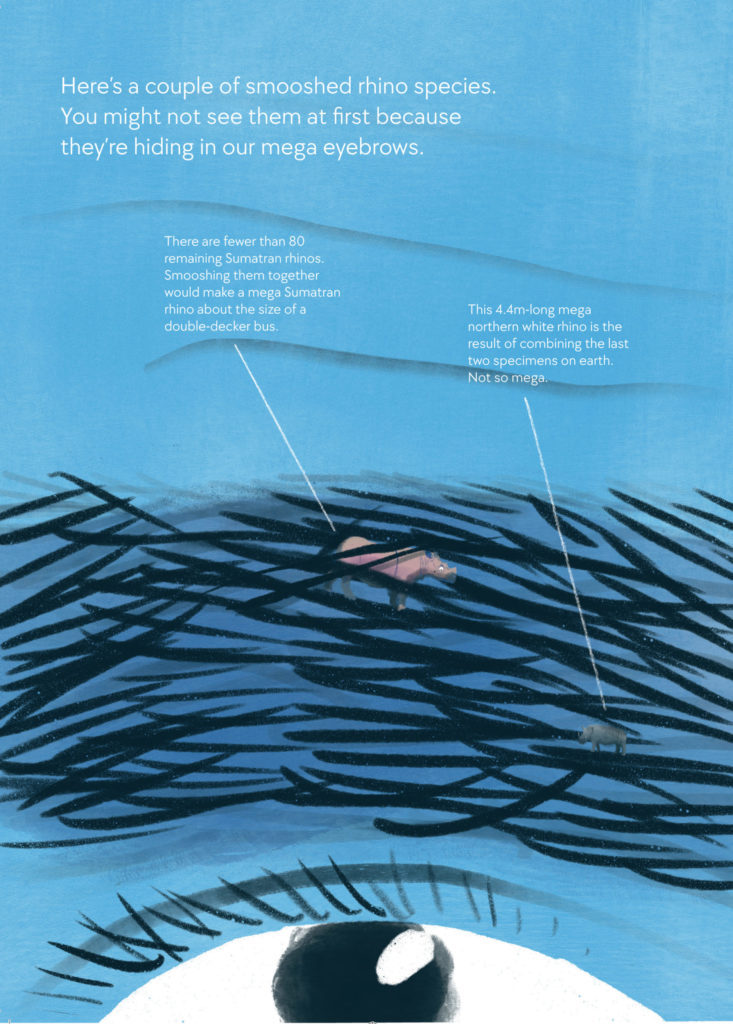
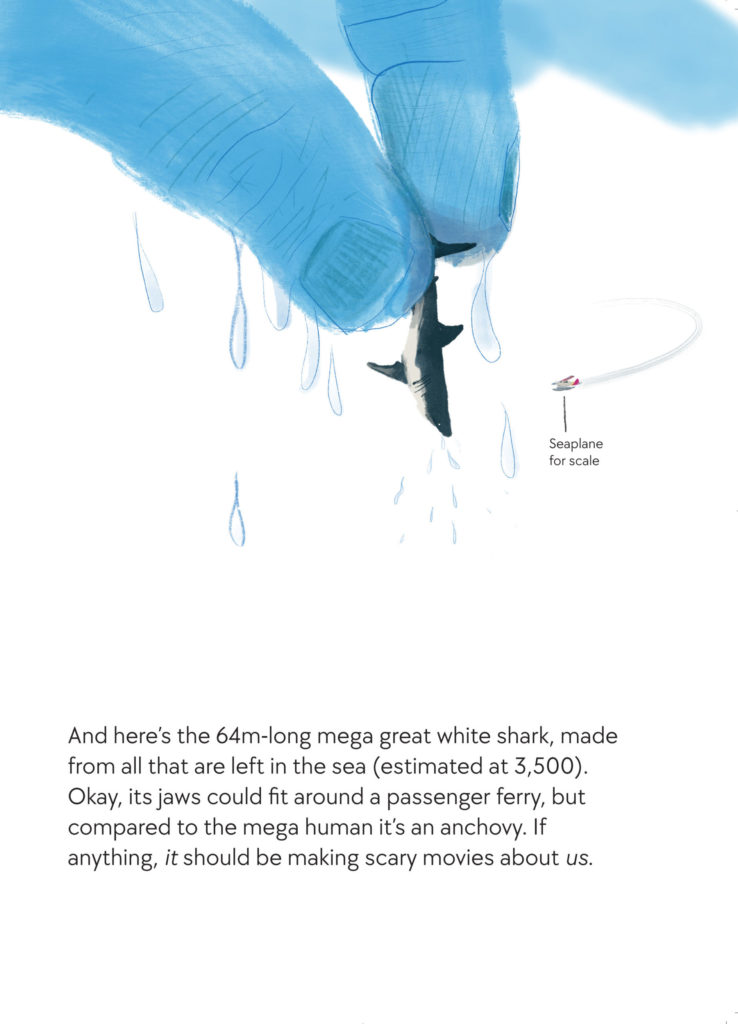
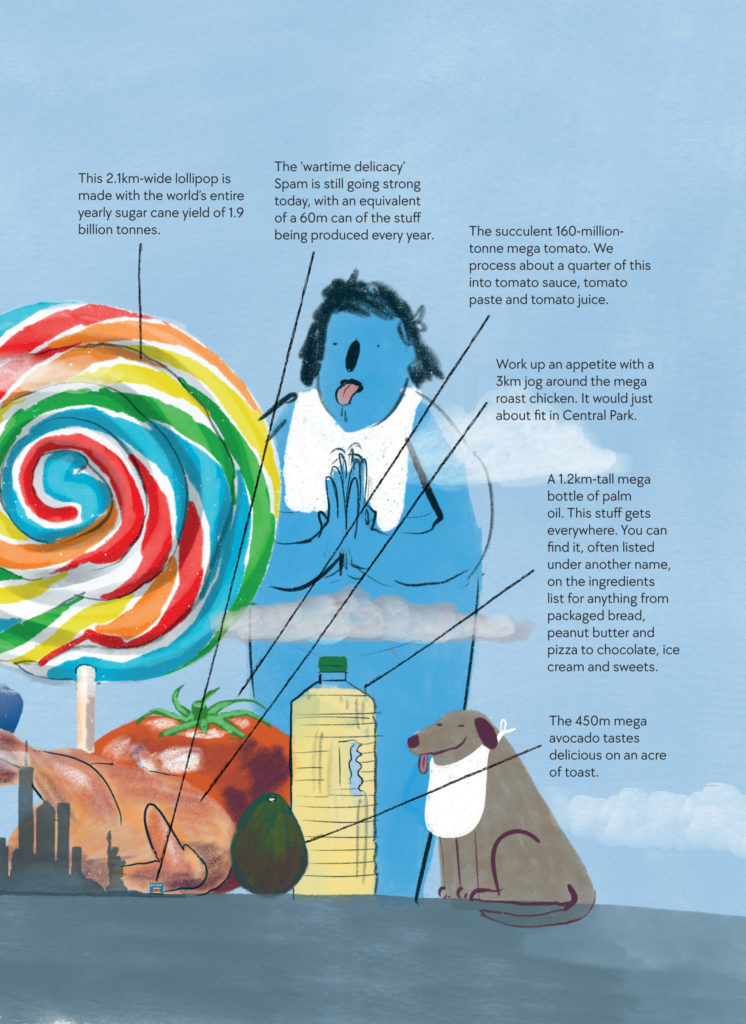
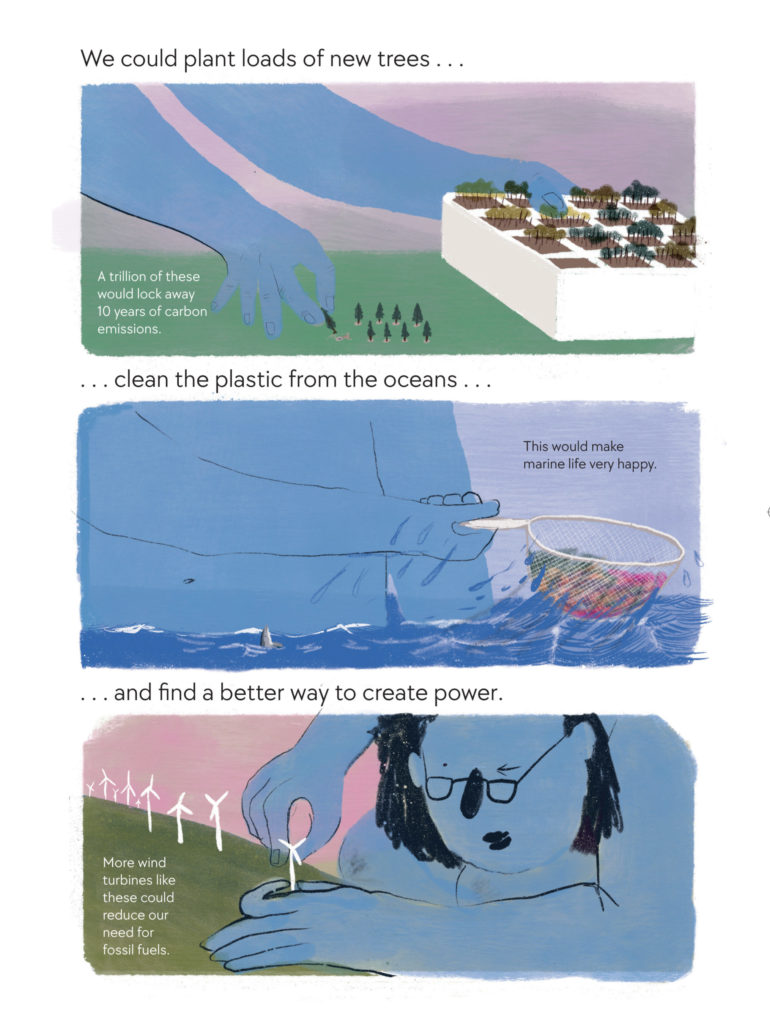
The Biggest Footprint by Rob & Tom Sears is published by Canongate Books, priced £14.99.
At this time of year, it’s usual to see a celeb memoir or two high in the bestseller list. David Robinson reads two that are well worth a spot on your lists to Santa.
Putting the Rabbit in the Hat: My Autobiography
By Brian Cox
Published by Quercus
Baggage: Tales from A Packed Life
By Alan Cumming
Published by Canongate
HOW do you become a star? How do you fascinate, cast an eclipsing spell, persuade the audience that whatever you are making up is really true? Is it all just a matter of getting the biggest, showiest, roles at the right time? Can it be taught and if so how?
These questions lie at the heart of two memoirs published this month – by, as it happens, two Scots who best know the answers. Losing self-consciousness is, Alan Cumming and Brian Cox concur, the key to great acting. Yet as both their books show, their childhoods gave them an awful lot to be self-conscious about.
For Cox, growing up in Dundee’s Brown Constable Street was carefree until he was eight. His debt-laden father’s death plunged the family into poverty and his mother into mental illness (she was hospitalised for over a year when he was ten). Yet Cox has been a star for so long, and been interviewed so often, that much of this is already widely known. So what does his memoir, Putting the Rabbit in the Hat, tell us that isn’t?
First of all, because he clearly hasn’t used a ghostwriter, we get a sense of how his mind works. This is no bland chronological, punch-pulling narrative, and instead hops back and forth across decades. The chapter on his schooldays, for example, leaps ahead to 2010 to make a good point about the naturalness of child actors, then we’re back to Cox daydreaming his way through secondary modern in 1960, and to his love of comics, in particular the Classics Illustrated series. Within a few lines, we’re fast-forwarded to 1997, when he’s filming The Boxer in Northern Ireland and watching its star, Daniel Day-Lewis, carry method acting to extremes. Why? Because twenty years later Day-Lewis gave up acting to become a cobbler and the Classics Illustrated version of A Tale of Two Cities reminded him of that.
This may be convoluted, but it rings true: big themes (here, method acting) often are triggered by the smallest details, and sometimes these can be fascinating. His parents met, he explains, because both their fathers died around the same time. In 1927, that meant three months of wearing a black armband and not socialising. If you wanted to go to a dance, for example, you had to leave town (Dundee) and go to a distant dancehall (Montrose) – which is what they both did, and where they first met.
Yet none of this gets in the way of Cox showing the key turning points in his life, like when he first watched Nicol Williamson at Dundee Rep and discovered the meaning of ‘theatrical presence’ and how a good actor ‘can displace the air’. He’d already got a hint of what was possible from cinema: Spencer Tracey, his mother’s favourite actor, was his too. Studying acting at LAMDA in the early 1960s, a host of other greats soon followed: Olivier, O’Toole, Glenda Jackson, Maggie Smith. All the time, he was watching and learning, catching them in rehearsal as well as performance, just as (fast forward again) he has spent the pandemic months catching up on indie cinema.
He was also working out a lot of things for himself. Brown Constable Street had given him a strong personality, but he had to stop it getting in the way of his acting. School didn’t instil an ability to focus, so he had to learn it. Fulton Mackay, a mentor and friend, taught him not to aim at stardom: just being a good actor was ambition enough. From Michael Elliot and Lindsey Anderson, he learnt how much a good director – one who digs deep into the text rather than fussing about lighting or camera angles – can bring to a production. Anderson, in particular, taught him stillness, how to let the audience come to him rather than demanding its attention – all encapsulated in his classic note: ‘Brian, don’t just do something, stand there.’
Put all of that together, and you can see why Cox is the kind of actor he is. Shakespeare, he says, is spot-on in Hamlet’s advice to the players: holding the mirror up to nature means just that: instead of muddying the text with what he calls ‘front foot acting’, actors should just be its conduit. Acting should be about expiation, about allowing the stage magic hinted at in the book’s title to happen: what it’s emphatically not about is surface show.
Cox doesn’t mince his words here. No matter the megawattage of the star involved, if he doesn’t believe in a performance, he’ll say so. Johnny Depp? Overrated. Tarantino? Meretricious. Kevin Spacey? A great talent, but stupid. Michael Caton-Jones? Doesn’t care enough about the script. Ed Norton? ‘A nice lad but a bit of a pain in the arse’. Gary Oldman’s Darkest Hour? ‘A shallow, crowd-pleasing farrago’. Oldman’s portrayal of Churchill, of course, won him the Oscar in 2017, while Cox’s own ‘more honest’ and ‘better researched’ Churchill that same year did not.
Normally, I would put Cox’s reaction down to sour grapes, but he makes a plausible case for his own film being better. And because of the candour he shows him in other judgments (not least his self-criticism over his failings as a father and husband), I’m inclined to believe him. Actorly forthrightness on such a scale is, frankly, rather refreshing. Where else, for example, can you expect to come across a chapter which opens like this: ‘To explain what I mean about “doing a schtick”, it’s worth looking at the example of Sir Ian McKellen’?
For all his many triumphs – not least, right now, his towering, Golden Globe-winning lead role as media mogul Logan Roy in Succession – he admits that he never has found closure (‘and never will’) over his father’s death. This is something echoed in the very title of Alan Cumming’s book Baggage. The triumphant ending of his 2014 memoir Not My Father’s Son, which seemed to exorcise the ghost of his abusive father was, Cumming now implies, a cop-out. ‘I am a survivor,’ he writes, ‘but not cured’: even at the moments of his greatest triumph, he has felt unhappy and confused, and he still thinks about his father almost as much as he ever did.
The book’s message, he says, is ‘Don’t buy into the Hollywood ending’: damage done in childhood will always be there as ‘a residual virus’: one has just to learn to live with it. And yet, as he charts his career from the collapse of his first marriage to contentment and freedom in his second, from his Broadway-conquering emcee in Cabaret to his starry, fully-packed life today, he makes the Hollywood ending sound completely credible. If his first book showed him confronting his bullying father, in Baggage he not only stands his ground against Stanley Kubrick (‘who found me intriguing because of it’) but also co-leads an actors’ mini-rebellion against X2 director Bryan Singer. It may not be happy ever after, but it sounds close enough …
Then again, two anecdotes from Baggage made me wonder just how accurately art can ever mirror life. While staying with Gore Vidal – a boor when drunk, apparently – he hears him confess that he never was really in love with his school classmate Jimmy Trimble, no matter what he wrote in his memoir Palimpsest. And then there’s Cumming’s Liza Minelli story.
He’d watched one of Minelli’s one-woman shows in New York, in which she told a story about how, when she was 16, she’d invited both her mother (Judy Garland) and godmother to see her perform, even though it was only a ten-second dance solo and miles away. The two women turned up, watched the show, and were in tears afterwards. Neither had a hankie, so Garland got out her powder puff and they dabbed their faces with it. Going backstage, they told Liza what they’d done, and then gave her the powder puff, still stained with her own and Liza’s godmother’s tears. ‘And I still have that powder puff to this day,’ Minelli told the crowd, to cheers and applause.
After the end of that show, Cumming asked her whether that story was true.
‘No darling!’ she replied. ‘None of that ever happened!’
‘And that, ladies and gentlemen,’ he concludes, ‘is show business.’
Putting the Rabbit in the Hat: My Autobiography by Brian Cox is published by Quercus, priced £20.
Baggage: Tales from A Packed Life by Alan Cumming is published by Canongate, priced £18.99
As we gear up for Halloween this week, BooksfromScotland took the time to speak to Alice Tarbuck, author of A Spell in the Wild, about her book and about everyday magic.
A Spell in the Wild
By Alice Tarbuck
Published by Two Roads
Your book A Spell in the Wild is having its paperback release this month. How have you enjoyed its reception with readers since its hardback release last year?
Perhaps the most surprising and wonderful thing has been the number of people who have read the book chapter-by-chapter, and followed through the whole year with it. I think that’s genuinely incredible, to think that people have used the book as a monthly comfort – I’ve had so many people reach out to tell me about the ways that following along with it has changed how they interact with nature in the world.
A Spell in the Wild is part-memoir, part-primer, part-history on magic and witchcraft. What precipitated your decision in writing the book?
The book naturally synthesised out of my doctoral research, and my love of academic research more generally, my private practice, and my experiences of the world – it felt natural to combine all three into something that I hoped would change and broaden the conversation around magic, witchcraft and the esoteric – something with robust research that nevertheless didn’t require you to be any sort of ‘expert’ to access the world you already live in!
It’s very interesting that in the introduction to the book that tell the readers you didn’t think to consider yourself a modern witch until someone pointed it out to you. Why do you think that was the case?
I think often we are still encouraged to believe that witchcraft is an exclusive, initiatory practice, which only certain people can participate in, and only after long training. It turns out of course that this isn’t true at all, but I am very aware that many people still see this model in culture. Its one of the reasons that, with Claire Askew, I teach witchcraft courses – to show people that this knowledge is accessible, its okay, its allowed.
Autumn has arrived now. What kind of practices will you be following in this seasonal change?
Some are very small – more soups and stews, fairy lights, but its also gearing up for Samhain, or Hallowe’en, which is considered ‘the witches’ new year’, so I take that seriously in terms of letting things go from my life that I wish to be rid of, and letting things in that I want to invite.
What do you recommend as practices, as engagements with the natural world, for those who are starting out?
I recommend just opening your eyes to the world – picking up fallen leaves, noticing when the moon is full (an app can help with that) and even just taking more nature photos – whatever opens your eyes!
There’s a practicality in your book, a recognition of what’s possible in any and all environments, to root magic in the everyday. Why is that important to you?
As someone with a chronic illness, and who is aware of how climate crisis affects our planet, and as someone who has grown up in a city, I think its easy when starting out to feel really alienated from the witchcraft of pristine landscapes so often put forward in books of the sort – I wanted to re-situate witchcraft, as occurring where we actually are!
Can you tell us anything about your current writing projects? What else can readers look forward to?
I’m currently working on my first poetry collection!
What have been your favourite books to read this year? What are you looking forward to reading next?
I’m currently enjoying reading Neil Gaiman’s Sandman – better late than never, and can’t wait to read Nina Mingya Powell’s Small Bodies of Water.
A Spell in the Wild by Alice Tarbuck is published by Two Roads, priced £9.99.
Graeme Macrae Burnet’s Case Study has been one of the most anticipated novels of the year, and with good reason – we thoroughly recommend you get a copy as soon as possible! We caught up with Graeme to talk about the books that have inspired him and his work.
Case Study
By Graeme Macrae Burnet
Published by Saraband
The book as . . . memory. What is your first memory of books and reading?
I think it’s of a picture book, Walt Disney’s Wonderful World of Wildlife or something like. On one page was a full colour photograph of the wide open mouth of a snake. This terrified me and I remember throwing the book across the room. But I kept sneaking back to take another peek.
The book as . . . your work. Tell us about your latest book Case Study. What did you want to explore in writing this book?
Well, the only things I set out to explore when I’m writing a novel are the characters and the milieu. In the case of Case Study the central character is a rather unworldly young woman who believes that a radical psychotherapist named Collins Braithwaite has driven her sister to suicide, so she presents herself as a client to Braithwaite under an assumed identity. Collins Braithwaite is a charismatic, somewhat monstrous figure, who inhabits the London counter-cultural scene of 1960s London.
The book as . . . inspiration. What is your favourite book that has informed how you see yourself?
In preparation for writing Case Study, I re-read R.D. Laing’s The Divided Self. It’s a book that I find tremendously insightful, in particular in relation to the way we present different personas (or false selves as he would have it) to the world. I recognise a lot of myself in the behaviours he describes.
The book as . . . object. What is your favourite beautiful book?
I’m very fond of my hardback edition of Marjane Satrapi’s Persepolis. I love the simplicity and poetry of her almost childlike black and white drawings. It’s definitely the book I’ve most often given as a gift.
The book as . . . rebellion. What is your favourite book that felt like it revealed a secret truth to you?
John Newsinger’s The Blood Never Dried, which describes a number of unsavoury episodes in Britain’s colonial past. It was published in 2006, but in an era of increasing jingoism and nostalgia it feels like a very necessary book.
The book as . . . a destination. What is your favourite book set in a place unknown to you?
St Petersburg drips from its every page of Crime and Punishment. I’ve never been there, but I feel that I’ve walked the every street that Raskolnikov walks, crammed myself into his tiny attic room and got sozzled in its grotty bars.
The book as . . . technology. What has been your favourite reading experience off the page?
I think reading Sorley MacLean’s poem Hallaig* on the plaque near the eponymous cleared village on Raasay is a pretty moving experience.
* in Seamus Heaney’s translation
The book as . . . the future. What are you looking forward to reading next?
A couple of things. I have a proof copy of Catherine Simpson’s new book One Body. I loved her memoir When I Had a Little Sister. She has the ability to write about the saddest things while always retaining a sense of humour. Also a book I picked up solely on the basis of its brilliant title: The Standardization of Demoralization Procedures by Jennifer Hoffman.
Case Study by Graeme Macrae Burnet is published by Saraband, priced £14.99.
Deep Wheel Orcadia by Harry Josephine Giles is a magical first: a science-fiction verse-novel written in the Orkney dialect – packed full of treats, and beautiful on the page. Here, we introduce two of its characters: Astrid, uneasy about coming home, and Darling, a martian who wants to discover more about place and people.
Extracts taken from Deep Wheel Orcadia
By Harry Josephine Giles
Published by Picador
Astrid an Darling settle in
Astrid aets wi her fock. “Thoo’ll wirk?”
speirs Inga ower the protein soup.
“A’m here tae draa,” says Astrid. “Tae work
at me art. A’m needan ideas fae haem.”
“Yass,” says Inga, “grand that. Thoo’ll tak
a job or twa fae the rotas forbye.”
Øyvind touches Astrid’s airm.
“Hid’s grand thoo’re haem. Thir plenty time.”
Halfweys roond the staetion, Darling,
breeksed wi sailan, pangit wi hopp,
sits i’the Hoose wi a plaet o maet.
Eynar teuk it tae her, sportan
a apron an a smile. Sheu tryd
tae speir him aboot his fock an the staetion:
he nodded an brustled back tae the bar.
Sheu waatches the fock an aets her maet.
Astrid spaeks aboot the journey,
aboot whit her pals in Mars is deuan.
The wirds is lood in thir peedie quaaters.
Inga an Øyvind’s speuns rudge.
Darling notts a plan on her slaet
o whit sheu waants tae see; she hopps
a smoosie body will ask whit sheu’s deuan.
Naebody deus. Sheu dights her plaet.
Eftir, the both o thaim lie i thir bunks
on conter airms o the Wheel, birlan,
askin thirsels if thir maed a mistaek,
askin thirsels whit wey is a haem
Astrid and Darling settle in
Astrid eats with her folk. “Will you work?” asks Inga over the protein soup. “I’m here to draw,” says Astrid. “To work on my art. I wantneed ideas from home.”
“Yes,” says Inga, “that’s goodbig. And you’ll take a job or two from the rotas as well.” Øyvind touches Astrid’s arm. “It’s goodbig that you’re home. There’s plenty of time.”
Halfway around the station, Darling, knackered from sailing, fullbursting with hope, sits in the House with a plate of foodmeat. Eynar brought it to her, sporting an apron and a smile. She tried to ask him about his people and the station: he nodded and bustlecrackled back to the bar. She watched the people and ate her foodmeat.
Astrid speaks about the journey, about what her friends on Mars are doing. The words are loud in their little rooms. Inga and Øyvind’s spoons gratehackrattle.
Darling notes down a plan on her slate of what she wants to see; she hopes a nosy personbody will ask what she’s doing. Nobody does. She cleanwipes her plate.
Later, both of them lie in their bedbunks on oppositeopposing arms of the Wheel, whirlrushdancespinning, asking themselves if they’ve made a mistake, asking themselves whathowwherewhy a home is.
Astrid sketches Orcadia
Sheu trails a finger ower her slaet i’the curve
o her planet, than wi a canny swirl bleums
hids swaalls o yallo an corkalit. Wi shairp
stroks, the airms o Central Staetion skoot
atwart the screen, an peedie tigs an picks
mairk oot the eydent piers o Meginwick
i’the corner o her careful composietion.
An lukkan oot the peedie vizzie-bell,
doon the taing o Hellay, airm o the kirk,
the dammer o the Deep Wheel surroondan her,
Astrid feels hersel faa, an lift, an faa.
Liv oot, sheu dights the natralism fae
her slaet, an stairts ower again, abstrack,
wi only the nirt o the thowt o coman haem
an odd gittan seean that peedie odds:
black lines fer the starns, blue dubs
fer the tides, green aircs fer the grand skail
o wheels an airms an bolas gaithered roond Central.
Mindan her lessons fae college, sheu follows sense
intae shape, an shape intae color, an noo sheu’s closer
tae the grace ootbye, but closser maks more o a ranyie.
Again her dightan liv. Again a blenk.
Astrid steeks her een an haads the device
tae her chest, sam as her braethan wir liftan Orcadia
tae the surface. But the screen bides skarpy,
an the view bides stamagastan, an Astrid
settles back tae waatch an braethe an mynd,
her fingers restan jeust abeun the slaet.
Astrid sketches Orcadia
She trails a finger over her slate in the curve of her planet, then with a skilledwisemagicalcautious swirl blooms its swellwaves of yellow and scarlet dye. With sharp strokes, the arms of Central Station jutthrust acrossover the screen, and little taptwitchteases and tapchaptakes mark out the constantindustrious piers of Meginwick in the corner of her careful composition.
And looking out of the little viewsurveystudyaiming-bubblebell, down the promontory of Hellay, arm of the church, the shockstunconfusion of the Deep Wheel surrounding her, Astrid feels herself fall, and lift, and fall. Palm flat, she cleanwipes the naturalism from her slate, and begins again, abstract, with only the crumbknot of the thought of coming home and growing strangedifferent from seeing so little difference. Black lines for the stars, blue poolpuddlemuds for the seatimetides, green arcs for the goodbig scatterspreadspill of wheels and arms and bolas gathered round Central. Rememberknowreflectwilling her lessons from college, she follows sense into shape, and shape into colour, and now she’s closer to the graceglory outside, but closer makes more of a writhingpain.
Again her cleanwiping palm. Again a blankblink. Astrid shutdarkens her eyes and holds the device to her chest, as if breathing was lifting Orcadia to the surface. But the screen waitstaylives barethinbarren, and the view waitstaylives bewildershockoverwhelming, so Astrid settles back to watch and breathe and rememberknowreflectwill, her fingers resting just above the slate.
The pieces Darling’s been
Fer her coman o age she asked o her faithers
a week’s resiedential on Aald Eart.
Nae Ball, nae press confrence, nae giftid
Executiveship, nae ship, even,
tho aa her brithers wis taen the sleekest
o sublight racers. Thay naeraboot
imploded, but sheu wis inherieted airts
an negotiated the week as traed
fer a simmer wirkan at senior manajment.
Mars simmers is ower lang.
That wis the stairt o her travaigan.
Foo wi the guff o fifty square mile
o aald equatorial rainforest, no
landscaepid ava, sheu kent
sheu wadno gang haem, but see as gret
a lot o the seiven starns as sheu coud.
Sheu peyed a ecogaird tae mairk her
on the wrang manifest, an fleed. She saa
the Natralist munka-hooses on Phobos,
whar papar refused ony maet treated
wi more as fire, praeched wershy beauty.
Sheu saa a demonstraetion station
o sepratist Angles: bred, snod,
rich, blond, an weel-airmed.
Her faithers’ credited wirds – first barman,
than teely, than dortan – trackid her
fae Europan federal mines tae stentless
pairties orbitan Wolf. Thay wir even
bowt bulletin time on the ansible network.
At lang an at lent sheu tint thir trackers
on the unregistered Autonomist traeder
whar, awey, sheu teuk her new name
an body an face, whar sheu teuk time
tae cheuss an recover, at teuk her here
tae Orcadia, the innermosst Nordren staetion,
aence the edge, aence the centre,
pangit an empty yet, wi Darling,
eftir peyan her rodd ower that
grand a piece o space, lukkan
fer a peedie piece tae listen an leuk.
The placesdistancepartwhiles Darling’s been
For her coming of age she asked from her fathers a week’s residential on Old Earth. No Ball, no press conference, no gifted Executiveship, no ship, even, though all of her brothers had taken the sleekest in sublightspeed racers. They almost imploded, but she had inherited skilldirectiongrift and negotiated the week in return for a summer working in senior management. Mars summers are very long.
This was the start of her roamingramblingtravels. Drunkmadfull on the stinkpuffsnortnonsense of fifty square miles of old equatorial rainforest, not landscaped at all, she knew she wouldn’t go home, but see as much of the seven stars as she could. She paid an environmental quarantine agent to mark her down on the wrong manifest, and flew. She saw the Naturalist monasteries on Phobos, where holies refused any foodmeat treated with more than fire, preached thinwatery beauty. She saw a demonstration station of separatist Angles: trainbreddrilled, cleantrimabsolute, rich, blond, and well-armed. Her fathers’ moneyrespected words – first ragefrothseething, then pleadwheedling, then sulkforsaking – tracked her from federal mines on Europa to unrestrainedendless parties orbiting Wolf. They had even bought time for a bulletin on the ansible network. At long last and after much effort she lost their trackers on the unregistered Autonomist trader where, awaydeaddistracted, she took her new name and body and face, where she took time to choose and recover, which took her here to Orcadia, the Northern station closest to the galactic centre, once the edge, once the centre, fullbursting and empty still, with Darling, after buypaying her way across such a goodbig placedistancepartwhile of space, looking for a little placedistancepartwhile to listen and look.
Deep Wheel Orcadia by Harry Josephine Giles is published by Picador, priced £10.99.
Mara Menzies is a supreme storyteller on the stage and the page who draws upon her rich, dual Kenyan/Scottish cultural heritage to explore her life and the world around her through myth, legend and fantasy. We hope you enjoy this extract from her beautiful book, Blood and Gold.
Extract from Blood and Gold
By Mara Menzies
Published Birlinn Ltd
Rahami and a New World
It is commonly known that death is the most absolute thing in the world. Even though it may arrive at an altogether inconvenient time, it will most certainly arrive. Rahami, Jeda’s mother, had never considered the possibility that it would happen to her. She was a young, beautiful woman. Beautiful because she was sure of herself. She walked with grace and poise. She moved through the cobbled streets, glancing upwards at the exquisite stone buildings, their spires, domes and turrets disappearing into the haar, that thick, magnificent fog that rolled in from the sea and hung low over the city. Wherever she walked, people turned to marvel at this woman whose skin glistened like the midnight sky. They noticed the thickness of her lips, the sway of her hips, the casual confidence she exuded with a flick of her wrist or a slight tilt of her head. She smiled, for despite the differences she knew she loved this place as much as the distant land of her childhood.
Rahami loved words. As she peered through the ghostlike haze she mouthed haar. She had learnt it from a talkative stranger eager to share the wonders of his city. She liked the sound of it. It rolled off her tongue so easily. It was soft and gentle.
She thought of the old stories she had heard of this place. Women accused of witchcraft and sentenced to death. Fresh bodies stolen from their graves and sold for the advancement of science. Murder, torture, incredible wickedness! She imagined that in this magnificent city many of these stories had likely taken place under the cloak of the haar. It lent an air of mystery to everything it touched. Quite perfect for committing a crime.
When she had first arrived, she had tried to fit in, changing her clothes to mirror the grey and the dark. After a few years she realised that even though she was now of this place, she would likely never be seen as fully belonging, and so she decided there was absolutely no need to blend in at all. This city was hers regardless, and so she returned to wearing the bright clothes that spoke to no era or trend. She danced as the buskers played, her body remembering steps from a different world but which matched the rhythms so perfectly. She laughed loudly in places where silence was expected, spoke her mind regardless of who was present.
One day, as she meandered through the streets, she was struck by the striking red stone exterior of an ancient building close to the city centre. Realising it was a portrait gallery, she walked in, keen to learn more about the people so greatly admired for having contributed to this great city. A young man with scruffy brown hair was looking around and was drawn to her inquisitive spirit. There was a curiosity about him that appealed to her. He was nervous and made a terrible joke. She laughed. He smiled and told her of some of the faces he recognised in the paintings. She seemed genuinely interested. He asked if he might take her out. When she agreed, he planned the perfect date, a slow meal and a walk on the beach.
As the sun set, he found her fingers enveloping his. She smiled, and as he gazed into her sparkling eyes he thought that she was perhaps the most beautiful person in the world. They spoke, sharing stories of their lives, their thoughts, their dreams, their ambitions. They agreed to meet the following day, and then the next. They spent increasingly more time together, and Rahami began to notice how the blue of his eyes reminded her of an ocean she once knew, many thousands of miles away. Her eyes followed the curve of his jaw, and when she noticed the thinness of his lips, she began to wonder if those thin lips knew what lips were supposed to do.
Those lips must have spun a web of sweet words around her, as soon the two of them were inseparable. A few years later her skin tingled and trembled as those thin lips sealed their marriage with a kiss and it was not long after they were blessed with a beautiful daughter. They named her Jendayi, for though her birth had been long and arduous, she had arrived safely with a sweet smile. As her grandmother’s name had been Jendayi, which meant gratitude, it appeared to be a perfect fit.
A tiny girl with skin the colour of gold, the thick, full lips of her mother and the round wide eyes of her father. Jeda, for that is how she came to be known, was very much loved. She was a wanted child, and she knew it, for her parents did their best to fill her life with joy.
Jeda and her father would spend the days creating wonderful new things together, using glorious shades of colour and light to bring them to life, but in the evening her mother would fill her world with words. They would snuggle in close together, and Rahami would take a comb and braid her daughter’s hair. She would reach back into her childhood, remembering the stories her father had told her. Stories of the hyena men and the snake women who disguised themselves as beautiful strangers, arriving in villages and tricking gullible young people into marrying them before stealing them away to their fate.
While Jeda had never travelled to the place of her mother’s childhood, she knew it vividly through these stories. She heard of talking chickens, eagles with sparkling, vibrant feathers and a magic needle to whom the rainbow willingly surrendered her colours. Her eyes widened in wonder as she imagined the sheer power of the deities who hurled each other across the Universe: the Mother of Fish in her robes of blue, the awesome power of the deity of beauty and divinity whose yellow skirts flowed as she danced around the world. Time and time again Jeda would insist on hearing the tale of the old hunched woman who, tired of the sky weighing down on her shoulders, furiously knocked it back up into the heavens with her walking stick, where it remained to this day.
But often Rahami would share the stories she had learnt in her new world.
‘Tell me, Jeda,’ she would begin, ‘what would you do if you met a wolf in the woods?’ Then she would weave her story, leaving the child spellbound.
The child grew up with stories of changelings and selkies, of the bogle, of the wandering poet who rode on a horse through the skies holding on to the fairy queen, wondering at the rivers of blood and tears below. She learned of the soldier forced to leave his loved one and how they would never again meet by the bonny, bonny banks of their beloved loch. She heard of princesses flinging their hair out of tall towers and children abandoned to the forest because there was not enough food for them to eat at home.
‘Did the witch die?’ Jeda asked, after hearing what happened following the discovery of a gingerbread house, but Rahami would extend the mystery and leave things unsaid. Fuelled by these stories, Jeda many a time imagined herself playing the roles of warrior, ruler and healer, her dreams being so intense she woke up exhausted. Other times, she lay there, awake, a silly smile plastered over her face.
‘Sleep, precious one,’ Rahami would say, as she gently kissed her daughter’s cheek and stroked her hair before closing the bedroom door behind her. years later, Jeda would remember these moments as perhaps the happiest times of her life.
- • •
How wonderful it would have been if everyone loved those stories as much as Rahami and Jeda, but that was not the case. Rahami’s best friend was Aunty, a larger, more opulent version of herself. While Rahami was quiet, Aunty was loud. While Rahami was not overly keen on shopping, Aunty would often arrive laden with bags, exhausted but happy. While Rahami preferred the natural look, Aunty would deftly fold the fabric of richly coloured headwraps into magnificent shapes that framed her face perfectly. Her mascara was thick, her lips a bright red and her numerous handbags were filled with all kinds of interesting niceties.
‘Aunty is coming, sweetheart!’ her mother would say.
‘you’re going to Aunty’s house!’ said her father.
‘Come, greet Aunty!’ Aunty would exclaim as she threw her arms out wide to embrace Jeda. As a child, Jeda never knew her by any other name. The comforting smell of warm bread and cinnamon surrounded her.
Jeda sometimes had the feeling that if Aunty squeezed a little harder she would be sucked into her enormous bulk and disappear forever. But she loved Aunty. There was always something to eat whenever she was around. In fact, if there was no food available within five minutes of Aunty requesting some, she would become visibly annoyed. And if Jeda refused to sit and eat with her, out would come one of her famous sayings: ‘Jeda, if someone eats alone, how can they discuss the taste of the food with others?’
Jeda never knew how to respond to that one, so she would always feel obliged to have a little something, even if it were just a bite.
While Aunty loved spouting words of wisdom, she was less keen on stories. It always began with a kissing of the teeth and a roll of the eyes. ‘Why? Why do you insist on telling her this nonsense?’ she would say to Rahami. ‘She will start having crazy ideas.’
‘Nothing wrong with crazy ideas!’ Rahami would retort, and Jeda would feel a little wave of exhilaration, imagining her mother as David defeating the giant Goliath.
‘Does she know of the Sermon on the Mount? Hmm? How He fed the five thousand? Be wary,’ Aunty would warn, ‘the road you are walking. Stories can be dangerous!’
‘And that is why I am so lucky to have you. you tell her those stories. There are too many others I want to share,’ Rahami would reply, before jumping up, kissing Aunty on the head and attending to something.
Aunty would inevitably raise her eyebrows, gesticulate wildly or furiously cross her arms. Jeda would always leave the room at this point, fearful of being drawn into a loud battle, but had she waited a few minutes she would have found them laughing loudly over some nonsense in the kitchen, chattering away in a language she did not understand.
Blood and Gold by Mara Menzies is published Birlinn Ltd, priced £12.99
Victoria Williamson has loved Burns’ poetry since she was in school, and her latest book for children Hag Storm takes ‘Tam o’ Shanter’ as its spooky inspiration. Here she tells us how Burns has influenced her throughout her life.
Hag Storm
By Victoria Williamson
Published by Cranachan
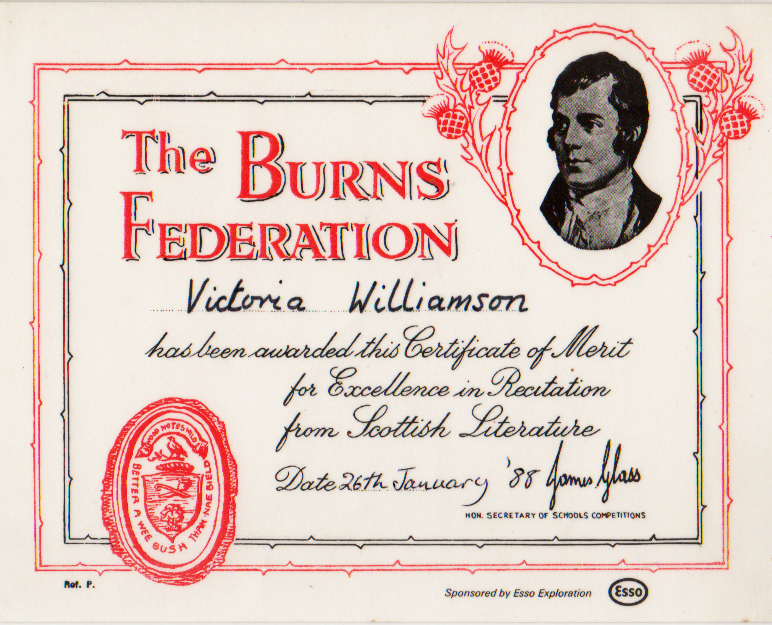
The dedication at the front of my new children’s book reads, ‘For Mrs Stewart, who first introduced me to the poetry of Robert Burns during a memorable year in Primary Four.’ It was during this year when I was eight, that I first learned about the poetry of Robert Burns, and seeds of the story that would grown into Hag Storm over thirty years later were sown. My school ran an annual Burns competition every January, supported by the Burns Federation (now the Robert Burns World Federation). We studied the poetry of Burns, discovering more about the meaning of Scots words and the history of the period, before learning to write and recite his poems. To this day, I can still remember the inspirational ‘A Man’s a Man for a’ That’, the stirring ‘Scots Wha Hae’, and the poignant ‘To a Mouse.’ But it was ‘Tam o’ Shanter’ that really captured my imagination, and I found the story of witches at Halloween both spellbinding and spine-chilling all at the same time.
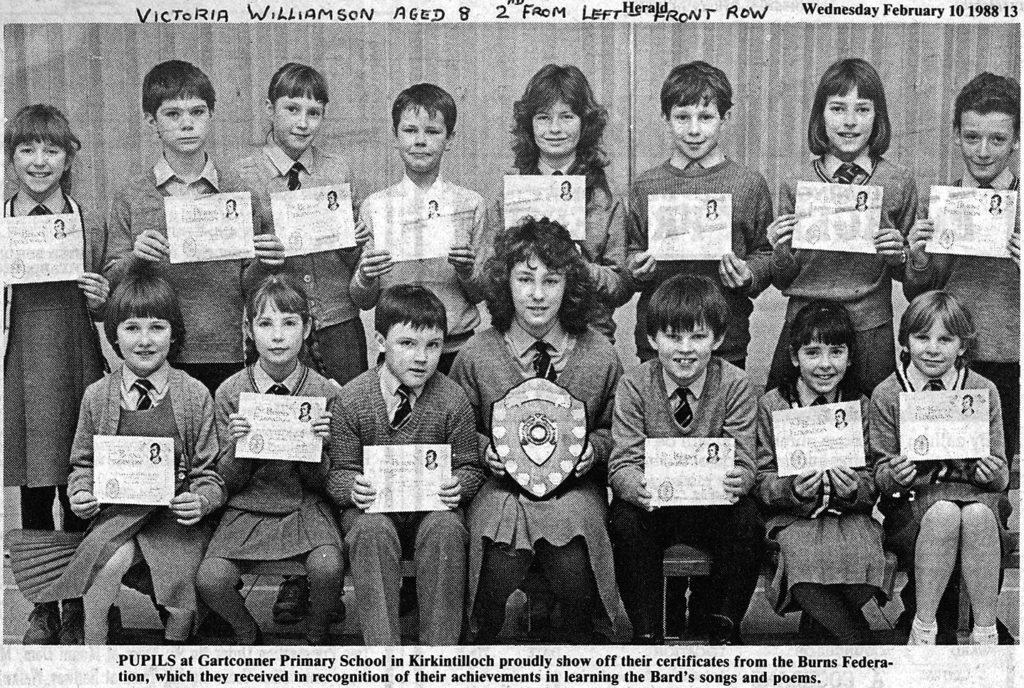
I’ve always loved autumn ever since I was a young child. Some of my earliest memories are of kicking up the red and orange leaves that covered the path on the way to drop my older brother off to school when he started primary one. Just up the hill from our school in Kirkintilloch was a farm estate full of ruined Victorian buildings, an overgrown walled garden, and spooky forest walks. In the autumn it was a place of magic. When the sun was shining, gleaming conkers were piled on the ground, the biggest ones hanging tantalisingly out of reach high up in the old horse chestnut trees. But come late afternoon, the sun would drop low over the fields, shrouding the forest trails in darkness and mystery. It was the perfect place to imagine witches holding secret meetings by moonlight, and looking out of my classroom window in primary four, I could see where the tree line began at the edge of the fields. I’d never been to Alloway, so when we began studying the poem that told the tale of Tam’s encounter with the witches in the Auld Kirk, and his desperate dash to safety on his horse across the Brig o’ Doon, I imagined it all taking place in the forests at the top of the hill. In my head the Auld Kirk was one of the ruined buildings in the Gartshore Estate, and the bridge was a crossing over the Luggie river that ran through Kirkintilloch.
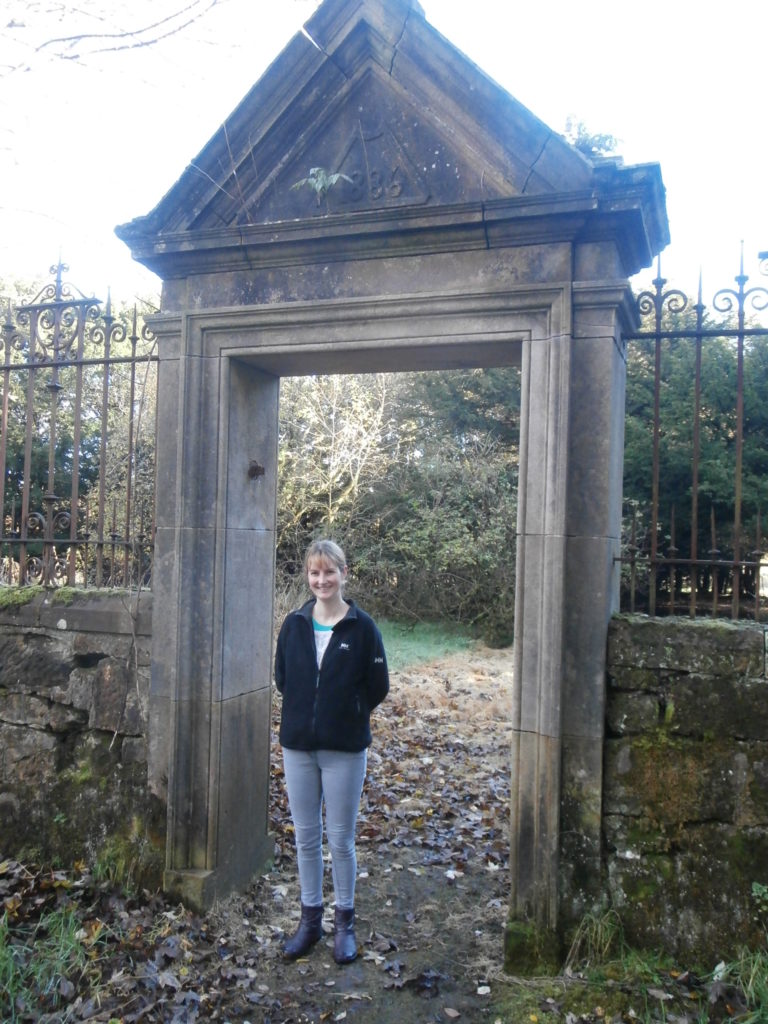
I didn’t get to see the ‘real’ scene of Tam’s flight from the witches until I visited Alloway for the first time in 2003. Learning about his early life in the old cottage turned-museum where Burns was born, all of the poems I’d studied as a child seemed to come to life, sparking the idea of a novel about ‘Rab’ not as an adult, but as a boy growing up in a world full of folklore and tales of the supernatural told round the kitchen fire on dark nights. Despite the fact that it was a warm June day, the Auld Kirk seemed full of full of mystery and suspense, and the bridge over the River Doon looked just as dramatic in the sunlight as I’d imagined it by the light of the Halloween moon all those years ago when I’d first heard about Tam’s dash for the keystone.
I still have the Burns competition certificates and photographs from my school years, and even the original short summary I wrote of ‘Tam o’ Shanter’ when I was in primary four. But the most important keepsakes from my years studying Burns in primary school are my love of his poetry, and the story of Rab as a boy that was sparked by ‘Tam o’ Shanter’ and my first visit to his birthplace museum. Researching the life of Burns for my book has led to a desire to discover more about the historical and social contexts that influenced his poetry. I recently began a course through the University of Glasgow’s Centre for Robert Burns Studies which looks at the life, works and legacy of ‘the Bard’, and for anyone who would like a chance to explore his work further online, they also run a wonderful free course twice a year in January and July:
I’m hoping that my retelling of Rab’s early life which is based partly on historical research, partly on ‘Tam o’ Shanter’, and partly on my own wild imaginings of Halloween, will help children discover a love of Burns for themselves. It’s thanks to my teachers, and to the Burns Federation, that I got the chance to learn about Burns and his poetry, and without that early introduction, this book would never have been written. In recognition of that, and in order to support the great work that’s done to promote children’s appreciation of the poetry of Burns in schools, twenty percent of my author royalties for Hag Storm will be donated to the Robert Burns World Federation.
Hag Storm by Victoria Williamson is published by Cranachan, priced £7.99.
In a time when there is still a small amount of anxiety about dancing the night away (and sometimes morning!) in loud, crowded, sweaty clubs, Voodoo Daze is a collection of short stories and poetry by Jason Golaup and Stephen Watt , that is a welcome celebration of the heady days of clubbing in the ’90s. Enjoy these extracts with your hands in the air!
Extracts taken from Voodoo Daze
By Jason Golaup and Stephen Watt
Published by Speculative Books
St Vitus
People in Germany celebrated the feast of Vitus by dancing before the Saint’s statue. This dancing was named “Saint Vitus Dance” and was given to the neurological disorder ‘Sydenham Chorea’ which is characterized by rapid, irregular, and aimless involuntary movements of the arms and legs.
inside some lollygagging bubble
of light,
everything brakes right down
into slow motion film
for this crucial moment in history
when the room is a flashlight inside my mind.
Utopia. Arcadia. Nirvana.
Sawdust of the promised land
sprinkles from beams
and like a dream, our postman emanates,
throwing shapes in large, white baggy robes
like an archangel; or pasty as a ghost.
He wears a stethoscope
but our doctor and liberator
is aglow in lasers, juggling chemicals
like fireballs, shaking his raver’s
elongated tentacles to subwoofer decibels;
a wacky waving inflatable man
sky-dancing on this song’s invisible molecules.
We name him St Vitus:
Patron Saint of the dancers, the ravers
(as well as comedians and actors).
Upon the podium, our postman dances,
rushes, flushes, rages,
momentarily forgets his wages
to lose time and break on through.
I’m in love with you. Want you to love me too*.
All bodies, here, dancing before his statue.
*Lyrics taken from N-Joi “Anthem” (1990)
Number Ten’s Commandment: Thou Shalt Not Party
Ye hud high unemployment n picket lines. Boays Fae the Black Stuff showin families livin oan the breadline, survivin aff scraps like they feral Harpies in Jason n The Argonauts.
Oan the other side ae the coin, yuppies wur quaffin in snazzy wine bars. Harry Enfield wis actin pure gallus wae a wad a banknotes yellin, ‘LOADSAMONEY!’ at ye.
Nae wunner thur wis a reaction.
House music wis croassin ower fae Chicago n Detroit, infiltratin oor inner cities n housin schemes. Yur boay here wis a bona fide denizen ae Easterhoose, a notorious housin scheme in Glesga. So, I wis ideally positioned tae tune intae it.
Yon Roland TB-303 bass synthesiser wis the catalyst. Maaan… ah found its squelches so addictive. Acid house n smiley culture wur borne n the tabloids wurnae slow tae latch oantae it. They reported oan the acid house craze thit wis sweepin the country, but portrayed it as a passin fad thit wid blow ower like a house a kerds – jist kids in fluorescent apparel, flingin thur erms in the air n chantin, ‘ACIEEEEED!’
The innocence didnae last. They tabloids soon cheynged thur tune wae features like ‘10 Reasons tae Say Naw tae Evil LSD’. We wur labelled as disaffected youths gittin spaced oot oan drugs at illegal werrhoose parties n raves, which screamed right intae the heids a parents who’d thoat thit thur weans wur merely gaun oot in psychedelic colours n dancin like heidcases.
Celebration: The Sound ae the North hud the gen oan the Madchester buzz – music, fashion, art, so many creative personnel talkin aboot the city n that. Wan clip thit captivated me wis a berr chisted dude whose pupils wur that dilated ye coulda flown a jumbo jet through thum. He wis ravin his face aff tae Don’t Miss the Partyline till WHAM! – ye hear the sound ae a prison cell door gittin slammed.
Ye wur never gonnae miss Maggie Thatcher’s party line. Acid house? Pfff. They musta been steyin in wan – The Acid Houses a Parliament – cos they came up wae a Bill tae ban gatherins ae merr thin twinty people listenin tae repetitive beats.
Whit?! Bannin folk fae listenin tae repetitive noayses? Wur they aw sittin aboot werrin earmuffs in therr cos aw ye hear is sarcastic groans n, ‘Order, order,’ sarcastic groans n, ‘Order, order,’ sarcastic groans n…
Whit kina hallucinogenics wur they oan tae dream up a Bill like that? They shoulda been puntin that gear oot at the raves thumsels if it wis that powerful. N don’t kid me oan thur wurnae any peeved aff young renegade Tory ravers. Visualise it troops: wan a Maggie’s posse ravin and coinin it in oan the auld LSD (pounds, shillings, n pence) spreadin the flow a tablets, giein The Vicky tae Thatcher; thus, spreadin a drug problem thit The Iron Wumman wis tryin tae eradicate.
Did we kerry oan ravin jist tae challenge authority? Nahhh. We never saw oorsels as rebels. We wur young. Daein the hings thit ye dae whin yur young. It wis 1990. Our Summer a Love. Ah felt electrified tae be part a somethin thit wis thrivin within a free-spirited n vibrantly creative climate.
Ah wis as happy as a sandboay compilin mix tapes in ma bedroom. Acid house merged wae Madchester, techno, n rave, creatin wan monumental cauldron thit wis burnin in ma soul n makin me feel like ah hud an identity. Ah cut through Easterhoose wae ma ghettoblaster in tow, hypnotisin strangers tae the beats; n those strangers became friends. Huddled roon a ghetto thit’s pumpin euphoric chants, mechanical rhythms, n bleeps mighta satisfied many a teenager. But we craved merr. We became rave junkies n went ravin at Peggy’s nightclub, meetin other likeminded souls; ultimately discoverin thit yur no a solitary aficionado ae rave culture cos thur’s others oot therr fae aw ower Glesga n beyond.
Ferr do’s – a bit a rave anarchy did occur en route tae Peggy’s oan the fifty wan. The bus hudnae even goat ootae Queenslie yit whin Vinny Lambie went, ‘COME ON AH THOUGHT THERE WAS A PARTY IN HERE!’ aff Awesome 3’s rave anthem Hard Up n booted a windae in. The alarm went aff so we even goat the sounds ae oor ain rave horns. But everybody bolted in fear ae additional sirens wae flashin lights fae the Easterhoose polis.
Ah never did fathom Vinny’s reason fur daein that. Mibbe he thoat thit he wis wan ae they Harpies n wahnted tae fly oot the windae tae Peggy’s insteid ae takin public transport like the rest ae us.
Voodoo Daze by Jason Golaup and Stephen Watt is published by Speculative Books, priced £9.99.
Bobby Gillespie’s memoir Tenement Kid takes him from his childhood days in Glasgow, through to his cultural awakening when Punk came along, to his early days of music stardom with the iconic The Jesus and Mary Chain and Primal Scream, ending just as the seminal Screamadelica is released. Enjoy this collection of songs that were childhood favourites, and formative memories.
Tenement Kid
By Bobby Gillespie
Published by White Rabbit Books
She Loves You – The Beatles
Although his mum was more of a Stones fan, Bobby Gillespie’s earliest recording is of him singing along with The Beatles.
Cryin’ Time – Ray Charles
Moanin’ the Blues – Hank Williams
San Quentin – Johnny Cash
Where’s the Playground Susie – Glen Campbell
Streets of Baltimore – Charley Pride
Rip Off – T Rex
Time – David Bowie
Hellraiser – The Sweet
Hellraiser was the first single Bobby Gillespie bought in 1973.
This Flight Tonight – Nazareth
Next – The Sensational Alex Harvey Band
I’ve Got the Music in Me – Kiki Dee
Don’t Believe a Word – Thin Lizzy
Bobby Gillespie’s first gig was Thin Lizzy in Glasgow’s Apollo.
Tenement Kid by Bobby Gillespie is published by White Rabbit Books, priced £20.00.
Part-girl, part-cat, Avery Buckle has always known she’s a little different (after all, her tail is a bit of a giveaway). What Avery doesn’t yet know is that she is the only one who can uncover a forgotten magical secret and bring back a great lost wizard… Winner of The Kelpies Prize, The Spellbinding Secret of Avery Buckle is a warm, quirky magical debut novel from a wonderful new voice in children’s fiction. Full of magical heart, it’s a perfect October read for children aged 8-12.
Extract taken from The Spellbinding Secret of Avery Buckle
By Hannah Foley
Published by Kelpies
Her tail was the reason Avery always went to the school Halloween disco dressed as a cat. Halloween was the only time in the whole year when she could show her tail and no one would bat an eyelid. If you had asked her, she would have said it was just part of her, in the same way that Low wore glasses or some of the kids in her class spoke different languages. She would have said it was a ‘normal difference’.
But deep down Avery knew nobody else had a tail, and although it was great for helping her balance and climb where no one else could, it did make sitting neatly in class very tricky. And because no one else had one, Avery kept her tail hidden under her clothes, except on Halloween.
*
Inside the disco, Avery swept across the floor, an ink‑black silhouette against the dancing lights of red and gold and green. Witches and monsters, ghosts and devils wheeled around her. Avery’s tail flew out behind her, seeming to curl gently this way and that of its own accord. She felt a thrill of freedom. Tonight, for once, she could just be herself.
Low ran up to her, all feathers and beak, dressed as an owl. ‘So, what do you think?’ he asked, arms held out so she could fully admire his costume mastery.
‘Brilliant!’ she grinned. ‘It suits you.’
He grinned back. ‘Have you tried these wriggly worms? I don’t think we had them last year.’ He offered her a crumpled paper bag full of warm, sticky worm-shaped sweets.
She grimaced. ‘I think I’ll pass, thanks.’
Low shrugged. ‘Don’t you get bored of always coming as a cat?’ he asked between enthusiastic chews. ‘Your tail’s always cool, though ‒ will you let me try it on?’ Before Avery could stop him, he’d given it a hard pull.
‘OW!’ Avery yelped, glaring at him.
‘Avery!’ Low stared back, mouth open, a half-chewed gummy worm in danger of escaping. ‘Your tail, it’s… it’s a-attached. And it’s warm… like it’s… r-real!’
But Avery didn’t get the chance to reply. Suddenly, there was a high-pitched screeching sound and the music came to an abrupt halt.
The disco lights flickered and then went out, plunging the school hall into thick darkness. Then there was full‑scale panic; children screamed, and bodies bumped and bounced off each other in the chaos.
Avery froze.
Something didn’t feel right. Something was far more not-right than a simple blackout at the school disco.
She had the creeping, uneasy feeling again; she could sense a dark, menacing presence.
Avery looked around the hall with dread. Her night vision (a handy benefit of being part cat) helped her to see movement through the pitch-black. She stared in horror as a dense shape began to grow out of the floor. Within it was a writhing, thrashing mass of shadowy creatures.
Avery’s heart pounded.
‘There was someone watching in the shadows!’ she whispered to herself in horror. ‘I didn’t imagine it. And now they’re here, and they’re after me!’
The thought hit her like a speeding train. She didn’t know how she knew this with so much certainty, she just did, deep down in her heart. She knew they were bad, and she had to get away. But where was Low?
Avery could feel the shadows slithering and snarling, hissing doom and destruction into the air. Above the shifting shapes she could make out teachers directing children to safety, but they couldn’t see the creatures in the darkness – the creatures that were coming for Avery.
She had to get out.
Swiftly and silently she dodged through the crowds, deftly winding her way until she found the exit. But out in the foyer more writhing shadows blocked her path, snatching out for her with long twisting arms. They had no real faces, no eyes or noses, but Avery could see rows of small sharp teeth in gaping mouths and black, flicking tongues. She backed away, groping with her hands against the wall, until she reached out into empty space.
The door to the kitchens.
She dived inside, knocking a stack of pans off a work surface with a clatter. The lights were out in here too, but Avery could make out her surroundings enough to be sure there was no way out.
Panic filled her, and she unconsciously put her hand in her pocket, wrapping her fingers around her collection of objects. She closed her eyes and felt her heart steady, her mind clear. Wasn’t there supposed to be some way up into the school attic from the kitchens?
She began opening doors, finding only cupboards, then, with a flood of relief, discovering a steep staircase behind a latched door. Avery leapt up the steps and heaved the cover of a wooden hatch out of the way, then pulled herself through and crouched on the edge of the hole.
The attic smelt musty, and it was littered with broken chairs. A square of moonlight at the furthest end illuminated the slanting space.
A window!
Heart pounding, she sprinted for it, not daring to look behind her. She imagined the shadowy figures filling the kitchens below her like smoke.
Bright stars pricked the night sky outside, but no matter how hard she pushed, the window wouldn’t budge.
‘No, no, no!’ Avery muttered desperately, feeling the nails holding the edges of the frame shut.
Suddenly, the fur on her tail stood up on end. She didn’t need to turn around to know that the shadows had found her. She was out of time.
Picking up a broken chair leg, she shielded her face as she swung it back and blindly began smashing at the glass. The cold night air rushed in just as she felt hot breath on her neck.
As a clawed tendril of dense shadow snaked towards her leg, Avery scrambled through the smashed window and jumped.
She leapt into the night sky, an arched silhouette against the white full moon. Momentarily she dropped, twisting in mid-air, then her legs swung up in front of her. Avery felt a sickening tightening of her costume as she lurched to a halt and was pulled upwards. She hung dejectedly, too weary to struggle. They’d got her.
‘Did we get away?’ a familiar voice panted from above.
Avery wriggled around in alarm, briefly in freefall again as strong talons lost their grip before gently regaining their hold.
‘Woah, you’re heavier than you look.’
‘Low? Is that you? You’re… an owl! A real one! And you’re flying!’
‘Yeah, though not for much longer if I have to keep carrying you.’
‘Right, right,’ said Avery, suspending disbelief for the sake of urgency. Peering round, she scanned the roof of the school hall but there was nothing there. The shadows had gone.
‘I’m actually not joking,’ wheezed Low. ‘You’re really heavy.’
‘Don’t worry, I’ve got a weird feeling something’ll come to me,’ replied Avery, feeling almost giddy with relief.
The story continues in The Spellbinding Secret of Avery Buckle – the perfect read for spooky season, ideal for children aged 8–12! Available now from the Kelpies website and your local bookshop.
Want to know more? Check out this great conversation between Hannah Foley and Elizabeth Ezra, author of the spook-tacular Ruby McCracken: Tragic Without Magic!
https://www.youtube.com/watch?v=6rjp4twy2sc
The Spellbinding Secret of Avery Buckle by Hannah Foley is published by Kelpies, priced £7.99
When May Morgenstern is bequeathed a collection of letters, little does she realise that she will bear witness to a story that will take her across continents, into the lives of iconic writer Henry Miller and heavyweight boxer Sonny Liston, and on the hunt for a dangerous truth. In this extract, we are introduced to May and the beginning of her new adventure.
Extract taken from The Girl, The Crow, The Writer and the Fighter
By George Paterson
Published by Into Creative
That’s enough, thought May switching off her small television. She took a towel from the radiator and wrapped it around her wet, still soapy head. As exciting as it had been to take flight and see, if not experience Las Vegas, May was glad to be back in Auburn. Comfortable. Where the milk is sour and the piles of washing reach to the sky. Good to be home. No work and a night of nothing much in particular from the comfort of her own bed. Music on, coffee percolating. Nothing like a warm cup on a blustery day, ain’t that right May?
She missed Elie. They’d only known each other for a few years but the old lady had brought some much-needed colour to her days. As for her nights, sure, she had the occasional date but not many since Connie left for Portland. She was a fully-fledged junior school teacher now. Good for Connie. She’d come back for the holidays, when she could, but the truth was that there weren’t too many unattached young bucks of their age left in Auburn and even fewer who frequented The Columbus.
May returned to Elie’s bequeath.
Here goes.
She loosened the strap, before placing the box on her bed to open. Released, the leather binding was no longer stiff and taut as it had been while protecting its precious cargo. May slid it off and left it on the floor, spent.
Open the box.
May placed her fingernail under the hooked clasp and with a crisp pop, the box was opened. The smell of cut wood and old paper instantly filled her nostrils. The envelope at the top was not sealed. It contained a handful of monochrome photographs.
First out, a cowboy. Or maybe he just looked like one. Square jawed, Stetson, handsome. There was a name imprinted on the bottom righthand corner but it was a little obscured. Chas. Langdon? A clue? May turned it over.
‘My darling Elie, only three more weeks until I am able to dust off this dirt and return to your loving arms. Stay true for me as I am for you. Your beloved, Clifford.’
Photo Likeness made by Chas. Langdon, Artist. Temperance, TX
So that’s Clifford? What can I say, she thought, the old lady had taste. Another photo of the same man then one of him with a much younger Elie. May touched the frayed, fading picture of her friend and sighed.
So beautiful.
‘Prettiest girl I ever saw.’
In the box, beneath the photographs was a book, bound in thick leather and held shut by a twisted clasp. May opened the front cover and read the following, handwritten inscription…
‘Dearest E,
It has been so long since I made it down the coast to see you. I feel a great sense of guilt about that, but I know you’ll understand that there are certain physical inhibitors which certainly do not excuse my absence but may mitigate. You have your mother’s eyes…
Many years ago, I made a request of you and, given that I feel the cold chill more with each passing year, the time to deliver is nigh. On certain things, my memory isn’t what it once was but with regards this I am crystal clear; our critical moment has arrived.
Stay well my sweet. Wherever the spirits take us…
H.’
Not what she was expecting.
C was for Clifford but H? This was an entirely different kettle of cod.
Who was this H and what was he to her? May thought. Another lover? A brother? No, you don’t refer to a sibling as ‘my sweet’ now, do you? And why if she deemed me important enough to be her only confidante during her dotage AND the sole beneficiary of her last will and testament, why didn’t she tell me about H? May picked up the handful of letters from Clifford and scoured them for any references to H.
‘I was sorry to hear about Henry’s fall. I hope that it wasn’t too serious. He was something. I know that he didn’t care much for me and in those awkward, early days, I perhaps felt a little uncomfortable about your relations with him. I believe he grew to understand that my intentions were honourable. Next time you write him, pass on my regards and tell him that I’ll gladly let him bum a smoke from me when he recovers.’
At that moment, a thrash of rain struck May’s window. The almighty howl which accompanied it, startled her.
So, H is Henry. But who is Henry? Returning to the book, May pored over the inscription, hoping that perhaps a clue would present itself.
Nothing.
She quickly thumbed through the rest of the book, at least a couple of hundred pages of varying sizes, written in pencil, in blue and black ink, but clearly by the same hand. May returned to the start.
‘There was never a grand plan. None of this was intended. Doors opened, I walked through. Gates locked, I climbed over. I guess that this behemothic conundrum we call life comes like one of those waves that rises from the bowels of the Great Pacific, crashing into the cliffs and coves near my cottage. Sometimes you sense it coming, sometimes you don’t. I’ve found that when the wave comes, it’s prudent not to worry about the one certainty; getting wet. Don’t argue with me on this. Remember, if it’s old, it must be right! Ha! Without wanting to sound like some sub-Kerouac, coffee house beat poet, I guess that the only wisdom I’m qualified to impart is just… ride the wave. Or ‘Embrace the moisture’. No, scratch that. Go with the first line.’
May turned the page…
‘I first saw her on the corner of Macon and Ralph, outside the yellow brick house where Mrs Ottmaier gave piano lessons, a dime an hour. She was fifteen, I was two years younger. Decades on, I recall her every detail. The emerald-coloured coat, her flame coloured hair tied up beneath a wide brimmed hat, protecting her alabaster skin from the late summer sun. She had a parcel of meat for her father, cut the way he liked it by Unger the butcher. Both men were quite important figures in Bushwick. Most of the neighbourhood, like my own family, was German but the Seawards, your mother’s people, were old English, Social Register types. One of her great uncles served as a Senator. They had class.
The same cannot be said of the Militz family who lived nearby. The father was loud and coarse – not MY type of coarse, of course! – and was an unforgiving taskmaster for the engineers and the apprentices who laboured under his tutelage. I wasn’t in their direct orbit but was friends with a few boys who ran with their youngest, Casper. An indulged boy, always with spending cash, he tended to attract those who didn’t mind prostrating oneself for ready tidbits. He was tall, pasty, heavy set and like his father, had a capacity for vindictive and cruel behaviour. Very different to his neighbour, and the object of my ardour, Cora. She was truly precious. Kind and thoughtful. One day, I shall speak with her father, I thought and ask for her hand. I had an inkling that’s what happened but I didn’t know exactly why. I was so young, I just wanted to be close to her. To see her was to voyage in the blue and uncharted firmament. My one true love. My dear Elie, I cannot begin to tell you the things I’ve seen and done in this wretched life but the purest and most Godly truth I’ve ever known was a smile from the lips of Cora, your virtuous mother. I wished dearly that I could have been there for her and stopped Casper but I wasn’t and that regret I’ll take to the grave.
The burghers of Bushwick made sure that the Militz family – and their business – bore a terrible price for what happened but to the boy himself? It was as if he’d snapped a shoelace. A minor inconvenience. After backing him with everything they had, his family was sinking. And in the face of that, he cast them aside and sailed on, surrounded by bootlickers and backers, impressed by his hard shell and seeming invulnerability. He did business with both the Shapiro’s and the Amberg brothers but never once spent a night in the Tombs or was dispatched to Sing-Sing. Your mother though was sent upstate to recuperate from the ordeal – and to prepare for your arrival.’
The paper, turned up and dry around the edges, felt fragile, as if it was not long for this realm. May turned the page carefully and read more.
The Girl, The Crow, The Writer and the Fighter by George Paterson is published by Into Creative, priced £16.99.
With Halloween fast approaching, we asked Craig Ian Mann, author of Phases of the Moon: A Cultural History of the Werewolf Film, to pick 5 lesser-known werewolf films to watch on Halloween. If you can handle it, read on . . .
Phases of the Moon: A Cultural History of the Werewolf Film
By Craig Ian Mann
Published by Edinburgh University Press
I wanted to write Phases of the Moon: A Cultural History of the Werewolf Film for many reasons, the first being a lifelong love of werewolf fiction. But another was that – if you’ll excuse an awful pun – werewolves in cinema have long been underdogs, never celebrated in the same way as their bloodsucking (or even brain-eating) brethren. Vampires and zombies are the subjects of far more films and, as a consequence, a much larger body of academic work.
There are a few reasons for this, some of them purely industrial. Werewolves are notoriously difficult to realise on the screen; horror fans raised on The Howling (1981) and An American Werewolf in London (1981) expect to see expensive practical effects and complex transformation scenes that are often out of reach for productions with lower budgets (and, of course, there is no horror fan with a keener eye for poor CGI than one with a taste for werewolf movies). Others are a little more abstract. There is a prevailing idea that the werewolf is thematically limiting, something of a one-note monster that solely functions as a manifestation of the ‘beast within’ (or the id run rampant).
While I can’t disagree that werewolf movies are often prohibitively expensive to make, my book is designed to take issue with that second point – and illustrate that werewolves, like vampires or zombies, have always been multifaceted monsters that have evolved in step with social, cultural and political developments. With that in mind, here are 5 lesser-known werewolf films to watch on Halloween that illustrate the monster’s metaphorical potential, all of them great choices for a Halloween that falls on the night of a full moon.
The Werewolf (1956)
While early werewolf films such as Werewolf of London (1935) and The Wolf Man (1941) locate the monster purely within the realms of the supernatural, by the 1950s the origin of werewolfery was being traced to the world of science. I Was a Teenage Werewolf (1957) sees a juvenile delinquent enter a primal state under hypnosis, while The Werewolf (1956) drew on atomic paranoia. Featuring perhaps the only radioactive werewolf in the history of cinema, it plays on fears of nuclear annihilation by having its unfortunate protagonist, Duncan Marsh (Steven Rich), turn into a lupine mutant after he is injected with irradiated wolf’s blood. A clear example of the werewolf’s metaphorical versatility, The Werewolf is as much a science fiction movie as it is a horror film and played on the bottom half of the bill with Earth vs. the Flying Saucers (1956).
Werewolves on Wheels (1971)
Werewolves on Wheels (1971) is to werewolves what Night of the Living Dead (1968) is to zombies. Produced by the turbulent social, cultural and political conditions of the late 1960s and 1970s, a period defined by the Vietnam War, the birth of the counterculture and the battle for civil rights, it pits a werewolf biker gang against devil-worshipping monks in the arid desert. A fiercely political film aligned to the ‘New Horror’ movement frequently associated with the likes of George A. Romero, Tobe Hooper and Wes Craven, it imagines a supernatural struggle between its bikers – standing in for the free-spirited men and women of the counterculture – and its satanic coven, an embodiment of the conservative mainstream. Nowhere near as mindless or exploitative as its title would have you believe, this is a bleak and desolate film that suggests political division can tear entire nations apart.
Silver Bullet (1985)
Based on Stephen King’s novella Cycle of the Werewolf (1983) and produced from a screenplay penned by King himself, Silver Bullet (1985) is a very different beast to the more famous werewolf movies of the 1980s. While An American Werewolf in London (1981) and The Howling (1981) are largely concerned with body-horror, Silver Bullet takes aim at conservative communities as it drops a vicious werewolf into the small town of Tarker’s Mills, Maine. As the townspeople divide into camps and indulge in petty in-fighting, it’s up to a young boy named Marty Coslaw (Corey Haim) to uncover the werewolf’s identity and put a stop to its rampage. Featuring a standout dream sequence that sees the citizens of Tarker’s Mills transform into werewolves inside their local church (all set to the sound of ‘Amazing Grace’), Silver Bullet is an indictment of Ronald Reagan’s America that finds monstrosity in the insularity of small-town life.
When Animals Dream (2014)
While they have never been as prolific as wolf-men, she-wolves have been at the centre of some of the most important werewolf films in the history of horror cinema – including the very first, 1913’s The Werewolf. Since then, female werewolves have appeared in films from Cry of the Werewolf (1944) to Bloodthirsty (2020) via Werewolf Woman (1976), Ginger Snaps (2000) and Wildling (2018). The Danish When Animals Dream (2014) is an excellent example of the feminist werewolf film, which sees sixteen-year-old Marie (Sonia Suhl) discover she has inherited werewolfism from her mother. But rather than fear the curse, Marie fears the men in her life who would force her to suppress her true nature. Here, as in many modern she-wolf films, werewolfery represents emancipation rather than monstrosity – a marker of difference that allows women to break free of patriarchal bonds.
Howl (2015)
A film for fans of Dog Soldiers (2002), Paul Hyett’s Howl (2015) could crudely be described as ‘werewolves on a train,’ but it is far more than that brief synopsis suggests. On a late shift, long-suffering conductor Joe (Ed Speelers) finds himself on a broken-down train in the middle of dense woodland. With the driver missing, he tries and fails to keep a diverse range of passengers happy. Meanwhile, a pack of werewolves emerges from the trees, brought to life with a fascinating and unique creature design that diverges from our traditional conception of werewolves and wolf-men. A riotously entertaining, smart and socially conscious film, Howl ultimately uses its werewolves to indict austerity Britain; while the passengers inside the train represent a cross-section of British society, the werewolves outside embody a forgotten underclass – diseased, emaciated and, unfortunately for Joe and his passengers, very hungry.
As the full moon creeps closer, now all you have to do is to decide which werewolf films to watch on Halloween!
This article appeared on the Edinburgh University Press blog on the book’s release.
Phases of the Moon: A Cultural History of the Werewolf Film by Craig Ian Mann is published by Edinburgh University Press, priced £19.99.
The pleasures of food and drink are always worth celebrating whatever the season, and leafing through the many treats in Ghillie Basan’s latest book will provide a whole lot of inspiration in spoiling yourself, while sharing stories of the many wonderful food locations in the Highlands. How lucky we are to have all this on our doorstep!
Extracts taken from A Taste of the Highlands
By Ghillie Basan
Published by Birlinn Ltd
Traditional Highland Cranachan
Cranachan is a traditional soft fruit brose, which was once a dish of celebration, particularly at harvest time. In some crofting households the fruit and cream were put on the table and everyone made their own mix adding whisky and honey. Sometimes a charm or a ring would be put at the bottom of the oatmeal brose – the person who found the ring would be the next to get married, or the charm might bring good fortune.
Also called ‘cream-crowdie’, the cranachan of my teenage years wasn’t nearly as exciting – only appearing on Burns Night, made with sludgy crowdie cheese that tasted like it been strained through someone’s unwashed tights and raspberries out of a tin! It was enough to put me off it for life – until one day a mouthful of creamy, nutty oatmeal, lightly laced with whisky and heather honey, topped with fresh, sweet raspberries from Blairgowrie made absolute sense. Nowadays, cranachan is regarded as a national pudding, served all over the country at any time of the year and the recipe has evolved to include whipped cream, yoghurt and a variety of cream cheeses and fruits. It is very much a dish that is prepared according to taste, particularly the ratio of oatmeal to cream and the measurement of a good dram. In this recipe I have tried to stick to the traditional whisky-soaked brose but lightened the layers with a puff of whipped cream. This is the way we enjoy it in our home. With three great Highland products – oatmeal, raspberries and whisky – it could be said that this is the Highlands in a bowl!
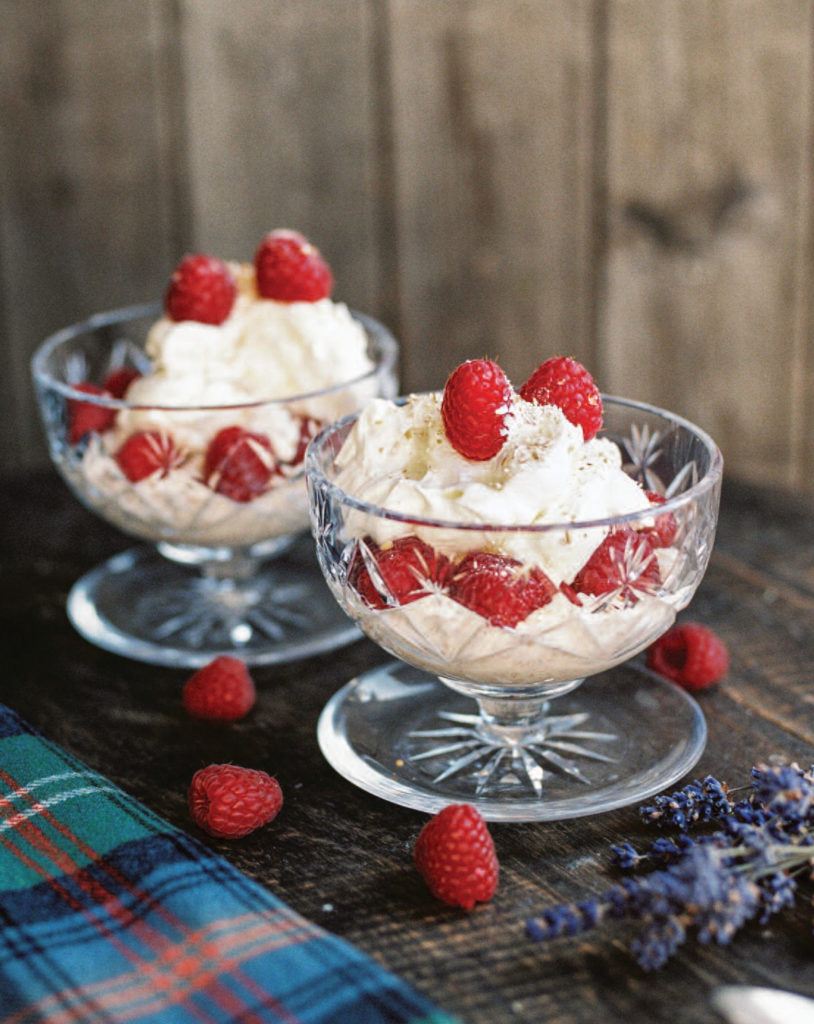
Tip most of the toasted oatmeal into a bowl – keep back 1 tablespoon for the top – and pour in the cream and whisky. Leave the oatmeal to soak it all up for at least 2 hours. Stir in the honey and add more whisky or cream to your taste. The mixture should feel quite light but the oatmeal will still have a chewy bite to it.
In a separate bowl, whisk the cream to light, frothy peaks and fold in a little sugar, if you like. Select glass bowls or glasses for serving and layer up the cranachan, starting with the soaked brose, followed by raspberries, more of the brose, whipped cream, top with raspberries and finish with the reserved toasted oats. Gently beat in honey and whisky to taste. Spoon the mixture into a serving bowl and top with fresh raspberries.
Serves 2–3
5 tbsp pinhead or medium
oatmeal, toasted in the oven
8 tbsp double cream
2–4 tbsp whisky (I use a local Speyside one)
2 tbsp heather honey
150ml cream, for whipping
1 tsp sugar (optional)
fresh raspberries
Bramley Apple, Beetroot and Heather Honey Crumble
(Nethybridge)
At Dell of Abernethy, Polly Cameron puts on the kettle, stokes the fires and props up the kitchen stove, stirring glorious soups and stews with the luring aroma of a cake baking in the oven while she waits for the return of her guests from woodland walks and wild swimming spots. She and her husband, Ross, are passionate about offering true Highland hospitality and making their guests feel welcome. The property, which has now been in Polly’s family for four generations, is situated right on the edge of the Abernethy Nature Reserve in the Cairngorms – the perfect location for the team from the BBC’s Springwatch to set up camp and present the show from the large canvas tipi usually reserved for yoga, fitness, dance, weddings and music gigs.
Previously Polly and Ross had run a successful restaurant, the Ord Ban, in Rothiemurchus so when they took over Dell of Abernethy eight years ago they brought with them their cooking and hosting skills to provide a nurture element to the retreat with carefully planned menus showcasing local growers, producers and artisans. They also grow as much as they can in their organic garden, turning gluts of herbs into pesto and steeping autumn fruits in whisky to make liqueurs. The apples shaken from the trees often end up in delicious and unusual crumbles like this one.
Preheat the oven to 180°C (fan 160°C), 350°F, gas mark 4.
In an electric blender, whizz the cooked beetroot with the honey and nutmeg until you have a smooth purée. In a bowl, combine the purée with 50g of the demerara sugar and toss in the cubed apple.
Pack the mixture tightly in a deep ovenproof dish, allowing a few centimetres for the crumble topping.
To make the crumble, pulse the remaining sugar, flour, butter and oats in a food processor or rub together by hand until a good crumble consistency.
Cover the apple mix completely and bake for about 45 minutes, until the crumble is golden brown and the apple is tender. Serve with cream, yoghurt or vanilla ice cream.
Serves 4
2 small cooked beetroot,
cooled and skinned (approx. 150g)
1 large dessert spoon of heather honey
½ tsp grated nutmeg
125g demerara sugar
3 large Bramley apples, peeled, cored and cut into 2cm cubes
75g plain flour
75g butter
75g rolled oats
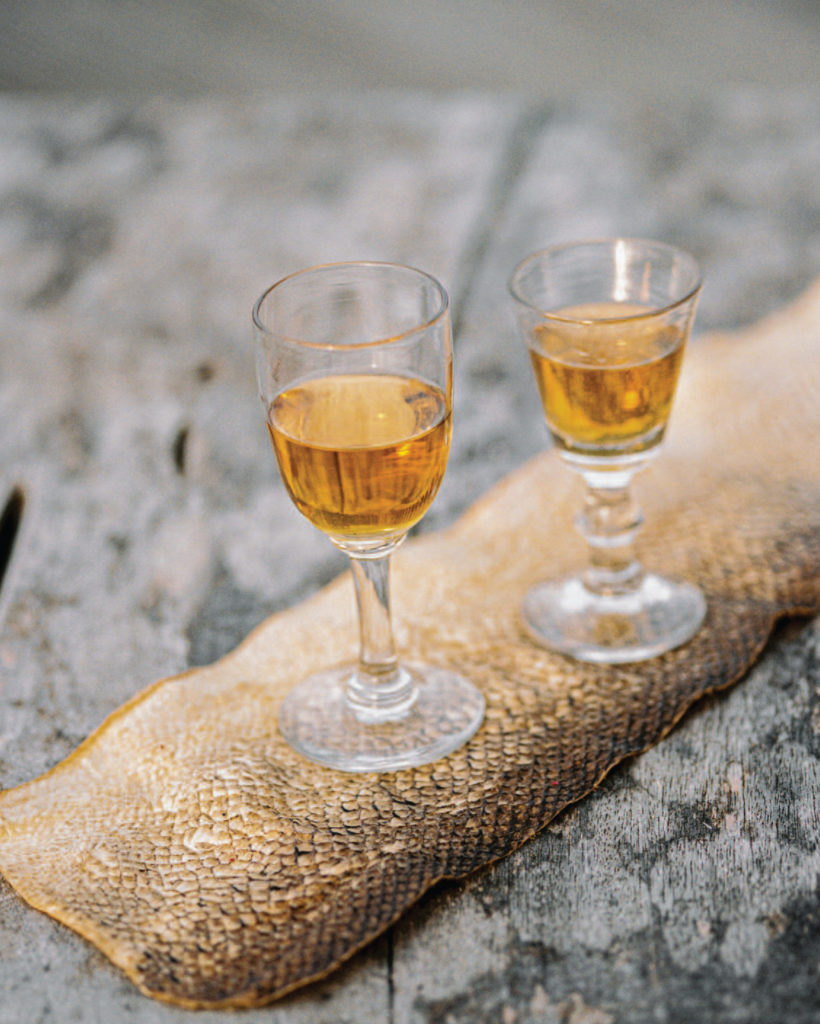
Highland Whisky
The word ‘whisky’ derives from the Gaelic uisge beatha (pronounced ‘ooshky bay’), meaning ‘water of life’ and for many Highlanders that is exactly what it is – life is good if there is whisky in the house. Some swear that a dram a day will see them through good health and old age. My nearest neighbour in a croft at the end of the glen ‘will die happy if he has a dram in his hand’, indeed my own father reached the grand age of 91 and his parting breath was enriched by a final dram.
Since the fifteenth century, whisky has been part of life in the Highlands, embroiled in illicit distilling and smuggling, evading excisemen and taxes. At one time whole communities were involved in either making whisky or smuggling it – the subject of myths and legends and the catalyst of many a story. I live in a whisky smuggler’s glen where over the years the tales of illicit stills and excisemen buried in peat bogs have grown congenial arms and legs but that is part of the spirit’s hypnotic pleasure. The aromas and flavours, the company and location, can all add to the dreams and storytelling; it is, after all, a drink of friendship and hospitality.
The Highland whisky region includes Orkney, the Western Isles and parts of Perthshire and Aberdeenshire. Within the boundaries of this book, though, we start at the foot of Argyll in Campbeltown with Springbank Distillery, the only distillery in the Highlands to do all its own malting, distilling, maturing and bottling on site, head up to Thurso to Wolfburn Distillery, the most northerly on the mainland, and we include Speyside, the biggest whisky making region in Scotland, where the modern Scotch whisky industry was born. The Highland whisky region is vast, characterised by diverse landscapes, geology, weather conditions, water sources, soil and vegetation, all of which bear some impact on the flavour of the whisky or the style of a particular distillery. The commonality is in the process – the malting, fermenting, distilling and maturing – but the singularity of whisky, the complexity of flavour and texture, the finish on the palate, is rooted in the location, the decision-making of the distiller, and time. Whisky is a creature of the land and time.
Should you drink whisky neat, with water, or on ice? I have worked with so many whisky groups from different parts of the world that I have learned that best way to enjoy whisky is to drink the one you like, the way you like it. But there is nothing quite like the enjoyment of a dram in its natural environment: the mist softly falling down the mountain slopes, miles of peaty moorland peppered white with wild cotton, little green lochans and the purplest heather you have ever seen, lashing rain followed by bursts of sunlight catching every droplet of water on the leaves and trees, horizons you never quite reach and silence that you can hear. Your cheeks feel tight and cold as your warm breath floats in the chill air, but when you nose that glass warming in your hands the aromas of larch and pine and coconut-scented gorse, heather honey and meadowsweet, smoky peat and salty air, even the fruity smell of the dung being spread to fertilise the fields, will fill your senses as you tip the dram to your lips to taste. A Highland dram in the Highland air – we’re back to where we started this the book with the goût de terroir!
Slàinte mhath!
A Taste of the Highlands by Ghillie Basan is published by Birlinn Ltd, priced £25.00
The Broken Pane is a beautiful debut novel that explores family, love, guilt and loss and will simultaneously break and lift your heart. We hope you enjoy this extract that introduces the family in better times.
Extract taken from The Broken Pane
By Charlie Roy
Published by Leamington Books
I do not have a first memory of my little brother. I do not remember my mother being pregnant, or her telling me that a baby was coming to live with us. There is an awareness of Nicky’s presence in my life that appears in my childhood recollections, like a bright light. Can anyone honestly say they remember it all accurately?
My mother, Ange, was pregnant again at the age of twenty one. Not an unusual age to be pregnant in those days, though her contemporaries in the maternity clinic were all anxiously patting their first bumps, asking her for advice on cots and layettes. Shortly after her twenty-second birthday and a relatively quick labour that lasted under three hours, she gave birth to a healthy baby boy, Nicholas James. This time round, my father Mick waited at the hospital, pacing the halls of the ward, grinding one finished cigarette into the standing ashtrays before immediately lighting the next, breaking only to refill his coffee cup, seasoned with a top note from his flask.
A young nurse came to find him in the late afternoon:
‘Congratulations, Sir, it’s a healthy baby boy.’
To the nurse’s surprise, he hugged her in delight. Mick, I mean Dad, always said that she had looked flabbergasted. He only ever used the word when he told this anecdote, savouring the use of it. I suspect he was not entirely certain of the meaning and had picked it up at the time to use in this specific context. I could never use it without picturing my father, sodden in his cups, welling up over the tale of the birth of his son.
He told it well, the birth of his second child, there at his wife’s bedside as soon as he was summoned, how tenderly they kissed, the baby nestling between them. The room was warm and clean, my mother’s blonde hair gently cascading down a shoulder, glowing with her light of happiness, basking in the joy that he had bestowed on her, a perfect boy.
This vignette was often repeated, the beats familiar, and we, his audience, knew to sigh contentedly at the end of the telling.
Nana’s “dear friend” George came to the hospital a few hours later with me clinging to his enormous hand. He held a camera in the other. With it, he took one of our very few family photos. They may have had an unconventional relationship, but he knew how to step up to the part of Grandpa, albeit unofficially.
In it, my father sits on my mother’s left-hand side, half on the bed with a foot still on the floor, his right arm behind her, supporting himself. She is sitting up, with my brother wrapped in a puce pink blanket cradled in her right arm, and I am sitting in front of them all, by my mother’s right knee, a grinning four-year-old, a mass of unruly black curls with my new blue teddy, Mr Blue, that Nana had given me on the day.
Photographic evidence that we could be a perfect family, no cracks on show.
Truth be told that I do not remember that day. The image is imprinted in my mind, soundtracked by the tale of Nicky’s birth.
I do have a few memories from the following year, the year of my fifth birthday. Like the time my friend from nursery school came round and we spread newspapers on the kitchen table and Mum got us paints and paper. It can’t have been Becky. I didn’t become friends with her until primary school. We daubed it all gleefully and laughed. I have incorporated details such as eating biscuits, and smearing paint on each other’s faces. I am able to remember it clearly because there is a photograph of us, our blue, yellow and green hands waving at the camera. I like this memory.
Mick, I mean Dad, swept me up into his arms every morning, with a ‘be good, Duckling’ and a kiss on the forehead. Then he set off to work, giving Mum a peck on the lips on the way out, and I would run to the window to wave, my hair set neatly in bunches.
It was a perfect snow globe time in our lives. I recall being held up so that I could, look down into Nicky’s crib at the sleeping baby, his farm mobile playing a tune as it cranked round, the bright pink pig somehow more incongruous than the blue sheep. I revisit myself sat playing with a rosy-cheeked infant. I paint it in my mind as a warm and happy time, all together. I know this because Mick, I mean Dad, has often told me the stories of how good it was back then, when my mother was a gentle angel, I was a good girl and Nicky was a precious gift.
One of Nicky’s favourites from the Book of 101 Jokes which he carried about for weeks was ‘What is the opposite of a snow globe?’. He would stare intently at the adult he quizzed for a moment before shouting ‘A lava lamp!’ and burst into peals of giggles. His audience would laugh too, relieved to be off the hook. I always thought that wasn’t quite right as a lava lamp has the same mesmerising effect as a snow globe. The exact opposite would be disturbing to watch.
There are times in your life you can hold like a perfect snow globe, some memories are the exact opposite lava lamps, made of real lava, too hot to hold in your mind.
The Broken Pane by Charlie Roy is published by Leamington Books, priced £16.99.
The Stone Mirror, by Ian Spring, is a collection of Gothic short fictions merging genres and mixing fact and fiction. Although the themes are often Scottish, the influences are more international: Borges, Poe, Calvino and others. ‘Story Cut Short’ is, appropriately, the shortest and the last story in the book.
‘Story Cut Short’ is taken from The Stone Mirror
By Ian Spring
Published by Rymour Books
STORY CUT SHORT
I will be brief. For some time I was employed in a medical capacity at the Sante prison. My role was to ascertain and testify to the death of those lost souls who encountered Madame La Guillotine. (You may think that, in view of their certain end, my presence was hardly necessary; but, as you will see, the pathology of decapitation is more complex than generally imagined).
At 5.30 am, on the twenty-eight of June 1905, I was privileged to be able to conduct an unusual experiment on the murderer Languille. With the agreement of the prisoner, I was allowed to address the capitis. Immediately after the blade had fallen, the eyelids and lips contracted for some five seconds, then the face relaxed, leaving only the white of the conjunctiva visible. Then, there was no doubt, the felon’s eyes fixed on mine. I called his name: ‘Languille!’. He blinked several times in response. This lasted for about 40 seconds then gradually eased until he was motionless.
For several years I conducted these experiments, increasing their sophistication. I devised a device that, attached to the ears, swung the head upside down, thus preventing the spurt of blood from the jugular foramer and extending consciousness. All this time I never saw a face that seemed to exhibit pain or horror. Some rolled their eyes or tried to mouth words. The wicked Landru, subject of my penultimate experiment (who had refused to hear the mass or take a last glass of brandy), I swear, winked at me insolently and remorselessly.
Now I was in the rapture of obsession. I began to think of the moments following decapitation as almost a joyous relief, an escape from corporal and visceral servitude. a moment unpolluted with consequences, a time for contemplation before meeting the one true maker. I thought of the theory that, at the moment just before death, one’s whole life is lived again, but more perfectly. The axe or bullet slow to a stop and devout souls have time to recite their sweetest prayers and make their peace with the corruptible world. I had read that some of the pygmy tribes of Africa, who beheaded their enemies, compassionately attached their heads to a springy sapling so that their last moments seemed like a transport to heaven. Thoughts like these tormented me. I pondered day and night on the same questions. I needed to know.
I devised the machine and nailed the upside down clock to the wall. The trip was set so that, when I released the blade, the stringed device would hold the head in the exact position.
So, now at last I know! The lapse between decapitation and death is at least 54 seconds—just enough time for me to recount this extraordinary…
The Stone Mirror by Ian Spring is published by Rymour Books, priced £10.99
American Goddess is a novel that explores an unstable marriage and the consequences of a post-pandemic world looking for hope from an unlikely leader. In this extract, husband and wife, Peter and Ellisha, meet a charismatic professor and her students.
Extract taken from American Goddess
By L. M. Affrossman
Published by Sparsile Books
Her attention turned back to Zach and Deborah. ‘Where was I?’
‘The infallibility of the deity,’ Zach suggested.
Babs threw him a venomous look. ‘Indeed. What an infallible thing the deity of men has become. He’s been sucking up power for thousands of years, first the power of women then the power of all the other gods. Gods once had weaknesses, you know. They were capricious and angry and jealous. But the God of Abraham lives in a very strange, exalted place. He takes credit for all the good in the world. And when things go wrong, earthquakes, tsunamis, the death of a child, his cronies throw up their hands and say his ways are too damn mysterious to interpret.’
‘Or that it’s our fault because we displeased him.’ This again from the boy.
‘Good point. What does God have to do to get a bad press?’
‘Yes, but isn’t— I mean …Well I think religion is a comfort,’ Deborah said nervously. ‘I mean as a Christian I think that’s the point of religion. To give comfort.’
‘Yes. Yes. That’s always the argument for religion,’ Babs answered. She was lighting a tipped cigarillo despite the sign that clearly read No Smoking above her desk. ‘But for every bit of comfort, how much is there in the way of guilt and fear and sheer inertia to change things? What about Galileo or the American reporter on his knees awaiting a beheading or the poor devils dragged up Castle Hill to be burnt as witches? How much comfort would it be to feel the flames licking about your feet?’ Babs banged her fist down on the table, startling everyone and sending an apple-shaped penholder rolling from the desk. Ellisha bent to pick it up.
‘Dr McBride,’ she said in a soothing voice. ‘Perhaps I should make some tea.’
‘No need. Brought my own.’ After some fumbling about under the desk, she produced a thermos and poured herself a generous measure of a liquid clearly unrelated to tea. She took a gulp then a long drag from the cigarillo. An ectoplasmic cloud of smoke escaped from her mouth. There was something compelling about her sheer hauteur, an insouciance that bordered on the negligent. How on earth does she manage not to set off the smoke detector?
He realised that she had caught him looking. Her gaze wandered up towards the nicotine stain around the detector then back to his with a conspiratorial twinkle. For an instant he felt she was trying to tell him something. But she shrugged and turned back to her students.
In a calmer voice she continued, ‘Our young friend here, Zachariah, doubtless with fewer hairs on his pubes than he has on his chin’—Zach turned scarlet—‘has struck at the heart of the problem. Why are those men and women, with their faith in God their father, so afraid to die? What could be lovelier than to return to the arms of one’s own maker?’
‘Perhaps their faith isn’t strong enough?’ Deborah suggested timidly.
‘Yet this is what they BELIEVE! They fight wars over it, sacrifice their children, lie, murder, rape in its name. A few ghastly ones even go round forgiving everyone. But always, when the darkness nears, they rage against the dying of the light.’ She held up a hand and waved off a protest from Zach. ‘Yes, yes. There are always a few exceptions, the saints, the martyrs, the suicide bombers. But a drop of deadly nightshade in an ocean does not change the ocean.
‘So how do we explain this?’ She paused and looked round the table. The students avoided her eye.
Babs opened her desk drawer, produced an ashtray and stubbed out the remains of the cigarillo. It was a gesture of disgust and everyone knew it.
‘We explain it,’ Babs said in her stinging nettle voice, ‘by showing that the godhead is incomplete. We’re missing something.’
Biting her lip, Deborah ventured, ‘Is it the Goddess? The feminine side of religion?’
Babs drank heartily from her cup then, smacking her lips together, set it down. ‘Perhaps. The world has been too long under the influence of men. But the Goddess isn’t some sort of sticking plaster to mend mankind’s woes.’ She glanced sharply at Ellisha as she said this, revealing that she had recognised her from the start. And, with one of those unanticipated veers of consciousness, she demanded suddenly, ‘And what do you believe, hmm, daughter of a Sanskrit dream? Do you imagine, somewhere deep within you, resides the glassy essence of a soul? A measure of the divine suffice to make the angels weep?’
‘I—’ Ellisha ran her tongue over her bottom lip. ‘I don’t know.’ Clearly, she would have liked to have left it there, but Bab’s headlamp eyes left no scope for concealment. A little expulsion of air, a squirm of her shoulders. ‘I wouldn’t say I believe in nothing. But you’re right. I don’t have a strong sense of belonging to any particular faith. I’ve never found anything that I could really hold on to.’
‘Apart from your rock? Your stone man.’
‘Apart from Peter, yes.’ She darted him a quick, loving look that moved him and made him feel despicable at the same time. Babs was pouring herself more ‘tea’. ‘But you’ve never felt touched by the unseen hand? No thrill of religious experience? The magnum sacramentum hasn’t tingled in your veins?’
Ellisha wrinkled her nose. ‘I don’t—’
He could feel her gaze, knew she was appealing to him. What do you think, should I tell? But he couldn’t look her in the eye, and he had no sense that this was a turning point or that Babs’ words were weighted. After a moment, he saw her shrug then square her shoulders. ‘When I was thirteen I was struck by lightning.’
Babs put her flask down. ‘What do you recall?’
‘Not much. It was a beautiful July day. No wind. Clear blue sky.’
‘Is that possible?’ Deborah asked.
‘Oh, it is.’ Babs had hunched forward, chin clasped between her bony fingers. ‘Lightning can travel over twenty miles from where the storm is. And you would have no clue it was coming.’
‘I didn’t,’ Ellisha said, with a laugh. ‘I think I remember a crackling sound. Then I couldn’t see anything but white light for a few seconds. I guess I passed out. Because I don’t remember anything else until I woke up at home, with the doctor examining me.’
‘But you made a full recovery?’ Babs was studying Ellisha as though she was a striking artefact unexpectedly revealed by blowing sands.
‘Mostly. You’re never really okay after a lightning strike. I get headaches and sometimes I see things in my peripheral vision, shadows, flashes, that sort of thing. On the upside, I have an amazing Lichtenberg figure on my back.’
‘A kind of scar?’ Zach asked.
‘Yup. The capillaries got fried under the skin. Sometimes they fade. But mine is still here all these years later. I guess it’s part of me now.’
‘When you were thirteen,’ Babs repeated ruminatively. ‘You’re certain?’
‘Day after my birthday. You don’t tend to forget a present like that.’ Her brow crinkled. ‘Why, is it significant?’
‘It depends. Had you started your menses?’
‘Now, wait a minute!’ Peter jumped to his feet. Things were getting out beyond a joke. But Ellisha put out a restraining hand. She seemed fascinated. A mongoose caught in the thrall of a python. Or perhaps, he thought uneasily, a pythoness.
‘I’d started the week before. It was kind of a big deal because I was first out of my friends.’
‘I see. I see. A moment of transition. A rite of passage. Mutatis Mutandis if you will. Plenty of resonances in the mythic scheme of things. Lightning is divine. It purifies. Herakles, Asclepius, Semele were all struck by holy fire before they were deemed worthy of heroic status. The Incas laid out child sacrifices on mountain peaks to be struck by lightning because they thought it made them divine. All are mortal before the touch of the celestial.’ She took a long meditative sip from her cup. ‘The gods singled you out.’
Ellisha laughed. ‘I don’t believe in the gods.’
‘Immaterial if they happen to believe in you. But, of course, I use the term figuratively. Gods is just a word for opening up the dark places in consciousness. Mythology, that’s the key to everything. Ignis Dei.’ She rounded, without warning, on her students. ‘Ignis Dei. No idea what that means, eh?’
Her smugness was irritating. Feeling side-lined, Peter racked his brains for a pithy putdown. But his schoolboy Latin wasn’t up to the task. Dei, something to do with God. But Ignis? Ignorant? Ignoble? Ignominious? Nothing quite fit.
‘The spark of God maybe?’
Ellisha had spoken softly, so softly that Peter wasn’t sure she had spoken at all, but Zach slapped his hand on the desk. ‘Of course. I was thinking fire. But ignis in the sense of ignite.’
Babs sat upright, the reanimated corpse in a horror movie. She glanced narrowly at Ellisha, her face a peculiar mixture of anger and fear. ‘Who told you? You didn’t get that on your own.’
Ellisha laughed gracefully. ‘Why is it no-one believes that Americans can know Latin?’
For a tense instant, things might have gone either way, but then Babs recovered herself. She turned back to her students, swerving off in a new direction. ‘Religion has had millennia to create a satisfying system of belief. Yet the best the great theological minds of the world have come up with so far is God loves us, which is, of course, in patent contradiction to everything the universe is telling us. So, what’s missing? What do we really need?’
‘More sex,’ Zach suggested.
‘A man’s answer.’
He came back with, ‘No more discrimination. If we all learned to see each other as equals there might finally be peace in the world.’
‘Terrible idea,’ Babs snorted. ‘The purpose of religion is to make people feel special, unique, chosen by God. Without discrimination there is nothing to separate the elect from the herd. Humans will forgive their fellows all sorts of sins; theft, war, destruction. But not the sin of equality. It stifles us. Petrifies us. Not in the sense of filling us with fear, but the old use of the word. Same root as stone-man here. Petra, Latin for rock or crag. Literally to turn to stone, to be inert, paralysed.’
‘We need a better story.’ Suddenly all eyes were on Peter, and he looked at Babs defiantly.
‘Ah, our stone-man has it.’
‘What do you mean, Peter?’ Ellisha asked.
What did he mean? For an instant intuition had flashed inside his head, brilliant, blinding. But now it was gone. He stumbled over his tongue, trying to mould the heavy clods of words into a recognisable shape. ‘A religion needs to tell a story, to … to appeal to some forgotten longing buried deep down in the subconscious.’ It was hopeless. He was using clay to depict light, but Babs was pleased.
‘That’s it, Stone-man.’ She gave a rasping, smoker’s laugh. ‘Humanity loves a story. Give men philosophy and they’ll learn to think. Give them a compelling mythology and they’ll change the course of the stars. Forget sex. Narrative’s the real generative force guiding mankind. It wasn’t a foetus the Angel of the Lord deposited in Mary’s womb. It was a legend. Fons sapientiae, verbum Dei, as they say.’ She rolled an eye towards Peter. ‘Get your wife to translate that one.’ She began to cough, a deep, dragging sound, like the sound of the tide draining over gravel. The coughing went on and on. She banged on her chest with her fist several times to no obvious effect. Ellisha jumped to her feet. ‘I’ll get water.’
Babs swatted a hand at the air to indicate that it wasn’t necessary, but Ellisha had already gone. Peter watched, half in horror, half in fascination until the spasm wore itself out and Babs relaxed.
‘Fine now. Just something caught at the back of my throat.’
Peter nodded. From the corner of his eye, he noted that the students were trying surreptitiously to clear away their things. Babs noticed it too. ‘Yes, yes. Run along, children. You are in grave danger of having a thought enter your heads.’ She was pouring herself another drink from the flask. Suddenly she slammed the cup down, sending a little tsunami of liquid across the desk. ‘Don’t think I don’t know what they ask you. What’s the old witch up to, eh? What’s she cooking up behind closed doors? Ignis Dei. That’s what they want to know. Ignis Dei! But the old witch won’t tell.’
The students gave a last frightened glance at their mentor then fled the room. Babs looked into the dregs of her cup then said in a softer voice. ‘Old witch, one of their kinder nicknames for me.’
American Goddess by L. M. Affrossman is published by Sparsile Books, priced £10.99.
ALSO ON BOOKS FROM SCOTLAND
-


Saltwater: A Midsummer Ghost Story by Elaine Thomson
‘The very thought of those grey faces made my skin grow cold.’
-
‘An Odious Campaign’ by Rob McInroy – Why a 1936 By-Election Still Resonates
‘This enraged the locals and he came close to being run out of town on several occasions.’
-

‘‘That’s right, Bobby,’ he growled. ‘I haven’t seen you in – well, since you decided to kill me.’ ‘
-

David Robinson Reviews: Solitary Agents by David Goodman
‘This is very much an up-to-the-minute story of spycraft, positively revelling in all the things tha …
-

The Savage Landscape by Cal Flyn
‘It is their resistance to the intrusions of the outside world − culturally, economically, environme …
-

The Shortest History of Scotland: A Q & A with Murray Pittock
‘We need to be better aware of that to understand the challenges and achievements of the past, and t …
FEATURED AUTHOR:
Anna Groundwater
Anna Groundwater is currently the Principal Curator for Renaissance and Early Modern History at the National Museum of Scotland. She previously lectured in early modern Scottish and British History at the University of Edinburgh. She’s the author of wo …
FEATURED PUBLISHER:
NMS Enterprises Limited – Publishing

NMS Enterprises Limited – Publishing is the publishing division of National Museums Scotland. We produce lavishly illustrated catalogues for Museum exhibitions such as Catherine the Great: An Enlightened Empress and, in 2008, Silver: Made in Scotland, …