


Helen McClory’s much anticipated second novel, Bitterhall, is released in early April, and we couldn’t wait to give you a glimpse of it, and to introduce you to Daniel, Órla and Tom, three characters thrown together by a grimy flatshare and drawn into a web of desire, obsession and secrets that leads to a shattering conclusion.
Extract taken from Bitterhall
By Helen McClory
Published by Polygon
Autumn Soft
I am on the swing in the garden, under the oak bough, late August night, a couple of beers tipped over beside me in the short mossy grass and my heart is a neat bundle of sticks in love with the dead and the unreachable. Up in the house a single light shines; first floor, the bedroom, my bedroom, so it looks like there’s somebody up there. And I, hazy, imagine them looking down on me, and at the same time down on the whole of this city, with some dispassionate warmth, like a God.
My head lies against the swing chain, the fabric of my scarf at my throat grey in this light, blue indoors, I’d grabbed it on leaving the new housemate and his girlfriend at a strange moment all together in the kitchen. I think how he, Tom, is legendarily good looking. Only later will I see Tom unravel and almost fall, and I will catch him.
Work is just beginning to launch itself to its full purpose, and I think of the objects I will handle, which I have seen in the catalogue or taken out of packaging and put into the safe, so frail in my careful hands; I think of the monumental paperwork, the email chains to and from absent bosses mostly floors above my soundproofed basement room.
I feel for the metal chain of the swing and kick off again, a gentle sway, a little more, wind in the face, cold, and the ground makes a good sound when I kick it. I don’t think about the thing I am trying not to think about. Shhhh. I think for a while about this ground, leafy, dirt in footprints, old scuff-mark furrows from swing-riders, and of the tensile strength of the chains, and of the cold of the seat. All I can think, just for a moment, is: Just be calm. Bed soon. Back up to the diary I am reading and I do not yet know of everything wild that waits above us to kick off, with my housemate, his girlfriend and me.
I want you to love me, if I’m being honest. That’s why I start so gently, in the garden, in the present tense. A good story begins tipsily in a garden, and carries on through well-proportioned rooms in the past tense in which blood is being spilled and was spilled, is measured out already, and the possessors of that blood were embarrassed at its spilling, and hold their hands over the wounds, pretending everything was fine. When exactly is this happening, and to whom is it happening, and who is making it happen? We begin to become tricky, don’t we, when I write in the first person. What tense do my intrusive thoughts manifest in? Somewhere between the first and second, like a harsh note in a piano recital, a piece so often played it should be clean of errors, yet here and here again the wrong note spikes in the same predictable, always jarring way, repeating itself, a bad inorganic refrain.
Intent is the issue, too. It’s a holiday to take up a different tense, a different perspective. But I’ll let you decide who is who, who is not who, who is real (real enough, then?). For a clue (as much as I’ve got), there is a centre to this whole thing. It’s up to you to mark it.
Aside – everything is an aside. Except the centre. That is the centre. Find it. Come along and around me. Us. Fill the edges of this thing.
Bitterhall by Helen McClory is published by Polygon, priced £8.99.
It has been said that readers are not ready to read pandemic novels yet, but when they are as thrilling as Ewan Morrison’s latest novel, How to Survive Everything, we think it’s safe to ignore that opinion! We caught up with him to talk about some of his favourite books.
How to Survive Everything
By Ewan Morrison
Published by Saraband
The book as . . . memory. What is your first memory of books and reading?
As a child, I used to tear through The Adventures of Tintin and Asterix the Gaul, but my first real experience of the power of the word was actually an audio recording of poetry. It was my parents’ copy of the album The Way I Say It – Poems by Norman MaCaig, read by Norman himself. There are so many inspired poems on that record, all read with such force and occasionally with MacCaig’s gently smiling wit: Man in Assynt, The Root of it, Truth of Comfort. I must have been about ten years old and I listened to the crackly LP, once every few weeks, with my headphones on, in between bouts of AC/DC and Black Sabbath. It struck me then that this old man was very wise, and that his wisdom was all tied up in this game he played with language. As MacCaig wrote ‘Ideas can perch on an idea, and sing’.
Forty years later, I find myself quoting his line from the poem Sparrow: ‘To glide solitary over grey Atlantics, not for him; he’d rather a punch up in a gutter.’ I only recently realised he was talking about a certain kind of people. Wonderful, wise Norman with his dry wit, introduced so many kids of my generation in Scotland to the wonder of words.
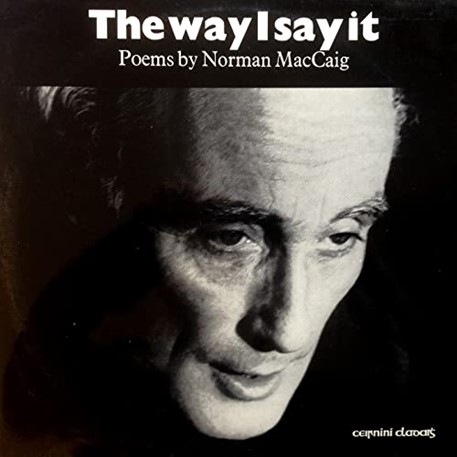
Album cover. The Way I Say it. (1973)
The book as . . . your work. Tell us about your latest book How to Survive Everything. What did you want to explore in writing it?
How do we survive things that seem too much to bear and that challenge the daily story we tell ourselves about reality? That’s what I really wanted to explore in How to Survive Everything. It’s written from the perspective of a teenage girl, Haley, who, along with her little brother is abducted by her father, Ed. Ed is a divorcee and a ‘prepper’ who’s been secretly preparing for the end of civilisation for years with a group of survivalists in an armed hideaway in the wilderness. The book is Haley’s own survival guide as she adapts to severe survivalist lockdown and as she uncovers her father’s obsessive faith in a world-ending pandemic. Haley’s mother ends up trying to snatch her kids back, and so Haley is caught in the middle, having to decide whose worldview to believe in – her Dad’s global apocalypse or her Mother’s belief that the pandemic isn’t even real and that Haley’s father is criminally insane.
There’s dark comedy in the novel as Haley explores questions of ‘Who can I believe and trust?’ in this era of fake news and conspiracy theories. The question ‘What life-story can we live by? ’lurks beneath How to Survive Everything, and probably behind every book I’ve written.
The book as . . . inspiration. What is your favourite book that has informed how you see yourself?
I think The Road by Cormac McCarthy had a huge impact upon me – probably from about 2012 onwards. It’s an Apocalypse narrative but it is permeated by such a profound sense of love between a parent and a child. Care, compassion, intimacy in the face of such horror. It’s impossible not to cry when reading The Road, and also to be amazed by the simplicity and beauty of its prose. It shook me on a number of levels. Personal it told me that being a father is incredibly important, and in terms of writing it made me want to take on the big themes we face as confront mortality. McCarthy has stripped away all that’s superficial in our civilisation and our language to ask ‘What really matters?’ It’s devastating book, a real life-changer.
The book as . . . a relationship. What is your favourite book that bonded you to someone else?
Back in the 90s I was blown away by Revolutionary Road by Richard Yates. I just couldn’t believe that this forgotten classic from 1961 could have such relevance to my generation. It’s all about a couple of beatniks who’ve sold out, who struggle against their stereotypical life roles and who plan to escape. It’s painfully psychologically honest. I loved that book so much that I kept loaning it to people, and then I’d have to buy another copy because I never got the loaned copy back, because it in turn was, without fail, always loaned to someone else. It spread, virally, because I would soon discover, I was not the only person doing this. I recall, meeting a friend in London who worked in film (he died of cancer in 2014) and we both got raving about how much we loved Revolutionary Road, and how we’d each bought about five copies over the years, all of which we’d ended up sharing or giving away. We realised that we’d been part of this strange underground sharing circle of devotees that spread across countries and borders. It was like we were dissidents sharing forbidden Samizdat books in the Soviet era. That was my first sense that a book can create a devoted secret society and make new friends. Oddly enough the huge underground friend-circle around this book led to the Hollywood movie being made in 2009.
The book as . . . object. What is your favourite beautiful book?
Ah, now, perhaps this is unfair because Dante’s Divine Comedy with the illustrations by Gustave Doré (1861) is as sublime as the illuminated manuscripts of the medieval era, but unlike those museum pieces it can be owned and taken home.
There is a lovely story about Doré’s edition of Dante that I like to call ‘The ass and the angels’. Originally Doré was supposed to create twenty illustrations for Dante’s epic poem with its three sections of Inferno, Purgatory and Paradise, but he became obsessed and couldn’t stop. Dore ended up making 135 illustrations and, in a panic, his publisher decided he no longer wanted to take a risk on publishing something so vast. So, Doré self-published the book. It sold out in a mere two weeks. His publisher then sent Doré the famous telegram that read: “Success! Come quickly! I am an ass!”
The illustrations are spell-binding and oddly uplifting, which is surprising given that they depict the nine circles of Hell.
This book was my constant companion in a time in which I was suffering from Chronic Fatigue Syndrome. It’s just possible the sense of wonder within the imagery, had some curative effect.
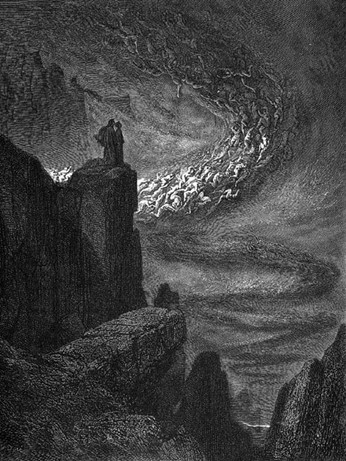
Illustration from Gustave Dore’s 1861, edition of Dante’s Divine Comedy
The book as . . . rebellion. What is your favourite book that felt like it revealed a secret truth to you?
The True Believer – Thoughts on the Nature of Mass Movements, by Eric Hoffer. First published in 1951, this is a brilliant study by a self-taught writer on what draws people to extremism. Hoffer has the courage to explore why people are drawn to totalitarian ideals, and some pretty devastating insights. Beware failed artists and idealists, he warns us. Beware of any group, whether political or religious, who claim that they have a single panacea solution to all of humankind’s problems; beware of people who are selflessly devoted to a cause – it is likely that they are motivated by resentment, there is a ‘venom and ruthlessness born of selflessness.’ As someone who came from three generations of fanatics, this book came as a necessary shock to my system; it convinced me to try to get rid of all the fanaticism and extremist thinking that was still lurking within me.
The book as . . . a destination. What is your favourite book set in a place unknown to you?
If I can travel through space and time then I’d have to say it’s the labyrinth library at the centre of The Name of the Rose (1980) by Umberto Eco. It’s a page-turning murder mystery set in an Italian Benedictine monastery with the largest library in Christendom in the early 14th century. The labyrinth holds the key to the murders, which are all connected to one lost and forbidden book. I wouldn’t be so keen to go back to the era of the black death, the inquisition, heresies and witch hunts, as no doubt I’d be one of the ones burned at the stake, but I’d like to find my own way in that labyrinth library, with its many thousands of ancient books that have now vanished from history.
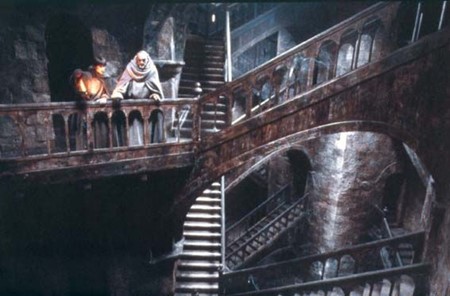
The film adaptation of Name of the Rose (1986). In the Labyrinth Library.
The book as. . .technology. What has been your favourite reading experience off the page?
I’m a terrible scribbler in the margins of all my books. In any book that I love you will find my scrawled handwriting every few pages or so, with asterisks, underlinings and arrows connecting passages. A real mess, and impossible for anyone else to read after me. I can’t do this in the same way with ebooks or PDFs, so I’m very much stuck ‘on the page’.
The book as . . . the future. What are you looking forward to reading next?
I’m a compulsive re-reader, and my next novel will be about an ‘outsider’ character who is potentially dangerous, so I have a stack here of brilliant ‘outsider classics’ to re-read next. They are Hunger by Knut Hamsun, Notes from the Underground and Crime and Punishment by Dostoevsky, The Trick is to Keep Breathing by Janice Galloway, Steppenwolf by Herman Hesse, The Mare and Veronica by Mary Gaitskill and of course The Outsider by Albert Camus. If anyone has any other Outsider suggestions, please get in touch with me on twitter: @mrewanmorrison
How to Survive Everything by Ewan Morrison is published by Saraband, priced £9.99.
Shrabani Basu is an author and a journalist whose latest book tells the fascinating story of how Arthur Conan Doyle became a detective and champion for justice in the campaign to pardon George Edalji, accused of mutilating horses in the English village of Great Wyrley. It’s an eye-opening look at race and an unexpected friendship in the early days of the twentieth century, and the perils of being foreign in a country built on empire. Here, in this extract, Shrabani Basu tells us of why she pursued this story.
Extract from The Mystery of the Parsee Lawyer
By Shrabani Basu
Published by Bloomsbury
I had always been fascinated by the case of George Edalji, and Arthur Conan Doyle’s involvement in it. I had read about George briefly in books about Asians in Britain, but always wanted to know more. I wanted to know how Shapurji arrived in Britain, what made him convert to Christianity and how he became the first Asian vicar of a small village in the coal-mining area of Staffordshire. As they were the only mixed-race family in the area, I wanted to know about the racism the Edaljis suffered and how it had all impacted on George’s trial. Conan Doyle had compared it to the Dreyfus affair, but unlike that famous case, captured in history and literature by Emile Zola’s letter titled ‘J’Accuse’, and the subject of books and films, few today have heard of the Edalji affair. The story of the Indian man targeted for his race and religion in England was soon buried and forgotten, just another casualty of Empire.
I often thought about the family at the vicarage even as I worked on another book set in Victorian Britain. 3 It was the true story of Queen Victoria and her Indian servant, Abdul Karim, who quickly became a firm favourite and caused a storm in the royal court. She gave him land and titles. He introduced her to curries and taught her Urdu. The lonely widowed queen lived the last years of her life in an Indian dream with the handsome turbaned youth by her side. It was more than the establishment could take. Victoria’s household and family closed ranks against Karim and conspired to defame him. Unable to destroy him while the Queen was alive, they swooped on him within hours of her funeral, and burnt all the letters that Victoria had written to him (often several in a single day). He was unceremoniously asked to return to India, and every attempt was made to erase him from history. Though their circumstances were completely different (Abdul worked in the royal palaces, and George lived in a mining village), and their personalities were a world apart, there was one parallel between George and Abdul. Both were victims of racism in a society that was ready to believe the worst of a foreigner.
At the time I was writing, Julian Barnes published Arthur & George , a fictional account of the Edalji story. It was shortlisted for the Man Booker Prize and I felt there was no point in trying to write anything more on the subject. Yet, every time I watched a repeat of a Sherlock Holmes drama on television, I would think of George Edalji and Arthur Conan Doyle. There is nothing quite like the calling of an unsolved mystery, a dark crime set in the English countryside over a hundred years ago.
In 2015 a small article in The Times newspaper caught my attention. It said that a collection of letters written by Arthur Conan Doyle dealing with the George Edalji case were to be auctioned. These were letters written by Conan Doyle to Chief Constable G. A. Anson, head of the Staffordshire police. The correspondence had never been published. It was a sign. There was hope of new material. I called up Bonhams auctioneers to look at the letters and made my way to their offices in Kensington. As I held the letters written in Conan Doyle’s neat handwriting from Undershaw, his house in Surrey, and from hotels across Europe, I could feel the obsession he had had with the case. Here was Conan Doyle wearing the deerstalker of his fictional detective, trying to solve the only mystery that he ever investigated himself. It coincided with a period in his life when he was coping with grief and emotional turmoil. His wife, Louise, had passed away and he was going to marry the love of his life, Jean Leckie. There was guilt about having loved Jean for nine years while his wife was ill and dying. In a way, the case of George Edalji lifted Conan Doyle from his melancholy.
‘In 1906 my wife passed away after the long illness which she had borne with such exemplary patience,’ he wrote later. ‘… For some time after these days of darkness I was unable to settle to work, until the Edalji case came suddenly to turn my energies into an entirely unexpected channel.’
Conan Doyle threw himself into the investigation, travelling to Staffordshire to meet the Edaljis and revisit the scene of the crime. His correspondence with Anson was combative. The chief constable was scornful of the famous crime writer trying to do the work of the police. Conan Doyle was convinced that the police evidence had been shoddy and that Anson was a racist. Anson’s personal notes revealed his character. . . .
Within the boxes lay a story, not just of the trial of George Edalji and the investigation by Arthur Conan Doyle; it was a story that went back to when George was just a young schoolboy in Great Wyrley, targeted for being the son of an Indian. Page after page of hate-filled anonymous letters lay in the boxes, directed at the family in the vicarage.
*
The events of over a hundred years ago in Great Wyrley could have been taking place in the present. Miscarriages of justice in Britain have happened before – the Guildford Four, the Birmingham Six – to name a couple. Prejudice, doctored evidence and decisions made on circumstantial evidence have also occurred in the recent past. In 1998, the Macpherson Report into the murder of black teenager Stephen Lawrence revealed there was institutional racism in the police force. In 1903, George Edalji was virtually sentenced before he had even walked into the dock.
The Mystery of the Parsee Lawyer by Shrabani Basu is published by Bloomsbury, priced £20.00.
Donald S Murray shed light on the Iolaire disaster in his award-winning novel As the Women Lay Dreaming. David Robinson finds that Murray’s sense of place and its people is there once again in his new novel In a Veil of Mist and is just as beautifully drawn.
In a Veil of Mist
By Donald S Murray
Published by Saraband
Go to enough book festivals and there’s one question you’ll hear so often that it’s hard to stop your eyes rolling. ‘How important to your writing,’ the writer is asked, ‘is a sense of place?’ And the writer will nod furiously and say that yes, it’s so vital that it’s almost another character, when all they’ve really done is to sketch in a real-life location or scout Google Maps for a dash of background colour.
Donald S Murray’s new novel, In a Veil of Mist, set in his native Lewis as firmly as the stones at Callanish, is the opposite of this. Not only is the setting at least as important as the plot, but it is so credibly drawn that the book is almost a ticket to the island – and not only that, but to the Lewis of 1952 and to a secret it has largely kept to itself ever since. As I read the book, I found myself pondering the whole business of place. How do you actually go about creating such solidly believable settings for fiction? Can outsiders ever do it? Suppose they took precisely the same subject, what might they miss?
First of all, the background. It’s 1952, and a team of biological warfare specialists are conducting experiments on monkeys and guinea pigs on a converted tank landing ship off the north-east coast of Lewis. The Russians are streets ahead in testing killer gases, so this is us trying to catch up. Bomblets releasing the gases are exploded in the air a mile or so offshore, and the effects on animals placed on a pontoon underneath are studied. There are warning flags everywhere and nearby ships have been instructed to stay clear of the area. Yet word hasn’t reached the crew of an approaching trawler, or if it has, they’ve disregarded it. So on they sail, through the titular veil of mist, making their potentially deadly way through the Minch. Breathe in, and the crew could be inhaling brucellosis or tularaemia or seeding the bubonic plague in the populace the next time they step ashore.
For many novelists, one way of telling this story would be to go the full Tom Clancy, immersing themselves in military technology and Cold War politics and using every last detail of the real-life Operation Cauldron that forms the basis of this story. But this is the antithesis of Murray’s style: his award-winning debut novel As the Women Lay Dreaming was so powerful not because it retold the story of the Iolaire tragedy with extra descriptive adjectives – the actual 1919 shipwreck was hardly mentioned – but because it showed how grief pulsed through subsequent generations of islanders too.
Another approach – and one that tempts him more – is to place the germ warfare experiments at the centre of a moral dilemma. For this, he introduces a Liverpudlian lab technician aboard the converted tank carrier whose wife finds his work abhorrent and wants him to quit. But even though most novelists would probably also create such a character, and furnish him with the necessary self-justifying arguments, those are just as obvious as the details of Operation Cauldron itself. Sense of place requires far more – and perhaps as with his previous novel, it only emerges obliquely: you only find it when you’re not directly looking for it.
For me, this is what makes Murray’s two other main characters – Jessie, a spinster in her fifties, or Duncan, a bus driver in his late twenties – so important. These two find the bodies of the monkeys and guinea pigs washed up on the beach, the Tràigh Mhòr, near North Tolsta, although Jessie has never seen animals like them. They wonder about these mysterious washed-up bodies, and word spreads out – slowly – about the odd goings-on on the north-eastern tip of the island and the strange men in white boiler suits clearing the beach of debris. But they don’t ask direct questions about what they’ve witnessed. Whatever is happening, it is hardly the most important thing in either of their lives. For Jessie, that happened in 1923, when George, the only man she had ever loved, took the emigrants’ boat from Stornoway after promising her that one day they’d be together again. But that was almost 30 years ago and everyone on the islands knew that it would never happen, just like everyone knew that he had been unhinged by the death of his brother in the Iolaire, and everyone knew that George had probably killed himself somewhere, somehow, in the New World.
Everyone knew: again, Murray doesn’t tell us directly. We just see a friend praying, decades after that leave-taking, that Jessie be given the strength to accept the possibility of disappointment. We see her writing letters that she never sends to her lost love, in which she tells him how the people he knew back home are getting on, because that’s the key fact about island life: it would be remiss for an islander not to keep up to date. We see her remembering that 1923 leave-taking, when she’d never gone to the pier because if she had she wouldn’t have been able to stop the tears, and ‘that’s not the kind of thing you do if you come from Tolsta. We’re not like Stornoway folk, are we?’
So it builds up, this sense of place. Jessie will carry on her daily round, as lonely and self-contained as a bachelor hill farmer in a William Trevor story, searching the shore for carageen for dessert or seaweed to fertilise her potatoes, making her own cures rather than bothering the doctors, her mind teeming with tales from folklore. And Duncan will carry on driving his bus round the island, reading the papers at Stornoway library and telling the news from the wider world to his passengers, nodding at their own stories even though he’s heard them before, and all the time looking forward to meeting the woman he’s set his heart on at the Lido cafe.
We wouldn’t do that, you or I. We wouldn’t have him daydreaming about the future, wondering how he could possibly ask his girl to marry him, knowing it would mean sharing the house with his mother, just as we wouldn’t have Jessie living so immutably in the past. If we’d written this, we wouldn’t have left time drift so freely either forwards or back, but concentrated on the potential terrors of the here and now. We would have missed the wider stories about the island because we would have concentrated on fleshing out the thinner, secret one. In the process, we would have also missed out on this book’s extravagantly realised sense of place – which comes not just from description, but from Gaelic song, poetry, hymns, sermons, folklore, and prayer too.
Fortunately, we didn’t write this novel and Donald S Murray did. And in this time of lockdown, when we can’t change the background to our lives as readily as we would wish, when we can hardly travel anywhere and certainly not to north-east Lewis, it seems an even more impressive achievement than ever.
In a Veil of Mist by Donald S Murray, is published by Saraband, priced £9.99.
Ryan Vance’s collection of short stories, One Man’s Trash, offers fictional gems that are a little bit weird and wonderful, a little bit sensual and spiky, and a whole lot enticing and entertaining. Here, we share one of his stories, ‘Mouthfeel’, where a dreaded evening out becomes something else, something entirely unexpected.
One Man’s Trash
By Ryan Vance
Published by Lethe Press
Mouthfeel
Nathan located the restaurant on the corner of Kent Road and Berkeley Street: another hasty pop-up in the race to gentrify Finnieston, it bore no signage, no menu board. The only guarantee of a hot dinner was Lizzie, standing by a blank door in her favourite red polka dot dress. She waved at him across the street, and pointed to her watch. As Nathan waited for a gap in the traffic, a sharp sensation of chives appeared unbidden in his mouth—serving as an early warning of the Stilton, which arrived more blue than cheese. He slipped a bottle of mouthwash from his coat pocket, swilled a quick mouthful and spat into the gutter.
‘I saw that,’ Lizzie said as he approached. He kissed her on the cheek as a greeting. ‘Minty fresh, as always.’ She looked him over, touching her pearl earring to make sure he hadn’t dislodged it. ‘Oh Nate, trainers? What did I tell you about looking smart?’
‘This isn’t smart?’ he said, tucking his wrinkled shirt into his jeans.
‘Surprised you asked me along, to be honest. Not my sort of thing.’
‘I wasn’t about to show up to a tasting night solo, was I? Anyway, I’ve been worried about you. Man cannot live on Soylent alone.’
‘Actually,’ said Nathan, ‘I think that’s the point.’
‘Humour me, will you?’ She squeezed his shoulder. ‘Just for tonight, leave your curious condition at the door?’
This was Nathan’s condition: his mouth had forever been haunted by the ghosts of meals he hadn’t eaten. Foods he didn’t even like—liquorice, coffee, anything with strawberry flavouring—made frequent appearances, despite attempts to avoid them in person. Some flavours went through phases. A week of high-grade sushi. A month of hospital food, aggressively beige. His twenties had been characterised by the bubbled saltiness of caviar manifesting each Hogmanay, though it wasn’t until his thirtieth birthday Nathan got the chance to connect the taste to its real-world counterpart, at a restaurant not unlike this one. Other times, the phantom flavours interrupted meals he was already eating, muddying the entire experience. Christmas in particular was unpleasant, like sucking on a chocolate-covered stock cube.
He had a theory. His mouth, somehow, was connected to another. Telepathy of the tongue. He’d shared this theory once with Lizzie, who’d called him organic, free-range bonkers and refused to entertain the idea any further. Yet other sensations could not originate from food. A frequent probing warm wetness, for example, begun at sixteen, bloomed at night into a sticky, salty suddenness. He knew what that was. Unmistakable. Personally, Nathan preferred to spit, but to each their own.
Going down, stairs led to a basement, the decor sitting somewhere between a New York speakeasy and a half-finished public restroom. Typical for the area. A young man showed them to their table. Once seated, Nathan was hit by another imaginary wave of Stilton, this time accompanied by a light mouthfeel of something melting on his tongue.
Mouthwash was one of his coping methods, the intensity of peppermint enough to banish even the most stubborn spirits. The invention of Soylent—a lab-brewed dust-flavoured meal-in-a-sachet— had been something of a blessing, as it cut out all interference. But as their waitress provided a small wooden board laid with four canapes: blue stilton and chives on a buttermilk wafer, Nathan realised, there would be no interference tonight.
By the bar, a wine glass and teaspoon commanded attention. A large man in a three piece suit beamed at his guests, paired with a round-shouldered chef, her height almost matching his, if you included her toque. Together they delivered some guff about pushing boundaries and contributing to the neighbourhood’s legacy for experimental dining. Nathan didn’t hear a word. He was too dumbfounded by the serendipity of canapes.
‘He’s here,’ breathed Nathan.
‘Who?’
‘My other taster.’
‘I don’t want to talk about it, Nathan. Look, here comes our food.’
Matched with a slim glass of Chardonnay boasting notes of pineapple over buttered toast, the first course was a bisque of langoustine with white chocolate and garlic. Nathan pushed it around with his spoon.
‘They know what they’re doing,’ said Lizzie. Nathan pinched his nose in preparation. Lizzie reached across the table and slapped his hand. ‘Stop embarassing me. Just try it. Please.’
So he did. The crustacean wash gave way to a sweet cream on the way down, at once seaside and farmyard, sending his brain into a strange pinching pleasure.
‘See?’ Lizzie said, as his eyes grew wide. ‘You’re missing out.’
The sensation of hot, smooth bisque filled Nathan’s mouth again. Not an after-taste. First contact, twice. Then came the wine. At least, he assumed it was the wine, though his palate wasn’t refined enough to identify anything as exact as pineapple. But he’d not touched his Chardonnay, the fine glass as yet unsmudged by fingerprints.
As they ate and chatted about their days, he couldn’t shake the feeling that someone he’d never been sure existed, but had known intimately throughout his life, was now here with them, hidden among strangers.
‘Recognise anyone?’ he asked Lizzie.
‘Oh, the usual crowd. Press and foodies.’ She looked at him with a sigh. ‘Can’t we play Guess Who later? I’m right here, Nate. I haven’t seen you in months. Since you started on that liquid goop you don’t eat like normal people.’
‘You’ve got it the wrong way round. I don’t eat like normal people, that’s why I’m on that liquid goop in the first place—you know that.’
Their second course arrived. The venison haunch was obvious enough, sitting medium-rare at one end of the bamboo board, but the sweet potato puree, caramelised chestnuts, gingerbread crumble and spiced roast plum were abstracted in dots and blobs, closer to modern art than food. Nathan hovered his fork first over one element, then the other, unsure of where to start. Lizzie rolled her eyes. As they ate, Nathan peered at the other diners. Was anyone shocked when he took a fluffy mouthful of crumble, or a rich cut of venison? Every flavour on the board blended with its neighbours. The puree gifted the plum a constancy of texture, its sweetness taking centre-stage when paired with the woody chestnuts. The crumble stole the venison’s juice, the plums returned the moistness. Nathan found if he alternated medleyed mouthfuls with his invisible dining companion, he could create a constant, shifting gradient of tastes and textures, as if he’d bitten out a chunk out of the Northern Lights.
‘I have to meet them,’ he said, half-standing to look around the dim-lit restaurant. Was there a flicker of interest from the thin, eagle-faced man alone in the corner by the door? Or the two elderly women sitting near the bar? What about the table of young party animals whose shiny helium birthday balloon bobbed against the ceiling? Did any of them seem curious?
‘Good grief.’ Lizzie downed her wine. ‘You should’ve stood me up, at least then I’d get double portions.’
Nathan slumped back into his seat. Double portions. Triple portions. Centuple portions. His telepathic tongue could be linked to every mouth in the room and he’d never know Eve from Adam, all of them eating the same apple.
Unless he went off-menu.
‘Don’t judge, okay?’ He lifted Lizzie’s empty wine glass. ‘This is a test.’
‘This whole night is a fucking test, if you ask me.’
Under the table, Nathan took his bottle of mouthwash and sloshed some into the glass. The chemical scent was alarming, out of place.
‘Nate. I told you, put it away.’
He tipped the whole lot into his mouth—
‘Nathan!’
—and held it there. Two round cheekfuls of dental cleaning fluid. Their waitress approached, concerned. ‘Sir, are you okay?’
Nathan nodded, and tried to smile without dribbling. Lizzie, less courteous, waved the waitress away, mortified. His eyes watered, his sinuses flamed, the menthol tingle flayed his taste buds in waves. But he didn’t desist.
‘Augh!’
The eagle-faced man in the corner leapt to his feet, knocking his chair to the wooden floor. He pushed his way to the bathroom, a hand over his mouth. Nathan spat the mouthwash back into Lizzie’s glass and took a strong gulp of white wine from his own. Under the soothing grape twisted sour by the mint, he felt tap water bubbling against the back of his throat, a cleansing gargle.
‘Give me that.’ Lizzie snatched her glass away and marched to the ladies’ room, returning to the table empty-handed. Nathan began to apologise, but stopped. Lizzie was looking at him funny.
‘That’s Eugene Richmond,’ she said. ‘You know Margot Richmond? Three Star Michelin Matriarch of Paris? I guess not. Rumour has it, she’s written him out of her will. He’s incompetent, she’s tried to teach him everything she knows, but it just won’t stick. She doesn’t want him near her empire. So of course he became a critic. But he couldn’t even get that right. His reviews were unusual, sometimes perfect but sometimes flat out wrong. Nobody took him seriously until…’ Lizzie leaned back in her chair and covered her mouth. ‘When did you start using Soylent?’
‘About two years ago? Two and a half?’
‘And it tastes of…?’
‘Nothing, really.’
‘Aye. That’s when Eugene got his book deal. Everyone assumed he’d hired a ghost-writer.’
Chatter rose around them as Eugene Richmond exited the men’s room and began collecting his belongings.
‘Don’t just sit there,’ hissed Lizzie. ‘Go talk to him! Butter him up! Get us an invitation to his mum’s flagship!’
She didn’t have to tell Nathan twice. He dodged his way to the stairwell through a flurry of servers carrying plates of star fruit coconut cheesecake, its layers de-constructed into poetry. He brushed past the doorman. Eugene was almost out on the street, almost gone.
Words came to Nathan in a rush:
‘What do you taste like?’
Eugene Richmond paused on the top stair, facing out into the night, one step from disconnection.
‘Excuse me?’
‘That came out wrong. I mean…’
Nathan wondered if at this moment Eugene’s mouth was also dry.
‘What is taste like, for you?’
Nathan tasted vomit. Eugene braced himself against the door frame.
‘It’s you, isn’t it?’
One hallucinogenic dessert later, the kitchen was closed, but Eugene had bribed the round-shouldered chef to knock up a feast of small plates, promising his first ever five-star review. Lizzie stayed behind also, to make amends to the staff with some very expensive champagne, which she had for no good reason started calling ‘bubbly’, something she’d never done before.
Over this private banquet, Eugene and Nathan came to understand some of their more unusual, unexplained experiences. A soggy scuttling sensation in Eugene’s childhood, the memory of which gave him nightmares to this day, had come from when Nathan, under a dare, had placed a beetle inside his mouth, panicked, and bit down. Meanwhile, a year of burnt pepperoni had, in fact, been the taste of Eugene’s chainsmoking ex-boyfriend, kissing.
‘Allow me to try something?’ said Eugene. He was quite handsome when he smiled, the severity of his birdlike nose softened by a lopsided pair of dimples. ‘Close your eyes.’
Nathan did so, and felt a cool lightness on his tongue, a woodsy caramel flavour that melted down the sides, tart and savoury and sweet at once.
‘Parsnip?’ Nathan guessed. ‘But charred and runny. The frothy stuff.’
‘The mousse, exactement!’
When Nathan opened his eyes, Eugene had lifted his glass of champagne, and motioned for Nathan to do the same. They both sipped, then smiled. It was impossible to tell where one man’s experience came to a close, and the other began anew.
‘Not once did I ever enjoy a meal the way I knew I was meant to,’ said Eugene, ‘Until tonight. It feels less… lonely, no?’
Decades running parallel to each other, but connected, two paths meeting in an impossible space. Now here they were, feeling altogether more-ish, umami for the soul. Nathan laughed. Eugene was right.
Exactement.
He scooped up the last remaining mouthful of cheesecake, and shared it with him.
One Man’s Trash by Ryan Vance is published by Lethe Press, priced £12.00.
Glasgow is no stranger to fictional detectives, but we are particularly excited about the latest addition to the gang. We know you’re going to love DI Jimmy Dreghorn and his sergeant Archie McDaid and their criminal investigations in 1930s Glasgow. We spoke to author Robbie Morrison to find out more about his debut novel, Edge of the Grave.
Edge of the Grave
By Robbie Morrison
Published Pan Macmillan
Congratulations Robbie on the publication of your first novel, Edge of the Grave. Could you tell our readers what to expect?
Thanks. Edge of the Grave is the first book in a new historical crime series set in 1930s Glasgow, which Peter James has described as ‘a mesmerizing debut,’ and Mark Billingham as a ‘magnificent and enthralling portrait of a dark and dangerous city and the men and women who live and die in it, chilling and brutal, but also deeply moving.’ Far be it from me to argue with them!
It’s a gritty story that takes Detective Inspector Jimmy Dreghorn and his sergeant ‘Bonnie’ Archie McDaid from the flying fists and slashing blades of Glasgow’s gangland underworld to the backstabbing upper echelons of government and big business in the hunt for a twisted killer. Beyond the first book, the series will focus on the lives, loves and investigations of Dreghorn and McDaid, in what is planned to be a sweeping mix of crime thriller and family saga.
You’re an experienced writer of graphic novels. How did you bring your previous writing experiences to Edge of the Grave?
Well, it’s always good to challenge yourself and try something different but writing a crime novel is actually something I’ve wanted to do for longer than I’ve been writing comics and graphic novels. As much I like comics as a medium for storytelling, crime fiction has always been my real passion.
Obviously, there are more words – LOTS more words – in a novel. In comics, you have the artwork to help generate mood, but when you’re writing a comics script – even though the style of writing might be more conversational – you’re still intent on firing the artist’s imagination with your descriptions of place, character and action. That hopefully inspires them to bring something of themselves to the story.
When writing a novel, you’re also aiming to get readers’ imaginations working, so that they visualise characters, places, etc, and become immersed in the story. As a writer, the reader’s imagination is one of the most powerful tools you have. If you can spark that, then you can go anywhere.
While I’d say the writing in a novel has to be tighter in some ways, the basic principles of good storytelling are exactly the same. When the reader of a novel reaches the end of a chapter, you want them to immediately turn the page because they’re so engrossed they can’t stop themselves – just like a comics reader reaching the cliff-hanger end of an episode and being desperate to buy the following issue to find out what happens next. The mediums might be different, but it’s all about telling a good story ultimately.
You open the novel with a quote from William McIllvanney. How have you been influenced by Glasgow crime writers who have come before you?
The work of the late William McIlvanney, a writer capable of achieving greater insight in a single sentence than most of us could in an entire novel is probably the biggest influence – especially the Docherty and the Laidlaw novels. In fact, the title derives from one of those sentences in The Papers of Tony Veitch: ‘It was as if Glasgow couldn’t shut the wryness of its mouth even at the edge of the grave.’
I wanted to write a story that captured the power and drama of the era – crime, politics, wealth, poverty, attitudes, divisions, the spirit of the people and the spirit of the city and how they make each other what they are – but also hopefully have resonance to our world now. In terms of Scottish fiction, especially crime fiction, that’s something McIlvanney pioneered, to the extent that he inspired a whole new school of writing – Tartan Noir.
What is it about the city in the 1930s that inspired you to set your novel there?
I’ve had something of a fascination with Glasgow and the 1930s for as long as I can remember. I think it stems primarily from two sources: My family history (compiled into a handy volume a few years ago by my dad), which has connections to shipbuilding in Glasgow and along the River Clyde that stretch back four generations on both sides; and my love for the hard-boiled crime fiction of that period – from Dashiell Hammett to Raymond Chandler – and the gangster films of James Cagney and Humphrey Bogart, whose sharp-suited, fast-talking protagonists also influenced the street gangs that feature in the novel.
Glasgow in this era, in the grip of the Great Depression, was a raucous, lawless city, with poverty, corruption, unemployment, extremist politics, sectarianism and the streets terrorised by razor gangs – in other words, the perfect location for a crime series!
It’s the first book in a series. Do you know the shape of the novels to come or do you want each book to stand alone?
I’m writing Book Two just now, so I know where I’m going with that – honest! Each book will be certainly be designed to be read as a standalone in its own right, but there are sub-plots and character arcs that will play out over the series. I have quite a few of them roughed out in my head and they hopefully won’t be what people expect.
I have a fairly good idea for the plot of what would be Book Three, and beyond that, I have plenty of ideas for storylines, although the exact order isn’t set in stone. Obviously, the historical setting means that actual events are bound to impact on the characters, so that will also have a bearing on upcoming novels.
Can you tell us a little bit more about your detective, Jimmy Dreghorn? How does writing him compare to writing superheroes?
To be honest, while I’ve created plenty of larger-than-life characters in comics and graphic novels, I probably spent a lot of my comics career trying to avoid writing superheroes. I’ve always been drawn more towards human characters than superhuman. Frailties, flaws and vulnerabilities are much more interesting.
A quick bit of background first: Declaring war on the razor gangs that terrorised the city in 1931, Glasgow controversially appointed Percy Sillitoe – an Englishman! – as the new Chief Constable. Sillitoe recruited the toughest officers in Scotland to form Britain’s first flying squad. Patrolling the streets in radio-cars, they were nicknamed ‘the Untouchables’ by the press, after the elite unit put together in 1920s Chicago by FBI agent Eliot Ness to target the gangster Al Capone.
Our heroes, Inspector Jimmy Dreghorn and ‘Bonnie’ Archie McDaid are two of these ‘tartan’ Untouchables. Dreghorn’s background is partly inspired by my grandfather, who worked in black squads in shipyards along the Clyde and boxed under the patronage of one of Scotland’s wealthiest landowners, elements that feature strongly in the novel. Likewise, Archie McDaid is based upon a real policeman of the period; a larger-than-life bagpipe-playing Olympic wrestler and Heavyweight Boxing Champion.
From our modern perspective, Dreghorn would probably be seen as more progressive than many of his colleagues in the police force, but it’s not necessarily deliberate on his part. It’s more of an instinctual thing, something he can’t stop himself from doing rather than something he feels he should be doing. My thinking was that his ‘kill or be killed’ experiences during the Great War have made him step above petty prejudices such as gender, religion and class. Why is he a policeman? ‘Because I’ve seen the alternative,’ he says at one point in the book, referring to the horrors of WW1.
Edge of the Grave is being pitched as ‘Scottish Peaky Blinders meets Tartan Untouchables’. How does cinema and television influence your writing?
Dreghorn and McDaid and especially the idea to use the gangland backdrop of 1930s Glasgow as a location for a crime series have been in my head for over ten years, in fact, probably nearer twenty, which is a sobering thought. Those are definitely elements in the story, however, and as far as pitches go, it’s a good shorthand encapsulation of the sort of thing I was aiming for. It’s like what I was saying earlier about sparking people’s imaginations.
I’m sure film and TV have influenced my writing, though in the case of Edge of the Grave that’s just part of a big melting pot of influences. I’m aiming for a gritty sense of realism, but one that’s also tinged with the mood of classic hard-boiled crime fiction, film noir and gangster films – and shot through with that brand of humour that is both particularly Scottish and Glaswegian.
What are you reading now? What are you looking forward to reading this year?
I’ve just finished David Bishop’s Renaissance Florence thriller City of Vengeance, which I’d heartily recommend and has the likes of David Baldacci singing its praises. Right now: On a whim, I picked up A Study in Scarlet, Conan Doyle’s first Sherlock Holmes novel, on passing a bookshelf, read the first couple of pages and kept on going.
A lot of this year’s reading will be catching up on books from last year – Don Winslow’s Broken, Kate Summerscale’s The Haunting of Alma Fielding, The Inheritance of Solomon Farthing by Mary Paulson-Ellis and Agent Sonya, by Ben MacIntyre. I’m also looking forward to Craig Russell’s Hyde, which sounds great.
Edge of the Grave by Robbie Morrison is published Pan Macmillan, priced £14.99.
Craig Lamont’s new study, The Cultural Memory of Georgian Glasgow, is a long overdue exploration of Scotland’s largest city as it was during the 18th century. Encompassing the city’s place within the Scottish Enlightenment, the transatlantic slave trade, and 18th-century print culture it’s a fascinating investigation on how the city was shaped by the emergence of new trades and new ventures in philosophy, fine art, science and religion, and is a must read for all armchair historians. In this extract, Craig Lamont considers the legacy of the city’s role in slavery.
Extract taken from The Cultural Memory of Georgian Glasgow
By Craig Lamont
Published by Edinburgh University Press
See what a change trade’s golden wand can do!
As if by magic make a village spring
To all the glories of a capital.
Her towers rise high in heaven, while far around
The hum of nations, gather’d like stray’d bees
By blooming commerce, to one busy spot,
Rolls like low thunder o’er the settled scene.
Dugald Moore, The Bard of the North (1833)
Glasgow’s relationship with slavery is far from straightforward. The myth that Scotland only became imperial after the Union with England in 1707 was dispelled long ago, not least of all thanks to books by Fry (2001) and Devine (2003) on Scotland and Empire. But myths die hard, and the Britishness of Empire may explain why Glasgow and Scotland escaped the spotlight of complicity for so long. As Duffill (2004) has shown, the Darien scheme (1698–1700) was a more logical starting gun for Scots merchants to begin slaving, with further evidence suggesting that Scotland’s trade on the slave coasts began as early as the 1630s. But this is not the prevailing legacy. As we will see in the next chapter the Darien ‘scheme’ or ‘plan’ has become the Darien ‘disaster’ in our minds, invoking a very specific cultural memory wherein the loss of Scottish lives and capital crystallised as the final straw that led to the Union. It is the ultimate Scots Tragedy, and a much more compelling narrative for the nation than slave trading and the evils of empire more generally.
Indeed, the big success story of Georgian Glasgow became the antidote to the ills of post-Darien life. This is the story of the first wave of merchants during the golden years of the tobacco trade. The so-called ‘Tobacco Lords’ included John Glassford (one-time owner of the Shawfield Mansion) and William Cunninghame (whose mansion is now Glasgow’s Gallery of Modern Art). These merchants helped boost Glasgow’s economy while increasing Scotland’s share in the British tobacco trade from 10 per cent in 1738 to over 50 per cent by 1769. The surviving images of these merchants are of them peacocking their wealth in the city’s coffee houses and clacking their canes on the ‘plainstanes’ of Glasgow Cross. Elisabeth Kyle’s The Tontine Belle (1951) portrays this world, drawn from scores of historical accounts vying to characterise Glasgow’s famous merchant class. On the other hand, the enslaved people toiling on Virginia’s plantations are not present enough as to affect cultural memory. There are, however, moves within the University of Glasgow to acknowledge and commemorate its own ties to the slave trade. As the first university in the UK to do so, these new plans will help improve public knowledge of slavery in the city. In November 2019 civic leaders in Glasgow followed this example by launching an in-depth investigation into the ties between the city’s built heritage and the gains of chattel slavery. Monuments, street names, civic buildings and bequests to the town council will be examined in this keen and searching light.
This momentum for reparation–whether culturally symbolic or financial–has been building in the past few years thanks to a swathe of studies and public events, but it follows a long-term dissociation with the subject. It was not until the Black Lives Matter movement gained popularity across Europe and the UK in 2020 that these issues became national headline news. The murder of George Floyd (b. 1973) on 25 May 2020 by a police officer in Minneapolis sparked new marches and rallies against police brutality and institutional racism. Suddenly the debate on how to exhibit awareness of historic slavery in public spaces was thrust to the fore. This will undoubtedly be the case in scholarly discussion too, which has really only dealt with the invisible economy of slavery in the past twenty years. James Walvin has made the point that British historians tend to write about slavery as something that happened mostly in the Americas. ‘Who,’ he asks, ‘when they looked the expansive and prospering face of late eighteenth-century Liverpool or Glasgow, saw that behind their handsome new buildings was the misery of African slaves?’ Time and again his book (2000) takes Glasgow in the same hand as Liverpool and Bristol, effectively setting up the three cities as a British triumvirate (outside London) of complicity: a rhetoric long absent from Scottish scholarship.
Fortunately a new wave of academic and public engagement with Scotland’s links to slavery has been gaining momentum. Three edited collections in particular have established the debate at the forefront of literary, historical and sociological studies: Invoking Slavery in the Eighteenth-Century British Imagination (Swaminathan and Beach, eds, 2013), Recovering Scotland’s Slavery Past (Devine, ed., 2015), and Britain’s History and Memory of Transatlantic Slavery (Donington et al., eds, 2016). Memory plays a major role as scholars seek not only to outline the facts, but to illustrate subsequent attempts to commemorate the slave trade. As we know, Maurice Halbwachs’ term ‘collective memory’ marks the beginning of this theoretical framework. In its widest sense, it refers to the memories of events and ideas shared by small groups (i.e. witnesses of an event) and/or large groups (i.e. members of the same city or country). Therefore, historical events might be actively ‘remembered’ only by a small group while impressions of these events may be generally ‘remembered’ later by large groups. As such, the term ‘collective’ has been appropriately recast as either ‘communicative’ (short-term, generational) or ‘cultural’ (long-term, transgenerational) memory.
With a focus on the Georgian era, the majority of this book has an obvious dependence on ‘cultural’ memory. However, the rejuvenation of slavery discourse in recent years has brought about a unique situation, drawing issues of ‘trauma memory’ and ‘sites of memory’ into the same framework. These terminologies are always in danger of becoming transient and interchangeable. For instance Tom Devine’s use of the word ‘amnesia’ regarding Scotland’s memory of slavery is effective, but misleading. The term ‘amnesia’ implies that people have gradually ‘forgotten’ something about their history. If the ‘forgetting group’ here are Glaswegians, or Scots, then the deeper implication with ‘amnesia’ is that we are talking about a single generation. But we cannot make the case that Glasgow’s pedestrians in 1950 had the same opportunity to remember the origins of the names of Virginia Street and Jamaica Street–the city’s most tangible links to plantation slavery–as those walking through them in 1850. This assumption confuses ‘cultural’ with ‘collective memory.’
The Cultural Memory of Georgian Glasgow by Craig Lamont is published by Edinburgh University Press, priced £80.00.
When journalist Tabitha Lasley quit her job at a women’s magazine to finally pursue her idea of writing a book on the lives of oil rig workers, she didn’t realise how deeply she would immerse herself in the lives of those she wanted to document. Sea State is both a portrait of the men who do the dangerous work in the oil industry, and a memoir of loneliness and desire. In this extract, Tabitha meets Caden a married rigger, with whom she embarks on an affair.
Extract taken from Sea State
By Tabitha Lasley
Published by Fourth Estate
I pushed my phone towards the man sitting opposite me.
He unloaded various grievances: the cost of the mail flight back to Teesside; the way oil companies expected contractors to drop everything and travel three hundred miles with a few hours’ notice; the class divide off shore. He was the oldest man at the table, and the best looking, by some margin. His eyes were black, his cheekbones high and slanted. He appeared to be mixed race, though it took me a while to register this. What’s obvious and unremarkable in London becomes shifting and indeterminate somewhere like Aberdeen.
‘There’s over a thousand men out of work now. Lads are applying for jobs and getting their CVs sent back, or replies saying “Sorry, but there’s six hundred looking at the same job”.’
‘When will the price go back up?’
‘They reckon it’ll get better by next month. End of March, everything will be back to normal.’
Tyler’s voice sailed over the collective burr. He was complaining about women. A man from the Tern had gone on Take Me Out. Before he’d even stepped onto the stage, every girl had switched her light off . I thought how nice it was, being around men who watched Take Me Out. Adam didn’t like me watching ITV. He called it the ‘northern channel’.
The afternoon wore on, the sky grew dark. We swapped stories. I offered a brief précis of the past month. The men shook their heads and commiserated.
‘What was your book about?’ said the one sitting to my right. He had a long, lugubrious face under a wedge of grey hair.
‘This, really,’ I said, looking at Tyler. ‘What it does to your relationship, having someone gone half the time. How the women at home cope.’
‘It’s hard,’ he said. ‘You shouldn’t plan things for your first week back. You always end up missing them. There was a lad who got stuck on the Central, missed his own wedding.’
‘That sounds like a punchline to a joke.’
‘Don’t think his lass found it funny.’
The grey-haired man was getting married that summer. He showed me a picture: a delicate blonde, younger than him, dandling a baby on her knee. It was passed around the table to generalised congratulation. Next to me, Caden murmured something.
‘What did you say?’
‘Weddings. They’re a nightmare.’
‘I think weddings are fun.’
It was one of those lies that was, even at the time of telling, inexplicable. I did not think weddings fun at all. An invite to late spring nuptials, in some far-flung rural outpost, could throw me into the sort of temper more often associated with being left off the guest list altogether.
‘Getting married is pointless. It’s a waste of money.’
I was surprised that the thought of wasting money might pain him. His wallet was thick with notes, and every time he got up to buy more drinks, crumpled twenties fell out and floated down towards the floor.
‘Not if you’re a woman. It makes economic sense. You don’t have any claim on your boyfriend’s assets if you break up, even if you’ve got children. People always think they do, but they don’t.’
‘I’ll tell you this, right. No man ever wants to get married. It’s always for they girlfriends.’
I tugged at my necklace. It was a nervous habit; dragging the crucifix back and forth, testing the chain’s tensile strength. The necklace was fi ne, and I knew that if I continued to pull it, one day it would snap. And yet I couldn’t stop.
‘Didn’t you want to get married to your wife?’ I said.
Around us, the noise ebbed and swelled. His gaze drifted over to the bar and back. His phone flickered to life and he picked it up.
‘Third on that. Each way we done. We’ve got back twenty quid.’
Snow was starting to fall. My phone lay on the table, forgotten, recording the crosscurrents of conversation. It would take hours to transcribe. Six different voices, their accents indistinguishably similar, all talking over each other.
‘His lass tracked him to a strip club last night.’
Caden’s lips were close to the whorl of my ear. We were both watching Tyler. He had a handsome, darkly flushed face. More teeth than the average person. He looked like a man who was successful with women, and would pay for it anyway. He was telling a story about his last trip home. He’d been dropped off in Edinburgh too late to find a room, and had struck some sort of deal with a homeless man. The content of the story was boring, but his delivery was pacy and dramatic. People were actually putting their drinks down to listen.
‘You shouldn’t go to strip clubs.’ I said. ‘It’s demeaning. As long as there are strip clubs, there will be men who think women’s bodies are for sale.’
‘I never buy dances,’ said Caden. ‘I don’t see the point. I just go there for a drink. I’ve never paid for anything, me.’
‘No.’ My eyes settled on his face. ‘I don’t suppose you’d have to.’
He glanced down at the table. Colour was building in his cheeks. His freckles glowed, backlit by the blush.
Sea State by Tabitha Lasley is published by Fourth Estate, priced £14.99.
Imbolo Mbue’s How Beautiful We Were tells the story of a people living in fear amidst environmental degradation wrought by an American oil company and a community’s decision to fight back. It’s a captivating tale of standing up to greed, and fighting for what is truly valuable. In this extract, we meet Woja Beki, leader of the village, as he tries to appease both his people and the Pexton company.
Extract taken from How Beautiful We Were
By Imbolo Mbue
Published by Canongate
Woja Beki walked up to the front and thanked everyone for coming.
‘My dear people,’ he said, exposing the teeth no one wanted to see, ‘if we don’t ask for what we want, we’ll never get it. If we don’t expunge what’s in our bellies, are we not going to suffer from constipation and die?’
We did not respond; we cared nothing for what he had to say. We knew he was one of them. We’d known for years that though he was our leader, descended from the same ancestors as us, we no longer meant anything to him. Pexton had bought his cooperation and he had, in turn, sold our future to them. We’d seen with our own eyes, heard with our own ears, how Pexton was fattening his wives and giving his sons jobs in the capital and handing him envelopes of cash. Our fathers and grandfathers had confronted him, after the evidence had become impossible to dismiss, but he had beseeched them to trust him, telling them he had a plan: everything he was doing was to help us reclaim our land. He had shed two cups of tears and swore by the Spirit that he hated Pexton as much as we did, wasn’t it obvious? Our young men had conspired to kill him, but our old men found out about the plan and pleaded with them to spare him. We’ve already had too many deaths, our old men said; we’ve used up too many burial plots.
Woja Beki continued looking at us, dreadful gums still exposed. We wished we didn’t have to look at them, but there could be no avoidance. They were the first thing we saw whenever we looked at his face: gums as black as the night’s most evil hour, streaked with pink of various shades; tilting brown teeth, wide spaces between.
‘My very dear people,’ he went on, ‘even a sheep knows how to tell its master what it wants. That’s why we’ve gathered here again, to resume this discourse. We thank the kind representatives from Pexton for coming back to talk to us. Messengers are good, but why should we use them if we can talk to each other with our own mouths? There’s been a lot of misunderstanding, but I hope this meeting will bring us closer to a resolution of our mutual suffering. I hope that after this evening we and Pexton can continue moving in the direction of becoming good friends. Friendship is a great thing, isn’t it?’
We knew we would never call them friends, but some of us nodded.
In the glow of the fading sun our village looked almost beautiful, our faces almost free of anguish. Our grandfathers and grandmothers appeared serene, but we knew they weren’t—they’d seen much, and yet they’d never seen anything like this.
‘We’ll now hear from Mr. Honorable Representative of Pexton, all the way from Bézam to speak to us again,’ Woja Beki said, before returning to his seat.
The Leader rose up, walked toward us, and stood in the center of the square.
For several seconds, he stared at us, his head angled, his smile so strenuously earnest we wondered if he was admiring a radiance we’d never been told we had. We waited for him to say something that would make us burst into song and dance. We wanted him to tell us that Pexton had decided to leave and take the diseases with them.
His smile broadened, narrowed, landed on our faces, scanning our stillness. Seemingly satisfied, he began speaking. He was happy to be back in Kosawa on this fine day, he said. What a lovely evening it was, with the half-moon in the distance, such a perfect breeze, was that the sound of sparrows singing in one accord? What a gorgeous village. He wanted to thank us for coming. It was great to see everyone again. Incredible how many precious children Kosawa has. We had to believe him that the people at headquarters were sad about what was happening to us. They were all working hard to resolve this issue so everyone could be healthy and happy again. He spoke slowly, his smile constant, as if he was about to deliver the good news we so yearned for.
We barely blinked as we watched him, listening to lies we’d heard before. Lies about how the people who controlled Pexton cared about us. Lies about how the big men in the government of His Excellency cared about us. Lies about how hundreds of people in the capital had asked him to relay their condolences to us. ‘They mourn with you at the news of every death,’ he said. ‘It’ll be over soon. It’s time your suffering ended, isn’t it?’
The Round One and the Sick One nodded.
‘Pexton and the government are your friends,’ the Leader said. ‘Even on your worst day, remember that we’re thinking about you in Bézam and working hard for you.’
Our mothers and fathers wanted him to offer specifics on exactly when our air and water and land would be clean again. ‘Do you know how many children we’ve buried?’ a father shouted. His name was Lusaka—he had buried two sons. We had been to both of the boys’ funerals and wept over their bodies, darker than they’d been in life and adorned with white shirts soon to merge with their flesh.
Lusaka’s departed younger son, Wambi, was our age-mate and classmate.
Two years had passed since Wambi died, but we thought about him still—he was the smartest boy in arithmetic, and the quietest one too, except for when he coughed. We’d been alive for centuries combined, and yet we’d never heard anyone cough the way he did. When the cough hit, his eyes watered, his back hunched out, he had to hold on to something to steady himself. It was sad to watch, pitiful but funny in the way a heavyset man falling on his buttocks amused us. Doesn’t your father know the path to the medicine man’s hut? We would say to him, laughing the careless laugh of healthy children. We knew not that some of us would soon start coughing too. How could we have imagined such a thing would happen to us? That several of us would develop raspy coughs and rashes and fevers that would persist until our deaths? Please stay away from us with that ugly cough of yours, we’d said to Wambi. But it wasn’t just an ugly cough, we would later find out. The dirty air had gotten stuck in his lungs. Slowly, the poison spread through his body and turned into something else. Before we knew it, Wambi was dead.
How Beautiful We Were by Imbolo Mbue is published by Canongate, priced £14.99.
The Weather Weaver is a brilliant adventure story where we meet the anxious 11-year-old Stella as she travels to Shetland for the summer holidays to spend time with her grandad who is still grieving the death of his wife and Stella’s gran. In Shetland Stella discovers a magical skill that takes her on wild journey where she will have to summon every ounce of courage she has. In this opening chapter we meet Stella as her ferry approaches Shetland.
Extract taken from The Weather Weaver
By Tamsin Mori
Published by UCLan Publishing
Shetland
STELLA hung over the wooden rail and watched the inky waves, far below.
I know you’re down there . . .
As if in answer, a sudden swell made the ferry tip and her stomach rolled. She’d never liked being out on the open water, but the nightmare had made it worse. She couldn’t remember all of it. Deep, dark water. The feeling of drowning. In the daytime, the details always faded, like mist in sunlight.
Mum always blamed it on Gran – all her tales of sea witches and selkies, blue men and sea monsters. Stella didn’t really believe the stories any more, but deep water still made her uneasy. She couldn’t shake the feeling there was something down there, watching.
‘We’re close now,’ said Dad, his eyes twinkling. ‘The edge of the world!’
It did feel like it. They’d been travelling for ages. Always north. Until the air was clear as crystal and the only sound was seabirds. Dad nudged her. ‘You excited to see Shetland again?’
‘Can’t wait,’ she said.
Ever since they’d moved away, Stella had been longing to come back, but now it was really happening, it felt alarmingly real.
‘It’d be better if you were staying too.’
Dad put an arm round her shoulder. ‘We’ve talked about this.’
‘Just for like, a few days?’
‘You know we can’t,’ said Dad. ‘That’s the whole point of you coming here. Mum and I have got to work.’
Work. Always work.
Other people’s families went on holiday together. That was the point of holidays.
‘It’s important, what we’re doing,’ said Dad.
More important than me. Stella narrowed her eyes at Dad, but he just smiled at her.
‘I could come with you?’ she said. ‘I could help.’
‘Don’t be daft,’ said Dad. ‘You’d be bored out of your mind. Besides, I don’t think they allow children on research vessels.’
Stella pulled a face to show what she thought of that.
‘Hey, you’re the one who’s been pestering us to come back here!’ said Dad.
It was true, but Stella had always imagined all of them coming back, as a family. Not just her, on her own. She was excited to see Grandpa again. The bit she wasn’t looking forward to was Mum and Dad leaving. Six weeks was a long time.
Dad shook her gently by the shoulder. ‘Happy thoughts, remember?’ he said. ‘I know you’re nervous, but you’re going to have a great time.’
Stella curled her toes inside her shoes. Maybe she would. Maybe it would be amazing.
‘Come on,’ said Dad. ‘Name one thing you’re looking forward to.’
Stella thought about it for a moment. ‘Hot chocolate,’ she said.
In a big mug. With cream instead of milk. And loads of shortbread to go with it.
‘More than I’d be allowed at home,’ she added, daring Dad to disagree.
‘Sounds like a plan,’ he said. ‘With cream? Shortbread to dip?’
Stella nodded. He remembered.
‘So, hot chocolate. What else?’
‘Seeing puffins again,’ she said. ‘Real live puffins.’
‘Tammie norries,’ Dad reminded her. ‘Get Grandpa to take you to the lighthouse. They’re nesting, this time of year. You’ll be able to get right up close.’
It was hard to stay cross with Dad, even when he deserved it. Somehow, he always knew what to say.
Puffins. Right up close!
‘I’m looking forward to staying with Grandpa too,’ she said.
It would be strange seeing him without Gran. They were always a pair. Salt and pepper. Bread and butter. Gran and Grandpa. Now it was only Grandpa. But it would still be brilliant to see him. It had been such a long time! Six whole years. The last time she saw him, she was only five.
“’you think he’ll recognise me?’ she said.
Dad smiled. ‘He’ll recognise you alright. But I daresay he’ll be amazed. His favourite little girl, all grown-up and independent,’ he said.
Stella’s heart glowed with pride. She stood up straighter, turned her face into the wind and let her knees bounce, riding the movement of the boat, like a proper Shetland sailor.
The deck bucked over a wave and she grabbed for the rail again. How did Dad make it look so easy?
‘There it is,’ he said and pointed at the horizon.
Stella squinted at the distant dot and her stomach flipped like a mackerel. Soon she’d have to say goodbye.
The Shetland mainland looked like a little limpet. A small grey hump hunched low in the sea. As the boat drew gradually closer, the cliffs loomed taller. Seagulls whirled and swooped down the sheer rock face like stunt pilots.
On the skerries, close to the shore, dozens of seals were sunning themselves like fat black sausages. Stella pointed at them in excitement. ‘Sleeping selkies!’
‘I’d forgotten you used to call them that,’ said Mum, joining them at the rail.
‘They’ve made a welcoming party for you,’ said Dad.
‘Remember the selkie story?’
‘Of course I do,’ replied Stella. ‘I’ve got the book with me.’
‘Shetland Myths and Magic? No wonder this rucksack’s so heavy!’ said Mum, hefting it in her hand. ‘How on earth did you fit it in?’
‘I took some stuff out . . .’ said Stella.
‘What?!’ said Mum. ‘What stuff?’
Stella could practically see the packing lists scrolling through Mum’s mind.
‘Nothing important,’ she said. ‘Just spare socks.’
‘There wasn’t spare anything!’ said Mum. ‘And I already packed a stack of books for you. That one’s falling apart!’
Stella felt a sudden twinge of embarrassment. Shetland Myths and Magic was very tatty now. And a bit young for her. But it was still her favourite.
‘Gran always used to read it to me,’ she said. ‘Coming back here, I just felt like . . .’
‘It was a good idea,’ interrupted Dad, firmly. ‘Grandpa will be pleased.’
Mum shook her head and looked doubtfully at Stella’s two bags – probably wondering what else she’d taken out.
Dad put a reassuring arm round Mum’s shoulder.
‘It’s not a problem,’ he murmured into Mum’s hair. ‘Socks can be washed. She’s going to be just fine.’
Stella gave him a grateful smile.
‘Come on, tell us what else you’re looking forward to,’ said Dad.
‘The northern lights?’ she said.
Dad shook his head. ‘Not this time of year. Right now, it’s the Simmer Dim – summer twilight, so it won’t get properly dark.’
Never dark? thought Stella. I’ll be able to stay up all night!
‘That doesn’t mean you get to stay up all night, mind,’ said Mum.
Mum did that sometimes – knew exactly what she was thinking. Usually when Stella was trying to get away with something.
‘It’s the holidays,’ said Dad. ‘A few late nights won’t hurt.’
‘I was thinking more of your father,’ said Mum. ‘I should think he’ll want his sleep, even if Stella doesn’t.’
‘You’ll be fine with Grandpa, won’t you?’ said Dad.
It wasn’t a real question. It was just to make Mum feel better.
She almost told him that, but a glance at Mum’s face changed her mind.
‘I’ll be responsible,’ she said. ‘And super helpful. And I’ll go to bed at bedtime. And I’ll wash my own socks if I haven’t got enough. You don’t have to worry. I’ll be completely fine.’
I will, she thought. I’ll be fine. Her stomach was doing little somersaults. Just think of it as an adventure, she told herself.
Stella breathed in as they slipped through the narrow opening in the harbour walls, as though she could make the boat thinner by sucking her tummy in. The harbour was packed with fishing boats, their lines clinking and clanking.
There was a great whirr and growl of thrusters as the ferry lined up neatly alongside the wall. Two crewmen leapt ashore and looped ropes around the bollards that sprouted on the dockside like massive mushrooms.
Stella peered over the side. Ropes of dark-brown seaweed tangled beneath the surface. She counted five jellyfish.
I do NOT want to fall in there.
A scrap of the nightmare surfaced in her mind: a feeling of being trapped, tangled in seaweed.
Dad picked up her suitcase in one hand and walked down the gangplank, as calmly as if he were taking an afternoon stroll, then headed off along the dock.
Stella glanced back at Mum. Dad had made it look easy, but now it was her turn.
She took a deep breath for courage. Also, in case she fell in.
Don’t think that! It’s not going to happen.
The gangplank bounced as she walked along it. Three short steps – with her arms out wide, like a tightrope walker – then she jumped off, onto the concrete, and let the breath out again.
It felt good to have solid ground under her feet.
The Weather Weaver by Tamsin Mori is published by UCLan Publishing, priced £7.99.
This month sees the release of Linda Cracknell’s novella The Other Side of Stone, a historical fiction story that centres around a cotton mill in Perthshire. In the novella, we follow the lives of a 19th century stonemason, a rural suffragette and a modern day architect to explore the themes of the industrialisation of rural Scotland and the struggles for women’s rights. Here, author Linda Cracknell writes of the inspiration behind her story.
The Other Side of Stone
By Linda Cracknell
Published by Taproot Press
It was the year 2000 and I was thrilled that my first collection of short stories Life Drawing had been published. But it wasn’t long before people were asking what was next. ‘Of course you’ll have to write a novel,’ they all advised, ‘to be taken seriously by publishers.’ So supported by a Scottish Arts Council bursary, I skulked off to think up a novel.
It began with a young ambitious architect. A fit, outdoor man, previously a climber, he was fixated on converting a disused industrial building into superior apartments and making a bit of a killing, despite his wife’s reservations. Somewhere in Highland Perthshire, where I’ve lived since 1995, I imagined them settling in to one of these apartments not long after completion. But he was ailing with some weighty weariness, a mysterious illness, and not everything seemed well with the building either. I always suspected it harboured a secret or some kind of harm. But I hadn’t entirely decided on the nature of the building.
When I lived in Devon in the 1980s my first job was in a defunct Victorian woollen mill. Abandoned as a commercial anachronism, it was frozen in time, economically unviable with its gloomy halls of stilled spinning machines and historic steam engine. I remember the darkness and quiet in this vast, fourth floor building with its stench of lanolin. Decades of neglect could be heard in the dripping from the roof, seen through glassless windows. Absences were evidenced by a half-eaten sandwich and a bookmarked, unfinished paperback abandoned on a windowsill when the final round of redundancies were announced.
We were to convert the place into a working museum. I began as a general labourer, then worked on the interpretation of the site to visitors and finally became education officer. As a result I learned quite a lot about the industry – its processes, organisation and the near demise of the woollen industry in the 20th century when artificial fibres became popular. The experience gave me a great respect for the historic significance of wool textiles and the universality of weaving as a fundamental structure. It didn’t take much of an imaginative leap to transplant such a building into a small, fictitious Highland Perthshire village. Although not as centralised as the woollen industry in either Yorkshire or the Borders, there had been clusters of wool manufacture here.
I’m always interested by hidden histories and knew that this building still looming over the village with buddleia ranging from its roof might act as an archive in stone and glass, even if converted for housing. But what exactly was it that had happened there?
My fiction nearly always begins with two or three preoccupations tangling with each other and refusing to be un-knotted. I can trace the journey of The Other Side of Stone back through drafts and re-drafts, photographs, press cuttings and scribbles in notebooks; files and files of research notes.
It was serendipity that brought me Catharine. Whilst scouring the Perthshire Advertiser microfiche in the AK Bell Library for historic evidence of the woollen industry and related industrial action, I was distracted by a headline from March 1913:
WENT TO CANADA
LIFE WITH A SUFFRAGETTE
I couldn’t help reading on. It was a long account about a man in Kinloch Rannoch suing his wife for divorce in her absence in Canada. Following his refusal to sign necessary documents to allow her to train as a nurse, she’d stopped cooking his food, begun reading books including Tolstoy, and become a suffragette. I tried to tear myself away from this ‘irrelevant’ story, but not long afterwards was diverted from my intended search by a second headline:
THREE PERTHSHIRE MANSIONS BURNED
HAVE THE SUFFRAGETTES BEEN AT WORK?
I was amazed to read that arson attacks had brought three grand houses not far from my home to the ground, and it was thought to be the work of ‘the militant voteless women’. Now I was hooked. Should I begin again – a different novel, a historical one? What might it be like to be a suffragette in a small rural community?
Catharine erupted out of the collision of these ideas, fiery and passionate about unionisation and suffrage, a cotton spinner from Paisley in love with a woollen weaver with origins in a Perthshire village. It was a marriage built on shared political and egalitarian values, or so she thought, until he took up a position in the village woollen mill in 1913 and she fought on alone for her own meaningful work and women’s suffrage. And so the idea of linked narratives a bit less than a century apart was born, and all those drafts followed.
It never did make it as a novel but neither would the characters and location desert my imagination. I was lured on by the idea of the building as a focus of anger and expectation, a repository of history and a sense that its trajectory might stand as a microcosm of the state of a country. Minor characters and their periods stepped from the shadows and demanded their own platforms. Locked in or locked out, struggling to save the place, find meaningful work or escape from its demands, Catharine was somehow central to all of them.
That’s how this novella came to take in stories of the mill between its building in 1831, and a sort of finale in 2019. And across the years all those intertwined lives have been watched over by the same steep hillsides of bracken, birch and heather, seasonally changing their colourways to match the different weave of tweeds.
The Other Side of Stone by Linda Cracknell is published by Taproot Press, priced £14.99.
Writer and critic James Campbell knew the James Baldwin for the last years of Baldwin’s life, and their friendship fed into Campbell’s biography of the great writer, originally published 30 years ago. Talking at the Gates: A Life of James Baldwin is being republished this month with a new introduction, and is still vital reading for anyone interested in the life and work of one of the 20th century’s greatest writers.
Extract taken from Talking at the Gates: A Life of James Baldwin
By James Campbell
Published by Polygon
The boom years of the 1920s—the era of the consumer revolution, of mass production and the assembly line, of great building in New York and fortunes on the stock market—scarcely touched America’s 16 million black citizens. Moreover, a population the size of Canada’s could look in vain to find itself represented in national literature, art, drama, or the cinema, unless to serve as nannies, doormen, or grinning entertainers (“Black girl, stretch / Your mouth so wide”). Out of this determined anonymity in the 1920s emerged an abstraction called the New Negro, who embodied the aspirations of the rising generation. Simultaneously, but not coincidentally, the cultural phenomenon known as the Harlem Renaissance came into being. Among its leading lights were James Weldon Johnson, Langston Hughes, Countee Cullen, Jean Toomer, and Claude McKay. Encouraged in some cases by white editors and patrons, such as Carl van Vechten and Joel and Amy Spingarn, they and others produced a stream of novels, poems, plays, and essays reflecting the experience of the modern American black.
The main activity of the Harlem Renaissance took place in the years immediately before and after James Baldwin’s birth. In 1924 Alain Locke was preparing an anthology to be published under the title The New Negro. Yet the mass of blacks in Harlem were as little affected by the so-called renaissance in their midst as they were by the “boom” they might hear in the downtown distance. “The ordinary Negroes hadn’t heard of the Harlem Renaissance,” Langston Hughes remarked in his autobiography The Big Sea (1945). “And if they had, it hadn’t raised their wages any.”
The Baldwin family certainly had at once more basic and more lofty concerns—food and worship—and even when he came to artistic conscious-ness in the early 1940s James Baldwin showed scant interest in the cultural movement that had flourished in the neighborhood during his childhood.
The puritanical regime which his father exercised under his roof was one reason for Baldwin’s lack of interest in the black renaissance; but what is more important is that from the moment he first knew he was going to be a writer—a writer or nothing at all—Baldwin set his course for the mainstream. The conditions were, to say the least, unfavorable. When he began to write in earnest in the mid-1940s, only one black writer in the history of America, Richard Wright, had been treated to national acclaim. But for Baldwin the important thing was to become an artist; to make oneself into a “Negro writer” was to accept the patronage of the literary world, and one’s place in the second rank.
While his subject matter, even in his juvenilia, was more often than not black, like Wright and a majority of American writers of the time he looked to Europe for formal models. The evidence contained in “Black Girl Shouting”* apart, he left behind scarcely a hint that he even held an opinion about the prime movers of the Harlem Renaissance: Toomer, Johnson, and McKay he never mentioned in print; Hughes was to be the subject of a scathing review in the New York Times in 1959. As for Cullen, who had been a teacher at Frederick Douglass Junior High School, Baldwin passed no opinion on his poems and was later unable to recall which subjects he had taught.
The first artist to exert a strong personal influence on him was not a writer at all, but a painter. By the time Baldwin met him, Beauford Delaney was already a respected and admired figure among the artistic community of Greenwich Village. Henry Miller wrote a long essay extol-ling the painter, “The Amazing and Invariable Beauford Delaney” (1945), which speaks—like all accounts by those who knew him—of Delaney’s gentleness, kindness, and ready friendship: “Beauford retains the green vision of a world whose order and beauty, though divine, are within the conception of man. The more men murder one another, bugger one another, corrupt one another, the greater his vision becomes.”
Born into a poor black family in Tennessee in 1901, Delaney had come north in the 1920s. To Baldwin, who met him in 1940, five years before Miller paid homage, he was to prove a teacher; in the young would-be writer, more than twenty years his junior, Delaney found a willing pupil and a friend for life. Addressing a group of women prisoners at Riker’s Island, New York, over three and a half decades later, Baldwin said: “The most important person in my life was and is . . . Beauford Delaney.”
Recalling the day when he first knocked on Delaney’s door in Greenwich Village, Baldwin wrote:
He had the most extraordinary eyes I’ve ever seen. When he had completed his instant X-ray of my brains, lungs, liver, heart, bowels, and spinal column (while I said usefully, “Emile sent me”) he smiled and said, “Come in,” and opened the door.
He opened the door all right.
Cullen apart, Delaney was the first genuine artist Baldwin had met. His attitude toward the Harlem Renaissance poet was one of schoolboy to schoolmaster, whereas he found Delaney warm and friendly, with a gift for instruction by example. In his studio at 181 Greene Street, Baldwin heard recordings of Ella Fitzgerald, Fats Waller, Bessie Smith—all forbidden at home—and listened to the older man talk about painting. “I learned about light . . . he is seeing all the time; and the reality of his seeing caused me to begin to see.”
Delaney was important not only for his aesthetic teaching, but for the precedent Baldwin found in his way of living. Delaney was neither famous nor rich; yet he was incontrovertibly an artist. And although he was a black artist, his work was not complicated—or simplified—by matters of protest. He tried above all to do his duty as a painter: to see clearly and to put down what he saw, to bear witness.
In the same year that Baldwin met Delaney, an important event took place in American letters: the publication of Native Son by Richard Wright, perhaps the first novel by a black American to be regarded in the literary world as a work of major significance. These two encounters—with Delaney in person, with Wright through his novel—together form the most profound influence on Baldwin in his teens. His career at the Magpie had already helped him chart a route to his proper subject: his people, seen through the lens of his own self. Now Beauford Delaney opened the door on a way of seeing. And Richard Wright showed that a black writer need have no fear of competing with whites on equal terms.
These meetings also had their effect on Baldwin the preacher. The sacred, it turned out, was not the only domain to scrutinize in search of the “everlasting life”; looked at another way, perhaps the Holy Ghost might be identified here on earth, among human beings, in works of art. (Baldwin had yet not reached the stage where salvation would be pursued via the profane.) Beauford Delaney taught him that art was a way of celebrating the material world, of transcending it and returning to it some-thing of itself in coherent, meaningful form.
* Black Girl Shouting
(first published in James Baldwin’s school magazine, The Magpie)
Stomp my feet
An’ clap my han’s
Angels comin’
To dese far Ian’s.
Cut my lover
Off dat tree!
Angels comin’
To set me free.
Glory, glory,
To de Lamb
Blessed Jesus
Where’s my man?
Black girl, whirl
Your torn, red dress
Black girl, hide
Your bitterness.
Black girl, stretch
Your mouth so wide.
None will guess
The way he died
Turned your heart
To quivering mud
While your lover’s
Soft, red blood
Stained the scowling
Outraged tree.
Angels come
To cut him free!
Talking at the Gates: A Life of James Baldwin by James Campbell is published by Polygon, priced £14.99.
Satan, Dracula, Sauron, Lord Foul, Darth Vader. The motif of the Satanic Dark Lord is ever-present in science fiction and fantasy, a malign intelligence seeking to thwart the Chosen One. In this study, prize-winning author A J Dalton considers how our understanding and characterisation of Satan has developed over time. In this extract, Dalton lays out one of the earliest uses of Satan as a literary character.
Extract taken from The Satanic in Science Fiction and Fantasy
By A. J. Dalton
Published by Luna Press Publishing
A close study of the history of Satan as a literary character thus allows us to understand the changing values and relationships of society. It also helps us understand how science fiction and fantasy are a reflection of, and direct comment upon, the moral, spiritual and philosophical condition and realities of their society. Without such an understanding and appreciation of Satan and SFF, I would argue, we are far lesser readers and far lesser individuals.
2.1 The Dark Lord and the white knight
It may surprise some to learn that Satan does not appear as a personification of evil in the Old Testament (OT) of the Bible (c.400BC). The serpent in the Garden of Eden is never named as Satan or described as any sort of supernatural entity. Indeed, rather than being a character’s name, the original Hebrew term ‘satan’ is a generic noun meaning ‘adversary’ (Kelly, 2006). Of the 27 uses of this noun in the OT, 17 of them are entirely generic/non-specific references to ‘the satan’ (it is unclear whether the agency is angelic, human or otherwise), seven more refer specifically to human beings, and two (including 2 Samuel 24) refer to an Angel of Yaweh acting on God’s behalf. The remaining reference in 1 Chron 21 simply references ‘a satan’ in a repeat of the story (told in Samuel) of David being punished by the Angel of Yaweh.
If we get any sense at all of Satan as a single, named character from the OT, it is as an angel of God’s celestial court carrying out the sacred tasks of God’s will. Far from being banished to some burning hell, Satan is one of heaven’s glorious representatives, honoured with the role of testing the worthiness of humans and punishing transgressors. Satan, therefore, acts as a divine prosecutor, only ‘adversarial’ in that he is an advocate of divine-will-as-the-law.
It is not until the New Testament (NT), approximately five hundred years later, that we have Satan as the distinct and named ‘devil’ with which modern audiences will be more familiar. This later version of Satan is diametrically opposed to the will of God, is as monstrous as it is seductive, represents sin in all its guises and only has a malign intent towards humankind.
With the increased characterisation of Satan’s nature in the NT, we also have an increased amount of description of his physical manifestation(s). It is the NT that claims the serpent in the OT’s Garden of Eden to be one of Satan’s avatars, and he is also described variously as ‘an enormous red dragon with seven heads and ten horns and seven crowns’, ‘a dragon that can spew water like a river’, ‘the beast’, a demon who can possess humans, one who can mark the heads and hands of his followers and ‘a thorn in the flesh’ (Biblica, 1978).
Therefore, the move from OT to NT sees Satan go from holy agent to a being who is entirely demonic in both behaviour and appearance. We must wonder what has happened in the five hundred years between the writing of the OT and NT to cause this ideological shift in representation. A closer examination reveals that the NT makes certain telling references and gives us some clues. In the Book of Revelation, Jesus instructs John of Patmos:
‘To the angel of the church in Pergamon write:
These are the words of him who has the sharp, double-edged sword. I know where you live – where Satan has his throne. Yet you remain true to my name. You did not renounce your faith in me, not even in the days of Antipas, my faithful witness, who was put to death in your city – where Satan lives.
(Biblica, Revelation 2: 12-13)
It appears that particular problems had occurred for the Christian faith in the city of Pergamon, and that these problems were due to an evil intent or ethos personified in Satan. By understanding what happened to the Christian priest Antipas, and the politics surrounding his death, we will see that the character of Satan was actually used to ‘demonise’ all those who were not Christian. This construction of Satan, then, was the product of the Christian faith engaging in a form of caricature-based political propaganda.
Pergamon was an ancient Greek city in what is now eastern Turkey. During the time of Antipas, who was executed in 92AD, the city was governed by Rome and was a regional and political capital. It was the site of one of Christianity’s seven major churches in Asia Minor, but also had major temples dedicated to the Greco-Egyptian god Serapis (Osiris twinned with Apis), to Athena twinned with Zeus, as well as to several other Greco-Roman gods and even to the Roman emperor himself. The city was also home to a famous school of medicine (where the renowned Greek doctor Galen himself practised) dedicated to the god of healing Asclepius, whose symbol was the snake. Purportedly, Antipas, whose name translates as ‘against all’, was killed by pagan priests and the followers of Serapis for refusing, when tested, to declare the Roman emperor as ‘lord and god’ above all (Renner, 2010). The manner of Antipas’s death is well documented: he was placed inside a life-size metal statue of a bull (the Brazen Bull had been previously gifted to the city by King Attalus, 241-197BC) and a fire was set beneath it; the screams of his death would have echoed inside the statue and sounded as if the bull was bellowing; the god was thereby brought to ‘life’ by the human sacrifice. Scholars such as Renner (2010) believe that the Brazen Bull would have been located upon the Great Altar of Zeus (the throne of Satan mentioned in Revelation) – an altar which took the form of a magnificent set of marble stairs and colonnades surrounded by a frieze (the battle between the Giants and the Olympian gods for supremacy of the cosmos) – atop the acropolis of Pergamon. From there, the public execution could be better seen and heard by all those in the city.
With Pergamon described as the home of Satan, its temples described as Satan’s throne, and the murderous attack on the priest of Christianity representing the action by which the devil ‘lives’, Satan becomes the personification of all pagan or non-Christian religions and all physical and political attacks upon Christianity. He is synonymous with bloody sacrifice, scheming, false idols, lies, cunning tests, death and brutality, fire and screaming, the animalistic, and a struggle for dominance and dominion. In terms of physical representation, he takes on the horns of a bull and the forked tongue of a snake. References to the bull might come from Apis the bull god, Zeus as a bull, or the golden calf of Exodus. The forked tongue of the snake, on the other hand, might relate to Asclepius (whose healers interfered with God’s will by way of their arcane arts), or the snake upon the god statue at the temple of Serapis as the Egyptian symbol of rulership and power, or yet again the snake in the Garden of Eden, or the ancient serpent that is the dragon. Finally, we see that the place over which he presides is a place of horror, torture, unholy spectacle and the public witnessing, endorsement or celebration of both sinful and sacrilegious acts. It is the exact opposite of the Kingdom of Heaven; it is literally hell-on-earth. It is not a place of ‘light’ (for Jesus is ‘the light of the world’, in John 8); rather, it is a place of darkness and the fires of punishment.
The Satanic in Science Fiction and Fantasy by A. J. Dalton is published by Luna Press Publishing, priced £12.99.
Will Purdom was a plant explorer and pioneer in reforestation and ecological management. The Royal Botanical Gardens of Edinburgh have just published a biography, written by Francois Gordon, and here he tells us why is an important figure in botanical history.
Will Purdom: Agitator, Plant-hunter, Forester
By Francois Gordon
Published by RBGE
Until recently, the sum of wisdom amongst those few enthusiasts of horticultural history who knew anything at all about Will Purdom was that he was the ‘old China hand’ who between 1909 and 1912 collected moderately successfully in north-west China and Tibet for the British nursery of Veitch & Co, and who in 1914/15 accompanied Reginald Farrer to the same region, an expedition described by Farrer in two books – On the Eaves of the World and The Rainbow Bridge – which are amongst the finest travel books of their period. When Farrer returned to Britain in 1916, Purdom stayed on. He died in Peking in 1921.
None of the above is false, but it begs a great many questions about how and why a working-class Edwardian botanist and gardener found himself collecting plants in China and was, a few years later, appointed as a senior adviser on forestry to the Chinese government and playing a key role in the adoption of scientific forestry management to restore and preserve China’s forests. The answers to those questions can only be understood against the background of the political turbulence and massive social changes in both Britain and China during Will’s too-short lifetime, as well as early efforts to reduce the damage done to the environment and climate as a result of human activities and the troubled and deeply problematical history of relations between China and the West in the century preceding the Communist Revolution.
Will Purdom was the son of a head gardener from Westmorland who trained at Kew, joined the Labour Movement (it was not yet a political party) and became Secretary of the Kew Employee’s Union. He was promptly dismissed, but even in 1905 this was illegal and he successfully appealed to the Board of Agriculture to be reinstated, a decision which so outraged the Kew Director that he resigned. Will then organised the only strike to date at Kew, and it’s perhaps not surprising that in 1908 Kew enthusiastically recommended him to the great British horticulturalist Harry Veitch as the very man for a three-year plant-hunting expedition to China on behalf of the Veitch nursery and the Arnold Arboretum in Boston!
Unfortunately, the Director of the Arnold Arboretum, Charles Sprague Sargent, insisted that Will should collect in the region of north-west China, largely unexplored by Western botanists, and the Tibetan border, where Sargent was convinced many new and exciting plants were waiting to be discovered. This was not the case, but Sargent and, to a point, Harry Veitch chose to believe that Will’s failure to send back a flood of ‘novelties’ was due to lack of effort on his part. Worse, for different reasons they both failed to give Will credit for those new plants he did send back. Will had a good eye for a plant and several of his collections – for example that staple of winter gardens Viburnum fragrans, the yellow-flowered Trollius chinensis, Clematis aesuthifolia (also yellow) and a fine Moutan peony – are very popular with British and American gardeners to this day. He also sent some fine trees, his real botanical love, including red-barked birch, several lovely flowering cherries and the Chinese horse-chestnut, an elegant tree which is increasingly planted in Britain as a medium-to-large ornamental.
All this was achieved in conditions of great discomfort and sometimes danger, especially when Will found himself caught up in the 1911 Xinhai Revolution which caused the abdication of the last Ch’in Emperor and replaced the centuries-old Imperial system of government with a Republic which struggled to assert its authority against a plethora of regional warlords. Will was collecting in the most troubled part of China and his survival is largely attributable to his unhesitating rejection of the deeply racist attitudes which were almost universal amongst foreigners in China, his determination to learn to speak Mandarin (which he mastered to a good standard with remarkable rapidity), and his matter-of-fact engagement on a basis of social equality with local officials, priests and farmers. Will was one of the tiny minority of Westerners who formed genuine and lasting friendships with Chinese people, who were able to offer help and advice without which he might well have fallen victim to the violence which swept China in 1911.
One of Will’s closest friends was the junior Ministry of Agriculture official Han An, a trained forestry expert who was determined to create a Chinese Forest Service to restore China’s lost forests, devastated by decades of disastrous logging. (Han is today revered in China as one of the founding fathers of Chinese scientific forestry). Will’s training in the Kew Arboretum made him a perfect fit for a key role in such endeavours, and Will himself was personally strongly committed to restoring and stabilising the eco-systems of northern China. But Han and his colleagues struggled to get their proposals through the labyrinthine Chinese bureaucracy and Will couldn’t afford to sit out what proved to be a three-year wait in Peking. Faute de mieux, he went home, where his past as a trade-union ‘agitator’ made it almost impossible for him to find employment and he retreated to his parents’ home in Westmorland.
Fortunately for Will, the Curator of the Royal Botanic Garden at Edinburgh, then as now the premier centre of excellence in Britain for the study of Chinese plants, recommended him to the flamboyant plant-collector and writer Reginald Farrer as the manager of the expedition Farrer was planning to north-west China. Farrer couldn’t afford to pay Will a salary, but offered him the chance to return to China with all his expenses paid. Will agreed, on the express understanding that he would quit the expedition if and when a Chinese Forest Service came into being. He and Farrer botanised quite successfully in 1914 and 1915, collecting inter alios some fine poppies, alpines, primulas and an elegant Buddleai (B. alternifolia), but Farrer’s plan to finance the expedition by selling plant material to connoisseurs at home did not survive the devastating effect on British gardening and horticulture of the First World War.
In the Spring of 1916, the Chinese government at last formally created a Chinese Forest Service and Will was appointed Forestry Adviser to the Chinese government. Will must have been deeply happy at last to have achieved a senior management position in which he could make his mark, and he and Han An began the back-breaking work of training Chinese foresters, develop tree nurseries and plant trees where they would do most good. By 1919, there were estimated to be over 1,000 tree nurseries in China, containing 100 million young trees and in the same year 20 to 30 million trees were planted on over 100,000 acres of otherwise unproductive land. Many of these were timber trees new to China, mostly from north America, which Will knew would do well in different Chinese regions and climatic zones. He organised the importation of many millions of seeds and cuttings, making him the only Western plant-hunter to have imported into China vastly more plant material than he ever collected there.
Will died suddenly in Peking in November 1921 at the age of 41, of an infection contracted following minor surgery. His Chinese friends and colleagues clubbed together to commission a large and elegant memorial stele in the Forest Service plantation at Xinyang, which was re-named the Purdom Forest Park. Remarkably, the stele and the park were both left alone during the violently anti-foreigner Cultural Revolution of the 1960s, and they are both carefully preserved to this day. The epitaph is too long to quote in full, but a hundred years later the sorrow felt by those 54 of Will’s friends who subscribed to the stele is still very clear. Perhaps what would have most pleased Will is their description of him as “ a true and loyal friend of the Chinese people who won the admiration and respect of his colleagues, worked tirelessly for the reforestation of China and who, had he lived, would certainly have trained the next generation of Chinese foresters”.
Will Purdom was a fine and honourable man, who rose from a position of very limited personal agency and overcame formidable obstacles to leave the world a better place for his passage. Not only does he deserve to be remembered in his own right, but his life has a good deal to teach us about our place in this interconnected world, as well as reminding us that what we often think of as very recent concerns about protecting local eco-systems were current well over a hundred years ago. Finally, we should in justice remember him when we plant in our gardens or even when when we see, for example, “his” viburnum, buddleia or prunus.
Will Purdom: Agitator, Plant-hunter, Forester by Francois Gordon is published by RBGE, priced by £18.99.
2021 looks to be another year of fantastic releases from the wonderful Charco Press. Their first publication of the year, Havana Year Zero follows Julia and her former lover Euclid as they set out to prove that the telephone was invented by Antonio Meucci in Havana, convinced it is will turn both their lives around and give Cuba a purpose once more. We hope you enjoy this opening extract.
Extract taken from Havana Year Zero
By Karla Suárez
Published by Charco Press
It all happened in 1993, year zero in Cuba. The year of interminable power cuts, when bicycles filled the streets of Havana and the shops were empty. There was nothing of anything. Zero transport. Zero meat. Zero hope. I was thirty and had thousands of problems. That’s why I got involved, although in the beginning I didn’t even suspect that for the others things had started much earlier, in April 1989, when the newspaper Granma published an article about an Italian man called Antonio Meucci under the headline ‘The Telephone Was Invented in Cuba’. That story had gradually faded from most people’s minds; they, however, had cut out the piece and kept it. I didn’t read it at the time, which is why, in 1993, I knew nothing of the whole affair until I somehow became one of them. It was inevitable. I’m a mathematician; method and logical reasoning are part and parcel of my profession. I know that certain phenomena can only manifest themselves when a given number of factors come into play, and we were so fucked in 1993 that we were converging on a single point. We were variables in the same equation. An equation that wouldn’t be solved for many years, without our help, naturally.
For me, it all began in a friend’s apartment. Let’s call him… Euclid. Yes, if it’s all right with you, I’d prefer not to use the real names of the people involved. I don’t want to hurt anyone’s feelings. So Euclid is the first variable in that damned equation.
When we reached his place in the afternoon, his mom greeted us with the news that the pump had broken down again and we’d have to fill the storage drums using buckets of water. My friend scowled, I offered to help. So that’s what we were doing when I recalled a conversation that had taken place during a dinner a few days before, and I asked him if he’d ever heard of someone called Meucci. Euclid put down his bucket, looked at me and asked if I meant Antonio Meucci. Yes, of course he knew the name. He grabbed my bucket, poured the water into the drum and informed his mother that he was tired and would finish the task later. She protested, but Euclid turned a deaf ear. He took my arm, led me to his room, switched on the radio – his usual practice when he didn’t want to be overheard – and tuned in to CMBF, the classical music station. Then he asked for the full story. I told him what little I knew, and added that it had all started because the author was writing a book about Meucci. An author? What author? he asked gravely, and that irritated me because I didn’t see the need for so many questions. Euclid got to his feet, went over to the wardrobe and returned with a folder. He sat down next to me on the bed and said: I’ve been interested in this story for years.
And then he began to explain. I learned that Antonio Meucci was an Italian, born in Florence in the nineteenth century, who had sailed to Havana in 1835 to work as the chief engineer in the Teatro Tacón, the largest and most beautiful theatre in the Americas at the time. Meucci was a scientist with a passion for invention who, among other things, had become interested in the study of electrical phenomena – it was known as galvanism in those days – and their application in a variety of fields, particularly medicine. He’d already invented a number of devices and was in the middle of one of his experiments in electrotherapy when he claimed to have heard the voice of another person through an apparatus he’d created. That’s the telephone, right? Transmitting a voice by means of electricity.
Well, he took this thing he called the ‘talking telegraph’ to New York, where he continued to perfect his invention. Some time later he managed to get a kind of provisional patent that had to be renewed annually. But Meucci had no money, he was flat broke, so the years passed and one fine day in 1876 Alexander Graham Bell, who did have cash, turned up to register the full patent for the telephone. In the end it was Bell who went down in the history books as the great inventor, and Meucci died in poverty, his name forgotten everywhere except in his native land, where his work was always recognised.
But they lie, the history books lie, said Euclid, opening the folder to show me its contents. There was a photocopy of an article, published in 1941 by the Cuban anthropologist Fernando Ortiz, which mentioned Meucci and the possibility that the telephone had been invented in Havana. In addition, there were several sheets of paper covered in notes, a few old articles from Bohemia and Juventud Rebelde, plus a copy of Granma from 1989 with that article I just mentioned.
I was fascinated. In spite of the fact that, so long after the events recounted in the documents, I was still unable to enjoy the advantages of a functioning telephone at home, I felt proud just knowing that there was a remote possibility that it had been invented in Cuba. Incredible, right? The telephone, invented in this city where telephones hardly ever work! It’s as if someone had come up with the idea of the electric light, satellite dishes or the Internet here. The ironies of science and circumstance. A dirty trick, like the one played on Meucci, who, over a century after his death, was still a forgotten figure because no one had managed to prove that his invention had preceded Bell’s.
A dreadful historical injustice, or something like that, was what I exclaimed the moment Euclid finished his exposition. That was when I learned the other thing. Euclid rose, stepped back a few paces, looked me in the eyes and said: Yes, an injustice, but one that can be righted. I didn’t understand. He sat down again, clasped my hands and, lowering his voice, added: What can’t be demonstrated doesn’t exist, but the proof of Meucci’s precedence and, ergo, its demonstration, does exist, and I know because I’ve seen it. I can’t even imagine the expression on my face; I only remember that I made no reply. He freed my hands, never taking his eyes from mine. I guess he was expecting a different reaction, waiting for me to jump up, perhaps, cry out in surprise or something, but my only feeling was curiosity, and that’s why, in the end, I simply asked: The proof?
Havana Year Zero by Karla Suárez is published by Charco Press, priced £9.99.
Each year the Association for Scottish Literary Studies publishes their New Writing Scotland anthology. Here, we share two poems from the anthology, which includes work from from forty authors – some award-winning and internationally renowned, and some just beginning their careers.
Poems taken from The Last Good Year: New Writing Scotland 38
Edited by Rachelle Atalla, Samuel Tongue and Maggie Rabatski
Published by the ASLS
GARDENER
Susan Mansfield
That’s how I see my father, looking back,
always stooped with a spade in his hand
slicing square sections from the rich, dark earth,
the rhythm of it, the heft of each cut,
leaving it furrowed and fresh, full of promise,
the mica gleam of it, ready for growing,
ready for roots. For the magic of growing
happens deep down where the land gives back
the lifeblood to the seedling, promising
fragile new things which need tended by hand,
and some will wither, such is the cut
and thrust, the mixed blessings of the earth.
My father claimed as his this patch of earth,
set aside plenty of ground for growing,
how he paced it out, how the sod was cut
without ceremony, how he bent his back
to building a home with his own hands,
with enough room in case the promise
in her eyes became more than a promise
and tending his seedlings in the dark earth
was just the beginning. How one small hand
changes all you know about growing,
the unflinching force of it, no looking back,
eyes on the wide horizon ready to cut
and run, but all so soon, the toughest cut
for man or gardener, seeing a promise
fulfilled by leaving you, then going back
to lay down next year’s crop in the mulched earth
and wait for the consolation of growing
while the furrows deepen on your gnarled hands.
I wasn’t even there to take his hand
at the last, which is the strangest cut,
holding the phone in the half-light, the growing
sense that the things we think are promises
are only good intentions, and the earth
receives everything but gives nothing back.
Now, the weeds grow thicker and in my hand
no spade to cut them. I made no promises,
feeling the turn of the earth at my back.
BLAST ZONE
Lotte Mitchell Reford
I want to write about meaningful things
but everything coming out is about fucking
or sometimes about churches. Often about how
I’m worried about drinking myself stupid
or to death. There is a story I’ve been wanting to tell
about the time I broke my leg and the morphine barely
worked,
how a man who loved me held my calf for an hour and felt
the split bones
pressing into his palms, and also a scene stuck bouncing
round my brain,
something I heard in an interview on NPR about nuclear
tests
in the ’50s and how they made young men bear witness to
the devastation
and gave them questionnaires afterwards to gauge its effect
on their mental health. Was it like a psychiatric intake form?
‘In the last week, on a scale of 1–7, how often have you
thought
about death’ – this one is always a 7 – or more like the
pain charts
they give you in an ambulance. Those ones have faces
to represent 0, 1–3, 4–6, 7–10. The only time I have pointed
at one of those little faces I had to ask what I was comparing
my current pain to. I’ve never felt anything worse than this
I said, my left tibia and fibula smashed into several pieces,
But someone must hurt more? Like, where are those men
now,
who after they watched the blast from a trench at a distance,
walked out in a line,
a search party, and combed the desert for what was left.
Those bombs are used now to measure everything
temporally. There is a before and an after; for bones, for
wine.
And in the middle of that hard dark line across time
were animals penned in the blast zone. The furthest out
lost limbs
and survived a while. Most of the animals were pigs
because pigs die like humans, and the guy I heard
on NPR, he said the worst part was how delicious
the whole desert smelled, a giant barbecue,
and that as they are dying like humans, pigs scream like
us too,
and yet, still, he thought of food. While we waited
for the ambulance Thom and I talked about pizza to
distract me,
pretending I’d be home in time for dinner.
In the hospital they pulled on my foot to reset the bones
above.
They told me not to worry because pain
is something we never really remember and anyway
I’d had all the morphine they could give me. I didn’t want
to point out
there are many kinds of pain, and some are hard to forget
some remain etched into you, your body and bones
or become a new kind of glass, Trinitite, superheated sand
which registers as radioactive. I didn’t want to tell them
that I had a hefty tolerance for opioids.
I never want to tell people who fix bodies
about the things I do to mine. Most of those men,
young as they were, must be dead now. Our bones hold
the nuclear tests in New Mexico, and so do wine cellars,
trees
and soil, but how do we hold those boys
with us too, how do we keep bearing witness,
how do we remember to remember?
The Last Good Year: New Writing Scotland 38, edited by Rachelle Atalla, Samuel Tongue and Maggie Rabatski is published by the ASLS, priced £9.95.
Thanks to Leela Soma, there’s a new detective in town: Glasgow’s DI Alok Patel. Cauvery Madhaven finds this new detective a welcome addition to Scotland’s fictional crime fighting cohort.
Murder at the Mela
By Leela Soma
Published by Ringwood Publishing
The word mela originates in Sanskrit means a gathering or assembly of people. Since its conception in 1990, the Glasgow Mela has taken this many steps further, evolving into an outdoor multicultural spectacular, one of the largest in the country. The Mela instantly conjures up images of music, dance, arts and food from Glasgow’s varied communities, celebrating their shared diversity.
Into this heady mix, Leela Soma throws in a murder at the mela. A young Asian woman, Nadia, is found dead on the closing night of the famous event, in Kelvingrove Park. Detective Inspector Alok Patel is not just newly appointed, but is also Glasgow’s first Asian DI. A rising star in the force, he is now under pressure to solve this murder quickly. Was the homicide a crime of passion, or was it racially motivated? There is talk of it being an honour killing. There are multiple suspects and very little to go on.
The investigation begins to uproot the barely buried tensions within Glasgow’s Asian communities and Patel must navigate all of it while coping with the professional jealousy of an overtly racist colleague. Adding to his problems is a deception of his own making – DI Patel is in a relationship with his colleague, Usma, a Muslim policewoman and all evidence must be kept from his disapproving Hindu parents.
Yes, Leela Soma’s third novel is a welcome addition to Tartan Noir. However, this book is far more than a police procedural crime novel. Sitting in the passenger seat of the police car alongside Patel, you get to read the very heart and soul of what divides and unites the Asian community in Scotland: the Hindu-Muslim rift that goes back decades, its roots in the partition of the subcontinent, the anxiety in the Muslim community about their young people getting radicalised, the personal angst of those drawn to strict religious tenets having to square up with what a youthful modern society has to offer. Soma’s characters, including the murder victim, confront the challenge of being Scot Asian today, charting their own destinies while trying to conform – to parental expectations and dreams, to norms laid down by gossiping aunties and interfering uncles. Soma is skillful in her revelations, carefully drawing back the many veils that shroud family life and religious pride and prejudice, so that her characters are utterly believable.
Soma moved from India to Glasgow in 1969. She was a Principal Teacher in Modern Studies and has made a name for herself as an award-winning poet and novelist, appointed Scriever 2021 for the Federation of Writers Scotland. Soma’s teacher’s touch is evident in her meticulous research of police procedures which keeps the investigative narrative moving briskly. DI Patel’s unit reflects life itself – police officers are no different from the citizens they are meant to keep safe – bitter, self-pitying DS Alan Brown, DI Joe grieving his young wife Lucy and Usma trying to reorganise her career so so she can ‘settle down’.
Soma’s love for Glasgow really shines through, her dual Indo-Scot heritage giving her a unique perspective into the lives of the Asian Scot community, as well as the urgent social issues that face Glaswegians of every colour. Interspersed with this well plotted whodunnit is a very truthful account of poverty in the post-war social housing schemes. Poverty that spawned Big Mo and Gazza in Drumchapel, who have no chance of escaping the ‘living aff the burro, man lifestyle’ and who are portrayed with the same wonderful compassion with which Soma details the life and loves of Hanif, a young medical student teetering on the precipice of being radicalised.
There are several suspects and Soma keeps the reader guessing – and when a second murder takes place DI Patel is give a rollicking by his superior. And with the uncanny bad timing that desi mothers are wont to have, DI Patel’s mother gives him a earful too – Usma, being Muslim, has to go!
Soma’s Murder at the Mela is a breakthrough book – the first Tartan Noir with an Asian DI, written in a very cinematic style with made-for-TV characters and a cliffhanger of a twist at the end – perfect for a season finale! Watch the listings as DI Patel is here to stay.
Murder at the Mela by Leela Soma is published by Ringwood Publishing, priced £8.99.
‘The Scottish Play’, one of Shakespeare’s most famous works. Though the play might have played a little with history, writer Shaun Manning and illustrator Anna Wieszczyk have decided to go back to historical sources for their graphic novel to tell us the real story of the Scottish monarch. Here we share some of the amazing storytelling and artwork to be found in Macbeth: The Red King.
Macbeth: The Red King
By Shaun Manning and Anna Wieszczyk
Published by Blue Fox Publishing
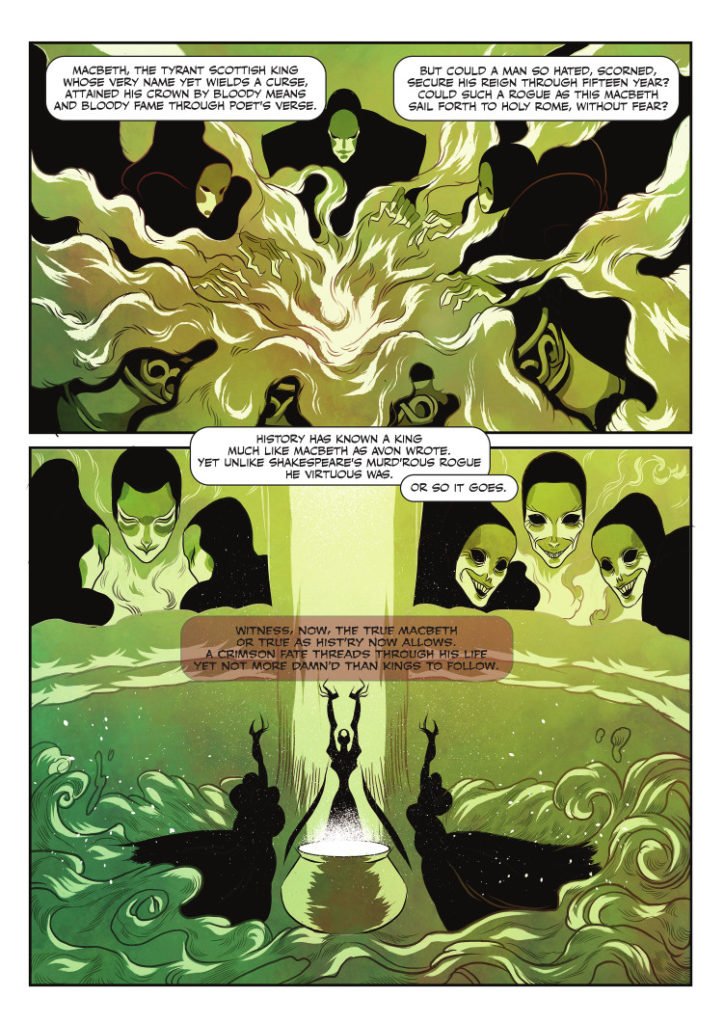

Macbeth: The Red King by Shaun Manning and Anna Wieszczyk is published by Blue Fox Publishing, priced £12.99.
Duck Feet, Ely Percy’s second novel, follows 12-year-old Kirsty Campbell as she and her friends go through high school together. Taking in teen rites of passage as well as the troubles of bullying, drugs and pregnancy, each chapter is told with poignancy and humour. In this extract, Kirsty contemplates the pitfalls of teenage fashion.
Extract taken from Duck Feet
By Ely Percy
Published by Monstrous Regiment
Nearly evrubdy in school wears stuff that says Tregijo. Yi can even get school shirts that’ve got it writ on them. This boy in ma class cawd David Donald, his family are pure poor cause thiv got aboot ten million weans, he come in wan day wi a Tregijo shirt an he got the slaggin ae his life. Ah didnae even notice anythin cause ah thought it looked identical tae evrubdy else’s but Charlene said, Naw yi can well tell that’s a fake, she said, Cause the stitchin on the cuffs is different.
Charlene wants tae get a pair ae Tregijo jeans as well as a top noo. Ah said, Ah didnae even know yi could get Tregijo jeans. Charlene said, Where’ve you been planet Uranus, an then she sniggert. Ah tolt her ah didnae get it an she jist said, Never mind, then she said, Ah take it ah’ll need tae gie you lessons oan how tae huv a sense ae humour as well as fashion.
*
Ma ma went an knittet me an Arran jumper tae wear ower ma school shirt. Ah said, Ah cannae wear that. How no, ma ma said, Yiv wore Arran jumpers tae school before. Ah says, Aye when ah wis aboot eight-yir-auld or somethin. Ma ma’s face wis pure trippin her. Actually the last Arran jumper yi had ah knittet a year past in October, she said, If yi remember right aw the wans in yir class wur jealous an ah endet up daein aboot six ae the bliddy things fur other folk.
Ah wantet tae say tae her that that wis primary school; that naebdy in high school wore an Arran jumper, no even David Donald an he wis the pure reject ae the class. Ma ma said when she wis at high school she’d tae wear hand me doons fae her big sister an she didnae go cribbin aboot it. She said, Ah remember bein no much aulder than you Kirsty, she said, An The Who had jist split up an fur months afterwards ah wis made tae wear yir Auntie Jackie’s auld denim jacket wi their logo on it.
Your ma musta been a pure reject anaw, said Charlene. This wis cause ah tolt her aboot The Who jacket. Ah wish ah hadnae tolt her noo but she kept askin me when ah wis gaun intae Glasgow an whit jumper did ah think ah wis gaunnae get. She kept on an on an on at me an ah had tae tell her somethin; ah never thought she’d hit me wi a comment lik that though.
*
Ma ma used tae be a sewin machinist. She used tae work in a factory that made aw the clothes fur Marks an Sparks. See aw yir Tregijo jumpers an yir shirts, she said, Thir no worth a chew. Widyi mean, ah said. She said, Thir no worth the money hen. She said, Ah’ve looked at some ae the stuff an the hems are aw squint an everythin an thiv jist been papt oot intae the shops an naebdy’s botherin as long’s it’s got a designer label on it thir’s folk that’ll buy it. Dae yi never think aboot gaun back tae it, ah asked her. Back tae whit, she said. Sewin machinin. Ma ma jist sighed. Wid yi no go back tae it then. Ah gave it up tae huv you an Karen, she said. Aye ah know. Don’t get me wrang it wis a great environment ah loved ma job, she said, But that wis thirteen year ago an it’s aw changed. Aye but yi could still go back. Aye Kirsty, she said, Ah can jist see it noo … ma designer Arran cardigans wid be aw the rage.
*
Ma ma gave me the thirty pound fur gaun intae Glasgow wi Charlene. Ah felt dead excitet cause ah’d only ever walked past Trendy Tribe, but then ah also felt bad cause ma ma an da had a big argument cause ma da jist got made redundant fae his work, an he says we cannae afford tae be spendin money willy nilly.
Charlene’s ma’s boyfriend disnae work either but he’s never oot the pub an he’s always wearin the best ae gear. Charlene’s ma works IN the pub an she’s whit ma da calls aw fur coat an nae knickers, an she gies Charlene thirty pound a week jist tae gie her peace. An they wonder how that wee lassie’s the way she is, said ma ma. Aye, ma da said, Ah’d rather dress lik a tramp than live the way that they live.
*
Ah wisnae that keen on Trendy Tribe. Ah thought thir sizes wur dead weird, an the folk that wur servin kept comin up an sayin, Can ah help yi dae yi need a hand can ah get yi anythin else there. Ah couldnae even get peace tae look but they wur up ma back every two minutes.
Charlene must’ve tried on every jumper in the shop in every different colour. She took that long in the changin rooms that ah actually shoutet through tae her, You better no be knockin anythin, an that soon made her move. She spent seventy two pound aw in: she bought a jumper that said
TREGIJO + PARTNER
that had a picture ae a cowboy haudin a smokin gun. She also got her jeans that she wis wantin, an a belt tae haud them up cause the smallest size wis too big fur her.
Ah endet up jist gettin a plain white T-shirt that had a T on the sleeve; it only cost fifteen pound an the lassie in the shop wis gaunnae gie me a twenty percent reduction because it had a black mark on it. Ah said tae her ah’d jist leave it though cause ah wisnae sure if it’d come aff, so she had tae go an get me another new t-shirt the same. Charlene wis pure hummin an hawin cause she said it wis takin ages an she wantet tae go fur somethin tae eat. Then she said, Is that it is that aw yir buyin, an when ah said Aye she said, Kirsty that’s pure miserable.
*
Charlene’s in a bad mood. She managed tae lose her purse wi twenty eight pound in it in the toilets in McDonalds, an by the time we realised an went back sumdy wis away wi it. Her return ticket wis in it anaw so ah had tae pay her bus fare back up the road.
When ah got in the hoose ah opent the carrier bag tae show ma ma whit ah’d bought an ah noticed the lassie had gied me a black Tregijo T-shirt by accident; then ah noticed that the white wan ah’d picked wis in there anaw. Sake, ah said, Ah’ll need tae go aw the way back intae Glasgow tae take it back noo. Don’t be daft, said ma ma, Sumdy’d need tae go wi yi an wur no wastin aw that money on bus fares. But it’s stealin is it no. Naw, said ma da. It’s whit yi caw an error in your favour – Anyway, it’s bad luck tae look a gift horse in the mooth. This is true, said ma ma. Ah wisnae convinced, but ah let it go cause ma ma did huv a point aboot the bus fares cause it widda cost another seven pound fifty an that’s only if we got a child an an adult day ticket.
Ma da had his ain good fortune the day. He’d applied fur a job packin balls a wool in a warehouse ower in Hillington an he got asked tae go fur an interview. Ah’ve got a right good feelin aboot this, he said. Me tae, said ma ma, An if yi get it they might gie yi some freebies.
Duck Feet by Ely Percy is published by Monstrous Regiment, priced £8.99.
David Bishop has just released his debut novel, City of Vengeance, introducing us to a new investigator, Cesare Aldo, in the sensational and dangerous underbelly of Renaissance Florence. We spoke to David about his book, and his favourite historical fiction.
City of Vengeance
By D. V Bishop
Published by Pan Macmillan
Congratulations David on the publication of City of Vengeance! It’s been quite the journey getting your book into print, but an encouraging one too for budding writers. Could you tell us more about your road to publication?
City of Vengeance was inspired by an academic monograph I chanced upon in a bookshop near the British Museum, which argued the criminal justice system in late Renaissance Florence was roughly similar to a modern police force. That set off a big lightbulb in my head, but I spent years researching and not writing the novel. The more I learned about the period, the more I realised how little I knew. I wanted to do the story justice, so I did other things instead – writing episodes of Doctors for BBC 1, audio dramas featuring Doctor Who, graphic novels and award-winning short film scripts that never quite got made.
To force myself into writing the novel, I started a Creative Writing PhD part-time via distance learning at Lancaster University in 2017. That gave me deadlines and a supervisor to offer feedback. The following year I entered the Pitch Perfect competition at the Bloody Scotland international crime fiction festival at Stirling. To my surprise I won, which galvanised me to hurry up and finish my first draft. More drafts followed and in Spring 2019 I started querying agents. Happily the wonderful Jenny Brown offered to represent me, and the book went on submission to publishers. Several made offers, but I chose Pan Macmillan – the home of Colin Dexter, Ann Cleeves, Ian Fleming, Lin Anderson and many others.
With historical fiction, a writer has to undertake a lot of research to bring authenticity to the world you’re creating. Did you enjoy this process?
Yes, too much at times. Research is utterly addictive because you discover so many fascinating things you never knew, facts that challenge your perception of history. My biggest problem is knowing when to stop researching and start writing, because it’s such a useful work displacement activity. My book shelves are groaning beneath the weight of books I have read, and those still waiting for my attention.
Your book is set in 16th century Florence. Did you already have a relationship to the city?
I grew up in New Zealand but had always wanted to see Florence, the cradle of the Renaissance. My first visit was in 2001, and I return every few years. Now I’m writing about the city, I have even more reason to go back – once the pandemic is over.
Your novel is a thriller as well as historical fiction. When writing, how did you strike the balance between your world-building and your pacy plotting?
My writing naturally tends toward pace, thanks to a background in journalism where lean writing is essential and a career in comics, where concision is crucial. I have to make a conscious effort to describe environments and characters, perhaps because I tend to send the story as a film playing in my head. I have to remember the readers can’t see what a tavern or a convent or a stabbing looks like unless I write it down.
You have quite the protagonist in your investigator Cesare Aldo. Can you tell us about his creation?
The fact I spent so long not writing City of Vengeance was to Aldo’s advantage. Instead of writing, I thought about his character. Who he was, how he was able to move between all parts and layers of life in Renaissance Florence. I knew he would be an outsider of sorts, but his sexuality means Aldo’s life is always at risk. Being what we now call a gay man at that time and in that place made you a criminal. So Aldo is both law enforcer and law breaker. When I realised that about him, a lot of his characterisation fell into place. He has a code he follows, things he will and won’t do. He’s a former solider, able to fight for his life when required, and he will kill if he deems that necessary. That makes him dangerous if cornered.
Who do you see playing him in a TV or film adaptation?
Twenty years ago the answer would have been Viggo Mortensen as Aragorn in The Lord of the Rings films. Now I think Shaun Evans who plays the young Morse in the TV drama Endeavour would make a wonderful Cesare Aldo. He’s a great actor, able to convey so much without saying a word – perfect for the often taciturn Aldo!
You’re currently working on a sequel. How far along do you see Aldo’s fortunes unfolding? Do you have a series arc in mind, or are you taking it on a book by book basis?
I have plans for the first four novels, which follow the seasons – winter 1536 in City of Vengeance, spring 1537 for the next book, and on into summer and autumn. There is a clear arc across those individual stories, which I hope readers will want to follow with me and the characters.
What historical fiction and thrillers have influenced you in your writing?
Abir Mukherjee’s novels set in early 20th Century India were a touchstone, the story of a good man working for a bad system of justice. The Leo Stanhope mysteries by Alex Reeve set in Victorian London showed that historical thrillers could have unexpected detectives. Books by Antonia Hodgson and Laura Shepherd-Robinson were also influential, as was the master of historical crime C. J. Sansom – we’re all following in his footsteps, one way or another.
What are you looking forward to reading next?
I’ve just finished an advance copy of Robbie Morrison’s Edge of the Grave, a cracking police procedural set in 1930s Glasgow which is coming out next month (March 2021). That really lives up to the ‘no mean city’ adage, and has all the deadpan humour you would expect of a great Glasgow novel. And I’m eager to read the next book by Liam McIlvanney, which is a sequel to his prize-winner The Quaker.
City of Vengeance by D. V Bishop is published by Pan Macmillan, priced £14.99.
ALSO ON BOOKS FROM SCOTLAND
-


Saltwater: A Midsummer Ghost Story by Elaine Thomson
‘The very thought of those grey faces made my skin grow cold.’
-

‘An Odious Campaign’ by Rob McInroy – Why a 1936 By-Election Still Resonates
‘This enraged the locals and he came close to being run out of town on several occasions.’
-

‘‘That’s right, Bobby,’ he growled. ‘I haven’t seen you in – well, since you decided to kill me.’ ‘
-

David Robinson Reviews: Solitary Agents by David Goodman
‘This is very much an up-to-the-minute story of spycraft, positively revelling in all the things tha …
-

The Savage Landscape by Cal Flyn
‘It is their resistance to the intrusions of the outside world − culturally, economically, environme …
-

The Shortest History of Scotland: A Q & A with Murray Pittock
‘We need to be better aware of that to understand the challenges and achievements of the past, and t …
FEATURED AUTHOR:
Alan Parks

Alan Parks has worked in the music industry for over twenty years. His debut novel Bloody January was shortlisted for the Grand Prix de Littérature Policière. He won the McIlvanney Prize in 2022 for the fifth entry in the Harry McCoy series, May God Fo …
FEATURED PUBLISHER:
NMS Enterprises Limited – Publishing

NMS Enterprises Limited – Publishing is the publishing division of National Museums Scotland. We produce lavishly illustrated catalogues for Museum exhibitions such as Catherine the Great: An Enlightened Empress and, in 2008, Silver: Made in Scotland, …