


Salena Godden’s debut novel has been deservedly garnering much praise from critics and early readers. Her lyrical, mesmeric story sees her personifying death as a black woman ready to tell her story and experiences. Here, in this extract, we are introduced to Wolf Willeford, who will go on to tell death’s story.
Extract taken from Mrs Death Misses Death
By Salena Godden
Published by Canongate
She came ten-pin bowling into my life, smashing over all that was good and all that made sense. I clung to the memories of my life before, as the weather turned bad and dark storm clouds gathered. It was a horror, a swirling ugly mess of feelings of loss and betrayal and abandonment. The room in my head was cold with the shadow of all that was absent and broken. The silence was screaming and I tipped my head back and screamed into it.
I cried. Of course I cried, I was just a kid and I was alone in the world. I lost a tooth one minute and everything the next. I remember I put the tooth under my pillow, but that night it was not the tooth fairy that came to visit, it was Mrs Death herself. This was my first time watching her at work. It is masterful, the way Mrs Death works. So deliberate. So merciless. There is a system: I’m not sure how it works, but I believe she must have a system and know what she is doing. There has to be a method for who lives and who dies, and when and where, but I cannot work it out. How does she choose? How does she know what’s best? What is supper for the spider is hell for the fly, or some-thing? I forget how that saying goes. Mrs Death is always too too too much. Too soon. Too sudden. Too cruel. Too early. Too young. Too final.
Mrs Death took my mother in one greedy gulp of flame and I watched. I still don’t know why I survived. That last night is in fragments. I can remember the last dinner we had together was a chicken curry. My mum made the best coconut chicken curry. Jamaican cooking is the best. I still miss my mum’s cooking so much. If I had known then that that was the last meal my mother would cook for me, I would have kneeled down and kissed it. I would have only eaten half and saved the rest to eat when I miss her. I would have distilled it, frozen it, locked it in a capsule, kept it in a safe. Or you know, I would have at least said thank you. Instead I just scoffed it down watching telly. I don’t remember what we watched on telly that night, I wish I could. We were being ordinary. We were being normal. Me and Mum on the sofa, we ate chicken curry and rice, we watched some telly and then when we went to bed, she said goodnight.
Goodnight, Wolfie, love you! she said. Night, Mum, love you too. She said the tooth fairy would be coming and remember to put the tooth under my pillow. Stop reading! Switch the light off! she probably said. Mum, what does the tooth fairy look like? Wait and see!
I never found out though. Next thing I knew everyone in the building was shouting and there was panic and smoke and then I was shivering and standing barefoot in my pyjamas in the road. They said there was nothing that could be done. I stood alone, frozen to the spot, cold feet on the wet pavement. Someone wrapped me in an itchy green that smelled sterile. I stared up at our building, the heat, the roaring fire, guffs of black smoke. And all around me was a chaos of blue lights, flashing lights, a scream of sirens, whilst the hungry flames grew higher and higher, scorching tree tops, tongues of flame, licking the heavens. Black pages, black ash, debris drifted, a black ash snow fell around me as our entire building burned. No sprinklers. No alarms. No warning.
I threw my head back and I howled into the charred and blackened sky. My home, my whole world was burning. I let her have it. I tipped my head back and roared and I hoped someone would hear it, perhaps that Death would hear it, hear me crying my heart out. Fat tears rolled down my dirty brown face.
Through the blur I saw a face in the smoke above me, a woman’s face: the face of Mrs Death. A kind black lady’s face was smiling down at me, and her smile, it was gentle, but that made me furious. I screamed at her. I was crying and crying and crying, raining tears to the river to the sea, from salt to salt, from root to root and blood to blood. And the wind swirled and echoed my pains. There was heat, a great heat within my pain, a searing heat in my heart and soul, a pain in my chest and guts and my cries were howls carried in the wind through time and space.
Mrs Death Misses Death by Salena Godden is published by Canongate, priced £14.99.
The 25th February 2021 will be the first Gray Day, a celebration of the writer and artist Alasdair Gray, on the 40th anniversary of his masterpiece Lanark. Canongate will be publishing a new hardback edition of Gray’s seminal debut, as well as new editions of Unlikely Stories, Mostly, McGrotty and Ludmilla and The Fall of Kelvin Walker. BooksfromScotland pays tribute to one of Scotland’s most iconic works by sharing one of its most iconic passages.
Extract taken from Lanark
By Alasdair Gray
Published by Canongate
One morning Thaw and McAlpin went into the Cowcaddens, a poor district behind the ridge where the art school stood.They sketched in an asphalt playpark till small persistent boys (‘Whit are ye writing, mister? Are ye writing a photo of that building, mister? Will ye write my photo, mister?’) drove them up a cobbled street to the canal. They crossed the shallow arch of a wooden bridge and climbed past some warehouses to the top of a threadbare green hill. They stood under an electric pylon and looked across the city centre. The wind which stirred the skirts of their coats was shifting mounds of grey cloud eastward along the valley. Travelling patches of sunlight went from ridge to ridge, making a hump of tenements gleam against the dark towers of the city chambers, silhouetting the cupolas of the Royal infirmary against the tombglittering spine of the Necropolis. ‘Glasgow is a magnificent city,’ said McAlpin. ‘Why do we hardly ever notice that?’ ‘Because nobody imagines living here,’ said Thaw. McAlpin lit a cigarette and said, ‘If you want to explain that I’ll certainly listen.’
‘Then think of Florence, Paris, London, New York. Nobody visiting them for the first time is a stranger because he’s already visited them in paintings, novels, history books and films. But if a city hasn’t been used by an artist not even the inhabitants live there imaginatively. What is Glasgow to most of us? A house, the place we work, a football park or golf course, some pubs and connecting streets. That’s all. No, I’m wrong, there’s also the cinema and library. And when our imagination needs exercise we use these to visit London, Paris, Rome under the Caesars, the American West at the turn of the century, anywhere but here and now. Imaginatively Glasgow exists as a musichall song and a few bad novels. That’s all we’ve given to the world outside. It’s all we’ve given to ourselves.’
‘I thought we had exported other things—ships and machinery, for instance.’
‘Oh, yes, we were once the world’s foremost makers of several useful things. When this century began we had the best organized labour force in the United States of Britain. And we had John McLean, the only Scottish schoolteacher to tell his students what was being done to them. He organized the housewives’ rent strike, here, on Clydeside, which made the government stop the landlords getting extra money for the duration of World War One. That’s more than most prime ministers have managed to do. Lenin thought the British revolution would start in Glasgow. It didn’t. During the general strike a red flag flew on the city chambers over there, a crowd derailed a tramcar, the army sent tanks into George Square; but nobody was hurt much. Nobody was killed, except by bad pay, bad housing, bad feeding. McLean was killed by bad housing and feeding, in Barlinnie Jail. So in the thirties, with a quarter of the male workforce unemployed here, the only violent men were Protestant and Catholic gangs who slashed each other with razors. Well, it is easier to fight your neighbours than fight a bad government. And it gave excitement to hopeless lives, before World War Two started. So Glasgow never got into the history books, except as a statistic, and if it vanished tomorrow our output of ships and carpets and lavatory pans would be replaced in months by grateful men working overtime in England, Germany and Japan. Of course our industries still keep nearly half of Scotland living round here. They let us exist. But who, nowadays, is glad just to exist?’
‘I am. At the moment,’ said McAlpin, watching the sunlight move among rooftops.
‘So am I,’ said Thaw, wondering what had happened to his argument. After a moment McAlpin said, ‘So you paint to give Glasgow a more imaginative life.’
‘No. That’s my excuse. I paint because I feel cheap and purposeless when I don’t.’
‘I envy your purpose.’
‘I envy your self-confidence.’
‘Why?’
‘It makes you welcome at parties. It lets you kiss the host’s daughter behind the sofa when you’re drunk.’
‘That means nothing, Duncan.’
‘Only if you can do it.’
Lanark by Alasdair Gray is published by Canongate, priced £20.00.
To find out more about Gray Day, please visit the Gray Day website.
Craig Russell is an internationally-bestselling writer of gothic, psychological thrillers. Next month, his new novel, Hyde, will be published, and in it, he explores one of Scottish literature’s most famous characters. We caught up with with Craig to chat about his favourite books.
Hyde
By Craig Russell
Published by Constable
The book as . . . memory. What is your first memory of books and reading?
Honestly? I can’t remember. Books, reading, the written word were always there as part of my conscious environment. My parents always claimed that I could read well before I went to school, and I remember that I always had books around me. I have the oddest, clearest memory—almost a flashbulb memory—from when I was at primary school: they had the alphabet up on the walls, large black letters against white backgrounds. I can still see, very clearly, the lowercase letter ‘a’ in a sans-serif typeface. I know it sounds bizarre, but I knew instinctively that the letter and the word were part of what defined me. Much in the way I suppose a natural mathematician engages with the number.
When I was very young, I read a story about boy, a Pacific Islander, and his conquest of his fear of the sea. I think it was at that point that I realized that reading was a magical device that allowed you to travel to any place or any time. That, I think, is very much what I try to do now that I’m a novelist. If I can transport myself completely to another time, place and experience, hopefully I can bring along my readers.
The book as . . . your work. Tell us about your latest book Hyde. What did you want to explore in writing it?
Hyde is set in Victorian Edinburgh and combines all the elements that excite me personally: conflicting senses of identity, psychology, history, myth and legend. I think every writer explores the complexities, paradoxes and contradictions of their own cultural and historical background.
Hyde isn’t a retelling of Stevenson’s tale. If anything, it’s more of an origin story. Just as Robert Louis Stevenson based the character of Long John Silver on his one-legged friend William Henley, I have suggested that the combined character of Jekyll and Hyde were based on a real acquaintance of Stevenson. My Hyde—Captain Edward Henry Hyde—is superintendent of detective officers of the City of Edinburgh Police. He keeps secret from all but his physician that he suffers from ‘lost time’—periods during which he cannot account for his actions—and is plagued with dark dreams that emerge him in a fantastical landscape populated with figures and monsters from Celtic mythology. With no memory of how he got there, Hyde finds himself at the murder scene of an unknown man, found hanging upside-down above the Water of Leith, a victim of the ancient Celtic three-fold death ritual. He starts to investigate the murder, worried that he himself should be a suspect.
Hyde is heart and soul a dark, gothic thriller, but it is woven through with dualities of all sorts, including Edinburgh’s split-personality (which was the true inspiration of Stevenson’s tale, even if he did set it in London). Hyde also allowed me to interrogate the Scottish sense of self at the zenith of the British Empire. It’s a very different book from The Devil Aspect, but it allowed me to delve back into some of the same Jungian concepts of the role of myth in our sense of identity, and the archetypes that haunt both our dreams and our legends. All of which allowed me to ratchet up the psychological horror.
The book as . . . inspiration. What is your favourite book that has informed how you see yourself?
God, that’s difficult! I would find it difficult to single out a single book. But, if I had to, I think it would be Nineteen Eighty-Four by George Orwell.
The book as . . . a relationship. What is your favourite book that bonded you to someone else?
My first novel, Blood Eagle. My wife and I already had a successful freelance writing business and I rather timidly suggested I wanted to devote time to writing a novel. Her enthusiasm and support was total and I honestly don’t know if I would have stuck with it without her encouragement.
The book as . . . object. What is your favourite beautiful book?
I love beautifully crafted books and I have a collection of Folio Society editions. My favourite, however, would be an heirloom: my copy of Gulliver’s Travels from 1898. My grandmother was awarded it as a school prize, and she gave it to me when I was a child. It’s filled with wonderful illustrations by A.M. Sargent.
The book as . . . rebellion. What is your favourite book that felt like it revealed a secret truth to you?
A combination, in totally contradictory ways, of Nineteen Eighty-Four by George Orwell and The Roads to Freedom trilogy by Jean-Paul Sartre. I read them both when still young and they helped form my political consciousness. I think outsider fiction influenced me greatly and all my protagonists tend to be outsiders, to varying degrees.
The book as . . . entertainment. What is your favourite rattling good read?
Again, this is a tie. The Thirty-Nine Steps by John Buchan and Figures in a Landscape by Barry England. Both pursuit thrillers where the landscape is as much character as setting.
The book as . . . a destination. What is your favourite book set in a place unknown to you?
When I was a teenager, I read all the Russians. And, of course, at that time, Russia was behind the Iron Curtain, and a land and culture in shadow. I read Dostoyevsky, some Tolstoy, all the short stories of Anton Chekhov, and graduated to the social realism of Mikhail Sholokhov—but, above them all, was Nikolai Gogol, whose work I loved. Unable at that time to visit Russia, I built an image of the land and its people. I think my favourite book would have to be The Diary of a Madman and Other Stories.
The book as. . .education. What is your favourite book that made you look at the world differently?
I honestly think that if a book doesn’t challenge one’s view of the world, of oneself, then it isn’t worth reading. There have been so, so many. One of my main literary influences and favourite reads is Heinrich Böll. His style was very simple and direct, yet so powerful. It would have to be a toss-up between his Collected Short Stories and The Lost Honour of Katharina Blum.
The book as. . .technology. What has been your favourite reading experience off the page?
Oh. I’m very last century. Or maybe even century-before-last. Everything I read tends to be physical books. Although I do love audiobooks … I recently listened to the late Anthony Valentine’s narration of Dracula … great stuff.
The book as . . . the future. What are you looking forward to reading next?
The Bridge at Andau by (a very young) James Mitchener. It was recommended to me by Frank Darabont (the writer/director of The Shawshank Redemption and The Green Mile), whose parents fled the 1956 Soviet crackdown in Hungary. Frank knows I wrote Dead Men and Broken Hearts against the background of the Hungarian Uprising and highly recommended Mitchener’s nonfiction book. I’m really looking forward to it.
Hyde by Craig Russell is published by Constable, priced £16.99.
The future of the union is a subject that will continue to dominate British political discourse throughout the year. David Robinson finds that Gavin Esler’s new book, How Britain Ends, sheds light on how we arrived at our current circumstances and what it may mean in the months and years ahead.
How Britain Ends: English Nationalism and the Rebirth of Four Nations
By Gavin Esler
Published by Head of Zeus
The best bit of Gavin Esler’s latest book is when he gets to grips with Shakespeare. The thesis of How Britain Ends is that it’s Brexit-fuelled English nationalism, rather than the SNP, that will consign what Gordon Brown last month called ‘the world’s most successful experiment in multinational living’ to the rubbish bin of history. You can’t talk about English nationalism without at some stage coming across that speech from Richard II, Act II – you know, the one about ‘this happy breed of men’, ‘this sceptred isle’, ‘this fortress built by Nature for herself against infection’ (ouch), ‘this blessed plot, this earth, this realm, this England’ – and Esler’s analysis of it is one of the highlights of his book.
The speech by John of Gaunt is, he says, is ‘one of the most beautifully patriotic found anywhere in literature’, capable of sending shivers up even a Scottish spine. But if you read it right to the end – and I must admit, I never have – its meaning changes. This once-happy land, it concludes, ‘is now leased out … like to a tenement or a pelting farm…’ and ‘This England that was wont to conquer others/Hath made a shameful conquest of itself.’
What else, Remainers like Esler argue, was Brexit? And even if you don’t accept that, look at the speech’s tone. John of Gaunt is emphatically not looking forward to new and exciting developments in the sceptred isle: just the opposite, he is looking back to a time when England was a far more contented place. This ‘nostalgic pessimism’ is, Esler suggests, inherent in almost all writing about Englishness and probably played its part in the 2016 Brexit referendum too. The EU didn’t really matter to most voters – in a survey the previous year only 6 per cent rated it as a touchstone issue – and the complexities of trade tariffs engaged even fewer. But given the chance to have their say, nostalgic pessimism kicked in, and English nationalists kicked the UK out of Europe. And, argues Esler, unless they are ready to accept root-and-branch constitutional reform, they’ve made the break-up of Britain inevitable too.
It’s the English not the Scots, who are swinging the sledgehammer here – or, in Fintan O’Toole’s phrase, ‘practising a form of silent secession from the UK’. Of course, they wouldn’t see it like that: Prime Minister Johnson furtively headed north last month to ‘save the Union’ not destroy it. But ‘getting Brexit done’, the one clear demand of the English nationalists, made this impossible. Taking away Scots’ European identity against their will in the Brexit referendum has made Scottishness more important, not less. To the true Brexiter, this was a price worth paying. In October 2019, Tory pollster Lord Ashcroft found that 76 per cent of Tory Leave voters wanted to push for Brexit even if it meant Scotland gaining independence. Slightly fewer – 74 per cent – thought that Brexit would be worth the sacrifice of Northern Ireland.
To anyone who thinks of themselves as British, those figures are hideous. If Unionists no longer care about the Union, says Esler, ‘the end of Britain is only a matter of time’.
But let’s drill down a bit deeper into Ashcroft’s polling sample. Surely the whole point about those people who didn’t set much store the Union is that they didn’t think of themselves as British in the first place. Nominally, of course, they were: and they wanted the dark blue passport to prove it. But in their heads they weren’t really Brits at all. They were English.
Esler calls these people English nationalists, and so far in this piece I have too. His thesis is that the Conservative party, which has now remodelled itself in the image of UKIP, has taken the UK to the point where it faces three possible futures. The first option, to reinvent Britishness, is unlikely to succeed because the things that made Britain work in the past now no longer do. The second is a form of federalism with a written constitution – basically, a reworking of the ‘Home Rule All Round’ plans from the 1890s that would incorporate much of Salmond’s 2014 independence plan. The final option – doing nothing – may well be the most likely, given the incompetence of the current British government, but would lead to an even more divisive break-up of the UK. Already, he notes, ‘Johnson has done more in a few months to bring about a United Ireland than the IRA managed in three decades of bombings and shootings’. If denied indyref2, Scots will become ‘even more scunnered, thrawn and determined to seek a more extreme form of independence’. The Great Paradox of Brexit – that a mainly English whim to assert independence from the EU could lead to Scotland and Northern Ireland demanding independence from England itself – could soon be complete.
This is a consistently thought-provoking and well-argued book, and yet the more I read it, the more I wondered about English nationalism. Maybe that’s because though I was born in England myself, I’ve never felt its pull. Britishness, yes; Scottishness too. Like everyone else, I’ve noticed how the cross of St George has gradually replaced the Union Jack south of the Border, but if this is a rising tide of millions, a force strong enough to fragment a country, where is its cultural expression? Where are the films clips from the Noughties onwards that you’d use to illustrate the thesis? Where are the books?
Esler is, however, right about one aspect of English nationalism: it is comparatively unexplored. If it does exist, it’s hidden away in the statistics, in the rising number of people who identify as English rather than British in recent censuses. According to the Institute of Public Policy Research, there’s a discernible sense of resentment among their English – especially in the North, home to all of the UK’s fastest declining towns with populations bigger than 100,000 – that Scots have greater political clout and get comparatively more money from the public purse. But that IPPR report was written in 2012, and if there have been any mass demos in favour of an England-only parliament since then, I must have missed them.
So was Brexit proof of rising English nationalism or just a loopy protest vote? I’ll leave that for you to decide, but first I’ll take you back to Shakespeare. What I love most of all about the John of Gaunt speech, that classic statement of English exceptionalism, is the man making it. For John of Gaunt, the Duke of Lancaster, is really Jean de Ghent. Or, as we would say these days, now that his own country has come into being, a Belgian.
How Britain Ends: English Nationalism and the Rebirth of Four Nations by Gavin Esler is published by Head of Zeus, priced £14.99.
This month sees the welcome republication of Jackie Kay’s Bessie Smith. Now including a new introduction, Kay’s book celebrates the life and art of the blues legend through biography, memoir, and fictional exploration. It’s a thrilling read, full of a fan’s love and will make you want to explore Bessie’s music more deeply. BooksfromScotland is on hand to start that ball rolling. We hope you enjoy these clips of an unforgettable talent.
Bessie Smith
By Jackie Kay
Published by Faber
Bessie Smith performs ‘St. Louis Blues’ in the film St. Louis Blues. The only existing footage of Bessie Smith singing. Jackie Kay writes: ‘I remember the shock of the grainy monochrome image of my heroine appearing in this sad tale of woe. There she was, a tall, beautiful woman, driven to drink by her feckless lover.’
One of Bessie’s most iconic songs, ‘Nobody Knows When You’re Down and Out’, recorded as her first marriage was breaking down, and just months before the Wall Street Crash in 1929 that saw her career decline.
One of Jackie Kay’s favourites, ‘Dirty No-Gooder’s Blues’. Jackie Kay writes of first hearing it: ‘It sounded so bad. The very name made you think things you weren’t supposed to be thinking at that age.’
Another one of Jackie Kay’s favourites, ‘Kitchen Man’. Jackie Kay writes: ‘I was a bit nonplussed when I discovered that all those jelly rolls and sugar rolls in those songs had nothing to do with food.’
Bessie’s first hit record, ‘Downhearted Blues’, released in 1923. It sold 750, 000 copies in six months, making her a star.
https://www.youtube.com/watch?v=go6TiLIeVZA
The brilliant and audacious (and a favourite of BfS – the first Bessie Smith song we heard) ‘Send Me to the ‘Lectric Chair’. Jackie Kay writes ‘The combination of the extraordinary plea with the graphically violent descriptions of the murder makes the song wildly funny. I can imagine women hearing it in 1927 and splitting their sides laughing.’
https://www.youtube.com/watch?v=TZ6w5IlqhSk
Let’s end our Bessie Smith playlist with one of her best party songs, ‘Gimme a Pigfoot and a Bottle of Beer’. Jackie Kay writes ‘The gutsy way she sings that “yeah” is like nobody else. She drags that yeah out of herself. She knew how to let herself go; didn’t give a damn what anyone thought of her.’
Bessie Smith by Jackie Kay is published by Faber, priced £9.99.
Ahead of the Valentine weekend, BooksfromScotland wanted to share an extract from Duncan Mackenzie’s memoir, Cappucino and Porridge, which pays warm tribute to the author’s father, from Harris, stepfather, from Skye, and father-in-law, from Tuscany. Here, though, in this extract, we learn of the romance that brought the two families together.
Cappucino and Porridge
By Duncan Mackenzie
Published by Acair Books
ALE AND I MEET AGAIN.
~.~ My Positive Premonition ~.~
At this juncture, I recall two points from my formative years. Firstly, at primary school age, I had an appetite for the stories of the Greeks and Trojans and of Scotland’s William Wallace. What the Greeks did to Hector was bad enough, but what the English did to William Wallace had me, aged not very much at all, making a solemn vow that I would never marry an English girl. Secondly, I had a distinct and recurring premonition that a tall, blonde girl was going to appear in my life and that would then be that.
Back in the eighties and I cannot explain why, it appears that I was guilty of having in my mind an ignorantly held stereotypical image of Italian girls as being short, dark haired and deeply tanned in appearance. There is no more validity in this than there is in believing that Scottish men all resemble the bearded, kilted piper of cartoon caricature, keen on whisky and on observing what a lovely, bright, moonlit night he was enjoying. To my eternal shame, this did not prevent me from picturing a short, dark bob-cut, deeply tanned, apprentice ‘mamma Italiana’ figure, with arms akimbo when, in 1983, I was invited to take a week off work to accompany my mother and John F to Garden Cottage, Balavil with a young Gori daughter in tow. The idea was sold to me by the offer of the use of my mother’s car (new, reliable, petrol paid by her) to get to a few golf courses and perhaps to Loch Ness and Skye to show them to the imagined ‘short, dark schoolgirl’ Italian guest. She was not English, obviously, but otherwise she was still most unlikely to fit the premonition description, according to my subconscious.
It nearly didn’t happen at all. Alessandra’s letter to Margaret, written at the suggestion of Cipriana, looked for help in finding a job as an au pair/babysitter/nanny for the summer holidays with the practice of English in mind. Ale was at university, majoring in German coupled with English as her secondary subject.
Margaret and her friends were all beyond the stage of needing the kind of help Ale was offering, but she responded with the offer of a two week visit with plenty of English practice available. Ale very nearly graciously declined, as she doubted that the length of stay would provide her with the volume of practice in conversational English that she thought she needed that summer. Fortunately, she decided to accept and booked her flight.
By this stage, both my brother and I had left home, had bought our own flats and my brother was engaged. Dinner was arranged chez Margaret and John F, with my brother and his fiancée forming the reception party at the airport, in the company of Margaret. I would arrive in time for the evening meal once I had played for the Court of Session football team against one of the big law firms in Edinburgh. It was an enjoyable time of the year for me with plenty daylight for evening golf; the rugby season was over, so click into football mode. Some of the opponents didn’t seem to have a switch to click nor anything other than long, metal studs. So, for me, it was a case of, ‘Hello. Welcome to Scotland. Excuse me while I patch up this gouge out of my leg.’
There was no ice to be broken by the time I reached my mother’s house. The ‘short, dark schoolgirl’ of my caricature turned out to be twenty years of age, tall, cascading blonde waves, brown eyes often widened in animated conversation, tanned only to the shade of honey and all hand gestures, loads of hand gestures. She would struggle for an English word, but only for an instant before her hand would be raised as if directing traffic to come to an immediate halt, then, ‘Wait!’ in a distinctly north German accent, followed by the furious turning of pages in a tiny dictionary. She was quite something, but it was Scottish eyes which met Scottish eyes across the dinner table and almost imperceptibly widened at the sight of Ale reaching confidently out to the wine bottle in the centre of the table and helping herself. It didn’t register with the MacKenzie boys that the wine was from Nazareno’s vineyard, sent over with his daughter in gift. Wine at our mother’s table was novel enough for the brothers without the sight of a young guest diving in and helping herself – utterly unthinkable for either son.
The teasing must have started almost immediately, as my brother has been quoted often since as having assured Alessandra that Scots only tease people they like. No doubt Rev and Mrs Fletcher’s eyes met and perceptibly widened when I was found to be helping to dry the dishes after dinner. I am sure that within three hours of our meeting my brother nudged me in the ribs and urged me to befriend the young Italian lady or, at least, something along those lines.
In the days that followed, I am told that I suddenly found time to drive from my office to my mother’s house for lunch and then to reappear for dinner in the evening. Mother, apparently, told family later that Ale would not eat until I arrived, no matter if work, football or golf kept me very late.
On one of my journeys in for dinner, I was nearly delayed on a long-term basis. I had been cruising along quite happily in my old mini, when a black car came right out in front of me from a side road on my left. It felt like the wee mini’s nearside wheels left the ground as it got itself round the black car before making it back on to its own side of the road – no anti-lock braking systems in those days, at least not in old minis. Looking back to see if the other car was ok, I saw it had stopped so I did the same. The driver came forward to thank me and congratulate me, in colourful terms, for my evasive action. We parted as new best buddies. Alessandra’s reaction, on hearing of the incident after dinner, was (wide-eyed of course) to take my hand in both of hers – nice. I was really getting to like this very foreign girl.
As to the week which followed, there is an unusual source of information. On 14th December 1996 Ale, John, Seumas and I were surprised to find ourselves in colour on the cover of the weekend section of one of Scotland’s national newspapers with the words ‘The Europeans’ emblazoned below. The four of us, pre-Finlay, were surrounded by cartoon Santas in the traditional styles of half a dozen European countries. The Glasgow Herald was running a feature on how Europeans had made Scotland their own. What had the Europeans found in Scotland? What did they miss? What part did they see Scotland playing in Europe?
In addition to the group photo on the front, inside there was a close-up of Ale, taken at her desk, the caption reading, ‘The Gaelic Dolce Vita.
Ale had clearly spoken freely to the writer of the article, Jane Scott. There are one or two quotes which, on re-reading the piece for the first time in many years, I found touching. In addition, there was a paragraph on Ale which remains pertinent, namely, ‘Her first foreign language was German. When she first came here, she had a German accent, but she has a superb ear. When she speaks now it is pure Edinburgh. After holidays on Harris, the island of Duncan’s father, her accent is often mistaken for Hebridean. She is proud of that.’ Ale still comes back from Harris sounding like Auntie Mary Ann in Quidinish.
The article did carry one serious error slap bang in the middle of the headline which read, ‘A first kiss upon the moor.’
No.
On the absolute authority of one of the parties to that first kiss, it is confirmed that it did not occur up on the moor. It happened a good two or three hundred yards below the edge of the Balavil moor, on the track, in the woods. Alessandra leaned forward, she still insists, to brush away a beastie which had landed on my collar. I misinterpreted the approach and there we had ‘the first kiss upon the track, two or three hundred yards down from the moor and thanks, in part at least, to a visiting insect.’
The suggested trip to Loch Ness did not happen, but the two of us did take off for a day trip to the Isle of Skye which is only about two hours away from Balavil.
Scotland, it must be admitted, had a very good summer in 1983, good enough to amount to a clear case of innocent misrepresentation to a visiting Italian. We stopped off at Invergarry where Ale took a photo from the riverbank. An enlarged version of that photo has hung above our open fireplace for over thirty years and it shows that the day must have been quite hot.
While we were walking in single file along a narrow path in the glen, I realised that things had gone quiet. There was no sound at all from the enthusiastic conversationalist behind me. I turned around to find Ale looking like a feeding duck, head in the river, both cooling off and controlling the former cascading waves, which had first become slightly unruly curls and which then became, instead, cascading ringlets; so, cooled and controlled, the operation worked on both counts. The feeding duck reference is perhaps best consigned to history; she probably didn’t find it funny, even then.
Over on Skye, on Broadford pier to be precise, I heard a burst of Italian (no German accent) which rang a few bells from early Latin classes, Amo, amas, amat and all that. By the time the week was nearing its end, we had talked about Protestant/Catholic and Scottish/Italian marriage and even the raising of children. Discounting the 1974 discovery of bivouacked children in my home, I had known Alessandra for all of two weeks.
Cappucino and Porridge by Duncan Mackenzie is published by Acair Books, priced £15.95.
The annual Burns celebrations are always a welcome moment in the dark January month. This year, Black and White Publishing have released a sumptious celebration of the bard, Burns for Every Day of the Year. Author Pauline Mackay gives us poems and commentary for each day, a perfect way to introduce yourself or rediscover his brilliant work. Here, we share entries for late January to accompany your Burns suppers.
Burns for Every Day of the Year
By Pauline Mackay
Published by Black and White Publishing
25th January
Robert Burns was born on the 25th of January 1759 in Alloway, Ayrshire. It is commonly believed that the first Burns Supper was held in Alloway in July 1801 to commemorate the fifth anniversary of the bard’s death. A gathering of contemporaries and admirers paid tribute to Burns by reading from his works, raising a toast to his memory and dining on haggis, a dish traditionally regarded as peasant food. They agreed to meet again in January of the following year to celebrate the bard’s birth and the tradition developed from there. Burns Night is now a truly global phenomenon: the biggest annual celebration of any author worldwide.
‘To a Haggis’ is the bard’s ode to the dish that has since become the culinary centrepiece of any Burns Supper. Haggis is comprised of those parts of a sheep that would not fetch a good price at sale: heart, lungs and liver combined with oats and seasoning, and boiled in the sheep’s stomach. In a performative piece, abundant with imagery, Burns presents the haggis as nutritious, hamely fare, unpretentious and truly worthy of celebration.
Why not try performing the poem at your own Burns Supper? By the end of this ‘warm-reekin, rich’ address, your company will be ravenous!
To a Haggis
Fair fa’ your honest, sonsie face,
Great Chieftain o’ the Puddin-race!
Aboon them a’ ye tak your place,
Painch, tripe, or thairm:
Weel are ye wordy o’a grace
As lang’s my arm.
The groaning trencher there ye fill,
Your hurdies like a distant hill,
Your pin wad help to mend a mill
In time o’need,
While thro’ your pores the dews distil
Like amber bead.
His knife see Rustic-labour dight,
An’ cut you up wi’ ready slight,
Trenching your gushing entrails bright,
Like onie ditch;
And then, O what a glorious sight,
Warm-reekin, rich!
Then, horn for horn they stretch an’ strive:
Deil tak the hindmost, on they drive,
Till a’ their weel-swall’d kytes believe
Are bent like drums;
Then auld Guidman, maist like to rive,
Bethankit hums.
Is there that owre his French ragout,
Or olio that wad staw a sow,
Or fricassee wad mak her spew
Wi’ perfect sconner,
Looks down wi’ sneering, scornfu’ view
On sic a dinner?
Poor devil! see him owre his trash,
As feckless as a’ wither’d rash,
His spindle shank a guid whip-lash,
His nieve a nit;
Thro’ bluidy flood or field to dash,
O how unfit!
But mark the Rustic, haggis-fed,
The trembling earth resounds his tread,
Clap in his walie nieve a blade,
He’ll mak it whissle;
An’ legs, an’ arms, an’ heads will sned,
Like taps o’ thrissle.
Ye Pow’rs, wha mak mankind your care,
And dish them out their bill o’ fare,
Auld Scotland wants nae skinking ware
That jaups in luggies;
But, if ye wish her gratefu’ pray’r,
Gie her a haggis!
26th January
Even in the absence of manuscript evidence, ‘The Selkirk Grace’ has long been attributed to Burns. Another Burns Supper favourite, it represents an important part of the almost ritualistic running order of the festivities.
The Selkirk Grace
Some hae meat and canna eat,
And some wad eat that want it:
But we hae meat and we can eat,
Sae let the Lord be thankit.
27th January
If haggis is the culinary centrepiece of the Burns Supper, then whisky is its most popular accompaniment. ‘Scotch Drink’ is Burns’s most explicit celebration of the Scottish national tipple and one of the country’s most successful exports (alongside the bard himself). In the following extract, Burns wittily extols the inspirational and illuminating ‘benefits’ of a dram.
Scotch Drink
Let other Poets raise a fracas
’Bout vines, an’ wines, an’ drucken Bacchus,
An’ crabbed names an’ stories wrack us,
An’ grate our lug:
I sing the juice Scotch bear can mak us,
In glass or jug.
O thou, my MUSE! guid, auld SCOTCH DRINK!
Whether thro’ wimplin worms thou jink,
Or, richly brown, ream owre the brink,
In glorious faem,
Inspire me, till I lisp an’ wink,
To sing thy name!
Let husky Wheat the haughs adorn,
And Aits set up their awnie horn,
An’ Pease and Beans, at een or morn,
Perfume the plain,
Leeze me on thee, John Barleycorn,
Thou king o’ grain!
On thee aft Scotland chows her cood,
In souple scones, the wale o’ food!
Or tumbling in the boiling flood
Wi’ kail an’ beef;
But when thou pours thy strong heart’s blood,
There thou shines chief.
Food fills the wame, an’ keeps us livin;
Tho’ life’s a gift no worth receivin,
When heavy-dragg’d wi’ pine an’ grievin;
But oil’d by thee,
The wheels o’ life gae down-hill, scrievin,
Wi’ rattlin glee.
Thou clears the head o’ doited Lear;
Thou chears the heart o’ drooping Care;
Thou strings the nerves o’ Labor-sair,
At’s weary toil;
Though ev’n brightens dark Despair,
Wi’ gloomy smile
28th January
We draw towards the close of this month with another of Burns’s Bacchanalian productions. Famous for its representation of conviviality and revelry in male friendship, ‘Willie Brew’d a Peck o’ Maut’ was inspired by a meeting between Burns, William Nicol (1744–1797) and Allan Masterton (c.1750–1799). Burns recalled that, ‘We had such a joyous meeting that Masterton and I agreed, each in our own way, to celebrate the business.’ And so, Masterton composed the air to which Burns’s song is set.
Willie Brew’d a Peck o’ Maut
(to the tune of Willie Brew’d a Peck o’ MautO Willie brew’d a peck o’ maut,)
O Willie brew’d a peck o’ maut,
And Rob and Allan cam to see;
Three blyther hearts, that lee-lang night,
Ye wadna found in Christendie.
Chorus: We are na fou, We’re nae that fou,
But just a drappie in our e’e;
The cock may craw, the day may daw,
And aye we’ll taste the barley bree.
Here are we met, three merry boys,
Three merry boys I trow are we;
And mony a night we’ve merry been,
And mony mae we hope to be!
Chorus: We are na fou, &c.
It is the moon, I ken her horn,
That’s blinkin’ in the lift sae hie;
She shines sae bright to wyle us hame,
But by my sooth, she’ll wait a wee!
Chorus: We are na fou, &c.
Wha first shall rise to gang awa,
A cuckold, coward loun is he!
Wha first beside his chair shall fa’,
He is the King amang us three!
Chorus: We are na fou, &c.
Every Day of the Year by Pauline Mackay is published by Black and White Publishing, priced £20.00.
Looking for more books to celebrate Burns Night? Check out . . .
 The Canongate Burns, edited by Andrew Noble and Patrick Scott Hogg
The Edinburgh Companion to Robert Burns, edited by Gerard Carruthers
My Luve’s Like a Red, Red Rose, illustrated by Ruchi Mhasane
Tam o’ Shanter, adapted by Richmond Clements and illustrated by Inko
The Life of Robert Burns, by Catherine Carswell
The Jewel, by Catherine Czerkawska
On the Trail of Robert Burns, by John Cairney
A Night Out With Robert Burns, edited by Andrew O’ Hagan
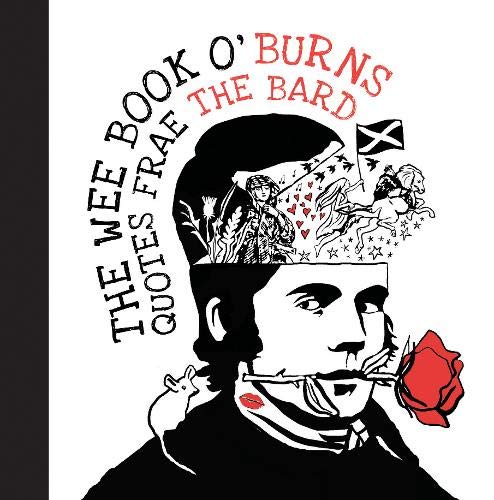
The Wee Book Book o’ Burns, by The Wee Book Company
With the rise and rise of Gaelic learners on Duolingo, there is no shortage of people interested in finding out more about Gaelic language and culture. Luath Press have just released a brilliant anthology of new and classic Gaelic poetry, from writers representing the past, present and future of Gaelic writing. Here, we share a few poems from the anthology – we hope it will spur you to investigate further.
100 Favourite Gaelic Poems
Edited by Peter Mackay and Jo Macdonald
Published by Luath Press
’s i ghàidhlig
Donnchadh MacGuaire
’S i Ghàidhlig leam cruas na spiorad
’S i Ghàidhlig leam cruas na h-èiginn
’S i Ghàidhlig leam mo thoil inntinn
’S i Ghàidhlig leam mo thoil gàire
’S i Ghàidhlig leam mo theaghlach àlainn
’S i Ghàidhlig leam mo shliabh beatha
’S i Ghàidhlig leam luaidh mo chridhe
’S i Ghàidhlig leam gach nì rim bheò
Mur a b’ e i cha bu mhì
gaelic is
Duncan MacQuarrie
Gaelic to me is the hardness of spirit
Gaelic to me is the grit of distress
Gaelic to me is my mind’s satisfaction
Gaelic to me is the pleasure of laughing
Gaelic to me is my beautiful family
Gaelic to me is my life’s mountain
Gaelic to me is the love of my heart
Gaelic to me is everything in my life
If it didn’t exist I wouldn’t be me
*
faclan, eich mara
Caomhin MacNèill
nam bhruadar bha mi nam ghrunnd na mara
agus thu fhèin nad chuan trom
a’ leigeil do chudruim orm
agus d’ fhaclan gaoil socair nam chluasan
an-dràsta ’s a-rithist
òrach grinn ainneamh
man eich-mhara, man notaichean-maise
sacsafonaichean beaga fleòdradh
words, seahorses
Kevin MacNeil
i dreamt i was the seafloor and you were the weight of ocean pressing down on me, your quiet words of love in my ears now and again, golden, elegant and strange, like seahorses, like grace-notes, tiny floating saxophones
Trans. the author
*
màiri iain mhurch’ chaluim
Anna C. Frater
Mo sheanmhair, a chaill a h-athair air an “Iolaire”,
oidhche na bliadhn’ ùir, 1919
Tha mi nam shuidhe ag èisteachd ribh
agus tha mo chridh’ a’ tuigsinn
barrachd na mo chlaisneachd;
’s mo shùilean a’ toirt a-steach
barrachd na mo chluasan.
Ur guth sèimh, ur cainnt
ag èirigh ’s a’ tuiteam mar thonn
air aghaidh fhuar a’ chuain
’s an dràst’ ’s a-rithist a’ briseadh
air creag bhiorach cuimhne;
’s an sàl a’ tighinn gu bàrr
ann an glas-chuan ur sùilean.
“Bha e air an ròp
an uair a bhris e…”
Agus bhris ur cridhe cuideachd
le call an ròpa chalma
air an robh grèim gràidheil agaibh
fhad ’s a bha sibh a’ sreap suas
nur leanabh.
Agus, aig aois deich bliadhna,cha robh agaibh ach cuimhne air a’ chreig
a bhiodh gur cumail còmhnard;
’s gach dòchas a bha nur sùilean
air a bhàthadh tron oidhch’ ud,
’s tro gach bliadhn’ ùr a lean.
Chàirich iad a’ chreag
agus dh’fhàg sin toll.
Chruadhaich an sàl ur beatha
agus chùm e am pian ùr;
agus dh’fhuirich e nur sùilean
cho goirt ’s a bha e riamh;
agus tha pian na caillich
cho geur ri pian na nighinn agus tha ur cridhe
a’ briseadh às ùr
a’ cuimhneachadh ur h-athar.
“… oir bha athair agam …”
màiri iain mhurch’ chaluim
Anne C. Frater
My grandmother who lost her father on the “Iolaire”,
New Year’s Night, 1919
I sit listening to you
and my heart understands
more than my hearing;
and my eyes absorb
more than my ears.
Your soft voice, your speech
rising and falling like waves
on the cold surface of the sea.
and now and again breaking
on the sharp rock of memory;
and the brine rises up
in the grey seas of your eyes.
“He was on the rope
When it broke. . .”
And your heart also broke
with the loss of the sturdy rope
which you had clung to lovingly
while you were growing
as a child.
And, at ten years of age,
you had only a memory of the rock
that used to keep you straight;
and every hope that was in your eyes
was drowned on that night
and through each New Year that followed.
They buried the rock
and that left a hole.
The salt hardened your life
and kept the pain fresh;
and it stayed in your eyes
as stinging as it ever was;
and the old woman’s pain
is as keen as the girl’s,
and your heart breaks anew
remembering your father.
“…because I had a father…”
Trans. the author
*
bho ‘nuair bha mi òg’
Màiri Mhòr nan Òran
Moch ’s mi ’g èirigh air bheagan èislein,
Air madainn Chèitein ’s mi ann an Òs,
Bha sprèidh a’ geumnaich an ceann a chèile,
’S a’ ghrian ag èirigh air Leac an Stòrr;
Bha gath a’ boillsgeadh air slios nam beanntan,
Cur tuar na h-oidhche na dheann fo sgòd,
Is os mo chionn sheinn an uiseag ghreannmhor,
Toirt na mo chuimhne nuair bha mi òg.
Toirt na mo chuimhne le bròn is aoibhneas,
Nach fhaigh mi cainnt gus a chur air dòigh,
Gach car is tionndadh an corp ’s an inntinn,
Bhon dh’fhàg mi ’n gleann ’n robh sinn gun ghò;
Bha sruth na h-aibhne dol sìos cho tàimhidh,
Is toirm nan allt freagairt cainnt mo bheòil,
’S an smeòrach bhinn suidhe seinn air meanglan,
Toirt na mo chuimhne nuair bha mi òg.
Nuair bha mi gòrach a’ siubhal mòintich,
’S am fraoch a’ sròiceadh mo chòta bàn,
Feadh thoman còinnich gun snàthainn a bhrògan,
’S an eigh na còsan air lochan tàimh;
A’ falbh an aonaich ag iarraidh chaorach,
’S mi cheart cho aotrom ri naosg air lòn –
Gach bot is poll agus talamh toll,
Toirt na mo chuimhne nuair bha mi òg.
Toirt na mo chuimhn’ iomadh nì a rinn mi
Nach faigh mi ’m bann gu ceann thall mo sgeòil –
A’ falbh sa gheamhradh gu luaidh is bainnsean
Gun solas lainnteir ach ceann an fhòid;
Bhiodh òigridh ghreannmhor ri ceòl is dannsa,
Ach dh’fhalbh an t-àm sin ’s tha ’n gleann fo bhròn;
Bha ’n tobht aig Anndra ’s e làn de fheanntaig,
Toirt na mo chuimhne nuair bha mi òg.
from ‘when i was young’
Mary MacPherson
Rising early, slightly sorrowful,
on a May morning when I was in Ose,
the cattle were lowing in their herd,
and the sun rising on the rock of Storr;
light beams glittering on the slopes of mountains,
hurrying away the hue of the night,
and above my head the lively skylark singing
make me remember when I was young.
Make me remember with joy and sadness
that I can’t find the words to relate,
each twist and turn of the mind and body,
since I left this glen of faultless heroes;
the river flowing downstream so gently,
the murmuring burn answering my words,
and the sweet-voiced thrush singing on a branch,
make me remember when I was young.
When I was foolish, walking the moorland,
the heather catching my white petticoat,
through mounds of moss, with my feet bare,
and the ice in patches on still lochs;
crossing the uplands, looking for sheep,
and feeling so light as a snipe in a field –
every bog and pool and muddy hole
make me remember when I was young.
Make me remember many things I did
that I can’t close until my story’s told –
going in the winter to waulks and weddings
with no lantern light, just a burning peat;
lively young folk would be singing, dancing,
but those times have gone and the glen is sad;
Andrew’s ruined house, now full of nettles,
makes me remember when I was young.
*
hallaig
Somhairle MacGill-Eain
‘Tha tìm, am fiadh, an coille Hallaig’
Tha bùird is tàirnean air an uinneig
trom faca mi an Àird an Iar
’s tha mo ghaol aig Allt Hallaig
’na craoibh bheithe, ’s bha i riamh
eadar an t-Inbhir ’s Poll a’ Bhainne,
thall ’s a bhos mu Bhaile Chùirn:
tha i ’na beithe, ’na calltainn,
’na caorann dhìrich sheang ùir.
Ann an Sgreapadal mo chinnidh,
far robh Tarmad ’s Eachann Mòr,
tha ’n nigheanan ’s am mic ’nan coille
a’ gabhail suas ri taobh an lòin.
Uaibhreach a-nochd na coilich ghiuthais
a’ gairm air mullach Cnoc an Rà,
dìreach an druim ris a’ ghealaich –
chan iadsan coille mo ghràidh.
Fuirichidh mi ris a’ bheithe
gus an tig i mach an Càrn,
gus am bi am bearradh uile
o Bheinn na Lice fa sgàil.
Mura tig ’s ann theàrnas mi a Hallaig
a dh’ionnsaigh Sàbaid nam marbh,
far a bheil an sluagh a’ tathaich,
gach aon ghinealach a dh’fhalbh.
hallaig
Sorley MacLean
‘Time, the deer, is in the wood of Hallaig’
The window is nailed and boarded
through which I saw the West
and my love is at the Burn of Hallaig,
a birch tree, and she has always been
between Inver and Milk Hollow,
here and there about Baile-chuirn:
she is a birch, a hazel,
a straight, slender young rowan.
In Screapadal of my people
where Norman and Big Hector were,
their daughters and their sons are a wood
going up beside the stream.
Proud tonight the pine cocks
crowing on the top of Cnoc an Ra,
straight their backs in the moonlight –
they are not the wood I love.
I will wait for the birch wood
until it comes up by the cairn,
until the whole ridge from Beinn na Lice
will be under its shade.
If it does not, I will go down to Hallaig,
to the Sabbath of the dead,
where the people are frequenting,
every single generation gone.
100 Favourite Gaelic Poems, edited by Peter Mackay and Jo Macdonald is published by Luath Press, priced £12.99
Moving to a new area can often be a lonely, challenging time. In Cat Step, author Alison Irvine explores how a public mistake can make that process even harder. Here is an extract from her honest, clear-sighted novel.
Extract taken from Cat Step
By Alison Irvine
Published by Dead Ink Press
Emily will ask me one day about Lennoxtown. She may discover that she and I lived there briefly when she was on the cusp of four and five and I’ll need to have answers when she asks me why we didn’t stay. I’ll tell her something of the story. She’ll believe me because I’m her mum. By then I may have made sense of her dad.
The truth is Emily and I danced a demi-detourné. We stepped up to Lennoxtown then turned away from it, a half turn, even changing feet so that a new foot was in front. Yet there was no ballerina’s precision or elegance; it was ugly.
Lennoxtown is hard to turn away from, I’ll give it that. Those hills. You catch them as you come round a bend, half submerged in cloud or crossed with sun and shadow or shining with the gold that comes off the grass you get up there. I imagined us climbing them, the Campsie Fells, picnicking, exploring, lying out in good air. But we came in March and winter wasn’t over and it rained and rained and my plans didn’t work out.
There was one thing I could have done differently. My mum said I should leave Emily with her and go alone – have a break, live a little, earn some money if there was any to be earned – and I nearly accepted, I nearly thought it the most sensible of all the options I had. I paused, – en l’air – extension – and then took her with me.
I use ballet terms but I was never a ballerina. I did the training and I almost had the technique, but not the physique or that extra porcelain quality. I was a dancer, a very good dancer: a tapper, a hoofer, a high-kicker. I wore feathers and sequins and American Tan tights and travelled the world on cruise ships. I will tell Emily that.
This is what I won’t tell her: she had been awake between the hours of two and three the night before, crying and thrashing with a temperature and a sore head. I gave her paracetamol and put a cold flannel on her forehead and thought if we ever got back to sleep it would do us good to lie long into the morning. But she woke at six and although she was calmer she was weak and didn’t want anything other than television. In the end she didn’t even want that. I tried to curl up with her on my bed and help her get back to sleep but she wouldn’t settle.
We had nothing in. The bread was gone, the milk was off. She liked fish fingers, and I knew if we drove to the Co-op I could buy some fish fingers and more milk and bread and she might fall asleep on the way home. I knew it would work for her. It always had.
I told her she could wear her dressing gown over her nightie and I’d buy her a treat. I brushed her hair but I didn’t wash her face or clean her teeth. I found her wellies because they were easy to put on and I tied her dressing gown. See how I’m telling it? I had to tell it in this detail many times to many people.
I’d forgotten about the roadworks and the temporary traffic lights and of course by the time the lights turned green Emily was asleep. I wondered if I should drive straight home but I had a queue of cars behind me so I had to go on and once I was through the roadworks I was two minutes from the Co-op and we did need fish fingers and milk and bread and other things I’d remembered like toilet roll and toothpaste. So I made the decision to go on.
I couldn’t get a space close to the entrance so we parked at the back of the car park under the fir trees where the crows had their nests. When I cut the engine I thought the sudden lack of noise might wake her as it often did, but it didn’t. I turned in my seat and checked her. Her lips were parted. Her cheeks were red. She’d kicked off her wellies and peeled her socks from her feet and I could see black hairs on her shins. I thought about carrying her in, but it would have woken her and, God, to wake a sleeping child – an ill child at that – and then drive for hours afterwards trying to get her back to sleep was not an option. I have driven around with her fighting sleep as if it was death closing down on her.
I opened a window to give her an inch of air. I locked the car. I ran to the Co-op. Perhaps I was longer than the few minutes I thought I’d taken. How long does it take to pick up milk, bread, fish fingers and toilet roll? And a slab of chocolate? And cheese and toothpaste. And a Freddo for her treat. I told the woman at the checkout that I didn’t need a bag – and then I changed my mind, so I watched her pack my bag, gave her my Co-op card, paid for my shopping and ran from the shop.
When I came out of the Co-op I saw there were people standing by my car looking towards a running boy. Cap, jeans, red top, that’s all I saw: the sprinting back of him and the flailing soles of his trainers. Something had happened.
‘There was a thief,’ a woman said. ‘He’s run off. We know who he is. Greg’s talking to the police.’ She pointed to a man who was on his phone, pacing. The man looked at me as he spoke and then turned away towards the traffic on Main Street.
I needed to check Emily.
‘He’s a menace,’ the man said, off his phone and making me listen. He pushed his hair back with both hands, shoved his phone into his pocket, adrenalin, urgency all over him.
‘But the car’s not even fancy,’ I said.
‘You left something on your front seat.’
I’d left my phone. I’d put it on the passenger seat to save me carrying it in. The window was smashed but not shattered. Emily was asleep. Fast asleep. She’d slept through it.
‘You can’t leave anything in your car round here,’ the man said. ‘There’s a ring of them. They’ll steal it and sell it on.’
‘At this time of the morning?’ I said, which struck me as an odd thing to say but it was too early to have my car broken into, surely? The sky was weak, the crows were barely awake and the clock on the sandstone church behind us showed only half past eight.
I looked at the people around me. The man and two women, one with a dog on a lead. I checked on Emily again.
She was unhurt. My phone was still on the seat, the window could be fixed. These people had stepped in to help me.
‘Thank you,’ I said.
There was silence. They looked at Emily and then at me.
‘You left her in the car by herself,’ one of the women said. Her dog pulled on its lead and barked at another dog across the car park. She told it to sit and in the same tone of voice said to me, ‘Anything could have happened.’
‘She was asleep,’ I said.
‘That’s even worse.’
I sensed the fullness of her judgement, in increments, like the gradual lightening of the morning.
The other woman spoke. ‘My niece is a social worker. She tells me this is a problem with some parents. You know it’s against the law?’
I unlocked the car and opened the boot and put my shopping down.
‘Please don’t make me feel guilty. She’s not well. She’s been up all night. I know my daughter.’
‘And look at her legs. Look at what you can see. Does she even have underwear on?’ The woman peered through the window at Emily.
I got angry then and when I turned my head I felt the shooting stars I’d been having for days. I told them to get away from the window and of course she had underwear on but when I checked at home, she didn’t. She wasn’t indecent, she was covered, even though her dressing gown had ridden up to her thighs, but they will have used that against me too, that her legs were exposed.
‘I’m taking my daughter home now,’ I said and went to open my door. ‘She’s ill. I know what’s best.’
‘Don’t touch the door!’ the man shouted. ‘That’s the police here now.’ He raised a hand and beckoned the police car to where we stood. ‘You’ll have to stay. They’ll want statements from us. They might be able to get the little shite if they have enough evidence.’
The woman with the dog nodded and told her dog to stay.
Cat Step by Alison Irvine is published by Dead Ink Press, priced £9.99.
Kirsty Gunn and Gail Low have put together a fantastic anthology of creative essays, essays that explore what the form of the essay can be as well as their diverse range of subject matter. In this enjoyable and thought-provoking epistolary essay between Duncan McLean and Kenny Taylor, they explore the idea of ‘The North’
Imagined Spaces
Edited by Kirsty Gunn and Gail Low
Published by The Voyage Out Press
The Flicker of North
Duncan McLean & Kenny Taylor
Hello Kenny
We’ve been invited to discuss the north as a place, both real and imagined. If you don’t mind, I want to call it the North. My notion is that there’s a place formed by ‘northness’, defined by ‘northness’, consisting of ‘northness.’ And you and I are both in it.
It would have been good to have had a blether with you before introducing such an idea, to make sure you don’t think it entirely daft, but so far it’s been impossible to talk. Who’d have thought it would be so hard in this day and age to catch each other on the phone! I will just have to launch our conversation with this brief contribution, and hope the words connect even if our mobile providers can’t.
A conversation of what kind? We won’t know till we talk! I’ll go first, will I? You can’t answer that, because you won’t even see the question till I send it to you, which I won’t do till I get to the end of whatever I’m going to write here. Let’s call it 700 words, two pages—it’s good to have an arbitrary target. Many years ago, I drove right across the USA. Every morning I’d look at the atlas and find a town 3 or 4 or even 500 miles west with an interesting name: Chunky, Mississippi; Uncertain, Texas; Truth or Consequences, New Mexico. And I’d drive till I got there and find a motel for the night. I had to have an arbitrary target, you see, otherwise, why stop? In the States, you can just keep driving forever. Not like here in Orkney: twenty minutes in any direction and you get to the sea. That’ll stop you.
Duncan
Dear Duncan
At first glance, part of the reason it’s been hard for me to communicate much seems simple: ‘notspots.’ During chunks of this spring and summer I’ve been working in some of the most trackless country I know. One of a team surveying birds, mammals and vegetation in the wilds of north Sutherland, I’ve often been far from both roads and reliable phone signals.
Your schedule and mine have meant that there seem to be only a few days—or hours—when we might have had a chance to chat. My hiking along a mountain slope or venturing into the boglands just adds to the difficulty at a time when we might otherwise have spoken.
Like that day when I was inland from Loch Eriboll, going towards Foinaven on a day of sunshine and wader calls, when the signal evaporated faster than the dew on the deer grass. We’d managed a quick phone rendezvous mid-morning, and I suggested that we could speak later, before you needed to go to the shop. Seemed simple—a good way to converse while I paused for some thermos coffee. But long before the appointed talk time, I’d entered the valleys and crags of no-speak. So I’ll tell you a little of what happened while we failed to converse; what I saw and what I didn’t see.
There were pools among the bog mosses when I reached a high plateau. I could see the Pentland Firth a few miles off, and a blue-green smudge on the horizon that I took to be the hills of Hoy. The Orkney Islands. Laser flashes might have made a connection between us right then. But signalling in Morse would have defeated me, while you, of course, were in Kirkwall, not Hoy. So my attention soon drifted to the closer sight and sound of a greenshank flying a couple of hundred metres away. Then another veered in from the east, diving at the first bird and chasing it, fast and low, over the bog and beyond. Once it had seen off the intruder, this second bird returned. Rising above the sky-mirroring lochans, it began to call. And call. The notes fluted loud and softer and louder with shifts of breeze.
I kept it in view as it ascended, cricking my neck back to watch, then arching further to catch its shape in binoculars and hold the silhouette in focus. After more than a minute, it stalled its high rise and plummeted, steep and fast, to reach the ground in seconds. In the times when I’ve thought of it since, I know that my interpretation of what it was doing in that airspace could be wrong. That the greenshank’s communication and signalling is not my language, though I think I understand some of it, that its place is not my home, much though I relish going there. And though my image of your home isles is more—much more—than that smudge on the northeast horizon, and though I’ve visited many times over many decades, still I wonder how much I actually know of Orkney and the wider North. How much I’m projecting my own preconceptions on the screen of the cool blue horizon. But I’ll leave that for later as we see what place or idea takes us further along the turns of this conversation.
Kenny
***
Dear Kenny
You have the ability to describe your work and make your readers envy you, wishing they were up on those trackless moors watching the duel of the greenshanks. Are you sure that really is work? Ach well, I suppose there was a painfully early start, the bog was claggy on your boots, and a million midgies showed up to keep you company. Oh, any number of downsides. It all comes round to what we choose to focus on, which parts of the working life we select to present in our prose. I could, for instance, suggest something of my working day by describing me throwing open the shop door first thing to see St Magnus Cathedral across the street, sandstone glowing red in the morning light. I could go on to recount a conversation with an excited Italian restaurateur, visiting Orkney on holiday and tasting Westray Wife cheese for the first time. And I could describe a late-afternoon delivery run in my van, out past the standing stones and Maes Howe, to deliver a case of good red wine to a restaurant in Stromness, named The Hamnavoe after George Mackay Brown’s classic fictional version of the town.
On the other hand, I could also show me in a sweat and pretty much wabbit by 9am, after the arrival of two pallets of wine from our importers, a couple of tons in weight, all of which has to be carried in by hand through our inconvenient back store, checked and stacked.
A few months ago a friend asked me a question that I couldn’t answer at the time, and has been gnawing away at me ever since. The question was, what do you like about Orkney? I couldn’t think of anything to say. I know what tourists and other visitors like: the landscape, the dozens of archaeological sites, the birdlife. I know what they like because they tell me. Sometimes they tell me because they’re bursting with excitement and want to spill it out. Other times they tell me because I ask them.
A typical conversation in my shop over the four or five tourist months runs like this:
Duncan: So, are you here for long?
Visitor: We’re here two weeks, we love it.
Duncan: You’re in Orkney for two weeks? Great!
Visitor: No, we’re in Scotland for two weeks: Glasgow, Skye, Lallybroch, and now Orkney for two days. Then we go to—what’s it called?— Edinburgh, and then home.
Duncan: And where’s home?
Visitor: The United States of America.
Duncan: Aye, I got that, but where exactly?
Visitor: Roanoke, Virginia.
Duncan: I’ve been there!
Visitor: You have? No one’s ever been to Roanoke! It’s dull as all heck! What were you doing there?
Duncan: I was staying with a friend in the Blue Ridge Mountains, and we were starting to get cabin fever, so we drove to Roanoke to see that terrible Mel Gibson film, Braveheart. That wasn’t a pretty sight. Tell you what though, those mountains were spectacular, and the landscape around there was just beautiful. As we drove along you could see eagles circling up in the sky… amazing.
So this is how I know what the tourists like about Orkney, conversations carried out all summer long, across the cheese counter.
But what about someone who lives here, or lives anywhere? Can they really ‘like’ their place? It’s not a Facebook post of a friend’s new pushbike or relationship status or political opinion. You can’t just get up in the morning, look out the window, and click a ‘like’ button to express mild and barely-considered approval of what you see. Those kinds of ‘likes’ are about reminding a far-flung friend you exist and are aware of them, maybe that you’re supportive of whatever they’re doing or buying or thinking. But that’s not what goes on in your own mind when you look out your window or walk down the road. That’s more likely to be a complex of plusses and negatives:
—Blue sky and sun, that’s a good start. But bushes leaning north-eastwards and cloud out beyond Hoy, so maybe a bit of rain coming in later.
—Small cruise ship anchored off Stromness. Busy day for the town, good for the shops and cafes and pubs.
—Still can’t believe that guy got planning permission to build that house down by the shore: does not fit in at all. Still, have to admit it’s quite modern and interesting, and anyway it’ll all be gone in a few years with the sea rising!
—Oh, there goes Billy down the road in his John Deere 6125. As usual, fifty miles an hour, on his phone, and his wee boy bouncing about the cab. Is it true what they say that tractors don’t have to obey the Highway Code? That they’re agricultural vehicles so can do what they like? Certainly seems to be here … Like taxi drivers in Kirkwall: no seat belts and wrong way round the roundabout: they can, because they’re taxis, it’s the law! (So they say.)
—Jesus, and now that bloody hen harrier’s back, cruising along and back the length of the garden, peering down into the bushes. I know what you’re after, you bastard, it’s the baby blackbirds, but you’re not getting them, I like blackies singing in the garden.
Here, hold my laptop: I’m off to throw some stones at a bird of prey. What is that? Is that liking Orkney? It doesn’t feel like it to me. It just feels like living Orkney.
Duncan
Dear Duncan
I feel the weight of your plusses and minuses, including the sweat of heaving heavy boxes—however tantalising their contents—at times when many of us might be doing nothing more strenuous than lifting a morning cup of coffee; the tractors careening down streets; the anti clockwise taxi drivers. And the hen harrier threatening to silence the garden blackbird. Much though I mourn the persecution of harriers on the killing fields of the grouse-moored uplands, that’s worrying. But to be honest, (sorry to be an anorak, though I do have the relevant jacket) that sounds much more like normal behaviour for a sparrowhawk than a harrier. A few years ago, a sparrowhawk slew the blackbird that liked to whistle the ‘da-da-da-DA’ phrase from Beethoven’s Ninth at the gable ends of my roof. I’ve not heard that whistler’s like again. Household birds apart, your comments also make me think about the balance sheet of emotions in how I relate to my own home place, on the Black Isle. I could say that I’m writing this at my kitchen table, where I often work, looking across a few miles, beyond the surrounding farmland, to the corries of Ben Wyvis, wondering when the first snows will come. But I’m travelling backwards at the moment, returning north to Inverness on an overcrowded train (as is normal on this line) and both ‘liking’ (there’s that word again) and loathing the increasing popularity of the Highlands to visitors. There’s a guy squashed-in beside me who’s dressed as superman, though his face is painted in zombie tones of fungal green and congealed-blood red. He and the Aussies across the passage are swapping tales of their trails and travels. Think he’s on his way to a stag party, while the girl in the wizard’s (not witch’s) hat down the carriage—who knows?
All a contrast to the Black Isle, highlighting how part of what I’ve always relished about life there is the relative quietness, and the sense of un-crowded space. Space to notice small things, such as subtle sounds in the woods behind my house … the way the click of a pine-cone on a track could mean there’s a crossbill feeding in the tree overhead. How else can I notice, not only the day, but also the very hour of autumn when the first skeins of pink-footed geese arrow-in from Iceland to glean the stubbles after harvest? The way my children might explore the woods, and later, dig full-on, adrenalin-boosting downhill mountain bike trails among the conifers, without anyone really noticing that they, or the bike tracks, were there.
Those are some of the plusses, as are the overlapping communities of interest here, such as among those of us who help to promote live performances of music, drama, poetry and more in small local venues. I know that’s no different to how things work in countless other places across Scotland—across many other parts of the world, perhaps.
But it’s part of what I value about ‘living the Black Isle’, as you do living Orkney.
It can also be one of the minuses; the way, for example. that communities of interest can rapidly circle wagons when faced with perceived threat and then fire at supposed adversaries in the parish. That happened some years ago, when there was a chance of community ownership of old woodland nearby. The woodland was part of what was classed as a farm, but had barely been worked as such in recent times. But that categorisation was enough for the community of farming interest (both practitioners and relatives) to react as if the sky would fall if anyone other than one of their own were to have a say in how the woodland was used and managed.
The bitterness and division engendered by what should have been a straightforward and positive process was almost frightening. In some ways, it taught me a great deal about how quickly group behaviour can turn from friendly interactions to something much more sinister. It also showed how there’s no straightforward way of defining what a particular place means to people living there, let alone to visitors. Where I thrill to the sounds of the wild geese overhead, as Neil Gunn did when he lived not far from here a few decades ago, a farmer might see a threat to winter-sown crops. Where I see an average stretch of Black Isle coast, my nearest neighbour down the track (not long deceased, and sorely missed) would think of possibilities for outwitting water bailiffs and catching salmon. Come to think of it, that chimes with some of Neil Gunn’s writing. Hugh Miller—a son of Cromarty, just a few miles away, both wrote of the local scene in the early 19th century in ways that I relish, especially in his close observations of wildlife—a relative rarity in his work—and people he knew on the peninsula. Those meld in his description in ‘My Schools and Schoolmasters’ of when a party of ‘herd-boys’ had stormed a humble-bee’s nest on the side of the old chapel-brae, and, digging inwards along the narrow winding earth passage, they at length came to a grinning human skull, and saw the bees issuing thick from out a round hole at its base—the foramen magnum. The wise little workers had actually formed their nest within the hollow of the head, once occupied by the busy brain; and their spoilers more scrupulous than Samson of old, who seems to have enjoyed the meat brought forth out of the eater, and the sweetness extracted from the strong, left in very great consternation their honey all to themselves.
Elsewhere (and I don’t have the book to hand) Hugh Miller also talked of his dislike of the long miles of heath and pines and bogland on the Black Isle, now shrunk to fragments since his day, which I’d love to see restored. If perceptions of place could be GPS overlays, I suspect there would be as many as there are individual inhabitants. So I know that my perceptions of Orkney, though shaped by many visits to many different islands and influenced by George Mackay Brown, Viking sagas and things such as the tunes and songs of the Drevers and the Wrigley sisters, are simply the mix I’ve been able to make mine. Billy in the John Deere might well think me daft.
But I’m minded to take a different track now. That’s part of the pleasure of essays as a writer or reader, of course (if, as you say, this staccato communication is indeed such a thing): the way you’re never sure—maybe don’t want to be sure—where the next few sentences might lead. Casting back, it’s like moving through the kind of blanket bog I was describing earlier. You think you see the direction of travel, but it’s impossible, assuming you don’t want to risk getting up to the oxters—or worse—in sodden moss or bog pools—to go in a straight line. Some of that, I assure you, is hard work, since making a mistake when you’re out there alone in cloud so low you can barely see your feet (as happened to me a few weeks after that greenshank encounter), could be life threatening. At least essays, whatever the barbs literary critics might throw, might be safer.
Another thing I can tell you that I often see from this part of the peninsula is liners. Cruise ships by the score, docking across the Firth at Invergordon to disgorge tourists in thousands to be taken in coaches across the Highland mainland. It’s hard to imagine how such numbers could descend on somewhere of such modest size and narrow streets as Kirkwall. Here, the similarly small town where the cruise passengers land won’t be high on their wish lists for selfies against a northern backdrop. But the hulk of the defunct aluminium smelter and the oil rigs parked inshore could say more about that place and the people who live and work there than the photo opportunities they’ll seek elsewhere. I’m sure that many of those travellers, between the diversions of shopping, are more minded to share images taken with an old castle behind, or Loch Ness, or maybe the place where both castle and loch could be caught in one frame (plenty of potential for ‘likes’ there). They’ll have journeyed in hopes of glimpsing ‘Nessie’, that prime economic asset of the Highlands and as improbable—and potent—as the tooth fairy or Santa Claus.
Santa, reindeer, north: now that last word is one that has excited me since childhood. Still does, even though the ways I think of it could be as much to do with my imagination—and the words and images of writers and northern artists whose work I relish—as with the realities of life and land beyond where I now live.
North: unless you’re standing precisely at the pole, there’s always a north. And from where I’m sitting, Orkney is part of that ‘north’.
Superman has left the train, by the way, but the wizard is still aboard.
Kenny
***
Dear Kenny
The idea of the North appeals to me too. I have gazed reverentially at William Heinesen’s old house in Torshavn, and watched Mairi Boine sing at mild blue midnight, the jagged peaks of Lofoten behind her. (By the way, I never made it over to Lofoten; if I had, I’d’ve had to have made one of my randomly generated trips to Å at the southern end of the archipelago. Of course, I would then have been obliged to find the legendary lost city of Z in the Brazilian jungle …)
So tourists are attracted to places by fictional animals like Nessie, and fictionalised versions of real people like Mary Queen of Scots, and fictional locations from Outlander. But what attracts and excites you and me is just as fictional: the notion that ‘North’ is something more than a relative geographical description; the idea that George Mackay Brown’s fantasies describe an Orkney that ever really existed; the wish-fulfilment that Sigrid Undset’s politics represent the values of far-northerners better than Knut Hamsun’s.
It’s all projection, isn’t it? ‘Imagined Spaces’ is exactly the right phrase: we invent a space or place in our minds that we want to believe in, and then set out to find it. We travel solo on foot to some wilderness free of human contamination (other than ourselves, who are not contaminants, of course, but neutral observers.) Or we go as a family to campsites in Normandy for that authentic French countryside experience, the back of the car full of iPads and Rice Crispies to keep the kids happy. Or maybe we hole up to work on a draft of a novel in North Ronaldsay or Graemsay because the Mainland of Orkney is just not Orcadian enough—a more concentrated essence of Orkney is required to steep in than the complex, diluted reality of the Mainland.
Which brings me to a surprising place where I find myself in sympathy with the liner passengers. Most of them, in my experience, don’t come on a cruise in order to visit a particular imagined place. It’s the travelling that’s the important thing. They’re not travelling TO anywhere; rather they are voyaging THROUGH a series of places. It could be half a dozen coastal towns from Portsmouth to Oban to Kirkwall to Invergordon. Or it could be northern seas from the North Sea to the Baltic to the North Atlantic.
Cynical and weary tourist industry workers claim that the cruise liner passengers often have no idea where they are. To which I reply, So what? Travelling, hopefully, is better than arriving. These liner folk travel day and night, on they go, always moving, pausing only briefly to draw breath in a town, yet another town, at the end of a pier, at a mooring out in the bay. Some come on land by footbridge or tender and spend a few hours—‘Where are we?’—wherever they are. Others choose to stay on the boat, sleeping or eating or gazing out at the shore: ‘There’s a town there, but I’m not going to it. Mustn’t get hooked in, must keep moving. I hate the stops, love the journey.’
When the shore visitors walk or bus back to the harbour, there’s a whole row of those ‘How was your experience?’ signs. You know, the ones you pass once you get through airport security, with the sad face, the neutral face and the happy face. There they are, a dozen or so signs lined up, all with, HOW WAS YOUR ORKNEY? in big bold letters. And as they go through, the visitors have to punch one or other face to register the extent to which they’ve liked their hours here. Every cruise port has such a set-up, apparently. And the good news for us is, Orkney gets more smiley faces punched than any other place in the UK.
The tourist board are actually planning to install a whole series of those punchy faces across the key sites of Orkney: HOW WAS YOUR SKARA BRAE? HOW WAS YOUR OLD MAN? HOW WAS YOUR BETTY CORRIGAL’S GRAVE? Only then will they be able to accurately assess the extent to which these various attractions are realising their potential in the tourist economy. Any which are found to be pulling less than their weight risk demolition or at least demotion from the tourist brochures to the history books.
All of which fantastical nonsense leads me to conclude that it is time for me to draw my part of this conversation to a close. By rights at this point I should assess the success of my contribution and punch myself in the face, which I may well do after rereading what I’ve written.
But before that I will finish by quoting lines from another Orcadian writer, Edwin Muir, which pop into my mind unbidden and seem relevant. In life he went south, but in his work he often came back north. Whatever the direction, there was always restless movement. Rather than spaces, imagined or real, there was the journey, ‘The Way’:
Friend, I have lost the way.
The way leads on.
Is there another way?
The way is one.
I must retrace the track.It’s lost and gone.
Back, I must travel back!
None goes there, none.
Duncan
Dear Duncan
Little did I reckon, when we began this correspondence, that a cruise passenger could lead me, through your words and reflections, into the heart of Nordic literature. Nor that this would make me reconsider ways in which some of its most famous writers raise questions about the relationship between art and artist, or how much of ourselves we project in concepts of place, including ‘north’ and the notion that this is anything more, as you say, than a relative geographical description.
The passenger disembarking at Kirkwall, in the company of perhaps thousands of other fellow travellers, morphs in my mind to a solitary figure and a much smaller ferry. The place is an island in north Norway, where a wooden jetty juts into dark waters. No one is there to meet the traveller, who walks towards a wooden house near the shore. The boat leaves. In a while—maybe days, maybe months from now—the traveller will go back aboard the ferry and depart, never to return. The wanderer’s name could be Knud Pedersen, could be Hamsun. But that’s my projection, my personal imagining. Because I think my name is in there too. Yes, North can simply be a cardinal point. But for me (and for you, I think, through both your home place and your knowledge of writers such as Heinesen, which suggests an interest not typical of many Scottish writers, editors or publishers) it’s also a concept that can stir imagination and creativity. There’s something more than the simple law of averages that means that some great writers, past and present, have come from northern countries.
In that context, I’ll admit that I wrestle with my enduring admiration for the power of Knut Hamsun’s prose. I was introduced to his work long ago, by a lover in Norway who gave me a copy of Pan. Its opening sentence, about the Nordland summer’s eternal day, can still haunt me. So do passages where the words seem to sing, especially in Norwegian, such as: ‘Sommernetter og stille vann og uendelig stille skoger’ (Summer nights and quiet water and endless quiet woods). Then he adds: ‘No calls, no footfalls on the roads; it seemed my heart was full of dark wine.’
As Thomas McGuane, writing about ways people relate to nature has said, Scandinavians differentiate between loneliness and solitude as a matter of course. I recognise that distinction, both in my own life and in Hamsun—the way he can raise a glass of that dark wine, but also, with his twists of voice and disdain for convention, throw it down to swig an entirely different liquor. Not least in Pan and Mysteries as well as the better-known Hunger, some of his work from the close of the 19th century still seems surprisingly modern. That includes, as Isaac Bashevis Singer said, his subjectivity, fragmentariness, use of flashbacks and his lyricism. Those comments are all the more remarkable because Singer wrote principally in Yiddish, while fellow Nobel laureate Hamsun spent his final years as a prominent Nazi sympathiser in occupied Norway.
Nina Frang Høyum of the Norwegian National Museum describes Hamsun as ‘a national cultural trauma’, but adds that his relevance is not only in his greatness as an artist, but also in how he can lead to debate about the relationship between fiction and society and the role of art and the artist. I know also that Sigrid Undset’s life and art was very different to Hamsun’s. Vocal in condemnation of the Nazis though the 1930s, she had to flee to Sweden, then the US, when Norway was invaded in 1940. Her eldest son died at Gausdal in the spring of that year, fighting for the resistance. When she returned to Lillehammer after the war, Sigrid published nothing more. She had earlier sent her Nobel medal to raise funds for Finland in the Winter War. Hamsun had sent his to Goebbels.
So, as you say, ‘it’s all projection, isn’t it?’ in perception of a space and place—and perhaps the art—we want to believe in. But what you say to conclude that observation seems crucial: that we then set out to find that imagined space. I know that describes what has always motivated me to think about, then seek, northern places. What—in addition to the skill of their writing—still draws me to Hamsun and Undset, Per Petterson, Lars Saabye Christensen and poets such as Olav Hauge. Which, prompted by your recent words, will lead me to seek more of the work of William Heinesen, who seems adept at moving from the particular of small-town Torshavn to the universal and back again. So—thanks for sharing ideas through a chunk of this year, where the subjectivity, fragmentariness and flashbacks have been part of the fun.
I’ve been to Å, by the way—on Vesterålen, so a bit to the north of the one you mention on Lofoten. It seems that Norway has seven of them, which could certainly be the start of a journey, either through the wider country, the whole alphabet, or only to places named without consonants.
I wish you well with the travellers who visit and for ventures in writing and publishing.
For me, North still flickers on the screen, still lures. I appreciate how you—and I hope both of us—have added some new frames to the projected story.
Kenny
***
Postscript: in further correspondence beyond this essay, the writers discovered that Sigrid Undset had called at Kirkwall on her return voyage from wartime exile in the US to Norway in 1945. She seems to have disembarked, since a copy of one of her books, The Longest Years, signed by her with a dedication and thanks to Winifred Clouston, widow of Orkney-based novelist and antiquarian J S Clouston—who had died the previous year—had recently been offered for sale by a local bookseller. Kenny is now the keeper of that book. The coincidence of Sigrid Undset coming ashore in Kirkwall and the track of some of the ideas in the essay is still a source of some amazement for the writers, and may even suggest future paths of inquiry.
Imagined Spaces, edited by Kirsty Gunn and Gail Low is published by The Voyage Out Press, priced £14.99.
It’s been nearly ten years since Alan Bissett published his last novel, Pack Men, so BooksfromScotland were delighted to hear that he has just released a novella with independent publishers, Speculative Books. Susan is far from lazy, packing in a weekend full of high jinx in Bissett’s story and told in a brilliantly unique way – we won’t give away the surprise, you’ll have to buy the book to know what we mean! Here, though, we share an extract, which sees Susan spending the night in a swanky hotel.
Extract from Lazy Susan
By Alan Bissett
Published by Speculative Books
Fancy some Led Zeppelin? he says.
Wee bedside light’s oan. Much better vibe noo.
Is that rhymin slang again? I says, hinkin through the possibilities an comin up blank.
Naw! he scoffs. Nivir heard Zeppelin?
Nup.
Aww man, Susie, he says, they were lit wannay the biggest rock bands ivir.
Noo, I dinnay really like rock music, but if sumdy’s passionate aboot sumhin ye should gie it a shout, try an feel whit they feel.
They invented aw that rockstar behaviour, he says. Groupies an mountains ay coke an trashin hotel rooms an worshippin the Devil. You’d have fitted right in wi them!
Hmm, I says, I dinnay want tay trash nae hotel room. Hotel rooms are for chillin in. An the Devil’s welcome tay lit hang wi us an that, but I’ll no be worshippin the cunt. Disnay work lit that pal!
Haha, he goes, ye ken whit I mean though.
dae I?
Stick them oan then, I says. Lit’s hear whit they’ve goat.
William presses play an straightaway this big sound bursts oot the speaker. Ooft, I goes.
Fuckin Kashmir, he says, as starts drummin in time tay the massive beat.
We listens tay it for a while, an I shuts ma eyes an lets it happen tay me. Eftir a while I opens them an goes: that is relentless.
Zeppelin, man, William says. Hammer ay the fuckin Gods.
I nods deeply, feelin the song’s vibe, but then William takes a deep breath an ootay naewhaur goes Susie? I… I dunno how much longer I can keep daein this.
Keep daein whit?
This, he says, openin his haun up as if that says iviryhin. I’ve been burnin the candle at baith ends an I feel lit…lit I’m gonnay crash against the shore or sumhin eventually. Dis that make sense?
Naw, I says. How can a candle crash against a shore?
He nods lit a wee dug in the back ay sumbdy’s motor, an looks lit a forlorn wee boy for a second. Whit I’m tryin tay say, Susie, is… this is ma final fling wi ye…
An his face hings there jist sortay tryin tay gauge ma reaction tay this.
See folks, I reflect the cunts I meet. You go low, I go low. You go high, I go high. You git high, I git high. Ye’ve just got tay gauge folks’ energies. Whit’s their deal? Match it. Dinnay come in disruptin them wi yer ain hing. Meet them whaur they are an ivirycunt becomes a soundcunt. Ye reflect back at folk whit they want ye tay be, an that wey ye’ve goat them oanside forever.
Charles Manson said that. He took it too far eh? But he had a loat ay gid ideas.
William, I says aw saftlike, it’s fine. I’m jist glad for the time I goat wi ye.
Ye’re no…ye’re no upset or nuhhin?
I dis the face. The face they aw need tay see. Well sure, I’ll miss ye. I like talkin tay ye, I like oor banter, but I unnerstaun. Ye need tay take care ay yer relationship. I respect that.
Kent you’d git it, Susie, he says, an it’s like sumhin’s been
released in him.
Course I git it, I says. That’s why ye like me. Cos mair than ony cunt: I. Git. It.
I dae like ye, he says, smilin.
Nods ma heid in time tay that bulldozer ay a beat. Whit a tune, man, I jist says.
Epic, he says.
Points at him an raises ma eyebrows. Jist lets a wee smile hing there in frontay him for a bit. Hunner percent mate, I says.
Next mornin we’re haulin oor bags oot the taxi ontay the train station platform, comedoons an hangovers collidin gently. We got nay fuckin sleep cos we were up bletherin till aboot hauf five eftir that, toppin up oan lines, movin fay Zeppelin ontay The Orb. William’s choice. Kinday chilled-oot but dancey at the same time. Loved it. Noo we’re gittin separate trains back tay oor separate lives.
Well, whitiver ma life is.
I’m no sayin ye’ll never hear fay me again, he says, as his train appears – the wan takin him tay Glesga for the Rangers gemme – an he starts inchin forward wi his bag.
Jist shrugs. Ye ken whaur I am, I says.
Gie nuhhin awa. Nivir ivir come acroass as weak, needy or entitled.
He nods a bit sheepishly, then there’s a wee glint in his eye jist as the train pulls tay a big noisy stoap in front ay us. That wis a gid night though eh? he says.
Oh aye, I grins, a classic. An he gets oan the train, takes his seat, waves at me, winkin, as the train pulls awa, an I wave back at him, an I ken fine that in aboot five months ma phone’ll ping an it’ll be William textin that he is in a club, high as fuuuuuck
The best feelin x
an I’ll jist reply
Aye mate. It is x
His train disappears roon the bend an I looks up an doon the empty platform, lit it’s a dusty stoap in the auld Wild West. Still an oor til ma train doon the East Coast tay the Edinburgh Festival. Whit a fuckin MADCAP weekend this is gonnay be, an oaff tay a great start hooooo
Takes a selfie ay me staunin unnerneath the sign that says STONEHAVEN, posts it tay Instagram wi the comment
Current stoap aff on the magical mystery tour through life that is me!
adds an emoji that’s wearin glam-rock type glesses, then finds a bench an sits doon, knackered.
Ma phone pings wi a text, an I looks at it. It’s fay William.
Xxx
Smiles then deletes it. Nivir be the last wan tay reply. Keep yer power.
An oor tay wait for ma train. Comedoon startin tae settle ower me gghhegh. Whit tay dae noo?
Lazy Susan by Alan Bissett is published by Speculative Books, priced £9.00.
The Snow and the Works on the Northern Line is the perfect novel to read while see through the dark, January days. And we’re not the only ones who think so – the novel is the current Radio 4 Book of the Week! We caught up with author, Ruth Thomas to chat more about the book.
The Snow and the Works on the Northern Line
By Ruth Thomas
Published by Sandstone Books
Happy New Year, Ruth, and congratulations on your new book The Snow and the Works on the Northern Line. Could you tell us how you came to write this novel? What did you want to explore in writing it?
My novels usually begin with a particular location or atmosphere in mind. In this case, I kept picturing a slightly fading old academic establishment set in fields somewhere, and this eventually crystallized into the shape of the Royal Institute of Prehistorical Studies, in Greenwich Park. The institute is imaginary, of course, as are various aspects of Greenwich Park (as it appears in the book, anyway). Some bits, like the view across the Thames and the path leading past the Altazimuth Pavilion, are real, but atmosphere is more important for me than sticking religiously to facts. I probably had most fun with this novel describing the outdated working practices at R.I.P.S (as the Institute’s known) and its somewhat eccentric staff. Hand in hand with the place (when I first envisaged the novel) came the main character, Sybil. I worked out a lot of her story as I went along, but I knew from the start that she should be a young woman feeling solitary and adrift in this peculiar setting, and with a lot of personal baggage to sort out. I think once you have a setting and a person to put in it (whose dilemmas you really care about), you’ve got the starting point of a plot.
The book has lots of memorable characters with their own eccentricities, flaws and vulnerabilities. Would you consider yourself a people watcher? Do you take note of things you observe in everyday life?
I wouldn’t describe myself as an active people watcher, which sounds a bit worrying! I also never take notes. I envy writers who remember to carry a notebook or laptop around so they can jot things down. I never seem to have the relevant things with me at the right moment; I just sit at my desk and try to recall scenes later. Most of my writing is about reflecting and ‘getting into the zone’ (if that doesn’t sound too hippy!) Like a lot of writers I’m also probably a bit of an introvert – more of a listener than a talker – so I do find social interactions interesting to observe, and I find ‘larger-than-life’ characters fascinating. So I probably file mannerisms and conversational tics away without even being particularly conscious of it. There seems to be so much scope for some conversations to go down odd, tangential pathways, particularly if the speakers don’t know each other all that well. I think that’s what draws me to the potential for comedy in dialogue. I suppose the characters in The Snow and the Works on the Northern Line are basically amalgams of people I’ve met over the years, and the kinds of conversations I’ve had with them. One of the most useful things anyone’s said to me as a writer was ‘Remember that everyone, even a pretty terrible person, has elements of light in them as well as shade.’ That’s what makes them believable. I always try to remember that.
The novel is set in the world of archaeology. Has this always been an interest of yours? Or was there another reason you decided to choose this setting?
When I was an undergraduate I studied Archaeology for a year alongside my main degree, English Literature. Ever since I was a child I’d liked the idea of becoming an archaeologist – partly because, pootling around my family’s back garden, I used to come across little bits of broken blue and white china and imagine that they might have come from some amazing piece of ancient pottery. Once, aged eight or so, I came across some abandoned old ceramic insulators from an old phone pylon, and fantasized that they were Roman goblets! My sister and I even wrote to Blue Peter about them (though, oddly, we never got a reply…) Tangible objects say such a lot about human lives, whether it’s a recyclable cup made in 2021 or a bracelet from the Bronze Age. Actually, for this reason, I think writing and archaeology are quite comparable. Some of the best writing, I think, centres around physical objects rather than abstract ideas: it’s the small ‘throwaway’ things that make up the bigger picture. So basing the novel around an archaeological institute of some sort seemed quite a natural way for me to proceed. I also just wanted to write about a museum. I love museums – particularly small, old-fashioned ones. Some of my favourites are the Grant Museum in London, the Bell-Pettigrew in St Andrews and the Gallery of Paleontology and Comparitive Anatomy in Paris. That one in particular is quite a gothic marvel, and it’s actually where I drew most of my inspiration for the gallery at R.I.P.S.
Having said all this, I was not a particularly impressive Archaeology student! Like Sybil, I had problems finding The Beaker People all that interesting. It really did seem to me, in lectures, that we were just looking at a series of slightly dull earthenware pots (a very Philistine thing to say, I know…) I think I’d pay a lot more attention these days and hopefully make more intelligent connections, but at the time I often found myself day-dreaming, and wondering when the end-of-lecture bell would ring. For the novel I wanted to revisit that youthful sense of impatient lethargy, and being in the wrong place at the wrong time. But I also wanted Sybil to realise, at some point, that she could be missing out by not taking new and interesting things seriously.
You pepper the novel with Sybil’s poetry, a project she has taken on to get over heartbreak. What does poetry mean to you as a writer and a reader?
I love poetry but have discovered, after much trial and error, that I’m not a poet. My poems always seem to extend themselves into sentences, then paragraphs, then start forming themselves around a character and a setting! I love imagery and brief allusions to things, but find that I can write it all better in prose. A few years ago I spent some time lecturing in creative writing, and my students and I would talk about poetry as well as novels and short stories, and the qualities they share. We’d discuss the way poetry often draws on story-telling ideas, and prose can work brilliantly when it uses poetic devices to conjure up certain moods and atmospheres. Although I’m not a poet I’m really conscious of the value of metaphor and rhythm and pace, at a sentence level, in novels and short stories. Prose has to have as much impact on the ear as poetry does. I think someone like Grace Paley is a great example of a short story writer who worked like a poet. She’d make these brilliant imaginative leaps and introduce all kinds of strange imagery into her stories. It made her collections seem like wonderful, sparkling jewels, so full of light and colour, and so memorable because of that. These days I run a reading group and have been thinking a lot more about poetry alongside the prose we read. For me the greatest poetry seems almost to transcend time. We were reading John Clare’s ‘November’ recently, which is all about a day in the countryside where the fog is so thick that the poet can only hear some cows very nearby in a field, rather than see them. It feels so existential and other-worldly. He wrote it in the 18th century but it could have been written yesterday.
Other than poetry and fantasising on possible revenge, do you have any advice on getting over heartbreak?
That’s an interesting question! I think I was trying to work that out myself, on Sybil’s behalf, over the course of the book. I suspect – although it sounds like a cliché – that forgiveness is vital if you’re going to move on from having your heart broken. Also, you have to engage with new things and try to make new connections. During the novel, Sybil comes across the poem ‘A poison tree’ by William Blake, where the first lines are: I was angry with my friend/I told my wrath my wrath did end; I was angry with my foe/I told it not, my wrath did grow. I wanted to write about the way Sybil was keeping her feelings of betrayal and loss very closely guarded when it might have been better if she’d confided in someone. Not speaking was probably not the healthiest thing she could have done. There were bound to be repercussions.
What books have you read recently that you’ve enjoyed?
Like a lot of people, 2020 was a pretty good reading year for me, and it looks as if 2021’s shaping up to be the same… One book I really enjoyed was Wilful Disregard by the Swedish writer Lena Andersson. It tells the tale of Ester, an academic and poet, obsessively in love with a famous artist (who is, it’s clear to the reader if not to Ester, a pretty unpleasant and self-regarding man.) As well as being quite tragic in some ways, it’s also extremely funny. Lena Andersson is so good at describing the humiliating and rather awkward lengths her heroine will go to, to be with the object of her desire. Another book I loved was Kevin Barry’s short story collection, Dark Lies the Island. He’s a brilliantly funny writer, often working with very dark themes. ‘Across the Rooftops’, one of my favourites, manages to be both wistfully beautiful about a potential (most likely doomed) romance, and also very down-to-earth. I love writers who combine the ethereal with something very ordinary. Winter in Sokcho by the French-Korean writer Elisa Shua Dusapin is also very good. Set in a border town between North and South Korea, it’s brilliant at describing the melancholy of a small, backwater town where most people seem to spend all day gutting fish, while the young protagonist so keenly wants to get away and begin a new existence. I’ve been reading a lot more literary essays recently, too. They are such a wonderful form of prose. Last year I read a lot by the Irish essayist Chris Arthur, who’s written some incredibly moving and wonderfully observed pieces in his collection Words of the Grey Wind.
Other than reaching readers with your new novel, do you have any other wishes for 2021?
Of course it’s a massive cliché to say ‘world peace’ but, writing this a day after the storming of Capitol Hill, it seems even more relevant this year. I wish that, after the pandemic is finally in retreat, decent principles and sane, fair policies begin to emerge. There’s such a divide at the moment in so many areas – health, education and work opportunities being three of the most obvious. On a quieter, more personal front, I also wish that we can start going back into bookshops and cinemas and museums again before too much longer. And theatres and cafes. They feel like such a huge absence in our lives at the moment. I wish, and hope, that 2021 will end a lot more calmly than it started – in like a lion, out like a lamb.
The Snow and the Works on the Northern Line by Ruth Thomas is published by Sandstone Books, priced £8.99.
Catch the Radio 4 adaptation here.
The works of George Orwell have now gone into the public domain and this month sees a flurry of activity surrounding his most famous books. David Robinson looks at a selection and finds a brilliant exploration of Orwell’s life and work.
Barnhill
By Norman Bissell
Published Luath Press
The Last Man in Europe
By Dennis Glover
Published by Polygon
Nineteen Eighty-Four (Jura edition)
By George Orwell with introduction by Alex Massie
Published by Polygon
Next time you are in Hong Kong, check out the bookshops. These days, most of them are run by Beijing’s Liaison Office, which is another way of saying the Chinese Communist Party. But if you go to Kowloon, get off the Metro at Diamond Hill and walk south, you’ll find yourself in Pat Tat Street. At the Well Tech Centre, take the lift to the 27th floor, and – provided the pandemic restrictions have been lifted and he is still in business – you might come across a New York-born former civil rights lawyer called Albert Wan.
Wan is the owner of Bleak House Books (bleakhousebooks.com.hk), which might lead one to expect a haven of Dickensiana. It’s not – the name is just a nod to his past career – though if you’re looking for a good selection of both new and second-hand English language books, it looks well worth the trek out from the city centre. Those who make the journey, though, often don’t buy what he expects. ‘We want to be selling more literature, more kids’ books,’ he told the Financial Times last month, ‘but everyone wants to buy Nineteen Eighty-Four and Animal Farm.’ Books by George Orwell, he says, ‘fly off the shelves’.
Hong Kong’s limits on freedom of thought and expression were becoming apparent even before the introduction of the national security law last July. As far back as 2015, when five employees of Causeway Bay Books were abducted from Hong Kong to China, booksellers realised that stocking politically sensitive books was an increasingly risky business. ‘So far, we haven’t been kidnapped,’ says the bravely cheeky Twitter bio of @bleakhousebooks.
To Hong Kongers, the dystopian vision of Nineteen Eighty-Four must seem increasingly plausible. But there’s another reason for Orwell’s appeal: it’s not just his work but his life too. As Wan says in another online interview, ‘I admire Orwell very much, for the way he lived his life as much as for the way he wrote. He belongs to the rare breed of writer who never sold his soul to make money or become famous.’
As Orwell’s books come out of copyright this month, a flurry of books are putting both his life and work in clearer focus. Polygon is the first out of the traps with a special ‘Jura edition’ of Nineteen-Eighty-Four, which comes with an introduction by Times columnist Alex Massie, who lives on the island where Orwell wrote it. Massie is honest enough to point out that there’s actually not much to connect the two: although Nineteen Eighty-Four is sometimes claimed as a Scottish novel, its topography is firmly Londoncentric, and the central London of the BBC and the wartime Ministry of Information at that. Jura’s importance, Massie suggests, was that life there gave Orwell the necessary distance from Grub Street – both in miles and mind – that allowed him to concentrate on what was to be his final novel.
But if the presses have been rolling with new editions of Orwell’s work, there have also been two new books about his life, both debut novels. Norman Bissell’s Barnhill (Luath, £8.99), named after the Jura farm where Orwell wrote Nineteen Eighty-Four, focuses on the writer’s last six years, with the third-person narration occasionally interrupted by first-person accounts from Orwell and Sonja Brownell, whom he married in hospital three months before his death from TB in January 1950. Though well researched and more detailed on Orwell’s life on Jura, it suffers by comparison with Australian writer and political commentator Dennis Glover’s The Last Man in Europe – Orwell’s original title for Nineteen Eighty-Four – which Polygon is also publishing this month.
It’s a question of focus. Even though Glover’s novel goes a lot further back into Orwell’s life, it is more tightly written and hardly mentions his relationships with women after his wife’s death in 1944. This isn’t too surprising, as Glover is really more concerned with understanding Orwell’s mind than his life – a tall, if not impossible order, but a bit more feasible with a writer whose Complete Works stretches to 20 volumes. It helps that he echoes his subject’s style, with sentences like ‘It was a bright warm evening in August and the barrage balloons were drifting in the sky’. In case we didn’t catch the reference, the prologue has already reminded us of Nineteen Eighty-Four’s famous opening (‘It was a bright cold day in April and the clocks were striking thirteen’). But this isn’t just an exercise in literary mimicry: Glover is enough of an Orwell expert to also weave in the kind of facts that most of us probably don’t know – like, for example, the fact that at least two of his novels had also started with the ringing of clocks and that when Orwell actually wrote that sentence, at Barnhill, in April 1947, it was midday on the first day of Double British Summer Time, when he really did have to move the hour hand of his watch forward by an hour. More impressive still, he tells you all of that so subtly that it doesn’t look like showing off.
When those barrage balloons were drifting overhead, it was 1940. In Orwell’s diary entry for 25 July, he noted that while walking to work in London he’d started wondering where would be the best places to site machine gun nests against the German invaders. He is imagining revolution, cadres of radicalised soldiers, defeated and demoralised at Dunkirk, moving in on the Ritz, setting up a very British soviet in the Savoy. And then the clocks move round and round and war turns away from the immediate danger zone, and he realises that he was wrong to expect revolution, or even to wish it, and that the possibilities of socialism can only be realised by men freed from the kind of hate he’d seen first-hand in Spain, which revolutions seem to engender and which can only be guarded against by political mindfulness.
And that’s why Glover’s Orwell is so credible. He was wrong about the Savoy soviets, just as he’d been wrong so many other times in his life, just as we all are. Wrong to give Keep The Aspidestra Flying a happy ending in the hope of making it a commercial success. Wrong perhaps to start his new books with the sound of church clocks: too lazy – at least until he revises the sentence and comes up with clocks sticking thirteen. Wrong to try his hand at reportage in the north of England when all the committed lefties had already left for Spain. Wrong, in Spain, to be fighting in the dullest part of the war, on the Aragon front, instead of filing copy from the beating heart of the republic in Madrid. And then, in 1937, still recovering from being shot through the neck and meeting up again with his wife Eileen in Barcelona, so completely and hopelessly wrong about politics that his worldview turned inside out.
In The Last Man in Europe, Glover vividly shows how Orwell was shaken by the betrayal in Barcelona, when he arrived in the city only to find that Soviet-supporting Republicans had taken power and were hunting him down, having already arrested and killed a number of his colleagues. According to the latest historiography* Orwell was a poor interpreter of events there. Be that as it may, we wouldn’t have had Animal Farm or Nineteen Eighty-Four without it.
This is surely the moment – though only a two-sentence memory in Bissell’s novel – when Orwell starts to become the kind of unfooled, focused writer who could have produced either of his last two novels, and Glover describes it with cinematic flair. Of course, film could indeed do justice to moments like Orwell’s terror in Barcelona, but – provided it’s written skilfully enough to mask all the research – a fictionalised biography is far better way of showing the steady accretion of other influences and images.
That’s exactly what happens here. I’ll give you an example. When Orwell is working at the wartime Ministry of Information (Telex address MININFORM, run by Brendan Bracken, aka BB) one of his colleagues is literary critic William Empson, then an enthusiastic supporter of a programme of Basic English, which involve severely limiting vocabulary in order to assist its spread as a world language. How would Basic English define, say, Hamlet’s insanity, Orwell asks. ‘Wrong-thinker,’ he is told. ‘A first step to criminalising thought altogether,’ Orwell muses. At no stage is Newspeak mentioned. It doesn’t need to be.
Fictionalised literary biography is a hard art to master. It demands almost the same amount of research as a biography, but also the ability to show how characters change through time (like Orwell’s wife Eileen, from sparky young socialist to hollowed out by grief after her brother’s death at Dunkirk) and to reanimate key moments in their life. Glover’s is highly readable, massively informative, even to the extent of coming up with a plausible hypothesis that changes the meaning of the final sentence in Orwell’s final book.
If you’ve remembered the clock’s striking thirteen at the start of Nineteen Eighty-Four, you’ll also remember how, at the end, brainwashed by Big Brother, Winston Smith concurs that 2 + 2 = 5. But this was too defeatist, Glover’s Orwell realises: it didn’t allow for hope. If 2 + 2 = 5, there’s no possibility of truth and Big Brother’s victory is comprehensive and final. It’s like that poster he saw in Spain, the Communist one of the boot ‘stamping down on all who resist, forever’.
That is the way the US edition ends, but Glover suggests that he changed it for the British edition, which was altogether more open:
2 + 2 =
I don’t know which hypothesis is correct, but I know someone who cares even more than I do about the right answer. Albert Wan is, he tells me, such a great Orwell fan himself that he has himself made the pilgrimage to Barnhill. He hasn’t read either Bissell’s or Glover’s book, so I’ve sent him both, and I know that he will enjoy them.
Barnhill by Norman Bissell is published Luath Press, priced £8.99. The Last Man in Europe by Dennis Glover is published by Polygon, priced £8.99. Nineteen Eighty-Four (Jura edition), with introduction by Alex Massie, is also published by Polygon, priced £7.99.
When Gavin Francis isn’t writing his fantastic books, his day job sees him work as GP in a surgery in Edinburgh. His latest book, Intensive Care, shares his experience of the COVID year of 2020, and though often tough reading is a hopeful and necessary read. Here, we share an extract where Gavin talks to Rankin Barr, and his work with the homeless during the pandemic.
Extract taken from Intensive Care: A GP, a Community and COVID-19
By Gavin Francis
Published by Profile Books
Listening to the story of Barr’s weeks in the hotel it was clear that GPs, district nurses and carers didn’t have a monopoly on intensive care in the community – that the work he and his colleagues were putting in had been transformative in the good it had done, and was continuing to do. But at the same time I wondered how sustainable the model was – if after only two days the hotels had filled up. But of the eighty people taken in over those first two days, Barr told me, forty-five had already been moved on to more permanent accommodation, and new homeless residents had come in to fill the vacated places. ‘Lots of those presenting now are not your traditional rough sleepers. They’re coming from broken relationships, and with lockdown they can’t go to family, they can’t go to B&Bs.’
Around half the rough sleepers in the city are originally from other EU countries, and at imminent risk of losing their right to be in the UK due to Brexit. ‘Half of all our residents are classified as “no recourse to public funds” – they can’t get benefits and aren’t eligible for housing. They’re not registered as UK citizens.’ The Streetwork team had been working with an immigration expert to clarify each resident’s legal status, and help those stranded without papers and who wanted to go home to do so. Fourteen of the eighty current residents were waiting for a decision by the Home Office. We talked about some economists’ dark predictions for the autumn, of the economy going into free fall and of the wave of destitution that would result. Barr had access to a discretionary government fund for ‘innovative and creative’ solutions to rough sleeping, part of which could be used to repatriate people who needed to get home. ‘I’ve got nine people from Romania who are just waiting for the airlines to open again,’ he said.*
Meanwhile, a vaccination programme had just commenced at the hotel. I said I had heard how difficult it was to implement effective immunisation in such a fluid population. Barr nodded. ‘Public health have been trying for years.’ It was amazing to see how quickly the challenges of caring for rough sleepers had been overcome in the city, when the political will and funding was there. Impressive, but at the same time sad, given how simple the solution turned out to be. Covid was transforming, reorientating society in ways both good and bad, as if all the old hierarchies were being pushed aside and new possibilities were emerging.
I asked Barr how long he thought he could keep going. ‘We’ve funding for six weeks more at least, and I’ve had assurances that they’ll give me at least a month’s notice – a month to find other solutions if the money is going to dry up.’ But he was optimistic about the future. ‘I sit on a committee of all the housing and homeless charities in Scotland, and Kevin Stewart [Scotland’s Minister for Local Government, Housing and Planning] sits in on it. All the years I’ve been working in housing, we’ve never had that before, a cabinet minister sitting in on our meetings.’
We were back at the main door. I had a clinic to get back to, and Barr had work to do. ‘It’s the wee things that have made these weeks so extraordinary,’ he said. ‘The other day we had a birthday party for someone who has been on the streets since the age of nine. Nine! Rough sleeping or in squats since she was a wee girl.’ His face shone. ‘You should have seen her face. She’d never had a birthday party before.’
* By late August Barr had arranged the repatriation of thirty-six of the hotel’s residents.
Intensive Care: A GP, a Community and COVID-19 by Gavin Francis is published by Profile Books, priced £16.99
We are certainly living through an era of great change, stress and strife,with a news cycle that can often seem overwhelming. In News and How to Use It, former journalist Alan Rusbridger helps readers make sense of our news media landscape. In this extract of his book, he introduces our current dilemma.
Extract taken from News and How to Use It: What to Believe in a Fake News World
By Alan Rusbridger
Published by Canongate
Who on earth can you believe any more?
I am writing this at the peak – or so I hope – of the most vicious pandemic to have gripped the world in a century or more. The question of what information you can trust is, all of a sudden, a matter of life and death.
As an average citizen you have four choices about where to find information on this new plague.
You can believe the politicians. That might work if you live in, say, New Zealand or Germany – less so if you are in Brazil, Russia, China, Hungary or the United States. And maybe not so much in Britain.
What about the scientists? As politicians have struggled for authority – or even understanding – some leaders thrust scientists and doctors into the limelight. We began to absorb many lessons in epidemiology, immunology, exponential curves, antibody tests, vaccines and the modelling of viral infections. And we learned that scientists disagree with each other. They harbour – and value – doubts. They even change their minds. To some this is reassuring; to others, confusing.
Or we can turn to our peers. As always, there is good and bad on social media; expertise and madness; inspiration and malicious nonsense. New words have been coined – infodemic and infotagion are just two – to describe an environment of viral information chaos which nevertheless has proved massively addictive as people the world over stumble in search of light.
And then there is journalism. There has been much to admire here: some brave reporting from inside hospitals and on the streets; some clear and honest analysis; some tough investigations into governmental advice and inaction; some brilliant visualisation of data and some admirably simple explanations of complex concepts. The best news organisations have performed a real, vital public service.
But – as with social media – there is bad to counter the good. Some were slow to grasp the immensity of what was happening. There will be a special place in journalistic hell for Fox News and its initial torrent of Trump-echoing propaganda. That coverage will have helped contribute to numberless deaths. There was lamentable confusion about how to cover the nightly parade of presidential lies, sulks, boasts and vainglorious irrelevance that flagged itself as public information. There was uncertainty about how to communicate risk.
Some news outlets – initially, at least – seemed unable to imagine the scale of what was happening: it was easier to report on what videos Boris Johnson was watching in his hospital bed than on the hundreds dying every day all around. The newsrooms that had jettisoned their health or science correspondents struggled. The idiots who suggested that 5G phone masts could be spreading the disease encouraged arson and trashed their own brand. So, it was a mixed picture.
Covid-19 could not have announced itself at a worse time in terms of the question about whom to believe. Survey after survey has shown unprecedented confusion over where to place trust. Nearly two-thirds of adults polled by Edelman in 2018 said they could no longer tell a responsible source of news from the opposite.
This was not how it was supposed to be.
The official script for journalism was that once people woke up to the ocean of rubbish and lies all around them they’d come back to the safe harbour of professionally-produced news. You couldn’t leave this stuff to amateurs or give it away for free. Sooner or later people would flood back to the haven of proper journalism.
This official narrative was not completely wrong – but nor was it right in the way the optimists hoped it would be. There was a surge of eyeballs to mainstream media sites, but it was too soon to judge if the increased traffic would remotely compensate for the drastic loss of revenues as copy sales plummeted and advertising disappeared. It normally didn’t.
At the very moment when the UK government recognised journalists as essential workers, the industry itself looked more fragile than ever.
Surveys of trust showed the public (especially the older public) relying on journalists, but not trusting them. Another Edelman special report in early March 2020 found journalists at the bottom of the trust pile, with only 43 per cent of those surveyed holding the view that you could believe them ‘to tell the truth about the virus’. That compared with 63 per cent for ‘a person like yourself’.
As the pandemic wore on, so trust in both UK politicians and news organisations slumped. Between April and May 2020, according to Reuters Institute for the Study of Journalism (RISJ), trust in the government plunged a full 19 points – partly, it was thought, as a result of newspaper investigations which appeared to show double standards between what the government was saying and what its top advisers were actually doing. But if reporters expected gratitude for their efforts they were disappointed: the same period saw an 11-point fall in trust in news organisations.
I spent most of my working life in journalism: I would like people to believe the best of it. I like the company of journalists and, as an editor, was frequently lost in admiration for colleagues – on the Guardian and beyond – who were clever, brave, resourceful, quick, honest, perceptive, knowledgeable and humane.
But it was impossible to be blind to so much journalism that was none of those things: editorial content that was stupid, corrupt, ignorant, aggressive, bullying, lazy and malign. But it all sailed under the flag of something we called ‘journalism’. Somehow we expected the public to be able to distinguish the good from the bad and to recognise it’s not all the same, even if we give it the same name.
The official story paints journalists as people who tell ‘truth to power’. But ‘truth’ is a big word, and we seldom like to reflect on our own power.
Now, four years on from being full-time in the newsroom, I want to bring an insider’s perspective to the business of journalism, but also look at it from the outside. How can we explain ‘journalism’ to people who are by and large sceptical – which is broadly what most of us would want our fellow citizens to be? This book aims to touch on some of the things about journalism that might help a reader decide whether it deserves their trust, and offer a glimpse to working journalists of how they are viewed by the world outside.
News and How to Use It: What to Believe in a Fake News World by Alan Rusbridger is published by Canongate, priced £18.99.
The long-awaited third novel by Jenni Fagan has just been published, and BooksfromScotland know that it’s already going to be one of the literary highlights of the year. We caught up with Jenni to ask her about her favourite books.
Luckenbooth
By Jenni Fagan
Published by William Heinemann
The book as . . . memory. What is your first memory of books and reading?
First memory of a book would probably be reading fairy tales and taking it really seriously, I didn’t want to be the girl who had toads fall from her mouth (rather than pearls) because she said horrible things about people, I knew if I didn’t help an old lady at the well then I’d grow a scaly tail (I am elaborating) and much, much later when I discovered Baba Yaga and her house on chicken legs that turns in circles and sits to rest and it all made perfect sense to me.
The book as . . . your work. Tell us about your latest book Luckenbooth. What did you want to explore in writing it?
Luckenbooth is a love letter to Edinburgh. I moved here when I was three years old and it’s a city of extremes, dark and light, wealth and poverty, mercurial, moody, pretty, exasperating, it’s a big village with iconic aspirations and the history is always on show in our architecture and pubs and lots of other things, I wanted to explore the unseen, the strange, occult, brilliant, unnerving, the guttural howl and institutional malaise, all kinds of things. The novel travels through nine decades of different characters lives in an Edinburgh tenement but their stories are all tied together by a curse, placed on Luckenbooth, when the devil’s daughter moved in to the building in 1910. Jessie MacRae reappears all the way through in one way or another and we finally find out the buildings oldest secret right at the end.
The book as . . . inspiration. What is your favourite book that has informed how you see yourself?
I’m not sure any one book has informed how I see myself, there have been books that gave me a real ‘ah’, moment. The Color Purple by Alice Walker is about a young girl growing into a woman, in the American South in between wars. Celie is a young black girl born into poverty and her book takes the form of letters to God, and later her sister. Her life really called to me, her voicelessness and the journey she took all throughout her life was so inspiring, I read it first when I was a teenager and it meant a lot to me.
The book as . . . a relationship. What is your favourite book that bonded you to someone else?
I liked reading Where the Wild Things Are by Maurice Sendak to my wee boy years ago, also The Hobbit, The Gruffalo’s Child was pretty good too. I am bonded by a love of certain stories to anyone who also has an affinity with them, The Yellow Wallpaper by Charlotte Perkins Gilman, Shirley Jackson’s The Lottery (among others), Breece D’J Pancake’s Trilobites, lots of Scottish female writers I discovered when I was younger, Laura Hird, A.L. Kennedy, Ali Smith, Sandie Craigie, this could go on endlessly actually.
The book as . . . object. What is your favourite beautiful book?
My favourite beautiful book is a very elaborate hardback edition of The Tibetan Book of the Dead. It’s really pretty. I am a sucker for a good looking book. I read a lot of religious texts and books over the years and sometimes I revisit them, this one looks great on any book shelf though.
The book as . . . entertainment. What is your favourite rattling good read?
I would struggle to pin down one single book that is a ‘rattling’ good read, I’ll choose Bastard Out of Carolina by Dorothy Allison for a book that hooks you in on the first line and returns you back to the world a day or so later, a much better person for it. Bone is such an amazing protagonist and I adore Dorothy Allison, I think she is one of America’s greatest living writers.
The book as . . . a destination. What is your favourite book set in a place unknown to you?
This is hard to pin down to one book but I’ll choose The Yacoubian Building by Alaa Al Aswaany. I read it when I was staying in a no stars pension in Downtown Cairo for a wee while, it tells the stories that are unseen and it made my time in Egypt so much richer for reading it.
The book as. . .education. What is your favourite book that made you look at the world differently?
A book that made me look at the world differently is Metamorphosis by Franz Kafka. I return to it often. The story seems perfectly told. Gregor Samsa wakes up one morning as an ‘ungezeifer,’ we don’t have a translation for the original German word but it means some kind of monstrous vermin. He has tiny wriggly legs and a big shell for a body and he can no longer speak in a way that humans understand, he just screeches. It is the story of how the individual no longer exists if they are not serving the structures that surround them, family, workplace, government, firstly financially but secondly by not being ‘other,’ or a burden in any kind of a way. I love this book.
The book as. . .technology. What has been your favourite reading experience off the page?
I do not read off the page. I have never even held a kindle. However, I love seeing flashes of poetry out in the world like Tracy Emin’s neon signs, or more recently I thought the projection of Kayus Bankole’s A Sugar For Your Tea, projected onto City Chambers in Edinburgh. The piece explored Scotland’s role in the slave trade and was so beautifully written, powerful and humane, it was a piece that greatly impressed me.
The book as . . . the future. What are you looking forward to reading next?
The book as the future, I am looking forward to reading a few things next, Helen McClory has a novel Bitterhall coming out in 2021, also Salena Godden has a novel out in January Mrs Death Misses Death, also Deep Wheel Orcadia by Harry Josie Giles, a science fiction verse novel written in Orcadian, they are all on my list!
Luckenbooth by Jenni Fagan is published by William Heinemann, priced £16.99.
Author Richard Hallewell, known primarily for his walking guides, has used his extensive knowledge of nature to create this wonderful childrens’ story, which tells the tale of Ka, a jackdaw who discovers a special talent for communicating with other birds and animals. When he is banished from his family, he embarks on a journey to seek out the mythical figure of the Old Raven. On his travels he meets many creatures including, in this extract, two crows.
Extract taken from Ka, the Ring and the Raven
By Richard Hallewell
Published by Hallewell Publications
SO Ka flew north once more, now hugging the coast. At first, he didn’t stop to ask the way, but on the afternoon of the second day he began to spot strange crows, a piebald black and grey, and recognised the hooded crows described by Swartfeather. After that, whenever he needed to feed or rest he would always look for a hoodie, introduce himself, and ask about Riach and the Old Raven. Both were always known, but both were always simply ‘north’. On he flew, past hills and then mountains, crossing deep arms of the sea and offshore islands. The weather was mixed, but never warm: days of sharp winds and rain, and others of grey, bone-chilling gloom.
A week after he had started, the cloud lifted and the sun shone brightly, bringing an unseasonable warmth. Ka was flying through a landscape he could never have imagined a few weeks before: a line of huge, undulating cliffs, falling sheer into the sea, occasionally broken by shallow bays with wide sand beaches backed by low dunes and sandy grassland cropped by sheep. He began to feel a deep tiredness, and remembered one of Swartfeather’s lessons.
‘Fatigue will sneak up on you on a trip like this,’ he had said. ‘Watch out for it. It makes you slow and stupid. If you can’t rest then you can’t, but if you can, do it!’
Ka peered down at the land, looking for somewhere safe to roost. There were no trees and no buildings, but looking closely at the cliff top he spotted something else: two crows – or something like crows – a male and a female, striding across the short grass behind the cliff edge. They looked a little larger than a jackdaw, but smaller than Swartfeather, and, though their feathers were a glossy black, they had bright red legs and narrow, curving red bills. They were choughs. Ka drifted down and landed beside them.
‘Hello,’ he said, in a mewing cat-like voice which turned out to be perfect conversational chough. ‘My name is Ka.’
The choughs stared at him with astonishment for a moment, then glanced at each other, before the male bird said:
‘Hello. I’m Branek, and this is Eseld. I’m sorry . . . I do apologise for staring – it must seem terribly rude – but we have never seen a bird like you before . . .’
‘. . . And we certainly haven’t met any bird which could speak to us,’ said Eseld. ‘Unless it was another chough.’
‘I’m a jackdaw,’ said Ka. ‘From the south. And I haven’t seen any others like me on this coast, so I may be the only one. And I’m fairly sure I’m the only one which would be able to speak to you, anyway.’
‘How extraordinary,’ said Eseld, with enthusiasm. ‘We are new here ourselves, you see . . .’
‘. . . So, for all we knew, it might be absolutely typical of birds here . . .’ said Branek.
‘. . . We just couldn’t be sure,’ concluded Eseld.
Ka found himself whipping his head from side to side as the birds completed each other’s sentences. After the austere discourse of the crows and hoodies, he found the conversation charming, but he was so tired that he was barely able understand what the birds were saying.
‘I have to apologise again,’ said Branek. ‘We are here on our own . . .’
‘No other choughs, that is,’ said Eseld. ‘When we got paired up we decided to head off by ourselves and find somewhere of our own to live . . .’
‘. . . So it’s rather nice to find someone else we can actually talk to,’ said Branek. ‘We are not usually quite so talkative . . . I say, are you quite all right?’
‘Oh . . . just a little faint,’ said Ka, who was shocked to find that he was on the very edge of collapse. ‘I don’t suppose you know of anywhere I could rest up, do you? I seem to have flown a very long way and I need a sleep more than I have ever needed anything.’
The two choughs looked at each other for a moment, then Branek said: ‘Well, if you can fly just a short way further, we have found a terrific cave in the cliffs . . .’
‘. . . The views are wonderful, and it isn’t a bit draughty,’ said Eseld. ‘Except when the wind is in the north west . . .’
‘. . . And there will be plenty of room for you to rest there,’ said Branek.
So the three birds took off, folded their wings to dip over the edge of the cliffs, then swooped in a low arc across the face of the rocks, with the calm water lapping idly against the edge of the cliff below. Ka was struck by the elegance of the choughs’ flight, and slightly embarrassed by the efforts he needed to make just to keep up. Fortunately, if was not a long flight, and in a few moments they landed on a little ledge jutting out from the cliff. At one end was a large rock, behind which was the entrance to a dry, shallow cave. Ka entered and looked around, then turned to the choughs to thank them – he may even have opened his beak to do so – but before he could utter a single word he had fallen into a deep sleep.
Ka, the Ring and the Raven by Richard Hallewell is published by Hallewell Publications, priced £10.00.
Heading into the new year, BooksfromScotland asked various Scottish publishers what they were looking forward to publishing and reading this year. Here we share their recommendations.
Allan Cameron, Vagabond Voices
 For a start I should catch up on Gabriela Cabezón Cámara’s The Adventures of China Iron (Charco Press) which was shortlisted for the Booker. I like the sound of Tania Skarynkina’s collection of essays from Byelorussia, A Large Czeslaw Milosz with a Dash of Elvis Presley (Scotland Street Press) and the new edition of Douglas Watt’s The Price of Scotland (Luath Press), which takes another look at the Darien Scheme. Perhaps most compelling for me is Kerri ní Dochartaigh’s Thin Places (Canongate), this ‘mixture of memoir, history and nature’ examines ‘how violence and poverty are never more than a stone’s throw from beauty and hope’. Having grown up in Northern Ireland during the troubles with one parent from one community and one from the other community, Ní Dochartaigh found some solace in natural landscapes.
At Vagabond Voices, in September 2021 will bring Volume II of our Estonian pentalogy by A.H. Tammsaare, Truth and Justice, which has had more success in North America, even though the rural world of late nineteenth-century Estonia has many parallels with the Highlands in the same period. The pentalogy, which is similar in construction to A Scots Quair, shifts to the cities in this volume and then pass through the Revolutions of 1905 and 1917 in the next volume. Volume IV takes us into the interwar period independence, and finally in the last volume, the protagonist returns to the countryside for a reflective summary of those eventful years.
Before that, we will be bringing out three books in March and April: Siblings is a short novel by Magnus Florin, whose pared-down prose narrates more through what is suggested and through what is written down on the page. Mither Tongue is a collection of poems by Jidi Majia in Chinese and Nuosu (a minority language in China) and translated into English and Scots. How about that for perfect symmetry! Anne Pia’s The Sweetness of Demons is an evocative series of responses to fourteen of Baudelaire’s poems, which emphasises the range and originality of the great French poet who embodied the fin de siècle. An ambitious and thankfully very successful project.
Jean Findlay, Scotland Street
I have just read Shuggie Bain (Picador) and loved every minute of it. It is a painful read, but the pain is all redeemed by love. It is also a good Covid read, because it makes you realise that there is always someone worse off than yourself, and no matter how much we suffer with restrictions, there are still children out there who suffer more simply because of poverty. Also that this suffering can be transmuted into wisdom. Yes there is a great deal in that book.
I am looking forward to Scotland Street’s first themed publication year. ‘International Women 2021’ will publish women from Canada, South Africa, India, the US and Scotland. The Christmas novel 2021 will be my own, The Hat Jewel, started in 2014 and winner of Hawthornden Fellowship 2018, and Lavigny Fellowship 2019. It has certainly been a long time in coming. My former editor, Jenny Uglow, advised me to publish it under SSP. So here goes.
The Floris Books Team
Suzanne Kennedy, Sales and Marketing Director
My son will be getting Alex Wheatle’s The Humiliations of Welton Blake (Barrington Stoke) for his forthcoming January birthday — sure to be a great introduction to his teen years!
Home of the Wild by Louise Grieg and Julia Moscardo is a stunner from us for this coming season. A perfect lockdown picture book about a young boy with a real connection to nature and the natural world who finds an orphaned fawn. He nurtures her to independence and then must learn to let go. Culminating with a gentle turn of events this is luminous, gorgeous and heartwarming.
Kirsten Graham, Marketing Campaigns Executive
The Spellbinding Secret of Avery Buckle is exactly the type of book I loved to read as a child – full of wonder and adventure, with characters you want to be best friends with. Featuring a magical library and portals that can transport you around the world, it’s the perfect world to escape to!
Elaine Reid, Community Marketing Manager
In our gorgeous forthcoming picture book Olwen Finds Her Wings, co-created by mother and daughter team Nora and Pirkko-Liisa Surojegin, Olwen the baby owl longs to roar like a bear or hop like a hare, but finds she can’t. What can little owls do? Set in a beautiful woodland landscape, you’ll find yourself encouraging Olwen on as she continues her search to find out what makes her special.
Ali Begg, Sales and Marketing Assistant
 A new David MacPhail book is the comic relief we all need this Spring, and Velda is the hero that we deserve. Fearsome, swashbuckling and hilarious in equal measure, with cracking zany illustrations from Richard Morgan, I can’t wait to see Velda the Awesomest Viking in print and start recommending it to parents. Particularly ideal for reluctant readers or kids that are making their first forays into chapter books, join the fun as Velda proves she’s the roughest toughest Viking around!
As we plummet into another lockdown, I find myself in search of journeying narratives, and Randa Jarrar’s upcoming Love is an Ex-Country (Sandstone) looks to be an incredible and powerful story. Told as a road trip across the USA, it charts her extremely personal experiences as a Palestinian daughter shamed for who she is, and a teenage mother rebelling against an abusive family. And. Look. At. That. Cover. Beautiful stuff.
The Kitchen Press Team
Nasim Mawji
One book by a Scottish publisher that I’m really looking forward to reading is The Unusual Suspect by Ben Machell (Canongate). I can’t resist a good crime thriller and this one is all the better for being true. It tells the story of Stephen Jackley, a British geography student who at the start of the global financial crisis in 2007 reinvented himself as a modern day Robin Hood and began robbing banks to redistribute wealth from the rich to the poor. He used disguises and fake weapons and robbed several banks before he was eventually apprehended and it was discovered that he also had Asperger’s. It sounds thrilling and promises to be ‘dark’. Perfect.
I’m so excited to be publishing Jeni Iannetta’s Bad Girl Bakery Cookbook in October. Jeni was a passionate home baker before moving to the Highlands and opening the Bad Girl Bakery. Quite soon customers were traveling from miles around to visit her cafe and she was producing tens of thousands of portions of cake a month and supplying high-profile clients like the National Trust for Scotland and the Caledonian Sleeper, to name just two. She takes pride in creating cakes that celebrate flavour and texture and look impressive but don’t take ages to prepare. With no-fuss recipes that utilise home-baking techniques, this book unlocks the secrets to many of her most popular bakes and is sure to inspire joy, not only in the eating but in the process of baking too.
Emily Dewhurst
 One thing that got me through the last year was getting out of the house and going out on my bike so I’m thrilled that the first title in our new Food for Sport series is a cycling book. It’s by Kitty Pemberton Platt and Fi Buchanan, and shares how female cyclists fuel their rides. I first saw Kitty’s illustrated food diaries on instagram, and loved how she celebrated the reality of life on the bike: yes, you might start the day with granola and a protein shake, but it turns out a handful of Haribos and an espresso is what is going to get you through the last 25km of a hard days ride. The book brings together diaries from a whole range of cyclists from enthusiastic amateurs to professionals across a range of distances, with tips and hacks for what works for them. Fi Buchanan (of the greatly missed Heart Buchanan deli in Glasgow’s West End) has created corresponding recipes to charge you up pre-ride, keep you going while you’re on the road and share with friends once you’ve hit the finish line. As well as providing inspiration on easy and tasty ways to fuel up, it’s a celebration of the female cycling community. Out in June.
A new Alan Warner book is always a treat, so I’m very much looking forward to reading Kitchenly 434 (White Rabbit) – it sounds like classic Warner territory: male delusion, romantic misadventure and the resentments of the class divide in a rock star’s Sussex Mansion at the tail end of the 70s. I can’t wait.
Ailsa Bathgate, Barrington Stoke
Onjali Q. Raúf is one of the most exciting authors at work in children’s publishing today, able to address pressing social issues in a way that makes them accessible to younger readers and encourages discussion, so we’re thrilled to be publishing The Great (Food) Bank Heist with her in July 2021. In this story Onjali gives a heart-rending child’s-eye view of the growing problem of food poverty and as with all her stories, she provides relief through her unique ability to combine empathy with humour in a madcap adventure that sees a group of enterprising friends use their ingenuity to expose a shameful heist targeting the local food bank. We can’t wait to share it!
Francesca Barbini, Luna Press Publishing
As an Italian, I really cherish the opportunity to access Speculative and SFF fiction in other languages. Translating from other languages and into other languages is a big part of what I set out to do with Luna Press. So this Spring we have two releases which cross that language barrier. The first is an SF collection by Brazilian author Fabio Fernandez, Love: An Archaeology. The second is an anthology of Greek SF, Nova Hellas: Stories from Future Greece. This particular book will be released in English, Italian and Japanese.
Another important aspect of Luna Press is going beyond fiction, through the projects of Academia Lunare, where papers and essays are explored further through the use of short stories. In June, we’ll be publishing Jane Alexander’s The Flicker Against the Light and ‘Writing the Contemporary Uncanny’. The insightful essay is enriched by clever storytelling to bring us all into the world of the uncanny.
Finally, as a speculative Scottish Press, we are always on the lookout for amazing and entertaining Scottish authors. This is how we met Barbara Stevenson, from Orkney. Barbara’s fabulous sense of humour, paired to her surreal imagination, will be brought to life in The Dalliances of Monsieur D’Haricot. And I am also thrilled that it will be released in Italian as well.
Because of my passion for translated works, I always look at Charco Press’s releases with anticipation. Whether is a new author or an established one, I get a chance to read fabulous South American literature. I’m also interested in Radical Acts of Love, by Janie Brown (Canongate). It’s about an oncology’s nurse conversation with the dying. I actually find these books very comforting, as they remind me of how much good is done every day in the world. I also want to read Love is an ex-country by Randa Jarrar (Sandstone). Randa is from Palestine, a land where I have spent a bit of time. Her personal account sounds intriguing and I’m really looking forward to hear it.
Aisling Holling, Saraband Books
 We’re bringing out great books in 2021. Three that I want to particularly highlight are In a Veil of Mist by Donald S Murray, How to Survive Everything by Ewan Morrison and Case Study by Graeme Macrae Burnet.
After the wonderful reception for As the Women Lay Dreaming, both from readers in the Western Isles and an audience far beyond, we are thrilled to publish another deeply poignant novel from Donald based on a little-known piece of Hebridean history. Evocative literary fiction exploring the human cost of war and the Cold War arms race: the perfect follow-up to Murray’s Paul Torday Prize-winning first novel.
How to Survive Everything is a biting satire wrapped in an electrifying thriller confronting the huge global issues of our time – from disease, fake news, consumerism and denial of science all the way to family dysfunction and mental health in crisis. Ewan is one of the most inventive, provocative and acclaimed writers of his generation, and once again he’s created a powerful and unforgettable voice in a young protagonist. On top of this, it’s extremely fast-paced and often funny.
It is a real honour to be publishing Graeme Macrae Burnet’s highly anticipated fourth novel; and dare we say – his best yet! Case Study extends Burnet’s playful ‘metafictional’ approach, and this time presents an enthralling, layered and profound novel exploring 1960s psychiatry and society. Drawing the reader so effortlessly into the mind and world of the protagonist, Burnet has created yet another set of unforgettable characters that feel deceptively real.
Ann Crawford, National Galleries of Scotland
The team at NGS Publishing have found that there is one silver lining to the lockdown life – the opportunity to spend even more time reading books. On our combined reading lists, you will find The Wind That Lays Waste (Charco Press), Scabby Queen (HarperCollins), Duck Feet (Monstrous Regiment) and Wheesht (KDD).
 We were thrilled to be working in the autumn on Ray Harryhausen: Titan of Cinema by Vanessa Harryhausen, his daughter. The pioneer of stop-motion cinema is famous for films such as Jason & the Argonauts and he counts many Hollywood giants among his fans – but he was also a great Dad, husband and friend. This book, which is filled with personal images as well as many of Harryhausen’s famous and not-so-famous creatures, tells us the uplifting story of the real Ray Harryhausen from the point of view of his daughter and people who worked with him. Perhaps it is the sheer joy in the book that has resulted in the need to order a reprint just days after the first stock arrived.
Looking ahead, we are finalising a publishing programme for 2021 that we know will be an offer of real colour and fascination into the months ahead. Among the titles coming is a new, highly illustrated book about the incredibly popular Scottish artist, Joan Eardley. In exploring how she portrays land and sea, Patrick Elliott uncovers brand new findings and brings new insight into the artist’s work and her love of the coastal village of Catterline.
Michele Smith, Jasami Publishing
We have a lot of exciting books coming out this year. I’m particularly looking forward to publishing Joy Dakers’ and Catherine Grace’s Journeys With Joy: Scotland, a photography book with short stories, as it will not only display the varied beauty of Scotland, but there will be a captivating short story to kindle the imagination of the reader giving a new and diverse perspectives. We are also looking forward to publishing the poetry book, Reflections of a Scotsman by Gordon McGowan. The poems are funny, tragic, intriguing, and absorbing as he encounters all aspects of the world we live in. For children we’ll have Bernie the Bear by written by Catherine Grace and illustrated by Holly Richards about the antics of a bear lost in the city and how those antics relate in his natural home. Bernie really entertains and educates children about what happens when urban life encounters nature. I am also looking forward to reading Precious and Grace (Abacus) by Alexander McCall Smith. I have read most in this series No, 1 Ladies Detective Agency, as they are always heart-warming and absorbing read.
Alan Windram, Little Door Books
In looking forward to 2021 it’s hard not to feel the ever present shadow of Covid and Brexit looming over us. But this is also a year that is very exciting for us at Little Door Books. We have three different types of debuts publishing this year within our list spanning age ranges from zero to nine year-olds. Alongside our picture books we are thrilled to be publishing a board book for 0-3 year olds which is a TV tie in with the popular Cbeebies animated series, Hushabye Lullabye. We follow cuddly little alien Dillie Dally as he flies to planet dream in the a unique lullaby jukebox Hushabye Rocket. Written and created for TV by Sacha Kyle, we’ll be publishing in June.
For the 3 – 6 age range, in July we are publishing a Little Door Debut picture book by brand new illustrating talent Madeline Pinkerton and her book A Dragon Story. Her warm, classical-looking illustrations perfectly combine with a wonderful story about bravery, following your own path, and friendship. A story loving dragon and a feisty young girl who loves to tell stories develop an unlikely friendship.
Also on the debut front, in April, we venture into another age range as we publish our first chapter book for 6 – 9 year-olds, a magical, fantasy adventure written by award-winning writer and journalist David C Flanagan, Uncle Pete and the Boy Who Couldn’t Sleep. This is Dave’s first book for children and is a hilarious adventure of the imagination involving the remarkable journey undertaken by Uncle Pete and his fearless female sidekick, with themes of determination, collaboration, ingenuity, kindness and acceptance. It’s also got fabulously quirky chapter illustrations by Will Hughes.
 With all this excitement and more coming up this year I hardly have time to read myself but I must say I am really looking forward to getting into some crime fiction with Chris Brookmyre’s new novel, The Cut, coming out in March and the next book in Elaine Thomson’s Jem Flockhart series, Nightshade (Constable) which is out in April. Spending every day running a children’s publisher I do like to escape with a bit of crime fiction.
Here’s to a 2021 of fabulous books for all ages, and I hope you will join us as we step out into this year with something new and different for our little readers.
David F Ross is a brilliant novelist, growing his fanbase with every release. When he is not writing, he is an architect – director of Keppie Design – and a facilitator of projects for design students at the City of Glasgow College. Last year, he oversaw the the students designing what book festival spaces might look like in the future, and here, we present the students ideas. Exciting food for thought!
There’s Only One Danny Garvey
By David F. Ross
Published by Orenda Books
The Outliers Book Festival: A Design for the Future
In the latter part of2020, this most unusual of years, I was invited to mentor design students from City of Glasgow College for an interesting project. Through collaborative practice, the BA Design Practice Degree -4th year (hon) students were to explore the possibilities for the creation of a new literary festival for 2021, planned to celebrate literature, and inspired by the ideas of togetherness, connections, relationships, physicality, meetings and rendezvous.
The students were free to decide whether the festival would feature a specific site, several variable locations, or even a digital ‘virtual’ space. This decision would depend on their findings when researching the target group, the project’s context and the possible interpretations of “meeting place”.
This process culminated in the form of a client presentation to the festival ‘organiser’, Karen Sullivan; the award-winning publisher of Orenda Books.
Designers are encouraged to understand how things have been and to analyse how they are now, to explore how they might be. This is the essence of design process. The global pandemic has turned our traditional analytical approaches upside down. Where the commerce of collaboration and connection once drove the type of spaces we wanted to be in, fear of contamination now controls them.
Book Festivals are facing hugely complex challenges as an unsurprising consequence. Paradoxically, there has been a rise in the sales of books and a dramatic resurgence in the popularity of reading. Taking cognisance of this, the City of Glasgow College design students responded imaginatively.
Fresh Horizons
The Fresh Horizons pavilion is a pop up venue that can be placed in any kind of location, from warehouses, school and university campuses and outdoor parks.



‘Our ‘Fresh Horizons’ pavilion is inspired by the Paisley pattern, which was in turn, inspired by the ‘Boteh’ of Persian origin, first incorporated into fabric designs in India. The Boteh is emblematic of the influence of other cultures and represents the aim of our project: a place to celebrate translated works of fiction from across the world.’
(Lynn and Martin)
MIND
MIND celebrates science-fiction by offering a daring authorless space with immersive, interactive exhibits using apps and AI technology.
Our Modular Interactive Novel Design (M.I.N.D) offers a unique experience in which festival users can immerse themselves in not only the structure but the atmosphere of the ongoing festival. Those with the passion for reading can discuss, share, listen, purchase, and even participate in a multitude of activities and events that encapsulate the genre of Sci-Fi. As a group, we believe that the project we have created offers a realistic direction for the future of book festivals. With the use of modern design techniques and innovative thought processes, we believe we have created an effective, forward thinking design solution to the Outliers Book Festival brief.
(Jade, Lewis, Becca and Beth)
The group behind MIND have even designed their own merchandise too.
Nexus Train
Alice and Stephanie’s ‘Nexus Train’ proposal features a moving festival with events taking place on a series of trains. Individual carriages are dedicated to individual authors or specific genres of literature depending on theme. Reading and events can be given from the trains to socially distanced audiences on the platforms. A brilliant graphic design advertising campaign promotes author readings and visual experiences from the outside of the carriages and on the platforms of the towns and cities on six different routes.



The Pheonix
Meanwhile, ‘The Phoenix’ – by Calum, Caitlin, Jordan and Nichola – is based at the Barras Art and Design (BAaD); an already established creative hub which is part of Glasgow’s East End transformation. This design centres on sustainability and personal interaction with opportunities for book lovers to design and print new book covers for their favourite titles. Other components include the interactive Exchange Vendor; a curving timber structure which encourages the exchanging of books as way of ‘recycling’ literature.
The Pheonix is a walk-through pop up venue that incorporates interactive exhibits celebrating book design’

The City of Glasgow College design courses are fantastic explorations of real-world projects. They require the students to analyse and understand complex design considerations before developing creatively pragmatic solutions. The ‘Outliers Book Festival’ project is a perfect example of this. The publishing industry is grappling with how to promote writers and books in a post-pandemic world, and the solutions reached by the students are not only impressively creative but hugely practical and deliverable.
The engagement of ‘live clients’ in the education process is vital for all practice-based learning development but none more so than in the creative industries where successful solutions are often subjective. Understanding the brief from the perspective of the client, and then communicating responsive ideas clearly and confidently is the basis of our profession and these students have demonstrated how much they understand this already. It wouldn’t surprise me if many of these ideas feature in the book events of the future.
‘The presentations were engaging, enlightening and thought-provoking, and really do represent viable options for book festivals of the future. I loved the creativity … the potential for pop-up venues, vending machines for books and merchandise (essential in a post-Covid world?), moving a festival around the country via train to engage readers everywhere, themes of literacy and regeneration (sustainable literacy!) that have been placed at the heart of so much of what we, as publishers, hope to do. There were new forms of delivery, from 3D printing onsite and apps to enhance the festival experience through to AI technology and QR codes for ebooks, celebrations of international literature with the emphasis on oneness rather than being ‘foreign’, and original, artistic interpretations of familiar backdrops and even seating.
Our lives have changed dramatically in the last ten months or so, and we need to rethink the way we present books and authors, the way we engage readers, the way we embrace the newest technologies. With online events taking precedence, readers will undoubtedly demand to see more of this in the future, and creative ways to provide access will become integral to any festival planning. The students offered explosive food for thought … and the freshness, vibrancy, immediacy of their visions and ideas are really worth contemplating – and incorporating.’
(Karen Sullivan, Publisher, Orenda Books)
Perhaps more than other professions, designers crave contact with others; to be creative, to be stimulated, to be inspired and, yes, sometimes to disagree. All are essential and necessary means of the trial and error design process. An educational environment in which these things can return as before is a universally shared ambition, even if currently difficult to imagine. As a profession we evaluate problems in the wide context where we find them and explore solutions that overcome not only those known problems, but anticipated ones that may emerge out of new phenomena. This experience of this project will stand these students in very good stead for their own future careers as designers.
“The ‘Outliers Literary Festival’ Project brought together individuals in a multi-disciplinary student project. Each team demonstrated innovation and sophisticated interpretations to the brief. Their research demonstrated insights into key issues such as sustainability, community engagement, user experience and above all the needs of the client. There was a significant amount of research underpinning each proposal. I was most impressed with the final presentations which demonstrated a confident and articulate delivery to the panel. The students were all able to present a compelling narrative with supporting visuals clearly addressing the key points in the brief and taking cognisance of earlier client feedback discussed at the interim review.”
(John Baird. Curriculum Head, Faculty of Creative Industries, City of Glasgow College)
The students:
Jade Frame, Lewis McKechnie, Becca Collins, Beth Cowan, Alice Brown, Stephanie Boyd, Lynn Crew, Martin Poli, Calum Lockerbie, Caitlin Smith, Jordan Russell and Nichola McArthur.
Now, let’s concentrate on David’s talents as a novelist. He has just released his latest, There’s Only One Danny Garvey, set against the backdrop of lower league football. Here he is giving a wee taster reading.
There’s Only One Danny Garvey by David F. Ross is published by Orenda Books, priced £8.99.
The beautiful book: the perfect Christmas present. David Robinson finds, in Lachlan Goudie’s The Story of Scottish Art, that not only is the book beautiful, but an inspiration for travel.
The Story of Scottish Art
By Lachlan Goudie
Published by Thames & Hudson
IV36 3WX. DD2 5SG. PA1 1DG. I’ve never reviewed a book through the medium of postcodes, but there’s a first time for everything, and in the case of Lachlan Goudie’s The Story of Scottish Art, it seems appropriate. A book like this, packed as it is with fine reproductions of paintings and sculptures, usually inspires its readers to go back to the galleries where they can see the originals, but with me, that wasn’t the case: none of those postcodes contain galleries. Yet in 2021, after I’ve had my jags and when the world is back to normal, Goudie’s book made me want to travel to all three of them.
What works of art will I be looking for? I’ll give you three clues. Before I read Goudie’s book I hadn’t heard of any of them, so while they may be well known to some, they’re not mega-famous or established stop-offs on the tourist trail. They’re also to do with Death and Christianity, yet none of them are graves. Any help?
IV36 is Forres and 3WX narrows that down to a solidly suburban street that used to be the old road to Findhorn. A hundred yards to the north is a huge white-painted tubular bridge for pedestrians over the main Inverness-Aberdeen road which runs beneath it. Why the bridge is there I have no idea because according to Google Maps, there’s nothing much on the other side apart from flat, featureless fields. Trust me, I won’t be going there for the view.
No: the reason to visit my first postcode is to check out the contents of what looks like an enormous glass box on the east side of Findhorn Road.The carvings on the red sandstone pillar are probably too weather-worn to make out as clearly as I’d like. Even without going there, I suspect that I’ll feel a bit let down when I finally do.
And yet I really will go there in 2021. Why? Because Lachlan Goudie had sold me on it. He’d already taken me, without a hint of artspeak, on an east coast trail of Pictish carved stones, ending up in front of what you have probably already correctly worked out is Sueno’s Stone. On one side of it there’s an enormous cross, but it’s the other side that is really interesting. Carved into this 21-foot pillar are incredibly detailed battle scenes, like a Pictish graphic novel. Goudie describes them from top to bottom: first, the cavalrymen marshalling before battle, then the bloody fight itself and, at what looks like knee height, the triumphant victory parade afterwards. Like a latter-day Rosemary Sutcliff, he gives us the sounds of battle and highlights some of its more gruesome sights, all in a particularly vivid present tense.
Goudie’s book isn’t like any art history book I’ve read. For one thing, he’s neither an academic or an art historian, but a painter trying to uncover what’s particularly Scottish about Scottish art. So he’ll commit all kinds of sins against academia, like calling artists by their first names once he’s introduced them, stringing together superlatives to emphasise why we should be interested in them, and making a series of often unsubstantiated subjective judgments. His is a very broad-brush approach, and given that he has five millennia to work through, and that he’s throwing architecture and sculpture into the mix too, perhaps it has to be. His book won’t dethrone Duncan Macmillan’s magisterial Scottish Art 1460-2000 as the essential book on (most of) his subject but then again, it isn’t trying to.
Essentially, the book is everything you’d expect from the 2015 four-part TV series on which it was based – well structured, informal and informative. His page on Sueno’s Stone is a case in point. This is one of those artworks when we don’t need the footnoted caution of academia, not least because academia hasn’t got a clue about it. We don’t know who they were, these people who hacked each other to death on the edge of what is now suburban Forres. We don’t even know where the battle was, when it was, what the war was about, who commissioned the stone, or who worked on it. “A final creative yell left to echo down the ages,” Goudie calls it. Me, I’d call it a massive sandstone question mark. Think you know your ninth-century ancestors? Think again.
What about our 15th century ones? For that, I’ll be heading to DD2 5SG – in other words to St Marnock’s church, Fowlis Easter, about half a dozen miles outside Dundee. Again, it doesn’t look much from the outside, but this is one of Scotland’s finest surviving medieval parish churches (built in 1180). Inside, it has one of only two painted rood screens to have survived the Reformation.
If you’re thinking ‘So what?’, let me put it another way. About a century before Knox kickstarted the Reformation up the road in Perth, here is rare primitive religious painting from old Catholic Scotland. Again, we don’t know the artist, but as Goudie points out, the people painted around 1480 at the foot of the Cross in this 5ft x12ft wooden panel certainly look like locals. They’re there, along with an unidealised Christ and even a jester, in a painting of charming naivety which itself was almost crucified during the Reformation, with angels’ faces scratched out and the rest of it damaged by hammered nails. It only survived, Goudie points out, because the green paint with which it was painted over in 1612 gradually flaked away.
The final stop on this vaguely mystical tour – PA1 1DG – is, as you have probably guessed, right in the heart of Paisley. Having just finished reading Pat Barker’s Life Class trilogy, I knew a small bit about the artists of the First World War, but I’d never heard of Alice Meredith Williams, who sculpted what looks like a spectacularly imposing memorial to the conflict. In our multicultural age, no-one would dream of commissioning a statue of the enormous Crusader knight who stands atop Sir Robert Lorimer’s equally gigantic (too high?) plinth. But it’s the four flanking stone infantrymen that intrigue me more because even though they are idealised to some extent, they still look as though they were drawn from life. And so they should, because Alice’s husband Morris – though not an official war artist – provided her with whole albums full of unflinchingly realistic sketches of life and death in the Flanders trenches. Over a century on, there’s still something incredibly moving about those four soldiers, their greatcoat collars up, striding purposefully forward alongside a mounted warrior from a different, but still faith-soaked, era.
This is already, I must admit, already a death-obsessed journey into Scottish art, so I’m almost afraid to mention Allan Ramsay’s 1741 portrait of his dead son, though I must because it is one of the most moving images I have seen: click on https://www.nationalgalleries.org/art-and-artists/5348/infant-son-artist and tell me I’m wrong. Like all the other three, it is something I had never seen before I read Goudie’s book. I’m not convinced by his conclusion that there is “a character to Scottish art, a strand of creative DNA that originates in this place” – apart from Sueno’s Stone, all the artworks I’ve mentioned could easily have originated in other places too. But if there’s still anyone out there who thinks that Scottish art is provincial, obscure and unimportant, there is a verve, beauty and breadth of imagination about the artworks in this book that will make them change their minds. And if you’re still looking for good ideas for Christmas presents, it’s definitely worth adding to the list.
The Story of Scottish Art by Lachlan Goudie is published by Thames & Hudson, priced £25.
ALSO ON BOOKS FROM SCOTLAND
-


Saltwater: A Midsummer Ghost Story by Elaine Thomson
‘The very thought of those grey faces made my skin grow cold.’
-
‘An Odious Campaign’ by Rob McInroy – Why a 1936 By-Election Still Resonates
‘This enraged the locals and he came close to being run out of town on several occasions.’
-

‘‘That’s right, Bobby,’ he growled. ‘I haven’t seen you in – well, since you decided to kill me.’ ‘
-

David Robinson Reviews: Solitary Agents by David Goodman
‘This is very much an up-to-the-minute story of spycraft, positively revelling in all the things tha …
-

The Savage Landscape by Cal Flyn
‘It is their resistance to the intrusions of the outside world − culturally, economically, environme …
-

The Shortest History of Scotland: A Q & A with Murray Pittock
‘We need to be better aware of that to understand the challenges and achievements of the past, and t …
FEATURED AUTHOR:
Muriel Spark

Muriel Spark was the grande dame of Scottish letters. A prolific writer, she has produced over twenty novels as well as works of poetry, drama, biography, non-fiction and children’s stories. Spark was born Muriel Camberg in Edinburgh in 1918 and educat …
FEATURED PUBLISHER:
Knight Errant Press

Knight Errant Press is a queer, intersectional micropublisher. They saw a definite lack of distinctly queer publishing and decided to step up. We want to empower writers to write more openly and more queerly and to not shy away from drawing on and port …