


As the latest volume in Alexander McCall Smith’s serial novel comes to an end in The Scotsman newspaper, David Robinson looks back at working on the series on the release of A Promise of Ankles.
A Promise of Ankles
By Alexander McCall Smith
Published by Polygon
For many years, there has been one editing job that I have looked forward to more than all others. Ever since 2004, when the first volume of Alexander McCall Smith’s 44 Scotland Street ‘daily novel’ first appeared in The Scotsman, I’ve been in charge of making sure that it did so without any mis-spellings or grammatical howlers before it went on to be published by Polygon. As Sandy has somehow acquired the knack of writing at speed (1000 words an hour), to length, and with minimal mistakes, this is one of the easier jobs in journalism. Because those words are also loaded with a fair dollop of wit and wisdom, it is also one of the more enjoyable.
Last week the 14th volume – a world record for a serialised novel, no less – ended its run in The Scotsman, ahead of publication this week by Polygon as The Promise of Ankles. Time perhaps for an insider’s guide to the crafting of a serial novel.
Though ubiquitous in the nineteenth century, these days the serial novel is a rarity. One of the few recent examples is American writer Armistead Maupin’s Tales from the City series. When Sandy met him in California in 2003, he made that very point. Why weren’t more writers following his example, he asked him. When Sandy mentioned this in an article in the Herald, I wondered the same thing. Would he himself be interested in writing a series novel? I asked. Yes, he replied.
Over lunch at The Witchery in Edinburgh, the Editor of The Scotsman expressed delight at the news. ‘But would you be able to write it daily?’ he asked as we rose from the table. Sandy hadn’t been expecting that. After all, Dickens, Flaubert, Tolstoy, Zola, Hardy and all the other star serial novelists of the 19th century usually had at least a month between instalments. Even readers of Maupin’s serial fiction in the San Francisco Chronicle had to wait for a week for the next episode. A successful daily novel would be a world first.
The true serial novel isn’t just one that has already been written and chopped up into equal-length chapters. Instead, it is created on the hoof: once made, mistakes can’t be corrected, characters changed, or dialogue rewritten. If all novels are tightrope walks, this is one without a safety net. Typically, McCall Smith starts off with about 20 episodes of each Scotland Street novel already written, but with 50 or so still to write. In pre-pandemic days, he filed these from all over the world, and although he never missed a deadline, there were times – like when his email link went down on a cruise round Cape Horn – when I wondered whether I would have to step into the breach and write an episode of my own. Fortunately for his readers, it never came to that.
Sandy hadn’t arrived at that Witchery meeting with a firm idea of what characters he wanted to write about, but he knew exactly where they lived. He himself had once stayed near Scotland Street, so he knew the New Town well, loved its charm, variety, and realised he could have fun with its occasional pretensions.
Let’s pause here and imagine that you or I had to choose the characters for a series novel set in Edinburgh’s New Town. My guess is that we’d aim for a rough sociological mirroring for our fiction. And why not?
Yet look again at the dramatic personae in The Promise of Ankles. For a start it’s called that because a small part of it takes place inside the mind of a dog tempted to nip the ankles of his master’s friend. The main character? Bertie, a seven-year-old boy breaking away from his hothousing mother. His gran? A Glasgow pie shop owner. His neighbour? A socialite Italian nun who speaks almost entirely in aphorisms. Hardly New Town stereotypes, any of them.
Yet at the same time, the Scotland Street novels aren’t just untethered comic whirligigs either. McCall Smith might write about absurd situations – infighting within the Moray Place-based Association of Scottish Nudists, for example – but there is never anything cruel about his comedy. Instead, he is a celebrant of the good things in life – friendship, art, wit, kindness, comedy and above all a profound love of both Edinburgh and Scotland, an emotion which also finds expression in his just-published debut poetry collection, In a Time of Distance (Polygon, £12.99).
What kind of story would we tell in our own putative Edinburgh serial novel? Again, I fear we’d get that wrong and, seduced by tartan noir, contemplate a thriller or a crime novel, failing to realise that the serial novel can’t really handle anything with a particularly complicated or convoluted plot. McCall Smith, whose own tastes run to the shrewd, slow-building comedies of Barbara Pym, intuitively realised that something similar could easily be adopted to serial fiction. Just as Armistead Maupin centred his tales on 28 Barbary Lane, on San Francisco’s Russian Hill, so he himself could base an enjoyable Edinburgh comedy of manners around a New Town stairwell, and that if the characters were sufficiently interesting or different, we would happily follow their interactions in subsequent volumes.
So now we’re onto book 14 in a series that that has already won the hearts of readers throughout the world. In McCall Smith’s new novel, they’ll discover that seven-year-old Bertie finally gets to live in the Promised Land (Glasgow), just as his father’s budding romance is stymied by the narcissistic Bruce Anderson (not a real villain but the nearest we get to one here). But though we read on to find out what happens to the characters, the real charm of 44 Scotland Street lies in the sometimes surreal unpredictability of the other stories McCall Smith will add to the mix. The chapter headings hint at their range. ‘Rhododendrons and Missionaries’. ‘Bruchan Lom’. ‘Akratic Action’. ‘A Speluncean Entrance.’ I’ll explain one of them and you’ll see what I mean.
Speluncean means ‘like a cave’, and when two characters go exploring by the Water of Leith near Stockbridge with Cyril (the titular ankle-tempted dog), the latter roots around in a shallow cave and comes up with what looks suspiciously like a human skull. Except it’s shaped differently, like a Neanderthal one. This discovery could rewrite archaeology, because Neanderthals hadn’t hitherto been known to venture this far north. Could Cyril have inadvertently proved that the New Town was Neanderthal before it was either new or a town?
I’ll leave you to find that out for yourself. But here’s the odd thing. A couple of weeks after I edited that chapter, I read a story in a newspaper about the discovery of 120,000-year-old stones thought to be Neanderthal tools on an island off Denmark. Because the earliest human remains in Denmark – as in Scotland – only go back 14,000 years and there was no evidence of Neanderthals so far north, this is thought to be a potentially significant find. So if, in the future, anyone ever does find proof that Neanderthals did make it as far as Edinburgh’s New Town – a couple of hundred miles further north than their remains have ever been recorded, but on the same line of latitude as that Danish island – it will be only fair to point out that McCall Smith got there first. And if Homo McCall Smithiensis turns out to have had an exceptionally large brain and well-developed smile muscles, I won’t be at all surprised.
A Promise of Ankles, by Alexander McCall Smith is published by Polygon, priced £17.99.
The Common Breath are an exciting new publisher releasing excellent books and creating a wonderful literary community. Their latest publication is The Middle of a Sentence, short stories from a wide-ranging collection of up-and-coming and established writers. Here we share two stories from Ruskin Smith and Jenni Fagan.
Stories taken from The Middle of a Sentence
Edited and published by The Common Breath
‘Outside’
By Ruskin Smith
She came towards me all in white—white jeans, a thin-looking white top—hugging herself as if the air was cold although it wasn’t, it was warm, it had been warm all day and even now the birds were chirping in the trees around the wasteground as she walked beneath them veering side-to-side a bit. Her shoes were deep white platform soles but big for her—one foot kept slipping off and she was crying now, or sort of crying, words I couldn’t understand, or whether they were words or groans and as she went to turn—the wall curves round, a slope towards a path behind the baths—she doubled over, stumbled to one side and whacked her temple on the wall. She went down slowly to her knees and made a noise and curled up with her forehead on the pavement. I had no phone on me, and no-one else was in the street. I looked around at all the flats, the windows, hundreds of them—glass, reflected glass, reflected sky. Nothing. She made a noise as if something had struck her in the gut. If anyone turned up they might think I was here involved, my bag of beer and ice-cream dangling, when I was only walking back from Co-op. If I left her she might not be safe—the things you heard about from time to time that happened on the wasteground, in the news. I squatted down beside her—Do you need a taxi home or anything?
She crawled sideways into the wall and all the broken bottles there, scraping her face. I stepped away to breathe and turn my back. She turned her face to yell at me—Jamie’s gone, I think it was. Her rows of teeth were very straight and white and too wide for her mouth, and as she shouted it her face had seemed to shrink around them. Then she curled up in a ball again, her hands in front of her now like a yoga pose. Her handbag, plastic and transparent, like a child’s toy, was on the concrete there in front of her, a fiver and some coins and lipstick I could see.
Jamie’s gone, she yelled into the ground, as if realising it for the first time. A woman walked by on the other side but in a rush, and talking on her phone, not noticing.
The ice-cream would be going soft. My beer was probably getting warm. She had gone quiet again. If I turned my back and stood for a few seconds I could almost think she wasn’t there at all—it was so still, the evening, a perfect night for walking outside in your tshirt, all the birdsong going on and on.
‘Ida Keeps Falling’
By Jenni Fagan
She is to be awake throughout the entire procedure. They’ll slice the top of her head open, saw through the bone (make it like an attic hatch — so they can peer in) and she was told to bring a friend.
– It’s important you chat to someone through the procedure, so we can see which areas of the brain light up.
– This will help you diagnose why I’m falling over all the time?
– Yes, we hope so.
All they know so far is that it is not a cancer, nor a tumour, she’s had a CAT scan, been to oncology, it is not Meniere’s disease, nor is it benign paroxysmal positional vertigo, no acoustic neroma, no vestibular neuritis, no herpes zoster oticus. Inner ear fine.
– This will be worth it, Ida, if it means you stop falling over.
It’s not possible to nod in agreement so Ida blinks. Her friend blinks back and they are smiling then. It will be. It’s so awkward, falling over in front of everyone, in the office, the water cooler shaking, bruises, arnica, staying home more and more. There is a tugging above her, then the surgeons fall momentarily silent.
– Well, Ida, we appear to have found the problem — the reason, for your balance issues.
– What is it?
– It’s a little man, bout as big as your pinky nail.
– What?
– Yup, tiny little thing he is, and he’s drunk, on a bicycle, cycling round and around.
– Okay — so, what do we do with him?
-Well, with your permission, Ida, we’d like to cut him out.
Signing a form then, a disclaimer, a dizziness and the surgeons working quickly so the anaesthesia does not wear off and wondering what he’ll look like, if they’ll let her take him home in a jar.
The Middle of a Sentence, edited and published by The Common Breath, priced £8.00
London, the third in the Adventures of Captain Bobo children’s picture book series is published early next year. Set on a famous paddle steamer the series has also recently been made into a Fun Kids radio series, narrated by the late, great, John Sessions. Author, Richard Dikstra tells BooksfromScotland more about the magical world of paddler steamers, missing elephants, crafty seagulls, mysterious tigers, shipwrecks and a quirky comic crew always ready to help save the day.
The Adventures of Captain Bobo
By R. D. Dikstra & Kay Hutchison
Illustrated by Matt Rowe
Published by Belle Kids
Somewhat unbelievably the series is inspired by real-life. A few years ago, we helped one of the Clyde’s best-known captains, Capt Robin L Hutchison, publish a memoir of his many years at sea. Hurricane Hutch’s Top 10 Ships of the Clyde was as much a social history, as it was about his story and the ships he sailed. Forget tonnages, timetables and cylinder capacities, his book was full of stories about the characters he worked with and the passengers that travelled on board – animals, as well as people! Funny stories, unusual incidents and many references to the ways things were done in an analogue age.
Kate and I always thought that some of the stories might also make the basis for a great children’s series – Ivor the Engine meets Para Handy, with perhaps a wee touch of Katie Morag thrown in. It’s no coincidence that Red Gauntlet, the paddle steamer in the series, bears a remarkable resemblance to the Waverley – the world’s last ‘ocean-going’ paddle steamer. It was a ship that Captain ‘Hurricane Hutch’ knew well.
Bananas! – the first book in the series opens with Captain Bobo and the crew facing an uncertain future. The big car ferries have taken over and no one seems to want a wonderful old paddle steamer anymore! But fate, and a lost elephant, prove otherwise. The books are beautifully illustrated by Matt Rowe, whose style brings a real charm and warmth to the series. The stories are about inter-generational friendship, teamwork and a celebration of our unique coastal communities. In London, Captain Bobo and the crew find their annual ‘Round Britain’ trip disrupted when Tower Bridge fails to open. It’s left to Emma, the Apprentice Engineer to come up with an idea to ‘save the day’.
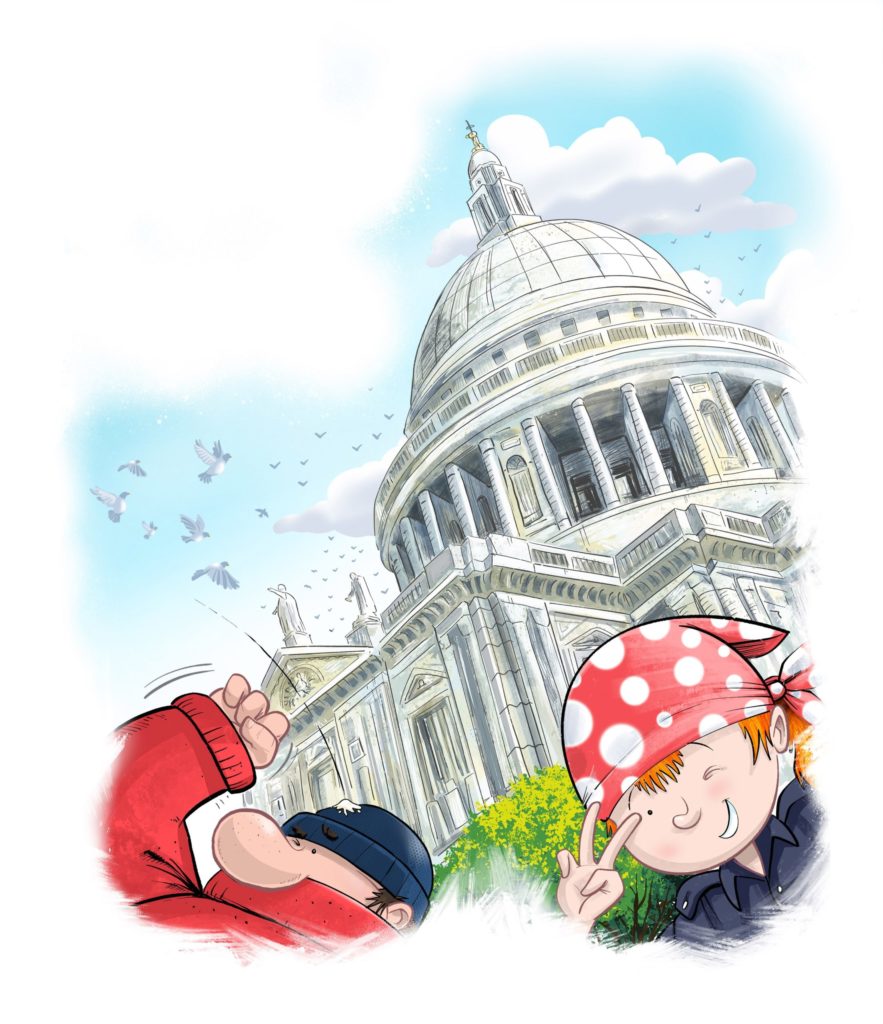
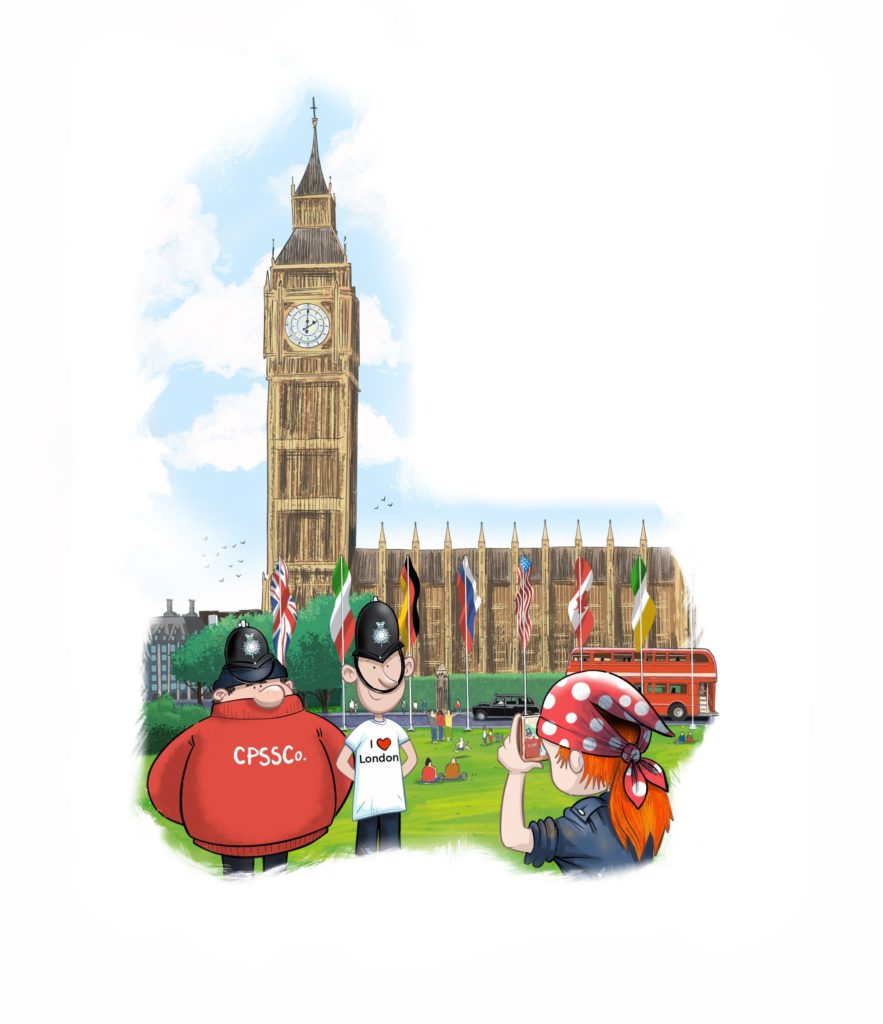
This autumn the series was adapted for radio. A 10-part series, narrated by John Sessions, initially premiered on Fun Kids Radio – the UK’s only national children’s radio station. It’s also available in Gaelic, narrated by Gillebride MacMillan, thanks to support from the Gaelic Books Council, and the English and Gaelic versions are being carried on numerous local and community stations across Scotland. It’s also being broadcast in Nova Scotia in both English and Gaelic.
The series is set in the modern world, but its slower pace reflects a brighter, more optimistic time. It’s a world of brass bands, lost teddy bears, shy puffins, fluffy sheep, missing dinosaurs, cream buns, mountain railways and Welsh teas.
John Sessions
John loved Captain Bobo. We were so lucky he wanted to do the series. We were recording the audiobook of Hurricane Hutch with Bill Paterson, when he suggested John as ‘storyteller’ for Captain Bobo. He knew John would be just right – with a lightness of touch and a talent for character voices like no other. John was also a real enthusiast for the Clyde. He was born in Largs and, although he moved to England at an earlier age, was a frequent visitor to the Clyde and was often a passenger on the ‘steamers’. His favourite ship was the Duchess of Hamilton, but he’d also been on the Waverley many times.
Most well-known for his impressions, and his work on ground-breaking shows such as Whose Line is it Anyway, Spitting Image and Stellar Street, John also appeared in a great number of films and television dramas, playing a range of roles, including two Prime Ministers, Harold Wilson (Made in Dagenham) and Edward Heath (The Iron Lady).
John was great to work with and very keen to help us promote the radio series, telling Radio Scotland’s The Afternoon Show recently they were ‘Lovely, lovely, sweet wee stories.’
With illustrations from the book, here is the first episode of the series Bananas! with John storytelling.
We have just completed the final episode. Captain Bobo was the last project John worked on and he died the day before he was due in the studio with Kay to record a podcast about his career and his love of the Clyde. When they were setting up the date he said to Kay, “If only life could be more like Captain Bobo.”
He will be sorely missed.
The Adventures of Captain Bobo: London by R. D. Dikstra & Kay Hutchison, and illustrated by Matt Rowe is published by Belle Kids, priced £7.99
When the Independent says ‘call off the search – we’ve found the new Terry Pratchett’, then we’re talking about a comic writer worth your attention. And in a year where humour has been much needed then – if you haven’t already – we suggest you should make your acquaintance with Barry Hutchison and his Space Team series. Luckily, we have an extract from the first in the series right here, right now . . .
Extract taken from Space Team
By Barry Hutchison
Published by Zertex Media
Cal Carver’s last day on Earth started badly, improved momentarily, then rapidly went downhill. It began with him being sentenced to two years in prison, and ended with the annihilation of two thirds of the human race. Somewhere in between, there was a somewhat enjoyable moment when he ate a lemon drop, but otherwise it was a pretty grim twenty-four hours all round.
The sentencing was harsh, but not particularly surprising. It wasn’t Cal’s first offense and, if he were honest, almost certainly wouldn’t be his last.
It was far from his first prison sentence, either, although usually they were dished out in terms of days, rather than years. Still, two years – half, once his impeccable behavior was accounted for – in a cozy open prison would be an opportunity to recharge. A holiday, almost. In some ways, Cal was even looking forward to it. There was just one problem.
‘What do you mean, “the wrong prison”?’
Cal flashed the warden one of his most winning smiles.
He had a number of them at his disposal, and this one was up there with the best, while still holding enough back in reserve to step it up to the next level, if required.
‘I literally do not know another way of saying it,’ Cal said. ‘This is the wrong prison. I’m supposed to be in Highvue – you know, upstate? With the gardens? They’ve got this training kitchen. The chefs there, they do these amazing little sort of pastry whirl things that—’
‘I know of it,’ the warden said, drumming his fingers on one of the few uncluttered patches of desk he had available.
‘Good. Right. Of course you do,’ said Cal. He waited, cranking his smile up a notch to be on the safe side. It was a smile so dazzling, you could practically hear the ding as the light reflected off his teeth. The warden, however, appeared unmoved.
He shrugged. ‘And? What’s your point?’
‘Well, Warden… Grant, was it?’
The warden didn’t do anything to confirm or deny his name, so Cal continued. ‘I’m supposed to be at Highvue. That’s what the judge said. Someone even wrote it down on that document this guard here was kind enough to look out for me.’
He gave the female guard an appreciative nod and a flash of that smile. A blush flushed upwards from the neck of the woman’s shirt, but she managed, to her immense relief, not to giggle.
‘He’s right, sir. Must’ve been a mix-up during transit.’
‘She’s really very good,’ said Cal, gesturing to the guard.
‘I don’t know how it works here, if you take recommendations for promotion or whatever, but if you do I’d be happy – no, I’d be more than happy to—’
‘We don’t,’ said the warden.
‘Oh. Well maybe you should,’ Cal suggested. The warden held his gaze for several excruciating seconds. Cal cleared his throat. ‘I’m going to just let you read that.’
The warden’s stare lingered for a while longer, then he lowered his eyes to the document in front of him. A single crooked finger tapped the desktop as he read, the nicotine-stained nail tic-tic-ticking against the wood.
‘As you can see, my crime – while obviously wrong – wasn’t really all that serious.’
The warden didn’t look up. ‘Identity theft is very serious, Mr Carver.’
‘I didn’t steal it, not really. I borrowed it. Just for a while.’
The warden raised his eyes just long enough to make Cal shut up, then went back to reading.
Cal rocked on his heels and studied the office. It must once have been pretty grand, with its wood-paneled walls, high ceiling and lush carpet, but time and a distinct lack of storage space had taken their toll.
The walls were almost completely concealed by mismatched metal shelving. The shelves themselves groaned under the weight of ramshackle ring binders and bulging box files that looked fit to explode and shower the room with their contents at any moment.
Around half of the carpet was as good as new, but a number of paths had been worn into it. The thinnest, most threadbare of them all terminated right on the spot where Cal now stood. He met the guard’s eye and smiled at her. Despite herself, she smiled back, then fought to straighten her face before the warden looked up again.
‘Hmm,’ the warden grunted. Cal turned, assuming he’d finished reading, but the old man’s eyes were still fixed on the page, his finger still tapping its steady, solemn beat.
Cal whistled softly beneath his breath and went back to looking around the room.
In the corner of the ceiling, where it met a really quite elaborate bit of cornicing, there was a murky brown stain – three roundish blobs and a swooping curve at the bottom.
‘It looks like a face,’ Cal announced. The warden lifted his eyes from the page. His gray-flecked eyebrows knotted in the middle. ‘The damp patch. It looks like a face,’ Cal said, gesturing towards the corner of the ceiling. ‘At least, I hope it’s damp, and not, you know, some kind of dirty protest. I’ve heard what this place can get like.’
He turned and lowered himself until he was half-sitting, half-standing against the edge of the desk. ‘It must be hard. All that responsibility. You know what? I bet they don’t appreciate you enough, John. Can I call you John?’
The warden’s face remained stoically unchanged.
‘Saw it on your stack of mail there,’ Cal explained. ‘You should probably open those, by the way.’
‘No,’ the warden said.
‘No, you’re not going to open the mail, or no they don’t appreciate you enough?’
‘No, you may not call me John.’
Cal held his hands up. ‘I fully understand. I was out of line. That was unprofessional of me.’
He spotted a small round tin on the desk, with a stack of sugar-dusted yellow candy inside. Taking one, he popped it in his mouth. Across the room, the guard stifled a gasp.
‘Mm. Lemon. Is that lemon?’ Cal asked. ‘Tastes like lemon. Nice, though. Not too sour.’
A vein pulsed on the warden’s right temple. He closed the folder, very deliberately replaced the lid on his tin of candy, then stared equally deliberately at the point where Cal’s buttocks met his desktop.
It took a few seconds before Cal got the message.
‘Right. Yes. Sorry, been on my feet most of the day, just taking the weight off,’ he said, standing up. He flashed another beaming smile, and indicated the closed folder. ‘So, we good?’
The warden crossed his hands over the folder and tapped out another slow drum beat on it. ‘It appears there has been an administrative error,’ he admitted, making no effort to hide the fact that doing so caused him very real pain.
‘Hey, these things happen,’ said Cal. ‘You shouldn’t feel bad about it.’
‘I don’t,’ the warden said.
‘That’s the spirit,’ Cal said. ‘So, I guess I’ll just gather up my things…’ He patted down his orange jumpsuit. ‘Yep, looks like I’ve already got everything, so I guess I am ready to go!’
Cal leaned over and shook the guard’s hand. She stared down at it in surprise. ‘Audrey, thank you for your help, it’s been a pleasure. I hope we can do it again sometime.’
‘Uh, no problem.’
Cal winked at her, then turned to the warden and extended a hand across the desk. ‘John, I really appreciate you sorting everything out,’ he said. ‘If I were you, I’d get that damp patch looked at. It’s structurally unsafe, and from this angle looks like the trapped soul of a dead clown, and neither of those – in my opinion, anyway – are things a man in your position should have to put up with.’
His eyes flicked from John to his outstretched hand and back again. He nodded encouragingly.
The warden’s chair creaked as he leaned back in it. ‘Unfortunately, Mr Carver, there are currently no prisoner transport options available to me.’
Cal’s smile wavered, just for a moment. ‘”No prisoner transport options”? What does that mean?’
‘I literally do not know another way of saying it,’ the warden said, the corners of his mouth tugging into a slight smirk. ‘I currently have no means at my disposal with which to transport you to Highvue.’
‘That’s fine. Know what? That’s totally fine. You could call me a cab,’ Cal suggested. ‘Audrey could come with me, if you’re worried about me running away. You’d be OK with that, right Audrey?’
‘Uh, yeah. Yeah, I could…’
‘No. Don’t worry. Prison transport will be arranged,’ the warden said.
Cal’s shoulders heaved with relief. ‘Really? That’s awesome! Thanks, John.’ He laughed. ‘You almost had me going there for a minute. I mean, the thought of spending another minute in this hellhole—’
‘Tomorrow.’
Cal blinked several times in rapid succession. The warden leaned forwards in his chair again, steepling his hands in front of his face. Somewhere beyond the door behind Cal, a high-pitched alarm began to chime.
Space Team by Barry Hutchison is published by Zertex Media, priced £8.99.
If you’re still on the hunt for the perfect gift for children aged between 9 and 12, then we recommend the final instalment in Ross Mackenzie’s thrilling – and award-winning – Nowhere Emporium series. With pirates, nightmares, treasure monsters and a whole lot of magic, readers will surely delight in the twists and turns on offer. But you don’t need to take our word for it – here is Ross Mackenzie to tell us more . . .
The Otherwhere Emporium
By Ross Mackenzie
Published by Floris Books
The Otherwhere Emporium by Ross Mackenzie is published by Floris Books, priced £7.99.
In A Friendship in Letters, Michael Shaw brings together correspondence between two of Scotland’s most famous writers – Robert Louis Stevenson and J. M. Barrie – for the first time. BooksfromScotland chatted to him about his book and what the letters revealed about each of them.
A Friendship in Letters: Robert Louis Stevenson & J. M. Barrie
Edited by Michael Shaw
Published by Sandstone Press
Congratulations on the publication of your book, A Friendship in Letters. When did you first discover the friendship between Robert Louis Stevenson and J. M. Barrie?
I wouldn’t say I ‘discovered’ it. It’s been known that the two corresponded since the 1890s and Stevenson’s letters (which have all been published before) made it clear that they had a sustained correspondence. But I only realised that they developed a friendship when I was doing my PhD thesis, when I was reading through Stevenson’s letters.
Barrie’s side of the correspondence with Stevenson was thought to be lost. How did you come to find his letters?
Some of Barrie’s key biographers have speculated that the letters were lost, but other scholars have known about them. When I first saw them, I didn’t realise some people had characterised them as ‘lost’. I was on a research trip at the Beinecke Library, Yale University, doing some research for my first book, The Fin-de-Siècle Scottish Revival (2020). I was investigating some manuscripts by Stevenson, Barrie and Andrew Lang, but I got through the material I had ordered quite quickly, so I had some time on my hands. I looked through the library’s catalogues and ordered material (mainly correspondence) that sounded interesting. This was when I first saw the Barrie letters to Stevenson. I simply assumed they had been published before, but I thought I would read through them while I was there. I was struck by how affectionate and fun they were (and the various things they included – such as a short playlet, in which Barrie imagines his visit to Samoa), so I resolved that I had to get a printed copy of the letters for my bookshelf. It was only when I got hold of a copy of Viola Meynell’s Letters of J. M. Barrie, which describes the letters to Stevenson as ‘lost or destroyed’, and did some more work that I realised that Barrie’s run of letters to Stevenson hadn’t been published before.
In reading Barrie’s side of the correspondence did you come to think differently of both writers?
I was struck by just how fun, playful and jesting Barrie was. And while I knew they developed a friendship, I didn’t realise just how much the friendship with Stevenson meant to Barrie. It’s an incredibly affectionate correspondence in places.
When they first started writing to each other Barrie had yet to write the work that would make him legendary. How did their correspondence inspire his work?
The correspondence inspired various Barrie works, in differing ways. Barrie wrote a poem to mark Stevenson’s death, titled ‘Scotland’s Lament’, shortly after Stevenson died, where we find some subtle references back to the correspondence. He included a chapter on Stevenson in his memoir of his mother, Margaret Ogilvy, and a character in one of Barrie’s lesser-known novels, Sentimental Tommy, is based on Stevenson. Barrie told Stevenson that he was modeling the character Captain Stroke on him, and Stevenson’s response inspired the ending of the sequel, Tommy and Grizel (I won’t give the ending away here…). Stevenson and their friendship inspired some later writings too: there are references to Treasure Island characters in the Peter Pan texts, and, in the 1920s, Barrie wrote a lovely short story imagining how he might have met Stevenson in Edinburgh. Several of these pieces are included in the book as appendices.
Though Stevenson was the more established writer, he was the one who initiated their correspondence. What do you think Stevenson appreciated from their friendship?
Stevenson had been reading some work by Barrie, which he was taken by, which prompted him to reach out. As Stevenson’s second letter shows, he was particularly fond of Barrie’s early novel, The Little Minister. I think Stevenson wanted to congratulate Barrie, but he also wanted to support him. He sometimes acts like a literary mentor at the beginning of the correspondence, giving him advice on writing to Barrie, but their relationship becomes much more equal as the correspondence progresses.
Stevenson was living his final years in Samoa when they started their correspondence. Do you think establishing a connection back to Scotland, and particularly Edinburgh, was important to him in writing to Barrie?
It absolutely was. I think Stevenson appreciated the fact that he could freely make cultural references to Scottish places and history with Barrie. He suspected that Barrie was, like him, a ‘Scotty Scot’. They don’t talk a great deal about Edinburgh, but it clearly played a role in stimulating the correspondence. Stevenson mentions their shared experiences of the ‘grey metropolis’ in the very first letter and quips: ‘no place so brands a man’.
As well as talking about literary matters, their letters cover family, love, politics, gossip; a whole range of subjects. Do you feel these letters give an insight into both writers that hasn’t been appreciated before?
I think the letters help us understand Barrie’s networks better, what he thought of other writers and writings, and his writing processes. I think we get a stronger idea of Barrie’s sense of himself too, and how deep his affection for Stevenson was.
Were you surprised to find the humour in their letters?
It would be surprising if the humour wasn’t there. I knew how funny Stevenson’s other correspondences could be, and Barrie is a great ironist and parodist in his novels and plays. They were well matched and a humourous correspondence was likely to emerge. Stevenson describes the pair of them as ‘fools’, and they enjoy poking fun at each other (and many other subjects).
Finally, what works from Stevenson and Barrie would you recommend as your favourites?
With Barrie, I’d recommend The Little Minister, Margaret Ogilvy, The Admirable Crichton and What Every Woman Knows. Farewell Miss Julie Logan (a late novella) is extraordinary. There’s so much more to Barrie than Peter Pan. With Stevenson, where to begin? There are very few I wouldn’t recommend. Treasure Island and Kidnapped are well worth returning to, and Weir of Hermiston and The Master of Ballantrae are wonderful. The Beach of Falesá, set in the Pacific Islands, is among my favourites.
A Friendship in Letters: Robert Louis Stevenson & J. M. Barrie edited by Michael Shaw is published by Sandstone Press, priced £11.99.
Stanley Baxter is an entertainment legend and his newly released autobiography gives a surprising insight into the man who has made us all laugh for decades. In this extract we follow Stanley trying to make his first steps in the world of entertainment as working down the mines and national service get in his way.
Extract taken from The Real Stanley Baxter
By Brian Beacom and Stanley Baxter
Published by Luath Press
The pit work involved a conveyor belt delivering a constant line of coal mixed up with stones and Stanley and Co. had to remove the stones, break them up with an 18-pound hammer into smaller pieces and then push them through a grille on the ground. However, as the bars on the grille were fixed close together, it made for far more stone breaking. Naturally, Stanley found this situation to be intolerable.
‘By the time I got the bloody stones broken up other stones had gone into the truck with the coal’
Infuriated, Stanley left his post and went back to the canteen to find the foreman.
‘[With Kelvinside silver spoon in mouth.] I simply must speak with you!’
‘[With pipe in mouth.] Oh, aye. Whit dae ye want, son?’
‘Do you realise what’s going on down there?’
‘No, what?’
‘No? Well, I’ll tell you…’ He does, and concludes: ‘And if there’s any more of this nonsense well, we’re going to WALK OUT.’
Stanley’s interpretation of Marx and Engels was unleashed. However, he could have been quoting Groucho Marx for all the foreman cared.
‘Walk out? Walk out? You’re working for His Majesty’s Service here, son. Do you realise you could be shot for what you’re saying to me?’
‘Shot? Shot? Well, em. Shot, you say? Em, well, regardless, something ought to be done. [Softened, conciliatory tone appears.] It’s really not good enough.’
‘Aye, well. We’ll see what can be done about taking away a couple of the bars.’
Threat of dawn execution passed and the young revolutionary at the vanguard of coal mining improvement schemes had his way. (In a few years’ time Stanley’s union work with Equity would see him described in a Glasgow Evening Times headline as ‘RED BAXTER’.)
But before Red could really make his name as a political activist, fate kicked in. When a very bad cold and his old earache flared up, so did Bessie. Her little Bevin Boy, she felt, had to come out of the mines. Bessie insisted Sonny Boy be given a new National Service medical, but it was only after protracted discussion the board reluctantly agreed to free Master Baxter from the chains of coal mining oppression.
‘They looked at me rather aggressively and said, “We’re dropping you down to b1 status. But don’t think you won’t be called up for one of the services!” And I said, “Look, I’m not asking not to be called up at all.”
‘All they said in dismissing me was, “Well, be on your way.” But I didn’t know where my “way” was at all.’
*
Released in the spring of 1945 from the pit of misery, Stanley had some unexpected time on his scratched and torn hands. And for a while he managed to delude himself that Her Majesty’s Forces may well have forgotten he ever existed. After all, what use could he be to the war effort now that it looked to be over? Dresden had been bombed flat, the Red Army was about to enter Berlin and the British and Canadians were set to liberate Belsen.
But just in case he were called up, Stanley determined to make at least a little hay while Freedom’s sun shone. Time was again spent at the movies, catching a tram out to the Boulevard in Knightswood to see the likes of Judy Garland’s Meet Me in St. Louis.
Stanley smiles as he agrees this particular days’ delights offered a clue to his sexuality. Yet, his sexual predilection wasn’t entirely clear. Lena Horne made him feel light on his feet, but the mere thought of Bill Henry caused the teenager to defy gravity.
Stanley, now almost 19, certainly didn’t think to explore the Glasgow world of teen heterosexuality. He didn’t like bars and the city’s vast array of glittering dancehalls/pick-up palaces such as the Locarno and the Dennistoun Palais – Glasgow now had more than 150 – held no real appeal.
‘I did go dancing with cousin Alma a few times to Green’s Playhouse in the city centre because she didn’t have a boyfriend, and I was there to be dragged around.’
But if Stanley was gay and in love with Bill what could he do about it? Bill wasn’t gay. He much preferred tea but would have the occasional coffee – when it was presented on a tray.
When Stanley wasn’t thinking of Bill Henry he was dreaming of a life in acting. In May 1945, just before his birthday, Betty Low (a keen actor as well as an artist) suggested Stanley audition for the radical Unity Theatre Group, based at Glasgow’s Athenaeum Theatre. To his utter relief he was successful. Here was a chance to prove to his dad he could make a career as a performer.
‘The only problem was this was I found myself in a workers’ theatre milieu, so I thought I’d better play up the mines and play down Hillhead – both school and district. But I didn’t fool anyone with my baggy brown corduroys and turtle-necked navy blue jersey and wise nods to Marx and Engels.
‘I was uncomfortably aware that the real thing, a young actor called Roddy McMillan, (who would become an iconic tv and film star) was controlling his mirth with difficulty.’
Stanley appeared in one play at Unity (he can’t recall the title – ‘I think it was a George Munro play.’) playing an old man and he loved it, but regrets he had to learn to smoke for the role and was hooked for life.
‘But the next part coming up, I figured, would be truly immense for me. The play was called Remembered For Ever and it was the story of a young soldier who was blinded. A real womb trembler. I thought, “There won’t be a dry eye in the house.”’
The female lead went to Josephine Crombie, his school siren.
However, Stanley didn’t get to play alongside his Paper Doll. Days before the opening, a manila envelope plopped onto the landing with the letters ohms on the back. It was the worst of news. Stanley had been called up.
He could of course have followed in the footsteps of Alfie Hill, later to change his name to Benny, who had decided to become a moving target and worked (hid) in the theatres of England for six months (Benny was caught and punished before being sent to a unit).
Then again, he could have become a conscientious objector and refused to enlist, as playwright Harold Pinter did – and was fined £30. But Stanley had never skipped school, far less a civil ruling you could be jailed for. And that would certainly have created scandal amongst Bessie’s mahjong ladies.
In June 1945, a month after VE day, Stanley set off for Pinefields camp in Elgin to join the Seaforth and Camerons. He was sad to leave behind his dad, Alice and erstwhile lover Bill, whom he’d said a brief goodbye to over the phone. Leaving his mother behind however was far less of an ordeal.
‘It was too close,’ he says of the relationship. ‘I badly wanted to get out of the house. I didn’t want to join the army, but one consolation was Bessie wasn’t coming with me.’
Stanley was sad however to leave the BBC behind and a developing career in acting on radio in series such as Kidnapped. But his saddened heart sank even lower than his battered seat covering when he looked out of the train window.
‘As the train made to move off, I saw this shambolic figure of Mrs Connolly rushing along holding the hand of Norman. And I nearly died at this realisation he was coming to Pinefields with me.’
Norman was all too much of a reminder of the outsider Stanley had been before he found his own set. And Stanley had more than enough adjustments to make on his own, what with moving into a wooden hut in the camp with ‘11 other hairy-arsed soldiers’.
‘When I walked in I thought a rat had died. The place stank of sweaty feet.’
There was another personal issue to contend with.
‘I was terrified to find that you had terrible trouble having a wank, down to the bromide they put in the tea. The army said they didn’t ever do such a thing but believe you me I am living proof that they carried out pharmaceutical de-bollocking. The number of nights I sat in that loo working up to a sweat that would pour down my face – with nothing to show for it but a wee feeling – convinced me we had all been tampered with.
‘I hoped that this wouldn’t go on for my entire army career, and fortunately it didn’t.’
But despite the stinking socks and sexual emasculation, being cut from Bessie’s umbilical cord was just what he needed. Stanley began to breathe on his own.
‘I got on awfully well with the corporal in charge of our hut because I started doing impressions of the Regimental Sergeant Major. In fact, he said to a personnel officer, “Take a look at Private Baxter, sir. He has his Higher Leaving Certificate. Could he be officer material?”
‘And this chinless wonder of an officer looked me up and down and with a derisory sneer, produced an Oxford accent and declared, “I don’t think so.”
‘I laughed at the time, thinking, “You are so fucking right!” I never did make officer.’ (Technically, he did – much, much later Stanley would be awarded the awesomely grand title of Brigadier.)
Meantime, he settled in nicely. Learning to march at Pinefields came easy, thanks to Alma’s dancing lessons. Yet poor Norman may have been brilliant academically but couldn’t march, or even fold a blanket.
‘He went AWOL. He ran back to mummy and the House of Usher. And after a few days she brought him back to the camp, by the hand. The commanding officer looked at Norman’s baffies, still held together by string, and his mum holding his hand and clearly felt sorry for the pair of them. He was sent to the Pioneer Corps to do some manual labour and I never heard of him again.’
The Real Stanley Baxter by Brian Beacom and Stanley Baxter is published by Luath Press, priced £20.00.
The Changing Outer Hebrides is a voyage of discovery, a fascinating book that focuses on one small village in the Hebridean islands to explore the connection between nature, community and place and how they nurture a ‘sense of place’. In this extract we look at the wonderful plant life of Galson and the cultural history of naming them.
Extract taken from The Changing Outer Hebrides
By Frank Rennie
Published by Acair
Carnivorous plants, and other delights
As we were walking on the moor one early-Spring morning, following a narrow stream-side sheep-path, winding beside the Allt Grunndal, my eye was captured by a small splash of vivid green among the uniform grey-brown clumps of Heather. The Heather had not yet begun to develop its new-season growth, so the contrast with the lime-green moss was quite startling, and when we drew closer, the reason for its presence became obvious. Wedged among the Heather tussocks was the dried and decomposing remains of a gull which had perished over the winter, probably snuggling inside the maze of tussocks for a last, fruitless attempt to gain shelter and warmth. The green moss was growing on the white carcass. In this nutrient-poor soil, the carcass of the gull would have been a bonanza for the moss, adapted to take advantage of any passing opportunity to suck up sustenance whenever a chance presents. Nor is this uncommon, for several species of plants on the moor of Gabhsann are wonderfully suited to this challenging environment. Among my favourite plants, although they are fairly common here with their red-and-green starburst outlines, are those that are exotically, and intriguingly, carnivorous.
When we hear mention of ‘carnivorous plants’ most people probably imagine strange Amazonian man-eaters, or perhaps something in a dreadful B-list movie Hollywood horror film, but there are half-a-dozen delightful species dotted across this northern landscape. Delightful, that is, unless you happen to be a Midge, or a small fly, because a couple of species of Butterwort, and three or four species of Sunflower specialise in trapping and digesting small insects to secure their scarce supply of nutrients. It was Charles Darwin who first demonstrated that some carnivorous plants capture insects as a source of nitrogen and phosphorous, but if you get your nose right down near ground-level and search among the moss, it is easy to observe the process for yourself. Over the short northern summer, the little green buds of the Sundew burst into a new phase of life and develop a rosette of sticky green leaves covered with tiny hair-like, red fibres. Apart from the clue in their English names, the Round-leaved Sundew and the Oblong-leaved Sundew are perhaps difficult for the botanically inexperienced observer to differentiate, but the leaves of the former are roundish and lie mostly flat on the peat and grow on the higher, drier parts of the bog surface, while the latter have leaves which are gently inclined or even erect, and prefer the lower and damper parts, even on open and water-covered areas of mud. Small insects are attracted to the colourful leaves, but get covered in their sticky coating, and are eventually dissolved by the enzymes which are released by the plant to secure its nitrogen intake. Once trapped on the sticky leaf, the struggles of the insect only serve to encourage the production of more digestive enzymes, and hasten the consumption of the insect.
There is also another species locally, the Great Sundew, but while the three species share the same geographical coverage across the Gabhsann landscape, they each prey on a slightly different range of insects and prefer to occupy subtly different microhabitats on the moor. Botanists have shown that the rate of insect capture increases with the area of the leaves, and that the growth of new leaves is directly related to insect capture.
Surprisingly, the Sundews are not the only carnivorous plants on the Gabhsann moor. Despite being regarded as botanical oddities, it has been discovered that several plant species have adapted to survive in sunny but wet and nutrient-poor habitats such as peat-bogs, where the nutritional benefit gained from capturing insects can give them an edge on survival. Although unrelated, two species of Butterwort are also found on the moor of Gabhsann and they too obtain their nutrient intake by capturing and digesting insect prey. The Common Butterwort and the Pale Butterwort can be harder to find among the ground vegetation, because they do not have the self-advertising red rosette of the Sundew, and they can be difficult to find among the Sphagnum mosses until the flowers bloom. Called ‘pinguicula’ after their fat, glistening leaves, and ‘butterwort’ because of their application by early peoples to curdle milk and produce a yoghurt-like fermentation, the Butterworts have a distinctive delicately blue flower, held on a long stem just high enough above the sticky leaves to ensure against trapping potential pollinators instead of a potential meal.
The Gaels, who have inhabited this landscape longer than anyone can remember, have named every part of it that was familiar to them (which is in fact everything) as did the Norse settlers, who came, stayed a while, then left or intermarried. Some people say that, as a general rule, the names of places which can be seen as landmarks from the sea, have names derived from the Norse, while the inland names were given by the Gaels. Superficially this has some truth, but as always there are many exceptions and oddities. There are names of places which betray a Norse derivation, but which are rendered now in the Gaelic mode of spelling. There are place-names whose meaning and origin are now lost beyond time. What is clear from the topographical nomenclature is that the Gaelic-speaking inhabitants were intimately familiar with every part of their landscape. The naming of the configurations of the land is intimately connected with the Gaelic language, and the Gaelic language is intimately reflected in the nature of that indigenous landscape. Land which might be simply called ‘moor’ in English has a wide diversity of descriptive names, based perhaps on the geomorphology, the colours, the predominant covering of vegetation, and/or the perceived usefulness of that land. This land is not the deep, fertile farmland common further south, but it is neither a wilderness, nor is it bleak. Neil Gunn, in one of his Highland novels The Other Landscape, explores the concept of a hidden landscape beyond the visible one. He describes it to be like to having two similar conversations with different men and liking the first man but distrusting the second because some ‘other conversation’ in the subconscious background led him to detect features and characteristics which gave different interpretations of what he could actually see. Some people read landscapes like this, and these are the impressions that I have as I walk, and work, and live in Gabhsann.
The Changing Outer Hebrides by Frank Rennie is published by Acair, priced £16.95,
Time for poetry, and a wonderful new collection from the award-winning and much-translated Magi Gibson. The poems in I Like Your Hat beautifully capture moments of noticing that speak to our wider connections, to family, community and love. We’re delighted to share a sample of them here.
I Like Your Hat
By Magi Gibson
Published by Luath Press
I Like Your Hat
At the bus stop where the wind’s trying
to kill us, slicing in like a scimitar from Siberia,
a tiny woman is wearing a colourful velvet beret.
She’s so small, I see each segment of its circle
sitting on her head like the wheel
of a stained glass window: emerald, sapphire,
saffron, indigo, amber, red. She beams
when I say it’s beautiful, tells me its story;
a gift from her daughter years ago,
she deemed it too bright, too loud,
stuffed it in a drawer, out of sight.
And now, her daughter’s dead.
Years later, the bus stop on St Vincent Street,
maybe it’s the same wind, slicing in
from Siberia, snow and ice spitting
through its sharpened teeth,
a young woman says, ‘I love your hat!’
It’s a beret of sorts. Mulberry wool.
‘Well cool,’ she says. ‘Unusual.’
‘It’s from a charity shop,’ I reply.
Then she admires my scarf. Hand-woven
in India. Fairtrade. And while the bus
doesn’t come, we talk recycling, pollution,
climate change, and I see she’s carrying
an art portfolio under one arm, while
on her shoulders she bears the future
of the world. And I swear her smile’s
so beautiful, this student girl
I’ve never met before, she’s lighting up
the shelter like an angel in a holy grotto
as all around the drear November dusk
descends black as the wings of ravens.
And the glow from her face warms me
more than my woollen kind-of-beret
or my hand-woven Fairtrade scarf or best
thermal underwear from Marks & Spencer,
or my specially lined duvet coat as worn
by explorers to far Antarctica
guaranteed to keep me warm at minus fifty
in a hurricane. And as we chat I recall
the tiny lady’s velvet beret, its jewelled
wheel of colours, and her sadness as she said
she wore it now to please her daughter,
who is dead. And all the while the darkness
deepens as if the sky is leaking sin
and the east wind with its icy breath
from Siberia does its best to kill us
and cut like a scimitar
through the warmth
of our common humanity.
Glasgow Epiphany
Underneath the No Waiting
At Any Time sign
where a homeless man’s been dossing
in a doorway, someone
has scrawled in white chalk
I CAN SEE INTO YOUR SOUL.
A thought that stalks me
dogged as my own shadow
onto Great Western Road,
past the kebab shop, and the
graffiti-scratched bus stop,
where a drunk is singing
obscenities into the cold ear
of the east wind. I can see
into your soul… seven syllables
that susurrate softly at the fringes
of my consciousness, fluttering
like the soft white wings
of the guardian angel I stopped
believing in when I was eight,
haunting me with whispers
of afterlife and sin and lost souls
with no place to sleep at night. So
when three Jehovah’s Witnesses
in the fading winter light offer me
Watchtowers with a sprinkling
of eschatological warnings
at the side door of Òran Mór,
I think maybe it will free me
of the strangeness of it all if I pass
the Good News on that up around
the corner in a dead end street
where No Waiting is Permitted
for All Eternity, there’s a down-and-out
dossing on cardboard in a doorway
who can see into their Immortal Souls –
when from the frozen branches
of a black-boughed tree
at the red-amber-green lights
where four roads meet and
the traffic roar stops starts stops,
and you can hardly hear the pound
of your own heartbeat, the song
of a blackbird rises into the city dusk
scattering sparks of stardust
like a tiny resurrection.
Three Days Till Christmas
in the packed department store,
shoppers laden like Sherpas
trek through forests
of synthetic trees,
wade through drifts
of special offers.
in the midst of this throng
under twinkling tinfoil stars
she wanders alone
on sandalled feet
donkey-brown coat
buttoned up all wrong
perched upon her unbrushed hair
a crown of tinsel thorn.
crowds part before her
like a red sea miracle.
she floats by on a cloud
of cheap whisky.
while her voice soars above
the festive ringing of cash registers.
a fallen angel singing
in the bleak midwinter.
I Like Your Hat by Magi Gibson is published by Luath Press, priced £8.99.
Sometimes all you want to do in your reading is visit another time and another place. And in Rescue Code, readers will find themselves far into the future, in 2256, as the comfortable life of Daniel Keaton is about to be shattered. Here’s an extract from this dark, futuristic thriller that will keep you guessing through each of its twists and turns.
Extract taken from Rescue Code
By Paolo Antonio Magrì
Published by Black Wolf Edition & Publishing
At 9:28 a.m. Daniel Keaton was already in front of the entrance to the W255 classroom.
The lesson of that 2nd February 2256 would have been remembered all his life. The study programme for the day included discussion of the popular uprisings and political unrest in Europe in the 22nd century against human cloning projects.
The lesson was, as usual, dominated by authority and enthusiasm at the same time, marked by lively discussions between students who supported conflicting opinions, and accompanied by the winks of the students bewitched by his charm.
Professor Keaton’s lectures were famous for the active role reserved for the gyys, whose judgments were stimulated and listened to and then centrifuged into the debate that characterized the last twenty minutes. Even that day two hours had flown by. The issue of cloning projects and the moral question it raised were still topical, even though all those years had passed.
Punctual, as it had begun, at eleven thirty the lesson ended. As he left the classroom, Daniel was approached by a young woman. She didn’t give the impression of being a student, she showed no more than thirty or thirty-five years. The golden blonde hair grazed the shoulders with a soft bob. The slim body, with an elegant posture, was embellished by two ultramarine blue eyes and a charm that was independent of the external appearance. The clothing was strictly designer: grey trousers, red blouse, high heel but not dizzy shoes.
‘Professor Keaton, I need to talk to you,’ the young lady said without even saying hello. She seemed to be in a hurry and kept looking nervously around. ‘Excuse me! Good morning, my name is Katrine Johnson and I need at all costs to speak with you’ she corrected herself.
‘Good morning,’ he replied a little uncertain, yet smiling.
‘Can we go to your studio, please? It’s something delicate.’
‘All right.’
Daniel’s studio was on the same floor, squeezed at the end of a blind corridor that ended straight at his shelter. He had demanded from the rector just that, since it allowed him to escape from the confusion and buzz of the people. His lair was not excessively large, but well organized and above all full of books, school texts, publications and manuals. ‘A true rarity for true connoisseurs’, the person concerned often said; ‘for true fanatics’, others specified; ‘for archeopsychopaths’, the most polemical advocates claimed.
At a time when thousands of books could be immediately available on a memory of a few millimetres, he still insisted on using old paper books. Those crammed in his studio were only part of the library he could show oat home. When some of his most trusted friends found the courage to point out this strange passion of his, he would take refuge in the corner kick with the old and proven excuse of investing in publishing antiques.
Daniel and Katrine Johnson walked down the endless corridor. The professor typed in the password, the security system swallowed the password and the door opened. Once inside, he made the girl sit down and consumed the ritual of every morning: opening the curtains, deactivating the
drawer block, and anxiously searching for the irreplaceable orange candy, which he immediately offered his guest.
‘Would you like that, miss?’
‘Ma’am. No, thank you.’
‘Tell me how I can help you,’ continued Daniel.
‘I’d like to find out what you have to do with my life.’
A sentence like that, with neither head nor tail, could only imply two eventualities: he was dealing with a psychopath, or that was a joke. In both cases, it was better not to overreact, in order to avoid bad reactions. He remained calm and relaxed, especially in tone. He flaunted a circumstantial smile, stroked his beard and asked, ‘Could you be more specific, please?’
‘It’s a complicated story. If I had figured it out, I wouldn’t have come all the way over here.’
The young girl’s face began to darken. She added, ‘The only thing I’m sure of…is that you are somehow connected to my family, and perhaps to my husband’s disappearance. Actually, the only thing I know is that you… I mean… I mean… It’s like if… You…’
‘All right, that’s enough,’ interrupted Daniel, managing to block out that rash of rambling phrases. It seemed that the woman feared that she could not fi nish a speech before she had even started it, so the words flew from her lips and remained meaningless.
‘I have little time to explain. Believe me, I’m not crazy,’ she continued, gesturing in growing agitation. Daniel was impressed, and somehow scared. Katrine Johnson did not seem dangerous, but she was clearly altered, perhaps prey to some strange substance. Or maybe she was a mythomaniac. It certainly wasn’t for him to find out.
‘Miss, I’m here to receive the students and the colleagues, not to…’
‘Does the name Robert Konnor mean anything to you? He was my husband. You have something to do with football? I’m a doctor and I found out that…’
Daniel stiffened and waved a hand to silence her.
‘Listen, I work here. If you have any questions about my profession, ask, otherwise go away. I’ve already pressed the button to call security, though.’
Katrine Johnson realized she had exhausted her chance to be heard.
‘All right,’ hissed bitterly. ‘I hope to come back if they’ll give me the chance.’
She got up, opened the door and left. The communicator rang at the same time.
‘I accept,’ said Daniel to activate the holographic call.
That was Mr Finson, head of security.
‘Professor Keaton, a problem has been brought to our attention. You may be bothered by a person. Keep the door locked. I’ll send an officer to you right away.’
‘All right.’
‘Out.’
The lapidary conclusion of the call upset him. Mr Finson used to call him ‘Professor Daniel,’ after all, they’d known each other for years. Secondly, who and why did you report the girl’s presence? He only pretended to call security in the presence of Mrs Johnson.
A knock on the door took him away from those thoughts. Finson’s warning advised him to keep closed, but after a few moments of reflection, his instinct took over and he decided to open up.
Behind the door, Katrine Johnson awaited him again. She was lying on the ground, powerless. She probably tried to get to the door with the last of her energy and ended up banging into it. Her face looked contracted, her eyes grainy and shiny. Daniel called her, no answer. He looked around lost, but there was no one around. He noticed the woman was holding a circuit board. Weird. Different from the common ones. He opened her palm and took it.
The hand stayed open, taut. Daniel bent over the woman and tried to wrap her in his own, as if to support her. After making the effort to lift her arm, Katrine grazed the professor’s astonished face trembling. Then she lowered her eyelids and her facial expression became more relaxed. It wasn’t clear whether she was unconscious or dead. There were, in any case, no traces of blood, apparent signs of a struggle or wounds.
Rescue Code by Paolo Antonio Magrì is published by Black Wolf Edition & Publishing, priced £13.99.
Coo Clayton’s Maggie books have been delighting young readers since Maggie first pulled on her mittens in her first adventure around Scotland. Now, in Maggie’s Magical Islands, Maggie and her mum travel around the Hebrides looking for treasure after finding an old map. Here, Coo Clayton tells us more about Maggie’s latest journey.
Maggie’s Magical Islands
By Coo Clayton
Illustrated by Alison Soye
Published by Black and White Publishing
Maggie’s Magical Islands by Coo Clayton and illustrated by Alison Soye is published by Black and White Publishing, priced £9.99.
Ross Sayers is one of Scotland’s rising stars in YA fiction, writing funny, touching novels that get under the skin of being a teenager in Scotland in the 21st century. We caught up with him to talk about his new book, Daisy on the Outer Line.
Daisy on the Outer Line
By Ross Sayers
Published by Cranachan Books
Congratulations on the publication of your latest YA novel, Daisy on the Outer Line. Could you tell us a little bit about what to expect from the book?
Thank you! It’s about a nineteen year old woman named Daisy, who, after making a bit of a scene at both her stepdad’s funeral AND Christmas night out, falls asleep on the Glasgow subway. When she wakes up, not only has she travelled back in time 16 days, she also looks like another person. She only knows one thing: she has to save someone’s life to get back to the right timeline…
This is your third YA novel now, how has the writing and publishing experience changed from when you released your debut, Mary’s The Name? Do you feel like you know what to expect from the process now? Or is it still full of surprises?
Sadly, the writing process never seems to get any easier. Always a bit of a slog. But at least now I have a bit more confidence that people actually might want to read what I’m writing, whereas before I was published, it was really just me and my mum reading my work. Similarly, my books seem to get stocked a few more places these days, which is really heartening and makes the 2-3 year process behind writing the book a little easier.
What draws you to write about the trials and tribulations of young people?
I suppose because I still feel like one…despite creeping closer and closer to [AGE REDACTED]. Anyway, I believe the children are the future (I think I came up with that), so they deserve good books written specifically for them! It’s tough, mind you, as once kids get to 15, 16 etc, they’re old enough to read adult books, so it’s your job as a YA author to convince them that your books are relevant and adult enough to stick with YA. (Remember when you were young, you didn’t want to watch 15 rated films when you were 15, you wanted to watch 18 rated films!)
You like to use the Scots language in your writing. Why is this important to you?
Part of it is just selfishness. There are not many new Scots YA books and there definitely aren’t many written in Scots, so I like to think I’ve created a bit of a niche for myself. (The nichiest niche in existence, too niche you might argue). But more than that, I like to think young Scottish kids will read these books and see that they’re language isn’t something to hide away. If you speak it with your pals, why do you need to bury it when speaking at your school, or your work? Speak and write in Scots if you fancy, or don’t, but just know that you’ve got the option.
You’re becoming a bit of a superstar online with some interesting Twitter marketing ploys. What is it about the medium that you enjoy?
I think a lot of writers would argue that it’s the immediacy of Twitter that draws us to it. If I’m writing a novel, and I write a joke, which I think is funny, it could be 3 years before anyone will read it. By that point, I’ll think it’s terrible. AND it’s very unlikely anyone will specifically say to me, ‘Hey Ross, that joke on p 45, I laughed at that’. Compare that to Twitter, where if I think of a joke, within a minute I can post it and receive those little notifications which give me a dopamine hit. 80,000 words with years to wait until anyone reads it, or 280 characters and people read it immediately. You can see the appeal…
Our First Minister, Nicola Sturgeon, even got involved! That must’ve been quite the surreal moment.
Aye, I was eating my tea one night and my notifications went a bit daft. She directed her followers to vote for Govan in the World Cup of Glasgow Subway Stops I set up. It actually still lost out to the eventual winner Kelvinbridge, so maybe her powers are waning… I believe my publisher Cranachan has sent her a copy of the new book so FM, if you’re reading this, check your post!
So, in Daisy and the Outer Line, Daisy finds herself travelling back in time. It’s something we all fantasise about from time to time. Do you have moments in history you’d like to travel back to witness? Anyone from the past you’d like to meet?
Hmm, good question. I think one of Bruce Springsteen’s early gigs in the UK would’ve been incredible. Or even just going back to the 90s and having a night out sans social media. Off the top of my head, would have loved to have met both John Candy and Robin Williams and gave them both a big cuddle.
Christmas is coming soon. Are their any books you fancy seeing in your stocking?
(Last plug, but a quick reminder that Daisy on the Outer Line is set at Christmas and I am counting it as a Christmas Book™. ) I’m quite bad for just buying the books that I want so I quite like a surprise, maybe something that I wouldn’t usually read. Like a bestseller or something.
And what has been your favourite read of 2020?
Very tough question! I’m going to cheat and say Toffee by Sarah Crossan and When the Dead Come Calling by Helen Sedgwick and The Black Flamingo by Dean Atta and Jack’s Well by Alan McClure and Scabby Queen by Kirstin Innes (and I’m also really enjoying The Cauldron of Life by Caroline Logan, which I’m halfway through).
Daisy on the Outer Line by Ross Sayers is published by Cranachan Books, priced £8.99.
BooksfromScotland love David Keenan and his latest novel Xtabeth is one of our favourite reads of the year. It’s a mesmeric novel of love, sex, art, magic and golf that will burrow deep into your subconsciousness. We got in touch with him to talk about the books that have meant a lot to him throughout his life.
Xtabeth
By David Keenan
Published by White Rabbit
The book as . . . memory. What is your first memory of books and reading?
I can remember sitting in my high chair and making noises as I turned the pages of a book about cartoon animals and the doctor who had come out to see me making some kind of comment about me reading. The next thing I know I am reading The Claws of Axos by Terrance Dicks, which I got from Tollcross Library, in Glasgow. All of my early reading is associated with libraries. Later, when I got a part-time job, I was able to buy second hand books, but my childhood was all about the libraries. I’ll never forget the day my mum asked me if I would like to get an adult library card. What a thrill. Plus I would ask for copies of the dust jackets that the library would staple on their wall to advertise new books coming in, so I had a great display at home in my bedroom covered in cool book jackets.
The book as . . . your work. Tell us about your latest book Xtabeth. What did you want to explore in writing it?
I wanted to explore the shape of consciousness, art, sex, and magic and how language interfaces between the three, I wanted to cast a spell, and create an entity, an organism, that would develop its own uncanny relationship with the reader.
The book as . . . inspiration. What is your favourite book that has informed how you see yourself?
Agua Viva by Clarice Lispector is my personal holy book. I feel euphoric every time I read it, it is so alive, and like my own work it is an attempt to exhaust language and to manifest the-thing-in-itself. Agua Viva is not about what might be or what was, it is. I see the world through the eyes of Clarice Lispector and I recognise it, truly, as my own.
The book as . . . a relationship. What is your favourite book that bonded you to someone else?
Allen Ginsberg’s Selected Poems 1947-1993. When my wife Heather Leigh and I were falling in love we would read Ginsberg to each other, especially “Song”, which my wife would sing. “The weight of the world/is love.”
The book as . . . object. What is your favourite beautiful book?
Too many to mention, so many beautiful books in my magick collection and in my poetry chapbook collection alone. I’ll mention two favourites: the original 1963 letterpress edition of Roxie Powell’s amazing poetry collection, Dreams Of Straw, printed by Charles Plymell and Dave Haselwood, and the original 1965 vellum binding of Charles Olson’s Human Universe and Other Essays published by The Auerhahn Society. I could go on forever, I collect beautiful books.
The book as . . . entertainment. What is your favourite rattling good read?
Friedrich Nietzsche The Gay Science. It’s the ultimate beach read. Nietzsche is pure feel good and no matter how you are feeling or what you are wresting with, he makes you feel that you are game enough for any of it.
The book as . . . a destination. What is your favourite book set in a place unknown to you?
The Invention of Morel by Adolfo Bioy Casares. Although I have travelled to this mysterious island many many times, it still remains gloriously unknown to me.
The book as. . .education. What is your favourite book that made you look at the world differently?
Arthur C Clarke’s Mysterious World by Simon Welfare and John Fairley. It was one of the first books I ever owned, I was obsessed with Arthur C Clarke, still am, and one day when I came home from school for lunch my dad had bought it for me and had left it waiting for me on the kitchen table. Just thinking about it makes me cry. I probably became a writer right then and there, when my dad gave me a book that introduced me to some of the mysteries of the world and that there are more things in heaven and earth.
The book as. . .technology. What has been your favourite reading experience off the page?
When I was young I used to write short stories and print them off on the silver paper of my ZX Spectrum printer, what a buzz, what a smell, it made your story instantly look like a missive from the future, which is where I was writing to, to my future self to tell him to get the fuck out of dodge and start writing.
The book as . . . the future. What are you looking forward to reading next?
The Black Books: Facsimile Edition by C.G.Jung, and I am so excited. A gift to myself to celebrate the release of Xstabeth.
Xtabeth by David Keenan is published by White Rabbit, priced £14.99.
Sam Heughan and Graham McTavish are better known to us as the stars of Outlander, but here, in Clanlands, they have become intrepid travel writers, travelling around the Highlands on a road trip to remember. Here is an extract from their journey, as they appreciate our national drink.
Extract taken from Clanlands: Whisky Warfare and a Scottish Adventure Like No Other
By Sam Heughan and Graham McTavish
Published by Hodder & Stoughton
GRAHAM
I wish I was the whisky-drinker Sam is. I stand in admiration as he chooses a whisky, casting his eye appreciatively over the selection, murmuring with surprise at a particular bottle he’s not tried before. Ordering with confidence, tasting with élan. You can see the barman realises this is a man who knows his shit. I just stand there nodding impressively, once again managing to look like I know what I’m doing without actually having a clue. And Sam and I have sampled some good ones. We both went to an Italian fan convention where our green room was furnished with a 1939 Laphroaig (listed at an eye watering $40,000 per bottle), a 1953 Mortlach and a 1970 Glenfarclas. Incredible.
And now, Richard and Sam are waiting for me to choose which whisky to sample and it’s not that I don’t like whisky, please don’t get me wrong, it’s just I don’t know what I like at nine in the morning nursing a hangover, after a bowel-loosening drive with Heughan. . .
SAM
The concentration of driving a boat on wheels has made me parched; as we say in these parts, my thrapple is dry. Richard hands us a glass of twenty-six-year-old cask-strength whisky distilled in the Black Isle in the northern Highlands at a gentle 46.9% proof.
All: Slainte!
Graham looks at me sheepishly as he takes a sip. He struggles to swallow. Richard explains it’s cask-strength, meaning it’s not watered down. I love the stronger stuff – it’s heavier on the tongue and feels special. If you’re a fan of Scotch, even just ‘nosing’ a whisky and smelling the sugars or flavours can be very enjoyable. The clear liquid takes on the colour and flavours of each barrel, such as French oak, as many are aged in barrels that previously held bourbon or sweet wine. As they age, the whisky deepens, becoming more balanced and less fiery, with notes of butterscotch, cinnamon, honey, leather, citrus and tobacco. The smell can transport you . . .
Graham: You remind me of Jilly Goolden.
Sam: Who?
Graham: Never mind, before your time. Similar hairstyle.
Richard recommends a wee splash of water with cask-strength whisky, which breaks up the oils and releases more flavour. Scotch. No other drink is named after a country, which is why whisky is more than just a drink for me. When I’m feeling homesick, I’ll have a dram. It brings me great comfort: the smell brings back memories of Scotland; the taste takes me home. . .
Many crofters supported themselves by generating income from the sale of their whisky. The earliest written record of Uisge-beatha, ‘Water of Life’, is in the Scottish Exchequer Rolls for 1494, where there is an entry of ‘eight bolls of malt to Friar John Cor wherewith to make aquavitae’. A boll was an old Scottish measure of not more than six bushels. (One bushel is equivalent to 25.4 kilograms). Shared around the hearth, it would ‘bond’ men together as they exchanged stories and banter, just as it does today, even with Graham’s stinky chat. Oops, he’s slumping. ‘Sit up, Graham.’ Honestly, it’s like going out with yer granddad. Next he’ll be telling stories from the war . . .
Clanlands: Whisky Warfare and a Scottish Adventure Like No Other by Sam Heughan and Graham McTavish is published by Hodder & Stoughton, priced £20.00.
If you’ve not yet been lucky enough to sample the delicious food at The Seafood Shack in Ullapool, then, with their new book, you can try your hand at recreating their recipes yourself. What a treat! And if you’re looking to cook something a little different for this year’s Christmas dinner, then the recipes below are a fabulous place to start. Our mouths are watering already!
The Seafood Shack
By Kirsty Scobie and Fenella Renwick
Published by Kitchen Press
Pan-fried Half Lobster with Parsley and Chive Butter
Once you have cooked the lobsters this is actually a pretty simple recipe, but don’t underestimate it. Keeping it simple can be key to making something delicious.
Serves 4
Ingredients
2 cooked lobsters, submerged into cold water straight after cooking
150g butter, chopped into chunks
a small handful of chives, chopped
a small handful of parsley, chopped
juice of 1⁄2 lemon
salt and pepper
Halve your lobsters and break off the legs and claws. Crack the claws, but don’t take the meat out of them. Place your butter and herbs in a large frying pan (don’t use a non-stick one as the shells can scratch it and ruin the surface) and put on a high heat. Once your butter starts to foam, put in your lobsters, claws and legs – if you don’t have a big pan you may have to do this in two batches.
Fry your lobsters for around five minutes, constantly turning them in the herby butter as you go, then add the lemon juice and season. Take off the heat and serve. Be extra careful you don’t overcook your lobsters as they become rubbery very quickly.
TIP: You can tell when a lobster is overcooking if the meat of the body starts to curl out of the shell.

Dauphinoise Potatoes
Creamy, cheesy and garlicky potatoes – what more do you want? This is the dirtiest dauphinoise recipe we know.
Serves 4
Ingredients
1kg white potatoes (or you can use a mixture of sweet potatoes and white)
knob of butter
2 white onions, sliced
3 garlic cloves, chopped
1 vegetable stock cube, crumbled
sprinkle of nutmeg
300–500ml double cream
100g Parmesan, grated
salt and pepper
Preheat the oven to 180°C. Peel and slice your potatoes very thin and dry them with a clean tea towel or kitchen roll. Melt your butter in a pan and add your onions and garlic, then sweat for 10 to 15 minutes until they are soft. Crumble in your vegetable stock and the nutmeg and season, then fry off for another five minutes. Stir in the potatoes and pour over enough cream to just cover, then season with salt and pepper. Bring up to just before the boil – you don’t want your cream to boil as it will curdle – then lower the heat and simmer until the potatoes are just tender.
Pour everything into an ovenproof dish (we use the same pan that we cooked the potatoes in to save washing up but make sure it’s ovenproof). Give it a shake so the potatoes are reasonably level on top, sprinkle over the Parmesan and pop in the oven. Cook for around 20 minutes or until the parmesan is crispy and golden. Right at the end, you can whack the heat up to 220°C to brown the top.
TIP: You can use ground nutmeg but you get so much more flavour by grating a whole one (and they keep forever).
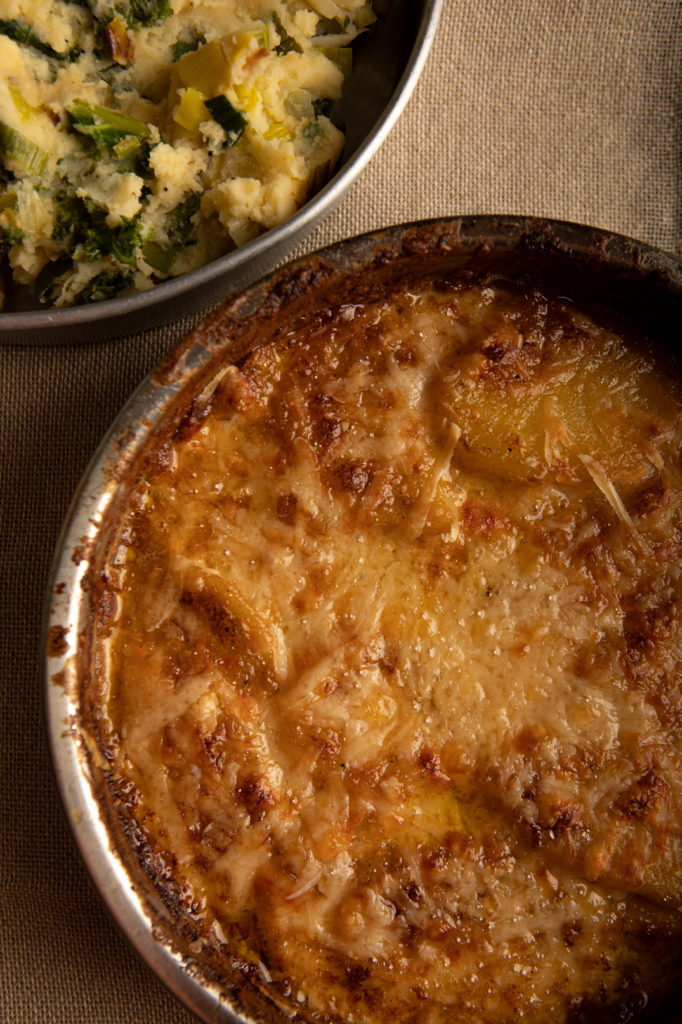
Sweet Roasted Root Veg
This is a great recipe to do when you’ve got a fridge full of vegetables that need used up. You can substitute the veg for anything you want, just make sure to adjust your cooking times – for example, if you’re using broccoli, put it in near the end as it cooks a lot quicker than carrots. Sometimes we add a handful of toasted flaked almonds at the end for a bit of extra crunch.
Serves 4
Ingredients
2 raw beetroot, peeled
1 butternut squash, skin left on, seeds discarded
1 red pepper, deseeded
2 red onions
1 carrot, scrubbed
2 garlic cloves, skin left on and crushed
good glug of olive oil
2 tbsp balsamic vinegar
2 tbsp honey
4 handfuls of baby spinach
100g feta, crumbled
salt and pepper
Preheat the oven to 200°C. Cut your beetroot, squash, red pepper, red onions and carrot into roughly the same sized chunks so they cook in the same time. Put them all on a large baking tray in a single layer and toss with the garlic and a good glug of olive oil. Season well.
Roast in the oven for around 20–30 minutes until the veg is just starting to soften but still has a good crunch. Take out of the oven and drizzle over the balsamic vinegar and honey, tossing
to make sure all the vegetables are well coated. Then whack up the heat to 220°C and pop the tray back in for another 15 minutes until everything is tender and caramelised but not soggy.
Take your veg out, mix through the spinach and feta, and serve immediately.

The Seafood Shack by Kirsty Scobie and Fenella Renwick is published by Kitchen Press, priced £20.00.
The dark, winter nights are the perfect time to curl up with a thriller, and BooksfromScotland highly recommend C. J. Cooke’s latest book, The Nesting. It’s a domestic noir that sees a vulnerable young woman start a job as a nanny with a grieving family as they set up in their new home in the Norwegian countryside. In this extract Lexi meets the family for the first time . . .
Extract taken from The Nesting
By C. J. Cooke
Published by HarperCollins
The room was suddenly charged with emotion, and I felt my lies pressing down on me like lead weights. But just then, Coco reached out to me, both her hands open wide. Tom passed her to me and I took her, feeling the lovely warmth of her in my arms. I swear, I’ve never been remotely maternal or gooey over other people’s kids – quite the opposite, especially during the drool stage – but there was something different about Coco and Gaia. Or maybe I just related to their loss.
*
‘Shall I let you spend some time with the girls?’ Tom asked me. ‘Ellen can fill you in on their routines.’
The urge to run out of there screaming was starting to wane. I was on surer territory, now, especially since I felt so comfortable around Gaia and Coco. It almost felt like I’d known them much longer than three minutes.
Serendipity. That’s what it felt like.
Tom left me and Ellen to chat while Gaia and Coco Cooke played in the nursery. Ellen told me she’d worked for Tom for just two and a half months, but she was getting married and couldn’t go to Norway. I could see she’d been torn about this and it was clear she loved the girls.
‘So you didn’t know their mother?’ I said, calculating the length of time Ellen said she’d been in the post and the length of time it had been since Aurelia died.
Ellen shook her head. ‘No. It’s clear that they were devastated, though they’re so young that it takes a long time to process something like that, losing your mother . . .’ She paused briefly. ‘It was one of the reasons Tom wanted me to nanny for him, while he tried to keep his business going and get his head around it all. I’ve had child counselling training, you see.’ She glanced over at Gaia who was playing with an enormous dolls’ house. ‘They’re doing much, much better now, though Gaia still asks questions. Just so you know, if she asks what happened, the party line is: Mummy had an accident and is in heaven.’
I nodded, though the phrasing made me unsettled. ‘An accident?’ I said cautiously.
Ellen dropped her gaze to the floor. ‘Suicide,’ she said in a low voice. ‘Terrible, isn’t it? What would drive someone to do something like that?’
The scabs on my arms began to itch beneath my sleeves. ‘Yes,’ I said after a long pause. ‘Terrible.’
I left an hour later, both exhilarated and disgusted with myself. There was no way I could take the job, absolutely no freaking way. I’d be lying to a family who had been utterly devastated by an unthinkable tragedy.
But on the other hand, I wanted to be a part of their lives.
I wanted to go to Norway, yes, and I wanted a home and a chance to write my book and turn my life around. But Gaia and Coco were sweet, precious girls who had lost their mother to something I knew better than I knew myself, and beneath the usual thrumming cacophony of self-hatred in my head was a quiet but insistent whisper that maybe – just maybe – I could actually make a difference.
The Nesting by C. J. Cooke is published by HarperCollins, priced £12.99.
The National Galleries of Scotland’s current exhibition pays tribute to one of cinema’s greatest pioneers, Ray Harryhausen. But if you can’t make it to Edinburgh while the exhibition is on (though it runs until September 2021), you can bask in his life and iconic work in the exhibition’s companion book, Ray Harryhausen: Titan of Cinema. We have a sneaky peek here to share with you, which we’re sure will bring back memories!
Extracts taken from Ray Harrhausen: Titan of Cinema
By Vanessa Harryhausen
Published by National Galleries of Scotland Publishing
Dad’s centenary
My dad, Ray Harryhausen, was known to his fans and moviegoers as a creator of magical creatures, and as the man behind the stop-motion animation technique Dynamation. He astonished and terrified his audiences with swordwielding skeletons, bronze giants and the iconic Kraken from Clash of the Titans. The 100th anniversary of his birth has given me the motivation to record the stories that reveal the kind, funny, fascinating family man behind these creations. With this book, I want to celebrate the fantastic collection of creatures and artworks which sprang from his incredible imagination. These are my own personal memories of this famous man’s life at home, as well as on set. Often, some of the people who knew him as a friend, colleague or mentor add their own revealing memories.
I so admire all of Dad’s achievements, and am proud to see what a legacy he has left. It’s exciting to see that people are still fascinated by Dad’s work, more than seventy years after he first animated for a major film. I still feel that what he created on screen was magical – from the initial seed of an idea in a drawing that sprang from his huge imagination to building a model which he then brought to life through animation. I had the opportunity of watching him create concept sketches and then construct the model at home. The creatures all had very strong personalities – Dad was always able to create such distinctive characters.
There are sixteen classic films that Dad worked on throughout his career; I was around for five of these, from One Million Years BC (1966) until his final movie, Clash of the Titans (1981). I was fortunate to be present on many of Dad’s film sets as a child, and mingled with the famous actors and crew who worked with him.
Once animation on the films had been completed, Dad would allow me to play, from an early age, with the very models that had been seen on screen. Our house was filled with items from Dad’s films, and so alongside my regular childhood toys, I was able to have fun with dinosaurs and other creatures – this was the norm for me. We also had some interesting reading material – Dad’s good friend Forrest J. Ackerman, the science-fiction writer and publisher, would send over copies of Famous Monsters of Filmland magazine, which we would read over breakfast, much to Mum’s disapproval. She just didn’t think it was right to have such gruesome reading material at the breakfast table!

Skeleton model from The 7th Voyage of Sinbad
Of all Dad’s creations, it is the skeletons which are most frequently remembered by film fans.
Even though The 7th Voyage of Sinbad (1958) was before my time, the fight scene between Sinbad and the skeleton on a spiral staircase is particularly special to me.
The choreography for this sequence was incredible. I have been lucky enough to practise some basic swordplay with Scottish battle re-enactors in the past, and so appreciate the level of concentration and timing required by the actor Kerwin Mathews in this scene. Mathews would spend hours and hours rehearsing his movements with the stuntman Enzo Musumeci Greco; then, when it came to shooting the live-action sequences, Mathews would be alone, fighting his invisible foe. Of course, Dad then animated the skeleton model to match with Mathews’ movements, and the end sequence was brought to life by Bernard Herrmann’s score.
This sequence was so successful that Dad decided to use skeletons in his 1963 film Jason and the Argonauts. This original skeleton was reused, as well as six additional models. For many years, Dad claimed that he had forgotten which of his skeletons the original from 1958 was. However, as we prepared for our exhibition at the Oklahoma Science Museum, our conservator Alan Friswell realised that this particular model was the original, after some close examination. We decided that he should be reunited with his 1958 sword and shield, just in time for the film’s sixtieth anniversary.
Director John Landis on The 7th Voyage of Sinbad
A Hollywood producer once said: ‘Those who make movies are in the transportation business.’ That exactly describes my first encounter with the work of Ray Harryhausen – I was transported!
The eight-year-old me was no longer sitting in my seat at the Crest Theater in Westwood, LA: I was on the beach of the island of Colossa, and as awe-struck and fearful as Sinbad and his crew when the first Cyclops made his appearance. I was spellbound by Sinbad’s adventures, and marvelled at the Cyclops, the two-headed Roc, the fire-breathing dragon and the skeleton brought to life by the evil magician Sokurah. Only later did I learn that these extraordinary beasts were really brought to life by the magician Ray Harryhausen.
The 7th Voyage of Sinbad was a truly life-changing experience for me. Thrilled by the movie, I went home and asked my mother: ‘Who does that? Who makes the movie?’ She replied: ‘Well, a lot of people, honey, but I guess the right answer is the director.’
And that was that: I would be a director when I grew up. All of my energy went into that goal, and I read everything about film that I could get my hands on.

Minaton model from Sinbad and the Eye of the Tiger
The character of Minaton saw one of the rare occasions that Dad alternated between a stop-motion model and an actor in a resin suit. In this case, the actor was the 7-foot 3-inch hospital porter Peter Mayhew, who would go on to appear as Chewbacca in the Star Wars movies. This was his first film role, after Charles Schneer saw an article in a local paper about a particularly tall man with large feet. Everybody who worked with him said that he was a very gentle, kind man. When I met with his co-star, Kurt Christian, he said that he rarely complained during filming, despite the fact that he was in such an uncomfortable suit in the baking sun.
I thought that Minaton was a tremendous character – he looked as though he had been constructed from bronze, and I love the dramatic scene where Margaret Whiting’s character Zenobia brings the creature to life. I remember meeting Margaret on set – I thought she was lovely, and fantastic as the female villain in Dad’s third Sinbad film.
Dad asked me to take care of the Minaton’s head that Peter Mayhew had worn for the role, many years after the film had been released. I lived in Scotland by this time, and our estate had a little more wall space than Dad’s house in London. He suggested that I mount the head like a hunting trophy, and display it alongside the stag heads, swords and targes that were up on the wall already. The head is made of fibreglass, and so is not particularly heavy – however, there are no holes for air or sight, and so I can’t imagine what it would have been like to wear on location. Thankfully, I don’t think Peter had to wear it for long.

Medusa model from Clash of the Titans
This is one of Dad’s most complicated stop-motion models. I remember him creating a key drawing of Medusa on his easel in his workshop at home – I returned home from boarding school just in time to see the artwork being finished. At the time, Dad was debating whether to include a ‘boob-tube’; he was concerned about American censors raising objections to a topless Medusa, regardless of the fact that she was a reptilian creature. In the end, it was decided that the garment should be removed; Dad felt that this allowed for a more authentic and effective Medusa.
I was on set during the filming of the live action for Medusa at Pinewood Studios near London, and remember the sequence where Medusa’s arrows were taking out Perseus’ companions, one by one. The scene where a supporting actor receives an arrow to the back and falls face down into a pool of water in Medusa’s temple required multiple reshoots, and I recall feeling very sorry for the actor, who was repeatedly dunked into the somewhat murky water!

Photographing Medusa, by Andy Johnson
I was captivated by the model of Medusa, which I vividly remembered from Clash of the Titans (1981). It was quite scary as I recall, but here I was carrying the piece to set up for photography. We were going to ask Ray to stand behind Medusa and move her as if he was working on a film sequence. I was so concerned that this fragile model would come apart or be damaged, but Ray began to move the various articulated joints through their sequences, and all seemed fine. We wanted to create a small sequence of movements to emulate the way it was photographed for the film, twenty-four images in a second. It was at this time that I fully realised how difficult it must have been; there were a dozen or so snakes on her head to manipulate, the arms, facial expressions, tail; and all the while, keeping them all moving in the correct direction – quite unbelievable.
Colin Arthur on Clash of the Titans
Ray and I worked together on Clash of the Titans. Again, he produced a waterfall of inspired drawings and visited my studio while I sculpted the Kraken and made some full-sized two-headed wolves. With the Kraken completed and in store, and an assistant finishing the wolves, I went off to shoot a Burt Lancaster film. But soon, calls came in looking for the Kraken for shooting in Rome. I loaded all Ray’s monsters, the Kraken and my tools into my Winnebago and drove to Rome. A mammoth trip in a very short time, leaving on Saturday and arriving in Rome on the Monday – Ray had summoned me!
As shooting drew to an end, we began to plan the make-up for the character Calibos, with his goat’s legs. I was keen to do the whole sequence for real with an actor and prosthetic goat’s legs, but in the end Ray decided to stay with stop-motion, and I did the close-ups. We were working on a very tight timescale, and we had little time to do the finishing work. Thank goodness for the wonderful Ted Moore, our lighting cameraman – Ted would say ‘no problem’ and, with subtle shadows and clever lighting, make things better than I had dreamed possible.
Ray was always there too and was concerned about the mix of techniques that were involved, but in the end we had a relaxed shoot. When the film was released, Ray came to me and admitted that the goat’s legs would have been more interesting with prosthetics and not stop-motion – but that was the way of our work, constantly breaking new ground, using unknown and unconventional materials, trying new ideas.
Alas, Ray’s next project never came to pass, and the technology changed into real-time special effects, then CGI and Star Wars, and the world changed for us. It was time to bow out graciously.
It also meant that I could then be in the UK, spend time with Ray, and indirectly give a small amount of support to the Harryhausen Foundation – what a pleasure to spend time with him, an old comrade and so much more than just a friend.
Ray Harrhausen: Titan of Cinema by Vanessa Harryhausen is published by National Galleries of Scotland Publishing, priced £27.95.
October is Black History Month and BooksfromScotland would like to take the opportunity to highlight books from Scotland’s publishers and writers that teach us of important people, places and stories as well as celebrate the writing talent working today. We’ve chosen a mixture of history, novels, biography and graphic novels to recommend to you, something for every reading appetite.
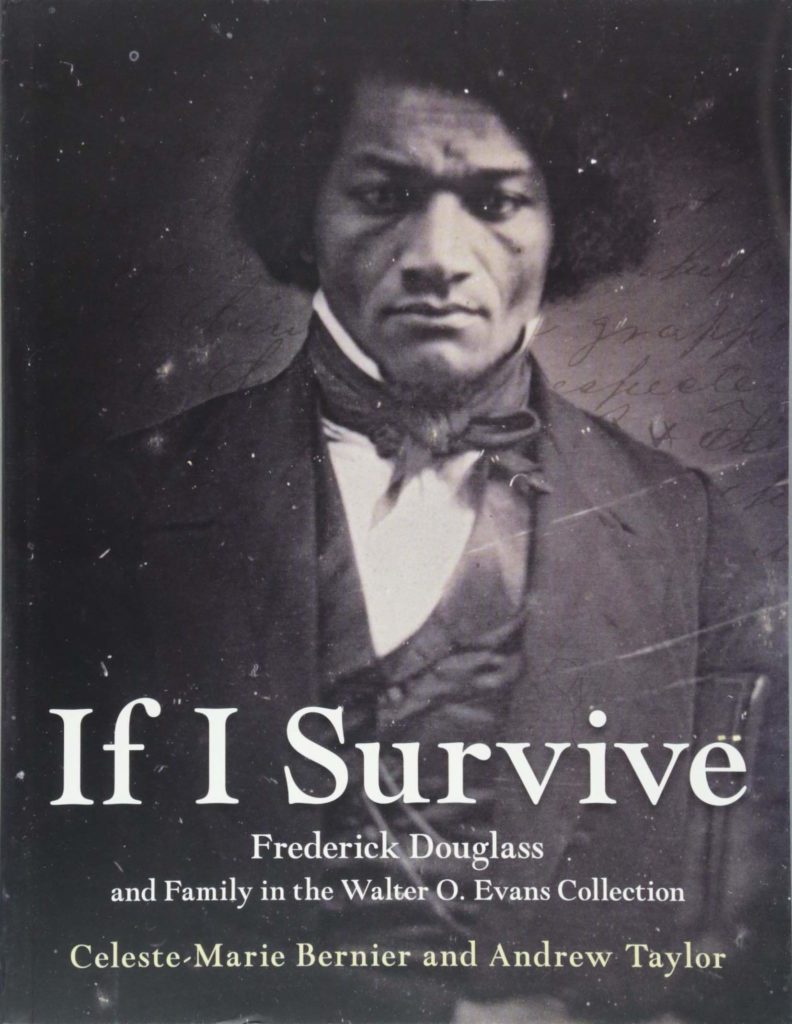 If I Survive: Frederick Douglass and Family in the Walter O. Evans Collection
Edited by Celeste-Marie Bernier, Andrew Taylor
Published by Edinburgh University Press
Frederick Douglass – autobiographer, orator, abolitionist, reformer, philosopher and statesman – is a giant of world history. This collection of previously unpublished speeches, letters, autobiographies and photographs sheds light on the private life of Douglass as a family man. All of life can be found within these pages: romance, hope, despair, love, life, death, war, protest, politics, art, and friendship. Working together and against a changing backdrop of US slavery, Civil War and Reconstruction, the Douglass family fought for a new ‘dawn of freedom’.
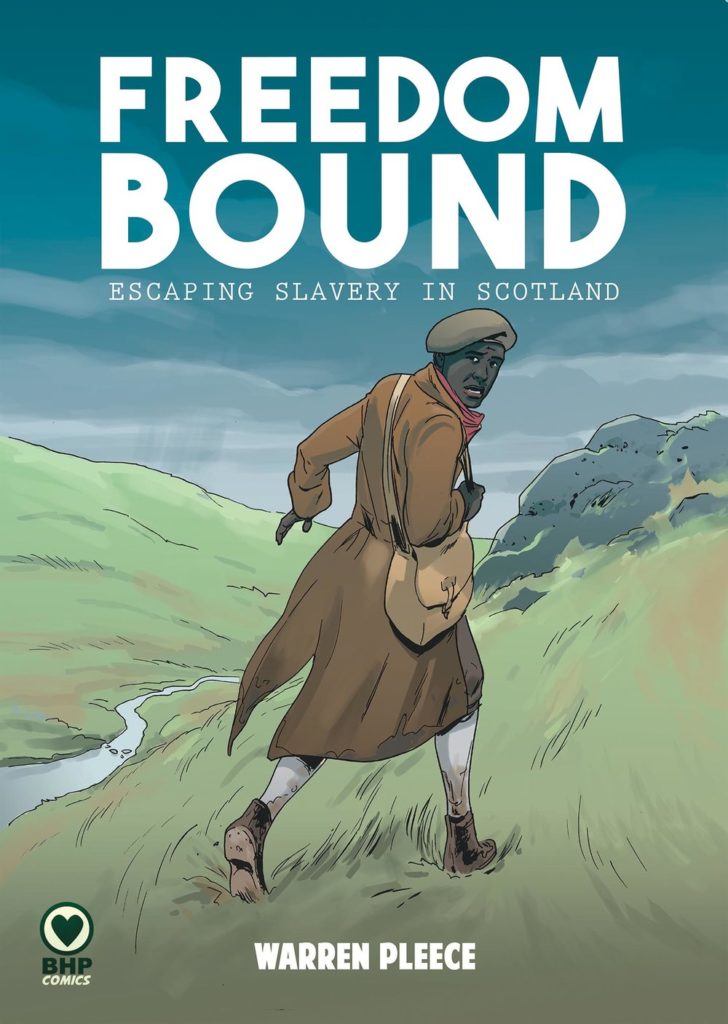
Freedom Bound
By Warren Pleece and Shazleen Kha
Published by BHP Comics
Warren Pleece’s graphic novel, Freedom Bound, follows the interconnected stories of three enslaved people living in Scotland before Scots Law proved slavery illegal. From mountainous countryside to the inner city, Freedom Bound explores Scotland’s unsettling history of slavery and the injustices perpetrated through the decades.
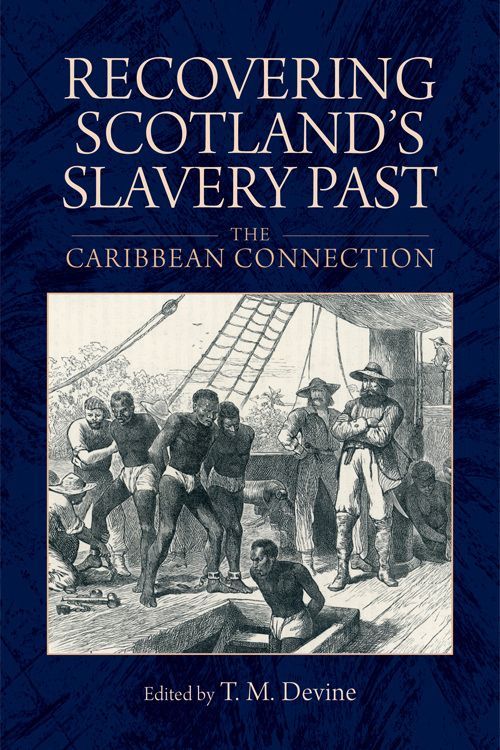 Recovering Scotland’s Slavery Past: The Caribbean Connection
Edited by Tom M. Devine
Published by Edinburgh University Press
For more than a century the real story of Scotland’s connections to transatlantic slavery has been lost to history and shrouded in myth. The essays in this book are a major contribution to understanding Scotland’s history with the transatlantic slave trade, and cover topics as wide-ranging as national amnesia and slavery, the impact of profits from slavery on Scotland, Scots in the Caribbean sugar islands, compensation paid to Scottish owners when slavery was abolished, domestic controversies on the slave trade, the role of Scots in slave trading from English ports and much more.
 The Lamplighter
By Jackie Kay
Published by Picador
In The Lamplighter award-winning poet and Scottish Makar Jackie Kay takes us on a journey into the dark heart of Britain’s legacy in the slave trade.
Constance has witnessed the sale of her own child; Mary has been beaten to an inch of her life; Black Harriot has been forced to sell her body; and our lead, the Lamplighter, was sold twice into slavery from the ports in Bristol.
Stirring, impassioned and deeply affecting, The Lamplighter remains as essential today as the day it was first performed. This is an essential work by one of our most beloved writers.
 The Shadow King
By Maaga Mengiste
Published by Canongate
SHORTLISTED FOR THE BOOKER PRIZE FOR FICTION 2020
ETHIOPIA. 1935.
As Mussolini’s army marches into the country and Emperor Haile Selassie goes into exile, recently orphaned Hirut struggles to adapt to her new life as a maid. She helps disguise a gentle peasant as the emperor and soon becomes his guard, inspiring other women to take up arms. But how could she have predicted her own personal war, still to come, as a prisoner of one of Italy’s most vicious officers?
The Shadow King is a gripping, gorgeously crafted novel exploring female power, and what it means to be a woman at war.
 Louis Armstrong
By Stéphane Ollivier, Illustrated by Illustrated by Rémi Courgeon
Published by Moonlight Publishing
This beautifully illustrated biography for children tells the life of Louis Armstrong, the greatest jazz musician and singer of his age, and gives an introduction to his music. On the accompanying CD, the narrative of the book is interwoven with 14 of Armstrong’s most famous recordings.
Also in this First Discovery Music series is Ella Fitzgerald and Ray Charles.
 Stay With Me
By Ayobami Adebayo
Published by Canongate
SHORTLISTED FOR THE BAILEYS PRIZE FOR FICTION 2017
Yejide is hoping for a miracle, for a child. It is all her husband wants, all her mother-in-law wants, and she has tried everything. But when her relatives insist upon a new wife, it is too much for Yejide to bear.
Unravelling against the social and political turbulence of 1980s Nigeria, Stay With Me is a story of the fragility of married love, the undoing of family, the power of grief, and the all-consuming bonds of motherhood. It is a tale about the desperate attempts we make to save ourselves, and those we love, from heartbreak.
 Bad Ass Raindrop
By Kokumo Rocks
Published by Luath Press
Kokumo Rocks is one of Scotland’s greatest performance poets, and her work on the page sings too, alive with love, passion, humour, wisdom and brutal honesty. Kokumo’s poetry explores the themes of love, race, freedom and imprisonment, and she does so with a sense of the importance of fun and humour. In Bad Ass Raindrop, you can hear the monsoon rains of Africa, taste the mangoes of India, touch the compassion and spirit of the child and feel the pain of burning flesh as race riots rage in Scotland.
 LOTE
LOTE
By Shola Von Reinhold
Published by Jacaranda Press
With a sharp eye and great wit, Shola Von Reinhold’s decadent queer literary debut immerses readers in the pursuit of aesthetics and beauty, while interrogating the removal and obscurement of Black figures from history.
We follow Mathilda, an art lover and aesthete, long enamoured with the Bright Young Things of the 20s. When she uncovers a forgotten Black Scottish modernist poet, Hermia Drumm, she endeavours to unearth everything she can about her. At the same time, she enrols in an artist residency with a more austere philosophy than hers which leads Mathilda to extravagant, uncovering systems of erasure and realising her own sense of self and beauty.
 The Black Flamingo
Dean Atta
Published by Hodder Childrens’ Books
WINNER OF THE STONEWALL BOOK AWARD
SHORTLISTED FOR THE CILIP CARNEGIE MEDAL
SHORTLISTED FOR THE JHALAK BOOK PRIZE
In this brilliant YA novel in verse, a boy comes to terms with his identity as a mixed-race gay teen – then at university he finds his wings as a drag artist, The Black Flamingo. A bold story about the power of embracing your uniqueness. Sometimes, we need to take charge, to stand up wearing pink feathers – to show ourselves to the world in bold colour.
 For Every One
By Jason Reynolds
Published by 404 Ink, partnered with Knights Of
Originally performed at the Kennedy Center for the unveiling of the Martin Luther King Jr. Memorial, this stirring and inspirational poem is New York Times bestselling author Jason Reynolds’ rallying cry to the dreamers of the world, illustrated by Yinka Ilori.
This book is a challenge to think beyond the expected and go for what you want, when going for it is the scariest part. It’s a one-of-a-kind inspirational book, an ideal gift for anyone from a school leaver to a retiree, for the creative, ambitious or those going on an adventure.
 Hadithi and the State of Black Speculative Fiction
Edited by Eugen Bacon and Milton Davis
Published by Luna Press Publishing
Hadithi is a book of two parts, first a scholarly dialogue on the global state of black speculative fiction, then a short story collection. It features seven short stories – three original – of ancestry, soul, continuity, discontinuity as well as steampunk, cyberfunk and a dieselfunk superhero story set in the ‘20s. It’s an enticing, illuminating celebration of afrofuturistic diversity, full of adventure, curiosity and brilliant, bold writing.
 Maud Sulter
Lastly, we urge you to investigate Maud Sulter (1960–2008). She was an award-winning artist and writer, cultural historian, curator and gallerist of Ghanaian and Scottish heritage who lived and worked in Britain.
Her poem ‘As A Blackwoman’ won the Vera Bell Prize for poetry in 1985. She wrote several collections of poetry, including As A Blackwoman (1985), Zabat: Poetics of A Family Tree (1989) and Sekhmet (2005), and was widely anthologised. She edited and contributed to a pioneering collection of writings and images, Passion: Discourses on Blackwomen’s Creativity (1990). Her books, though they may be hard to find now, are well worth hunting down.
Carrying on our new ‘Introducing . . .’ series, where BooksfromScotland highlight the work of up-and-coming writers, we bring you the poetry of Nasim Rebecca Asl.
Nasim Rebecca Asl is a Geordie-Persian poet and journalist based in Glasgow. Her work has been featured in Skin Deep, Young Poet’s Network and Now Then Magazine, as well as Tapsalteerie’s anthology pamphlet Ceremony. She’s performed her work in cities across Scotland and was featured in Sorry I Was On Mute, part of the inaugural Fringe of Colour Films. She’s an alumna of The Writing Squad and is participating in 2020’s Traverse Young Writers Programme.
A resurrection in north-west Iran (imagined)
Mamanbozorg splits threads in the Caspian sun. We hear again
her rusted tongue speak, weave, paint carpets Persian. Here again,
the lambs she lambed raise their heads at the sound of her song.
Her roosari dances. She calls to a God who answers, and cheers again:
Golgaz. Sweet flowers shed thorns and burst through dry soil to
carpet her feet. Sunlight holds her. She won’t disappear again.
Under a pall of flour she kneads. Births noon and cherry wine.
Saffron, rose and thyme crescendo in her mouth. She feels again,
moves to the city where her children grew with the mountains.
Dusk breaks. She toddles the ninis to the park. Happy tears again.
She crosses the world and wonders if it’s faith keeping the plane
adrift. A runway of stars lead her to us. The skies clear again.
Baba gets a chance to say goodbye but won’t. Not again. She makes
Space for me beside her and says “Nasim, bia inja” -Come here, again.
Glossary
Mamanbozorg Grandma
Roosari headscarf
Golgaz My grandmother’s name
Noon bread
Ninis nini = baby, plus English plural
Baba dad
Bia inja come here
(This poem first appeared in Ceremony, published by Tapsalteerie)
On trying tattie scones for the first time
- Cook the sausages.
You’ll need the scissors for this. Grab them from the cutlery drawer (top left); the ones with the blue handles. Separate the sausages. Say sorry as you split skin from skin. Do not imagine the pain they must be feeling, the sadness of being pressed so close and suddenly torn apart. Be glad you cannot hear them cry as you rip them from their friends.
Close the oven. Forget them, for now.
- Cook the tattie scones.
Bring the hob to life. Savour the lick and the woosh as the fire bursts into being and kisses the back of the pan. Add a generous helping of butter. Tilt. Let it paint the black in liquid gold. Think of holding a buttercup in your once tiny hands and offering it to the smiling face of your mam. Feel the catch in your four-year-old throat when the glow lit her skin.
Liberate potato from packet. Lay down the scone into your pool of sunlight. Use your now grown hands to massage. Paint. Give peace. Wait for the butter to bubble in excitement, and flip – admire the newfound melanin, the honey flower dew of its skin. Wait for the fat to crescendo, to fade. Rescue from the embers.
- Combine the ingredients on the plate.
Bring the sausages into the cold. Ignore their frightened hiss: instead, admire the split in their seams. Build a meal with their bricks. Steal a bite and travel to your first festival, the first-love of your life. Remember the hungover sandwich you paid dearly for; how tomato sauce stained the corner of his lips while the afternoon flushed his cheeks and your makeshift fire danced in his eyes. How he offered you the last bite; how you kissed the ketchup from his skin.
His bloody smile.
- Try your first tattie scone.
Take a photo first, to prove you took your friend’s advice – they’re golden brown. He said this was best. Savour your first bite. Feel the butter seep into your tongue, let the soft starch fill your soul. Enjoy your taste of his childhood. Think unbidden now of his mother, looking out towards the west-coast sea. The islands waving at her through the kitchen window, three boys waiting at the table, a chocolate spaniel circling their feet, and between them all; endless tattie scones.
(This poem was first published in Staying Home, a response to Covid-19 by The Writing Squad)
Becoming
a book spine poem
Touching from a distance
the left hand of God.
The beating of his wings
the forbidden echo burning
a thousand splendid suns.
Tender is the night,
sincerity the noonday demon,
the testaments geography
for the lost. I’d die for you
if they come for us.
Brave new girl, girl, woman,
other: this is going to hurt.
Origami
Imagine dragons and freelance whales,
spiralling past shadow realms and
tumbling into our heavens.
Under the beat of wings and enormity
we’re folding desperate stars with desperate
fingers, bleeding dust through broken skin.
My shaking hands found worlds. Blue cut
crease, turn, twist, repeat. I fill tiny globes
with my own oxygen, breathe sharp edges soft.
Your right eye squints through an eyelash forest.
Checkered sleeves watch from your elbows.
Your hands stroke, coax the paper birds into being,
cracked lips kissing life into the creases of their necks.
Creation blossoms in the corner of your mouth.
Hurtling, we birth an army of cranes.
We release them as oblivion rests
on the horizon. Floating on the edge of our breath
they pass into nebulas and we’re rewarded
with the whisper of a wish.
You can find out more about Nasim’s work by following her on Twitter and Instagram @nasimrasl
Tiger by Polly Clark was one of last year’s most bold novel releases, telling the story from the perspective of both its human and animal characters. Ahead of it’s paperback release, Polly has written a piece on the work she does in the name of research, which is just as bold as her writing!
Tiger
By Polly Clark
Published by riverrun
For my first novel, Larchfield, I spent a lot of time immersed in WH Auden’s work and papers, and wandering his haunts in Helensburgh. I did everything I could to get inside that young poet’s skin, and I thought I had a handle on what research is – a tool, for me, the writer. It was hard work but I was in control of it. It was labour that was in service to the bigger picture of my story.
When I began my second novel, Tiger, about a last dynasty of Siberian tigers, and the people who live alongside them, I knew the research would involve some fairly extreme travel into harsh conditions (11 time zones, -35C, and deep snow) but I didn’t anticipate how it would come to transform the very structure of the book and change my way of understanding the world and my place in it – as both writer and human being.
My expedition was to the remote forests of the Russian Far East where the last 500 Amur (Siberian) tigers roam wild. It might be expected that the aim of the trip was to see one in the wild, but they are so vanishingly rare this is nigh on impossible. A major selling point of the eye-wateringly expensive trip was that you will not see a tiger. We tracked the tigers with expert guides and set camera traps at their favourite spots and collected the footage later. Some in our party secretly believed we would beat the odds and see a tiger. And when the tiger proved just as elusive as we had been told, were very disappointed.
Years ago I was a zoo keeper and I have seen tigers fairly close-up. In an enclosure, away from the forest a tiger seems outlandish and exotic – its stripes, for instance, seem almost anti-camouflage in their vibrancy. The Amur tiger, the largest cat in the world, is more precisely and fully encountered by experiencing its lethally hostile environment, where is camouflage is so perfect that it can be ten metres away and you will never know. Studying its tracks, discovering its recent kill sites, all the time knowing it is watching – this is how you really ‘see’ this creature, the apex predator of an entire continent. The indigenous people of the region, the Udeghe, call the tiger the ‘Lord of the Forest’ and this came to make perfect sense. The trip was a pilgrimage: a journey to encounter a creature you will never see in the flesh.

The transformational experience was therefore not seeing a tiger in the wild – it was something else, completely unexpected, that went on to create the fundamental structure of the novel. It was The White Book. Like most people I had read about the pattern of tracks in the snow, but I did not fully appreciate how meaningful it is until I was in the taiga, with nothing around me except blank snow marked with the ‘narratives’ of animal tracks. These were sometimes intertwined, sometimes parallel, sometimes alone, the totality revealing the incredible variety of life in the winter forest – and how each creature is affected by the decisions of the one before it. A weasel, for instance coming across a mouse’s tracks, will change its direction. Similarly, the tiger, discovering boar tracks, will set off in pursuit, leaving its own trail. The tracks are alongside in space, but not time and in this way the forest floor becomes a vast web of narratives, all interconnected – until a new page of snow makes the ground blank again.
Another astonishing facet of the White Book is that following tracks away from the direction of travel (as you must do with tiger tracks – if the tiger senses you, it will loop round behind you…) is effectively travelling back in time. You can discover the beginning of a creature’s story, follow it through to the end. These two things together – the interconnection of narratives in the snow, along with how tracks bring all times into the present — became the basis for the structure of Tiger, which has four connected storylines which gradually converge. The tiger, which is tracking a bear, links them all. The forest of this novel is not a backdrop, but is the very essence of the book. Tracks in the snow, are quite simply, the most thrilling and profound encounter with nature I have ever experienced. And it taught me that the best research is the kind that takes the writer over, refuses to give its answers in advance, and transforms the work beyond what the writer could have ever imagined.

Visit Polly Clark’s website www.pollyclark.co.uk
Follow Polly Clark on Twitter: @mspollyclark
Watch the book trailer for Tiger:
Tiger by Polly Clark is published by riverrun, priced £8.99
ALSO ON BOOKS FROM SCOTLAND
-


Saltwater: A Midsummer Ghost Story by Elaine Thomson
‘The very thought of those grey faces made my skin grow cold.’
-

‘An Odious Campaign’ by Rob McInroy – Why a 1936 By-Election Still Resonates
‘This enraged the locals and he came close to being run out of town on several occasions.’
-

‘‘That’s right, Bobby,’ he growled. ‘I haven’t seen you in – well, since you decided to kill me.’ ‘
-

David Robinson Reviews: Solitary Agents by David Goodman
‘This is very much an up-to-the-minute story of spycraft, positively revelling in all the things tha …
-

The Savage Landscape by Cal Flyn
‘It is their resistance to the intrusions of the outside world − culturally, economically, environme …
-

The Shortest History of Scotland: A Q & A with Murray Pittock
‘We need to be better aware of that to understand the challenges and achievements of the past, and t …
FEATURED AUTHOR:
Ajay Close

Born in Sheffield, Ajay Close worked as a newspaper journalist, winning several awards, before becoming a full-time author and playwright. Her first novel, Official and Doubtful, was longlisted for the Orange Prize. Her fourth, A Petrol Scented Spring, …