


Chris Dolan made his first trip across Spain when he was a teenager, in the footsteps of Laurie Lee. A little bit older and a little bit wiser, he made the same trip, writing of returning, of memories, of art, travel and history. In this extract of his book Everything Passes, Everything Remains, he reminisces about busking the streets and making friends with his fellow musicians.
Extract taken from Everything Passes, Everything Remains
By Chris Dolan
Published by Saraband
When exactly I left Brendan in La Coruña – or he left me to go north to his in-laws in El Ferrol – and I took my violin to begin the vagabond trail in the wake of Laurie Lee, neither of us are sure. I simply remember heading off. First to some of the villages I had already visited with Brian, or Tere, or others. I had never in my life busked before. I was terrified. I also wasn’t very good, which didn’t help. On the other hand, busking wasn’t a thing back then. Now, in Spain as in the UK or anywhere, there are buskers at every corner, the entrance to every tube station. Back then I was a one-off. People stood in astonishment rather than appreciation.
The loneliness of the busker. No one has asked you to play. You’re getting in the way in a public space, a beggar essentially. Aware of your limitations, trying to catch strangers’ attention but not their eye. Hoping for payment but unsure you deserve any. Part of me wanted to be ignored, another craved their approval – and needed their loose change. I had never busked in Scotland, had never met anyone who had. I stood as close to the wall as possible, kept my eye on my fiddle. I felt like a shadow, a smudge on the pavement.
Then passers-by began to throw pesetas into my opened violin case (eventually I learned to put in the first few – silver – ones myself, pour encourager les autres) out of sympathy and concern rather than for having been whisked momentarily to a haven of glorious music. I would usually make just enough to afford the cheapest menú del día in the village, and a night in the most basic pensión.
I didn’t have the adventures, neither the highs nor the lows that Lee had in 1935. Inns in his day sound nineteenth-century in comparison. Bedding down with animals in straw, or in shared barns with entire families. His descriptions of single-room cabins and outhouses, or cheap dormitories in cities, run by drunks and crones and children – it all reads like Dickens. Or Stevenson. David Balfour, lost in the Highlands, taking refuge in black houses and crofts and among the heather. Stevenson wrote Kidnapped in 1886, and set it in 1751, after the turmoil of the Jacobite Rising. So Lee’s accounts sound, in fact, eighteenth-century. Perhaps because he likes to tell a good story and his ‘facts’ are elsewhere dubious, it’s hard not to suspect that he exaggerates his living conditions. But not by much. Spain was poor enough in ‘74, much more so in ‘35. Cut off from Europe by the Pyrenees, exhausted from a century of civil wars (the one in 1936 was far from the first), and another century of thrawn Church and landowners’ conservatism, Lee’s Spain had hardly changed in over a century.
The pensiones I stayed in – and would over the next few years on return journeys – were lugubrious, heavy old furniture, blinds down. There was usually a landlady, usually in her seventies – which back then was shockingly old to me. Almost without exception she’d narrow her eyes, look suspicious, demand payment, or part of it, up front. In every bedroom, hall, and bathroom there were crucifixes, dripping with blood and howling in pain. Stepping inside my room reminded me of going to confession as a child. Closed space, an air of pious anxiety, left alone with sins and penance.
But, just as usually, the old landlady would soon turn out to be kindly, offering you soup a la casera, seldom included in the final bill. If you stayed more than a night she’d even smile, ask you about yourself. You’d open your blinds, let in the light and the noise of the street, meet family and, what appeared initially as some murky house that held terrible secrets, became a family home, into which you were often, temporarily, accepted.
A few times, bar owners who had heard me in the street invited me to play inside, at lunchtime, or in the evening. Reimbursement was a few beers or glasses of wine and a thick, hot caldo gallego – a stew of a few bits of whatever meat was available but mainly cabbage and beans, garlic, onion.
Life was easier now that my Spanish was improving. I could ask for food, beer, accommodation, join in on very basic conversations, explain a little of the background to my songs and tunes. But in Vigo someone from elsewhere in Spain informed me I was talking Gallego. Or rather, the mix of Galician, Spanish and street-talk Brendan I had been unwittingly learning in bars and on Riazor beach. To be absolutely accurate, I was speaking a mix of Gallego, Spanish, street jive, and west coast Scots. (A later version of which a student of mine in Pamplona dubbed escoñol.)
Maybe that’s why I was destined to be The Man Who, unwittingly, Invented Fusion Music. Or at least one half of the duo that invented it. I was in Pontevedra playing my violin on one corner of the main square and some very noisy bongo player was attracting audiences at the other. I can’t remember his name. A young black Brazilian guy. Twice my height, he moved slowly but played fast. After an hour or two he ambled – which implies far too much urgency – up to my pitch. Through his Brazilian-Portuguese-Spanish and my Gallego-Scots we managed to negotiate.
‘Oi, Branquinho. Vamos a play juntos, yeah?’
Hoy, wee white man. Let’s play together.
I’ve since gotten to know the music of Milton Nascimento and now, in my head, that bongo player is called Milton. Milton’s thinking was right. We more than doubled our individual audiences. No wonder. The sound we made drew people from streets away. I’m playing the Irish Washerwoman and Milton is pulsing out a spliff-saturated slow samba. I switch to ‘My Love Is Like A Red Red Rose’, bowing with all the soul and misty romance I could muster, and Milton whacks hell out of his drums in some complex war cry.
Everything Passes, Everything Remains by Chris Dolan is published by Saraband, priced £9.99.
Gavin Francis is an adventurer and has written of his travels in his excellent Empire Antarctica and True North. His new book, Island Dreams explores our fascination with islands, and we caught up with him to chat about another fascination – books.
Island Dreams: Mapping an Obsession
By Gavin Francis
Published by Canongate
The book as . . . memory. What is your first memory of books and reading?
Where The Wild Things Are, with my mum – doesn’t everyone dream of being able to sail off to an island world, have dramas and high risk adventures, but be home in time for supper?
The book as . . . your work. Tell us about your latest book Island Dreams. Is there something in particular you’re setting out to explore?
The allure of isolated places – from Greenland to Antarctica, from the Galapagos to the Andaman Islands, has long animated my travels and my choices in life. But so has the city and all of its possibilities for connection and cross-fertilisation of ideas. My profession for the last twenty years has been medicine and there’s no better work for someone fascinated by what connects people in all their diversity. But I’ve also worked as an expedition doctor in some of the most remote parts of the planet, and as a nature warden on island bird reserves in Scotland. And so I wanted to write a book that mapped the tension, the creative tension, between those extremes: island and city, isolation and connection. And along the way exploring the rich history of island literature.
The book as . . . object. What is your favourite beautiful book?
The Renaissance anatomist Andreas Vesalius’s On the Fabric of the Human Body (1543) is a phenomenal work, seven volumes of beautiful engravings that revealed the elegance and beauty of the human body, just under the skin, for the first time.
And of course the Times Atlas of the World. In times of pandemic lockdown it’s a consolation to be able to go atlas-travelling until the real thing once again becomes possible.
The book as . . . inspiration. What is your favourite book that has informed how you see yourself?
Which aspect of the self? Every book I’ve ever read has had that power. Like everyone else, different books have all inspired aspects of the many roles I inhabit, whether it’s as a doctor, a writer, a traveller, a scientist, or even as a father.
The book as . . . a relationship. What is your favourite book that bonded you to someone else?
John Berger and Jean Mohr’s A Fortunate Man, about a country GP in 1960s Gloucestershire, has offered deepening friendships with others who also love that book, and those with whom I’ve shared it. But I’m also grateful to it for igniting my own friendship with Berger. I wrote to him about another of his books, Cataract, we struck up a correspondence, and he invited me to stay with him in Paris. Our conversations led to me writing the introduction to the new edition of the book (Canongate, 2015), through which I hope many other readers will come to know it.
The book as . . . entertainment. What is your favourite rattling good read?
Elena Ferrante! The world she created is utterly immersive and compelling. Also Hilary Mantel’s Cromwell books. Ursula le Guin’s Earthsea books. Philip Pullman’s His Dark Materials. I could go on…
The book as . . . a destination. What is your favourite book set in a place unknown to you?
I love Anne Michaels’ Fugitive Pieces, a novel set between Eastern Europe, the Aegean islands and Canada. Canada I don’t know at all, and the Aegean and Eastern Europe I have visited only briefly. But the ‘destination’ is less important as a set of geographical coordinates than feeling at home in an author’s writing. I have read WG Sebald’s The Rings of Saturn ‘about’ Norfolk numerous times, but know that in the future I’ll go on visiting it through his eyes, not my own. Rebecca Solnit’s A Field Guide to Getting Lost is good on this – the writing as an exploration of an idea rather than the exploration of a place.
The book as . . . the future. What are you looking forward to reading next?
So many… Like all your bibliophile readers my bedside table is always stacked high. It’s a pleasure to know that beautiful, inspirational books that I’ll come to love are being written right now and I don’t even know yet how much I’ll need them in my life!
Visit Gavin Francis’s website www.gavinfrancis.com
Island Dreams: Mapping an Obsession by Gavin Francis is published by Canongate, priced £20.00.
Cameron McNeish is one of Scotland’s most popular broadcasters on hillwalking. He follows up his popular memoir, There’s Always the Hills with his new book, Come by the Hills, which celebrates Scotland’s hills and his memories of walking them. In this extract, he walks to Glen Lyon in the Highlands and appreciates its majesty and mystery.
Extract taken from Come by the Hills
By Cameron McNeish
Published Sandstone Press
The Longest, the Loveliest and the Loneliest
Sir Walter Scott first described Glen Lyon in the above terms, and my mentor Tom Weir was fond of using the same alliteration to describe this thirty-four-mile-long glen of Highland Perthshire. He often told me Glen Lyon was his favourite, and for a man who knew Scotland like few others that was a high recommendation.
It is indeed a magnificent place, from its heavily wooded lower glen near Fortingall, where the River Lyon crashes and tumbles through its deep, shadowed gorge, all the way to the bare upper slopes of the glen, a place of desolation and remote mountain grandeur despite the hydro works that have dammed the loch, created a stony tideline around the shores and laced the upper glen with power lines. Notwithstanding the hand of man, Glen Lyon is famed for something else. It is also Scotland’s most mysterious glen, a place of myth and legend and, according to some, home to the creator goddess of the ancient Celtic world.
Years ago, I met an old friend of mine here. Lawrence Main lives in Mid Wales and has a penchant for New Age thinking. Lawrence describes himself as a Druid and has a long-standing fascination with the earth-mysteries and legends of our wild places. He had come north to Glen Lyon to visit Fortingall, a place he believed may have been the birthplace of Pontius Pilate, the Roman judge of Christ. Two thousand years ago, the legend suggests that Emperor Caesar Augustus sent an emissary to Scotland, to Dun Geal, near modern Fortingall. The emissary’s wife gave birth to a baby, and they called him Pilate. He went on to become the fifth procurator of Judea and ordered the crucifixion of Christ.
Lawrence was also searching for the Praying Hands of Mary, a large split rock that stands in Gleinn Dà-Eigg, an offshoot of Glen Lyon close to Bridge of Balgie. He also believed that Glen Lyon was the home of the Celtic creator goddess, and was itself a sacred place. Although megalithic remains are found just outside the glen, in Fortingall and near Loch Tay, Glen Lyon is curiously devoid of megalithic monuments. As the home of the creator goddess the glen was sacred by nature and such special sites were normally left untouched by the ancient Celts.
Lawrence’s revelations aroused my own long-standing interest in such mysterious matters. Just as North American outdoors folk have learned much from the native North American tribes, so I believe we can learn much from our Celtic ancestors, particularly about living in harmony with the land. Lawrence’s various speculations reminded me of a story I had been told some forty years ago by an old pal of mine, the late Harry McShane, a former warden of Crianlarich Youth Hostel and an erstwhile hillwalking buddy.
Harry told me a story about small stone figures that were apparently taken to a lonely spot near the head of Glen Lyon every spring, and removed again every autumn. He couldn’t verify the story and had no idea who moved the stones, but the tale has lodged in the scree slopes of my memory and my conversations with Lawrence Main encouraged me to carry out further research. What I discovered surprised and astonished me. This is the story of a pagan shrine dedicated to the Cailleach, in the tradition of the Celtic mother goddess, who once blessed the cattle and their pastures and ensured good weather.
The Cailleach, often translated as the ‘old woman’ or in this case the ‘divine goddess’, is a potent force in Celtic mythology, commonly associated with wild nature and landscape. The Celtic creator goddess is encountered throughout the length and breadth of Scotland, an entity taking many forms and represented in a variety of different shapes. Believers would see her essential nature in the harmony and balance of the natural order, the ebb and flow of growth and decay, of life and death itself.
Nearby, in Rannoch, legend names her as the Cailleach Bheur, the blue hag. According to A. D. Cunningham’s excellent book Tales of Rannoch this old witch was once a familiar sight on Schiehallion: ‘Her face was blue with cold, her hair white with frost and the plaid that wrapped her bony shoulders was grey as the winter fields.’
Other ancient forces have been at work in Glen Lyon. Years ago, just before I climbed the Corbett of Cam Chreag, high above the glen, I visited the little church at Innerwick. There’s a car park with interpretative signs beside the start of the right-of-way that runs over the hills to Rannoch and the little church is well worth a visit, just to see the ancient bell of St Adamnan.
St Adamnan, also called Adomnan or Eonan, was Irish-born and is famed for his biography of St Columba, whom he studied and worked under at Iona. Adamnan lived mostly in the seventh century and died around AD 704. His bell has been dated to AD 800 and apparently lay in the churchyard of St Brandon’s Chapel in Glen Lyon for centuries before being rescued. St Adamnan travelled here from Iona, setting up Christian cells on ancient pagan sites of worship. Another of his churches lies on the shores of Loch Insh, by Kincraig in Badenoch and, curiously, that church also has a bell that apparently belonged to the well-travelled saint. At Loch Insh, according to the legend, St Adamnan used to ring the bell to summon the Swan Children of Lir, a brother and sister who were half child, half swan, to worship. Today, Loch Insh, and its adjoining meadows, is Scotland’s principal wintering place for whooper swans. Coincidence?
I recalled these old stories as I climbed towards Cam Chreag, a 2,828-foot/862-metre Corbett that neighbours the Munro of Meall Buidhe above Loch an Daimh. I wanted some photographs of the loch and the wild land beyond it and remembered Cam Chreag as a pretty good viewpoint. I was also aware that the recommended route given in the guidebooks was less than satisfactory and a better route was possible by following the hill’s south-east ridge, returning to the start via its lowly neighbour of Meall nam Maigheach, a pleasant horseshoe-shaped route of about nine miles round the glen of the Allt a’ Choire Uidhre.
This glen has a bulldozed track running up its length to a corrugated iron hut just below Cam Chreag’s eastern face – the guidebook route – but the first bonus of my horseshoe route became apparent as I topped out on Ben Meggernie, at the end of Cam Chreag’s east ridge. This little bump offers a fabulous view right down the length of Glen Lyon and is well worth climbing, if only to understand why Tom Weir, and others, have described this as Scotland’s loveliest glen. On one side the peaks of the Ben Lawers range rise high into the sky, the pointed culmination of long, steep ridges. On the other, the blunter Carn Mairg hills rise on equally steep-sided flanks. The glen itself is wooded with the River Lyon flowing through green meadows. Rob Roy’s mother was born here, and before that the ancient Kings of Scotland came here to hunt deer.
Lovely as Glen Lyon is, I was more impressed with the views from Cam Chreag itself. To the west, the big Munros stood clear: Stuchd an Lochain and Meall Buidhe, one on either side of Loch an Daimh, and the wild country beyond to the hills of Mamlorn and Orchy. To the north-west, across the Rannoch Moor, Ben Nevis was clearly visible, rising above the hills of the Mamore Deer Forest and the enormous bowl of peat hag and heather, lochs and lochans that make up the vastness of the Rannoch Moor. Only the West Highland railway line offers any sign of man’s hand until you reach the A82 Bridge of Orchy road and the A86, away beyond the narrow slit of Loch Treig.
Come by the Hills by Cameron McNeish is published Sandstone Press, priced £19.99.
David Robinson enjoys the comic capering in William Boyd’s latest novel, Trio, set against the backdrop of an ego-strewn film set and the changing social mores of the 1960s.
Trio
By William Boyd
Published by Viking
1968. Across the Channel, rioting students are taking on the government. On the other side of the planet, the Americans are mired in the Vietnam War. In Brighton, meanwhile, the Sixties are swinging by in comparative peace, and filming has just started on Emily Bracegirdle’s Extremely Useful Ladder to the Moon. There’ll be a nude scene tomorrow with its two stars, the beautiful American Anny Viklund and home-grown pop star Troy Blaze.
We’ll be on or near the filmset for almost all of Trio, William Boyd’s 16th novel, a deliciously black comedy that takes us inside the heads of three characters – Elfrida, an alcoholic novelist married to the film’s director; Anny, the film’s star, who seems to have fallen foul of the CIA; and Talbot, the film’s producer, whose job seems to consist entirely of preventing the whole enterprise from unravelling.
Although Boyd has written about film-making before in The New Confessions (1986), that novel ranged panoramically across continents and most of the 20th century. Here the focus is both tighter (in its time scale) and looser (the three-way story split). We’re not looking – as we were in the earlier novel – at the rise and fall of art forms (silent movies, B-westerns) but at the sheer grind, greed and grubby compromises involved in the shooting of a single film.
Boyd knows more about film-making than most novelists, having directed one himself (The Trench, 1999) and written more than 60 scripts for film and TV, including the BAFTA-winning adaptation of his 2002 masterpiece, Any Human Heart. Of those 60, about 20 have actually been made – a 1:3 success rate which is unusually high in the screen trade. So he knows all about why movies implode or fail at the box office, and the novel reflects his knowledge of the pitfalls, extravagances and workarounds that are all part of most film shoots.
The star of this behind-the-scenes story is producer Talbot Kydd. The pressures on him are many and varied: the director who goes behind his back to make sure his girlfriend is hired as a writer; the pop star’s gangsterish managers; or a co-producer trying to finesse valuable film rights away from him. He has grown used to coping with far more, in a job that seems to consist of cosseting his stars, dealing with drugs, divorces, punch-ups, drunkenness, scene-stealing, one-upmanship and ‘generally the sort of behaviour that a three-year-old would be ashamed of’.
Unbeknown to Talbot, Elfrida, the director’s wife, is falling apart. It’s been ten years since she wrote her third novel, her writer’s block growing ever wider as she sinks into alcoholism. Maybe the seeds of it were there right at the start of her career, when she was heralded as ‘the new Virginia Woolf’ – an epithet she is unable to shake off, even though she can’t stand Woolf’s novels. Finally, she has an epiphany: she realises the will only be able to write if she kills off Woolf in her own fiction, so she starts writing about the summer’s day in 1941 in which Woolf waded into a river weighted down by stones. That happened only about 15 miles from Beachy Head, where Elfrida’s husband sets the denouement of his film, in which his two stars prepare to do what we now know as ‘a Thelma and Louise’ over the East Sussex cliff. Suicide – both fictional and real – is in the air.
Boyd has always acknowledged the influence of Evelyn Waugh – the ‘glittering, malevolent brilliance’ of early comedies more than his later works – and there are indeed strong echoes of it in the Elfrida chapters. She drinks remorselessly, lying about it all the time, yet here at last is a way out. Why, she wonders, has it taken her so long for this recension? She looks it up. No, wrong word. Recessional? No. ‘”Transfiguration” was the word she needed. It had been a transfiguration, a transformation, something beautiful, sublime had happened – a metamorphosis.’
Boyd tells Elfrida’s story in the third person, but it is written so closely that it might just as well be first. On page one of Trio, the waking Elfrida notices the sun ‘printing a skewed rectangle of lemony gold light onto the olive green-flecked wallpaper close by her pillow’. And when Woolf wakes up on her last day on page one of Elfrida’s novel, exactly the same rectangle of sunlight and design of wallpaper reappear. This is Boyd doing what he does best: playfully crossing and recrossing the line between fact and fiction so often that it starts to blur. He shows us the opening paragraphs in Elfrida’s novel, constantly being rewritten as the vodka takes hold. We will see her stumbling about on her research, wondering, for example, whether Virginia ever used a Hoover. This is great comic writing, not least because it sometimes bring us up short, like when she spots an old man in the garden of Woolf’s house and asks if she can come in and explains why she wants to. The old man, she realises later, in a scene that is pure Waugh – hard-edged, unsentimental, shocking – was Leonard Woolf.
Something else is going on in that scene. Although this is 1968, we are made to realise how close the world of 1941 remains. Leonard Woolf is reading the newspaper in his garden now, but his wife’s tragic death is presumably still within him. Similarly, the skies above East Sussex that feature in the rather ridiculous film Talbot is shepherding to a conclusion were, only a generation before, full of men trying to kill each other. Talbot’s own brother was one of them: his Spitfire crashed into the sea just three miles off the Sussex coast.
In the war, Talbot was a major in the Army. He was gay, but never acted on his impulses and instead married a nice Home Counties gal. But now the times are a-changing, especially for those who are, as they said back then, ‘light in the loafers’. Boyd has always had a wonderful ability to place his characters very precisely in the past and that is very much the case here. The 1967 Sexual Offences Act legalising homosexual acts between consenting adults has made a difference and a new gay club has just opened down the road in Brighton. The thought of going there has already crossed Talbot’s mind.
Of the titular trio, I shall pass lightest of all over Anny. Maybe she’s the reason the film is being made – a genuine American star of head-turning beauty – but she’s not the reason this novel will be read. True, she is fundamental to the plot’s more action-packed scenes and has her own secrets, but compared with Elfrida and Talbot she is just a pretty face. Yet that is unfair too: without Anny, there’s certainly no film and there mightn’t even be a novel.
It’s been a while since Boyd gave us such an obviously comic novel, and the scenes of Elfrida’s search for the real Virginia Woolf are a hoot. No doubt some readers will be disappointed that it’s not another Boydian epic in the mould of Any Human Heart, but they’ll be missing the point: instead of showing lives changing with the great sweep of the century, he is picking a seemingly inconsequential moment in time and describing the making of a definitely inconsequential film. But because Boyd is such a capacious novelist, there’s a lot more than that to it. Part thriller (Anny), part clever literary comedy (Elfrida), part subtle portrait of Sixties change (Talbot), part knowing homage to the zaniness of movie-making, Trio burns with brio.
Trio by William Boyd is published by Viking, priced £18.99.
Despite the death of Arthur Conan Doyle, readers still cannot get enough of his most famous creation, Sherlock Holmes. Robert J. Harris is adding to the new Holmes canon with his brilliant tribute to the detective in his novel A Study in Crimson. In this extract, Sherlock leads Watson to a shocking discovery in their latest case.
Extract taken from A Study in Crimson
By Robert J. Harris
Published by Polygon
I was woken at the earliest hour of morning by an energetic rapping at the connecting door. As I struggled upright on my pillows, the door was flung open and Sherlock Holmes strode imperiously into the room. He was fully dressed, and at close quarters smelled of soap and hair oil.
‘Come along, Watson,’ he exhorted me briskly, ‘this is no time to be a slugabed. My nostrils are twitching with the scent of a breakfast being cooked.’
Even through the blackout curtain, I could tell it was still dark outside. ‘Holmes,’ I grumbled, ‘it’s surely too early for breakfast.’
‘Too early for us, but not for certain others. Come along, man. Get dressed quickly and meet me outside.’ With that he was gone. Clambering out of bed, I pulled on my clothes, ran a comb through my hair, and stumbled downstairs. Holmes was pacing up and down outside the front door in a fever of impatience.
When he spotted me, he pressed a finger to his lips. ‘Quiet now and keep to the shadows,’ he instructed, and beckoned me to follow.
We made our way round the north wing of the castle to the rear where we crouched behind a rain barrel. From this vantage point I could see Holmes’s gaze was fixed firmly on an open door in the basement level. From the scents wafting through the air I had no doubt that this was the back entrance to the kitchen. Why we should be spying on Mrs Sienkowski’s efforts was beyond me, while the smell of cooked breakfast stirred a sharp hunger in the depths of my stomach.
Holmes abruptly yanked me down deeper into hiding as a uniformed figure emerged from the doorway and made its way steadily up the small set of steps to the ground level. I recognised at once the burly outline of Sergeant Ross. He was carrying a tray which held an assortment of covered dishes. As we watched, he set off into the surrounding woods.
Holmes turned to me with a gleam in his eyes. ‘Come along, Watson, and go cannily. Sergeant Ross is our trail of bread crumbs.’
Crouching low and darting from one patch of shrubbery to the next, we followed the sergeant into the trees. There was no difficulty about keeping him in sight even at a safe distance, as he was making no effort at concealment. He clearly did not expect anyone else to be abroad at this hour and strolled casually along a narrow, winding path.
‘Holmes, where on earth can he be going?’ I murmured.
‘Can you not guess?’ Holmes sounded genuinely surprised.
In a flash it occurred to me that Ross must surely be taking this breakfast tray to the vanished Dr MacReady.
I said breathlessly, ‘Are you suggesting that the sergeant is actually an enemy agent? That he spirited Dr MacReady away and is holding her captive somewhere in these very grounds?’
Holmes clucked his tongue reprovingly. ‘I’m suggesting nothing of the sort. Surely I explained it all last night.’
‘You did everything but explain,’ I retorted with some warmth. ‘Perhaps you might begin with the loose button on the discarded blouse to which you attach such importance.’
‘It was pulled loose because the blouse was removed in haste,’ said Holmes. ‘The fact that the shoes were kicked off willy-nilly and the skirt was only partially unzipped before being pulled off tells the same story.’
‘Are you saying that Dr MacReady was in a hurry to take a bath?’
‘If she had intended to take a bath, she surely would have put the plug in before turning on the taps. No, no, the clothes in the doorway and the running water were intentional distractions. Then there were the spaces on the bathroom shelf from which a few essential toiletries had obviously been removed. On the other side of the room was the telling evidence of the wardrobe.’
The path forked ahead of us and Ross turned off to the left. As we followed, Holmes continued to discourse.
‘You saw the disordered shoes in the otherwise tidy wardrobe. They had been thrust aside to make room for a bundle. Then, of course, the clothes hanging there, and the shoes themselves, clearly indicated that Dr MacReady is quite a tall woman.’
I felt myself bewildered but pressed on. ‘And the mark on the wainscot?’
‘Made by the thick rubber sole of a boot. Someone was pressed tightly behind the door out of sight. Of course, none of this was possible without the aid of Sergeant Ross and some of his men.’
‘But why on earth would Ross connive at the doctor’s disappearance?’
‘From his choice of reading matter,’ said Holmes with a grimace of distaste, ‘which he was so annoyingly eager to share with us, we know he has a taste for adventure. It may be why he joined the army in the first place, only to find himself incarcerated here with a party of dry, bookish intellectuals. Few things incline a man towards mischief more surely than boredom.’
Still following the sergeant, we came within sight of the loch I had observed upon our arrival. Nestled among a stand of willows on the shore was a wooden building in a poor state of repair, that must once have served as a boat house. Ross ducked under a low door and disappeared from view.
‘Last night you told me that the most significant thing about Dr MacReady is that she is a Scotswoman,’ I reminded Holmes. ‘What did you mean by that?’
‘Come, Watson,’ said Holmes, leading the way to the boat house. ‘You surely noticed that her colleagues are all English and are held in various degrees of contempt by the Scotsmen who guard them. She alone has a spark of life, she alone is happy to mix socially with the soldiers and, like them, she has taken a considerable dislike to the officious Professor Smithers, particularly so as he disdains her purely on the basis of her sex.’
The full realisation of the plot now dawned upon me. ‘So when you told Professor Smithers that he was the victim in this affair, you were not simply being ironic.’
‘Indeed not,’ said Holmes, bowing his head to step indoors.
A Study in Crimson by Robert J. Harris is published by Polygon, priced £12.99.
Caroline Logan began her fantasy YA series, Four Treasures, with last year’s The Stone of Destiny. On publication of the next instalment of the series, The Cauldron of Life, BooksfromScotland got in touch to ask Caroline to tell us more about the series and her writing.
The Cauldron of Life
By Caroline Logan
Published by Cranachan
Congratulations, Caroline – you’ve just published the 2nd book in the Four Treasures series. For those people who still haven’t found themselves in the world of Eilanmor, can you tell readers what to expect from the series and from the The Cauldron of Life?
The Four Treasures series is based on Scottish mythology. Book one, The Stone of Destiny, followed Ailsa MacAra, a social outcast, who got roped into finding a magical stone by two insistent selkies. If you’ve read the book, you’ll know that there was a lot more to the story. I always have people saying: ‘but there’s 100 pages left, what’s going to happen?’ Basically Ailsa’s world was turned upside down and The Cauldron of Life is about her journey to find out who she really is. I’ve heard people say The Cauldron of Life is darker and has higher stakes than The Stone of Destiny. I guess that’s the benefit of a sequel: I’ve already introduced the characters, so now we get to go deeper into the world.
Your books are inspired by Scottish myth and legend. How did your interest there grow? Were you imagining faeries and selkies when you were young too?
Actually, I didn’t really know about Scottish mythology when I was young. I think we hear about so many English and Welsh or even Greek myths but not so much of ours. In fantasy books and movies, we tend to find dragons and mermaids, but never selkies and kelpies. So when I decided I wanted to try writing my own book, I tried to find out more about Scottish legends. I feel very grateful that I get to write about those stories as a Scottish person – they feel like my heritage.
How do you tackle writing about the past—even a fantastical past—for a modern audience?
I have a confession to make: originally I wanted to write a historical fantasy novel, but I found the research too difficult. I worried that I wouldn’t get things right since I don’t have a history degree, so I decided to just make up my own world based on Scotland. I’m really glad I did because it means I can have kilts and curry and beautiful dresses – things that wouldn’t have existed in a medieval setting. A lot of YA Fantasy is written like that, drawing on the past for inspiration but not holding itself to accuracy. It’s more entertaining, and at the end of the day that’s what a story should be.
The Four Treasure books form a series. Do you know what’s going to happen in the future books? Have you always known how the series will end? How do you tackle pacing in a series as well as a single novel?
When I first started writing The Stone of Destiny, I imagined all the things that will happen in the series in one book, but I quickly realised the story was too big for that. It grew to a duology, then a trilogy and then a four book series. Four is my lucky number anyway. From the beginning, I’ve had all four books plotted out, but I do add some things as I go. I know exactly what will happen in each of the books. That means I can drop in some little Easter eggs as I go. For example, someone walks past in Book one that you’ll eventually meet in Book three. In terms of pacing, I just try to have a number of peaks and troughs and I like to keep the pace up. No one wants to read about a return journey – the characters have already been there. So I just skip time a bit and add in some more action!
What is it about the fantasy genre that you think excites young readers?
I think everyone hopes that the world is a magical place, but sometimes we need to escape into books. Fantasy provides that fantastical escape and is so different to daily life. The stories are epic and inspiring. Personally, I love being spooked, and fantasy also has that ability. While things can be beautiful, they’re often also deadly.
What were your favourite books as a teen reader?
I really loved The Wind on Fire series by William Nicholson and The Chronicles of Narnia by C. S. Lewis, plus Noughts and Crosses by Malorie Blackman. Towards my later teen years I became obsessed with Dan Brown’s books – I love a bit of symbology and art history. I tried to write about Angels and Demons in a Higher English essay but my teacher was having none of it. She said his writing wasn’t good. Maybe I should have listened to her as I got a C in the final exam.
As well as writing, you teach high school biology. What do your pupils think of your books? Does your teaching inspire your writing?
A surefire way to get me flustered is for one of my pupils or co-workers to tell me they’ve read my book. I definitely separate those two parts of myself so when the worlds collide it feels very strange. Thankfully, most pupils have been really complimentary. I hope it’s inspiring for some of them to know that you can do one thing for your day job and also have a creative outlet. They have asked me before if I’m going to give up teaching but, aside from it not paying well, I don’t know if I could give up seeing them everyday. I’m very proud of all of them.
Does your expertise in science find itself in your writing?
Yes, absolutely. I like to know that what I’m writing about has a little bit of science to back it up. You see it a lot more in The Cauldron of Life; there’s a character who is a healer and all of the things he says are based on fact. Also, I studied Geography during my first year of university and I definitely drew from that when I was drawing my map.
You live in the Cairngorms National Park area. How does your surroundings influence your novels?
I started writing The Stone of Destiny when I lived in Campbeltown and you can see how that environment inspired the first part of the book. There are sandy beaches, caves and the churning sea. At one point when I lived there I did part of The West Highland Way and that made it into the book too. Now that I live in the Cairngorms, I think you can really see a shift in the landscape in The Cauldron of Life. The characters journey through the woods and, if I was ever lacking inspiration, I could just take my dogs for a walk in the forest.
What books have got you through this year’s lockdown experience?
I’ve really struggled with reading this year. Maybe it’s a side effect of all the worry the pandemic has brought? I did race through Stay Sexy and Don’t Get Murdered by Georgia Hardstark and Karen Kilgariff and also The Raven and The Dove by Kaitlyn Davis. To be honest, I listen to podcasts every second I get. I cannot get enough. I reckon it’s almost the same as listening to an audiobook, right? My favourites are Let’s Get Haunted, My Favourite Murder, Wine and Crime, Lore, And That’s Why We Drink and Morbid. There’s a theme there: I love true crime and spooky stories. I’ve found a lot of inspiration in them and I am absolutely addicted. Maybe soon I’ll manage to break my book slump and I’ll go back to reading again.
The Cauldron of Life by Caroline Logan is published by Cranachan, priced £8.99.
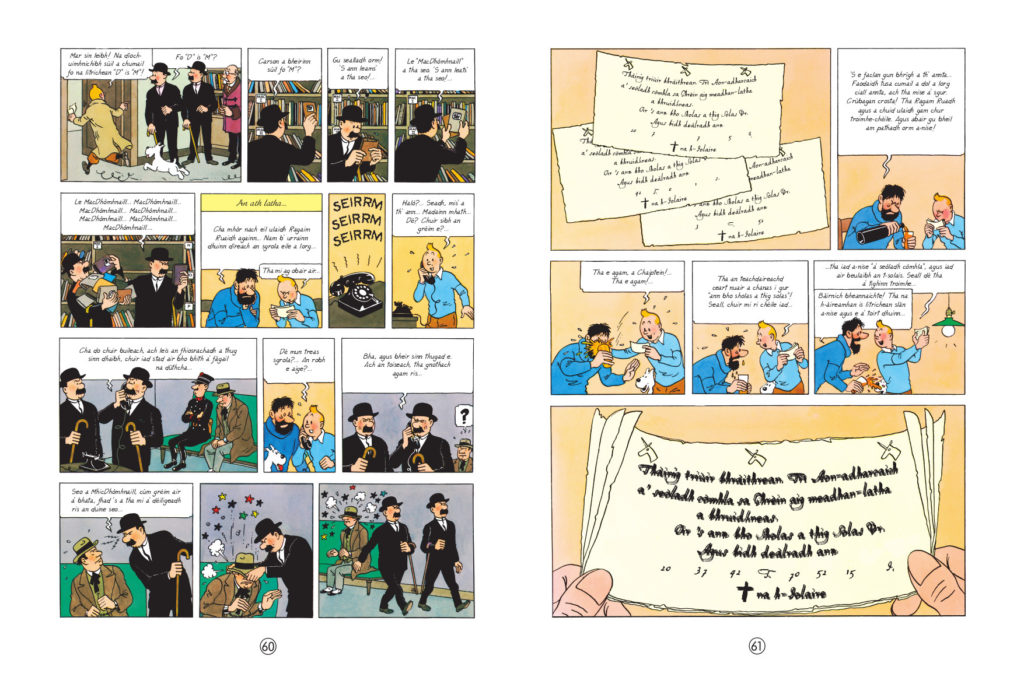
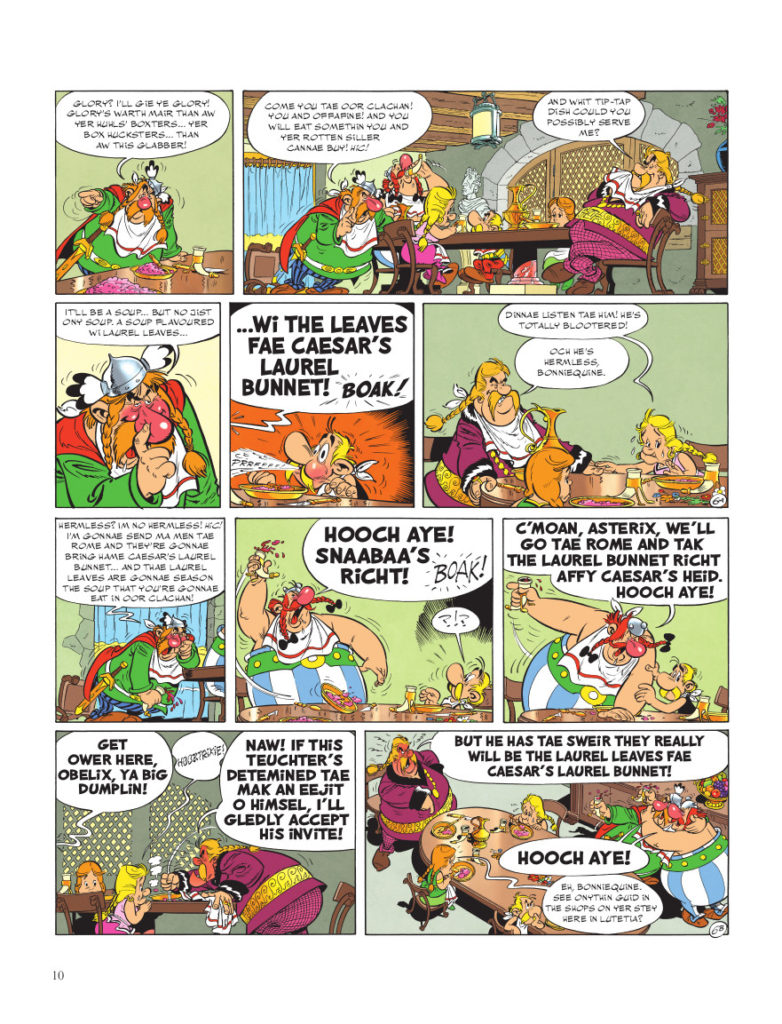
Tin Tin and Asterix are two of our most beloved fictional characters, and publisher Dalen have been doing a sterling job releasing their graphic novels translated into Scots and Gaelic. This autumn, they are releasing 6 new Scots and Gaelic editions, and you’ll find a sampler from each below.
From the Tin Tin adventure The Treisure o Reid Ranald

From Tin Tin adventure, The Saicret o’ the Unicorn

From Tin Tin adventure, Ulaid Ragaim Ruaidh

From Tin Tin adventure, Sgeul-Rùin an Aon-Adharcaich
From Asterix adventure, Asterix and Caesar’s Laurel Bunnet
From Asterix adventure, Asterix agus Crùn Cheusair
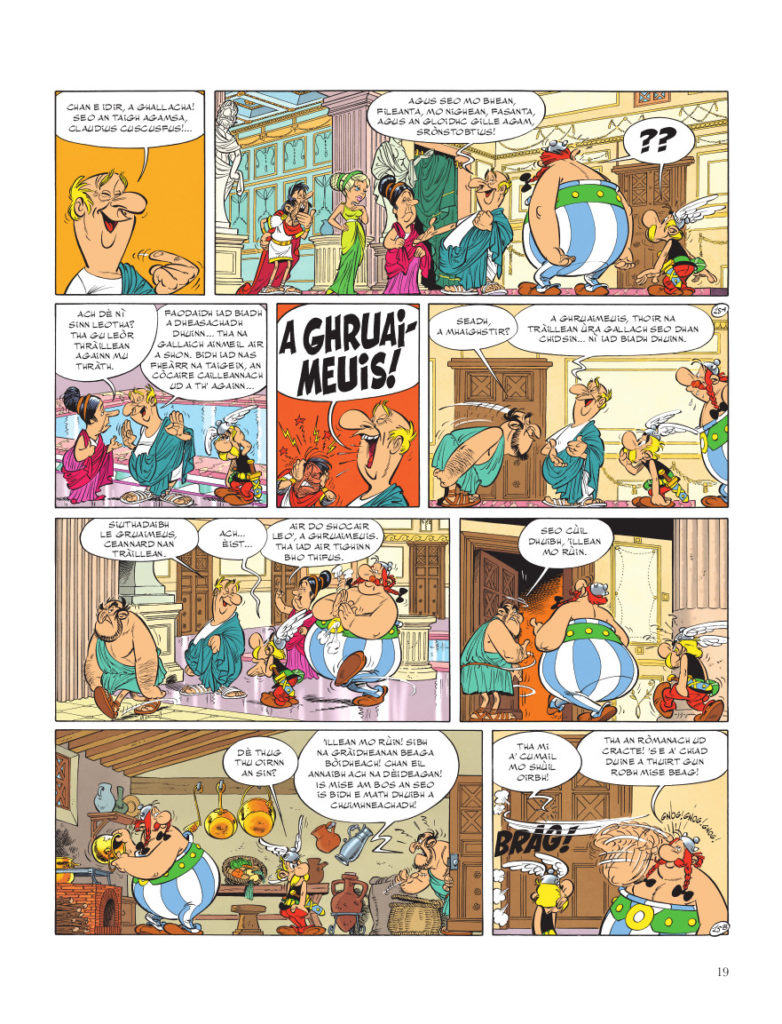
The Treisure o Reid Ranald, The Saicret o’ the Unicorn, Ulaid Ragaim Ruaidh, Sgeul-Rùin an Aon-Adharcaich, Asterix and Caesar’s Laurel Bunnet andAsterix agus Crùn Cheusair are all published by Dalen, priced £7.99.
Elisabeth Gifford’s latest novel is a sweeping love story set against the backdrop of World War Two and the last days of life on the island of St Kilda. In this extract, we are introduced to Rachel Anne, desperate to find out more about her past.
Extract taken from The Lost Lights of St Kilda
By Elisabeth Gifford
Published by Corvus
My mother says I am her whole world, and she is mine, but all the same I would still like to know at least the name of my father.
This much I know: that I was born on an island far from here, a place called St Kilda, although we left there before I could form any useful memories, so the island is doubly lost to me. My mother doesn’t like to talk about St Kilda. ‘There’s no use in looking back, Rachel Anne,’ she says. ‘This is our life now and we must make the best of it.’
I was not much more than two years old when some thirty of us left the island. We had lived together all our lives in one village, sharing what little we had, but after the evacuation we were scattered across the mainland. It wasn’t long before many of the old ones and the children faded away from TB or from broken hearts, among them my grandmother. So now the loss of the island and our dear ones is too great for my mother to brook any questions from me.
But everything is different since Hitler turned the world upside down. Since many of the men from round here have gone to join the 51st Highland Division, my mother goes off early each morning to manage the dairy on Brockett’s farm. She herds the cows into the yard with a stout stick tall as herself, calmly counting them in. She knows their names, sets up the milking parlour and sees to the milk churns. When I went over with her on the first day, Mr Brockett came to make sure she knew enough about the beasts. ‘You don’t need to worry,’ she’d told him. ‘On St Kilda, we used to walk miles each day to tend the cows. Wasn’t I raised on a croft where every stalk of barley had to be wrested from the weather?’
‘Aye, and you’d had to leave there for want of food. Well, we’ll give you a trial, Mrs Gillies, see how things go.’
By the end of the week she’s laughing about how he’s so keen for her to stay on. ‘“Never seen the cows give so much milk,”’ she says, imitating his Morvern accent. ‘“What do you do, Mrs Gillies, to make such a difference?” What does he think?’ she says. ‘I know them each by name. And all of them different.’
So with Mother away I am left here alone through the long summer days, instructed to practise my piano pieces. It was my mother who first taught me to play, my hands on hers, walking me over tunes she brought back from the island. She learned by ear and she thinks it a great thing that I am learning to read sheet music at school, taking the grade exams and so on. But there’s only so long you can play a piano in a day and so it is that I have taken to searching through the house for a scrap of information on my father, growing bolder in my search each day, until I stand on the threshold of her silent room. I walk in on the balls of my feet, as if she might hear me away on Brockett’s farm, gently slide open sleeping drawers, turning over her folded clothes and linens.
Finally, I find something, hidden between the layers of an old rough blanket in her kist from the island. Pictures of antique-looking people in long, full-skirted dresses and men in flat woollen bonnets and thick mufflers, standing in front of a row of cottages – my grandparents and aunts and uncles from before the island was emptied. I think I may have seen these pictures before. I recognize my grandmother Rachel Òg, who came with us to this house. By her side, a man who must be my grandfather. I know well my mother’s stories, how he was famous for his skills in dancing sideways across the faces of the highest cliffs in Europe, his brother above holding the rope firm as my grandfather caught the fulmars and gannets whose feathers and meat kept the islanders alive. In the photograph, he stands solidly next to my grandmother. I memorize each detail and put them back, but as I smooth down the blankets, I feel something else tucked away at the end, an empty cocoa tin gritty with spots of brown rust. When I shake it, something light and muffled moves inside. I twist off the lid. It’s not been opened in a long while, the lid sealed with rust and damp. Inside, wrapped in a piece of pale ginger tweed and curved around in the shape of the tin, there’s another photo. I’ve never seen this picture before. It’s grey rather than the sepia of my grandparents’ photo, a blurred snap of two young men, arms around each other’s shoulders. Not island men, but visitors. They’re sitting on a hillside, the breeze ruffling their hair, a dog alert and panting by the side of one of them. I sit back, wanting to glean every detail, for I know with a conviction, feel it in my bones, that one of these men must be my father. I’m the spit of my mother, with dark hair and blue eyes, but all the same I’m disappointed that neither of them look anything like me. The conviction remains, however. Why would she have kept this, hidden it away, if it didn’t mean something?
But the one person who can tell me is the one person I can never ask. The afternoon is fading. She’ll be back soon. My hands, like quick little liars, hurry to put everything away.
The Lost Lights of St Kilda by Elisabeth Gifford is published by Corvus, priced £8.99.
Ian Parsons has been watching vultures in their native habitat for a long time and has put all his experiences in his book A Vulture Landscape. Here he writes about his first encounter with these amazing birds.
A Vulture Landscape
By Ian Parsons
Published by Whittles Publishing
It was many years ago now that I first travelled through the Iberian Peninsula, and whilst it was a journey that wasn’t in the same league as Laurie Lee’s, it was still an eye opening adventure for me. Everything was different, the people, the culture, the architecture, the weather, but most noticeable to my young naturalist’s eyes were the landscapes and the wildlife. They were something else.
The hot, open, rolling plains of central Spain are, at first sight, dull and uninteresting places. But once you are off the fast straight roads that traverse them, you get to see them for what they really are. Wild flowers abound, a myriad palette of yellows, whites, pinks and purples splashed across a canvas of green, the hum of insects is everywhere, but this background buzz is drowned out by the bird song, the sky is full of larks, their song pouring down, the bubbling calls of rainbow coloured Bee-eaters mixes with the raspberry-blowing of displaying Little Bustards. It is an aural and visual experience.
It was here that I saw my first vulture, a huge aerial leviathan that flew on unflapping wings across the great expanse of open grassland, trailed by its equally huge shadow that followed it over the undulations of the ground. I was completely hooked.
Not long after I had seen my first, I was seeing more, lots more. They were materialising out of the blue from all directions, all heading to the same point over the plains. Within a few minutes they had formed a large loose circling mass, a kettle of vultures. They were mainly Griffon Vultures, birds with a wingspan of over 2.5 metres and even at the distance I was from them, they looked colossal. But there were other vultures with them, much darker in appearance, their wings held flatter as they too circled the land below. They were Black Vultures and they were even bigger, their wingspans edging up towards an almost unbelievable 3 metres.

As I watched transfixed, the birds changed their behaviour, first one lowered its legs and dropped down towards the ground, vanishing from my sight behind an undulation in the plain, and then another, and then another, suddenly they were all dropping, raining down towards the grassland and all of them disappearing from view as they did so. I knew they had found a carcass and I knew I had to get closer to them; my compulsion for vulture watching began at that moment.
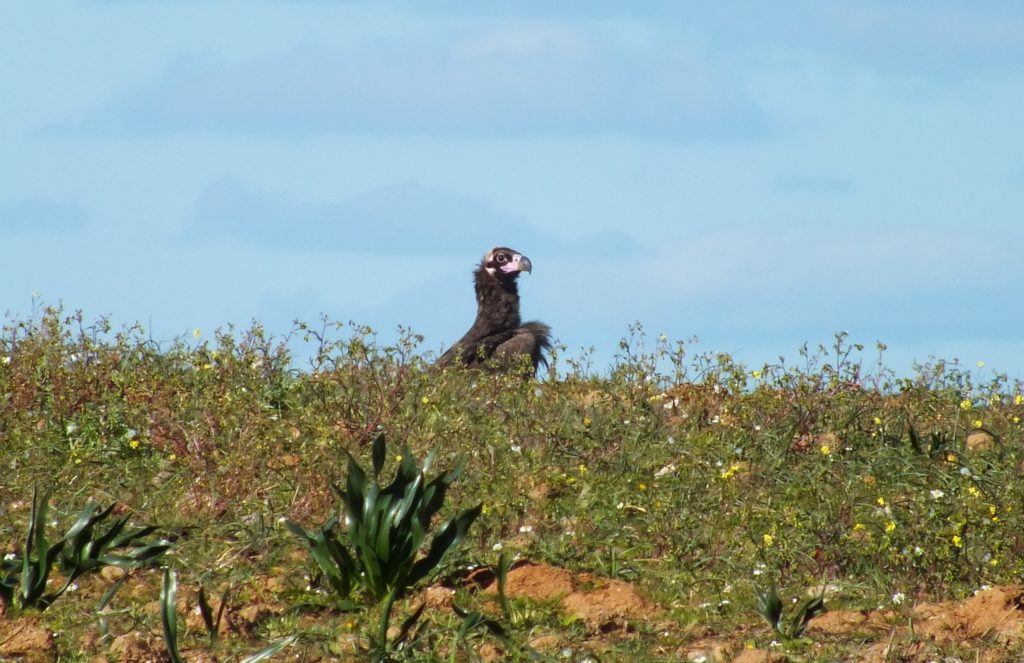
It took me a while to navigate the dusty tracks to put myself in a position where I could see the birds on the ground and by the time I arrived there they had finished feeding, some large bones and a bit of tattered hide were all that was left of what I guessed to have been a cow. The vultures hadn’t killed it, they are not predators, they are cleaners and they had thoroughly cleansed the environment of this carcass and the potential diseases it harboured.
The vultures stood scattered around the remains, dozens and dozens of them, I can remember that I counted 68 Griffon Vultures and four Black Vultures, all just there standing on the ground, letting their food go down about 100 metres from where I watched. I was close enough to hear them; occasional squabbles would break out amongst the Griffons and when they did, strange hissing noises and rasping cries of discontent would carry across the plain towards me, long necks would be thrust out, large beaks jabbed towards each other, the older, more dominant birds putting the younger, more subservient, birds firmly in their place.
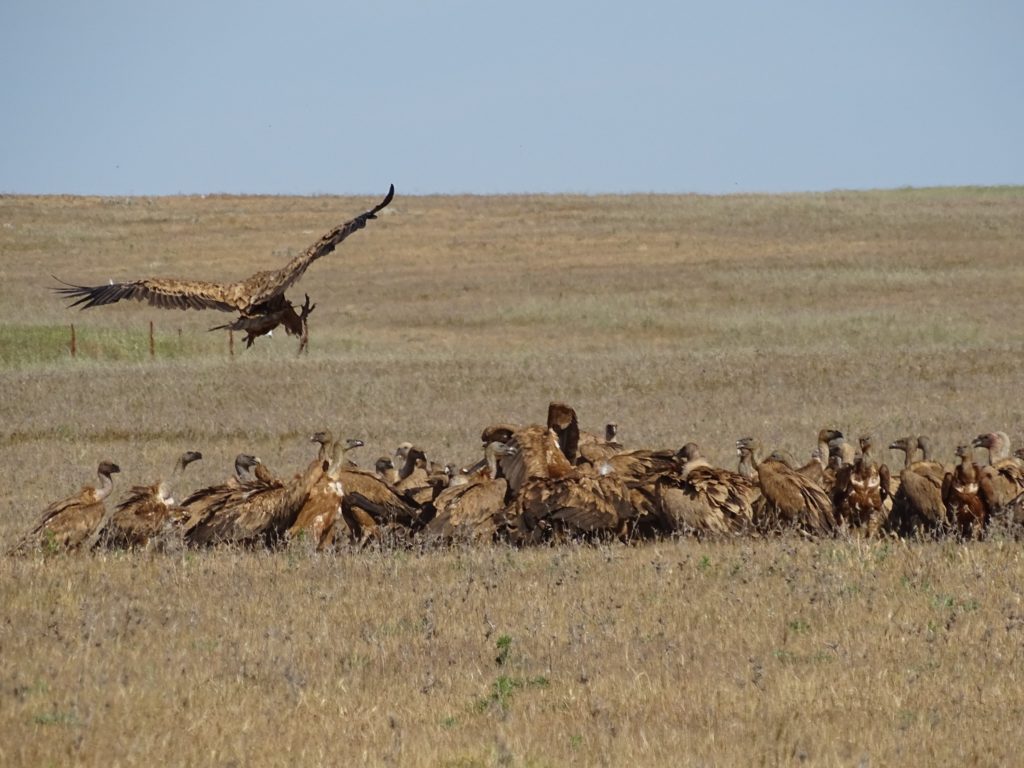
Even on the ground, with their huge, sail-like wings folded, they were still massive. I found it hard to grasp just how big they were until I realised that the small black bird picking its way amongst them, gleaning morsels from the ground, was in fact a Raven, a bird that is normally considered to be big.
There were other vultures around me, the birds on the ground may have been resting, but their presence had attracted others to see if there was still a feeding opportunity. Looking up, there were vultures all across the sky, flying in towards where I and the vultures stood, travelling with a purpose at first, before circling the scene and then slowly drifting off again to seek a meal elsewhere. Wherever I looked I could see these amazing birds, I was in a vulture landscape and my life was never going to be the same again.
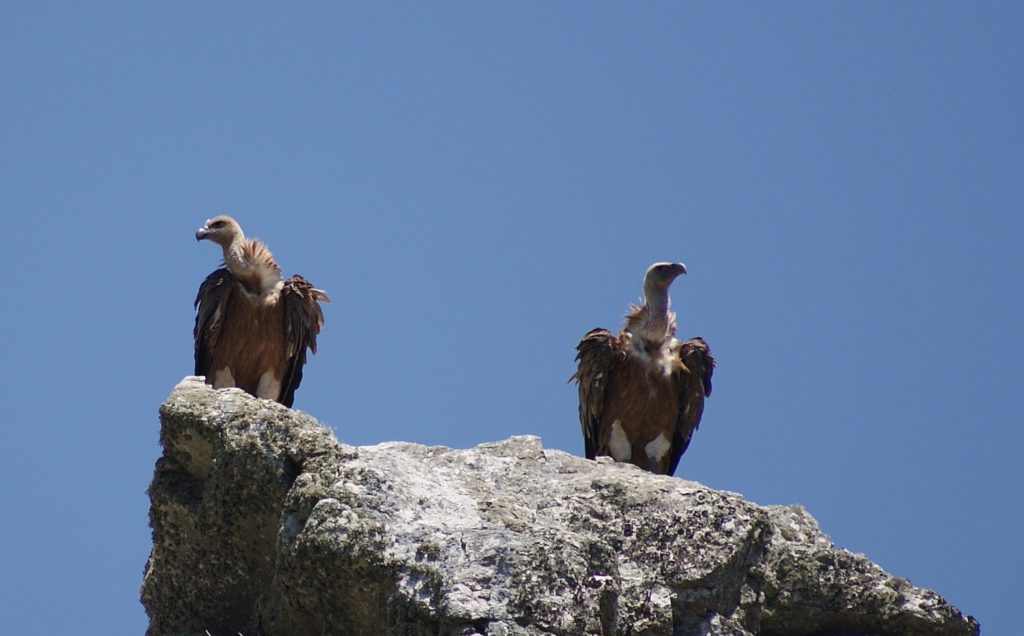
A Vulture Landscape is my personal account of spending twelve months living within the vultures’ realm, following them and the many other wonderful species they live with during a year of their lives. The book looks at the vultures of Europe and beyond, it describes their lives, the problems that they inevitably face in this modern world and it celebrates them for what they are, brilliant birds!
A Vulture Landscape by Ian Parsons is published by Whittles Publishing, priced £17.99.
Fear in the World is an Italian dystopian classic, released in 1938, which explores the use of fear by totalitarian states. Now translated into English, it deserves to be as well-known as Orwell’s Nineteen Eighty Four or We by Yevgeny Zamyatin. In this extract, Barbara gets in touch with old friend who has just returned to his much-changed home town.
Extract taken from Fear in the World
By Corrado Alvaro
Pubished by Vagabond Voices
Barbara had a room in the city centre in an old apartment whose owner had fled to some other part of the world – Paris, Rome or London. Occasionally that man would remember the apartment, and if someone mentioned his native city, he would ask if they knew Y Street. And yet if he had ever returned, he would not have recognised the cause of this nostalgia. The caretaker and maintenance works were to be found in a low building in the courtyard, whose door was open all night and its lights were always on in its two rooms. The presence of this white addition was enough to change the entire look of the building, to the point that anyone returning there would not have recognised it. A dozen names written on pieces of paper and poorly printed visiting cards on each of the apartment doors demonstrated that they were occupied by several people who had nothing to do with each other. Separated by doors that led from one room to another, they must have heard each other talking, snoring, raving and dreaming. The sounds passed through ill-fitting doors sealed with scraps of paper or secured with pieces of string. The telephone in the corridor continued to work and if you wanted to use it, you had to go through the exchange; publication of the annual directory had recently been resumed. Barbara immediately thought of using the phone when she returned to her room that evening. She looked up the number of Dale’s hotel, and once she’d found it, she started to leaf through the directory in search of surnames of people she had heard mention of and she knew to have disappeared, as well as her friends who had disappeared and famous people who had fled or been killed. She often found surnames without the right forenames, as though the people were hiding in that manner and attempting to get by unobserved.
There was no one in the apartment, and she asked the telephone operator to ring Dale’s hotel, which she immediately got through to. She calmly asked for him in a low voice. Then she heard his voice and said quietly, ‘It’s Barbara. I’m home, and I’m fine.’
The voice on line started to reply, and she put down the receiver. That voice had said, ‘You forgot…’ Barbara threw herself on the sofa. A few minutes later the phone began to ring. ‘How can this be?’ thought Barbara. ‘How could he know… I can’t reply. He doesn’t understand.’ No sooner had she thought this than she heard footsteps in the corridor and the ringing stopped. Someone had replied, and it was a man’s voice. He went silent.
Suddenly someone was knocking at Barbara’s door. ‘Come in!’ she shouted, leaping to her feet. The door opened.
A man filled the doorway and said, ‘The telephone operator asks if you have finished speaking. It was you on the phone?’
‘Yes,’ said Barbara.
‘Good,’ replied the man in the doorway. ‘Excuse me.’
He started to turn, but stopped and instead took a step forward to speak further, ‘You’re wearing a new smock which I’m sure has been manufactured abroad. I don’t know where, but I’m certain that it wasn’t here. I can tell from the cloth and the cut without inspecting it closely. Would I be indiscrete to ask you whether I am deceived?’
‘No,’ she replied, ‘actually…’
‘I’m glad to hear that. I’m a retired inquisitor. This is merely professional curiosity.’
He seemed almost joyful. He rubbed his hand and added, ‘I’m keeping my hand in.’ He bowed. ‘Thank you.’ Then he closed the door behind him. She had seen that man in full light, high in stature, a clean-shaven face, a small flat nose, a sulky expression due to his buck teeth, and eyes that would have been attractive in youth but were now clouded by the passing years. But he couldn’t have been old. A thick head of grey hair framed a wide, stubborn and almost childlike forehead. Barbara had no idea where he could have come from. She started to shake violently and thought, ‘Years of living like this have had their effect; it takes nothing to upset me.’ She didn’t realise this until she was on her own, like an insect that climbs a wall summoned by some inexplicable instinct. And, like an insect, anyone could crush her without compunction.
Then she did something incredible, something she too found hard to believe: in spite of her fright and her trembling, she went back to the telephone and asked for Dale’s hotel. She feared that she wouldn’t be able to articulate a single word, but managed to speak in a strained and lifeless voice, as though reading her conscience out loud, ‘It’s Barbara. Let’s meet tomorrow evening in front of the park, main entrance. Yes? See you later.’
She threw herself on her rickety bed clasping her hand to her breast. She recalled the operator’s voice on the phone – a bored, monotone voice that displayed no surprise that she had requested that number which she had repeated with precision. When Barbara spoke to Dale, it had seemed that she was uttering those words against her will and that someone or something within her which never revealed itself was dictating them to her. The time between Dale’s ‘Hello’ said in an artificial voice and her first soft and suffocated words, ‘It’s Barbara’, seemed like an eternity to him. In that pause, there was time for some terrifying announcement to intervene; instead Barbara’s voice rose from a great depth until steadier words allowed her to finish what she had to say. That voice sounded anguished, tearful and in the dark, because he closed his eyes as she spoke and saw her appear almost wounded with a bright but sad and even hurt expression. The red of her wound was, as he realised later, the memory of having seen her as a girl with a red ribbon on her hat above her light brown hair.
The Secretary at the State Industrial Technical Office had to deliver some documents from the Director to Dale. She entered Dale’s room, and having placed the dossier on the table, she sat down with hands on her lap as though she wanted to rest. Her bag was on her knees, her hat tipped too far forward and her legs slightly apart. There was nothing elegant about her. Her speech was mild and world-weary. ‘It’s odd,’ she said, ‘that last night I dreamt that I would have to come and see you.’
She spoke calmly in a colourless voice, and attributed no great importance to the business of the dream. This must have been her way of doing things.
‘Ah! Do you often dream,’ asked Dale, ‘about what you’ll have to do the following day?’
‘Sometimes I do. I feel connected to many people, and occasionally I guess their thoughts. Even people I don’t know who are very important. And how does this come about? Well, I couldn’t say. But often when I read a news item in the paper, I think that I was the one who caused it by dictating it in my thoughts.’
She spoke slowly in a sleepy voice, and what she said didn’t have any particular meaning.
‘Consequently,’ she concluded, ‘one has to be careful about what one thinks. We can influence others. We need to get into the habit of thinking the right thoughts. It’s dangerous, very dangerous.’
As she spoke in this manner with her legs apart and her feet diverging gracelessly, she appeared to become increasingly animated, and the complexion of her cheeks took on a slight rosiness.
‘What do you mean by thinking the right thoughts?’ Dale asked. ‘How do I know whether my thoughts are right or wrong?’
‘Wrong is all that is done secretly,’ the woman stated matter- of-factly. ‘After all, everything is revealed eventually.
Dale felt that she wanted to suggest something more. He wondered if this was a warning. But her demeanour did not express this, rather that her conversation was casual, and if anything her words expressed a disciplined opinion that conformed to all the rules. Her eyes responded to Dale’s question by wavering like two snails emerging from their shells slowly and full of suspicion.
‘Everything is revealed because one takes on a suspicious attitude,’ said Dale.
‘Not at all. Do I have a suspicious attitude? Here I am, a woman like any other. And yet…’
She leaned over towards Dale and smiled. In this posture she seemed to be a completely different woman, and her afflicted expression gave way to a lively, malicious and feminine gracefulness: ‘And yet,’ she continued, ‘every so often I discover my thoughts written in the newspapers. Not only. If you read the speeches made in the Presidium of the Partisans…’
Dale listened to her. Her eyes became watery, her cheeks red and she grabbed his wrist, squeezing it between her fingers: ‘Those speeches were my words. They were all things that I had thought up.’
‘What do you mean?’
She sat back in the armchair.
‘How did I manage to survive so long? It was the general in command of the Partisans who saved me. He did as I wanted.’
‘You had a relationship with him?’
She shook her head, but let him suppose all sorts of mysterious bonds and intrigues: ‘I didn’t have a relationship with him. I was about to say that I didn’t know him… almost. But he saved me. We often thought of each other, and he was grateful to me. I sincerely admired him. He was truly very kind.’
‘And the Director?’ Dale asked.
‘Oh, the Director. Things will end badly for him, of course.’
‘But who? How can…’
‘Oh some day, somebody – an inquisitor – says, “Arrest that person over there, what’s his name?” That person is arrested and eventually confesses his guilt. That he has done or thought something criminal, which should not be done.’
‘But what if it wasn’t true?’
‘It’s always true. We all have criminal thoughts.’
‘Hence it could happen to any one of us…’
‘To any one of us.’
‘Ultimately the most grievous thing would be waiting for the inquisitor to say…’
‘Exactly, the waiting. That’s it.’
The woman who spoke as in a dream, as do very simple or sickly creatures, had become the focus of Dale’s thoughts.
‘Exactly, exactly,’ she repeated turning her shining eyes towards him as though in approval. ‘This is why I can never wait to hear the news or open a letter without trembling. There are days this happens when I’m opening the newspaper. Or waiting for someone to speak on the phone. And what about the theatre? The theatre is the same, just the same. At the theatre you have to wait for the catastrophe. I always tell myself that they’re doing it for fun, that they’re pretending, but you can’t pretend all the time…’
‘No, you can’t pretend all the time,’ Dale repeated. ‘There comes a time when you want to scream.’
She smiled like a doctor whose patient has just revealed the symptoms of an illness the doctor had already diagnosed. For a few minutes she didn’t say a word, but looked around and examined the bronze knight on the marble clock. “We’ve exchanged a few words,” she said as she made to leave, “but I tire very easily, and yet it’s very nice in here.” Off she went, clarifying that she was expected at home, she was tired and she tired very easily. She needed a great deal of rest. All these words provided her with important lessons, which acquired substance the moment she said them aloud. On her feet and walking towards the door, she was once more the timid and insignificant young woman with a heart problem.
‘What should I take her?’ Dale wondered as he thought about his meeting with Barbara the following day. ‘Something that would please her or make her laugh.’ A pencil with a gold cap. A fountain pen. Something that he was keeping in reserve. Souvenirs of his previous life for which he strangely felt no nostalgia, and yet he kept the objects as evidence of a recent past that felt more like a distant childhood. He decided to give her all of them, a little at a time, and he thought about how such objects enter into a person’s life: we wake up in the morning and remember a little happiness encountered on the threshold of sleep, and we realise that happiness often consists of such things. Barbara would experience the same feeling.
Fear in the World by Corrado Alvaro is pubished by Vagabond Voices, priced £12.50.
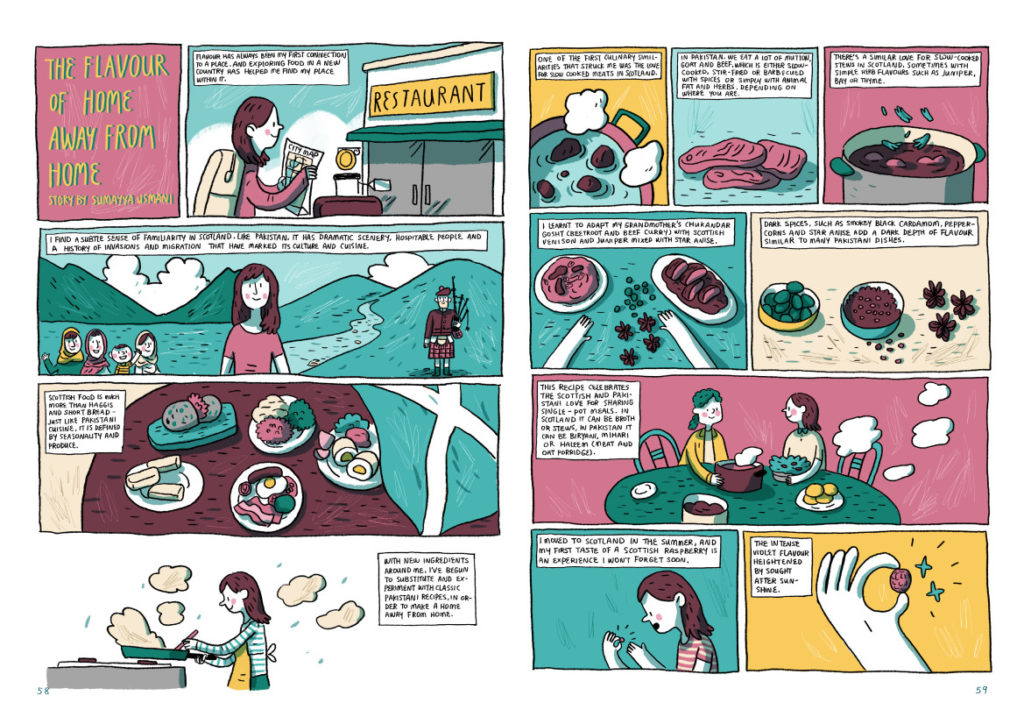
A graphic novel about food and eating with recipes – yes, please! Tomorrow’s Kitchen is a unique collection of stories and recipes from novelists, food writers, chefs, playwrights and activists from all over the world. It invites you to taste flavours from around the world, and to think about how we might cook things up differently in tomorrow’s world. Enjoy some of the marvellous illustrations below – we think they’re delicious!
Tomorrow’s Kitchen
By Deborah May and ShuangShuang Hao
Published by Kitchen Press


Tomorrow’s Kitchen by Deborah May and ShuangShuang Hao is published by Kitchen Press, priced £15.99
In a North Carolina mountain town in the early 1970s, Hannah Sterling struggles with questions of forgiveness after her mother’s death. When she Hannah finds letters in her mother’s effects connecting her grandfather to the Nazi party she embarks on a journey through Germany to uncover the secrets of her family’s past. In this extract, Hannah finds arrives in Berlin to begin her investigation.
Extract taken from Secrets She Kept
By Cathy Golke
Published by Muddy Pearl
I set my jaw, refusing to look back. I wasn’t leaving forever, just for now, for me. I promised to write.
The plane – my first plane ride ever – bumped all the way to New York. Courage waned as my breakfast came very close to revisiting my mouth. But I couldn’t go home or back to Aunt
Lavinia, not until I found some answers.
For two hours I wandered JFK’s eclectic airport shops, discovering scarves and sweatshirts and coffee mugs all touting the Big Apple – a world as surely foreign to a Southern girl as Berlin. Boarding took another hour, but at last we pushed back and taxied to the runway. I sat back, closed my eyes, chewed my Doublemint, and felt the world fall away.
I changed planes in Munich. It was late morning when my plane taxied to the gate in Berlin’s Tempelhof Airport. The little German I’d gleaned from an English-German dictionary on the plane through the night did not help much through customs.
Weary and bleary-eyed, I finally stood in the middle of a terminal aisle, doing my best to read signs and thumbing through the book for inspiration.
‘Fräulein Sterling?’ A silver-haired gentleman of perhaps fifty-five spoke softly.
‘Mr – Herr Eberhardt?’
‘Ja, very good, Fräulein.’ He smiled.
‘Oh, I’m so glad to meet you. How did you know who I was?’
He gestured towards my dictionary, then glanced around the terminal.
No one else looks so green or lost. I didn’t know whether I should be miffed that he’d pointed out my inability to blend in or show my relief at being rescued. I felt very much like Alice having fallen down a rabbit hole. ‘Thank you for meeting me.’
‘You must be greatly fatigued from your journey. Allow me.’
He lifted my hand luggage bag from my shoulder – a weight gladly released – and grasped the heavy suitcase whose contents had been rummaged through and turned upside down in customs.
Gratefully, I trailed after him through a maze of corridors, out the door, into a frigid German morning and to a waiting Mercedes.
…
Carl Schmidt waited by his car for me the next morning, ready for a tour. But I bore no stomach for touring Berlin, no matter his insistence and unadulterated enthusiasm for ‘the city’s world-renowned Tiergarten, boasting animals in as near their natural habitats as possible’.
A respectful audience, I nodded at the loveliness of the pond he pointed to, listening only with my face. All the while my brain conjured pictures of concentration camps and Jews being shamed and beaten, worked to death and gassed – by someone who might have been my father…
‘And the hip bone is connected to the leg bone, and the leg bone is connected to the ankle bone, and they’re all connected to the eye socket. Wouldn’t you agree?’
‘What? Oh, yes, yes, of course.’
Carl stopped in the middle of the Tiergarten path. ‘You’ve not heard a thing I’ve said.’
‘Of course I have. I’ve heard …’ I stopped too. Those raised eyebrows again.
‘I don’t usually have such a poor effect on my clients, especially my female clients.’ His smile disarmed me.
‘I’m sorry. I’m really not very good company today, Carl. Maybe you should take me back to my grandfather’s.’
‘And lose my employment? I’m under strict orders to help you discover Berlin as the most fascinating city on earth.’
‘You’ve done a splendid job. But I just can’t stop thinking about the reason I came here in the first place, and it wasn’t to see the sights.’
‘Ah, your family.’
I closed my eyes. Why couldn’t the world just go away?
Secrets She Kept by Cathy Golke is published by Muddy Pearl, priced £14.99.
In The Mysteries of the Island of Thara, a professor of anthropology discovers a childhood diary whilst packing up his home. He finds a description of a forgotten time spent on an island during a holiday, a place that changed the course of his life. This extract details that discovery and the faded memories it brings up.
Extract taken from The Mysteries of the Island of Thara
By Lucio Schina
Published Black Wolf Editions
A distant island in the North hidden among the waves of the ocean. An ancient legend that hides a mystery to discover. The memory of an echo that hovers between reality and magic. An anthropologist who embarks his journey in search of the truth. A story that combines adventure and mysteries, where time redefines its cycles to create an alternative reality.
…
I turned two more pages and recognized my handwriting. It was uncertain and hiding a strong anxiety. The diary was interrupted from time to time, giving way to sketches and drawings. Underneath each one there was a little caption. During the three days I spent on the island I had written a diary of about ten pages structured as a fantastic story. I was reminded of the reason for that choice; I wanted to be sure that if it had been read by anyone, it would have been mistaken for something else. I had chosen not to divulge anything about that experience and still today I remain convinced of the goodness of the decision. Not so much because I would be laughed at, but because I felt that those emotions had to be kept inside me and remain a secret forever.
I read it in a few minutes, all in one breath. It was like a light came back on. A story that had marked the entire course of my life. The ending was unbelievable and, although I had written it in my own handwriting, it raised doubts about its authenticity. Too great had been the magic I had experienced, a magic that an age-hardened mind could hardly accept. A story born from curiosity or perhaps from a destiny that had in store for me the most incredible adventure I could imagine. An island hidden among the waves of the northern ocean, a legend handed down for centuries and a secret jealously guarded in the folds of time.
…
Stains of discoloured paint came out here and there along the sideboards, a sign that originally the boat must have been a very pronounced dark blue. A guy in his 50s showed up. The appearance was far from respecting the clichés of the brave captain. No cap with a sailor’s visor, no long white beard and no surly character. He dressed in a large yellow sweater and a pair of wool trousers, and had a large mass of messy curly hair on his head. He gave me permission to come aboard and greet me with a friendly smile.
‘If you want to visit the islands off the promontory you’ve found the right person. We can set sail in half an hour. In this season, then, they offer beautiful natural spectacles.’
I asked him if he could make his way to the island of Thara; the expression on his face became questioning, but he went back to relax a moment after hearing what I was offering him for the crossing.
‘We leave in 20 minutes, time to set course and refuel.’
‘Perfect!’ I simply responded, giving a slight nod of approval with my hand.
While the powerful motor propellers drew a white trail into the sea and the ferry headed north towards the mainland, our boat turned east, with a slight wind in the stern, towards the small and almost forgotten island of Thara. After passing the small islands nearby, the sea became frizzier and the captain shouted to push the engines at full power. All I did during the crossing was watch the sea. I shut myself off altogether. I had planned a study trip but now, lost among the waves and an endless horizon, I realized I had given up the role of researcher the moment I stepped on board. The reason that prompted me to visit the island of Thara was unknown to me, yet it seemed natural to me as if the mind had programmed it many years earlier, only to make it dormant in the years to come. I was taking a leap in the dark and I knew I had to. I had not carried out any kind of preliminary study, neither geographical nor historical anthropological. All I had with me was the little book that contained the story, a small drawing kit and a diary for personal notes. Whether in those few faded pages there was a fictionalized account of an event that had actually happened, or a fictionalized story that over time had turned into legend, I would have discovered it once I landed and set foot on the island. I remember, as if it were now, that the view of the pristine sea of the north had cleared my mind of all thoughts, making me tune in to the natural elements that surrounded me; it was as if an inner call was guiding me, a feeling that I felt clearly during the journey. I could hear something akin to a hiss, a slight melody mixing in the wind. Its origins were obscure to me and I didn’t understand if it came from outside or, on the contrary, if it came from inside. It was imposing, embracing, and it traced the path I was walking down. As evening fell and the sun’s reflections on the waves turned into a bright rosy hue, I saw the island’s outlines blurred from the horizon. A crewman warned me we’d be arriving at our destination within minutes. I used that little time to re-read the legend one last time. It was called ‘The Echo of Remorse’. The plot weaves with wise ambiguity reality and supernatural; I deliberately use these terms in a conventional way, not having the certainty of where the barrier that divides it from its opposite rests.
The Mysteries of the Island of Thara by Lucio Schina is published Black Wolf Editions, priced £5.99.
Being famous, that’s the dream, right? In Alan McClure’s latest novel for teenagers, he writes of young Jack, who is famous, and his life isn’t exactly a dream come true. Still, there’s always the imagination . . . Below, Alan McClure reads from Jack’s Well, an excellent tale for an autumnal evening.
Jack’s Well
By Alan McClure
Published by Beaten Track Publishing
Jack’s Well by Alan McClure is published by Beaten Track Publishing, priced £8.99..
Peter Ross has been writing, with great empathy and care, of lives great and small throughout his journalistic career. David Robinson finds he brings the same skill and sensibilities to his new book on death and burial, A Tomb With a View.
A Tomb with a View: The Stories and Glories of Graveyards
By Peter Ross
Published by Headline
Whether with a ton of earth above us or an hour and a half at 900C in the incinerator, all our stories come to an end sometime. Opt for the former, though, and there is at least a sliver of hope of an afterlife. One day over the rainbow, Peter Ross might wander into your graveyard, notebook in hand.
It helps if you have had an interesting life or death. The first barmaid in England to have been eaten by a tiger (Hannah Twynoy, 23 October 1703, Malmesbury) makes it into his pages. So does the first woman to be bayoneted while fighting as a soldier in the British Army and then live until 108 (Phoebe Hessel, 12 December, 1821). But let’s face it, once you’ve stood in front of their lichened graves and read the inscriptions, unless you’re writing a biography, what else is there to say? Fascinating these lives may have been – and Ross is right, Hessel’s is a BBC drama series waiting to happen – but they have all reached a full stop. What can a writer add?
Quite a lot, as it happens, because there is always a lot more to say about death, especially in an age like ours which tries to block it out with an ocean of trivia. In 1859, when Jules Verne visited Edinburgh, he noted that, among the city’s haute bourgeoisie, one of the most popular destinations for a Sunday afternoon stroll was around the well-maintained paths and gardens of Warriston Cemetery. The Royal Botanic Garden had opened nearby just 40 years earlier, but to the promenading mid-Victorians, taking a gentle stroll around a garden of death was a comparable attraction. I know Warriston Cemetery reasonably well, and even though it is no longer the vandalised junkie playground it was in the Eighties, it is hidden away from the rest of the city, half overgrown, well off the tourist trail, and with nothing neat, tidy or haut bourgeois about it at all.
In our culture, Death has made exactly the same transition, from central to fringe, visible to obscured. These days, it’s the people who hang around graveyards, who openly talk about death, who are intrigued by our attitudes to it, who are the real oddities. Ross is one of them. Even as a child, growing up in Stirling, he haunted the nearby cemetery; in lockdown, he has found himself walking most days in the cemetery behind his house ‘as a vaccination against gloom’. And why not? It’s always consoling to find someone worse off than yourself, after all.
Taphophiles – people who are interested in cemeteries, funerals and gravestones – are an interesting bunch. What makes them go against the cultural current? What made Bob Reinhardt – who lives in the US – set up Friends of Warriston Cemetery and become so obsessed with the place that he has taken around 60,000 photos of it and other Edinburgh burial grounds? Why did John Constable (aka ‘urban magician’ John Crow) set up the Crossbones annual vigil for London’s medieval outcast dead outside the place where they were buried in unmarked graves? What made Nick Reynolds, Alabama 3’s harmonica player, start a new career as a death mask artist, taking casts from the freshly dead faces of the likes of Malcolm Maclaren and his own father, the Great Train Robber Bruce Reynolds?
In some ways, these people are the Thanatotic equivalents of the glorious eccentrics Ross has interviewed as a journalist. But he didn’t win all his many awards just for writing about colourful characters. He can also handle harder stories that blend history and culture too, sometimes ones you might never have thought of. What, for example, happens to urban graveyards when they are full up and no-one has any money to look after them? Should cemeteries with famous dead market themselves as tourist attractions? How do Muslims manage to bury their dead within 24 hours? Will we ever finish burying the dead of the First World War? (Answer: probably not). And are cillini – unmarked graves near churches for the unbaptised – doomed to be forgotten?
In his last book, The Passion of Harry Bingo, Ross wrote about how close journalistic observation is a form of compassion, and how while working on a story, all of his senses are engaged as he tries to understand, without any preconceived ideas, what is going on around him. Here, that seems particularly true of the chapters set in Dublin and – particularly – Belfast, where the ‘dark romance’ of the paramilitary dead colours the city ‘like some hidden pigment just outside the visible spectrum’.
Good feature writing demands having an eye for detail, an ability to ask tough questions and a certain humility too: the journalist is just a fly on the wall, not omniscient. Walking with the Easter Sunday parade to the Republican plot at Belfast’s Milltown Cemetery, Ross spots a little girl outside the Royal Belfast Hospital for Sick Children, banging gleefully on her dialysis machine as the marchers pass by, honouring the dead of the 1916 Easter Rising with flutes, drums and replica uniforms and rifles. He is accompanying former Sinn Fein spokesman Danny Morrison, who points out each place someone was killed by the British Army as they pass by. Could, he asks, the British soldiers who also died on these streets ever be commemorated too? Morrison’s answer takes him by surprise. The families of British soldiers know what to expect when their sons sign up, Morrison replies, so if they die on active service, that’s an end to it. ‘Well, that’s not the end of it for us,’ he adds. ‘Our dead are precious.’ Yet it’s surely blinkered to think that the other side’s dead aren’t precious too.
There’s a lot of history in these pages, as there has to be: the story of London’s ‘Magnificent Seven cemeteries’, from the ‘Victorian Valhalla’ of Kensal Green to Marx’s Highgate haven, demands it. But this is more than a book about the historical changes in the British and Irish way of death. Other writers could do that, and they’d all probably also finish by describing natural burial – sometimes called green or woodland burial. But I bet they wouldn’t end up, as Ross does, at one such natural cemetery overlooking the River Dart in Devon on a blustery All Souls’ Day. If they did, they probably wouldn’t find themselves talking to a woman whose husband had committed suicide while being mentally ill. And even if they did all that, I don’t imagine they would get to hear about how she broke off in the middle of putting the earth around his body with her bare hands to have a cigarette. How she took off his shroud just before he was put in the ground and how it now hangs above her fireplace. How they fell in love, and how it was a love story right to the end, even though in hindsight she realises he should have been sectioned.
Research gets you so far. But empathy gets you the whole story, the kind of story Ross heard from that woman in Devon and which is echoed throughout this engaging book, filled as it is with life, and loss, and love.
A Tomb With A View by Peter Ross is published by Headline, priced £20.
Andrew O’ Hagan is one of Scotland’s most talented and interesting writers and his latest novel, Mayflies, is garnering praise across the board. BooksfromScotland caught up with him to talk about his favourite books.
Mayflies
By Andrew O’ Hagan
Published by Faber
The book as . . . memory. What is your first memory of books and reading?
In our house, you had more chance of spotting a mountain gazelle than a book. My parents didn’t read, and life, for them, seemed to carry enough distractions and entertainment to keep them going. But for me reading was a kind of religion. It raised you to the higher ground. In school, I pored over my first reading books as if they were Wisdom Itself. I’m talking about books called things like Dick, Dora, Nip, and Fluff. It was a steady, exhilarating climb from there. I remember, when still small, reading Wuthering Heights, and feeling that I saw human beings on the page for first time — romantic, unreasonable, beautiful, despairing. Just like life, only better. I was hooked.
The book as . . . your work. Tell us about your latest book Mayflies. What did you want to explore in writing it?
I wanted to write a funny, true, and heartbreaking book that showed a friendship in its entirety. From beginning to end, the book relates to my own life, and I wanted that autobiographical urgency to perfume the story. We meet two Scottish boys in Mayflies, two funny kids growing up in Ayrshire, and they are full of attitude, music, politics, plans, and hurts — they rush into the world in the hope of making it better. And what do they find? How does their childhood closeness affect their adulthood? These are questions for everybody, and when, in the book, one of the boys telephones the other one, 30 years later, with terrible news, loyalty and love are tested. As I say, it’s my most personal book, and I felt in writing it that I was telling a story everybody really interested in human experience could relate to.
The book as . . . inspiration. What is your favourite book that has informed how you see yourself?
My favourite book changes every day. Today it is The Strange Case of Dr Jekyll and Mr Hyde. Robert Louis Stevenson had such a wonderful imagination — so bizarre, yet so human, so universal, yet so particular — and you just can’t improve on his sentences. He designs each book perfectly to suit his material. No two books are the same, or even similar: they are discrete works of art with their own architecture and their own colours. Dr Jekyll makes me see that I am a disunited person, as all people are. We are a disunited kingdom, as all kingdoms are. The lesson is that life is nicer if we use our intelligence to confront our opposites, though, unfortunately, the lesson comes too late for the good Doctor. Tolerance of difference should be our hallmark. Stevenson’s story (so handsomely Scottish in its bones) manages to suggest a whole philosophy of life in its allegory. With great economy, it paints existence.
The book as . . . a relationship. What is your favourite book that bonded you to someone else?
Saturday Night and Sunday Morning by Alan Sillitoe. It’s not a masterpiece of any sort, but it does its work perfectly. It’s a story of a working class lad in Nottingham who resists the forces that would keep him down. One of my friends, Keith Martin, who inspired Mayflies, was driven forward by that book. We both were. And it became a kind of bonding text for us and many of our gang at that time — a vivid, bright book of life.
The book as . . . object. What is your favourite beautiful book?
Old Glasgow by Thomas Annan. This is a book of carbon-print photographs published in 1878. It is the real beginning of urban documentary photography, based on life on the street, and the book, in green Morocco leather, is so rare and so expensive that I know is shall never own it. But they have it in the Mitchell Library. It is a wonderful object and alters your sense of what beautiful means, when it comes to a book.
The book as . . . entertainment. What is your favourite rattling good read?
It would have to be a biography. They are my beach reads — I am just riveted by all the stuff that can happen in real life. At the moment I’m reading an early proof copy of Tom Stoppard by Hermione Lee. I’m also looking out for two new Dickens books, by A.N. Wilson and John Mullan. In fiction, you can’t beat Zola for suspense and gripping-ness.
The book as . . . a destination. What is your favourite book set in a place unknown to you?
It would have to be Apsley Cherry-Garrard’s The Worst Journey in the World. The author was part of Scott’s team when he attempted to reach the South Pole, and it’s a masterpiece of witnessing and reporting. You are there, with them. A new book along those lines that I admired, a vivid account of one man’s bizarre journey to reach Everest, is Ed Caesar’s The Moth and the Mountain. When people say they can’t put a book down, they must be holding a book like Ceasar’s.
The book as. . .education. What is your favourite book that made you look at the world differently?
Thomas Paine’s The Rights of Man. It never gets old. Once you’ve read it, you want to fix the world, or fix yourself, which is the same thing.
The book as. . .technology. What has been your favourite reading experience off the page?
I am having a torrid affair with my Kindle. I go home to my books every night, and sit down to dinner, and we go to bed, but in the afternoons I am often to be found in flea-bitten places, somewhere at the edge of the city, looking lovingly at my Kindle.
The book as . . . the future. What are you looking forward to reading next?
Edinburgh University Press are in the process of publishing a series of beautiful, new, fully edited and annotated editions of John Galt’s work. One of the first two in this glittering series came out in June and is Annals of the Parish. Edited by Robert P. Irvine, the book is masterstroke of scholarly diligence and imaginative publishing. Every respectable home in Scotland should have a copy. Born in Ayrshire, John Galt is the first great novelist off the industrial revolution, and I can’t wait to reacquaint myself with Annals, his greatest work, a hilarious and far-seeing masterpiece of Scottish literature, which will be 200 years old in 2021.
Mayflies by Andrew O’ Hagan is published by Faber, priced £14.99
Floris Books publish many brilliant, colourful books for children celebrating Scottish history, culture and nature – they are always a bit of a treat! The latest release, The Amazing Animal Atlas of Scotland, takes you around the country and is packed with information on our wildlife.
The Amazing Animal Atlas of Scotland
Illustrated by Anders Frang
Published by Floris Books


Find out more about The Amazing Animal Atlas of Scotland over on the Floris Books YouTube channel:
The Amazing Animal Atlas of Scotland, illustrated by Anders Frang is published by Floris Books, priced £12.99
Bloomsbury’s Object Lessons series are short, beautifully designed books about the hidden lives of ordinary things. Laura Waddell has written a book in the series on exits, and what they mean on subjects such as architecture, transport, ancestry, garbage, death, Sesame Street and Brexit. In this extract she tackles language, and Scots in exile.
Extract taken from Exit
By Laura Waddell
Published by Bloomsbury
What are exits, if not turning away from the colour and clutter of one situation into another whose possibility and potential is yet to come? A blank canvas; the space to create. Although sometimes that’s frightening, too.
Helen Adam was a Glasgow-born poet who reported that, not until she left Scotland and moved to America in the late 1930s, was she able to find her poetic voice. She found her groove in performing traditional Scots ballads, an oral rather than written tradition and so by its nature tenuously recorded in history, mixing with the San Francisco Beats scene as it flourished in the 1950s. Fellow poet Edwin Morgan described the effect of her move as a jolt bringing to the surface what was already there:
‘Although she had grown up in a literary household and been in college when Hugh MacDiarmid was asserting the political necessity of claiming Scottish literature and dialect as distinctly separate from English, all the poems Adam had written while she lived in the UK followed English rules and dictionaries It was not until she got to America that she began investigating her own native Scots language and incorporating Lallan dialect into her ballads. Similarly, Ginsberg encouraged his students at Naropa Institute, on a day when they were studying Helen Adam and the ballad tradition, to remain true to their own regional American dialects.’
I can imagine Adam testing her sense of self. Leaning into the differences between her voice and others, as well as bringing something new and different to the linguistic scene. Her ballads were hearty songs full of mythmaking, and her lyrical voice was pulled along by their bounding beat. They were lustful and intemperate, eerie and portentous, and sometimes humorous. She was inspired by an ‘extraordinary unearthly quality in the lonely places, in the moors and glens’ of her home country, and also the Romantics which came before her, telling stories of wildness and women.
The bonds of being dissolved and broke.
Her body she dropped like a cast off cloak.
Her shackled soul to its kindred sped.
In devouring lust with the wolves she fled.
—The Fair Young Wife
In the words of Prevallet,
‘Adam’s subversion of traditional forms […] revises traditional content with regard to gender. In most ballads, women, no matter how strong, are rarely positioned outside of domestic space. Even if they are travelling, they are still traversing a passage between one form of bond to another. In Adams’ ballads […] women are active protagonists. They are the ones who seek out their rights of passage, even if they are aided by supernatural powers.’
It took exiting Scotland for Adam to feel able to engage with the Scots language, experimenting and self-reflecting, and most of all rummaging through language in its varying forms, with the belief there was truth to find in words.
Let words be naked
As Yeats said, walking
The streets unashamed.
Let the boast and chatter
Of shop and office
Somehow disclose,
Through some poet throwing
Forked lightning
The essential secret
All language hides.
What have I exited, in order to write? What have I removed myself from in order to feed the impulse to spend time tucked away with books and thoughts and what I might make with them?
Places, spaces, people, stretching back always.
Exit by Laura Waddell is published by Bloomsbury, priced £9.99.
Through a lifetime’s experience of award-winning work in community gardens and in mental health care and training, Jan Cameron shows us how tending green spaces can bring tremendous benefits to mental health. In this extract, we look at the benefits of taking part in community gardening.
Extract taken from The Garden Cure: Cultivating Our Wellbeing and Growth
By Jan Cameron
Published by Saraband
COMMUNITY GARDENING
Community gardens come in all sorts of different shapes and sizes. Some can be several acres, others can be the size of a typical council house back garden. Some are managed as a part of a much bigger mental health, environmental or social organisation; some are national, some are small, individual and local. They can also vary in management styles. As part of a big organisation, some gardens have a paid staff team and have to adhere to company rules and guidelines, while others are managed by boards of trustees or committee and may have a very small staff team or a single worker. Then there are those that have no structure at all and are run democratically or even anarchically by a small group of unpaid individuals with no budget. They all involve volunteers and as such share a great deal of common experience. I have worked in all kinds of these settings and it is this commonality I would like to describe.
In these pages, I have distilled some of what I have observed and learnt along the way about the close interaction between horticulture and better mental health.
The garden itself is a wonderful metaphor for health. Organics in horticulture is all about creating the conditions for health rather than treating the symptoms of disease. It is easy to see the parallels with the human condition. In horticultural terms when we try to create a healthy growing environment, we look at good nutrition and regular watering specific to each plant’s needs. We need good hygiene routines, to prune out unproductive growth and concentrate energy on the healthy branches, to keep on top of the weeds, to encourage fresh air, with time to rest and room to grow and unfold safely. Does this ring any bells?
Here is just one story that illustrates how powerfully this can work. We will explore many such examples throughout the course of the book. (As mentioned before, every story and example in this book is drawn from the real experiences of different people, but I have distilled common elements of these into a single story – and I have always anonymised them.)
One morning Josh came into the garden and his body language was the picture of dejection. He wore a baseball hat firmly pulled over his face. His shoulders were slumped, his back was rounded and his eyes were downcast. He was carefully trying to avoid catching anyone’s eye or engaging with anyone. His body language was saying very clearly: ‘I am feeling very fragile and afraid. Please don’t come near me.’ When I watched him put his boots on I could see he was trembling. We knew from experience that this was not a good time to try and talk to him about why he was feeling low, so we assigned him a task in the garden as usual. His job for the day was to tie back the branches of the apple trees on the south-facing wall. Luckily, it was a warm sunny day.
Two hours later when I went to check on him he was fully engaged in the task. He was standing with the sun on his back, which was easing all his muscles, he had his arms outstretched on either side in order to reach the bits of the tree he had to tie up. His back had straightened, his chest had opened, his head had come up, he was breathing deeply and he was talking to the person standing next to him – because he had to, so that they could put the ties up together. It was like a lesson in several alternative therapies – yoga, Alexander Technique, tai chi, mindfulness, massage and talking therapies all rolled into one – AND the tree got supported and we got apples!
It’s that subtle combination of things that opens people up and helps them to talk and feel more at ease.
I refer frequently to four gardens that were also mental health services. The lessons learnt there apply just as readily to community gardens, allotment groups and indeed creative groups of many different kinds. I worked in these gardens for more than thirty-five years, and they are dear to my heart. Together, we cultivated them into healthy, thriving organic havens for people recovering from mental health problems – and indeed, as the adult ones were open to the public, they provided an oasis for anyone who came into contact with them. My hope is that these accumulated experiences may be of interest and use to you and those whom you may meet or work with, just as all gardens and all people can grow and flourish with a little attention and shared knowledge.
Throughout the book, I will refer to people attending these gardens as volunteers (with the exception of the children’s unit), and the gardens as therapeutic gardens as opposed to community gardens. By volunteers, I mean people who have made a personal choice to come to work in the garden without payment, with the hope of finding a safe space, some peace from their distress, and inspiration: places that neither look nor feel like a medical setting, but a place of work.
The gardens and the work that happened within them were the result of very dedicated and skilled teams of people who were willing to give their best. They were creative, curious, honest, and a privilege to know and work with.
I loved going to work and looked forward to every day. Even the difficult parts, like when someone was telling me about something awful that had happened to them, gave me the privilege of being trusted with something very special – despite it being about stressful and often deeply sad situations. I was always inspired by the courage that people showed. The world feels a better place to me with the knowledge that there are places where people feel safe enough to open up and share and support each other and believe in a future for themselves.
The beauty of working with people in a garden is that it is most definitely a place of work with a clear ‘firmly rooted’ agenda of ‘creating growth’ for the future. (As you may have realised by now, it is also a place that yields metaphors!) We, and others, benefit from it, but it is not about us. It’s a chance to have a break from our own problems and dilemmas and to get involved, immersed, absorbed in a completely different universe: the world of plants, the weather, nature and its many creatures. It’s both hard work and restful at the same time. After a day in the garden you feel pleasantly tired, rather than worn out. Gradually, your body becomes fitter and your mind begins to relax.
WHAT KIND OF PEOPLE COME HERE?
If I had a pound for every member of the public who came to visit a therapeutic garden and asked me this question in the last twenty-five years, I would be dining out every week. What kind of people come here? Their implication seemed to be that it couldn’t possibly be the kind of people they knew, and certainly not themselves. My usual response would be, ‘People like you and me. There is no special kind of person who comes here. We have professional people, craftsmen, teachers, doctors, plumbers, chefs, artists, manual workers, and some people who have never had paid work. We have visitors from a whole range of educational achievements, all ethnicities, religious backgrounds, and physical abilities’.
As one person in the garden noted, she had never worked with such a diverse group of people in her life. Usually we spend most of our lives with people in the same profession – whether engineers, architects, teachers, social workers or other occupations – or their client group, customers and suppliers. The mix in the garden makes for a different kind of learning experience in itself.
While out walking recently, I was thinking about this and suddenly realised that there was in fact a common denominator. People come to a therapeutic garden because they want their lives to be different. They have that very particular kind of courage that it takes to walk through the gates of a strange place and meet someone like me – someone they don’t know. Moreover, they have the courage to admit that their lives are not going the way they want them to, and that perhaps they need help to change things. I still don’t know after all these years whether I would have the courage to do that myself. The people I worked with taught me a language to describe their emotional inner journey and their recovery experience, especially when it followed a lifetime of abuse or trauma. They laid an easier path for someone who would come after them, and this helped me to work more effectively with the next person. Although we never go down the same recovery path twice, the person before often provided a gate or a stepping stone into the next person’s story, aiding a better understanding. Indeed, as everyone wore the same clothing – steel toe-capped boots and work jeans – people visiting the garden were often not aware of whether they were talking to a member of staff or a volunteer.
This book is a tribute to all those brave people and everything they were able to teach, however painful that process was for them. Hopefully many of them feel that by sharing their stories they’ve opened up possibilities for others to be helped, and that some good will have come out of their distress.
I have seen over and over how people’s lives can be transformed – put back together and changed for the better – by the richly healing rhythms of growing together in a garden.
If I contributed in any way to make the gardens I worked in better places for anyone to be in, then I feel grateful to have had that opportunity.
The Garden Cure by Jan Cameron is published by Saraband, priced £9.99
Neu Reekie is one of the best spoken word-cabaret-avant garde nights out in Edinburgh, who have taken their unique brand of entertainment across the world. Their latest volume of poetry, featuring artists who have appeared on the Neu Reekie stage, has poems and music for every mood. Here, we share poems that will tell us a little something about life, love and memory.
Neu Reekie Untitled Three
Edited by Michael Pedersen and Kevin Williamson
Published by Polygon
Ciara MacLaverty
Keeping Up with the Kids
My girl has her mission:
flour, eggs and milk, placed on the table top.
She’s donned an oversized apron; a chef’s hat.
My boy? A druid in a dressing gown, hood up,
listing 20th century icons:
Ann Frank! She wrote a diary, to make the bad stuff good.
Bill Gates? I think he invented YouTube?
She’s only half listening to her brother,
their elbows knock in the full-length mirror.
She swishes her hair, sticks out a hip
by the strip of fairy-lights. I flip the crepes:
portions equal. Or it’s goodnight.
He kicks invisible balls high into the air,
and lists footballers now:
Ronaldinho, Maradona. Kevin de Bruyne.
Try-outs on the tongue. Poetry for wee boys.
Dad’s been gone 7 weeks.
Hong Kong to New York and everywhere in between.
Our kitchen clock sneaks. Drums keep the beat.
Each of us moves about the room,
each to their own tune. Whatever it takes
to mark these patient, keepie-uppie days;
waiting for him to come home again.
Gratiagusti Chananya Rompas
new galaxy
at the dining table i think perhaps it is now time to look for another galaxy. a
bowl of kidney bean soup looks like stardust. the dim kitchen makes me long to
be engulfed in a cosmic stream of lights. we speak about a motel named after a
bird and about the local optometrist. about respect and milkshakes. and finally
about the house renovation that’s taken ages to start. a ghost clings around my
ankles like an invisible ball and chain, so hard to shake off. where will your
adventures take you. a freshly decorated living room right out of a magazine,
where your friends and family quietly have their tea and cakes, or a distant
planet where the air is fresh, filled with promises of victory for humankind, or
simply another place for you to die. anywhere but here. a more meaningful
death, but a death nevertheless. once the last cockroach flips over on its back
and stops moving, no one will ever eat a bowl of kidney bean soup again. and
stardust will stay afloat in space, as if no one from this earth has ever made it
out alive.
Ian Macartney
The Bookshop I Burned Down
Here was Uncle George’s shelf.
Magnus in ashes. Here was
Alasdair Gray’s Lanark,
illustrations like black leaf.
Here was a stroke of genius
(useless dancing dust).
Here was another ur-text,
fire as its summary.
Here was Tony Kushner’s stuff,
the origin of a course
I could never take.
Now all of Scottish culture
is stained with your lack of tears,
anti-blots that block writing
progress. Walking through spaces
safe from money (museums, etc.)
become funeral marches
to the peace I felt when, leaning
slightly in Rose Street’s record-shop,
our shoulders brushed. Pecked.
You tolerated it. You awwed.
I still try to capture that birdsong.
Kevin Williamson
Roddy Lumsden is Somewhere
And here we are, reading his thoughts.
Arranged like purple orchids in a vase
on a boutique wooden crate coffee table.
Leaves reaching out, petals unfurled.
He was a crossword with missing clues.
Sonic the Hedgehog eyebrows. Disdain.
My favourite stanza was the Oyster Bar
where we entered a midweek pub quiz.
There is no collective noun for a Lumsden,
a Reekie & a me. He winced when Paul
or myself chipped in with a plausible guesstimate
which inevitably proved wrong.
He wasn’t always patient, with other men.
We came third. Won a bottle of citric wine
whose origin & age he surely despised.
But fair play to him. We prised it open on
the spot & clinked two glasses per poet.
I raise mine high to an omnium-gatherum,
an olla podrida, a gallimaufry, of good ole
bars that never change, to poets who
wear button down shirts of khaki. Prost!
Leyla Josephine
the good stuff
the smell of garlic, grass, petrol, pals, poems that make you weep, tits, you
filling your arms with me, the way town looks at christmas, the moon and how
it always comes back, expensive pens and red swimsuits, diving in, hair long
enough finally to tie in a pony, plaits, armpits, elbows, pubic hair, collar bones
and bellybuttons, all in and all out, all bodies of water, all bodies of sky, the
sound of cereal hitting the bowl, freckles, constellations, scalding hot hot water
bottles, the smell of the rubber reminds me of my mother, someone to take
your temperature, sweat in summer, dew, snow, fruit pastel ice lollies, things
that fizz, child’s pose, happy baby, learning how to say no, finding your glasses,
your keys, your phone, your vibrator, pictures of you when you were a child, the
mosh pit, the war ending, people saying sorry and meaning it, singing together,
how easy forgiveness comes, patterned wallpaper, flamingos, penguins, whales,
kissing strangers on dance floors, the cha cha slide, your friend’s bed, laughing
with their loves, bookshops, libraries, printers that are working, postcards,
handwritten letters, hotel rooms and the orgasm on the freshly made bed,
blackheads, cliffs, the edge, the chain, fleetwood mac, islands, horizons, eating
fish and chips, skin, your period finally coming, waking from deep long sleeps,
blood coming out of the sheets, satisfying sentences, the tongue of your home
town, windows, oh i am grateful for windows and grandmothers and family and
finishing books, a film that sticks on you like a stamp, finding a painting that
is more like a mirror, backpacks, bikes, wheels, circles, bats, birds, weddings,
stretching, reality tv, the top of mountains, contact lenses, the right shoes, all
dogs and their ears, oranges, easy bowel movements and drivers waiting for
passengers running for the bus.
Watch the Neu Reekie online launch video on the Neu Reekie YouTube channel:
Neu Reekie Untitled Three, edited by Michael Pedersen and Kevin Williamson is published by Polygon, priced £12.99
ALSO ON BOOKS FROM SCOTLAND
-


Saltwater: A Midsummer Ghost Story by Elaine Thomson
‘The very thought of those grey faces made my skin grow cold.’
-
‘An Odious Campaign’ by Rob McInroy – Why a 1936 By-Election Still Resonates
‘This enraged the locals and he came close to being run out of town on several occasions.’
-

‘‘That’s right, Bobby,’ he growled. ‘I haven’t seen you in – well, since you decided to kill me.’ ‘
-

David Robinson Reviews: Solitary Agents by David Goodman
‘This is very much an up-to-the-minute story of spycraft, positively revelling in all the things tha …
-

The Savage Landscape by Cal Flyn
‘It is their resistance to the intrusions of the outside world − culturally, economically, environme …
-

The Shortest History of Scotland: A Q & A with Murray Pittock
‘We need to be better aware of that to understand the challenges and achievements of the past, and t …
FEATURED AUTHOR:
David F. Ross

David F. Ross was born in Glasgow in 1964 and lived in various part of the city until the late 70’s, before moving to Kilmarnock where he now lives with his wife and their two children. He studied architecture at Glasgow School of Art, and in 1992 grad …
FEATURED PUBLISHER:
The Islands Book Trust

Since 2003, IBT has published over 100 books or booklets on the history and culture (in English and Gaelic) of Scottish islands. In an earlier period we were publishing over 10 books pa. Our website shows the publications currently in print. Our most r …