


Universal Basic Income has become a hot topic, especially since the global COVID-19 outbreak. Annie Miller has been an advocate for UBI for over 30 years, and has written two books that explain the issue for easy understanding. Here, Annie summarises the benefits of adopting Universal Basic Income.
Essentials of Basic Income
By Annie Miller
Published by Luath Press
A Basic Income Pocketbook
By Annie Miller
Published by Luath Press
Essentials of Basic Income and A Basic Income Pocketbook are both by Annie Miller and published by Luath Press, priced £4.99 and £9.99.
We may be enjoying the wonderful nature of Scotland as we take a break in these summer weeks, but we also be aware not to take our landscape for granted. In his book, Cottongrass Summer, conservationist Roy Dennis, shares seasonal essays that both celebrate Scotland’s natural spaces and warn us to think on and take care of the land around us. In this summer essay, he shares his thoughts on the gorgeous red squirrel.
Cottongrass Summer: Essays of a Naturalist Through the Year
By Roy Dennis
Published by Saraband
A good day with red squirrels
On the last day of August 2015, my fieldwork was with red squirrels rather than ospreys. It was a magical day. At noon, I called in on old friends at Amat Estate in Sutherland to see how the squirrels in their woodlands had done. We sat at the kitchen table looking out at their bird table above the river. Soon there was one squirrel, then another, and in the end a total of seven beautiful red squirrels, all of them, bar one, born in 2015.
This area was where we, the Highland Foundation for Wildlife, working with The European Nature Trust and the landowners and staff of Alladale, Amat and Croick estates, translocated thirty-six red squirrels that I had caught in Moray and Strathspey during February and March 2013.
When I left the house I saw three more in the gardens and another ran across the public road as I drove off. Eleven squirrels – no wonder my friends said to me how much they loved the project and what pleasure so many visitors had gained from our successful work to restore red squirrels to this part of the Highlands, where they had died out nearly fifty years before. Two really young squirrels had also recently been seen in the nearby Alladale pinewoods and, judging by the number of eaten pine cones on the forest floor that I witnessed, red squirrels were indeed alive and well there also.
Later in the day, after checking out a satellite-tagged golden eagle location, I drove along Loch Broom from Ullapool. It was great to know that those pinewoods also had red squirrels again. In the winter of 2008 and 2009, I organised and carried out our first translocation of red squirrels under a licence from Scottish Natural Heritage. This pioneering project was carried out with the enthusiasm and support of Dundonnell Estate. We moved forty-three red squirrels from Moray and Strathspey, with the support of private landowners and people who feed squirrels in their gardens.
Two squirrels were live trapped in any one place, checked by Jane Harley, a Strathspey vet, and then driven the same day to the release site. Each squirrel was transported in a nest box containing hay, nuts and sweet apple, and the boxes were fixed in trees in groups of four at the release site in Dundonnell woodlands. At each site six nut feeders were also erected and these were kept restocked during the first winter by Alasdair MacDonald, the estate keeper. Young squirrels were observed in the first summer and the population grew rapidly, with one enterprising squirrel even walking over the mountains to Leckmelm, near Ullapool. The owners of the garden reported to me that it was male, so in March 2009 I released a female in the same garden, and that spring they bred and reared young. The local people thought it was magic – a bit like a ‘lonely hearts’ club’ for squirrels! I called there again in January 2020 and my friends, John and Ann, told me that their garden was still a haven for squirrels.
The translocation of red squirrels to Dundonnell was so successful that in March 2012 we moved twenty more from Dundonnell to three private estates on Loch Broomside. Again, the squirrels responded, and it’s wonderful to know that red squirrels have spread throughout all the available woodlands and now occur in some of the gardens in Ullapool. The squirrels were last seen in these parts of Wester Ross in the 1960s and 1970s, and it’s very satisfying to think there are probably now between 500 and 1,000 squirrels between Dundonnell and Ullapool. At the Sutherland site, red squirrels have spread ten miles or more down the glen, and I received a wonderful eyewitness account of a squirrel boldly swimming across the River Carron to get to conifers on the other side of the water. By 2018, they had reached Rosehall and Strathoykell. It’s been very exciting to see how well these wonderful wee creatures have responded, given the chance.
That’s why I then had discussions with SNH and was granted a five-year licence to carry out further translocations in the Scottish Highlands, north and west of the present range. It’s a great way to create new populations isolated from the threat of grey squirrels and their disease risk. Under the licence, Trees for Life are also carrying out a series of translocations to suitable locations. My foundation has also more recently successfully restored red squirrels to Inverewe Gardens in Wester Ross and to Loch Ossian in Lochaber. I think our pioneering fieldwork has been so successful that it should be copied in many areas of mainland UK, instead of just accepting the presence of grey squirrels.
Cottongrass Summer: Essays of a Naturalist Through the Year by Roy Dennis is published by Saraband, priced £9.99
BooksfromScotland are kicking off a new feature series ‘Introducing. . .’ where we publish work from up-and-coming writers based in Scotland.
We start the series with Andrés N Ordorica, a queer Latinx writer and educator based in Edinburgh. He creates worlds with characters who are from neither here nor there (ni de aquí, ni de allá). His fiction and poetry has been featured in Confluence Medway, The Acentos Review, Gutter, and 404 ink Magazine. His work has been anthologised in Ceremony (Tapsalteerie Press), We Were Always Here (404 ink), and The Colour of Madness (Stirling Publishing). His non-fiction has been published by The Skinny, Bella Caledonia, and Somewhere: For Us. Currently, he is working on a novel that explores love, same-sex desire, and the intense search for belonging through the eyes of two young men from the same Mexican immigrant family at two distinct points in their family history.
The Fountain
I was walking into Princess Street Gardens on a sunny day. In the middle of a conversation with my friends. You were waiting there like a split infinitive ready to quickly interject at any given moment. I don’t remember what I was trying to say to them, but I remember I never finished the thought.
You were exactly how I imagined you would be if ever this moment happened. Your stance, that aloofness, the golden hair on your sun kissed legs. All exactly how I knew it would be. Some white patches and fine lines may have appeared, but we are who we were seven years ago at the end of the day. You stood there looking at your phone dressed in a linen shirt and shorts, vintage sunglasses, and loafers. Looking ever the part of the posh boy abroad. The cadence of your voice and how you punctuate moments with your hands were exactly the same. How you use your deeper register when you feel uncomfortable had not changed. You were always serious when you let your voice go deeper. You were always drunk when you camped up. But, who’s to say what was the real version of you? I never quite knew back then. Went with whatever I was given on any given day.
The sun was hot, and we were surrounded by throngs of tourists, my friends went on without me. It was I who made the first move. It was I who went up to you. Even though it felt like you were waiting there ready to pounce. I don’t know why I did because you did not deserve such generosity. You did not deserve me mending the years that went by without you apologising. But I was able to forgive you in that moment because I wanted to win. I wanted to have the upper hand. I wanted to tell myself that I had indeed forgiven you. So up to you I went to put an end to the previous seven years of not speaking:
—Hello stranger.
You slowly took in my presence as it started to dawn on you what was happening. As you started to realise who I was. You straightened up, combed your hands through your hair and said:
—Oh my God!
—What an unexpected surprise.
It was true. I did not expect that I would be attempting to resolve our past while out at lunch on a Tuesday afternoon. In a city, in a country, so far from where we first met. In all honesty, I never thought we’d share the same air ever again. But here we were.
I removed my sunglasses to force you to look into my eyes and take all of me in. I wanted you to remember me in this moment as having power, being calm and in control. I wanted you to remember my civility and maturity. Two things you did not have even though you were the older of us two. I wanted you to see me as I was seven years onward. Seven years of evolution and happiness.
Eleven thousand miles divided us. But in an instant, I traversed that distance by noticing you, taking in the moment, and going over and saying hello. Easily I could have disappeared into the masses of foreign voices and never would you have known we shared such close proximity. This boldness was not like me. I had never felt more powerful than I did in that moment. I was able to be both. I was able to be both the young man you had erased from your life seven years prior, and the older man who was willing to say hello and let bygones be bygones. I was all the things you never were.
I was kind and asked you questions about your life. Things I knew from friends and the occasional stalk on social media. With interest I asked about your work, your family, your years sans our friendship. All the while I remembered the happy times we had together, and of course the fallout. I remembered the night we decided to drunkenly take the friendship to the next level. I remembered you throwing me in the air on a dance floor as a jazz quartet played big band songs. We downed whisky from crystal tumblers and set about making poor life choices. I remembered the soft whispers back at our flat, tiptoeing from my room to yours and attempting to not wake the others. I remembered the smell of musk that you wore; stored in a pretty glass bottle that came from Morocco. I remember your wardrobe of Victorian military uniforms and pinstripe dinner jackets. Your great grandfather’s smoking pipe that rested on your bookshelf. Its smell of leather and vanilla tobacco hanging in the air. A room of curiosities curated with such specificity. Why did I think all of this was so interesting back then? How did I not see it was all a set? You were always acting, never willing to give anyone a true sense of yourself. You were always waiting to be written about.
You asked about me, but not about him (which felt purposeful). Your eyes were fixed on my wedding band. You took in the surroundings and realised he must be the reason I was there in that moment. In the seven years, that we did not speak I had made a life. I moved forward with myself and continued my story without you as a character. With enthusiasm I mentioned his name, told you about our flat, laughed about adulthood and responsibilities. My wedding ring gave me power in that moment. It meant that great things had happened for me while you were gone. Things that could have been yours to know had you not vanished from my life. But there was no bitterness in me anymore. Speaking to you removed any venom that might have remained. I was able to let go of all of that when I walked over to you.
Our catchup had reached a natural conclusion and I said goodbye to you. Put my sunglasses back on and disappeared into the throng. In that moment, I was both. I was the old me that held anger for how you treated me in our last few months together and I was the new me who would go on the rest of his life knowing life had happened exactly as it should have. I was both things you could never be. I was forgiven and I had forgiven.
The morning after we spent the night together, you had to leave. You were going on a two-week journey across north Africa. You hurriedly filled your vintage suitcase with odds and ends. We were both hungover, I brought you coffee. I sat on your bed and played through the night before. The heat of your mouth on my navel, the way you devoured my body, the way it felt to come with you. Your hands as they explored me, the whispers of things that we shouldn’t have said but did. I remember walking you to the front door. Your cab was waiting and in the morning glow of summer light, you looked ever the angel. I kissed you on the cheek and told you that I hoped your trip goes well. When you came back, you would be different, but I did not know that then. Did not know how you would stop speaking to me and gaslight all my recollections. Would erase the glass tumblers, the big band, the all-night dancing, the many mistakes. You’d choose to forget it, but I would not.
***
When I finally found my friends, they handed me an iced cold beer and I happily took it. Popped the tab and greedily gulped some. The sun was shining over Princes Street Gardens. The castle stood tall in the foreground. They asked about you, and I quickly summarised your time in my life, leaving out the unhappy memories. I presented your story in a kinder light. I was a new person in that moment. I was more powerful than I had ever been. After seven years chained to the memory of what went wrong, I had learned to let go. I sipped my beer and let the scenery anchor me to my new life. The fountain sparkled in the summer light and a rainbow shone in its mist and I was finally at peace.
You can find out more about Andrés N. Ordorica at andresordorica.com and on Twitter @AndresNOrdorica.
We have an abundance of fictional detectives here in Scotland, but that doesn’t mean there’s no time to get acquainted with a new one! Introducing DCI Grant McVicar, who has been called in to investigate after a body has been found in Castle Semple loch . . .
Extract taken from Drown For Your Sins
By Diarmid MacArthur
Published by Sparsile Books
The uniformed constable pulled a face as he waved the grimecrusted silver pick-up through the police cordon, then turned back to his post. As it trundled past him and into the car park, a deep voice boomed out.
‘Constable, make sure those camper vans don’t bugger off…’
The vehicle pulled in to a space and the imposing figure of DCI Grant McVicar got out, stretched and rubbed his hand over his shaved head as he stared out over the calm waters of Castle Semple loch; waters that today had been sullied…
He had wakened with a vague, undefined feeling of unease that he couldn’t explain. No doubt it would come to him, but for now he turned his gaze along the car park, already a hive of activity; uniformed cops were taking statements from rather shocked-looking members of the public, SOCOs were busy on the three pontoons that stretched into the loch and there were a number of emergency vehicles parked indiscriminately, including an ambulance and a red van with an empty trailer attached. He presumed that the semi-rigid rescue boat was already out on the water. There were a few buildings situated at the far end of the car park, including Castle Semple Rowing club, outside which the activity seemed to be centred. He sighed heavily and set off towards the epicentre of the investigation; he would keep an open mind until he had spoken to his team, but already he had the feeling that it was going to be a murder investigation. Despite the implications, he felt the first frisson of excitement run up his spine…
As he approached, he could see the unmistakable figure of Detective Sergeant Quinn issuing instructions to a couple of uniformed officers. He frowned. He still hadn’t made his mind up about his new assistant…
*
DS Briony Quinn regarded the tall figure of her boss as he strode along the car park; she glanced surreptitiously at her watch; unfortunately, he noticed and rewarded her with a frown.
‘Aye, I know, sorry…right, what have we got. Who all’s here?’
“Mornin’ Briony” might have been nice…
‘Okay, Boss, two female rowers capsized at the far end of the loch after hittin’ what turned out to be a body.’
‘What time?’
‘Just before eight, they reckon. Weren’t wearin’ watches, apparently.’
‘Have you taken a statement?’
Of course I bloody have…
‘Aye, but they’re in shock. No wonder, mind you; the body was naked and they think that the hands and feet were tied.’
‘Hm, definitely sounds like murder, then – how did they get back up here?’
‘They managed to wade ashore – it’s pretty shallow up there – then a local resident took them in and called us. There’s a few bungalows up at the end…’
‘Aye, I can see them from my house. Right, is anyone up there just now?
‘Cliff took one of the rowing club’s launches up, just to secure the locus. I’ve got uniforms along at the far end tapin’ off the area, just in case. The place is a warren of paths, it’s a bloody nightmare…’
‘I know, I sometimes cycle down here…’
He suddenly realised that he hadn’t. Not for months, not since…
No…
Their conversation was interrupted by the sound of a powerful Zephyr outboard – they turned and saw the Water Support Rescue Vehicle approach and draw in alongside the central pontoon, on which a number of figures had gathered. A black body-bag lay in the centre of the boat and Grant turned angrily to his sergeant.
‘Who the hell authorised removal of the body. I always like to have a look…’
‘Sorry, Boss, it was Doctor Napier. I said you’d probably want to see where it was found but she refused to wait any longer.’
His anger subsided slightly – even he wouldn’t dare cross the formidable and experienced pathologist, Margo “Nippy” Napier. As he frowned in the direction of the pontoon, he saw her petite, wiry form step nimbly into the boat and unzip the body bag.
‘Aye, fair enough…right, who else is here?’
‘Well, as I said, Cliff ’s up at the end of the loch, Kiera is out co-ordinatin’ the uniforms round the paths and Faz is on his way. Actually, I think that’s him arrivin’ now. Sam’s in Dundee on leave, won’t make it back until Monday.’
Clifford Ford, a young and enthusiastic DC, was a relatively new member of the team, still anxious to prove himself; DC Kiera Fox had been with him for a few years, her short red hair matching her short temper, especially where the criminal fraternity was concerned. They were capable officers who could be left to get on with the job in hand.
Grant looked back along the car park as DC Faz Bajwa jogged towards them. The black turban of the young Sikh officer contrasted with the white t-shirt and khaki cargo shorts that showed off his muscular physique and, as he approached, he flashed a wide grin through his dark beard.
‘Morning Boss, morning Sarge. Sorry, was playing football; right, what can I do?’
‘Get back along the car park and interview the occupants of those three camper vans. They’ve got German plates on them but they’ll probably speak English and they might have witnessed something if they’ve been here overnight.’
Faz smiled again.
‘Sure, Boss, Catch you in a bit.’
They watched as he jogged back along the car park.
‘Bloody runs everywhere, that boy, eh.’
Grant gritted his teeth. For some reason, his sergeant’s slightly uplifted east coast “eh” at the end of her sentence irritated him.
‘Hm. Right, let’s get down and see what Nippy has to say. Brace yourself…’
Drown For Your Sins by Diarmid MacArthur is published by Sparsile Books, priced £9.99
We’re big fans of Charco Press here at BooksfromScotland, so we’re delighted to give you a taster of their latest release, Holiday Heart by Margarita Garcia Robayo.
Extract taken from Holiday Heart
By Margarita Garcia Robayo
Published by Charco Press
That night, after they’re all showered and fed, Lucía logs onto Skype and calls Pablo so the kids can say hello. It’s hard to get full sentences out of the children, but they tell him, as best they can, about the seaweed, the brunch, their bodies buried in the sand. Then they start yawning and Lucía sends them off to their twin beds, in the room Cindy has decorated with old stu#ed toys she found in the apartment, left over from a previous life.
‘They’re shattered,’ she says. She is sitting at the table. The sound of the waves drifts in through the open balcony door. Pablo is wearing the same dressing gown he had on when she left. She wonders if he’s even showered. He’s in the study, with his back to the wall where a photo hangs of the four of them by the entrance to a funfair they went to a long time ago, in a farming town near New Haven. They’re all holding cotton candy. It was a happy day, or that’s what the photo implies. In reality it was probably hard work, full of tetchy discussions about whether the rides were appropriate for the children at that age, or whether they’d already had too much sugar. She suddenly has flashbacks of that day out: obese families devouring shiny glazed ham with their sticky hands; old people hauling other old people in their wheelchairs with their special passes for getting on the rides without queuing. And the ladies selling homemade cakes and syrups at the bakery stalls, while their kids scampered around excitedly, getting under everyone’s feet.
In the background she can hear the television: a Colombian soap opera, from the sound of it.
‘Lety’s here,’ says Pablo.
‘I know.’
‘You do?’
Silence.
They’ve been together for nineteen years. The strange thing is not the infidelities, thinks Lucía: she also committed some, although they were more discreet, more casual, nothing that’d put anybody’s heart at risk. The really bizarre thing is to look at the other person and wonder who they are, what they’re doing there next to you, when it was that their facial features changed so much. The accumulation of time makes strangers of us; nobody can say precisely when the seed is planted. The first symptom is disinterest, something miniscule that then becomes normal, and then both people stop wondering why they’re still there, oozing indifference towards one another, agreeing with what the other says as a formality: the time long gone when what they said seemed interesting. Or worth listening to.
Their relationship had been bad for a long time, but it had also been a long time since she stopped thinking she should do something about it. Sometimes she surprised herself in front of others, applauding the longevity of her relationship with Pablo. She would take his hand, look smugly at the others, and say ghastly things like, ‘Despite our differences, we’ve made it this far.’ What did she want, a medal?
She thinks about Franco. Nine or ten years ago.
Whenever Lucía spoke, Franco appeared to be giving her his undivided attention. But she could tell from the blank look on his face that the poor guy was just trying to work out the meaning of the words coming out of her mouth.
Franco was nothing to her, but she likes remembering him, especially now.
An intern who did her filing and brought her coffee. She’d offered to edit an internal publication for the scholarship program; it was a dull, time-consuming job for which she was paid a pittance, and which involved chasing up contributors to ensure they met their deadlines. She sometimes also moderated a virtual forum that the journal hosted for each issue; in general the themes were related to the Hispanic community in the United States, and the majority of the participants were resentful, aggressive immigrants who answered her opening questions with lines like ‘Show us your ass, sexy momma!’ The only help she had was Franco, which was as good as no help at all. She’d decided to get him out of the way, assigning him pointless tasks that would keep him away from her cubicle – where the guy usually sat in silence and watched her work – until the day he stopped behind her and started rubbing the back of her neck: ‘You’re stressed out,’ he said. How original, she thought. But instead of getting annoyed, she focused on the warm tips of his fingers pressing gently into the nape of her neck. She got up from her seat, turned around and was startled by what she saw in Franco’s eyes. Hunger. A young guy, with thick hair and very white teeth. Something was not right about it, but she didn’t care. She saw herself as if from outside her body, and barely recognised herself: a veil had been drawn over her, and now it was pulled back to reveal something too gruesome, too intimate. Scars, she thought, as she slipped her tongue into the intern’s mouth. A stump.
Rosa comes shuffling back wearing slippers.
Lucía is glad of the interruption, which breaks the excruciating silence and drags her away from her thoughts.
Rosa tells Pablo who they’ve got staying at the hotel.
‘David Rodríguez?’ he replies, pretending to be as excited as his daughter. ‘Wasn’t he injured?’
Rosa nods.
‘He’s on crutches.’
‘What a legend,’ says Pablo. ‘Do make sure you get a photo with him, darling.’
Rosa goes back to bed, smiling.
Lucía considers a few things to say and discounts them all as pointless.
She remembers Pablo crying, denying everything, even his own versions of events. Too scared to even look up. She sees him crouching in the bedroom, his dick hanging down limply like the clapper of a bell. Dark, wrinkled. Sordid.
Pablo leans back in his chair, briefly pulling a resigned smile. How long can they go on examining one another on-screen?
Sometimes, thinks Lucía, he’s such an open book, it’s just sad.
And sometimes he’s a padlocked trunk.
The dressing gown has a stain on it that looks like grease. His face is covered with sparse stubble, giving it the appearance of suede. His eyes stare into the screen in a way that reminds her of a photo of prisoners in Pakistan: pressed up against one another, gripping the bars of the cells with their nail-less fingers. She saw it in an exhibition, years ago.
Holiday Heart by Margarita Garcia Robayo is published by Charco Press, priced £9.99
There has been some brilliant YA books coming from Scotland’s publishers recently (check out Ross Sayers, Laura Guthrie and Akemi Dawn Bowman), and it looks as if Black and White Publishing’s Ink Road imprint has got another corker on their hands with Harry Cook’s Fin & Rye & Fireflies. In this extract, we follow Fin as he goes exploring the new town he has moved to with his parents. He is about to make some friends, and possibly some enemies too . . .
Extract taken from Fin & Rye & Firefies
By Harry Cook
Published by Black and White Publishing
I wander down the street, the sky the colour of honey and the trees full of acorns. I have to hand it to Lochport; the town itself is pretty cute. I stroll into the centre, which takes about five minutes from our place, and find it full of maple and oak trees, rustic old buildings with shop signs like ‘Smith’s Candies’ and ‘McElroy’s Fish & Chippie’ and a wooden dock that looks like it’s from the set of JAWS. A bright yellow bike with a pink seat leans against the window of McElroy’s. It has a scribbled sign that reads ‘Free to a good home’ followed by another sign underneath that reads: ‘Just kidding. $50. Pay within for the key.’ The bike’s wheels are locked with a chain. I have a small wad of savings, $150 to be precise, from my job at a coffee store back in Pittford, and I figure a bike of this kind – especially that pink seat – is a sensational investment. I open the door and let myself in, a bell jingling somewhere out back. The smell of fish overpowers me like a chemical attack.
‘Hello?’ I say, calling into the abyss. ‘I . . . I’d like to buy the bike.’
A rummaging noise comes from behind the plastic curtain and a woman wearing a yellow rain mac, high-top wellies and a fisherman’s hat comes out to greet me; she’s plump with big kind eyes and a button nose.
‘Sorry, love. We just got a new delivery in and my hearing ain’t what it used to be. You been waiting long? What can I get for ya?’
I smile. Her warmth is contagious.
‘I was . . . I’m new here,’ I say. ‘I was actually hoping to buy that bike out front?’
‘Oh that?’ she says. ‘Oh, take it. You’d be doing me a favour! My daughter, Poppy, she put that fifty-dollar sign out front under mine. She calls herself a “hustler”.’
The door behind me swings open and cool air tickles the back of my neck.
‘Speak of the devil. We were just discussing your hustling skills, darling.’
Poppy, dark hair with piercing green eyes, leans over the counter next to me and gives her mother a kiss on the cheek.
‘Poppy McElroy,’ she says, offering me her hand to shake. I can’t help but notice that it’s emblazoned with a ring on nearly every finger.
‘Fin Whittle,’ I reply.
‘And I’m Isla,’ Poppy’s mother says, walking around to the front of the counter with a key on a pompom fob. ‘They call me a local treasure.’
‘Yeah, right. I take it you didn’t get the fifty dollars for my bike?’ Poppy asks, a crease in her forehead the size of the Grand Canyon.
‘Mr Whittle here is kindly giving your old bike a new home,’ Isla says with a grin as we follow her out on to the street. ‘I refuse to take money from a new neighbour,’ she continues, unlocking the bike and presenting it to me like it’s a showroom-fresh Mercedes S Class.
‘Thank you so much,’ I say, glancing at Poppy who rolls her eyes and gives me the hint of a smile.
The three of us stand silently for a moment, the only noise coming from the splash of the ocean against the dock just across the street.
‘I see Rye still hasn’t caught anything,’ Poppy says, giving a nod to where a guy roughly my age is sitting on an upturned bucket with a fishing rod bobbing up and down in the grey sea. Next to him squats an English Bulldog, drool pooling under its cheeks.
‘Not a thing,’ Isla says with a giggle. ‘Your friend’s a terrible fisherman.’ And with that she heads back into the store to serve a customer.
Poppy turns to look me up and down.
‘Fin, was it?’
I nod.
‘Cool name,’ Poppy says, flashing me a grin which just as suddenly fades as something behind me catches her eye.
I follow her gaze across to the wharf.
Two guys and two girls are now standing a little way off from Poppy’s friend Rye and laughing. At first I pay no attention to anything other than the adorable English Bulldog, but then I hear the word.
Fin & Rye & Firefies by Harry Cook is published by Black and White Publishing, priced £7.99.
BooksfromScotland has always loved Eilidh Muldoon’s illustrations, so when we heard that Little Door were publishing her debut picture book, we knew we had to share a sample of its beautiful interior. And aren’t these pages lovely? Plus, Eilidh’s got great advice for getting the young ‘uns to sleep too.
Snooze: Helpful Tips for Sleepy Owls
By Eilidh Muldoon
Published by Little Door Books


Snooze: Helpful Tips for Sleepy Owls by Eilidh Muldoon is published by Little Door Books, priced £6.99
BooksfromScotland will confess to being ignorant about the world of gaming, but we can also tell you that a new book from Joe Connelly, Checkpoint: How Video Games Power Up Minds, Kick Ass and Save Lives, will fascinate even the most sceptical non-gamer out there. We caught up with Joe to find out more about his book.
Checkpoint: How Video Games Power Up Minds, Kick Ass and Save Lives
By Joe Donnelly
Published by 404 Ink
Your new book Checkpoint: How Video Games Power Up Minds, Kick Ass and Save Lives has a speedily added foreword that brings us right up to date, placing you and the reader within the current COVID-19 crisis. Though you have had your own stresses during the last few months, did you feel, as a gaming enthusiast, a little more prepared for having to stay indoors?
I’m not sure if I was more prepared for staying indoors as such, but I was perhaps more aware of the rich and engrossing virtual worlds video games can transport us to. At a time when freely exploring the real world became impossible, almost overnight, I found the sprawling digital landscapes of the likes of Red Dead Redemption 2 (2018), The Witcher 3 (2015) and Zelda: Breath of the Wild (2017) to be especially important while escaping our increasingly terrifying reality. The thriving social platforms of Fortnite (2017) and Grand Theft Auto Online (2013) also helped offset the physical and mental isolation brought by lockdown.
Having submitted the final manuscript for Checkpoint just as the global pandemic took hold of this side of the world, my publisher 404 Ink and I decided to add the foreword to reflect the situation, and underscore the importance of video games and escapism during lockdown.
Gaming, especially for those who don’t take part, can be seen as an isolating and therefore troubling pastime. (It’s funny how the same isn’t said for reading!) Your book sets out to tell another story about gaming culture. How did you come to write it?
One of Checkpoint’s overarching aims is to deconstruct and dispel that very stereotype. As a narrative non-fiction book about video games, mental health and how the two overlap, I sought to explore my own journey and how I used games to support me through some tough moments in my early adult life onwards. My uncle killed himself in 2008, which impacted my own mental health – to the point where I was diagnosed with depression and anxiety disorder, sent to see a counsellor and put on a course of medication which I’m still on today. Throughout, I used video games as a coping mechanism, a learning tool and an outlet for escapism. Books, TV and film are great resources for learning about mental health, but video games are too! All of which is detailed in Checkpoint alongside insights from mental health professionals, video game players and video game developers.
You tell the reader some personal stories about your family and your own experiences with your mental health. How did you prepare to write with such intimacy?
While coming to terms with my own depression and anxiety, I switched careers from plumbing and gas fitting to journalism – studying at university and graduating into video games journalism. Whenever I could, I wrote about video games and mental health, at one stage doing so in a monthly column for VICE. While doing that, I wrote a wee bit about my own experiences, but with Checkpoint, I sought to go deeper. I generally find writing cathartic, so when I started digging into some of the more personal stories which feature in the book, it felt good to get them out of my head and onto the page. Still, the process as a whole was pretty exhausting!
When did you make the connection between your love of gaming and its positive effects on mental health?
At first, my personal connection between video games and mental health was simply the fact that I used games to escape reality. I still do so today, as do loads of players, but once I moved into writing about the medium, I discovered a whole host of games which explore sensitive and interpersonal themes, such as depression, social anxiety, Obsessive Compulsive Disorder and suicide, to name but a few. Speaking to the developers of these games, and the players playing them, helped me further appreciate the positive effects gaming can have on mental health. To be clear: I’m not a mental health professional, which is why having voices better qualified than me in Checkpoint was so important.
In the book, you speak to many others in the gaming industry about mental health. Was it a challenge to get others on board with what you wanted to achieve in writing the book?
Not at all – everyone I approached was happy to share their insights with me, which definitely made the process easier. I think the reason for this is two-fold: one, once I explained the project and the desired message, it aligned with their point of view; and two, the gaming and mental health experts I spoke to are so, so passionate about what they do. Speaking to passionate people about something they enjoy is one of the best feelings as a writer, and I *think and hope* I’ve done everyone I spoke to justice in conveying that message through Checkpoint.
Do you remember when you first fell in love with gaming? What was your favourite game as a child?
I attribute the now defunct Dundee-based DMA Design’s Lemmings (1991) as being the first video game I ever properly got into. At five years old, I fell in love with the puzzle platformer game’s cutesy blue-robbed/green-haired sprites, each of who I was tasked with guiding to safety (or not!), and the fact that each level had multiple routes for success blew my wee mind. I loved the family Atari ST computer we had back then, upon which Lemmings was easily my favourite game. As an aside, while DMA Design no longer exists, the company did move to Edinburgh in the late 90s/early 2000s, rebrand as Rockstar North, and is responsible for a pretty popular video games series named Grand Theft Auto.
Readers may prefer crime fiction, biographies or poetry. As a gamer do you have a preferred genre?
As with reading, for me it really depends on the mood I’m in. If I want something light, I might pick up football simulator FIFA, or jump into something familiar like Sonic Mania. If I want something which requires more brain power, I might resume my career in the digital dugout of Football Manager 2020, wage war in a grand strategy sim like Crusader Kings 2 (2012), or fight hordes of undead demons in action role-playing game Dark Souls (2011). With a young daughter (and another on the way), I’ve increasingly found myself playing games on the couch – courtesy of my Nintendo Switch – and have recently spent a load of time frolicking in Hollow Knight (2017) and Luigi’s Mansion 3 (2019).
What are you playing just now?
I recently replayed horror game The Last of Us (2013) in preparation for its sequel, and it was great to revisit what is surely one of the best video games all of time several years since its release. I’m now only a few hours into The Last of Us 2 (2020), and I’ve fallen in love all over again. Developer Naughty Dog’s latest venture is gorgeous, thrilling and brutal all at once, and I can’t put it down. That is, when I’m not hiding behind the couch, cowering from its cast of zombie baddies!
There are some brilliant game recommendations in the book. Are there any you’d recommend just now as we head into the summer holidays with travel restrictions still in place?
When it comes to virtual exploration in the midst of real-world travel restrictions, sandbox open-world games are my go-to. Modern classic Zelda: Breath of the Wild (2017), available for the Nintendo Switch and Wii U, is chalk-full of stunning mountain ranges, leafy forests and beautiful vistas, and is a joy to explore. Going back a little further, The Elder Scrolls V: Skyrim (2011) is a fantasy realm still well worth getting lost in today. And I’m sucker for a city break in Grand Theft Auto V’s (2013) pseudo LA cityscape, Los Santos.
What are your next writing plans?
I’d love to break into fiction. At present, I’m working on a whodunnit thriller about an agoraphobic, housebound teen-turned-viral star who uses online vlogging as her sole means of outside contact. When she discovers there’s more to her sister’s suicide than first thought, she goes missing overnight. Watch this space 🙂
Checkpoint: How Video Games Power Up Minds, Kick Ass and Save Lives by Joe Donnelly is published by 404 Ink, priced £9.99.
Who dreams of a trip to a sleepy, sunshiny Italian village? Us too! And if we can’t visit just now, we can always read all about it! Which brings us to Perfume Paradiso by Janey Jones – the perfect slice of escapist fun! In this extract Charlotte Alexander, arrives in Montecastello from New York to look at lavender farms for her thriving cosmetic company. What else will she find there?
Extract taken from Perfume Paradiso
By Janey Jones
Published by Black and White Publishing
It was riposo time in Montecastello that Wednesday afternoon when I emerged from the station. All was quiet. How was I going to get to the hotel? There wasn’t a cab in sight. My phone told me it was just a seven-minute walk, so I decided to go on foot. My case on wheels posed no problem, although my wedge sandals were another matter. I was pretty pleased with my choice of a white shift dress, as the early afternoon sun was blisteringly hot.
As I walked along the almost deserted main street, a sleepy silence surrounded me. Montecastello dozed, but it did look like a very charming town, with shops boasting flowers, cheeses, honey and antique books. The quaint town hall with its clocktower stood behind a town square. An ice cream parlour called Gloria’s teased with its promise of twenty-five flavours. A wine shop had one word above its window: Rossini. I admit, I was mildly excited about being in the town where this most delicious fizz is made. I imagined Montecastello bustled in the mornings and late afternoons, but for now, there was not a whisper.
Until, that is, I heard the sound of a truck trundling noisily over the cobbles. I glanced over my shoulder to see a green tractor and trailer bouncing towards me like a giant grasshopper. It certainly was rural here, no doubt about it. Cute enough, but very countrified, and I’d finished with country places as soon as I got out of my tiny childhood village of Ambler when we’d moved to London for Dad’s job. I’d missed the horses, and my stable buddy, Jonny Kent, but that was all.
The tractor got closer. I looked back again, and although the glinting sun blocked my view of the driver’s face, I saw the strong, tanned forearm of a farmer, as he rested his elbow on the door. As he drove by, the tractor bumped over a raised block in the cobbled road and the contents of one of the barrels in the trailer splattered over the side, spraying through the air and HELP! spotting my white dress with a thousand little pink dots. Baptism by rosé wine. No!
You’d think the farmer would be apologetic, but, no. He just raised a hand by way of a surly, ‘Oops, sorry,’ his heavily bearded face unmoved, and then he carried on, leaving me furiously messed up on the pavement. I was completely blindsided. And now my dress looked like a total disaster! I took my rage out on the pavement, pounding along the cobbled surface crossly, planning what I’d change into at the hotel, and then . . . Goddammit! OW!
Caught between two cobbles, I lost my footing and, in painful slow-motion, twisted my left ankle as I went over on it. The damned wedge heels. It was e-x-c-r-u-c-i-a-t-ing.
Nauseous with pain, I had to stop, telling myself it would soon pass. I took deep breaths as I rested by the doorway of a bakery. Sadly, the pain only intensified. I tried to walk, but my ankle collapsed under me. I couldn’t believe the agony. I took my shoes off, but still couldn’t walk, and the burning heat of the pavement cobbles didn’t help. The world really was against me!
It was one of those moments when I wished my mother was still alive so I could call her. She always advised taking tiny steps forward. I couldn’t even do that! I was trying to decide what to do when, confusingly, I heard the tractor getting closer again – making its way back to me from the opposite direction. Great, the return of the rude farmer. I was embarrassed by my foolishness and the last thing I wanted was his pity. I tried to make some progress along the pavement as he approached, but barefoot and in agony, it was hopeless.
He rolled the tractor – gently – to a stop by the kerb. His face was clear to see now; handsome perhaps, under a beard, brow smeared by a morning’s work, framed by unkempt dark hair. He looked irritated, so why he’d turned back to assist was beyond me.
‘Do you need help?’ he asked, in Italian. Impatient voice. Glum expression. Inexplicably annoying demeanour.
‘No, thank you. I’ll manage,’ I replied, curtly, in Italian. I then muttered under my breath, in English, ‘Stupid country bumpkin.’
‘I came back to give you a lift.’ This time he used near perfect English and glowered furiously. I guessed he’d heard my childishly rude comment.
‘I’d rather not,’ I said, eyeing the one seat in the tractor.
‘Okay. I watch you walk, then I go,’ he said. This sounded like an order. God, he was bossy, too.
I gathered all my strength, trying to take a step forward, but as my left foot hit the ground, I couldn’t stop an agonised cry as my ankle gave way. I felt like such a fool, but I knew I wasn’t going to make it on foot.
‘I will lift you,’ he said, jumping down and striding towards me.
First, he promptly lifted my case onto the trailer.
‘My good case,’ I protested. ‘It will get all sticky.’
‘Sticky or stay here?’ he said.
I was in an impossible fix. ‘Sticky,’ I conceded.
Next, he gathered me up and hoisted me across his shoulder. I was mortified. My dress was not the longest. I could tell that my thighs were on show. How had my arrival in Montecastello deteriorated to this situation of deeply chaotic shame so quickly?
Perfume Paradiso by Janey Jones is published by Black and White Publishing, priced £8.99.
Who would like a dose of psychedelic noir set in South Africa in a not-too-distant dystopian future? You would? Then Scotland’s science-fiction press, Luna Press Publishing, has the book for you. If you’re ready to dive into a world of doomed Hollywood blockbusters, elite all-female espionage operations, drug cults, and the possible ending of time itself, then read on. Here, we’re introduced to Brick, a Hollywood star teetering on the edge of living the dream . . .
Extract taken from Club Ded
By Nikhil Singh
Published by Luna Press Publishing
The rain drags flags beyond the glass walls of Charles De Gaulle. Brick can feel the Northern winter coming on. He’ll get one last taste of it before stepping through the airlock. A nostalgic ‘escape-to-paradise’ feeling resurfaces. For a moment, it’s just like the old days. Then time catches up to him. Escape to Paradox, the old inner voice chortles. He wonders when he picked up such an annoying voice. Did it come out of rehab? Was it perhaps a fossil of some half-defined character sketch, the career-relic of a younger self? Brick prefers to ignore it in any case. Inner voices are way too Hollywood for Paris in the rain.
The coziness of the airport café, in relation to its freezing views, only accentuates the unreality of his situation. Flying out to a shoot used to be a daily grind. But after years of inactivity, Betty Ford and a splendid array of mid-life crises, the whole situation had started to morph into memoir-potential. Something a young writer could breed a rom-com out of—a real touchie-feelie. Brick realizes that he is finally playing the starring role, in the nostalgic sequel to his very own life. Looking back at the golden years with a bitter aftertaste; ‘Just south of cliché’ was what he would have grumbled twenty years ago. Or was it fifteen? Exactly how many golden years did it take before the ripest of grapes turned to dust in his mouth? He could recall all the dates. The numbers stayed solid. It was just actual memories he was having trouble with. The colours and tones escaped him. Lost time, he ruminates, the ultimate special-effect. He tries to avoid being cynical. He even listens to his wife and attempts yoga here and there. Yet, despite his obvious sincerity he is still haunted by the age-old sensation of feeling like an imposter. It’s a sensation that took him back to when he was a young lion and the world was still his tuna fish. This was back when the fame had really hit hard, leaving technicolour bruises over everything. But even in the glow of those golden days, Brick was always waiting for the penny to drop, waiting by the phone, or in the wings. When fans looked up and saw their ‘dapper Hercules’, fresh from outer space or slick with the blood of an enemy, the man behind the action idol remained in silent doubt. Brick waited patiently to be exposed for the cheap Hellenic mirror-portrait that he struggled to maintain. He was continuously on the watch for the critic, reporter or love interest that would finally unmask him for the stand-in he felt he had become. It never happened. Instead, his career took off.
Brick’s life descended into corporate wangling and backroom deals. Fame crystallized around him; that most exclusive of amber’s, slowly asphyxiating his personal freedom and pickling him in ‘type’. But that was all in the Jurassic—light years ago. Now, Brick has been exiled to the land of Nod. He regards his wife Lisa-Marie, who wafts beyond the wasteland of a wilting cappuccino. She looks so cinematic, he thinks. He begins to mentally construct an opening scene: camera tracks slowly through a large crowded airport. It finds a man and his wife. They sit at a corner table of a cafe. Isolation in a crowd (or is that too obvious for an opener?). The man is Brick Tynan Bryson (early 50’s) and the bottleblonde ex-swimwear model, is his wife, Lisa-Marie Liszt (mid 40’s). She faces in towards him while he sits facing out, feet apart, uncomfortable and shifty in the hubbub. In dress, both are sleek and well turned out. He, every bit the ‘aging action movie star’, large, statuesque, standing out almost comically against a tide of urbane human traffic…. A ‘dapper Hercules, lost amongst suburbanites’ was how the Times described him in ‘95 (the description still sticks—‘like bubblegum on a shoe’). She, on the other hand is (what any callous casting brief would describe as) the ‘mature trophy-wife’.
Perhaps Lisa-Marie had been content to wear the trophy tag once. But 1995 was a lifetime ago. By now the routine has worn thin and died. Her strategically disguised intelligence turned to melancholia, in the same way wines age. The ingredients remain the same, but an irrevocable alteration had occurred after fermentation. She was like that—a real California red. Still, Brick couldn’t help but cartoonify her anxiety. He is incapable of interacting with the morbidity of her yoga-toned body, which to him, is a pointless strategy against the onset of age. Her withering silences had only brought him closer to the shore of death. It’s all too Ingmar Bergman for an old-school action legend. This sensation of mortality became the excuse he offered his reflection. When she was crying in the lounge next door, quaffing dong-qui ornostalgically watching reruns of the sitcoms she had despised so much in her youth. Brick often dwells on her old reflections. He remembers a lush Amazon, bounding un-catchably through the Malibu surf. Or winking down from billboards across Scandinavia. Of course, he loathes the fact that he objectifies his wife. But these judgements are played close to the heart. After all, Lisa-Marie could always be counted on to remind him of his affair with alcoholism. All his neuroses are, by now, just so many dirty glasses to her. ‘Take off the mask, we need the hood’ was still her oldest insult.
Club Ded by Nikhil Singh is published by Luna Press Publishing, priced £12.99
Everyone loves One Button Benny, so BooksfromScotland is delighted that our favourite robot is back for another adventure. What gigantic catastrophe is about to trouble Benny? You can see in our taster below. And will Benny be able to save the day? You’ll have to pick up a copy of the book to find out!
One Button Benny and the Gigantic Catastrophe
By Alan Windram
Published by Little Door Books
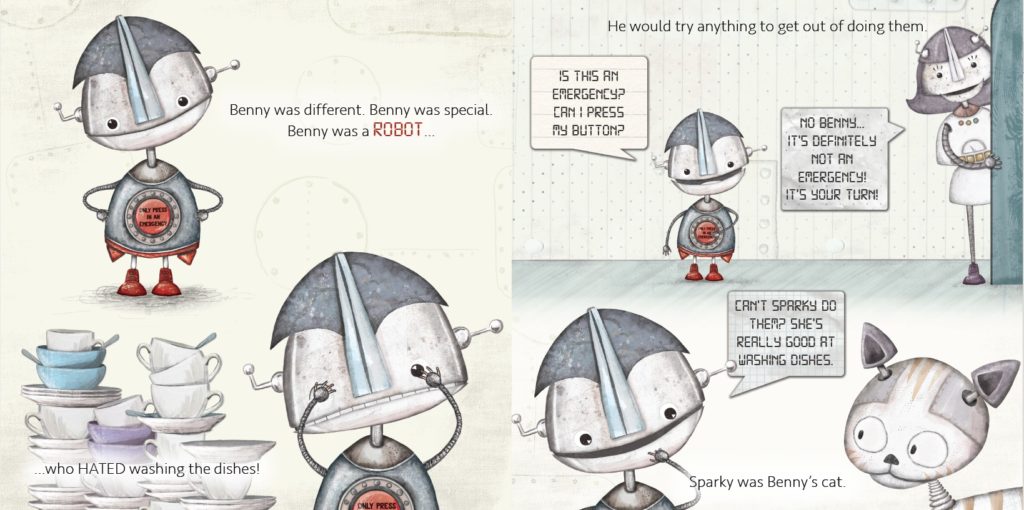
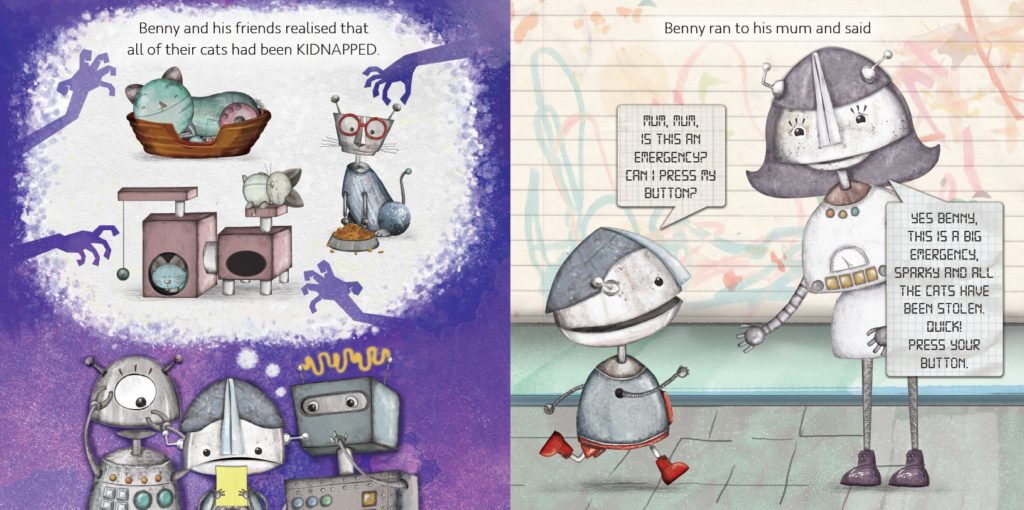
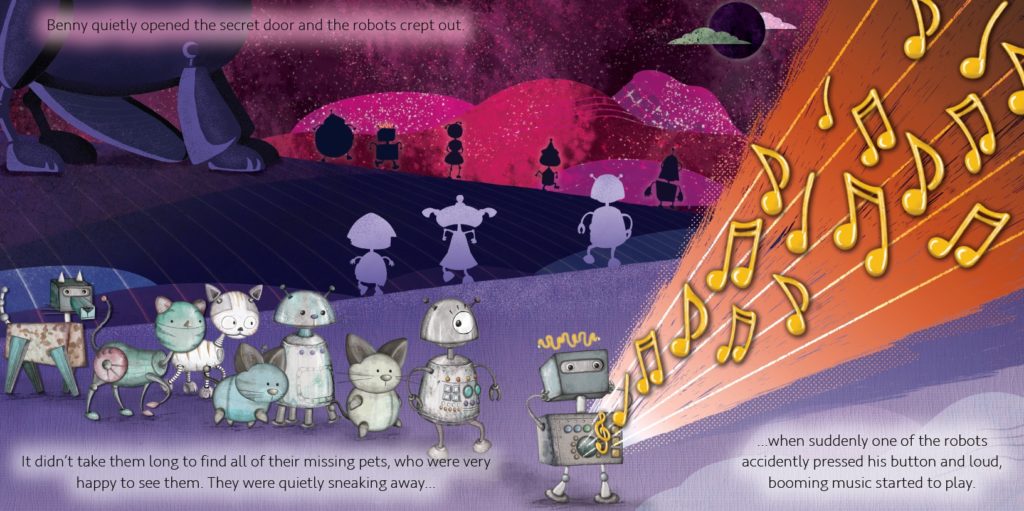
One Button Benny and the Gigantic Catastrophe by Alan Windram is published by Little Door Books, priced £6.99.
There has been a huge surge of interest in cycling over the COVID-19 lockdown as people have tried to curb their reliance on cars and public transport. In Gears for Queers, authors Abi Felton and Lili Cooper tell us that you don’t need to be consumed by all things lycra to challenge yourself to a memorable cycling adventure. BooksfromScotland chatted to them both about their recent experiences in cycling, writing and publishing.
Gears for Queers
By Abigail Felton and Lilith Cooper
Published by Sandstone Press
You’ve had quite the adventurous time of it over the last couple of years. Firstly, you both cycled (and camped!) across Europe and then you decided to write about the experience. How did these adventures come about?
Abi: When we started dating, we both talked about travelling, but neither of us were sure how we wanted it to look. For a while, I had been thinking about walking across Europe, and it was Lili who suggested we try cycling instead. I hadn’t been on a bike for about eight years before we met, so I knew it would be a steep learning curve, but I was up for giving it a go!
The opportunity to write the book came up when we were approached by Kay, an assistant publisher at Sandstone Press, based up in Inverness. She’d got hold of a few of our zines and asked us if we’d considered writing a book!
Did you always know that you would write about your trip?
Lili: Not at all! Or at least, not in the way we ended up writing about it. I kept a journal the whole way, and when we came back we started writing blog posts and zines about the tour, but really focusing on specific things like offering advice for folxs considering touring, or vegan campstove recipes. I think we probably wouldn’t have written a book about the trip without the push from Kay, and she really helped us figure out the process. In the end, it’s a very time consuming, albeit rewarding, experience, and with the pressures of jobs and life, I’m not sure we’d ever have carved out that time of our own initiative.
And now you’ve had to go through the publishing process in the strangest of circumstances. As debutants you don’t have the comparison of publication outwith a pandemic. Still, how have you coped with lockdown?
Abi: I think like most people, lockdown has been a total rollercoaster. We definitely had a massive crash post-publication, because for a while that was our only focus, and it felt like it came around really quickly! The one thing that was great was having a really supportive community on social media, who helped keep us feeling excited and good about the process, because it’s easy for that to be chipped away at in such stressful circumstances.
Lili: We’ve been phenomenally lucky really – both of us have been able to continue working from home, neither of us needed to shield and we’ve got pretty stable housing. In terms of publishing, the hardest thing for me has been it not feeling ‘real’ – we can’t just go into a bookshop and see our book there. We’ve been really grateful for everyone sharing photos of Gears for Queers and messaging us to say they’re reading it or have enjoyed it.
But back to your story. We are well used to the phenomenon of the MAMIL (Middle-Aged Man In Lycra) – so much so they have a recognised acronym! Were there challenges you didn’t expect cycling long-distance as a queer couple?
Lili: I think on the tour we write about in the book, many of the challenges were those we face in our everyday lives – questions of safety and visibility that are as present at home, as they are on the road. There were loads of challenges of long distance touring we didn’t expect, completely unrelated to being a queer couple, simply because we were complete beginners. And I think we also faced challenges that any couple would face, travelling together and living in a tent for six months!
We went on a second longer tour in 2019, where we cycled from Kirkcaldy to Budapest. Travelling through somewhere like Hungary, where we knew there were maybe more negative attitudes towards LGBTQ people, increasingly reflected in legislation, we were more cautious and, whilst there were lots of places where we felt safe and welcomed, it was also stressful as a queer couple feeling that bit more guarded.
Although your trip was testing physically and mentally, there were plenty moments of joy and appreciation. What are your favourite memories?
Abi: I think so many of the joyful moments came after really hard times – like a stop at a thermal bath in Germany in the midday heat, or eating the best falafel in Switzerland after a hell ride. But for me nothing will beat when we were invited into a family’s house, in the middle of this tiny village in France. We’d knocked on the door for water, because we were going to wild camp nearby and were invited to stay overnight. Sophie and her three children cooked us an amazing three course vegan meal, and we stayed up late helping the kids with their English homework. In the morning they sent us off with fresh baguettes from the bakery. It was such a warm and generous act.
Lili: I think one of my favourite memories is of eating dinner with our Warmshowers host on the roof of a student house in Wageningen in the Netherlands, as the sun was setting. It’s funny, whilst the cycling was fantastic, and some of the views and the hills and the routes will stay with me forever, the memories that are most special to me are to do with the people we met, who hosted us, or who we encountered on the route.
What did you notice about each country’s relationship with cycling that’s different from the UK?
Lili: God, so much! Especially starting riding in the Netherlands, it was so different – in terms of infrastructure, being able to ride off road cycle paths pretty much everywhere, and in terms of attitudes to cycling and cycle touring. When we’ve ridden fully loaded touring bikes across the UK we’ve felt like a total oddity, but it’s much more common across mainland Europe. The difference, especially in terms of how bikes (and pedestrians) have priority at things like roundabouts, and the way that can impact drivers attitudes, is really noticeable. It wasn’t always great – we had some pretty hairy rides in Switzerland and parts of the south of France – but there were undeniable differences.
Because of COVID-19, there has been a surge in interest in cycling. What advice would you give to these new cyclists?
Abi: I’d say don’t worry about what other cyclists are doing. There’s sometimes a pressure to cycle in a certain way, or be a certain type of cyclist, or look a certain way. But really cycling should feel fun – whether you’re riding to and from the supermarket, or along the Rhein. Sometimes I get bogged down because I don’t feel fit enough, or fast enough, but as soon as I get back on my bike, all that disappears and I know I belong on two wheels!
Lili: My advice would be more practical. Find a bike you are comfortable riding – it doesn’t have to be the newest or the lightest or the most expensive. If you’re interested in learning how it works, there are some great classes and places to do that – I’d recommend London Bike Kitchen’s online classes as great place to start – but if you’re not interested, that’s ok too! Try out different route planning tools – we use open street maps in combination with google maps and komoot to figure out new routes. Finally, I guess I’d say connect with other cyclists – whether in real life or online!
Have you been thinking about your next cycling adventure once travel restrictions are lifted?
Lili: We went to a webinar from Cycling UK about the Great North Trail and were totally sold. We don’t fly, so international travel is probably going to be off the table for a little while yet, and we were already looking for routes closer to home. In the far future, we have some unfinished business from our 2019 tour and I think we’re going to take the bus to Munich, cycle to Venice, and then follow the coast round and down to Athens!
Abi: I recently discovered the Great American Rail Trail, so that’s on my radar too!
How did you approach the task of writing your travelogue together?
Abi: We’re lucky in that a lot of the work we do is already done collaboratively, so we both felt pretty comfortable facing writing a book together, more so than if we were doing it individually! We decided early on to split the book as evenly as possible, and to make sure neither of us had more of the exciting events than the other. We worked to keep our voices really distinct. It can be easy to fall into a sort of ‘shared narrative’ when we are talking about the tour. That said, one of the advantages of writing alongside your touring partner was the ability to memory check each other, and we spent the first few months reminiscing and remembering together in as much detail as we could.
Do you have any plans to write together again?
Lili: Definitely! Abi is keen to start on Gears for Queers part two, but I’m waiting for the dust to settle from this first book. But we’ve been writing blogs and zines in the last few months – I think one of the best things about our relationship is that we enjoy working on creative projects together!
Finally, what have you been enjoying reading during lockdown?
Lili: Luckily, it was Abi’s birthday during lockdown, and two of our favourite bookshops – Lighthouse in Edinburgh and Category Is Books in Glasgow have still been delivering! The last book I read was The City We Became by N.K. Jemisin, which I just smashed through in three days.
Abi: Pre-book publication I was reading a lot of memoir and travelogue, but since the book came out I have retreated into science fiction and fantasy. I finally finished Circe by Madeline Miller, and at the moment I’m halfway through Rosewater by Tade Thompson.
Gears for Queers by Abigail Felton and Lilith Cooper is published by Sandstone Press, priced £8.99.
In interviewing Malcolm Alexander about his book, Close to Where the Heart Gives Out, David Robinson finds a doctor who discovered time is often the best medicine.
Close to Where the Heart Gives Out: A Year in the Life of an Orkney Doctor
By Malcolm Alexander
Published by Michael O’ Mara
Looking back, Malcolm Alexander can hardly understand why he took the job. It’s not as though he liked island life: even a month as a junior doctor in Shetland had been long enough. So why he even applied to be a GP on the Orkney island of Eday (population 125) in the late 1980s was something he can’t properly explain. It’s not as though the island had made a particularly good first impression either: on his first visit, he decided to rule himself out as a candidate at the interview in Kirkwall the following day.
He changed his mind, took the job, moved there with his wife Maggie, a trained anaesthetist, and their four young boys, and in turn Eday changed his life. How it did so, and how he and his family learnt to love the island is the subject of his thoughtful, well-written and engaging memoir Close to Where the Heart Gives Out.
Alexander, 63, worked on Eday for only four years in his thirties, and his book is mainly about his first year there. The rest of career – indeed, the rest of his life – hardly gets much of a look-in, though he has held a number of top-level medical posts, and was associate medical director of Scotland’s telephone triage service, NHS 24, before he retired three years ago. So why, I ask, did he give his memoir such a tight – and come to that, rather non-egotistical – focus? What was so special about that first year on Eday that it dominates his life’s rear-view mirror?
‘The original intent,’ he tells over the phone from his home on Bute,’was to show how a doctor thinks and to write about things which they don’t often express – such as fear of failure. To be honest, I’m not sure how well it achieves that aim, because in the writing I often got distracted by the environment and the people.’
That’s understandable. In his previous practice in suburban Glasgow, he’d never experienced the kind of ferocious winds he did on Eday (‘It’s only a proper gale,’ locals tell him, ‘when the grass goes black.’) ‘Growing up in West Linton, I’d always enjoyed nature, yet on Eday … Well, the wildlife was everywhere. I’d never seen curlew chicks, for example, yet there you might see them walking down the road.’ He writes well about the island’s ‘intake and exhalation of wildlife’ and it’s somehow no surprise to find him working as a de facto vet for the occasional injured seal or sick swan.
The main focus, though, is on the islanders. In Glasgow, he treated an average of 30 to 35 people in a morning’s surgery. On Eday that number dropped down to around seven. Even so, he says, that’s not the best patient-doctor ratio in the NHS: that honour belongs to North Ronaldsay, whose GP has to look after a mere 90 potential patients.
‘Doesn’t that mean it’s all a bit of a skoosh?’ I ask with my customary tact.
‘This is why Eday was so pivotal for me. You had so much more time with the patient. The consultation in the surgery might still average 10 or 15 minutes, because there would be people in the waiting room: they trended to arrive at the same time and all have a blether, but you didn’t want to keep them waiting all the same. A home visit, however, could take an hour and a half, because you then had the time to immerse yourself in the patient’s whole history. And the central realisation from that is that it’s lives that are important, not the prescription.’
Many of his patients were elderly people whose lives had barely changed since the 1950s, many of them with a stoicism engrained in pre-NHS days when it had cost money to see the doctor. One such was a woman whom he treated in the same box bed in which she’d been born. Her croft had no electricity and the only water supply was the rain collected in buckets by her front door.
Alexander’s book is dedicated ‘to the people of Eday, who helped me understand the important things in life’. Like what? ‘The key realisation was that I needed them just as much as they needed me. And when you really fit into a community you become more tolerant of people. You realise that everyone has stress in their jobs – maybe the boat couldn’t get to the pier that day or there wasn’t enough flour on the island or the farmers hadn’t been able to make hay. The island taught me that I was part of the community, and that I was no more and no less important than anyone else.’
That lesson stayed with him when he helped to write the clinical algorithms underpinning NHS 24 in Scotland. ‘When I started working there in 2005, the questions you’d be asked in the telephone triage were too long and boring and we had to rewrite them to make them quicker and easier to understand. All the time, I had in mind whether those questions would still be appropriate for someone ringing from Eday. If you write them just for, say, Glasgow, you might be assuming that people can just go down the road and buy some paracetamol, that they can hop into a car and go to A&E. But that’s not going to work for Eday, so why not write an algorithm that’s helps them to do what they can at home and then move them to an A&E environment that might involve a boat or a plane but which would just be a taxi in Glasgow?’
Although he doesn’t mention any of this in his book, I notice that he talks about NHS 24 as ‘a general practice with five million people in it’. And somehow it’s entirely apposite that such an important part of the whole nation’s health care has its roots in the attentiveness and experience of a doctor working on with a maximum potential caseload of just 125 souls.
This is a wonderful portrait of island life and a year of family adventure, discoveries and occasional moments of fear, as when his heavily pregnant wife has to be flown off the island for emergency care in Aberdeen – the only time he kicks himself for living in such a remote place. I will, however, take issue with Alexander on two points: first, for thinking that he hasn’t conveyed a sense of the fear of failure any island doctor must surely feel when they alone have to deal with an emergency. Secondly, for writing that ‘We don’t spend enough time truly doing nothing.’ Really? Even in lockdown? ‘Well,’ he concedes, ‘maybe I should rewrite that bit now.’
Close to Where the Heart Gives Out: A Year in the Life of an Orkney Doctor by Malcolm Alexander is published by Michael O’ Mara, priced £8.99
The great thing about thrillers is at they often play with or even break the conventions associated with the genre. Tom Gillespie’s novel The Strange Book of Jacob Boyce may start with the mysterious disappearance of Ella Boyce, but it becomes something entirely unexpected and surprising. We got in touch with Tom to talk more about his novel.
The Strange Book of Jacob Boyce
By Tom Gillespie
Published by Vine Leaves Press
Here, Tom introduces his novel The Strange Book of Jacob Boyce:
Tom gives us a reading:
Now, Tom talks about the theme of obsession in the novel:
The Strange Book of Jacob Boyce by Tom Gillespie is published by Vine Leaves Press, priced £9.99.
In the latest installment of the Mirabelle Bevan series, author Sara Sheridan has her super sleuth up in the Highlands for her latest adventure. BooksfromScotland chatted to Sara about the books that mean the most to her.
Highland Fling: A Mirabelle Bevan Mystery
By Sara Sheridan
Published by Constable & Robinson
The book as . . . memory. What is your first memory of books and reading?
I was definitely the weird kid in my family and the only one who was into books. We didn’t have much to read around the house when I was growing up, at least not initially, but I encouraged my parents to invest in some books for me. I remember visiting the old Bauermeister shop on George IV Bridge and also going to Morningside Library (which was VERY exciting) I find it difficult to remember much from being very young but my father read me Peter Rabbit and I learned the word soporific and I remember being excited – soporific remains one of my favourite words. I still get excited when I find a new word I like the sound of.
The book as . . . your work. Tell us about your latest book Highland Fling. What adventure does Mirabelle Bevan find herself in?
Highland Fling is the 8th Mirabelle Bevan mystery. I’ve been writing my way through the 1950s for 9 years now and I’ve got to 1958 at last! I’ve been dying to bring Mirabelle home to Scotland, but I was waiting for the Cold War to get fully underway… and for her relationship with Superintendent Alan McGregor to get to the point where he could introduce her to his family, specifically, his cousin who lives outside Inverness. I love Agatha Christie and I wanted to write a traditional country house mystery and of course, Mirabelle and McGregor have barely arrived when a the body of a glamorous fashion buyer commissioning a range of cashmere for a New York boutique is found in the orangery. Scotland in the 1950s is fascinating – for a start it’s when we stopped voting majority Tory but also, in the Highlands, most landowners were right wing and had been since before WWII when they mostly supported Neville Chamberlain’s appeasement plans. Plus the 1950s was the genesis of modern press so I wanted to have paparazzi, whisky cocktails and courtesy of the American contingent of characters, a dollop of 1950s New York chic. People often talk about landscape when they talk about Highland Noir, but though the scenery is lovely, I think the character of Highlanders, particularly Highland women is unique, so I wanted to explore that – hard as nails, no nonsense and genuinely thrawn.
The book as . . . object. What is your favourite beautiful book?
This is a tough one. I love Kate Leiper’s illustrations and her Illustrated Treasury of Scottish Mythical Creatures is magical. But also, I am obsessed with maps. I’ve got Edinburgh Mapping the City by Chris Fleet and Daniel MacCannall on my desk at the moment and I love it. But then, the Common Weal’s Atlas of Opportunity is also on display in my study and has been since it came out cos I want to keep it in mind.
The book as . . . inspiration. What is your favourite book that has informed how you see yourself?
Straight up – my daughter wrote me a notebook for my birthday this year of memories and also of things we’ve learned and how we’ve grown in our family since she left home and it’s the most inspiring thing I’ve ever read. So personal but important to me.
The book as . . . a relationship. What is your favourite book that bonded you to someone else?
When I met my now-husband, he gave me a copy of Water Music by TC Boyle which is hands-down my favourite historical novel and I suppose I knew then he was a keeper (the husband, not TC Boyle)
The book as . . . entertainment. What is your favourite rattling good read?
I love Eva Ibbotson – she’s my favourite mid-20th century writer and her novels for adults are good-hearted and whizz along. I’d choose A Countess Below Stairs or Madensky Square. That’s what I’d take to the beach.
The book as . . . a destination. What is your favourite book set in a place unknown to you?
I go back again and again to Apsley Cherry-Garrard’s Worst Journey in the World which is his account of his expedition with fellow Antarctic explorers Birdie Bowers and Edward Wilson when they walked through the harsh Antarctic mid-winter to collect Emperor Penguin eggs. The book was recommended to me by a writer friend I bumped into deep in the shelves of Thins on South Bridge. It’s probably why I wrote The Ice Maiden which was my imaginative response to the stories about polar explorers of the heroic age – with an added supernatural element.
The book as . . . the future. What are you looking forward to reading next?
Because I’m writing a novel right now and I find it difficult to read fiction and write fiction at the same time, I’m saving books to read. When I next get a reading break, I’m slowly working my way through some of the little-known female Scottish writers I discovered last year while writing Where are the Women? So I have a Jane Porter novel on the side plus Unsheltered by Barbara Kingsolver and also an anthology of short stories to which I contributed a Mirabelle Bevan short – I’m dying to read the others. It’s called Noir from the Bar and all the profits go to the NHS.
Highland Fling: A Mirabelle Bevan Mystery by Sara Sheridan is published by Constable & Robinson, priced £8.99
There has been a real resurgence in interest in the Scots language, and poet, Stuart Paterson, has a new collection for bairns to get that interest started early. Here are a few poems from his latest collection that’ll fair mak ye greet wi’ lachter!
Poems taken from A Squatter o’ Bairn Rhymes
By Stuart Paterson
Published by Tippermuir Books
The Tobermory Dodo
Whit’s yon ye say?
Ye’ve never heard
O Tobermory’s
Wingless burd?
Ane day it grew
Gey seek o copin,
Upped an skreighed fareweel
Tae Oban.
Flew tae Mull
A while tae bide,
Lost the baith its wings
An steyed.
Alas, it ate
Jist Cullen Skink
An twae year later
Wis extinct.
Ma Wee Mammy
Ma wee mammy
Is the bravest wee mammy.
She disnae greet nor wheenge
When her leg gets gammy,
She jist gets tae wark
Wi a duster or a shammy.
Ma wee mammy
Is the bravest wee mammy.
Ma wee mither
Is the hardiest wee mither.
In a stooshie or a barnie
She’ll no stop nor swither,
She’ll tell ye whit’s whit
An she’ll clap yer heids thegither.
Ma wee mither
Is the hardiest wee mither.
Ma wee maw
Is the smertest wee maw.
She kens jist aboot aathing
But there’s nae wey she’s a blaw,
Her heid’s aye in a beuk
An whit she disnae ken’s hee-haw.
Ma wee maw
Is the smertest wee maw.
Ma wee mammy
Is the smashinest wee mammy.
Ah’m tellin ye Ah’m lucky,
Pure fortuitous an jammy
That ma maw, ma mither, mammy
Is the very cat’s pajammies
An gin ye say ocht different
Then we’re gonnae hae a rammy!
Ma wee mammy
Is the best wee mammy in the warl –
An so is yours!
Space
The universe
Is lang an wide,
It has nae bottom
Tap nor side.
When did it stert?
When will it feenish?
Thinkin o it
Maks me squeamish.
Mixter-Maxter
In Scotland oor wirds
Are gey different, aye.
When ye speir someone how?
Then yer speirin them why?
Piece isnae a fragment
It’s somethin ye eat
Wi twae dods o breid
An cheese or cauld meat.
An when ye feel doon
Then ye micht stert yer greetin –
Elsewhaur it’s somethin
Pals dae when they’re meetin.
When ye bide here in Scotland
In north, sooth or centre
Then mind’s no yer mind
It’s the wird tae remember.
A tap isnae somethin
Ye turn on fir watter
It’s somethin ye weer
In cauld chitterin wather.
A burn willnae burn ye
Burns are aa roon ye
Though dinnae loup in
In case the burn droons ye!
A press willnae press ye
A press ye’ll discover
Is whit thaim in England
Will aye cry a cupboard.
Messages arenae
The texts that ye’ve got,
They’re whit ma an da
Will bring hame fae the shop.
A poke’s no a prod
An whit’s in it’s delish,
Yer braw sausage supper
Or chips wi yer fish.
Ginger elsewhaur is aye
Kennt as a spice.
In Scotland it’s juice
An tastes fower times as nice.
Mince isnae aye
Whit ye hae wi yer tatties –
If ye talk it they’ll cry ye
A richt glaikit daftie!
Ken is a name
Jist like Jimmy nor Joe.
Up here it’s the wird
That some Scots yaise fir know.
A hen is a chookie,
Lays eggs an scrans grass.
In Scotland it’s whit
Ye cry wummin or lass.
An dinnae tell fowk
That ye fair like tae hum –
It means ye’ve no waasht
Or no dichtit yer bum!
A Squatter o’ Bairn Rhymes by Stuart Paterson is published by Tippermuir Books, priced £7.99
Emma Major has been inspiring many with her thoughtful and distinctive illustrations in her book, Little Guy, which offers a gentle path to finding a way through anxiety. She even found herself appearing on Grayson Perry’s Art Club during lockdown! Here, we share some of her illustrations with her own video explanations.
Little Guy
By Emma Major
Published by Wild Goose Publications
Little Guy Picture 4
Floating peacefully
Leaving stress and strain behind
Catching calmness
Little Guy Picture 6
Swinging thoughtfully
Breathing deeply; thinking likewise
Looking for uplift
Little Guy Picture 11
Singing joyfully
Not a care in the world
A lesson for me

Little Guy Picture 14
Waves gently lapping
Warm breezes cooling heat haze
Perfect peacefulness

Little Guy by Emma Major is published by Wild Goose Publications, priced £3.90.
If you’re looking for something a little bit different from your crime fiction, then BooksfromScotland recommends you give Claire Macleary’s dynamic duo, Maggie and Wilma, your full attention. There are now four mysteries to catch up on if you’re still to introduce yourselves – Cross Purpose, Burnout, Runaway, and now Payback – and Claire gives us a wonderful reading here. She also takes the time to answer some probing questions . . .
Payback
By Claire Macleary
Published by Saraband Books
Payback by Claire Macleary is published by Saraband Books, priced £8.99
Anthony McGowan’s Lark has won the Carnegie Medal, the UK’s oldest and most prestigious award for children’s literature, published by dyslexia-friendly independent Barrington Stoke, based in Edinburgh.
Author, Anthony McGowan has said of his win:
‘Every writer for young people dreams of winning the Carnegie Medal. Its incredible history, the roll call of the great writers who have won it and the rigour of the selection process makes this the greatest book prize in the world. It is also a magnificent way of connecting with readers. The hundreds of shadowing groups in schools and libraries around the country provide that one thing that writers cannot do without: a living, arguing, debating, biscuit-munching population of brilliant readers!
On one level, Lark is a simple adventure story. Two woefully ill-equipped teenage boys and their old Jack Russell terrier go for a walk on the North Yorkshire Moors. A blizzard descends and their fun day out, their ‘lark’, turns into a desperate battle for survival. On another level, the book is about the unshakeable love between two brothers, one of them with special needs, after enduring family break-up, poverty, bullying and cruelty. Lark is also a story about the power of stories and the way they weave through our lives. The book ends with the words “Tell me a story”, and with those words we are led back again to the beginning.’
BooksfromScotland are so thrilled to hear Barrington Stoke’s great news, that we thought we’d share the first chapter of this amazing, and now award-winning, story. Treat yourself to this taster – we’re sure it will make you want to read the rest!
Lark by Anthony McGowan is published by Barrington Stoke, priced £7.99
If you’ve yet to make your acquaintance with Douglas Watt’s fictional investigator, Advocate John Mackenzie, has he solves criminal cases against the backdrop of 17th century Edinburgh, then BooksfromScotland urges you to rectify that immediately! This month, Luath Press brings out a brand new adventure, where Mackenzie’s life has changed since the political upheavals following the revolution in 1688. When he is tasked by an enemy to investigate a merchant’s brutal murder, he is, at first. reluctant, fearing ulterior motives. But he is soon is drawn in to the mystery, and in this extract, we follow him as he observes the scene of crime.
Extract taken from A Killing in Van Diemens Land
By Douglas Watt
Published by Luath Press
He returned to the kitchen and examined the range. Had something been burned there in the night? He took a rag and opened the small metal door, peering inside. It had burned out and was full of ash. A small white shape caught his eye at the front. He picked it up delicately. It was a small fragment of material, a couple of inches in length, partly burned. He placed it in his pocket and stood for a few moments more, contemplating the scene, recalling the kitchen of his foster mother years before when he was a boy in the Highlands. It had been his job to make sure the range was supplied with a plentiful supply of peat. He had taken a particular pleasure in the responsibility, carrying the basket back and forward from the peat stack. He remembered the sweet odour of burning peat filling the house. The range in Van Diemen’s Land used coal. A scuttle sat beside it. He picked up a lump of coal and stared at it, before dropping it back into the scuttle.
On the way out the kitchen, MacKenzie cleaned his shoes with the rag to remove any blood picked up from the floor. He climbed the stairs to the ground floor and walked down the narrow hall to check the front door. It was bolted securely and the lock appeared sound. He turned into Kerr’s trading premises on the right, a large bright room full of bales of cloth which included calico, blue linen, brown linen, diaper, serge and Yorkshire. A fine bale of green linen and some high-quality muslin caught his eye. Kerr must have had rich customers.
The window at the front of the chamber which looked out on the courtyard was made up of dozens of tiny rhomboid panes of glass. They were all intact. Another window at the back of the chamber looked out onto the rig behind and there was a door to the garden. The window was also barred with iron and intact. MacKenzie entered the office on the left. It had one tiny window, high on the wall which was too small for anyone to enter through. Inside the office, documents and papers were strewn over the floor and the desk had been ransacked.
There were two kists on the floor. The lid of the smaller one was open. MacKenzie got down on his haunches. A key, part of a set, was in the lock and the kist was empty. He turned to the larger kist and found it was locked. He tried to move it along the floor, but it would not budge more than a few inches because it was chained to the wall. He took the set of keys from the lock of the small kist. The second one fitted and he opened the larger one. Inside was a pile of bonds, notes and bills of exchange. Underneath the stack of paper, he found a pistol, as well as gold and silver coins, guineas and pieces of eight. He quickly estimated they came to a healthy sum – a couple of hundred pounds sterling at least. The burglar had chosen the wrong kist.
MacKenzie returned to the back door and noticed it was very slightly ajar. He pulled it open carefully. It provided access to a stone platform above the basement which led to the yard at the back. It was immediately obvious the lock had been broken. A vision flashed through his mind of the killer entering here, but why did he or she descend into the kitchen? If Kerr had disturbed a thief, he would have confronted the person up here. Or had the thief taken Kerr down to the kitchen for some reason? He closed the door gently and returned to the office to examine the debris on the floor more carefully. Letters and lists lay everywhere. He picked up a random paper – an inventory of cloth Kerr had bought in Amsterdam.
He noticed a line of ledgers on a shelf above the desk. He looked through the first fat leather-bound volume. The ledger itemised Kerr’s purchases and sales back in the 1670s. MacKenzie returned it and took the next on the right. The book was only half used. He found a number of transactions dated the day before – three in total. He wrote the names in his notebook. William Spence, Ninian Reid and Archibald Purves were all tailors in Edinburgh. A portrait of Kerr and his wife on the wall opposite the window caught his attention. The painting gave the impression of confidence and wealth, but there was something about the demeanour of Margaret Kerr. MacKenzie noticed again that she was a fine-looking woman, if a serious one. From the picture she hardly appeared a happy wife. A knock on the door startled him. Margaret Kerr herself stood at the doorway; the same beautiful, unhappy face in the painting, although a little older.
She spoke first. ‘Was the motive theft, Mr MacKenzie? I see the back door has been broken.’
‘It’s too early to say, madam’, replied MacKenzie.
She moved into the room and looked at the kists. ‘My husband always carried the keys with him. Everything is gone from the smaller one.’
‘It may be burglary’, replied MacKenzie, nodding. ‘But I haven’t seen around the house yet. Where did your husband keep his keys?’
‘They were always on his belt. He wore his belt even in bed at night. He never took it off.’ She crossed her arms over her chest and looked away.
MacKenzie moved closer to her. ‘Do you know what’s been taken from here?’
‘The cash was kept in the larger one. The small one contained items concerned with daily business. Maybe some bonds… correspondence, that kind of thing, a little petty cash perhaps. He kept important things in the larger one.’
‘Why would a thief take the papers from the small kist and not try to open the larger one?’ asked MacKenzie. She did not reply and shook her head. MacKenzie turned back to the portrait, smiling. ‘A fine likeness. When was it painted, madam?’
She stood transfixed for a few moments staring at the image, before coming back to herself. ‘About ten years ago. A Dutch artist was in town painting nobles and lawyers and merchants. It cost us a pretty packet. Jacob was adamant we should be recorded for posterity. The artist was impressed by the Dutch name of our house. He was disappointed to learn we did not belong to the original family.’
MacKenzie smiled. ‘Is it a good likeness of your husband?’
She looked at the painting again, and as she did so, dropped to her knees. She cried out, ‘What are we to do now, sir? Why has God forsaken us? Why has He taken him?’
MacKenzie helped her back to her feet. As she looked up at him, he saw for an instant the younger woman in the portrait. She was bonnie indeed, if a tad severe, like many Scottish lasses. The ministers and elders of the Kirk, like her husband, demanded their wives dress like crows. He looked again at the portrait. Kerr appeared confident to the point of arrogant with a large belly protruding over his belt. And there were the keys hanging from it. The keys he slept with. The security of his house and the kists was paramount to him as a merchant. MacKenzie observed Kerr’s large florid cheeks, cold eyes and double chin. Something made MacKenzie shudder at the owner of Van Diemen’s Land.
He turned from the painting and nodded at Mrs Kerr. ‘I’ll take in the rest of the house myself, madam.’
A Killing in Van Diemens Land by Douglas Watt is published by Luath Press, priced £8.99
ALSO ON BOOKS FROM SCOTLAND
-


Saltwater: A Midsummer Ghost Story by Elaine Thomson
‘The very thought of those grey faces made my skin grow cold.’
-

‘An Odious Campaign’ by Rob McInroy – Why a 1936 By-Election Still Resonates
‘This enraged the locals and he came close to being run out of town on several occasions.’
-

‘‘That’s right, Bobby,’ he growled. ‘I haven’t seen you in – well, since you decided to kill me.’ ‘
-

David Robinson Reviews: Solitary Agents by David Goodman
‘This is very much an up-to-the-minute story of spycraft, positively revelling in all the things tha …
-

The Savage Landscape by Cal Flyn
‘It is their resistance to the intrusions of the outside world − culturally, economically, environme …
-

The Shortest History of Scotland: A Q & A with Murray Pittock
‘We need to be better aware of that to understand the challenges and achievements of the past, and t …
FEATURED AUTHOR:
Neil Broadfoot

Neil Broadfoot worked as a journalist for 15 years, covering some of the biggest stories of the day. Falling Fast – which was shortlisted for the Dundee International Book Prize and the Bloody Scotland book of the year – is the first in the Edinburgh-s …
FEATURED PUBLISHER:
Bright Red Publishing

Bright Red Publishing is an independent educational publishing company based in Edinburgh with our own distribution warehouse in Fife. We are a small, but perfectly formed, team of seven and we manage every part of our publishing process here in Scotla …