


Alistair Moffat mixes history and travelogue in his latest book, The North Sea. In this extract he travels to the Bell Rock to investigate the story of the Stevenson lighthouse that dominates the skyline.
The North Sea: Along the Edge of Britain
By Alistair Moffat
Published by Canongate
Seven years after Robert Stevenson had surveyed the Bell Rock, the Commissioners of the Board of Northern Lights were at last persuaded that a lighthouse should be built on it. But not by Stevenson. John Rennie had designed and overseen the construction of canals and aqueducts as well as taking a leading role in drainage schemes in the Fens. At Kelso, my hometown, he was responsible for a beautiful bridge over the Tweed that has stood many tests of time. Rennie’s insistence that its piers should be sunk more than two metres into the bedrock below the river, the diggers protected by coffer dams, made the structure immensely strong and durable. It was the model for London’s Waterloo Bridge.
Economic arguments were also persuasive for the Commissioners. In the second half of the eighteenth century victorious campaigns against the French in Canada and India had given Britain a vast and potentially very lucrative empire. Merchant shipping was the only means of bringing raw materials to the mills and factories of an industrialising British economy, and far too many cargoes and men were being lost at sea. A light on the Bell Rock would also greatly enhance the developing economy of Dundee. Raw flax for the city’s linen mills was being imported from Russia and the Baltic, while commercial whaling had begun in the 1750s. These valuable cargoes needed safe access to the mouth of the Tay.
*
On 16 August 1807, with a rousing send-off from Arbroath harbour, the first work party sailed out to the Bell Rock. Their immediate task was to clear it of seaweed and the melancholy litter left by shipwrecks. The plan was to build barracks so that workers did not have to be ferried back and forth from the shore or spend periods of high tide on board the lighthouse ship, and footings had to be prepared for the cast-iron skeleton of the structure. Most important was the digging of the wide foundation pit for the base of the lighthouse. Hacked out of the rock with picks, pinches and chisels (which needed constant maintenance from blacksmiths), the pit needed to be perfectly flat and perfectly circular. Sixty centimetres deep, it would hold the first two courses of granite in place, and eventually the whole lighthouse, planted like a post in a posthole.
It was wet, slippery and dangerous work – and at one point almost fatal. On one autumn day the lighthouse ship broke away from its moorings and left Stevenson and his work party of thirty-two men stranded on the rock. The tide was rising as they watched the ship drift further and further away, and disaster loomed. It was only a matter of time before the incoming tide engulfed them. There were two small boats used to transfer materials from the ship, but they could only take a few of the men. Stevenson later recalled:
‘Not a word was uttered by any one, but all appeared to be silently calculating their numbers . . . The workmen looked steadfastly upon the writer [Stevenson] and turned occasionally towards the vessel, still far to leeward. All this passed in the most perfect silence, and the melancholy solemnity of the group made an impression never to be effaced from the mind.’
But then good fortune suddenly intervened. One of the men thought he could make out a boat on the horizon, sailing out towards them from Arbroath. It was a supply vessel bringing letters – and salvation.
Landing granite blocks on the rock that weighed a ton, with nothing but simple, hand-winched cranes and muscle power, was proving very difficult, and as he did throughout the life of the project, Robert Stevenson had to be inventive, find a better way of doing things. To get the stones from the safe landing place to the foundation pit, he had a short railway built and a small bogey adapted which the workers could push. It was vital to move these blocks very carefully, without chipping them in any way. Their shape, carved by the masons in the Arbroath work yard, was crucial to the strength and the durability of the lighthouse. What, in essence, Stevenson had designed was a huge three-dimensional jigsaw, and it had to fit together perfectly to form strong foundations and the walls of the tower that would rise from them.
At the work yard in Arbroath wooden moulds were made and fitted together in what was both a trial run and a guide for the masons. Each stone was carved like a jigsaw piece that would fit only into the stones next to it. The blocks of granite forming each course would link together in a circular pattern with a curved outer face before tapering inwards in sinuous lines to where they were butted against the stones next to them so that they interlocked with them, and only them. When the first course had been laid and found to be perfectly level, the second was locked on to it using two techniques. Set at random intervals, joggles were small knobs, protuberances on the bottom of each stone that fitted snugly into exactly matching notches in the one below it. The second means of locking the courses together was to have two holes bored right through a stone and then part of the way through the stone below it. Oak rods known as trenails were then inserted and pushed down until their top ends were flush with the new stone’s upper surface. The ends were then split and wedges driven in to make the trenails as tight as possible. Pozzolana, what the masons called Roman cement, was used to point the seams between the stones. It would set in the wet. All of this very precise and strenuous work was done at speed in the two hours of low tide and with little more than muscle power and determination to make the stones fit. And they did fit, perfectly, giving the tower the immense strength it would need when gales blew in and mighty waves battered its walls.
At the end of March 1808 Robert Stevenson sailed out to the Bell Rock to see what damage the winter’s storms had done to the foundation courses. To his immense relief, not one stone had moved, the jigsaw had stayed in place, the design and all the care taken over the carving had proved itself. That summer the pace of construction quickened. Not only were the barracks completed, housing eleven men and Stevenson himself, but as one course was laid upon another, rising up out of the incoming tide, work could go on a little longer each day. By the end of August 1809 the lighthouse tower was nine metres high, its sheer weight also adding significantly to its strength. By June 1810 the first internal floor had been laid, where the entrance door now is. At the end of August all that remained was the difficult and delicate business of placing the lantern on top of the tower, the whole point and purpose of all that effort, skill and ingenuity.
In February 1811 the Bell Rock light flared for the first time, and since then it has only been extinguished in wartime. Waves thirty-five metres higher than the top of the lantern are whipped up by gales, but none of these mighty storms has made any impression. And nor could the Luftwaffe. Three times in 1940 and 1941 the lighthouse was strafed by machine-gun fire, and on 1 April 1941 a bomb was dropped. It exploded about ten metres from the base of the tower, but it didn’t cause any damage. The Bell Rock light can be seen for thirty kilometres out to sea as its beam rakes over the waves. And almost as much of a comfort, it can also be seen fifty-six kilometres inland, a reassurance for those who waited at home for the safe return of fishermen and sailors.
When the Ultimate Predator circled slowly around the lighthouse, the engines quiet and the passengers all standing on one side, the effect was almost hypnotic. Like others, I stared at the white tower as the sun made it brilliant. Awesome is now a threadbare adjective, but that is how it seemed to me; awe is what I felt, a belly-hollowing sense of awe at this elegant, powerful testament not only to hard, dangerous work and ingenuity but also to selflessness. The Bell Rock was built to save lives, and Robert Stevenson patented none of his inventions nor guarded any of the secrets of his methods so that others could use them elsewhere. More lights needed to be built, more lives saved.
As we sailed away, back to safe harbour, from this structure that had no business being there, standing sentinel in the midst of the sea for more than 200 years, I knew that I had been privileged to see one of the wonders of the modern world.
The North Sea: Along the Edge of Britain by Alistair Moffat is published by Canongate, priced £20.00.
The Little Book of Christmas and Hogmanay is the perfect stocking filler gift, but we’d also urge you to read it ahead of the festive season too to get some brilliant hints and tips about making your own celebrations that little bit more special. Here we include two seasonal recipes and poems for you to enjoy.
The Little Book of Christmas and Hogmanay
By Anna Marshall
Published by Birlinn
Whipkull
Whipkull (or whipkül) is Shetland’s answer to eggnog. The drink is thought to originate in Scandinavia and is traditionally made with cream, eggs, nutmeg and rum. People have also been known to substitute the rum for whisky. It is drunk at the end of a Yule feast and sometimes even as a breakfast drink on New Year’s Day.
INGREDIENTS
12 egg yolks
200g caster sugar
8 tbsp rum or whisky
350ml double cream
1 tsp nutmeg
METHOD
- Whisk together the egg yolks, sugar and rum.
- Add the cream.
- Pour the whipkull into glasses and dust with nutmeg.
How I’ll Decorate My Tree
It was still very far from Christmas
when my mamma said to me:
tell me, Precious, what you going to hang
on our Christmas tree?
I said: the fairy-lights that Dad just fixed
and . . . jewel-coloured jelly-beans from the
pick’n’mix –
oh, and from it I’ll dangle tinsel in tangles,
sparkles, sequins and spangles,
a round golden coin (chocolate money),
that cracker joke that was actually funny,
my rosary beads – and a plastic rose
as red as Rudolph Reindeer’s nose,
the gnome that grows the tangerines,
the picture of me with my tambourine,
and (this is Mum’s favourite, she says)
the photo of all of us in our PJ’s!
The Ladybird book that Lola lent me,
the blue butterfly bracelet that Brittany sent me,
the ear-ring I lost,
a pop-up Jack Frost,
a space-hopper, an everlasting gobstopper,
a pink-eyed sugar mouse,
the keys to my grandfather’s house,
a tiny pair of trainers with silver laces,
and – now my smile is straight – gonna hang up my
braces!
A marble, an angel-scrap, a star,
the very last sweetie out my advent calendar,
a kiss under the mistletoe,
a mitten still cracked with a crunch and a creak of
snow,
that glitter scarf I finally got sick of,
a spoon with cake-mix still to lick off,
the Dove of Peace that our Darren made,
some green thoughts in our tree’s green shade –
I’ll hang up every evergreen memory
of moments as melted and gone
as that candle that was supposed to smell
of cinnamon –
memories big as a house and as small’s
the baubles I used to call ball-balls.
With pleasure I’ll treasure them
then, on proper Christmas Day, I’ll show them all to
you
between the Queen’s Speech and Doctor Who.
Liz Lochhead
Black Bun
Black bun was supposedly the original Twelfth Night cake eaten in Scotland, before it became known as ‘Scotch Christmas Bun’ during the first half of the nineteenth century. It was traditionally a spiced fruit mixture encased in bread dough, but the dough gradually gave way to a lighter shortcrust pastry case and the name became simply black bun.
Serves 12–16
INGREDIENTS
For the pastry:
280g plain flour
½ tsp baking powder
grated zest and juice of
1 lemon
150g unsalted butter, diced
3–4 tbsp cold water
1medium egg, beaten to glaze
For the filling:
450g raisins
600g currants
100g whole almonds, roughly chopped
50g walnuts, roughly chopped
150g plain flour
75g caster or demerara sugar
1 tsp ground allspice
1 tsp ground ginger
1 tsp ground cinnamon
½ tsp cream of tartar
½ tsp baking powder
2 tbsp whisky
4 tbsp (approx.) milk
METHOD
- For the pastry, sift the flour and baking powder into a bowl, then stir in the lemon zest. Rub in the butter, then add the lemon juice and 3–4 tbsp cold water – enough to bind to a stiff dough.
- Turn out onto a lightly floured board and roll out thinly. Use two-thirds of the pastry to line a buttered, square 23cm/9in cake tin. Roll out the remaining pastry to fit as a lid, cover and chill both the lid and the case for half an hour or so.
- Preheat the oven to 140°C/275°F/Gas 1.
- For the filling, mix everything together, except the whisky and milk. (I do this with my hands – it is easier.) Now add the whisky, and enough milk to moisten the mixture. Turn into the pastry case and press down well.
- Dampen the edges of the pastry all round with a little water and place the rolled-out pastry lid on top. Press together the edges to seal, then cut off any remaining pastry. Prick all over with a fork. Using a very thin skewer, prick right through to the base of the tin: 6–8 pricks altogether. Brush the surface with some beaten egg, retaining a little for later.
- Bake for 2–2½ hours until golden brown on top, reglazing with the remaining beaten egg after 1 hour of baking.
- Cool in the tin for at least 2 hours, then carefully decant onto a wire rack to cool completely. Wrap in foil and store in an airtight container for at least 1month – and for anything up to 3–4months.
Open the Door
Open the door for the auld year
It is the pairtin-time:
Open the door for the new year
And lat the bairn win hame.
Bundle your winter’d joy and grief
On the back of the year that’s düne:
Open your hert for the new life
And lat the bairn come in.
William Soutar
The Little Book of Christmas and Hogmanay by Anna Marshall is published by Birlinn, priced £9.99.
Edinburgh’s Charco Press brings readers the best in Latin American fiction, but their latest book sees editor Carolina Orloff compile essays on feminism across the continent. We asked her to tell us why this project is so important to her and Charco Press.
La Lucha: Latin American Feminisms Today
Edited by Carolina Orloff
Published by Charco Press
What is the genesis of La Lucha? Why did you want to put this book together?
La Lucha comes from an intense desire that is the same one that gave birth to Charco: an urgent need to give visibility to Latin American voices and Latin American realities in the English-speaking world, which tends to be dominated by a mindset that, generally speaking, shies away from all-things translated, in the broadest sense of the term translation.
In recent years, women in Latin America have been leading profound social and political transformations, advancing feminist movements and human rights struggles in ways that are often unprecedented globally. As a woman living in the UK, where the realities of gender equality and social activism are very different, I felt it was essential for La Lucha to exist, and for people to access the experiences of these authors, activists and intellectuals. The book brings these voices and experiences to an international audience, offering insights into the courage, creativity, and resilience of Latin American women who are reshaping society, and inspiring readers beyond the region to engage with these vital struggles.
And Carolina writes in the Preface:
Feminism is ubiquitous (and so it should be) but not all feminisms are everywhere. This anthology arrives as both rupture and bridge: Latin American voices cross over not as guests, not as footnotes, but as protagonists in a global struggle for meaning and justice, where too often only a few feminisms are allowed to speak for the world. The pieces here collated are more than text: they are the catalysts of political consciousness, resistance, and transformation, taking place in a region which is generally neglected in the international weaving of idea formation. While bringing together a wide array of voices, this collection does not aim to smooth out or iron them into harmony; quite the opposite, it wants to celebrate and disseminate their differences, frictions, contradictions – their disobedient brilliance.
La Lucha, the title of this collection, expresses the powerful junction of feminist voices from Latin America. It is the noun in Spanish for fight, battle, confrontation. It is also the conscious action of resistance, the active representation of rage: an empowering sentiment running through the visions for change that bring these texts together. A fury that expands with and through the cultural complexities of a region marked by colonialism, social injustice, neglect, patriarchy. It is a common root igniting the women of Latin America to speak and fight for a life in dignity, for the acknowledgement of women’s rights, voices, bodies, actions, perspectives, desires, practices.
Rooted in testimony, reflection, and defiance, these texts do not represent a cultured invitation to ‘diversify’ the canon. Rather, they are a call to reorient the script, to deepen and widen the lenses through which feminist action – both everyday and revolutionary, intimate and historical – is understood and enacted. The aim is not to discard European or Anglo feminisms, but to decentre them, to demand recognition in a global arena of feminisms still unreflective of the plurality of streams that make up its political force, to leave a mark.
La Lucha wants to look at patriarchy in the eye, unravelling the literary and social fabrics of feminism through varied and deep-rooted genealogies – of land, labour, care, defiance, death, and resistance. In so doing, it rejects the quiet violence of absence and the polished coherence of singular narratives. From land-rights movements to city streets, from communal life to the solitude of resistance in the barrio, the ideas collected here create a shared space where contradiction need not collapse into confusion, and solidarity is not simplification
Latin American feminism is not a singular river but a constellation of moving, breathing, life-bearing currents. As such, what this anthology wants to offer is not curated harmony but rather a gathering of tensions: Indigenous, Black, queer, migrant, working-class, academic, literary, insurgent.
La Lucha aims to represent the struggle for life itself, for a new politics of care and self-determination. In a world still shaped by colonial and linguistic hierarchies, this book builds a politically diverse, horizontal space. In La Lucha, heterogeneity is not a challenge to be fixed via universalizing codes of conduct or understanding: it offers no artificial consensus, but instead opens a space for the mindful interplay of tension and convergence, solidarity and difference; elements that give rise to a still-unwoven landscape of feminist political imagination from Latin America.
La Lucha: Latin American Feminisms Today, edited by Carolina Orloff is published by Charco Press, priced £14.99.
In 2022, Christina Riley became an ‘underwater artist in residence’ at the Argyll Coast Hope Spot, and the essays she wrote about her time there have been collected in this wonderful book. In this extract she talks about sharing the wonder of the natural world.
Looking Down at the Stars: Life Beneath the Waves
By Christina Riley
Published by Saraband
The coast toys with the senses. Some days it is striking in its stillness and silence. On others, the wind tears away the calls of gulls and crashing waves. Around midsummer, my usually beloved seaweed made me gag as it rotted in the stagnant heat. When the tide was especially low, I could walk far out onto the intertidal rock pools and feel the barnacles jag into the soles of my feet or, while kneeling to stare at a hermit crab, deep into my knees. The pain rose almost imperceptibly until suddenly it was searing, but the crab was surely about to move again … so, just bear it a little bit longer. Back on the sand, some pebbles were so sea polished they gleamed like glass, calling out to be rolled around in the palm. Like the tiny patch of tiny shells, there was a particular spot to find, and sit amongst, these perfectly polished pebbles (how they were all carried to the same area is a mystery to me). Handling the cool stone on a hot day, the beach came to inhabit more of my body, increasing my physical sensitivity to a shifting landscape which always, with every visit, without fail, provided something new to feel. To sit down, staring at the sea, holding something like comfort in the palm of my hand, felt like a valuable way to spend my time. These days spent feeling the beach acutely made it appear all the fuller to my heightened senses and quietening mind. Each day added a layer that compressed and solidified my love for this coast and for others. It matters how we experience the coast. It matters what we take away from it in our minds, in our hands and in our pockets. It matters that we tread lightly but feel fully.
Emptying my pockets at home, I’d shuffle them around on the floor in some kind of flat lay and, inevitably, a pattern would form in the swirling symmetries or the tilting of a whelk, or a periwinkle would spill light into its concave. Empty shells, stilled lives. Gathered, they seemed to spell out whatever it was I didn’t have the energy or clarity to say with words. The all-encompassing sea begs for a physical, three-dimensional experience, something I had the privilege of feeling every single day. Yet some of the most intimate moments of this beach diary occurred on social media. Each night, I posted a photograph of the day’s arrangement to Twitter, for no particular reason other than it was the most accessible and simplest way of sharing them, which I suppose I felt a desire to do. But I worried that the speed of social media would somehow wash the beauty away from such tactile artefacts, trivialising an intimate moment by squeezing it into a chaotic and two-dimensional one. The tenacity of Twitter didn’t feel in sync with my experience on the shore. These objects lured me in by the way they caught the light, by their curved surfaces or the way the colours shifted as they turned in my hand. Twitter didn’t feel like a place to express love, be it for a person or a place. But in those early days of lockdown, Twitter became an intensely sensitised realm. Our emotions had nowhere else to go. And as it turned out, I gained as much joy, beauty and—perhaps most importantly in spring 2020—connection online as I did by the sea.
Eventually, these daily tweets formed a book, The Beach Today. A scrapbook of sorts, or a diary, attempting to tell the story of the coast at a time when words failed. How could I describe every contour of a shell, or the soft chalk that transfers onto my salt-dried and cracked skin when rolled between my fingertips? The photograph acted as the memory, or souvenir. The means of saying, “Wow, would you look at this?”
This makes me think about who gets to tell what story, and how words fail me when the subject is of the underwater realm. It isn’t for me to say how a whelk, or the kelp, lives their life, or how they feel. If we write what we know, then there’s nothing I can contribute when it comes to the unknowable sea. It’s a lesson in what needs to be said and what’s best left unsaid, and in imparting stories onto a place that isn’t my domain. Anything I write about the sea can only come from the perspective of land, and never will I be able to write truthfully about the way an octopus understands coralline algae enough to camouflage itself against its purple encrustations, despite being unable to see colour itself. Or perhaps they can, I may never know. How could I ever write about an octopus other than to tell you how it makes me feel to live on earth at the same time as that octopus? To tell you that the octopus, that all of it, is miraculous?
It’s important to love what we don’t understand.
We thought we understood whales enough to execute horrors onto them. We thought fish were inexhaustible. One of the (many) difficulties of the pandemic has been grasping the idea of doing nothing as a means of doing something. What’s the difference between walking a mile on a beach, or taking that same time to sit down on it? Not moving an inch but exploring each shell within your arm’s reach? What would be gained by doing less? Would it, in fact, be more? What is “less” and “more,” anyway?
In More About Wild Nature, Eliza Brightwen sums up at least one reason why we attempt to share a place, whether it’s through language, photographs, or collecting objects, contemplating this innate desire we have to show others the beauty we’ve witnessed ourselves. She explains that even if the task of describing a sunset to one who hasn’t seen it appears feeble, it’s worth trying nonetheless:
“The friend will be able to conjure up from your description not perhaps the sunset you saw, but something bright and beautiful that will bring refreshment to a mind possibly very wearied with the monotony of everyday life. Sweeter still will be to her the thought that, whilst nature was giving you such exquisite pleasure, you received only that you might bestow, you took thought and pains that she might be the sharer of your joy.”
To say, “I want you to see this” for no reason other than the belief that it will bring pleasure or joy is always worthwhile. By photographing these beach collections and posting those photos online, inanimate objects gave rise to human connection, a shared looking at the sea. An encrusted clam shell its own seascape, something to point to and say, ‘What do you think of this?’ There is no right or wrong answer. There is also a commitment made when you choose a place (or perhaps it chooses you) and share it with others. To look at a beach with slow and meticulous wonder is to see it for everything that it is: tangled weed and wires, periwinkles and plastic, sea and smashed glass. Not all of our seaside experiences are pleasurable, and the more we get to know a place, the more we understand that it is often as much a story of loss as of abundance. But it is in the face of loss we need to be looking, collecting, and sharing that which we love, that which we don’t want to lose.
Looking Down at the Stars: Life Beneath the Waves by Christina Riley is published by Saraband, priced £12.99.
The Barrowland Ballroom has long been a cornerstone of the live music scene, embodying Glasgow’s identity for decades. Alison Irvine offers readers a brilliant cultural history of the venue, and here she tells BooksfromScotland her own favourite memories.
Barrowland: The Inside Story of Glasgow’s Beloved Ballroom
By Alison Irvine
Published by Luath Press
Imagine having an Access All Areas pass to one of the greatest music venues in the world: the Barrowland Ballroom. Imagine on quiet days being allowed to stand on the empty Maplewood dance floor or peek into the main band dressing room with its iconic stars above the mirrors. Imagine, on gig nights, standing at the back of the hall and watching a crowd go wild as a band returns to the stage for its encore.
That’s been my experience at the Barrowland Ballroom for several years while researching my book and I have loved every minute of my time there. For my research, I spoke with Barrowland staff, gig-goers and musicians and all of them talked about the chemistry created between artists and audiences and the shared experience of being at a Barrowland gig. Staff expressed pride at working in such a beloved venue and of playing a part in making a gig-goer’s experience extra special.
I wanted to capture as many stories and memories as I could about the Barrowland Ballroom and in, doing so, I observed staff at their work, spoke to gig-goers and was witness to many wee details that make up the Barrowland experience. Here are some of my favourite moments:
Working a shift behind the bar
Pints, half-pints, gin, vodka, cider, alcohol-free: I served it all alongside the famous Barrowland bar staff. These colleagues of mine worked hard. From the moment security staff called ‘doors’ and the first gig-goers entered the hall, the Barrowland bar was busy. Yes, there were lulls, when we could look over the tops of heads to the musicians on the stage – in my case, I saw Lucy Dacus play – but mostly we had our heads down and kept serving. I loved it. My favourite moments were witnessing the legendary Barrowland chant: ‘Here we… Here we… Here we f**king go’ and seeing everyone in the crowd lit up in golden light with their arms in the air. It was an extraordinary sight.
Observing the world-famous Glasgow crew
The crew that loads in bands equipment prides itself on being the most hardworking and reliable in the world. This is primarily because there is no lift at Barrowland and there are several flights of stairs to climb to get to the ballroom. There is a hoist for really heavy pieces of equipment but everything else is carried up the stairs and carried down again at the end of the night. I saw these guys empty the contents of two artic lorries at seven-thirty in the morning. Amps, crates, lights, monitors, they all went up the Barrowland stairs. The crew sang and joked and sweated and smoked and they got the job done.
Checking in coats in the cloakroom
This was fun. I was there at the start of the evening when I could sense the excitement everyone had for their night ahead. I greeted people as they walked along the red-railed pens and checked in their coats, bags and umbrellas. I chatted to customers, wished them a good night, and had some fascinating chats with staff members as they came in to say hi during the gig. I can’t tell you how many times I glimpsed men coming into the cloakroom then turning on their heels and exiting because they’d mistaken it for the gents’ toilets next door!
Watching a gig from the control room
A gig in miniature. In Rock Steady’s office on the floor below the ballroom there are TV screens showing pictures from inside the Barrowland Ballroom. One night, I saw silent black and white images of a Bear’s Den gig. I wouldn’t have known there was a gig on upstairs were it not for the sound of people’s feet stomping on the ceiling above us. That night the band wanted to play an acoustic number in the middle of the dance floor and the security staff had to ensure that everyone was ready for the musicians’ walk from the stage into the crowd. It went without a hitch.
Seeing my friend play with The Pogues
I watched from the crowd, notepad and Dictaphone put aside, as I experienced The Pogues and their guests play a recent Barrowland gig. Sweat, beer, heat and joy is what I remember most, as well as pride at seeing a pal of mine up on the stage. She is in a folk band called Stick in the Wheel which not only supported The Pogues but joined them on stage during the gig. I asked her afterwards what it was like. ‘Amazing,’ she said. It looked amazing from where I stood too. She and The Pogues seemed like they were having the time of their lives and I can assure you that I was too – along with the other 1900 people in the crowd that night. Another Barrowland shared experience.
I’ll miss my AAA access to the Barrowland Ballroom, but I’ll be back, there’s no doubt, happy to be a punter again.
Barrowland: The Inside Story of Glasgow’s Beloved Ballroom by Alison Irvine is published by Luath Press, priced £20.
Jim Kerr and Charlie Burchill of Simple Minds have just released their autobiography and collaborated with music writer Graeme Thomson to put their story together. BooksfromScotland got in touch with Graeme Thomson to talk about the project.
Our Secrets are the Same:
What can you tell us about your latest book, and collaboration, Our Secrets Are the Same? How did this opportunity come to you?
The book is the joint memoir of Jim Kerr and Charlie Burchill, the founding members of Simple Minds and for the longest time now the sole original members still in the band. In it, of course, they reflect on the highs and lows of their near-50 year career in perhaps Scotland’s most successful ever group, but it is also a book about their even longer friendship, which began in 1967, when they were eight years old and their families moved from the Old World tenements of Southside Glasgow to a New World high rise housing estate in Toryglen. It’s a book about music, fame, ambition and creativity, but also about enduring male friendship, family, place and codes of behaviour, spoken and unspoken.
In 2020, I wrote a book about the earlier years of Simple Minds called Themes For Great Cities. I interviewed all of the original band, including Jim and Charlie, who I already knew a little. After the book came out and was well received, I was involved in a few more Simple Minds related pieces of work, including being a consultant on Joss Crowley’s documentary, Everything In Possible, and interviewing Jim and Charlie off camera for a Sky Arts show where they performed all of their classic album, New Gold Dream, at Paisley Abbey. It was on that day, in October 2022, in a little room upstairs at the Abbey, that Jim and Simple Minds’ manager Ian Grenfell mentioned the idea of joint memoir with Charlie, and asked whether I would like to collaborate with them on it. I thought it was a really very interesting idea, and a potentially fascinating route into something a little more expansive and relatable than the standard ‘rock memoir’. And so it proved.
You’ve written about Simple Minds before in Themes for Great Cities, but the approach for this book must’ve been completely different. Can you tell us about how you worked with Jim Kerr and Charlie Burchill, and how you agreed on how the book is formatted? Who chose the quotes that open each chapter?
Themes For Great Cities was very much my personal take on the music of Simple Minds, and a bunch of records that meant a lot to me. I had a lot of things that I had wanted to say about that music for a long time, and also about what you might call the Platonic ideal of a band operating as a collective creative democracy, an approach which I thought was exemplified by Simple Minds in its early years.
Whereas Our Secrets Are The Same is Jim and Charlie’s personal story. It was absolutely driven by their memories, insights, opinions, input, ideas – and their words.
It is very much a collaboration. Jim in particular had a lot of his own written material that he shared with me in batches, some of which made it directly into the book, some of which I used as basis for sections, and all of which helped shape the tone and the themes of the book. Over and above that, in the autumn of 2024 I interviewed both Jim and Charlie separately around a dozen times for, I would estimate, around 25 hours each in total. Some of that was done in person, some of it was done via Zoom. We were already quite comfortable with each other, and we had lunch at Jim’s house in Glasgow shortly before we embarked on the interviews just to catch up and settle on how we would proceed.
After the interviews were done, and using all that material as well as Jim’s writings, I worked on drafts and shared them with Jim and Charlie. They came back with comments, annotations, suggestions, re-wordings and so forth. They were very closely involved and fully ‘in’. The book would never have happened without their commitment to making it as good and as true as it could be. Simple Minds were heading off on a five-month world tour in March 2025, which was a good deadline. By then the text was in pretty good shape, but we kept in contact via email and phone during the early parts of the tour to finalise the manuscript.
The structure of the book, with each chapter opening with a first person, present tense vignette leading to a more in-depth passage on a particular theme, time or event, was, I think, my idea. I had in my head the idea that the opening salvo of each chapter could be regarded as similar to the ‘intro’ of a song: a hook, a riff, a snatch of the chorus, here and there a longer motif. These were intended to bring the reader into the action very quickly, and then the ‘song’, or the chapter, opens out from there. I also fought hard to have Jim and Charlie’s voice in different fonts! I think it is key to helping the reader slip between the two narratives.
The idea of having quotes as epigraphs opening each chapter came directly from Jim’s notes, which as well as his own writing included lots of quotes from many sources – classical texts, all kinds of literature, travel writing, pop culture, films and TV shows – which meant something meaningful to him. We ended up using some of these in the book and I sourced more that felt relevant to particular chapters. Frustratingly, there were a couple that had to be changed quite late in the day because we didn’t get the necessary permissions in time. Again, the quotes Jim sent were incredibly helpful for me to get a sense of the things that might be important to write about in the book.
Did working on this book make you feel differently about your previous book?
I don’t think so. In some ways I see the two as complementary. I think we were all in agreement that we wanted this book to touch on topics and say things that Jim and Charlie hadn’t necessarily said publicly – or even privately! – before. Obviously, we wanted to shine a light on the music they have made together, but doing so without getting overly bogged down in the detail of making every Simple Minds album. They have been doing interviews for almost half a century, and there is a lot of material already out there where they talk about the minutiae of making Simple Minds records, not least in Themes For Great Cities. So this was about going deeper and wider than Simple Minds in terms of really trying to understand them as two very different and quite complex people; to get a sense of where they came from and what shaped them, and in turn show how that has impacted upon all the wonderful music they have made through the years, and the ways in which they have managed to keep the band going through thick and thin.
Did it make you feel differently towards the music?
I have been listening to Simple Minds for more than 40 years and have already written at length about them, so my feelings about their music are fairly well set! However, I may in the past have been slightly dismissive of some later Simple Minds material. Spending quite a lot of time in the book reflecting on the period from the mid-nineties to mid-00s, when things were quite tricky for the band, allowed me an opportunity to go back and reassess the output from that time more objectively. Knowing what I know now about what was happening in their lives and the life of the band, I can appreciate more aspects from all eras of Simple Minds, I think, and the sheer variety of music they have made.
This book focuses just as much on relationships as the work they’ve produced together. What have you discovered about friendship and family in this collaboration?
Jim and Charlie’s enduring friendship is so much about being on the same page in terms of the fundamentals, the kind of basics that don’t need to be articulated. Shared values, shared experiences, shared codes. I think they would both say having that kind of shorthand has made both their friendship and creative partnership so much easier, and incredibly solid, even though they are very different personalities. And that really comes from the fact that they grew up in the same area, with supportive parents who instilled the same values in them. It has allowed them to act almost as one throughout Simple Minds, which at times has been incredibly helpful and at other times has meant they have lacked objectivity and have suffered from the absence of a more detached voice to offer different perspectives.
There is also the fact that Jim is the oldest sibling in his family, and Charlie is the youngest in his. They both make the point that this has impacted the dynamic in their relationship: Jim tends to lead, Charlie is happy to follow… up to a point! It’s clear from writing the book that both Jim and Charlie have been very single-minded – they would even say ‘selfish’ – in prioritising Simple Minds throughout their lives. But Charlie in particular is incredibly tenacious. His refusal to deviate from the course of keeping Simple Minds going, or to even contemplate its failure, has proved crucial to the band’s survival.
What do you think is their abiding feelings for Scotland now, for Glasgow?
They are very proud Scots and even prouder Glaswegians, without being sentimental about it. Jim still has a home in Glasgow and a place in Perthshire, not too far from where Simple Minds built their own studio in the late 1980s and 1990s. He enjoys spending time here. I recently did an event with them in the Assembly Rooms in Edinburgh, a relatively intimate gig for them! They were really delighted to feel the warmth of the Scottish audience so close at hand. There is, I suppose, a similar form of shorthand between Simple Minds and its Scottish fanbase as there is between Jim and Charlie: so much shared history, cultural touchstones, humour, and love.
They had appeared at the Citizens Theatre in Glasgow the night before the event in Edinburgh. That was a real buzz for them as the Citz was a very important cultural hub for Jim and Charlie growing up as teenagers on the southside. So, these connections remain real and significant. They have retained many friendships from their schooldays and younger years. There is a great deal of affection and history stored up, but their lives nowadays are lived mostly far away from here. Charlie hasn’t lived in Scotland since the late eighties, and has subsequently lived in Italy, Ireland and Holland. Jim no longer has any close family in Glasgow, and his primary base for the past 25 years has been Sicily. Charlie has joined him there in recent years. They are both now Italian domiciled and speak the language very well.
Perhaps this passage of the book, written by Jim, sums it up best:
Charlie and I are formed completely from Glasgow granite. That will never change. But the granite has been shaped by so many other experiences and influences, going right back to the time of our first ever hitchhiking trip. The idea of being first Europeans, then internationalists, always held huge appeal to both of us.
Outside of playing shows with Simple Minds, I return to Scotland regularly. I love to be in Scotland in August and September. It’s the perfect antidote to being on the road. I love the peace, the poetry, the nature and the history we have. But Sicily is home. We have it so good: the landscape, the culture, the weather, the food. Who wouldn’t want to eke out more summer months each year if they can?
I realise now that my choices have been about more than simply chasing the sun. My nephew here in Taormina is Sicilian. My other nephew is a Frenchman. There is a strong Japanese influence in my life. I married an American and an Englishwoman. Mine has been an international existence; Charlie’s has been the same. That hunger we had as kids, that curiosity, never died – and it has shaped us. Yet some core part of us will always be quintessentially Glaswegian. I love the Glasgow spirit, that condensed mix of Irish and Scottish, and everything that comes out of it: the wit and grit and humour. The street-level surrealism. I love the ability to laugh through the tears – and, crucially, at yourself.
Do you know what your next writing project will be?
I am just finishing a book about Talk Talk which will be published next year. The start of that project actually predates the entire span of doing Our Secrets Are The Same, and I’m really delighted that it will soon see the light of day.
Our Secrets are the Same:
Who says you have to go out to the wilds of the country to see Scotland’s fantastic wildlife? Not Keith Broomfield in his latest book, Wild Edinburgh, a guide to nature spotting in Scotland’s capital city. We asked him to name is five favourite spots in Edinburgh to spot wildlife.
Wild Edinburgh: An Illustrated Guide to the City’s Wildlife
By Keith Broomfield
Published by Tippermuir Books
- Wardie Bay
Bounded by Newhaven Harbour and Leith Docks to the east and Granton Pier on the western flank, Wardie Bay is rich in all kinds of wildlife. Look out for sea ducks such as goldeneye, eider and long-tailed duck in autumn and winter, whilst summer is often productive for spotting common and sandwich terns fishing for sprats and sandeels. At low spring tides, a treasure trove of rockpool creatures are waiting to be discovered, including fish such as shanny, butterfish, and long-spined sea scorpion. By gently lifting large stones, fragile starfish-like brittlestars may be found, as well as green shore crabs and porcelain crabs – but always place the stones carefully back into their original position.


- Holyrood Park
The jewel in the crown for Edinburgh’s wildlife, Holyrood Park and Arthur’s Seat is home to many scarce and unusual plants, mosses and lichens within its 260 hectares, which makes it a botanist’s dream. Rarities included sticky catchfly, which was the favourite flower of King James VI of Scotland and became the official floral emblem of the Scottish capital. The wealth of wildflowers means Holyrood Park is unusually prolific in butterflies – 26 species have been recorded, which is an impressive figure, given there are around 35 species in total found in Scotland. Among those that occur are northern brown argus, wall and grayling – all of which are classed as nationally rare. Other species include common blue, holly blue and small copper.


- Water of Leith
Described as a ‘silver thread in a ribbon of green’, the 11 km stretch of the walkway from Colinton to Leith is diverse and enjoyable, mostly following a tranquil riverside path with occasional dips into city streets. Kingfishers, dippers, grey wagtails, goosanders, mallards, grey herons and moorhens can all be encountered, as well as elusive otters. The woodland at Colinton and Craiglockhart Dells are expansive, comprising a wide variety of trees, including ash, lime, elm, birch, willow and hawthorn, along with oak, yew, holly, hornbeam, sweet chestnut and beech.


- Corstorphine Hill
The large woodland of Corstorphine Hill dominates the skyline of western Edinburgh, a rich ridge of verdant growth that runs from Clermiston to Ravelston. The hill is home to over 100 species of wildflower (including grasses), some of which are rare and unusual, including moschatel, climbing corydalis, little balsam and blue sow-thistle. The star attraction for wildlife enthusiasts is the healthy population of badgers, which are often glimpsed at dusk and dawn. One intriguing inhabitant of the woodland is the Natterer’s bat, a relatively scarce animal in Scotland.

- Newington and Warriston Cemeteries
Founded in Victorian times, Newington and Warriston Cemeteries are both humbling and inspiring in equal measure, with each gravestone having a story to tell, often of young men cut down in their prime during the First and Second World Wars. These cemeteries are now wonderful natural mausoleums, particularly characterised by imposing trees, including large-leaved lime, common lime, horse chestnut, Norway maple, gean (wild cherry), laburnum, walnut, wych elm, hornbeam and ash. The trees and open glades attract many songbirds such as blackbirds, song thrushes, willow warblers and blackcaps, which in turn are preyed upon by sparrowhawks. Once the sun has set, the night shift moves into action, including tawny owls, foxes and badgers.

Wild Edinburgh: An Illustrated Guide to the City’s Wildlife by Keith Broomfield is published by Tippermuir Books, priced £11.99.
White Raven is an espionage thriller set in the Highlands at the early stages of the Cold War. BooksfromScotland caught up with author Maggie Ritchie to chat about its inspiration.
White Raven
By Maggie Ritchie
Published by Scotland Street Press
Hello Maggie, what can you tell our readers about your new novel, White Raven?
Bored with her life as a teacher in an Edinburgh girls’ school, artist Rosie is on a painting holiday in Crail in the East Neuk of Fife when she recognises Alex Kuznetsov from her previous life as a decoder at Bletchley Park.
Alex, a war hero and anti-Soviet intelligence officer, is in Crail to run a Russian language school for National Servicemen – the Cold War Joint Services School for Linguistics – to put Britain’s best and brightest young men through intensive training as translators and intelligence operators in the event of a third world war.
During an ardent courtship, Rosie is recruited as an art teacher at the JSSL. She soon finds out that there is more to her role as she is persuaded to take on a daring undercover espionage mission in a Highland country house – and finds that what starts out as a thrilling game has deadly consequences.
Inspired by the role Scottish women played in the Cold War during the 1950s, when the threat of nuclear war with the Soviet Union was at its height, White Raven is a story of courage, resilience – and betrayal.
White Raven moves from World War Two to the Cold War period. What is it that fascinates you about this period of time?
The inspiration for this book was meeting 91-year-old Moira Beaty, one of the artists known as the Glasgow Girls. During the course of the newspaper interview, she showed me a sketch of a handsome young man – her Russian lover when she was 18. Moira told me about her astonishing early life as a code breaker at Bletchley Park during World War Two and her love affair with a British intelligence officer with Russian roots who started the anti-Soviet intelligence unit at Bletchley.
I wanted to take the story on after the war. Bletchley Park, where class and gender were unimportant compared to your ability to break codes in a race against time against the Nazis – was a fascinating and liberating place for ordinary women like my heroine.
Moira told me that her years at the Park were the best of her life. I wondered what it would be like for women like her years later, in the 1950s, when they were expected to settle down and never mention their ultra secret work, which saved thousands of lives and helped bring the war to an early close.
My heroine, Rosie, who also worked at Bletchley Park during the war, relishes the thrills, intrigue and sense of once again playing a part on the world stage and having a cause to fight for when she enters the world of Cold War espionage.
White Raven is set in 1956, when Scotland had a crucial, strategic role in the Cold War in the northern seas between the Americans and the Russians – and why it was chosen as a base for nuclear powered and armed submarines.
I was intrigued when a TV director friend told me about an abandoned military base outside Crail in Fife, which in 1956 was the new home to the Cold War Joint Services School for Linguistics. The JSSL, also known as the School for Spies, put Britain’s best and brightest young men through intensive training as translators and intelligence operators in the event of a third world war.
Famous graduates include writer Michael Frayn, writer and actor Alan Bennett, dramatist Dennis Potter, the former Royal National Theatre director Sir Peter Hall, and the former governor of the Bank of England Eddie George. They were taught fluent Russian by eccentric White Russian émigrés and Soviet defectors. The convicted Soviet spy Geoffrey Prime was also one of the 6,000 alumni.
The school closed in 1960 with the ending of conscription, but you can still see the abandoned buildings on the former RNAS Crail (HMS Jackdaw) camp a few miles outside the village.
Could you tell us about how you approach your research in writing historical fiction?
As well as doing a huge amount of research in libraries, museums, art galleries, online and buying far too many books about the 1940s and 1950s, as well as memoirs and biographies of women spies and women who worked at Bletchley Park, I like to visit places where my books are set.
For White Raven, they include fascinating Bletchley Park, Crail, a picturesque fishing village in the East Neuk of Fife, Edinburgh, where I used to live, Pool Ewe in the Highlands, and the dramatic tiny Aberdeenshire fishing village of Crovie, where my lovely artist friend Emma has a cottage.
My most exotic research trip was to Shanghai, funded by a Society of Authors grant, for my previous book, Daisy Chain, which features some of the characters in White Raven, 20 years later.
Where possible, I also interview people who have had similar experiences to my characters, like the artist Moira Beaty for White Raven. For previous novels I’ve interviewed my late parents and a retired missionary priest about their time in Africa in the early 1970s for my novel Looking for Evelyn, based on my childhood in Zambia, and a sculptor who works in marble for Paris Kiss, for my debut novel about Rodin and Camille Claudel.
How do you balance the historical weight of your settings with the intimate story of your characters?
Settings and period detail – the latter conveyed with a light touch – are hugely important for transporting the reader into another time and place. I strive as far as possible to get the facts right but I’m writing novels, not biographies or history books, so the characters and their emotions, thoughts and motivations, as well as a compelling plot are just as, if not more, important.
I also think it’s important that we remember the amazing lives of people who came before us, their courage and the hardships and joys they experienced. It is said that travel broadens the mind, and I think that’s equally true of time travel.
You often write about women and their rebellion against societal constraints. Is there anything you want to say about the contemporary world with these historical explorations?
While women have come a long way, we are still held back by unequal pay and opportunities for advancement at work, sexism, sexual harassment, and too many women are subjected to violence and abuse, often in their own homes.
The advances we do enjoy are relatively recent – my mother, who was a young woman in the 1950s – was not allowed to go to university despite excelling at school, her name didn’t go on the house deeds, and she was expected to give up work as soon as she had children. It was why she encouraged my sister and I to go to university. Equally, she was appalled at how we had to juggle work and inadequate childcare and be pulled in different directions.
I like to explore how women over the ages have bravely resisted the constraints imposed on them, finding ways to express themselves and fulfil their ambitions while negotiating romantic love, marriage and the demands – and wonders – of motherhood.
I’m constantly fascinated by artists in general and women artists in particular who, as well as struggling creatively, fight to be taken seriously alongside their male peers, only to be too often forgotten, like Camille Claudel and the artists known as the Glasgow Girls.
If there was a film adaptation of White Raven – who do you see in the starring roles?
Saoirse Ronan who has the intelligent sensitivity and nobody’s-fool wryness to play Rosie Anderson, and Jack Lowden, who has the right scowl and world-weary impatience he perfected in Slow Horses to play the Russian love interest and spy Alex Kuznetsov. It helps that they are both Celts with all the contradictions that brings, and that they are married, so their relationship will not come across as too saccharine and be tempered by Scottish/Irish humour and some eye rolling.
As it’s coming up to the end of the year, could you tell us what your favourite books have been in 2025?
I’m reading Andrew Miller’s latest, The Land in Winter, which I’m very much enjoying as a gentle, thoughtful contrast to a gruesome but intriguing Spanish police thriller, La Novia Gitana (The Gypsy Bride) by Carmen Mola. I recently read The Mitford Girls, a biography by Mary S Lovell. I love Nancy Mitford’s books and it has made me want to re-read them for the umpteenth time.
White Raven by Maggie Ritchie is published by Scotland Street Press, priced £16.99.
Reimaginings of the Lady Macbeth story have been a big trend recently at Sally O’ Reilly’s Hag Tale is an excellent addition. In this extract Wulva becomes aware that this legendary role is being created for her.
Hagtale
By Sally O’ Reilly
Published by Scribe Publications
Wulva hears that there is to be a great feast, to greet a new arrival. A mormaer from the north is coming with his men. They are to hunt boar, and there are to be celebrations. Such is the chaos and frenzied activity that for a while she is caught up in the preparations. But then Aefric takes her to one side.
‘When our guest comes …’ She looks at Wulva, uncertain. ‘My lord Macduff has asked that you entertain our visitor. His wife died, not long ago.’
‘I shall do as my lord says.’
‘But yet — I don’t know.’ Aefric frowns. ‘You are so young. Be careful. Talk to him only in company. If anything disturbs you, come to me. You are our daughter, and only just a woman.’
‘Who is this guest? What is his name?’
‘Lord Macbeth,’ says Aefric. ‘A great warrior.’ She hesitates then lowers her voice. ‘My lord thinks very well of him as a soldier. But I do not admire him as a man. He is the sort that is never still, never satisfied. Even in the firelight, when there’s talk and laughter, you can see him looking outward, at the dark. He’s … greedy, hungry. Cruel. Even his love of hunting is greater than it should be. There are no more boar living in his country, which is why he has journeyed here.’
‘Are you afraid of him?’
Aefric takes her hands. ‘My child, there is only so much I can tell you. This is a matter of allegiance, and what will come I cannot say.’ Her voice drops to a whisper. ‘Be careful of him. Be guarded. And don’t repeat this. What I have said must go no further.’
Wulva goes to her chamber and closes the door. She thinks of the witches and their mission. Standing at the window, she watches the stormy clouds. Then she takes her finest clothes from the chest and lays them on the bed. A bodice trimmed with fur and silver thread, broadcloth skirts of deepest scarlet.
He arrives, in the midst of other men. Glittering, blackhaired, wolf-pelts around his shoulders. His eyes are pale, and when their gaze meets, she feels a jerk, a shock. It’s you. She knows that face, she knows that scent. He bows his head, watching her intently. She feels his presence like a fever, cold and hot at the same time. The sickness presses down on her. Is this part of their spell? No good can come of this, she thinks, but she cannot tear her eyes away.
Macduff calls her over; they talk of wars, of kings, and plans for battle. They talk of horses, plunder, areas for expansion. There is worthless land — mountains, chiefly — and land worth dying for. This is the land that may be fenced and ploughed and cultivated. Blood for food, food for blood. Macduff glances at her; she knows he wants her to say something to impress his guest, but the moment passes, and she remains dumb. This does not seem to matter. The talk shifts to the boar-hunt, and the plans for the following day. There’s a wide forest on the mountainside where boar are still plentiful. All the while, Macbeth is watching her, and there has never been a watching like it. She feels as if she is under the eye of Almighty God, or maybe the eye of Satan. Her body and her face are charged with a power beyond her understanding, and within that power she’s nothingness, a puff of sky.
‘Why are you so quiet?’ he asks, the talk around them vanishing.
‘Why should I speak?’
He touches her forehead. ‘There is much in here. I see it.’ She feels as if she is standing on the edge of a steep cliff, as if the drop is all around her, as if she dare not take a step. If there’s a task to do, an errand to run, she cannot name it. All there is in all Creation is this: a finger held out, touching her skin; beneath the skin, the bone.
‘Wulva,’ he says, considering. ‘A curious sort of name. And you are a curious kind of creature, aren’t you? Not quite what you seem.’
And she thinks of what Cailleach said: You will know him when you see him. Likewise, he’ll know you.
There is a storm brewing beyond the castle walls; the sky is reeling, and the three sisters are out there, riding the steep winds, making a pattern of what is yet to come, spinning cloud into frenzy. Sea-scapes mount into the night sky and crash down upon the splintered ships below.
The down on her arms itches. She drinks a cup of wine, and he notes her every move. There is no escaping this; she cannot get away. White flesh in a red gown, heart beating like a drum.
Hagtale by Sally O’ Reilly is published by Scribe Publications, priced £16.99.
Thomas A. Clark is one of Scotland’s most distinctive writers, a vivid minimalist, ruralist and experimentalist. His collection, Thrums, will make you halt and pay attention to each moment. Please enjoy this selection.
Thrums
By Thomas A. Clark
Published by Carcanet
rise early
stir the oatmeal
breathe on the embers
of unchanging change
climb out through the window
the sea is at the door
*
a mare browsing gorse blossom
deer at the snowdrops
footprint
of crushed
dewdrops
*
in mountain top detritus
berries form from clouds
snow crystals melt
into starry saxifrage
*
better than knowledge
than understanding
is lightness
access or ease
retreat of a glacier
removal of a weight
***
sally is a willow
jean is a gean
holly is a holly
hazel is a hazel
daphne is a laurel
who knows how
*
trees love to hide
from form and inference
in shade and nuance
with leaves and bark
with rings of years
they cover themselves
pull the pendulant
undulant canopy
down around you
trees love to hide
then leap out
and catch you
*
the dancers exceed the measure
they dance away from the figure
from a round a jig a gavotte
teach gravity without weight
you speckled wood
you wild thyme
you mourning dove
you downy willow
you
*
the alder is trembling
the willow is weeping
the pine is pining
the oak is aching
not for this or that
when a branch shakes
the light shakes
Thrums by Thomas A. Clark is published by Carcanet, priced £12.99.
Lynda Kristiansen continues her fictional journey through Scotland’s Wars of Independence in the fourteenth century. It’s a tale of courage and treachery, and is a brilliant way to learn of our history. Please enjoy this extract.
The Bruce’s Treasure
By Lynda Kristiansen
Published by Ringwood
Bertrand could be as argumentative as he liked if he did what he was told and recognised she was in charge.
His eyes followed her as she climbed over all the mounds, still curious, but he didn’t ask any more questions and feigned disinterest. He was like many brutes – adept at following orders, but unlike a leader, he had little interest in why.
‘Madame, let us know if you need us to join you.’ Madame could tell this was what he thought he should say rather than what he wanted to say.
She shook her head and continued to wade through each pile, throwing pieces to either side.
‘Did you find any sign of the keel when you were scouring the river?’ She continued rummaging.
‘No, whoever sent the fireship set the explosion where the river is deepest, and the water is still full of a devil’s mixture of soot, mud, and charcoal. You can only see a few feet down from the side of any ship.’
‘Send more free divers to take a look?’ Madame continued to scrutinise each mound.
‘Madame, there are no more to be found in these parts. The peasants consider it a mistake to learn to swim, and we would have to send south for the Persian divers. And in any case, you can’t see your hand in front of your eyes.’
Baldwin cleared his throat, spat on the ground, and placed his hands directly in front of his eyes to illustrate his point.
Bertrand pulled a small chest which had miraculously survived almost intact from one of the piles and sat on the lid, followed quickly by Baldwin. He then produced a small flask from inside his tabard and seemed to drink most of the contents before he handed the flask to Baldwin.
She was now covered in more filth as she progressed deeper into each mound. Blackened sweat started to drip into her eyes, stinging them, rendering her vision blurred. As she attempted to wipe the moisture away, she only made things worse, but it was of no consequence, as she had found what she was looking for deep in one of the mounds.
Her exertion had aggravated her wound, the pain was excruciating so whilst her companions drank, she removed a leather pouch from her tunic which was filled with poppy juice that Olivier de Pau had provided. She felt underneath her woollen shirt and recognised the sticky, warm sensation of fresh blood.
‘Madame, did you find anything in those piles of rubbish?’ Bertrand mocked, emboldened by the contents of the flask.
She could see both men grinning. ‘Indeed, I have.’
She kicked the chest onto its side, surprising the brothers, who fell onto the muddy ground.
‘What have you found?’ Bertrand struggled to get up from his backside.
She pulled the chest upright. ‘Sit, and I will explain.’
The brothers sat down, and Bertrand produced another flask.
‘Some people will tell you lies. Others will tell you what they believe to be the truth and mislead, despite genuine intent. Evidence has no voice. It cannot lie, and it tells me a lot without any concerns about truth or the perception of truth. The trick is interpreting what it is shouting out. What are you looking like and what is it telling you?’
Madame pointed at the largest heap and drew a frame in the air around the detritus with her hands.
‘Isn’t it obvious? It tells me everything was destroyed, and the barge is at the bottom of the Seine.’ Baldwin delivered his conclusion with the ignorance she had come to expect. Bertrand simply nodded and continued drinking.
‘That is partially true. The wood I threw to the right is covered in soot and a black resin, which is tar mixed with the magical black powder that created such carnage. The explosion has blinded your senses. You are ignoring what is in plain sight and what is missing from these remnants.’
‘You are sounding like a sorceress. Be careful.’ Bertrand’s torso swelled, and he placed his dagger on the chest. His comment was mocking, but managed to sound like a threat.
Madame had already marked them both down for death. Bertrand’s continued ignorance had simply made that outcome more certain. Stupidity combined with drunkenness, even if there was a brutal efficiency about them, it was something King Phillip could do without amongst servants trusted with such serious state business.
‘Look again. We believe both the fireship and the barge were destroyed in the explosion. Several other ships were damaged but not sunk, including our own. The large heap on the right is what remains of the fireship. The grain and texture of the wood is the same, and it smells the same, because it came from the same ship.’
‘Fascinating, but as you have said, we already knew that ship had sunk. Hundreds of witnesses saw it completely alight before it sank.’ Bertrand added impertinence to ignorance.
‘Now look at the tiny pile on the left. I am sure these wooden chests and the one you now sit on came from the barge. The pieces don’t look damaged – they look like they were jettisoned overboard. There is no sign of fire, because the barge survived the explosion.’
The Bruce’s Treasure by Lynda Kristiansen is published by Ringwood, priced £9.99.
Brutalist architecture can be controversial to those who care about the aesthetics of our towns and cities. But Simon Phipps survey of Scotland’s brutal buildings is a stunning collection that could change minds about its functional and imposing beauty. Enjoy some of the book’s photography here. They may even make you feel nostalgic!
Brutal Scotland
By Simon Phipps
Published by Duckworth Press
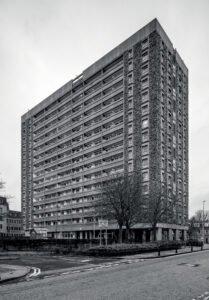
Thistle Court, Aberdeen. Designed by Aberdeen City Architect’s Department. Built 1971 – 75
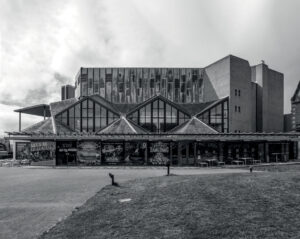
Eden Court Theatre, Inverness. Designed by Law & Dunbar-Nasmith. Built 1973 – 76
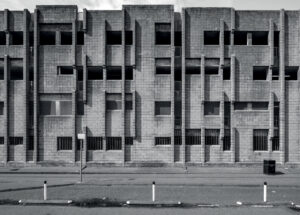
Esplanade Car Park, Kirkcaldy. Designed by Fife Regional Council Architectural Services. Built 1984

Andrew Melville Hall, The University of St Andrews. Designed by James Stirling. Built 1964 – 68
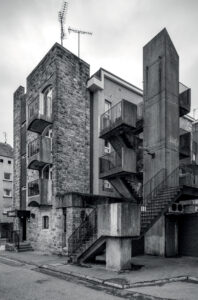
65 – 71 Canongate, Edinburgh. Designed by Basil Spence & Partners / Sir Basil Spence, Glover & Ferguson. Built 1963 – 68
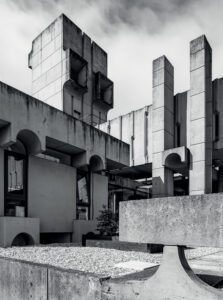
The Macmillan Day Treatment Centre, Western General Hospital (Formerly known as Nuffield Transplantation Surgery Unit), Edinburgh. Designed by Peter Womersley. Built 1963 – 68
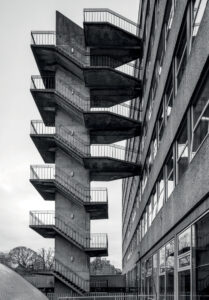
Merchiston Campus, Edinburgh Napier University. Designed by Alison & Hutchison & Partners. Built 1959 – 64
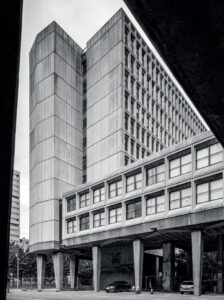
Anderston Centre, Glasgow. Designed by R Seifert & Partners. Built 1967 – 73
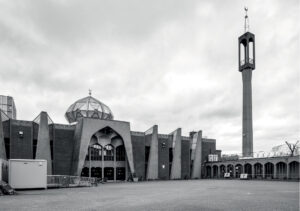
Glasgow Central Mosque. Designed by W M Copeland & Associates and Coleman Ballantine Partnerships. Built 1979 – 84
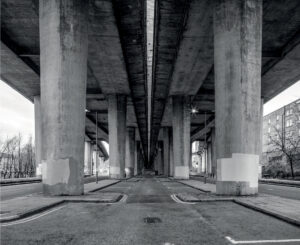
Glasgow Inner Ring Road. Designed by W A Fairhurst & Partners. Built 1966 – 69
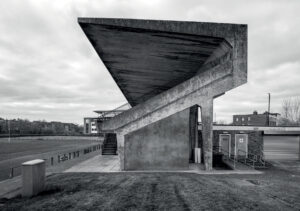
Dam Park Stadium, Ayr. Designed by Maurice Hickey. Built 1961 – 63
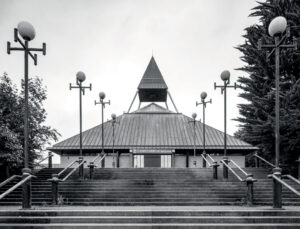
St Mungo’s Church, Cumbernauld. Designed by Alan Reiach & Partners / Alan Reiach, Eric Hall & Partners. Built 1963 – 64.
Brutal Scotland by Simon Phipps is published by Duckworth Press, priced £30.
The Salvage, Anbara Salam’s second novel, is an entertaining gothic tale of supernatural mystery and claustrophobic island living. The novel sees maritime archaeologist, Marta Koury, travel up to the north of Scotland to investigate a shipwreck belonging to an aristocratic family. This extract describes her first dive into the wreckage.
The Salvage
By Anbara Salam
Published by Baskerville
The first dive into a ship is an otherworldly experience. It’s travelling into a moment that has been paused in time. When Jenine and I were young, we used to play a game where we peeked through other people’s windows and made up stories about their lives. It was a winter game, best played after the brooding Glasgow sunset, when strangers’ front rooms would be lit up by the fire, tea-kettles whistling from back kitchens. The boards of HMS Deliverance are lacy with algae, and I trace my fingers over knots in the wood. It gives me the same kind of thrill I felt back then, as the unseen observer of someone else’s world. Like I have become both invisible and all-powerful. Being the first diver to visit the ship after her relocation means that I’m exploring a place almost nobody has been in over a hundred years, since she sank. I have her all to myself.
Inside the passage, the lips of water beyond my torchlight are coal black, stippled with freckles of sediment. Slowly, I ease myself along the narrow corridor that leads to the crew quarters. The cabins along the right-hand side are frozen in Victorian grandeur. They look exactly as they must have in 1849 when the boat last left Port Mary Harbour: wooden panelling, narrow bunks built into the walls. I expected there would be breakage from when the ship was towed back here, but she was made for movement: furniture nailed to the walls, drafting pens fixed to writing desks. I take photographs of the crew quarters, the flash glinting on shaving mirrors shrouded in webs of algae. I’ve never seen a site like this before – it seems almost staged in its completeness, like a doll’s house. Through the silt I spot an ivory-handled clothes brush and a tin spectacle case tucked into the rail of the first officer’s bunk. Lord and Lady Purdie will have their pick of trophies for their museum. After taking pictures in the next three rooms, I kick gently down to the far end of the starboard side. A copper-coloured pollock has slipped in from the kelp on the seabed and darts in startled zigzags as I approach the reason for my trip to Cairnroch Island: Captain Purdie’s bunk.
The door is sticking to the floorboards, and I deliberate for a moment before sliding my knife through the algae and dragging open the door, a fog of silt seeping into the water. I float against the ceiling of the passage until it’s settled enough for me to see my own hands again, and pull myself through into the room. The skeletal remains of Captain James Purdie appear in the frame of torchlight. Curled on the bottom bunk, his knees are drawn to his chest, wisps of hair drifting softly around his skull. His skeleton is well preserved, his bones dappled with gooey-looking sediment. Nestled under the remains of Purdie’s hands is a chunky golden ring – unusual for a Calvinist of this era, but perhaps it was a guild gift. I have to focus at close range to take a photograph, illuminating the faint outline of a barque engraved on the bezel. The Purdies will lose their minds over the ring – there couldn’t be a more perfect museum showpiece. Through the speckles of silt I peer through the doors of a glass-fronted cabinet, which contains a pair of bone snow goggles, a horn comb and a toothbrush, the bristles still intact. There is no porthole, but dents in the wall mark where nails must once have held up maps or schedules, maybe photographs from home, and slotted into a niche in the wall is a small gilt mirror. On the table next to Captain Purdie’s bunk is what looks like a copper coin, a fringe of glutinous seaweed smothering it to the surface of the wood. The discovery report recorded that the top drawer of the desk contains the provisioner’s ledger and the captain’s expedition journal, but the Danish team who found the ship were pessimistic about the likelihood of the books surviving the tow. The drawer has become gummed with seaweed, and I carefully drag my penknife through the fronds, praying I haven’t accidentally cut the material. When I prise open the drawer, the two leatherbound books inside seem to have held up much better than anticipated. Gingerly, I open the books and take photos at random to send back to Sophie, the textual expert at the museum in Edinburgh, for review. The captain’s diary contains preruled boxes for recording the latitude and longitude, as well as wind speeds and temperature. But I can’t make out the writing – visibility is too poor, and deciphering handwriting isn’t my strong suit in any case.
Swimming away from Captain Purdie’s remains, I squeeze through the passageway into the galley kitchen, where two metal spoons still hang from pegs on the wall. There is a horn cup engraved with Captain Purdie’s initials attached by a snap hook above the grate. It must have been his personal drinking vessel. I haven’t seen this type of fixture before; it’s a clever little grooved latch to stop items from falling during bad weather, and I take a couple of extra photographs. The pantry is stacked with corroding tins and stoneware jugs nailed into position with wooden dowels. It’s odd the crew would have left this many tins here before abandoning the ship, but I suppose they must have taken the dried pemmican with them. Maybe one day their remains will also be discovered. I wonder if Lord and Lady Purdie will pay for their repatriation, too, or if their generosity only stretches to their ancestors.
My regulator glitches; it hiccups with a start and I brace myself in the corner of the room. Don’t panic, I say to myself, release the valve, and it cocks back again. For a moment, I give myself permission to miss Alex, knowing that we could always rely on each other during a dive, if not above water. On the other side of the kitchen is the saloon, the only space on the ship large enough for group meals or socialising. The walls of the saloon curve inwards, and it feels smaller than I’d expected, silt gently coasting in the water like snowfall. It must have been claustrophobic for the crewmates to spend the dark Arctic winter cooped up in here while they planned their escape across the ice. The table riveted to the floor has gouges cut into it, someone marking down time, measuring wins or losses. As I take a picture of the grooves, a cupboard door on the far side under the porthole smacks open. I jump and the circle of torchlight swings to the ceiling. The bubble of my laughter echoes in my mouthpiece. I right the torch. The storage cupboard is only knee-high and set at an angle with a latch to prevent it from knocking open on rolling seas. In my surprise, I’ve unsettled the sediment and it is rippling in creamy ribbons that fill the room, like ash. It’s hard to take photos in such poor conditions, so I lever myself against the table to swim back the other way. As I begin to pull myself from the saloon, a flicker of movement behind me catches my eye. The cupboard door is closing again. Slowly, this time. I must have created an eddy of pressure. Or it’s a fish, knocking against the wood. I blink back into the room through the ripples of silt, raising my camera.
And there, underneath the window, a man is crouching.
The Salvage by Anbara Salam is published by Baskerville, priced £18.99.
Badlands by Deirdre Chapman is a literary thriller that looks at memory, guilt and family secrets. In this extract, Charlotte has travelled to a solicitor in the Highlands to hear about the will of her great-aunt who lived and died Vienna. While there she encounters a strange man . . .
Badlands
By Deirdre Chapman
Published by Vagabond Voices
‘Is there a hotel here?’ she asks. The barman, proprietor, whoever, raises his head from polishing a glass and tilts it towards the ceiling which has not been painted since the introduction of the smoking ban. ‘This is a hotel,’ he says. ‘The Claymore.’
He is waiting for a reaction but all she can imagine happening upstairs is a flophouse for over-the-limit drinkers and a breakfast of fried things, black pudding, bacon, bread, token tomato slice. If he owns the taxi and the bar he will also own the hotel.
‘Is there somewhere . . . quieter?’ she says into the silence. It might get noisy at night, most pubs do.
‘Achindarnoch House Hotel.’ The voice comes from somewhere along the bar. She picks out the bright ginger eyes of her bus informant, breaking ranks. The barman/proprietor shoots him a look. She aims a smile in his direction.
‘Is that in walking distance? Can you give me an idea of what it’s like?’
‘Upscale traditional,’ says a voice from behind her. It’s the newcomer in the flash parka. He picks up his glass and brings it to the bar. ‘Picturesque situation. Ensuite facilities, tea and coffee kit, internet connection, dinner inclusive deals. A little draughty.’
‘You’re staying there? Could you direct me?’
‘I can take you,’ he says, and setting a three-quarter-full glass on the bar counter he nods to the company and ushers her decisively through the dodgy door.
‘Outside sleet is still falling. She pauses on the pavement to fasten her coat and to suss out what she’s getting herself into. He is looking away, avoiding her gaze.’
‘Are you on holiday?’ she asks as they set off. Nothing about that seems probable.
‘I shouldn’t think so.’ He is facing ahead as he says this so she can’t see his expression. They pass the butcher, the bank and the undertaker walking in silence and as they approach the doorway of MacMillan Partners he takes her elbow to steer her across the empty street. They pass a newsagent – he glances at a billboard outside it – then a school with an empty playground. She tags all these as landmarks in case the village up ahead erupts into urban sprawl. But the pavement is narrowing here and seems likely to run out here at the mountain end of the village. The road forks and they are clear of buildings so, she thinks, a country house hotel. ‘You see,’ he says breaking a long silence but without breaking his stride, ‘I’ve lost my memory.’
She slows – better not to stop – and turns up her coat collar, glancing back at the solicitors’ office, wondering if she should make a dash for it. This feels, after an hour spent among glamorous ghosts, all too real. His silence was calculated, his voice is serious.
The High Street, now that she’s leaving it, seems a place of charm. She has slowed the pace further, half-turning from time to time as if she might be weighing up her options, country hotel versus high street, but his hand comes up to cup her shoulder and turn her towards a right fork like a date he’s steered into his choice of bar.
‘And I’m counting on you to help me get it back.’
It’s quite a hike to the Achindarnoch House Hotel and he is using the time to sell the primacy of his predicament over whatever boring back story she might have. Distant traffic sounds reach them from the A road she saw signposted but now they are walking along an erratically surfaced road with trees closing in on either side and something is drawing her onwards more urgently than he is steering her. The place is beginning to talk to her, drowning out most of what he is saying. Once this tiresome escort duty is over and before she returns to her travel options she will explore these surroundings. But as they arrive at a pair of handsome gateposts leading to a tree-lined drive a thought strikes her.
‘Why me?’
He stops and looks at her as if she is being deliberately obtuse. ‘You’re a stranger here. You can’t be involved. Can you?’
Involved in what? As they start up the drive, crunching along a carpet of mulched tree debris it’s the ‘can you?’ that she’s hearing, a bleat of self-doubt in an otherwise unvarying and uninteresting account of the hotel layout and his exit from it. For the first time he is wondering about her. Like, who is she?
Who indeed? By-product of nineteenth century economic migration, refugee from light opera in far too many acts. Bit of a hybrid, bit of an orphan if she was inclined to see things that way which she is not.
The question, though, must have been rhetorical because he hasn’t waited for an answer. He is telling her in some detail of his escape from the hotel. He watched from his bedroom window as the hotel proprietor who was wearing a kilt saw off two groups of guests from the car park. Once they had gone the hotel proprietor had glanced round furtively then moved into a small clump of trees where he took from his sporran a pipe and tobacco, a pipe-smoker in denial, giving him the chance to escape the building unseen and find his way out of the grounds to the high street and the sanctuary of the pub.
The building coming into sight puts an end to what’s left of her attention. It’s a converted shooting lodge, she guesses, set in a huge wild garden, protected by a stand of trees she recognises, can even put names to. Beyond the hotel is the end-of-the-village mountain. All this – the building, its grounds, its trees, the scent that is pine resin, the other that is wood smoke, the non-metropolitan bird that shrieks and gets an answer – is familiar.
She is still walking but he has stopped. She turns to find that he is waiting for a response to something and only now does the essential oddity of his story start to hit her. ‘Why didn’t you just’ – he has turned away and she waits till he resumes eye contact – “I don’t know, just go to the reception desk and tell someone?’ He’s been holding out on her. Or she hasn’t been listening. Now he has all her attention.
‘There’s someone in my room.’ His voice is calm and rational. ‘A woman. She’s dead.’
He holds her gaze in a manner that, as the implications sink in, is clearly intended to reassure. She keeps her eyes on his and in doing so turns this into a two-way transaction in which she will take the lead.
‘A young woman?’
‘I’d say so. Late teens, early twenties.’
‘Natural causes?’ She diverts her gaze to the beech tree behind him.
‘I would think not.’
‘Did you . . . do you think you might have killed her?’
‘Then wouldn’t I be feeling something? Loathing? Or guilt?’ He notices the self-validating inversion and wonders if she does.
‘I don’t know.’ She faces him again. ‘I’ve never killed anyone. Have you?’
‘I shouldn’t think so. But then . . .’
‘Did you feel anything?’
‘Distaste. Surprise and distaste.’
‘OK. Putting myself in your situation . . .’ she pauses to let that idea self-destruct ‘. . . I don’t think I would be returning to the scene. Why are you?’
This is not helpful. Questions are not what he needs from her, actions are. Before he frames the answer he will have to run it past himself. For a while now he’s been getting messages from the person he thinks he is, and this person’s need to know is off the scale, way ahead of his anxiety to save his skin. His patient sifting of the meagre facts strikes him as meticulous, well-honed, even enjoyable. And that makes him wonder.
She is still meeting his eye. If he has scared her she is still in control. He smiles and shrugs, watches himself doing that. ‘I have to find out who I am.’
Badlands by Deirdre Chapman is published by Vagabond Voices, priced £12.50.
David Robinson enjoys Peter Ross’s latest travelogue in search of the UK and Ireland’s ancient past.
Upon A White Horse: Journeys in Ancient Britain and Ireland
By Peter Ross
Published by Headline
If you are writing about the lure of Britain’s deep past, you have to write about Stonehenge. If you write about Stonehenge, you have to write about the winter solstice. And if you have to write about the winter solstice at Stonehenge, you should start off something like this:
‘It was half past five in the morning, three days before Christmas, and King Arthur was on the bus …’
That’s how Peter Ross handles it anyway in his latest book, Upon A White Horse, taking the No 333 bus from Salisbury to watch the midwinter sunrise at England’s No 1 neolithic site. I can imagine him on it, tape recorder in hand, sitting next to the self-styled ‘king’ Arthur Uther Pendragon, his sword Excalibur slotted between them. Perhaps that intro is already forming in his head. And why not? It works.
King Arthur is a Druid, a biker with ‘Born to be Wild’ as the ringtone on his mobile (a typical Ross killer detail) and in his battle for free access to Stonehenge he was once defended in court by a certain Keir Starmer. In many ways, he is just too interesting (Arthur, that is, not Keir) – or, if you prefer, eccentric. Too much of him, or Stonehenge’s Archdruid Rollo Maughfling (‘he has an avuncular, plummy charm, but there’s something cosmic about him too’) could overbalance the story. And in any case, the building of Stonehenge had nothing to do with the Druids; by the time they came on the scene, a few centuries before the Romans arrived, it was already ancient and possibly in ruins.
Ross is too polite to take this up with King Arthur. In his text, though not in conversation, he points out that the Druidic link to Stonehenge was confabulated in the 1660s, and that the Ancient Order of Druids isn’t so ancient at all, as they were founded in 1781 at the King’s Arms pub in Soho. That’s not the point of the book: it’s not about splitting historical hairs so much as finding out why the ancient places of these islands cast such a strong spell. Behind that lie deeper, wider questions: is our interest part of a search for identity, simplicity and authenticity in an increasingly bland yet technologically frightening world? Is it a comfort blanket we need to cling to more strongly as our collective future darkens?
Some of the answers Ross finds are in surprisingly modern places, like Glasgow’s Sighthill Stone Circle (built in 1979 using the astronomical expertise of the father of Mogwai guitarist Stuart Braithwaite), Surrey’s Hascombe Stones Circle erected in the mid-1990s by members of a hippy commune, or the all-new neolithic-style barrow tombs like All Cannings in Wiltshire. Many such places are built out of a wish to memorialise loved ones in the most permanent way we can imagine – entirely understandable given the anonymous 15-minute farewells of so many crematorium services.
Sometimes the links to the past Ross uncovers are both visible and invisible. The Uffington White Horse, carved into the south Oxfordshire chalk hills a thousand years or before the Romans arrived, is indeed, as points out, an amazing bit of graphic design. More amazing still, though, is the fact that if the locals didn’t weed it and hammer in a new layer of chalk every year, within 25 years the hill on which the chalk horse is etched would be completely grassed over.
Just think, Ross writes, of everything that has happened since the horse was etched onto that hillside – the Roman invasion, the Norman Conquest, the two world wars – while in each generation local people ensured it was never put out to grass. There is a simple poetry in that fact, just as there is in the science of dating chalk layers by when they last saw sunlight, and his writing uncovers it. Again, an archaeologist might come up with a theory about the horse’s origins as a form of sun worship, but I prefer Ross’s pithier summary: ‘A prayer in chalk. Hallowed be thy mane.’
Personally, I have a bit of a blind spot about archaeology. I lack the imagination for it. (History is different: as soon as there’s a written record about how people thought, felt and behaved, I’m on board). I need a helping hand: a writer with a wide cultural frame of reference, who can write descriptively and accessibly, involving himself in a place either directly or through others. Ross fits the bill perfectly: at Uffington, for example, he joins in the parish’s annual weeding of the chalk horse and interviews XTC’s bassist about why the band used an image of the horse on their album English Settlement. On the site itself, he meets both dope-smoking teenagers and a retired brigadier working as a National Trust volunteer who keeps dementia at bay by memorising Anglo-Saxon poetry.
It’s the same weirdly wonderful story at Cerne Abbas, home of the club-wielding and notoriously well-endowed chalk giant (not prehistoric, apparently, but more likely Anglo-Saxon), where singer-songwriter Virginia Astley tells him about Gustav Holst meeting Thomas Hardy in Egdon Heath. On May Day, he’s there to see Wessex Morris Men dance round their monster mascot, as locals tear into donated barrels of local beer. As if that isn’t surreal enough, the local vicar then asks him if he’d like to meet Chesney Hawkes. ‘What do you make of it all?’ he asks him. ‘I live in LA,’ Hawkes replies. ‘You don’t get this on Ventura Boulevard.’
Yet do not, for a second, get the idea that this book is just a compendium of the strange, the unusual and the downright eccentric. Whether writing about Silbury Hill (the largest prehistoric mount in Europe, it would once have been entirely chalk white: according to novelist Adam Thorpe, ‘nothing as spectacular and lovely has been created since on our islands’), Avebury, Sutton Hoo, the bog-preserved bodies in Ireland’s National Museum, the Ness of Brodgar, or the massive Vindolanda camp on Hadrian’s Wall, or taking his son on a walk across the Antonine Wall, Ross is always lucid, almost reverent, about the whole process of archaeological discovery.
On Page 132 we find out why. One weekend when he was ten, his grandparents took him to a sand and gravel quarry near his Stirling home for his first dig. On the Friday night his grandfather had overheard a quarryman talking in the pub about how he’d accidentally unearthed a skull when his excavator bucket had smashed a stone slab. That slab, his grandparents – both amateur archaeologists – knew, was a Bronze Age burial cist that had been undisturbed for 4,000 years. They got out their trowels and started digging. Uncovering pieces of bone and of a beaker, they put them in a sealed plastic tub, and on the Monday morning reported the find to the council archaeologist. Imaginatively, they then asked their grandson to write it up for the archaeological journal Discovery and Excavation in Scotland.
There is a coda to the story that I won’t spoil by revealing. It is, however, worth pointing out that this anecdote does at least show that Ross has been in the archaeology and writing business for rather a long time. ‘Really,’ he writes, ‘I should have been an archaeologist rather than a writer…. Whenever I think about my childhood adventures in digging, I have a feeling of a path not taken. This book is an attempt to walk it a little.’
Upon A White Horse by Peter Ross is published by Headline, priced £22.
Yasmin Hanif has released a beautiful picture book Abdullah’s Bear Needs a Name! that is fabulously illustrated by Sophie Benmouyal. The story was inspired by Yasmin’s work with school children and her observations when they themselves were given a teddy bear to name. We hope you enjoy this reading.
Abdullah’s Bear Needs a Name!
By Yasmin Hanif; illustrated by Sophie Benmouval
Published by Floris Books
Abdullah’s Bear Needs a Name! by Yasmin Hanif and illustrated by Sophie Benmouval is published by Floris Books, priced £7.99.
Ghillie Başan is an internationally acclaimed writer, broadcaster and food anthropologist with, and is renowned for her work on Turkish, Middle Eastern and Moroccan food. But her heart is also in the Highlands where she loves to bring her food knowledge to Scotland’s wonderful larder of ingredients. Her latest book, Food, Whisky, Life is more than a recipe book – it’s a celebration of a life well lived and well fed! Here, we publish her recipe for whisky-inspired baklava.
Food, Whisky, Life
By Ghillie BaŞan
Published by Tin Shack Press

Whisky-inspired Baklava
Pastries filled with ground nuts, baked fruit or creamy, semolina mixtures, and bathed in honey or syrup are made for a dram.
A legacy of the Ottoman Empire, baklava is perhaps the grandest of all sweet pastries as the paper-thin sheets of dough, the number of layers, the different texture of the nuts, the density of syrup and the shape of the pastries are all crucial to its perfection in its many guises.
During the reign of Suleyman the Magnificent when the banquets were indulgent and lavish, the creative chefs of the Topkapi kitchens produced trays of syrupy pastries and sponges with suggestively descriptive names – ‘young girl’s breasts’, ‘sweetheart’s lips,’ ‘ladies’ navels’, ‘Vezier’s fingers’ – all of which are still popular today but, when I’m pairing with whisky, it is baklava that I turn to.
Many people shy away from making baklava at home as it seems like it would be complicated to do, but if you buy the filo sheets rather than make them yourself, the rest is easy, although I’m not saying that a top pastry chef in Istanbul would approve! In my modest kitchen where the oven is erratic and I use shop-bought filo, I stick to elements of tradition interspersed with a twist of fruit and flavoured syrups tailored to the whisky I am pairing with, such as apricots and raspberries, combined with orange, rose or whisky syrups.
An Ottoman sultan might have thrown me out of his kitchen but I enjoy preparing baklava to pair with whisky as you can be creative and invent your own fillings and toppings. My guests are always delighted– even the ones from Turkey, Lebanon and Greece! It usually leaves with them in a doggy bag. These are some of my creations: Ricotta, vanilla, pine nuts with whisky syrup and fresh raspberries; Ground Pistachios, chopped dried apricots in lemon syrup; Ground Pistachio with blackcurrants in lime syrup; Ground almonds, mashed baked pumpkin, rosemary and preserved lemon syrup; Ground cashews, pulped pineapple with pink peppercorn syrup
How do you make baklava?
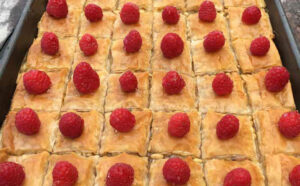
First you make the syrup with a ratio of roughly 500g granulated sugar to 300ml water, the juice of one lemon and any other flavourings. Bring the water and sugar to the boil in a heavy-based pot, stirring all the time, then add the lemon juice and other flavourings and simmer for about 10 minutes to thicken. Turn off the heat and leave the syrup to cool. You add cold syrup to hot baklava.
For a large tray of baklava, you need a 250g packet of filo sheets (you can use more than this – it all depends on the size and shape of your tin), roughly 175g butter or ghee, and the fillings you choose for the layers, generally consisting of finely chopped or ground nuts, chopped dried or fresh fruits, and spices like cinnamon, vanilla and cardamom. Preheat the oven to 350F/mark 4/180C.
Melt the butter in a small pan and keep it beside you as you layer up the filo sheets. Brush a little butter over the base of your oven tray, place a filo sheet over the base and brush it lightly with butter, then place a filo sheet on top of that and brush it with butter. Repeat with five to seven layers and work quickly so that the filo sheets don’t dry out. (If your sheets of filo overlap the tray, just fold them over to fit and brush the fold with butter and, if your filo sheet is too short for the tray, you can overlap with another sheet making sure the overlap is brushed with the butter).
Scatter your filling over the fifth or seventh layer, spreading it evenly across the sheet, then continue layering the sheets and brushing with butter. If you are using two fillings, layer two to three sheets between the fillings. There are usually 12 sheets in a packet. When you get to the top sheet, brush it generously with butter and, using the tip of a sharp knife, cut down through the layers in lines from one end of the tray to the other and across the way to form small squares or diamond shapes.
Place the baklava in the oven for 35-40 minutes, until golden brown and crispy on top. If the oven is too hot, it will darken on top but won’t be cooked all the way through, so you can put it on the low shelf of your oven first and then move it up towards the end of the cooking time.
Take the baklava out of the oven, ladle some of the cold syrup over the top, and return it to the oven for five minutes. This helps to absorb the syrup and seal the top layer.
Take the baklava out of the oven again and place it on a heat-resistant surface. Gradually drizzle the rest of the syrup over it, giving the baklava time to absorb it. You can garnish the top with fruit, nuts, roasted seeds, petals, whatever you like, and leave to cool before serving.
Food, Whisky, Life by Ghillie BaŞan is published by Tin Shack Press, priced £26.
Twelve-year-old Tally Smuck is destined to become a Sting Winkler — someone who can communicate with jellyfish — just like her mother and grandfather before her. The Smucks‘ special gift means only they can do the vital job of caring for the invaluable jellies that Stormcliff depends on. The isolated, salt-soaked isle of Stormcliff is preparing for the annual Firebloom Festival, a famous gathering of thousands of jellyfish and their incredible light show. But with only a day to go, there’s no jellyfish. Can Tally save the festival?
This illuminating middle-grade mystery adventure from award-winning author Justin Davies is full of jeopardy, joy and jellyfish! Firebloom is a bright and brilliant standalone novel set in the same imagined world as Haarville.
Firebloom
By Justin Davies
Published by Floris Books
The First Sting Bites the Deepest
I have never been stung by a Stormcliff jellyfish.
No Smuck ever should.
– from The Sting Winkler’s Handbook by Agnes Smuck
The night before the Firebloom Festival began was almost as exciting as the festival itself.
At least, that’s what Tally Smuck was thinking as she hung from the final rung of the Cliff-Climb ladder above Bloom Bay. She twisted her neck to look down in an attempt to judge the distance she was about to drop, but her salt goggles were so dirty she couldn’t see a thing.
Too bad. Tally let go.
“Thank the krakens,” she whispered, as her feet made contact with the sand and her knees buckled to absorb the impact.
Staying crouched for a moment, Tally whipped off the goggles. The wind had dropped during her climb down, so the risk of eye-smarting salt spray off the waves had disappeared. She picked up a handful of sand. It was still warm from being heated by the sun all day. As she let the grains run through her fingers, Tally smiled at the tiny particles of quartz sparkling in the moonlight like diamond dust.
Standing up, she turned to look out across the bay, taking a moment to enjoy the sound of the surf bubbling on the shoreline. Any other time of year, she would have been deafened by massive waves, whipped up to a frenzy by the constant wind crashing on the shore and towering rocks that gave Stormcliff its name. In those conditions, no sensible Stormcliffer would dream of leaving home without their salt goggles firmly clamped to their face. But now, and for the next week, a soft breeze was as much as they needed to worry about.
It always fascinated Tally how the weather seemed to know to calm down whilst the Firebloom Festival took place. Just thinking about the festivities to come sent an excited shiver up her spine. Tonight, she had the bay to herself. But this time tomorrow the beach would be packed with locals and visitors, all gathered to witness the first firebloom, when thousands of jellyfish would put on their spectacular light show, just as they had at the same time every year since before anyone in Stormcliff could remember.
Tally kicked off her shoes and rolled up her trouser legs, then made her way across the sand. The excited spine-tingle had fizzled away, replaced by a nagging knot in her stomach, and she suddenly wished she hadn’t piled quite such a large dollop of potted plankton on her kelp crackers for supper. She had never felt this nervous about the Firebloom Festival before.
It wasn’t the arrival of this year’s visitors that was giving her the jitters. Tally was as eager as everyone else to meet the tourists lucky enough to have secured a seat on the once-a-year sailing to Stormcliff from the mainland. Some of them would have waited a long time for the chance to witness the legendary display put on by the Stormcliff jellyfish.
Nor was it the prospect of helping Grandad Isaac and Mandeep – or Mandad, as Tally had always called Grandad’s husband – with this year’s jellyfish-sting harvest. If you were a Smuck, you had no choice. The jellies had always been their responsibility and Tally had been allowed to help her grandads in the sting shed at harvest time since she was six years old.
No. The thing making Tally’s stomach twist and tumble like a tangle of dried seaweed was whether this would be the year she would finally become a Sting Winkler. Just like Grandad was. Just like her mum had been.
Tally smiled. She had a few clear memories of her mum, Ama. But the clearest of all was the last time she stood with her, just like this, in the surf the night before the festival began six years ago. It had turned out to be her mum’s last ever Firebloom Festival – she’d died later that same year. But when she’d been alive, Tally’s mum had liked to greet any jellies that had arrived in Stormcliff’s waters early, to let them know that they were welcome and that they would be taken care of during their stay. That night, she had held Tally’s small hand in hers and told her that one day it would be her job to do the same: to talk to the jellies and gain their trust, to be a Sting Winkler, just like generations of Smucks before her.
That’s why tonight, Tally had come down to the bay to greet the jellies alone. Just as her mum had done.
Not that the jellyfish understood her yet, of course. She’d need to be a Sting Winkler for that to happen, and even though she was already twelve, there’d been not so much as an inkling of any winkling. Tally couldn’t help but worry that her abilities should have shown themselves by now. After all, Grandad had become a Sting Winkler when he was eleven, as had Tally’s mum. What if hers didn’t arrive at all? No, that couldn’t happen. Could it…?
Tally squeezed her eyes shut, twisting some of her copper-tinged curls around a finger, whilst tapping her chest in the spot where a tiny jellyfish hung on a chain. Stormcliff’s very first Sting Winkler, Agnes Smuck – Tally’s who-knew-how-many-times-great-grandmother and famed Victorian jellyfish seeker – was said to have carved the jelly out of a strange amber-coloured gem she’d found washed up on the beach when she first came to the isle of Stormcliff many years ago. Now, as she stepped into the surf, Tally sent her ancestor a silent plea for help.
Biting her lip, she scanned the surface for signs of jelly life. For a few minutes there was nothing but a ribbon of moonlight dancing on the gentle ripples, then Tally spotted a flickering blue light about an oar’s length away, just under the surface.
“There you are!”
The first flicker was followed by one, then two, then three more. As the jellies washed closer, their markings became more defined, flashing bright circles on their smooth, translucent domed tops.
With her fingertips just breaking the water’s surface, Tally waited to greet the first jellies of the year. And maybe, just maybe, she would feel a connection – like a true Sting Winkler should.
Only, these jellies seemed reluctant. They were holding back, pulsing gently against the tide, faintly flashing their blue circles, one after the other. It was almost as if they were whispering amongst themselves.
“It’s alright,” Tally whispered back. “You know me.”
She held her breath. Five seconds, then ten. Finally, one of the jellies displayed a sequence of flashes, before bobbing closer until Tally could reach out and ever so gently stroke it. The jelly glowed briefly, then faded to an eerie milky white. Tally waited, her feet sinking into the sand, but she didn’t dare move.
Then, in a single rapid movement, the jelly turned sideways, sucking itself in, before exploding in a series of rapid flashes radiating from its centre, across its dome and sparking along its tentacles as it billowed away.
“Hey!”
Tally reached out, but as she did, a single sparking tentacle lassoed back and whipped across her arm.
For a moment, she could only stand in disbelief, her skin throbbing.
She’d been hoping for a sign that she was a true Sting Winkler. Instead, Tally was the first Smuck to ever be stung.
And it hurt.
It hurt a lot.
Firebloom by Justin Davies is published by Floris Books, priced £7.99.
Every year we look forward to the publication of the New Writing Scotland anthology as it always highlights the best in established names and exciting newcomers in Scotland’s literary scene. The new anthology, A Chaos of Light, is fine reading as expected! Here, we publish a few poems from the collection.
A Chaos of Light: New Writing Scotland 43
Edited by Kirsten Innes, Chris Powici & Niall O’Gallagher
Published by Association of Scottish Literature
Kevin Cormack
SHORACKS
fur Tony Swain
This wis whin TVs hid thir oun national bedtime:
a vicar in a comfortable, high-backed chair
wid shepherd his mild-mannered story
aboot a window cleaner, or a trip tae the seaside,
twaards hids inevitable punchline:
‘And, you know, Jesus was a bit like that.’
At these words the TV wid sink intae a sea o white noise.
We convened in her mither’s attic,
oan an owld couch beneath the cooples,
and stared at yin churnan blizzard fur oors oan end.
Hunkered in front o her mither’s muted Grundig,
a year since wir last meeteen, we drifted oot again
intae a dwam until figures appeared.
The hoose below breathed like bellows
o an accordion; a timorous whistle, me squeaky eyes.
The attic lowed like a crystal haal, last I saa her –
dark-eyed and ready tae furgit me.
I wid lean intae that storm (o some demiurge’s
makeen) the rest o me days.
Sheu leant in different – like bliindie-bockie –
and disappeared intae tambourines and mirrors.
Shoracks: shore-dwellers of Kirkwall
bliindie-bockie: blind man’s buff
GUTS
i.m. K. H.
‘You know more than I know’ sang John Cale,
under the needle in yir student digs, twinned
wae mine. Words afore I worded thum;
clippeens o feteesh and crime scenes
afore the inkleen, the glue, the compositional eye.
Whar ye came fae and whar ye then dwelt:
that fraction o a second afore sense
reaches the brain, raffles up wae emotion,
laughter lippers ower. Whar stimuli bides
in the raa, afore adoption: colourless colour,
touchless touch and ither such blethers.
Makan me whit? A cover version – a bad wan
at that – wae virry little say in the metter?
Me intimidatan mate, as mates so often err.
The Mekon in Bowie’s black leather jaiket
fae the cover o Heroes, riflan through
vintage paperback emporiums,
as if elbuck-deep in a buullick’s liver.
Lendan me biographies o resplendent,
reckless lives – hand-me-doon
subversion fur yir second-hand sael –
designed tae mak me less and less sure.
Fae somebuddy thit nivver bowt a stick
o furnityir in his life, nivver ouwned
a fridge or washeen machine, hoose or ker,
computer or smertphone.
Zeus (as played bae Niall MacGinnis)
geen foosty in a ruined picture-hoose attic.
That’s the trouble wae classicists:
liable tae spang clear o the membrane entirely.
Blessed be the latecomers – the gulf
between stoory needle crackle
and yir bureaucratic bowels.
Reyzl Grace
BRIGADOON
for E. R. Shaffer
A think A knew, somegate,
in that first month we war girlfreinds –
We’d passt the nicht thegither,
an it wis sae haurd tae lea’ ye
in the morn, cuisten across
yer gowd-strawn bed
like a saunt’s cloak on a sunleam
whiles yer ain lay on the fluir.
Ye laucht, telt me object
permanence is a real thing
an that ye’d still be there eftir
ye walkit me tae the door.
As it shut, I cawed
oot, ‘An the door eelit
a hunner year . . .’ A wis anely
tryin tae mak ye lauch,
but ye reappeart in an instant,
luiken sae sairious,
catcht bi ma vyce afore
the joke, and then ye grint
in that aaber, elfin wey
ye dae that inveets ma tongue
like the clootie wall caws
the cuinyie in a lanely lass’s
purse. A wis late tae wark.
That wis afore A’d eaten
thae cupcakes on yer birthday –
afore A’d passt a century
watchin ye draig a fag
an then kythed tae find A’dna
been missin mair ’an a day.
Nou A knaw why
ye walk circles aroond
the flat whan things gae missin,
why yer een wirth til milk
like some Greek oracle
anent the clock, why
ye maist like daena remember
the lingelie whit apens the poyum
ye demandit, an why ye demandit
a poyum, oot aw things,
whan offert yer auchtin. Ye telt me,
aince, that ye war afeart
A wudna date ye acause
ye’re a stoner, but the suith
is A cudna lea’ ye kis ye’re a sìth.
Zain Rishi
PILLARS
Among the trees, there is a tree, the leaves
of which do not fall and is like a Muslim.
—Sahih al-Bukhari
- Sajjada
It was as if blessing the floor below her knees was
the only way she could ever stand again. Her scarf,
black and billowing, moulded to her like a dark
calcification as she said the words, , and I
couldn’t help saying them too. I didn’t know what
they meant, only that somewhere in the rhythm of
each syllable, the roughness of the middle h, was
a kind of safety: something that resembled a home.
- Taeam
Home was an unfaltering reminder that our lives
were burdened with temporality. Plastic chairs.
Plastic plates. Plastic food containers stacked like
glassy, wordless bookshelves behind the fridge.
We lived as though we were bound to leave, and
yet we could not deny our permanence, how we
pulsed out of the foreign ground like a weed, how
we only grew twofold, only deepened our roots.
iii. Hadiiqa
Roots veining below my feet, I climbed higher and
higher towards the canopy. I found my Allah in the
furrows running up the tree, in the bugs that left
them just to live below my nails. I climbed higher
and higher, leaves cleaving to me like a new flesh,
dew mottling my hair as I broke out into the daylight,
forgetting, if only for a moment, the splinters in my
palms, the bark breaching my new, ascended skin.
- Wajah
Skin that was never scarred or spotty, only plain as
bleached canvas, only warm blood bristling under
rosy white cheeks. It meant something in me was
wrong, something I could never reach, a place
I could never inhabit, a beauty I could never keep.
Because to keep a thing was to love it, and to love
a thing was to become it. So I would put on my
own skin, every day, thinking it wasn’t mine
- Rouhi
until I knew it was hers. And there are many things
I know now. That the Devil is the name we gave to
the human condition. That there are a thousand ways
to love another boy. That I never uttered an honest
prayer, not until I knew this skin was ours, that we
grew out of foreign ground, that we fell from the
canopy, our bodies glowing with sin, and prayed
for a faith where we didn’t need words at all.
A Chaos of Light: New Writing Scotland 43, edited by Kirsten Innes, Chris Powici & Niall O’Gallagher is published by Association of Scottish Literature, priced £9.95.
2025 sees the centenary of the births of three Scottish writers – Alexander Trocchi, Ian Hamilton Finlay and George MacDonald Fraser. Greg Thomas considers their lives and legacies.
The year so far has been awash with centenary celebrations for the feted Scottish poet, artist, and ‘avant-gardener’ Ian Hamilton Finlay (1925-2006). From a series of international exhibitions organised by the poet’s estate to shows at the Scottish National Gallery of Modern Art and further afield, to print-media coverage touching on lesser-known aspects of the poet’s legacy, oeuvre, and biography, the roster has been packed. There has even been some old-fashioned broadsheet controversy of the type Finlay courted during his lifetime, with The Guardian’s Jonathan Jones offering a carping review of the recent Finlay show at Victoria Miro Gallery in London, earning a rejoinder from the veteran Scottish journalist Magnus Linklater in The Times.
It’s less well-known that 2025 also marks the centenary of two other Scottish authors, Alexander Trocchi (1925-1984) and George MacDonald Fraser (1925-2008). In very different ways, both also made striking contributions to twentieth-century Scottish literary culture. Both were also, for very different reasons, figures as liable to attract opprobrium and fierce loyalty as Finlay. Yet, while the latter of these ‘tricky figures’ has seen his star rise posthumously, the counter-cultural impresario Trocchi and waspish writer of the Flashman historical novels Fraser have faded into relative obscurity or cult status—notwithstanding a two-day symposium on Trocchi’s work held at the University of Glasgow in June, and an ongoing trickle of academic interest in his work since the 1990s, not to mention Fraser’s still-sizeable and loyal coterie of readers.
I’ll touch on some possible reasons for this contrast in fortunes further on. But I’m primarily interested in comparing the lives and works of these three writers as a way of teasing out some of the details of the era of literary and public life in which they found fame. The 1960s in Scotland have been the subject of a mini-flurry of critical attention over the last decade, partly involving revisionist analysis of some of its leading literary lights, from the concrete poets Finlay and Edwin Morgan to the folk revivalist Hamish Henderson and radical women writers such as Helen Adam and Fiona Templeton. Much of the discussion has also centred on the new social infrastructure – from radical book shops such as Jim Haynes’s Paperback to iconic small publishing projects including Finlay’s Wild Hawthorn Press, the rise of the Edinburgh Festival Fringe, and performance spaces such as the Traverse Theatre – by which the old, ‘Rose Street’ coterie around Hugh MacDiarmid was superseded.
Trocchi, who famously clashed with MacDiarmid at the 1962 Edinburgh Writers Conference, helped to define the spirit of the new at that event in the most pugnacious possible terms, decrying the ‘turgid, petty, provincial … stale porridge Bible-class nonsense’ which he felt defined the post-Scottish-Renaissance literary establishment. (He added, for good measure that ‘of what is interesting in the last, say twenty years in Scottish writing, I have written it all’.) By contrast, Finlay and Fraser – I will argue – partly represent different kinds of conservative reaction against the tide of social and sexual liberation that Trocchi embodied, Finlay with his stern neo-classical moralising and Fraser with his white-male fantasies of imperial and sexual dominion, more of which below.
Alexander Trocchi, of Italian heritage on his father’s side, was born in 1925 in Glasgow, and became a brilliant and wayward student at the University of Glasgow, finishing his studies in English and Moral Philosophy in 1949 after a three-year stint in the Royal Navy (1943-46) had curtailed an earlier university career. Leaving for Paris immediately on completing his final exams, he fell in with the existentialist coterie, becoming the editor of the literary magazine Merlin, publishing authors such as Jean-Paul Sartre, Pablo Neruda, and, most crucially to his own writing, Samuel Beckett. In 1954 he published a novel squarely in the existentialist idiom, Young Adam, about a man who witnesses a woman drowning, writing under the pen-name Frances Lengel because of the gratuitous sex scenes that his editor Maurice Girodias had insisted he insert.
Leaving Paris for New York in the late 1950s, Trocchi worked on a barge and descended deeper into the heroin addiction that he had consciously cultivated as a form of counter-culture posturing in Paris. (‘I have a bounden duty to go out and experiment with strange and unknown states of mind,’ he is quoted saying in the 1996 television documentary A Life in Pieces.) His experiences at this time were gathered into the roman-à-clef Cain’s Book (1960), which presents a non-linear picture of its protagonist Joe Necchi’s inner world through flashbacks to his childhood and an abandoned domestic life, combined with various accounts of drug use and underground life.
This fairly squalid and nihilistically endured present is enlivened only by the cool ecstasy of the fix:
At certain moments I find myself looking on my whole life as leading up to the present moment, the present being all I have to affirm. It’s somehow undignified to speak of the past or to think about the future. I don’t seriously occupy myself with the question in the ‘here-and-now’, lying on my bunk and, under the influence of heroin, inviolable.
One of the implications of the book is that the routine and mental life of the junkie is in some sense naturally attuned to new principles of literature defined by Trocchi’s heroes such as Beckett. In the absence of the kind of guiding moral principles which might propel a character’s actions forward, Necchi lounges in an eternal present of hustling, scoring, and fixing, in similar fashion to Didi and Gogo beneath the dead tree waiting for a visitor who will never arrive to push the story along.
Escaping the States while on bail for a charge of supplying heroin, Trocchi was, bizarrely, taken in by Leonard Cohen in Canada, before heading back to Britain. Cain’s Book was famously banned following an obscenity trial in Sheffield during 1964-65. Meanwhile, Trocchi confirmed his status as a counter-cultural impresario as the compere for the iconic International Poetry Incarnation reading at the Albert Hall in June 1965. But his productive years as a writer were already over. He would remain in London until his death from pneumonia in 1984. By this time his wife Lyn had died of hepatitis connected to heroin use and his son Marc of cancer at the age of 19.
No new fiction followed after Cain’s Book, but the author did publish two inter-related manifestos outlining the possible conditions of a revolutionary network of educational and cultural institutions (‘Project Sigma’) during the 1960s. The first of these, ‘Invisible Insurrection of a Million Minds’, appeared in the Scottish journal New Saltire in 1963. ‘Sigma: A Tactical Blueprint’ was circulated privately in 1964 as part of Trocchi’s Sigma Portfolio pamphlet series, in which ‘Invisible Insurrection’ had also appeared.
According to his sometime saviour Cohen, Trocchi ‘saw himself as the general secretary of some new subversive worldwide movement’. In an interesting presentation given to the recent Trocchi symposium, later published on the Bella Caledonia website, Calum Barnes points to the strange irony of a writer so fixated on his own, rudderless inner life becoming the evangelist of a revolutionary anarchist politics with implications for all of humanity: ‘[t]he hopelessly involuted self-consciousness of Cain’s Book is refashioned as a potential panacea in his quest to unleash homo ludens’. This perhaps had to do with a kind of figurative mirroring of the non-teleological, ungoverned emotional life of the junkie author with a theoretical global society freed from all institutions and economic systems with similar kinds of top-down order.
To this end, there is an interesting passage in ‘Invisible Insurrection of a Million Minds’ in which the base-superstructure model of Orthodox Marxist analysis is turned on its head. Revolutions in thought and language become the means by which broader, cultural and economic revolutions might be fomented.
We are concerned not with the coup-d’etat of Trotsky and Lenin, but with the coup-du-monde, a transition of necessity more complex, more diffuse….The cultural revolt must seize the grids of expression and the powerhouses of the mind. Intelligence must become self-conscious, realise its own power, and, on a global scale, transcending functions that are no longer appropriate, dare to exercise it. History will not overthrow national governments; it will outflank them
Of course, the dystopian reality of Trocchi’s life – not to mention the appalling fortunes of many of those closest to him – give the lie to the idea that the ‘strange and unknown states of mind’ the writer doubtless inhabited were a viable basis for even the most elementary form of workable social grouping.
Ian Hamilton Finlay had no time for the international underground. Indeed, in an interesting counterpoint to Trocchi’s grand youthful adventures with drugs, the Edinburgh-based poet and artist was treated with LSD in a psychiatric hospital in 1959 and succumbed to a series of terrifying hallucinations. According to his son, the poet and critic Alec Finlay, this explains his ‘rejection of psychology and the exposure of anguish, and his distaste for the 1960s counter-culture’.
Born in 1925 in Nassau, Bahamas, to a Scottish father who was running bootleg alcohol into prohibition-era USA, Finlay returned to Scotland for boarding school at a young age and ended up at Glasgow School of Art during the early 1940s (probably 1943-45). After a decade spent as a painter he began writing plays and short stories in the mid-1950s, moving back to Edinburgh after several years living in Comrie, Perthshire. Very much indebted to the classic Russian short story, his prose is naturalistic and melancholy in tone, dealing with the loneliness and flashes of beauty in everyday life for a cast of characters mostly living in small-town or rural Scotland.
Finlay reoriented his work again at the close of the decade, becoming a lyric poet in a style closely connected to the neo-objectivist and Black Mountain aesthetics of North-American poets such as Robert Creeley and Lorine Niedecker, while also whimsically imbibing a kind of post-Burns doggerel. Here is ‘Glasgow Poem’:
Airship poet Guillaume (Angel) Apollinaire
Wrote poetry something rer.
It was back in the Future. What the Scotch call ‘auld Sol’
He called the ‘sun airplane’. It would drive you up the wall.
The piece is typical of this phase of Finlay’s work in alluding to the international avant-garde in a way that played off and reframed the homely and faux-parochial connotations of his craft, rather than suggesting a Trocchi-esque commitment to the new and radical.
It was through contact with the concrete poets of Brazil’s Noigandres group in 1962 that Finlay really found his animus. He began creating concrete poems, on the page and in three dimensions, exploring a variety of visual, sculptural, and tactile effects that could enhance the linguistic dimension of his work. At the same time, his concrete poetry inhabited the same realm of rustic and rural imagery that had defined his plays, short stories, and lyric verse. Again, radical figures and movements in art and literature were invoked in a way which simultaneously suggested their relevance to, and distance from, Finlay’s own emotional and creative world.
His 1965 poem ‘3 happenings’, with its titular reference to the uber-fashionable Fluxus art movement and its semi-spontaneous performance events, is quintessential in this regard:
the little leaf falls
the little fish leaps
the little fish falls
the little leaf leaps
the little fish leaps
the little leaf falls
the little leaf falls
the little fish leaps
Beneath the version of this poem printed in Emmett William’s 1967 Anthology of Concrete Poetry (whose use of italics and bolds is reproduced here), an authorial note reads: ‘[a]re happenings sometimes wearisome? This is a plein air or out-of-door one.’ The sentiment is typical in coolly imbibing contemporary intermedia art aesthetics while transporting them into a realm of rural calm in which, we sense, the urban-anarchist cultural connotations of those aesthetics are stripped away.
Finlay’s interest in aesthetic ‘purity’ – a commonly used term of his – also found expression through concrete poetry, in the reduction of the poem to just a few reiterated words and visual or formal effects. However, by the 1970s, he was defining purity in far more tendentious and politically motivated terms, ones that were largely anathema to what he felt was the prevailing, liberal and secular spirit of the age. By the mid-1960s Finlay had already been complaining in letters to Stephen Bann about the appropriation of concrete poetry by the counter-culture: ‘all those ignorant young ones are getting out of hand – they are like a blight with their “Zen” and all that nonsense’.
The spirit of ‘neoclassical rearmament’ that overtook him during the 1970s, after his 1966 move to Stonypath farmhouse, led to a pointed engagement with classical culture, taken to entail a form of rigid and virtuous social order ordained by the Gods and backed up by the latent presence of military violence. This realignment contextualises his redesignation of an art gallery on his grounds as a ‘garden temple’ in the late 1970s, something which famously set him at odds with Strathclyde Regional Council over the tax rates due on the building.
Finlay’s emergence as a classicist also indicated his complete break with any spirit of counter-cultural ideology to which he might have seemed tangentially attached via his multi-media artistic aesthetics in the 1960s. Then again, the political and cultural worldview that Finlay’s practice ultimately came to embody is almost impossible to place within any modern pigeonholes. When he described himself as a ‘High Tory, like Bakunin’ at the close of the 1980s, he was emphasising the extent to which, as Alec Finlay puts it, ‘his politics were those of a poet, party of one’.
What, finally, of George MacDonald Fraser? An introductory anecdote suggests the nature of his fandom today: you can find a spoof Flashman account on X that promises to ‘taunt … Corbynistas only to run off when it looks like it’s turning nasty’, as well as ‘the usual high-jinx with belly-dancing warrior-queens’. Born in Carlisle in 1925, Fraser was a self-confessed lazy student who entered the army at 18 and was demoted to private three times before becoming an officer in the Border Regiment that fought in Burma in World War Two. On his discharge in 1947 his father found him a job on the Carlisle Journal, and Fraser remained in journalism until he rose to become deputy editor of the Glasgow Herald from 1964 to 69.
The first of his Flashman novels appeared, not coincidentally, the year he left that employment, having promised his wife – according to a posthumously discovered note included with a recent edition of the book – that he would ‘write us out of it’. In a canny meta-fictional conceit, the character of Flashman is lifted directly from Tom Brown’s School Days, an 1857 comic novel by Thomas Hughes recounting its protagonist’s adventures at Rugby. Flashman, a drunken bully expelled halfway through the story, was recognised by Fraser as the unsung ‘hero’ of the book, and incorporated into a dozen historical novels between 1969 and 2005, in which Flashman found himself at the centre of all the major events of Victorian imperialism, from the Retreat from Kabul (the subject of the first novel) to the Boxer Rebellion, the Indian Mutiny, and the Charge of the Light Brigade.
Throughout his escapades – which, as critics often point out, are the product of meticulous historical research, and richly evocative of their era – Flashman appears as a hard-drinking, sexually abusive, subordinate-flogging cad. In a particularly egregious passage in Flashman which sums up many of these tendencies, the protagonist is offered the sexual services of a topless dancer by his host, the Ghilzai leader Sher Afzul:
He beckoned her to dance close in front … and the sight of the golden, near-naked body writhing and quivering made me forget where I was for the moment. By the time she had finished her dance, with the tom-toms throbbing and the sweat glistening on her painted face, I must have been eating her alive with my eyes….Sher Afzul saw it too…. ‘You like her, Flashman bahadur? Is she the kind of she-cat you delight to scratch with? Here, then, she is yours’
This orientalist titillation takes a dark turn when the dancer angrily refuses his advances and Flashman takes her by force: ‘after a vicious struggle I managed to rape her—the only time in my life I have found it necessary.’ Fantasies of imperial and sexual conquest are entwined throughout the Flashman stories. And, while the anti-hero is undoubtedly presented as a coward, whose chief characteristics include a desire to avoid danger at all costs combined with an uncanny ability to steal credit for others’ military bravery, his seeming nudge-wink lovableness as far as Fraser is concerned is hard not to interpret as coded nostalgia for the golden age of British imperialism, when we all knew who was in charge.
Fraser was happy to accept the insinuation. In that posthumously discovered note, he writes: ‘[w]ith the exception of one left-wing journal which hailed it as a scathing attack on British imperialism, the press and public took Flashman, quite rightly, at face value, as an adventure story dressed up as the memoirs of an unrepentant old cad.’ An article by historian Saul David based on a 2006 interview with the author reads:
MacDonald Fraser is an unashamed fan of the British Empire, and was delighted that revisionist historians like Niall Ferguson (and myself, for that matter) had recently felt able to write about it in a more objective, less guilt-ridden way. “With all its faults,” he says, “it’s just about the best thing that’s happened to an undeserving world[“]….It would have been a “good thing”, he adds, if the empire hadn’t ended when it did.
A 2008 obituary in The Washington Post rounds off this picture, noting that ‘Mr. Fraser was proudly conservative and often spoke out against modern social trends, including immigration, coarse language and the metric system of weights and measures’. Needless to say, he was never on the mailing list for Trocchi’s Sigma Portfolio.
So much for our three centenarians. What do these three life stories tell us about the era which spawned them? Apart from anything else, we might do well to remember the historian Dominic Sandbrook’s proviso that the sixties, in Scotland as elsewhere, represented more than its gilded memoirs and flower-power mythology. For ‘people who spent the 1960s in Aberdeen or Welshpool or Wolverhampton’, the sixties might ‘conjure up memories not of Lady Chatterley, the Pill and the Rolling Stones, but of Bingo, Blackpool, and Berni Inns’.
Of course, our authors do not fit neatly into this binary model of cosmopolitan radicalism and humdrum provincial conservatism, but they do suggest that the legacy of the Scottish sixties in culture and literature is vexed and complex. If Trocchi rode the crest of a wave of emerging radical thought, crashing into drug-addled oblivion, Finlay and Fraser represent different kinds of oppositional reaction to the perceived spirit of the times, while partaking it some of its advances: Finlay, for example, in his attachment to mixed-media artforms connected with the anarchistic philosophies of Fluxus, and MacDonald with the seedy seventies eroticism of his sex scenes. (It’s not surprising to learn that he went on to co-write the script for a James Bond film, 1983’s Octopussy.)
The relative status of the three seems to have less to do with the extent to which they accepted or rejected the (real or imagined) advances of their time as with the global status and visibility that Finlay achieved in his transition from the world of (small press) literature to fine art, via his reorientation as a concrete poet and, ultimately, a maker of beautiful three-dimensional poem-sculptures and conceptual artworks at his garden Little Sparta and elsewhere. Both the striking visible presence of Finlay’s work around the world, and its entry into civic and commercial gallery circulation from the late 1960s onwards, mean that it continues to be seen—and sold at lucrative prices. In short, the artworld can perhaps provide the kind of lively critical and popular afterlife that the economics and networks of literature might fail to deliver.
It may also be that the murkier thematic subtexts of Finlay’s work – his interrogatory use of the iconography of fascism, for example – have been easier to partition off from his central achievement than those of Trochi and Fraser. The unrepentant misogyny and racism covertly embraced through the figure of Flashman is difficult to reconstruct in age of febrile debate on identity and empire, while Trocchi’s addict-life in retrospect seems far less liberatory than it does brutal, tragic, and dangerous to be around (particularly for the women in his life, such as his wife Lyn, who at one point in New York became a sex worker to fund the couple’s habit). Yet each writer, through both their flair and their flaws, helps to offer a more complex picture of the decade in which they emerged, a decade in whose long shadows our Scottish culture still moves.
ALSO ON BOOKS FROM SCOTLAND
-


Saltwater: A Midsummer Ghost Story by Elaine Thomson
‘The very thought of those grey faces made my skin grow cold.’
-

‘An Odious Campaign’ by Rob McInroy – Why a 1936 By-Election Still Resonates
‘This enraged the locals and he came close to being run out of town on several occasions.’
-

‘‘That’s right, Bobby,’ he growled. ‘I haven’t seen you in – well, since you decided to kill me.’ ‘
-

David Robinson Reviews: Solitary Agents by David Goodman
‘This is very much an up-to-the-minute story of spycraft, positively revelling in all the things tha …
-

The Savage Landscape by Cal Flyn
‘It is their resistance to the intrusions of the outside world − culturally, economically, environme …
-

The Shortest History of Scotland: A Q & A with Murray Pittock
‘We need to be better aware of that to understand the challenges and achievements of the past, and t …
FEATURED AUTHOR:
Francine Toon
Francine Toon grew up in Sutherland and Fife, Scotland. Her poetry, written as Francine Elena, has appeared in The Sunday Times, The Best British Poetry 2013 and 2015 anthologies (Salt) and Poetry London, among other places. Her debut Pine, was longlis …
FEATURED PUBLISHER:
Muddy Pearl

Muddy Pearl is a young independent publisher based in Edinburgh and specialising in books that help people explore issues of spirituality and prayer, international and social justice, health and lifestyle from a faith perspective. Our authors include t …