


Rose Ruane’s debut novel, This is Yesterday, tackles how women define and express themselves, the consequences of both action and inaction, and the soul-fatigue caused by carrying around baggage from the past. Lee Randall reviews and finds a novel with much emotional resonance.
This is Yesterday
By Rose Ruane
Published by Corsair
Billed as a story ‘of a woman’s relationship with her art, her body and desires, her memories, herself,’ Rose Ruane’s debut novel, This is Yesterday, mines themes familiar to fans of her previous work across a range of media (performance, sculpture, drawing, video, and writing). These include emotional manipulation, self mythology, and the idea that a part of us never entirely grows up.
Here, Ruane probes questions that are certain to resonate with contemporary readers: Who has the ‘right’ to create art? Is there a statute of limitations on mistakes made in youth? Whose version of history is the version? Is anyone truly unloveable? If we lack purpose—any kind of purpose—what’s life for?
The novel kicks off with an abrupt wake-up call: ‘The phone ringing in the dead of night can only mean sex or something terrible. Or maybe both. Even in the deep sludge of sleep her body registers shock. Cold sweat and a kick in the chest.’ Peach is summoned to a hospital where her elderly father, suffering from Alzheimer’s, lies in intensive care, badly injured after being struck by a car.
We’re plunged into a family drama seen from Peach’s perspective. We discover she and her older sister, Bella, haven’t been alone together in 25 years. They are apparent opposites: Bella’s a mildly famous internet lifestyle guru, married to a man Peach disdainfully labels ‘part sperm donor, part hedge fund.’ They have twin daughters and financial security.
At 43, Peach knows what she doesn’t want, but has been less successful in identifying and achieving her heart’s desires. Her whole life ‘has felt like grieving for a better person she never became. . . . Peach never wanted to be called wife, she never wanted to be called Mum; but she always wanted to be called important.’
She has abandoned a promising career in fine art photography, ‘dumping art before it had a chance to break up with her.’ For a decade she’s worked as the gallery assistant for a man who ‘spends the first hour of his day doing yoga and meditating and the next eight throwing tantrums a two-year-old would consider needlessly dickish.’ Where Bella is beautiful and glossy, Peach is perpetually disheveled, seen swiping at the red wine stains peppering her coat as she tumbles into the ICU.
They are joined by younger brother Greg, an outdoors-loving, ‘adequate and practical’ bloke who has been most actively—and resentfully—dealing with their father’s increasing incapacity. Eventually their mother and her second husband arrive, rounding out the family unit and ratcheting up the tension.
Peach is ready for a rapprochement; she longs for one, but the siblings instantly fall into familiar patterns—all angles and sharp corners, glancing off each other without connecting, too afraid to speak honestly. This depiction of the push-pull of familial love/resentment hits the mark.
Push-pull effects characterise the novel overall, seen in the way it ping-pongs between present day and the summer of 1994, the fateful year when long-hidden secrets and sexual tensions crested, then burst like a festering boil, fracturing the family. Everyone blames Peach for what happened. She blames herself most of all, and we discover how the burden of guilt corroded her self-esteem, impeding her progress at every level—professionally, emotionally, intellectually.
The push-pull effect is also there in Ruane’s use of language, an unsettling profusion of short sentences and fragments. The narrative judders and jabs. For example: ‘After that they could not fudge and demur. Worst suspicions confirmed. Dad’s dissolution had a name. A prognosis. They gathered round the luminous blue scan as a consultant pointed out dirty thumbprints on the creamy cauliflower of their father’s brain.’
This technique mimics Peach’s inability to focus in the throes of a crisis, her skittish brain obsessively returning to its memory bank, searching for information to help her process how the past led them to this present and how they became the people they are now. Such language recreates the clicking of a camera’s shutter, capturing life in small, frozen bites. It is often distracting and distancing and may frustrate some readers.
Ruane is notably insightful about the female experience of sex, with all its confusion and ambivalence. Describing Peach’s first time, she writes: ‘No, she told herself; I’ve let him start, I’m losing my virginity: it is happening now. I might as well go through with it. She wondered if there was something wrong with her that she should be so practical in the throes of her first fuck.’
Sex and desire are complicated, and Ruane captures the how and why of that perfectly. Peach thinks: ‘All she wanted was for someone to hold her, to make her feel lovely. Not lovely even—just all right, a miracle of sufficiency.’ At various points we see her as both hunter and prey, victim and antagonist. Her vulnerabilities are never far from the surface.’Peach realised he had been checking her out to see if she would do, whereas now he was checking Bella and Magda out so see who he would do. Peach held Nick responsible for the pain of her own crass thoughts.’ And Ruane excels at conveying how women squander themselves emotionally, giving us a satisfying fist-pump of a scene when Peach ends a relationship by calling out her lover’s emotional cowardice.
Ruane’s Peach is someone you’ll want to shake and cuddle, sometimes simultaneously, for This is Yesterday conveys the messiness of real life—as well as its poignancy.
This is Yesterday by Rose Ruane is published by Corsair, priced £14.99
We all know and love Arthur Conan Doyle’s creation, Sherlock Holmes, but Robert J. Harris may love him more than most! He has been writing the brilliant Artie Conan Doyle Mysteries for a while now, putting the young author through a series of adventures perfect for young sleuths. We caught up with Robert J Harris to talk to him about his latest mystery.
The Artie Conan Doyle Mysteries: The Scarlet Phantom
By Robert J. Harris
Published by Floris Books
For those who are still unaware (for shame!) could you tell us a little bit about the Artie Conan Doyle mysteries?
The premise of the series is that Arthur Conan Doyle, while still a schoolboy in Edinburgh, has a series of adventures which will later inspire him to create the character of Sherlock Holmes and write those stories which would make him the most famous character in literature. In the course of these adventures he gradually acquires the skills of a detective and takes his first steps towards being a writer.
You’re on your third mystery now, The Scarlet Phantom, could you give us a hint of what to expect?
I pride myself that the mysteries Artie has to solve are worthy of the great Sherlock Holmes himself. In this novel he is presented with a series of seemingly impossible crimes committed by an invisible thief who walks through walls and disappears at will. It will take all his courage and ingenuity to crack the case along with his friend Ham, new friend Peril Abernethy, a girl scientist, and young actress Rowena McCleary, who returns from the second book in the series The Vanishing Dragon.
You’ve written a number of novels for adults and children, and you like to tackle characters from history. What do you like about continuing to explore characters that already exist?
My first two solo novels concerned the teenage adventures of Leonardo da Vinci and William Shakespeare, which was an exercise in imagining what they would have been like as young men and inventing adventures for them set against an accurate historical background. Working with existing literary characters is a very similar in that I have to accurately represent the world of the original stories.
I see myself in a position rather like that of a folk musician who works in a certain tradition, carrying on and maintaining interest in that tradition while enriching and adding to it. In my case I see myself as carrying on in the particular tradition of the Scottish adventure story, which can be traced from Sir Walter Scott on through Robert Louis Stephenson, Arthur Conan Doyle and John Buchan right through to Alistair Maclean.
As well as reviving John Buchan’s classic hero Richard Hannay in two new adventures, the Artie Conan Doyle Mysteries allows me to approach Sherlock Holmes from a new and entertaining angle. Having honed my skills as a mystery writer in the Artie series, I am excited to now be working on a brand new Sherlock Holmes novel which is to be published by Polygon in September of 2020. Watch out for that!
Your novels are action-packed and full of adventure. What do you think is the key to a good pageturner?
In order for a novel to be a page turner it is not enough to just have exciting action and cliffhanger chapter endings. Readers actually have to care what happens next because they have been drawn into the story and are engaged with the characters.
Have you ever solved any crimes or mysteries in real life? Or do you keep your adventuring to the page?
I did many years ago use deductions worthy of Sherlock Holmes to discover where my wife had misplaced the spare car keys (They were in a tray of children’s paints on top of the fridge.). Other than that my adventures are strictly literary.
What novels inspire you in your writing?
The novels of Arthur Conan Doyle, John Buchan and John Dickson Carr. My World Goes Loki trilogy was inspired by the comic fantasies of Diana Wynn Jones. I have also written a teen science fiction novel inspired by the stories of Eric Frank Russell which I am sure WILL BE PUBLISHED ONE DAY!
What are you reading at the moment?
I’m reading Night at the Mocking Widow by Carter Dickson, which is a pen-name of my favourite mystery writer John Dickson Carr. In non fiction I really enjoy Tom Holland’s histories and am now reading his latest Dominion: the Making of the Western Mind. In comics I’m reading Injustice 2 from DC. I am totally in love with the whole of the epic Injustice series. And no, I won’t call them graphic novels. There’s nothing wrong with reading comic books.
What other books do you always recommend to young readers?
I always recommend the hilarious Dark Lord: The Teenage Years by Jamie Thomson, Frozen in Time by Ali Sparkes, and Red Fever by Caroline Clough, a gripping post-apocalyptic adventure for younger readers.
Do you know what’s next for young Artie? Are you allowed to tell us?
We don’t have a fourth adventure scheduled as yet, but I have some ideas about what will be in it. It will be a little different as this time Artie and his friends – Ham, Rowena and Peril – will be working as a team right from the start. This opens up a wide range of possibilities for investigation and adventure and will allow me to try the characters in new combinations.
The Artie Conan Doyle Mysteries: The Scarlet Phantom by Robert J. Harris is published by Floris Books, priced £6.99
David Robinson takes a look two new historical thrillers, and appreciates their masterly world building and page turning plots.
The Crown Agent
By Stephen O’Rourke
Published by Sandstone Press
Death in the East
By Abir Mukherjee
Published by Harvill Secker
At the end of Ian Rankin’s latest Inspector Rebus novel In a House of Lies, there’s a brief mention of the notorious nineteenth century Edinburgh murderers Burke and Hare. The former was, of course hanged, and his skin forms the binding of a notebook on display at Edinburgh’s Surgeons’ Hall Museums. But Hare is the interesting one. In exchange for giving evidence against his friend, he was released. According to Rankin, Rebus and Wikipedia, he fled south, someone blinded him and he spent the rest of his days begging.
The fact is, nobody really knows what happened. The story of Hare’s blinding may only be, as historian Owen Dudley Edwards has argued, a Victorian morality tale to prove that, in Rebus’s words, ‘nobody every really gets away with it’. But novelists were never going to leave such a fascinating vacuum unfilled. Five years ago, for example, Scottish journalist Peter Ranscombe’s debut novel Hare imagined him not only living on for decades but playing a vital role in the American Civil War.
The latest novelist to work Hare into his story is Stephen O’Rourke, a Greenock-born lawyer (a QC, no less) whose first novel The Crown Agent introduces us to disillusioned doctor Mungo Lyon. It’s 1829, Burke has just been hanged, but because of the revulsion against Lyon’s mentor, Robert Knox (who bought the bodies Burke and Hare supplied him for use in anatomy lessons), he is unable to practise as a surgeon. When the Lord Advocate asks him to turn detective and find out more about schooner Julietta, which has been found adrift on the Firth of Clyde with all of her crew dead of yellow fever, he agrees immediately.
Already the reader knows that some sort of game is afoot, because the novel’s prologue had a lighthouse keeper being murdered in the middle of a storm just as he was about to light a beacon to help a stricken ship (the Julietta?) a mile off Cumbrae. Three days later, a customs officer disappeared from Campbeltown, so perhaps the Julietta had been smuggling something from the Caribbean. But what?
Second question: whatever the illicit cargo, where was it landed? Third, whom did it benefit? Lyon has to work out whether any of the four main landowners on that part of the coast were involved, and if so, why. Fourth question: who are the four men pursuing Lyon right from the start working for? Fifth: can Hare – whom Lyon meets in Greenock at the start of his mission – really be trusted?
The Crown Agent has its roots in a short story O’Rourke submitted for a Daily Telegraph competition in 2012. It won, and from the novel one can easily guess what the judges saw in it. O’Rourke writes well, the plot has an engaging complexity, and it is generally free of anachronisms (although I’m not sure whether Lyon’s family home in Edinburgh’s Morningside Place would have been built by 1829). Generally, though, he is spot-on: the Glasgow Lyon passes through is already booming, even though steel and shipbuilding haven’t yet arrived, and the onward journey to Greenock is possible by steamship but not (yet) by train. The journey across from Edinburgh is still most comfortably done on the canal that Burke and Hare came over from Ireland to dig, so Lyon does just that, ‘drifting asleep to the clop of Clydesdales hauling me west’ with his pistol in his medical bag next to his bunk.
Night Barge to Falkirk. At this early point in the story, that would have made sense as a title – indeed, I’d like to have had more quiet moments like that, where we could get to know Lyon better. Because when the plot starts again it’s as loud, insistent and colourful as a cinema advert. Lyon – who boasts early on that he ‘can amputate a limb in 48 seconds with the patient unconscious, slightly longer if not’ – will get plenty of opportunities to do just that in a storyline that, as well as everything I’ve already mentioned, also takes in kidnapping, insurrection, a masked ball, murders and deaths galore and trawlerfuls of red herrings. It’s a rich mix, but if you love unadulterated adventure stories, Mungo Lyon could be well worth following.
The year after O’Rourke won that Daily Telegraph short story competition, another Scot won. Abir Mukherjee turned his winning tale into his debut novel A Rising Man, which went on to win yet more awards. I haven’t yet read it, but now want to, because his fourth – Death in the East – is one of the most enjoyable historical thrillers I have read for a long time.
In the books, Mukherjee pairs Captain Sam Wyndham, who becomes a detective in Calcutta after surviving the First World War, with Sergeant Surendranath Banerjee (or “Surrender-Not” as he is invariably called by imperialist Brits). It’s after World War One, Calcutta has only relatively recently lost its status to New Delhi as the capital of the Raj but is still its main economic hub, and Gandhi’s campaign for independence is about to begin. A fascinating time, and an intriguing place, both barely explored by crime fiction.
In relation to crime novels set in the present, those set in the past always makes me think of that great line about Ginger Rogers having to do everything Fred Astaire did ‘except backwards and in high heels’. If it’s hard enough to get the present right, it’s even harder to bring the past to life, and populate it with characters who don’t feel as though they are our contemporaries. Racist attitudes being what they were in the early 1920s, you might briefly wonder whether Wyndham is just being a bit too ‘woke’ for his own good in his friendship with Banerjee. Or vice-versa, come to that: wouldn’t Bannerjee’s affection for Wyndham be similarly unlikely?
The trick Mukherjee pulls off is to make those questions irrelevant, so convincingly does he write about character, and so subtly about his book’s historical setting. It helps, of course, that Wyndham isn’t your traditional Raj stiff upper-lipper, but at the start of this book a paranoid opium addict undergoing detox at an ashram in the Assam hills. As for Banerjee, that nickname is just about perfect: yes, it’s racist not to call him by his proper name, but there’s a certain implicit respect in the nickname too.
Although half of the book is set in 1922 Assam, Death in the East actually gains a lot of its impact from the story of a murder in the East End of London in 1905, where Wyndham served as a constable. When the main suspect turns out to be Jewish, a great deal of what Mukherjee wants to say about racism in the Raj already applies here in anti-semitism stoked by Daily Mail-type newspapers (I caught myself thinking what a great name – Harmsworth – he had invented for one such hack before I realised that, of course, he hadn’t.) The murder victim is a former girlfriend of Wyndham’s and his attempt to solve the case reveals a great deal about his character, not all of it to his credit. On top of that, the case is a classic locked room mystery, which turns out to be mirrored in a similar one in Assam. So: not just excellent characterisation and historical credibility (and, I should add, witty narration too), but bravura plotting as well.
In interviews, Mukherjee has admitted that his Wyndham and Banerjee books owe a great deal to Martin Cruz Smith’s Arkady Renko novels or Philip Kerr’s Bernie Gunther series in which good men uphold systems they don’t believe in. He’s right: they do, and yet his pairing of detectives from such different backgrounds allows for an even greater degree of cultural and political understanding. But those are the standards by which Death in the East should be judged, and it more than matches them. I wouldn’t be remotely surprised if it goes on to win the McIlvanney Prize as best Scottish Crime Book of the Year at 2020’s Bloody Scotland. Yes, that good.
The Crown Agent by Stephen O’Rourke is published by Sandstone Press, priced £14.99
Death in the East by Abir Mukherjee is published by Harvill Secker, priced £12.99
Crìsdean MacIlleBhàin / Christopher Whyte is a poet in Gaelic, a novelist in English, and the translator from Russian of the poetry of Marina Tsvetaeva (1892–1941). After teaching at the universities of Rome, Edinburgh and Glasgow, he moved in 2006 to Budapest where he writes full-time. His sixth collection Ceum air cheum / Step by step, with facing English translations by Niall O’Gallagher, is published by Acair, and has been shortlisted for the Saltire Poetry Book for the Year 2019. This is his poem in the latest New Writing Scotland collection, Sound of an Iceberg.
‘Mo Shearmon’ / ‘The Way I Talk’
By Crìsdean MacIlleBhàin / Christopher Whyte
Taken from Sound of an Iceberg: New Writing Scotland 37
Published by the Association for Scottish Literary Studies
MO SHEARMON
Mo shearmon siùbhlach struthlach deifreach,
’na ruith gu cabhagach mar an t-uisge
an dèidh da dhoineann bualadh air bearradh àrd
fad uairean, ’s e sireadh gach beàirn is sgoir,
dèin’ air a bhith tèarnadh, a bhith
sgaoilte ann am mìltean dhe chuisleannan
beaga, drillseanach, nach cuir cnap-starra
bacadh fada orra – far an tig stac gu oir,
bidh an t-uisge gu h-obann a’ stealladh
mar gum b’ e falt fuamhair a bh’ ann,
ach leis a’ cheart ghluasad mhì-fhoighidneach
a bhios aig boireannach ’s i tilgeil
a pailteas chiabhan ri taobh
a thuiteam ’nan eas dhe bhoinnean
do-àireamh, làidir, leanmhainneach –
theireadh tu nach fhliuiche idir a bh’ ann
ach sreangan, ròpannan anabarrach tana,
cho tana ’s gum bi sèideadh beag gaoith
a’ fòghnadh gus an toirt às a chèile –
no dh’fhaodadh iad a bhith
’nan cùirtear a tha ceiltinn
chan eil dòigh air nochdadh
ciod e ’n seòrsa thaisbeanadh,
am mireagach no gruamach no co-measgt’ –
mo shearmon a shiùbhlas cho grad
nach bi gu lèor a dh’ùin’ agad
airson freagairt a chruthachadh nad inntinn,
feumaidh greas a bhith ort
ma tha thu ag iarraidh a ghlacadh!
Mo shearmon a tha mar bhòcan beag crùbte
a gheibh a-steach do chùbaid
nach bu chòir neach eile seach am ministear
a bhith ’na sheasamh innte,
le aodach sìobhalta, oifigeil a’ mhinisteir air,
tha e sealltainn dìreach coltach ris
ged a smaoinicheas an coithional
gu bheil e mar gum b’ ann air seargadh –
b’ àbhaist don mhinistear a bhith coimhead
beagan na b’ àirde – agus fhuair
am bòcan gruag bhreugach a dhinn e
sìos air a cheann, bhon a tha fhios ann
falt nam bòcan a bhith cleiteagach, pràbhach
mar nach biodh riamh falt a’ mhinisteir
’s e nochdadh anns an eaglais air Di-dòmhnaich
agus, san tiota a thòisicheas am bòcan a’ bruidhinn,
cha bhi ach treamsgal gun chèill
a’ sileadh a-mach bho bhilean sgabach
do bhrìgh ’s nach eil na bòcain
eòlach air aon chànan daonnda
ach draoidheachd shònraichte a bhith orra –
is ciamar a dh’fhaodadh draoidheachd phàganach
a bhi èifeachdach san eaglais air Dì-dòmhnaich? –
san tiota seo, nochdaidh am ministear
am measg a’ choithional
gun aon chòmhdach air a chom
rùisgte mar san latha a thàinig e dhan t-saoghal
agus bidh e a’ ruith ’s a’ ruith às an eaglais
suas air a’ chnoc a tha faisg oirre
fo mhaoim gum faic an sgìreachd uile
cho crìonach neo-theòma ’s a tha a cholann
’s a bharrachd air sin cho beag ’s a tha a ——
(aon fhacal air a dhubhadh às an seo)
ach air cho clis, grad-shiùbhlach ’s a bhios am ministear
a’ ruith dh’ionnsaigh na coille taobh eil’ a’ chnuic,
fo ionndrainn do bhrìgh ’s gu bheil e cinnteach
nach bi e tachairt ri drathais no briogais
air an crochadh gu dòigheil air geug beithe
no sgithich, mar as àbhaist dhaibh bhith crochte
ann am preas-aodaich farsaing
san dachaigh chomhfhurtail aige –
aig a’ cheart àm, bidh am bòcan a’ leantainn air gu socraichte
treamsgal an dèidh treamsgail a’ tighinn bho bheul
cha robh fhios aige idir e fhèin a bhith
cho sgileil anns an òraideireachd,
tha ’n coithional a’ fàs beagan an-fhoiseil
b’ àbhaist droch latha no dhà a bhith aig a’ mhinistear
cha bhiodh e an còmhnaidh ag ràdh
rudan reusanta no loidigeach
aig amannan bhiodh e doirbh dha-rìribh
aomadh no brìgh a shoisgeulachd a ghlacadh
no aon seagh a b’ fhiachail a tharraing a-mach aiste
ach an-diugh tha e dìreach air a chuthach –
bidh am ministear bochd a’ faighneachd dheth fhèin
am bu chòir dha, ’s dòcha, dàibheadh dhan lochan
ach tha uisgeachan an lochain uamhasach fionnar
b’ fheudar dha snàmh gu tìr is a liubhairt fhèin
mu dheireadh thall – air cho bun-os-cionn,
dian, clisgeach ’s a bhios am ministear fo oillt
a’ saigheadh air adhart ’na dheann-ruith,
cha ruig e ’m feast’ an luathas a th’ aig
Mo shearmon a bhios uaireannan mar fhiadh sgeunach
nach fhaicear ach plathadh dheth am measg nan duilleagan
leis cho meata prìobhaideach ’s a tha e
agus an uair sin, gun rabhadh idir, mothaichidh tu dha
a’ streup suas air a’ bhràighe
is smaoinichidh tu gum faodadh sin a bhith ’na aisling
bhon a tha am fiadh cho mòrail, rìoghail, coileanta ’na mhosgladh
gach ball dheth a’ co-oibreachadh le chèile
mar gun robh e ’g itealaich an àit’ a bhith siubhal,
creididh tu cuideachd gum b’ fheàrr math dh’fhaodte
nach robh sin ach ’na aisling bho nach bitheadh
modh no inneal ann an uair sin
beud no aimhleas a bhith beantainn dha,
bhiodh e do-ruighinn do-leònadh do-chiùrradh
mar gach rud a chruthaich mac-meanmna
no a thugadh dhuinn ann am bruadar,
cho iomlan, cuimir, do-chlaoidheadh –
agus their thusa riut fhèin:
“Chan eil mise creidsinn ann an Dia sam bith,
chan e Crìostaidh no Muslamach a th’ annam,
cha bhi mi toirt mo thaic do ghin dhe na seann-teagasgan
mu bhodach aosta, fòirneartach
no mu na h-àitheantan a sgrìobh e sìos
gu bhith gan leantainn leinn
no mu na peanasan sìorraidh
a tha a’ feitheamh oirnn
mur a bi sinn strìochdail gu leòr” –
ach their thu cuideachd gur dòcha sin
am faireachdainn a bhiodh aig Dia fhèin
an uair a chruthaich e creutair ùr de fheòl ’s de fhuil
gu bhith ga shuidheachadh am bad àraidh dhen t-saoghal
Mo shearmon gun fhios dè cho fada ’s a tha e dol a bhith
’s dòcha gun tèid mi air adhart
gus am faigh Alba neo-eisimeileachd
aig a’ cheann thall agus
“Abraibh rium! Sibhse aig a bheil
dlighe air inntreachdainn sa bhùth bheag is crois
a chur sìos ri taobh na beachd as fheàrr leibh
eadar ’s gu bheil sibh gealtach no dàna!!
Ciod e an àireamh bhliadhnaichean as fheudar traoghadh
mus tig an latha miannaichte sin?”
Mo shearmon a bhios ’na dhearbhadh nach eil
coltas sam bith ann gu bheil
an cànan seo fo smachd a’ bhàis
a dh’aindeoin na their a’ chuid anns an dùisg
a’ Ghàidhlig gràin no gamhlas, a bha co-èigneachadh
ar pàrantan is ar seann-phàrantan
gus a mùchadh ’s a dearmad,
a dh’aindeoin linn sàrachail fadalach
nuair nach ceadaichte a h-ùisneachadh san oilthigh no san sgoil,
sam bruidhneadh na fir-teagaisg
eadhon air cuspair Gàidhealach sa Bheurla,
ar cànan fhìn a dh’fhàs ’na adhbhar-maslaidh,
’na chomharradh air bochdainn’ is ainfhios
na feadhna chleachdadh ann an cagair e –
smaoinichidh mi air cruinneachadh sgoilearan
bliadhnaichean air ais sa Phòlainn, ann
am baile ris an can na daoine Szczecin
baile Pruiseanach a bh’ ann ron chogadh,
Stettin an t-ainm a bh’ air, bha suipeir
fhèiseil, mheadhrach a’ dùnadh na còmhdhalach,
òigear ann, ’s e Sasannach, bha ’g obair
ann an oilthigh san Eadailt, mar a rinn mi fhìn
is mi ’nam òigear, ach nuair a chaidh mi null
a bhruidhinn ris, an ciad rud a thuirt e,
b’ e Not many people speak that language
agus chuala mise mo ghuth fhìn ag ràdh
gu soilleir, stèidhichte, a’ toirt
a thruime sònraichte ri gach aon lide
I – just – haven’t – got – the – time
dh’èirich mi air ball is chaidh mi thairis
gu na boireannaich Phòlainneach nach bitheadh,
bha mi cinnteach, claon-bhreith dhen t-seòrs’ ac’
’s nach iarradh orm bruidhinn mu dheidhinn cuspair
a bhruidhinn mi mu dheidhinn cho tric san àm a dh’fhalbh
’s gu robh e faisg air sgreamh a dhùsgadh annam –
nuair a sheall mi air ais, cairteal uarach às a dhèidh,
bha an t-òigear a’ coimhead orm fhathast
iongnadh air aodann, theireadh tu
gun d’ fhuair e dìreach sgealp air a ghruaidh
agus smaoinich mise nach robh teagamh ann
nach e dreuchd a tha a’ beantainn ruinne fhìn
barrachd foghlaim a sholarachadh do luchd na Beurla
Mo shearmon aig nach bi ach fìor-chorra uair
an aon mhaille eagnaidh, mhion-chùiseach a bhios
uaireannan aig mo leannan ’na ghnìomhachadh –
cha bu chaomh leam sibh a bhith gam thuigsinn ceàrr,
faodaidh a’ chùis gu lèir a bhith air a coilionadh
ann an ùine ghoirid cuideachd, mar an turas sin
a bha sinn còmhla nar suidhe aig cuirm-bainnse
is bana-charaid ghràdhaichte air pòsadh aig a’ cheann thall –
theab sinn gach dòchas a chall oir bha
uimhir a chompanaich air a bhith aice, cuid dhiubh
geanalta gu leòr ach cuid eile nach gabhadh
creidsinn gu robh i comasach air feart thaitneach
no tharraingeach sam bith fhaicinn
ann an uilebheist dhen seòrs’ ud – chan ann
mu dheidhinn gastachd no ciatachd a tha mi bruidhinn
ach mu eileamaidean nas bunailtiche riatanaiche
mar, dè cho tric ’s a bhios cuideigin ga nighe san t-seachdain
air neo, gu leòr a mhion-airgead a bhith ’na phòcaid
gus dà chofaidh a phàigheadh, gun iomradh air notaichean –
bha feasgar àraidh ann a thàinig esan dhachaigh
cha d’ fhuair sinn bloigh de chadal gu trì uairean san oidhche
’s e bruidhinn is a’ bruidhinn mun chùram a bh’ aige
air sgàth na bana-charaid ud – ach a nis bha coltas ann
a h-uile rud a bhith air a seatlaigeadh gu dòigheil,
mo leannan riaraichte mar a bha mise,
sinn nar dithis beagan nar misg, ris an fhìrinn innse
ged nach robh na mìlseanan fhathast air am bòrd a ruighinn
ach bha am fìon a dhòirt iad nar gloinneachan
blasta gu h-ìre nach fhurast’ a chur an cèill –
thuig mi bho mar a bha e sealltainn orm
cha duirt mi facal is mhair esan cuideachd ’na thost,
lean mi e gus an taigh bheag aig na fireannich –
b’ e taigh-òsta anabarrach rumail is spaideil a bh’ ann,
suidhichte am meadhan pairce mhòir, agus na caibeineidean
san taigh bheag aibheiseach mar gach uidheam eile,
thachair a h-uile rud gu luath snog, bha sinn fortanach,
cha d’ rinn neach eile ar ruighinn fhad ’s a bha sinn ann –
an dèidh dhuinn an t-èideadh foirmeil aig a chèile
a chur gu mionaideach air gleus, mar a bha feumail,
chaidh sinn air ais gus an talla mhòr
far an robh a’ chuideachd uile ’na suidhe –
ach ’s ann mu dheidhinn maille shònraichte a thig air
am mòmaidean ainneamh a bha mi ’g iarraidh bruidhinn,
neo-ar-thaing gu bheil sinn air uimhir a bhliadhnaichean
a chur seachad le chèile, mar as trice is esan
a stèidhicheas ruithim an t-sùgraidh,
chan eil mi cinnteach carson a tha sin a’ tachairt,
’s a’ mhaille ud a’ misneachadh faireachdainn annam
cho anabarrach tlachdmhor ’s gu bheil e an impis a bhith pianail –
faodaidh an ceart ruithim a bhith uaireannan aig
Mo shearmon mar chuthachd aighearach nan gobhlan-gaoithe
ann am baile beag san Eadailt air barr cnuic
le bòtharan corrach, caola ’s na taighean cho faisg
air a chèile, bidh tu ri plosgartaich mun ruigear leat
mu dheireadh an sguèar a dh’fhosglas air a’ mhullach –
mothaichidh tu gu h-obann dha na gobhlanan-gaoithe
gan cur air bhoil le camhanaich an latha
dìreach mar a bhios a’ chlann a’ ruith
a’ glaodhach ’s a’ brùchdadh a-mach
sna deich mionaidean mus tèid iad dhan leabaidh
an nàdar fhèin a’ fàsgadh bhuap’
gach aon luirg air smioralas no guaineas,
a’ cuimhneachadh mar a bhrùthas neach spong
gu teann eadar a mheuran gus a h-uile
boinn’ a fhliuich’ a dh’fhanas innte fhuadachadh –
na gobhlanan-gaoith’ gu trang a’ figheadh sa chamhanaich
lìn aibhisich len goban, a’ glacadh
snàthainnean an dorchadais an siud ’s an seo,
chan e na cuileagan no na meanbh-bhiastagan
itealach eile a cheapas iad, ach cinn
sreanganan na duibhr’ ag udal san adhar,
iad gu dìcheallach a’ saigheadh
eadar nam bunnacha-bac, a’ teannachadh
na lìn ud anns an tèid an’ oidhch’ a ribeadh
gu mall rùnaichte dh’aona-ghnothach,
plangaid dhubh a’ teàrnadh oirnn uile
a cho-èignicheas eadhon an fheadhainn as buaireasaiche
’s an-fhoiseile dhen chloinn a ghèilleadh
ris a’ chadal a dheòin no a dh’aindeoin
ged nach do dh’fhàs iad fhathast sgith dhe
Mo shearmon . . .
THE WAY I TALK
The way I talk moves, streams and urges,
rushing along like water when a storm
has beaten for hours on a high ridge,
seeking out every gap and notch,
aching to descend, to be scattered
in thousands of small, gleaming
rivulets no obstacle can hold back
for long – where a crag reaches an edge
suddenly the water spurts
like the hair of a giant,
but with the same impatient gesture
a woman has tossing her mass of hair
to one side, so it descends
in a waterfall of countless
drops, powerful and insistent –
you would think it wasn’t wetness at all
but cords, unbelievably thin ropes,
so thin a gust of wind suffices
to dishevel them – or else
they could be a curtain hiding
who can tell what kind of a performance,
comical or tragical or both –
proceeding so fast
you won’t even get time
to form a question in your mind,
you’ll have to put your skates on
if you want to catch up with
The way I talk like a little hunched goblin
who somehow managed to get into the pulpit
where no one else but the minister
has any right to go,
wearing the minister’s fine, official garb
and looking very like him
even if the congregation have the feeling
he sort of shrank –
the minister generally looked
that little bit taller – the goblin also
got hold of a wig he pushed
down onto his head, because everyone knows
goblins have shaggy, unkempt hair
such as the minister’s would never be
when he appears in church on a Sunday
and, as soon as the goblin starts talking,
nothing but senseless drivel
comes from his scabby lips
given that goblins are incapable of speaking
any human language whatsoever
unless under a particular spell –
and how could a heathen spell
work in church on a Sunday? –
at that very moment, the minister
appears in the midst of the congregation
naked as on the day he came into the world,
he runs and runs out of the church
up onto the hill close by
terrified that the whole shire will see
how withered and uncoordinated his body is
and besides that, the smallness of his ——
(one word has been crossed out)
but however nimbly and speedily the minister
sprints towards the wood on the far side of the hill,
filled with melancholy because he knows only too well
he won’t come upon a pair of trousers or underpants
hanging tidily on the branch of a birch tree
or an ash, the way they usually hang
in the spacious cupboard
of his comfortable home –
meanwhile the goblin chunters on determinedly,
more and more rubbish coming out of his mouth,
he had no idea he was such a splendid orator,
the congregation is getting a bit restless,
from time to time the minister would have a bad day
the things he used to say weren’t always
reasonable or logical, at times
it was extremely difficult
to grasp what he might be getting at
or extract any worthwhile meaning from his preaching
but today he has really lost the place –
the poor minister is wondering
if maybe he ought to dive into the loch
though the water is tremendously cold,
he would have to swim to the shore in the end
and hand himself over – however helterskelter,
headlong the panicking minister is
as he shoots onwards like an arrow in his flight,
he’ll never match the speed of
The way I talk, at times like a shy deer
you only catch a glimpse of through the foliage
because it is so withdrawn and private
and then, without warning, you see it
climbing up the braeside
and you tell yourself it could be a vision
because its movements are so majestic, kingly, consummate
all of its limbs working together
as if it were flying rather than running,
and you wonder if it might be better
for it to be a vision, because then
there would be no way or possibility
for harm or malice to reach it,
the deer would be inaccessible, invulnerable
like whatever the imagination produces
or something we see in a dream,
perfect, shapely, invincible –
and you say to yourself:
“I don’t believe in any kind of a god,
I am neither a Christian nor a Muslim,
I don’t support any of the old doctrines
about a venerable, violent old man
or the commandments he wrote down
for us to follow,
or the eternal punishment
waiting on us
if we are insufficiently obedient” –
but you also say that maybe this
was how God himself felt
after making a creature of flesh and blood
to set down somewhere in the world –
The way I talk, without anybody knowing
how long it is going to continue
maybe until Scotland finally
achieves independence, and:
“Tell me! You who have the right
to enter the little cubicle and put
a cross next to the policies you favour
however courageous or craven you may be!!
How many years still need to pass
before that longed for day arrives?”
The way I talk which proves beyond question
death is not going to triumph over this language
whatever people who regard Gaelic
with distaste or detestation may say,
the ones who forced our parents and grandparents
to suppress it and neglect it,
all through endless, oppressive years
when it couldn’t be used at school or at university,
when teachers would use English
even for discussing Gaelic topics
and our language was a source of shame,
a symbol of poverty and ignorance
for the people who spoke it in a whisper –
it makes me think of a conference
I attended years back in Poland,
in a town they call Szczcecin,
a Prussian town before the war,
Stettin was its name then,
the whole business concluded
with a joyous, festive dinner,
there was a young Englishman who taught
at a university in Italy, as I had
when I was young, and when I went over
to speak to him, the first thing he said was
“Not many people speak that language”
and I heard my own voice saying
firmly, steadily, giving due weight
to each single syllable:
“I – just – haven’t – got – the – time”
I got up at once and went over
to the Polish women who I was sure
wouldn’t have prejudices of this sort
and wouldn’t ask me to talk about something
I’d been asked so often in the past
it simply made me feel sick –
when I looked round, a quarter of an hour later,
the young man was still gazing at me
with a surprised expression, you would think
someone had just struck him on the cheek
and I decided there was no question about it,
it’s not a job we have to take on,
educating people who promote English –
The way I talk, which very, very rarely
has the same detailed, punctilious slowness
my partner occasionally has when making love –
I wouldn’t want you to get me wrong,
sometimes the whole business is over
in a very short time, like the day
we were both sitting at a wedding lunch –
a dear woman friend had finally married –
we practically lost hope, because
she had been with so many guys, some of them
perfectly acceptable, but others
there was no way you could grasp how she could possibly
find anything pleasing or attractive
in a monster of that sort – I’m not
talking about manners or looks
but about basic, indispensable things
like, how many times in the week somebody washes,
or having enough change in their pocket
to pay for two coffees, not to mention notes –
one night my partner came home,
we didn’t get a wink of sleep till three in the morning,
he kept on and on with how worried he was
about our woman friend – and now it looked
as if everything had got settled properly,
my partner was as pleased as I was,
the two of us slightly tipsy to tell the truth,
even though they still had to serve the puddings
but the wine they poured into our glasses
was excellent in a way I can’t describe –
I realised from how he was looking at me,
and followed him without saying a word
to the gents’, he too was silent –
it was an unusually spacious and posh hotel,
in the middle of a big estate, the toilet
cubicles were as huge as everything else,
we got through it neatly and quickly, we were lucky,
nobody else entered all the time we were there –
once we had adjusted our formal clothes
with due care, we went back
to the big hall where everyone was seated –
but what I wanted to talk about was
the particular slowness that comes over him
in certain rare moments, even if the two of us
have been together for such a long time,
generally he sets the rhythm of our lovemaking,
I couldn’t actually say why this happens –
that slowness awakens a sensation in me
so acutely pleasurable it almost hurts –
sometimes there is that same rhythm in
The way I talk, like the exultant craziness
of swallows in an Italian hilltop village
with twisting, narrow lanes and the houses
so close to each other, you are spluttering
before you finally reach the square
that opens at the summit – all of a sudden
you notice the swallows going crazy in the twilight,
just the way children will run around
shouting and exulting in the ten
minutes before they get into bed,
nature itself squeezing out of them
every last trace of energy or mischief,
making you think of how you squeeze a sponge
tightly between your fingers to expel
every last remaining drop of moisture –
the swallows busy weaving in the dusk
a huge net with their beaks, catching
the strands of darkness here and there,
it’s not midgies or other flying
insects they intercept, but the ends
of threads of darkness floating in the air
as diligently they dart back and forth
between the eaves, intently weaving
that net tighter, gradually and deliberately
so the night can get trapped in it,
a dark blanket descending on us
that forces even the most tempestuous
and restless of children to yield in the end
to sleep, even if they’re still not tired of
The way I talk . . .
translated by Shuggie McCall
‘Mo Shearmon’ / ‘The Way I Talk’ by Crìsdean MacIlleBhàin / Christopher Whyte is taken from Sound of an Iceberg: New Writing Scotland 37, published by the Association for Scottish Literary Studies, priced £9.95
For over 10 years The Big Issue magazine has asked some of the best known figures in sport, politics, business and entertainment to talk about their younger selves and to offer advice to that person they once were. Here we share extracts from interviews with two of BooksfromScotland’s favourite writers, Val McDermid and Ian Rankin.
Letter to My Younger Self: 100 Inspiring People on the Moments That Shaped Their Lives
Devised and edited by Jane Graham
Published by Blink Publishing
Val McDermid
At 16 I was preparing for my Oxford entrance exam. I was very driven and pushed myself in everything. I played hockey for the first eleven in the East of Scotland. I played guitar and sang in folk clubs. I won debating prizes. Everything I did, I wanted to do really well.
I was very much of the working-class generation that thought education was the key to doing well in life. My parents were bright people who passed their exams to go to high school but they had to leave at 14 because their families couldn’t afford it. They never got to reach their potential, so they very much encouraged me not to be trapped by circumstances. But my parents had mixed feelings about my going to Oxford. It was a long way from Kirkcaldy – the only time we’d gone to England was a weekend in Blackpool. And it was a long way intellectually as well. So I think they were really a bit nervous for me, as well as very proud. But I think they saw that I was always going to go my own way.
I became aware when I was at Oxford that I was drawing a line between my past and my future. I couldn’t articulate this when I was 16, but I think I wanted to spread my wings because of my sexuality. There were no lesbians in Fife in the ‘60s. I knew I felt different, and quite lonely, listening to Leonard Cohen and Joni Mitchell on my own, feeling that sense of both alienation and unhappiness. I thought my difference must be because I wanted to be a writer. If lesbians aren’t visible in your culture – on TV or in books and films – it’s very hard to come to that understanding by yourself. I’d spend hours walking with the dog along miles of coastline – days full of nothing but me, my dog and a book.
I did go out with boys. That’s just what you did. I went to parties, did the illicit drinking, a wee bit of smoking dope. On the face of it, I was the life and soul, but I knew I was going through the motions. The music I was listening to was a far better reflection of how I really felt. And I was singing in folk clubs, where you’d meet people hanging out in the back room – people like Billy Connolly and Gerry Rafferty. It wasn’t glamorous at all, but I was playing with people who were serious about what they were doing. If I hadn’t been a writer, I’d have liked to be a musician.
. . .
If I’m honest, I’m still a bit wary of the world and I still hold back a bit. Many women struggle to let go of that imposter syndrome; waiting for the moment when they turn round and say, ‘It’s not really you we wanted!’ When I went for my Oxford exam, the woman asked me how long I’d lived in Shetland. My heart contracted in my chest and I thought, ‘They’ve got the wrong person. It should be a lassie from Shetland sitting here, not me.’ I almost shouted, ‘I’ve never been to Shetland!’ She said, ‘But it says here you went to Fair Isle Primary School.’ I said, ‘That’s just a name!’ That was a terrible, terrible moment, and it’s never quite left me.
*
Ian Rankin
At 16, my life was all about rock music and books – I didn’t go out much. I grew up in Cardenden, a very working-class mining village with no private housing. I was surrounded by family – an uncle over the back fence and an aunt two doors along – so every move was monitored and you couldn’t get away with anything. Even if you didn’t feel like you fitted in, you had to look like you did because you didn’t want to get beaten up. I was happiest staying in my bedroom with my hi-fi and my records, writing painfully bad poetry about a lovely young woman who wouldn’t look twice at me.
I was painfully shy around girls. I still remember that crippling embarrassment of the two-month run-up to Christmas at school, when you stopped having PE and started having dance lessons. All the boys lined up on one side of the room with the girls on other side, and you had to pick a partner and spend the next 40 minutes dancing the Gay Gordons with them. You had to hang back to let the roughty-toughty kids get their first choice, because if you picked their favourite you’d get a kicking at playtime. It was nightmarish for everyone involved.
. . .
I think the teenage Ian would be dumbfounded by how his career has gone. If he dreamed of writing, it was as a literary novelist, not a guy whose books you’d buy in an airport bookshop. He’d want to be studied at university or as a set text in schools. I’m not sure he’d have wanted to be a wellknown popular writer, and I’m still not sure I’m used to it now. I might look quite relaxed on TV, but it’s taken me 20 years to get there. When I first went on The Review Show, I was an absolute bag of nerves.
Letter to My Younger Self: 100 Inspiring People on the Moments That Shaped Their Lives, devised and edited by Jane Graham is published by Blink Publishing, priced £16.99
All royalties from the sales of this book go to The Big Issue.
Floris Books are well-known and loved for their beautifully-illustrated childrens’ books, and they have another stunner with Little Pearl by Martin Widmark (and illustrated by Emilia Dziubak). It’s a tale of sibling love and adventure with gorgeously-surreal artwork reminiscent of Alice in Wonderland. Let BooksfromScotland introduce you to this magical tale.
Extract and illustrations taken from Little Pearl
By Martin Widmark, illustrated by Emilia Dziubak
Published by Floris Books
Daniel loved it when his parents were out, because Grace came over and told him bedtime stories. Her tales were the most exciting ever.
‘Please…’ he begged, when she was tucking him in, ‘just one more.’
‘OK,’ she agreed, ‘but then you really have to sleep.’

On her finger was a ring with a big pearl. She held it up close, and began: ‘A long time ago, when I was younger than you, when every day was as bright as this pearl, something strange happened to my big brother Tom. At first, all I knew was that he’d disappeared…’
Tom wasn’t just my brother, he was my best friend. We did everything together. He always looked out for me. He carved two wooden flutes: one for me and one for himself. We made up tunes and played together.

And then one day in the middle of winter he was gone. There was no trace, no clue of where he might be. Every night I cried myself to sleep, and dreamed of him and his music.
On a cold, snowy morning, I wanted to escape the sad house. I took my red sledge to Tom’s favourite hill. As I started down the slope, the sledge quickly picked up speed, and soon it was plummeting so fast my tummy tingled. Then it hit a little bump on the hillside.
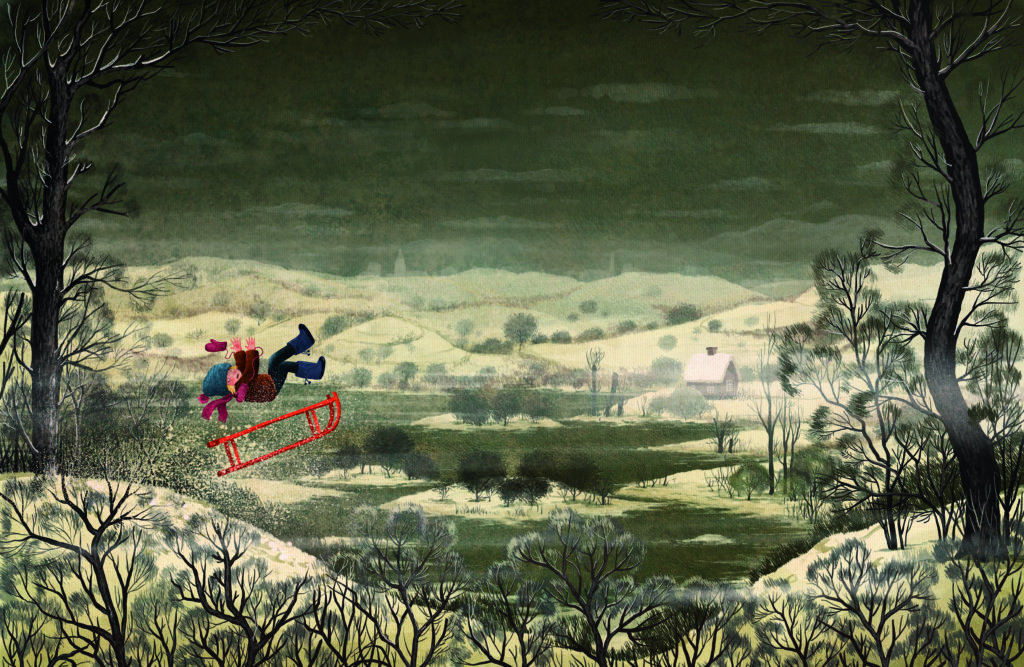
I flew into the air and the sledge shot off through the trees. I skidded into an icy tunnel, sliding faster and faster until I couldn’t tell up from down.
Little Pearl by Martin Widmark and illustrated by Emilia Dziubak is published by Floris Books, priced £12.99
Alycia Pirmohamed is a Canadian-born poet living in Scotland and is a current Ph.D. student at the University of Edinburgh. Her chapbook, Faces That Fled the Wind, was picked by Camille Rankine as the winner of the 2018 BOAAT Chapbook prize and we are delighted to share some poems from that collection with you.
Poems taken from Faces That Fled the Wind
By Alycia Pirmohamed
Published by BOAAT Press
Ways of Looking
Every prayer is a heron at first glance,
the marbled neck of someone
indistinguishable from this house.
Every figure wildreed unbelonged cursive
is a morning’s mound of sugar.
This mosque is a wood
where I sit cross-legged,
alder straight.
Where I mirror my mother’s
twenty-year-ago askings.
This mosque is a cut of apple—
I mistake each slice for a mouth
—I mistake the back of every head
for my father;
red gala, ambrosia, faces arranged into
holy sorrows.
He is here with cloves packed
into his wounds.
I am here because there are wounds
packed into my wounds.
In my language, every line is a fallen thing.
In my other language,
.
Mother’s
I am imagining again,
her story
of resin and cassava,
thin blood,
and flight.
It is mine, too,
like mirrors
inherited only
from mother, to mother,
to daughter—
eventually.
That smaller
tether
in every cell,
a helix of hushes,
sweet, tart
grapes on the vine.
All of the firsts
accruing in a body,
one voice
splitting into its Februarys
and its silences—
first dab of oil,
first whole nutmeg,
first unknotting
of adolescent hair—
first heartache,
its spectrogram passed
down,
whale song
from chest to chest,
an echo slickened
with rain and salt
and habit.
Hawwa is Creating Her Garden
Before her, the clay
of evergreen and juniper and oak.
Hawwa drinks sweet water from the well
studies the spine of each tree,
kisses each face
she finds in the river.
Hawwa is this garden. Look closely
at the rosary beads that glisten
like blackberries
on the bough.
Hawwa is olivine
and zinc,
she has planted seeds beneath the highest point
of the sun
and unfolded her body
onto the earth. She rises
like an eagle,
and laughs like a wasp.
Hawwa loves many things, and what she loves
she gives a name—the birds
that ki ki ki
are northern flickers. She cracks open a
pistachio
and delights in its snap.
Hawwa is heart and animal and breast and god.
Faces That Fled the Wind by Alycia Pirmohamed is published by BOAAT Press.
Your home is supposed to be your sanctuary, the place where you are most relaxed, most safe. But what if you have the neighbour from hell – literally? In his latest thriller Anthony O’Neill gives us a page-turning cautionary tale on getting exactly what you wish for.
Extract taken from The Devil Upstairs
By Anthony O’ Neill
Published by Black and White Publishing
Cat had been trained to deal with difficult people – to charm them, establish a rapport with them, manipulate them. She was proud of her record in doing so. And she backed herself to get results now.
The following evening she raced home from work and changed into her running gear. She felt slightly out of shape – moving in, setting herself up, then adjusting to Moyle’s routines had all taken their toll – but she knew she still looked OK in Lycra pants. She tied her hair back in a swishy ponytail. Even considered stuffing her bra.
Then she sat in her armchair, trying to read a book about Julius Caesar, and waited for Moyle to come home.
Frustratingly, it wasn’t until ten p.m. But when she heard the kah-lunk of the building’s stair door and clap clap clap of his boots on the granite steps, she was ready. She took a deep breath and started down the stairs past the malfunctioning light.
She met him for the first time outside the door to Number Three.
‘Hi,’ she said as brightly as possible, thrusting out a hand. ‘You must be Dylan.’
He had unruly shoulder-length hair, a lank beard, a bloodless complexion and ruthless dark-brown eyes. He was wearing an inflexible scowl, a dog-collar tattoo and a leather jacket over a ragged T-shirt bearing the words HOUNDS OF HADES. He couldn’t have looked more like a hard rocker if he’d stepped off the cover of a death metal magazine.
He accepted her hand with a desultory shake but was still giving her a million-mile stare.
‘I’m Cat, Cat Thomas,’ she went on, still smiling. ‘I’m living in Flat Five, right beneath you.’
He continued looking at her blankly.
‘I’m sorry I didn’t introduce myself earlier,’ she said. ‘But I think you were away for the first few weeks I was here. This is really some sort of place, huh? So atmospheric – I love it.’
He finally seemed to have realised she was talking to him. ‘Cat,’ he said. ‘Thomas Cat. Tom Cat.’
‘Yeah!’ She laughed, as though nobody had ever made that joke before. ‘Catriona actually, in the Scottish style, but where I grew up no one knew how to pronounce it, so I shortened it to Cat. Tom Cat, yeah.’ Another pointless chuckle.
Moyle continued staring at her. His eyes roamed her body, but he didn’t look impressed.
‘Oh, well,’ said Cat, ‘better be on my way. It was great to meet you.’
She turned away and started down the steps. But almost immediately turned back. Because now came the ‘afterthought’.
‘Oh – Dylan?’ And when he slowly rotated back in her direction: ‘I don’t know if you’re aware, but apparently there’s nothing insulating the space between our two apartments – just empty air. So I can hear everything. Everything. And, you know, I’d really appreciate it if you could be mindful of that. At night, I mean. The boards in your place creak. The pipes clang. The doors bang. And sometimes I find it a little hard to sleep. Which is a problem because I’m settling into a new job and . . . well, you understand.’
She’d said it all with upraised eyebrows and the sweetest of smiles – completely unthreatening and non-aggressive, just a new friend asking for a favour.
But in response Moyle’s forehead furrowed, as if he was struggling to work out why she was bothering him with such trivia. And finally:
‘American.’
He said it as though he’d belatedly recognised her accent. As though it explained everything. As if her nationality were some sort of disease.
Cat could only laugh politely, treating the reaction as a joke, then turn around, head down the stairs again, and go out for her run.
But as she scaled the hills of Ravelston – half-heartedly, and absurdly late at night – she had a terrible feeling in her gut. A sense that her charm, her wiles, all her strategic manipulations, had come to naught.
And so it turned out to be.
That night she lay awake in bed, hearing the klunks, the creaks, the kee-wahs, and the shhhhhhhhhhhh of the hissing pipes. If anything, the noises were more insistent than ever. She slept in fits and starts, drifting in and out of psychedelic dreams, her solutions becoming ever more biblical.
The Devil Upstairs by Anthony O’ Neill is published by Black and White Publishing, priced £12.99
Ailsa has had a difficult young life, and when she rescues two selkies from some bloodthirsty raiders she finds that becoming their guardian only adds to the dangers she faces. Caroline Logan’s debut fantasy, The Stone of Destiny is a rattling good read, and in this extract we find her at the beginning of her adventure with the selkies, but still haunted by her past.
Extract taken from The Stone of Destiny
By Caroline Logan
Published by Cranachan Books
In her dream, Ailsa could see a golden-haired woman with a crown of branches. The woman held out her arms.
‘Come to me, my child,’ she whispered.
When she didn’t move, the woman’s face became angry. ‘You’ll never escape.’ Behind her, four large wolves appeared with glistening fangs.
Ailsa turned and ran through the forest, the wolves hot on her heels. She could feel their breath on the backs of her calves. Suddenly, there was a thud and the sounds of pursuit ended abruptly. She stopped and waited. Then she heard it.
Crunch.
Crunch.
Crunch.
Throughout the woods, the footsteps echoed. Ailsa turned to run again but realised her feet couldn’t move. When she looked down, they were encased in mud. It shifted around her legs as if alive; creeping up her skin and clothes, gnawing and sucking. Her heart beat wildly in her chest as she struggled to wrench herself free.
I’m going to die, she thought as she sank further into the ground. She tore at the dirt in front of her face, scrambling to find purchase. Her breath came out in desperate sobs but the mud continued to crush her body in a vice grip. As it pinned her arms, she looked up for someone, anyone, to help her.
That’s when she saw them.
Two large, red eyes glowing from between the trees.
*
Ailsa woke with a gasp, and sat up to remove the blankets that had become tangled around her ankles. She’d had the same nightmare many times before; the blonde woman was a new addition, though. She had probably seen her in the inn somewhere. Ailsa leaned against the headboard and allowed herself to wake up fully.
Although the dream left her with a residual feeling of terror, she felt strangely hopeful. Today, they would be travelling to Dunrigh. She had often wondered what it looked like but had decided not to risk venturing too near in the past. Ten people and a goat in a wee village she could handle. Thousands of men and women, packed closely together, watching and gossiping? She’d have been hounded in the streets if she were lucky. At worst, a mob would have lynched her on the spot. Regardless, she was curious about Dunrigh. There must be something worthwhile about the city, if so many people decided to stay there?
The mouth-watering smell of bacon drifted up to her nose through the crack under the door. The light peeking in through the little window told her that it was just after dawn. No doubt it would be a grey, dreich day, as usual.
Ailsa heard a faint whistling sound coming from Harris and Iona’s room next door. Unsure of who or what was making the noise, she rose to investigate.
The siblings had not locked their door, either in carelessness or anticipation of her visit. Inside, she found a narrow room, a twin to her own. The fresh smell of sea salt and citrus wafted about the room. Hers probably smelled like sweat; she hadn’t bathed last night.
Iona must already be downstairs. Harris, however, was still fast asleep and seemed to be the source of the whistling.
He snores? Ailsa grinned to herself. She’d have to file that useful information away for later. Stepping fully inside Harris’s room, she closed the door quietly behind her. Leaning against the door, she studied the unconscious lump in the bed.
He’d managed to find an undershirt and trousers to sleep in. His messy hair curled around his face, which had formed an unpleasant expression: his mouth was hanging open and drool was pooling onto his pillow.
It was still hard to believe that only yesterday she’d witnessed Harris change from a cute, injured seal into the slevering man that slept before her. She wondered, not for the first time, how his transformation actually worked.
Then, thinking about how infuriating he had been the night before, she stepped around the foot of the bed, creeping quietly across the rug-covered floor. Peering down at his sleeping form, she couldn’t contain her smirk.
Beside the bed, a glass of water sat on top of a side table. With nimble fingers she lifted the tumbler from its place and held it in one hand.
Let’s test some theories.
Ailsa dumped the water on his face.
Harris thrashed and, still half asleep, let out an almost scream. He wiped the water off his face, spluttering in surprise.
‘Sorry, Harris,’ said Ailsa in a honeyed voice, mischief glinting in her eyes. ‘I just wanted to see if you would turn back into a seal.’ She backed away from the bed.
He squinted groggily around the room until his eyes fixed on her.
‘YOU!’ he growled, sitting up. He would have looked menacing, Ailsa thought, if not for the hair plastered to his forehead and the lines his pillow had left on his cheek.
‘Obviously, I was wrong.’ Ailsa’s attempts to stay out of his reach failed when Harris dived towards her with a wail of fury and they thudded to the floor.
‘Let me go,’ she protested. ‘I’m sorry I got you wet!’
She tried to escape his grasp, but he held on strong.
‘Here, you can have some,’ he grumbled, shaking his hair at her. She grunted and pushed at his chest, but he just grinned wickedly.
‘You deserved it, you wretch.’
‘Don’t dish it out, lass, if you can’t take it.’
‘What in the Hag’s name is this?’ Iona shouted, appearing at the door. She towered over them with her hands on her hips, glaring down at their entangled bodies.
It was Harris who started giggling first. With one look at the hair streaked across his face, Ailsa let out a quick bark of laughter. With a gasp, she covered her mouth with her hand. She got up, adjusted her clothes and then marched from the room.
‘See you at breakfast,’ Ailsa threw over her shoulder.
What the hell was that? Ailsa thought. She would need to be more careful. She couldn’t afford to start liking her new companions—and that was a very bad idea. Because when you like people, they have the power to hurt you.
When Ailsa was young, other than her brother, Cameron, she’d only had a few friends. He had alternated between playing the doting older brother and wanting nothing to do with her. The best days had been when he let her tag along on adventures with his friends. The neighbourhood children were talented at sneaking away from their parents and didn’t have the same prejudices. Ailsa had spent her summers wandering around the woods, playing bandits and maidens with a gang of youths, long before the forest embodied her fears. The children knew their parents disapproved of Ailsa, but this had only made her friendship more appealing. They used to hide her round the back of their cottages and feed her treats like a pet. Then, when they played their games, she was always a lovely, good, faerie princess or a wicked pirate queen with her motley crew of cutthroats and scoundrels. Cameron had loved to parade her around them.
But it all came to an end the spring her mother died. Then Ailsa became a wandering orphan: an outsider not tolerated by the villagers. Afraid she would hurt him next, her brother had been taken away and sent to live with distant relatives. She still remembered the sorrow in his panicked eyes as he was led away from the cottage, kicking and screaming her name.
Later, towards the end of that summer, Ailsa returned to her house to find the door kicked down and the walls smashed. She gathered up her belongings, including a few of her mother’s trinkets, and moved on to the next town.
Even now, she couldn’t bring herself to think of the only other time she’d had a friend. He didn’t deserve to be remembered.
If you start to care, you’ll be disappointed when they leave. You can only rely on yourself.
The Stone of Destiny by Caroline Logan is published by Cranachan Books, priced £8.99
For Philip Marsden, the Summer Isles were a place of personal significance, a calling card to his imagination. In his latest book, The Summer Isles, he writes of his journey to the islands up the west coast of Ireland and Scotland. He explores how mythologies of places are created, and in this extract contemplates the importance of the Selkie while moored beside the island of Jura.
Extract taken from The Summer Isles
By Philip Marsden
Published by Granta

Map illustrations by Emily Faccini
Something made me turn. A head in the water, just a few yards from the boat’s quarter – two big eyes, whiskers, pale blotches on the neck. A grey seal. We looked at each other. It was hard not to read in its gaze a sense of surprise, an anthropomorphized reaction to this intrusive form in its bay: Who are you? What are you?
Seals were always selkies here, along the Atlantic coast. They led semi-human lives. They lived in their own world beneath the waves, one that mirrored that of people’s above. They were capable of human speech and human emotions, and they had underwater houses with doors and windows, the same as us. Once a year, they gathered at a place off the Donegal coast and elected from their number a leader a selkie king. Sometimes they could be heard singing of the seal city underwater, its coral gardens and its mother-of-pearl facades. To those who heard the song, it had a hypnotic effect: a delicate air, and words which spoke of a place ten thousand times more beau- tiful than the sky. The selkie world was a version of the otherworld.
Selkies could make near-seamless appearances on land. Female selkies would slip out of their sealskins and take on the form of women and sleep with men. Male selkies would also take on human form and father children. They might take those children back to the sea, or they might leave them on land. You could never be sure which were the selkie children; they might be very good at swimming, or very small, or ‘very sharp indeed at the learning . . . particularly at the Hebrew’. Then one day they’d just disappear. There were whole families in Ireland and Scotland who were known to have the seal blood in them, and the Scottish folklorist John Gregorson Campbell speaks of the Clann ’ic Codrum nan ron of North Uist, ‘the MacCodrums of the seals’, so named for their seal ancestry.
In the 1950s, David Thomson travelled in the west of Ireland and Scotland gathering selkie stories. In the tender account of his journeys, The People of the Sea, he tells of meeting a man of the road down in Kerry who was descended from seals. ‘The seals are a class of a fairy,’ explained the man. ‘They come out of the north of Ireland, from some place by the County Donegal.’ He then told Thomson about a boy who, collecting kelp one day, stabbed a seal. The boy watched as it turned into a red-headed man and ran away. Years later, when the boy was a man, he was fishing near Tory Island. When he went ashore, he saw that red-headed man, and the man said ‘thank you’ to the boy for what he’d done years earlier. He’d been freed from his seal-state by the stabbing.
Thomson not only recorded the habits of selkies and their place in the world, but also the relish with which their antics were told. The selkies could be malicious or a threat, but they were also characters, recalled like any old-time village eccentric. He remembered one man in north Mayo telling a selkie story: ‘Do you remember the seal we met outside chapel? You remember how it was walking like any dog.’ He said that someone hitched it up to a cart and put it in a hay shed and it spoilt the hay – no cow would touch it. It was Finoola Finney who drove the seal, he recalled, and she was a girl who was up for ‘any mad thing’ – and the man laughed so much that for some time he was unable to finish his piece.
Thomson heard another account of a man travelling to the annual fair in Belmullet. He was late and all the currachs had already left to cross the estuary. So he sat on a rock, feeling sad. A seal came up and addressed him by name. The seal said he was also going to the fair. So the man jumped on his back and they swam out to cross the tide. They were joined by other seals, all going to the fair. When they reached Belmullet quay, the man jumped off and waded ashore, then turned to thank the seal. But he was gone. Instead he saw ‘a fine gentleman’. ‘I am the seal,’ said the gentleman. The man took him to the pub and they drank rum together. Rum was the ‘seaman’s drink’.
The selkie stories were sustained on these coasts by the constant presence of seals. Some strange congress takes place when you look at a seal, some hint of recognition, reinforced by the sense that it appears to be mutual. In many places, seals were believed to be fallen angels, the ones who, expelled from heaven, fell into the sea. But it was less their angelic nature than their human habits that were recalled again and again. Seamus Heaney said of the seal belief that it represents ‘the old trope of human beings as creatures dwelling in a middle state between the worlds of the angels and the animals.’ Yet shape-shifting is less about affirming man’s separation from the beasts than the possibility that we remain a part of them. It implies a world in which the boundaries between things do not – or should not – exist. It is the same parallel country of fairies and angels, the spirit world, into which we might occasionally glimpse or even travel. We might be locked within our frames, within our own mortality, but a bit of us remains mobile. ‘Of bodies changed to other forms I tell,’ Ovid declares in the opening line of Metamorphoses, and goes on to make the case that our souls are essentially fluid, and ‘adopt / in their migrations ever-varying forms’. Introducing his own version of Metamorphoses, Ted Hughes reflects on the moment of transition, repeated in each of the poems: ‘Ovid locates and captures the peculiar frisson of that event, where the all-too-human victim stumbles into the mythic arena and is transformed.’ The tales might be salutary, cautionary or retributive, but they hold out the promise of transformation – and transformation answers to that perennial itch at the core of our condition: the dissatisfaction of being, and the promise of becoming.
The endurance of the selkie myth can also be explained as an example of the poetic faculty, where everything can be revealed by finding its parallel. It comes from that strange region of cognitive territory where the chaos around us is briefly ordered by analogy, and the analogy grows into story and the story evolves and mutates into myth, a species in itself, both true and untrue. Selkie belief is a measure of the abiding need for such ambiguity. We might think that belief means certainty, but it doesn’t – it works better as the accommodation of paradox. Seals can be people and people can be seals. That’s it.
In the Ordinalia, a series of medieval mystery plays written in the Cornish language, there is a discussion about the question that lies at the heart of Christianity, the same question that has vexed and divided Christians for 2,000 years: how can Christ be both mortal and divine? The Cornish play has an answer:
Look at the mermaid
half fish and half man.
God and man clearly
To that we give belief.
I woke in the night and lay listening. Every ten seconds came the sound of a wave being dumped on the beach. I went up on deck. The boat had drifted round to face north-west. Not a breath of wind. My masthead light was glittering on the water. Over the Paps a large moon was half-hidden in shreds of cloud, and I listened to the anchor chain below, mumbling as it dragged its links over the sand.
I became aware of another sound. It was coming from the skerries. I realized that it had been there on the edge of my sleep for some time. I focused the binoculars: in the moonlight, a jagged silhouette of rock, a black void, and, above the water, three softer shapes. The moonlight on their backs gave them a roundness, the sort of shape that only animate things can hold. Seals. The noise they were making was part foghorn and part wolf-howl – and for the briefest of moments, I thought I understood what it meant.
The Summer Isles by Philip Marsden is published by Granta, priced £20.00
David Robinson has appreciated William Dalrymple’s writing on India for a long time, and in reading Dalrymple’s latest book, he finds a writer as insightful, probing and as gripping as ever.
The Anarchy: The Relentless Rise of the East India Company
By William Dalrymple
Published by Bloomsbury
The reviews are all in for William Dalrymple’s The Anarchy, his history of the rise of the East India Company published last month: I’ve read as many as I can find and they are uniformly excellent. Amidst the panegyrics, there’s not a whiff of criticism. The opening sentence of the author’s note at the end of the book – ‘William Dalrymple is one of Britain’s great historians’ – stands unchallenged.
I’m old enough to remember when that wasn’t the case. In the Nineties, no-one thought of him as a historian at all. He was a travel writer, and had been ever since he left Cambridge and headed off in Marco Polo’s footsteps from Jerusalem to Kubla Khan’s Mongolian summer palace for his prize-winning 1989 debut In Xanadu. India had already a hold on his imagination, but he would never have thought of himself as its historian.
All that had changed by June 2003, when I met him for the first time to interview him about his book White Mughals. It had just won the Scottish Arts Council Book of the Year, and as one of the judges, it fell to me, sitting in the sunny garden of his Queen Anne cottage in Chiswick, to tell him that he could soon expect to be £10,000 richer.
White Mughals is the story of the love between an East India Company representative in Hyderabad and a Mughal princess at the end of the eighteenth century and the beginning off the nineteenth. Not only is it a great story in its own right but it broke new historiographical ground. The relationship between James Achilles Kirkpatrick and Khair-un-Nissa, Dalrymple showed, reflected the times they lived in. Long before the unbridled racism of the Raj, there was ‘a succession of unexpected and unplanned minglings of peoples and cultures and ideas’. Interracial love stories, such as Kirkpatrick’s were part of this and far more common than previously thought.
Back in 2003, Dalrymple didn’t know that White Mughals would go on to be picked by the Richard & Judy Book Club, doubling its sales to 200,000, or that Bloomsbury would woo him with oodles of money for a six-book deal. In fact, at the time, writing history books about India looked like a shortcut to penury. But like his literary hero, Bruce Chatwin, who walked out of a well-paid job at Sotheby’s for the uncertain life of a travel writer, Dalrymple was determined to defy the odds. He spent four years researching and writing the story of Kirkpatrick and Khair-un-Nissa, remortgaging his house and running up a £27,000 overdraft. The day before I met him, his exasperated bank manager had told him he was going to stop honouring his cheques.
It didn’t come to that. On the same day he met the bank manager, he was told that his book had won the £10,000 Wolfson History Prize. The next day, thanks to the Scottish Arts Council, he had twice that amount. A corner had been turned.
That visit to Chiswick taught me a lot about William Dalrymple. First, that he is excellent company: bright, breezy, funny, charming, ferociously committed to his work (‘That’s Daddy’s girlfriend,’ his seven-year-old daughter told me as I examined a portrait of Khair-un-Nissa on his living room wall). But even if White Mughals hadn’t taken off, he told me, he wouldn’t have stopped writing about Indian history.
Over the years, I’ve either interviewed him or heard him talk about nearly all of his books about India. His pitches for them are irresistible. For The Last Mughal (2006), he basically gave a condensed version of the opening page: a secret burial on a rainy September night in Rangoon in 1862, when the last descendant of Ghengis Khan, Tamerlaine and Babur in a lime-drenched plywood coffin in a pauper’s grave, without either a ceremony or a gravestone. ‘There will be no surviving vestige,’ wrote the supervising British officer, ‘to mark the remains of the great Mughals.’ Sounds like a good story, I said feebly when he’d finished. ‘It’s a f****ing great story,’ he replied, throwing back his head and laughing.
For Return of The King (2012), I met him in a pub near his East Lothian family home, and over fireside whiskies he told me a condensed version of the First Afghan War, the greatest British military disaster of the nineteenth century, when a whole invading army was all but wiped out. This time, his research – there’s always plenty, usually involving a whole array of hitherto untapped sources – had more than a whiff of danger. He showed me pictures on his phone of the rear window of the taxi that picked him up at Kandahar airport. It had been shattered by a Taliban sniper’s bullet aimed at the back of his head. Had the taxi not had another layer of bulletproof glass, he would have been killed. As I listened to his tales of travelling deep in Taliban territory with a GPS alarms in case he was taken hostage, I couldn’t help thinking how, when he finally gets round to writing his memoirs, they’ll be far more gripping than those of any other historian I can think of.
In each of these three books, you may have noticed, Dalrymple has confined himself to a relatively small and manageable chronological canvas – Hyderabad 1795-1805, Delhi 1856-8 and Afghanistan 1839-42. The Anarchy is different, sweeping across the centuries from the East India Company’s relatively poor and occasionally piratical beginnings in 1599 to its military dominance of the subcontinent in 1803. This is a huge challenge to any historian, especially when most of his readers won’t know anything about key events (hands up those who know what the 1765 Diwani was or why Mughal Emperor Shah Alam was blinded and his family raped), or even the basics about regional rivalries at the time. Thanks to his sparkling narrative skills, Dalrymple passes the test with ease.
The dazzled reviews The Anarchy has received are mainly variants of Maya Jasanoff’s assessment of White Mughals, that Dalrymple ‘researches like a historian, thinks like an anthropologist and writes like a novelist’. All the ones I’ve seen accept his central thesis, that the British domination of India began with ‘a dangerously unregulated private company, headquartered in one small office five windows wide, in London, and managed in India by a violent, utterly ruthless and intermittently mentally unstable corporate creditor – Clive’. Drill down even further, and you learn how corporate greed on this scale was possible in the first place, and how the company’s success owed less to its competence than to the tax-collecting powers granted by the Mughals (the Diwani) or loans from Bengali bankers. The fighting, of course, was mainly done by Indian sepoys, but the ones serving this new, massively rich multinational were often paid four times more than the ones fighting against them. Money talks, and in the story of the British conquest of India, it talked louder than almost anything else.
No-one looted more money from India than the Englishman Robert Clive, who became the richest man in Europe on the back of his victories. No-one conquered more of India than the Irishman Richard Wellesley, the Duke of Wellington’s elder brother, all but forgotten now even though his battles won more of India than Napoleon’s won of Europe. Yet the Scots were up to their oxters in the commercial pillage of India too: the first three Governor-Generals were Scots, as in 1759 were almost a third of the EIC’s staff, and (by 1795) one in every three officers and six in every eleven of the company’s British soldiers.
The Dalrymples were there as well, just like the Frasers (ancestors of his wife Olivia, whose mastery of painting Mughal-style miniatures rivals her husband’s skill in explaining Mughal history). In 1754 Stair Dalrymple came out from the family’s North Berwick home and was one of the 126 prisoners of war who died over three days in the Black Hole of Calcutta atrocity two years later. By then Alexander Dalrymple was already working for the EIC in Madras and later, as a celebrated geographer, returned to work as its chief hydrographer in 1771. In 1780 a Lt James Dalrymple (1757-1800) was badly wounded and taken prisoner at the battle of Pollilur against Tipu Sultan of Mysore in 1780, the biggest British defeat in India. Along with his cousin Sir David Baird, he was kept as a prisoner of war for 44 undoubtedly horrendous months. Both fought at Srirangapatna in 1799, by which time Dalrymple was a Lieutenant-Colonel. Tipu Sultan was killed in that battle just 300 yards from where the two Scots had been imprisoned.
I mention James Dalrymple only because William Dalrymple doesn’t say so much about him in The Anarchy. But he did in White Mughals, where he pointed out that James was married to a certain Mooti Begum, a Muslim princess and the daughter of the Nawab of Masulipatam in eastern India. Together they had five sons and one daughter. I don’t know exactly how that family tree leads back to North Berwick, only that it does. That 18th century Scottish-Indian marriage was part of the wider background story for White Mughals, the book that turned William Dalrymple into a historian. Whether as a travel writer or historian, he excels both as a stylist and scholar. Mooti Begum Dalrymple would, I think, be very proud of him indeed.
The Anarchy: The Relentless Rise of the East India Company by William Dalrymple is published by Bloomsbury, priced £30.00
In the quiet wee village of Skerrils, Callum and his friends are desperate for excitement and adventure. Little do they know that some all powerful nature spirits are just about to grant them their wish . . .
Author Alan McClure gives us a lively reading of the first chapter, below. We hope you enjoy it!
Extract taken from Callum and the Mountain
By Alan McClure
Published by Beaten Track Publishing
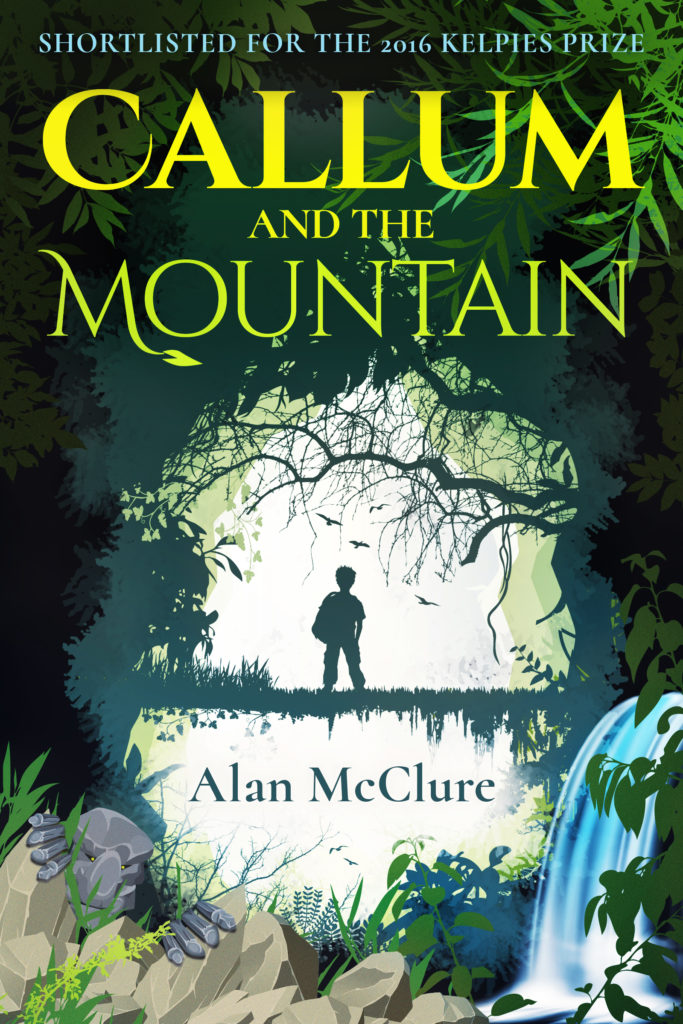
Callum and the Mountain by Alan McClure is published by Beaten Track Publishing, priced £8.99
As the nights get colder and darker, it’s time to coorie in! Beth Pearson, in The Coorie Home, has some excellent ideas on living in a beautifully-cosy fashion whether you’re in a city tenement or a country cottage. Here she chats with illustrator Alison Soye about front doors.
Extract taken from The Coorie Home: Beautiful Scottish Living
By Beth Pearson
Published by Black and White Publishing
Northern Irish illustrator Alison Soye, who stays in Edinburgh, is known for her fascination with beautiful front doors. As we wandered through a wee back street between Bonnington and Broughton, she explained what intrigues her about them and what she has become aware of through her art and her photography.
What intrigues you about front doors, specifically in Scotland?
How people ‘dress them’ in different ways – painting their doors, adding beautiful door numbers, creating leading lanes and quirky gates. I also love how the doors are often adapted to seasons and events – for example, Christmas and autumn wreaths, Halloween decorations and even balloons for birthdays. I feel that in a lot of areas in Scotland people take pride in their front doors, as it’s their one way to make a leading impression on their home.
What do you think you can learn about a person from to their front door?
I think you can learn a lot about a person’s creative mind by how their front door looks! For instance, they might have a really bright,colourful paint colour on their door if they have a loud personality. A traditional doorway might show a person appreciates the history and heritage of their country. An uncared-for doorway, and peeling paint, might show that a person perhaps cannot afford or doesn’t have the time to maintain it. Or perhaps it is just not a priority! You can sometimes see the opposite of this in the pride lots of retired people take in maintaining immaculate doorways and front gardens.
What have you learned about Edinburgh and Scotland from studying and photographing doors?
I have learned how traditional and historical Edinburgh and Scotland might have looked as many of the doors have been so well preserved. I have also learned how buildings and doorways are very important in establishing a sense of pride in homes, businesses and historical, national buildings.
How do you think someone could at a low cost improve their front door?
Paint. Natural seasonal wreaths – holly, ivy, pine cones for Christmas; red and orange leaves and acorns for autumn; fresh green leaves for spring or summer. Simply keeping the front door clean and clear of bins or debris can also make a big difference!

Photography by Ciara Menzies.
The Coorie Home: Beautiful Scottish Living by Beth Pearson is published by Black and White Publishing, priced £14.99
A night in with a dram and a book: what’s not to love on darkening autumn evening? And so Canongate and Balvenie Whisky have joined forces on an excellent collaboration, Pursuit: The Balvenie Stories Collection, bringing together some of the hottest writers around to write tales – fiction and non-fiction – of determination, achievement and perseverance. Here we have Sara Collins’s contribution, an affecting story on how it feels to leave home behind.
‘State of Emergency’ by Sara Collins, taken from Pursuit: The Balvenie Stories Collection
Edited by Alex Preston
Published by Canongate
We loaded the car and drove into the hills. We packed the radio, because we needed it; and nappies, because we needed them, too. We took fifty US dollars per head, which the law allowed us, but not much else, because this is the story of the things we didn’t carry and, since it was Jamaica in 1977, we didn’t carry much. By this time the State of Emergency was already seven months old; there had been an outbreak of political violence in the lead up to the elections – the beginning of a long national nightmare – and my parents decided we had to leave.
The prime minister, Michael Manley, had promised to smash capitalism ‘brick by brick’, and I guess you could say we were getting hit by all those flying bricks. We drove all night, until below us the place we’d come from was nothing but a black shadow sinking into the sea, caught in the first glaze of sunrise, and, even though we loved that old landscape and all its green undulations, we didn’t look back. We were ironing ourselves out of it, getting the hell away.
I want to tell you how, after you’ve left a place this way, you may find yourself needing to write about it, keeping in your rearview a litany of things you don’t remember, with as much choice in these things as you might have about falling in love. How when you start writing, you’ll find yourself coming full circle to the same emergency. The same words leaping around you eager as dogs: curfew-gunman-garrison-gun. How I read books because those words were caught in my head like a line from a song.
*
We flew to Grand Cayman: my parents, my three brothers and I. We got ourselves a room of our own. Two beds, two crocheted bedspreads, one bassinet. My Caymanian grandmother, whose house it was, had a habit of jabbing at my skin like it was something she forgot in the oven. ‘You caught the sun,’ she’d say, as we both surprised ourselves with the discovery that she’d have loved me better pale. My mother worked night shifts. During the day my brothers and I tried to prise her eyelids open while she slept. I stared at myself in the mirror with her nurse’s badge pinned to my T-shirt and her white cap perched on my afro, imagining what it would be like to be a woman who worked. One of our neighbours, a man named McDoom, who ran a bar called Club Inferno in a place called Hell, brought us gifts of food. Baskets of yams. Green bananas.
Finally we could afford the rent on one half of a shared duplex, where one night we built a bonfire in our backyard and my brothers and I raced each other around it, thin and barefoot, singing: Run from Michael Manley! Run from Michael Manley! We were finding our feet (limping, yes, but standing), my father working again as a barrister, picking up the threads of his old life, so we could afford to fill an old barrel every couple of months. Packs of Jacob’s cream crackers scuttled like crabs under lace-edged underwear (the ‘good’ kind that wouldn’t shame you before the eyes of ambulance-drivers), Johnson & Johnson talc, bags of cornmeal, tins and tins of sardines. The barrel would stand in a corner of the kitchen filling up slowly until the lid sat snug on the final item – perhaps a navy-blue tin of Danish butter cookies – and then it would be dispatched to my Jamaican grandmother, who was one of the things we’d had to leave behind.
*
You could spend too much time trying to understand what led to those hardscrabble years, but it boils down to the same story everywhere, doesn’t it? The machinations of men. I understood nothing at the time about what we were doing or why we were doing it. I was a child and these were not childish matters. The PNP and the JLP were at war and it turned out there wasn’t enough country for the both of them. It turned out there’s no such thing as an easy passage.
In April 1978, there was a concert in Kingston – the One Love Peace Concert – an attempt to stitch the two sides together, would-be murderers with would-be murderees: Bob Marley on stage, joining the hands of the two reluctant leaders, the two pale kings – Manley and Seaga – buckra men in a country that had taught itself those were the best kind of men to be. Bob telling the people to come together. And maybe for a moment they all believed him, they believed in the possibility of peace, they left behind the light poles and dirt patches and bullet-wounded walls of the old garrisons. There was a frenzy of dancing; they seemed happy as cult members. Bob telling them that things would be all right. You could almost believe it, too, if you went and watched it now, if you didn’t already know the future, if you didn’t know that sometimes it seems the State of Emergency was the only thing that lasted. By the date of the peace concert, I was already gone, already watching the unfurling of a country that would never belong to me.
*
Jamaica was the place that had caused all this. It was seven years before we could go back to visit. Summer. A break from school. All six of us in the rented car. Twisting this way and that for a backseat view of the things we had abandoned, noticing everywhere these quick currents of memory I couldn’t quite grasp. There were so many things around me I didn’t know that I’d forgotten. The car pushing inch by inch through street vendors, who cried out and waved bags of just-roasted peanuts, peppered shrimp, fried fish and bammies. Their hands slipped like fishes past the glass. I had never seen this kind of urgency to sell something before, this way of pushing the thing at you, so you had to take it or be hit with it.
We started going uphill: urgent noises from the clutch and engine. After a time there seemed to be a bar or church every hundred yards; then women, straddling the roadside with children on their hips, who, when they heard the car, stopped and shifted to the side, without looking around. But sometimes there was no one for miles. Only the orange groves, or the small, ramshackle, apparently deserted buildings. Wood, zinc, sturdier houses sitting proudly beside concrete cisterns. Corner shops. Burglar grilles. Chain-link fence after chain-link fence.
Then, finally, Lambsriver. My grandmother’s tiny flat-roofed house: the walls blue-green inside and out; the floor that thumped underfoot; the yellowing crocheted curtains; the smell of wood. She came out onto her porch, plaits battened down under a head-tie, and watched at arm’s length as we poured ourselves out of the car. We were shy of each other, but my brothers and I trailed her through her garden. Breadfruit and mango and banana. More trees than flowers. We followed her to the outside kitchen, leaving all our questions hanging. A pot of goat meat ticked away on the stove. She’d baked toto, and as usual with anything that delicious we gave each other the eye, the starting signal for our usual backwards race to be last to finish, and, after we had, we peeled mangoes with our teeth and threw the skins into a pile under the tree, raising up a cloud of flies. We took our long, brainless pleasure in the food. I liked the way this grandmother looked at me. As if I was something you could be proud of. Then we heard our mother calling out urgently from the house: ‘What is all this? What is all this?’ And when we rushed inside we found her standing dumbstruck before Grandma’s wide-open wardrobe, pulling out bars of unused Ivory soap, tins and tins of talcum powder. Cotton nighties unfolding like white birds. My grandmother watched my mother from the doorway and, when her smile came it came slowly, like something that had been waiting a long time to be seen.
*
I want to tell you how lonely it must have been, to be the one left behind, curating the contents of those barrels, waiting to show us when we came.
*
How each person’s perseverance is only after all the simple matter of an accumulation of breaths.
*
How these small acts of perseverance hardly ever add up to something history cares two figs about.
*
How we left her that day, too, and drove back down to our hotel, and my brothers and I squeezed onto the concrete balcony and elbowed our way to the railing, so we could perch on the bottom rung and look out across the sand and whisper about the tourists, glossy with tanning spray, beating back against the currents of dark water swelling around their waists.
*
How that last image is a palimpsest. Faint beneath it are men on ships, and fainter still the traces of all the bad things that followed them.
*
How sometimes I hate the whole notion of endurance, mainly because it is the trick that hoodwinks us into staying in place.
*
How breath is the only tool with which we fight extinction.
*
For a long time I didn’t have the money or time to return, but, ten years afterwards, I travelled the Caribbean with a friend. Jamaica was on our list. We hitched a lift from Kingston to Montego Bay and waited in town for the Lambsriver bus. Shabba Ranks blared from a nearby sound system and I wandered over to a cart offering cigarettes for sale, negotiated a Benson & Hedges and a lit match from the woman tending it, standing to one side away from the crowd to smoke, wondering if anything would ever stop me feeling always and forever a visitor everywhere, but especially here.
A slight, dark, gap-toothed man slotted himself into the space between cart and wall and hugged the cigarette-seller from behind. She kissed her teeth. ‘What you troubling me fah? You nah see me working?’
But he spun around, addressing himself to the small crowd of us leaning against the wall. ‘You see this woman? Me love her bad, you see! Me love her bad!’
You couldn’t help but grin, and when I looked at the woman she was smiling too.
My friend and I, the people leaning against the wall, the music, the cigarette-seller’s lover, the way she laughed, leaning over the cart towards him, like she was peering into the bathroom mirror to paint her face. Here was a country. The place where, for me, desire had outlived memory. I felt my love for that whole place stir then; I felt love, like breath, conspiring with muscles and lungs and heart. I felt it as a thing harder to endure even than the history that had led to it.
My friend and I took the bus to Lambsriver. My grandmother had sprained her wrist, but she’d still been cooking all morning. I made her sit at the table and, as I tied a makeshift sling across her shoulder, she spread the fingers of her good hand wide across the wood and seemed happy. I would have known what to say to her had the country not snapped itself in two, leaving her on one side and me on the other. I had one of those cardboard disposable cameras with me and I took a picture of her before I left, a snapshot that could not yet reach across the space and time between that moment and the one when I would find myself, about ten years later, driving slowly through her village, knowing that she was dying, when my memory of her sprained wrist and her joy about the sling would rear up at the sight of her little house, and I’d sit beside her holding her hand and trying to conjure up some important thing to say, when the woman my mum was paying to look after her rattled the Dutch pot in the sink as if impatient to see the back of me and it would strike me that it was too late for the thing I wanted: Gran’s approval, or at the very least, her forgiveness. As if guilt was the only thing I had to show after going out into the world, and coming back.
Pursuit: The Balvenie Stories Collection edited by Alex Preston is published by Canongate, priced £12.99
Author and illustrator – and campaigner – Kate Milner is garnering great praise and prizes for her beautifully-illustrated and empathetic picture books. It’s a No-Money Day follows her award-winning My Name is Not Refugee and explores life below the poverty line with sensitivity and stunning artwork. With more than one in four children in the UK growing up in poverty and many dependent on foodbanks to survive, Kate Milner has given us an excellent starting point for parents to discuss a difficult issue with young children.
It’s a No-Money Day
By Kate Milner
Published by Barrington Stoke
To mark publication of It’s a No-Money Day, publishers Barrington Stoke are encouraging readers of all ages to donate to their local foodbank. They’ve produced postcards with information on where to find your local branch and what items are most needed, so to request a bundle for your classroom, library, bookshop or just for home, please email kirstin.lamb@barringtonstoke.co.uk
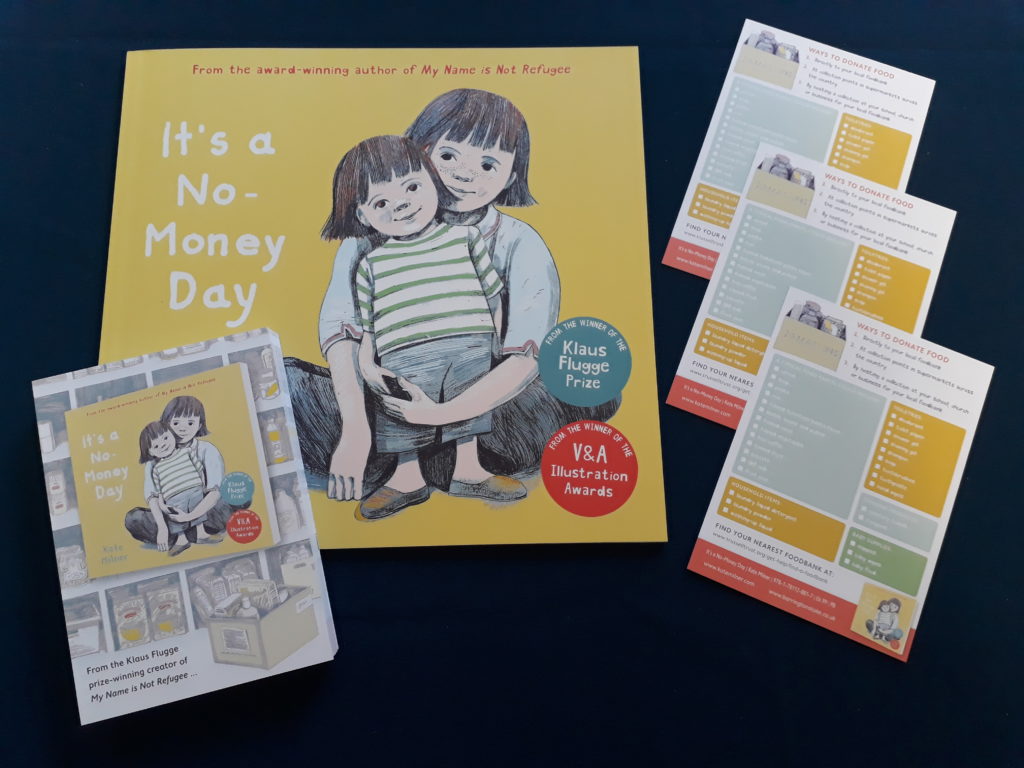
It’s a No-Money Day by Kate Milner is published by Barrington Stoke, priced £6.99
Today is National Poetry Day, and to celebrate BooksfromScotland are glad to share these extracts from Stephen Watt’s Fairy Rock, a crime novel written in verse. Set in Glasgow at the turn of the millenium it roams around the worlds of organised crime and sectarianism while exploring the disaffection and alienation from those left behind by poverty.
Extracts taken from Fairy Rock
By Stephen Watt
Published by Red Squirrel Press
DYNAMATION
Paying tribute to the savage giant cyclopes
in Homer’s ‘Odyssey’, army friends had informally
named him Phemus after an explosive mine
accidentally discharged on a military training exercise.
One scorched doll’s eye shunted towards his nasal bridge
and like a Harryhausen creation,
he twitched, shifted damaged bones frame by frame
like a stop-motion picture being filmed in the Gallowgate.
Past the vinegary taxi ranks and weed-perfumed council vans,
Phemus’ bald, ugly structure lumbered between shady Irish bars
which cops relished to monitor.
Rumour whispered like Tolbooth traitors
that he had partaken in Satanic rituals
and that unfortunate homeless individuals
had meat sucked from their bones like crabs
inside their stopgap squats;
their metacarpals suited for dental floss.
Such nightmarish skinder hindered an ability to ever get close.
Abusing any bar’s breakfast license,
Phemus seemingly turned his blind eye
to the bigotry and violence,
squandering his dole money on coffin nails and stout.
As clouds of his soul slithered from his nostrils,
not a single patron had suspected
that he was a snout, a covert informant
for the filth, someone’s animated model
given new life to brief; Argonaut in training.
OLD FIRM DAY
is tense flowers
of blue and green, blossoming inside boozers
where a thick air of language and stale sweatoverflows on to the street.
It is a day to think twice about the colour
of your footwear, nail varnish, contact lens.
In the home, the unwalked dog meditates pavements,
daren’t make eye contact if they lose.
The church is well-stocked ciborium’s and empty pews.
Is it true priests get free seats at Parkheid?
On trains, no-one wants the day-shift
as the city spins grave colours on the faces of the neutrals.
Trouble is not prejudiced, welcomes all-comers
into its morning-after papers with blades incising faces
and into ribs in the dangerous places
your parents once warned you about.
Southern India, child-labour stitched-flags
stir hatred and poison and for many, this is an enjoyment –
a reason for existing. A sense of belonging.
Keep your head down
if you don’t like what you see. Glasgow’s about to kick off.
SHIPMENT
Loose lips sink shipments. House whisky cackling aside,
the two old, flat capped boys inside the Tolbooth Bar
had lowered their voices to hide their schemes.
Semi-automatic ArmaLite AR-15’s and detachable magazines
were easy to break into parts.
These had proven popular with Provo farmers
overpowered by British troops during the early scraps
of what became known as The Troubles.
The weapons would be smuggled in crates
laden with white sports socks.
A pickup point had been arranged
at Cairnryan Port, wherein a messenger would transport the box
up the A77 to an agreed drop-off spot
on the outskirts of Glasgow.
The job was worth two thousand notes
and word was that there was a boy just released
from a short-term prison stint identified to carry out the errand.
Below the television in the corner of the pub,
Phemus was using his military-acquired skills
to lip-read, squinting his remaining eye
to take heed of every detail.
The police would pay him well for such information
but now new priorities were leading his reasoning.
TABLOID HAIKU
TOLBOOTH REGULAR
SLAIN AT CLOSED ICE RINK CENTRE.
REPUBLICAN LINKS.
Fairy Rock by Stephen Watt is published by Red Squirrel Press, priced £10.00
Our final piece in our Translation as Conversation strand comes in the week where we celebrated International Translation Day. Here, translator Fionn Petch tells us how travelling and living abroad contributed to his skills in his chosen field.
Turning Together
“as a translator you need to be a chameleon in life as on the page”
Bear with me. I’ll get to the conversation bit. Though it’s already happening, here, now.
I grew up in Scotland but took off quite early, travelling in Latin America, and found myself living in Mexico City, where I stayed for over a decade. My first years there were a period of trying out different lives, trying them on for size. Partly out of necessity and partly out of a desire to challenge my fears and disinclinations, I invented or accepted jobs that took me beyond my own sense of who I was. So, I followed the example of seemingly half the city and set up a street stall to sell my wares: my own home-baked bread. I learned how to lay bricks and render a wall with cement. I presented movies to crowded theatres at film festivals. I modelled clothes on a catwalk. I burrowed into corporate towers to teach English to bored executives, buffing up their language skills with the same affected good humour as the shoeshine guy who did their shoes.
In short, I translated myself into different worlds, worlds I could move between with a facility that felt impossible at home. I’d been freed from the trammels of accent, of upbringing and of expectations that can so constrict you in the country in which you’re born. At some point things coalesced, and I found that I had become a translator. And it turned out that all these meanderings had been good preparation for that task. The image I often turn to is that of the chameleon: as a translator you need to be a chameleon in life as on the page, to have a malleability that enables you to adapt to different registers of dialogue, to class and cultural contexts.
I’m not just talking about literary translation, of course. Having the agility to swiftly grasp a context and place yourself in it is just as important to so-called ‘commercial’ translation. Often disparaged as the poor relation, it is in fact an important foil to working on fiction or poetry. (Apart from anything else, it’s rare to be able to make a living solely as a literary translator, without any other source of income.) Such texts – whether magazine articles, product websites, tourist brochures, or whatever – make up the stuff of the language-world that an author is immersed in and draws on. Translating that world is the best way to become conversational with it and – assuming you’re not only doing home appliance manuals – of getting to know its outer reaches.
During this time I also embarked on a PhD at the National University of Mexico, not because I wanted to pursue an academic career but because many years earlier a work of translated fiction pulled from my dad’s bookshelf, A Different Sea by Claudio Magris, had led to an obsession with the little-known thinker Carlo Michelstaedter and his book Persuasion and Rhetoric. As I wrote my thesis, which focused on the shift between poetic and rational persuasion that took place in early Greek thought, the notion of ‘turning’ emerged as key. Turning in the sense of words, from within or without, altering your course or bearing. And I came to see translation as exemplary of this dilemma of persuasion, as a twisting and turning between choices. Translation is about turning over alternatives, about countless tiny decisions that must be taken without there being an absolute basis for determining if they are the right ones or not. All you have to go on are the myriad decisions previously taken by the author, decisions which you must track closely, but not simply imitate.
And so, a kind of conversation is established, even if it’s one where the author doesn’t exactly answer back. Perhaps surprisingly, the etymology of the word ‘conversation’ refers not to ‘speaking together’ but rather ‘turning together’ and originally had a sense of ‘dwelling, keeping company with’. When you walk alongside someone in conversation you do not march parade-style at a fixed distance, rather there is a constant back-and-forth of brushed shoulders, touched arms, glances of complicity, frowns of misunderstanding, while the accidents of the path itself throw you momentarily closer together or further apart.
As with the feet, so with the mind: a good conversation should not just involve repeating facts or opinions at each other, but engaging in a deeper kind of listening. It is not simply about trying to convince, to win somebody over with your arguments, but about making space for the other, letting in the possibility of being changed by the other. It is a turning-towards the other, one that invokes the affirmation of the gaze, and an attentiveness that now seems almost irretrievably lost amidst the catastrophe of social media.
Depictions of St. Jerome, patron saint of translators, whose feast day on September 30 has become International Translation Day, almost always show him working alone in his study, with only a lion and a skull for company. Nevertheless, despite the solitary character of the translator’s work, there is always someone else there. When done with care, translation embodies all the attributes of a good conversation, because it requires you to go beyond single-mindedness, beyond singularity of thought, and to open yourself up to a text, to another person’s experience and perspective on the world. As a translator, you are constantly practising this art of conversation by not imposing your own thoughts, not adapting the author’s words to your preconceived ideas, but rather turning towards the author, hosting them, allowing in that newness, all that strangeness, that multiplicity. It is an act of radical empathy.
In her wonderful book Translation as Transhumance (translated by Ros Schwartz), Mireille Gansel expresses this idea more simply and beautifully than I can:
I remember clearly how, one morning as the snows were melting, as I sat at the ancient table beneath the blackened beams, it suddenly dawned on me that the stranger was not the other, it was me. I was the one who had everything to learn, everything to understand, from the other. That was probably my most essential lesson in translation.
So, when I think about the conversation that is translation, whether I am working on a novel or on a very ordinary kind of text, I do so in the light of my own many-turning path into the profession. All those glimpsed potential other lives, those times I felt like a stranger to myself, inform me, just as every new book continues to change me. Translation, in the end, is a conversation with ourselves, with our many human selves.
Fionn Petch is a Scottish-born translator working from Spanish and French into English. He lived in Mexico City for 12 years, where he completed a PhD in Philosophy at the UNAM, and now lives in Berlin. Since 2017 he has been translating and editing Latin American fiction for Edinburgh-based Charco Press, including translations of Fireflies by Luis Sagasti (shortlisted for the Translators’ Association First Translation Award 2018) and The Distance Between Us by Renato Cisneros (winner of an English PEN Award, 2018).
Twitter: @elusiveword
Emily Ilett, winner of the 2017 Kelpies Prize, has written a story of bravery and kindness that celebrates the power of friendship and will have you holding your breath at each twist and turn. We hope you enjoy this extract.
Extract taken from The Girl Who Lost Her Shadow
By Emily Ilett
Published by Floris Books
Gail’s stomach twisted as she heard the bed creak upstairs. Kay’s shadow hadn’t just run away. It was Gail’s fault. If she hadn’t kicked it… The hurt in Kay’s brown eyes bubbled in front of her. “I chased her shadow away,” Gail said to the empty kitchen. She grabbed a photo of Kay from the fridge, stuffing it into her bag. “And now I’ll get it back.”
When she opened the door, the wind tugged at her hair. Gail squeezed her eyes against the rain, peering forward. Behind her house, the ground rose steeply towards Ben Fiadhaich, the wild hill. There it was: she could just make out the dark blur of Kay’s shadow pouring over the damp grass at the end of their garden. Gail saw it flow over the wall towards the river, which tumbled icy-cold and fierce down the hillside. “Wait,” she cried out, but the word was tugged from her lips by the wind and undone.
Rain soaked through her leggings as she ran down the garden and clambered over the wall. Here, a footpath curled along the river and out of the village for a mile, before forking into two: one beginning long-legged zigzags up the hillside, the other dipping to wind along the jagged cliff edge towards the south of the island. The shadow was metres in front of her, its shape shifting and swirling as it rolled over pebbles and through puddles.
Gail’s legs burned as she tried to keep up, blinking rain out of her eyes. At least now she was out of the house she could breathe again. Her head didn’t feel so squashed. And once she brought Kay’s shadow home, maybe everything would go back to how it was before. Before their dad walked out. Before Kay got sick. Before she stopped swimming.
Gail swallowed.
It had to.
She was out of the village now. Ben Fiadhaich loomed on her left, its slope scattered with straggles of trees and ledges of rock where shallow caves pitted the hillside like eyes. Gail crossed her fingers, hoping that Kay’s shadow would turn right towards the cliffs where kittiwakes wheeled and cried. But the dark shape slipped left at the fork, and Gail groaned and pressed her hands against her legs to push against the rise. No one climbed this side of Ben Fiadhaich. The slope was jagged and crumbling and there were too many whispered stories about the caves. Lynx Cave, Oyster Cave, Cave of Thieves.
The shadow slid in and out of her sight, slippery as a fish. It was moving further away. Now it left the path, darting over rocks and between tall pines.
Gail plunged through the grass, hands lurching to steady herself against the uneven ground. As she slalomed between trees, the rain petered to a fine drizzle. Here, the ground felt alive with shadows, stretching and reaching towards her. Which one was Kay’s? How would she know? But as she saw a dark shape sweeping over the grass, her mouth twitched in relief. Of course she’d know Kay’s shadow. It was like recognising her sister’s handwriting, or hearing the sound of her footsteps on the stairs.
Gail fought to make her legs move faster but the shadow was always ahead of her. Her chest heaving in waves, she tried to sprint but a stitch pierced her side and she folded over, clutching her stomach. “I can’t,” she gasped, and she crumpled to the ground. And she lay, panting for breath, her legs stuck out in front of her, as the shadow moved steadily up the hillside, closer and closer to the caves.
Gail had short legs, big feet and seal-dark eyes that were fond of staring. Her brown cheeks were dotted with so many freckles it looked like a bowl of Coco Pops had been tipped onto them. Beneath her coat and jumper, she wore a tawny-orange T-shirt which almost reached her knees, and her sodden leggings were zigzagged blue and green. When she talked, her whole face moved, and when she ran she jumped high in the air so as not to trip over her feet. But she tried not to run if she could help it. She was a swimmer, not a runner. Gail winced. And not much of a swimmer either, without Kay.
Gail was higher and further from the village than she’d thought. Below, the island rolled down from Ben Fiadhaich, speckled with villages and towns and silver beaches. She could see the harbour to her right, reaching out towards the mainland, where her mum worked at the hospital. Fishing boats and ferries dotted the sea. Fiorport, the harbour town, was where Gail went to her new high school. She’d been looking forward to starting for months, looking forward to Kay showing her around. But then Kay hadn’t started back after summer and Gail caught the bus alone each morning, her mouth a thin silent line. Her friends had tried to understand, for a bit. But now they’d given up. Even Rin had stopped sitting next to her at lunch.
“You don’t seem like you any more,” she’d said. “You’ve changed, Gail.”
Gail grimaced. She had changed. Just like Kay had. It began when they stopped swimming together. Her edges felt wobbly and uncertain. No wonder her shadow had run away.
As a bubble of anger grew inside her, the stitch in Gail’s side prickled and she pushed her hands against it, below her ribs. It felt like a pufferfish. The spikes made her fists tighten and a flood of scarlet blotched her throat and ears. Gail took a deep breath. It had been two weeks after their dad left that she’d first felt the pufferfish inside her stomach.
On that evening, when the light had already begun to seep from her sister’s eyes, she’d found a crab shell speckled like a starry night sky and had taken it to show Kay. It was beautiful, covered in hundreds of tiny galaxies, and inside it was the purple of blackberry stains and twilight. Kay wouldn’t even look at it, her back curved against Gail, eyes half-closed. So Gail had pressed it into Kay’s hand, but she’d pressed too hard and the shell had crumbled like dust between their fingers. Kay had turned around then, flicking at the broken pieces of shell on her duvet, her eyes cold. She’d said that real marine biologists didn’t break stuff.
It was then that Gail had first felt a sharp blossom of spikes in her stomach and a flare of anger that made her crush the last of the starry shell in her own fist. Since then, the pufferfish inside her stomach kept her awake at night. Anger bubbled through her all the time and she couldn’t make it stop.
Gail took a deep gulp of air. Kay would make it stop. Once Gail got her shadow back, everything would return to normal.
The Girl Who Lost Her Shadow by Emily Ilett is published by Floris Books, priced £6.99
Cracking the Enigma code has long been considered one of the key events in the Allied victory over Nazi Germany. In Enigma: The Untold Story of the Secret Capture, we discover the story of David Balme, the soldier who went aboard a German U-boat and brought back the Enigma machine.
Extract taken from Enigma: The Untold Story of the Secret Capture
By Peter Hore
Published by Whittles Publishing
Neither Balme nor telegraphist Alan Long knew anything about Enigma, but they were both intrigued by this strange looking typewriter.
‘And we both thought it looked very interesting, probably some sort of decoding machine, so I said: “Can you unscrew it?” And he [Long] had a little set of tools, very well equipped, and he unscrewed all the screws and this thing, about 2 feet by 1 foot, I suppose, was the famous Enigma machine. The Morse code on their Enigma machine would come in from Berlin on to their machine and would be immediately transposed into another code, and by pressing a button you got a different message. This was the famous Enigma coding machine, which we, the Navy, had never managed to capture before. Anyway we unscrewed it and sent it up. Quite difficult, about 2 feet by 1 foot and quite heavy, and one only had one arm for the machine and one arm for going up the ladder. Quite difficult. Anyway we got it up. Got it into one of the boats and back to HMS Bulldog. This was the first time that the British had ever got a German Enigma machine and it was worth untold gold.’
It not was, strictly, the first time that the British had ever got a German Enigma machine. Enigma had been invented in the 1920s, when it was used commercially, and it had only later been adapted by several countries to military use. Starting in 1932, Polish military intelligence had ‘broken’ German Enigma machines using reverse engineering, mathematics and material supplied by the French.
The Enigma machine consisted of a set of rotors that were driven electrically. Coding was achieving by the setting of the rotors, and each rotor had twenty-six positions, one for each letter of the alphabet. There was a choice of rotors to install (at this stage of the war the German navy used three rotors from a choice of eight). The order of the rotors could be changed, and the initial position for each could be varied. There was also a plug board, and all of this equipment was changed and set differently each day. In addition, each individual message was encrypted using an additional, three-letter key modification. The Poles devised mechanical devices for breaking Enigma ciphers, but as the Germans introduced more complexity to their Enigma machines, decryption became more and more difficult, requiring resources that the Poles did not have.
In 1939 the Poles shared their knowledge with the British and French, and, after the fall of France, Britain exploited this knowledge alone. Through German procedural flaws, operator mistakes, and capture of key tables and hardware, British codebreakers gradually mastered Enigma. At first the intelligence gained from read Enigma and other sources was known as Boniface, but from 1941 onwards it was designated as Ultra. Ultra was particularly important in the Battle of Atlantic because of the way in which the U-boats were operated.
*
The war at sea and in particular the Battle of the Atlantic was profoundly changed by the secret capture Balme had made. Bletchley began to read continuously and with little or no delay the wireless traffic in the ‘home’ or Heimisch settings of German naval Enigma, which were common to most of the German surface navy and to U-boats in the Atlantic and the Mediterranean. The combined effect of these captures was to enable Bletchley to read all German naval signal traffic for June and July, including ‘officer only’ signals, concurrently with the intended German recipients.
It also gave Bletchley such an insight into the workings of Enigma that by the beginning of August ‘it had finally established its mastery over the home waters settings, a mastery which enabled it to read the whole of the traffic for the rest of the war except for occasional days in the second half of 1941 with little delay. The maximum delay was 72 hours and the normal delay was much less, often only a few hours.’
Balme’s pinch saved countless Allied ships and lives, and brought about the end of numerous U-boats and their crews. Ultimately, in the opinion of one naval historian, it led two years later to a German retreat from the North Atlantic, which was a strategic victory as important as the Battle of Midway in the Pacific and the Battle of Stalingrad in Europe.
Enigma: The Untold Story of the Secret Capture by Peter Hore is published by Whittles Publishing, priced £16.99
The Jacobite Rebellion looms large in Scotland’s historical memory, though in Desmond Seward’s new complete history of the movement, and in this extract, he shows the restoration of the House of Stewart to the throne of the United Kingdom was not only fought on fields in Scotland.
Extract taken from The King Over The Water: A Complete History of the Jacobites
By Desmond Seward
Published by Birlinn Ltd
Too long he’s been excluded,
Too long we’ve been deluded.
Anon, ‘Let our Great James come over’
The Bell Tavern in King Street was within strolling distance of the Palace of Westminster and from the early years of Anne’s reign High Tory MPs who belonged to the Country Party – the landed interest – had met there to drink vast quantities of October ale (so called from being brewed in that month). Although a portrait of the Queen hung in the room where they gathered, many toasts were drunk to ‘The King over the Water’, a name now used by Jacobites when drinking James III’s health as they passed their tankards over a decanter, a finger bowl or a glass filled with water.
Backwoodsmen of the sort caricatured by Joseph Addison in The Tory Foxhunter, they were High Churchmen who detested the ‘Rump’ (the Whig party), ‘Low Churchmen’ (Latitudinarians) and Dissenters. They wanted to purge Parliament by impeaching half a dozen Whig MPs – ‘get off five or six heads’, as Jonathan Swift put it – and opposed not only taxes for wars abroad but a standing army in time of peace. In 1709 the political wind began to blow their way.
On Guy Fawkes Day, Dr Henry Sacheverell of Magdalen College, Oxford, gave a sermon at St Paul’s Cathedral on ‘The Perils of False Brethren’ which attacked the Toleration Act, Low Churchmen and Dissenters, claiming the Church of England was in mortal danger. Although he ranted, he had a point. Since the Toleration Act of 1691 over 2,500 Dissenting chapels had been licensed and everywhere parsons were dismayed by the numbers who attended them instead of worshipping at the parish church.
Printed as a pamphlet, the sermon sold 100,000 copies. In a second sermon, Sacheverell belittled the Revolution, extolling passive obedience and referring to the Whig leader Godolphin as ‘Volpone’ – the sly villain of Ben Jonson’s comedy. Every High Churchman applauded him. There were roars of approval at the Bell Tavern, his health drunk in bumper after bumper.
The doctor was impeached for criticising ‘her Majesty and her government’ and tried at Westminster Hall, with General Stanhope insisting that the sermons favoured ‘a prince on the other side of the water’. Although she disapproved of him, the Queen attended his trial, her sedan chair greeted by a pro-Sacheverell crowd with shouts of ‘God bless your Majesty and the Church’. Mobs destroyed Dissenter meeting houses and did their best to set fire to the London residence of the Low Church Bishop of Salisbury, the aged Gilbert Burnet.
Found guilty, the doctor was forbidden to preach for three years, his sermons being burned by the common hangman, but it was a Pyrrhic victory for the government. Rewarded by an admirer with a rich living on the Welsh Border, Sacheverell’s coach was cheered all the way to Shropshire. What upset the Whigs was his attack on the Revolution, which they saw as a message of support for the Restoration. They were quite right – soon after, he wrote to King James, offering his services.
Dr Sacheverell’s friends were not confined to the Bell Tavern or the Country Party, but to be found in large numbers among the London mob and in the applauding crowds along the Great West Road – especially at Bath and Bristol.
*
James III’s baptism of fire 1709–10
In November 1709 Archbishop Fenelon of Cambray, a cleric of a very different sort from Rance or the Jansenists, met King James and was struck by his good sense and amiability. Soon a close friend, Fenelon gave him his own conviction that every man has an overriding duty to care for his neighbour. He may also have instilled Quietism – abandonment to God’s will to the point of never asking his help – which encouraged a mood akin to fatalism.
Notwithstanding Quietism, to gain combat experience the king served with the French army as the Chevalier de St George in the Maison du Roy (Louis XIV’s household brigade) and fought against Marlborough. He saw action at Oudenarde in 1708, admirably cool under fire, according to Berwick – he laughed when he saw Georg August of Hanover, the Elector’s son, have his horse shot under him. Afterwards, Marlborough openly expressed pleasure at hearing such a good account of James. But it was in September 1709 during the murderous bloodbath at Malplaquet, Marlborough’s last great victory over the French, that he really distinguished himself, charging twelve times with the Maison du Roy and being wounded. At one point he fought on foot at the head of the French grenadiers. Afterwards, English soldiers drank his health, Marlborough warmly praising his gallantry.
The war became unpopular in England, despite the Duke of Marlborough’s victories and Whig attempts to turn him into a national hero. Many resented his rewards, such as Blenheim Palace, and his thriftiness – at Bath he went on foot in the worst weather rather than pay 6d for a sedan chair. People wanted an end to spiralling war taxation, besides being shocked by the casualties. Queen Anne wailed, ‘Will this bloodshed never stop?’
She had transferred her affections from the Duchess of Marlborough to the ingratiating Abigail Masham, a distressed gentlewoman who had joined the royal household as a ‘dresser’ – a lady’s maid. The duchess responded to the takeover by hinting at lesbianism. Unruffled, Mrs Masham, a Tory (and secret Jacobite) undermined Anne’s confidence in Godolphin, securing his dismissal in August 1710.
At a general election in October the Tories won a big majority, partly because of Sacheverell’s trial but mainly from anger at never ending war and heavy taxes. They immediately formed a government. The Bell Tavern circle increased to over 150 MPs, naming itself the October Club in honour of the new ministry and its favourite beverage. It included a hundred known Jacobites, the most extreme of whom were nicknamed ‘Tantivies’.
The King Over The Water: A Complete History of the Jacobites by Desmond Seward is published by Birlinn Ltd, priced £25.00
ALSO ON BOOKS FROM SCOTLAND
-


Saltwater: A Midsummer Ghost Story by Elaine Thomson
‘The very thought of those grey faces made my skin grow cold.’
-

‘An Odious Campaign’ by Rob McInroy – Why a 1936 By-Election Still Resonates
‘This enraged the locals and he came close to being run out of town on several occasions.’
-

‘‘That’s right, Bobby,’ he growled. ‘I haven’t seen you in – well, since you decided to kill me.’ ‘
-

David Robinson Reviews: Solitary Agents by David Goodman
‘This is very much an up-to-the-minute story of spycraft, positively revelling in all the things tha …
-

The Savage Landscape by Cal Flyn
‘It is their resistance to the intrusions of the outside world − culturally, economically, environme …
-

The Shortest History of Scotland: A Q & A with Murray Pittock
‘We need to be better aware of that to understand the challenges and achievements of the past, and t …
FEATURED AUTHOR:
Tariq Ashkanani

Tariq Ashkanani is a writer based in Edinburgh, Scotland. His debut thriller, Welcome to Cooper, won the Bloody Scotland Debut Award and was shortlisted for the CWA New Blood Dagger. The Cooper-verse continues in the prequel novel, Follow Me to the Edg …
FEATURED PUBLISHER:
Polaris Publishing

Established in 2011 and based in Edinburgh, Polaris Publishing Ltd are immensely proud to publish award-winning works by world-class authors. We are committed to unearthing exciting voices and publishing important, thoughtful and gripping stories with …