


Publishing archives are full of wonder, and HarperCollins’s archive is bursting with treats. Here, archivist Dawn Sinclair tells us a little about how crime fiction transformed over the years.
The archive of HarperCollins Publishers is full of stories of all kinds – romance, western, thriller and of course, crime. This genre has rarely been out of fashion over the decades. William Collins and now HarperCollins have ensured they have published some of the most well-known names in crime from the early days. The archive holds books, artwork, correspondence, editorial material and all sorts of ephemera. Our collections give us the chance to understand our history as a company, celebrate it and all its requisite parts.
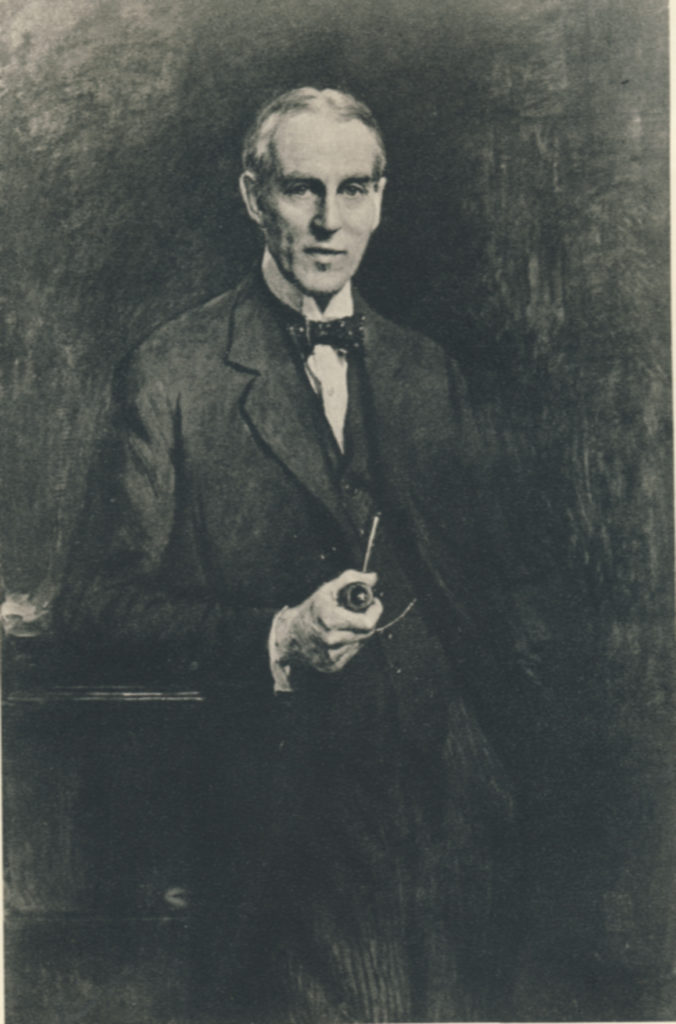 At the beginning of the 1900s, there was an obvious trend for the murder mystery novel and people had become interested in the workings of the police and moreover detectives due to writers such as Wilkie Collins, Edgar Allan Poe and Arthur Conan Doyle. At this time, William Collins and Sons was led by William Collins IV, his brother Godfrey and their cousin William Collins Dickson. All three were astute business men and each had an area of the business to look after. Godfrey, who oversaw the publishing side of the business, was also a Liberal MP and became the Secretary of State for Scotland in 1932. Despite juggling his many roles, it was he who recognised the popularity of crime books.
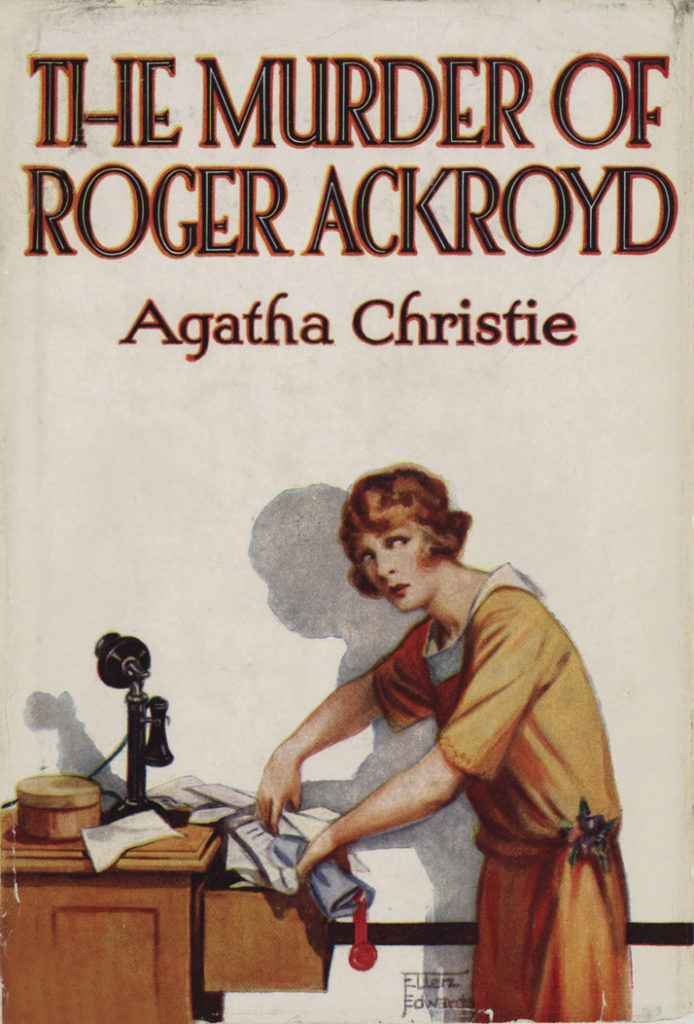
Therefore, in 1919, the first Collins Detective story was published – ‘The Skeleton Key’ by Bernard Capes. This book started a long tradition of Collins publishing crime stories for decades to come. Next, Freeman Wills Crofts’ book ‘The Cask’, chosen from the many crime story manuscripts which had been sent to Collins, was published. Wills Crofts went on to write another 16 books for Collins which included his ‘Inspector French’ series. The momentum had taken over and the number of crime authors multiplied. In 1926, Collins hit the crown jewels and published Agatha’s Christie first book with the company – ‘The Murder of Roger Ackroyd’. Agatha’s talent was clear and 93 years later, we still publish her books.
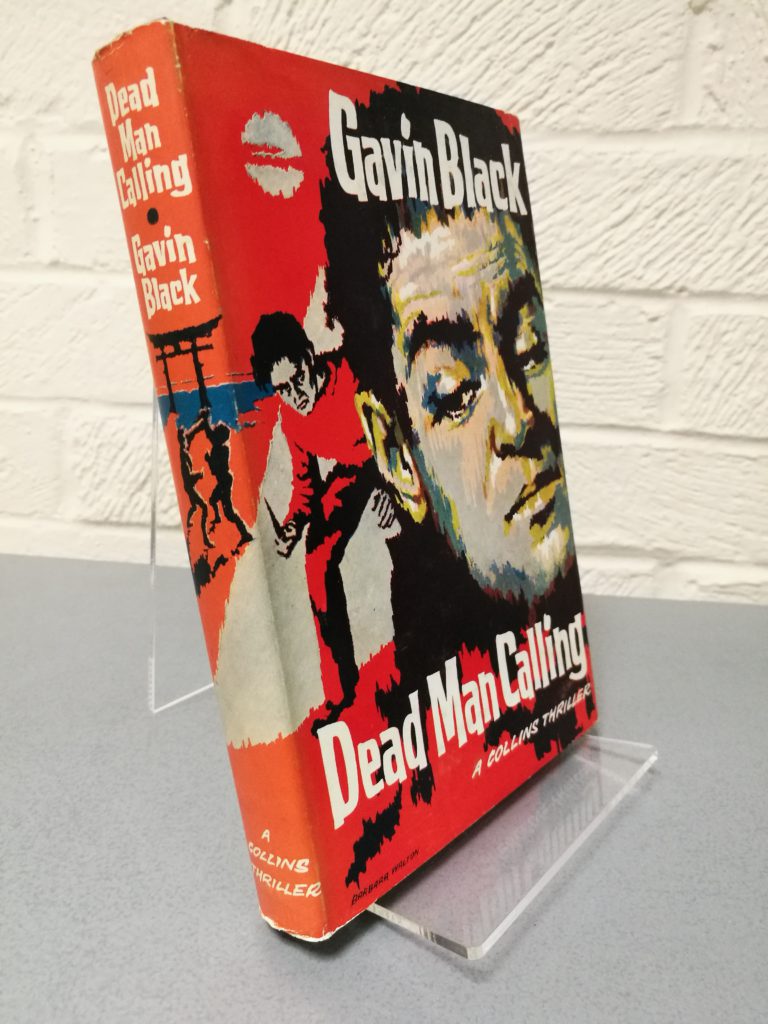
Around 260 authors were published under the imprint of the Crime Club, some with only one or two books or some like Agatha Christie with 80 books. Authors came from all over the world from New Zealand to the UK. There was also a small contingent of Scottish authors who were published under the Crime Club. One such author is Gavin Black. However, his story is a bit more complex than you expect. Gavin Black was the pseudonym of Oswald Wynd. He was born in Tokyo to Scottish parents, who were originally from Perth. They had moved to Japan to run a mission. Oswald was raised in Japan and spoke both Japanese and English. Despite this, he was and is considered a Scottish author. After studying at the University of Edinburgh, he joined the war effort and travelled many places. However, he was captured as a prisoner of war for three years in Malaya.
After his time in the army and as a prisoner, he returned to Scotland and began a long career in writing. His first book with Collins, Suddenly at Singapore, was published in 1961 and was well received. His knowledge of South East Asia and military experience gave his books extra flair and gave both crime and thriller fans a view into the exotic. Most of his subsequent books were set in Asia and were full of twists and turns. However, in A Big Wind for Summer, Black’s protagonist visits the Isle of Arran. The covers for his books were equally interesting. Mostly of them were illustrated by Barbara Walton, who was a prolific dustjacket illustrator for many years with Collins and other publishers.
Wynd died in Scotland in 1998, at the age of 85. While he was never a worldwide phenomenon, he is considered a writer of immensely intriguing books but also someone who had an equally interesting life.
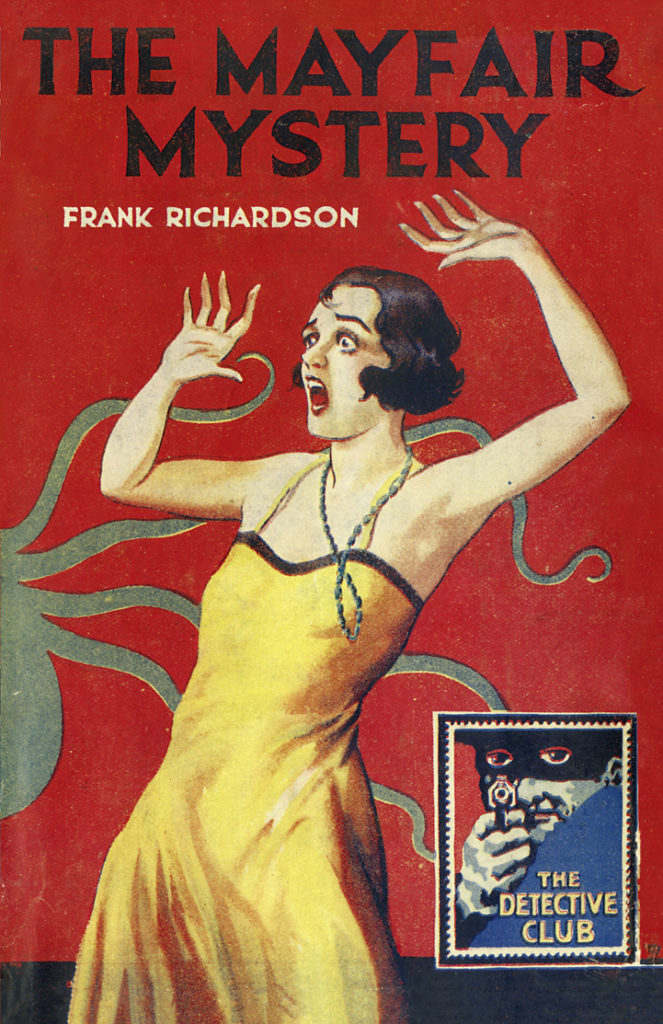
Although the Crime Club stopped in 1994, HarperCollins continued to publish many important crime writers. The perennial writers like Agatha Christie were obviously still on our crime list but many new authors were appearing on the scene including Val McDermid, Camilla Lackberg and Stuart MacBride. In 2005, HarperCollins published Cold Granite by Stuart MacBride and from that first book, there has been 12 more Logan McRae novels, two standalone novels, short stories and the Oldcastle novels. However, with such a plethora of titles going back to the Golden Age of Crime, in August 2015, the first Detective Club Crime Classic novels were published. Using original covers from the early 1920s plus the classic Detective Club logo, each book has an introduction from a crime writer or expert about what the book originally brought to the genre. The Perfect Crime by Israel Zangwill, Called Back by Hugh Conway and The Mayfair Mystery by Frank Richardson were the first three titles to be republished. As the end of 2018, 50 books have been made available to new modern audience of crime fans.
As with all their books, Collins wanted crime books to be accessible to everyone. Our crime novels were published in all different forms and prices from the Crime Club hardbacks, the White Circle paperbacks and the cheap 6d editions. Due to the unwavering popularity of crime stories, Collins have amassed a collection of some of the greatest writers in history. Telling the story of crime in the Archive at HarperCollins Publishers is one that is easy to tell.
In this latest book from National Galleries Scotland, coinciding with the exhibition at the Scottish National Gallery of Modern Art (Modern Two), Patrick Elliott shows us that collage as an art form has been with us for hundreds of years. Here he tells us why he put the book and exhibition together, and tells us a little about how the Cubists ‘invented’ the form.
Extract from Cut and Paste: 400 Years of Collage
By Patrick Elliott
Published by National Galleries Scotland
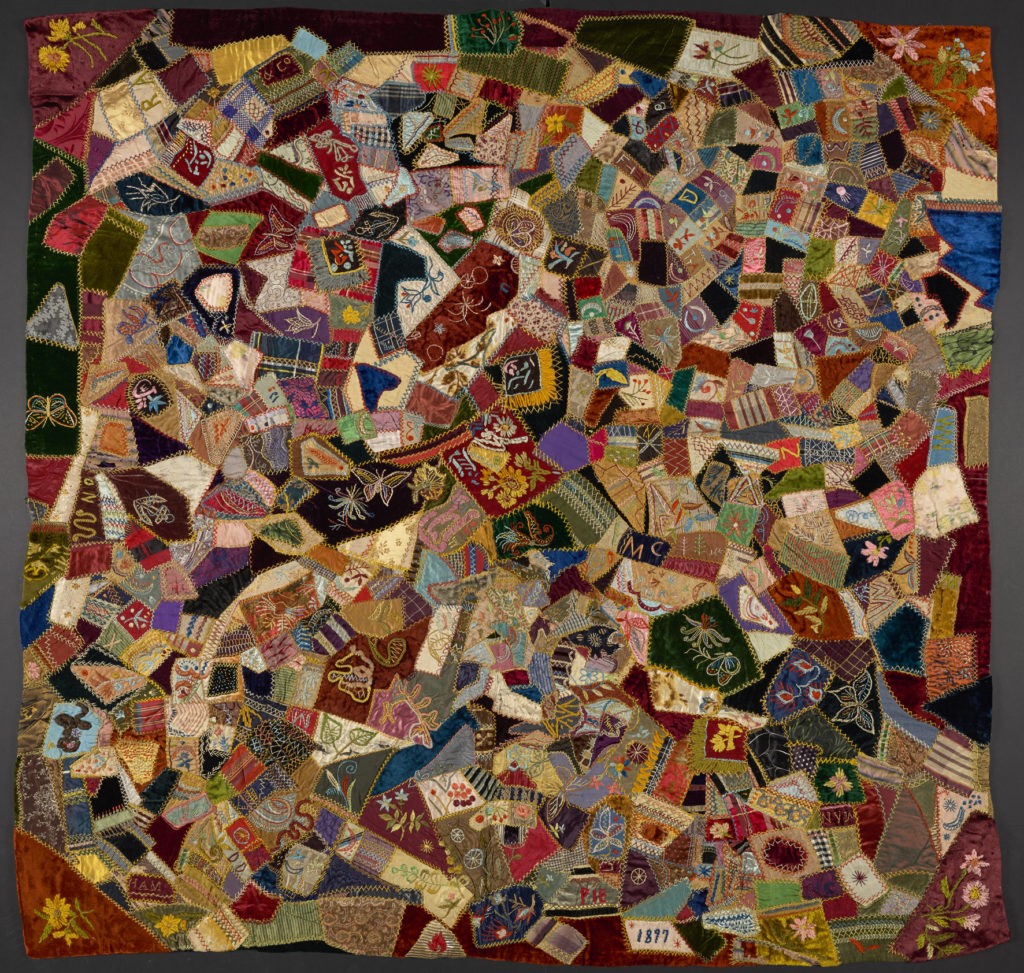
The idea of collage is so brilliant, so simple, so rich and imaginative in every way, that you might wonder why nobody had thought of it before. Well in fact they had, but historians of modern art have tended to ignore anything before 1912. Collage has a history stretching back hundreds of years, but at the time it was not called collage. That term, deriving from the French verb coller, meaning ‘to stick’, evolved as late as the 1920s. Before that it was called ‘scrap work’, ‘découpage’, ‘mosaick’ work and ‘adornment’. (In nineteenth-century dictionaries, the word ‘collage’ means bill posting and wallpaper hanging.) And the people who were cutting and pasting were not seen as artists. They were amateurs having fun, being creative and passing time. Many of the early collagists were women and children, and people with no formal training, such as tailors, writers and quilt-makers. Occasionally professionals used ‘cut-and-paste’ methods to save time and money, and early photographers used collage techniques such as photomontage and composite printing to get around the technical limitations of their art. Modern collage emerges from this amateur, craft activity.
In the 1910s collage – or papier collé as it was then known – was embraced by the Cubists, Futurists, Dada and Russian Constructivists as a way of attacking convention and mirroring the dynamic, modern machine age. In the 1920s collage became the favoured technique of the Surrealists. The French word ‘Surrealism’ means ‘beyond realism’ and that is where collage could take them. Collage allowed the Surrealists to fight academic traditions on the one hand, and on the other to create seamless, credible worlds suggestive of dreams and nightmares. The Pop Artists took to collage as a direct way of incorporating popular culture of magazines and posters into their work. In the 1960s and 1970s collage became a favourite tool of the Counter-Culture: it was cheap, quick and was, by its nature, disruptive. It was the technique of choice for the anti-Vietnam generation, and for Feminists, Punks and for anyone making photocopied Fanzines. Today, photoshop cut-and-paste techniques are used by millions of us, daily. Embracing the work of amateurs and professionals, men and women, children and photographers, film-makers and performance artists, collage is the most democratic, varied and inclusive of art forms.
We are in Paris and it is 1912: Pablo Picasso (1881–1973) and Georges Braque (1882–1963) have rebelled against the Renaissance ideal of trying to ‘copy’ nature and present a picture as if it were a fixed view seen through a window. Photography has taken over that job; a child with a Box Brownie can do better. Instead, they want to recreate the experience of looking at their subjects from a multitude of different angles and then build those different views into a single picture. It is an active approach, geared to the modern world of cars, planes, films and rapid change. They are wrestling with the paradox that the world is three-dimensional, and you can move about in it and it exists in time, while their pictures are flat and fixed. They are doing all sorts of innovative things: they introduce stencilled lettering which apes the flatness of newsprint; they add joke shadows to make it look as if nails have been driven into their canvases; they mix sand and grit into their paint. They want a new kind of realism, not illustration. Then in 1912 there is an epiphany. Instead of painting, say, a newspaper, or a wine label, or a chair, it occurs to them to glue a page of a real newspaper, or a real wine label or a facsimile reproduction of a chair seat, onto their pictures. All of a sudden, the age-old relationship between the subject and the artist’s representation of it has been turned upside down and inside out. Instead of trying to imitate something with paint or pencil, you stick it on the picture.
The ‘invention’ of collage by the Cubists is one of the most scrupulously analysed moments in the history of art. The story usually begins with Picasso’s Still Life with Chair Caning, which was made in May 1912 and includes a printed reproduction of a caned chair seat, stuck onto a Cubist still-life painting. It is often described as Picasso’s first collage. The baton then passes to Braque, who pasted pieces of paper bearing a printed wood-grain design onto a still-life drawing to make the first papier collé (‘stuck paper’), Fruit Dish and Glass, in the autumn of 1912. Picasso embarked upon a series of his own papiers collés in December 1912. Other Cubist artists, such as Juan Gris (1887–1927), followed their lead and added their own individual twists to the process: Gris stuck a mirror onto one painting and an engraving onto another but invited the buyer to swap it with a photograph of himself if he preferred. The Italian Futurists, the Russian Cubo-Futurists and Suprematists, and later the Dada artists, observed these developments with keen attention and took them in different directions. Braque and Picasso also made three-dimensional assemblages, which had a profound effect upon the development of twentieth-century sculpture. Even pure painters, particularly the Cubists, made paintings that looked like collages. Poets, writers and musicians also adopted the cut-up approach.
There is much literature on this watershed moment in art, largely focused on which one made which step, Picasso or Braque, and exactly when. In his celebrated essay ‘The Pasted Paper Revolution’ (1959), Clement Greenberg stated ‘Who invented collage – Braque or Picasso – and when is still not settled’. In his landmark study of Cubism, John Golding noted that Picasso ‘invented collage’ while Christine Poggi, in her detailed account of Cubist, Futurist and Dada collage, tells us that Picasso’s Still Life with Chair Caning ‘has acquired legendary status in the history of art as the first deliberately executed collage’. Another exhaustive account of Cubist collage and its aftermath, Brandon Taylor’s Collage: The Making of Modern Art (2004), begins with the chapter ‘Inventing Collage’.”
Cut and Paste: 400 Years of Collage by Patrick Elliott is published by National Galleries Scotland, priced £25.00
Victoria Williamson follows up her critically-acclaimed debut novel The Fox and the White Gazelle with The Boy with the Butterfly Mind. BooksfromScotland caught up with her to hear more about her writing journey.
The Boy with the Butterfly Mind
By Victoria Williamson
Published by Floris Books
Hi Victoria, thanks for speaking with us today. Could you tell us a bit about yourself and your career so far?
I’ve wanted to be a writer ever since I can remember – that’s definitely my parents’ fault for reading me so many stories and taking me to the library every week before I was even old enough to walk! I started writing my first novel – an animal story – in my late teens, which turned into a very long trilogy that I didn’t complete until I was well into my twenties. It wasn’t bad for a first attempt, but it certainly wasn’t publishable.
My teaching work ate up a lot of my writing time for a good few years after that, but as I had plenty of adventures in Africa and China, as well as here in the UK, I’m certainly not complaining. It was very good experience, and I now base a lot of my characters’ voices on the children that I’ve taught over the years.
I’ve been working as an author full time since The Fox Girl and the White Gazelle was released, dividing my time between writing, editing, visiting schools, and running creative writing classes. There’s always lots to keep me busy!
Were there any authors that really inspired you when you were starting out?
I read widely as a child and as a teenager, so my work was influenced by a huge range of writers of different genres. I particularly enjoyed fantasy stories such as The Hobbit and The Lord of the Rings by J.R.R Tolkein, horror stories by James Herbert, science fiction by Ursula K. Le Guin, animal stories by Richards Adams, humorous books by Terry Pratchett and Douglas Adams, and the classics by Jane Austen and Charlotte Bronte. That’s a rather confusing collection of influences, so it took me quite a while to decide what kind of stories I wanted to write. Like many authors, I was drawn back into the world of children’s fiction by J.K Rowling’s Harry Potter series, so if I had to cite one defining inspiration, it would definitely be hers.
Could you walk us through the method you use for writing your books?
I used to spend a lot of my time plotting out everything that was to happen in a book in minute detail, but these days I’m a bit more relaxed about letting the story unfold naturally as I’m writing it. Now I tend to loosely follow the five-point narrative structure of exposition, rising action, climax, falling action and resolution, which helps give shape to a plot, without being too prescriptive. I’ve found that the most important thing is character voice, so as long as I’m clear about who the characters are and what they want before I start, they generally drive the plot forward naturally themselves without every detail needing to be planned in advance.
What’s your favourite thing about being a writer?
Writing books! I know that might seem obvious, but a huge amount of an authors’ time is spent visiting schools, talking at festivals, running writing workshops and promoting their work. Although these are also an enjoyable part of the job, they all require a lot of time-consuming admin to organise, and that’s before editorial work to novels waiting for publication is even added in! All of this other work means that finding uninterrupted time to sit down and actually write can be difficult, so when I do get a block of time to work solely on a new book, I really appreciate it.
Tell us about your new book – The Boy with the Butterfly Mind.
The action centres around two main characters. The first is eleven-year-old Elin, whose parents are divorced, and who is trying to be as perfect as possible as she thinks that will convince her dad to leave his new family and come and live with her and her mum again. The second is Jamie, whose parents are also divorced, and who is just trying to be normal despite his ADHD making things difficult for him.
When Jamie’s mum moves to America with her new partner, Jamie is sent to live with his dad. But Jamie’s dad now lives with Elin’s mum, which ruins Elin’s fairytale ending of getting her own father back. Jamie and Elin’s polar opposite personalities create conflict, and when things spiral out of control, they come to realize the only way they can save their blended family is to admit they’re more alike than they first thought.
It’s a story about divorce, blended families, and ultimately, accepting that happy-ever-afters come in all shapes and sizes.
Can you tell us a bit about your research for The Boy with the Butterfly Mind?
A lot of the inspiration for my stories comes from the real-life experiences of children I have taught in primary schools. Many children are members of blended families, and some of them initially struggle with the changes and transitions that a changing home lifer can bring about. Some of these children share how they’re feeling with their class teacher, so I’ve heard a number of real-life stories from them over the years of jealousies, power struggles, arguments, and ultimately acceptance, although nothing as extreme as Elin and Jamie’s story! I’ve also taught a number of children with additional support needs, including ADHD, so I felt it was really important for them to see a child with ADHD portrayed positively in a story that they could relate to.
Is there any advice you would give to aspiring writers?
Don’t write in a vacuum – that’s a mistake I made, and one of the main reasons why it took me so long after writing my first novels to get published. I was re-inventing the writing wheel myself, and making the same mistakes over and over again. If possible, join a writing community to support you on your journey. I’m very lucky that my younger brother has always acted as my beta reader, but it’s also important to be part of a community that includes professionals who can give you up-to-date industry advice, as well as editorial feedback. There are lots of great organisations that support writers, from writing groups, local SCBWI groups, The Book Trust/The Scottish Book Trust, to literary festivals such as Bath and Winchester, where you can not only meet other writers and attend workshops, but you can get one-to-one feedback on your work-in-progress. Writing can at times be a very solitary pursuit, and being part of a supportive community – whether in person or even online on Twitter or Facebook – can make all the difference when the going gets tough.
Lastly, what’s next?
My next work’s still hush-hush at the moment, but what I can say is that it’s Scottish historical middle grade, featuring a famous real-life person. More to follow – watch this space!
The Boy with the Butterfly Mind by Victoria Williamson is published by Floris Books, priced £9.99
Scotland’s visual artists were at the forefront of the cultural changes throughout the 20th century, and Bill Hare has captured their stories in his brilliant new book Scottish Artists in an Era of Radical Change. In this extract, Bill interviews The Boyle Family, the artist collective founded by Mark Boyle and Joan Hills in the 1950s who went on to become central to the counterculture scene in 1960s London.
Extract taken from Scottish Artists in an Age of Radical Change: 1945 to the 21st Century
By Bill Hare
Published by Luath Press
The particular occasion for this interview is the acquisition and display of your Tidal Series at the Scottish National Gallery of Modern Art (currently on display in New Acquisitions at the SNGMA). Maybe we could begin by you giving an account of the making of this important work?
Sebastian Boyle: We all first went to Camber Sands in 1966, which is a very important trip in our work as that was when Mark and Joan made the first resin and fibreglass studies of the surface of the Earth. They had already moved on from making their assemblages to making the first Earth pieces using a grid system to transfer real material onto boards covered with resin. In the demolition sites in west London they were working in, they would find a board, cover it in resin and then transfer the real material from the site – whether that was bricks, stones, twigs, bottles, newspaper, dust, etc – to the appropriate place on the board.
But these transfer pieces were very heavy and had to be flat and Mark and Joan wanted to make larger pieces that presented the details and shape of the surface of the Earth, not just the detritus lying on top. They’d heard about resins and fibreglass and they wanted to experiment with these new materials. They needed somewhere where they would be relatively undisturbed and so a beach close to London seemed a good idea.
So we went there around Easter 1966 and the first Beach Studies were made. We then went back in 1969 when Mark and Joan wanted to make a series of works that included time as being an element in the work. Questions of time and change had been present in the 1960s projection works but the Earth Studies seemed fixed and permanent and they wanted to show this isn’t the case. So Tidal Series is a critical series for us. It introduces time into the Earth Studies and provides a link to the wider Boyle Family project. The series comprises 14 studies made on the same square of the beach after each tide, two tides a day, for a week, showing the constantly changing tide and ripple patterns created by the sand, the wind and the tide.
I would now like to turn to the broader aspect of Boyle Family as an artistic phenomenon. Unlike other artists, you have operated under a number of different names, such as Mark Boyle, Boyle and Hills, the Institute of Contemporary Archaeology, the Sensual Laboratory, through to Boyle Family. What were the reasons for all these name changes?
sb: Initially works were exhibited under Mark’s name, which was partly because when Mark and Joan started out, they didn’t expect to be making a living as artists. They and all their artist friends were sure they would always have to have second jobs to get by. When they started to exhibit in the early ’60s, most art dealers thought it was easier to sell work by a single male artist and, for Mark and Joan, the possibility they could actually make a living out of making art seemed so amazing that it was a battle which they felt they didn’t need to fight. All their friends knew that Mark and Joan were working together as a team. Mark’s name was almost a nom de plume for the two of them. Later in the 1960s, they created the Institute of Contemporary Archaeology and the Sensual Laboratory almost as front organisations to interact with ‘officialdom’ in some way, whether that was to help get permission to work at a site or deal with the police, a film lab or a hire company. Companies didn’t like dealing with scruffy looking artists. So the Institute of Contemporary Archaeology sounded appropriately official for doing the Earth Studies, and Sensual Laboratory was their production company for the projection pieces and later for their interactions with the music business. Then, over time, we shed those cover names and it just came down to the four of us working together and to give a public face to that fact we adopted the name ‘Boyle Family’.
Can I now go back to the beginnings of what eventually would become Boyle Family? Although both of you were originally from Scotland – Joan, Edinburgh, and Mark, Glasgow – you met by chance, or fate, in Harrogate in 1957. Neither of you had much, if any, formal art training, yet you wanted to make art together. What was it that made you feel you could form a creative partnership?
Joan Hills: Passion. I think it was just a sum total of wanting to be together, and working together, and bashing ideas around in the same space for a number of years and this is what came out of it. From the very first meeting we knew that we would be creating something together. He was writing poetry, I was painting, and we were interested in music, jazz, theatre and performance.
sb: You thought you were going to do something creative together but you weren’t thinking that would be necessarily as visual artists. It was a whole spectrum of possibility. Over the next few years you experimented with different art forms and techniques, such as happenings, projections, film, photography and sculpture because you were not sure which techniques and abilities you might need.
jh: Exactly. We wanted to experiment, try things out and see where they might lead. We still don’t know if what we do is art. That issue seems superfluous.
Joan, you and Mark moved to London at the beginning of what would later be known as the ‘swinging ’60s’. What was it like for you trying to break into the London art scene then and how did you establish your credentials as radical and innovative artists so quickly?
jh: When you were in it, how did you know when it was starting to swing? You didn’t. You were just leading an everyday life and still interested in the things that you were interested in, like going to galleries, listening to plays on the radio. If anything like the Theatre of the Absurd plays came to the Royal Court, we would go and try to see them. We were extremely interested in Beckett and seeing everything that was possible. There weren’t hierarchies that you had to get through. The old ICA on Dover Street was a place that people went to and hung around in because they were interested in pictures or writing or communication. We went to some of the shows and talks and met a few people.
sb: It was a small scene – I remember that you and Mark would say that when you were putting on an event, slightly later, in 1963–4, that you would call up 20 or 30 contacts and friends who were interested in what you were doing and who would come and support you – and vice versa. Whether it was at Better Books bookshop, the ICA, Signals, or, what did you say, Gallery One or Gustav Metzger’s event with the acid at the South Bank?
jh: That’s right.
sb: You weren’t really looking to establish yourselves as radical and innovative artists, were you? You were just trying to make work?
jh: No, we were just trying to get on with our lives.
sb: I think 1963 was really quite a turning point. Somehow you got the show at Woodstock Gallery under Mark’s name. You also went up to Edinburgh to visit your parents, taking slides of the assemblages with you and went round to see Jim Haynes who had started his paperback bookshop. He had a gallery in the basement, didn’t he?
jh: He wanted very much to get the things down into the basement gallery but some of them were just too large to go down the staircase. It was his suggestion that I take the slides round to the Traverse Theatre, which was in a tenement on the Royal Mile and when I got there, they were preparing for their first production at the festival. That’s when I first met Ricky Demarco. They didn’t have a gallery but he was very enthusiastic about what they were going to be doing and thought it would be great to put on our show at the same time in a room upstairs. So that was the beginning of the Traverse Gallery.
sb: It was in doing the exhibition during the festival that you met the artist Ken Dewey who’d been asked by John Calder to put on a ‘happening’ as one of the events at the international drama conference at the McEwan Hall.
jh: Yes. It was a very conflicting period for drama because many people thought that British theatre and drama in London were pretty superb but we felt that more exciting things could happen. Ken Dewey brought that out in all of us.
sb: Calder had asked two American artists, Alan Kaprow and Ken Dewey, to come over and do events to mark the end of the conference. Dewey worked collaboratively, particularly with local artists, and he must have thought that you and Mark were good people to get involved with his ‘happening’ or event. The event they put on, In Memory of Big Ed, was really the first British performance art event that went out into the wider public consciousness. It caused a huge furore because it had involved a nude model being taken across the balcony and was on the front page of most of the national papers. Questions were asked in Parliament and the police prosecuted Calder and the model. It caused a major scandal, but one unexpected consequence was that you were then the artists who’d put on ‘that’ event in Edinburgh. It wasn’t planned but it gave you a bit of a name and meant you were able to put on more events in London and get more people to come and see them.
jh: It didn’t feel as rapid as that at the time, but I’m sure these things counted. That’s absolutely true.
During that period of great social and cultural upheaval in post-war Britain, you were regarded as a vital force within the British Counterculture movement. How did you see what you were doing in relation to all the other changes that were taking place at the time?
sb: I have the sense that Mark and Joan were beginning to find a kind of identity among a group of people at the ICA who were trying to do something different, whether in music, theatre, film or art. It was a group of people who believed in experimentation, aware that they were part of a new generation trying to do something alternative to abstract expressionism or Pop art. They wanted to be grounded in the real world and real experience. Joan had done a bit of work with her film colleagues, working for the Labour party of Harold Wilson.
jh: Inserts for the election of 1964. We never saw Pop art as our thing, we saw it as fantasy somehow.
sb: You felt, though, that it was an exciting time, with Kennedy as President and Wilson talking about the white heat of technological change – the world was changing and Britain was changing.
jh: There’s no doubt that we were aware things were developing in different directions. Society was just breaking down a bit, as far as new ideas were concerned. It was a stimulating time.
Your wide-ranging activities during the 1960s such as your initiatives in the area of happenings and light projections have had a profound impact on the development of both British art and popular musical entertainment. Looking back, are you surprised that this aspect of your work has been so influential?
jh: No, because in the days of going to dances and things in the 1950s and early ’60s, ballrooms had glitter balls, music, perhaps a colour wash on a wall and that was it. Suddenly, we were able to create something that came from another background altogether, slightly scientific. In our projection events we were setting up little scientific experiments, which we watched as they developed and then we’d start another one and that would go on top of the first, then we’d fade one out, start another and so on. When we went to the States with Hendrix and Soft Machine, we found the big New York and Californian light show teams were doing something very different. In some ways more commercial.
sb: You weren’t thinking of it as being popular entertainment but an art event. You did some experiments with the projections on your own terms at home, for us, and for friends, then you started doing it on a wider scale, developing projection events such as Son et Lumière for Earth, Air, Fire and Water in art spaces, before you were asked to do a projection event, at the first night of the London underground club, UFO. I think it is important to say that UFO wasn’t only a great club and it wasn’t just about the music. It was a great art club. It was a place where theatre and dance groups performed, poets came and read and avant-garde films were shown. It was a meeting place for all sorts of alternative artists from all over the world and, while it became famous for the music and the projections that Mark and Joan were doing, I think that it was also very important as a creative hub. Their projections became the main visual element of the club and the bands who played there wanted these kinds of visuals for their gigs. The psychedelic light show has been credited with being the beginning of the big rock gig stage show with amazing projections and special effects – and Mark and Joan were there at the beginning.
Throughout the 1960s, in your monumental ambition to include ‘everything’ in your work, you took a multimedia, collaborative approach involving theatre, film, sound, music, archaeology and scientific research. Yet, by the beginning of the next decade you were cutting back on this highly varied approach and focusing mainly on what was to become the epic World Series. What brought about this change in artistic strategy?
sb: It wasn’t so much a change in artistic strategy as a change of scale. Up until 1971, Mark and Joan hoped that it might be possible to put on quite large-scale multimedia performances using projections, film and sound and at the same time make progress with the World Series and other Earth Studies projects. Indeed, the idea was that these events could be put on at museums to coincide with our exhibitions and that it would be an interesting way of showing the range of our interests, combining exhibitions maybe with our concerts with Soft Machine and contemporary theatre or dancers such as Graziella Martinez.
So the exhibition that launched World Series at the ica in 1969 was billed as being by Mark Boyle, the Sensual Laboratory and the Institute of Contemporary Archaeology, bringing together the Earth Studies, projections, events, body works and sound pieces. And Soft Machine did a gig with Boyle Family projections during the show and during the following exhibitions at the Gemeentemuseum in The Hague and the Henie Onstad Kunstsenter near Oslo. The combination of the exhibitions and the concerts was great for us, the museums and I think for Soft Machine, whose members liked playing in venues that weren’t the usual rock venues and festivals. It would have been great to have kept it going. Unfortunately, we then had a bad experience in Berlin in 1971 at an alternative culture festival, where we were putting on an exhibition, Soft Machine gig and a performance piece Mark and Joan had been developing called Requiem for an Unknown Citizen. This was an event piece studying society at large using theatre, random films, sounds and projections. The festival turned out to be a bit of a fiasco and we hastily performed Requiem instead at the De Lantaren Theatre in Rotterdam. This experience, coupled with the problems of having a theatre group and the financial problems it posed, led to the realisation that it wasn’t going to be possible to have a large team without major funding. Mark and Joan were still interested in making multimedia, multi-sensual work but the team was limited to us as a family and the presentations were kept on a smaller scale within the exhibitions, showing film installations before video became widely available to artists. There was a shift to the Earth Studies and the World Series in particular but we have always thought that the projections, films, sound works and happenings are part of our continuing overall body of work.
Maybe we should now concentrate on the work with which Boyle Family is most identified, the World Series. Could you tell us something about the circumstances that brought this mammoth project into being?
sb: After making the first Earth Studies in Camber Sands and then working on sites in the area around our flat in Holland Park, Mark and Joan wanted to do a London Series but, as they couldn’t drive, this was approximately a two square mile area of west London, which we could all walk to. Then we had to leave that flat as it was being knocked down to clear space for Shepherd’s Bush roundabout and Mark and Joan realised they couldn’t start a new London Series each time we moved and that, rather than do a British or European Series, they could expand the Earth Studies project to be a survey of the whole of planet Earth. The Americans and Russians might have been racing to get man to the moon but we could undertake our own study of the Earth. For the World Series, it was decided that 1,000 sites should be selected by using the biggest map of the world that we could find, blindfolding people, and then asking them to throw or fire darts at this map. We would then go to these sites and study them.
You must have realised that 1,000 sites randomly scattered far and wide across ‘the surface of the Earth’ would never be completed in any of your lifetimes. Thus you would have to be selective as to what you could accomplish. On what basis is the selection of sites made?
sb: No, Mark and Joan really did think that they were going to be able to do it in their lifetimes! They wrote in the catalogue for the ICA show that it was a 25-year project and that they could do 40 sites a year. We realised pretty quickly that it wasn’t going to be possible, probably when we went to The Hague in 1970 to do the first site and realised how much work was going to be involved. I think we’ve undertaken and completed approximately 20 of the 1,000 sites. Each one is a bit like making a short film – it’s a major undertaking. Of course, all the other works we’ve done have in a sense been helping us fund and make the World Series project. Quite often, the selection of which site we will do ties in with an exhibition. For example, while we were having a show in Oslo we went and made works in Norway and we made the Sardinian one for the Venice Biennale in 1978.
Your aim is to replicate these various sites as accurately as possible with80 out ‘any hint of originality, style, superimposed design, wit or significance’. When you’re in the process of making a World Series piece, what are the factors that allow you all to feel that you have fulfilled this demanding aim of absolute exactitude and objectivity?
jh: We use larger and larger maps to ‘zoom’ in to a site. Eventually, we throw a metal right angle in the air and where that falls is the first corner of the piece. We extend that six feet and work on that, and there’s never any question of saying, ‘it would be better over here or over there’. You couldn’t improve on what you get in a random selection.
sb: We know that it’s not possible to be absolutely exact and objective but we’re trying to be as objective as we can. The main thing is to take ourselves out of the site selection process. We then try and figure out how we are going to do it, whether it’s going to be one of our resin Earth Studies, or a film or video work that we’re going to make, or if there is some other way of doing it. I am not sure we ever feel we have fulfilled the aim of absolute exactitude and objectivity. Mark and Joan made a list of possible studies we were going to make at each site. We try to complete as many things on this list as possible, which includes making the actual study of the six-foot square, studying examples of animal and plant life on the site, the weather and what we call ‘elemental studies’ of the major types of rock and earth in the area. We include studies of ourselves in the project because we have to acknowledge that we are not neutral observers – just by being there we are having an effect on the site, so we include ourselves as active agents. We’ve never managed to complete the whole list.
Boyle Family had a major retrospective exhibition at the Scottish National Gallery of Modern Art in 2003. That must have given you the opportunity to see the body of your work as an organic unity. From your point of view, what holds such highly complex and varied work together under the name of Boyle Family?
sb: That was a very important exhibition for us as it gave the British art world a chance to see the range and variety of the work and how it works together. There are all sorts of ideas and concepts that underpin our work. One of the key questions for us is how to look at anything objectively, to see it for itself. Not to look at it to tell a story or fit an agenda or even to make an artwork but simply to see, bear witness, record and maybe begin to understand. Mark and Joan came up with a number of frameworks for how to do this. One is ‘contemporary archaeology’ that we would study the contemporary world as if one were an archaeologist looking at evidence of a past society. Another key to understanding our work is the idea you have to ‘isolate in order to examine’. The question is how are you going to choose what to examine? Are you going to impose your value system, your value judgements, on that process? And how did you come by those values? Our random selection techniques are a way of trying to open up that process. They are far from ideal but they help. It’s not just the surface of the Earth we’re interested in, but everything – human beings, plants, animals, societies, physical and chemical reactions, bodily fluids and so on. We use random selection techniques to try and take ourselves out of the equation, to help us choose and focus on just a minute selection of the infinite number of possible subjects for study.
As artists who, although London based have their roots in Scotland, and over a long career have frequently exhibited north of the border, do you think of yourselves in any way as Scottish artists?
jh: You bet. This sounds parochial but because we have a World Series, that interest takes us everywhere.
sb: We certainly think of ourselves as Scottish artists and if there’s one trait which we see holding Scottish artists together – and maybe all Scottish people – it’s a certain bloody-minded determination to actually just get on with things. Maybe we needed that bloody determination in order to keep on going for 50 years.
This interview was conducted by Bill Hare in 2014 for Scottish Art News, issue 21
Scottish Artists in an Age of Radical Change: 1945 to the 21st Century by Bill Hare is published by Luath Press, priced £30.00
Extraordinary times demand extraordinary novels, and Kristian Kerr finds that James Meek has given us just that in his latest, To Calais, In Ordinary Time.
To Calais, In Ordinary Time
By James Meek
Published by Canongate
It’s hard to begin James Meek’s new novel, To Calais, In Ordinary Time, without suspecting it is an allegory for Brexit. The medieval setting, the cutting of a crimson rose in a young Lady’s garden in the opening scene, the defamiliarised, mannered English all heap on top of that channel port and its centuries of baggage. Calais, pace our current Foreign Secretary, has always been Britain’s crucial pinchpoint-gateway to the continent. It is also this novel’s City on the Hill, the destination of its travellers. It is even, in this summer of 1348, an English port, a recently acquired and still precarious toehold in mainland Europe. Were this work purely a Brexit allegory, Calais could be a symbol of a perpetually bellicose attitude towards our continental neighbours, or a kind of common ground, a site of exchange and beacon of confraternity to which the enlightened are flocking. Or it could be both at the same time, because the best allegories work that way.
However, as Meek told his audience at an excellent event at the Edinburgh International Book Festival on publication eve, this isn’t a book about Brexit per se. It was begun in 2013, as a novel about climate change. Meek found his analogy for universal human catastrophe in the Black Death and, in the six years during which he immersed himself in the fourteenth century, he also chronicled a 21st century distracting itself from global crisis by fervent, tribal, identity crises, matters of great import to individuals and nations but of comparatively small difference.
It has become somewhat of a cliché to say that we live in extraordinary times, and this novel shows that, indeed, other times may be similarly extraordinary. I hope that the ‘Ordinary Time’ of the title is a sly joke on this hackneyed phrase, for, taken literally, it refers to the journey taking place in July, a fallow period in the liturgical calendar between Pentecost and advent and so designated as merely ordinary. Still, a time ordinary in its extraordinariness can tend to help historical fiction bridge the gulf of centuries.
While writing To Calais, Meek also published the Orwell-winning Private Island (2014) about the privatisation of our public services and Dreams of Leaving and Remaining (2019) a collection of essays about Brexit drawn from his writing in the London Review of Books. Both Meek’s journalism and this novel exhibit the same knack for portraiture in the true painterly sense. They present people and characters not only as individuals with particular virtues, faults, beliefs or desires, but they also relate their behaviour to broader paradigms, such as myth or social theory. One of the achievements in the complexity of this novel is to depict people getting on with their own short, challenging lives, wrestling betimes with the “big questions” of national and personal identity, freedom, faith and desire, while all-at-once a cataclysm fundamentally alters the foundations of society. So even if this is an allegory of climate change and barely about Brexit at all, as a novel it also does a whole heck of a lot more.
A score of archers is travelling towards Melcombe harbour in Dorset to take ship for Calais. In the Cotswolds they pick up a number of official and unofficial hangers-on: Lady Bernadine, fleeing an arranged marriage and seeking a reunion with the courtly Laurence Haket, also the archers’ captain; Thomas Pitkerro, a Scottish proctor returning to the papal court at Avignon; Will Quate, a bondsman intending to earn his freedom in service as a bowman; and the elusive trio of Hab, Madlen, and Enker, respectively the swineherd, his sister, and a road-going clip-clopping shod boar. The archers, rejoicing in names such as Longfreke, Sweetmouth, and the misnomer Softly, saw action together in France. Their skill secured the English triumph at Crécy but their service has also bonded them in shared knowledge of dark secrets, which will gradually unfurl and shape their destiny.
The unmissable, most ambitious, and most challenging aspect of To Calais is its language. The novel is narrated in three distinct idiolects, each corresponding to a different social class and a distinct way of seeing, feeling, and being in the world. Berna, the daughter of the manor, speaks a French-influenced aristocratic English, the language of power. Thomas writes (letters, mostly) in the Latinate language of the clergy, a language rich in abstractions that could be quite straightforwardly construed. Everyone else speaks a sort of quasi-Chaucerian English peppered with archaisms. It is a conceit designed to show the social divisions that will be erased by the characters’ journey and, across society, by the Black Death itself.
Comedy and pathos arise from early misunderstandings between people who don’t really speak the same language, but the proximity of the journey brings them to an understanding and empathy, as this conversation between Berna and the maid Madlen about fear shows:
‘Are you afraid?’ ‘You mean afeared? Yeah’ ‘Of the pest.’ ‘Yeah.’ ‘You ne appear afraid.’ ‘Appear?’ ‘Seem.’ ‘I ne understand my demoiselle.’ ‘I mayn’t rest. My heart beats furiously and hard. I contemplate and think on my mortality over and over. I see myself covered and ended by darkness. But you seem calm and even, like to you are untroubled and unhurt by the possibility of fatal and deadly malady and sickness.’ ‘Possibility?’ ‘Let’s say “speed” or “hap”. That which may or may not.’ ‘I never had no possibilities, my demoiselle. I have what I have. I mayn’t do nothing about what’s to come.’
Words, concepts, and experience all overlap here. Berna, brought up behind the manor’s walls has only contemplation and fear. Without the word ‘possibility’, Madlen is unaware that people like her might have any.
Linguistically, Meek has pulled off a monumental task. While they remain almost unrelentingly alien, the different voices of To Calais do become mesmerising, especially the rhythm of the common speech, which echoes Chaucer when read aloud. In the earliest stages, while the project is finding its feet, the novel seems to take a tour of medieval storytelling genres in a kind of square-bashing exercise. We have Berna’s self-conscious readings of the Roman de la Rose, Will appears in an allegorical stage play as Venus, a number of confessions are granted to Thomas, there is the history of the battle, and, close to the end, a short, lyrical recap of the novel by Mad, the Welsh archer-bard.
As for the voices, so too for the plot and the characters. Together, the journey and the pestilence slough the encumbrances off the central characters. Not all are spared but the resolutions that come are accompanied by turns of real beauty. In an early conversation Berna and Thomas discuss the crucial aspects of love, and decide that Frankness is an essential component of love. On the open waters of the channel, sailing to a new world in Europe, the surviving characters find a new freedom. The medieval abstract concepts make the resolution of the novel, with its thoroughly modern sense of self-fulfilment, all the clearer and more powerful. In setting out to novelise a time before novels, Meek set himself an extraordinary task. Through language, this book challenges its reader to rewire their brain and adopt a different worldview. This is a deeply humane book, suggesting that our chances of survival in the darkest times are increased by collaboration and fellowship. It is a fascinating, dazzling, provocation towards greater understanding and empathy.
To Calais, In Ordinary Time by James Meek is published by Canongate, priced £18.99
Kathleen Jamie has become one of our finest essayists inspiring us all to pay attention and contemplate the world around us. BooksfromScotland are delighted to share her thoughts on her new book, Surfacing.
Surfacing
By Kathleen Jamie
Published by Sort Of Books
Surfacing, like my previous two books, is composed of short pieces, call them essays. When I began writing in this way, the form was out of fashion in the UK; there were very few places where one could publish or read a personal essay, of 4 or 5000 words. But American authors like Annie Dillard and Barry Lopez used this form, and I found their work very attractive. The short form appealed to the poet in me: one could explore an incident or an encounter without being bogged down in narrative.
*
I began as a poet, and in my essays I certainly use so-called ‘poetic’ techniques: there’s concern with the sound of the language, with concision and image-making. There are similes, (I love similes) and connections which surprised me. In fact, I think of my essays as ‘extended poems’ rather than ‘short novels’, because as I say, I’m really not very interested in plot and story-telling. But I do like dialogue; I like catching what people say.
But every writer ought to be listening to the patterning of their words on the page, to the tone and heft of a sentence. Otherwise you’re just typing.
*
I was 40 when I decided to try my hand at essays. I thought they might be easier than poems (they’re not!). So I tried a couple and they seemed to work. I liked this new venture! I liked blending the natural, the personal, the direct experience. I could speak as I found. And writing this kind of creative non-fiction had unexpected benefits. Poetry is my first love but it’s a solitary pursuit. But the essays….one of the great discoveries of my writing life has been the joy of working alongside various experts, especially outdoors. I stumbled on it by accident, by being fortunate in my friends. Some of the most fulfilling projects have come about when I accompanied ornithologists, surveyors, archaeologists on their field work. Their ways of ‘seeing’ or ‘reading’ their chosen landscapes enriched mine enormously. Pathologists too, who turn their gaze onto the inner body.
But scientists are often constrained in what they can say or write. A scientific paper about, for example, seabirds, reveals absolutely nothing of the real-life adventure of sailing to a bird breeding colony on an island, camping there in the wind and weather, being among the birds, the noise and smell – and a science report tells nothing about the ornithologists’ emotional response. That’s where writers and poets come in. We can give all that real-life experience; and we can talk about emotional things too.
Truly, being outdoors with a good naturalist is an unforgettable experience. It is shocking, what most of us miss most of the time. It’s a matter of paying attention, learning to pay heed. Look up, once in a while. Keep an ear open! We only pass a short while on this majestic planet – so attend!
*
But that realisation came later. With Findings, my first book of essays, I really didn’t know what I was doing. Except: the children were young and I couldn’t travel. I couldn’t go on great adventures abroad – I had to be back for tea. So I wondered: what is the biggest adventure I can have, as a young mother? And that is how Findings began. With the local, the nearby, my own backyard, my own life situation.
Findings became a literary book by a Scotswoman of ordinary background, doing what she could to engage with her own country. A working mother, I began to write about nature nearby, about what is under our noses or above our heads, if we’d just look.
The work developed in Sightlines, and now there is a third in this triptych: Surfacing.
*
In all the books I wrote about time and change – archaeology is a long-standing interest of mine. In fact, when I was young I wanted to be an archaeologist. I loved landscape, and as a teenager I became aware of the way the past is visible in the landscapes of today. I was fortunate to grow up under the Pentland hills near Edinburgh. There were Neolithic standing stones and chambered cairns marked on the map, one could visit them. I loved that. Archaeology tells us that time is long, change happens, nothing lasts for ever. Cultures, epochs, empires, come and go. But we are wreaking more damage now than ever before, in our long human past. We are in the midst of enormous change.
*
Also, I began writing about the natural, non-human world. But I’m not a pure ‘nature’ writer. The best description I’ve ever heard about my work is that it stands ‘at the confluence of travel, nature and culture’. There are two long pieces in Surfacing which attest to that. (Having said what I did about brevity, I confess I’m trying my hand at longer pieces. And shorter too! Surfacing contains pieces of 6 or 60 pages, because that’s what they required. Others are very short, a few paragraphs, more poem-like – why say more? ‘In Quinhagak’ is about an astonishing archaeological site in Western Alaska. (My children were grown, travel was an option again.) ‘Links of Noltland’ is about a Neolithic site on Orkney. ‘From the Window’ is a short observation about my own life changing as my children grow. One human life mapped against the long reaches of human time…a life finding its shape.
*
So. Here is Surfacing. I feel I have completed a long, long project, three books’ worth, almost 20 years in the making. If you asked me about its ‘theme’ I would say I don’t trust ‘themes’. Set yourself a theme and you feel obliged to go chasing after it, until its exhausted. A bit scorched earth.
*
I suppose its concerns are: the past, climate change, memory, nature, culture, travel, our present moment, politics, the frightening, exciting future…that’s enough! What else is worth thinking about?
*
Nothing stands still, everything is in change. That’s what it means to be mortal, being creatures of time. Much of Surfacing is about recovering and reinterpreting the past, and allowing the past to condition the present. I mean both the long-ago cultural past of our species, and the personal. The book was written during years in my life when my children left home to find their own way, reminding me of my own youthful travels. And then, just as the book was nearing completion, my father died. So here I am, here we all are, living in this moment, in this culture, interpreting the past and looking into the future and thinking – what now?
Surfacing by Kathleen Jamie is published by Sort Of Books, priced £12.99
We’re all book lovers here, right? And we read books for many different reasons – for inspiration, for community, for challenge, for entertainment. Tom Mole takes a look at how books shape our lives, and the myriad ways they do so in his latest release. BooksfromScotland caught up with him to ask him how books in their many ways have shaped him over the years.
The Secret Life of Books: Why They Mean More Than Words
By Tom Mole
Published by Elliot and Thompson
The book as a book. In a reading world of multiple formats, what is your favourite book that celebrates its form as a book?
There are lots of children’s books that do this wonderfully – think of the holes in the pages of The Very Hungry Caterpillar, or the bite marks in Oliver Jeffers’ lovely The Incredible Book-Eating Boy. Sometimes I think it’s a shame that books for adults don’t make as much of their physicality. But my favourite book in this category must be The Life and Opinions of Tristram Shandy, Gentleman, by Laurence Sterne, a mad-cap sendup of an autobiography published in nine volumes from 1759 onwards. Sterne continually draws attention to the thing made of paper and ink that you hold in your hands as you’re reading. He includes a blank page for you to draw your own illustration, a black page that marks the death of a character, and a marbled page that is a ‘motley emblem’ of the novel itself. Sterne reportedly hung around the printing house and gave the compositors precise instructions about how long the dashes should be. On almost every page, you can see that he’s thinking not only about what he wants to say, but about the material form his work is going to take on. The book is flamboyantly physical.
The book as a thing. What is your favourite book as an object?
I’m more of an accumulator of books than a collector of them. I seem to have acquired books as a side effect of reading them rather than as a result of seeking out expensive treasures or rare first editions. But I do have some books that are very special to me. A couple of years ago, I had the privilege of interviewing Kathleen Jamie in front of an audience at the University of Edinburgh. We talked about the forms her writing has taken in different kinds of books. Afterwards, she gave me a signed copy of her beautiful limited-edition book This Weird Estate, which is a series of poems inspired by images from the collections of the Royal College of Surgeons in Edinburgh. It’s a lovely memory of the occasion, as well as being a remarkable object.
The book as yourself. What is your favourite book that has informed how you see yourself?
Lots of people have a book that marked their coming of age as a reader. For me, this was Lord Byron’s comic epic poem Don Juan, which I read in the Penguin paperback edition when I was still at school. The book is long – over 700 pages – and so I carried it around for ages. It taught me that poetry could be laugh-out-loud funny, even when it was full of serious subjects. I’m still in awe of Byron’s sheer technical ability as a poet. I went on to study Byron and write about Don Juan, and I kept on re-reading this book until the pages started to fall out. I’ve acquired other copies of the poem over the years, but my first copy still has a special place on my shelves. More than any other book, it was the catalyst for a lifetime of reading and thinking about literature.
The book as a relationship. What is your favourite book that bonded you to someone else?
I didn’t inherit any books, but after my Grandfather died my brother and I went into his flat and took one or two things each. I ended up with an overcoat that I’ve worn quite a lot, even though it doesn’t really fit me, and a copy of Andy McNab’s Gulf War memoir Bravo Two Zero. The book didn’t really fit me either – I would never have picked it up in a bookshop, and the only reason I pulled it off my Grandad’s meagre bookshelf was because it seemed marginally more appealing than the Reader’s Digest abridgements on either side. I read the book in any case, and I’ve kept it ever since. As I was reading, I often wondered whether my Grandad had enjoyed the book, and what he’d thought of it. But by then it was too late to ask.
The book as your life. What is your first memory of books and reading?
Our house wasn’t full of books – my parents had no bookshelves of their own. But we did have stacks of ladybird books, and slowly these stopped being something my mother read aloud, and became something my brother and I could read for ourselves. I distinctly remember one occasion – I suppose I must have been six or seven – when I read one of these books through from beginning to end in one sitting by myself. And I thought to myself, I can read now. I’m not learning how to do it, I can do it.
The book as technology. Reading now occupies the digital landscape as much as the physical world. What books are your favourites as eBooks or audiobooks?
Although I read quite a lot on the screen for work, I haven’t got used to reading eBooks for pleasure yet. I think the connection between the eyes, the hands, and the printed page is too deeply ingrained for me to migrate easily to another format. It would be like asking a pianist to play on an instrument where all the keys have been rearranged. But my daughter is an avid listener to audio-books, and some of these have been a revelation. Fiona Shaw’s reading of Alice in Wonderland is a terrific piece of interpretative art in its own right, and has certainly enhanced my appreciation of Lewis Carrol’s book. I also loved David Tennant’s reading of the How to Train your Dragon books by Cressida Cowell.
The book in the future. Do you have any thoughts on the next manifestation of reading?
Books are changing, and reading is changing with them. The form of the book shapes and informs the way you respond to it, and so when the form changes, your response changes as well. Perhaps for the worse. There’s some evidence that people don’t understand as well or remember as much when they read on screens compared to when they read on paper. I think it’s too soon to say for sure – maybe a new generation that have always read screens alongside pages will be able to switch between the two with ease. Books have taken many forms in the past, from papyrus scrolls to parchment codices and from leather-bound volumes to mass-produced paperbacks, so the book can adopt new technologies and adapt to new media environments with ease. I’m more concerned about how reading will be changed by the conditions of constant distraction we now inhabit, when more and more of us are reading on devices that constantly offer the possibility of turning aside from our reading to pay attention to something else.
Finally, what are you looking forward to reading next?
Like most readers, I have a large pile of books waiting for me. Actually, it’s so large that it’s spawned several sub-piles. I don’t like to look at them too closely, because they remind me of good intentions left unfulfilled, and opportunities not yet seized. Far more fun to ignore those ziggurats of worthy volumes and breeze into a bookshop, pick up something that takes my fancy and start reading it on the bus home. No matter how many I read, there always seems to be another P.G. Wodehouse or Agatha Christie to enjoy. The trouble is that everything I read leaves me with its own list of further reading. David Mitchell’s Cloud Atlas led me to his Thousand Autumns of Jacob de Zoet, and now I have The Bone Clocks on my bedside table. Meanwhile, my daughter keeps telling me I have to read the Katherine Rundell books she’s obsessed with. There’s no end to it….
Tom Mole’s The Secret Life of Books: Why they Mean More than Words is published by Elliott & Thompson, priced £14.99.
When contemplating the new year, Esther Rutter decided she couldn’t face going back to her office job. An avid knitter, she decided instead to travel round Britain discovering how wool and textiles had shaped the country. This Golden Fleece is the result of that journey, and David Robinson finds there is much to offer to those who don’t know how to cast off too.
This Golden Fleece: A Journey Through Britain’s Knitted History
By Esther Rutter
Published by Granta
Here’s a code I never cracked but you might. Have a go. UU/OOO, UOU/OUOO/UUOOUU/OOUUOO. Any ideas?
Once you’ve worked out that O is for over and U is for under and the slash means a turn or change in the needle direction, you might have worked out that what we are talking about are shorthand instructions for nålebinding. Nålebinding? you ask. Of course: any book about the British knitting that didn’t include nålebinding would be a poor book indeed. How else did you think the Vikings made socks?
Personally, I’ve got through my life so far without knowing anything about Viking socks or how to make them. Nor would I know where to find the kind of wool they’d use (Lopi yarn from Iceland’s only commercial wool producer, using lightly spun from flocks of sheep that hadn’t been interbred for a thousand years) or, to be honest, anything at all about Britain’s earliest knits. But I know somebody who does.
To Esther Rutter, writer in residence at St Andrews and author of This Golden Fleece, knitting a Viking sock with just one needle – because that’s what nålebinding is – was just another of the challenges she has set herself over the course of a year. Others included knitting her dad a gansey for his 70th birthday and a hap, or traditional shawl, for her first baby. Off to Thurso, Guernsey, and Cornwall, she goes to find out about fishermen’s ganseys, up to Shetland for the baby’s shawl (though she only finds out she’s pregnant while she’s there). These and all the other stops on her journey round Britain also knit together the past and the present, the social, historical and the personal, in an altogether engaging way.
In one sense, I’m the last person who should be reviewing this book: I’ve never knitted a stitch, know nothing about knitting techniques, or what is what is involved in, say, handloom weaving. The stitch-sliding trickery of ridge and furrow cabling for her dad’s gansey, the wrist ache involved in using heavy 15mm needles – such things will be forever unknown to me, just like the entire syllabus of the MA in knitwear at Heriot-Watt. So how does a book like this even appeal to knitting ignoramuses like me?
The framing device of a monthly chaptered quest helps, but Rutter also tells the reader just enough about herself to make it more than just an abstract search for knowledge: we have, after all, to care about this person whom we’re following round Britain, and she emerges as a genuinely nice person. This balance can be a difficult one – too much of the personal stuff and you wouldn’t be able to see the wool for the ego, too little and the non-knitter loses interest – but Rutter (just like Clare Hunter on needlework in Threads of Life earlier this year) gets it absolutely spot-on.
Whatever aspect of the story she is dealing with, Rutter usually offers a historical overview, fusing it with a more specific piece of social history, and usually adding her own description of learning a relevant skill. To take one example, writing about the wool industry in the Borders, she touches all the requisite bases (the Border abbeys, the Cheviot breed, Hawick, Pringle etc) but she’s soon off making her own discoveries such as meeting the world’s only hand-frame knitting apprentice, or and heading to Nottingham to find out more about Luddism. Back in Hawick, she takes in latest knitwear designs, talks to a retired knitwear mechanic, a knitwear designer and, with a nod to the town’s swimwear exporting past, decides to knit the nearest thing she can to an “itsy-bitsy teenie weenie yellow polka dot bikini”.
This loose framework gives her the freedom to roam: she’s good on knitting’s links with language and literature, but is particularly strong on its role in social history. Did you know, for example, that funeral stockings – the ones people were buried in – used to be given as wedding presents or as gifts to children (thanks, mum) until as recently as the 20th century? Or that knitting, at least in Cornwall, Yorkshire, Wales and the Channel Islands, wasn’t a gender-divided occupation? Or that in west Wales, groups of women would often spend a couple of weeks at a time wandering the country gathering wool from hedgerows? I didn’t.
And yet wool and knitting is a hardly niche subject, at least in these islands. Male historians may have downplayed its importance, bur it’s easy to see how wrong they were. Take the Vikings. How do you think they got here? Weaving the 85 square metre sails of their ships required 165,000 metres of yarn, or the fleece of 2,000 sheep. A single sail took two whole years to make.
Wool remained central to English and Scottish history: in the Middle Ages, it was easily our biggest industry. The best quality fleeces were to be found in the Cotswolds, though the vast and richly ornamented churches of Suffolk (where Rutter grew up next to a sheep farm) are also testament to the wealth wool brought there too. Centuries before the Industrial Revolution powered up the wool mills of my home town of Bradford, wool brought England out of disaster. When England’s king Richard was captured in 1192, the enormous ransom of 150,000 silver marks (the equivalent of £2 billion in today’s money) was mainly provided by the sale of the Cistercians’ entire wool crop. The Cistercians were big wool men wherever they went: in 14th century Melrose, for example, the abbey’s flock alone numbered 17,000.
Nearly all of these riches are gone now. Fleeces are no longer golden when, on the international market, their price can drop to as little as 10p. But the world of wool is, Rutter shows, an entirely intriguing subculture. It is the mark of a good writer that they can communicate their own fascination, and maybe even spread it, and this debut book marks her out as a non-fiction writer worth following. Essentially, knitting is about making something from – well, if not nothing, then at least something you could hardly imagine creating anything from – a grey, greasy clump of raw wool. It’s about spending time and providing memories and, usually (because most knitters don’t knit for themselves) providing a gift of love. And even though I’ll never sample the joys of Shetland Wool Week, spin a fresh raw fleece or, ever learn to knit, at least I can understand that.
This Golden Fleece: A Journey Through Britain’s Knitted History by Esther Rutter is published by Granta, priced £16.99.
The environmental consequences of technological progress is an ever-present topic of conversation now as we try to counter climate change. In her book, Incandescent, Anna Levin, explores our relationship with artificial light and its affect on our health and wellbeing.
Extract taken from Incandescent: We Need to Talk About Light
By Anna Levin
Published by Saraband
Light wakes the world gently at this latitude. The sky softens as it ever so slowly brightens, easing from a rich, deep blue into a curious green. The stars dim gradually – like music faded so skilfully that you feel a pang for its passing but listen all the more attentively as it quietens.
Back home I’m not one for prising my sleepy body from my quilt a single moment before I must, and so the magic of dawn too often passes me by. But here – in Glen Affric in the Scottish Highlands – I wake in the darkness, and, momentarily disorientated, I reach out to feel for the campervan curtains. Then gasp out loud at the clarity and density of the stars.
I’m not used to real dark anymore – the sky around my home on a slope of central Scotland is stained from the lights of industry and the sprawl of nearby towns – so the darkness that greeted me when I arrived at this Highland loch last night was unnerving, but welcoming too. It was cloudy, and I realised – or remembered – that real dark is sometimes described as “velvet”; there is that texture to it, soft and alluring. But now the clouds have dispersed and that dark is just a canvas, a backdrop to the exhilarating star-scape that adorns it. More vocabulary takes on refreshed meaning: “a pristine sky”. That’s exactly right – it’s clean, as if the stars have been polished. And another one: “gaze” – a sense of awe enshrined in the language; we watch birds and even whales, but we gaze at stars.
I get up and venture out into the darkness, step by step, the silhouettes of trees splintering the star-bright sky, and the sound of Loch Affric lapping gently at the rocky shore somewhere nearby.
And that’s when daylight starts to soften the sky, greening the blue way over there, edging a dimmer switch up ever so slightly until the stars are gone and the colours intensify in the autumn-tinged landscape all around me. The world around me is a forever of wooded mountains bathed in morning mist that lies in downy streaks among the trees. Lower down there are dark pines, and the soft yellows of birch just turning; then ghost trees stand behind them in black and white, like pencil drawings gently smudged, and above them is a layer of sky. Then higher still, improbably high: a ridge of pines up in the sky like some wooded celestial kingdom that’s momentarily revealed.
Then the sun comes pouring in and the mist scarpers, leaving just a few drifty wisps on the water’s surface. Sunlight gilds the Scots pines on the shores and they gleam red against the dark forest behind, their reflections stretching into the morning loch. Close by, a robin’s call draws my eyes to the silver birch beside me, its September leaves hanging in soft, yellow diamonds. The feathery bracken at my feet is glowing, backlit.
Ha. This trip was supposed to be a break from my light obsession. But here in this enchanted place, I can feel the light addressing me from all around. It’s light that tells the green birch leaves to fade to soft ochre, tells the robin which song to sing, that touches these Scottish mountains with the colours of the spice rack: saffron and cinnamon and turmeric.
Far from having a break I’m feeling more aware than ever of the interplay between light and life. It’s regaling me with a bigger story. Once upon a time, it’s telling me, there were dark nights and light days. And that once upon a time lasted a very long time – a good three billion years – and life on Earth emerged, following a constant rhythm, tapping its collective toes to a steady beat: dawn-day-dusk- night, dawn-day-dusk-night. The length of the beats stretching and tightening gently in response to the seasons and the lunar cycle. Climates changed, continents drifted, mountains rose and oceans swirled and still Nature kept the beat: dawn-day-dusk-night. On and on and on.
And pretty much every living thing developed and evolved and adapted to this rhythm. If the world’s a stage, the show is an elaborate dance created by Evolution, the flamboyant choreographer, in close collaboration with the Cosmos as virtuoso lighting designer. They’re an inseparable partnership – every footstep of the dance takes its cue from the changing light. It’s performed by an astonishing cast of creatures, all flying, swimming, hiding, hunting, resting, growing and blossoming to the beat with breathtaking synchronicity. They’re all poised for their prompts: flowers ready to open their petals, frogs to croak a love song, birds to gather and fly south. Migration, predation, pollination and reproduction all respond to the intensity of the light.
And these cues come from the subtle lights of the night as well as the sun in the day. “Real” night, pristine and unpolluted, isn’t dark but a perpetual shifting, glowing light show put on by the moon, stars, planets and celestial activity. Many species of migratory birds become skilled astronomers, able to recognise the patterns of the stars and to adjust their navigation to the tilt and rotation of the sky. Dung beetles use the glow of the Milky Way to orientate themselves, ensuring that even on a moonless night they can roll their precious ball of dung in a straight line away from the competition of the dung heap. Hundreds of species of coral all spawn simultaneously after the full moon, because a gene in their DNA enables them to detect light with enough precision to track the phases of the moon.
Whenever I talk about light, I’m also talking about darkness. They’re part of the same whole and I feel we’re inclined to underestimate the importance of darkness, just as much as we do light. There’s a glib presumption that the world goes to sleep at night because we do. Yet much of life on Earth is nocturnal, and darkness is essential, not just for the sleep and health and well-being of diurnal creatures, but for the rest of life that needs the dark to live and thrive, to travel and hunt and hide in.
Looking for otters tuned me in to this otherworld, showed me that the growing dark heralds not a shutdown but a shift change. A quiet bridge over a river is a perfect vantage point to observe this process. As the light fades, fishermen and dog walkers head home – the bankside footpaths belong to the roe deer now. The colours drain away and the landscape quietens. A fox might move among the shadows, or bats flicker over the water from riverside trees, and from somewhere in the nearby woodland a tawny owl calls. And sometimes, just sometimes, there’s a rippling in the water, a twist and a tapered tail as an otter slips into the river from the darkness of the edges.
Dusk and dawn are when we may notice the light change and feel its impact, but the colour and quality of natural light is changing constantly throughout the day. The shifts in frequency of the light spectrum, from blue morning to red evening, are subtle and often beyond our awareness, but they are not beyond our perception. The cues from lighting designer to cast keep coming, the messages changing: rest now, start to dig, become sexually aroused . . . The performers respond at every level: within the very cells of individual dancers; in their presence on the stage; and in the twists and turns and drama of the interaction between species. If we mess with these cues, what happens to the dance?
Incandescent: We Need to Talk About Light by Anna Levin is published by Saraband, £9.99
Edinburgh’s August festivals may be over, but that doesn’t mean our revels are now ended. Anytime is the right time to spoil yourself! Food writer Ghillie Basan knows exactly how use Scotland’s larder for pure, sensual indulgence, and her latest book, Spirit & Spice, takes the reader on a most delicious culinary journey. Here she shares her thoughts on pairing whisky and food.
Extract taken from Spirit & Spice
By Ghillie Basan
Published by Kitchen Press

Spices can elevate whisky beyond the realms of taste, comfort and tradition to being downright sexy. The descriptive tasting notes on the bottles and in whisky manuals are a testament to their seduction, such as ‘crisp aroma of fresh linen’, ‘enticing flavours of the Orient’ or maybe ‘comforting like soft pillows’ or ‘silky and lingering’. A hint of spice can flirt on the nose and palate with mystique and warmth, a touch of playfulness against the luxurious background of oak casks infused with sweet sherry, bourbon, rum or cognac or the smokiness of the maverick peat. Whisky can offer opportunities to quietly savour and dream: for a moment the aromas and flavours transport your palate and your mind to a different place or time, but it is often the spice notes that carry your thoughts and take you on that journey. Such is the power of the spirit in all its intriguing complexity.
Many a Scot will tell you that all you need is a ‘wee dram’ to keep you warm, to brighten your spirits, to cure your cold, or to keep you going. Some will even swear that their daily dram has taken them fit and healthy into old age. A dram a day will keep the doctor away. In his retirement, my father became one of these Scots. Every evening, he would nurse a dram, or two, and when he felt a twinge of discomfort from an ulcer, or perhaps from his developing cancer, he would soothe the alcohol burn by adding a splash of milk. Even when he was dying, he would enjoy a milky dram in his bed. When he could no longer speak, we had a ‘thumbs up thumbs down’ system for eating and drinking and his thumb would always rise at the offer of a wee dram. The last taste to pass his lips before he slipped away shortly after his 91st birthday was the salty machair of his beloved smoky Caol Ila.
There was always a bottle of whisky in our house when I was growing up, but until my late twenties I had only really ever had it splashed into my porridge, in a hot toddy with honey and milk, or combined with ginger wine in a Whisky Mac – my favourite hip-flask tipple for skiing in the biting blizzards at Glenshee. The memory of my father enjoying his dram, with or without milk, is firmly etched on my mind from the age of four, but I don’t recall my mother or any of her female friends ever touching a drop; they drank wine or sherry instead. Even the designs on the bottles and boxes depicted men as whisky drinkers – the kilted highlanders, landed gentry kitted out in tweeds for fishing and shooting – yet the roots of the spirit are humble and entrenched in a rural, often harsh, landscape where the women would have been as involved in its illicit production as the men; they would have tended to the pot and probably enjoyed drinking it too. There are several distilleries that have been founded or run by women, and the image of whisky drinking being a male domain is a thing of past with an increasing number of female brand ambassadors and a growing trend of female tasters and distillers.
When it comes to pairing food with whisky, it is the delightfully complex layers of flavour and aroma that need to be teased out and enhanced with skill. To the nose and the palate, there are often detectable fruits like pears, apricots, pineapples and oranges; toasted nuts and grains; warming spices like cinnamon, ginger and nutmeg; and sweet notes of vanilla, honey, caramel, treacle and burnt sugar. In the peaty whiskies there is the aroma and taste of smoke, perhaps of tar, tobacco, wood and grass too, even a hint of sea air. And the ‘finish’ or the ‘mouthfeel’ – the taste that lingers in the mouth after you have swallowed – might be long and luxurious, blunt and citrusy, or silky and creamy. In just one sniff and sip, there can be a lot going on, sometimes familiar, other times ambiguous, so in order to pair the whisky with food, you have to strip back the layers in the spirit and build them up again in the food which can be a challenge.
The best way to do this is to work within a flavour spectrum and enhance the key notes by utilising different techniques to complement and contrast and to introduce textures. You might do this by smoking, curing, pickling or conserving ingredients and then introduce the spice notes by working the natural oils in the spices through roasting, grinding and pounding them to a paste. How you combine the spices and pastes is crucial as you want them to provide a warming, perhaps lingering, back note to the punchier, fresher ones that hit the front of the palate and, ideally, you want to create subtle layers of flavour. Whisky is a robust spirit and retains its body, flavour and texture when it is paired with spices in this way. In my opinion, this makes it the perfect companion to dishes from many spice cultures like North and West Africa, the Middle East, India, Southeast Asia and the Caribbean.
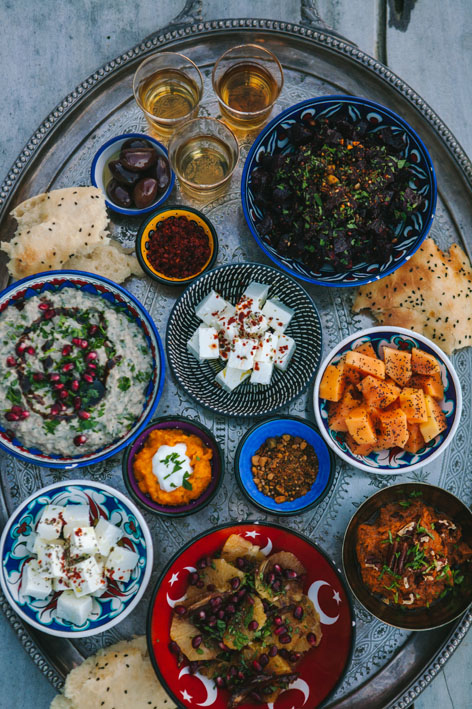
First and foremost, though, whisky is simply a drink to be enjoyed. As taste is subjective, different whiskies appeal to different people. Some people only drink single malts; others only enjoy blends. Whisky is about flavour and the role of the distillers and blenders is to create a balance of flavours that make their whiskies unique – what you do with it after that is up to you. The addition of a drop of water to your whisky is optional but many connoisseurs swear that it releases the aromas and opens up the flavours, smoothing the edges of the alcohol and killing the burn. Adding ice is a personal choice and probably very welcome in a hot climate but some traditionalists might perish at the thought. And having hosted the Chivas Masters group of enthusiastic bartenders from around the world, all competing to create the best whisky cocktail, I have learned that there really are no rules when it comes to the enjoyment of the spirit. I prefer to drink a good dram neat, no water or ice, and sip it in the fresh air on the moor or on my deck with a view to the hills. It is even better when there is a little snow or frost on the ground and the air is so crisp you can see your breath – the whisky warms you from inside and lifts your spirits as your mind drifts. If you are a Scot away from home, it can for a moment bring you back to the feeling of your boots springing on the peat bogs in the mist and the rain. To my mind, whisky is a drink of dreams and it makes me smile from my heart.

A guide to pairing food with whisky
Toolkit
- Identify the key aromas and flavours of the whisky – refer to the tasting notes on the bottle.
- There is a natural connection between food and whisky – the evidence is in the aroma and flavour, or in the tasting notes – so draw out the principle ones to focus on.
- Build a flavour and taste framework to create and taste within.
- Focus on and understand the marriage, balance, sensation and enjoyment of food and whisky. Texture and taste are important, but avoid ‘noisy flavour’ clashing.
- Remember that whisky-making is a human process, not a technological one. Art and skill are involved in transforming a cereal into a spirit that is so complex and enjoyable. For some, the creative process is in the blood – perhaps passed down from father to son – so it is often a labour of love. Out of appreciation and respect for this process, art and skill should be applied to the food that you are pairing with it. The aromas and flavours of the whisky are already telling a story so the food should just tease out the humour and drama; it needs to blend with the essence and should enable that story to reach its natural end. You don’t want to kill the story! Just like the creation of the whisky, the creation and cooking of the food should be a labour of love.
Spirit & Spice by Ghillie Basan is published by Kitchen Press, priced £25
If you’re a crime fiction fan, you’ll be as pleased as we are that this month sees the return of Lin Anderson’s brilliant Rhona MacLeod series. Time for the Dead sees Rhona leaving Glasgow for Skye to recover after the trauma of her last case. In this extract, she is walking in the woods with a rescue dog, Blaze, and makes a troubling discovery. . .
Extract taken from Time for the Dead
By Lin Anderson
Published by Macmillan
All was silent apart from the panting of the dog as it ran a little ahead, turning frequently to check on Rhona’s progress. She passed two small clearings set up with wooden barriers for the pursued to hide from their attackers during airsoft games. At the top of the hill the trees parted to reveal a grassy clearing in the middle of which stood a wooden fort, where the defenders made their last stand.
At this, the highest position among the trees, the defenders might survive a concentrated attack from below, in much the same way that Scots had defended hilltops over the centuries. Rhona halted here to climb on the pal-isade and stare down into the skeleton trees, until Blaze barked at her to indicate she hadn’t yet reached her required destination.
With the path petering out, the dog now made off into the trees to the right of the fort, its bushy tail swaying.Trying to follow, Rhona was immediately met by a web of interlocking branches which necessitated ducking and weaving, even as she stumbled over rocks buried under mounds of dying bracken.
If you’re chasing a rabbit or a deer, Blaze . . .
As Rhona paused for breath, she spotted Blaze a little distance ahead, standing to attention, the shaggy coat glis-tening with moisture from the undergrowth. The dog was looking towards her, obviously waiting for her to come and join him. Whatever Blaze wanted her to see, it seemed they had reached it.
Rhona began to force her way upwards through the undergrowth.
They had reached a small break in the tree cover. Rhona registered the sound of a burn running somewhere close by. A bird rose with a hoarse call that startled her, raising her heartbeat.
As she drew alongside the dog, it turned to lick her hand, whining a little.
‘What is it, boy? What’s wrong?’
Everything, the answering whine told her. Everything about this place is wrong.
‘Show me, Blaze. Show me what you’ve found.’
*
A worried Jamie met Rhona at the gate. ‘We thought you’d got lost!’
‘No, although Blaze did take me a fair distance into the woods.’
‘Is something wrong?’ Jamie asked, taking note of her perturbed expression.
Rhona didn’t know what to tell him, because she wasn’t sure herself if anything was wrong.
‘I need to speak to Matt and Donald.’
‘They’re in the office.’
*
‘What’s up?’ Matt looked up from his laptop when Rhona appeared in the doorway.
Rhona got straight to the point. ‘Did someone get hurt recently in the woods?’
‘You mean during an airsoft battle?’ Matt said, with a worried expression. He looked to Donald, who shook his head, as puzzled it seemed by her question as Matt was. ‘We’re dead quiet at the moment. Just one group yester-day. Soldiers on leave. They really went to town, but they all left unhurt. Why?’
‘Blaze took me directly to a spot in the woods he was obviously interested in, just like a police dog would.’
‘He catches game. Might he have killed something up there? He’s dragged me to a couple of places he’s made a kill and buried it for later,’ Donald offered. ‘Oh, come to think of it, he did ask to be let out late last night.’
‘That could be it,’ Rhona said, to ease their concern. ‘But I’d like to come back with my forensic bag. Take a proper look.’ She’d said this almost to herself, then realized that Matt and Donald were looking at her, slack-jawed.
‘Forensic bag?’ Matt repeated, stunned.
Jamie came in then, speaking directly to Rhona. ‘Do you want to talk to Sergeant MacDonald? We could call in at the station on our way back.’
Rhona wasn’t sure she did. ‘I’ll take another look first. Check if it’s human blood.’
‘There was blood?’ Matt repeated, horrified.
Rhona ignored his panicked expression. ‘I’d like to protect the area until tomorrow morning,’ she told him. ‘D’you have a tarpaulin I could use?’
*
Jamie was silent when they eventually exited the site after stretching and securing the tarpaulin, although Rhona knew he really wanted to question her further. The problem was she had nothing to tell him, nothing concrete anyway. Just an informed feeling about the scene.
‘You really think something bad happened there?
Rhona tried to make light of it. ‘I think I’m maybe missing my work.’
Jamie’s face broke into a relieved grin. ‘And that’s good, isn’t it?’ When she nodded, he said, ‘You didn’t half scare the shit out of Matt, though.’
Rhona changed the subject. ‘Did you organize the stag do?’
‘I did.’ Jamie seemed pleased to talk about something else. Then a worrying thought occurred. ‘Will your investigation be over by next weekend?’
‘It will,’ Rhona assured him.
As they drew into the square at Portree, Jamie asked if she wanted to eat with him at the Isles before heading home.
‘I have to get back,’ Rhona said. ‘I’m expecting a Skype call.’
‘Chrissy?’
‘DS McNab.’
Rhona had felt it necessary to give Jamie some explanation for her extended time on the island, although he’d never questioned her himself. And he was no fool, nor was he off-grid. Therefore he had to be aware of the sin-eater case and at least the fact that she’d been involved in it.
Rhona tried to make light of things. ‘McNab asks how I’m doing. I tell him fine, which is true. Although I suspect if I don’t agree to such calls, he may well get on his motor-bike and head back here.’
‘He’s that protective of you?’ Jamie said.
‘He’d be the same with Chrissy,’ Rhona told him. ‘Her wee boy’s called Michael after McNab,’ she said to illus-trate. ‘And not because he’s the father.’
Jamie drew into the square and turned off the ignition.
‘Are you sure you don’t want to run your suspicions about the site past Lee MacDonald?’
‘I’d rather wait and see if there’s anything to tell him first,’ Rhona said.
‘D’you want me to come back with you tomorrow?’ Jamie looked so worried for her when he said that, Rhona almost laughed.
‘I specialize in hidden and buried bodies, remember?’
‘At least we have the burying bit in common.’ He gave her a half-smile. ‘You’ll let me know?’
‘Of course,’ Rhona promised.
*
The sky was a brooding grey mass as she crossed into Sleat. The pleasure she normally took in the long stretch of road was missing tonight, replaced by the recurring image of that small clearing in the woods.
In most cases you knew you were entering a crime scene, but not always. Like the time she’d been called to the Shelter Stone cave on Cairngorm to view the bodies of three dead climbers. Death had many guises on the mountain, the majority being the result of the weather and the terrain. Not in that particular case, though.
Studying a body and the context in which it was found eventually told death’s true story.
There had been no body in the woods, but there had been enough to suggest there had been, if she respected her instincts . . . and those of the dog.
She’d seen enough police dogs in action to know their response to the discovery of human blood. According to Donald, Blaze had been trained like a rescue dog and the collie had all the instincts of one.
Someone had lain injured there. That was all she knew . . . until tomorrow.
Time for the Dead by Lin Anderson is published by Macmillan, priced £14.99
Once you’ve sampled all the drama, comedy, music, food, drink and larks in Edinburgh, we recommend getting back into nature for peace and contemplation. There’s no better way to do that than to head for one of Scotland’s long-distance walking routes, and the St Cuthbert’s Way in the Borders is a great choice. Luckily, Wild Goose Publishing has just released a guide to help you make the most of the trip.
Extract taken from The St Cuthbert’s Way: A Pilgrim’s Companion
By Mary Low
Published by Wild Goose Publications
In the steps of St Cuthbert?
St Cuthbert’s Way is not an ancient pilgrim route, but parts of it were probably walked by pilgrims in the past, and other parts would certainly have been known to Cuthbert and his contemporaries. From the seventh till the ninth century, visitors would have come and gone regularly between Lindisfarne and its daughter-house at Melrose, either on busi- ness or on pilgrimage. Cuthbert would have known the area intimately, from his childhood and from his pastoral journeys. He was a great walker: he had to be. There were very few roads here in the seventh century and it was easier to walk or ride than to bump along in a cart. The countryside was criss-crossed by a network of footpaths and bridle-ways and these are what Cuthbert would have used. We know that he could ride and sometimes he went on horseback, but more often he did the rounds of the villages on foot. Sometimes he would be away for a week, a fortnight, even a month at a time, living with the ‘rough hill folk’. Bede tells us that he made a point of searching out ‘those steep rugged places in the hills which other preachers dreaded to visit because of their poverty and squalor’. If he were alive today, he would probably visit people in towns and cities as well, but he knew from experience that beautiful scenery is no protection against hardship and he made it his business to understand and encourage people, especially if they were isolated or in trouble.
Where exactly did he go? We can only guess, but ‘steep rugged places’ within a day’s walk of Melrose would include the southern slopes of the Lammermuirs and the Leader valley, the Black Hill at Earlston, the Eildons, Teviotdale and the hills around Hawick, and above all the great mass of the Cheviots. From his days as Prior of Lindisfarne, he would also have known the Northumberland coast, parts of Berwickshire and the hills inland towards Wooler. As bishop, he travelled even further afield.
No one knows exactly which route he took between Melrose and Lindisfarne. Sometimes he travelled by boat. The rivers Leader, Tweed and Teviot are all mentioned in his early Lives. On one occasion, after several years living at Old Melrose, we are told that he ‘sailed away’ privately and secretly. This can only mean that he sailed down the Tweed. On another occasion, he sailed from Old Melrose to the territory of the Picts and got caught in a storm along the way. The nearest Pictish communities of any size were in Fife, with some in Lothian, so he probably travelled downstream as far as Tweedmouth, then north, along the coast, past Coldingham and Dunbar. For visiting the hill-folk however, he can only have gone on foot. It’s impossible to imagine him not using Dere Street, the old Roman road. It was the only reasonable road in the area and ran very close to Old Melrose. From Dere Street, he would have branched off onto larger pathways, sometimes along the river valleys and finally onto mountain tracks.
Personally, I don’t think it matters very much where he walked. Cuthbert himself would probably be bemused that anyone should want to follow in his footsteps literally, like the page boy in Good King Wenceslas. If anyone had asked Cuthbert about his ‘way’ he might have said that he did not have one, not one of his own. He did, however, have a way of life, the way of Jesus of Nazareth. And if he is listening from his place in heaven, he is probably delighted to know that people still want to follow that way, the way of faith and compassion. He might ask you about your way, what brings you here, what you hope for. He might delight or unsettle you by talking about God. But you don’t have to be conventionally religious to explore what this journey might be about for you. There’s nothing like putting one foot in front of the other, day after day, in all weathers, for putting you in touch with the things that really matter.
The St Cuthbert’s Way: A Pilgrim’s Companion by Mary Low is published by Wild Goose Publications, priced £10.99
Time now for a contemporary thriller set in Edinburgh, which has at its heart that all too common drama: sibling rivalry. From The Outside is narrated from beyond the grave by the multi-millionaire businessman, Harry, who has died in a car crash. His brother, Ben, who has spent his life in Harry’s shadow is brought in to look after his charity, but he soon finds out the truth behind his brother’s success.
Extract taken from From the Outside
By Clare Johnston
Published by Urbane Publications
My life was, in truth, all about me. Everything I’d ever strived for had been one big shout for attention: ‘Look at me, look at what I’ve achieved.’ That’s how my business had started – with a small venture I tried my hand at as a student in an effort to impress my father.
Edinburgh University had been chock full of little rich boys and girls who were living in flats bought for them by mummy and daddy. They had been filled with old bits and pieces from home,
including vases, paintings, rugs and furniture that their mothers had long gone off. Some of these unloved items were actually pretty valuable. And that’s where I stepped in. I helped these cashstrapped students earn a bit of extra dosh by relieving them of the older furnishings, having agreed to a 50:50 split on whatever I got for them. Those bits and pieces that I reckoned were actually worth a bob or two I’d take to antiques dealers, and the rest I’d flog at my weekly boot sale in the university car park. These sales became legendary, with bargain-hungry customers scrapping over the old tat and the occasional genuine article. It was a perfect marketplace. And it was also the birth of the YourLot empire. Shortly after I left uni, Dad backed me in opening up my own antiques dealership. Then, when internet enterprises really started taking off, I realised I could sell an awful lot more stuff online. To begin with we simply traded antiques, but quickly opened it up to more modern pieces and then – six years ago – took the leap of allowing members to sell their own items via our site. The rest, as they say, is history. I was the eternal optimist, but not even I envisaged the level of financial success I would reap through the website. YourLot.com became a global phenomenon and I, in turn, a very rich man.
Dad was so proud. My achievements were a favourite topic of conversation for him, with my long-suffering mother taking the brunt of it in the early years. She always listened patiently and
smiled encouragingly in my direction, but I could have been a billionaire ten times over and it wouldn’t have made any difference. Material wealth never impressed her. She was only ever interested in our inner wealth; namely the talents she thought my brother had in abundance but never used.
Mum didn’t live to see the height of my success, but she saw the depths of my personal failings. As did Ben. Whenever I was in his presence my achievements became as weightless as air and my
determination to prove myself as solid as stone.
•
Ben took a deep breath as he prepared to enter his first Monday morning team meeting. Pushing the door to the office open, he found three faces staring at him expectantly from their seats behind the meeting table. This time he’d be more assertive he told himself. So he forced himself to look straight into the eyes of his new employees as he entered the room, but in doing so failed to spot the umbrella at his feet which sent him stumbling around the doorway like a circus clown. Once he’d regained his balance he returned his gaze to the three faces in front of him realising pretty quickly that it was too late to salvage his dignity. They were already desperately trying, and failing, to stifle their laughter.
‘I guess that’s what you call an entrance,’ said Ben, managing a smile. At this they all fell about laughing, but at least they were laughing with him, he hoped.
Ben sat down and reminded himself that he had to remain in control. He pressed on with the statement he had planned, clasping his hands tightly as he spoke so they wouldn’t see them shaking.
‘I want to meet as many of the kids as I can this week.’
‘No problem,’ said Dave.
‘I need to spend this week getting to know the place and everything that goes on here. Then, next Monday we’ll talk about how we move forward. If you have any ideas then that will be your
opportunity to raise them, and I’ll bring a few of my own too. Everyone okay with that?’
‘Absolutely,’ said Sonja, at last looking at him with something he thought could just pass for respect. He noticed for the first time that behind the tough facade, she actually had a nice, round,
kindly face – a face that was comforting to look at. Ben smiled at his colleagues and hoped this fleeting feeling of belonging might last.
He was about to tell them the meeting was over when Sonja cleared her throat. ‘Ben, we…eh, we’re not quite sure what to do with Harry’s stuff.’
‘What stuff?’
‘Eh… that filing cabinet behind you is full of his paperwork and files. We didn’t want to go through it without talking to you first.’
‘I see,’ said Ben, turning to look at the cabinet in question behind him. ‘Why don’t you give me the key and I’ll go through it this afternoon.’
Sonja’s relief was palpable. Clearly, she wasn’t relishing the idea of working her way through my secrets. Personally, I thought that showed a rather disappointing lack of adventurism, but then I
always was a nosey sod. Ben was certainly afraid of what he’d find in a locked cabinet belonging to his heedless twin. And there was a secret within that cabinet, one I longed to be uncovered but would only be done by the most astute of minds. Just as well then, that it was my brother unlocking it.
From the Outside by Clare Johnston is published by Urbane Publications, priced £8.99
Back in Edinburgh, Scotland’s performance poets are knocking it out the park with their Fringe shows, and BooksfromScotland would recommend catching those shows from the likes of Jenny Lindsay, Harry Josephine Giles, Kevin P Gilday, Cat Hepburn, Jen McGregor and many, many more. Another poet who should get a great audience is Ross McLeary, who has just released a new pamphlet with the marvellous Stewed Rhubarb Press. We hope you enjoy this selection of poems from his collection.
Extracts taken from Endorse Me, You Cowards!
By Ross McLeary
Published by Stewed Rhubarb Press
A Business-of-one
You are a business-of-one.
This means when you wake up you are
already on the clock.
This means when you sleep you dream
of reports and contracts and deals.
This means when you eat lunch you
are eating into your own profits.
Be careful where you stand. The floor
is made of money.
You are a business-of-one.
This means meetings are
straightforward: you know what
direction to go in.
This means coming up with ideas for
the Christmas party is easy.
This means synergy is a strange
combination of narcissism and
masturbation.
Be careful what you say. The walls
have ears, you know.
You are a business-of-one.
This means that profits do not have to
be shared.
This means the glory belongs to you.
This means that your confidence isn’t
misplaced.
Be careful what you wish for. The
market doesn’t care.
You are a business-of-one
but then
everyone is a business-of-one now
and everyone is exhausted.
You are a business-of-one
but then
all your friends are a business-of-one
and you haven’t seen them in weeks.
You are a business-of-one
and when the business fails, as all
businesses fail,
they’ll point to your failings and say
that you had no one to blame but yourself.
10 Things Recruiters Look for in Your LinkedIn Profile
1. Make sure there is one lie on your profile. Recruiters know you are flawed—no one is perfect, after all—and making things up is an important part of showing a human touch.
2. Make sure there is at least one visible owl in your photo.
3. If you have employment gaps, use them to describe your most frequent daydreams.
4. Embed within your profile a deep, monotone hum. Something from an expensive synthesiser or your dad singing the lowest note he can manage.
5. Rock-hard abs.
6. Evidence of a desire to be killed in combat.
7. Put your email address in a visible place—how else are you supposed to get feedback on your poetry?
8. Wear a watch in your photo. Be warned, though, you must make sure the time is correct at all times or Recruiters will think you’re wearing a broken watch.
9. Good content. Recruiters want to know you can churn out the good stuff hour after hour, day after day. Neverending content from dawn til dusk and back again.
10. A birthmark like the one on your left clavicle. The one that looks like Greenland. You can see the tip of it in your profile picture, but only if you know what to look for. The Recruiters on LinkedIn aren’t just looking for anyone. They’re looking for you, aren’t they? They are hunting you and they will find you and when they do, they will offer you a job, and that job will involve long hours and be underpaid and your boss will treat you like shit and the job market’s tough and rent is due and bills need paid and you’re exhausted, my god are you exhausted, and you cannot run forever and you’d like it to stop, even for just one minute, but maybe this time it won’t be so bad?
Making Recruiters Come to You
Have you tried drawing Recruiters with magnets?
You are the North Pole and they are the South.
Opposites charge towards each other
like a bull to a flag, a cake to a mouth.
Have you tried hosting a Recruiters Bake Sale?
Luring them with warm bread delights,
showcasing your skills in the morning
after hours of working all through the night?
Have you tried sending your CV in bulk?
Not just once or twice but more than ten times.
They will appreciate your commitment and effort;
they will find your enthusiasm well within line.
Have you tried sending your CV again?
It’s been a week and you’ve heard not one word.
They must want you, surely? Your skills are unique.
To give up just now would be quite absurd.
Have you tried sending your CV again?
Rearranging the words, adapting your skills,
making up jobs, rewriting your past,
saying what they want, and going for the kill?
Have you tried sending your CV again?
Have you tried sending your CV again?
Have you tried sending your CV again?
Have you tried sending your—
You’re trying too hard and it shows.
5 Things Your Spreadsheet Cannot Do
1. It cannot bring her back. You input the number of days since she left. The hours. The weeks. The minutes. The years. You input the time you spent together. You write it out to a hundred decimal places. The increments and the precision do not matter. It changes nothing.
2. It cannot bring her back. You write IF statements, craft logical formulas, define permutations and possibilities and choices. Ways it could have turned out differently. But so what? The past is an immutable black hole.
3. It cannot bring her back. You write down everything you said. Every flirtatious word. Every compliment. Every insight. Every ambiguous statement. Every misunderstanding. Every fight. All the things you disagreed on. From this, you make charts and graphs and trend lines, try to figure out where it all went wrong. But it tells you nothing. It just hurts.
4. It cannot bring her back. And you are not sure why you thought it would. No matter how much information you put in, there is always something missing. Something which renders the project incomplete. The volume of information is impressive but every missing detail reflects how frail, faulty and inadequate your memories are. And even if you hadn’t forgotten a thing, it would still be incomplete. The past cannot be reduced to an equation or a number. It is a wave of light stretching outwards in every direction at once. The further into the future you go, the thinner and more ungraspable the past becomes. You cannot change that. You can only accept it. You have to accept it, and then you have to move on.
5. It cannot bring her back. You delete the arguments, fights, and misspoken words. You filter out bad memories and the day when it ended. You do all this but it does not alter that it happened, that it was not perfect.
Endorse Me, You Cowards! by Ross McLeary is published by Stewed Rhubarb Press, priced £5.99
Catch Ross McLeary’s Fringe performances at the Scottish Poetry Library on August 14 – 17 and 20 – 23
https://tickets.edfringe.com/whats-on/employ-me-you-cowards
We at BooksfromScotland always look forward to the Scottish National Gallery’s big summer exhibition, and this year’s showcase dedicated to the work of Bridget Riley is an amazing visual feast. We highly recommend a visit! If you can’t make it, here’s a little bit of what to expect from the exhibition’s accompanying book.
Extract taken from Bridget Riley
By Michael Bracewell, Éric de Chassey, John Elderfield, Dave Hickey, Robert Kudielka, Bridget Riley, Richard Shiff, Frances Spalding, David Sylvester, David Thompson
Published by The National Galleries of Scotland Publishing

Bridget Riley is an artist who has forged, over the course of some seventy years, a remarkable and innovative career. She makes paintings that are not only rigorous but also beautiful, bringing attention to the act of looking at art and at the world around us. This publication accompanies major exhibitions of the artist’s works, held in Edinburgh and London during 2019, which mark the first survey of Riley’s work to be staged in Scotland and the first of its scale in the UK since 2003. The exhibition looks back over Riley’s long career and traces the dynamic and evolving nature of the artist’s practice, from her early student drawings to very recent paintings.
In keeping with the retrospective nature of the exhibition, this book brings together a selection of critical writings starting with David Sylvester’s review of her first exhibition in 1962 and ending with Eric de Chassey’s recent and perceptive text, for which we thank him warmly. These reviews, essays, statements and conversations have been selected by the artist and include her own writings. Spanning almost six decades, they trace the development of Riley’s ideas and the critical reception of her work during that period, providing an historical survey into the wide-ranging practice, which includes writing, lecturing and curating, of one of the most influential artists of our time.
We are delighted to be working together to present these exhibitions of Riley’s work, building on both past partnerships between the National Galleries of Scotland and Hayward Gallery, and on the close connections the artist has with each of our institutions.
In 2016, the National Galleries of Scotland staged a small exhibition devoted to Riley’s work, which juxtaposed the painting Over, 1966, by Riley, from our collection, with eight paintings from across the artist’s career. Over was acquired in 1974 following an earlier solo exhibition of Riley’s work at the Scottish National Gallery of Modern Art. The 2016 presentation provided an opportunity to begin a new conversation with the artist – a conversation that resulted in this landmark exhibition and accompanying publication. We have particularly valued the artist’s insights into works by other artists in the collection, which have long been known to Riley. Amongst them, Georges Seurat’s La Luzerne, Saint-Denis, 1884–85, provided the inspiration for her post-impressionist painting Lincolnshire Landscape, 1959, while Piet Mondrian’s Composition with Double Line, 1932, featured in Riley’s selection for Tate’s 1997 exhibition Mondrian: Nature to Abstraction, and in her essay for the accompanying catalogue.
Riley’s work is part of a long tradition in painting; to see that art through her own thinking is hugely rewarding and we are indebted to her for this rich and illuminating dialogue that continues in her work today. Following Riley’s winning of the International Prize for Painting, in its old form, at the 34th Venice Biennale, Hayward Gallery presented the artist’s first major UK survey exhibition in 1971, the Hayward’s very first show devoted to a contemporary painter. Since then Bridget Riley has been a leading light in the gallery’s history. In addition to co-curating a Paul Klee exhibition in 2002, Riley herself was the subject of another Hayward solo show in 1992. Her works have also been included in a total of five group exhibitions over the years. On all these occasions, she has applied her acute understanding and appreciation of the Hayward’s particular architectural style in relation to the work displayed. Almost half a century after her first Hayward exhibition, it is a great privilege to be adding to Riley’s long association with the gallery by presenting this rich and inspiring retrospective featuring so many works which feel as new as the day they were made.
Bridget Riley by Michael Bracewell, Éric de Chassey, John Elderfield, Dave Hickey, Robert Kudielka, Bridget Riley, Richard Shiff, Frances Spalding, David Sylvester and David Thompson is published by The National Galleries of Scotland Publishing, priced £34.99 in paperback and £44.99 in hardback
There are a few authors making 19th century’s Edinburgh and its pioneering medical study their fictional world (all rise E S Thompson and Kaite Welsh!), and it is a time and a place ripe for fictional adventuring. Ambrose Parry (the husband and wife team of Christopher Brookmyre and Marisa Haetzman) joined in with their bloody escapades in The Way of All Flesh last year, and we’re delighted to publish an extract from their brand new novel, The Art of Dying.
Extract taken from The Art of Dying
By Ambrose Parry
Published by Canongate Books
There was a bite in the breeze as Raven climbed from the carriage and hefted his bags down to the pavement. Late autumn in Edinburgh. He permitted himself a wry smile at its chilly embrace, like a welcome home from a relative with a grudge. Its teeth were not so sharp as they once felt, however. He used to think that the wind off the Forth was a cruel presence. That was before he had felt the gusts that whipped along the Danube.
The familiarity of the city’s sights and smells was heartening. He had only come to appreciate how much he missed Edinburgh once he had committed to return, and if he had doubts as to the wisdom of his decision, they were blown away like steam as his eyes lit upon the door to 52 Queen Street.
How vividly he recalled the first time he came here. He had been unconscionably late, dishevelled in his worn and grubby clothes, and sporting a recently sutured wound upon his face. He raised his hand to his left cheek in a semi-reflexive action, his index finger tracing the length of the scar. He thought of the individual responsible for it but quickly put that ugly visage from his mind. It was said the best revenge is living well, and he was certain their respective fortunes would have been satisfyingly divergent in the time that had passed. Raven had left that world behind, while his assailant was no doubt utterly mired there, if he still lived at all.
His facial disfigurement aside, he felt his appearance to be considerably improved since he first presented himself here. His wardrobe, like his travels, had been financed largely by the involuntary contribution of another gentleman, late of this parish, who had no need of luxuries where he had ended up. His clothes were new, tailored to fit, and his boots were polished to a high shine. He wondered if he would be recognised, so complete was his transformation.
When Raven had first seen it, 52 Queen Street had represented a route to wealth and renown, his aspirations filled with aristocratic patients and their hefty fees. Professor Simpson had shown him what it truly meant to be a doctor. This house and those who lived there had been the making of him, had saved him from himself. Now that he had returned, he wanted to show them all how he had flourished.
He paused on the front step, trying to anticipate the changes he would find inside, conscious that things were unlikely to be as he had left them. He remembered with a mixture of fondness and exasperation the gallimaufry of messy humanity which was often to be found behind this door. The personality of its owner was stamped upon the place from the attic to the basement. It was warm, cheerful, bustling, challenging and inspiring; but it could also be chaotic, confounding, fraught, thrawn and downright overwhelming. There were animals running loose, children running looser, patients spilling out of doorways, staff scrambling to accommodate the guests invited upon a whim of the professor, and somehow amidst it all had been made a discovery that changed the world.
As he rang the bell, he thought about who might answer, the faces he was about to see. He thought about Jarvis, Simpson’s redoubtable butler, whose very politeness towards Raven was itself a means of conveying how much he would like to turn him out onto the street for a wretch. He thought about Mrs Simpson, perpetually in mourning for the young children she had lost and vigilantly dedicated to the care of those who survived. He thought of her unmarried sister, Mina, left heartbroken after she mistakenly believed her search for a husband had finally come to a happy end. Foremost in his thoughts, however, was Simpson’s housemaid, Sarah Fisher.
Hers was the image he had most tried to conjure throughout his travels: her pale complexion, her honey-coloured hair, the soft touch of her hand as she administered ointment of her own making to salve his wound. He remembered the smell of her – lavender and fresh linen – the way she carried herself, her smile. He remembered also her withering disdain, her sharp intelligence and her tendency to let her frustrations talk her into trouble. Most of all he remembered the kisses they had shared, the swell of feelings he had not known around a woman before – or since.
He shook his head in an attempt to clear his mind. Such reminiscences had been in equal parts a comfort and a torment over the past year. They had been thrown together by circumstance, but propriety dictated that to pursue any kind of relationship would have been damaging to both of them. There had been no contact between them since he left. Deliberately so. He had written letters to her during his time in Paris, and again in Vienna, but they had never been sent. He was a doctor, a physician. She was a housemaid. Anything other than a professional relationship was surely out of the question. What possible future could there have been for them? None that he could see. He had tried to explain as much to her before he left, but she had been reluctant to accept the intractable realities before them; strong-willed and argumentative to the last.
He had been sure that a period of separation would cool his ardour for her, and there had been interludes during his travels when she seemed far distant in time as well as space; a treasured step on his journey, but one he had been ever progressing away from. However, as he stood on the doorstep, he was conscious of an increase in his heart rate, an excitement of the body in defiance of anything his mind might wish to deny.
It was more than an excitement: it was a longing. And the closer he drew to seeing her again, the more imperative that longing became.
He was therefore quite unprepared when it was not Sarah but another young woman who answered the door.
‘Can I help you, sir?’ she asked, peering up at him from beneath her cap.
‘Yes. I am Dr Will Raven, the professor’s new assistant.’
Raven’s pride in being able to announce himself this way helped conceal how crestfallen he was suddenly feeling. The girl stood aside to allow him to enter. He handed her his hat and gloves.
‘Very good, sir. I was told to expect you.’
‘You are new here, are you not?’ he asked, peering past her down the hall in a search for more familiar faces.
‘Been here almost a month now, sir.’
‘Is the professor at home?’
‘No, sir.’
‘Mrs Simpson?’
‘Mrs Simpson and the children are out visiting.’
‘And Miss Grindlay?’
‘She is at her father’s house in Liverpool.’
Raven thought again about Mina and her marital disappointment. He had hoped she would by now have found a suitable partner, but some things, as he well knew, were not meant to be. He looked up the length of the hallway again. Everything was preternaturally calm, causing him to feel uneasy. He decided he could stand it no longer.
‘Where is Miss Fisher?’ he asked.
‘Miss Fisher, sir?’
‘Yes, she is a housemaid here. Or was,’ he added. Sarah had received a promotion of sorts before he left, and he was unsure how he ought to refer to her now.
‘There is another housemaid here besides me, sir, but none called Fisher.’
She stared blankly and Raven suppressed a sigh. The girl had evidently replaced Sarah but was by no means a substitute for her.
He smiled benignly at her.
‘Perhaps you know her simply as Sarah.’
A realisation passed across her face like a shadow.
‘Oh. You must mean Miss Fisher as was, sir.’
As was? Raven was gripped by panic, his disappointed heart thumping again and his guts churning. What had happened to Sarah? Was she dead? He would surely have been told if something catastrophic had befallen her. Then he remembered all of his unsent letters. Perhaps no one would have thought to inform him. After all, they had endeavoured to keep their connection concealed.
His palms were suddenly moist. In that instant it all came flooding back and he understood that far from fading, his feelings for her had merely been suppressed by time and distance. Then he noticed that the girl was smiling.
‘She is no longer Miss Fisher, sir. She is now Mrs Banks.’
The Art of Dying by Ambrose Parry is published by Canongate Books, priced £14.99
The parallels between the art of Andy Warhol and Edinburgh-born Eduardo Paolozzi was celebrated by the Scottish Gallery of Modern Art in late 2018, and the accompanying book is full of great insight and images on and from both these iconic artists, and particularly on their early works. Here’s an extract from Keith Hartley, Chief Curator and Deputy Director at the Scottish National Gallery of Modern Art.
Extract taken from I Want to be a Machine: Warhol and Paolozzi
By Keith Hartley
Published by the National Galleries of Scotland Publishing
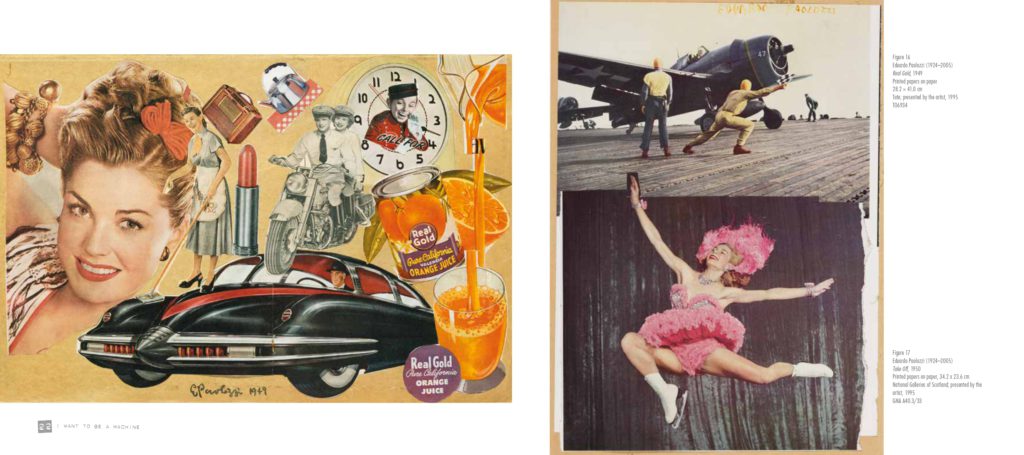
In the summer of 1968 the Art Advisory Service of the Museum of Modern Art in New York organised an exhibition of five artists in the lobby of the famous Four Seasons restaurant at 99 East 52nd Street. Included in the five were Andy Warhol and Eduardo Paolozzi. Warhol was represented in the show by six of his silkscreen prints of Marilyn Monroe produced in the previous year. As the press release says: ‘This particular image is one he has used many times before, but never more successfully than in these newest works … Viewed together, the varied range of expression is remarkably striking. Dramatic shifts in color as well as character are achieved in each separate screen.’ Paolozzi was represented by a highly polished aluminium sculpture Marok-Marok-Miosa, 1965, ‘mirroring its surroundings’, and two ‘brilliantly colored silkscreen prints done this year and closely related to his sculpture’.1
Marok-Marok-Miosa consists of a series of aluminium parts, welded together to form a winding group of figures, with snake-like pipes emerging from them – probably inspired by the famous ancient Graeco-Roman sculpture Laocoön (now in the Vatican Museums in Rome), which fascinated Paolozzi at this particular time. The synthesis of classical sculpture with machine-made, serial metal structures goes back in Paolozzi’s work to his earliest paper collages in 1946, when he was only twenty-two years old. The two brightly coloured prints which mirrored the shapes of the sculpture were from Universal Electronic Vacuum, a portfolio of ten screenprints that evidences the beginnings of Paolozzi’s interest in the relatively new imagery emerging from computer printouts – the latest metamorphosis of the machine. Working with the master printer Chris Prater in Kelpra Studio, London, Paolozzi was one of the first artists to exploit the full potential of screenprinting: beginning with a photographic image that was transferred onto the screen, but then proceeding to use a whole series of successive screens to print a range of colours. In 1963 he had taken advantage of the relative ease of changing the colours by printing each of the forty-sheet run of the key screenprint Metalization of a Dream with a different colourway. What Paolozzi was doing in screenprinting was a parallel exploitation of the mechanical processes inherent in the medium to the way that he used prefabricated metal parts to make sculptures.
At the same time, on the other side of the Atlantic, Warhol was carrying out similar experiments with mechanical processes, so as to exploit the full potential of photography and colour. The set of Marilyn Monroe screenprints (six instead of the full ten) shown in the exhibition at the Four Seasons were also printed in different colour combinations. Although the photographic image remained the same, the changing colours made her features look different and certainly seemed to alter her expression. While Warhol made this kaleidoscopic series in 1967, a full four years after Paolozzi rang the colour changes in Metalization of a Dream, there is a fundamental difference in the two print productions. Paolozzi never intended to show all the differently coloured prints together. In a way, it enabled him to turn an inherently serial production of near-identical prints into unique works of art. The mechanical process of photo-screenprinting allowed him to do this with relative ease. Warhol, on the other hand, made the set of Marilyn prints with the express purpose of them being shown together. Each individual print was differently coloured, but each set was identical. In a way it was like the Campbell’s Soup Can series. The basic shape and structure were the same – like Marilyn’s head – but each print showed a different can of soup. The point was that each can of black bean, each can of tomato, tasted the same. There was uniformity within variety. And Warhol liked that. He felt that it was very democratic and very American. Warhol’s ‘discovery’ of screenprinting in the summer of 1962 (probably around the same time as Robert Rauschenberg (1925–2008)) allowed him to use photographs as the direct basis for his paintings, without the need to trace and enlarge or project and copy the images. The process was as near to the mechanisation of art as it was possible to get at that time and Warhol was very aware of this. In a key interview given to Gene R. Swenson in 1963, he talks about the anonymous, mechanical nature of screenprinting paintings:
‘That’s … one reason I’m using silk screens now. I think somebody should be able to do all my paintings for me. … I think it would be so great if more people took up silk screens so that no one would know whether my picture was mine or somebody else’s … The reason I’m painting this way is that I want to be a machine, and I feel that whatever I do and do machine-like is what I want to do.’2
1 Eduardo Paolozzi, Universal Electronic Vaccum, 1967
2 Andy Warhol in Gene R. Swenson, ‘”What is Pop Art?” Interviews with Eight Painters (Part 1)’, ARTnews, November 1963
I Want to be a Machine: Warhol and Paolozzi by Keith Hartley is published by the National Galleries of Scotland Publishing, priced £7.95
The streets of Edinburgh hold a million stories. Sometimes you see them being told by caped storytellers to interested tourists in the centre of town. But, as David Robinson found out, there is more than one way to tell our capital city’s tales. . .
Constitution Street: Finding Hope in the Age of Anxiety
By Jemma Neville
Published by 404 Ink
If anyone has a year or three to spare to write it, here’s a great idea for a book, and I’ll give it to you for free. It’s very specific, because it’s about just one street in Edinburgh, the people who have lived there in the past and those who live there now. And before you can say, ‘Why should I care about that if I don’t live there?’ – let me tell you.
I’m talking about the Cowgate. Why? Because it’s got everything and been everything. Back in the fifteenth and sixteenth centuries, this was where you wanted to live if you were, say, an ambassador to the Scottish court or a high-ranking courtier in it. Yet in the nineteenth, it was an overcrowded and mainly Irish slum, the place revolutionary socialist James Connolly called home. ‘To look over the South Bridge and see the Cowgate below full of crying hawkers,’ wrote Robert Louis Stevenson, ‘is to view one rank of society from another in the twinkling of an eye.’
Exactly. But rather than do the usual riff on that quote – you know, divided city, Jekyll and Hyde, Caledonian antisyzygy, yadiyahiyah, let’s imagine someone else leaning over South Bridge and looking down. Someone who, as far as I know, never even visited Edinburgh in the first place.
Let’s imagine that the great American oral historian Studs Terkel (1912-2008) not only came back from the dead but to Scotland’s capital too and that he also took in that very same view from South Bridge. Right now, in the middle of the Festival, the ‘blackened urban ravine’ of Cowgate is plastered with flyers and crowded with Fringe-goers ‘haphazardly crossing over or standing in little knots in the middle of the road as if no-one had told them that roads were for cars and pavements were for pedestrians.’ (The quotes are from Kate Atkinson’s One Good Turn, which gets one thing about the Cowgate absolutely right: even in daytime, there’s no street in Edinburgh where it’s easier to run someone over.)
But let’s imagine too – indulge me – that a reborn Studs Terkel isn’t just looking for stories from the Cowgate in August, but the rest of the year too. That he is ranging, tape recorder in hand, round, say, the Cowgate’s hostel for the homeless, or the grim black box of the city morgue nearby (where most of the bodies in Ian Rankin’s novels end up), or just interviewing random strangers he encounters on a street which has a shop selling dinosaur fossils at one end and a parliament at the other. What story-hunter wouldn’t swoop down onto the Cowgate utterly confident that they were bound to return with the most amazing tales? The kind of stories that we don’t hear any more, and haven’t heard ever since journalism started haring off after celebrity instead of being properly curious about real life? A no-brainer, surely?
When he wrote his career-defining book Division Street in 1967, Terkel was looking at Chicago as a microcosm of the US itself, and for street interviewees who, in their diversity, were a microcosm of the city. ‘I was on the prowl for a cross–section of urban thought, using no one method or technique,’ he wrote. ‘I guess I was seeking some balance in the wildlife of the city as Rachel Carson sought it in nature.’ He hadn’t, in other words, any predetermined thesis to prove: his only aim, as he set out to do the 70 interviews in his book, was to take the collective pulse of his city and, by implication, his country.
Set it on the Cowgate, and that’s a book I’d love to read too, and if you’d like to write it so much the better. As for what to call it, I was thinking about Scotland’s Street but Alexander McCall Smith has sort of got there first. A Street through Scotland? Division Street Revisited? You write it, you decide. Just let me know how you get on.
Whatever you call it, such a book would be fairly unusual. I can’t think of anything ever written in Scotland remotely like it. Or I couldn’t until I picked up a copy of Jemma Neville’s debut book Constitution Street, out next month from 404 Ink, and I was delighted to see that she had been thinking along similar lines too. Similar, but different, because while my putative book (the one I was too lazy to write) would have followed Terkel in “using no method or technique” – in other words, just letting the interviewees’ stories speak for themselves – Neville has a far clearer purpose in mind.
What she wants to do is twofold. First, there’s an overlap with what I would have wanted the Cowgate book to be: a reminder of the sheer diversity, singularity and unpredictability of people’s lives. Neville comes up with a particularly good example. A few yards from the end of Constitution Street is the domed Bank of Leith, which dates back to 1793. Once upon a time, Sir Walter Scott was a customer. These days, it is an outpost of the Buddhist Samye Ling Centre. And Ani Rinchen Khaniar, the shaven-headed Buddhist nun, who brought the former bank and turned it into a centre for meditation and yoga is … and this is what I mean by unpredictability … a former Mancunian model called Jackie Glass who was the first love of George Best’s life. According to the Daily Mirror, they went out for two years before she dumped him.
Neville is more high-minded and right-on than me, so she doesn’t call that chapter (as I would have done) ‘The Nun Who Gave George Best The Boot’. Instead, it is called ‘The Right to Freedom of Religious Belief’, which is a key to the second – and arguably more important – purpose of her book. Because Neville’s extended stroll down Constitution Street isn’t just an exercise in journalistically reflecting what she finds. It also asks the reader to think about how its residents’ lives could be improved too. In these uncertain, choppy, Brexity waters, she argues, Scotland needs its own written constitution. Constitution Street – where she has lived since her student days – would be as good a place as any to start looking how a new Bill of Rights could work.
Neville’s background in human rights law (she worked for the Scottish Human Rights Commission before taking up her current job as director of Voluntary Arts Scotland) makes her a good guide to the topic. Her love of Leith, both past and present, and the warm-hearted intelligence she shows in her writing about her neighbours, give the book all the necessary grounding it needs to interest all those readers who aren’t idealistic constitutional lawyers. As books about streets through Scotland go, Constitution Street is informative, empathetic, and almost certainly the best on the market. It will probably remain so for a long time – at least until someone heads down the Cowgate with a tape recorder, notebook, pen – and a publisher’s contract …
Constitution Street by Jemma Neville is published by 404 Ink, priced £12.99
Although Edinburgh is busy and buzzing throughout August, you may want to escape to the calm of Scotland’s islands, just like Sue Lawrence who shares her culinary highlights from her island travels. And when the food is as good as she says . . .
Extract taken from A Taste of Scotland’s Islands
By Sue Lawrence
Published by Birlinn
Honey
(Colonsay)
When you attend a book festival as an author, you are invariably given a goody bag, something to look forward to with anticipation. Sometimes you find a book, a pen, a scarf or even some whisky. But without doubt, one of the most welcome gifts I have received as an author was at the Colonsay Book Festival in 2017. There in my bedroom at the Colonsay Hotel was a jar of the island’s honey. What a nice touch, I agreed with my fellow authors, and thought nothing more of it until the following morning when the same honey appeared on the breakfast table. The taste was and is exquisite, unlike any other honeys I have tasted. Nuanced and floral, the texture is rich, creamy and unctuous. I was hooked over breakfast and could not wait to find out more about this honey’s provenance.
Andrew Abrahams has been producing Isle of Colonsay Wildflower Honey for some four decades, a labour of love that he fits in between his many other jobs, including that of oyster farmer. Andrew lives at the Strand, right at the south end of Colonsay opposite the small tidal island of Oronsay and has beehives – some 50 to 60 – all over both islands. His bees are a strain of the native black bee, whose hardiness means they are able to harvest on cool, sunless days and even in a strong wind.
When I asked Andrew about the distinctive, complex flavour of his honey, he summed it up perfectly by telling me it is ‘the essence of all the flowers on Colonsay’. There is a lot of heather in it – and unusually there is both ling and bell heather. Most heathers in Scotland grow on moorland; on the island, however, they also grow on rocks and this gives a different flavour to the honey. There are also wild thyme, clover, sea pinks, hawthorn and many more flowers growing on the sandy machair and on the moors of Colonsay.
The honey is harvested once a year, usually in September, and then comes the process of extracting the honey from the wooden frames of honeycomb. Honey is extracted by centrifrugal force, usually radially. However, given the high proportion of heather, those honeys with the specific consistency that Andrew’s have are extracted tangentially instead. They are then potted into jars and labelled with a picture of the Celtic cross representing Oronsay’s fourteenth-century priory.

When asked how he likes to eat it and if he has any particularly recipe using honey he would like to share, Andrew insists you mustn’t mess about with it. Apart from serving it with ice-cream where it is simple enough to retain the pure honey flavour, he says why eat it with anything other than on a simple piece of bread or toast. In times past on the Scottish islands, honey was eaten with bannocks made of beremeal or oats (and sometimes rye) and it was used as a sweetener in that harvest-time pudding, Cranachan, made from hedgerow brambles, crowdie and toasted oats. There are also some old recipes that predate the arrival of sugar to Scotland, in rich game dishes such as hare with honey and claret.
Personally, I like to use it in simple recipes, but best of all, with honey as delicious as Andrew’s Colonsay honey, I also like to eat it neat, from a spoon, straight out of the jar. Nectar.
Colonsay Honey Ice-cream
serves 6–8
I had finished the jar of honey I brought back from the Colonsay Book Festival with indecent haste on my return to Edinburgh, but my agent Jenny managed to buy the last two jars in the village shop on Colonsay when she was there. And with this, I made this exquisite ice-cream. Because the recipe is so simple, the true, floral, elusive taste of island honey takes centre stage.
600ml double cream
4 heaped tbsp Colonsay honey
¼ tsp of sea salt
1 397g tin of condensed milk
Strawberries/raspberries and
perhaps some shortbread, to serve
Pour the cream into a bowl and whisk gently (at low speed if using an electric mixer) for a couple of minutes, then increase to a medium speed (or use a heavier hand whisk!) until you can see it start to thicken.
Now add the honey, one spoon at a time, whisking after each spoonful. Add the salt and continue to whisk until you have soft peaks, then pour in the condensed milk. Using a large metal spoon, combine gently until thoroughly combined. It should be light and thick. Pour this mixture into a freezer container, seal tightly and pop in the freezer for several hours (at least 6 hours) or overnight. Let it wait at room temperature for a couple of minutes before serving, perhaps with some shortbread and berries: both strawberries and raspberries go well with honey.
A Taste of Scotland’s Islands by Sue Lawrence is published by Birlinn, priced £20.00
BooksfromScotland is carrying on with its new strand, ‘Rediscovering’, bringing back into focus authors from the past whose books still deserve a spotlight shone on them. This month Lee Randall takes a look at D E Stevenson, a writer who sold more than her more famous second cousin in her day. But with new reprintings, it looks like she may get a deserved revival.
Sam Abbott bursts in on his uncle at the publishing firm of Abbott & Spicer, waving a manuscript, declaring, ‘Uncle Arthur, the feller who wrote this book is either a genius or an imbecile.’
Chronicles of an English Village, purports to be by John Smith. Fans of the novel within a novel know the re-christened Disturber of the Peace is by Barbara Buncle, a mousy spinster of no importance in Silverstream. Thus when an outraged neighbourhood goes on the warpath to discover—and punish—the villager who’s made free and easy with their secrets, no one considers her a candidate.
I imagine D.E. Stevenson (1892 – 1973), author of Miss Buncle’s Book (1934), also confounded expectations. It can’t have been easy growing up clever in an age when middle-class mores dictated that a woman’s destiny was marriage. Dorothy wasn’t sent to school, but educated at home. She sat the Oxford entrance exam and received an offer, but her parents decreed further education ‘an unforgivable deterrent to potential suitors.’ No doubt they were unaware she’d been hiding in a cupboard writing books since she was eight.
Born into the Lighthouse Stevensons, she’d marry into another renowned family. In 1915 she published a collection of poetry, and around then, met James Peploe, a captain in the 6th Ghurkha Rifles, in Edinburgh on medical leave after losing most of his hearing to a head wound incurred at the Battle of Mons. (His father’s half-brother was famous Scottish Colourist, Samuel.) They married in 1916.
By 1923, when she published Peter West, the first of her 45 novels, they had three children. Nine years passed before her next novel, Mrs Tim of the Regiment, a gap possibly connected to the death of their eldest daughter, in 1928, and the arrival, in 1930, of a fourth child. From 1946, until retiring in 1969, Stevenson published a book a year, earning the bulk of the income required to run a household that included full-time help.
I bring that up because when asked why she wrote a novel, Miss Buncle’s answer is immediate and honest: ‘I wanted money.’ Her dividends have run dry; her future looks terrifying. Stevenson lets Barbara rescue herself through work, rather than via advantageous marriage, and the novel’s clear-sighted about the difficulties facing women without independent means. It also, some may be surprised to learn, includes a lesbian couple, post-natal depression, an abusive husband, and love between the middle-aged.
Stevenson was, by all accounts, as likeable as her heroines. In 2011, her daughter, Rosemary Swallow, told the BBC, ‘She would sit down on the sofa, put her legs up and light a cigarette. She had a special wooden writing board covered in green baize and would just carry on writing whatever was going on around her.’
Her industry paid off. She was one of the bestselling novelists of the 1930s, shifting seven million copies of her novels in the UK and the USA, where her fan base remains strong thanks to an active network of soi-disant ‘Dessies’.
During World War II, after Glasgow was bombed, the Peploes moved from Bearsden to 1 North Park, Moffat. (Dorothy died there in 1973.) War was a recurring subject, reflecting the times, and her husband’s background. Her successful Mrs Tim series (Mrs Tim of the Regiment, Mrs Tim Carries On, et al), sprang directly from her diaries, offering a firsthand account of a career officer’s wife.
In her master’s thesis, Love in Conflict: D.E. Stevenson, War-time Romance Fiction, and The English Air, Ingrid L Baker observes, ‘Her novels were popular and successful, which suggests that this kind of fiction met the needs of readers . . . [and] reflected how women . . . internalised and survived the uncertainty of their lives while their husbands, brothers, and friends were distant and in peril.’
Mrs Tim won critical favour, with The New York Times saying, ‘Stevenson never seems to work at being funny, but she has spiced this tale of British army with an unobtrusive, effortless wit which often proves deceptively sharp.’
Why, then, are we perpetually rediscovering Stevenson? Because she was a woman, writing about the female experience.
Scott Thompson, co-publisher of Dean Street Press’s Furrowed Middlebrow Imprint, which publishes five of Stevenson’s novels, says, ‘She has inspired passionate and often lifelong devotion in her readers. [But] most of her books were out of print before Persephone got the ball rolling by reprinting Miss Buncle’s Book. The reasons are probably the same as for so many brilliant women writers of the time. Their tendency to focus on domestic themes and the challenges and changing roles of women meant that male critics and scholars dismissed them as “women’s fiction.” If the likes of Barbara Pym and Elizabeth Taylor had lapsed out of print, what chance did D. E. Stevenson’s books—so often mischaracterised as “romances”—have?’
He adds, ‘Readers have come to realise that the canonical 20th century novels they studied only tell a fraction of the story. We were missing out not just on women’s voices and perspectives, but also on the meticulous and fascinating details of day-to-day life at pivotal historical moments.’
Like Hester Tim and Barbara Buncle, Stevenson is appealingly gemütlich. She once wrote, ‘Sometimes I have been accused of making my characters “too nice”. I have been told that my stories are “too pleasant,” but the fact is I write of people as I find them and am fond of my fellow human beings.’
For me, the defining image comes from the Bearsden Film Club’s 1930 short, Fickle Fortune. Dorothy wrote the screenplay, about Rob Roy McGregor, and plays his wife, Flora. Watch it here.
Stevenson bursts out of the cave buckling her swash for all it’s worth, rallying her clan. She injects a jolt of energy and devilry, evincing the lively spirit of mischief that’s present in her deceptively quiet novels—which surely explains their hold on successive generations lucky enough to rediscover them.
D.E. Stevensons books are published in handsome editions by Persephone Books: http://www.persephonebooks.co.uk, and Dean Street Press’s Furrowed Middlebrow imprint: http://www.deanstreetpress.co.uk/authors/stevenson.
In 2017, the Edinburgh City of Literature Trust commemorated
- E. Stevenson with a plaque installed at her childhood home on 14 Eglinton Crescent.
Backlisted Podcast #96 centred around Miss Buncle’s Book. Listen to it here: https://www.backlisted.fm
ALSO ON BOOKS FROM SCOTLAND
-


Saltwater: A Midsummer Ghost Story by Elaine Thomson
‘The very thought of those grey faces made my skin grow cold.’
-

‘An Odious Campaign’ by Rob McInroy – Why a 1936 By-Election Still Resonates
‘This enraged the locals and he came close to being run out of town on several occasions.’
-

‘‘That’s right, Bobby,’ he growled. ‘I haven’t seen you in – well, since you decided to kill me.’ ‘
-

David Robinson Reviews: Solitary Agents by David Goodman
‘This is very much an up-to-the-minute story of spycraft, positively revelling in all the things tha …
-

The Savage Landscape by Cal Flyn
‘It is their resistance to the intrusions of the outside world − culturally, economically, environme …
-

The Shortest History of Scotland: A Q & A with Murray Pittock
‘We need to be better aware of that to understand the challenges and achievements of the past, and t …
FEATURED AUTHOR:
Molly Aitken

Molly Aitken was born in Scotland in 1991 and brought up in Ireland. She studied Literature and Classics at Galway University and has an MA in Creative Writing from Bath Spa. She was shortlisted for Writing Magazine’s fairy tale retelling prize in 2016 …
FEATURED PUBLISHER:
Museums Etc
MuseumsEtc is an independent publishing house based in Edinburgh and specialising in books on photography and books for museum and gallery professionals. For us, books are just the starting point for cultural action, involvement and education. And for …