


Jenny Lindsay is one of Scotland’s best performance poets, and the publication of her new poetry collection This Script has been BooksfromScotland’s most highly anticipated releases of the year. We’re delighted to share some of her poetry with you, and highly recommend you go to the This Script show when it tours around the UK later on in the year.
Extracts taken from This Script
By Jenny Lindsay
Published by Stewed Rhubarb Press
This Script
a part-univocal poem in and about ‘I’
Since six, it imprints in skin –
this girl script, this birthright which kills spirit
whilst timid lips twitch Shhhhh, girls
Swirl mildly within this
is itch in this skin, in this script
Misfits spit:
KILL THIS!
Whip nit-wits stingingly with livid riffs!
This script stinks!
It is shirt lifts. It is skirt shims with impish grins
It is slits pink, bikini tits. It is
pricks infringing with victim scripts
It is in birth til infirm
this script, this girlish mimicry…
Grim risk if girls wish trim bits within knicks!
If thigh-ripping thick skins in big biffs shirts
bits binding within rigid distinct ticks ID-ing with
script-ish wish-lists is inspiring? PFT!
It binds ‘I’ within slim-picking piddling limits!
Misfits flick digits. Fists twitch. Indignity fizzing.
Sighs rising.
I
GIRL
Is it implicit? Is it ID?
This insipid script – is it simply right?
Writ in birth? Identity? Cis?
(is this msprnt??)
Kick it. Stick it in bins brimming with skin flicks!
High-five other ‘I’s!
Let a collective ‘I’ light up within winning shin-kickings!
Bitches, reclaim this script!
Be singing: one is not born, one becomes WOMAN!
oops… off script…
It’s illicit thinking, skirting kinship with siblings whilst
hissing indignity within isms splits ID from ‘I’s –
Schisms rip Twit’ring vigils
Timid girls flit, sighing:
Skirmish! Irk! Pitching in is visibility! Crisis-rid!
Shhhhh
Shhhhh
Kick it. This script?
It’s ‘I’ ridden
‘I’ is limiting
‘I’ is ‘I’ first
Tight-knit wiring gives wind chill
We are not this script
Though we act it well – and with vim
‘I’ stands still, individual,
while a collective head wricks necks tae listen.
The Imagined We
We are never permitted to be human
poets, writers, journalists, whatevers
We are female poets. Women
writers. We are murdered women
We are statistics
We are problems to be solved
We are problems to be represented
Each of the imagined we who rises up
becomes us, whether we like it or not
Do not tear them down, sisters!
Do not tear us down, women folk!
It is not womanly of us, to us
to be at each other’s throats
not when they are our throats
not when sirens are the soundtrack tae our newsfeeds
or, we are slashed at the throat
We are severed heads weighed down with rocks
in bin bags chucked far from our bodies
our humanity shucked off
by default humans’ hands
We stand in the shower
The blood trickles down our thighs on
One of those days
One of those days
One of those days
Where we’re encouraged
Me time!
Me time!
ME TIME!
Alone with chocolate!
Alone with scrummy bubble-baths in delicious flavours!
Misogyny Mud-pie and Mint?
Creamy Dreamy Cum-dumpster Froth?
Raspberry Coulis and Kool-Aid? Mmm!
Paedo Pear with Jojoba and Argan Oil
Lollipop?
We plug it in all holes, don’t we?
We lean our heads on the tiles and
watch our blood plop and pool
because the plug-hole is blocked.
We imagine that an epic car-chase
followed by fist fights led us here to
this bleeding from a hidden wound –
and that we are renegades! We are superheroes!
(or perhaps functioning drunk anti-heroes)
We have trauma in our pasts and we are
Setting Things Right!
The Imagined THEM! The bad guys
have been left in pools of writhing regret!
Some of them have stakes sticking out of where
their hearts once were – some of them
turned tae dust in front of our eyes.
And we are bruised
We are injured
But we are alive
We are just temporarily crunched over
tenderised, bleeding from the fight
This script writes itself
Plop
plop
plops
In our silence…
PICTURE THE SCENE:
Strings rise up
are soon accompanied by brass
as the camera angle switches
from our point of view
It starts at polished toe-nails that
sparkle through our bloodied feet
pans up smoothly – at the same speed
as that constant little trickle
The lens ensures a glimpse
of our shaved mound
There’s a sloooo
ooowing at un-suckled nipple
And then, our face
our face in tight-lipped defiance
close-eyed anger
and then a sudden SNAPPING OPEN!
Clearly, fierce pain inside
The scene ends with our fists
punching and then
pummelling the tiles
our strangled throats expleting
our knuckles bloodied too now
all this fucking PAIN!
At which an audience will cry:
BRAVO!
What fighting spirit!
Triumph over adversity!
All those banished demons!
and the removal of awards.
Rewards limited tae a fist
smashing another fist
and being told it’s the fights against us
that make us who we are?
And that we must love the pain of this at all costs.
We must love the pain of this at all costs.
An Invite to your baby shower or your child’s birthday party
They don’t make them like they used to.
Don’t make women like yer Gran did.
Nor daughter’s like yer Ma did.
Or girls like this absence
in the shape of a child.
I’ll send best wishes. Maybe
I might come sip
awkward prosecco at the barbie,
get accidentally pished like
my ‘aunties’ did.
But never ask me of ideal worlds,
or if this choice is choice,
or look at me knowingly when
you hear I’m in love now –
there is no path but the one that’s walked.
This Hello, welcome to the world! I wish you wonder!
Joy! Nae Larkin!
is all I have to give at present.
This cradled hope, though
no gifts were asked for,
no gifts demanded.
This Script by Jenny Lindsay is published by Stewed Rhubarb Press, priced £10.99
Vagabond Voices bring us the best in translated fiction. This month they release a modern classic from one of Latvia’s most esteemed novelists, Zigmunds Skujins. Nakedness opens with the protagonist, Sandris Draiska, nervously knocking on the door of Marika Vitina, the girl he has been exchanging letters with while in the army.
Extract taken from Nakedness
By Zigmunds Skujins
Published by Vagabond Voices
With every moment that he stood there, Marika’s value seemed to increase whilst his weight seemed to decrease. His fired-up courage soon collapsed.
‘Allow me to introduce myself: Sandris Draiska, demobilised Special Forces Yefreytor…’
Now everything was supposed to change in an instant. She might even fall into his arms with unexpected impetuosity. That really could happen.
Sandris! It’s you! This is crazy! My goodness! And what a fool I was in not recognising you. In my wildest dreams I never could have imagined that you would be in a suit. Oh, and how I look! I’ll be right there! Wait one moment! But not behind a closed door. Please come in!
Sandris, you rascal, why didn’t you warn me? That’s not fair. You caught me completely off guard. Look how my heart is racing…
‘What do you want?’
‘I’ve arrived.’
‘That’s hard to deny. And will that be all?’
This was some kind of a mistake, some kind of idiotic misunderstanding. But they were so strangely similar – perhaps he was misled by the retouched, shadowy photograph. Maybe Marika has a sister, possibly even a twin sister.
‘I’d like to see Marika Vītiņa.’
‘Then please look faster, I have to get to work.’
That couldn’t have been a joke. She was saying that with complete seriousness.
‘You’re Marika Vītiņa?’
‘Do I have to show you my papers? Are you with the police?’
‘No, I already said – I’m from the army.’
‘Extremely interesting.’
‘And the most interesting thing is that we should know each other. You’ve sent me forty-nine letters. And have received just about as many in return.’
‘Letters? What letters?’
‘Well… in my opinion, completely normal ones.’
‘Then where did I send you these ‘completely normal letters’ to, if I may ask?’
‘To the army unit.’
In the front hall, buttoning his shirt, appeared a tall young man, wide in the shoulders and thin in the waist, fairly similar in appearance to him, they even had something in common in their faces and movements.
‘What’s going on?’ the young man asked. He probably didn’t feel all that comfortable.
‘Come over here, Varis, listen to this unimaginable fantasy.’
‘Maybe you should invite this person in. It’ll take a little time to figure this one out, I think.’ The young man looked on with a sly grin and winked. She immediately stepped back from the threshold; this movement apparently was intended as an invitation. The young man, sticking his hands into the pockets of his black bell-bottoms, let them pass, underscoring with all his behaviour that he was a bystander with no intention of interfering in their conversation. The room really did have four beds. One of these had been sloppily covered with a chequered blanket. Expensive curtains fluttered at the open window, while last season’s radio-gramophone cowered shyly between suitcases piled up behind a three-doored wardrobe.
‘Please sit,’ said Marika. Everybody stayed standing.
‘So, I’ve written you forty-nine letters…’
He wasn’t angry any more, just deeply amused. Judging by how quickly her face cleared, her harsh coldness in no way reflected her underlying nature.
‘My poems were printed in the magazine Liesma. After that you began to write to me. I received your last letter two weeks ago.’
‘Could you show me these letters?’
‘Unfortunately, no. They stayed in Riga; too large a stack to carry them all around with me. But I can show you the photograph that was in the third letter.’ Opening his wallet, he felt Marika’s stare on his fingers and purposely tried to lend his movements an indifferent quality. The conversation had turned out to be incredibly silly. To a certain extent even insulting. It had turned into a kind of exercise in making excuses: he wasn’t believed, but he objected, stubbornly persisted, and tried to prove what he was saying.
‘Here it is.’
Marika looked first at one side of the photograph, then the other side, and shrugged.
‘Truly interesting. Well, Varis, what do you have to say?’
The young man’s bright, puckish cheek wasn’t shining nearly as brightly as earlier.
‘A pretty picture. My gut tells me that it’s something I’ve seen before.’
‘So, the picture is yours?’
‘I guarantee it. But I didn’t send it to you. I didn’t send you anything. It must have been some kind of a stupid joke.’
‘Very possibly. I just doubt that someone would write fortynine letters as a joke.’
‘A complete mystery. Varis, what do you think?’
‘Excuse me, but when did you receive this photograph?’ Taking a long and careful drag on his cigarette, the young man lifted his head.
‘About a year ago. No, not quite that long. The poem was published in February of last year. In winter, in any case.’
‘Ancient history,’ the young man said. ‘I got mine long after that.’
Marika shot Varis a lightning quick look, almost like a slap to the face. ‘Don’t be an idiot. You heard. He got the last letter two weeks ago.’
‘Well, then somebody’s writing them.’
‘And gets letters in my name? Ha. Why?’
The young man pulled the cigarette pack out of his shirt pocket again.
‘I guess I forgot to offer you any. Let’s poison ourselves together, if it’s alright with you. My gut feeling is that we’ve got a reason to get to know each other. Varis, Son of Tenis, Tenisons.’
‘Aleksandrs Draiska. Thank you, I don’t smoke, I’ve got other vices.’
Varis’s eyes flashed darkly. ‘Oho! I guess I didn’t hear you quite right. What did you say?’
‘I’ve got other vices.’
‘Smoking isn’t a vice… Aleksandrs Draiska… Smoking is a weakness. Sure, sure, the world is full of all kinds of strange happenings like those letters. Sometimes you have to wonder about them just like the gypsy did: dad’s white, mom’s black, where did the black twins come from?’
‘It’s a vice to brag about weaknesses,’ Marika added.
‘I think it’s an even bigger vice to hide weaknesses.’
Varis’s answer sounded cool and distant, but it was aimed only at Marika and lingered as long as the glance they exchanged. After that Tenisons resumed his decidedly friendly chattiness.
‘I also didn’t smoke in the army. And you know why? I had to quit while I was at the gasoline depot. I came for my first guard shift and the sergeant major was at my pockets right away. He threw the matches in the toilet; all I heard was the gurgle of the water. “From this moment on you’re a non-smoker,” he said. “It’s not possible to quit smoking that easily,” I tried to object. “A real soldier can do anything,” the sergeant major replied. “I, for example, have quit smoking thirty-five times already.”‘
‘That’s from Mark Twain.’
‘Could be. Our sergeant major knew his literature. Yeah, military service – what a strange thing. While you’re assessing the wreckage, it feels like the end, but when you get home and you’re living as a free man again it’s nice to reminisce, don’t you think?’
‘You know that better than me, I haven’t lived too long as a free man.’
‘The most important thing is to take off your uniform. And right away it feels like you’ve got a completely different head attached.’
‘For the moment I somehow don’t feel it…’
Tenisons had undoubtedly shifted the conversation to army matters on purpose in order to give him a chance to understand his situation. His initial surprise gave way to disappointment, which was difficult to hide. He didn’t feel so much deceived, as ashamed. He’d made a fool of himself.
Nakedness by Zigmunds Skujins is published by Vagabond Voices, priced £9.95
Lindsay Littleson is a fantastic childrens’ writer who takes us into many different worlds with her books. She tells BooksfromScotland about the inspiration behind her latest release.
Guardians of the Wild Unicorns
By Lindsay Littleson
Published by Kelpies
Some of my all-time favourite novels are set in other worlds, such as Tolkein’s Lord of the Rings trilogy and Cornelia Funke’s wonderful Inkheart series. But right from the start, Guardians of the Wild Unicorns had to be set in contemporary Scotland. Unicorns are our country’s national animal and setting the story in the Highlands made perfect sense. There are statues of unicorns all over Scotland, from the Unicorn Fountain in Linlithgow Palace to the Merkat Crosses in Fife towns like Crail and Falkland. In the past, people believed that unicorns existed. They’re on our Royal Coat of Arms, part of our history.
But disaster has struck for the unicorn’s reputation. Something has gone terribly wrong. The unicorn has been stolen by toy and clothes manufacturers. It has been stripped of its strength and its dignity. Unicorns are being marketed as fluffy, sparkly, and strictly for girls. My strength as a children’s writer lies in creating realistic child protagonists to whom young readers can relate. In Guardians of the Wild Unicorns, my main characters, Lewis and Rhona, are dealing with serious difficulties in their home lives. Rhona is a young carer and Lewis has had to deal with his father’s alcohol issues. Combining their ‘real world’ problems with a sugary tale of cute, glittery unicorns would have jarred horribly and I needed to ensure that the unicorns’ mythical world had equal depth and darkness.
The unicorns in Guardians of the Wild Unicorns are neither cute nor sparkly. Like the heraldic unicorns of Scottish history, chained to symbolise their power and ferocity, my unicorns are fierce, wild animals, whose ancient magic makes them even more intimidating. Treating the unicorns as real animals made the task of combining the real world and mythical world straightforward to write. In the novel, the unicorns are the last of their kind, sheltering in Whindfall Forest in the Highlands. They are in danger, as are so many of the world’s wild animals, from human greed. The unicorns are being hunted, as rhinos are in Africa, because people believe that their horns have magical, medicinal powers and are willing to pay a lot of money for them, whatever the cost to the survival of the species.
My unicorns might be fierce, but no animal is a match for armed poachers. Endangered animals need the help of humans who are willing to do whatever is necessary to protect them, and Lewis and Rhona, two Glaswegian kids on their P7 residential trip, become the unicorns’ guardians. Rhona takes a while to believe in the existence of unicorns but when she is confronted with irrefutable evidence, she is as determined as Lewis to save them from a terrible fate. Magic begins to seep in to the real world, but as Lewis says, “it’s weird, but good weird.” Because if you’ve accepted the existence of unicorns, why would you not believe that magic is possible? Of course, the magic has to fit the story: fairies waving wands would have been totally inappropriate in Guardians of the Wild Unicorns. This is quiet, ancient magic, shimmering over the forest and in the peace of the walled garden, revealing itself in open doors and hidden messages. Until the story’s climax, when the magic becomes something far more powerful and deadly.
Guardians of the Wild Unicorns by Lindsay Littleson is published by Kelpies, priced £6.99
Wole Talabi is an award-winning speculative fiction author from Nigeria. His debut short story collection Incomplete Solutions will be published by Luna Press Publishing next month, and BooksfromScotland is delighted to share one of its stories.
Extract taken from Incomplete Solutions
By Wole Talabi
Published by Luna Press Publishing
A Short History of Migration in Five Fragments Of You
V
Your name is Asake and you can tell that you are being taken south because the wind is in your face and the clay-like redness of the soil is slowly becoming a yellow sandiness. The soil is all you see. Everything else is a blur.
You scream for help in desperate, high-pitched shrieks but it seems there is no one willing to save you. Desperation claws at your belly like unanswered hunger.
You remember that you had only stopped walking briefly, pausing as you navigated your way back from your mother’s farm at the place where the Imu and Buse pathways met. You’d paused to make the seemingly mundane choice of which route to take when a powerful arm suddenly wrapped itself around your torso, hoisted you onto a sturdy shoulder and began to run. A moment was all it took.
Screaming even louder, you consider that you did not really need to go to the farm today, or any other day for that matter. There was no need for the daughter of the great hunter Ajiboyede, the niece of the Baale of Olubuse, to go to the farms-your family has never lacked anything. Your father’s lands begin along the banks of river Elebiesu and run all the way down to Olubuse’s limits where great big trees stand like soldiers guarding your uncle’s territory. But you went anyway because you like to work with your hands, you enjoy the feel of soil beneath your feet and you relish the sight of verdant life around you. You decided to go to the farm today because the quiet beauty of the rising sun at dawn had spread over the sky, cloudless and taut like a drum skin and called to you. You went seeking nature’s touch.
Now, you are being carried along a snaking pathway carved into the reeds that stand beside the river like a loyal spouse-a path that takes you far away from home. You writhe and wrestle and fight with all the might you can muster but it is futile. The hands that have you are iron and do not loosen their grip. You remember the stories that sad visitors from nearby villages would sometimes tell of children who had been kidnapped and sold to strange men from faraway lands, and you wonder if this is what is happening to you. Just then the wind carries the unmistakable briny tang of the ocean air to your nose.
You scream louder.
IV
Your name is Newton Brookes and it is your turn to go into the hold and take stock of the human cargo. But you do not want to go into the belly of this wretched whale where men, women and children are chained and crammed into every available space like beasts. The stench is appalling, even the walkway is mired in filth. Starved of food, kindness and humanity, many of them have little choice but to die.
You tell the chief mate that you were never meant to be aboard this abomination, that you are no slaver. You are just a man seeking his fortune whose brother-in-law offered him free passage to the new world in exchange for your services as a crewman on his ship. If you had known this was his vessel, you would have refused his kindness.
The chief mate spits a gob of something brown and viscous and tells you to stop talking and start counting before he puts a knife in you.
He looks angry, but the clearer emotion plastered across his thickly bearded face is impatience. You choose not to test him.
You clamber down the hatch reluctantly, carrying a lantern and some rope and begin to audit the ship’s misery, counting corpses and trying to ignore the sunken, accusing eyes of the living that stare back at you. You steel your heart, close your mind and try to do your duty, aware that these eyes will haunt you for years to come.
You reach a column and see a young girl lying still on the wooden floor, delicate and angelic, even as she is surrounded on all sides by her own filth. You tally her as dead and turn away but something gnaws at you, small but persistent in its urging. You turn back and walk toward her, set your lamp on the floor and take her hand in yours to feel for a pulse. Her eyes open slowly, revealing brown orbs set in a sea of jaundiced yellow. An emotion overwhelms you – something soft and warm and strange but fundamentally human – that you are frightened of. You decide suddenly in that moment, what you will do, knowing what it will cost and that it will change the course of your life forever.
III
You are twelve years old and you are running through your grandfather’s cornfield, laughing, carefree and wild as the summer breeze. You are being chased by Tom Wiggins, your best friend and the overseer’s son. He is desperate to turn the tide in the game of hide-and-seek that you are currently winning. You bank left, hard, and burst through the curtain of stalks and leaves onto a dirt road. You realize too late that you are going too fast to keep from colliding with the regal man talking with your father and Brutus Wiggins, the overseer.
You crash into him clumsily and he falls to his knees. When you manage to get up and reorient yourself, your father is glaring at you, his caramel skin glimmering in the hazy shine of the afternoon sun.
‘Amira Brookes! How many times have I got to tell you not to keep running around this here cornfield like you’re being chased by the devil, child?
‘Sorry Papa. Tom’s running real hard behind me and I didn’t wanna ruin the cucumbers but I was running too fast to stop and I was gonna run into them, so I turned. I’m sorry.’
The man rises slowly, dusting at his trousers with his callused hands. He has a thick imperial moustache and his skin is darker than yours but he reminds you of your white grandfather, whose thick beard and strange mannerisms always make you smile.
‘That’s alright,’ He says with a smile of his own, ‘I have two young boys about your age and they run around and knock me down so often, I’m used to it now. You’re the one I came to see anyway.’
He looks directly at you and you decide you like him because he has honest brown eyes.
Tom appears from behind the curtain of corn and is seized by Brutus who takes him by the shoulder and starts to walk with him toward the shed. You hope Tom isn’t in trouble because of you. The regal man with the moustache watches them briefly and then asks, ‘Tell me Amira, do you like school?’
‘Of course! I love it!’ You exclaim eagerly, because it is true. You love learning about things and ideas and numbers and how if you put them together in just the right way, they can describe the most amazing things.
The man says, ‘Well, I can’t say I’m surprised. Your teacher Miss Emily said you were the smartest girl she’s ever come across.’
You blush, and, looking more at your father than the man, you say with puffed up cheeks, ‘Miss Emily is wonderful! She taught me some real fancy math called differential calculus and it’s just the most wonderful thing!
‘I see.’
You watch the old man’s eyes dance in their sockets, animated and alive with an idea or a thought or a vision that has seized him like a fit of epilepsy. He says something to your father in deliberately hushed tones. You father says something back. Then the old man bends over and extends his hand to you.
‘My name is George. George Elijah Culver. From Michigan, up North. Pleased to meet you, Miss Amira.’
You take his hand. It is hard but it is warm.
And then he says, ‘How would you like to come with me to Michigan? We have a special boarding school there for bright young coloured kids just like yourself where you can learn about differential calculus and lots more things they won’t ever teach you in regular school. Would you like that, Amira?’
You smile.
II
You are sitting with Akin in his sprightly ’62 Opel commodore, parked beside Iowa State University’s Lake Laverne. The Temptations’ ‘My Girl’ is on the radio, it is two weeks to Valentine’s Day and the heater is on even though the car is not moving. Somewhere in some recess of your mind, you are wondering how much gas the vehicle is consuming just to keep you both warm. He is telling you something in his lilting Yoruba accent and you are staring at his face intently—wondering in another little recess of your mind what your grandmother would have said if you told her you were dating someone from West Africa, from Nigeria. The words are spilling out of Akin furiously. Then, unexpectedly, he slows down and measuring his words, asks, ‘Darla Culver-Brookes, will you marry me?’
Your breath catches and all your diffuse thoughts condense like water vapour from a breath blown against a window in winter. His proposal is unexpected but not surprising; you have both discussed the possibility for months now and you have been, in some way, waiting for it – even though you did not know when it would come.
You feel tension in your neck and dryness in your throat because you know that what you say next could close the door on choir practice with the lovely girls of First Baptist, on the weekly dinners with your parents and perhaps, and even, perhaps, on the annual thanksgiving dinner with your large, loving family.
You gaze and you wonder just how much your life will change, having only been to Nigeria once and seen it not just for all its beauty and potential but also its shortcomings. The unknown beckons and you gaze into its eyes in that moment wondering about the new friends and colleagues that you will make, the heat and the food and the potential of the country you will call home and if you will receive the same warmth and love as you have now from the family that will adopt you as their own. And then you stop wondering about things and let yourself be overwhelmed by how happy Akin’s proposal makes you feel. How much you want to hold him, make love to him, bear children with him, grow old with him. You let yourself say, ‘Yes.’
Akin leans in to kiss you, his soft brown eyes locked on yours. You let him. Then you kiss him back, urgently. Outside, on the lake, the mute swans are gliding along the surface of the water, made vitrescent by the empyrean caress of a full moon.
I
You stare through the observation panel at the planet’s moon—a pale alabaster orb with streaks of bright brown criss-crossing it like the etchings of a great cosmic artist. Up close, with nothing but the blackness of space framing it, the vision is beautiful, almost worth the year-long trip to this satellite that you hope will tell humanity something new about its place in the universe. For some reason you are not entirely sure of, the sight of Jupiter’s moon sends a pang of familial hankering through you.
In your pocket is an old picture of you with your family: brother Femi, father, Akin and your mother, Darla. In it, your father still has his afro, you and your brother are young children and your mother’s hair is dark and braided. She is holding you tight against her chest and your brother is pulling at her skirt, smiling. You have been thinking a lot about your family-there was not much else to do on this voyage. Now, you are about to land on Europa, and the constant thoughts about them have become a longing for them. You wonder if you made the right choice, volunteering for this mission.
Vitaly, the Russian navigation officer who has become your friend and lover, is floating lazily beside you.
‘Moyin?’ he calls to you.
You turn, still thinking about your family, to see him pointing at an electric orange patch splashed against the mostly blue and green background of his display screen. His broad, heavy-set shoulders partly obscure what he is looking at.
‘There are active cryo-volcanoes in our primary landing zone,’ he begins. ‘It will be too hot to land there for the next seventy-two hours or so, but…’ He smiles and points with stark, heavily veined hands to something on his screen. ‘…I already asked Agatha to check for alternate landing zones for the explorer and she found two that are perfectly safe. We can either head for the Conamara Chaos, which Agatha assures me isn’t as bad as it sounds, or we can descend onto the Rima Lenticle which was our original landing zone before Nairobi mission control redirected us anyway.’
‘Agatha,’ you call out into the small empty space around you.
‘Yes, captain,’ the AI responds.
‘Which of the landing zones is preferable, given the current and projected conditions over a seventy-two hour cycle?’
‘Both have landing safety factors between zero point eight and zero point nine.’
‘I already checked, captain,’ Vitaly says, his face and greying hair illuminated by his display screen. ‘Basically, once you factor in the uncertainty window, there’s no significant advantage going either way in terms of safety, so it’s really up to you. Where do you feel like going?’
You reach for your own display screen to check the explorer’s metrics and the picture you are carrying in your pocket slips out, drifting away from you and spinning so that in one moment you see yourself and your family, in the next, white emptiness. You freeze and find yourself struck by a kind of clarity. You see yourself for what you are—an aggregation of the choices and decisions of all that have come before you stretching back into infinity and beyond. All of these choices, uncertain and fearful and hopeful as the people who made them were, all conspired with each other to bring you to this place, to this point, to now. Choices, not unlike the one you are about to make. This clarity gives you a comfort you did not know you needed but you are grateful for.
You reach for the picture, take it and smile.
‘Right,’ you say. ‘Let’s head for the Lenticle.’
‘Aye captain,’ Vitaly is smiling too. You suspect he already knew your decision before you made it.
You both swipe away your personal display screens, float to the main control panel and strap yourselves into your chairs. The translucent input surface before you beckons. You key in the landing initialization sequence and begin to descend, rightwards, to Jupiter’s sixth moon, with the fortitude of an eternity of humanity behind you.
Incomplete Solutions by Wole Talabi is published by Luna Press Publishing, priced £9.99
World Heritage Canal gives readers a fascinating mixture of historical, personal and engineering insights into the life and work of Thomas Telford; and a modern guide to the Llangollen Canal. Author Paul A. Lynn introduces us to an engineering pioneer.
World Heritage Canal: Thomas Telford and the Pontcysyllte Aqueduct
By Paul A. Lynn
Published by Whittles Publishing
Thomas Telford (1757–1834) was Scotland’s greatest civil engineer. In recent years I have become fascinated by his humble beginnings and self-propelled rise from journeyman stonemason to famous canal engineer. What mixture of family background, training, and ambition encouraged him to venture far beyond the limits of existing knowledge and experience, accepting challenges that others pronounced foolish, or dangerous, or both?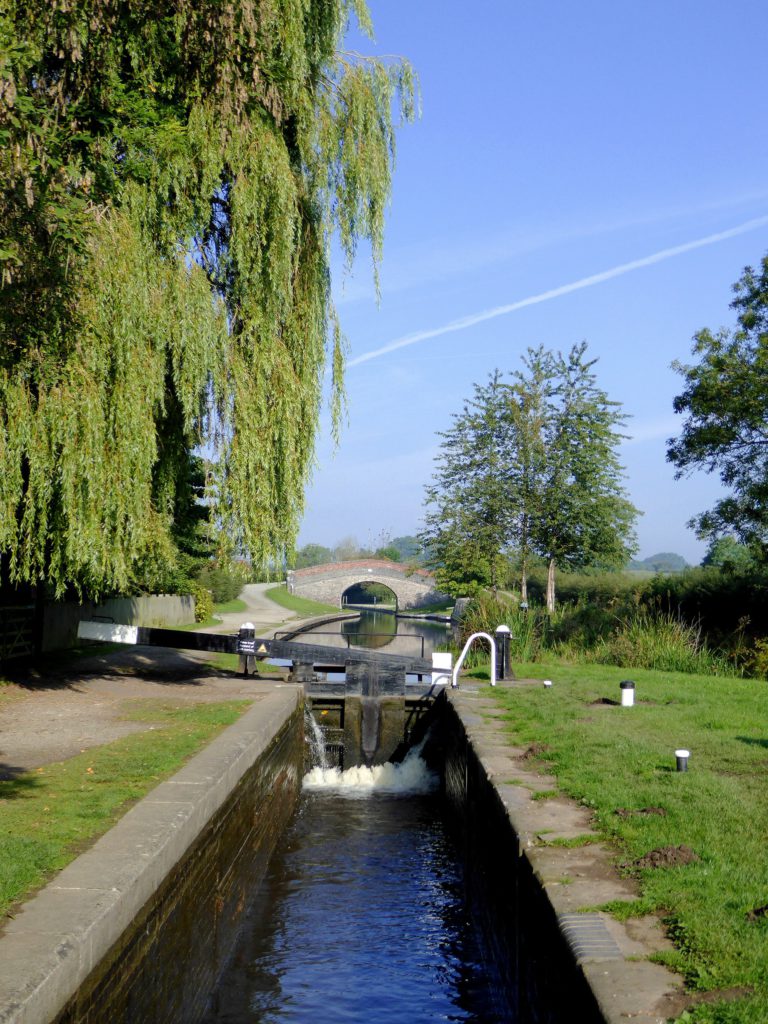
Never married, Telford’s time was almost totally devoted to his work and therefore – as some claim – lacked the emotional peaks and troughs that accompany most lives. But to delve deeper is, as so often, to reveal a more complex tapestry – a lover of poetry and wild landscapes, a loyal and devoted friend, an engineer who rose to international fame but never lost a deep affection for his native Scotland.
He was born in a mud-walled cottage at Glendinning in Eskdale, an isolated valley in Scottish Border country about 20 miles north of Gretna Green. It is gentle country by Scottish standards, more rural idyll than highland drama, with rich green hills sweeping down to valley floors and sparkling streams feeding the River Esk. But the idyll was accompanied by tragedy: his mother Janet had lost a previous baby Tom, and before the year was out her husband, “a blameless shepherd”, also died. Left penniless, she faced a long hard struggle with enormous fortitude, overcoming problems that would have destroyed lesser spirits. It seems that her second baby Tom, destined to become an engineer of legendary determination, inherited a generous assortment of genes from his mother.
Unfortunately Tom’s entry into the world took place in a greatly diminished Scotland. It was only fifty years since the Act of Union, and only twelve since Bonnie Prince Charlie’s Jacobite army took Edinburgh and marched as far south as Derby – a profoundly unnerving crisis for the London government. Although subsequent retribution, swift and brutal, was principally aimed at the Highlanders and their clan system, a continuing air of crisis and uncertainty in Scotland reduced the chances that her citizens would feel much improvement in their lives, at least in the short term.
In any case there was a longstanding problem with Scottish infrastructure. The road network was worse than that in England, the land more sterile, the people poorer. Travel by land, always difficult, was often impossible in winter. The remarkable improvements in roads, bridges, buildings, and agriculture that took place in the following 100 years became the main drivers of economic and social progress; but at the time of Janet’s bereavement in 1757, that was all for the future – a future to which her infant son would make an outstanding contribution.
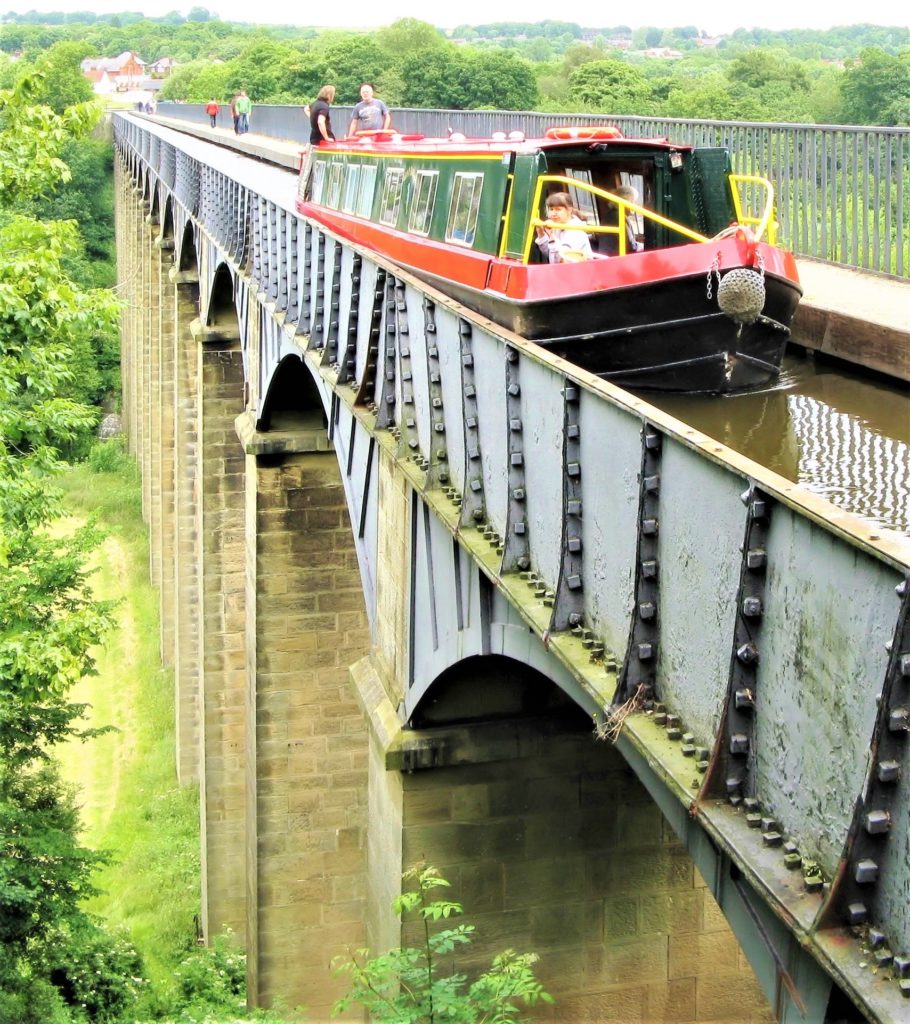 It seems extraordinary that Thomas Telford could rise from such humble beginnings to become one of the world’s greatest engineers. His formal education started and ended at the village school in Eskdale, and his subsequent advance was almost entirely his own affair: apprenticeship to a local stonemason; a spell in Edinburgh as a journeyman mason; a flight to London where he worked on Somerset House, then rising on The Strand; a year in Portsmouth building a house for the Commissioner of the Naval Dockyard; and then a move to Shrewsbury where he became County Surveyor for Shropshire. He was on the up and up.
In 1793 Telford was appointed principal engineer to the Ellesmere Canal (now the Llangollen Canal) in North Wales. He had absolutely no experience of canal engineering, yet dared to propose a revolutionary design for the Ellesmere’s greatest challenge – the magnificent Pontcysyllte Aqueduct over the River Dee near Llangollen. An 11-mile section of the canal, with the aqueduct as its centrepiece, has recently been granted UNESCO World Heritage status, putting it in the company of such international icons as the Taj Mahal, the Statue of Liberty, and the Tower of London.
I have tried to tell a personal as well as a professional story, putting Telford’s life and work up to the time when he became a famous canal engineer into its historical and social context. Today there is great interest in Britain’s transport infrastructure and the 19th-century engineers who did so much to pioneer and improve it. We owe a great deal to Telford and others for creations that have stood the test of time, built with courage and daring in an age when major construction projects relied heavily on pickaxes, wheelbarrows, and an extraordinary amount of hard physical labour.
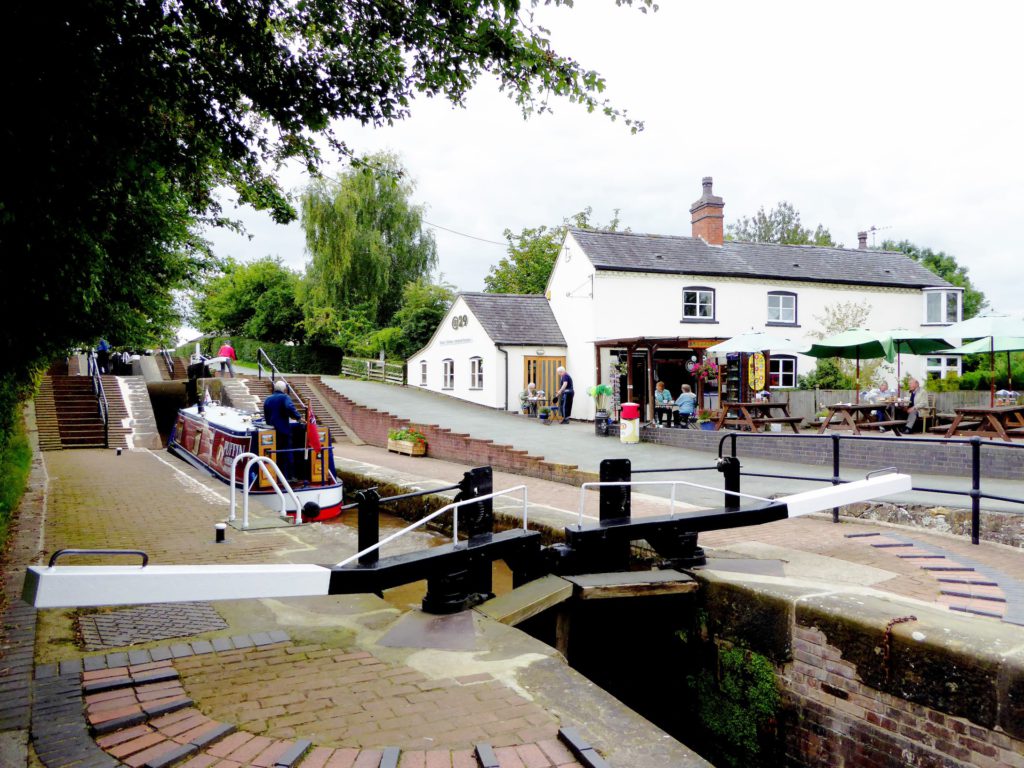
World Heritage Canal: Thomas Telford and the Pontcysyllte Aqueduct by Paul A. Lynn is published by Whittles Publishing, priced £16.99
Claire Wingfield’s debut novel explores how we get our sense of belonging. She tells BooksfromScotland why Berlin matters to both her, as a writer, and her main character, Francesca Maier.
Saving Francesca Maier
By Claire Wingfield
Published by Off The Press Books
A week after graduating from my English degree, I was browsing Cambridge University careers office when I came across a tiny advert for a publishing traineeship in Germany. A week after that, I moved into the first of three buildings I was to live in during two years in Berlin.
There was an exhilarating freedom to my time in Berlin as a young graduate, and an intensity to each day I explored the city. Soon, I dreamed in German and this splitting of self – the intoxicating possibility of a new identity in a country I had moved to knowing no-one – formed the seed of Saving Francesca Maier. The city provoked transformation and so it seemed natural to pick a central character on the cusp of transformation as a young girl and show the city through her eyes.
On holiday visiting her parents’ old friends in Berlin, Francesca soon finds the strained behaviour of the adults conceals secrets that span decades. She grapples with the German part of her identity – barely thought of until now.
‘Francesca wonders what her mother would be like if she’d stayed here for all those years, as Anja has done. That’s weird, of course, because it means she, Francesca, would have been brought up in Germany, like these children. She’d be a completely different person. The British side of her personality would be the one that would be hidden, the side that would be submerged. How strange that would be. There’s no way the two sides could ever be balanced – unless she spent half of every year in one country, and half in the other. But she’d have to rotate the seasons too – it wouldn’t seem fair to always spend Christmas or summer in the same country, so it would have to go in a strange pattern, a bit like crop rotation. It makes her head spin just to think about it.’
This other world brings Francesca into contact with a set of characters she would never ordinarily have met. It’s a crossing of social divide I’m continuing to explore in the second novel in the series, which sees one of the German characters come to Edinburgh as an au pair, becoming embroiled in the secrets of the family she works for and caught up in their outrageous demands of her.
Saving Francesca Maier is framed by two terror scares. Whilst the characters aren’t directly caught up in an attack, I wanted to explore how living in a volatile world impacts their choices. Berlin is a city to get lost in, another world that is intoxicating in its pull and yet in a moment can transform into something far less hospitable.
Francesca rejects the idea of herself as a tourist although at times she and her family are guilty of treating the people they meet there as disposable – something their status as tourists allows.
‘”I thought you’d like it. Hardly anyone knows about it,” says Antonio, scrambling to stand beside Francesca. “Just something to add to your tourist’s experience. Not many tourists get to see this, though. Not many tourists get to be shown around by me.”
“I’m not just a tourist, Antonio,” Francesca almost yells, surprised at how angry she is. “I am half German, you know. Is that what you think I am? Just a tourist?”
“You’re not planning on staying, are you? You are just visiting, aren’t you?”
It sounds so coolly logical when Antonio says it, and yet Francesca feels so bound up in the strange things she’s found here, and the people she’s met, that she wants to be as far away from Antonio’s words and the feelings they provoke in her as possible. She stalks to the other side of the mound and sits down sullenly with her back to Antonio and her face in her hands. Antonio watches her without moving, lights a cigarette and sits on the grass, looking at the view over East Berlin.
“My house – is over there,” he shouts across at Francesca, pointing towards an indefinable clump of buildings in the distance.
“Your friends’ house – is over there,” he calls, pointing in the opposite direction.
“Templehof airport. You see it? – is over there.”
“The lake at Wannsee – you can’t see it. But it would be over there,” says Antonio, pointing West.
Silence.
“My uncle’s bar – is over there,” says Antonio, gesturing in the distance.
“Ok, I give in – I want to see what you brought me to see,” says Francesca, wondering how long Antonio could cheerfully troop through the sights with no response from her.
“You sure?” he grins. “There’s more.”
“I’m sure,” says Francesca, pulling Antonio to his feet. He keeps hold of her hand as they move to inspect the entrance to the old bunker, a set of stone stairs descending deep underground.’
Saving Francesca Maier by Claire Wingfield is published by Off The Press Books, priced £7.99
Sara Sheridan’s fiction has always highlighted her fascination with uncovering forgotten women in history. Now, her latest book brings those women to every corner of Scotland. Kristian Kerr takes a trip through this alternative nation.
Where are the Women? A Guide to an Imagined Scotland
By Sara Sheridan
Published by Historic Environment Scotland
SCOTLAND – a version of the present day. Arthur has been unseated and Triduana has taken his place. Her mountain is girt by the Livesey Crags, named after Doris Livesey Reynolds, geologist and the first woman elected to be Fellow of the Royal Society of Edinburgh. The one o’clock gun has been silenced, and every day at the Scottish Parliament an MSP presides over a ceremony to commemorate the life of a woman who fostered political change. The Mother’s Monument to all women who died in childbirth has stood in Glasgow’s necropolis since the 1970s, inscribed with the words ‘our foremothers, our heroines’; in Dundee an architecturally striking new museum stands on the docks, it is the Museum of Misogyny because that is a thing of the past.
This is the country as imagined by writer Sara Sheridan, in her new book Where are the Women: A Guide to an Imagined Scotland. It propels its reader into a powerful counterfactual thought experiment, one that asks what it might be like to live in a world that honours women’s achievements in its toponymy and memorializing practices.
Sheridan herself honours the work of American feminist and environmental writer Rebecca Solnit, who relabelled the Manhattan Transit Authority map, naming all its subway stations after women, and turned the five boroughs pink. In the essay that accompanied this radical female topography, Solnit pondered life in this alternate universe, writing, ‘I can’t imagine how I might have conceived of myself and my possibilities if, in my formative years, I had moved through a city where most things were named after women.’ Sheridan asks this question on Scottish ground and invites her reader on a tour of the country, to imagine and experience it for themselves. Bestriding fact and fiction, this Scotland is a place that memorialises its great women in a public and permanent manner. She calls the book a ‘provocation’, it is certainly that. But it is also a call to action and a vision of hope for the future.
It takes the form of a guidebook, making us tourists in this uncanny land. Women’s names are inscribed on familiar cityscapes and well-known landmarks. Neptune’s Staircase has been renamed for Salacia, Roman goddess of saltwater, and individual locks take the names of Highland women writers, celebrating the local. The reader will learn much from the lives and works that are named in these pages.
In the capital, where the memorialisation of men’s national accomplishments is most intense, St Andrew Square has been replanted in green, white and purple, transforming it into Suffragette Square. It is adorned with statues of individuals who fought for the vote or worked to advance the cause: Bessie Watson the child piper, Anna Gillies Macdonald Munro, sisters Flora & Rosaline Mason and Margaret Sackville. The new Square commemorates collective action and the deeds of outstanding individuals simultaneously, reflecting the contribution of each and raising both as inspirational examples.
Both square and staircase are places of the imagination, but realising such a scheme would (and should) not be beyond the realm of possibility. Indeed, a strange effect of this book is that, though phantom monuments are marked with a ghost-shaped asterisk, it can sometimes be difficult to catch the exact moment when reality gives way to imagination, and vice versa. While this can be disorientating, it also testifies to the force of the idea driving the book: much of what Sheridan envisions is eminently plausible.
There is wry humour here too. The towering gothic spire of Walter Scott’s Monument has been replaced by the graceful curve of Susan Ferrier’s Arch. Ferrier, whose bicentenary was memorialised in 2018 by Val McDermid’s sound and light show Message from the Skies, was the author of three novels Marriage (1810), The Inheritance (1824), and Destiny (1831). Sheridan has selected the last of these for her re-christening of Waverley Station and remarks that the name has ‘prompt[ed] a thousand jokes about “getting off the train at your destiny”.’ A crucial element of the book is her imagining of the life of this re-gendered Scotland. She brings her novelist’s craft to the book: people live here, they engage with their past and take its examples forward into the future.
On reading Where are the Women? you might start to think that life in this world might be a bit crowded, that there might be so much memorialising going on that it would be impossible to move without brushing up against a plaque or cairn or stumbling across a poetry reading, commemorative concert or lightshow. There can be no doubt that project adds to the built environment and increases cultural activity while it reorientates it. To those who would say ‘there’s no space for this’ this book serves as a reminder that lots of space has been designated, and buildings, statues, monuments, and plaques have been raised to men. To read it is to have your eyes opened, not only to the one-sidedness of the environment that we have built and named, but also to the possibilities for improvement that lie within easy reach.
A distinction exists between urban and rural Scotland, though. To test the power and the bounds of the imagined Scotland I took Where are the Women? with me on a long, looping journey across Scotland, from Edinburgh to the Uists and Barra, returning via Oban and through the Trossachs. I learned a huge amount and found the landscape re-peopled and suddenly brimming with stories. However, I found that once I moved beyond the towns and cities, places which were built and named coextensively with the industrial capitalist revolution, I travelled through a landscape mostly named after its own natural features. Surroundings become more neutral, or even feminine. The need for polemic, for thoroughgoing iconoclasm, seemed less severe.
In South Uist, a landscape overlooked by Hew Lorimer’s granite Bana Thighearna nan Eilean (Our Lady of the Isles), I stopped at Flora Macdonald’s birthplace, which is signposted and memorialised by a cairn, and visited the nearby Kildonan Museum. Flora Macdonald, perhaps like Mary Queen of Scots, is a special case, but the museum tells her story in a powerful, balanced and conscientious manner. Gender is integral to story of the fugitive Charles Edward’s escape to Skye, Raasay, and thence to safety in France. One of the first things you see is a fabulous modern portrait of Bonnie Prince Charlie in costume as Flora’s female servant, and the interpretation panels deliberately recognise Neil MacEachern’s pivotal role in the scheme, one which was deliberately downplayed at the time in order to protect his activities as a Jacobite spy.
Furthermore, at Kildonan a ‘Future Curators’ programme, which sees high-school pupils working at the museum, was operating. It may have been pure coincidence that it was only women leading that day, but I observed some very accomplished young women telling the story of their island to a group of boys. One of the dangers of a provocative polemic is that its pursuit of its own radical agenda can tend to brush aside the progress already under way. Kildonan has its own thorough entry in the guide, but a display about the South Uist bards (male) is reworked into a display about women who contributed to the Gaelic tradition through teaching, recording, preserving and storytelling: Peggy McClements, Ella Carmichael and her mother Mary Carmichael, and sisters Marion Campbell and Catriona Macdonald. These women should absolutely be named and memorialised, yet I was left with the feeling that the museum had been in some way criticised, its efforts discounted, for not being completely perfect. I felt fiercely protective of the all-female staff and young curators I met there. I don’t doubt that Sheridan herself would too. This is one of the pitfalls of transformative discourse: it ruffles feathers, even feathers belonging to birds of the same species.
There have been a number of projects in recent years that have rebalanced the scales of historical representation, moving away from conceptions of history as the great actions of great men, they have attempted to insert women’s stories into the story Scotland tells about itself. Academic specialisms have emerged, much archival work is being undertaken but, as Sheridan notes, these stories need to go mainstream, they need to be permanently and publicly installed into the national story. Glasgow Women’s Library is curating an impressive and accessible archive; Rosemary Goring’s recent anthology Scotland: Her Story and the Great Tapestry of Scotland have begun to make women’s contributions to the broad sweep of Scotland’s history more visible. Where are the Women? does the same for our public spaces, work that is all the more vital because it is so visible. Sheridan’s imagined Scotland is a place that doesn’t and (most likely) will never exist, as she acknowledges in her prefatory essay. It is, however, a fascinating place to visit and from which to imagine a more equal world.
Where are the Women? A Guide to an Imagined Scotland by Sara Sheridan is published by Historic Environment Scotland, priced £16.99
Denise Mina is one of Scotland’s best writers, and with her latest novel, Conviction, she continues to bring fresh and innovative ideas to storytelling. Lee Randall catches up with her to talk about pushing boundaries.
Conviction
By Denise Mina
Published by Harvill Secker
Some people are human batteries: they fizz you up, energising, and inspiring you to approach the world with an inquiring, open mind. You want to be around them all the time. Denise Mina is one of those people.
One recent Saturday we spent a few hours setting the world to rights and talking crime fiction. A fortnight earlier, Elif Shafak had included Mina in a list of the UK’s ten most exciting female writers, saying, ‘Their words heal wounds, old and new. Their stories help us to understand not only other people’s pain and anger and resilience, but also our own. . . . They re-humanise those who have been dehumanised.’
That’s not a bad description of Mina’s new novel, Conviction.
Her protagonist, Anna McDonald, has slammed—and bolted—the door on her traumatic past, reinventing herself as the wife of a wealthy, older man, and mother to two young girls. Anna’s world feels safe and secure—until her husband announces he’s leaving Anna for her best friend and taking their daughters with him.
Anna, a podcast fan (‘A good podcast can add a glorious multi-world texture to anything.’), displaces her emotions by disappearing into a true crime story. Realising she knew one of the victims in another life, she’s convinced she can figure out what happened, and sets out to prove it.
Denise Mina also loves podcasts. She’s been enthusing about them for years, and it feels right and inevitable that she’d invent one for her novel. For those slower to embrace the form, can she describe their attraction?
‘Because it’s auditory, it feels like a very intimate connection,’ she says, ‘like someone is whispering in your ear and you’re the only audience member. It’s a really intense experience, and a unique form of storytelling. It’s like watching fiction being invented.’
Interesting, that. I recall her saying that narrative is more compelling than facts, and a better way to disseminate ideas.
‘That’s the whole reason I started writing fiction. It’s called the narrative paradigm, the idea that, for example, Jesus isn’t mentioned until 400 years after the birth of Christianity. It was just a failing sect, then someone invented a central character and it took off. It’s that powerful.’
Speaking of Conviction she expands, ‘It’s a way of using emotive narrative to have a central character who is a survivor of sexual abuse and isn’t pathetic. Of having someone who has been in a mental hospital and doesn’t need helped all the time because they’re broken—they’re just another person. I’m very conscious that we don’t have representation of a lot of the people that I think are heroic.’
A plot element of the novel, written at the height of #MeToo, is a sexual attack. Mina uses it to explore victim blaming, the disturbing belief that there are ‘right’ and ‘wrong’ sorts of victims, and the idea that an attack needn’t become the central fact of a survivor’s life.
‘It goes back to the Judeo-Christian idea that sex is for procreation, and if a woman is sexed in a certain way then she is ruined, so that must be the thing that you know about her. It may well be the central fact of her life, and it may form her identity, but we shouldn’t only ever speak about people in that way.’
Silence and secrecy are important themes of the novel, and Mina tells me this reflects her concern for women’s safety. ‘At the start of #MeToo, a very powerful woman came out. In the second wave, it was less powerful women saying, “I’ve been sexually abused by extremely powerful people.” A thirteen-year-old said Trump had sexually abused her. The whole Jeffrey Epstein thing. The [accused] are really powerful people, and we need to form a feminist army if we’re going to keep these women safe.
‘We’re all quite damaged from our experiences. These women feel very unprotected to me. It reminds me of the civil rights movement, when black children were sent into schools with no black teachers, to change the world. I heard a podcast of a woman saying her mom absolutely hated white people. She had been one of the girls sent into Little Rock. She was spat at every day through high school. You think, why didn’t we integrate schools at board level? Why didn’t we integrate teachers first? It feels like we’re not protecting people who are speaking out.
‘The question is, are you safer out, or hiding? It’s such an interesting thing in our culture—which is such an open culture—to choose not to talk about stuff. What do we make of people who don’t tell?’
Mina says a lot of this book is about Donald Trump. ‘I’m really interested in Melania. What the fuck is going on in her head? I don’t think she is a nice person. But you never hear from the trophy wife. It’s a good place to hide. [I like] the idea that he might be burbling on and she has a thought process: “You fucking dreary twat.”’
This novel, purportedly written by Anna, is her finally telling the truth, ‘writing a whole book about it for you to read.’ I mention that an early review described Anna as a ‘strong female protagonist,’ a phrase guaranteed to make me snarl. Does it annoy Mina?
‘You wouldn’t believe the atmosphere when Garnethill came out! Everyone commented on the fact that the protagonist was female. The only advice I got from my publisher was “don’t mention feminism.” It was so out of fashion. I used to say, “You know the feminists that everyone hates, the scary ones—that’s the kind I am.”
‘I’d give the same interview all the time, which mentioned central characters, narrative paradigm, Stanley Fish, point-of-viewlessness. I’d talk about all this stuff, and the interview would come out and say, “sprightly mother of two, how does she do it all, how does she get her laundry done?”’
That’s ironic, since discussions about Tartan Noir always highlight its social commentary.
‘That’s now. They talk about the social commentary but not the politics. For some of us, that’s the only reason we’re writing—and the reason we’re writing crime, because you want to talk to that audience. You want to put it in a story and say, “Isn’t it wrong that people die of cold?” That’s exactly what Dickens was doing. He never came up with solutions, he observed, so there’s a humanity and humility to what he’s talking about.
‘I think there is a churlishness about crime fiction being important. It’s important because lots of people read it, because we’re saturated with those stories, because it does talk about politics. Inevitably, it talks about politics. And the audience know long before the commentators know.’
She’s curious to see how Conviction, which plays with narrative conventions, will be received. ‘People [in the UK] feel tricked by the notion of a meta-novel talking about the nature of narrative. When I wrote Sanctum, which is a discovered diary, people felt tricked, and that it’s not the place of crime novels to do that.’
Then where is the place, and where do we draw a line—if a line exists—between crime fiction and literary fiction?
‘I don’t think there is a line,’ she says, ‘but there is a marketing distinction. It’s quite random. If your first book is a crime book you’re always a crime writer. Dostoyevsky would be a crime writer now.’
Well, surely so would Dickens, Shakespeare, and a host of others. Crime features in many an acknowledged literary masterpiece.
Mina agrees. ‘We went to see Romeo and Juliet the other night—that’s a crime story about gangs. I think the promise of crime fiction is that you can enjoy this, and the promise of literature is you may be improved by this. I suppose it’s what the coded signalling is: what does it mean? With crime fiction, if you don’t entertain people, if you bore them, they’re very angry about it.
‘But I think the trick of saying crime fiction isn’t as important, and isn’t talking about important things, is part of what makes crime fiction keep being crime fiction. Because people do read it with a sense of entitlement, and stop if they’re not enjoying it. Again, the resistance to admitting that is what makes the British—particularly reviewers—resent tricksy crime novels. Novels that talk about the fact that it’s a narrative. I think the audiences are much more amenable to that than reviewers are. Or maybe the audiences aren’t? Well, we’ll find out when this book comes out.’
Having succumbed to the story’s momentum, inhaling Conviction in one breathless sitting, I have no qualms about predicting that readers will love it.
Conviction by Denise Mina is published by Harvill Secker, priced £14.99
There has been a real upsurge of late in fiction set on Scotland’s islands. David Robinson looks at two recent novels using Shetland as their setting.
The Valley at the Centre of the World
By Malachy Tallack
Published by Canongate
macCloud Falls
By Robert Alan Jamieson
Published by Luath Press
When poet and novelist Robert Alan Jamieson was growing up in Sandness, a scattered community on the west coast of mainland Shetland, two elderly brothers and their two sisters used to live nearby in a rather unkempt croft. Its doors were often open for animals to wander in, and a single electric lightbulb was one of their rare concessions to modernity. They were kind people, always ready to donate when he came round collecting for charity. Yet when the last of them died, the people clearing the house found a stash of uncashed pension dockets.
Jamieson tells the story in Susan Kemp’s beautifully elegiac 2014 film Nort Atlantik Drift, which is based on his poetry book of the same name and which he made on a visit to the island to bury his father. His neighbours’ house is now roofless and crumbling, but that is hardly unusual. In the film, he points out two photos of the land round Grobsness, where his wife came from, that his father commissioned as a first wedding anniversary present. They show curls of smoke drifting up from crofts’ chimneys, roofs neatly thatched or tiled, the land ordered, marked, fenced, and working. Now those roofs, too, are gone, the house walls are crumbling, and the land has emptied of people.
I found myself thinking of Kemp’s film while reading Malachy Tallack’s debut novel The Valley at the Centre of the World, which has recently come out in paperback from Canongate. While its story is entirely fictional, it too is set on the west coast of mainland Shetland, in a valley of crofts that is now far less populous than it used to be.
Tallack’s novel is true enough to real life to spell out the inevitability of all this. Supermarkets are always going to kill off the village shop. Teens are always going to want to mess around on social media rather than hoeing the vegetable patch or mucking out the lambing shed. When they finish school, they’re always going to want the bright lights and the big city. As the old song (almost) says, How you gonna keep ’em down on the croft?
But what I want to look at here is the other side of that; at belonging rather than loss. Remember those Sandness siblings who didn’t cash their pensions? Mightn’t it have been in part because they already had what they wanted in their lives? And that first anniversary wedding present: what more loving one could there be than a photo of the landscape where your wife spent her childhood?
It’s a cliché of book reviewing to talk about a sense of place being so strong that it’s almost another character. Often, that’s an empty phrase and just means a description that might roughly square with Google Maps. But both Tallack – and, come to that, Jamieson himself in his excellent novel macCloud Falls, largely set in the wilds of British Columbia – need, for the purposes of their fiction, to make the land and its people far more central than that. And the challenge is real enough: how do you express that visceral love of even an unforgiving landscape so that it offers a credible counterbalance to the obvious appeal of an easier, more comfortable way of life? That’s a tough one, because unless you do, there’s no inherent tension, and yet the characters who love the land the most might well be the worst at actually expressing it.
In Tallack’s novel, the man who has to make that particular case is David, a father of two grown-up daughters who have now left home to live in Edinburgh and Lerwick. He was himself born in the valley, and he cannot bear the thought of it emptying.
Tallack does everything he can to dispel any notion that there is anything remotely idyllic about life in the valley: the work is occasionally bloody and invariably backbreaking, the wind is always “clawing” at one’s face, and the rain tends towards the horizontal. In such a cold, unforgiving land, flowers get shredded by the wind, and even when a lamb dies (eyes pecked out by birds, naturally) it is hard to find soil deep enough to bury it. For all that, though, the valley is fundamental to David’s whole life. It shapes his thoughts: “The slope of it, the tender fold of the land. Somehow it was mirrored inside him. It was part of him, and he could no more leave this place than he could become someone else.”
Now I should add that there is far more to Tallack’s book than this, but the depth of its attentiveness to the landscape is one of the things that most impressed me about it. And I could say exactly the same about Jamieson’s own latest novel, even though it also tacks on the even bigger themes of love, death and history.
In macCloud Falls, Jamieson follows an Edinburgh antiquarian bookseller recovering from cancer on what he reckons will be the last big trip of his life – following, about a century on, in the footsteps of a Shetlander called James Lyle, who settled in British Columbia, married a Nlaka’pamux woman, and became a key figure in explaining First Nations culture to western Canada.
Here, historical truth weaves in and out of fiction. Lyle is heavily based on James Teit (Teit and Lyle, geddit?), who was born in Lerwick in 1864 and who did indeed become a significant ethnographer. As he tracks down Lyle, the bookseller shows the reader exactly how the British Columbian valley in which Teit and Lyle both settled has changed too, how the colonists planted orchards and built stores and railways but also took away the land rights of its indigenous inhabitants.
But how effective can fiction ever be in showing the landscape as a palimpsest going all the way back to that time before the colonists came? Can we understand what being edged off the land meant to the First Nations “in this great wilderness where human beings held the littlest hold on the space they had cleared for themselves”?
That’s one of the challenges Jamieson has set himself, but he is well able for it, and there’s another scene in Kemp’s Nort Atlantik Drift film that shows just why. In it, Jamieson remembers how his grandmother used to complain that her own mother used words in the Shetland dialect that had fallen out of use in just a single generation. The tribal world of the remote BC valleys hasn’t quite gone, no more than Shetland dialect has, but Jamieson makes them both flourish again, the first in his novel, the second in his poetry. The fictional valley he is exploring in British Columbia, like the fictional one Tallack explores in Shetland, may be at the centre of a slowly vanishing world, but it is one that both authors make profoundly real.
The Valley at the Centre of the World by Malachy Tallack is published by Canongate, priced £8.99
macCloud Falls by Robert Alan Jamieson is published by Luath Press, priced £9.99
What do think of when you think of stars? A-list celebrities or the immensity of the universe? Charlie Laidlaw’s latest novel combines family drama with different ways of being starstruck. Let BooksfromScotland introduce you to narrator, Emma Maria Rossini.
Extract taken from The Space Between Time
By Charlie Laidlaw
Published by Accent Press
Dad had looked pretty dead on the screen. The blood on his chest had looked pretty real. If it had been a different dead person, I would have been OK. Children don’t really know where make-believe ends and the real world begins and, partly because of who I am, it’s remained pretty hazy ever since. I also don’t like to remember that film because it was the moment when I realised that our lives were about to change, and I didn’t know if that would be a good thing.
Sounds strange, yes? Here’s something stranger: I am a child of the sea, I sometimes think, and have done ever since we first moved to live beside it. I feel subject to its vagaries and tempers, with its foaming margins framed against a towering sky. I am familiar with its unchanging mood swings. That’s how I like things; I find the familiar comforting. I find change threatening.
I am the daughter of someone who, not long after that ghastly cinema outing, became one of the most famous actors of his generation and, importantly for me, the granddaughter of a rather brilliant but obscure physics professor. But despite their overachievements, I have inherited no aptitude for mathematics and my father positively hated the idea of his only offspring following in his thespian footsteps. He knew how cruel and badly paid the profession could be. But I still look up to my grandfather, and think of his ludicrous moustache with affection.
Gramps once told me that there are more stars in the universe than grains of sand on Earth. Just think of all those sandpits, beaches and deserts! That’s an awful lot of stars. He then told me, his only grandchild, that I was his shining star, which was a nice thing to say and why I remember him talking about sand and stars. On clear nights, with stars twinkling, I often think about him.
I still believe in my grandfather, and admire his stoic acceptance in the face of professional disdain, because I believe in the unique power of ideas, right or wrong, and that it’s our thoughts that shape our existence. We are who we believe ourselves to be.
I gave up believing in my father long ago, because speaking other people’s words and ideas seemed like a lame excuse for a job, even if he was paid millions, and met the Queen on several occasions. She must have liked him because she awarded him an OBE for services to film, theatre and charity. Charity! Who the hell told the Queen that?
I stopped believing in him one Christmas Day, a long time ago, when he simply didn’t turn up. It wasn’t his presents that I missed, or even his presence, but the warm, fuzzy feeling of being important to him. During that day of absence and loss I concluded that his wife and daughter couldn’t much matter to him, otherwise he’d have made a bigger effort to get home. That Christmas Day, my father was simply somewhere else, probably in a bar, immaculately dressed, his hair slicked back, the object of male envy and the centre of every woman’s attention for miles around.
In that respect, Dad was more tomcat than father, except that by then his territory, his fame, stretched around the globe. I know this: by then he had a Golden Globe to prove it. He gushed pheromones from every pore, squirting attraction in every direction, and even women with a poor sense of smell could sniff him out.
I feel mostly Scottish, but am a little bit Italian. It explains my name, Emma Maria Rossini; my dark complexion, black hair, the slightly long nose, and thin and lanky body. Obese I am not, and will never be, however much pasta I eat, and I eat lots. It also explains my temper, according to some people, although I don’t agree with them, and my brown cow’s eyes, as an almost-boyfriend once described them, thinking he was paying me a compliment, before realising that he had just become an ex-almost-boyfriend.
But mostly I am a child of the sea. That’s what happens if you live for long enough by its margins: it becomes a part of you; its mood echoing your mood, until you know what it’s thinking, and it knows everything about you. That’s what it feels like when I contemplate its tensile strength and infinite capacity for change. On calm flat days in North Berwick, with small dinghies marooned on the glassy water, and loud children squealing in its shallows, it can make me anxious and cranky.
The sea, on those days, seems soulless and tired, bereft of spirit. But on wilder days, the beach deserted, or with only a hardy dog-walker venturing across the sand, with large waves thundering in, broaching and breaking, then greedily sucking back pebbles into the foam, I feel energised: this is what the sea enjoys, a roaring irresponsibility, and I share in its pleasure. We are all children of the sea, I sometimes think, or we should be – even those who have never seen an ocean or tasted its saltiness; I can stand for hours and contemplate its far horizons, lost within myself, sharing its passion. In the Firth of Forth is the ebb and flow of my past and my existence, wrapped tight against the west wind. It is what I am, placid and calm, or loud and brash.
I still hear the sea, the shush of waves and the screech of seabirds, in the Edinburgh flat where I now live. Children of the sea are like that; it’s in our blood, coursing through our veins; it reminds us where we came from, where we were born, and tells us without compassion that it will still be around long after we have gone.
The Space Between Time by Charlie Laidlaw is published by Accent Press, priced £8.99
As part of our Translation as Conversation strand of articles this year in association with A Year of Conversation, BooksfromScotland got in touch with Kay Farrell, editor at Sandstone Press. She acquired and edited Celestial Bodies by Jokha Alharthi, which has just been shortlisted for the Man Booker International Prize. We spoke to Kay about the story of its english-language publication.
Celestial Bodies
By Jokha Alharthi
Published by Sandstone Press
Firstly, can you tell us a little bit about Celestial Bodies?
Celestial Bodies initially tells the story of three sisters living in a small village in Oman. From this starting point it sprawls out to talk about their families, families connected with theirs and a transitional period in Omani history, drawing an intimate portrait of a culture undergoing rapid change. It’s ambitious and sweeping, complex and beautiful.
Why did you want to acquire this book?
When I first read Celestial Bodies, I was struck by how different it was from anything else I’d read at the time. It’s dense and perhaps best seen as a fable, where the prose is injected with poetry, philosophy and history throughout but has at its heart the relationships between people. By shifting the point of view, Alharthi enables us to understand not only why a character acts or feels as they do but also the impact it has on others. The chapters add layers to each character so that the reader’s understanding of their personalities shift and change as we encounter another facet of them. I found I was constantly adjusting my opinions of particular figures but understanding their problems and triumphs made both their actions and reactions more plausible and relatable. There is such a strong sense of a culture outside of time combined with a traditional storytelling sensibility that there’s quite a sense of displacement when signs of modern life start appearing which I think mirrors the way it must have felt to live through this time superbly. It’s all so elegantly done that I just fell in love and practically begged to acquire it!
Working with a translator adds an additional layer to the publishing process – how was working with the author and the translator?
Working with two people rather than one does add a level of complexity, but Jokha and Marilyn had worked together already and developed a good rapport, which meant they were largely in agreement and had some clear ideas of how they wanted the English language version to be. That meant that most of the discussion was on the finer details. Celestial Bodies includes quite a few Arabic terms so a lot of discussion focused on use of vocabulary, how much to explain in the text and so on. I think it helped a lot that I was very unfamiliar with the Arab world in general and Oman in particular, as it enabled me to stand in for readers in a similar position.
Working with a book from another culture is always a learning experience – what was the most interesting thing you learnt about Oman while working on Celestial Bodies?
There are lots of really lovely details in the book, from the hot stones wrapped in fabric to preserve a young mothers’ figure to the belief in curses which led to Merchant Sulayman having his head burnt as a child. What has stayed with me, however, is discovering that slavery was legal in Oman until 1970. There are some really harrowing details in the book about the situation of slaves and the stigma which followed their descendants even after abolition. I think it’s important to confront such topics: in the West we like to think slavery is in the dim and distant past but that’s simply not true.
Which character from the book would you most like to have dinner with?
Zarifa, definitely. To me she’s one of the most interesting characters. A slave in Merchant Sulayman’s house, she raised Abdallah and became almost a stand-in wife for Sulayman. She has a strong personality and is fascinating to read about, as her station means that she’s not faced with the same expectations as other female characters. She’s fierce and loving throughout and definitely knows more than she tells the other characters. I’d like to ask her a lot of questions!
How does it feel to have a book you’ve edited shortlisted for the Man Booker?
I may have screamed and danced a bit when I heard! The original Arabic edition had already won prizes, of course, so we hoped but you can never be sure. When I met Jokha back in August last year she was really sincere in thanking Sandstone for taking a chance on her work and I’m so pleased that it’s being recognised in this way. When you’re an editor all you really want is for the author to have enjoyed working with you and for others to see what you saw in the text. So this is fantastic!
Celestial Bodies by Jokha Alharthi is published by Sandstone Press, priced £8.99
Find out more about A Year of Conversation at www.ayearofconversation.com (#AYOC2019)
With the latest in the Tigeropolis series published in mid April, author R D Dikstra explains why he started writing the series and how he came to write about a family of vegetarian tigers living in the foothills of the Himalayas.
Tigeropolis – Caught in the Trap
By R D Dikstra
Published by Belle Kids
I’ve been involved in conservation for years. I was inspired to write the series during a survey of what was happening in the buffer zones that surround India’s wild tiger reserves.
Tiger reserves are vast – 400-500 sq kms or more. But the numbers of wild tigers are only a fraction (5%) of where they were 100 years ago. Tiger numbers have fallen from about 90,000 in 1900, to only about 3,600 now. Even if you are with experts, it’s often extremely difficult to see them in the wild. However, if you are lucky enough to see one, the experience is truly unforgettable. My first sighting happened after many days of fruitless searching and long after I’d resigned myself to it never happening. It was my last day. It had been a tiring, yet fascinating trip, as we journeyed from park to park, staying, for the most part, far off the beaten track, in old rest houses built to accommodate colonial era District Officers as they inspected the more remote areas of their patch.
We were in Bandhavgarh – one of the more important tiger parks in India. It was already dusk. Just as we were about to leave the park, suddenly, out of the gloom we could just make out something moving in the undergrowth, two hundred metres away. We stopped and waited quietly in our little open-topped jeep.
Slowly, the tiger slid out from its hiding place, briefly sniffed the air, then, cool as you like, walked towards our vehicle. It came within a few metres, looked at us for a moment, then ambled slowly past us on the verge of the dusty track. Twenty metres further on, it turned back, gave us a final glance as it moved towards some bushes and disappeared.
It was only a couple of minutes, but you never forget that first sighting. Black and amber stripes, 200 kgs of muscle and pent-up power. Tigers are undoubtedly magnificent, iconic animals – hard to believe they are under threat.
I knew instantly I wanted to write something about tigers. Yes, there are important issues to address, but I didn’t want something too serious, or ‘all doom and gloom’. I wanted to write something positive; something that would engage children, make them laugh, but also think a bit about the world around them. The Tigeropolis books have an important underlying message about conservation, but, above all, they are meant to be fun.
In Tigeropolis the tigers end up running the show. They outwit bumbling officials, skilfully avoid a maharaja with a score to settle and even fight off a band of notorious poachers, all with the help of burrowing pygmy hogs, a troupe of bungee jumping monkeys, a herd of elephant powered water-cannon and a team of ‘stunt deer’, fresh from filming their latest Bollywood blockbuster. There’s more than a bit of slapstick humour in places, but much of what I write is based on real knowledge of what is happening ‘on the ground’.
Tigers are not just worth saving in their own right, they are also an important ‘flag carrier’ for conservation. They are right at the top of the food chain. If we can help tiger numbers increase, then, almost by definition, a whole eco-system benefits. It’s one of the reasons organisations like WWF place so much emphasis on their Tx2 campaign to double the number of tigers in the wild by 2022, the next Chinese Year of the Tiger.
So, given that tigers have such a key role it’s wonderful to know that tigers also have a special place in the hearts of children. They are simply fascinated with them. Almost without exception, in every school I visit, the children have seen a tiger. It might have been in a zoo, or in a wildlife park, but in each case the memory of their experience is clearly precious to them, and they are always keen to tell you all about it. I’m also really touched by the drawings of tigers I’m sometimes presented with quite spontaneously by a child. In my talks it’s great to be able to draw on all that enthusiasm, explain a bit more how tigers live, and then tell the story of how I came to write my Tigeropolis series about a family of vegetarian tigers running their own tiger park in the foothills of the Himalayas.
I glad to say that the books have been well received leading figures involved in tiger conservation as they recognise that they offer a great way of getting children to think about the world around them. There’s also an audiobook narrated by Oscar-nominee Richard E Grant.
The third book in the Tigeropolis series : Tigeropolis – Caught in the Trap is published by Belle Kids, priced £7.99
www.tigeropolis.co.uk
It always makes us happy at BooksfromScotland when a much-anticipated debut novel is finally released! Damian Barr’s You Will Be Safe Here has been generating buzz for months, and Lee Randall finds that the buzz is more than justified.
You Will Be Safe Here
By Damian Barr
Published by Bloomsbury
Appalled by the death of Raymond Buys, killed in a camp designed to “make men out of boys,” Damian Barr investigated South Africa’s culture of toxic masculinity—all the way back to the Boer War.
His discoveries inspired You Will Be Safe Here. It’s a world away from the classic debut, an autobiographical first novel, rendered unnecessary by his bestselling memoir, Maggie & Me, which told that story beautifully. Thematically, however, they harmonise in obvious and also surprising ways, leading Barr to speculate, “I wonder if every single book I ever write will essentially be about mothers and sons and survival?”
Two short sections bracket the meat and potatoes of his story, which begins in 1901, with the diary of Mrs Sarah van der Watt, who’s keeping the farm ticking over while husband Samuel is away fighting. Sarah has an ear to the ground, aware that the British are coming to turf them out. Her entries are a poignant attempt to stay close to her beloved husband, and to process new experiences as they unfold.
Early entries feel more for our benefit than Samuel’s: Sarah describes things about herself and the marriage that her partner of a decade surely knows. But Barr settles into his stride once the British arrive, remaining confidently in control of the material thereafter.
When Sarah refuses to swear allegiance to Britain, soldiers cart away her furniture, kill the animals and torch the farmhouse and buildings. Barr writes, “Scorched Earth policy was supposedly intended to cut off support to men fighting on commando, but the real aim was to break Boer morale by forcing their women and children onto the open veldt or concentrating them into camps.”
Things go from awful to harrowing in the Bloemfontein Refugee Camp, whose commander says, “You are not prisoners here. You are refugees. We are concentrating you all in camps like this for your own safety and at great expense. . . . Please be assured you will be safe here.”
They are anything but. The novel doesn’t stint on gut-wrenching descriptions, but here, and in later sections, Barr chooses his details judiciously, conveying horror without descending into torture porn.
He excels at depicting psychological abuse, such as the British removing their soap, then calling the increasingly filthy Afrikaners vermin. It’s one of many reminders that when you dehumanise people, when you “other” them, you allow yourself to ignore their suffering—and your culpability.
Like all abusers, the British excel at transferring blame to their victims: “Your husbands have abandoned you and your children forcing us to feed and house you and provide you with the modern medicine and schooling you so obviously lack. All at the expense of the generous British taxpayer.”
Next the action jumps to 1976 Johannesburg, introducing sixteen-year-old Rayna, whose life is upturned by a rape that leaves her pregnant, prompting a hasty marriage before her son’s birth. She also has a daughter with a married lover, but raises the children alone.
Daughter Irma goes on to have a son called Willem, born on the day apartheid ends, who becomes the focus of the book. Softer and more sensitive than other boys, he defies machismo expectations, though whether or not he’s gay—“moffie,” in South African slang—is irrelevant. Barr’s real interest is highlighting the plight of outsiders in a culture of bullies—one of whom is Irma’s new partner, Jan, a security guard with white supremacist leanings.
South Africa changes rapidly in the novel’s second half, when Mandela goes from prison to president. Barr reveals rising anxiety among the white population through an accretion of domestic details, showing them effectively imprisoning themselves. People carry weapons; buy guard dogs; drive short distances, rather than walk; build walls, then equip them with razor wire and electrified gates; and never, ever stop on the road, “even if it’s a cop car. You go somewhere with CCTV and witnesses.”
After an escalating series of confrontations, Jan persuades Irma to send Willem away, bringing us to the third prison of You Will Be Safe Here, the New Dawn Camp, whose chilling motto is “Freedom, Power, Purity.” Here, boys must speak Afrikaans, may not drink, smoke, or use mobile phones. Above all, there must be no outside opinions or independent thinking, for “Information is ammunition.” Conditions here echo the brutality Sarah endured—then worsen.
Anyone unschooled in South African history, or Britain’s tactics during the Boer Wars, will come away from You Will Be Safe Here with the beginnings of an education. While the novel is set in South Africa, and partly in the past, its message is pertinent for every country struggling with identity, with “otherness,” and with the erosion of tolerance and compassion. In other words, all of us, right here, right now.
We have only to look at the rise and rise of the far right, with its roots in the myth of white genocide, to ongoing abuse levelled at the LGBTQ community and the rows about what is and is not fit subject matter for British school children, to the status of women, and at our appalling treatment of immigrants and refugees, to understand that the dangers described in this novel have not been eradicated.
Barr’s potent message is delivered in the smartest way possible, by enmeshing us in the lives of characters we relate to, allowing us to see the world through their eyes.
You Will Be Safe Here by Damian Barr is published by Bloomsbury, priced £16.99
Hundreds of thousands of people walk the pilgrim route of the Camino de Santiago each year seeking physical challenge and spiritual renewal. Church of Scotland minister, Richard Frazer, has made the journey and written about the experience in Travels With a Stick. Here we have an extract where he ponders on Scottish pilgrim routes and the nature of friendship.
Extract from Travels With a Stick: A Pilgrim’s Journey to Santiago de Compostela
By Richard Frazer
Published by Birlinn
Pilgrim routes lead us to places with wonderful stories to share. The Rev. Alexander John Forsyth, parish minister of Belhelvie in Aberdeenshire in the early nineteenth century, was a keen field sportsman but was unhappy with the firing mechanism of his rifle. He had to fill it with gunpowder that invariably got damp, so he invented the first percussion mechanism to be used in a firearm and had great fun trying to sell his idea to the British Army. When they dropped the idea, he is supposed to have tried to negotiate with Napoleon Bonaparte. His would be a great story to tell on a pilgrimage route through the North-east, putting Belhelvie on the map.
The parish of Fortingall in Perthshire has one of the oldest trees in Europe and is reputed to be the birthplace of Pontius Pilate. The parish of Luss on Loch Lomondside, where the Celtic evangelist St Kessog did so much to spread the Gospel and then was executed by Druids, is a beautiful spot and already has a ‘Pilgrim Palace’, constructed from surplus Royal Navy portacabins. I can’t help but think that there is a real opportunity for congregations all over Scotland to revive their sometimes flagging spirits by sharing their amazing stories about faith and the rich cultural narrative of their nation.
…
I found myself reflecting on the people I had met along the route, and my thoughts turned to a newspaper article I had read recently, written by the Edinburgh author Alexander McCall Smith, in which he had explored the nature of friendship. I have always liked him as a writer and have admired his desire to see the good in people. I have a couple of reasons to be grateful to him personally too. But on the Camino I found that our views on friendship were beginning to differ. The article had a very ‘Edinburgh’ take on the whole concept. He suggested that it might take years to establish a real friendship and that before being in a position properly to invest in a friendship one had to go through many preliminaries. I have to say that on the Camino I was meeting people that I could quite confidently call friends, even if our acquaintance only lasted a matter of hours.
I have often felt that when I meet someone, I can, very frequently, tell if this is someone whom I would like to get to know within an instant. Friendships, I think, don’t always have to be tried and tested or last a lifetime. They can spontaneously arise, and then you move on, but you are the richer for having been open enough, made yourself vulnerable enough and been frank enough to have made a connection, an exchange of humanity.
Indeed, I think that one of the things that our settled urban life often prevents us from doing is really engaging with our neighbours. We fear that if we disclose too much we might be put into an awkward situation, and, having given too much of ourselves away the other person might have something ‘on us’ to use against us in the future, so we hold back. The freedom and trust of the Camino allows real friendship to arise and develop very quickly and can be a genuine source of blessing, even if it does not last longer than a few miles or a pilgrim dinner. There is a biblical imperative to be open to the blessing of the empty-handed stranger, the unknown one who just might be Christ in disguise. Just think of the disciples on the road to Emmaus (Luke 24) and how, when they broke bread with a perfect stranger and offered hospitality in open friendship, their hearts burned within them as they felt they had met their friend Jesus whom they’d seen die on the Cross just days before. There is an old Celtic rune of hospitality I love, which concludes, ‘Often, often, often, comes Christ in the stranger’s guise.’ And, of course, the writer of the Epistle to the Hebrews invites his readers to make hospitality to strangers a special care, for ‘thereby some have entertained angels unawares’ (Hebrews 13:2).
Travels With a Stick: A Pilgrim’s Journey to Santiago de Compostela by Richard Frazer is published by Birlinn, priced £12.99
There is no denying that the longer days put a spring in the step of us here at BooksfromScotland. Nature writer, Jim Crumley, is writing a series of beautiful books observing the wonders of the seasons and speaks to BooksfromScotland about his appreciation of the world around him throughout the year.
The Nature of Spring
By Jim Crumley
Published by Saraband
What is The Nature of Spring about and what are its big themes?
It’s the third in a quartet of books about nature through the seasons. The series began with The Nature of Autumn in 2016 and The Nature of Winter in 2017, and I am about to start work on The Nature of Summer, so it will be a sustained five-year project of nature writing from beginning to end. The approach is simple – to keep nature’s company as the seasons wash over and transform familiar and unfamiliar landscapes. In the case of The Nature of Spring these include islands as diverse as Yell in Shetland, Colonsay and Lindisfarne, and Highlands and Lowlands from Loch Tulla and Rannoch to Glen Clova, the Trossachs and the Ochils. By choosing the landscapes carefully and being still in them, and by listening to the land, my aim is to invite nature to confide some of its secrets, then I try to write them down. Simple!
Climate change courses through all the books, it is unavoidable in an endeavour like this. And so does that idea of listening to the land, paying attention to what nature is trying to tell us.
What epitomizes spring in Scotland for you?
The miracle of purple saxifrage! It appears in bunched fists of startling purple flowers high in the mountains, often overcoming snow and ice and rock in the process. The Gaelic name is clach-bhriseach purpaidh , “purple stone-breaker”. Whoever came up with that had a fine sensitivity to the wonder of spring in the mountains.
Why did you decide to embark on this series of four books?
I didn’t! I had wanted to write a book about autumn which is my favourite time of the year. Once I found the space to write it, my publisher Sara Hunt at Saraband thought a quartet would be a good idea. I needed persuading, but both she and my literary agent Jenny Brown were enthusiastic and I always listen to such sage counsel, but don’t tell them I said that. Once I was locked into the series I began to appreciate the colossal scope it offered and I became a convert.
You often write about your “nature writing territory” in your work. Where is it and what do you mean by the term?
It extends from the upper Forth valley in the south to Glen Dochart in the north, embracing Flanders Moss, the Trossachs, Balquhidder Glen, and as far east as the western edge of the Ochils. It’s a rich mix of habitat, it binds Highlands and Lowlands together, and it’s on the doorstep. It is where I do much of my day-to-day fieldwork between forays further afield, and I have known it for 40 years. It is a good thing for a nature writer to know a landscape intimately. It teaches me about nature’s priorities and rhythms, and if something new happens I learn about it quickly. And the knowledge acquired is transferable when I travel all across Scotland and occasionally beyond.
You’ve been a nature writer for more than 30 years. What changes in Scotland’s wildlife and landscape have you seen in that time?
The bad news: a hardening of Victorian attitudes that still characterise too much privately owned estates, where creatures like mountain hares, foxes, wildcats and birds of prey are treated contemptuously; farming practice that thinks nature owes it a living instead of the other way round (the treatment of beavers by Tayside farmers has been appalling); the wildcat is about to become extinct if it isn’t already, because people have failed it at every level – habitat destruction, persecution, and even conservation efforts have been disastrous.
The good news: consolidation of breeding populations of osprey, red kite, sea eagle, pine marten; beaver reintroduction, native woodland restoration, land reform (especially community ownership), a surge in golden eagle numbers. Now, let’s get serious about a second spring for the wolf.
The Nature of Spring by Jim Crumley is published by Saraband, priced £12.99
Seeking harmony with the world around us and what is within us can be a challenge, especially as we can no longer ignore the realities of climate change. Katharine Preston writes of finding the joy in that challenge, using both her ecological and theological experience.
Extract taken from Field with a view: Science and Faith in a Time of Climate Change
By Katharine M Preston
Published by Wild Goose
Sometime after giving up on the idea of being a ballet dancer or a cowboy, I dreamed of being a forest ranger. My reverie was explicit: I lived alone in a cabin deep in the middle of some national forest or park. My ‘office’ was a fire tower – overlooking thousands of acres of forestland.
The point was not particularly the job itself, the responsibility for watching and protecting the area. Rather, the essence of the dream was in the intimate knowledge that I would acquire about the place due to a long and observant relationship. It is March – I look for the sow bear to emerge from her winter quarters; I suspect there will be more than one cub, as the fall berry season was so prolific. It is May – there are fewer warblers than this time last year … I wonder why. It is October – I mourn the absence of the hulking bulk of the wolf pine, destroyed by lightning last July, that used to stand in solid green contrast to the colourful fall palette.
I know this place; I feel this place; I am this place.
Eventually, I persuaded myself I could make a vocation out of this dream. I could be assigned to nurture that intimacy in the name of a job. So I attended forestry school, obtained a degree, and then, as realities and personal relationships intervened, ended up predominately behind a desk for the rest of my professional career. Not in a fire tower.
The French mystic Bernard de Clairvaux said, ‘Our yearnings shape our souls.’ I think he is right. And all our yearnings, fulfilled or not, are sacred.
Some of us yearn for intimacy with non-humans and with place. This yearning is an affliction of the modern world; in former times, people experienced that intimacy every day, eking out their existence alongside their fellow creatures. Over time, humans began to see themselves as separate, with a very specific and sacred role – appeasing and placating the gods, or God – which gradually placed them at the top of the hierarchy of the cosmology.
But ever since our very first view of planet Earth from space, we began to see ourselves differently, and finally, more realistically. This is frightening, challenging. Sometimes indescribably joyous.
* * *
I remember walking in the woods with my father or mother when I was very small, diligently looking for ‘signs of spring’. There is an intimacy fostered by taking the time to notice the first funky spears of skunk cabbage; a precious relationship is established that sets a child on a journey. The journey does not necessarily have to be informed by scientific knowledge of the heavens, earth or humankind, but it helps to be aware of place and to acknowledge the yearning for intimacy with it.
Over time, I found myself fascinated by the question: Where do people place themselves in the oikos, the home, the household of the rest of the planet, and how is that reflected in how they live and in their concept of the sacred?
In college, I studied anthropology, in particular, the indigenous Hopi people of northeastern Arizona. I wondered how their rituals reflected their relationship to their harsh environment. My thesis was that without the rituals, they could not have maintained their existence on their marginal ancestral lands, where they have lived, continuously, for nearly one thousand years. In forestry school, I studied ecology, particularly human ecology, and, as it was the early ’70s, became aware of the often-negative human influence on natural systems. Why this disconnect? What did it say about how humans saw themselves in relation to the rest of the natural world? In seminary – some thirty years later – I explored how the God/human relationship and religious teachings, particularly as reflected in progressive Christianity, liberation and process theology, might mend the human/environment relationship.
Looking back now, the forest ranger dream was my search for grounding. I think I was seeking confirmation that a human being could indeed learn to live in close harmony with a small bit of the planet.
For a long time, I resisted writing about climate change. I wanted to write lyrical descriptions about the landscapes surrounding me. I wanted to rest in the here and now, in the moment, in this place. I evaded the issue, pushing the terrifying science to the margins of my mind, along with the increasing evidence that migrations and wars reported on the news were directly or indirectly related to local disruptions due to a changing climate.
But the evidence caught up with me when I realised that some of the most precious beings and landscapes around me were already changing. Scientists were beginning to hint that we might already be beyond the ‘tipping point’ of catastrophic change. I look at my grandchildren. What kind of a world will they inherit and how will they inhabit it? And then there was the irrefutable fact that the people most innocent of contributing to the problem were the ones most affected and least able to adapt.
I simply could not ignore the injustice of this.
My scientific and theological training insistently whirled around in my mind, forcing me to consider some existential questions.
How do I, as a rational person of faith, make sense of climate change? I don’t mean trying to understand what happens, what might cause it, or how it affects humans and non-humans, although as a member of the species Homo sapiens I embrace the wisdom of trying to find out these things. But how do I, how do we, make sense of it? How do we incorporate this new reality into our lives?
Climate change forces people of faith to face some very profound and challenging questions about the God/human relationship:
How can God let natural occurrences such as hurricanes and floods and wildfires hurt so many innocent people?
Would God create a human species so flawed that we could do this to ourselves?
Would/could God actually let the human species die off?
And for all people, with or without faith in God:
What are our responsibilities to the people suffering because of climate change?
What are our responsibilities to the rest of creation?
The reflections that follow are formed by a lifetime of loving the intricacies and wonders of a planet that never ceases to awe, inspire and comfort me. Most particularly, the reflections spring from the pinewoods of my youth in Massachusetts, the fields surrounding our farm in the Champlain Valley of New York and the contiguous Adirondack Mountain wilderness. And they spring from my observations of the hopeful human/earth relationships developing in our small rural community. These reflections are also formed by my faith, which sees the earth as a sacred manifestation of God, and its human and non-human inhabitants as neighbours to be loved and defended from the injustice of climate change.
At the moment, I see people with different arms tied behind their backs, trying to save a world in crisis. There are those who have abandoned faith, because they think God is the same thing as church. A relationship is thrown away with the institutional bathwater. There are others who have abandoned science, because they feel it threatens a biblical narrative and somehow negates the workings of the Spirit. The possibility of awe and wonder at scientific discoveries is thrown out by a narrow definition of ‘truth’ and of the miraculous. I see both positions as sadly shortsighted.
So these reflections strive to be both theologically challenging and ecologically informed. I hope for readers with open minds: scientists leery of faith but open to unanswered mysteries, as well as believers who see value in every miraculous scientific discovery and are not afraid to say so. Many of my friends take the ‘spiritual but not religious’ road. I hope that they will see value in some of the unconventional views of divinity and church that I present.
I relate an ongoing journey; my personal response to what I believe is an apocalyptic moment. I have moments of anguish, moments of unbridled fear, but also moments of joy. Frankly, the hope is harder to come by these days, perhaps because I am discriminating: I do not want to embrace cheap hope (humans have always come through) any more than I want to accept cheap anguish (we are doomed). Solutions, if they exist, are far more complicated and nuanced.
Thinking about these things has sharpened my relationship with God. I do not have answers to all the questions posed; I can only relate what I feel and what I have learned, what decisions I have made in response. I invite you to ponder the questions, journeying alongside.
Field with a view: Science and Faith in a Time of Climate Change by Katharine M Preston is published by Wild Goose, priced £9.99
If imitation is the highest form of flattery then affectionate parody can’t be too far below, and Luna Press have published this tribute to the Lord of the Rings phenomenon with superfan Mark Egginton’s Lord of the Grins. So if you’re interested in finding out about Sourone’s mission to retrieve his lost nose ring from his Goth days, read on . . .
Extract taken from Lord of the Grins
By Mark Egginton
Published by Luna Press Publishing
LOSTLOTION
Amidst a huge clearing sat Lostlotion, Fairground City of the Elves. Atop massive trees sat buildings with big, flashing neon lights above them. On the biggest tree, in the centre, was a huge structure with a sign that read, Cellphone’s Casino. All around through the forest was a track-way, along which trundled a rollercoaster. Moving closer to the city, they came to the main gates and upon the gates was a sign that read thus:
WELCOME TO LOSTLOTION
LEISURE PARK AND FAIRGROUND
ALL PLEASURES CATERED FOR (EXCEPT THAT ONE).
‘Come,’ said Haldrear, ‘here is Careless Gallivant. I will take you to meet our Lord and Lady.’
Through the centre of the great tree bearing the Casino, was an elevator into which they all entered. On the wall was a bank of buttons paired with the names of the different establishments next to them. The only one that Legless saw was for The Stagger Inn and he hoped that the greetings wouldn’t go on for too long, as his tongue was starting to think it was a worn out flip-flop. Haldrear pushed a large button marked, Casino. The elevator slowly started to move. On its way to the top, it slowed to a crawl. A metallic voice complained, ‘There are too many fat ugly Dwarves in the lift.’
Grimy looked around and said, ‘There is only one Dwarf in the lift: me.’
The voice replied, ‘One fat ugly dwarf is one too many. Please leave by the back door.’
Grimy looked out of the window of the elevator and saw that they were a few hundred feet up the tree. He was beginning to think that Elves didn’t like Dwarves.
When they reached the top, the doors opened to reveal their hosts.
‘I am Gadabout,’ the Lady welcomed, ‘and this is Cellphone, which is Telephono in the language of the No-Older.’
To Grimy they looked tall and beautiful, but then, other than the Halfbits, everyone did to a Dwarf. The hair of Gadabout was as golden as the sun shining on a golden thingy, strangely similar to Colorall No5.
Cellphone, who had been partying all night, was wearing a tinsel wig. ‘Welcome to the Fairground of Lostlotion. How r u gud ppl? It is gr8 2 c u,’ said Cellphone, lapsing into the Qwerty text of The Haughty Elves. He caught himself, and continued, ‘Welcome Paragon son of Paramount. It is thirty-eight of your years since we saw your smile in Careless Gallivant — the Botox injections have worked well. Forget your burden and rest for a while; you mortals do need your beauty sleep. Welcome Son of Thatfool; seldom do my kindred make the journey from the North, especially since they closed all the inns on the way here. It will be accounted among the marvels of our people that you made it this far.’
Legless looked quite drawn, and wasn’t actually listening; his mind was on the ice-cold beer that awaited him in The Stagger Inn.
Cellphone turned to the Dwarf and said, ‘Welcome Grimy, son of Grubby. Long it is since we fired your people from the Haunted House and Ghost Train; you frightened our young ones for a long time, but you know you went too far wearing those smiley politician masks. Maybe before you go we can renew the ties of old between our people and give the Nowgrim a contract to work on the Coconut Shy, as we have difficulties getting hold of coconuts these days.’
When the greetings had finished, Gadabout spoke again, ‘The message we got from Riverdwell was that nine set out on this quest.’
Cellphone looked at the companions, ‘Using both my hands and after a couple of attempts, I can only count eight of you. Did not The Grand Alf set forth on this quest also? I was hoping to greet him with you, for I much desired to see his stage act again. Where is he?’
Paragon looked pained as he told the story of The Bridge of Khaziboom. He told them of the fate of The Grand Alf. ‘He fell in Moribund, locked in combat with an ancient evil,’ and he would say no more.
‘It was a Labdog of Mortcough,’ explained Legless.
‘Yea, verily,’ moaned Grimy. ‘It was on that accursed bridge that I saw the monster that haunts our very dreams, that which is known as Dunins Baying, the nightmare of the Nowgrim.’
Cellphone looked troubled. ‘Long have we known that something evil had been woken by the Dwarves under Carbuncle, for we have spent many sleepless nights listening to the mad, incessant howling. We complained, of course, to the Environmental Elf, but he was virtually helpless as it was outside his jurisdiction. We sent several letters of which the first few came back unopened. It wasn’t until the third one returned that we thought maybe our neighbours were pig ignorant, uneducated morons. I was at that point told that the Dwarves had been evicted by even thicker individuals. Things went quiet for a long time after the Dwarves were sacked from our employment. We had no knowledge of these others but the howling ceased. Now you tell me of this Brawlin; if we had known that the Dwarves had disturbed this evil again, then the Dwarf would be trying on his new concrete boots by now. I would also add that, at his end, The Grand Alf fell into folly.’
‘No, he fell into a big hole,’ said the small voice of Pipsqueak from the back.
‘Amazing!’ exclaimed Cellphone, staring in disbelief at the Halfbit. ‘Who taught these things to speak?’
‘Now, that would be Lingo of Longwinded,’ said Pipsqueak proudly, ‘who introduced us to Wyrdsome, the language of the big people; that would be about the 37th of Yowl, in the year 34723 of the Third Stage, in the Snore Reckoning. And then-’
‘Do they always speak such rubbish?’ cut in Cellphone. ‘What possible use have they?’
‘They are disposable Ringbreakers, cannon fodder, not much use for anything else at all really,’ whispered Paragon.
‘Yes, I can see one of these carries the nose ring,’ said Gadabout.
Her gaze fell upon Foodo and he heard a voice within his mind, saying, ‘Foodo of The Snore, you have come through many perils. Ill-Farter knows how you got here. We will meet later when the others are asleep for we have much to discuss.’ Gadabout was Muddy Earth’s top Psychic, Mind Reader, Fortune Teller and Spoon Bender. Foodo was instantly worried, as he had never been alone with a female before and thought he had better stick close to Stan.
Lord of the Grins by Mark Egginton is published by Luna Press Publishing, priced £11.99
The gin craze shows no sign of stopping, and Scotland’s gins are becoming as famous as their whiskies. Luckily, Fiona Laing has brought all of Scotland’s gin distilleries together in her new book, The Gin Clan and given us all the perfect excuse to fill our glasses. Chin chin!
Extracts taken from The Gin Clan
By Fiona Laing
Published by Great Northern Books
For many people, the thing they will associate with Scotland’s distilleries is whisky. After all, Scotland exported the equivalent of 1.23 billion bottles in 2017 according to HMRC data.
Yet, gin is intrinsically tied to whisky, sharing many of the same processes and technology.
Distillers were key players in the Scottish economy in the 18th and 19th centuries, satisfying both domestic consumption and exporting their spirits. But they were also at the mercy of the wider economic conditions and changes to the tax regime.
At the height of the Gin Craze in the early 18th century, Scots were taking advantage of the thirst for spirits.
Two families – the Steins and the Haigs – were dominant in Scottish distilling and had much of the home market sewn up, so they looked further afield.
In 1777, records show James Stein exported 2,000 gallons of spirit to England to be “rectified into gin”. By 1782, the figure was 184,000 gallons and it is said that by 1786 Scottish production accounted for a quarter of the English market.
In 1786, when extra duties were imposed on Scottish spirits, sales in England collapsed and it hit the Steins.
However, the family bounced back, and by 1826 Robert Stein had invented a still capable of a continuous method of distillation. This was the seed for revolution in the industry and meant greater quantities of better quality spirit.
Refined by the Irishman Aeneas Coffey with the introduction of a twin column still, the need for multi-distillation was removed and the quality of the spirit improved again.
Distilleries founded by the Stein-Haig dynasty – John Stein married Margaret Haig in 1751 – are today the sites of modern gin operations. In the north of Fife, Seggie was founded by William Haig in 1810 and is now the site of Eden Mill. Further south, John Haig founded Cameronbridge in 1824: it is now the largest grain distillery in Europe and home to Tanqueray and Gordon’s Gin.
Today, three of the world’s bestselling gins – Gordon’s, Tanqueray and Hendrick’s – are all made in Scotland.
Which helps explain the often-quoted statistic that 70 to 80 per cent of the gin produced in the UK comes from Scotland.
The Botanist
Bruichladdich Distillery
As Islay distilleries go, Bruichladdich has one of the most stunning settings, right on the shore, looking out over Loch Indaal.
In a community steeped in whisky tradition, its outlook however is deliberately progressive.
The birth of the Botanist is a good illustration of this intention to shatter expectations. It was Islay’s first gin – and one of the first from a Scottish whisky distillery.
The distillery itself dates back to 1881 and in 1994 was shut down.
With the new millennium, came owners with a vision to transform the semi-derelict site into a modern operation which went on to set the whisky world alight.
Creating the Botanist was a complicated process. Head distiller Jim McEwan experimented for more than five years before settling on the balance of nine core and 22 Islay botanicals, wheat-based neutral grain spirit and water from Dirty Dottie’s spring on Octomore Farm.
The technicalities of distilling this complex recipe also called for innovation.
When people talk about a bespoke still rarely do they mean something like Ugly Betty.
Brought from a grain distillery in Dumbarton, the 15,500-litre Lomond still had originally been designed as a flexible tool.
However, it still took serious modifications to create something that would satisfy Jim’s gin vision and exacting standards.
Ugly Betty’s 17-hour distillation creates a complex gin where the botanicals – including chamomile, creeping thistle, bog myrtle, downy birch, elderflower, gorse, hawthorn and heather – each have their place.
The Gin Clan by Fiona Laing is published by Great Northern Books, priced £11.99
This issue has been concentrating a lot on the the feeling of wellbeing connected with the cycles of change in our nature and landscape. We can’t help it! There are so many great books that remind us of the importance of paying thoughtful attention to the world around us. Juliet Blaxland has been paying attention to the land around her in the easternmost part of England, only 25 paces away from the cliff edge.
Extract taken from The Easternmost House
By Juliet Blaxland
Published by Sandstone Press
‘Oh, to be in England, now that April’s there, for whoever wakes in England sees, some morning, unaware, that the lowest boughs of the brushwood sheaf the elm tree bowl are in tiny leaf, while the chaffinch sings in the orchard bough, in England – now!’ One of the earliest poems I learnt as a punishment for talking after lights-out at boarding school, was Home Thoughts from Abroad, by Robert Browning. At that time, it was one of my favourite poems (another being the ‘Stop all the clocks’ one made famous in Four Weddings and a Funeral, which I also learnt as a ‘punishment’). Now, reading the April poem aloud as fluent normal English without the line breaks (as above, and in the game of ‘Crit that Poet’), it niggles me that Robert Browning has used the word ‘bough/s’ twice in the same sentence and has ended the poem with a gratuitously unnecessary screamer!
Yet the April poem and its sentiment still evokes in me a nostalgia for certain ‘old friends’ who have died, old friends who happened to be trees: a particular weeping lime felled by the 1987 storm, our lost orchards, an old chestnut. The weeping lime I planted as a teenager, mourning the many losses in the storm, is now thriving and tall. I remember feeling guilty for minding more about the weeping lime than some person who had recently died at the time. I find it comforting to think how many long-lived trees I have personally planted during my brief moment of life, like the wise man of the aphorism, who plants trees in whose shade he will never sit.
Browning’s poem also stirs a more general appreciation of our native trees, particularly the English elm, many an ‘elm tree bowl’ savaged by Dutch Elm Disease, approximately when we were toddlers. It reminds us of our symbiotic relationship with wood and timber, the ‘if we nurture trees, they will nurture us’ kind of idea, and how cut timber is so obviously useful. More of which later.
As well as brushwood sheaf in tiny leaf and the Grand National (by far the most exciting day of the year for me when aged ten), April on our clifftop also brings the ‘stringing of the beach’, which involves the stringing-off of a section of shingle for the ground-nesting birds. Avocets, oystercatchers and ringed plovers nest there undisturbed, by the calm water of Easton Broad, which is also visited by bitterns, geese, mallards and swans.
There is a movement in the birdwatching world, a world with which I am largely unfamiliar (despite watching birds most days) promoting birdwatching as beneficial to mental health. Although mental health is a currently fashionable subject, my hunch is that mental health problems have always been with us and always will be, and not everyone can stiff-upper-lip their way through it, so anything that helps people deal with their troubles can only be a good thing. And watching birds certainly can.
I hesitate to use the word ‘birdwatching’, as it leads into ‘birding’ and then ‘twitching’ and phrases like ‘showing well’, which can become mildly obsessive, even to the point of aggression. I know this because I have several times met unexpected birders in our so-called garden, looking into the hedge from the garden side not the crop side (which is also private land) for a tree sparrow or some other little brown job they have been alerted to by Rare Bird Alert on the internet. The birders were enthusiastic and chatty, but apart from trespassing, which people are perfectly free to do, it seems slightly bad manners to actually go into someone’s garden without asking. The ‘right to roam’ applies to uncultivated mountain and moorland, not the gardens of Suffolk. Serious birding also seems to miss some of the point.
Concentrating on quantifying rather than qualifying birds, ticking-off rather than just enjoying watching the birds for their own sake, seems to create extra stress rather than calming it. It strays into avian trainspotting. Will the bird ‘show well’? Can we flush the bird? Why are we not allowed on this private land? And all of this in a big crowd of people with long lenses. The now infamous ‘PG Tips twitch’ at Holkham is a fine example of the genre, immortalised on YouTube.
Birds often cited as rare or endangered, particularly hen harriers, lapwings and curlews, are living quite happily here, untagged, unwatched, unseen by anyone, except occasionally by me and three ducks. Reed buntings are regulars in our garden. Sand martins live in deep holes in the cliff. Swooping swallows and sand martins seem to lose some of their freedom when referred to as ‘hirundines’, and a swift is a swift is a swift. Birdwatching somehow seems more stressful than simply watching birds.
The Easternmost House by Juliet Blaxland is published by Sandstone Press, priced £9.99
Polly Clark’s love for tigers started when she worked in Edinburgh Zoo. David Robinson is admiring of the ambition in Clark’s second novel, Tiger, and her own fascination with the inner life of these magnificent creatures.
Tiger
By Polly Clark
Published by Riverrun
Shere Khan. Tigger. Richard Parker. Tigers have always figured heavily in fiction, and writers have tried to frame their fearful symmetry for centuries, and certainly long before Polly Clark finished her first novel and started on her second.
Larchfield, her debut novel, told the story of Dora, a contemporary English poet, newly arrived in Helensburgh from Oxford, who overcomes her social isolation by throwing herself into studying WH Auden. It took its title from the name of the Helensburgh public school where Auden taught in the early 1930s, isolated by his homosexuality almost as much as Dora was by young motherhood, and those two stories run on twin tracks, separated by decades, throughout the first half of the novel. Then the impossible happens. Time dissolves, and their two minds meet.
On publication in 2017, Larchfield gathered the kind of praise any writer would dream of (“gripping” – Margaret Atwood; “captivating” – Louis de Bernieres) even before its shortlisting for the 2018 Costa First Book award. And those of us who agreed, impressed by that same Uri Geller-like ability to bend parallel plot lines, wondered what on earth she’d write about next.
“Siberian tigers,” she told me. I loved that answer; it seemed to contain so much of fiction’s potential, one minute bending time, poetry, and everyday experience by the shores of Gare Loch, the next and taking us – where? Behind the eye of a tiger in the taiga? I didn’t ask, because I know how much authors hate talking about books that are still years away from publication. But it turns out that I was absolutely spot-on.
She had, I remembered, told me briefly about how her fascination with Siberian tigers began when she was a teenager working at Edinburgh Zoo. That obsession has, it turns out, only been deepened by a research trip to the Russian Far East to track tigers in the snow. So even before we pick up Tiger, Polly Clark’s new novel, there are two parallel plots one can imagine, on past form, blending together – the world’s biggest pure-bred big cat repetitively plodding round a zoo enclosure, and tracking prey across its 500 square mile territory in Siberia. Actually, that’s only the start: the novel has so many parallel-lined plots and characters that it is effectively a big cat’s cradle of them.
Behind them all, though, lies one key question: what can fiction tell us about how animals think? How close can a human come to imagining what it’s like to be a tiger? In what distant deeps or skies burns the fire of its eyes? Clark has a good bash at finding out.
Her central character is Frieda Bloom, a zoologist who has taken a PhD in studying inter-generational communication among bonobos. Bonobos are the John Lennons of the animal kingdom, always giving peace a chance, making non-stop love (and face-to-face too, which is rare in the animal kingdom) to solve societal problems, and generally acting altruistically. Straight away then, we realise two things: first, that as a serious academic, she is set on studying animals on their own terms, and secondly, that when she starts work in a Devon zoo about to receive a new Siberian tiger, she has got a great deal to learn, as tigers and bonobos could hardly be more different. And tiger-keepers, she soon discovers, seem to be every bit as unpredictable, dangerous, and alluring, as their charges. One of the keepers clearly loves looking after his tiger more than he loves his wife; another is almost maddened by being banned from his job.
Already, in other words, Clark has started working her fiction’s magic, getting those parallel lines – the human and the animal minds – to move closer together. In Larchfield she blurred the decades by starting off the chapters set in the past in the present tense and always using the past tense for scenes set in the present. Here, the human-animal divide starts blurring even more when we leave the Devon zoo behind and track its tiger back to its taiga cubhood in SIberia. To the humans there, the tiger is almost revered: at a conservation reservation preparing for a visit by one of Putin’s generals (and even, possibly Putin himself) everything hinges on it being able to thrive in the wild. And although the villages are starting to lose their shamanistic beliefs, tigers still – just about – remain totemic. The tiger is still the Lord of the Forest, and if it is harmed, its revenge is guaranteed. Humans cannot survive in this icy wilderness unless they start thinking like a tiger themselves. And as soon as they do that, Clark really has merged those parallel lines: a human being really is behind the eye of the tiger.
Even before she moved to the zoo and started working with tigers, Frieda’s research depended on her ability to understand animal behaviour. Watching how bonobos cope with death of one of their troop, she notes, “I could feel their mood. Sticky. Violet. Goosebumps arose across my arms and chest.” At first, she is glad of the thick glass between her and them; later, she starts to befriend the bonobos, to intuitively understand the group’s dynamics, and becomes so relaxed in their company that she will think nothing of falling asleep in their enclosure.
What Clark is trying to do both here, and in the rest of the book, is to metaphorically remove that thick glass separating us from the animals. And certainly, Frieda is given every incentive to move away from human society into their world: she has no family, no friends, no lovers and has become addicted to morphine after being violently attacked.
In the end, for all the parallels between the four quarters – human, animal, zoo, wilderness – of the novel, I wasn’t completely convinced. But I don’t want to end on a negative note. Because what’s important about this novel is its ambition. For so long so much of our fiction about animals has been anthropomorphised. This isn’t. This is zoocentric, or animal-centred, fiction. And that may well be an impossibility. Can we actually get inside the mind of a tiger? Can its fearful symmetry ever be framed by a mortal hand or eye? I don’t know. But it is, I think, worth trying to find out.
Tiger by Polly Clark is published by Quercus, priced £14.99
ALSO ON BOOKS FROM SCOTLAND
-


Saltwater: A Midsummer Ghost Story by Elaine Thomson
‘The very thought of those grey faces made my skin grow cold.’
-
‘An Odious Campaign’ by Rob McInroy – Why a 1936 By-Election Still Resonates
‘This enraged the locals and he came close to being run out of town on several occasions.’
-

‘‘That’s right, Bobby,’ he growled. ‘I haven’t seen you in – well, since you decided to kill me.’ ‘
-

David Robinson Reviews: Solitary Agents by David Goodman
‘This is very much an up-to-the-minute story of spycraft, positively revelling in all the things tha …
-

The Savage Landscape by Cal Flyn
‘It is their resistance to the intrusions of the outside world − culturally, economically, environme …
-

The Shortest History of Scotland: A Q & A with Murray Pittock
‘We need to be better aware of that to understand the challenges and achievements of the past, and t …
FEATURED AUTHOR:
Leela Soma

Leela Soma was a Scottish-based writer who was born in Madras (former name for Chennai) in India, and lived in Glasgow. She came to Glasgow in 1969 with her husband. She worked, until her retirement, as a teacher of Modern Studies. During this time she …
FEATURED PUBLISHER:
Saraband

Saraband is a creative independent publisher known for its engaging, well-written and beautiful non-fiction titles (especially in nature, history and memoir), and for its emerging literary and crime fiction lists. The crime, mystery and noir titles are …