


Catherine Simpson’s memoir, When I Had a Little Sister, is already gaining many plaudits, with The Times calling it ‘an incredible achievement’. She writes with unflinching honesty about her family life, on her relationship with her sister and her sister’s death. It’s a brave and forgiving book, and we’re delighted to share an audio taster for you below.
When I Had a Little Sister: The Story of a Farming Family That Never Spoke
By Catherine Simpson
Published by 4th Estate
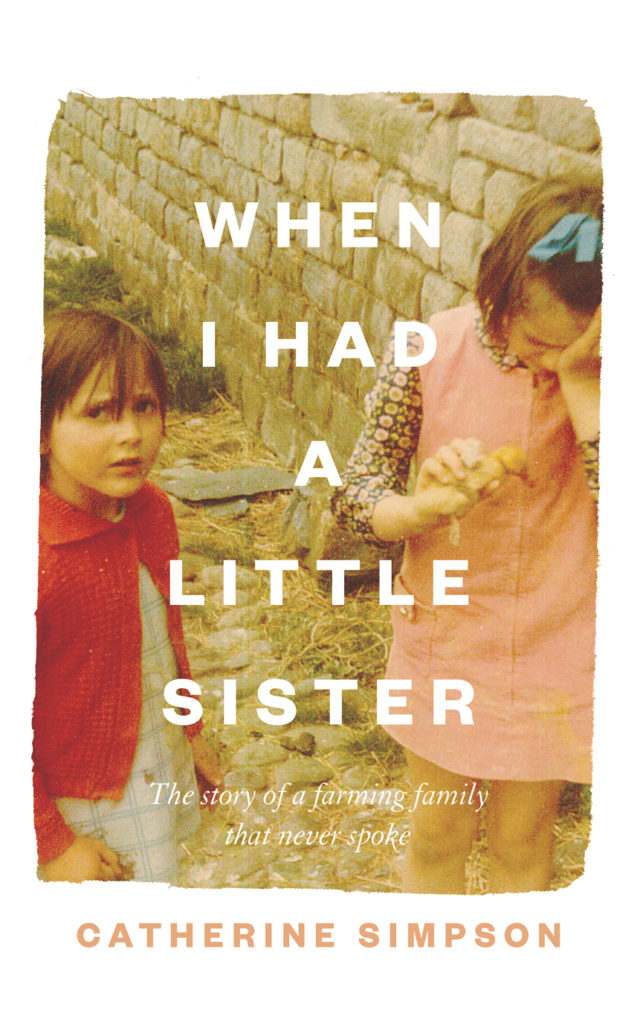
When I Had a Little Sister: The Story of a Farming Family That Never Spoke by Catherine Simpson is published by 4th Estate, priced £14.99.
We Were Always Here is a brilliant, vital anthology, championing writing from the LGBTI+ community. The stories and poems gathered in the collection look at living and loving in the 21st century, and as author Garry Mac instructs us in the Foreword: ‘Read it and recognise that we were always here, and you are here, now, and so are they, and we are all in this, here, together.’ It’s good advice. Here we share Christina Neuwirth’s story, ‘Sequins’.
‘Sequins’, by Christina Neuwirth is taken from We Were Always Here
Edited by Ryan Vance & Michael Lee Richardson
Published by 404 Ink
The first time Robyn invited me round I must have been about twelve or thirteen. I distinctly remember it because she normally asked a group of us to come over, but this particular time she only asked me. She said, ‘What are you doing after swimming on Thursday?’
‘My Mum is picking me up.’
‘You could come home with me and we could pick out summer camps in the brochure my dad got.’
‘Okay,’ I said. I didn’t want to ask further questions because I was worried it might scare Robyn off.
That night it was hard to get to sleep after dinner. I couldn’t stop thinking about the next day.
After school, Robyn and I walked to swimming together. Heather was there too, and Robyn was talking to her. She hadn’t really looked at me all day, not since I’d told her that I was allowed to come over — she’d said ‘Fun!’ and then proceeded to ignore me. I was used to it, but it still tied my stomach into knots.
Heather and Robyn giggled and splashed around the shallow end of the pool while the rest of us did our warm-up laps. Miss Feever told them off, but then concentrated more on timing the rest of us on our butterfly laps.
Robyn didn’t even look at me.
I had brought a change of clothes but Robyn always left quickly after training so I knew better than to try and get completely cleaned up and changed now. She was wrapped in a towel and smiling when I came out of the changing rooms with my bag and my dripping hair.
‘Quick, let’s get to mine,’ she said.
‘Yes.’ I wasn’t sure if we were back to being friendly so I figured I’d better stay quiet for another little while. In the car, her mum asked us a few questions but Robyn was always quicker to answer. It was only a ten-minute drive. At the end of it I felt suddenly cold in my stomach. I checked the time. It was three. I was meant to be home by seven.
When we arrived, Robyn ran to the bathroom and I could hear the shower through the closed door. Robyn’s mum kept asking me questions in the front room. I sat on the edge of the sofa.
When Robyn was done she came out wrapped in a number of big towels. Steam drifted from the open door of the bathroom into the hallway.
‘What are you waiting for?’ asked Robyn and called me to her room. ‘Are you not going to shower?’ she said without looking at me.
‘Um.’ I didn’t know what the right thing was.
‘You know you need to shower every day now. Leave it any longer than that and you’ll start to smell, like Gary.’
‘Of course. I’m going to shower,’ I said. ‘Can I shower here?’
‘Of course, silly! That’s why I asked. Ask mum for a towel, we’ve got loads — they’re so soft. Much softer than the ones at your house, I bet!’ said Robyn. She’d never even been to mine.
Their bathroom was huge. It had a shower and a tub, separate, and a warming towel rack. I put the towel Robyn’s mum had given me on the rack. It was turquoise and extremely fluffy. I took my clothes off, folded them, and put them on a little wicker stool by the sink. Then I got into the shower and turned the tap on. There were several big bottles of shampoo and shower gel in there, and I used small amounts and took care to put them back facing the right way. I tried to do everything as quickly as possible. I didn’t want to take too long, but I also didn’t want Robyn to think I wasn’t showering properly. I wiped the floor of the shower with my feet to get rid of any hairs I might have left behind, and dried myself off, then put on my clothes again.
I felt better.
Robyn met me outside the bathroom and said, ‘That took forever. What makes you think you can use up all our hot water?’
‘I don’t know.’
‘What?’ She came closer.
‘I’m sorry.’
‘Maggie, darling?’ Robyn’s mum interrupted. ‘Are you staying for dinner?’
I didn’t know what to say. I wanted to leave. I wanted, desperately, to not be rude.
‘Of course she’s staying!’ said Robyn, her face suddenly kind again, throwing her arm around my shoulder and pulling my head closer until it touched the side of hers. She didn’t mind that my hair was wet, or that I had used a lot of hot water to get clean. Her arm around my shoulder felt warm and soft.
Robyn grabbed my hand and we went to her room. When we were there I asked if I could phone home to let my Mum know I was staying for dinner. She said I didn’t need to do that, and that using the phone would cost money. Then she said we should both cut our hair.
‘It would be so cool! We could both have the same haircut. My mum cuts my hair all the time. It’s easy.’
She said the best way to cut hair was to tie it into two pigtails and then snip them off. She tied up her hair first: it was long and ginger and still damp. It smelled lovely. I wondered if she could smell her shampoo on me. She brushed my hair very carefully with a large-toothed comb. It was long and bushy, and normally my Mum and I would detangle it as quickly as possible, which always resulted in tears and shouting. When Robyn did it, it didn’t hurt at all. She was very careful. Then she tied it into pigtails. We looked cute already, and the same, which made me feel warm and gooey. She stood me up and we looked at ourselves and each other in her full-length mirror.
‘I’ll get the scissors. This is going to be so fun!’ she said. She arrived back with the pointy hairdressing scissors, which were packed in a plastic case that said they were indeed made for that purpose.
‘Shall I go first? Or do you want to?’ she asked. She unzipped the case, took out the scissors, opened them and held them to her pigtails.
‘Um,’ I said.
‘I can go first if you’re scared!’ she said, and gripped her own pigtails.
‘No, it’s ok, I’m not scared.’
I cut off my pigtails.
She didn’t cut off hers.
That was the first time I was round at Robyn’s.
I arrive at the venue and I know she’ll be here. It would’ve been weird if Jenni hadn’t invited her. We are all each other’s friends, after all. I try not to crane my head in case it’s too obvious, but I want to see her before she sees me. There aren’t many people here — it’s still early. I know Jenni wouldn’t have put me and Robyn at the same table, but I check the chart just in case. At least we won’t have to watch each other eat. We won’t have to make conversation over a plate of food. We won’t have to clink glasses.
I still have a small hope that I will be asked to stay overnight at the hotel, even though I helped Jenni with the booking and she mentioned that those rooms are for family and out of town visitors, and that I, living 45 minutes away, can just sleep at home. I don’t mind, right? I don’t mind.
Robyn has a room at the hotel. So she’s out of town, now.
My stomach is flipping.
I see Jenni has seated me next to Thomas who is recently single, so maybe I can flirt with him and that’ll distract me.
Weddings have sort of stopped being exciting after I’ve been to so many, of colleagues and friends and cousins, but Jenni’s is different, because we’ve known each other for fifteen years. And because I can tell she is so happy, and Tabby is happy. They got married in the back garden this morning at 8am when the sun was still pale and the dew was still on the grass, and other romantic things like that.
‘Jesus Christ, what a day,’ says Jenni, rushing out of a side door and nearly running me over.
‘Is everything okay?’ I say.
‘Yes, yes, it’s fine. It’s just non-stop.’ She waves off my offers of help, points me to a corner where others have already left their bags and coats, and leaves me to look for my seat.
‘Maggie! Hi!’ says a familiar voice. I turn around and I feel my face get hot. Not her. Not yet. I scramble for the right name.
‘Danielle!’ I say.
We stand for a few minutes talking, but the hallway is starting to stress me out — the confined space, how exposed I am, the big poofy shoulders on my dress, so I ask her where the bathroom is.
The bathroom is cooler than the rest of the hotel. It’s also surprisingly quiet. Except, there she is: Robyn.
‘Oh, hi!’ she says. Her hair is bobbed and more auburn than ginger now. It suits her, makes her neck look slender and elegant, swan-like. Her dress is blue, and shiny all over, and the pleats running down the side of it will look lovely when she dances.
She shows me her teeth.
Is she smiling? I can’t tell.
Yes.
It’s a friendly, Oh hi.
‘Hi, Robyn! Fancy bumping into you here!’ I say. It is a really weird thing to say but it is what comes out of my mouth.
‘So,’ she begins.
‘Listen, I’m sorry, I’m bursting. Lots of tea this morning. I’ll just see you in there, yeah?’ I add a little laugh at the end, and she indulges me and laughs too. I push past her and into the first cubicle I can find. I sit down, but can’t even start peeing until after I hear the door shut.
I try to remember whether she is angry with me, or am I angry with her? It was all such a long time ago. A searing memory of a kiss — one-sided, sloppy — comes back to me, but I push it aside.
Not now.
I remember the first time I chose my own outfit without consulting Robyn. Normally Robyn and I would be on the phone to make sure we didn’t match, or to make sure that we did, but for some reason at this particular party, we hadn’t. We were sixteen. I was wearing a loose-fitting black dress, with casual flare and pleating at the skirt. The top bit was covered in black sequins that were arranged to form small roses. My Mum had bought it for me and I thought I looked very casual goth.
I’d put eyeliner on and pinned back my black hair.
Robyn was already at the party when I arrived. It wasn’t anything fancy, just at someone’s house on a Saturday, with three Bacardi Breezers to last a room full of people for the night. She was wearing jeans and a t-shirt, and I instantly realised that I was wearing the wrong thing. Some other girls were in dresses, and some of them looked more dressed up than others, but seeing Robyn there in what she was wearing, and the way she looked at me, I knew I was in trouble.
She said Hi like normal, and we went and got a drink and stood in a corner to assess the party situation together, and when she’d been nice to me for long enough it started.
‘You’re shiny today,’ she said.
‘Yes,’ I said. I didn’t even try to defend myself. I was wrong. I looked stupid.
‘Did you think it was fancy dress?’ she said.
‘No,’ I said. She was looking me full in the face, and I was looking down at my cup.
‘Because we could’ve both dressed up as old ladies if that was the idea,’ she said.
There was no use trying. I just let it wash over me.
‘Listen. I can help. I have a scarf. If you wear it over your front like this, maybe — oh, shit, is it on the back too?’
I nodded as she walked around me looking at the intricate sequin roses.
‘There’s nothing for it. They’ll have to come off.’
I looked down at my stomach, at the floral pattern.
‘Come on,’ she said, like we were co-conspirators. She took my hand and led me to the bathroom, where we found, after rummaging in our friend’s parents’ medicine cabinet, some nail scissors. They were bent to follow the curve of a fingernail.
‘It’ll be tricky but it’ll have to do,’ she said. Before she made the first cut, she tipped my face up by poking my chin with her finger. ‘You’re okay with this, right? I mean, you didn’t want to be a shiny granny all night, did you?’
I nodded. I tried not to think about how excited both Mum and I had been when she’d bought the dress.
‘Okay,’ said Robyn. She giggled. She came really close to me, pulled on one of the sequins, and cut the tiny thread of stitching that connected it to the fabric of the bodice. It took a long time.
There were a lot of sequin roses on that dress.
Robyn’s seamstress work wasn’t very accurate because the scissors were bent, so in the end I had lots of small holes all over the dress. The fabric was loose enough so they didn’t show up flat against my body but I could still see them, and, standing in a circle of sequins on the bathroom tiles, I felt like she’d clipped my wings instead.
After the operation was over, Robyn and I knelt on the cold tiles together and cupped our hands to sweep up the sequins that were all over the floor. We put them in the bathroom bin, downed our sickly sweet drinks, and went back to the party.
Robyn was laughing again, rubbing my back, reassuring me that the dress was great now and I looked amazing. I laughed, too.
When Mum picked me up I told her Robyn didn’t like the sequins. She gave me a row, saying it didn’t matter, that I should only care what I liked, but I tuned it out. I’d heard it too many times before. She didn’t know anything.
I check my face, wipe the inevitable mascara smudge from the side of my eyes, and rearrange the poofy top bit of my wedding reception dress. I remind myself again that this is the dress Jenni wanted me to wear, and this day is about her. Not about impressing Robyn, or about anyone else.
I reach the hall again, which has filled with more people, so I go to my table and take a swig of water.
A couple of people are sitting here already, so I say Hi, and we giggle about how excited we are for Jenni and how she always used to say she would never ever get married.
I look around the room and find the table Robyn is sitting at. She is facing away from me. Her bare shoulders look soft and there are freckles on them. I can see a bobby pin in her hair.
There is a commotion near the door when the newly married couple come in. The band plays the wedding march, and Jenni sticks out her tongue towards us. Both her and Tabby are wearing a little veil on a hair clip. They hold two bouquets and throw them across the room, not backwards and coy, but front-facing, like a javelin. One lands on one of the cousins I am sitting with, who picks it up gingerly and keeps it in his lap. The other one gets caught mid-flight by one of Tabby’s co-workers. Then they walk up to the top table, both grinning from ear to ear. Jenni is looking straight ahead in a daze, Tabby’s eyes fixed on her. I think she might cry. Robyn is watching them too.
Much, much later, outside the hall, I queue for the taxi. Robyn stands outside too, hugging her arms to her chest against the night chill. She is talking to someone else, but hovering near me, and I know she has a room at the hotel so she isn’t here waiting for a taxi.
Finally, in a vacuum of chatter, she turns to me and says, ‘We didn’t get a chance to talk all night!’ in a tone that is all cream and strawberries. It’s the way our mothers used to speak to each other when we were little. I smile and touch my finger to my mouth. I worry my lipstick has bled.
‘Are you heading back into town or sticking around?’ she says, because I still haven’t answered. I look up at the wall of the hotel, where a few of the windows are illuminated.
‘Just grabbing a taxi, yeah,’ I say. I want to kick myself.
‘Ah, right.’ She is still lingering. I can see she wants to talk, but I don’t know what about. Suddenly I worry I might cry.
‘So, did you have a nice wedding?’ I ask.
‘I’d say. One of my favourites.’
‘Yeah, it was really good, as weddings go!’ I feel self-conscious saying that, as though I was asking her to marry me; I also worry Jenni is nearby and will overhear, although the last I saw of her, she was playing the grand piano in the lobby with her dress bunched up around her knees.
There is a silence and I fiddle with my phone.
‘I like your hair,’ I say. It looks soft.
‘I like your hair.’
‘Hey, it’s not a competition,’ I say.
She looks at me like a door has closed behind her eyes, but she blinks and then the expression is gone. ‘So, how have you been?’
‘Pretty good, you know. Can’t complain.’
I want her to tell me what she’s been up to so I can make a face like I don’t already know, even though I’ve been watching along, on and off, on Facebook. She has a child. The child is two years old. She shows me a picture on her phone.
I don’t know what to tell her about my life. There is too much.
I start talking about an event I hosted a few weeks ago and I realise that every single person there is someone who has come into my life after Robyn and I broke up. Everything that matters in my life has crystallised afterwards. It felt like I was suddenly free to be someone without her, I remember.
My taxi arrives, and she says goodbye. We hug, and, probably due to the copious amounts of wine I’ve had, I say that we should catch up properly sometime. I know that everything speaks against this, but I can’t take it back. She agrees, but I can’t read her eyes. She takes my phone and puts her number in it.
When she hands it back to me, our fingers touch briefly; the sequins on her dress reflect in the darkness of the screen.
‘Sequins’ by Christina Neuwirth is taken from We Were Always Here, edited by Ryan Vance and Michael Lee Richardson, and is published by 404 Ink, priced £8.99
Married life is not always easy, especially when you’re navigating the necessary hum drums of mortgages, chores, parenting and work stresses. Luckily, Katharine Hill has written a guide to getting the best out of coupledom, and here is a little taster.
Extract taken from If You Forget Everything Else, Remember This: Tips and Reminders for a Happy Marriage
By Katharine Hill
Published by Muddy Pearl
Five Ways to Say, ‘I Love You’
In his book The 5 Love Languages, psychologist Gary Chapman writes about his theory that just as we have a native or first language, we also have a primary ‘love’ language – the way we most naturally communicate and understand love. When we learnt about this, my husband Richard and I discovered that, like many couples, our love languages are very different. So despite our best intentions, we hadn’t been communicating our love in a way we both understood. My affectionate notes meant little to him, and I didn’t notice when he’d spent hours demonstrating his love for me by cleaning the kitchen!
The good news is that learning our partner’s love language has the potential to transform our relationship. So what are the five love languages?
Words of affirmation
If words are important to us, encouragement from our partner can have an incredibly positively impact on our marriage. I love it that Richard often says kind and encouraging things to and about me. But not always …
On my birthday my friends gave me a card in which they’d written a list of wonderful things about me. Admittedly, it was over the top, but it made me feel incredible. Then Richard leaned over to read it. ‘Guys, it’s only Katharine!’, he said. He meant it as a joke, but my balloon burst immediately. At home later we sorted it out (ha!), but it was a valuable lesson about the power of words to build up … or to tear down. If our partner’s love language is words, we’ll need to take extra care with what we may think are funny comments about cooking, driving, dress size, etc. They will feel them deeply. Be imaginative about showing them your love: send them by text, put a note on the dashboard, say them – ‘You look great tonight’, ‘Your lasagne is the best’, ‘I’m proud of you’, ‘I love you …’
Quality time
When Carol and Duncan bought a new house, Duncan set about redecorating it completely. Weekends and evenings passed in a blur as he worked to get everything finished. The problem was that Carol’s love language was ‘time’ and she became distant. She was grateful for Duncan’s hard work, but they hadn’t had any quality time together for months and she ended up feeling unloved.
If our partner’s primary love language is quality time, they’ll feel loved simply when we spend time with them. Going for a walk or chatting round the kitchen table – the activity itself is incidental. What matters is finding time when you can simply be together.
Acts of service
One of Richard’s main ways of feeling loved is acts of service. So when I do something practical for him like sorting out the washing, it says to him: ‘I love you.’ If our partner’s primary love language is acts of service, here’s a word of warning: if we forget to do something they’ve asked us to do it will have an especially negative impact on them.
Showing love in practical ways is not about being a doormat; it’s about spotting things we know our partner would love us to do. For them, actions really do speak louder than words.
Gifts
Gifts can communicate love strongly on an emotional level – it’s my other love language. The first Christmas after we married, I carefully planned what present to give Richard and wrapped it beautifully. I felt so disappointed when he ripped the paper off, said a quick thank you, and put it to one side. It wasn’t that he didn’t like the gift – it simply didn’t carry the same significance for him as it did for me.
This love language is about the thought behind the gift rather than how expensive it is. So forgetting their birthday or an anniversary will be especially disappointing for our partner. Whether it’s a magazine or a packet of wine gums, giving a present of some kind – and not just on special occasions – speaks volumes to a partner whose love language is gifts.
Touch
For some people, touch communicates love more powerfully than words. The love language of touch covers everything from a hand on the knee, a kiss, a hug, through to sexual foreplay and making love. When withheld, it can communicate rejection, so if this is our partner’s love language it will be important to find opportunities to express love in this way – not just as a prelude to making love. For them, a touch makes all the difference.
It’s easy to express our love in the same way we want it to be shown to us, but when we do that we risk our partner not feeling loved. Take time to discover each other’s love language today … it can revolutionise your relationship.
If You Forget Everything Else, Remember This: Tips and Reminders for a Happy Marriage by Katharine Hill is published by Muddy Pearl, priced £9.99
There are many ways to tell a story, and Clare Hunter’s Threads of Life is a fascinating exploration how history has been shaped by the needle as well as the pen. David Robinson appreciates this introduction to these forgotten stories.
Threads of Life: A History of the World Through the Eye of a Needle
By Clare Hunter
Published by Sceptre
ME, I’ve got a soft spot for Mies Boussevain-van Lennop. Why? First of all, because she was a Dutch resistance fighter who helped Jewish refugees fleeing from Nazi Germany. Secondly, because she founded a feminist political party, the Dutch Women’s Movement. And third, because of the way she wanted its members to dress.
They should make, she said, a liberation skirt. It would be a symbol of what women in the resistance had done and would do to help rebuild the country. To make it, every bit of fabric would remind them of something or somebody: a piece from a child’s coat, a dead son’s shirt, a Jewish yellow star, some parachute silk, a badge from a uniform. Whatever they used, it had to mean something. Often they worked together on those liberation skirts in quiet, companionable comradeship; later they would wear them with pride, stitched together like the new country they were also refashioning. In the five years from 1945, 4,000 liberation skirts were made.
Clare Hunter’s book Threads of Life is full of stories like that, which many of us might never have known (or at least I didn’t) but which show very clearly how what we sew chronicles who we are. Why, I wondered, has that idea of honouring of loved ones’ through patchwork never caught on? If we like to celebrate individualism through fashion, wouldn’t that be the ultimate way of doing so?
Read Hunter’s book, though, and you know what would happen next. Those liberation skirts would be end up being mass-produced, like the quilted, embroidered traditional kanthas of Bangladesh – no longer made (as they used to be) from dead relatives’ clothes but simplified and impersonal and sold as tourist souvenirs. Hand-stitched embroidered symbols of place and genealogy, where each village had different patterns, would be replaced by symbols of obvious national identity, as happened in Palestine. National dress in modified became blander, less threaded through with meaning, as happened in Ukraine under Soviet rule.
For all that, sewing can sometimes capture the quiddity, the vividness, the occasional oddness of the death-dulled past better than anything. Hunter provides plenty of examples. A Great Yarmouth woman locked up in a Victorian workhouse rages in wildly stitched capitals against her abandonment. A piece of embroidery turns up at a jumble sale in Bristol in which British women prisoners of war recorded their first sight of the infamous Changi jail after the fall of Singapore in 1942. In the archives of the London Foundling Hospital, as she gently touches the cloth tokens that eighteenth century women left behind with their abandoned babies, Hunter meditates movingly on that moment of choosing, ‘of mothers deciding what remnant of themselves to leave, how best to communicate love, regret, hope, a small explanation to the child they will never see again.’
Threads of Life isn’t always about marginalised people. You could, for example, very easily tell much of the life story of Mary Queen of Scots through her clothing, embroidery, and dresses, and indeed Hunter does. This was, she points out, a time when embroidery was ‘one of the most potent forms of Renaissance communication, when it was valued as a transmitter of intellect and emotion, when it was a conversation between people and they God. Back then, sewing mattered’.
For most historians, though, it hasn’t and doesn’t. Go to Bayeux, listen to the audio guide, and there won’t be a single mention of the women (probably captured English noblewomen) who made its world-famous tapestry. Go to the National Museum of Scotland, and you won’t find a single banner made by women suffragettes on display (although, oddly enough, there is one for the Federation of Male Suffrage). Go to the Glasgow Style Gallery in Kelvingrove Museum and there’s not a stitch of the new style of needlework pioneered in the city in the early 20th century. When she visited the Willow Tea Rooms, Hunter was even more outraged to find no mention of her ‘chosen muse’ Margaret Macdonald, even though that project was as much her creation as of her husband, Charles Rennie Mackintosh.
But Hunter’s book is a lot more than a necessary feminist correction for such oversights. Through its wide ambitions are spelled out in its subheading – ‘A History of the World Through the Eye of the Needle’, and though it is indeed quite fascinating about a whole range of sewing women, from the Miao of south-west China to the mothers (and grandmothers) of the Plaza de Mayo in Argentina who embroidered their headscarves with the names of their ‘disappeared’ loved ones, it is the personalised chapters which linger longest in the memory.
Oddly, perhaps, Threads of Life doesn’t begin with any explanation of how embroidery first got hold of Hunter’s imagination. Instead, it steps straight into history, and a heavily-structured narrative that breaks down the subject into categories such as Protest, Loss, Art, Captivity and Identity. Given the width of its ambition, this is undoubtedly necessary.
But there’s another book hiding beneath this objective overlay – smaller scale, Scottish, and personal – and fascinating though I found the rest, it was the stories based on her own experience as a banner-maker, community textile artist and textile curator that drew me in the most. This is, I must admit, a world about which I know nothing. In the past, if I came across exhibitions of work done by community sewing groups, while I would have been glad someone was putting them on, I would probably have mentally filed them away under the ‘well-meaning but worthy’ category and not bothered to have a look myself.
Threads of Life has made me change my mind and realise what I, in my condescension, have missed. To explain why, I must go back to a comment Hunter overheard while looking at the Great Tapestry of Scotland. ‘The standard of work is so uneven,’ a woman complained. And maybe it is, but so what? We’re all uneven, and the great tapestry of Scotland is great because it involved so many people; as near as could be managed, it is by us as well as about us.
The shellshocked soldiers returning from the First World War, who couldn’t do much with their lives, but who could gather – officers and men together – to stitch on the altar cloth for the Service of Thanksgiving at St Paul’s Cathedral in 1919, they were uneven too. The grieving mothers and lovers of AIDS victims who made such heart-warmingly colourful quilts to challenge the anonymity of the dead, they were also uneven. The banners made in the Eighties by the striking miners or the Greenham common women or the residents in the Buchanan Street Housing Association in Leith (Hunter’s first community textile project in 1985) might have been uneven too, but they were about causes bigger than their makers – and that, ultimately, is what matters.
It is one of the glories of Hunter’s book that it takes you into so many lives, many of which have been marginalised by the history books, just as sewing has been. Bewitchingly, it stitched together a past I knew little about. It has only one glaring fault, its publisher’s not its author’s. The press release comes with half a dozen pictures, from the NAMES Memorial Quilt filling the entirety of the Mall in Washington DC in 1996 (when it was seen by 14 million people), to the sumptuously coloured sewn story cloths of south-western China. Sadly, the book doesn’t have a single one.
Clare Hunter will be appearing along with Kassia St Clair at Aye Write! in Glasgow on 23 March at 4:45pm.
Threads of Life by Clare Hunter is published by Sceptre, price £20.
Dylan and Tristan have escaped death and conquered destiny. Finally, there is nothing to stop them from being together. But their actions have caused an imbalance. The afterlife is owed two souls – and it wants them back. Outcasts is the stunning finale to the Ferryman series from multi-award-winning author Claire McFall, which has sold more than 3 million copies and been translated into 18 languages.
Extract taken from Outcasts
By Claire McFall
Published by Kelpies Edge
Tristan was already parked on Dylan’s bed. He held a large pad of paper, the blue front cover decorated with intricate black swirls. His drawing book, the one he’d never, ever let her peek at.
It had driven Dylan near-demented wondering what he was sketching when he’d disappear off to a corner with the thing tucked tight in his grasp, but he’d been shy about her seeing it and, although she’d had a few horribly tempting opportunities, she’d never looked. She wanted to; she really, really wanted to. But she hadn’t.
Tristan had never had anything that was his before, had never had any privacy. It was a small gift, but it was something that Dylan could offer him.
But ohh, how it had niggled at her. The pad sitting on her top bookshelf (the one she’d given over to Tristan because she couldn’t reach it without standing on a chair anyway), waving at her day after day. Taunting her, tempting her.
Art was a recent discovery for Tristan. Dylan didn’t take it at school – she couldn’t draw. Or paint. And she’d dropped it as soon as she could – but Tristan had expressed an interest so Dylan had bought him some basic art equipment for Christmas. He’d taken to it like a duck to water… or so it seemed. As she’d never seen any of his drawings, Dylan had no idea if he was any good, but he enjoyed it, and that was all that mattered.
She was curious, though.
He tapped his fingers once, twice against the spiral binding running down the spine, before holding it out to her. ‘Here,’ he said. ‘Your reward.’
‘Seriously?’ Dylan raised her eyebrows in mock astonishment, but in truth she was surprised. ‘You’re going to let me see?’
‘I am.’
Not giving him an opportunity to change his mind, Dylan sat down on the bed beside him. Taking the pad carefully, she flipped the cover over to reveal the first drawing.
Her own face stared back up at her. Her eyes dominated the image, looking out from the page beneath sweeping eyebrows. Her lips were quirked up in a half-smile that made her look teasing, secretive. And pretty. In the picture, she looked pretty.
Glancing up, she saw Tristan was watching her carefully. It was hard to keep her face impassive but she tried, working to keep her embarrassment in check and off her cheeks.
Slightly clumsy fingers swept the picture away to reveal the next sketch. This one was charcoal, a side-on view of her standing staring at something off the page. Her hair was blowing out behind her in long, sinuous waves.
Another page. Another picture. Dylan in the wheelchair, her face clouded over with frustration as she fumbled with her cast.
The lines of the wheelchair were slightly off, the perspective not quite right, but the mulish look on her face Dylan certainly recognised.
The next sketch wasn’t a picture as such, but six rough pencil sketches of—
‘Is that my ear?’ Dylan asked, tilting her head in confusion. She didn’t necessarily recognise it as her ear, per se – an ear was an ear, wasn’t it – but that was her little daisy earring.
‘Uhm, yeah.’ Tristan reached over to take the pad back from her, but Dylan twisted to keep it out of his reach.
‘Hold on,’ she said. ‘I haven’t finished.’
She flicked another page over and saw herself, laughing. Her eyes were scrunched up and her chin was tucked in a way that wasn’t all that attractive, but Dylan smiled anyway. There was joy in the picture, it radiated out at her.
‘Tristan, these are really good,’ she said quietly, realising that she hadn’t said anything bar the ear comment. If it had been her in Tristan’s place, she’d be wriggling like she had ants in her pants, wondering what he thought. ‘I mean, they’re really, really good.’ The next page was blank, the start of drawings still to come, so she flicked back through the ones she’d seen. ‘How did you get the details so accurate? You can’t have seen any of these for more than a moment!’
‘I don’t know.’ Tristan shrugged. He reached again for the pad and this time she let him take it. ‘I just saw something I liked and then, later, when I was drawing, sketched out what I remembered.’
‘You’re very observant, then,’ Dylan commented.
‘I had a lot of practice,’ he reminded her. ‘At night, in the wasteland, there wasn’t a lot to do but sit and stare.’
‘True,’ Dylan said softly. She didn’t like thinking about the long years Tristan had spent ferrying soul after soul, trapped in a never-ending cycle. No, not never-ending, she told herself. He was here now, with her. He’d escaped that life.
She watched as he flipped back to the first picture. The one of just her face, gazing up at them both.
‘Why now?’ she asked quietly. ‘Why show me today?’
Tristan shrugged. ‘I just…’ He flicked to another page, the picture of Dylan in the wheelchair. ‘In the wasteland, it was just the two of us. But here, there are so many people, so many distractions.’ He closed the pad and set it aside, fixing his full attention on Dylan. ‘I want you to know that I still see you. This life, this world, it’s amazing, but only because I’m living it with you.’
Dylan opened her mouth, but nothing came out. How was she supposed to respond to a declaration like that? She’d never been good with words.
‘I love you,’ she managed to blurt.
Tristan grinned, reaching up to tuck a lock of hair back behind her ear. ‘I know,’ he said. ‘I love you, too.’
Then he kissed her, his mouth hot against hers as his arms wrapped around her. Dylan closed her eyes and allowed herself to melt into his embrace. They were safe, and together. Nothing could change that.
Outcasts by Claire McFall is published by Kelpies Edge, priced at £7.99
Matt Hopwood goes for long walks. And on those long walks he meets people who tell them their stories of love, which he gathers and presents in beautiful books. His second book, Mother: A Human Love Story focusses on stories of parenting.
Extract taken from Mother: A Human Love Story
By Matt Hopwood
Published by Birlinn
Matt Hopwood: We sit by the fire in the evening. Warm hospitality and gentleness. You both share as one corded together through the pain of experience. Outside, the wind blurs the sounds, and time seems to fluctuate. In the morning, you both walk me out along the paths north to the borders and leave me wandering onwards with your voices and memories still rolling around in my head amongst the silence of the hills. I want to cry, but no tears come.
S: My eldest son died about four years ago, four years tomorrow actually. It’s the anniversary tomorrow. And we were in Australia when it happened. When the notice came through, Eddy was the one who got told to go to the police station to get some news, because my son was in America at the time. And Eddy had to come back and tell me that he had died, and I’d never seen him cry like that. From that moment and over the next few weeks and months, I didn’t eat very much and I wasn’t sleeping very well. And he completely took over functioning in every sense, getting us to America from Australia and dealing with everything that needed doing. And he completely took over everything and dealt with it and assumed that role and I just handed it over. He took over everything, even though he was grieving. He looked after and he cared for me and I’d never felt so vulnerable or as needy, and that’s quite scary, because I don’t think I’ve ever felt so vulnerable before. Needing someone in such a raw way and for him to be there and do it without any complaint. And, as the first couple of years passed, when I found it wasn’t just about grieving, it was about dealing with not having joy in myself, and how to function for the rest of my life and me feeling quite low, he just quietly got on and looked after me but didn’t make a big deal of it and didn’t expect anything in return.
I think that’s when I realised how much I love you and how much you love me, and that there could be a vulnerability in loving each other, rather than coming at it both with strength. And that’s been a huge learning curve for me, to have such implicit trust, and it’s made me love you even more.
E: For me, you were this kind of crumpled person. I so remember going to this Australian police station. And they came out and told me and I completely broke down. All I could think of was you and I thought, ‘This is going to destroy her! I remember saying to the policeman, ‘God, why did it have to be Patrick, of all the people in the world?’ I said, ‘It’s going to destroy her.’ I said,’I’d put myself in his place a hundred times.’ I remember saying all this to the coppers and they must have thought I was mad. But I remember thinking, ‘How is she ever going to get over this? How are we ever going to move forward from this point? It’s just a complete disaster.’ I suppose that is my love for you, because it was probably two, three years of you really struggling but I never thought, ‘For frick’s sake, I can’t be with her any more’, I just thought, ‘Well, this is where we’re at and I’m just going to be with you, just be with you. Do what I can and just be there for you!
S: I think I never imagined I could feel love like that for someone who wasn’t my child. I panicked a few times about whether you could still love me. It felt much like it was for any of the children. In fact, in some ways, almost greater because the need for you to love me and be there unconditionally was so strong. I needed it. I couldn’t have functioned without it. And I think particularly with Patrick’s death. He was my son but I had him when I was very young. I was seventeen and I was a single mother. So all my adult life, I’d been with Patrick – he was my one constant. From being a very silly, giddy little teenage girl doing too many drugs and drinking too much to suddenly realising and understanding a purpose in the world, which was love for this child. And then loss, but maybe then discovering my love for you. I mean, I knew it was there, without a shadow of a doubt, but it deepened or solidified from that implicit trust and faith in you.
E: ‘Cause I didn’t know you thought that really.
S: Didn’t you?
E: Not like you’ve just said it.We just managed to do it, didn’t we really.
S: We did, you did and you took me with you. I was committed to loving you but I never let myself feel vulnerable in that love. I always felt I could function completely well on my own because that was how I felt strong. So, to discover I could feel vulnerable in love and that it was safe was a huge learning lesson for me.
Mother: A Human Love Story by Matt Hopwood is published by Birlinn, priced £9.99
Family secrets have a way of reverbating through the generations. Sue Lawrence’s latest novel, Down by the Sea, is an intriguing historical mystery steeped in secrets and lies. Read with the light on!
Extract taken from Down by the Sea
By Sue Lawrence
Published by Contraband
1898
The girl walked up the cobbles of Laverockbank Road, then stopped to look back down the street and out to sea. The low, grey clouds reflected on the water, which was swirling up into frothy, foam-crested waves. ‘A guid day for the fishin’,’ her mother had said before handing her a ragged bag of belongings and pushing her out the door. Her home, in the long row of tiny fishermen’s cottages on the shore, was only a ten-minute walk, yet she felt she was miles away, so alien did it seem coming up the hill towards these big stone houses where the rich folk lived.
She had never been up this way. She’d never even been to Leith and certainly not to Edinburgh. But she had been to Granton one day in the summer for the gala day when she was allowed to sing in the choir. The Newhaven Fisherlassies, they were called. Aged thirteen, she had sat in the front row, cross-legged, wearing the uniform of all the Newhaven girls and women: a red-and-white-striped petticoat and yellow-and-white-striped apron with its deep pouch. And around her head, she wore a paisley shawl. Her mother had scraped all her thick, dark hair back off her face before tying the shawl round the back of her neck. She could still feel the skelp her mother had given her when she complained she was tying the shawl too tight.
Her big sister Dorrie, one of the older girls, had stood at the back of the choir of twenty or so and she and Ruby Gray had started off the singing. ‘Caller Herrin’, ‘Caller Ou’’ and ‘The Boatie Rows’ were the only songs she could remember off by heart. What a day that was! People clapped and told them what good voices they had, what a fine choir they were. Granton didn’t have one and they wanted to hear Newhaven’s girls’ choir to see if it was worth starting one. Newhaven had a school and Granton was having one built; the nearby village wanted to copy everything. Only one mile along the shore, Granton seemed like a foreign land. Only once in all her fourteen years had she ventured out of Newhaven.
The girl gazed out at the water, looking beyond the harbour where a flock of herring gulls soared and dived. Though it was an estuary, the locals always called it the sea, it was so vast. She looked over the broad span of the Firth of Forth where she could just make out the hills of Fife.
Her father had said there was a king who lived in Fife, but Pa was always joking, so she didn’t know if that was true. Her father used to smile all the time and was always cheery, even, according to her brother, when he was out in gale-force winds on the sea. When she thought of him she felt tears prick her eyes but then she bit her lip hard, to stop them. She just had to accept that Pa and her big brother Johnnie were gone now. All ten of the men and boys who’d gone to sea that day were dead, drowned. The fishwives said it was all the girl’s fault. That she was cursed. The girl was devastated when even her own mother, in her grief, agreed.
The girl turned back round and looked up at the trees with their orange leaves rustling in the autumn breeze. She headed left and walked along the pathway towards the big house. Her stomach tightened at the sight of the imposing building ahead.
The girl stepped onto the doorstep and put down her bag. She bit her lower lip, distracted, as she tried to remember who she was meant to ask for. She gazed up at the great stone house then reached up to the door and pulled the bell. She looked down at her tatty dress and pulled at the hem. It was her older sister’s and was far too baggy on her. Well, she had nothing else to wear. At least she had shoes on, black shoes that she’d only ever worn on Sundays and gala days, shoes that were now too small but her sister’s shoes were still too large. She was more comfortable in bare feet but Ma had insisted she squeeze into these for the walk up the hill.
There was a grating noise as a key turned in the lock and then the huge wooden door creaked open. In the gloom, the girl could make out a plump figure with an angry scowl on her face. She was about to say her piece when the woman hissed, ‘What’s an urchin like you doing at this door?’
‘I’m Jessie Mack, Ma said I’d to come and …’
‘Aye, to come round the back door. The front door isn’t for the likes of you.’ The woman jangled the keys on a large metal ring in her hands, picking out a smaller one. ‘I’ll unlock it just now.’ She pointed round the corner of the house and slammed the door in Jessie’s face.
Jessie picked up her bag and trudged round the back, her shoes pinching her toes. She bit her lip once more. Hard.
Down to the Sea, by Sue Lawrence, is published by Contraband, priced £8.99
In perfume there are three scent notes: top note, heart note and base note, so discovering that P M Freestone’s YA fantasy thriller, Shadowscent, uses the language of scent at the heart of its story meant it was a shoo-in to feature in this month’s BooksfromScotland. We spoke to Peta about writing her debut.
Shadowscent: The Darkest Bloom
By P M Freestone
Published by Scholastic
Shadowscent is your debut YA novel. Tell us about your writing journey leading up to publication.
I’ve written on and off for years, and had a handful of short stories published, but it wasn’t until I received a Scottish Book Trust New Writer’s Award in 2016 that I gained the confidence to seriously pursue writing a novel. That novel was Shadowscent. For me, what’s most important to note is that so many generous people helped with advice and encouragement at key junctures along the way. There’s a reason the acknowledgments in Shadowscent are three pages long!
Did you read a lot of fantasy when you were younger? What are your main influences?
I did! These days, I love Leigh Bardugo, Sabaa Tahir, Roshani Chokshi, Samantha Shannon and others, but I grew up on the likes of Feist, Eddings and George R. R. Martin (yes, prior to the HBO series, I’m one of those), before YA as a category really took off. In many ways, Shadowscent is an homage to those epic books I loved most as a teen, but hopefully with a broader range of identities, perspectives and experiences than I often saw in those stories. I sometimes wonder, for example, what it would have been like if I’d more regularly read positive portrayals of queer characters while I was growing up – I imagine life would have been way less confusing!
Scent plays a big part in your novel. Tell us what fascinates you about all things olfactory.
I’ve long been intrigued by how we think about perfumes and stenches. At many points in history, people took extraordinary measures to make themselves smell nice. It wasn’t just fashion. It could determine whether you were worthy of trust, like in Ancient Rome, where your aroma was believed to reflect your morals. But it was more than that, too. Pleasant smells were associated with the divine. In many ancient civilisations, animal sacrifices were burned with fragrant herbs and oils to seek the favour of the gods. Medicine and scent were also entwined, with some scents believed to hold the power to protect or heal. And, neurologically, our sense of smell is linked to memory. Merely thinking of a scent you’ve previously experienced likely conjures up all kinds of associations. So, I thought, what better way to transport a reader than to build a fantasy world around fragrance?
Your academic background is amazing! What drew you to such subjects as disparate as archaeology, religion and infectious diseases?
Curiosity. And you know what they say: curiosity kills the bank account! But seriously, I studied archaeology because I was a history nerd as a kid, fascinated with everyone from Akhenaten to Boudicca, and every place from Copán to Delphi. Adding in religion was because I wanted a deeper understanding of where belief originates, how it changes, and how it can be co-opted, and there’s a vein of that running through Shadowscent. Infectious diseases was later, after I’d been working in universities for some years. I knew I wanted to do a PhD in how science and technology are not separate (as many would like to argue) from our social, political and economic values. After one of my best friends contracted tuberculosis, I focused on the state of play in science for TB management, because the drugs we currently have for treatment are losing efficacy and the mycobacterium is becoming resistant again. There’s no coincidence, then, that there’s a prevalent disease – the Rot – in Shadowscent.
Shadowscent is the first book in a series. Can you give us some hints as to what to expect from further books?
Sure! Shadowscent is a fantasy quest caper embedded in a world where a much larger struggle for power has been brewing for centuries. Book 2 will reveal more about the vying factions hurtling towards that confrontation, and the roles Ash, Rakel, their friends, allies and enemies, will take. Because with what’s coming, there can be no bystanders. Prince or servant, everyone must make their choice.
What else are you looking forward to in your publication year?
Everyone tells me that getting your first fan mail is pretty special! But I’m also looking forward to connecting with readers at various events – a particular highlight will be appearing at Cymera, Scotland’s first festival of science fiction, fantasy and horror writing. It’s in June, and I can’t wait. See you there?
Shadowscent: The Darkest Bloom by P M Freestone is published by Scholastic, priced £7.99
BooksfromScotland love a bit of noir, and it’s usually the femme-fatale or the care-worn detective that most noir stories revolve around. Spare a thought for the ‘Muscle’ – they’ll maybe get a throwaway line but, generally, they’re in the background looking tough. Alan Trotter’s debut novel gives these hard men a voice, an inner life, and they might just break your heart as well as your bones. We hope you enjoy this extract.
Extract taken from Muscle
By Alan Trotter
Published by Faber
_____ tried to find us work but he had no plan for going about it. We would set out from _____’s apartment, pursue a circuit, and as we went we’d see a key-cutter or a florist and _____ would make an approach. This didn’t come easily to him. Violence was all we had to offer, and there must have been those who wanted it, but it was too obvious in _____’s pitch, too close. Instead we got no work, and left a trail behind us of confused and intimidated key-cutters and florists and road sweepers, which we’d add to until one or other of us grew tired of the parade. At which point we’d take ourselves to a bar, where _____ would drink beer while I dwelt on what exactly I’d expected from him, and from us.
We repeated this like a circuit on a ghost train where every ghost was an intimidated sweep, key-cutter, spotwelder or meter reader, and repeated it for days, until we hit on what seemed to be some good luck.
First thing that morning we passed a woman on the street, who was not much older than twenty and standing alongside a van maybe twice her age. She was turning a handle that fit into the vehicle’s chest—the whole side of it was open to copper ribs, a device for the production of coffee, and the handle, we found out, was fixed to a grinder.
We bought coffee from her and it was dark and thick in tall mugs. As we drank it, _____ asked the woman if she had any work that needed doing, and maybe because _____ was occupied with his coffee and this altered the impression he made, she didn’t recoil from him, but asked what kind of thing he meant. _____ suggested maybe she was owed some money, or there could be someone who had taken advantage of her one way or another, or perhaps an ex-lover. She said she’d think it over. We drank the hot, heavy coffee.
She said the longer she thought about it the more she realised she knew some kind, decent people, and she should be grateful for that. Because honestly if you asked her would she like to see any of these people have their teeth punched out of them or be made earnestly to fear for their life, then the answer was no. We finished our coffee, gave her back the cups and she reached into the guts of the van to rinse them.
We went on with a feeling, maybe from the coffee, which was good, together with the outlook of the woman, which seemed good too, that we should stick to our circuit and we’d be rewarded. And before two hours had passed we were in the back room of a clockmaker’s, and he was telling us that there was a customer who owed him money and maybe we could get it back for him.
Muscle by Alan Trotter is published by Faber, priced £10.00
Romance, mystery and bookshops – what a perfect combination for a dose of well-crafted escapism. Author, Jan Ellis, has now created three brilliant books in her Bookshop by the Sea series. Here she tells us how she came to write her novels.
A Summer of Surprises/The Bookshop Detective/French Kisses and a London Affair
By Jan Ellis
Published by Waverley Books
The Accidental Novelist
I need to begin this with a confession. Well, two in fact. The first is that I never intended to write fiction; the second – whisper it! – is that my stories began life as computer code. Both things came about when I was approached by a digital publisher to write a history book, but we couldn’t agree on a topic. ‘No problem,’ they said. ‘Why not have a go at women’s fiction instead?’
The first rule of being self-employed is to say ‘yes’ to everything so, ignoring the fact that I hadn’t written stories since the age of about seven, I whizzed over a proposal, contracts were signed and off I went into the great literary unknown.
Fortunately for me, once I sat down and thought about the setting and the basic plot, I was amazed by how quickly ideas flowed. As soon as my heroine Eleanor Mace appeared, the personalities of her sister Jenna and other characters followed on quite naturally. I particularly enjoyed designing The Reading Room – Eleanor’s fictitious shop – because I work for part of the BA and have serious bookshop envy.
My stories are generally described as ‘romcom’, but the emphasis is firmly on the humour of everyday life. I became very fond of Eleanor and her eccentric bunch of friends and family – especially mother Connie and her octogenarian squeeze, Harold – so I was delighted to revisit them in The Bookshop Detective.
When thinking about this book, I wanted to come up with an old-fashioned mystery that would involve the sea-faring traditions of a small coastal town. Eleanor becomes intrigued by a Victorian crime report and sets out to discover what happened to a young lad at the centre of the story. She also becomes embroiled in a mystery much closer to home. I especially enjoyed researching the history and I’m very fortunate to have a learned friend who was able to answer my peculiar questions about wrecking and the Victorian penal system.
It was relatively easy to come up with puzzles for The Bookshop Detective to solve, but I had no idea what the solutions would be. Fortunately, the characters worked them out – phew! Of course, even uplifting stories need tension, so there’s a sub-plot around Eleanor, her new husband and the interfering ex-wife, Freya.
One of my favourite characters to write was an old-fashioned librarian referred to by Eleanor as ‘Dismal Deirdre’. She ended up with a bigger role than anticipated, although this wasn’t entirely my fault. ‘We like her,’ said my publisher at Waverley Books. ‘Can you give her a bigger role?’ So I did, then they said, ‘Oh, no! What if we upset all the librarians and they refuse to stock the book?’
I believe in living dangerously, so Deirdre stayed. (Disclaimer: some of my best friends are librarians and they are still speaking to me. Just about.)
Friends are often the catalyst for some of the funniest events in my books. One kindly allowed me to include an incident she had with an exploding dress and a stapler that I put to good use in a book-launch scene. The pleasures and perils of running an indie bookshop are key to the storyline.
So, dear reader, whether you’re looking for contemporary romance, comedy or mystery, I hope you will find plenty to entertain you.
The Bookshop by the Sea series by Jan Ellis is published by Waverley Books, all at £7.99
Sadly, love doesn’t always work out the way you’d hoped. Fiction and Feeling’s Katie West has put together an enlightening and inspiring anthology that looks at how it’s possible to have a good divorce from those who have been through it.
Extract taken from Split
By Katie West
Published by Fiction and Feeling
How do you survive the end of love? Same way you survive the end of the world.
I’m a divorcee. But I’m not sad, angry, or broken, and neither is my former husband. When I tell people I’m recently divorced, the look they always give me? I know pity when I see it. I understand that reaction; marriage is this thing, this contract, this relationship that is supposed to last forever. The entire goal of marriage is to have no end, till death do us part and whatever. When I tell people that my marriage has ended, the only seemingly appropriate reaction is to mourn the broken promises and then politely inquire as to my well-being. This is a reaction I don’t appreciate because it takes away from the work I have done to survive the end of love.
Think about it this way, if you’d seriously and diligently prepared for the apocalypse so that, when it finally happened, not only did you survive, but you thrived, would you like people to treat you delicately and with sympathy? I want people to high five me and congratulate me on discovering a new way of living, to celebrate with me my new understanding: that survival is insufficient.
I understand that my circumstances may be unique, but I also think it’s important to know that we don’t have to go through particular life events the same way as everyone else or feel the way that others expect us to. I believe that Apocalyptic survival – both literal and matrimonial – is best achieved in two phases: Phase 1 is Survival. If you make it through this, you can move on to Phase 2: Knowing that Survival is Insufficient. This phrase comes from an episode of Star Trek: Voyager (my favourite Trek) and is used to express the importance of freedom and individual choice. It’s used to recognise the difference between surviving and living. I’m sharing this with you because the apocalypse of my marriage was one of the best things that ever happened to me, and I’m going to tell you why, and how.
Phase 1: Survival
Everyone preparing for the apocalypse should understand the basic Rule of Three if they hope to be successful: three weeks without food kills you, three days without water kills you, and three hours without shelter kills you. These rules can handily be applied to marriage, too.
So when the world ends, what will you do? Have you thought about it much? I have. I’ve thought about it a lot and the first thing I’m going to do when shit goes south is find my former husband, Matt. We’ve talked about the apocalypse and how it will happen and our plans to survive. We’ve discussed infectious diseases, economic collapse, famine, flooding, environmental disasters, and nuclear war. We have an outcome for every eventuality; chance of survival is always slim – we’re realists – but if we make it, we have plans. We planned for every possibility. We voraciously read post-apocalyptic books and watched post-apocalyptic movies. We planned our escape routes and discussed weapons of choice. But while we were busy planning for the apocalypse, our marriage ended.
If the end of my marriage was like any particular kind of apocalyptic event, it would have been a slow flood. You know it’s raining – raining quite a bit actually – and you keep waiting for it to stop, but eventually you accept it’s not going to. That this is it. As we noticed the world was starting to flood, we were angry and blamed each other, but when the end of the world comes, there’s always more than one person to blame, so you’ve just got to get out a lifejacket, pack up your gear, and go searching for a boat. The thing that most people don’t understand though, is that while it was raining, my husband held the umbrella for me so I could put on my lifejacket, and while he searched for a boat, I kept his gear dry. By the time the flood waters were at our knees we knew that there could be life after this, but we’d have to take separate boats. We spent the last few months of our marriage just preparing to set out alone.
The end came five years and three months after we said our vows and, because of our preparation, very little changed when it did. In essence, the apocalypse of our love had come, but we had food to keep us full and satiated, water to keep us hydrated and clear, and shelter to keep us safe and warm.
Phase 1.a: Food
When you’re not hungry you feel one of two ways: either you don’t even notice it, or you feel very comfortable, safe, and content. To feel that way in my marriage meant I needed money, as unromantic as that sounds. Not having the money to buy the things you need is extremely stressful and gives a marriage a very anxious undertone. There have been long periods of time in my life, and in my marriage, where I had no money and had to rely on the kindness of strangers to support me and, by extension, my husband. This is probably why, even though I am a picky eater, I will eat any food as long as it’s free; so here’s hoping that whatever apocalyptic event we’re faced with also comes with the demise of capitalism and the destruction of our current monetary structures.
And speaking of free: do you know what’s free in a world where the apocalypse hasn’t happened yet? That’s right, basically nothing. But being married makes it much easier to live in a world where nothing is free, which, in turn, can make separating a lot more difficult. Maybe alone you can make twenty bucks last for three weeks, but married life means you have forty bucks. Married life means two people sharing all the bills and you get a bigger apartment, a faster internet connection, and you eat more than just Kraft Dinner and pizza, theoretically. So, if you’re the person in the relationship who makes less money, separating from your partner often means separating from the quality of life you’ve become used to. Your life suddenly becomes stretched, spread over distances you didn’t even know existed, let alone how to navigate on your own.
But if you’re the person who makes more money – say almost twice as much as your partner – then you’re me, and you feel like you’re creating a situation where your partner will starve. If food is required for survival, and money is food, then the best way I could ensure both Matt and my own survival was to share what I had. Which is why we lived together for eight months after we separated, shared a credit card for over a year, and just split our Netflix account a week ago. Neither of us starved, both of us stayed comfortable, safe, and content. This is probably not a very popular piece of advice, but if you’re aiming for mutually assured survival after divorce, sometimes that means sharing your food stores with someone who no longer shares your table.
Phase 1.b: Water
Finding fresh water during an apocalyptic event is paramount. Three days! You only have three days to come across a water source that isn’t contaminated, stagnant, or, you know, an ocean. Three days is also about as long as I could go without talking to my husband; my need to communicate was a thirst, especially as things got more difficult. It is the very nature of language to flow, and so, like water during end times, words during a marriage, and a divorce, are paramount. Finding the right ones, those without salt, without toxicity, is a skill that helped me survive. My former husband is my best friend. I say ‘former,’ because ‘ex’ sounds so shallow, so rough. The language we use to talk of the end of things is often small and sharp, like the wreckage of ships jutting up from a calm sea. Look at the ‘end’ compared to the ‘beginning’; everyone is so verbose at the beginning of things.
The language my former husband and I used at the beginning of our marriage was not in keeping with this idea. Our words have always been small, but instead of sharp, they’ve been full, they’ve quenched in single gulps. We lived our entire marriage knowing there would be an end. In our minds, it was the end of the world, not the end of the marriage, but it still resulted in an urgency to get to exactly how we were feeling. The end of the world doesn’t have time for you to sit around and think about what you want to say; the apocalypse demands you say it now, say what you mean, choose your words with conviction, this may be your last chance. So that’s how we spent our marriage, saying what we meant and waiting for the end that would make it all justified. We were great communicators. These words kept us sated, so we continue to share them. Our words to one another are a bracing fresh water source we can draw from anytime we get thirsty out here beyond the end of marriage.
Phase 1.c: Shelter
In some apocalyptic circumstances, finding shelter will be no problem. If, for example, a virus wipes out 99 percent of the planet’s population, there’s going to be a lot of empty houses. However, if we find ourselves in a nuclear wasteland or a Waterworld situation, shelter may be more difficult to come by. In marriage, think of love as your shelter. Love can be something you stumble upon when you weren’t really looking, or it can be hard to come by no matter how badly you need it. But the fact remains, you can only survive three hours without shelter in harsh environments, and divorce can be a very harsh environment. Many people get divorced because they’re no longer in love with the person they married, and that’s okay; there is more love being put out into the world than there are people to receive it and they will find love again. But at the end of my marriage, my love didn’t end.
I loved my husband from the day he emailed me in university and all it said was, ‘What’s your story, Katie West?’ The first time we hung out, we were both seeing other people, and we sat in the basement of the university library and he told me his theories on the end of the world. And I told him mine. And that day we started making plans, not about the future of us, but for what we would do in a future so doomed to fail. I loved him not like in teen vampire movies and epic fantasy books; it wasn’t romantic – it was necessary. I needed a place to keep my heart safe and Matt was it. He became the walls that protected me from harsh winds of criticism, the roof that kept me dry when my depression stormed around me, he generated the heat that kept me stable and functioning. And when we built this shelter, we built it strong enough to weather a flood, so it remains to this day. The love I felt hasn’t really changed; it has remained as four sturdy walls and a roof over my head. People think this is weird, if I still love my husband, why did we get divorced? Because survival is insufficient. Even during the apocalypse, you eventually have to leave the shelter and start to live again.
Phase 2: Survival is Insufficient
The phrase ‘Survival is Insufficient’ highlights the difference between surviving and actually living. This is Phase 2 of the Apocalyptic Survival Plan, wherein surviving is not enough. Survive and you’re Max instead of Furiosa; survive and you’re Katniss instead of Peeta; survive and you’re Sergeant Ed Parks instead of Melanie. You might think you’re fine, and people may even see you as the hero of the story because you survived; you survived the end of love and what could be more difficult than that?
What’s more difficult is what comes after. When it’s done, when the smoke clears and you receive your official divorce papers in the mail, you ask yourself now who are you – what are you? This is when you realise survival is insufficient. Just getting through it with food, water, and shelter isn’t enough. Now you must create new habits and ways of being, ones that push you forward towards a life that is scary and fills you with anxiety and is most definitely the best life you’ve ever had. A new habit can be as seemingly insignificant as sleeping in the middle of the bed, to something more substantial like taking up new hobbies. I did weird things, like shoemaking, tried watercolour painting, refreshed my high school skills with sewing classes, and pushed my body into new positions with yoga. I did all of these new things by myself. I wanted to understand, after over five years of marriage, who I was when I was alone.
While I was married, I was surviving a slow flood; after I was divorced, I was living a life I chose. I quit my job. I switched careers. I moved to a new continent. I wasn’t running away – I was choosing to live. I do a lot of things now that I didn’t do before; small things like drink cocktails and meet more than one person at a time, but also big things like write seriously and see a vague outline of forever.
Don’t fear the end. The apocalypse can be a herald of death and isolation, just as divorce can be a herald of loss and loneliness, but though these endings are scary times, you can survive, and you can thrive. The end of the world is coming, but I came out of a marriage happy and free and with a friend who will always have my back, so the apocalypse can suck it.
Split by Katie West is published by Fiction and Feeling, priced £12.00
The twentieth-century Scottish Renaissance saw a dramatic change in Scotland’s literary landscape, where our writers increasingly engaged with social and political issues and bestowed, once more, a literary status to the Scots language. A Kist o Skinklan Things is a brilliant selection of the best work from this period. Reaquaint yourself with some of Scotland’s most inspirational poetry.
Extract from A Kist o Skinklan Things
Edited by J. Derrick McClure
Published by ASLS
Thesaurus Paleo-Scoticus
I mind when I was a bairnie hou ma mither
brocht out ae day a kist o skinklan things,
ferlies I thocht them, ilk mair rare nor anither,
aa kind o gowdies, stanes and chains and rings,
braw orleges that made her guidsire vauntie,
auld fallals that belanged her grannie’s auntie.
I thocht ma forebears maun be queens and kings,
sic sma delytes can mak a bairnie canty.
I’m canty yet wi sma delytes, albeid
ma baird’s sae black and swack. I ken a thing
that’s like a kist o ferlies gif ye read.
Frae Jamieson’s muckle buik the words tak wing,
auld douce or ramstam, lown or virrfu words,
for musardry o thocht or grame o dirds,
our forebears useit, to flyte or scryve or sing.
I’d wuss to be a falkner o sic birds.
Douglas Young
Pantoum fer Winter
doun riven the tint braith
mawkin scribbles owre the snaw
wee arles o sun-daith
water warstles wechty, slaw
mawkin scribbles owre the snaw
sternies bou tae the mockrife mune
water warstles wechty, slaw
nou the taid an puddock sloum
sternies bou tae the mockrife mune
houlets hunker saft as haar
nou the taid an puddock sloum
grippit fest in dwinin lair
houlets hunker saft as haar
winter’s nieve is cauld an sterk
grippit fest in dwinin lair
aa maun learn tae dree the mirk
winter’s nieve is cauld an sterk
doun riven the tint braith
aa maun learn tae dree the mirk
wee arles o sun daith
Kate Armstrong
The Makar
Nae man wha loves the lawland tongue
But warsles wi’ the thocht—
There are mair sangs that bide unsung
Nor a’ that hae been wrocht.
Ablow the wastrey o’ the years,
The thorter o’ himsel’,
Deep buried in his bluid he hears
A music that is leal.
And wi’ this lealness gangs his ain;
And there’s nae ither gait
Though a’ his feres were fremmit men
Wha cry: Owre late, owre late.
William Soutar
A Kist o Skinklan Things edited by J. Derrick McClure is published by ASLS, priced £14.95
Harry Giles is one of Scotland’s most exciting poets working today. His collection Tonguit explores themes such as nationality and sexuality with real verve, inventiveness and a rigorous playfulness with language. We hope this taster has you seeking out the full collection.
Extract taken from Tonguit
By Harry Giles
Published by Stewed Rhubarb
Brave
Acause incomer will aywis be a clarty wird,
acause this tongue A gabber wi will nivver be the real
Mackay, A sing.
Acause fer aw that we’re aw Jock Tamson’s etcetera, are
we tho? Eh? Are we.
Acause o muntains, castles, tenements n backlans,
acause o whisky exports, acause o airports,
acause o islans, A sing.
acause o pubs whit arena daein sae weel oot o the
smokin ban, A sing.
acause hit’s grand tae sit wi a lexicon n a deeskit mynd,
A sing.
acause o the pish in the stair, A sing.
acause o ye,
A sing o a Scotland whit wadna ken workin class
authenticity gin hit cam reelin aff an ile rig douned six
pints o Tennent’s n glasst hit in the cunt,
whit hit wadna
by the way.
A sing o google Scotland,
o laptop Scotland,
o a Scotland sae dowf on bit-torrentit
HBO drama series n DLC packs fer
paistapocalyptic RPGs that hit wadna
ken hits gowk fae hits gadjie,
tae whas lips n fingers amazebawz
cams mair freely as bangin.
A sing o a Scotland whit hinks the preservation o an
evendoun Scots leeteratur is o parteecular vailyie
n importance bit cadna write hit wi a reproduction
claymore shairp on hits craig,
whit hinks Walter Scott scrievit in an either tide,
whit hinks Irvine Welsh scrievit in an either tide.
A sing o a Scotland whit wants independence fae Tories
n patronisin keeks
n chips on shouders
bit sprattles tae assert ony kin o
cultural autonomy whit isna
grundit in honeytraps.
A sing o a Scotland whit hinks thare’s likely some sort o
God, richt?
whit wad like tae gang fer sushi wan nicht but
cadna haundle chopsticks,
whit signs up fur internet datin profiles n nivver
replies tae the messages,
whit dreams o bidin in London.
A sing o a Scotland whit fires tourists weirin See You
Jimmy hats the puir deathstare,
n made a pynt o learnin aw the varses tae Auld
Lang Syne,
n awns a hail signed collection o Belle n
Sebastian EPs.
A sing o a Scotland bidin in real dreid o wan day findin
oot juist hou parochial aw hits cultural references mey be,
n cin only cope wi the intertextuality o the Scots
Renaissance wi whappin annotatit editions,
n weens hits the same wi awbdy else.
A sing o a Scotland whit hasna gied tae Skye,
or Scrabster,
or Scone,
bit cin do ye an absolute dymont
o a rant on the plurality o Scots
identity fae Alexandair mac
Alexandair tae Wee Eck.
A sing o a Scotland whit cadna hink o a grander wey tae
end a nicht as wi a poke o chips n curry sauce,
whit chacks the date o Bannockburn on
Wikipaedia,
whit’s no sae shuir aboot proportional
representation,
whit draws chairts on the backs o beermats tae
learn ye aboot rifts n glaciation
n when hit dis hit feels this oorie dunk,
this undesairvt wairmth
o inexplicable luve,
whit is heavt up,
in the blenks afore anxiety is heavt up
by the lithe curve o a firth.
Whit wants ye tae catch the drift.
Whit’s stairtin tae loss the pynt.
A sing o a Scotland whit’ll chant hits hairt oot dounstairs
o the Royal Oak, whit’ll pouk hits timmer clarsach
hairtstrangs, whit like glamour will sing hits hairt intae
existence, whit haps sang roon hits bluidy nieve hairt,
whit sings.
Maeshowe
Chambered Cairn, Winter Solstice
Lown i the lair
o five thoosan year,
we wauk the luntit
lip o winter
whiles hit starn
the runit flags.
We’re suithless: gabbin,
lowsin shaidaes,
raxin fer some kin o
mynd i the muivement
o starns n starn.
Haud haunds n braith.
Aw unconcernit
the thief cried sun
steals intae the rouk.
The wicht cried muin
taks back the lift.
Wi sou wi the birlin.
Banes wir nivver
kistit here.
Nae faith but in time.
Tonguit by Harry Giles is published by Stewed Rhubarb, priced £10.99
It’s not too late to start with your resolutions for the new year, and a great one is to bring more poetry in your life. Pan Macmillan have made this easy with their brilliant collection A Year of Scottish Poems, bringing together 366 poems from Scotland’s poets, past and present, with many in Scots as well as standard English. We’ve got a few wee gems here for you now.
Extracts taken from A Year of Scottish Poems
Chosen by Gaby Morgan
Published by Pan Macmillan
Kidspoem / Bairnsang
it wis January
and a gey dreich day
the first day Ah went to the school
so my Mum happed me up in ma
good navy-blue napp coat wi the rid tartan hood
birled a scarf aroon ma neck
pu’ed oan ma pixie an my pawkies
it wis that bitter
said noo ye’ll no starve
gie’d me a wee kiss and a kid-oan skelp oan the bum
and sent me aff across the playground
tae the place Ah’d learn to say
it was January
and a really dismal day
the first day I went to school
so my mother wrapped me up in my
best navy-blue top coat with the red tartan hood
twirled a scarf around my neck
pulled on my bobble-hat and mittens
it was so bitterly cold
said now you won’t freeze to death
gave me a little kiss and a pretend slap on the bottom
and sent me off across the playground
to the place I’d learn to forget to say
it wis January
and a gey dreich day
the first day Ah went to the school
so my Mum happed me up in ma
good navy-blue napp coat wi the rid tartan hood
birled a scarf aroon ma neck
pu’ed oan ma pixie an ma pawkies
it wis that bitter.
Oh saying it was one thing
but when it came to writing it
in black and white
the way it had to be said
was as if you were posh, grown-up, male, English and dead.
Liz Lochhead
John Anderson my Jo
John Anderson my jo, John,
When we were first acquent;
Your locks were like the raven,
Your bonny brow was brent;
But now your brow is beld, John,
Your locks are like the snow;
But blessings on your frosty pow,
John Anderson my jo.
John Anderson my jo, John,
We clamb the hill thegither;
And mony a canty day, John,
We’ve had wi’ ane anither:
Now we maun totter doun, John,
And hand in hand we’ll go,
And sleep thegither at the foot,
John Anderson my jo.
Robert Burns
Scottish Haiku
A bonny Ayrshire
chews the cud on Ben Nevis –
noo that’s a high coo!
John Rice
A Year of Scottish Poems, chosen by Gaby Morgan is published by Pan Macmillan, priced £12.99
Now in his nineties, the North East folksinger, Jock Duncan, spent over fifty years of his life seeking out and interviewing Scottish veterans of the First World War. Transcribing their testimony, told mainly in rich and earthy Scots, on an old manual typewriter over two thousand Sunday mornings, Jock’s labour of love has gifted us a truly unique glimpse into the real-life experiences of those who left the farms of North East Scotland for the fields of Flanders and France. The stories of 59 men, representing 16 Scottish regiments including the Gordon Highlanders and the Black Watch, are told here for the first time, in their own exact words. Be prepared for laughter and tears in equal measure.
Extract taken from Jock’s Jocks
By Jock Duncan
Co-published by NMS Enterprises Ltd – Publishing & the European Ethnological Research Association
For most of Jock’s men their first encounter with military culture and authority would come when they responded to Kitchener’s pointing finger and headed voluntarily to the recruiting offices across the north east. Lord Kitchener, the first serving soldier to be appointed to cabinet since the 17th century, distrusted the Territorial Force, and opted instead to create a network of special service battalions attached to the regular full time regiments of the army right across the nation. Setting out to recruit one hundred thousand volunteers, his ‘Your Country Needs You’ poster campaign must surely be one of the most successful marketing projects in history as young men from shipyards, factories, transport depots, professional football teams and virtually every walk of life responded enthusiastically and volunteered to fight in the New Army. The farming folk of the north east were no different:
I jined up wi ma pal Fred Duncan efter the leaflets cam oot fae Kitchener needin a hunner thoosan men. We biket wi a lot mair fae Millbrex ti Peterheed ti jine up in the 5th Gordon Highlanders. We wis teen richt awa ti dee wir trainin an gid oot ti France fae Bedford in the Spring o 1915. Fred wis teen wi a lot o idder volunteers to the newly formed Machine Gun Corps that eer, bit he wis killed on the Somme.
Sandy Simpson, Woodhead, 5th Gordon Highlanders
Others testify to the fact that there were around thirty farm servants who cycled the twenty- five or so miles together from Millbrex to Peterhead that day – it must have been quite a sight, this peloton of ploughmen! Some local farmers tried to confiscate the posters and hand bills, understandably worried that they would lose their workforce, but it was an ineffective ploy. There was to be no holding them back.
The numerous stories of recruitment and volunteering collected by Jock and presented in Chapter Three generally follow the same grand narrative which applies throughout the nation. What comes through powerfully is the eagerness of these volunteers to sign up, to go, to get involved, to do their bit. There is an edge of excitement there, almost a levity, as these men, reflecting back much later in life, recall their youthful enthusiasm at the start of the great adventure. Several lads admitted to Jock they had lied about their age, Robert More, of the 4th Seaforth Highlanders being just one of an estimated 250,000 boys in the British army who fought in the Great War while underage:
I wis in the Terriers at Perth. Wi their Black Watch battalion. I wis mustered when war started, I went to my officer and told him I wanted back to my own lot in the Black Isle. I was granted my wish and sent back up north to join the 4th Seaforth Highlanders at that time still at Nigg. I wis only 14 years old. We went from there tae Inverness and stayed there a while, then later entrained for Bedford Camp. We were sent tae France in October 1914 and joined the 1st Corps, 1st Division, 3rd Brigade. … As I had went off in 1914 when I wis 14 years old my folk tried to get me home a few times. I always refused when I wis called in front of the C.O. I suppose I liked it though it was rough at times.
Whatever their age, when the volunteers arrived onto the fields of Belgium and France, the realities of war kicked in very quickly. The bulk of this book comprises detailed and often graphic accounts of the experiences of these men in virtually all of the main theatres of war on the Western front and in Gallipoli. In almost every case their stories are told in a rather matter of fact manner, with little attempt to add further to the drama, and often with a humour that on first reading may seem surprising. Violent death was a daily occurrence, and many of the men represented here were wounded, some several times over. And yet there is very little evidence of bitterness, and almost no politically infused questioning of the reasons why they were there in the first place. In fact, one of the few hints of protest contained in these narratives comes from Alec Robertson of the 5th Gordon Highlanders when recalling the words of his new Commanding Officer who had replaced the highly popular Lt Colonel Grant who had lost an arm to a shell explosion:
Colonel MacTaggart came after Grant. He was a wee man who came from the Lancers. When we came out of the Somme, he addressed us and said that it was an honour to die for our country, but I don’t think we appreciated that.
For sure, Alec would have agreed with Wilfred Owen’s rejection of that ‘old lie’, ‘Dulce et decorum est pro patria mori’.
Jock’s Jocks by Jock Duncan is co-published by NMS Enterprises Ltd – Publishing & the European Ethnological Research Association, priced £12.99
Barbara Henderson wanted to write a childrens’ novel about the Highland Clearances and worried that she couldn’t do it justice if she didn’t get the language right. Here she tells us how she tackles the problem.
Fir for Luck
By Barbara Henderson
Published by Cranachan
Portraying the languages of Scotland can be a challenge – I certainly struggled with the responsibility of portraying a Gaelic-speaking society in 1814 and 1841 in my Highland Clearances novel Fir for Luck.
I am not a Gaelic speaker. Did that preclude me from writing about a Gaelic speaking world?
I didn’t think it should provided I cared enough about the story to do it justice; in terms of characters, plot – and yes, of language too. After all, language forms a large part of our identity.
I was daunted. I am a big-picture person, not naturally meticulous. For many years, this was the reason why I stayed away from historical fiction altogether – I simply didn’t believe I could do it justice. But then I realised: Linguistic faithfulness is similar to historical accuracy. Too much and you risk alienating modern readers – child readers in my case. A sprinkling is enough, I was told – small details of life in the 19th century. but don’t overdo it, otherwise, you risk distracting the reader and lose momentum. The same, I was told, applied to the Gaelic language, or Scots for that matter.
Well, losing momentum was the last thing I wanted. A sprinkling it was.
I began by throwing in the odd Gaelic word to remind the reader where we were. Greetings, exclamations and other non-essentials, so the reader could skip over them and not lose momentum while taking in a flavour of the linguistic landscape in the world I am portraying.
It seemed to work.
By contrasting simple syntax and vocabulary with elaborate structures, I was also able to suggest the divide between villagers and their simple concerns, and the officials who are threatening them with eviction. It was important to me to picture the scenes of confrontation authentically, so I describe the delay of translation.
‘It’s on our way back that we see the notices: one outside the church and another one on the post along the road, one on the schoolhouse wall and two pasted to the walls of the outhouses on the path into Ceannabeinne:
A Public Meeting will be held on Thursday at three o’clock at Durine Square. In attendance will be the Sherriff of Sutherland: Mr Lumsden of Dornoch. Representatives of all Rispond townships must attend.
Between us, we manage to translate it word for word from the English, although I’m sure the Reverend would have done it quicker and better. Hugh nods thoughtfully and marches faster to catch up with Father.
Of course, I wish I was a fluent Gaelic speaker, and that I could write easily in Lowland Scots for my current work in progress. But it would be counterproductive to suggest that we can only portray these societies we are part of them. A little research, a well-directed question to those who know more than us is enough for a sprinkling of authenticity.
And thankfully, that is all that is needed.
Fir for Luck by Barbara Henderson is published by Cranachan, priced £6.99
Who doesn’t love a good sing-song? And we’re lucky in Scotland that we have a back catalogue of folk songs that will easily have you stamping your feet. HarperCollins have just released this dinky delight of a pocketbook full of our very best, and here we reproduce Hamish Henderson’s legendary ‘Freedom Come All Ye’.
Extract taken from Scottish Folk Songs
Published by HarperCollins
Freedom Come All Ye
Roch the wind in the clear day’s dawin
Blaws the cloods heelster-gowdie ow’r the bay,
But there’s mair nor a roch wind blawin
Through the great glen o’ the warld the day.
It’s a thocht that will gar oor rottans
– A’ they rogues that gang gallus, fresh and gay –
Tak the road, and seek ither loanins
For their ill ploys, tae sport and play
Nae mair will the bonnie callants
Mairch tae war, when oor braggarts crousely craw,
Nor wee weans frae pit-heid an’ clachan
Mourn the ships sailin’ doon the Broomielaw.
Broken faimlies in lands we’ve herriet
Will curse Scotland the Brave nae mair, nae mair;
Black an’ white, ane til ither mairriet
Mak’ the vile barracks o’ their maisters bare.
O come all ye at hame wi’ freedom,
Never heed whit the hoodies croak for doom;
In your hoose a’ the bairns o’ Adam
Can fi nd breid, barley bree an’ painted room.
When Maclean meets wi’s freens in Springburn
A’ the roses an’ geans will turn tae bloom,
And a black boy frae yont Nyanga
Dings the fell gallows o’ the burghers doon.
Have a listen to this version of ‘Freedom Come All Ye’:
Scottish Folk Songs is published by HarperCollins, priced £6.99
David Robinson was not born in Scotland, and yet cannot do without a sprinkling of some Scots words in his vocabulary now. Here he explores his own curiosity on a language that fascinates and confuses him in equal measure. And publishers: there’s a call to arms at the end, which BooksfromScotland think is a very grand idea indeed.
I have quite a few books on my shelves by friends, but only one that is written by one friend, translated by another and illustrated by a third. It’s written in a language that I don’t speak, yet which I partly understand even though I was never taught it.
Precious and the Puggies (Itchy Coo, 2010) by Alexander McCall Smith (translated by James Robertson and illustrated by Iain McIntosh) is that book and it is, of course, in Scots. And of all the subjects anyone born, like me, south of the Tweed should be wary of writing about, Scots is fairly near the top of the list. So although – see below – I’ve got something to say about it, I’m going to tiptoe away from that well-planted minefield of the extent to which it should be taught, published or broadcast. That’s up to Scots to work out. Not people like me who weren’t born here.
That said, I’m broadly sympathetic. Who wouldn’t be? When, in McCall Smith’s story, the young Precious Ramotswe, in the middle of solving her very first case, walks home from school down a path that winds round boulders, Robertson’s Scots seems to emphasise its tortuousness. “It was a narra, joukin path – here and yon, muckle boolders had whummled doon the brae thoosans o years syne and the path had tae jink aroond them. In atween the boolders, trees had raxed up, their roots snoovin their wey through the gaps in the stane.” Whummled, joukin: you don’t have to be a Scots language obsessive to see its beauty, to see it lifting a child’s imagination, making it grow and twist around its subject like those raxin, snoovin tree roots. Breathes there a teacher with her soul so dead as to say no, we won’t have that kind of language here, in my classroom, thank you very much? In its own country?
Of course not. And the child whose brain takes in both rolling stones and whummlin stanes is, I don’t doubt, going on to have a greater number of thoughts zapping across his or her synapses. Those different thoughts will make different connections, no doubt giving a greater fluency in other languages too. Scots might have some problems, but equally clearly it is a language with its own verve, power, past and presence.
So yes: I get all of that. And yes, I can see how in the thirty-plus years I’ve lived in Scotland, some Scots words have started to invade my English. “Wee” is obviously so much more versatile than “small” and so has replaced it completely, just as “dreich” sounds even more perfectly miserable than “dreary”, so I’ve already made the switch. Gallus, shoogly, thrawn, thirled, scunner, besom, sleekit, sonsie, flyting have all staked an inviolable claim on my vocabulary, either because they’re clearly so much more expressive than their English equivalent or because there isn’t an equivalent in the first place. Even when both the English and Scots words have their own quiet beauty – beyond and outwith, for example – there’s a subtle difference in meaning. Before I came up here, I’d never used outwith. Now I’d never be without it.
Against that, there are words that defeat me completely. Take “gantin for a gunk”. It’s on the cover of Billy Kay’s The Mither Tongue along with such obvious Scots words as “baffies” and “pinkie” so I thought it must be equally well-known. Not to me it isn’t. Google doesn’t help. Gantin: “Scottish word commonly used to describe one who smells, or a person who is ugly, also said to describe the genitalia of a female,” says urbandictionary.com. In Glasgow, it adds, the word means “to be in dire need of sexual satisfaction.” “Gunk”, according to the Dictionary of the Scots Language at dsl@ac.uk, means “a bitter disappointment” or “a dunce”. And yet, according to Kay, gantin for a gunk means nothing you could guess from any of that but “desperate for a shock”, which is the sort of phrase I can barely imagine using in the first place.
You can’t, in other words, guess Scots. And right enough, whenever I try, I get things wrong. Bonnie broukit bairn means neglected, not – as I’d have guessed, broken. And Precious and the puggies was nothing to do with slot-machines or dogs or even “the hole in a game of marbles into which marbles are rolled” (the only meaning given in the Dictionary of the Scottish Language) but monkeys. Monkeys! Did you know that? I didn’t.
Actually, I would have guessed that one easily enough from Iain McIntosh’s artwork for McCall Smith’s book, which handily has a monkey hanging upside down over the cover byline. But not every Scots word inside it is as obvious. Would I have guessed that jalouse meant guess? Maybe. But at least all of this makes me think. If I ruled the world and wanted to spread Scots, what would I do? How could I do it while minimising wrong guesswork? And where’s the gap in the market?
Itchy Coo, it seems to me, do an excellent job in spreading Scots in our primary schools. But what is there for adults? Nothing. Naething.
We’re not all born in Scotland. There are 470,009 Scots who come, like me, from south of the border. Maybe, also like me, they’re a little bit lazy because they already speak what even Billy Kay admits is “the most useful language in the world”. Or maybe these adults come from further afield, from Iraq or Syria, say, and they already have English but yearn to put down deep linguistic roots here in Scotland. When they look up phrases like gantin for a gunk, they too might get meanings hopelessly wrong, as I did. When they use English to guess Scots, they might go similarly astray.
So here’s a thought. Someone should find and translate from English into Scots a book that is a) aimed at adults not children, b) massively popular (ideally most people should have read it already in English or have their own copy) c) not too long and d) out of UK copyright.
I’m no expert, but I reckon all of Orwell should be coming out of copyright in 2020, so there’s plenty of time to line up a publisher and get in that Open Project funding application in to Creative Scotland for a Scots translation of Animal Farm. If they insist it has to be by a Scottish writer, well, there’s no problem with The 39 Steps (or any of Buchan’s books come to that) but we’ll have to wait until 2035 for Ian Fleming and 2045 for a square go at a Scots PG Wodehouse. Which is, I think you’ll agree, a bit of a shame, eh what?
Precious and the Puggies by Alexander McCall Smith & translated by James Robertson is published by Itchy Coo, priced £6.99
One of BooksfromScotland’s favourite releases last year was Amanda Thomson’s A Scots Dictionary of Nature. Here, she tells us more about her thoughts on the book and the Scots language.
A Scots Dictionary of Nature
by Amanda Thompson
Published by Saraband
Why are the words contained in the dictionary important?
The words help us to deepen our understanding of people and places, and they also pull us across time. They tap into the social history of Scotland – ways of living, being and interacting – but also reveal more personal connections, sometimes across different generations, so they allow us to remember in lots of different ways.
Why do you think these words, and the book as a whole, have so captured people’s imagination?
I think the book has captured people’s imagination in the same way that coming across the original 19th-century Jamieson’s A Dictionary of the Scots Language in a second-hand bookshop caught mine. Some words are really sharp and call it like it is – a fir gown for a coffin, for example. Many are poetic and hugely evocative, like huam – the moan of an owl on a warm summer’s day.
Other words we haven’t heard for a long time and perhaps remind us of childhood – I remember my papa calling sparrows speugs, and going for a dawner (walk) with my family every Sunday afternoon. So there are connections to people and places that resonate, and there’s also a poetry to a lot of the words and their definitions that captures the imagination.
What do these words say about Scotland’s people / culture / history?
They speak of a close relationship of people to place and landscape and to working the land – a lot of the words aren’t cosily nostalgic but point to the trials and tribulations of life. There’s something incredible about a harvest moon being called the break-back by harvest labourers because of the additional work the moon signified at that time of year. Or words relating to bonnage (bondage), or a word like herezeld, described in Jamieson’s dictionary as ‘the best beast on the land, given to the landlord on the death of the tenant’.
What is the future for the Scots language?
I’m not a linguist, so I can’t really say. Language is always evolving and it becomes what we need it to be. When I was doing background research for the book I came across 19th-century writers worried about the demise of the Scots language even then, and I think a part of Jamieson’s impetus behind the book was a fear of losing the language.
I’m more interested in how we can use certain words to see and understand the world before us – and in these Scots words there is an attention to the details of nature that I think is important to keep: in order to care about something you have to notice it, and these words aid that process, which is crucial as far as I’m concerned.
What are some of your favourite words in the dictionary?
My favourites change every time I look at the book. It depends, sometimes on where I am and what I am doing: whilst walking on a stormy day, I love the notion that trees flounce in the wind. And I love the specificity of some of the words or phrases – a calledin-o’-the-blade, for example, is a slight shower which cools and refreshes grass.
There are so many words that are onomatopoeic – you can almost guess their meaning even if you don’t know the word: a glousterie day is filled with wind and rain, and gludder is the sound of a body falling into a mire. To spoonge means to go about in a sneaky or suspicious way, so as to excite suspicion, as in “there he’s gauin spoongin’ about”.
We’re just past new year and I made sure to take the crap (crop) o’ the water – the first water taken from a well after midnight of December 31st, supposed to bring luck for the new year.
A Scots Dictionary of Nature by Amanda Thompson is published by Saraband, priced £12.99
BooksfromScotland are big fans of the up-and-coming Chris McQueer. His short story collections Hings and HWFG have given the Scottish literary scene a welcome injection of energy, imagination and gallus gallows humour. We’re delighted to share with you, from HWFG, ‘Hawns’. It’ll have you choking on your pint.
Extract taken from HWFG
By Chris McQueer
Published by 404 Ink
Hawns
‘Here, pal,’ the woman sitting herself in the corner of the pub shouts to you. ‘C’mere a minute.’
You give her a polite nod and a smile and look back down at your phone. You angle yourself away from her a wee bit. She looks…weird. Skinny, in a black and white stripey top. Lank, greasy hair. She’s middle-aged, maybe a wee bit older. A wee bit twitchy.
‘Can ye no hear me?’
You stare at your phone, hoping if you avoid eye contact she’ll get bored and just leave you alone.
The barman is away to change the barrel. For now, it’s just you and this weird old wifey.
‘Suit yerself. Fuckin ignoramus.’
You look over at her after a couple of minutes of silence. She has her hands under the table, resting on her thighs. She has a pint sitting in front of her. A pint that she’s leaning forward and drinking through a straw.
She catches you looking at her, and sups down her pint, keeping eye contact with you.
‘Goat yer attention noo, eh? C’mere,’ she nods at the empty seat directly in front of her.
You look around the pub. It’s still only you two.
What have you got to lose from going over to talk to this woman? Nothing, really. She’s probably harmless. If anything, you’ll get a good wee story out of it to tell your pals. Maybe you could tweet about it later on. That would get some good numbers.
You walk over to her table. You extend a hand for her to shake before you sit down but she doesn’t reciprocate.
‘Ahm gonnae tell you a story.’
This is going to be good, you think.
‘Couple ae years ago, there wis this team ae surgeons. Scottish they wur. They wurnae joost the best in Scotland; they wur the best in the world. Transplants wis their hing. They could dae anyhin. Livers, hearts, lungs, kidneys. Some say they wur gearin up tae dae full HEID transplant in the near future.
‘But see these surgeons? Ye know the phrase “work hard, play harder”? These cunts wur the very definition ae that. They worked as a team. Five ae thum. Three boays and two lassies. They’d take it in turns, helpin each other oot in the theatre.
“You hawd that an ah’ll get that bit”, “You grab that, ah’ll attach that then she cin sew it aw the gither”, that kind ae hing. They hud this… understandin wi each other. Like fitbaw players ah suppose, guys that have played the gither fur years an years, oan the pitch they know exactly where the other cunts will be withoot even lookin. They could dae anyhin these surgeons.’
You hear the sound of typing on a computer keyboard. The barman has appeared behind the bar once again. He has his laptop out.
‘Here, you listenin?’
You turn back round to face the woman. ‘Aye, sorry.’ She leans forward and takes another long drag from her pint and finishes it. She whistles at the barman the way a farmer would whistle at a sheepdog.
‘Aye, so. These surgeons. Best in the world at surgery. But they wur the best in the world at boozing, shaggin, sniffin gear an poppin pills anaw. They wur paid a fortune, as ye cin imagine, an fuck me, these basturts knew how tae spend it. They wurr oot awwww the time. Naebody at the hospital minded though. These surgeons could hawndle it nae bother at aw.’
The barman plonks another pint down in front of her. He takes the straw from the empty glass and slips into the new one.
‘There ye go, Tracy.’
The woman doesn’t acknowledge him and continues her story.
This team ae surgeons wis due tae perform this pioneering bit ae surgery; Scotland’s first ever double hawn transplant.’
You lean in closer. A double hand transplant? Surely not. You’ve heard about thumbs and fingers being reattached after grisly accidents but an entire hand? TWO entire hands? No chance.
‘A double hand transplant?’ you ask.
‘Aye,’ she says. Taking a sip from her fresh pint.
‘As in not re-attaching someone’s own hands after an accident or something. Attaching hands… from a donor?’
‘Aye that’s wit ah said.’
‘I didn’t know that was a thing.’
‘Aw aye. It’s a hing awrite. It’s kind ae common noo but these surgeons were gonnae be the first people in Scotland tae even attempt it. It wid be good practice, they said, fur when they eventually done the heid transplant. Anywey, the night afore they wur due tae dae the transplant, you know wit they done?’
You shake your head. You’re on the edge of your seat here.
‘They went oot oan the randan of course. That wis thurr tradition. The night afore a big operation they’d go oot fur a few drinks. Always joost a few though. Wis never a fully blown night oot, naw, that came efter the surgery. But that night? Well, it happened tae be thurr Christmas night oot. An they wurnae geein that up fur anyhin.’
You zone out for a minute, not listening to her now. It was her. You know it. She knows that you know it. She was who these surgeons were operating on. It was her who got the double hand transplant and the surgeons fucked it up. She doesn’t want you to see them. That’s why she wouldn’t shake your hand. That’s why her hands haven’t moved from under the table. That’s why she’s drinking her pint through a fucking straw.
‘You listenin ae me?’ she snaps. She’s caught your eyes drifting downwards, trying your best to see her hands through the wooden table.
‘Aye, sorry,’ you say.
She looks you up and down. She looks disgusted but carries on undeterred.
‘The night afore the operation, the surgeons went wild. They were gettin massive bonuses fur this. Line efter line they hoovered up. Lines ae God knows wit. Knockin back the dearest champagne the bar hud. They wur fucked. The operation didnae kick aff until 12pm the next day so it wis awrite, they thought.
‘Wit they didnae realise though wis that they wurnae even gettin hame efter that night. They wid huv tae go straight tae the hospital. Straight intae theatre, cause these greedy basturts joost didnae know when ae say “enough’s enough.”.’
You can tell from her voice she’s getting upset here. Understandably, you think. With a roll of her shoulder, she uses her top to wipe away a tear that’s creeping down towards her cheekbone.
‘So what happened?’ you ask. You know this is clearly a difficult story for her to tell but you need to find out more. She composes herself and carries on.
‘That night, the surgeons left the bar they wur in an then went tae a hoose party in Shawlands. Mair booze, mair drugs. Next hing they knew, it wis nine in the mornin. Wan ae thum realised the time an phoned a taxi. Bundled her pals intae it and told the driver tae take thum ae the hospital. They stoapped at a cafe,’ she laughs. ‘Coffee. As if that wid sober thum up.’
She sucks greedily at her pint. You turn your head to look at the door as she nods towards it. Two burly guys walk in, nod at the woman, and sit at the bar, motioning the barman over to them and engaging in hushed conversation. One of them has a grossly bent-out-of-shape nose.
‘When it wis time fur the operation, they wur still paralytic. Fawwin aboot the place. That poor wummin they operated oan,’ the woman looks down at her hands. ‘She hud nae idea. Put tae sleep afore she could even see the basturts that wurr aboot tae ruin her life.’
‘Was it you?’ You can’t help yourself. The woman looks up at you with a furrowed brow. The men at the bar stop talking.
Then the woman laughs.
‘The wummin that they operated oan wisnae me,’ she leans over the table and makes intense eye contact with you. So intense that it takes a few seconds for you to realise she’s stroking your clasped hands with her fingers.
You pull away in shock and stare at her hands. They slip back under out of sight before you can get a good look at them.
But they look normal, you think. Totally fine.
‘It wis me who done the operation.’ She stares down into her lap. ‘We made a cunt ae it.’ Another tear falls down her face. ‘A right cunt ae it. The operation should’ve took us upwards ae 11 hours. We rattled through it in less than four. Still hawf cut. Still oot wur faces.’ She shakes her head. ‘Still cannae believe we thought we could get away wi that.’
‘What did you do wrong? What happened?’ you ask. You hear one of the men at the bar suck in air through his teeth. The woman takes a breath to compose herself before continuing.
‘We thought we’d huv a laugh,’ she sighs. Clearly still burdened with the guilt of what she did all those years ago.
‘We put the poor lassie’s hawns oan the wrang way.’
‘The wrong way? Like palms up or something?’
‘Mibbe that wid’ve been worse than wit we did. But wit we done wis still terrible. We stuck the right hawn oan her left airm and the left hawn oan her right airm.’
‘Jesus Christ. That… that’s terrible.’
‘Aw ah know that, pal. Ah know that fine well. But that wis only the start ae the bother.’
You feel yourself leaning in close again. That was only the start? Turning up to work, steaming, and putting someone’s hands on the wrong way? How much worse can it get?
‘See, if it wis yer normal, run ae the mill sepsis victim who’d loast her hawns an then hud new wans transplanted oan the wrang way by a team ae highly trained but also highly drunk surgeons, ye could joost gie them a few quid tae no go ae the papers, a grovelling apology and get them fixed, right?’
You can’t believe that doctors could be so callous. You shrug your shoulders. ‘I mean, aye, I suppose.’
‘Well this wisnae yer average sepsis victim. This wummin wis the burd ae this hardman gangster fae Govan. None ae yer small time Paul Ferris type stuff. This cunt wis international. Fucking Pablo Escobar wi a Rangers season ticket.’
The door to the pub opens again. It’s a man and a woman this time. A well turned-out couple. They sit at the bar, a few seats away from the two burly men.
‘He wis stawnin there as soon as we wheeled oot his burd. Aw excited tae see her new hawns. He wanted tae stick an engagement ring oan her fur a wee surprise when she woke up. He sees us aw laughin an jokin, huvin a cerry oan, howlin at oor handiwork. He comes flying err as soon as he sees her. He takes wan look at her hawns an clocks straight away that suhin’s the matter. Clear as day, thurr oan the wrang way.’
‘What did he do?’
‘He went apeshit. Started shoutin aboot how he’d huv the best lawyers in the world sortin this oot. Threatenin tae kill us. Callin us every name under the sun. He grabbed wan ae mah colleagues and battered him til he wis black an blue. Took four ae us AND a couple ae nurses tae get him aff.’
‘He calmed doon eventually. Told us we hud tae fix the mess we’d made there an then.’
‘Did you?’
‘We said we couldnae. It wid take months tae find another suitable donor. They hawns we’d used awready wid be nae good. They widnae be able tae last through another operation, they’d be in tatters. But this cunt wisnae takin naw fur answer.
He told us tae get her ready tae go back in an he’d be back wi a new set ae hawns.’
Under your breath you say, ‘Jesus Christ.’
‘Ah know, pal. That wis oor reaction anaw. That made us sober up awrite. We kept the wummin under anaesthetic fur a few mair oors until we could figure oot a plan, hopin we could huv it aw sorted afore the guy turned back up again.
‘Then he comes stridin intae the operatin theatre, blood oan the collar ae his shirt, cerryin this big ice boax an dumps it mah feet. Ye know wit wis in the boax, eh?’
You nod solemnly.
‘The chances ae this guy findin a suitable donor in only a couple ae oors, never mind removing thurr hawns in a way that wid make them viable fur transplant wis probably a million tae wan.
‘We wurr like that, “It disnae work like that”, tryin ae plead wi the guy. Then he pulls oot a fuckin gun!’ She laughs at this. ‘Ah hud never seen a gun in real life afore, don’t hink any ae us hud. The sight ae that wis enough tae make us comply. So we did it. Another hawn transplant.’
‘Fucking hell,’ you say. You turn round to the bar to look at the other patrons. They’re all looking at you.
‘That lassie died afore she came roon fae the anaesthetic. The guy wis distraught. He ran away, actually ran away, roarin an greetin. It wis a shame, it really wis.’
‘So then what happened?’
‘Nuhin. Fur a long long time. We covered up wit we done. Paid aff the cunts in the mortuary tae say the wummin died oan the operatin table. The shock ae it aw. Wan ae the boays broke her sternum wi a hammer so it looked as if we tried tae resuscitate her.’
Your feel your mouth hanging open.
‘The gangster guy never went tae the polis urr the papers urr anyhin. We thought we’d goat away wi it. A fuckin miracle.’
‘So did you get away with it?’ This is going to go fucking viral when you tweet about it later. Even if it is obviously a wind up.
‘We thought we did. Thought we’d goat aff scot-free fur wan ae the biggest atrocities in medicine ever. Until a couple ae year ago that is. Guess wit happened?’
You shrug your shoulders again. ‘No idea,’ you smirk.
‘Gangster cunt turns up at the hospital wan night. The five ae us stawnin in the car park, huvin a laugh efter a hard day at work, an there he comes. Oot the darkness like fuckin Batman. We very near shat ourselves. Two seconds later a Transit van comes screechin intae the car park. The guy slides open the side door an tells us tae get in. We joost aw look at each other. Ah remember ah joost couldnae process wit wis happenin. Ah wis so sure we’d goat away it. Then he gets his gun oot again.
“In,” he says.’
You raise your eyebrows. Guns? Gangsters? Hand transplants?
This is wild.
‘We aw bundle in. Nae clue wit’s gonnae happen next. We wurr drivin aboot fur ages, eh?’ she shouts over your shoulder. You spin your head round and one of the men sitting at the bar is looking at you. ‘Aye, that’s right,’ he says. Now everybody at the bar is looking at you.
Panic stations now. This is weird. You turn back round.
‘He took us tae a pub, joost like this.’ The woman looks around the room. Then you hear the noise of keys jangling.
The barman locks the door.
‘He made mah colleagues dae this tae me at gunpoint in the cellar ae a fuckin pub.’ The woman lays her hands flat on the table. At the end of her left arm is a very clear right hand. At the end of her right arm is a very clear left hand. Her thumbs point out the way. Her two pinkies meet in the middle.
You almost fall off your chair at the sight of this. Angry, pink scar tissue zig zags across her wrists.
‘Ah’ve been wantin tae get these fixed fur a while noo.’ She drums her fingers on the table. ‘Ah’ve goat the people that can dae it fur me.’ You hear the sound of wooden stools shuffling on the wooden floor. The three men and the woman who came in earlier come over to your table and loom over you.
‘Aw ah’ve been waitin fur is a donor.’
You can’t even say anything.
‘Ah’ll never furget your face, hen.’ She smiles at the other woman. ‘Greetin as ye put that anaesthetic mask oan me, tellin me it was aw gonnae be awrite. Retribution wis the word
he used. That’s the last word ah cin mind afore a went under. Well, the day ah get mah retribution.’
‘It won’t work,’ you say. ‘Surely? I mean how do you know I’m even a match?’
‘We work in a hospital, pal. Well, ah mean, ah don’t, no anymerr. Cannae dae much wi yer hawns oan the wrang wey cin ye?’ the woman laughs. ‘We’ve goat aw yer records. You’re a perfect match, pal.’
‘Please,’ you sob. ‘You can’t do this to me.’
The team of surgeons grab you.
HWFG by Chris McQueer is published by 404 Ink, priced £8.99
ALSO ON BOOKS FROM SCOTLAND
-


Saltwater: A Midsummer Ghost Story by Elaine Thomson
‘The very thought of those grey faces made my skin grow cold.’
-

‘An Odious Campaign’ by Rob McInroy – Why a 1936 By-Election Still Resonates
‘This enraged the locals and he came close to being run out of town on several occasions.’
-

‘‘That’s right, Bobby,’ he growled. ‘I haven’t seen you in – well, since you decided to kill me.’ ‘
-

David Robinson Reviews: Solitary Agents by David Goodman
‘This is very much an up-to-the-minute story of spycraft, positively revelling in all the things tha …
-

The Savage Landscape by Cal Flyn
‘It is their resistance to the intrusions of the outside world − culturally, economically, environme …
-

The Shortest History of Scotland: A Q & A with Murray Pittock
‘We need to be better aware of that to understand the challenges and achievements of the past, and t …
FEATURED AUTHOR:
Todd Westbrook

Todd is a writer lucky enough to have appeared in newspapers, magazines, agencies and online outlets in a number of countries and across a wide range of subject areas. His first book, the non-fiction work Revolution, was published in October 2020. He f …
FEATURED PUBLISHER:
Leamington Books

Leamington Books publishes a variety of fiction and non-fiction titles under our ethos, Transformative Publishing. Our authors are chosen for their undiscovered talents, unique perspectives and one-of-a-kind stories to tell. Leamington’s work is driven …